Sample Category Title
Eurozone Manufacturing Industry at a Six-Year High and Still Growing
Markit Eurozone Manufacturing Purchasing Managers' Index (PMI) data released today shows a continued upturn in the sector, now at a six-year high and counting... Figures show a particular boost in Germany, Austria and the Netherlands.
Final PMI figures were posted at 56.2 in March 2017, a considerable rise from February's results at 55.4 and demonstrating remarkable growth since January's figure of 55.2. This month's report shows the fastest growth in manufacturing production and new orders for six years, as manufacturers gained more work from both within and outside the Eurozone. However, the threat of inflation and increasing cost pressures remain.
The most growth was seen in Germany, Austria and the Netherlands, while Italy and France also reported good results, with a faster pace of expansion. Spain and Ireland saw a slowing of growth in the latest report, as Greece's woes continue, reflected in their poor performance.
More new export business
Euro area manufacturers saw continued growth in new export business across all countries, bar Greece, as export orders grew for 45 months in a row, signalling a six-year high in growth rate. Germany and France led the way in export expansion at over six-year and three month highs, respectively. Italy also saw export growth expand the fastest for a year-and-a-half.
Price pressures still an issue for the industry
Price pressures are still high as we move into April, still rising at a similar rate to the close to six-year highs we saw in February. This has caused a dramatic increase in prices at the factory gate, again, rising the fastest for almost six years.
The fluctuations in the rate of the Euro against its major trading partners and the increasing price of commodities were cited as the key reasons for increasing costs and pricing pressures.
The report also noted better seller pricing power and its contribution to rising costs throughout March.
Vendor delivery times - a key indicator for the health of the industry - grew longer once again in March, the biggest difference seen for nearly six years. This has meant vendors increasing their prices.
Jobs growth continues, although slower in some regions
In March, there was improvement in jobs growth in Germany, Austria, Italy and Ireland, with slower increases noted in Spain and the Netherlands. This time around, France only saw small levels of employment growth.
"We warned of rising pricing pressures following the previous reports over the last quarter," comments David Johnson, Director at currency specialists, Halo Financial.
"All the pieces of the puzzle seem to be in place to engender growth, such as more new orders coming through, increasing output, exports increasing and growth in employment. These levels are running at six-year highs, which bodes well for the Eurozone's manufacturing sector."
"However, while it's great to see this continued boost in performance, there are warning signs for the industry in the form of inflationary pressures and lagging vendor delivery times - both key elements to keep the European manufacturing industry growing and increasing in productivity."
"Markets will be keeping a close eye on these indicators and how the volatile exchange rates are affecting the industry's performance, which reflects the health of the wider economy."
Neil Lloyd, Sales Director at manufacturing legal experts, FBC Manby Bowdler, commented,
"Despite all the political uncertainty, it's pleasing to see that Eurozone Manufacturers continue to perform well, driven along by strong export demand, and helped in part by the relatively low euro exchange rate."
"There are plenty of good stories across the Eurozone, including increased production and increased job creation, which now stands at a six year high. Purchasing costs are still a concern, with the average vendor delivery times lengthening and inflationary pressures are as prevalent as always."
Eurozone Manufacturing PMI - March 017
- Germany 58.3 (flash: 58.3) 71-month high
- Netherlands 57.8 2-month low
- Austria 56.8 3-month low
- Italy 55.7 72-month high
- Spain 53.9 5-month low
- Ireland 53.6 5-month low
- France 53.3 (flash: 53.4) 2-month high
- Greece 46.7 2-month low
Trade Idea Update: USD/CHF – Buy at 0.9950
USD/CHF - 1.0031
Original strategy :
Buy at 0.9950, Target: 1.0050, Stop: 0.9915
Position : -
Target : -
Stop : -
New strategy :
Buy at 0.9950, Target: 1.0050, Stop: 0.9915
Position : -
Target : -
Stop : -
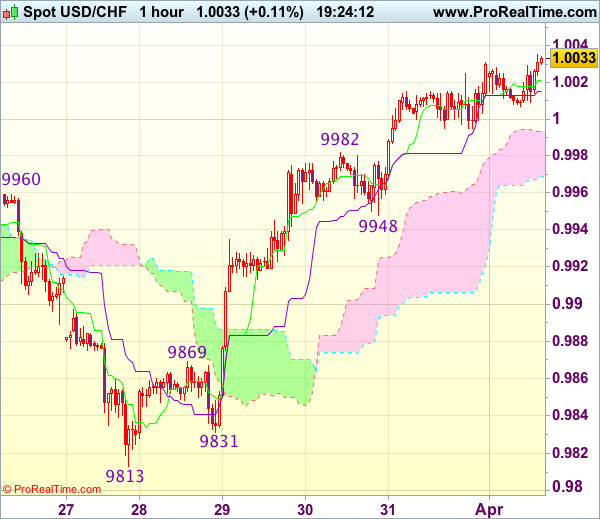
As the greenback has continued trading with a firm undertone, suggesting recent rise from last week’s low at 0.9813 is still in progress and bullishness remains for this move to extend gain to previous support at 1.0060 (now resistance), however, loss of upward momentum should prevent sharp move beyond resistance at 1.0109, risk from there has increased for a retreat to take place later.
In view of this, would not chase this rise here and would be prudent to buy dollar on pullback as said support at 0.9948 should limit downside. Below 0.9931 (50% Fibonacci retracement of 0.9831-1.0031) would abort and signal top is formed instead, bring correction to 0.9905-10 (61.8% Fibonacci retracement) but reckon previous resistance at 0.9869 would hold from here.
Trade Idea Update: GBP/USD – Stand aside
GBP/USD - 1.2505
New strategy :
Stand aside
Position : -
Target : -
Stop : -
As cable found good support at 1.2433 on Friday and staged another strong rebound on active cross-trading in sterling, suggesting the erratic rise from 1.2377 (last week’s low) is still in progress and may extend gain towards 1.2570-75, however, as broad outlook remains consolidative, reckon upside would be limited to 1.2595-00 and price should falter below last week’s high at 1.2616, bring retreat later.
In view of this, would not chase this rise here and would be prudent to stand aside in the meantime. Below 1.2480 would bring weakness to the upper Kumo (now at 1.2469) but said support at 1.2433 should remain intact. Only a drop below 1.2433 support would revive bearishness and suggest the rebound from 1.2377 has ended, bring weakness to 1.2400, break there would confirm and retest of 1.2377 would follow.

Stocks and Dollar Starting Q2 on a Positive Note
Monday April 3: Five things the markets are talking about
Global stocks and the "mighty" dollar are starting Q2 on a positive note despite investor caution ahead of the first "superpower" meeting between U.S President Trump and China's Xi Jinping (April 6-7).
To investors, the markets "reflation" trade remains a concern, especially now that President Trump's failed to push through his healthcare act in March. Can Trump get support for his anticipated tax cuts and infrastructure spending bills?
In Europe, the market focus will be on the French Presidential election. Will Marine Le Pen and her ideologies have an influence on government yields and the single unit, or will Macron squash her beliefs in round two?
On the data front this week is a busy week for central banks. The Reserve Bank of India (RBI) and the Reserve Bank of Australia (RBA) announce their respective rate decisions (Tues). The Federal Open Market Committee (FOMC) publishes their minutes (Wed) from its most recent meeting where they increased the fed funds rate by +25 bps.
Elsewhere, manufacturing, services and composite PMI's will be released globally. On Friday, Canada delivers its March labor market survey while the U.S announces its latest non-farm payroll (NFP) report.
1. Global stocks start Q2 on firmer footing
Q1 was the best quarter for global equities in four-years.
In Japan overnight, stocks prices rebounded after the BoJ 'Tankan' report showed an improving outlook among their countries' largest firms. The Nikkei's gained +0.4%, while the broader Topix added +0.3%.
Note: Business sentiment improved for a second straight quarter to an 18-month high in March, but was slightly lower than market expectations.
In Hong Kong, stocks rallied led by infrastructure plays on the news that China will set up an economic zone. The benchmark Hang Seng index, which fell on Thursday and Friday, gained +0.6%, while the HK China Enterprises Index edged up +0.4%.
Elsewhere, South Korea's Kospi and Singapore's Straits Times Index were each up +0.3%, while Jakarta's Composite climbed +0.6%.
In Europe, ahead of the U.S open, the Eurostoxx has climbed +0.2% in early trade after increasing +5.5% in Q1, the best quarter in two-years.
U.S stocks are set to open in the red (-0.2%).
Indices: Stoxx50 flat at 3,499, FTSE flat at 7,320, DAX +0.2% at 12,341, CAC-40 -0.1% at 5,116, IBEX-35 -0.3% at 10,431, FTSE MIB -0.2% at 20,459, SMI +0.2% at 8,671, S&P 500 Futures -0.2%
2. Oil prices nudge higher on upbeat economic sentiment
Oil prices start the week in the black as upbeat sentiment about economic prospects in Asia and Europe outweighed concerns a higher U.S. rig count strengthened worries about global oversupply.
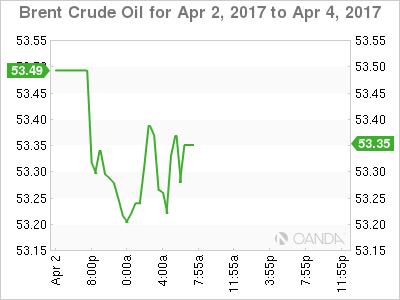
Brent futures are up +3c, or +0.1% to +$53.56 a barrel, while U.S West Texas Intermediate (WTI) crude futures climbed +10c, or +0.2% to $50.70 a barrel after settling +25c higher on Friday.
Note: Brent and U.S crude posted their worst quarterly loss in two-years in Q1. U.S futures fell -6%, while Brent lost -7% as rising inventory levels outpaced output cuts by OPEC and non-OPEC members.
Crude prices rallied last week amid expectations that OPEC would extend production cuts beyond June. However, prices were capped after energy services firm Baker Hughes said the U.S rig count increased by 10 to 662 last week, making the first quarter the strongest for oil rig additions since mid-2011.
The market continues to look for additional indicators for overall direction.
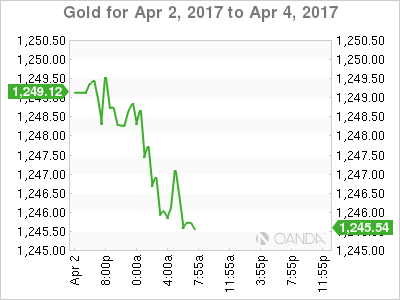
Gold prices have started the week on the back foot (-0.2% to +$1,246.84 per ounce), pressured by a stronger dollar and investor profit taking.
Note: The 'yellow' metal has been stuck between +$1,238-$1,260 with the risk skewed to downside based on rising expected interest rates and failure to break higher.
3. Eurozone periphery yields spike
Government bond yields in the euro zone's lower-rated countries (Spain, Italy and Portugal) have backed up this morning and are underperforming their peers as a reduction in the ECB bond purchase program takes effect.
April marks the beginning of the scaling back of the ECB's bond buying purchases from +€80B to +€60B per month until the program ends in Dec.
Note: Various ECB speakers noted last week that this process not any signaling the start of tapering as it had the option to be more expansionary if needed.
The yield gap between Portugal's 10-year bond and the German Bund have hit a four-week high of +368 bps, up +4 bps.
Note: French and peripheral bond yields have risen in recent months on the outside chance that far-right leader Marine Le Pen would win Franc's Presidential race and push for a French exit from the E.U.
The yield on U.S 10's has backed up +1 bps to +2.40%, after dropping -3 bps on Friday.
4. Dollar finds support
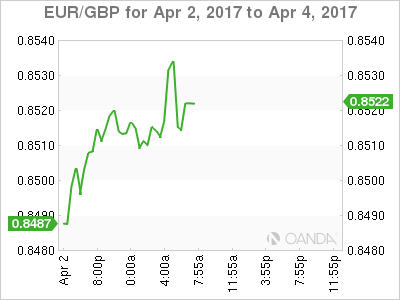
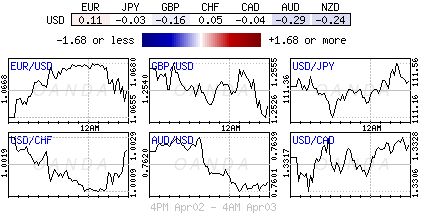
Ahead of the U.S open, the pound (£1.2508, down -0.37%) continues to experience volatility, as the pair has given back roughly half of last Friday's gain, as selling has taken place following the release of U.K PMI data (54.4 from a revised 54.5 in Feb.) The reading for March was below consensus expectations of 54.6 and the lowest reading for four-months.
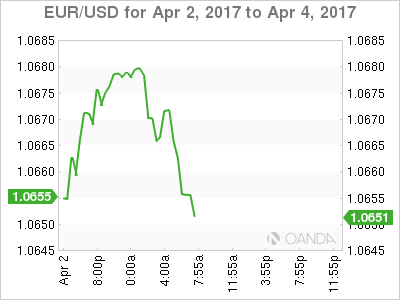
The EUR (€1.0656) is little changed despite stable industrial prices in the region and a stronger unemployment print (+9.5% vs. +9.6%). The yen fell -0.1% to ¥111.47, while the AUD lost -0.3%. The KRW rose +0.3%, building on its more than +7% advance in the Q1.
5. Global data shows mixed results
Reports this morning showed that German manufacturing growth reached a six-year high in March (PMI 58.3). Along with a stronger France and Italian headline print, adds to signs of a pickup in momentum in the region and the global economy.
On the weekend, a private survey on China's manufacturing came in below market expectations (51.2 vs. 51.7), but still showed a healthy expansion after a similar survey by the government last Friday pointed to strong growth in the sector.
In Japan, the Bank of Japan's "tankan" survey showed that business sentiment improved, albeit slightly less than expected (12 vs. 14). Down-under, Aussie retail sales disappointed (-0.1% v +0.3% e).
Trade Idea Update: EUR/USD – Sell at 1.0740
EUR/USD - 1.0655
Original strategy :
Sell at 1.0740, Target: 1.0625, Stop: 1.0775
Position : -
Target : -
Stop : -
New strategy :
Sell at 1.0740, Target: 1.0625, Stop: 1.0775
Position : -
Target : -
Stop : -
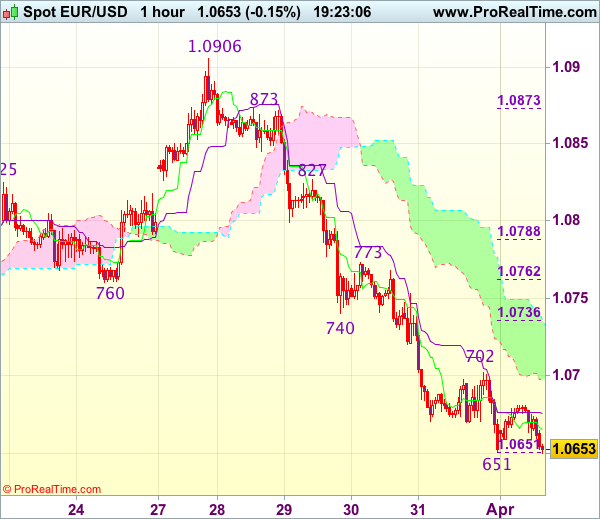
As the single currency has remained under pressure after last week’s selloff, suggesting the decline from 1.0906 top is still in progress and bearishness remains for this fall to extend further weakness to 1.0620-25, then test of previous chart support at 1.0600, however, a sustained breach below the latter level is needed to retain downside bias for subsequent selloff to 1.0570-75 first, otherwise, risk from there is seen for a rebound later.
In view of this, would not chase this fall here and would be prudent to sell dollar on recovery as 1.0735-40 should limit upside. Only a firm break above resistance at 1.0773 would suggest low is formed instead, bring a stronger rebound to 1.0800 but resistance at 1.0827 should remain intact.
Trade Idea Update: USD/JPY – Stand aside
USD/JPY - 111.44
New strategy :
Stand aside
Position : -
Target : -
Stop : -
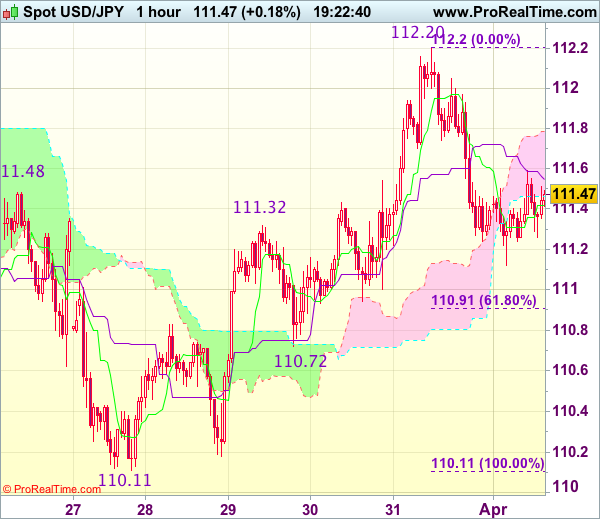
Dollar’s retreat after last week’s strong rebound to 112.20 suggests top has possibly been formed there and consolidation with mild downside bias is seen for weakness to 110.91-94 (61.8% Fibonacci retracement of 110.11-112.20 and previous support), however, break there is needed to add credence to this view, bring further fall to support at 110.72, once this level is penetrated, this would signal the rebound from 110.11 has ended and further decline to 110.50 would follow.
In view of this, would not chase this fall here and would be prudent to stand aside in the meantime. Above 111.75-80 would bring recovery to 112.00-05 but price should falter below resistance at 112.20, bring further consolidation. Only break of 112.20 would revive bullishness and extend the rise from 110.11 low to 112.50-55 but price should falter below previous resistance at 112.87-90, bring retreat later.
DAX Steady On Solid German, Eurozone Manufacturing PMIs
The DAX Index has edged lower in the Monday session, as the DAX trades at 12,366.50. On the release front, it's a very busy start to the week. German and Eurozone Manufacturing PMIs continue to point to expansion. Both indexes improved in March, with readings of 58.3 and 56.3, respectively. Elsewhere in the eurozone, PPI came in at 0.2%, above the forecast of 0.0%. The unemployment rate edged lower to 9.5%, matching the forecast.
It was an impressive week for the DAX, which jumped 3.0 percent. Earlier on Friday, the DAX pushed above 12,300, its highest level since April 2015. The index has been boosted by strong German numbers across the German economy, as business confidence, retail sales and unemployment claims all beat their estimates last week. The German economy, the largest in Europe, is looking sharp and has enjoyed a robust first quarter in 2017. Stronger global trade has led to increased demand for German exports, notably cars and machinery. Germany's GDP expanded 1.6% in 2016, its highest rate since 2012. The generally positive picture in Germany has boosted the eurozone economy and if the strong numbers continue, the ECB will be under more pressure to tighten monetary policy.
It's been a turbulent start to Donald Trump's presidency. The battles with the media continue, an economic policy remains a mystery, and Trump suffered a major setback has he couldn't even muster a vote over his healthcare bill. Despite these hiccups, the US economy hasn't missed a beat in 2017. The CB consumer confidence report soared to 125.6 in March, and strong consumer confidence levels should translate into increased consumer spending. GDP for the fourth quarter was revised to 2.1%, up from 1.9% in the previous GDP report. This points to strong growth for the economy, as the discussions around the monetary policy tables are not whether the Fed will raise rates, but will it press the rate trigger twice or three times in 2017. The Fed will release the minutes of its March meeting on Wednesday, and the markets will be looking for clues as to the timing of a possible rate hike.
EUR/USD – Unchanged As Eurozone Manufacturing PMIs Meet Forecasts
EUR/USD is showing little movement in the Monday session. Currently, the pair is trading at 1.0670. It's a very busy start to the week, with a host of manufacturing releases out of the eurozone and the US. German Manufacturing PMI improved to 58.3, while Eurozone Manufacturing PMI rose to 56.2 points. In the US, today's highlight is ISM Manufacturing PMI, which is expected to dip to 57.2 points. We'll also hear from two FOMC members – Esther Dudley and Patrick Harker.
The euro has steadied on Monday, following a weak performance last week. EUR/USD dropped 1.9 percent, marking its worst weekly decline since November 2016. Soft inflation numbers in the eurozone disappointed the markets and soured sentiment on the continental currency. German Preliminary CPI posted a weak gain of 0.2%, short of the forecast of 0.4%. This was followed by Eurozone Flash CPI Estimate, which slipped to 1.5%, missing the forecast of 1.8%. At the same time, German employment and retail sales data beat expectations, as the German economy continues to expand at a healthy clip in 2017.
Donald Trump's presidency has been anything but smooth. The battles with the media continue, an economic policy remains a mystery, and Trump suffered a major setback has he couldn't even muster a vote over his healthcare bill. Despite these hiccups, the US economy hasn't missed a beat in 2017. The CB consumer confidence report soared to 125.6 in March, and strong consumer confidence levels should translate into increased consumer spending. GDP for the fourth quarter was revised to 2.1%, up from 1.9% in the previous GDP report. This points to strong growth for the economy, as the discussions around the monetary policy tables are not whether the Fed will raise rates, but will it press the rate trigger twice or three times in 2017. The Fed will release the minutes of its March meeting on Wednesday, and the markets will be looking for clues as to the timing of a possible rate hike.
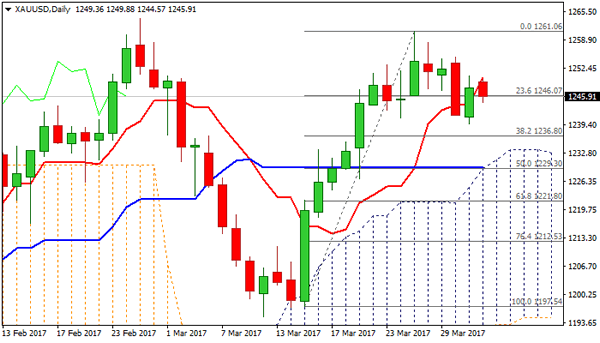
Technical Outlook: Spot Gold May Extend Consolidation Between $1239/50 Before Bulls Resume
Bounce from last Friday's correction low at $1239 provided temporary relief as risk of retesting key near-term supports at $1236/33 (Fibo 38.2% of $1197/$1261 rally / daily cloud top) has eased.
However, recovery attempts were so far capped at $1250 zone, where rising daily Tenkan-sen lies today, suggesting extended consolidation.
Spot Gold may retest $1239 support, before bulls resume, with close above $1247 (Fibo 38.2% of $1261/$1239 pullback) required for stronger bullish signal.
Extension above $1250 /52 pivots (recovery top / Fibo 61.8%) is needed to confirm bullish continuation and re-expose key barriers at $1259 (200SMA) and 1261/63 (peaks of 27 Mar and 27 Feb).
Thick daily cloud continues to underpin (currently spanned between $1191 and $1233) and only firm break into the cloud and violation of next pivot at $1229 (daily Kijun-sen) would risk stronger downside action from $1261/63 double-top.
Res: 1250, 1252, 1255, 1259
Sup: 1244, 1239, 1236, 1233
GOLD Starting A New Leg Lower, SILVER Further Consolidation, Crude Oil Back Above $50.
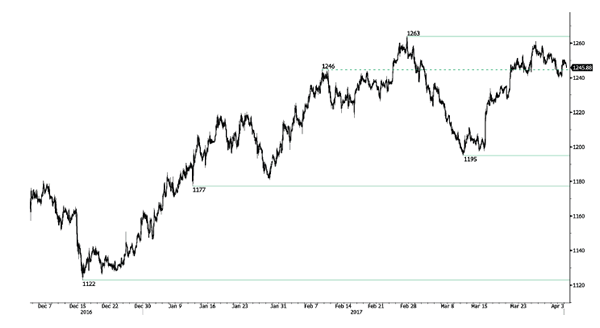
GOLD Starting a new leg lower.
Gold is getting stronger. The momentum seems back to bullish despite some consolidation. Strong resistance is located at 1263 (27/02/2017 high). Hourly support can be found at 1224.10 (16/03/2017 low).
In the long-term, the technical structure suggests that there is a growing upside momentum. A break of 1392 (17/03/2014) is necessary ton confirm it, A major support can be found at 1045 (05/02/2010 low).
SILVER Further consolidation.
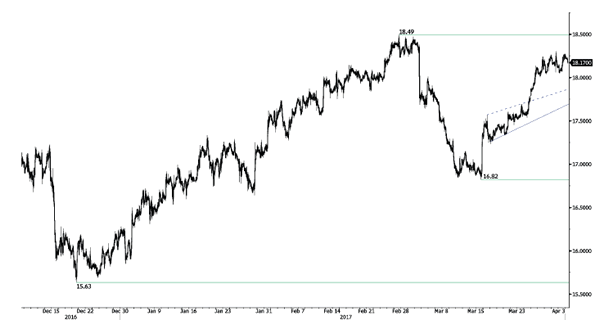
Silver has increased above 18.00 which is now a support. Strong resistance is given at a distance at 18.49 (27/02/2017 high). Key support is given at 16.82 (15/03/2017 low).
In the long-term, the death cross indicates that further downsides are very likely. Resistance is located at 25.11 (28/08/2013 high). Strong support can be found at 11.75 (20/04/2009).
Crude Oil Back above $50.
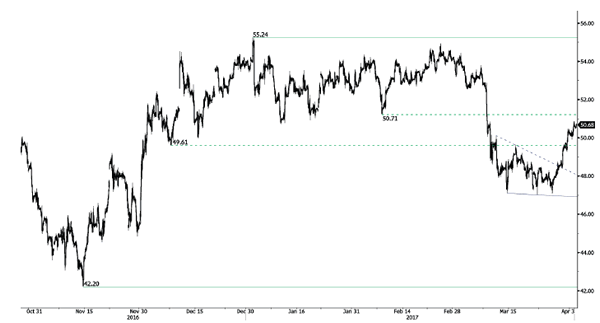
Crude oil's bearish pressures seems to fade. The commodity had been located in a bearish trend since the commodity had been unable to mount a serious challenge to resistance at 55.24 (03/01/2017 high). Hourly support is given at 47.09 (016/03/2017 low).
In the long-term, crude oil has recovered after its sharp decline last year. However, we consider that further weakness are very likely. Strong support lies at 24.82 (13/11/2002) while resistance can now be found at 55.24 (03/01/2017 high).