Sample Category Title
September CPI: Minor Turbulence
Summary
The September CPI report came in slightly hotter than expected, but not enough to meaningfully change the outlook for U.S. inflation. Headline CPI rose 0.2% in the month, while excluding food and energy prices consumer price inflation was a tenth stronger at 0.3%. A 4.1% drop in gasoline prices helped restrain overall inflation, although a 0.4% rise in grocery store prices served as a partial offset to the respite at the pump. Core goods prices rose 0.2%, ending a six-month streak of goods deflation. Higher prices for new and used vehicles as well as apparel were the culprits for the increase in core goods prices. On the services side, slower inflation for shelter costs in September was offset by a jump in prices for airfares, motor vehicle insurance and medical care.
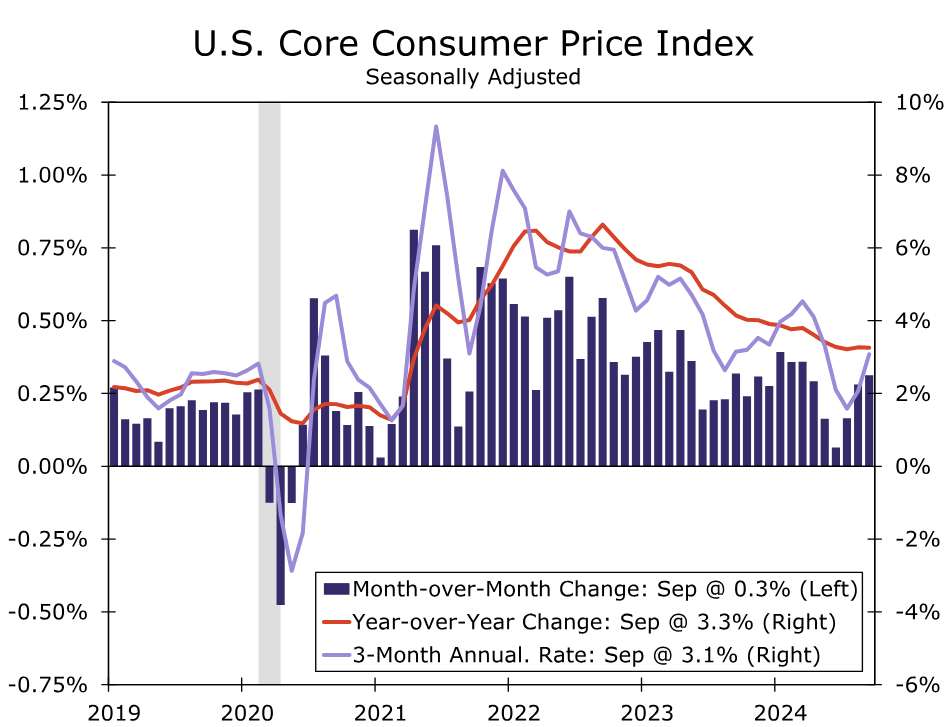
Today's data bring the year-ago change in the core CPI to 3.3%, with prices over the past three months increasing at a 3.1% annualized rate. For context, core CPI inflation averaged 2.2% in 2019, suggesting that the underlying pace of inflation at present is about one percentage point above what prevailed before the pandemic. Looking ahead, we expect the disinflation trend to continue, albeit gradually rather than sharply. The ongoing cooling in the labor market and lagging service sector components should help reduce core inflation a bit further in the months ahead. As a result, we expect the FOMC to continue normalizing monetary policy. We still anticipate two 25 bps rate cuts from the Federal Reserve at the two remaining FOMC meetings of the year.
Inflation Still Cooling on Trend
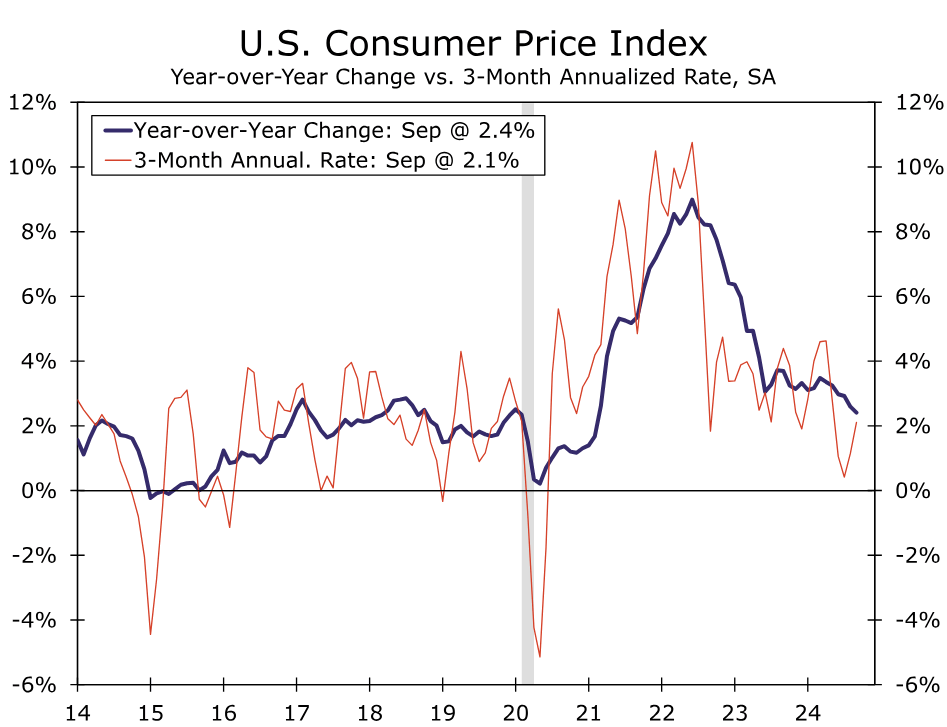
The bumpy ride to slower inflation continued in September. Overall consumer prices rose 0.2%, which was a tick higher than the Bloomberg consensus. Despite the somewhat larger-than-expected outturn, prices over the past year are up 2.4%, which marks the lowest one-year change in consumer prices since February 2021.
Consumers received some respite at the pump in September, with gasoline prices falling 4.1% last month. However, grocery store prices picked up sharply, increasing 0.4%. This was the largest monthly gain in nearly two years and was driven by a jump in egg prices (+8.4%) and the relatively volatile food component of fruits & vegetables (+0.9%). Even with September's jump, prices for food at home have risen 1.3% over the past year, down from a 12-month pace of 2.4% this time last year and a recent peak of 14% in the summer of 2022.
Excluding food and energy prices, core CPI came in at 0.3% (0.31% unrounded). This was modestly higher than we expected. Core goods prices rose 0.2% in the month, halting a six-month streak of deflation for prices in the goods sector. Small increases for prices of new and used vehicles contributed to the move higher, as did a 1.1% increase in apparel prices. Lower prices for medical care goods and recreation goods helped keep the increase in core goods prices in check.
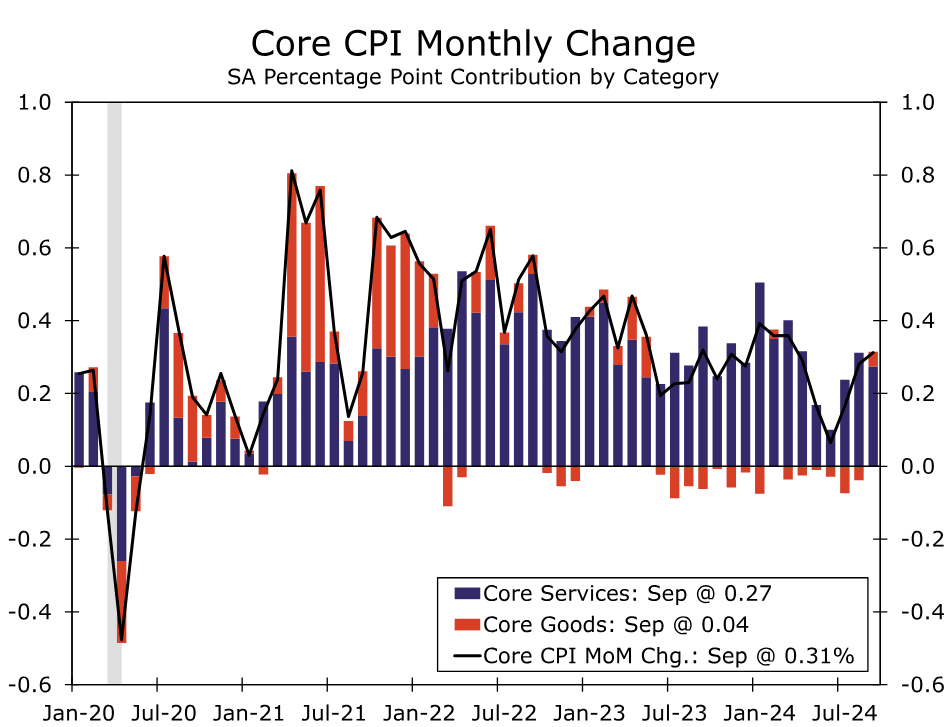
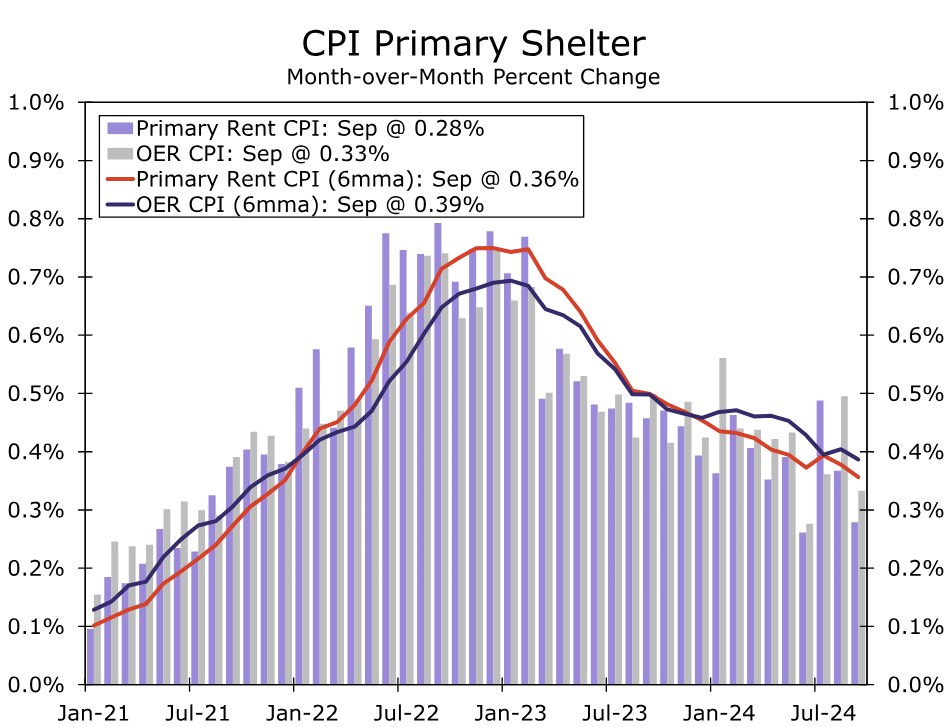
Core services inflation was 0.4% in September (0.36% unrounded), a modest cooldown from the 0.41% pace registered in August. The drivers of services inflation in September were much different from what took place the prior month. Owners' equivalent rent came in at 0.3% in September, reversing the puzzlingly-strong 0.5% reading in August. Rents rose 0.3%, a tenth slower than September. However, outside primary shelter, services inflation jumped on the back of higher prices for airfares (+3.2%), motor vehicle insurance (+1.2%) and medical care services (+0.7%). Looking through the month-to-month noise, the underlying trend in core services inflation in recent months seems to have been between 0.3% and 0.4%, about a tenth or so stronger than the monthly pace that prevailed before the pandemic. Overall core CPI inflation has risen at a 3.1% annualized pace over the past three months, slightly below the year-ago pace (+3.3%) and about a percentage point faster than core CPI inflation in 2019.
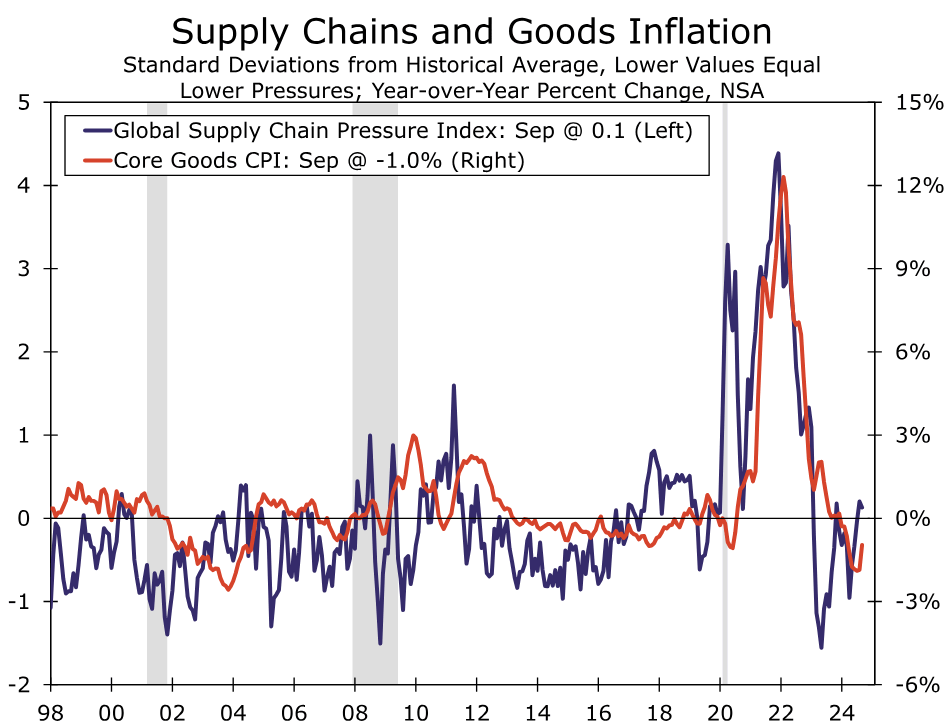
The September CPI report is consistent with our view that, while the overall trend in core inflation remains lower, further improvement is likely to be slower-going. The deflationary impulse to goods prices has waned with supply chain pressures no longer receding and inventories largely replenished. The downdraft to overall inflation from food and energy also has weakened, with the risks to energy costs for the time-being seeming to lie to the upside. However, we look for services inflation to continue to slow as housing inflation eases further and service providers benefit from tamer input cost growth for goods and labor.
While the next leg lower in inflation may take more time, the good news is that with the jobs market remaining in good shape and solid growth in productivity, average hourly earnings growth, up 4.0% over the past year, continues to outpace inflation. Thus, we do not see slower improvement on the inflation front as an impediment to real spending and output.
While today's inflation report may make some of the more hawkish members of the FOMC somewhat more reluctant to ease monetary policy further at the Committee's next meeting on November 7, we do not believe it is strong enough to warrant a pause. With inflation continuing to slow on trend and upward pressure on prices dissipating amid a cooler labor market and encouraging trends in productivity, there is still likely scope in the near term for policy to "recalibrate" further.
AUD/USD Stabilises Near Monthly Low Amid Mixed Signals
The AUD/USD pair has halted its nearly continuous seven-day decline, stabilising around 0.6730 on Thursday. This level marks the monthly low for the Australian dollar, which has faced significant pressures lately due to a strengthening US dollar and uncertainties in China, Australia's largest trading partner.
Market influences and economic indicators
The recent US jobs report and the Federal Reserve's latest meeting minutes have led investors to reassess their expectations for future US rate cuts, affecting the currency pair. Additionally, no new stimulus measures have been announced in China, impacting sentiment, given that earlier stimulative actions are still not fully reflected in the economic performance.
In Australia, inflation expectations have decreased to a three-year low of 4% in October, providing a somewhat positive signal. However, the minutes from the Reserve Bank of Australia's (RBA) latest meeting revealed discussions around both potential rate cuts and hikes, reflecting ongoing uncertainty about the economic outlook. The RBA concluded that the current interest rate appropriately balances the risks associated with inflation and labour market conditions.
AUD/USD technical analysis
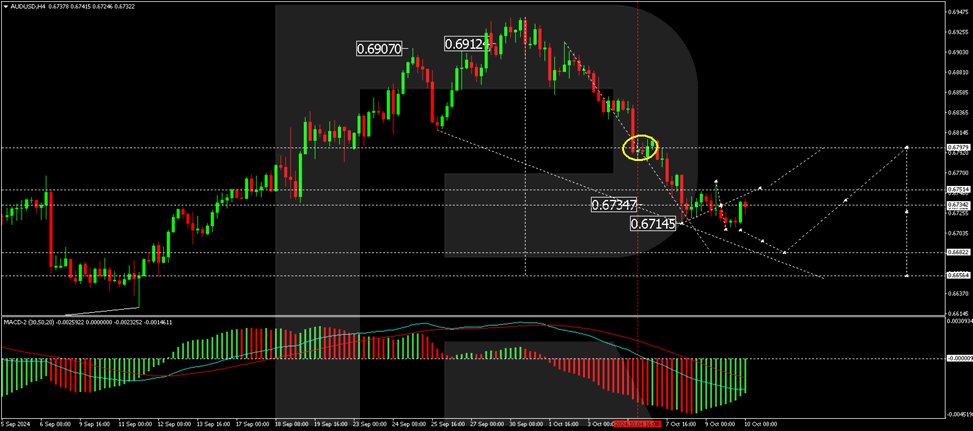
The AUD/USD pair recently completed a downward wave to 0.6707 and is now forming a consolidation range above this level. If the pair breaks downwards, it could target a further decline to 0.6682. Conversely, an upward break might lead to a corrective move towards 0.6796. After this correction, the downward trend could continue towards 0.6655. The MACD indicator supports a bearish outlook, with its signal line positioned below zero and trending downwards.
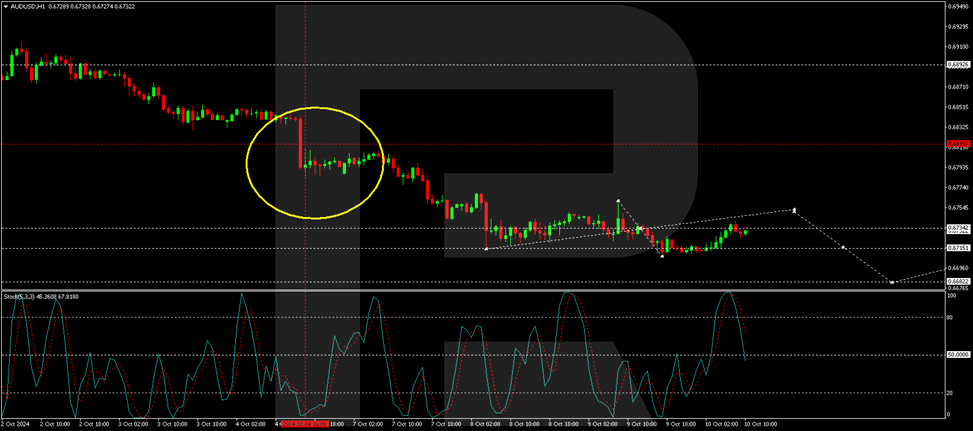
On the hourly chart, the pair is consolidating around 0.6734. An upward breakout could lead to a rise towards 0.6815. Following this, a new downward phase could begin, potentially reaching 0.6710. If this level is breached, the decline could extend towards 0.6682. The Stochastic oscillator, with its signal line below 80 and poised to move downwards, aligns with this potential downward trajectory.
Conclusion
Investors and traders should closely monitor further developments from both the Federal Reserve and the RBA, as well as any new economic data from China, which could significantly influence the direction of the AUD/USD pair. The complex interplay of US monetary policy expectations, Chinese economic actions, and domestic Australian economic indicators will likely continue to drive volatility in the currency pair.
EUR/USD Mid-Day Outlook
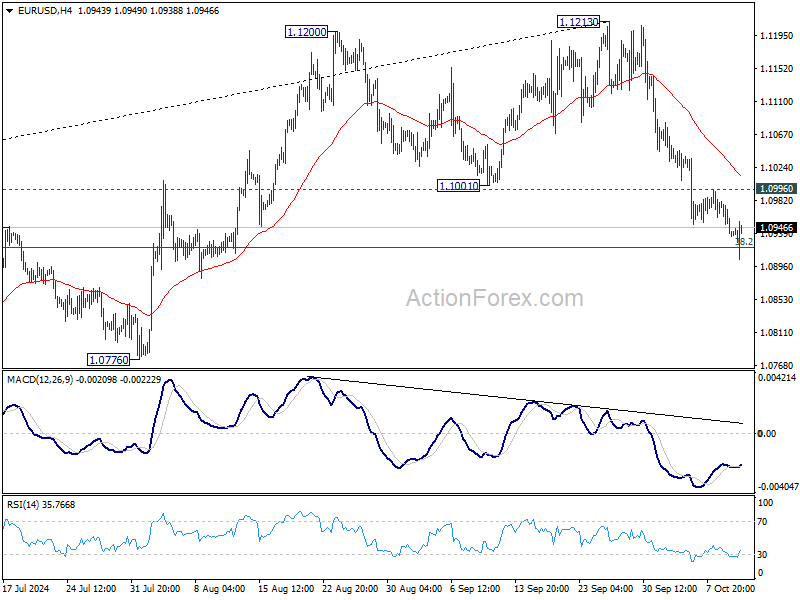
Daily Pivots: (S1) 1.0920; (P) 1.0956; (R1) 1.0975; More....
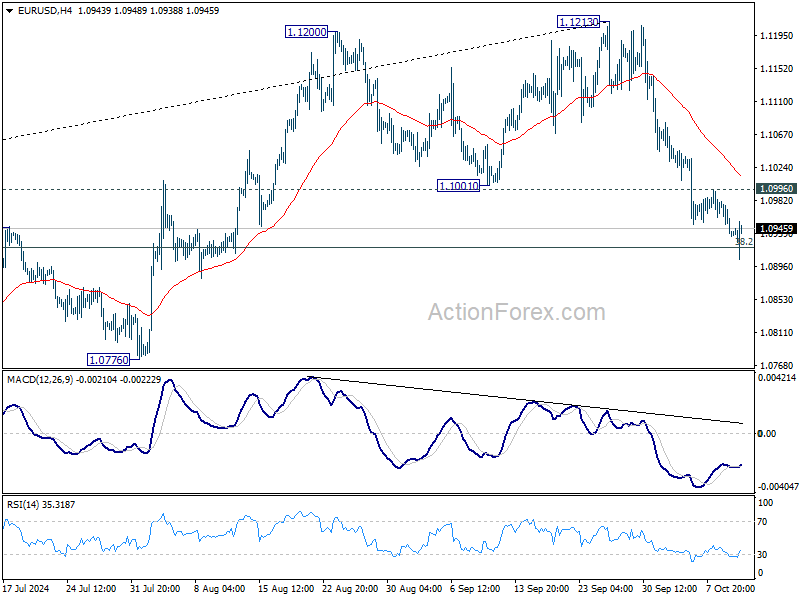
Intraday bias in EUR/USD stays on the downside for the moment. Sustained break of 38.2% retracement of 1.0447 to 1.1213 at 1.0920 will argue that fall from 1.1213 is the third leg of the corrective pattern from 1.1274. In this case, deeper decline would be seen to 61.8% retracement at 1.0740 next. On the upside, above 1.0996 minor resistance will turn intraday bias neutral again first.
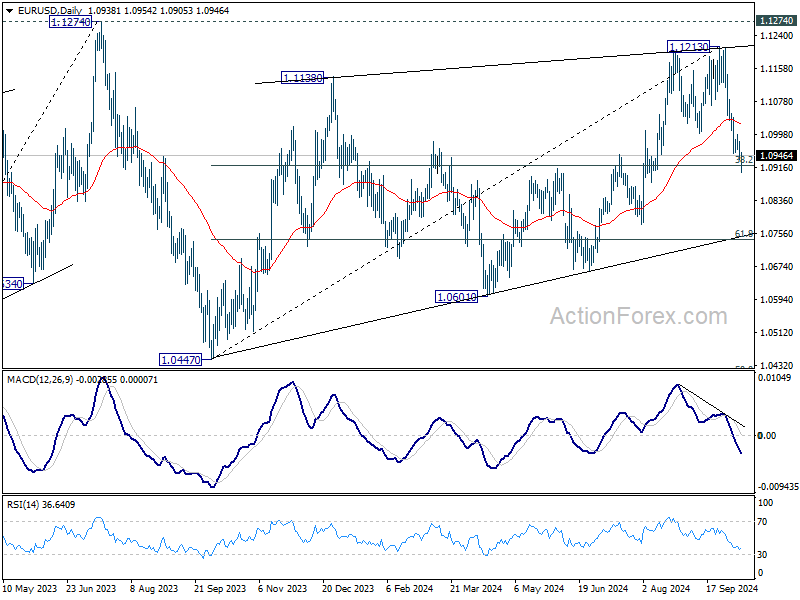
In the bigger picture, rejection by 1.1274 resistance suggests that corrective pattern from 1.1274 (2023 high) is not completed yet. Instead, decline from 1.1213 might be another falling leg. Sustained break of 55 W EMA (now at 1.0877) will validate this case, and bring deeper fall towards 1.0447 support again.
GBP/USD Mid-Day Outlook
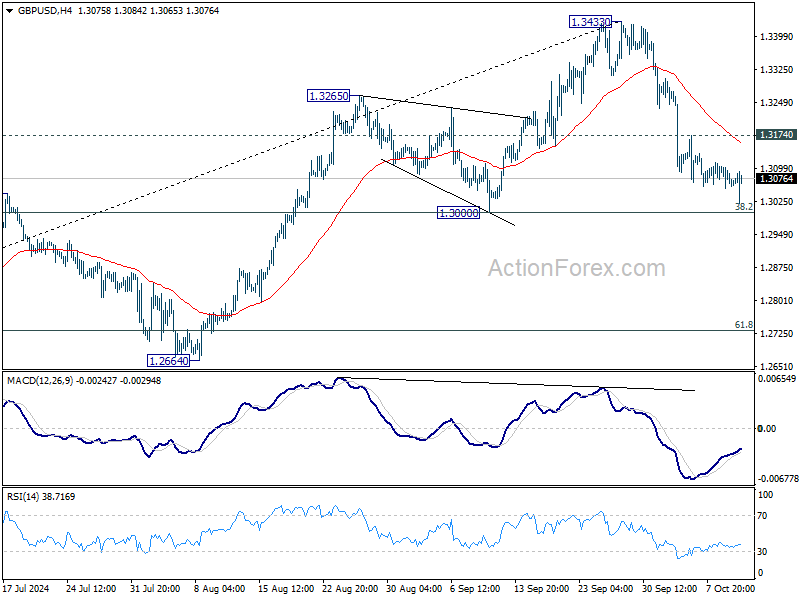
Daily Pivots: (S1) 1.3049; (P) 1.3081; (R1) 1.3107; More...
Outlook in GBP/USD is unchanged and intraday bias stays neutral. While corrective fall from 1.3433 might extend lower, strong support should be seen from 1.3000 cluster support (38.2% retracement of 1.2298 to 1.3433 at 1.2999) to contained downside. Above 1.3174 minor resistance will turn bias back to the upside for stronger rebound. However, decisive break of 1.3000 will carry larger bearish implications.
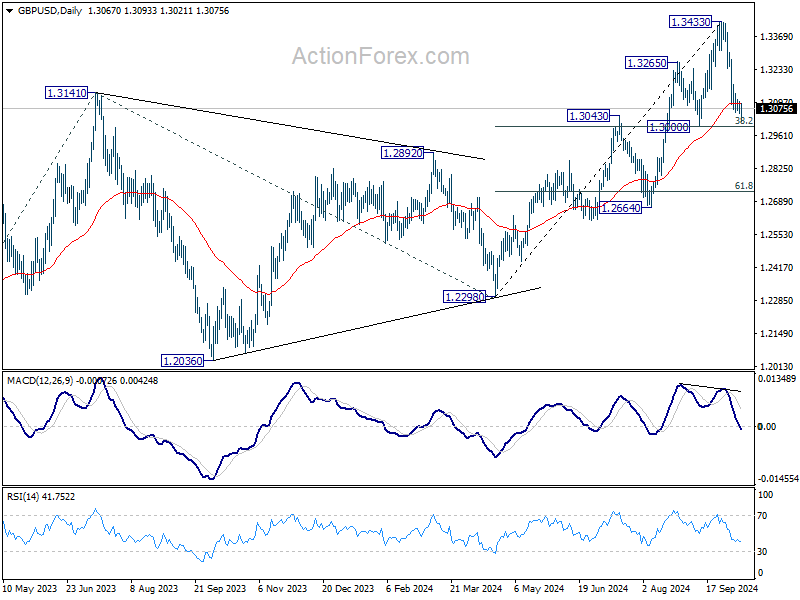
In the bigger picture, as long as 1.3000 support holds, the up trend from 1.0351 (2022 low) is still in progress. Next target is 61.8% projection of 1.0351 to 1.3141 from 1.2298 at 1.4022. However, considering mild bearish divergence condition in D MACD, decisive break of 1.3000 will argue that a medium term top is already in place, and bring deeper fall back to 1.2664 support next.
USD/CHF Mid-Day Outlook
Daily Pivots: (S1) 0.8579; (P) 0.8594; (R1) 0.8624; More…
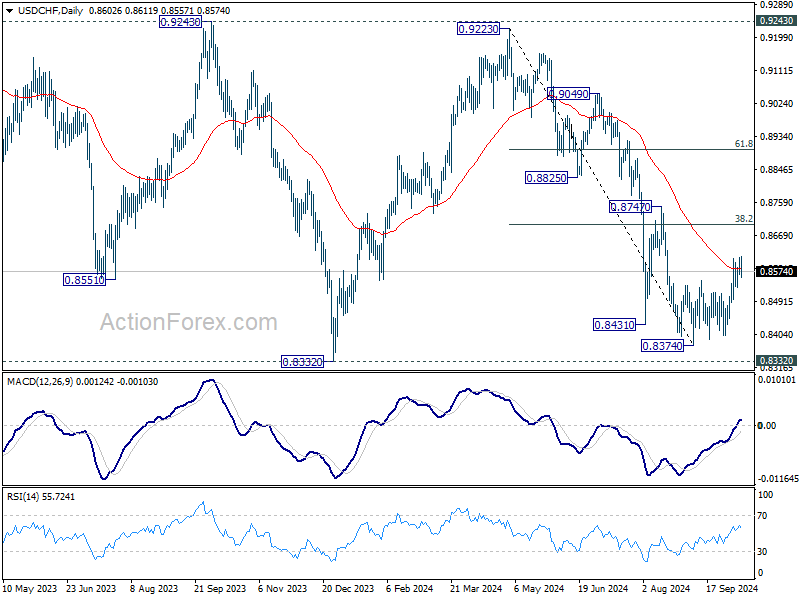
Intraday bias in USD/CHF remains mildly on the upside with 0.8529 minor support intact. Rebound from 0.8374 is in progress for 38.2% retracement of 0.9223 to 0.8374 at 0.8698. Sustained break there will argue that fall from 0.9223 has completed after defending 0.8332 low. Next target will be 61.8% retracement at 0.8899. On the downside, below 0.8529 minor support will turn intraday bias neutral again first.
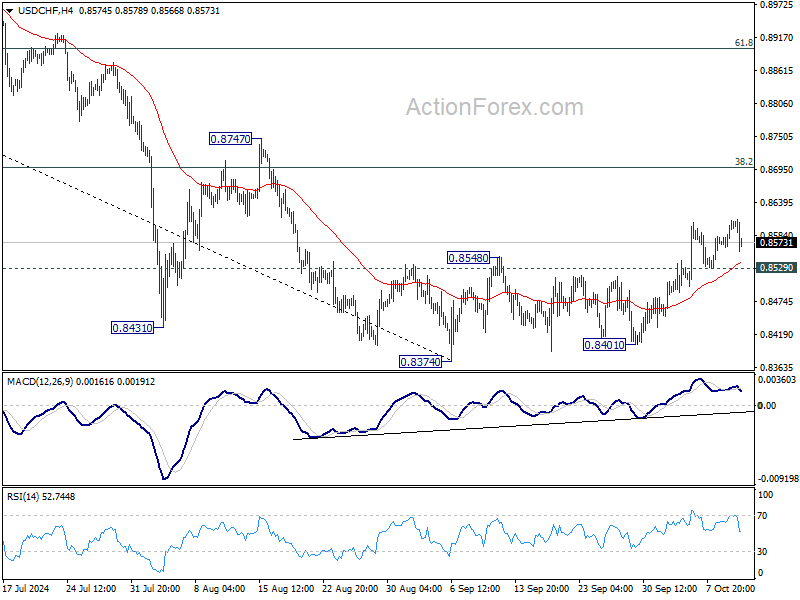
In the bigger picture, price actions from 0.8332 (2023 low) are currently seen as a medium term corrective pattern, with fall from 0.9223 as the second leg. Strong support could be seen from 0.8332 to bring rebound. Yet, overall outlook will continue to stay bearish as long as 0.9243 resistance holds. Firm break of 0.8332, however, will resume larger down trend from 1.0146 (2022 high).
US: Progress on Inflation Front Stalls in September, Supporting Smaller 25bps Cut in Nov
The Consumer Price Index (CPI) rose 0.2% month-on-month (m/m) in September, a tenth of a percentage point (pp) above the consensus forecast. On a twelve-month basis, CPI fell to 2.4% (from 2.5% in August).
- Energy prices (-1.9% m/m) were again a drag on headline inflation, almost entirely driven by a pullback in gasoline prices (-4.0% m/m). Conversely, food prices sharply accelerated last month, rising 0.4% m/m – its strongest monthly gain since January.
Excluding food and energy, core prices rose 0.3% m/m, as it did the preceding month. The twelve-month change ticked up 0.1pp to 3.3%, while the three-month annualized rate rose to 3.1% (from 2.1% in August).
Price growth on core services rose a "soft" 0.4% m/m (0.38% m/m unrounded), in line with August's gain.
- Primary shelter costs were up 0.3% m/m, following a gain of 0.5% m/m in August. The deceleration was driven by a slowing in both Owners' Equivalent Rent (to 0.4% m/m from an outsized gain of 0.5% m/m in August) and Rent of Primary Residence (0.3% from 0.4% m/m). Over the last twelve months, primary shelter costs are up 5.1%, well off their 2023 highs of over 8% but still a few percentage points above the pre-pandemic pace of growth when inflation was running closer to 2%.
- Non-housing services inflation (aka "supercore") rose by 0.4% m/m, also matching last month's gain. The continued strength was primarily driven by another strong advance in vehicle insurance (+1.2% m/m), airline fares (+3.2% m/m) and medical costs (+0.7% m/m).
Core goods prices ticked higher by 0.2% m/m, with higher apparel (+1.1% m/m) and new (+0.2% m/m) and used (+0.3% m/m) vehicle prices all contributing to September's uptick.
Key Implications
This morning's CPI report showed little progress on the inflation front in September. Even with some cooling in shelter costs, service prices remained elevated, while core goods added to overall inflationary pressures (a first in seven months), pushing the three-month annualized rate up to 3.1% – the firmest pace of price growth since May.
With progress on the inflation front stalling and last week's employment report still showing a relatively sturdy labor market, the Fed is likely to slow the pace of rate cuts next month and deliver two additional quarter-point cuts by year-end. While further cuts are in the pipeline for 2025, the Fed will remain data dependent as they continue to adjust the policy rate lower.
USD/JPY Mid-Day Outlook
Daily Pivots: (S1) 148.43; (P) 148.89; (R1) 149.78; More...
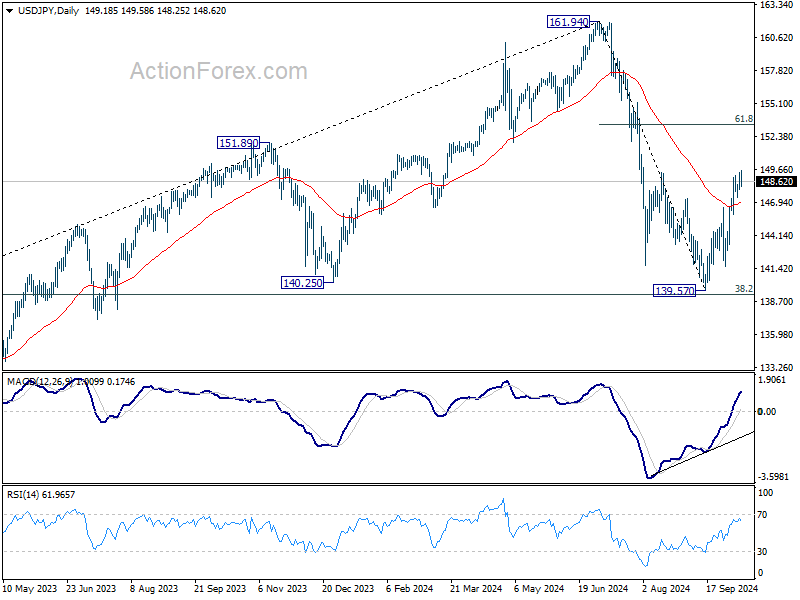
USD/JPY dips in early US session but stays above 147.33 minor support. Intraday bias stays on the upside, as rise from 139.57 short term bottom is still in progress. Current rally is seen as the second leg of the corrective pattern from 161.94. Next target is 61.8% retracement of 161.94 to 139.57 at 153.39. On the downside, below 147.33 minor support will turn intraday bias neutral again first.
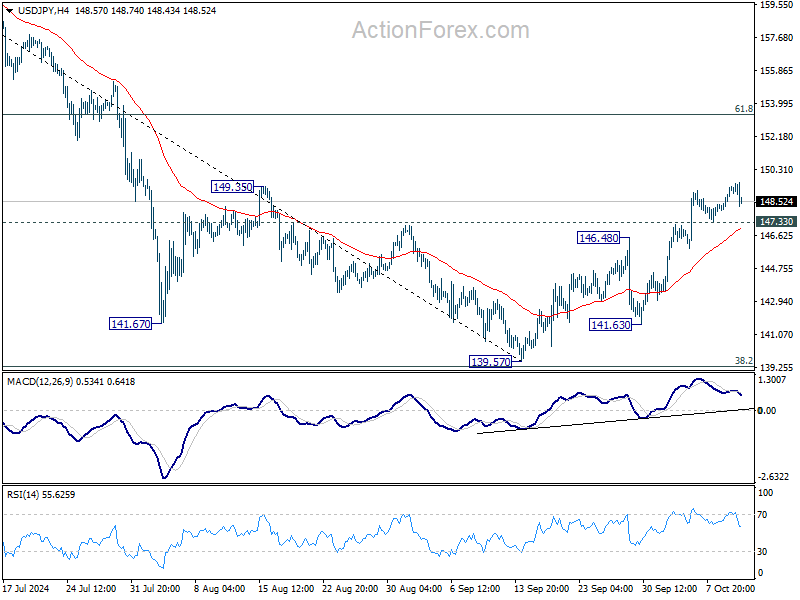
In the bigger picture, price actions from 161.94 are seen as a corrective pattern to rise from 102.58 (2021 low). The range of medium term consolidation should now be set between 38.2% retracement of 102.58 to 161.94 at 139.26 and 161.94. Nevertheless, sustained break of 139.26 would open up deeper medium term decline to 61.8% retracement at 125.25.
Dollar Struggles for Direction Amid Mixed Signals: Strong Inflation vs. Weak Jobs Data
Dollar is struggling to find a clear direction after a set of contrasting economic data sent mixed signals to the markets. On one side, inflationary pressures remain elevated, especially with core inflation ticking up, signals that Fed won't be able to accelerate its policy easing. On the other hand, the unexpectedly sharp rise in initial jobless claims has sparked concerns about amore severe slowdown in the employment market.
Market expectations for Fed remain largely unchanged, with Fed funds futures still pricing in over 80% probability of a 25 bps rate cut in both November and December. Beyond these two meetings, however, the future path of monetary easing looks even more uncertain now.
For the day, Japanese Yen leads in strength, supported by comments from a top BoJ official signaling that more rate hikes could still be on the table. Swiss Franc is the second strongest, followed by New Zealand Dollar. Conversely, Canadian Dollar is the weakest, trailed by Euro and British Pound, while Dollar and Australian Dollar are mixed in middle positions.
Looking at the broader picture for the week, Dollar continues to lead as the strongest currency, followed by Swiss Franc and Yen. Commodity currencies, including the New Zealand Dollar, Canadian Dollar, and Australian Dollar, remain under pressure. Euro and Sterling are in the middle of the pack.
Technically, as there is prospect of deeper retreat in Dollar, here are some levels to watch, including 1.0996 minor resistance in EUR/USD. 1.3174 minor resistance in GBP/USD, 0.8529 minor support in USD/CHF, and 147.33 minor support in USD/JPY. Dollar's near term rally would still be intact if these levels hold. But firm break of them, in particular if simultaneously, will indicate that Dollar selloff has returned.
In Europe, at the time of writing, FTSE is down -0.07%. DAX is down -0.07%. CAC is down -0.23%. UK 10-year yield is up 0.021 at 4.206. Germany 10-year yield is up 0.002 at 2.265. Earlier in Asia, Nikkei rose 0.26%. Hong Kong HSI rose 2.98%. China Shanghai SSE rose 1.32%. Singapore Strait Times fell -0.29%. Japan 10-year JGB yeld rose 0.0252 to 0.959.
US CPI slows to 2.4% yoy in Sep, but core CPI rises to 3.3% yoy
US CPI rose 0.2% mom in September, above expectation of 0.1% mom. CPI core (less food and energy) rose 0.3% mom, above expectation of 0.2% mom, and Shelter costs rose 0.2% mom. Food prices rose 0.4% mom. Together, these two indexes contributed over 75 percent of the monthly all items increase. Energy index fell -1.9% mom.
Over the 12-month period, CPI ticked down from 2.5% yoy to 2.4% yoy, above expectation of 2.3% yoy. That's still the lowest level since February 2021. CPI core ticked up from 3.2% yoy to 3.3% yoy, above expectation of 3.2% yoy. Energy index fell -6.8% yoy while food index rose 2.3% yoy.
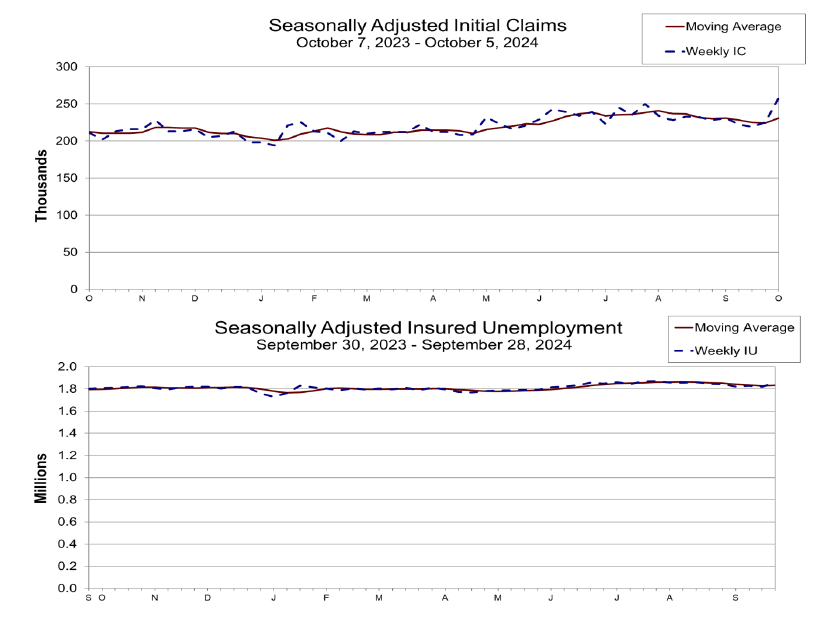
US initial jobless claims surges to 258k, highest since mid-2023
US initial jobless claims jumped sharply by 33k to 258k in the week ending October 5, well above expectation of 231k. That's also the highest level since mid-2023. Four-week moving average of initial claims rose 7k to 231k.
Continuing claims rose 42k to 1861k in the week ending September 28. Four-week moving average of continuing claims rose 4.5k to 1832k.
ECB Minutes: Caution on inflation as rate cuts expected to continue
Following the ECB's 25bps rate cut in September, the minutes reveal a cautious stance on future monetary easing, emphasizing the need to rely on a broader evaluation of data, rather than any single metric. While members agreed that further reductions in policy restrictiveness would depend on incoming data, they stressed that "data-dependence" should not be misinterpreted as "data point-dependence" , and mechanical response to short-term inflation figures.
The committee highlighted that a "gradual and cautious approach" remains appropriate, as uncertainties around inflation persist. Despite some signs of improvement, it is still too early to declare the inflation battle won. Concerns over upward revisions in core inflation projections and recent surprises in services inflation were also noted.
ECB emphasized that the "real test" of inflation stability would come in 2025, when the impact of wage growth and productivity gains would be clearer.
For now, markets expect another rate cut at the upcoming October meeting, with a follow-up move in December also largely anticipated.
BoJ's Himino: Rate hikes to continue if economic outlook aligns
BoJ Deputy Governor Ryozo Himino made it clear at a conference today that the central bank if the economic and price forecasts outlined in the July Outlook Report are realized, "the bank will accordingly continue to raise the policy interest rate and adjust the degree of monetary accommodation."
He emphasized that future decisions will be data-dependent, with each meeting assessing the evolving outlook, stating that the BoJ is “not on a preset course.”
Himino addressed the surprise and market disruption following BoJ’s unexpected rate hike in July, acknowledging that the central bank faced criticism for its communication approach.
He conceded, “There’s no silver bullet to improving communications,” but stressed the bank’s strong commitment to refining how it conveys policy decisions to the markets.
Japan's PPI rises 2.8% yoy in Sep, import prices tumble
Japan’s PPI rose by 2.8% yoy in September, a notable increase from the previous month’s 2.6% yoy and well above the market's expectation of 2.3% yoy.
A significant development was the shift in import prices. Yen-based import price index dropped sharply by -2.6% yoy, turning negative for the first time in eight months. This is a stark reversal from the 10.7% yoy rise recorded as recently as July. Export prices also followed a similar downward trend, falling by -1.0% yoy after previously rising by 2.5% yoy.
On a month-over-month basis, PPI remained flat at 0.0% mom, while yen-based import price index decreased by -2.9% mom, and the export price index fell by -1.7% mom. The decline in both import and export prices reflects a combination of softer global demand and a stronger Yen.
USD/JPY Mid-Day Outlook
Daily Pivots: (S1) 148.43; (P) 148.89; (R1) 149.78; More...
USD/JPY dips in early US session but stays above 147.33 minor support. Intraday bias stays on the upside, as rise from 139.57 short term bottom is still in progress. Current rally is seen as the second leg of the corrective pattern from 161.94. Next target is 61.8% retracement of 161.94 to 139.57 at 153.39. On the downside, below 147.33 minor support will turn intraday bias neutral again first.
In the bigger picture, price actions from 161.94 are seen as a corrective pattern to rise from 102.58 (2021 low). The range of medium term consolidation should now be set between 38.2% retracement of 102.58 to 161.94 at 139.26 and 161.94. Nevertheless, sustained break of 139.26 would open up deeper medium term decline to 61.8% retracement at 125.25.
US CPI slows to 2.4% yoy in Sep, but core CPI rises to 3.3% yoy
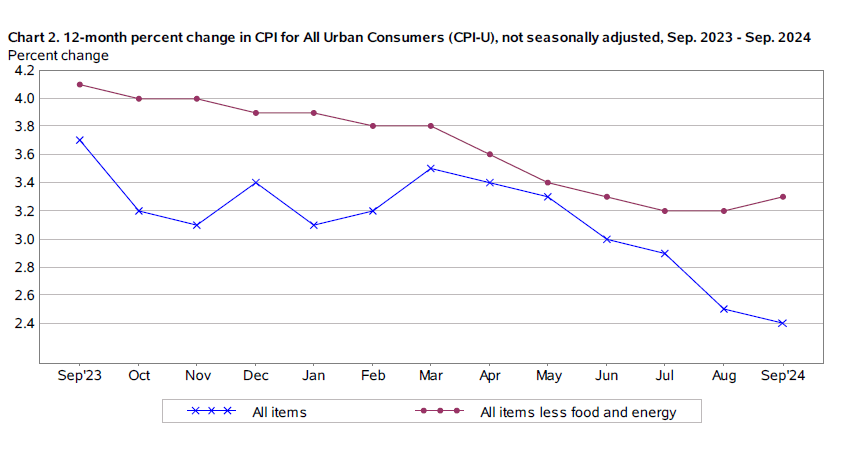
US CPI rose 0.2% mom in September, above expectation of 0.1% mom. CPI core (less food and energy) rose 0.3% mom, above expectation of 0.2% mom, and Shelter costs rose 0.2% mom. Food prices rose 0.4% mom. Together, these two indexes contributed over 75 percent of the monthly all items increase. Energy index fell -1.9% mom.
Over the 12-month period, CPI ticked down from 2.5% yoy to 2.4% yoy, above expectation of 2.3% yoy. That's still the lowest level since February 2021. CPI core ticked up from 3.2% yoy to 3.3% yoy, above expectation of 3.2% yoy. Energy index fell -6.8% yoy while food index rose 2.3% yoy.
US initial jobless claims surges to 258k, highest since mid-2023
US initial jobless claims jumped sharply by 33k to 258k in the week ending October 5, well above expectation of 231k. That's also the highest level since mid-2023. Four-week moving average of initial claims rose 7k to 231k.
Continuing claims rose 42k to 1861k in the week ending September 28. Four-week moving average of continuing claims rose 4.5k to 1832k.