

Sample Category Title
USD/CHF Daily Outlook
Daily Pivots: (S1) 0.9061; (P) 0.9078; (R1) 0.9100; More....
Intraday bias in USD/CHF remains neutral as consolidation from 0.9005 is extending. Further decline is in favor as long as 55 4H EMA (now at 0.9099) holds. On the downside, break of 0.9005 and sustained trading below 55 D EMA (now at 0.9000) will bring deeper fall to 38.2% retracement of 0.8332 to 0.9223 at 0.8883. However, firm break of 55 4H EMA will suggest that the pull back has completed, and bring stronger rebound to retest 0.9223 high.
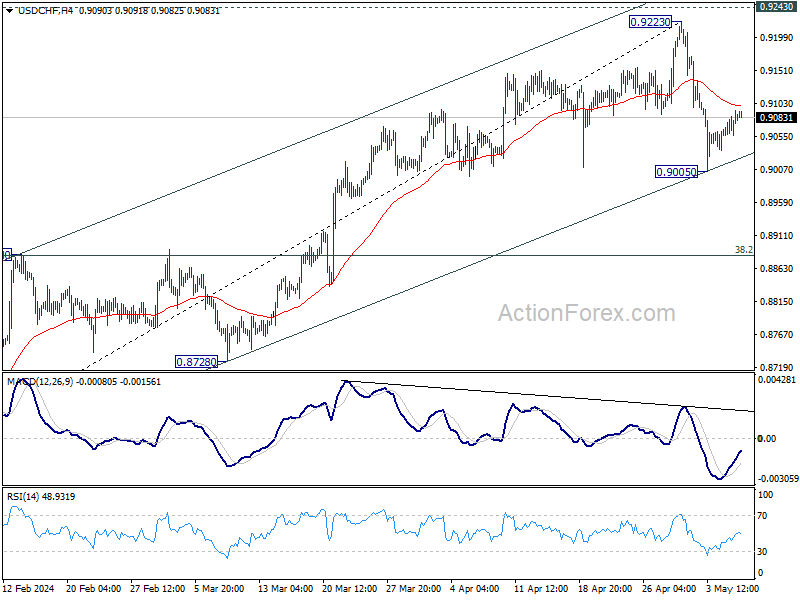
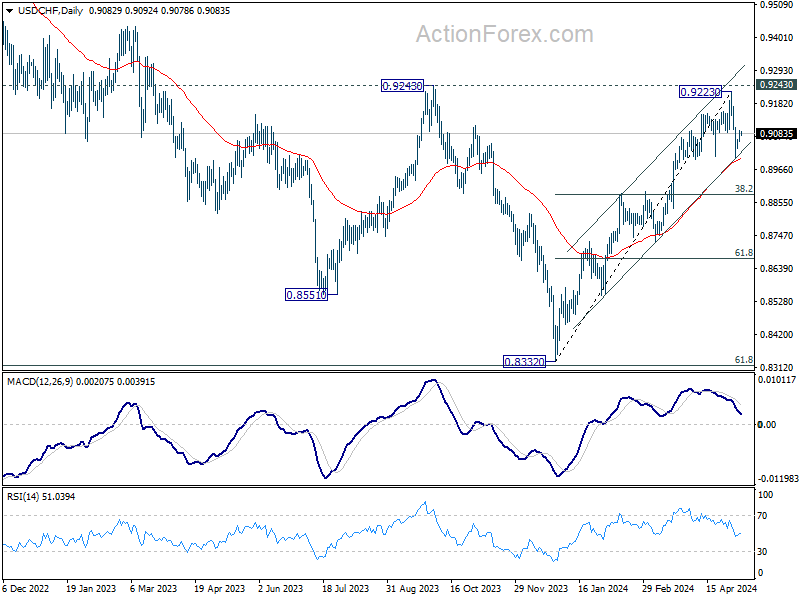
In the bigger picture, price actions from 0.8332 medium term bottom are tentatively seen as developing into a corrective pattern to the down trend from 1.0146 (2022 high). Rejection by 0.9243 resistance, followed by sustained break of 38.2% retracement of 0.8332 to 0.9223 at 0.8883 will strengthen this case, and maintain medium term bearishness. However, decisive break of 0.9243 will argue that the trend has already reversed and turn medium term outlook bullish for 1.0146.
EUR/USD Daily Outlook
Daily Pivots: (S1) 1.0739; (P) 1.0764; (R1) 1.0779; More...
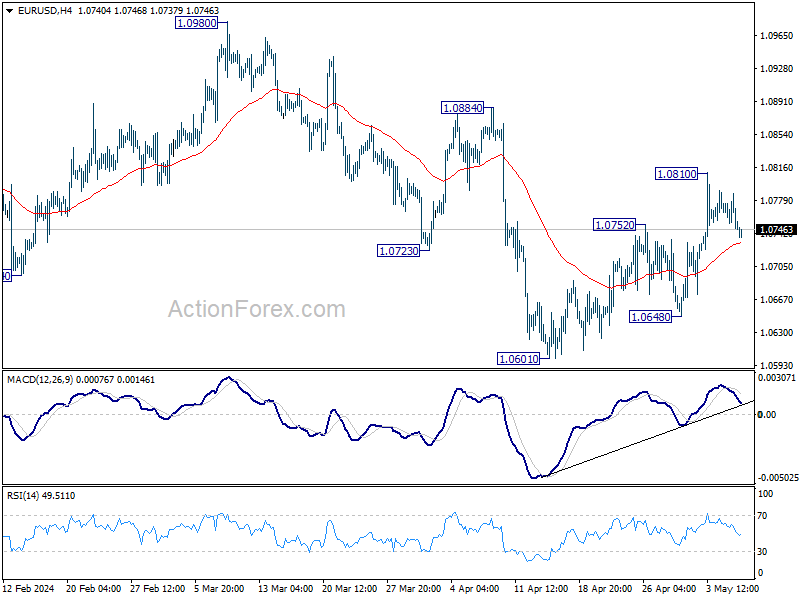
Intraday bias in EUR/USD remains neutral and more consolidations could be seen below 1.0810. Further rally is expected as long as 55 4H EMA (now at 1.0731) holds. On the upside, above 1.0810 will resume the rebound from 1.0601 to 1.0884 resistance next. However, firm break of 55 4H EMA will argue that the rebound has completed, and turn bias to the downside for 1.0648 support instead.
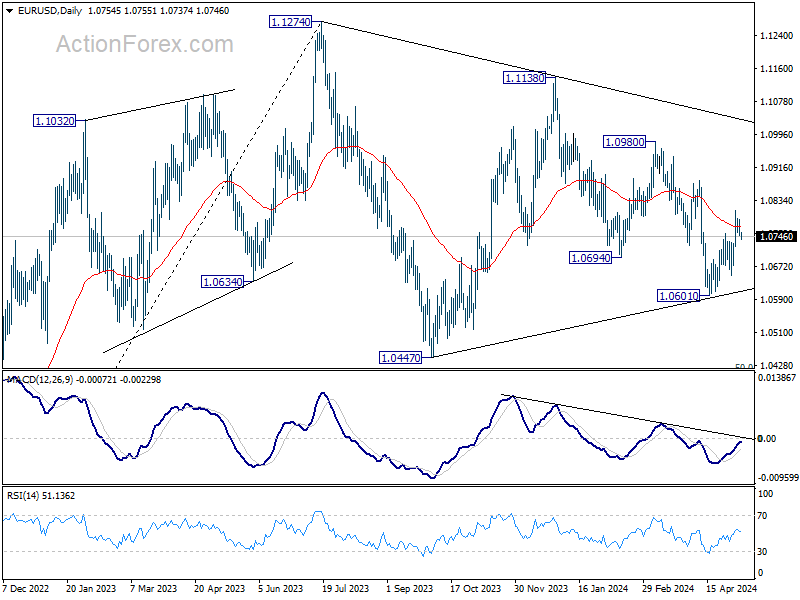
In the bigger picture, price actions from 1.1274 are viewed as a corrective pattern. Fall from 1.1138 is seen as the third leg and could have completed. Firm break of 1.1138 will argue that larger up trend from 0.9534 (2022 low) is ready to resume through 1.1274 high. On the downside, break of 1.0601 will extend the corrective pattern instead.
Elliott Wave Analysis on Dow Futures (YM) Favors Upside
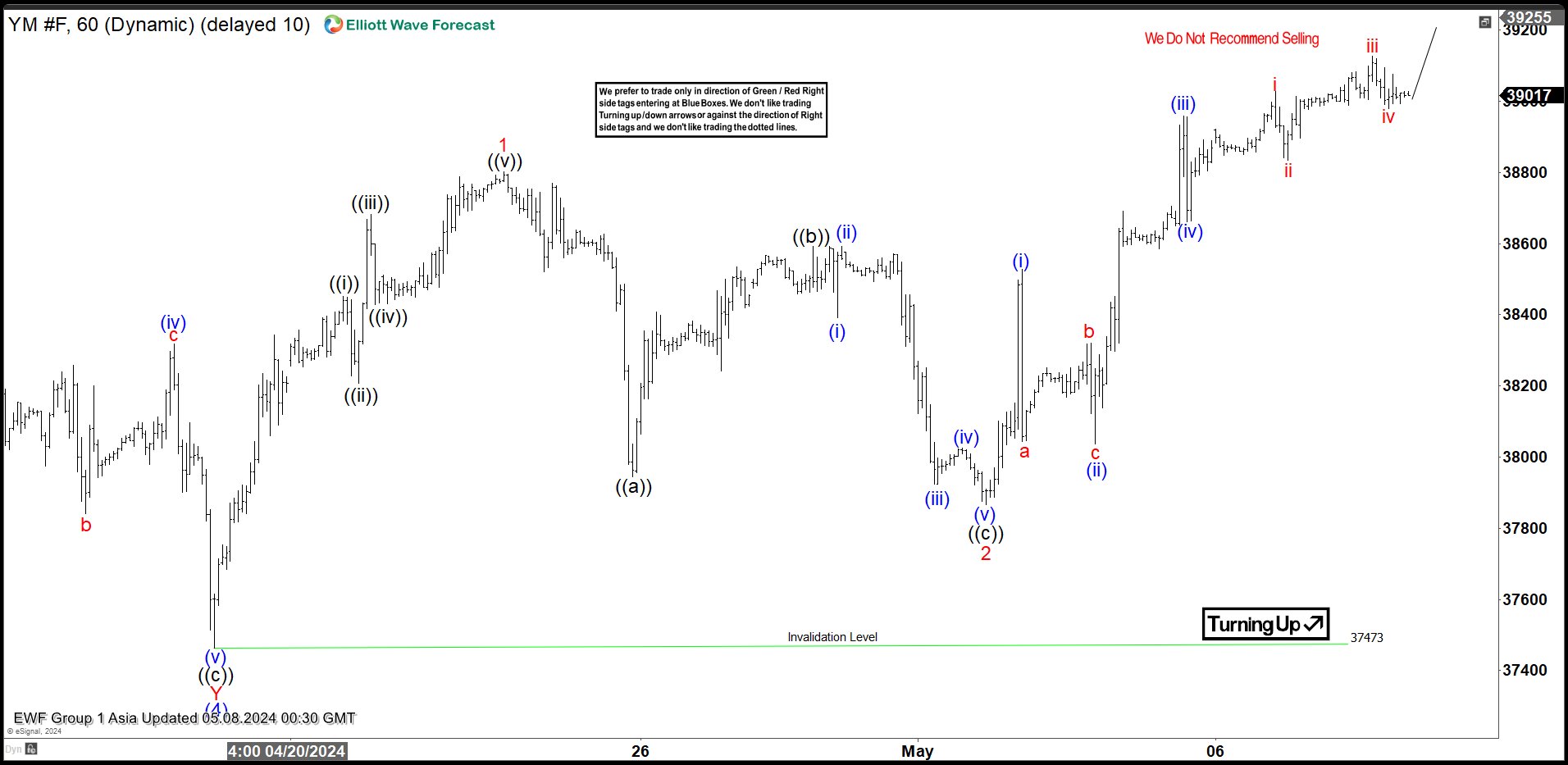
Short Term Elliott Wave View in Dow Futures (YM) suggests the Index ended wave (4) correction at 37473. The Index has now turned higher in wave (5). However, it still needs to break above the previous wave (3) peak on 4.1.2024 at 40358 to rule out a double correction. Up from wave (4), wave ((i)) ended at 38451 and pullback in wave ((ii)) ended at 382808. Wave ((iii)) ended at 38682, dips in wave ((iv)) ended at 38428, and final wave ((v)) higher ended at 38801. This completed wave 1 in higher degree.
Pullback in wave 2 unfolded as a zigzag Elliott Wave structure. Down from wave 1, wave ((a)) ended at 37944 and wave ((b)) rally ended at 38592. Wave ((c)) lower ended at 37866 which completed wave 2 in higher degree. The Index has turned higher again in wave 3 of (5). Up from wave 2, wave (i) ended at 38527 and pullback in wave (ii) ended at 38037. Wave (iii) higher ended at 38958 and dips in wave (iv) ended at 38661. Near term, as far as pivot at 37473 low stays intact, expect pullback to find support in 3, 7, or 11 swing for further upside.
Dow Futures (YM_F) 60 Minutes Elliott Wave Chart
YM_F Elliott Wave Video
https://www.youtube.com/watch?v=Nifoia6_w6U
GBP/USD Daily Outlook
Daily Pivots: (S1) 1.2481; (P) 1.2528; (R1) 1.2554; More...
Intraday bias in GBP/USD remains neutral for the moment and some more consolidations could be seen below 1.2633. Further rally is in favor with 1.2471 support intact. On the upside, above 1.2633 will resume the rebound from 1.2298 to 1.2708 resistance next. However, firm break of firm break of 1.2471 will indicate that this rebound has completed, and revive near term bearishness. Retest of 1.2298 should then be seen in this case.
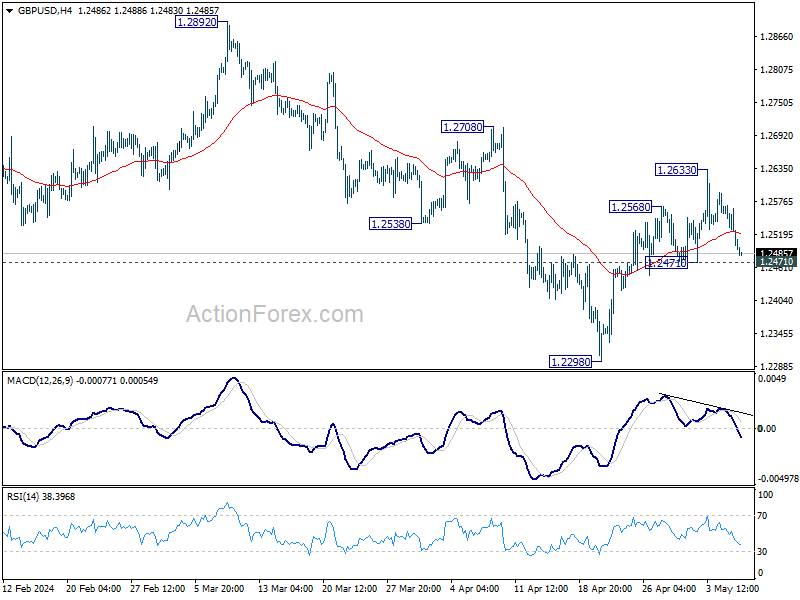
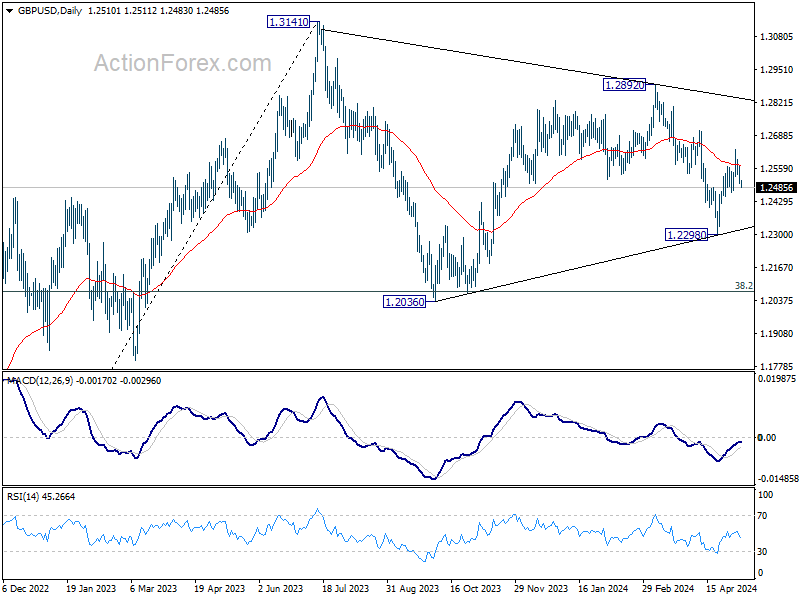
In the bigger picture, price actions from 1.3141 medium term top are seen as a corrective pattern. Fall from 1.2892 is seen as the third leg which might have completed already. Break of 1.2892 resistance will argue that larger up trend from 1.0351(2022 low) is ready to resume through 1.3141. Meanwhile, break of 1.2298 support will extend the corrective pattern instead.
Dollar Recovery Continues, But Bulls Struggle to Secure Full Control
Dollar's rebound gained some momentum in Asian session today on resurgence of risk aversion. Selloff in Japan was most notable where key industry leaders like Fast Retailing, Nintendo, and Toyota saw substantial declines. The sentiment was further dampened after remarks from BoJ Governor Kazuo Ueda, who reiterated that Yen's extended weakness might necessitate monetary policy responses.
Throughout the current week, Dollar is currently standing out as the best performer at this point. However, its ascent has been somewhat restrained, and capped below the previous week's highs against other currencies. The greenback will have to demonstrate more strength to prove that it's near term pullback started last week is over. Euro trails as the second strongest currency, followed by New Zealand dollar.
Conversely, Yen is the weakest performer, despite managing to retain a substantial portion of its gains from the previous week that were rumored to be bolstered by Japan's strategic market interventions. Australian and Canadian dollars follow as the next weakest. British Pound and Swiss Franc are positioned in the middle. The Pound, in particular, stands at a critical juncture as market participants keenly await BoE's forthcoming rate decisions and the release of new economic forecasts tomorrow.
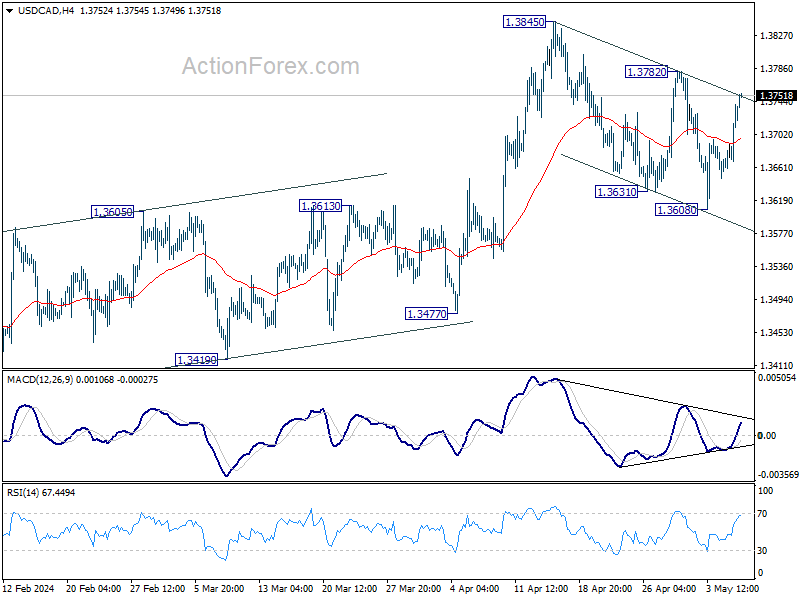
Technically, USD/CAD's breach of near term falling channel is strengthening the case that correction from 1.3845 has completed at 1.3608 already. Immediate focus is now on 1.3782 resistance. Decisive break there will argue that larger rally from 1.3176 is ready to resume through 1.3845 high. Based on current development in Dollar elsewhere, USD/CAD might not need to wait for Friday's Canadian job data to make the move.
In Asia, at the time of writing, Nikkei is down -1.55%. Hong Kong HSI is down -0.52%. China Shanghai SSE is down -0.50%. Singapore Strait Times is down -1.04%. Japan 10-year JGB yield is up 0.0038 at 0.876. Overnight, DOW rose 0.08%. S&P 500 rose 0.13%. NASDAQ fell -0.10%. 10-year yield fell -0.0260 to 4.463.
Fed's Kashkari: Interest rates likely to stay here for an extended period of time
Minneapolis Fed President Neel Kashkari highlighted at a conference overnight that the current interest rates are likely to be maintained "for an extended period of time" to ensure that inflation steadily returns to the target level.
Kashkari elaborated on circumstances that might prompt a shift in this policy. If inflation metrics "start to tick back down" or if there is a "marked weakening in the labor market," Fed might consider lowering interest rates. Conversely, he warned that if inflation seems "embedded or entrenched now at 3%," an increase in rates could be necessary to control inflationary pressures.
Further exploring the complexities of current economic conditions, Kashkari, in an essay, suggested that misjudgments regarding the tightness of existing policies might explain the "constellation of data we are observing." He questioned whether the disinflationary trend is just slower than expected or if inflation is settling around 3%, indicating that "more work" might be required to meet Fed's dual mandate objectives.
ECB's Nagel warns of persistent inflationary pressures
Bundesbank President Joachim Nagel, a member of ECB Governing Council, cautioned about enduring inflationary challenges during a speech overnight. Nagel noted the confluence of factors, including supply chain resilience, impending labor shortages due to demographic shifts, and the green transition, all of which could exert upward pressure on prices.
"To improve resilience, some form of de-risking seems reasonable, especially in the case of strategically important goods," Nagel said in a speech. "We should keep in mind that greater security for supply chains is likely to come with some additional price pressures." These structural changes in the eurozone economy, Nagel argued, could sustain inflationary tendencies for an extended period.
Highlighting demographic trends, Nagel projected a significant annual decline of 80,000 individuals in the potential labor force starting from 2026. This demographic shift, he emphasized, could drive wage growth, thereby fueling inflationary pressures further.
Nagel reiterated the ECB's commitment to price stability, emphasizing its mandate to curb inflationary pressures. "One thing is clear: Our mandate is price stability!" he said. "If there is more price pressure in the medium-term, we must take action against it... price stability is a prerequisite for an efficient adjustment process."
BoJ Ueda signals shift in focus to exchange rate impacts
In comments made to the parliament today, BoJ Governor Kazuo Ueda underlined growing focus on the effects of currency movements rather than solely on wages, signaling a broadening perspective on economic influences.
Ueda pointed out that as recent behavior in wage- and price-setting has become "somewhat more active," BoJ has to be "mindful of the risk that the impact of currency volatility on inflation is becoming bigger than in the past.".
"Foreign exchange rates make a significant impact on the economy and inflation. Depending on those moves, a monetary policy response might be needed," Ueda said.
Similarly, Finance Minister Suzuki expressed significant concern about the negative aspects of a weaker yen, particularly the pressure it places on import prices.
"Since Japan relies on overseas markets for food and energy, and a large portion of its transactions are denominated in dollars, a weaker yen could raise prices of imported goods," Suzuki said.
Looking ahead
The economic calendar is light today. Germany industrial production, Italy retail sales, and US wholesale inventories final will be released.
GBP/USD Daily Outlook
Daily Pivots: (S1) 1.2481; (P) 1.2528; (R1) 1.2554; More...
Intraday bias in GBP/USD remains neutral for the moment and some more consolidations could be seen below 1.2633. Further rally is in favor with 1.2471 support intact. On the upside, above 1.2633 will resume the rebound from 1.2298 to 1.2708 resistance next. However, firm break of firm break of 1.2471 will indicate that this rebound has completed, and revive near term bearishness. Retest of 1.2298 should then be seen in this case.
In the bigger picture, price actions from 1.3141 medium term top are seen as a corrective pattern. Fall from 1.2892 is seen as the third leg which might have completed already. Break of 1.2892 resistance will argue that larger up trend from 1.0351(2022 low) is ready to resume through 1.3141. Meanwhile, break of 1.2298 support will extend the corrective pattern instead.
Economic Indicators Update
| GMT | Ccy | Events | Actual | Forecast | Previous | Revised |
|---|---|---|---|---|---|---|
| 06:00 | EUR | Germany Industrial Production M/M Mar | -0.4% | -1.10% | 2.10% | |
| 08:00 | EUR | Italy Retail Sales M/M Mar | 0.20% | 0.10% | ||
| 14:00 | USD | Wholesale Inventories Mar F | -0.40% | -0.40% | ||
| 14:30 | USD | Crude Oil Inventories | 7.3M |
BoJ Ueda signals shift in focus to exchange rate impacts
In comments made to the parliament today, BoJ Governor Kazuo Ueda underlined growing focus on the effects of currency movements rather than solely on wages, signaling a broadening perspective on economic influences.
Ueda pointed out that as recent behavior in wage- and price-setting has become "somewhat more active," BoJ has to be "mindful of the risk that the impact of currency volatility on inflation is becoming bigger than in the past.".
"Foreign exchange rates make a significant impact on the economy and inflation. Depending on those moves, a monetary policy response might be needed," Ueda said.
Similarly, Finance Minister Suzuki expressed significant concern about the negative aspects of a weaker yen, particularly the pressure it places on import prices.
"Since Japan relies on overseas markets for food and energy, and a large portion of its transactions are denominated in dollars, a weaker yen could raise prices of imported goods," Suzuki said.
Bitcoin Price Is At Risk of Another Decline – Here’s Why
Key Highlights
- Bitcoin price recovered above $63,500 but faced resistance at $65,500.
- BTC cleared a key bearish trend line at $63,250 on the 4-hour chart.
- Crude oil prices extended losses and declined below $78.80.
- Gold might struggle to start a fresh increase above $2,335.
Bitcoin Price Technical Analysis
Bitcoin price formed a base and started a fresh increase above $60,000. BTC/USD was able to clear the $61,500 and $62,500 resistance levels.
Looking at the 4-hour chart, the price cleared a key bearish trend line at $63,250. It even surpassed the $64,200 level and the 100 simple moving average (red, 4 hours). However, the bears were active near the $65,500 resistance and the 200 simple moving average (green, 4 hours).
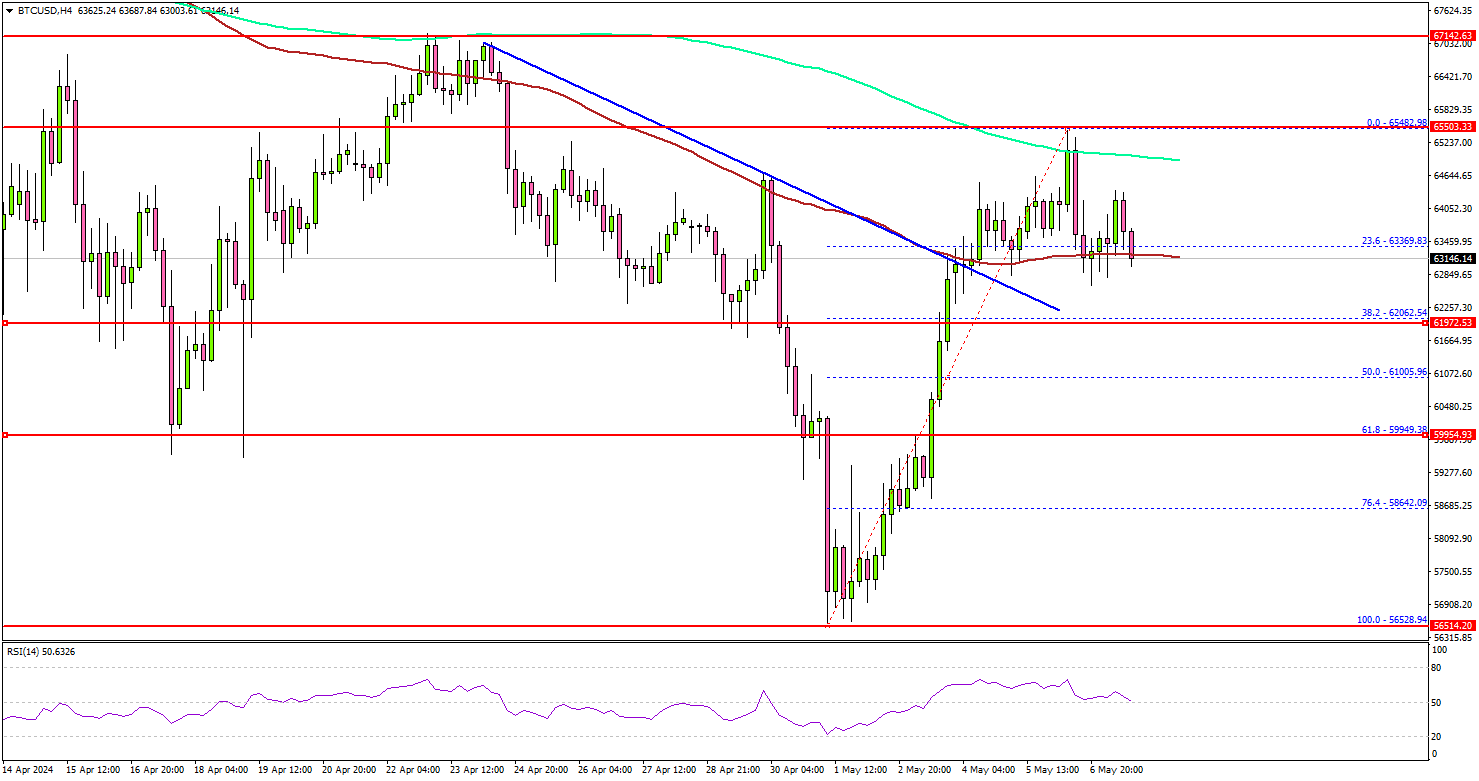
A high was formed at $65,482 and the price corrected gains. It retested the 100 simple moving average (red, 4 hours). Immediate support is near the $62,000 level.
The next major support sits at $60,000 or the 61.8% Fib retracement level of the upward move from the $56,528 swing low to the $65,482 high. Any more losses might send the price toward the $58,000 support zone.
Immediate resistance is near the $64,600 level. The first key resistance is near the $65,250 zone and the 200 simple moving average (green, 4 hours).
The next resistance is near $65,500. A successful close above $65,500 might start another steady increase. In the stated case, the price may perhaps rise toward the $68,000 level.
Economic Releases
- US Wholesale Inventories for March 2024 – Forecast -0.4%, versus -0.4% previous.
- Fed's Jefferson speech.
Fed’s Kashkari: Interest rates likely to stay here for an extended period of time
Minneapolis Fed President Neel Kashkari highlighted at a conference overnight that the current interest rates are likely to be maintained "for an extended period of time" to ensure that inflation steadily returns to the target level.
Kashkari elaborated on circumstances that might prompt a shift in this policy. If inflation metrics "start to tick back down" or if there is a "marked weakening in the labor market," Fed might consider lowering interest rates. Conversely, he warned that if inflation seems "embedded or entrenched now at 3%," an increase in rates could be necessary to control inflationary pressures.
Further exploring the complexities of current economic conditions, Kashkari, in an essay, suggested that misjudgments regarding the tightness of existing policies might explain the "constellation of data we are observing." He questioned whether the disinflationary trend is just slower than expected or if inflation is settling around 3%, indicating that "more work" might be required to meet Fed's dual mandate objectives.
ECB’s Nagel warns of persistent inflationary pressures
Bundesbank President Joachim Nagel, a member of ECB Governing Council, cautioned about enduring inflationary challenges during a speech overnight. Nagel noted the confluence of factors, including supply chain resilience, impending labor shortages due to demographic shifts, and the green transition, all of which could exert upward pressure on prices.
"To improve resilience, some form of de-risking seems reasonable, especially in the case of strategically important goods," Nagel said in a speech. "We should keep in mind that greater security for supply chains is likely to come with some additional price pressures." These structural changes in the eurozone economy, Nagel argued, could sustain inflationary tendencies for an extended period.
Highlighting demographic trends, Nagel projected a significant annual decline of 80,000 individuals in the potential labor force starting from 2026. This demographic shift, he emphasized, could drive wage growth, thereby fueling inflationary pressures further.
Nagel reiterated the ECB's commitment to price stability, emphasizing its mandate to curb inflationary pressures. "One thing is clear: Our mandate is price stability!" he said. "If there is more price pressure in the medium-term, we must take action against it... price stability is a prerequisite for an efficient adjustment process."
S&P 500 Wave Analysis
- S&P 500 reversed from support level 5000.00
- Likely to rise to resistance level 5300.00
S&P 500 index recently reversed up from the support zone lying between the round support level 5000.00 (which also stopped the previous correction (2)), lower daily Bollinger Band and the 50% Fibonacci correction of the upward impulse from January.
The upward reversal from the support level 5000.00 stopped the previous short-term correction 2.
Given the strong uptrend that can be seen on the daily charts, S&P 500 index can be expected to rise further to the next resistance level 5300.00 (which stopped the previous impulse wave 5 at the end of March).
