

Sample Category Title
Forex and Cryptocurrencies Forecast
EUR/USD: Reasons Behind the Dollar's Strengthening
The past week was notably sparse in terms of macroeconomic statistics. Consequently, the market participants' sentiment largely depended on the statements made at the World Economic Forum in Davos (WEF). It's worth noting that this event, held annually at a ski resort in Switzerland, gathers representatives of the global elite from over 120 countries. There, amidst the sparkling, crystal-clear snow glistening in the sunlight, the world's power players discuss economic issues and international politics. This year, the 54th edition of the forum took place from January 15 to 19.
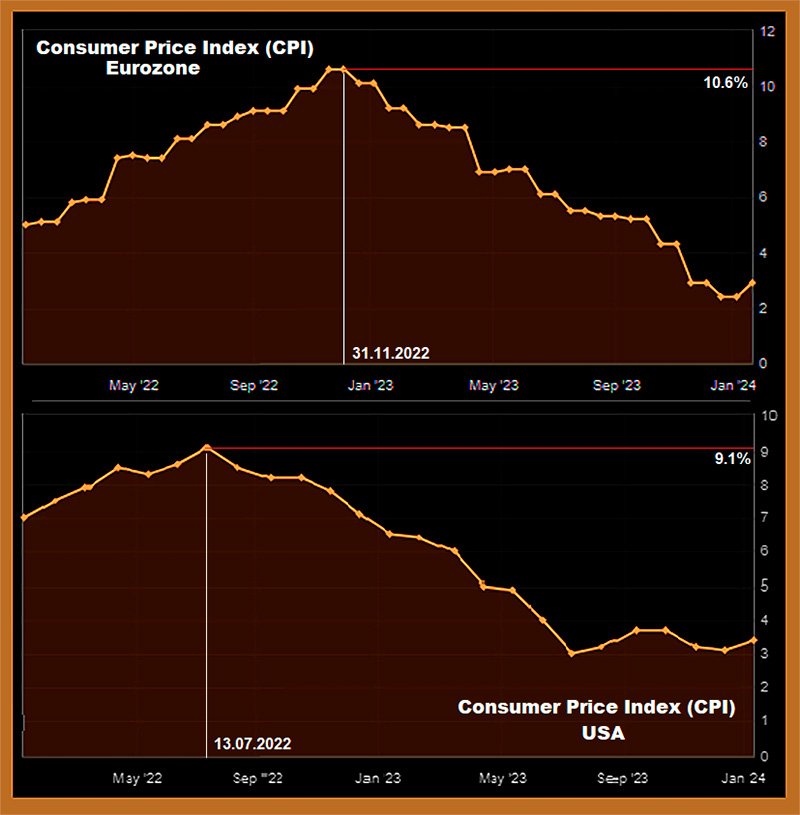
Speaking at the World Economic Forum on January 16, the President of the European Central Bank, Christine Lagarde, expressed her confidence that inflation would reach the target level of 2.0%. This statement did not raise any doubts, as the Consumer Price Index (CPI) in the Eurozone shows a steady decline. From a level of 10.6% at the end of 2022, the CPI has now fallen to 2.9%. Isabel Schnabel, a member of the ECB's Executive Board, did not rule out the possibility of a soft landing for the European economy and a return to the target inflation level by the end of 2024.
According to a Reuters survey of leading economists on the future monetary policy of the ECB, the majority expect the regulator to lower interest rates as early as the second quarter, with 45% of respondents believing that this decision will be made at the June meeting.
On the other hand, inflation in the United States has been unable to surpass the 3.0% mark since July 2023. The figures published on January 11th showed that the annual Consumer Price Index (CPI) increased by 3.4%, which was above the consensus forecast of 3.2% and the previous value of 3.1%. In monthly terms, consumer inflation also rose, registering at 0.3% against a forecast of 0.2% and a previous value of 0.1%.
In light of this, and considering that the U.S. economy appears quite stable, the likelihood of the Federal Reserve lowering interest rates in March started to diminish. This shift in sentiment led to a slight strengthening of the dollar, moving EUR/USD from the 1.0900-1.1000 range to the 1.0845-1.0900 zone. Additionally, the weak performance of the Asian stock markets exerted some pressure on the European currency.
According to economists at the Dutch Rabobank, long positions on the euro may face further challenges. This could happen if Donald Trump continues his movement towards a potential second term in the White House. "Although President Biden's Inflation Reduction Act meant that the past four years were not always easy for Europe, Trump's stance on NATO, Ukraine, and possibly climate change could prove costly for Europe and enhance the appeal of the U.S. dollar as a safe asset," the Rabobank experts write. "Based on this, we see a possibility of EUR/USD falling to 1.0500 in a three-month perspective."
EUR/USD closed last week at 1.0897. Currently, the majority of experts predict a rise in the U.S. dollar in the near future. 60% voted in favour of the dollar's strengthening, 20% sided with the euro, and the remaining 20% took a neutral stance. Oscillator readings on the D1 chart confirm the analysts' forecast: 80% are coloured red, indicating a bearish trend, and 20% are in neutral grey. Among the trend indicators, there is a 50/50 split between red (bearish) and green (bullish) signals.
The nearest support levels for the pair are located in the zones of 1.0845-1.0865, followed by 1.0725-1.0740, 1.0620-1.0640, 1.0500-1.0515, and 1.0450. On the upside, the bulls will face resistance at 1.0905-1.0925, 1.0985-1.1015, 1.1110-1.1140, 1.1230-1.1275, 1.1350, and 1.1475.
Unlike the past week, the upcoming week promises to be more eventful. On Tuesday, January 23, we will see the publication of the Eurozone Bank Lending Survey. Wednesday, January 24, will bring a deluge of preliminary statistics on business activity (PPI) in various sectors of the German, Eurozone, and U.S. economies. The main event on Thursday, January 25, will undoubtedly be the European Central Bank's meeting, where a decision on the interest rate will be made. It is expected to remain at the current level of 4.50%. Investors will therefore be paying close attention to what the ECB leaders say at the subsequent press conference. For reference, the FOMC meeting of the Federal Reserve is scheduled for January 31. Additionally, on January 25, we will learn about the GDP and unemployment data in the United States, and the following day, data on personal consumption expenditures of residents of this country will be released.
GBP/USD: High Inflation Leads to High Rates and a Stronger Pound
Unlike the United States and the Eurozone, there was a significant amount of important statistics released last week concerning the state of the British economy. On Wednesday, January 17, traders were focused on the December inflation data. The data revealed that the Consumer Price Index (CPI) in the United Kingdom rose from -0.2% to 0.4% month-on-month (against a consensus forecast of 0.2%) and reached 4.0% year-on-year (compared to the previous value of 3.9% and expectations of 3.8%). The core CPI remained at the previous level of 5.1% year-on-year.
Following the release of the report showing inflation growth, UK Prime Minister Rishi Sunak moved quickly to reassure the markets. He stated that the government's economic plan remains correct and continues to work, having reduced inflation from 11% to 4%. Sunak also noted that wages in the country have been growing faster than prices for five months, suggesting that the trend of weakening inflationary pressure will continue.
Despite this optimistic statement, many market participants believe that the Bank of England (BoE) will postpone the start of easing its monetary policy until the end of the year. "Concerns that the disinflation process might slow down have likely intensified as a result of the latest inflation data," economists at Commerzbank write. "The market will probably bet on the Bank of England responding accordingly and, therefore, being more cautious regarding the first interest rate cut."
Clearly, if the BoE does not rush to ease monetary policy, this will create ideal conditions for the long-term strengthening of the British pound. This prospect already allowed the GBP/USD pair to bounce off the lower boundary of its five-week channel at 1.2596 on January 17th, rising to the channel's midpoint at 1.2714.
It is quite possible that GBP/USD would have continued its upward trajectory, but it was hindered by weak retail sales data in the United Kingdom, which were published at the end of the workweek on Friday, January 19th. The data showed a decline in this indicator by 4.6%, from +1.4% in November to -3.2% in December (against a forecast of -0.5%). If the upcoming Purchasing Managers' Indexes and business activity indicators, due to be released on January 24th, paint a similar picture, it could exert even more pressure on the pound. The Bank of England might fear that a stringent monetary policy could overly decelerate the economy and might consider easing it. According to analysts at ING (Internationale Nederlanden Groep), a reduction in the key interest rate by 100 basis points could lead to GBP/USD falling to the 1.2300 zone over a one to three-month horizon.
ING analysts also believe that the UK budget announcement on March 6 will significantly impact the pound, with tax cuts on the agenda. "Unlike in September 2022," the experts write, "we believe this will be a real tax cut, financed by the reduced cost of debt servicing. This could add 0.2-0.3% to the UK's GDP this year and lead to the Bank of England maintaining higher rates for a longer period."
GBP/USD ended the last week at 1.2703. Looking ahead to the coming days, 65% voted for the pair's decline, 25% were in favour of its rise, and 10% preferred to remain neutral. Contrary to the specialists' opinions, the trend indicators on D1 show a preference for the British currency: 75% indicate a rise in the pair, while 25% point to a decline. Among the oscillators, 25% are in favor of the pound, the same proportion (25%) for the dollar, and 50% hold a neutral position. If the pair moves southward, it will encounter support levels and zones at 1.2650, 1.2595-1.2610, 1.2500-1.2515, 1.2450, 1.2330, 1.2210, 1.2070-1.2085. In case of an upward movement, the pair will meet resistance at 1.2720, 1.2785-1.2820, 1.2940, 1.3000, and 1.3140-1.3150.
No significant events related to the United Kingdom's economy are anticipated for the upcoming week, other than the previously mentioned events. The Bank of England's next meeting is scheduled for Thursday, February 1.
USD/JPY: The 'Moon Mission' Continues
According to data published by the Japanese Statistics Bureau on Friday, January 19, Japan's National Consumer Price Index (CPI) for December was 2.6% year-on-year, compared to 2.8% in November. The National CPI, excluding fresh food, was 2.3% year-on-year in December, down from 2.5% the previous month.
Given that inflation is already decreasing, the question arises: why raise the interest rate? The logical answer: there is no need. This is why the market's consensus forecast suggests that the Bank of Japan (BoJ) will leave the rate unchanged at its meeting on Tuesday, January 23rd, maintaining it at the negative level of -0.1%. (It is worth remembering that the last time the regulator changed the rate was eight years ago, in January 2016, when it was lowered by 200 basis points.).
As usual, Japan's Finance Minister Shunichi Suzuki made another round of verbal interventions on Friday, and as usual, he said nothing new. "We are closely monitoring currency movements," "Forex market movements are determined by various factors," "it's important for the currency to move stably, reflecting fundamental indicators": these are statements that market participants have heard countless times. They no longer believe that the country's financial authorities will move from persuasion to real action. As a result, the yen continued to weaken, and USD/JPY continued its upward movement. (Interestingly, this aligns precisely with the wave analysis we provided two weeks ago.)
The past week's high for USD/JPY was recorded at 148.80, with the week closing near that level at 148.14. In the near future, 50% of experts anticipate further strengthening of the dollar, 30% are siding with the yen, and 20% hold a neutral position. As for the trend indicators and oscillators on D1, all 100% point north, though a quarter of the latter are in the overbought zone. The nearest support level is located in the 147.65 area, followed by 146.90-147.15, 146.00, 145.30, 143.40-143.65, 142.20, 141.50, and 140.25-140.60. Resistance levels are set in the following areas and zones: 148.50-148.80, 149.85-150.00, 150.80, and 151.70-151.90.
In addition to the Bank of Japan's meeting, another significant event related to the Japanese economy to note for the upcoming week is the publication of the Consumer Price Index (CPI) data for the Tokyo region, which is scheduled for Friday, January 26.
CRYPTOCURRENCIES: Numerous Predictions, Uncertain Outcome
Last week, the long-awaited regulatory saga finally concluded: as expected, on January 10th, the U.S. Securities and Exchange Commission (SEC) approved a batch of all 11 applications from investment companies to launch spot exchange-traded funds (ETFs) based on bitcoin. This news initially caused a spike in bitcoin's price to around $49,000. However, the cryptocurrency then depreciated by about 15%, falling to $41,400. Experts cite overbought conditions or what is known as "market overheating" as the main reason for this decline. As Cointelegraph reports, the SEC's positive decision was already factored into the market price. In 2023, bitcoin had grown 2.5 times, with a significant part of this growth occurring in the fall when the approval of the ETFs became almost inevitable. Many traders and investors, especially short-term speculators, decided to lock in profits rather than buy the now more expensive asset. This is a classic example of the market adage, "Buy on rumors (expectations), sell on facts."
It cannot be said that this price collapse was unexpected. In the lead-up to the SEC's decision, some analysts had predicted a downturn. For instance, experts at CryptoQuant talked about a potential drop in prices to $32,000. Other forecasts mentioned support levels at $42,000 and $40,000. "Bitcoin failed to break through the $50,000 level," analysts at Swissblock wrote. "The question arises whether the leading cryptocurrency can regain the momentum it has lost."
Our previous review was titled "D-Day Has Arrived. What Next?". More than a week has passed since the approval of the Bitcoin ETF, but judging by the BTC/USD chart, the market still hasn't decided on an answer to this question. According to Michael Van De Poppe, head of MN Trading Consultancy, the price is stuck between several levels. He believes that resistance lies at $46,000, but bitcoin could test support in the range between $37,000 and $40,000. In reality, for almost the entire past week, the primary cryptocurrency moved in a narrow sideways channel: between $42,000 and $43,500. However, on January 18-19, bitcoin experienced another bear attack, recording a local minimum at $40,280.
Evaluating the impact of the launch of spot bitcoin ETFs will require some time. Suitable data for analysis is expected to accumulate around mid-February. However, as noted by Cointelegraph, these funds have already attracted over $1.25 billion. On the first day alone, the trading volume of these new financial market instruments reached $4.6 billion.
Andrew Peel, Head of Digital Assets at investment bank Morgan Stanley, points out that the weekly inflow of funds into these new products already exceeds billions of dollars. He believes that the launch of spot bitcoin ETFs could significantly accelerate the process of de-dollarization of the global economy. He is quoted as saying, "Although these innovations are still in their infancy, they open up opportunities for challenging the hegemony of the dollar. Macro investors should consider how these digital assets, with their unique characteristics and growing adoption, can change the future dynamics of the dollar." Andrew Peel reminds us that the popularity of BTC has been growing steadily over the last 15 years, with over 106 million people worldwide now owning the first cryptocurrency. Meanwhile, Michael Van De Poppe notes that the events of January 10 will change the lives of many people around the world. However, he warns that "this will be the last 'easy' cycle for bitcoin and cryptocurrencies" and that it "will take longer than before."
The impact of the newly launched bitcoin ETFs on the global order has also been a topic of discussion among many influencers at the top of the power pyramid, underscoring the significance of this event. For instance, Elizabeth Warren, a member of the U.S. Senate Banking Committee, criticized the SEC's decision, expressing concerns that it could harm the existing financial system and investors. In contrast, Kristalina Georgieva, the Managing Director of the International Monetary Fund (IMF), holds a different view. She believes that cryptocurrencies are a class of assets, not money, and it's crucial to make this distinction. Therefore, she argues, bitcoin will not be able to replace the U.S. dollar. Additionally, the IMF head disagrees with those who expect that bitcoin ETFs will contribute to the mass adoption of the first cryptocurrency.
Bitcoin's price is projected to reach $100,000 - $150,000 by the end of 2024 and $500,000 within the next five years, according to Tom Lee, co-founder of the analytics firm Fundstrat, in an interview with CNBC. "In the next five years, supply will be limited, but with the approval of spot bitcoin ETFs, we have potentially huge demand, so I think something around $500,000 is quite achievable within five years," the expert stated. He also highlighted the upcoming halving in the spring of 2024 as an additional growth factor.
ARK Invest CEO Cathy Wood, also speaking on CNBC, predicted a bullish scenario where the first cryptocurrency could reach $1.5 million by 2030. Her firm's analysts calculated that even under a bearish scenario, the price of the digital gold would grow to at least $258,500.
Another forecast was given by Anthony Scaramucci, founder of SkyBridge Capital and former White House Communications Director. "If bitcoin is at $45,000 during the halving, then by mid-to-late 2025, it will be worth $170,000. Whatever the price of bitcoin is on the day of the halving in April, multiply it by four, and it will reach that figure within the next 18 months," said the SkyBridge founder in Davos, ahead of the World Economic Forum.
It's interesting to see how different AI chatbots have provided varied predictions for the price of bitcoin by December 31, 2024. Claude Instant from Anthropic predicted $85,000, while Pi from Inflection expects a rise to $75,000. Bard from Gemini forecasts that the price of BTC will exceed $90,000 by that date, though it cautions that unforeseen economic obstacles could limit the peak to around $70,000. ChatGPT-3.5 from OpenAI sees a price range of $75,000 to $85,000 as plausible but not guaranteed. A more conservative estimate from ChatGPT-4 suggests a range of $40,000 to $60,000, factoring in potential market fluctuations and investor caution, but doesn't rule out a rise to $80,000. Lastly, Bing AI from Co-Pilot creative predicts a price around $75,000, based on the information it has gathered.
These diverse predictions from AI systems reflect the inherent uncertainty and complexity in forecasting cryptocurrency prices, highlighting a range of factors that could influence market dynamics over the next few years.
As of the evening of January 19, BTC/USD was trading around $41,625. The total market capitalization of the cryptocurrency market stood at $1.64 trillion, down from $1.70 trillion a week earlier. The Bitcoin Fear & Greed Index, a measure of market sentiment, has dropped from 71 to 51 points over the week, moving from the 'Greed' zone to the 'Neutral' zone. This shift indicates a change in investor sentiment, reflecting a more cautious approach in the cryptocurrency market.
In conclusion regarding the growing market speculation about the imminent launch of spot ETFs on Ethereum, in our previous review, we cited a statement by SEC Chairman Gary Gensler, who clarified that the regulator's positive decision applies exclusively to exchange-traded products based on bitcoin. According to Gensler, this decision "does not signal readiness to approve listing standards for crypto assets that are considered securities." It's important to note that the regulator still classifies only bitcoin as a commodity, while "the vast majority of crypto assets are seen as investment contracts (i.e., securities)."
Now, analysts from the investment bank TD Cowen have confirmed pessimism regarding ETH-ETFs. Based on the information they have; it seems unlikely that the SEC will begin reviewing applications for this investment instrument in the first half of 2024. "Before approving ETH-ETFs, the SEC will want to gain practical experience with similar investment instruments in bitcoin," commented Jaret Seiberg, head of TD Cowen Washington Research Group. TD Cowen believes that the SEC will revisit the discussion of Ethereum ETFs only after the U.S. presidential elections in November 2024.
Nikolaos Panagirtzoglou, a senior analyst at JP Morgan, also does not expect a quick approval of spot ETH-ETFs. He opines that for the SEC to make a decision, it needs to classify Ethereum as a commodity rather than a security. However, JP Morgan considers such a development unlikely in the near future.
Silver tumbles amid rate cut expectation adjustments
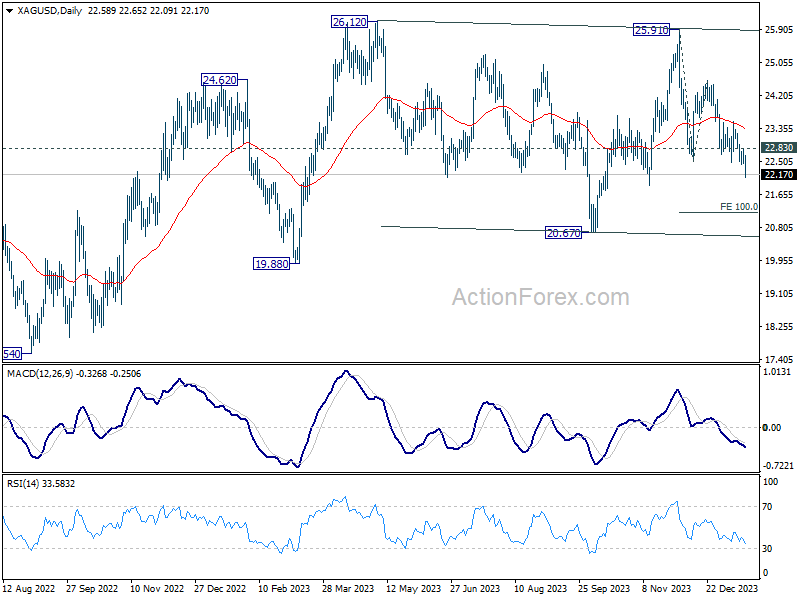
Silver falls steeply today as the decline from 25.91 resumes. This steep selloff in the precious metal is interpreted, at least partly, as a reaction to the recent market adjustments in global central bank rate cut expectations. With the anticipation of prolonged high interest rates, the opportunity cost of holding precious metals like Gold and Silver remains elevated, putting additional pressure on their prices.
Technically, near term outlook in Silver will stay bearish as long as 22.83 resistance holds. Next target is 100% projection of 25.91 to 22.50 from 24.59 at 21.18.
Price actions from 26.12 are seen as a sideway consolidation pattern from with decline 25.91 as the third leg. While break of 20.67 cannot be ruled out, strong support should be seen 19.88 and 20.67 to conclude the fall from 25.91, as well as the sideway pattern.
January Flashlight for the FOMC Blackout Period
Summary
- We share the near-universally held view that the FOMC will leave the fed funds rate and pace of quantitative tightening (QT) unchanged at the conclusion of its upcoming meeting on January 31.
- The FOMC's decision last month to leave the fed funds rate unchanged for a third consecutive meeting made it increasingly clear that the most aggressive tightening cycle since the 1980s has come to an end. Consequentially, overall financial conditions have eased considerably since the last policy meeting.
- We also look for the FOMC to remain in a holding pattern in terms of its policy guidance, and we expect only minor changes to the post-meeting statement relative to December. A change to the statement we would not be surprised to see at this meeting is the removal of the paragraph on the U.S. banking system and financial conditions.
- Overall, we view this meeting as one where the Committee will buy time to discern if inflation is indeed on a sustainable path back to 2% and serve as an opportunity to build consensus around the conditions for eventual policy easing.
- Market chatter about changes to the existing pace of QT has picked up recently, and we expect the meeting will include a discussion about the path forward for the Federal Reserve's balance sheet.
- Our base case is that the FOMC will announce a plan to slow the pace of QT at its June meeting, although we would not be shocked if the Committee decided to do so one meeting earlier in May.
- Specifically, we expect the runoff caps for Treasury securities to be reduced to $30 billion while MBS caps are dropped to $20 billion starting on July 1. We anticipate this slower pace of QT running until year-end 2024. Under this scenario, the Fed's balance sheet would reach a trough of $6.8 trillion or so at year-end 2024 and begin growing gradually again thereafter.
The Less Said the Better?
We share the near-universally held view that the FOMC will leave the fed funds rate and pace of quantitative tightening (QT) unchanged at the conclusion of its upcoming meeting on January 31. The FOMC's decision last month to leave the fed funds rate unchanged for a third consecutive meeting made it increasingly clear that the most aggressive tightening cycle since the 1980s has come to an end. The December post-meeting statement continued to signal that, in the near term, any adjustment to the policy rate is still more likely to be up than down. However, a small tweak sent a big signal that the Committee believes additional tightening is increasingly less likely. Specifically, the insertion of "any" to the sentence "In determining the extent of any additional policy firming that may be appropriate..." indicated that the Committee is more confident that the current policy setting is sufficient to return inflation to 2% on a sustained basis.
Moreover, in the post-meeting press conference, Chair Powell underscored the Committee's shifting focus away from potential further hikes and toward eventual policy easing. Not only did the FOMC continue to discuss how long the fed funds rate may need to remain restrictive, but the Committee discussed when it may be appropriate to remove current policy restraint—a discussion that is the first step on the road to eventually easing.
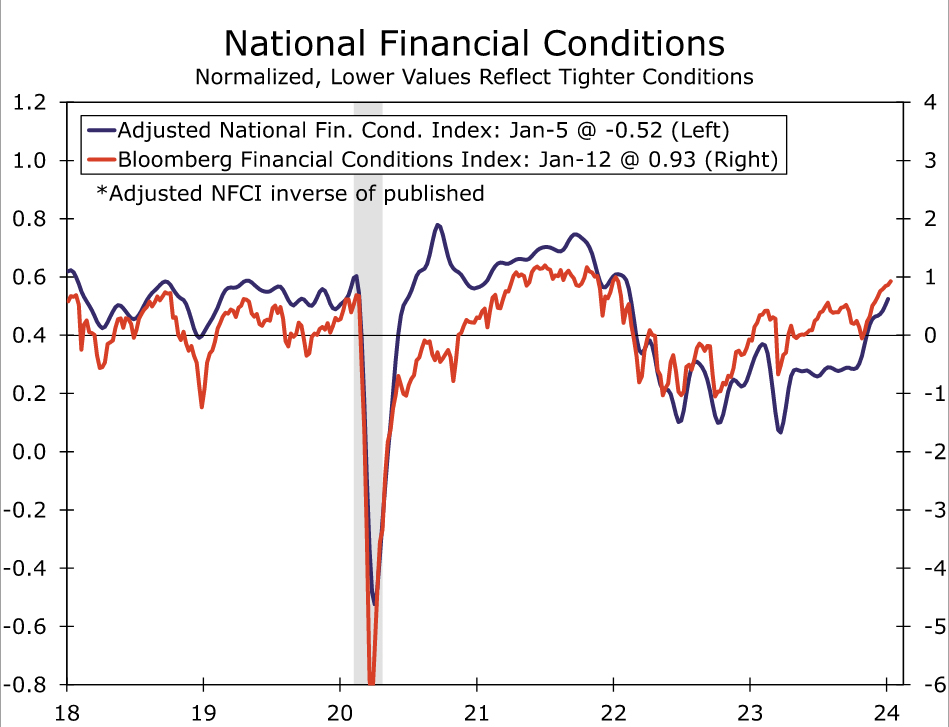
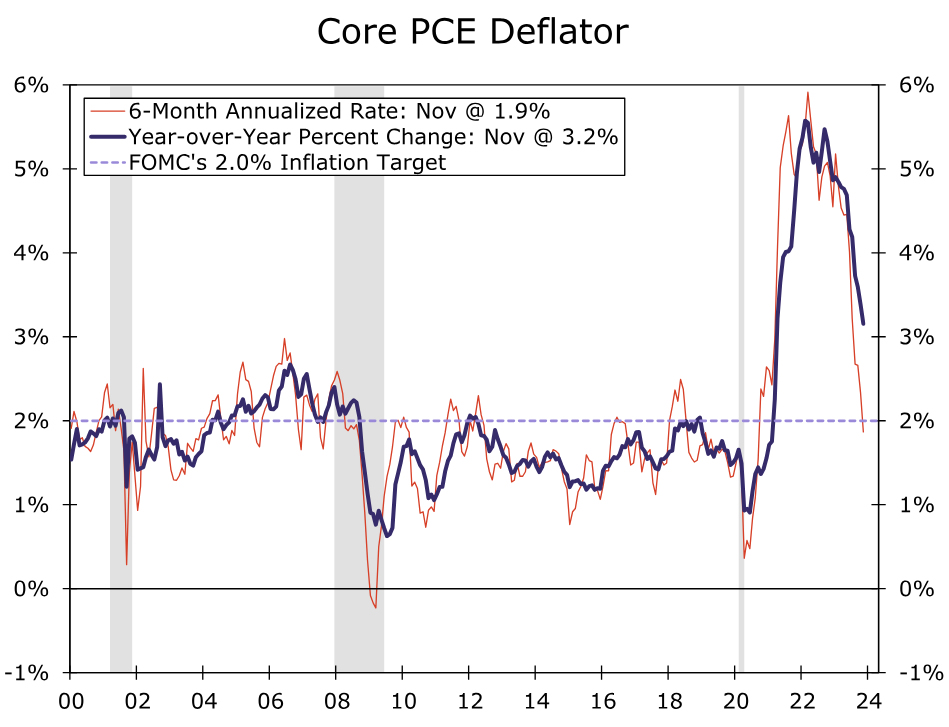
With Powell sharing that the topic of rate cuts had been broached, financial conditions loosened further over the inter-meeting period. At present, indices of financial conditions are sitting near the most accommodative levels since the FOMC began its current tightening cycle (Figure 1). That easing in financial conditions has caused some consternation about premature policy easing given that they are the channel through which the Fed's policy settings impact the real economy. Inflation has fallen sharply in recent months (Figure 2), with the rise in the core PCE deflator slowing to a six-month annualized rate of 2.0% through December by our estimates. However, Chair Powell and other FOMC members have indicated they need to see progress continue in the coming months to be convinced inflation can return to 2% for the long-haul. Meanwhile, economic growth continues to hold up well. Employment increased more than expected in December, the unemployment rate remained unchanged at 3.7% and layoffs remain near record lows. GDP in the final quarter of the year looks to have risen close to a trend-like 2% annualized rate.
Therefore, we look for the FOMC to remain in a holding pattern, not only with the fed funds rate at its January meeting, but also with its policy guidance. While progress in lowering inflation over the past six months has built the case that rate cuts are coming, the economy's recent performance suggests no imminent need to ease. Given a still-elevated degree of uncertainty over the outlook and a desire to limit further near-term easing in financial conditions, we suspect that Fed policymakers will want to be careful about sounding too dovish in the post-meeting statement and Chair Powell's press conference.
As a result, we expect the post-meeting statement to include only a few changes from December. Guidance around the future path of policy likely will remain unchanged after the last meeting's adjustment. Rather, changes are more likely to be in the characterization of recent economic activity.
On the less consequential side, the statement likely will remove the reference to Q3 GDP and acknowledge that growth in Q4 was solid, albeit slower than in the third quarter. (Preliminary data for Q4-23 GDP are scheduled for release on January 25.) We expect the statement will continue to note that "job gains have moderated" but "remain strong." More consequential would be a change to the statement's description of inflation. If the FOMC wants to clearly signal it is inching closer to eventual rate cuts, it could remove the reference to inflation remaining "elevated," and instead say something along the lines of "Inflation has eased over the past year, but a sustained moderation in inflation pressures has yet to be convincingly demonstrated" (our emphasis on the possible new language).
One other change to the statement we would not be surprised to see is the removal of the paragraph on the U.S. banking system and financial conditions. The FOMC's emphasis on the soundness and resiliency of the overall banking system came in the immediate wake of a handful of high-profile bank failures last March. But with the immediate crisis since passed and some policy easing on the horizon, its purpose has been served. At the same time, the easing in financial conditions since the autumn leaves the reference to "Tighter financial and credit conditions..." feeling stale. We believe the removal of this paragraph should be viewed as a tidying up of the statement, rather than a meaningful change in the FOMC's thinking.
Overall, we view this meeting as one where the Committee will buy time to discern if inflation is indeed on a sustainable path back to 2% and serve as an opportunity to build consensus around the conditions for eventual policy easing. Our current view is that the first "normalization cut" will occur at the May 1 meeting.
Time To Talk About QT
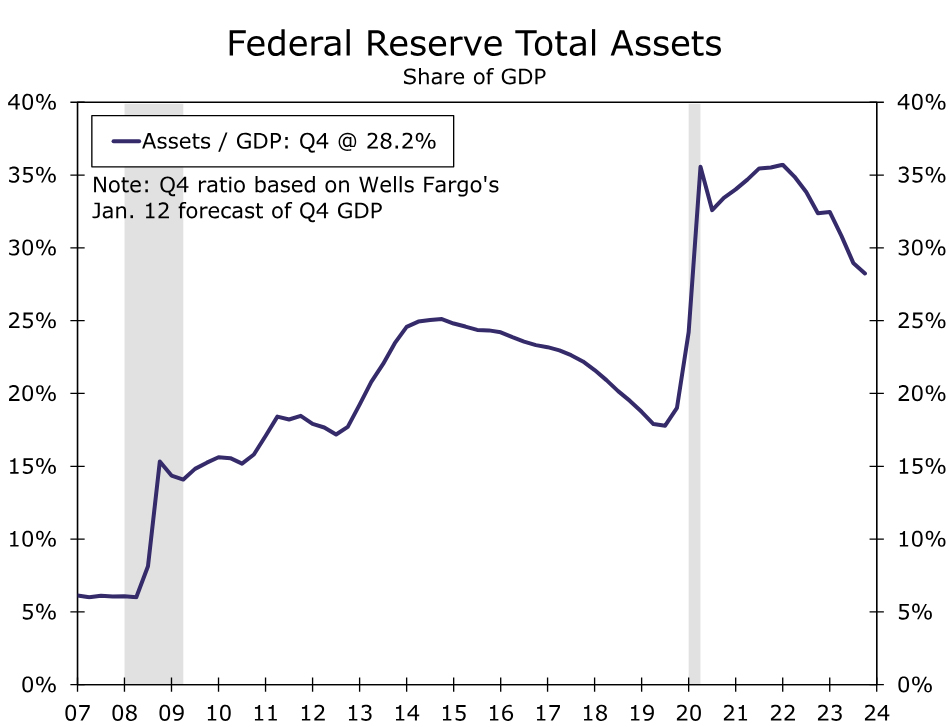
We suspect the January FOMC meeting will include a discussion about the path forward for the Federal Reserve's balance sheet. The Federal Reserve has been shrinking its balance sheet since June 2022 in a process frequently referred to as "quantitative tightening" (QT). Starting in June 2022, the FOMC began allowing a maximum of $30 billion of Treasury securities and $17.5 billion of mortgage-backed securities (MBS) per month to roll off its balance sheet. These caps were increased to $60 billion and $35 billion, respectively, in September 2022, and they have subsequently remained unchanged. At present, the Fed's balance sheet totals roughly $7.7 trillion, down from nearly $9 trillion at its peak in Q2-2022. That said, the Fed's balance sheet remains significantly larger than its pre-pandemic size, both in dollar terms and as a share of GDP (Figure 3).
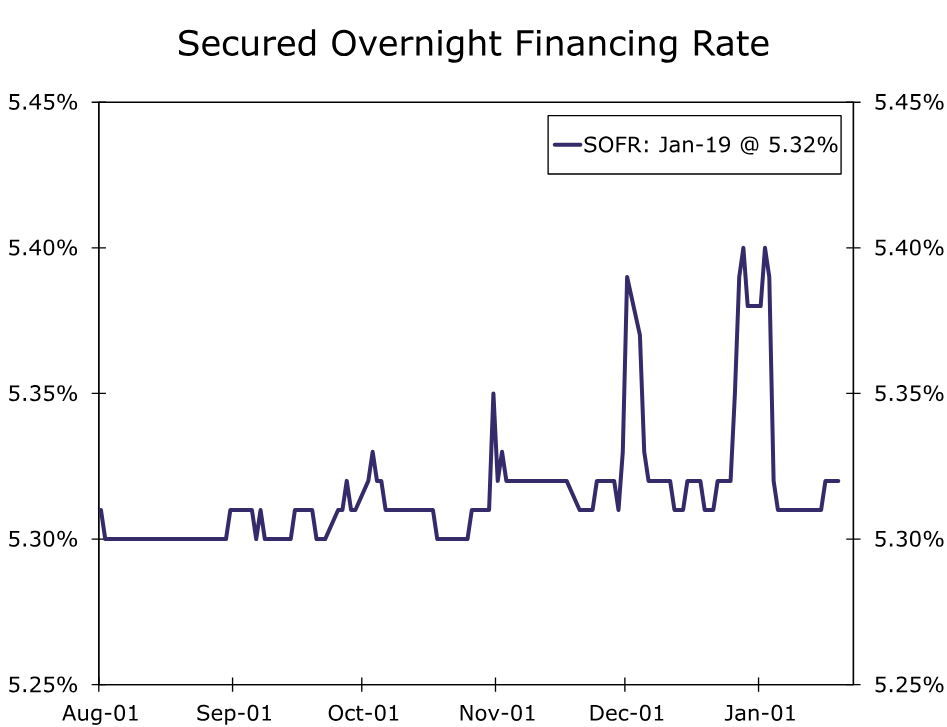
Market chatter about changes to the existing pace of QT has picked recently up for a few reasons. Money market rates have drifted higher around month-end over the past couple of months. For example, the Secured Overnight Financing Rate (SOFR) increased by 8-9 bps for a few days around the end of November and again at the end of December (Figure 4). These moves proved temporary and receded shortly after month-end, and they were smaller than the similar month-end moves that occurred in 2018-2019 when the Federal Reserve was last undertaking QT. However, these small stresses are an early sign that liquidity may not be as abundant as it has been over the past few years.
Some Fed officials appear to have taken notice. In the minutes from the December FOMC meeting, “[several] participants suggested that it would be appropriate for the Committee to begin to discuss the technical factors that would guide a decision to slow the pace of runoff." A speech from Dallas Fed President Lorie Logan on January 6 added more fuel to the speculation. In a previous role, Logan was manager of the System Open Market Account for the FOMC, and her expertise earned while managing the Federal Reserve's securities portfolio means that many market participants put additional weight on her views in this area. Logan acknowledged that the "emergence of typical month-end pressures suggests we’re no longer in a regime where liquidity is super abundant and always in excess supply for everyone." Logan suggested that it is "appropriate to consider the parameters that will guide a decision to slow the runoff of our assets."
Our expectation is that the FOMC will spend the next few policy meetings discussing the path forward for the balance sheet. Our base case is that the FOMC will announce a plan to slow the pace of QT at its June meeting, although we would not be shocked if the Committee decided to do so one meeting earlier in May. Specifically, we expect the runoff caps for Treasury securities to be reduced to $30 billion while MBS caps are dropped to $20 billion starting on July 1. We anticipate this slower pace of QT running until year-end 2024. Starting in 2025, we look for balance sheet growth to resume to accommodate organic growth in liabilities (e.g., paper currency and bank reserves). We expect the FOMC will continue to passively reduce its MBS holdings in 2025 and beyond while replacing these MBS with Treasury securities, a move that would replicate what occurred in 2019.
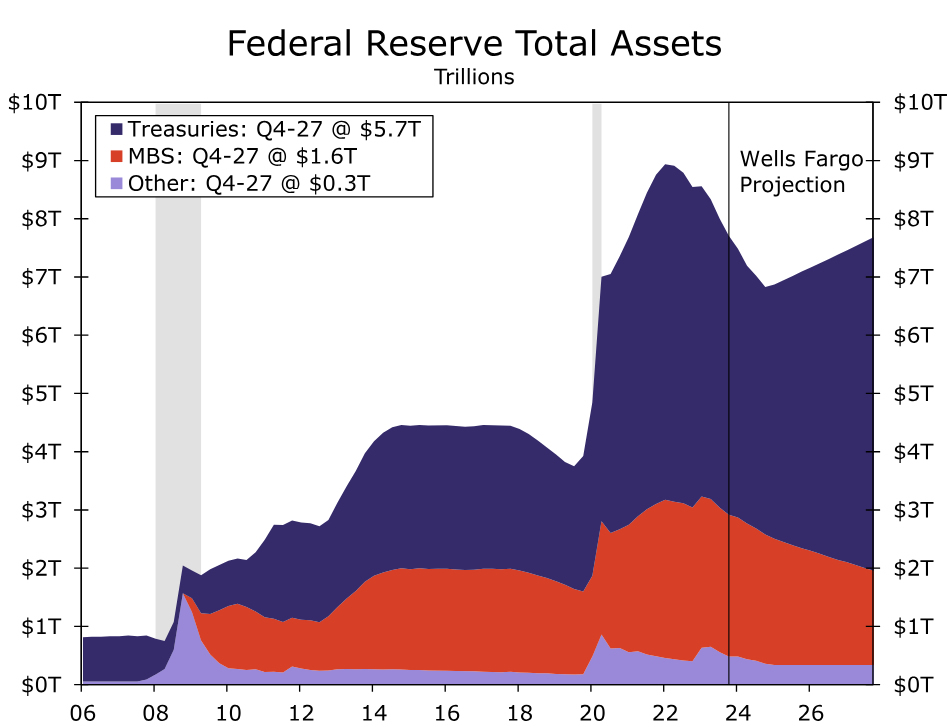
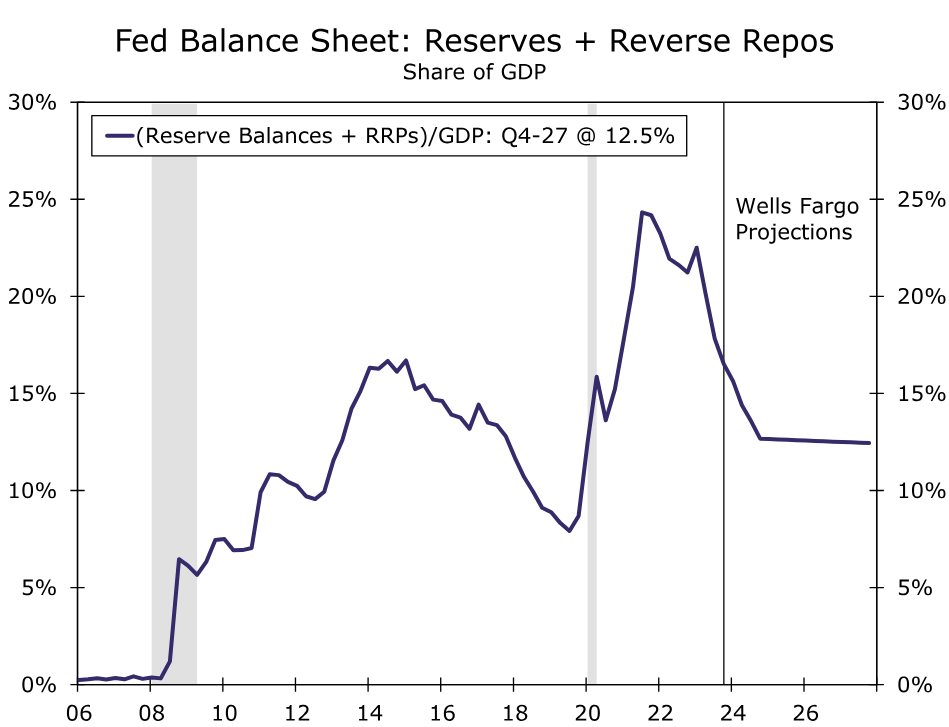
If realized, the Fed's balance sheet would reach a trough of $6.8 trillion or so at year-end 2024 and begin growing gradually again thereafter (Figure 5). The nadir in the Fed's balance sheet would be only a bit higher than the $6.5 trillion projection in our "middle-of-the-road" scenario outlined in our report on QT from last October. QT that slows/stops modestly sooner than expected would not have a major impact on our expectations for the level of rates and the shape of the yield curve. In this scenario, we look for RRP balances to decline to about $200 billion by year-end, with bank reserves that are around $3.1 trillion at the trough. As a share of GDP, this would represent a meaningful liquidity buffer relative to pre-pandemic levels (Figure 6).
US 500 Index Skyrockets to New All-time High
- US 500 index still confirms a strong upside tendency
- MACD and RSI in positive territories
- Next resistance at 161.8% Fibonacci extension
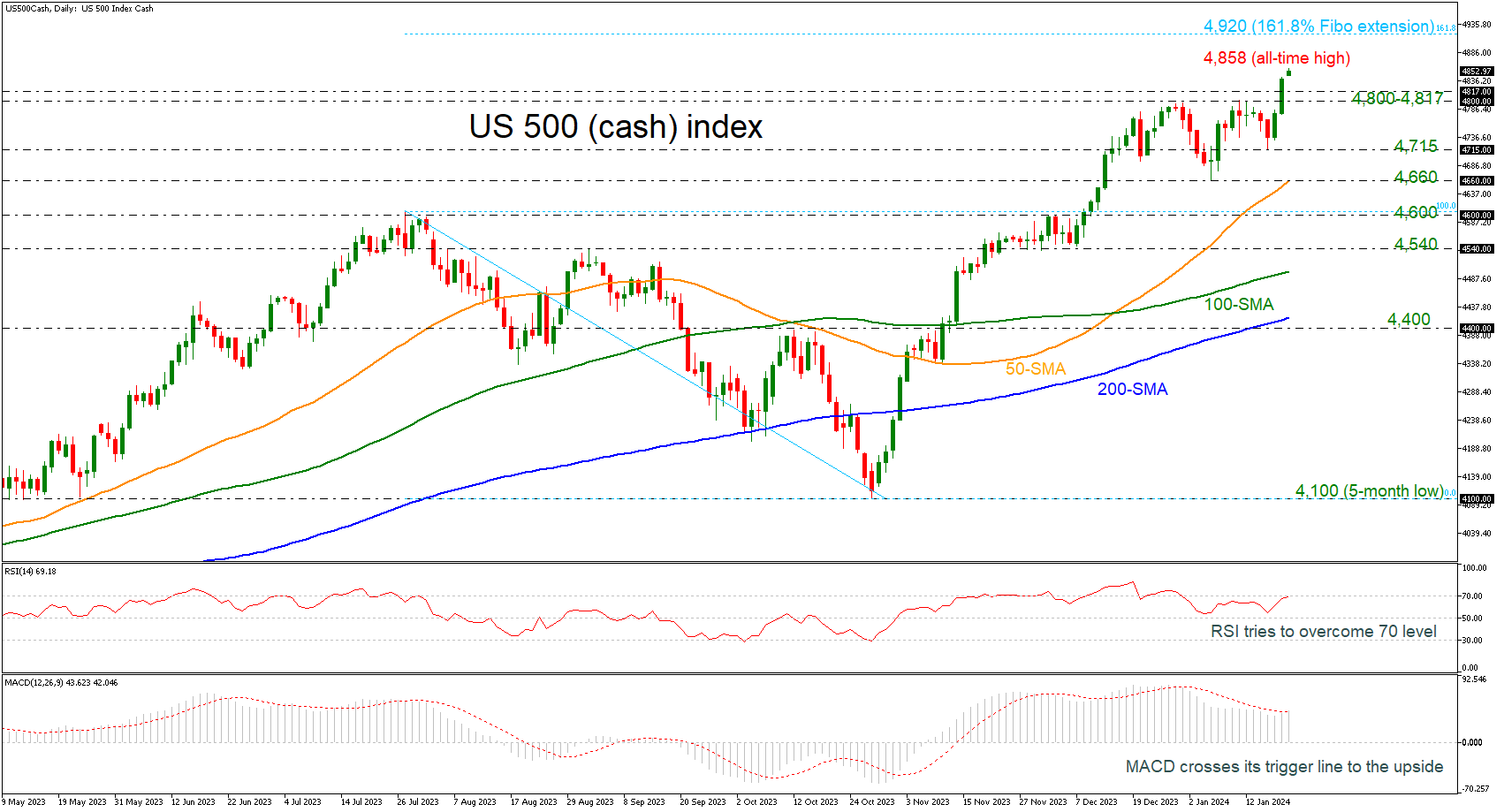
The US 500 cash index has been in a prolonged uptrend since the end of October, posting a fresh all-time high of 4,858 earlier today. After a period of rangebound trading, the pair stormed above the 4,800-4,817 region, which is now acting as support area.
According to technical indicators, the RSI is moving towards the 70 level and the MACD oscillator is creating a bullish crossover with its trigger line above the zero area. Both are confirming the aggressive buying interest in price.
Considering that the short-term oscillators remain tilted to the upside, the price could edge higher and visit uncharted levels such as the 161.8% Fibonacci extension level of the down leg from 4,600 to 4,100 at 4,920. Piercing through that wall, the index may hit the next psychological number such as 5,000.
On the flipside, should the price reverse lower, immediate support could be found at the aforementioned zone of 4,800-4,817. A break below that area could trigger a retreat towards the 4,715 support and the 50-day simple moving average (SMA), which overlaps with the 4,660 barricade. In case of a downside violation, the bears may then attack the 4,600 low.
In brief, the US 500 index is still developing near the record highs and only a decline beneath the 50-day SMA may suggest a bearish correction in the medium-term timeframe.
USDJPY Trades Sideways Ahead of BoJ Meeting
- USDJPY consolidates near its almost 2-month high
- RSI and MACD lose ground but stay in positive zones
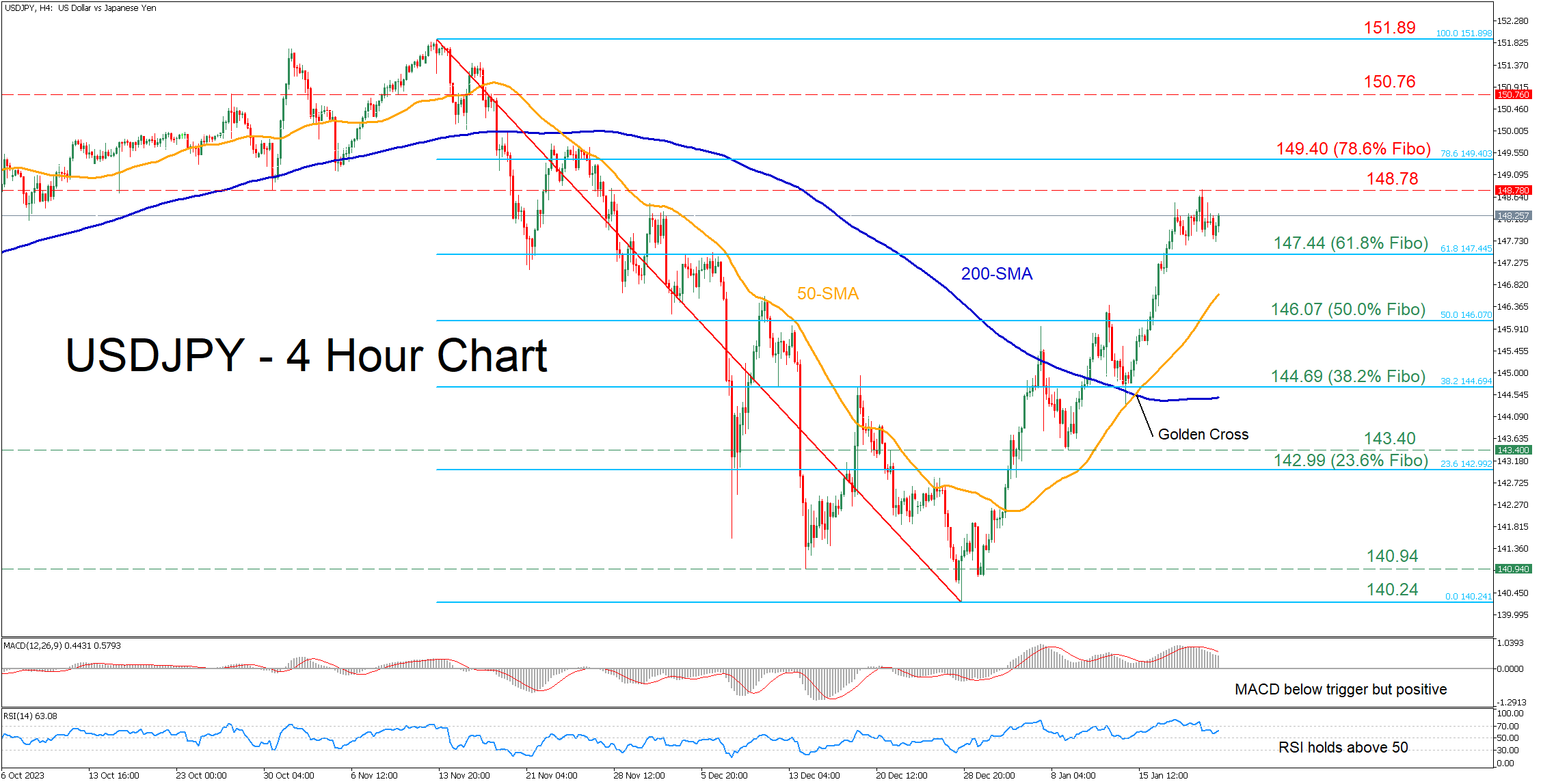
USDJPY has been in a steady advance since its five-month bottom of 140.24 registered in late December, posting consecutive higher highs. However, the rally seems to have taken a breather in the past few four-hour sessions as momentum indicators suggest that bullish pressures are fading.
Should the pair reverse lower, immediate support could be found at 147.44, which is the 61.8% Fibonacci retracement of the 151.89-140.24 downleg. Further retreats could then come to a halt at the 50.0% Fibo of 146.07. Even lower, the 38.2% Fibo of 144.69 may provide downside protection.
Alternatively, if buying pressures re-emerge, the price might revisit its recent peak of 148.78. Conquering this barricade, the bulls could attack the 78.6% Fibo of 149.40. A violation of that zone might pave the way for the October resistance of 150.76.
In brief, USDJPY appears to be in a consolidation mode ahead of the BoJ meeting on Tuesday. Any surprises there are likely to put an end to the rangebound pattern.
USD/JPY Flat Ahead of BoJ Announcement
- Bank of Japan to make announcement on Tuesday
The Japanese yen is in a holding pattern on Monday as the Bank of Japan holds a two-day meeting today and Tuesday. In the European session, EUR/USD is trading at 148.05, down 0.08%.
The yen has been on a rollercoaster in recent weeks. In December, the yen took advantage of a slumping US dollar and surged 4.85%. Those gains have been squandered as the dollar has rebounded in January and jumped 5.1%. On Friday, USD/JPY touched a high of 148.80, its highest level since November 28. The 150 level is not too far away and if the yen continues to lose ground, concerns will mount that the Ministry of Finance could intervene to prop up the yen.
Bank of Japan unlikely to make a move on Tuesday
The Bank of Japan will wrap up its policy meeting on Tuesday, and any hints of a shift in monetary policy would likely send the yen sharply higher. The markets aren’t expecting the central bank to change policy settings, although the BoJ, which isn’t known for transparency, has surprised the markets before.
The BoJ is expected to abandon negative rates, but Tuesday’s meeting doesn’t seem to be the right timing. Inflation has been easing and the economy remains fragile. The major earthquake on January 1 has contributed to the markets lowering expectations of a policy shift at this meeting. As well, the national wage negotiations take place in March and the BoJ would prefer to analyse the results of the wage talks before making any policy changes. This would point to the April meeting as being more ripe for a major announcement. Even if the BoJ stays on the sidelines tomorrow, investors will have plenty to digest, including updated inflation reports, quarterly economic projections and Governor Ueda’s follow-up press conference.
USD/JPY Technical
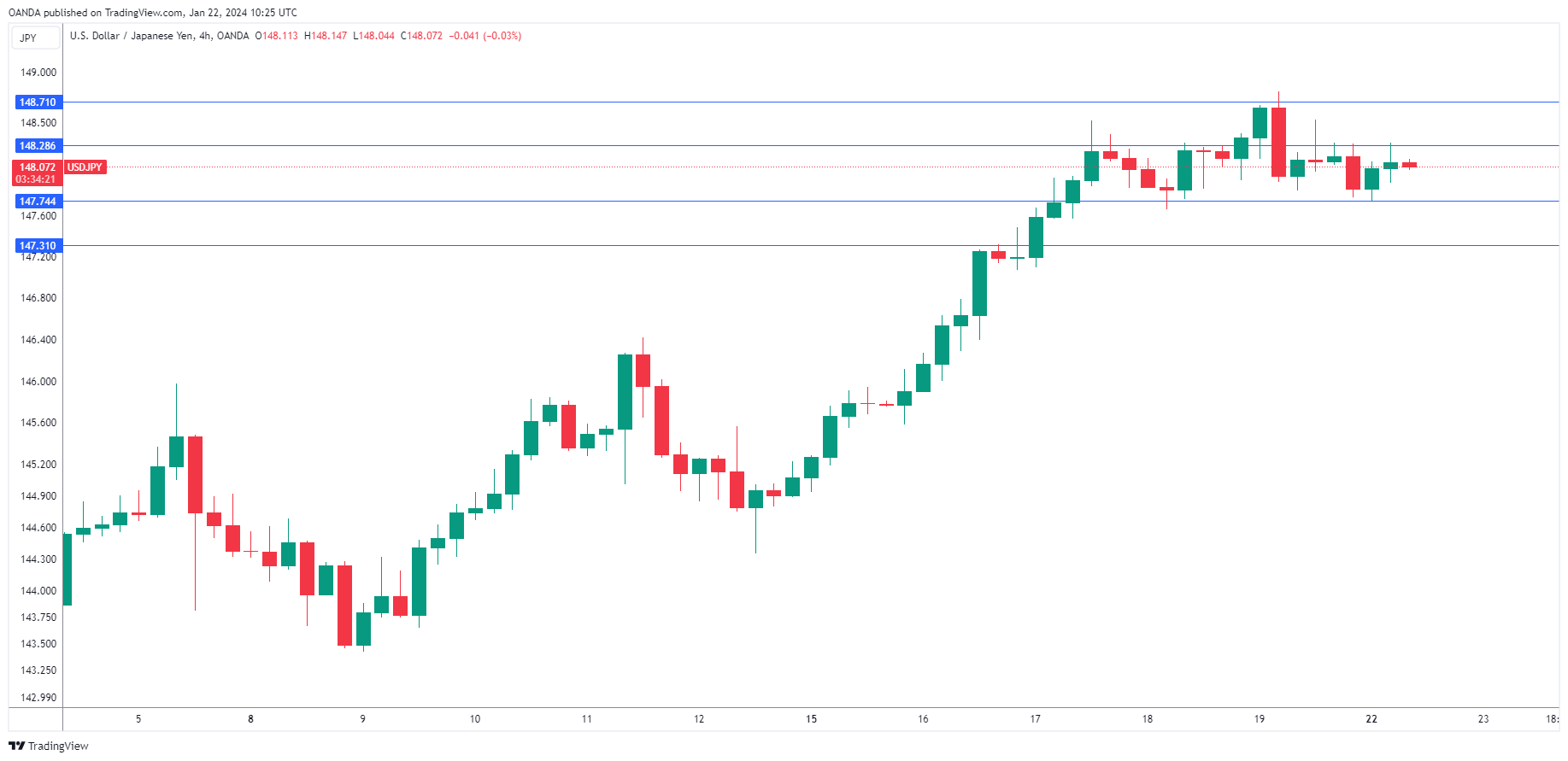
- USD/JPY tested resistance at 148.28 earlier. Above, there is support at 148.71
- There is support at 147.74 and 147.31
USD/JPY: Yen Pauses in Anticipation of Bank of Japan’s Decision
In 2024, the yen has significantly depreciated against other currencies. The USD/JPY chart indicates that since the first trading day of January, the exchange rate has risen by more than 5%. However, since the 18th, there has been a lull, and it may be disrupted today or tomorrow due to the Bank of Japan's meeting, during which comments on monetary policy will be provided.
According to Reuters, traders expect that interest rates will not be raised, remaining in the negative territory. This expectation is based on recent "peaceful" comments from the Bank of Japan, coupled with the country facing a serious test in the form of an earthquake on the west coast.
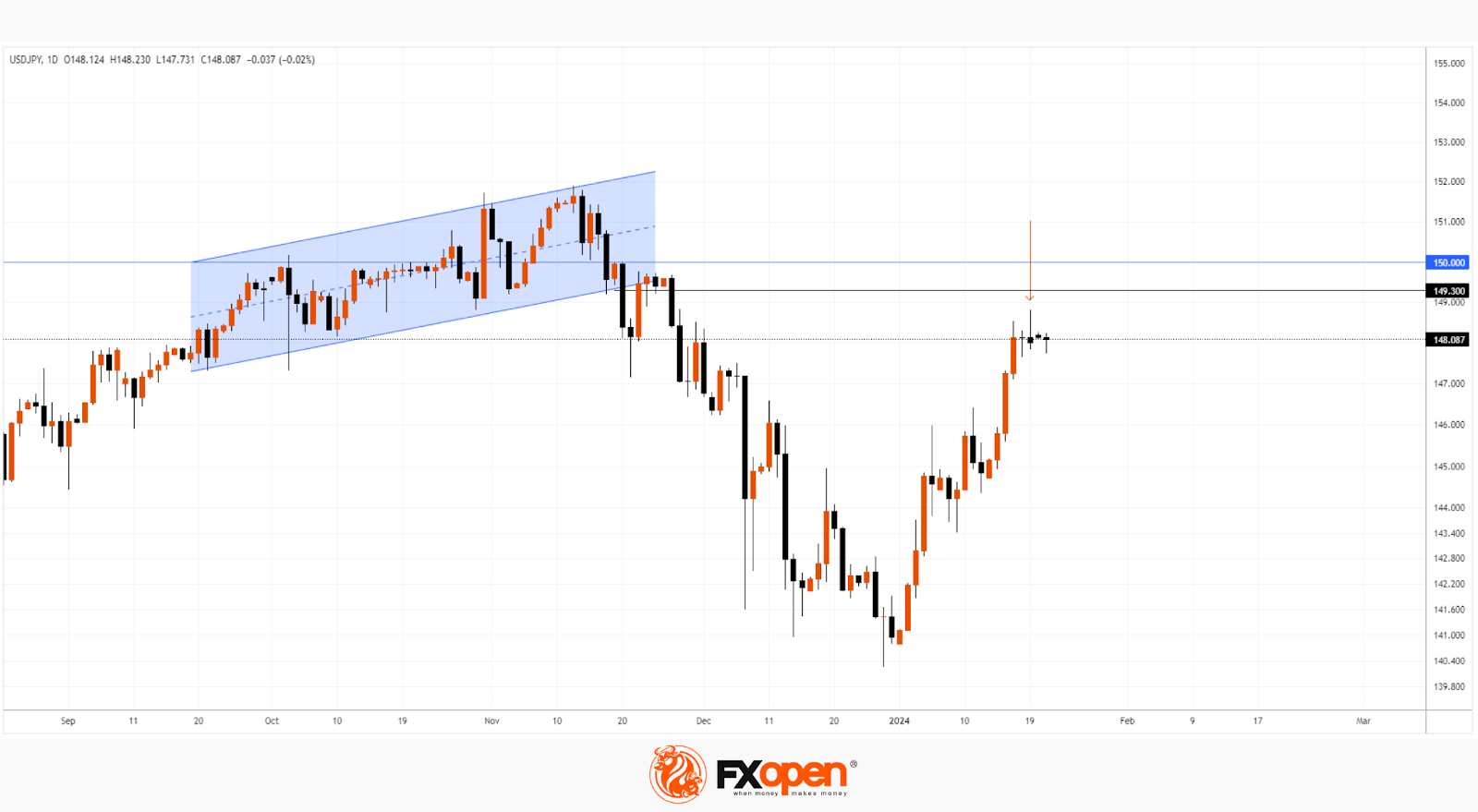
Today's technical analysis of USD/JPY suggests that buyers may have lost momentum as the price approached the psychological level of 150 yen per dollar. Judging by the long upper shadow (indicated by the arrow) on January 19, selling forces were activated. This could be attributed to either profit-taking by buyers after the rally in the first half of January or the opening of new short positions.
Pay attention to an important resistance zone (shown in blue). The bearish breakthrough occurred around the 149.3 level, confirming bearish dominance at the end of the previous year. It is possible that this dominance may persist, supporting the idea that the current calm may be disrupted in favour of the bears.
This article represents the opinion of the Companies operating under the FXOpen brand only. It is not to be construed as an offer, solicitation, or recommendation with respect to products and services provided by the Companies operating under the FXOpen brand, nor is it to be considered financial advice.
New Year, Old Habits for the BoC?
- BoC meets on Wednesday; decision to be announced at 14.45 GMT
- Market wants a dovish show, but BoC might not be ready for such a shift
- Loonie could find its footing again against the US dollar
Bank of Canada meets on Wednesday
The week will be dominated by central bank meetings with the first BoC gathering for 2024 coming on Wednesday. The market does not expect any significant announcements but would clearly enjoy a dovish meeting that could open the door to rate cuts down the line. The BoC is seen cutting by around four times in 2024 with the first 25bps rate move fully priced in by June 5, 2024. It is worth noting that the BoC has amended its communication procedures with the decision being published 15 minutes earlier than usual i.e. at 14.45 GMT and a press conference held, 45 minutes after the decision, at every meeting.
What has changed since early December 2023?
The December 6, 2023 gathering was a touch more dovish compared to the October 2023 meeting but far less than anticipated by certain market analysts. No press conference was hosted but both the Governor Macklem and the BoC member Gravelle were quite explicit in their post-meeting appearances that (1) the BoC wants to see a number of months of sustained downward momentum in core inflation, (2) it is too early to consider cutting rates and (3) the housing sector remains a big hurdle and plays a key role in the recently elevated inflation rates.
By examining the data flow since December, it is evident that no significant progress has been made on any front. Inflation for the month of December edged higher to a yearly increase of 3.4% with the prices subcomponent of the December Ivey PMI survey remaining north of 60. However, producer and raw material price indices continue to record negative yearly changes, thus setting the scene for possibly weaker price pressure down the line.
The housing sector remains a grave issue
On an equal footing, the housing sector remains a key input in the BoC’s deliberations. BoC member Gravelle devoted an entire speech in mid-December on the housing sector with the end-product being that the low supply of new homes is keeping shelter price inflation high and thus feeding through to national CPI.
Having said that, a central bank cannot directly affect the supply of new homes, but it could slow down the economy and reduce the demand for borrowing by keeping rates at current high levels for a considerable amount of time. That would probably be the outcome of Wednesday’s meeting i.e. no rate change and anticipation until inflation makes the BoC-desirable dip, barring a major surprise.
Quarterly projections matter
A small surprise could come at the quarterly Monetary Policy Report (MPR) and more specifically at the 2025 inflation projection. The October MPR had headline inflation dropping to 2.1% by the fourth quarter of 2025. Therefore, a downward revision to this figure would be the strongest signal yet that rate cuts are coming at some stage in 2024.
In addition, any BoC comments on the developments in the Middle East with its oil prices implication, could upset the market. A price war would be particularly bad for the oil-rich Canada but to a certain extent it might not displease the BoC, as lower growth would cool inflation, provided of course that such an event proves short-lived.
Could the loonie reverse its underperformance against the US dollar?
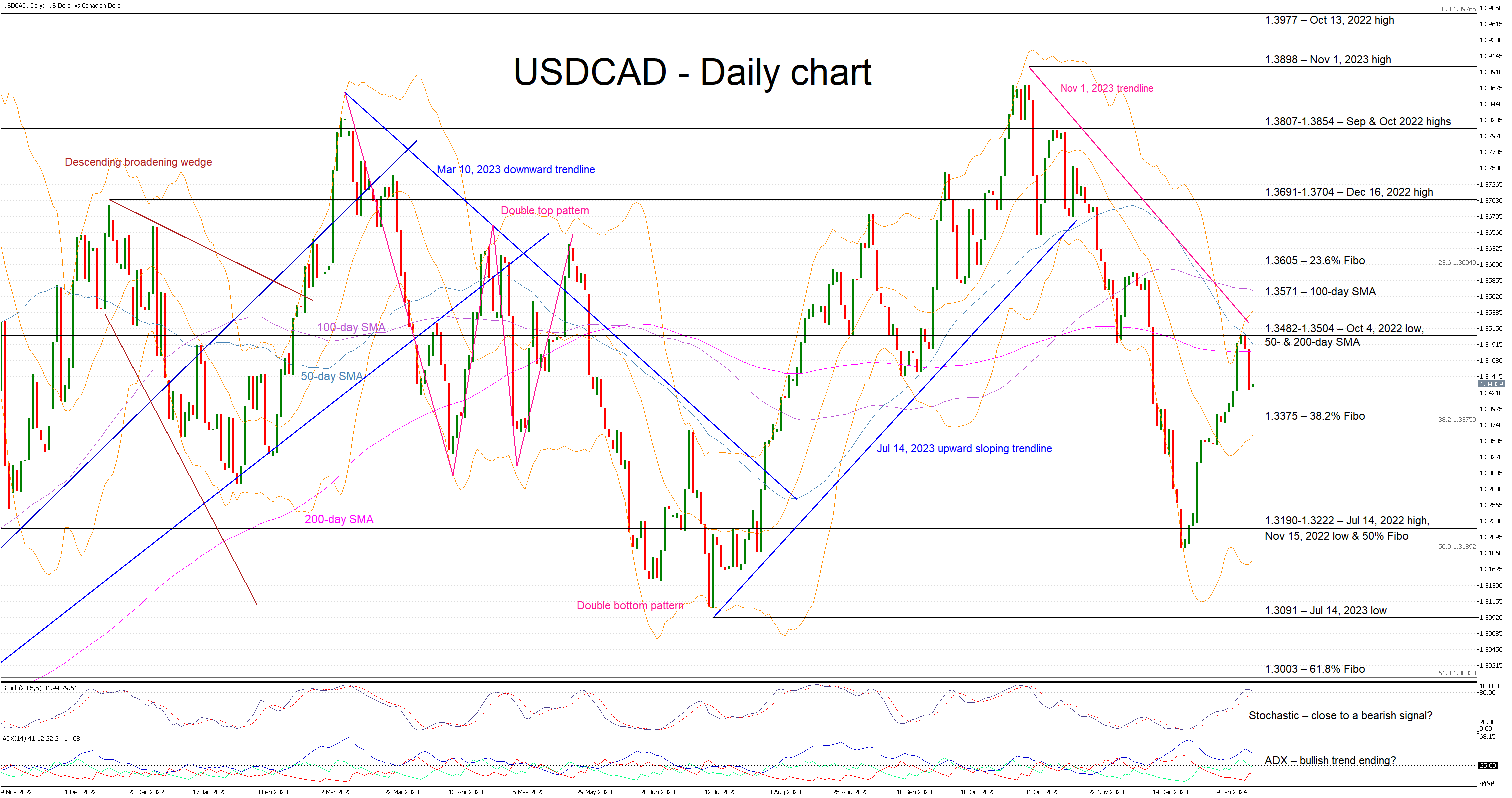
The aggressive correction recorded during the November-December 2023 period is a distant memory as in the past 20 days the US dollar has managed to rally around 2.5% against the loonie. It is currently trading below a busy area which is populated by the 50- and 200-day simple moving averages (SMAs).
A hawkish show on Wednesday could allow the loonie bulls to regain the market reins and aim for the next key support area at the 38.2% Fibonacci retracement of the April 5, 2022 – October 13, 2022 uptrend at 1.3375. On the flip side, should the BoC decide to make a dovish turn, then the US dollar-loonie pair could finally manage to overcome the busy 1.3482-1.3504 area.
Gold Lower; Tests Key Trendline
- Gold is lower again today
- Holds beneath short-term SMAs
- Momentum indicators disappoint below mid-levels
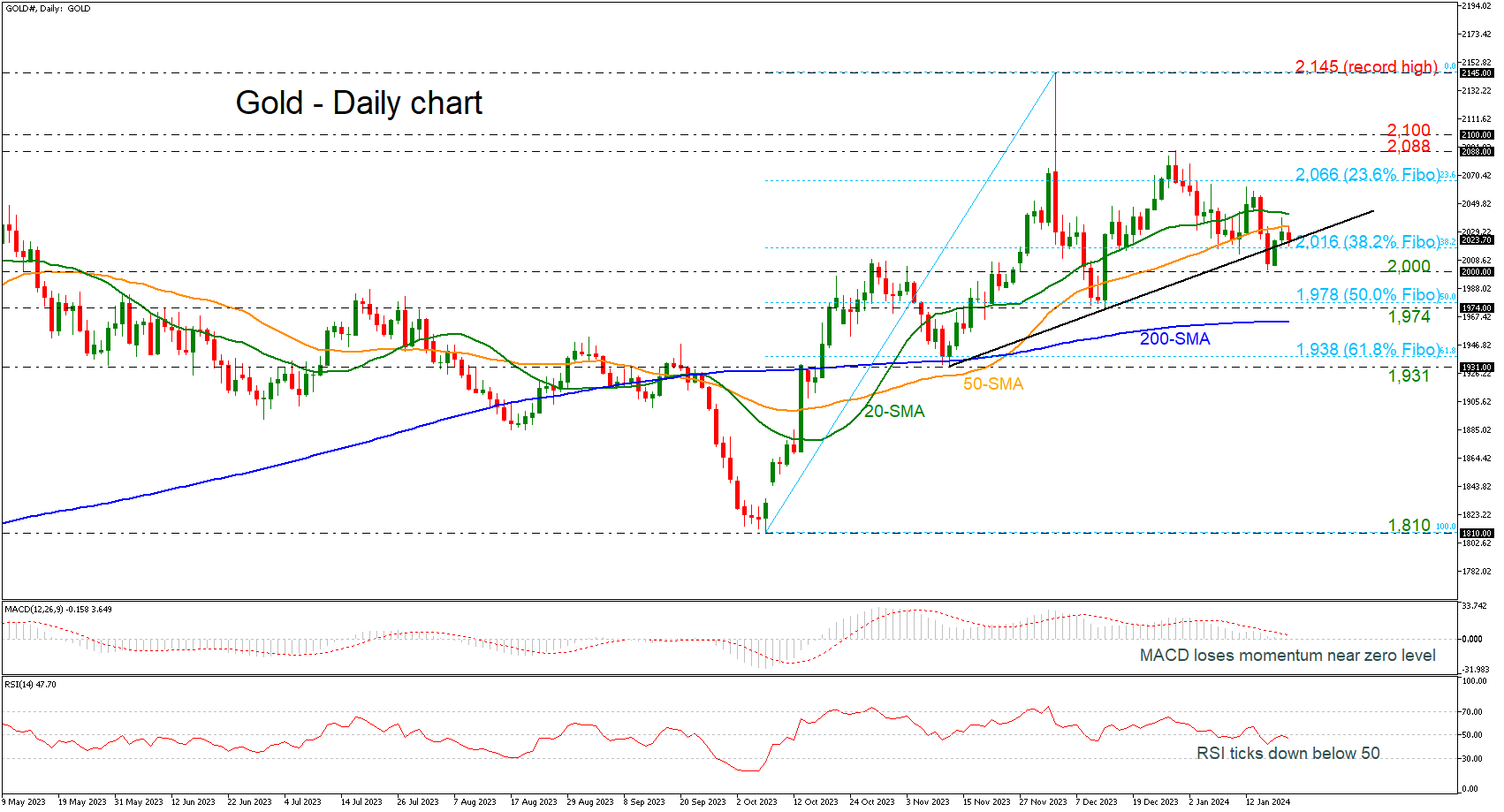
Gold prices are fighting with the short-term uptrend line, which has been drawn since mid-November, and the 38.2% Fibonacci retracement level of the upward wave from 1,810 to 2,145 at 2,016.
Also, the market is failing to surpass above the 20- and the 50-day simple moving averages (SMAs), indicating weak momentum. The MACD oscillator is moving lower beneath its trigger line and near the zero level, while the RSI is pointing south after the pullback off the 50 zone.
Should the bulls thirst for more upside moves, they would try to overcome the short-term SMAs and then test the resistance set by the 23.6% Fibonacci of 2,066. If successful, they could then plan their course for the 2,088-2,100 restrictive region ahead of the record high of 2,145.
On the other hand, the bears are probably keen on retaking market control and defending November’s trendline. They could then face the significant 2,000 region before resting near the busy area of the 50.0% Fibonacci of 1,978, the 1,974 support and the 200-day SMA at 1,964.
To sum up, gold bulls are trying to cancel out the current bearish move that has been in place since the 2,088 high, but the path higher remains tricky, especially due to the weak support from the momentum indicators.
Focus Shifts to First Major Central Bank Gatherings of the Year
Markets
The goldilocks outcome of January University on Michigan consumer confidence ended a week of weakness in US Treasuries (and core bonds in general). The headline figure unexpectedly jumped from 69.7 to 78.8 (vs 70.1 expected; highest level since July 2021), backed by both better current conditions and a more rosy view for the next 12 months. Both short (1y) and long term (5-10y) inflation expectations declined, respectively from 3.1% to 2.9% (lowest since early 2021) and from 2.9% to 2.8%. Daily changes on the US curve varied between +3.2 bps (2-yr) and - 3.6 bps (30-yr). The front end of the curve still underperformed as more Fed governors pushed back against aggressive rate cut pricing. Atlanta Fed Goolsbee was the latest, suggesting that markets may have put the cart before the horse on cuts. SF Fed Daly added that monetary policy and the economy are in a good place so the Fed can be patient. She thinks that it’s far too early to declare victory on inflation. The market implied probability of a March Fed rate cut fell to 40%, coming from 80% at the start of the year. US equity markets rallied into the weekend following the Michigan release, gaining 1% (Dow) to 1.70% (Nasdaq). The S&P 500 added 1.23% to a fresh all-time high. The US dollar faded into the weekend with EUR/USD closing just below 1.09.
Today’s eco calendar is completely empty. Focus shifts to first major central bank gatherings of the year. Chronologically, the Bank of Japan has a first go tomorrow. Rumours suggested downward revisions to the near term growth outlook and the near/medium term inflation outlook. Together with uncertainty related to external events like the severe earthquake, it suggests that the BoJ is in no hurry to implement a real policy U-turn (ending negative policy rates). The Japanese yen is the biggest victim of this continued soft stance in combination with new weakness in core bonds. The Bank of Canada convenes on Wednesday. December Canadian inflation data unexpectedly showed new momentum in underlying price trends, suggesting the BoC won’t be able to flag a rapid start to policy rates cuts. They could nevertheless turn somewhat more neutral as they still vowed to raise the policy rate (5%) further if needed. On Thursday, the duo of Norges Bank and ECB decide on monetary policy. A faster-thanhoped Norwegian disinflation process and a slightly stronger NOK could prompt the Norges Bank to pull its Dec 2024 first rate cut call forward in time. ECB President Lagarde pushed back against aggressive market expectations at the WEF in Davos. She suggested a first rate cut only in summer. Media concluded that European central bankers are preparing a June rate cut, with the jury still out whether June 6 can already be labelled “summer”. If not, our view, we’re talking about a July rate cut at the very earliest with markets still convinced about an April move. We expect Lagarde to hold this week’s line which should underpin this year’s trend (higher) on interest rate markets.
News and views
The European Commission will on Wednesday unveil a proposal with rules that aim boosting its power to screen and potentially block foreign investment in sensitive industries. The EC is also said considering the creation of a fund to increase development of technologies both for miliary and civil purposes. The proposal comes as the covid pandemic and geopolitical developments over the previous years highlighted Europe’s trade vulnerabilities and the region’s reliance of supplies from other countries.. According to Bloomberg, this week’s package will include five initiatives including strengthening of foreign direct investment regulation, coordination of export controls, options to support research of dual-use technologies, Ideas to improve research security and firs steps toward a new tool to control leaks of sensitive know-how to adversaries through European investments overseas.
Chinese Banks held their benchmark lending rates unchanged at 3.45% for the 1y loan prime rate and 4.20% for the 5y loan lending rate. The new pricing follows after the PBOC last week unexpectedly kept the rate on its medium term lending facility unchanged at 2.4%. This decision came even after recent data showed that the economic recovery struggles to gain further traction and as several indicators show deflationary tendencies. However, the PBOC apparently wants to avoid a further deprecation of the currency. The yuan eases marginally this morning to USD/CNY 7.1965. It finished 2023 at USD/CNY 7.10.