

Sample Category Title
GBP/USD Daily Outlook
Daily Pivots: (S1) 1.2672; (P) 1.2694; (R1) 1.2725; More...
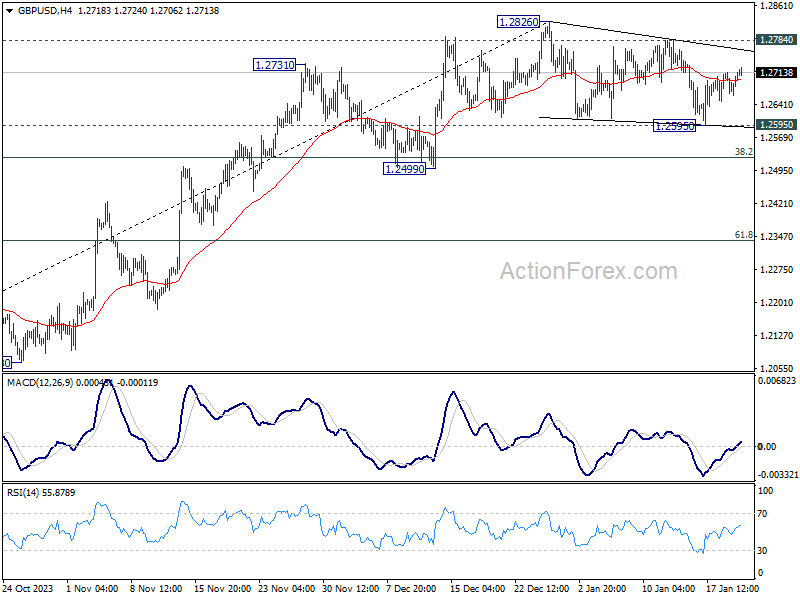
Intraday bias in GBP/USD stays neutral for the moment. Consolidation pattern from 1.2826 could extend further. Break of 1.2595 support will target 1.2499 support. On the upside, however, firm break of 1.2784 resistance will suggest that the consolidation pattern has completed. Further rally should then resume through 1.2826 towards 1.3141 high.
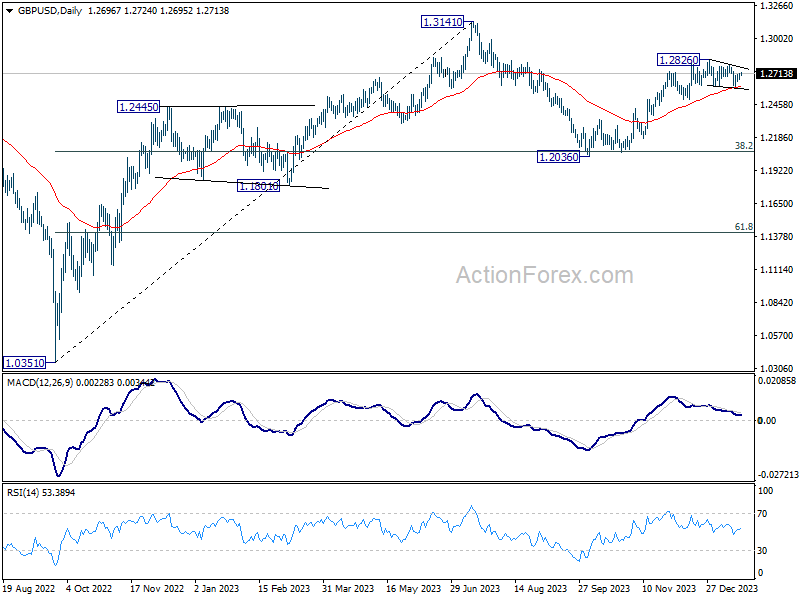
In the bigger picture, price actions from 1.3141 medium term top are seen as a corrective pattern to up trend from 1.0351 (2022 low). Rise from 1.2036 is seen as the second leg that's in progress. Upside should be limited by 1.3141 to bring the third leg of the pattern. Meanwhile, break of 1.2499 support will argue that the third leg has already started for 38.2% retracement of 1.0351 (2022 low) to 1.3141 at 1.2075 again.
USD/CHF Daily Outlook
Daily Pivots: (S1) 0.8666; (P) 0.8685; (R1) 0.8700; More....
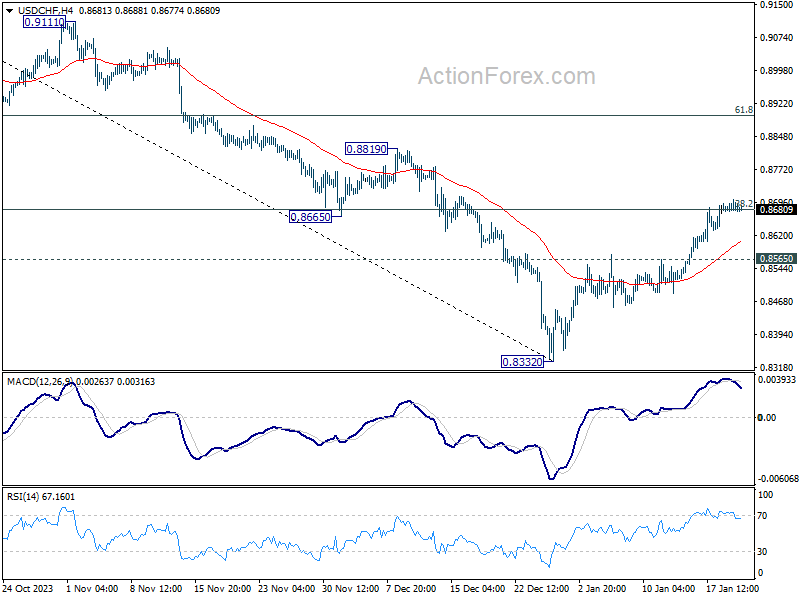
Outlook in USD/CHF remains unchanged, with focus on 38.2% retracement of 0.9243 to 0.8332 at 0.8680, which coincides 55 D EMA (now at 0.8687). Decisive break there will turn near term outlook bullish for 61.8% retracement 0.8995. Nevertheless, break of 0.8565 minor support will turn intraday bias back to the downside for retesting 0.8332 low.
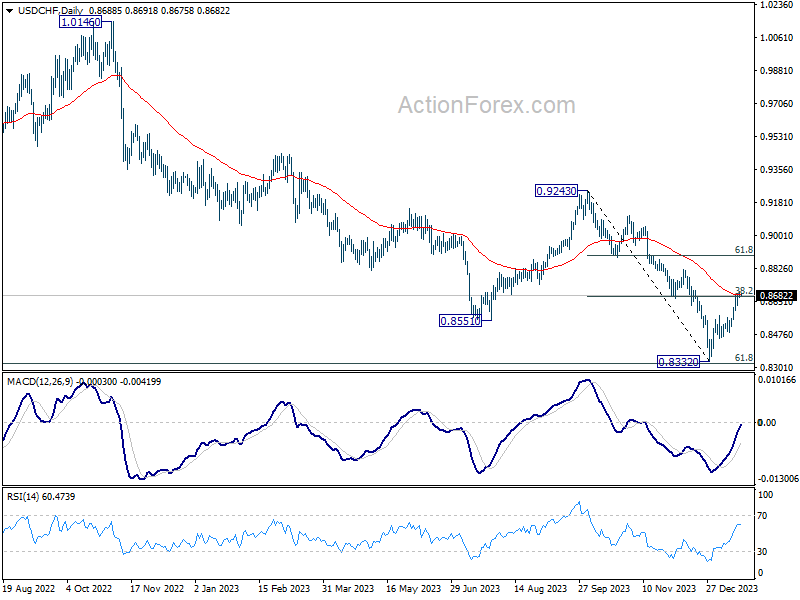
In the bigger picture, while rebound from 0.8332 could be strong, there is no clear sign of medium term bottoming yet. This rebound is tentatively seen as a corrective move for now. Also, outlook will stay bearish as long as 0.9243 resistance holds. Larger down trend from 1.0146 (2022 high) should resume through 0.8332 low at a later stage.
USD/JPY Daily Outlook
Daily Pivots: (S1) 147.74; (P) 148.28; (R1) 148.71; More...
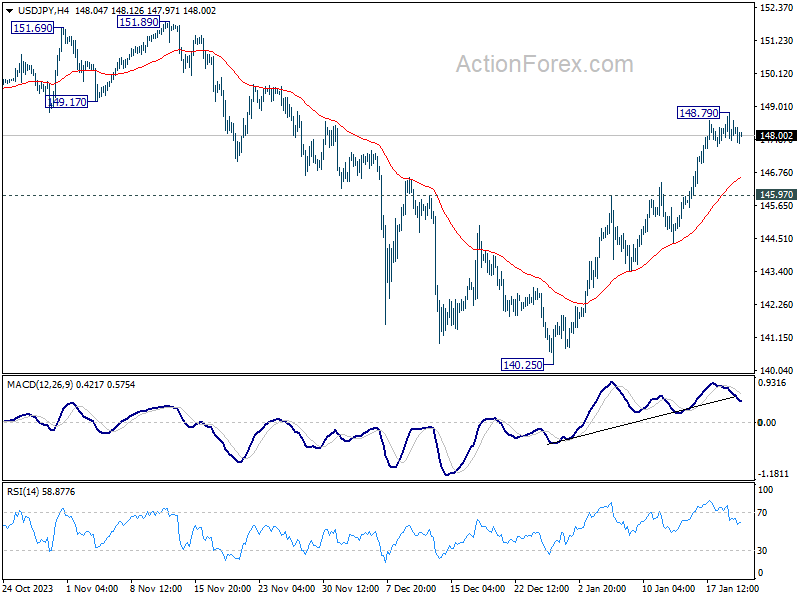
Intraday bias in USD/JPY remains neutral for consolidation below 148.79 temporary top. Further rally is expected as long as 145.97 resistance turned support holds. Corrective all from 151.89 should have completed at 140.25 already. Break of 148.79 will resume the rise from there for retesting 151.89/93 key resistance zone.
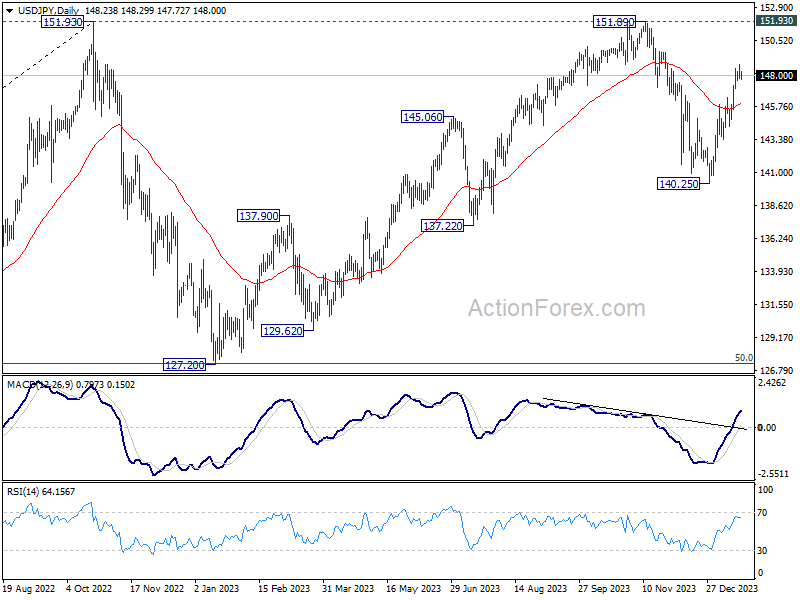
In the bigger picture, stronger than expected rebound from 140.25 dampened the original bearish review. Strong support from 55 W EMA (now at 141.89) is also a medium term bullish sign. Fall from 151.89 could be a correction to rise from 127.20 only. Decisive break of 151.89/93 will confirm resumption of long term up trend. This will now be the favored case as long as 140.25 support holds.
USD/CAD Daily Outlook
Daily Pivots: (S1) 1.3403; (P) 1.3453; (R1) 1.3478; More...
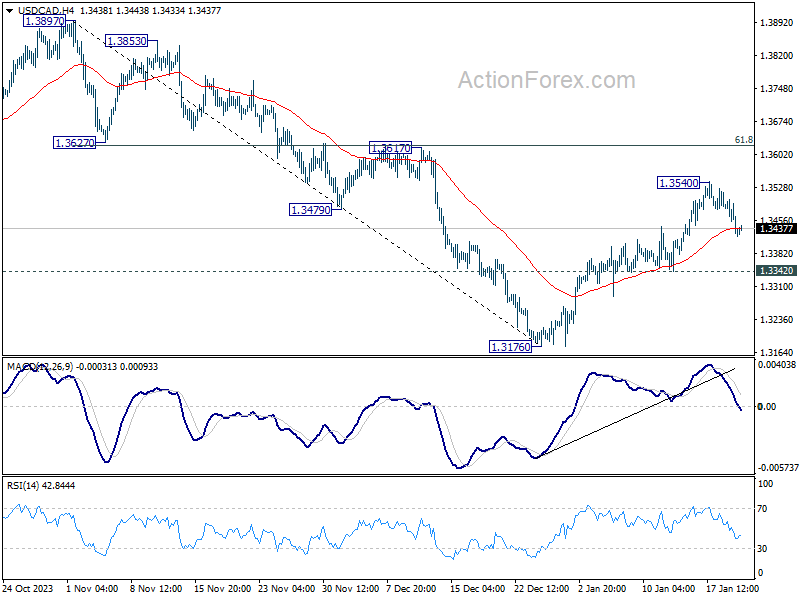
Intraday bias in USD/CAD remains neutral at this point, and some more consolidations could be seen below 1.3540. But further rally is expected as long as 1.3342 minor support holds. Fall from 1.3897 should have completed at 1.3716. Break of 1.3540w ill target 1.3617 cluster resistance (61.8% retracement of 1.3897 to 1.3176 at 1.3622). Decisive break there will pave the way to 1.3897/3976 key resistance zone.
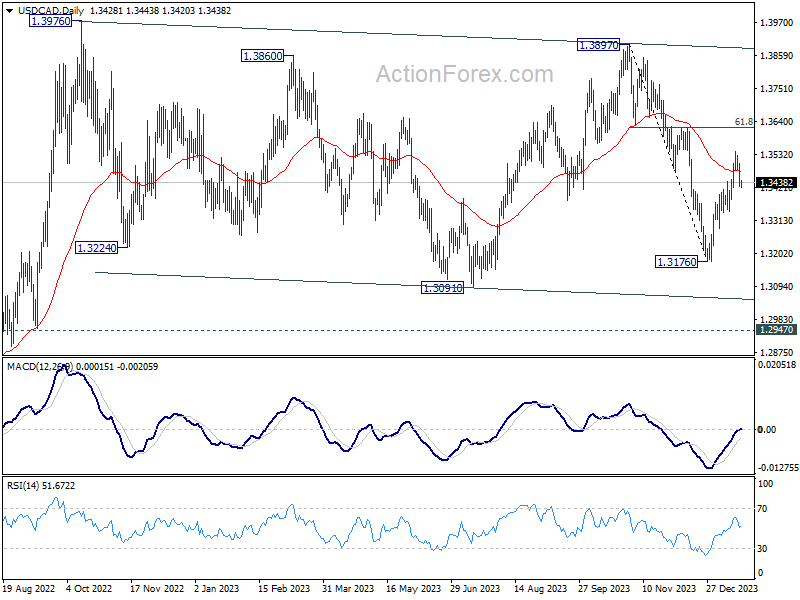
In the bigger picture, price actions from 1.3976 (2022 high) are viewed as a corrective pattern only. In case of another fall, strong support should emerge above 1.2947 resistance turned support to bring rebound. Overall, larger up trend from 1.2005 (2021 low) is still expected to resume through 1.3976 at a later stage.
Busy Week Ahead: Tech Earnings and Central Bank Meetings
Friday’s economic data was yet another proof of the diverging fortunes between the US economy and the rest of the developed world. In the morning, the UK announced that its retail sales slumped for the second straight year, fueling the worries of a mild recession in the UK this year. But in the afternoon, Michigan’s consumer sentiment index showed an advance to a more than two year high, the expectations improved more than expected, with falling inflation expectations as a cherry on top. Remember, the US retail sales also showed a shiny number for the past holidays season.
The prospects of Federal Reserve (Fed) rate cuts and the likely scenario of soft landing hint that there is a growing chance that we see the US 10-year yield go back to where it belongs – above the 2-year yield. Right now, the US 2-year yield stands near 4.40%, the 10-year yield advanced past the 4.10%, the US dollar has been unable to clear the 200-DMA last week, but the strong US data versus weak data from the rest of the world would justify a swift move above this 200-DMA and the US stocks – especially the US technology stocks continue to fly high in the first month of this new year. The S&P500 finally hit an ATH level last Friday. Nvidia extended its gains to a fresh record as well, thanks to Meta’s announcement that it will be buying 350’000 cutting-edge chips from Nvidia to power its AI systems. Some estimate that Meta’s purchases will ensure around $10bn revenue this year for Nvidia from Meta alone.
Overall, strong US economic data has been tempering the expectation of a March rate cut from the Fed. But the Fed is still broadly expected to cut in May, if it doesn’t in March. The US yields are drifting gently higher from last year’s end levels. The rebounding yields weigh heavier on the S&P493; the equal weighted index continues to underperform the Magnificent 7.
The earnings season continues full swing with Netflix and Tesla due to announce their latest quarterly results this week.
The week’s economic calendar is also busy with major central bank meetings including the Bank of Japan (BoJ), the European Central Bank (ECB) and the Bank of Canada (BoC).
The BoJ will not normalize rates this week. In the best-case scenario, it will give further hints regarding the timing of the first rate hike – perhaps April. More realistically, the Japanese policymakers will push back on the normalization expectations and say that the monetary policy in Japan will remain supportive for as long as needed. The USDJPY opened the week near the 148 level. The risks are tilted to the downside as the risk of a verbal intervention increases into the 150 level.
The ECB and the BoC will certainly keep their rates unchanged, but the nuance in their accompanying statement will be closely watched for any hints regarding the first rate cut. ECB Chief Lagarde said last week in Davos that the ECB could lower rates by or in summer. The EURUSD is flirting with the 1.09 level this morning. Any hint that the ECB is ready to cut rates will weaken the euro bulls’ hands for a sustainable rise above the 1.10 level.
We Expect BoJ to Stay on Hold
In focus today
We start off the week with low activity on the data release front.
In Denmark the monthly employment statistics for November is released Monday morning.
Early Tuesday we await the rate decision from the first policy meeting from Bank of Japan in 2024. We expect the Bank of Japan to stay on hold. Wage growth remains the key missing piece of the puzzle before they can raise the policy rate out of negative and let go of the yield curve. We expect they will be ready to do that once we have hard evidence that the Shunto (spring wage negotiations) results in wage acceleration.
This week's main event is the ECB meeting on Thursday, where we expect rates to stay on hold for now, but signal that the next rate change most likely is a cut, which may happen in the summer. We also look out for Thursday's rate decision from Norges Bank, January PMIs on Wednesday and Tokyo January CPI print from Japan on Friday. Focus will also be on the US earnings season, where companies from a broader selection of sectors (including IT) will report.
Economic and market news
What happened overnight
In China the People's Bank of China kept its loan prime rates unchanged. This means that the one-year and five-year loan Prime Rates will remain at 3.45% and 4.2%, respectively. The move was in line with expectations, after the People's Bank surprisingly kept the medium-term lending facility unchanged last week, despite the consensus of a cut.
In the Republican primary election, Ron DeSantis suspended his campaign and endorsed Donald Trump becoming the republican nominee for the 2024 US presidential election, leaving Nikki Haley as Trump's sole competitor in the race. The decision was made in the aftermath of last week's first round Iowa election where Ron DeSantis gained 21% of votes compared to Donald Trump's 51%. Tomorrow, the primary election heads to New Hampshire for the second round.
What happened over the weekend
In the US, the University of Michigan's consumer sentiment survey showed that the consumer sentiment improved markedly from 70.1 to 78.8 (consensus: 69.7) as current conditions and expectations improved. This is the highest level since July 2021. 5-10Y inflation expectations fell from 2.9% to 2.8% in January (consensus: 3.0%), though still close to the 3% average over the past year. Short-term inflation expectations (1Y) declined to 2.9% from 3.1% in December.
In the UK, December retail sales dropped more than expected, at the fastest pace since early 2021, raising concerns over the health of the economy in late 2023.
Equities: Global equities were higher on Friday with S&P 500 reaching a new all-time high. This will of course happen from time to time but it was the first time in more than two years for the big refence index to set a new high. Our benchmark index, the MSCI world local currency index also made a new high. Just as interesting, the index is almost 35% higher since October 2022 and based investor surveys a period of historical underweights among profession investors. This should serve as a lesson on risk of being underweight and too defensive. Very often we meet investors seeing the risk in being overweight risk but not so much vice versa. On Friday there was big appetite for cyclical, large cap growth stocks. Global big tech outperformed consumer staples by 2.5% although yields continued to push higher. However, as emphasised several times in our Espresso, as long as yields are higher for the right reasons it is not a problem. On Friday, US consumer confidence increased significantly while inflation expectations dropped further. In US on Friday, Dow +1.1%, S&P 500 +1.2%, Nasdaq +1.7%, Russell 2000 +1.1%.
FI: Friday was a relatively volatile session in bond markets as investors continued to digest the hawkish signals from central banks during the week. Initially, long government bond yields dipped early in the session, but the move was swiftly reversed in the afternoon following the release of a stronger-than-expected US Michigan Consumer Survey for January. Meanwhile, 2Y Bund yields climbed by 5bp, reflecting ongoing adjustments to ECB expectations. Ahead of this week's meeting, the pricing of ECB rate cuts for the year stands at 130bp vs. 150bp last Monday. The Bund ASW-spread widened after consequent tightening for most of the week. The issuance pressure in the coming weeks will continue to be significant.
FX: USD/Scandies have started 2024 on a strong note, though last week was one where the USD consolidated vs most G10 peers. EUR/USD closed Friday a notch below 1.09, USD/JPY close to 148, USD/SEK in the mid-10.40s and USD/NOK just below 10.50. Meanwhile, NOK/SEK is again closing in on parity. This week offers a lot of important macro events to digest for FX, fixed income and equities including the ECB meeting on Thursday and US PCE data on Friday.
AUD/USD Daily Report
Daily Pivots: (S1) 0.6575; (P) 0.6588; (R1) 0.6611; More...
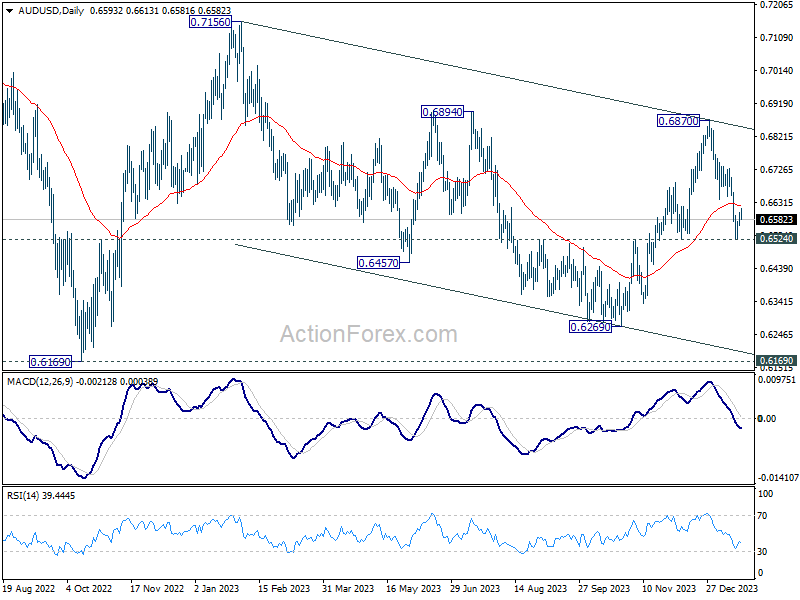
Intraday bias in AUD/USD remains neutral at this point. Some more consolidations could be seen above 0.6524 temporary low. But further decline is expected as long as 0.6639 support turned resistance holds. Firm break of 0.6524 support will argue that whole rebound from 0.6269 has completed, and bring deeper fall to this support.
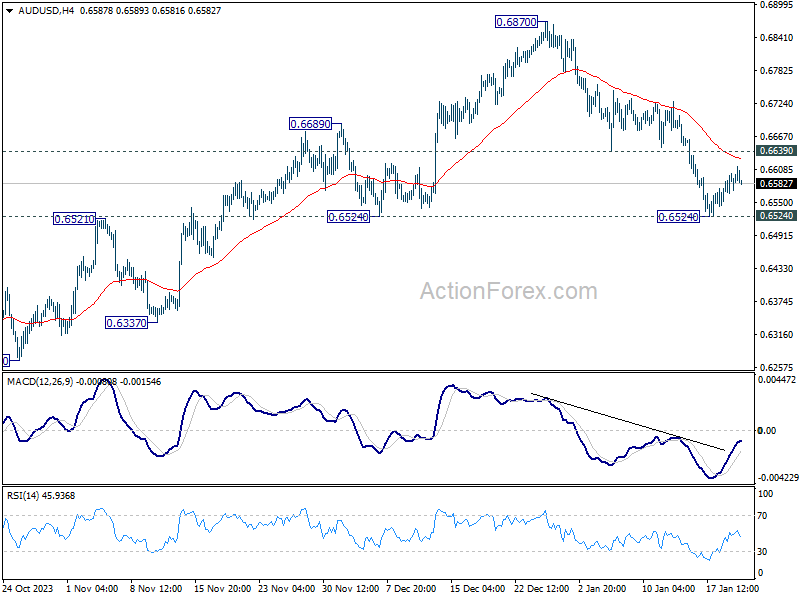
In the bigger picture, price actions from 0.6169 (2022 low) are seen as a medium term corrective pattern to the down trend from 0.8006 (2021 high). Sideway trading could continue in range of 0.6169/7156 for some more time. But as long as 0.7156 holds, an eventual downside breakout would be mildly in favor.
Contrasting Trends in Asia; BoJ, BoC and ECB to Highlight a Busy Week
Asian markets highlights sharp divergence in trends today. Nikkei surged to new 34-year high, buoyed by last week's record closes in US and bolstered by expectations that BoJ will maintain its negative interest rate policy in the this week's meeting. Japanese stock market is also riding on the optimism that BoJ is not in a rush to tighten its monetary policy, with the earliest rate hike not expected until April. However, this April decision on rate hikes will still hinge on new economic projections due tomorrow and the results of upcoming spring wage negotiations.
In stark contrast, stocks in Hong Kong and China extended their downtrend, with significant plunges of more than -2% and -1%, respectively. Investors in these markets are showing dissatisfaction with the Chinese government's lack of substantial stimulus to boost the sluggish economy and counter deflationary pressures. Additionally, there appears to be an emerging sentiment among heavyweight investors favoring investment "anywhere-but-China."
In the currency markets, most major pairs and crosses are currently trading within Friday's range. Australian Dollar is leading the decline among commodity currencies, while Swiss Franc is also under pressure. Sterling stands out as the strongest at this point, followed closely by Yen and Euro, with Dollar showing mixed performance. Trading might remain subdued today due to a near-empty economic calendar, but several important events loom on the horizon. These include BoJ, BoC, and ECB meetings, as well as crucial economic data like US GDP and PCE inflation, in addition to global PMI data.
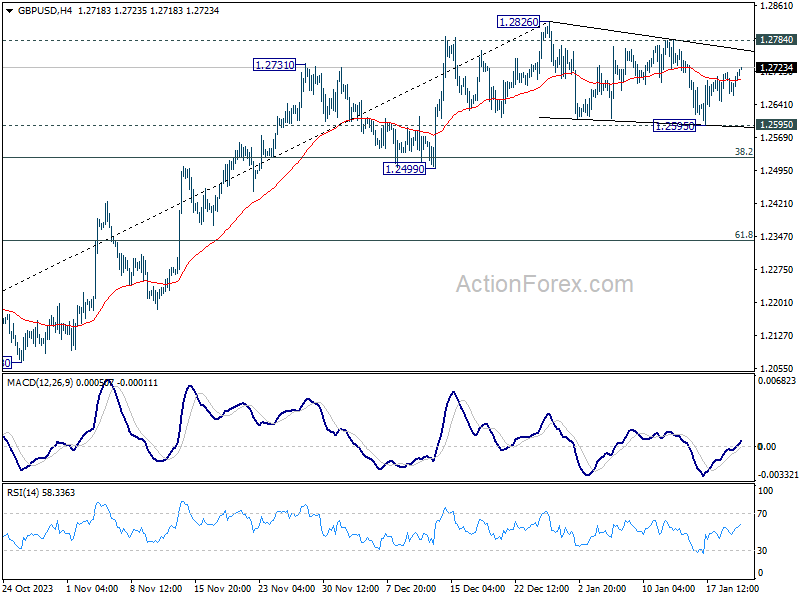
Technically, GBP/USD's rebound from 1.2595 is picking up some momentum today. It's plausible that consolidation pattern from 1.2826 has completed with three waves down to 1.2595. Firm break of 1.2784 will argue that larger up trend is ready to resume through 1.2826 high. This is a development to watch in the next two to three days, with UK PMIs on Wednesday a possible trigger.
In Asia, at the time of writing, Nikkei is up 1.59%. Hong Kong HSI is down -2.30%. China Shanghai SSE is down -1.34%. Singapore Strait Times is up 0.20%. Japan 10-year JGB yield is down -0.0107 at 0.658.
PBoC holds 1-yr and 5-yr LPR steady
People's Bank of China announced today that it would maintain one-year loan prime rate at 3.45%, a level unchanged since August last year. Similarly, five-year rate, critical for mortgage financing, remains steady at 4.2%, consistent since its last reduction in June. This decision follows PBoC's unexpected move last week to keep its medium-term lending facility rate stable.
PBoC's decision to hold rates steady comes amid a sluggish economic environment in China, coupled with increasing deflationary pressures. Despite these challenges, the central bank appears reluctant to employ interest rate reductions as a tool to stimulate the economy, primarily due to concerns over the depreciating Yuan. PBoC might continue to avoid further rate cuts until Yuan regains some stability, to prevent exacerbating the currency's depreciation.
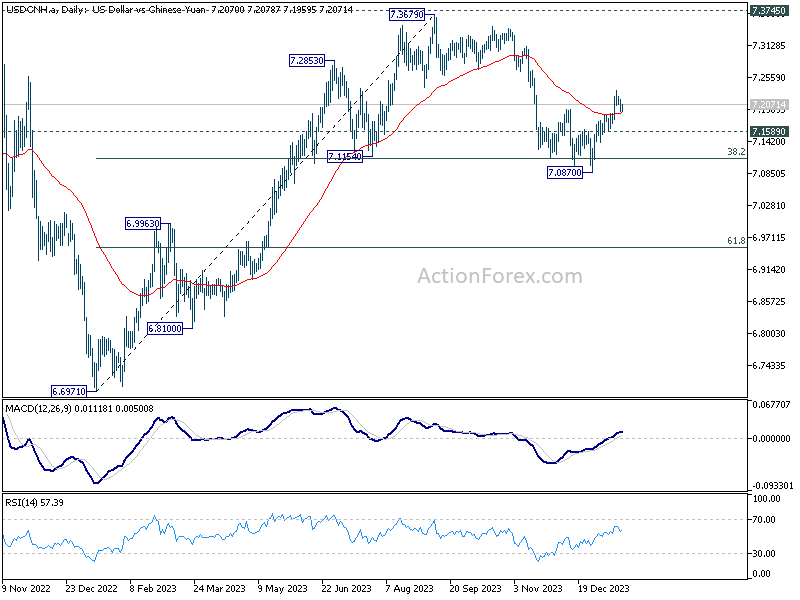
USD/CNH's break of 55 D EMA last week suggests that the corrective pull back from 7.3679 has completed at 7.0870 already. That came after drawing support from 38.2% retracement of 6.6971 to 7.3679 at 7.1117. Further rise is now mildly in favor as long as 7.1589 minor support holds, back to retest 7.3679 high.
BoJ, BoC and ECB to stand pat; Lots of top tier data too
BoJ, BoC and ECB are all expected to keep monetary policy unchanged this week. It's unlikely for BoJ Governor Kazuo Ueda to drop any hints on negative interest rate exit for now. Ueda would reserve that card for March meeting, if BoJ is to raise interest rate eventually in April. Yet, some subtle hints could be seen in the new quarterly economic projections. There were reports about BoJ lowering core inflation forecast of fiscal 2024 due to falling oil prices. But instead, the key is on the inflation forecast through fiscal 2026. The chance of a hike could increase notably if BoJ sees core inflation staying around 2% target through this horizon.
As for BoC, attention will be on how much longer will it keep interest rate at current level of 5.00%. The central bank will likely push back against the idea that rate cuts are coming soon, emphasizing that inflation remains sticky. A recent Reuters poll indicated mixed expectations: while 22 of 34 respondents anticipated rate cuts to commence in June or later, 12 predicted an initial cut in April. The survey's median suggests a cumulative 100 basis points reduction in rates to 4.00% this year..
ECB's communications are not expected to deviate from the chorus of comments out of Davos last week. President Christine Lagarde would continue to push back on speculation of an early rate cut. The question is whether should would explicitly noted summer is the likely timing for the start of policy loosening. March is the more likely meeting for any substantial shift in tone, given that new economic projections will then be available. A Reuters poll showed a divide in expectations: 55% of respondents predicted no easing until at least the second half of the year, while a significant minority of 45% anticipated a reduction in borrowing costs as early as June.
In terms of economic data, US Q4 GDP and December PCE inflation will be major focal points for the Dollar. Other data with the potential to impact respective currencies include Germany's Ifo business climate, New Zealand's CPI, and Japan's Tokyo CPI. Additionally, PMI data from US, Eurozone, UK, Japan, and Australia will be closely scrutinized for insights into global economic health and potential market movements.
Here are some highlights for the week:
- Monday: US leading index.
- Tuesday; New Zealand BNZ services; Australia NAB business confidence; BoJ rate decision; UK public sector net borrowing; Canada new housing price index; Eurozone consumer confidence.
- Wednesday: New Zealand CPI; Australia PMIs; Japan trade balance, PMI manufacturing; Eurozone PMIs; UK PMIs; BoC rate decision; US PMIs.
- Thursday: Germany Ifo business climate; ECB rate decision; US GDP, jobless claims, durable goods orders, trade balance, new homes sales.
- Friday: Japan Tokyo CPI, SPPI, BoJ minutes; UK Gfk consumer sentiment; Germany Gfk consumer sentiment; Eurozone M3 money supply; US personal income and spending, PCE inflation, pending home sales.
AUD/USD Daily Report
Daily Pivots: (S1) 0.6575; (P) 0.6588; (R1) 0.6611; More...
Intraday bias in AUD/USD remains neutral at this point. Some more consolidations could be seen above 0.6524 temporary low. But further decline is expected as long as 0.6639 support turned resistance holds. Firm break of 0.6524 support will argue that whole rebound from 0.6269 has completed, and bring deeper fall to this support.
In the bigger picture, price actions from 0.6169 (2022 low) are seen as a medium term corrective pattern to the down trend from 0.8006 (2021 high). Sideway trading could continue in range of 0.6169/7156 for some more time. But as long as 0.7156 holds, an eventual downside breakout would be mildly in favor.
Economic Indicators Update
| GMT | Ccy | Events | Actual | Forecast | Previous | Revised |
|---|---|---|---|---|---|---|
| 15:00 | USD | Leading Index M/M Dec | -0.30% | -0.50% |
Technical Outlook and Review
DXY:
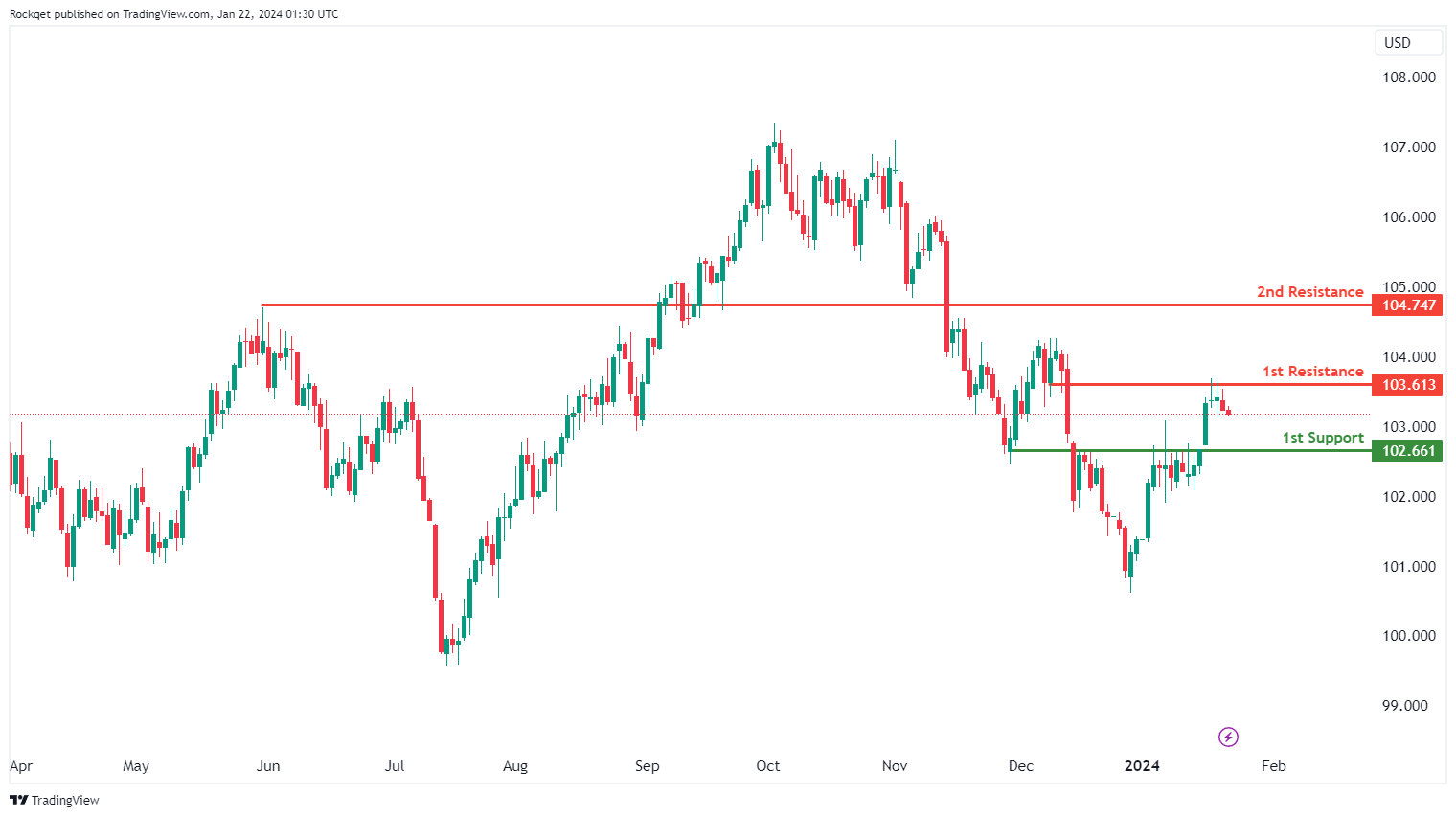
The DXY (US Dollar Currency Index) chart is currently experiencing a bearish overall momentum, indicating weakness in the US Dollar. According to your analysis, there is potential for a bearish continuation towards the 1st support level.
The 1st support at 102.66 is considered a significant level of support due to its categorization as a pullback support. This implies that it may serve as an important area where the price could potentially find support during a bearish move.
On the resistance side, the 1st resistance at 103.61 is recognized as an overlap resistance, indicating that this price level has previously acted as both support and resistance. This historical significance makes it a potential barrier where selling pressure could emerge.
The 2nd resistance at 104.74 is identified as a pullback resistance, suggesting that it may serve as a significant resistance point during price pullbacks.
EUR/USD:
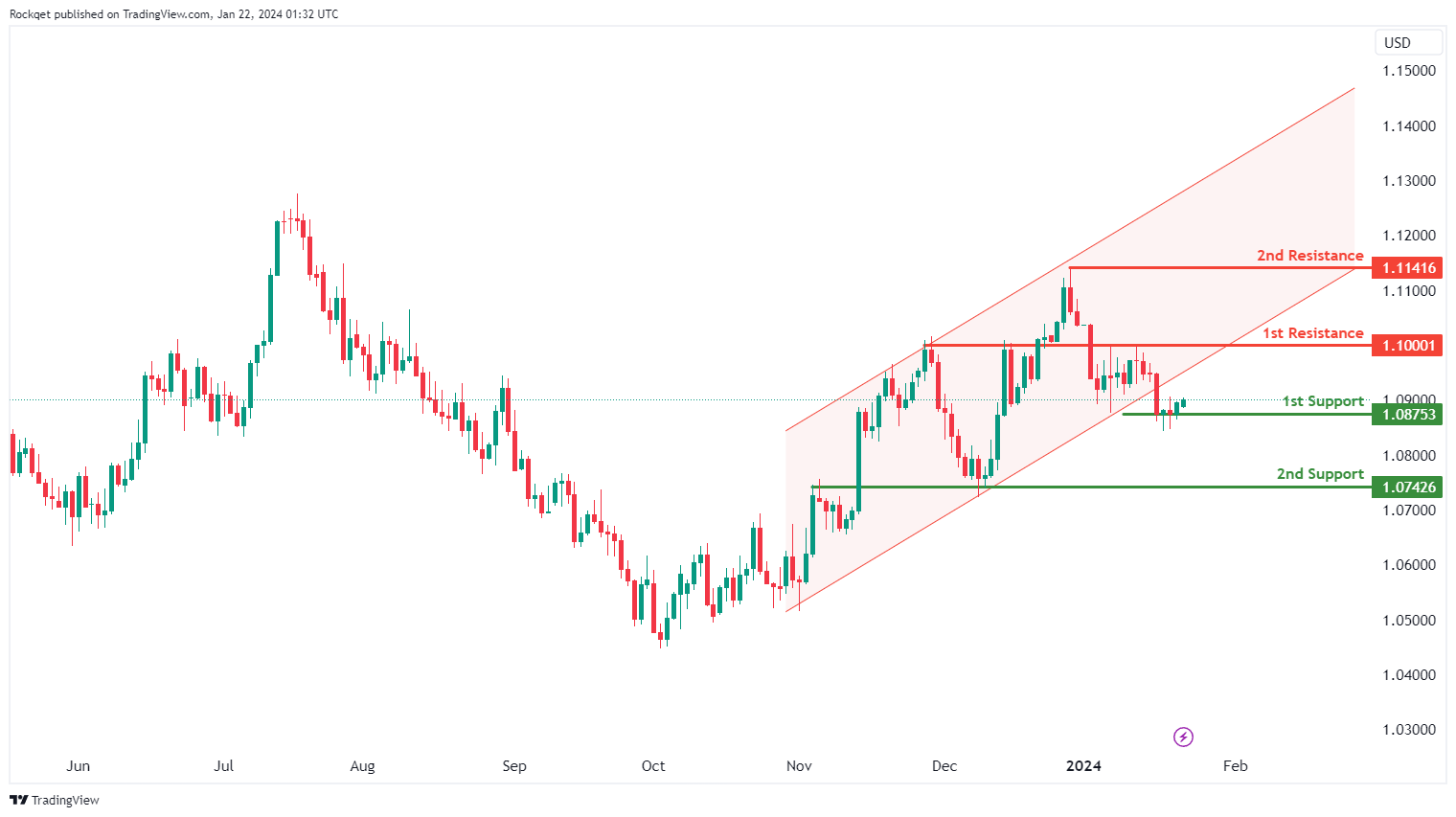
The EUR/USD trading pair is currently exhibiting a bearish overall momentum, with the momentum being driven by the observation that the price has broken below the lower channel line, which typically signifies a continuation of the prior bearish trend.
There is potential for a short-term rise in price towards the 1st resistance level before a reversal and a subsequent drop towards the 1st support level.
The 1st support level at 1.0875 is considered significant as it represents a multi-swing low support. This suggests that it has historically been a level where the price has found support during previous downtrends, making it a potential area of interest for buyers.
The 2nd support level at 1.0742 is identified as an overlap support, indicating that it has previously acted as both support and resistance. This historical significance reinforces its potential as a support level during price declines.
On the resistance side, the 1st resistance level at 1.1000 is recognized as an overlap resistance, implying that it has previously served as both support and resistance. This makes it a potential barrier where selling pressure may emerge.
EUR/JPY:
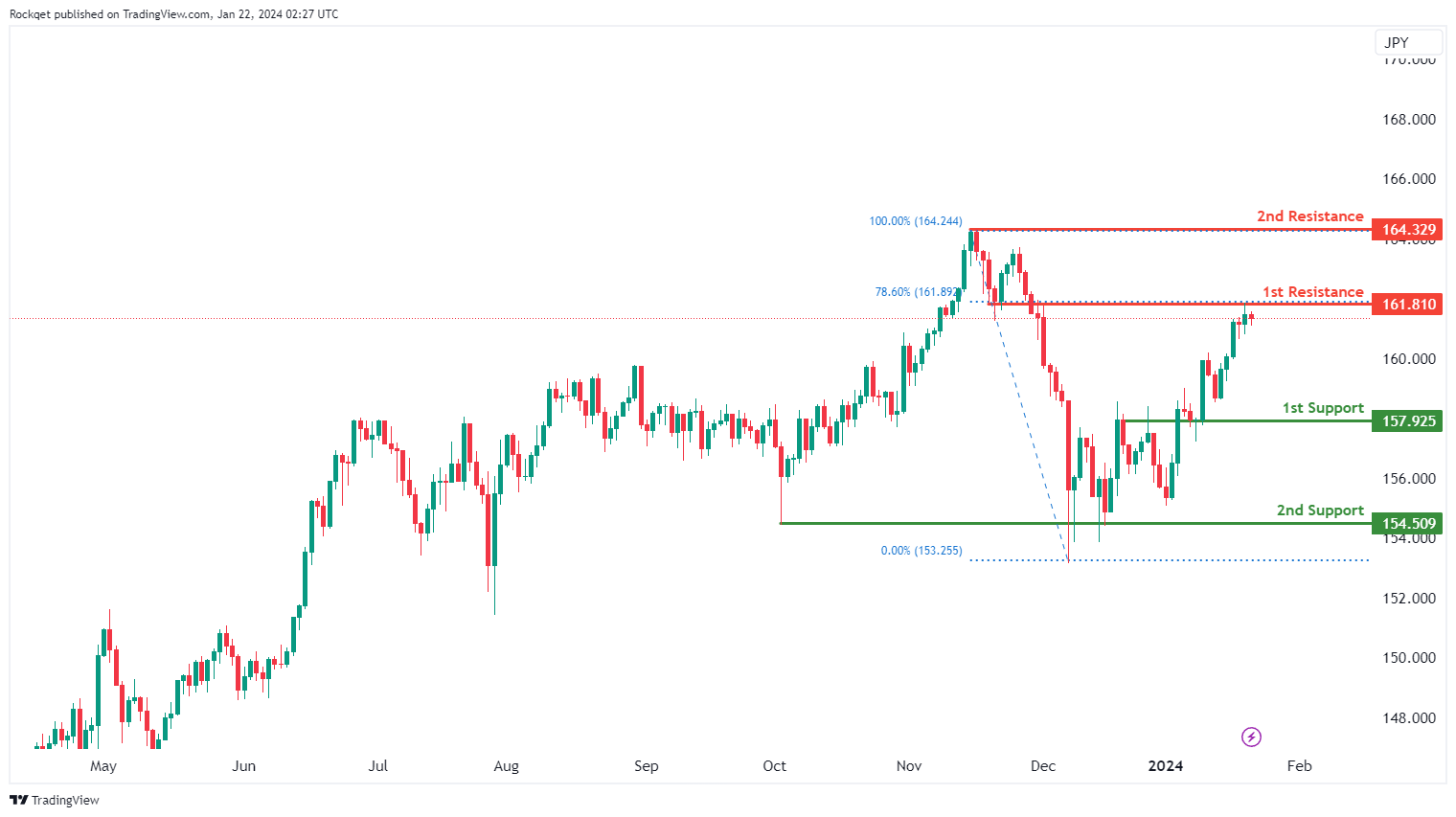
The EUR/JPY trading pair is currently exhibiting a bearish overall momentum, indicating weakness in the Euro relative to the Japanese Yen. Your analysis suggests that there is potential for a bearish reaction off the 1st resistance level, leading to a drop towards the 1st support level.
The 1st support at 157.50 is considered a strong level of support due to its history as an overlap support, indicating that this price level has previously acted as both support and resistance. This suggests that it may be a significant area where price could find support during a bearish move.
The 2nd support at 152.50 is identified as a multi-swing low support, implying that this level corresponds to multiple previous significant low points on the chart. This reinforces its importance as a potential support level during price declines.
On the resistance side, the 1st resistance at 161.81 is recognized as an overlap resistance, and it also aligns with the 78.60% Fibonacci Retracement level. This confluence of factors suggests that it may serve as a strong resistance level, where selling pressure could potentially emerge.
The 2nd resistance at 164.32 is characterized as a swing high resistance, indicating its historical significance as a point where the price has encountered resistance and potential selling interest.
EUR/GBP:
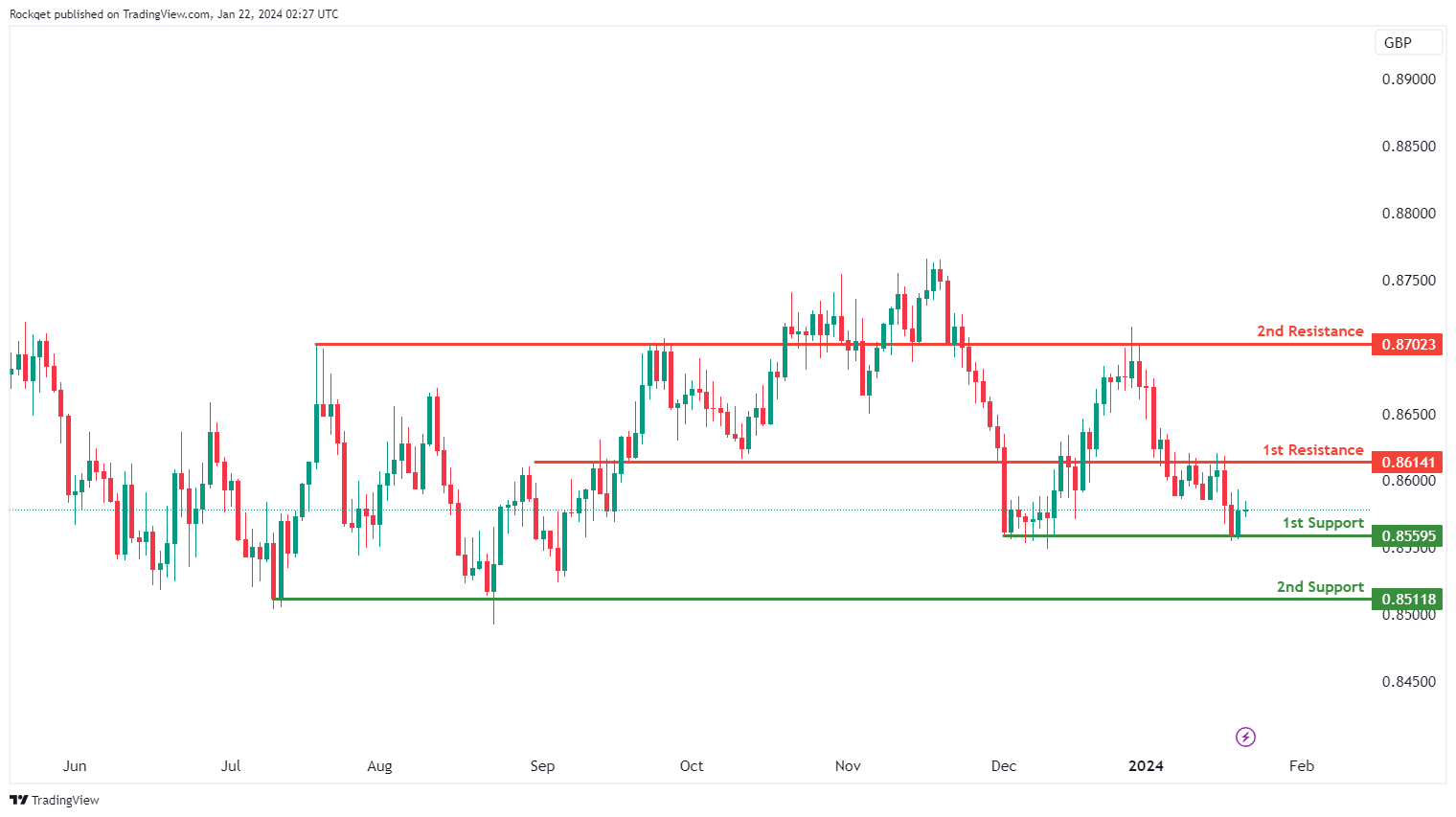
The EUR/GBP trading pair is currently displaying a bullish overall momentum, indicating strength in the Euro relative to the British Pound. Your analysis suggests that there is potential for a bullish continuation towards the 1st resistance level.
The 1st support at 0.8559 is identified as a strong level of support due to its history as a multi-swing low support. This implies that this level corresponds to multiple previous significant low points on the chart, reinforcing its significance as a potential support level during price pullbacks.
Similarly, the 2nd support at 0.8511 is also categorized as a multi-swing low support, indicating its importance as another level where the price has found support in the past.
On the resistance side, the 1st resistance at 0.8614 is recognized as an overlap resistance, suggesting that this price level has previously acted as both support and resistance. This makes it a potentially strong resistance level where selling pressure could emerge.
The 2nd resistance at 0.8702 is also identified as an overlap resistance, further emphasizing its historical significance as a potential barrier for further upward price movement.
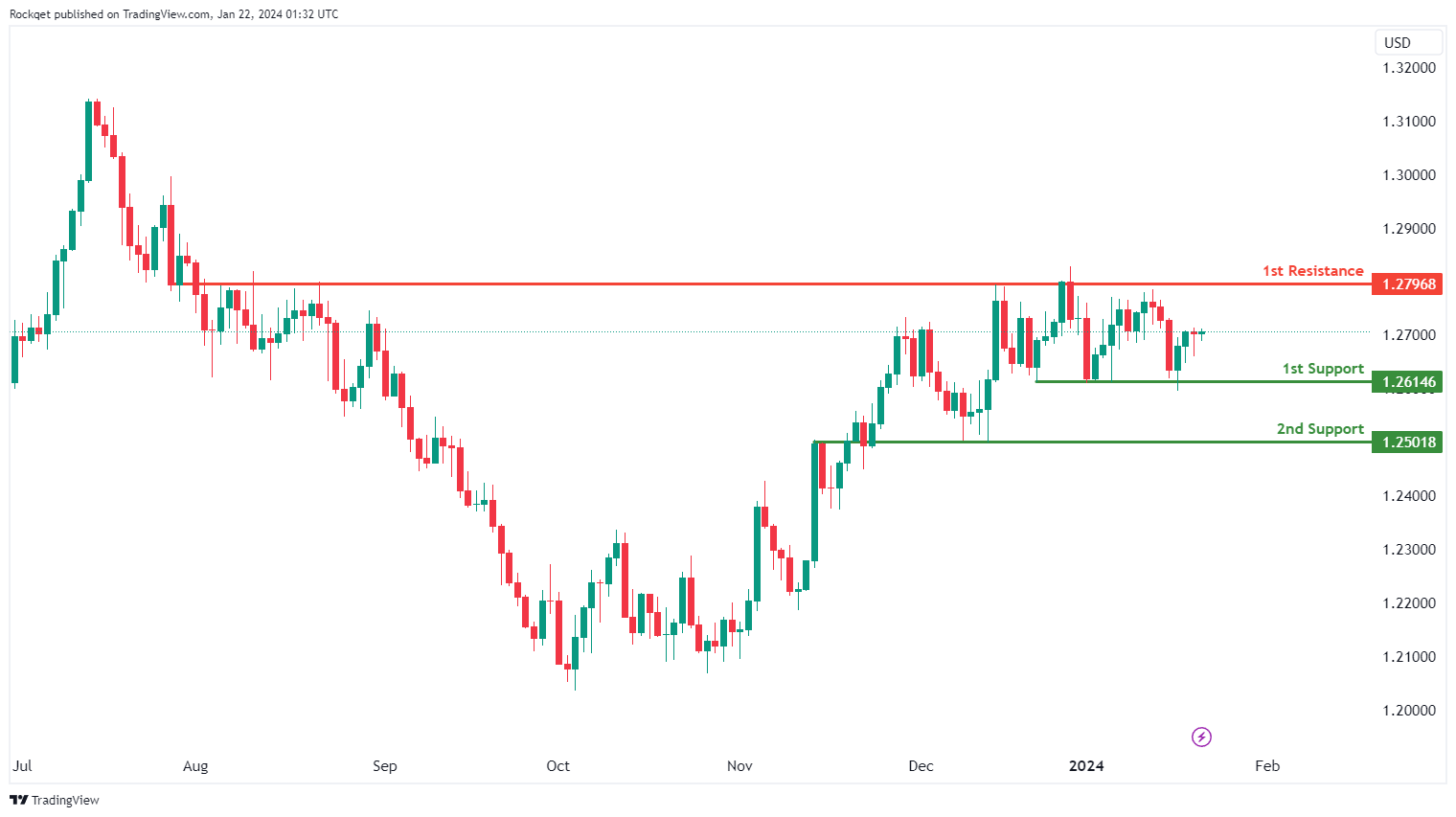
GBP/USD:
The GBP/USD trading pair currently has a neutral overall momentum, indicating a lack of a strong directional bias in the market. The analysis suggests that price may potentially fluctuate between the 1st resistance and the 1st support level.
The 1st support level at 1.2614 is considered significant as it represents a multi-swing low support. This suggests that it has historically been a level where the price has found support during previous fluctuations, making it a potential area of interest for buyers.
The 2nd support level at 1.2501 is identified as an overlap support, indicating that it has previously acted as both support and resistance. This historical significance reinforces its potential as a support level during price fluctuations.
On the resistance side, the 1st resistance level at 1.2796 is recognized as an overlap resistance, implying that it has previously served as both support and resistance. This makes it a potential barrier where selling pressure may emerge.
GBP/JPY:
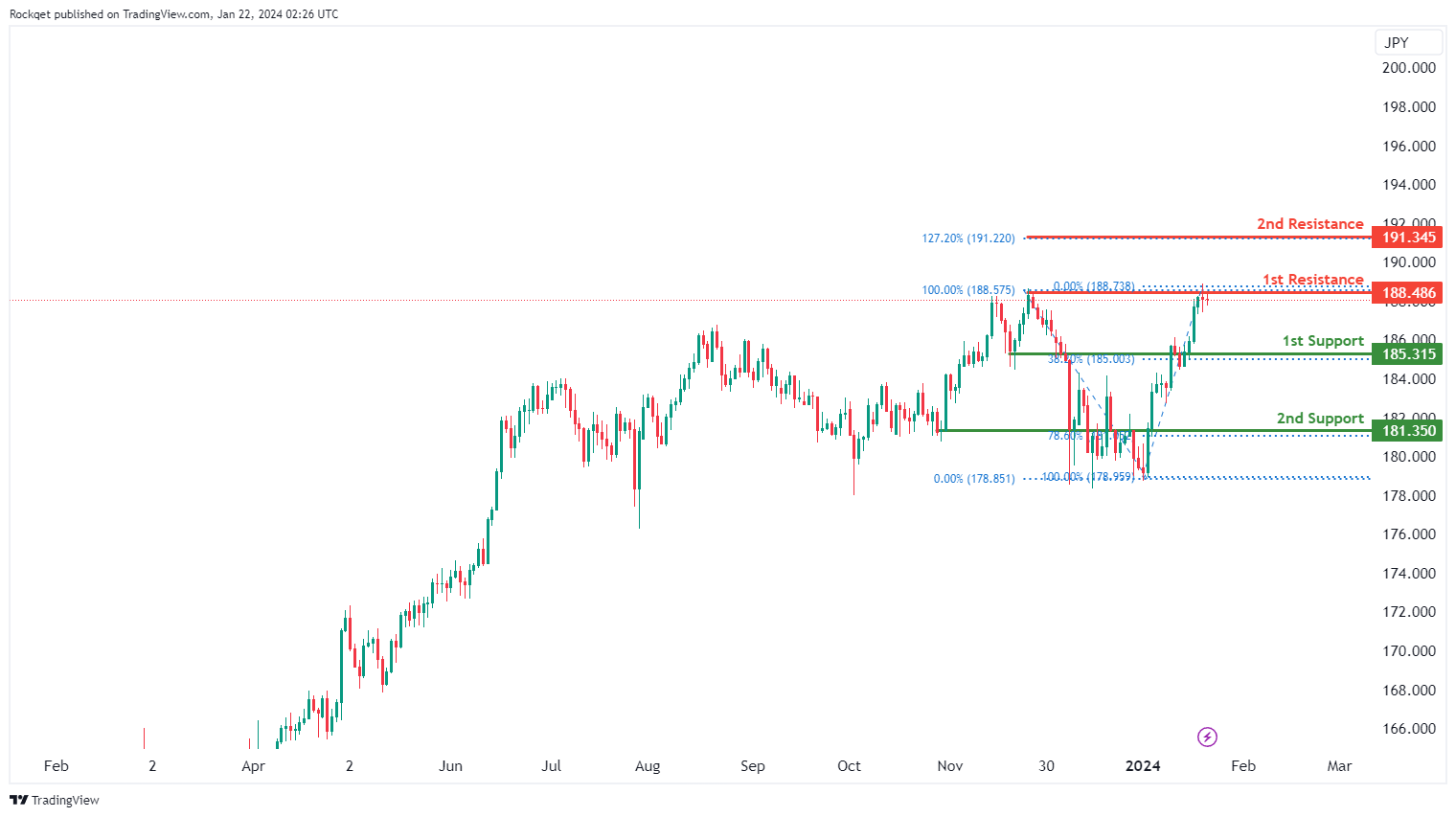
The GBP/JPY trading instrument is currently showing a bearish overall momentum, indicating weakness in the British Pound relative to the Japanese Yen. The analysis suggests that there’s a potential for a bearish continuation towards the 1st support level.
The 1st support at 185.31 is considered a strong level of support for several reasons. It is identified as a pullback support and coincides with the 38.20% Fibonacci Retracement level. This confluence of factors suggests that it may serve as a significant area where interest could emerge, providing temporary support for GBP/JPY during a bearish move.
The 2nd support at 181.35 is also categorized as a pullback support and aligns with the 78.60% Fibonacci Retracement level. This level, too, carries importance and may act as a strong support zone during price pullbacks.
On the resistance side, the 1st resistance at 188.48 is recognized as a swing high resistance, indicating that it has historically served as a point of resistance where selling pressure may emerge.
The 2nd resistance at 191.34 is identified as the 127.20% Fibonacci Extension level. This level may act as a significant barrier for further upward price movement, as Fibonacci Extension levels are often used to id
USD/CHF:
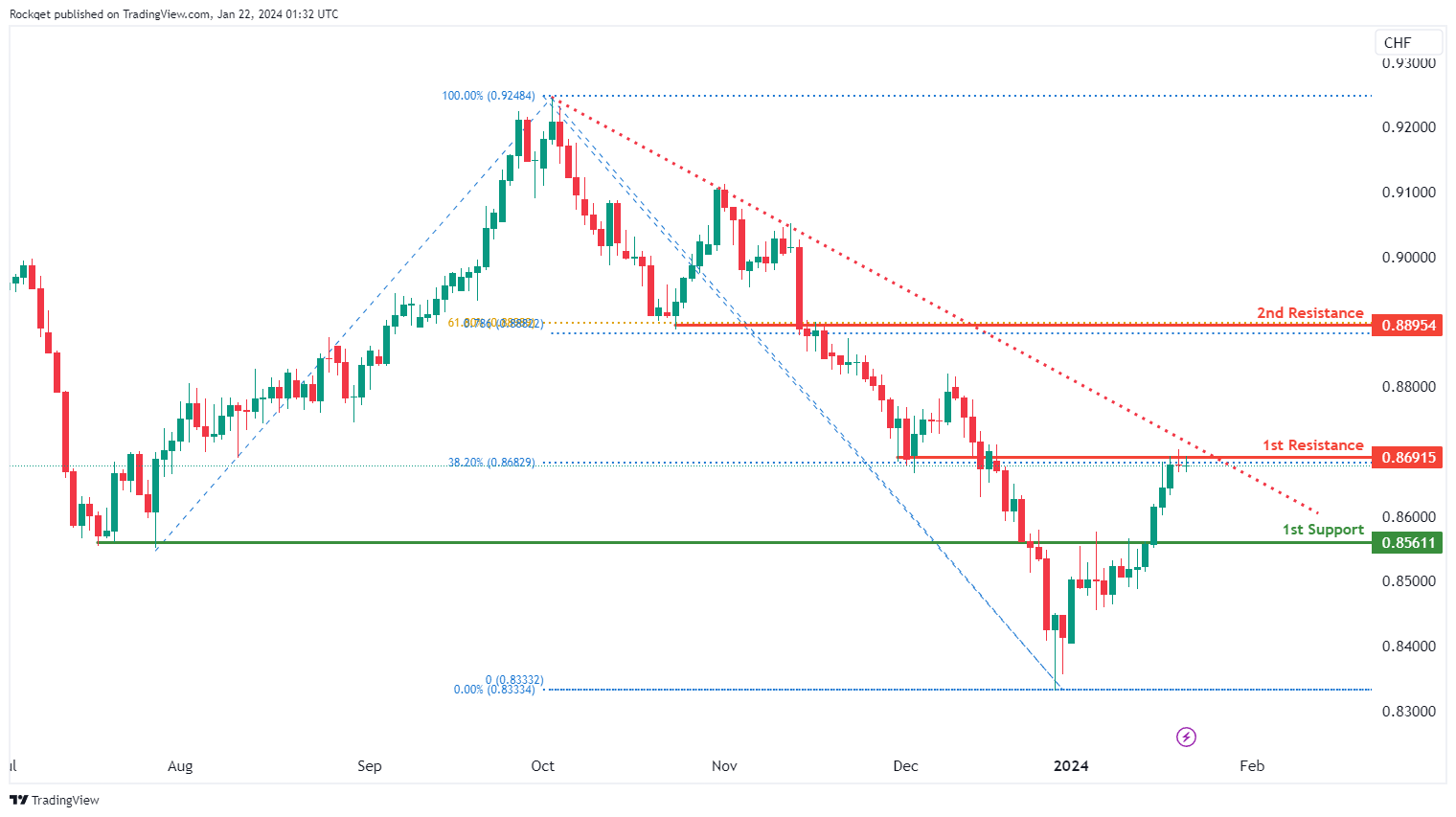
The USD/CHF chart currently exhibits a bearish overall momentum, with factors contributing to this momentum being the price’s position below a major descending trend line. This suggests that bearish momentum is prevalent in the market.
Price could potentially make a bearish reaction off the 1st resistance and drop towards the 1st support.
1st support at 0.8561 is identified as pullback support, indicating a potential area where buying interest may emerge, providing temporary support for USD/CHF.
On the resistance side, 1st resistance at 0.8691 is marked as an overlap resistance, which may act as a barrier for further upward price movement.
2nd resistance at 0.8895 is categorized as an overlap resistance, and it holds significance due to the confluence of the 61.80% Fibonacci Retracement and the 78.60% Fibonacci Projection.
USD/JPY:
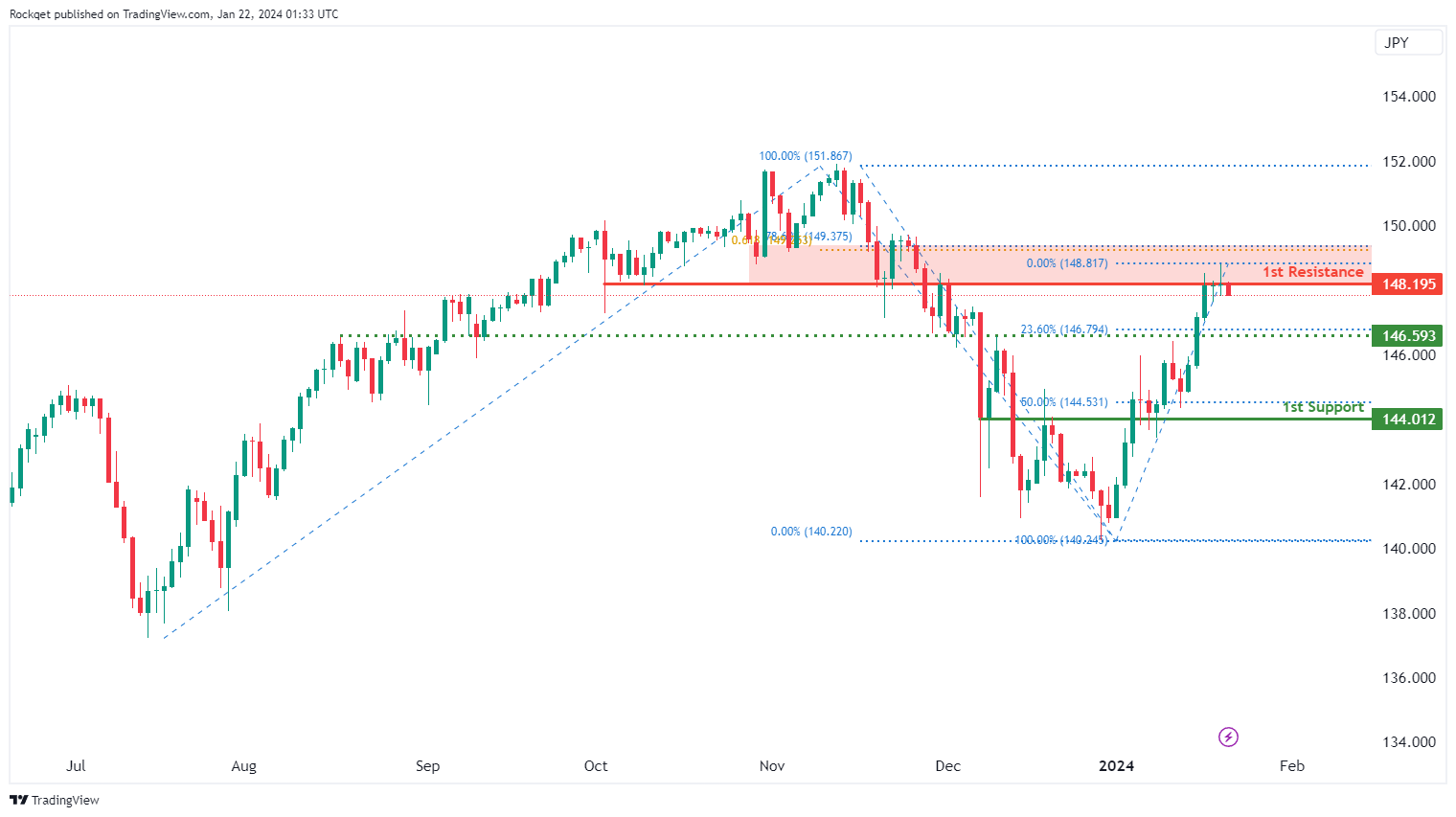
The USD/JPY chart currently exhibits a bearish overall momentum. Price could potentially make a bearish continuation towards the 1st support and the identified support and resistance levels are as follows:
1st support at 144.01 is an overlap support and aligns with the 50% Fibonacci Retracement level. This level is significant as it suggests a potential area where buying interest may emerge, providing temporary support for USD/JPY.
Intermediate support at 146.59 is categorized as a pullback support and is reinforced by the 23.60% Fibonacci Retracement, further adding to its significance as a potential support zone.
On the resistance side, 1st resistance at 148.19 is marked as an overlap resistance, and it may act as a barrier for the price if it attempts to move higher.
USD/CAD:
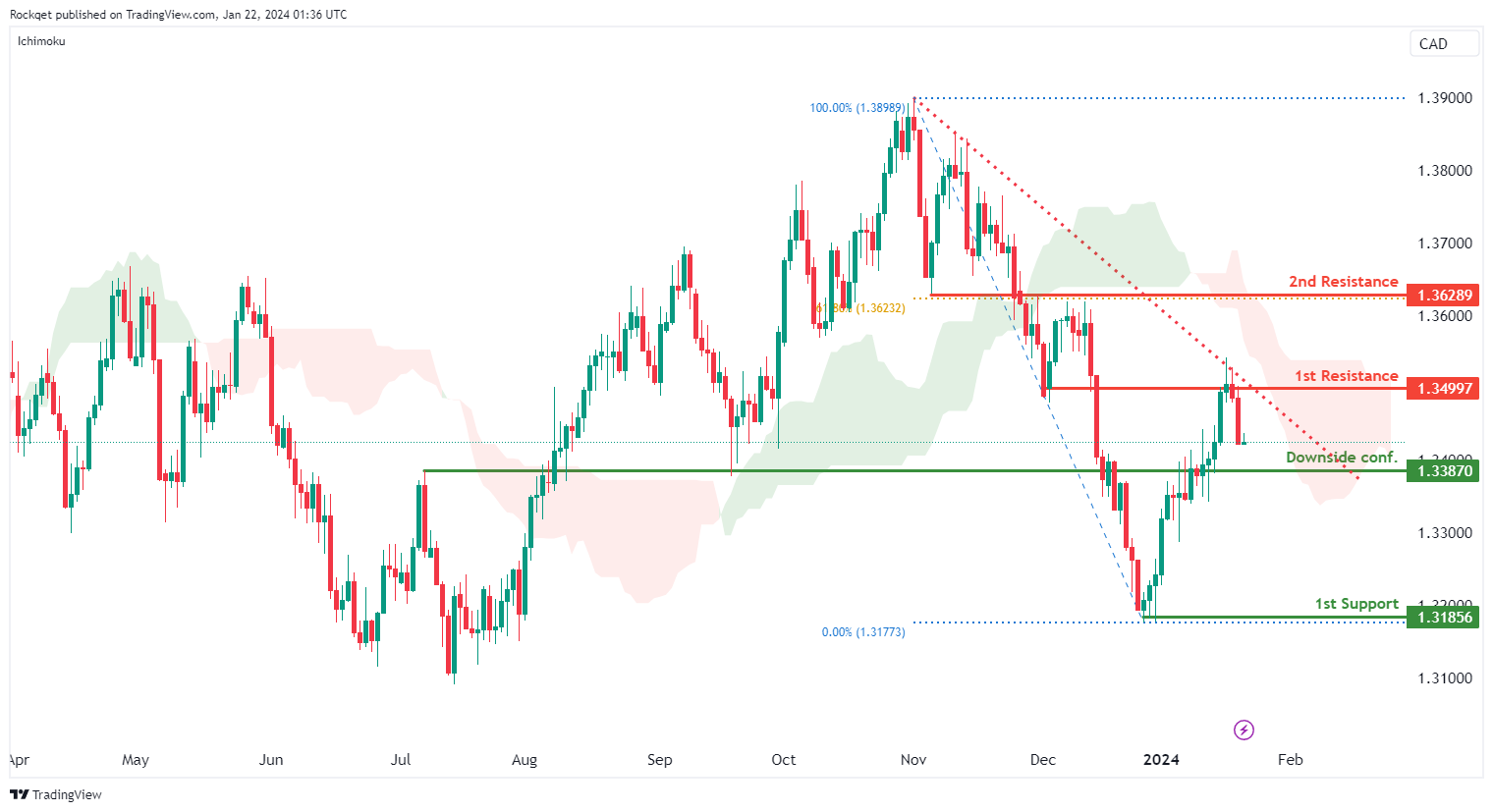
The USD/CAD chart currently exhibits an overall bearish momentum. Factors such as the descending trendline and the bearish Ichimoku Cloud are contributing to this bearish outlook. In this context, there is a potential scenario for price to drop towards the 1st support should it break the Downside Confirmation level.
The Downside Confirmation level at 1.3387 is identified as an overlap support. Further below, the 1st support level at 1.3185 is marked as a swing-low support, further reinforcing its importance as a key support level.
To the upside, the 1st resistance level at 1.3499 is identified as an overlap resistance. Higher up, the 2nd resistance level at 1.3628 is also noted as an overlap resistance that aligns with the 61.80% Fibonacci retracement level, further reinforcing its significance as a potential resistance zone.
AUD/USD:
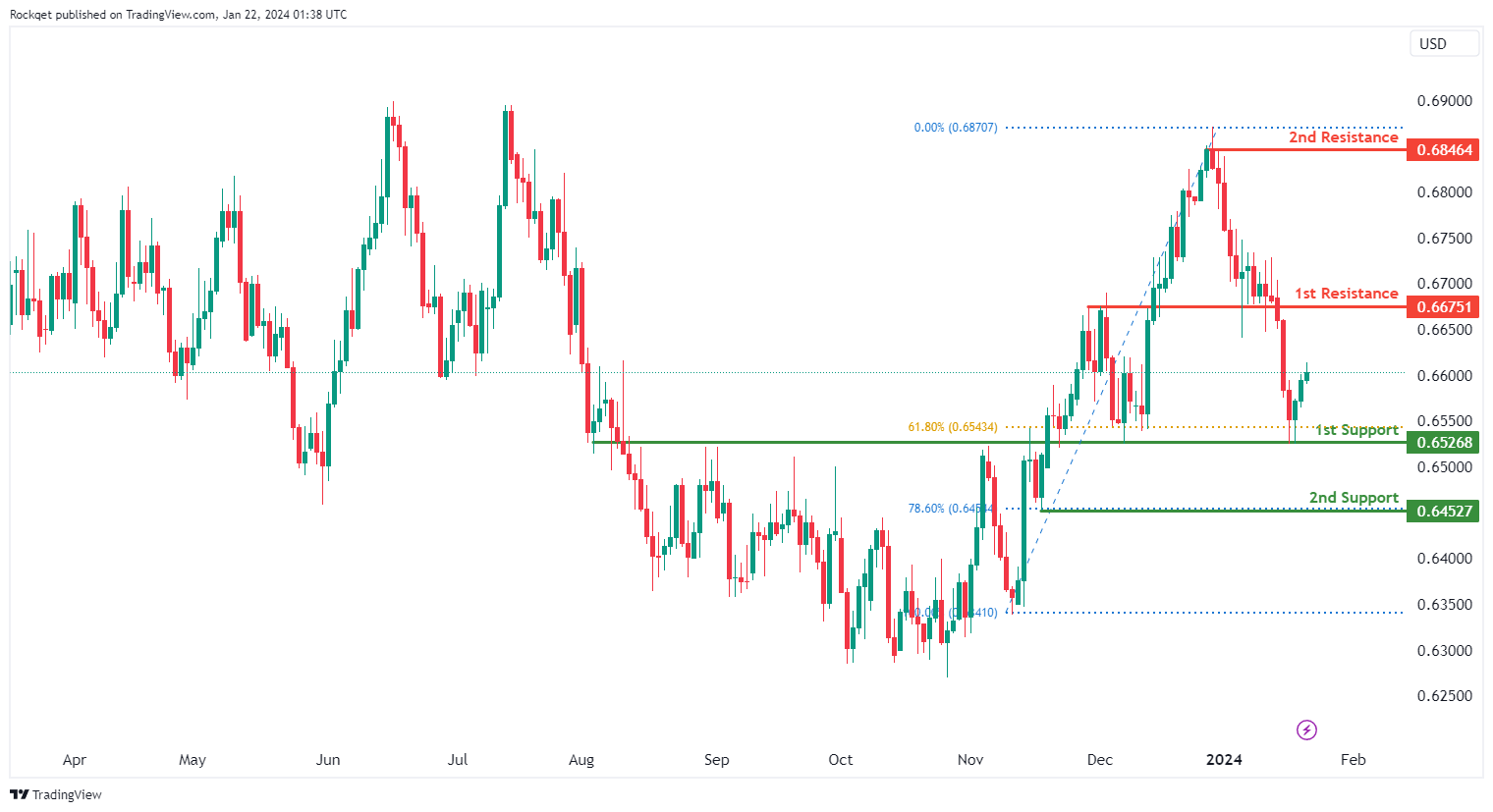
The AUD/USD chart currently exhibits an overall bullish momentum. In this context, there is a potential scenario for price to rise towards the 1st resistance.
The 1st resistance level at 0.6675 is identified as an overlap resistance. Higher up, the 2nd resistance level at 0.6846 is noted as a swing-high resistance, suggesting a potential barrier for further upside movement.
To the downside, the 1st support level at 0.6526 is identified as an overlap support that aligns close to the 61.80% Fibonacci retracement level. Further below, the 2nd support level at 0.6452 is marked as a pullback support that aligns with the 78.60% Fibonacci retracement level, further reinforcing its importance as a key support level.
NZD/USD
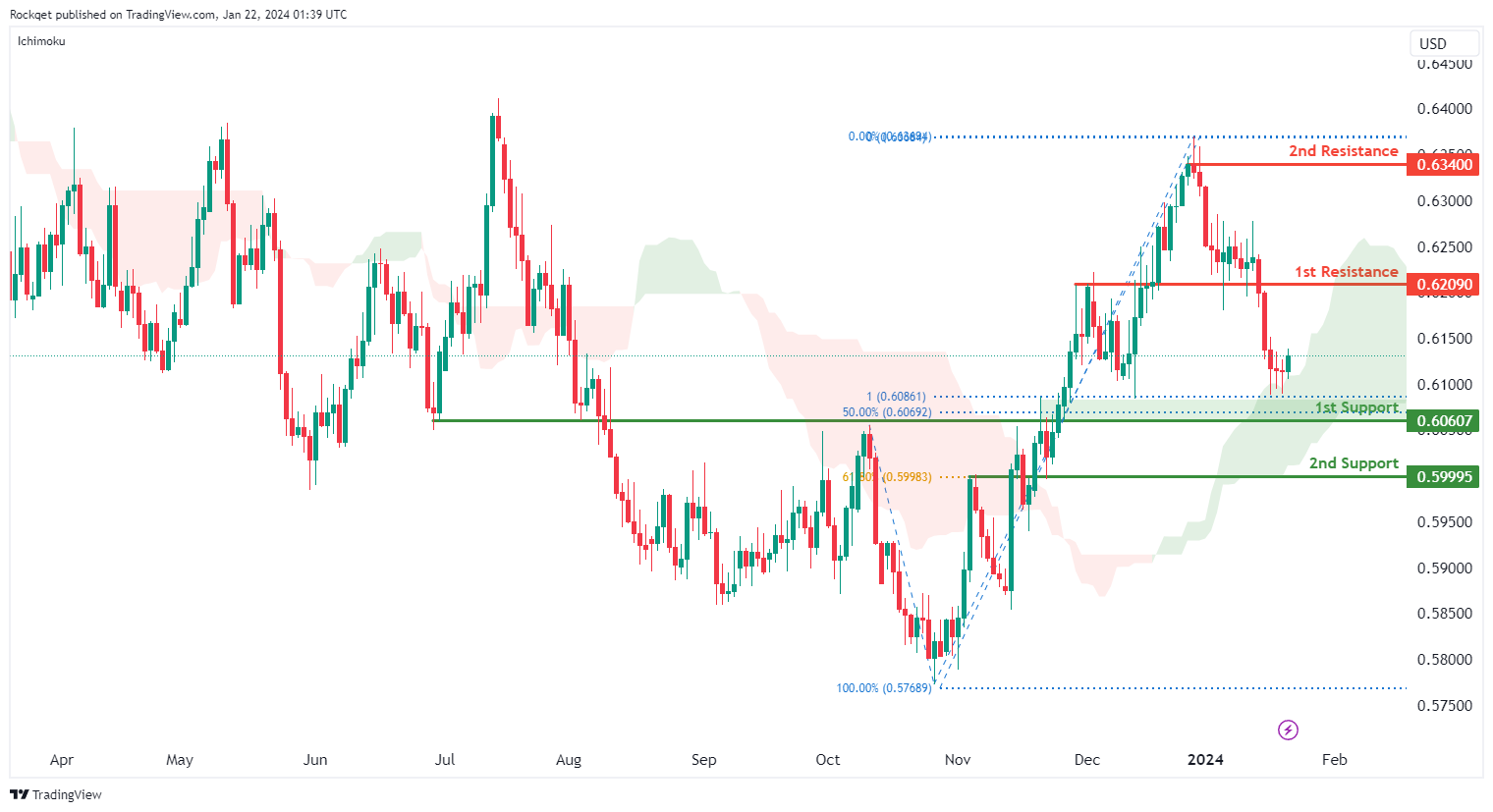
The NZD/USD chart currently exhibits an overall bullish momentum with price finding support just above the bullish Ichimoku Cloud. In this context, there is a potential scenario for price to rise towards the 1st resistance.
The 1st resistance level at 0.6209 is identified as an overlap resistance. Higher up, the 2nd resistance level at 0.6340 is noted as a swing-high resistance, suggesting a potential barrier for further upside movement.
To the downside, the 1st support level at 0.6060 is identified as an overlap support that aligns with a confluence of Fibonacci levels i.e. the 50.00% retracement and the 100.00% projection. Further below, the 2nd support level at 0.5999 is also marked as an overlap support that aligns with the 61.80% Fibonacci retracement level, further reinforcing its importance as a key support level.
DJ30:
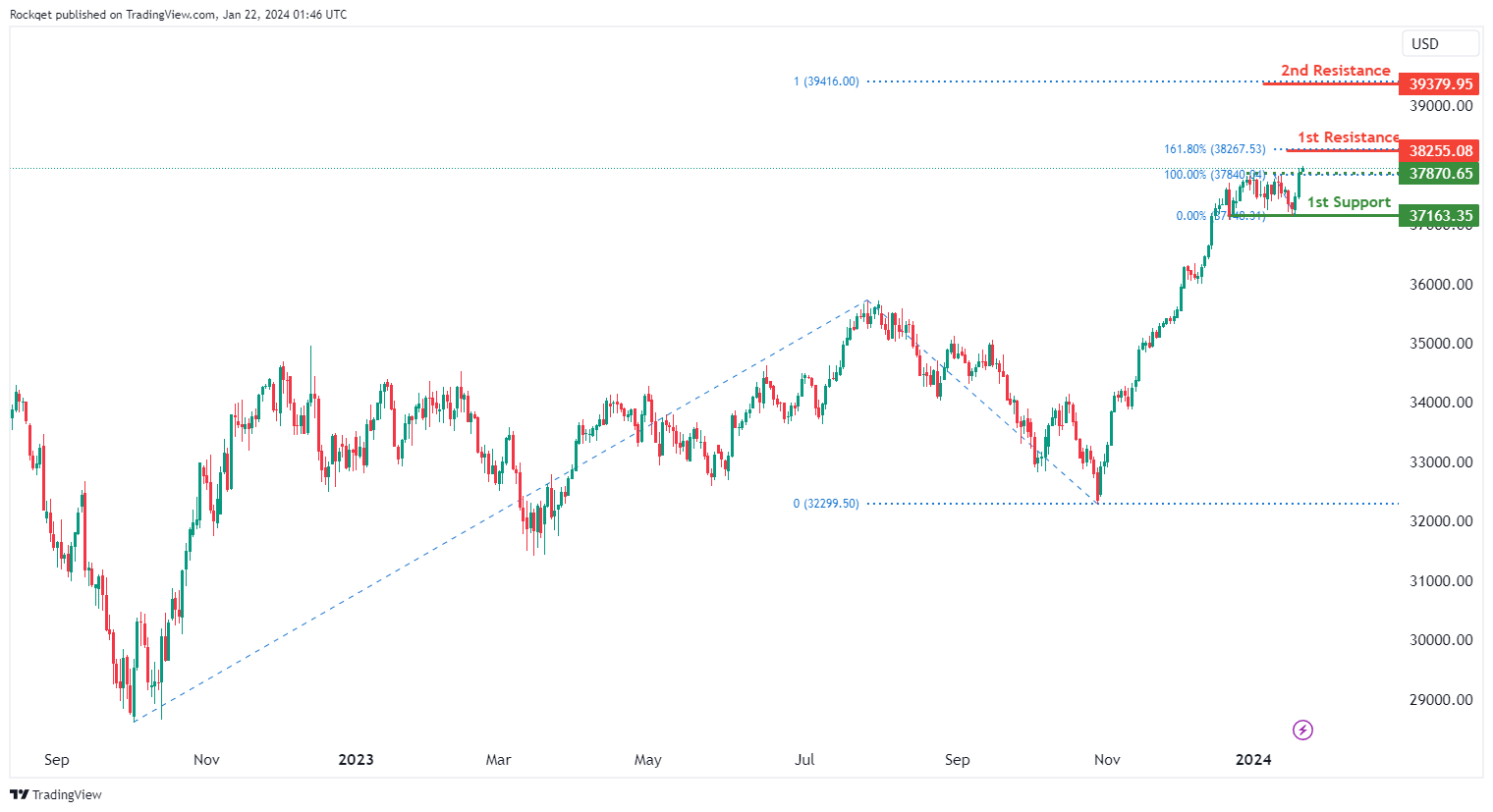
The DJ30 (Dow Jones) chart currently exhibits an overall bullish momentum. In this context, there is a potential scenario for price to rise towards the 1st resistance.
The 1st resistance level at 38,255.08 is identified as a resistance that aligns with the 161.80% Fibonacci extension level. Higher up, the 2nd resistance level at 39,379.95 is noted as a resistance that aligns with the 100.00% Fibonacci projection level, suggesting a potential barrier for further upside movement.
To the downside, the intermediate support level at 37,870.65 is identified as pullback support. Further below, the 1st support level at 37,163.35 is also marked as a pullback support, further reinforcing its importance as a key support level.
GER40:
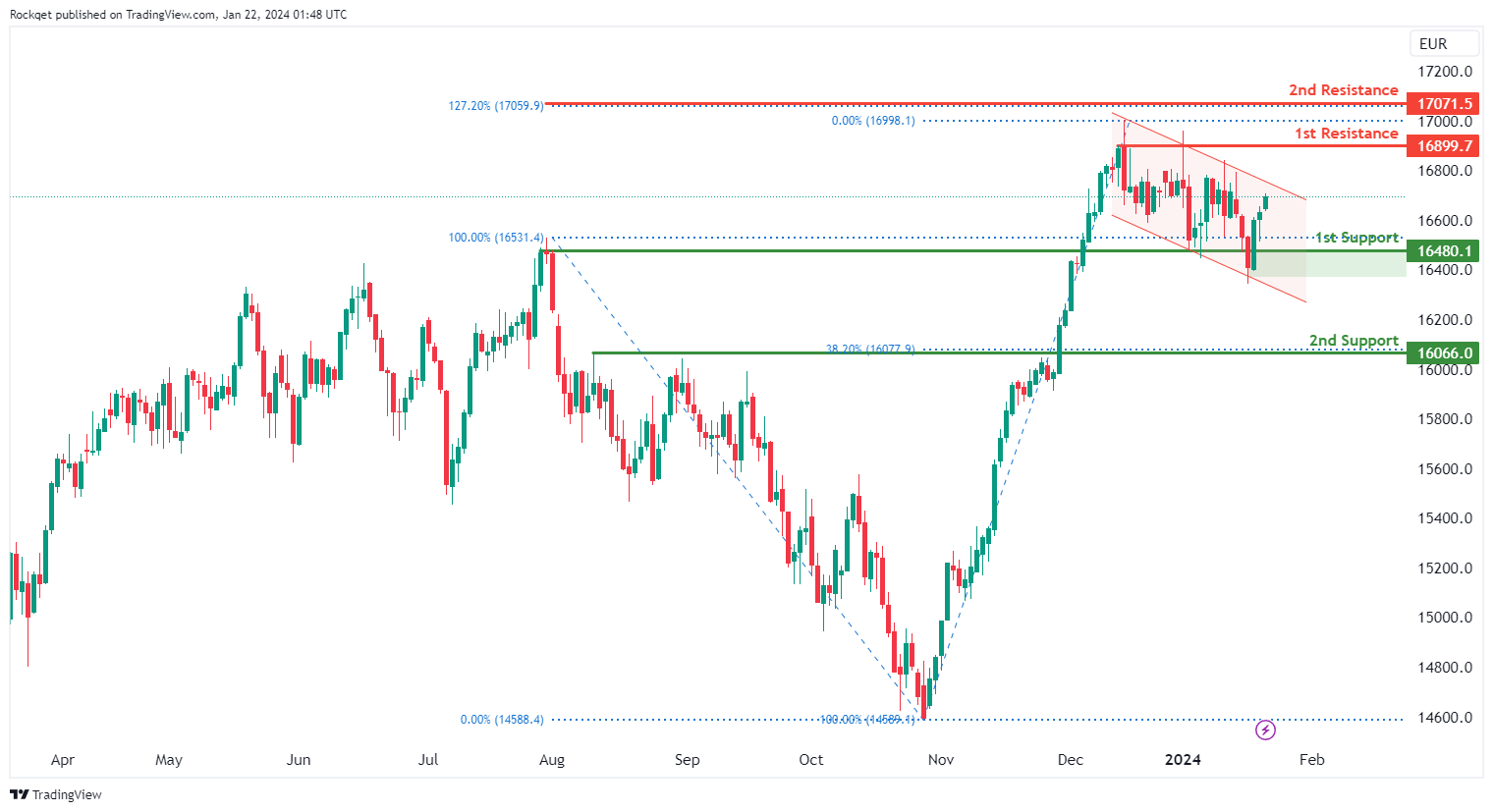
The GER40 (DAX) chart currently exhibits an overall bullish momentum. In this context, there is a potential scenario for price to rise towards the 1st resistance. However, take note that price is also trading within a bearish channel.
The 1st resistance level at 16,899.70 is identified as a pullback resistance. Higher up, the 2nd resistance level at 17,071.50 is noted as a resistance that aligns with the 127.20% Fibonacci extension level, further reinforcing its significance as a potential resistance zone.
To the downside, the 1st support level at 16,480.10 is identified as an overlap support. Further below, the 2nd support level at 16,066.00 is noted as a pullback support that aligns with the 38.20% Fibonacci retracement level, further reinforcing its importance as a key support level.
 US500:
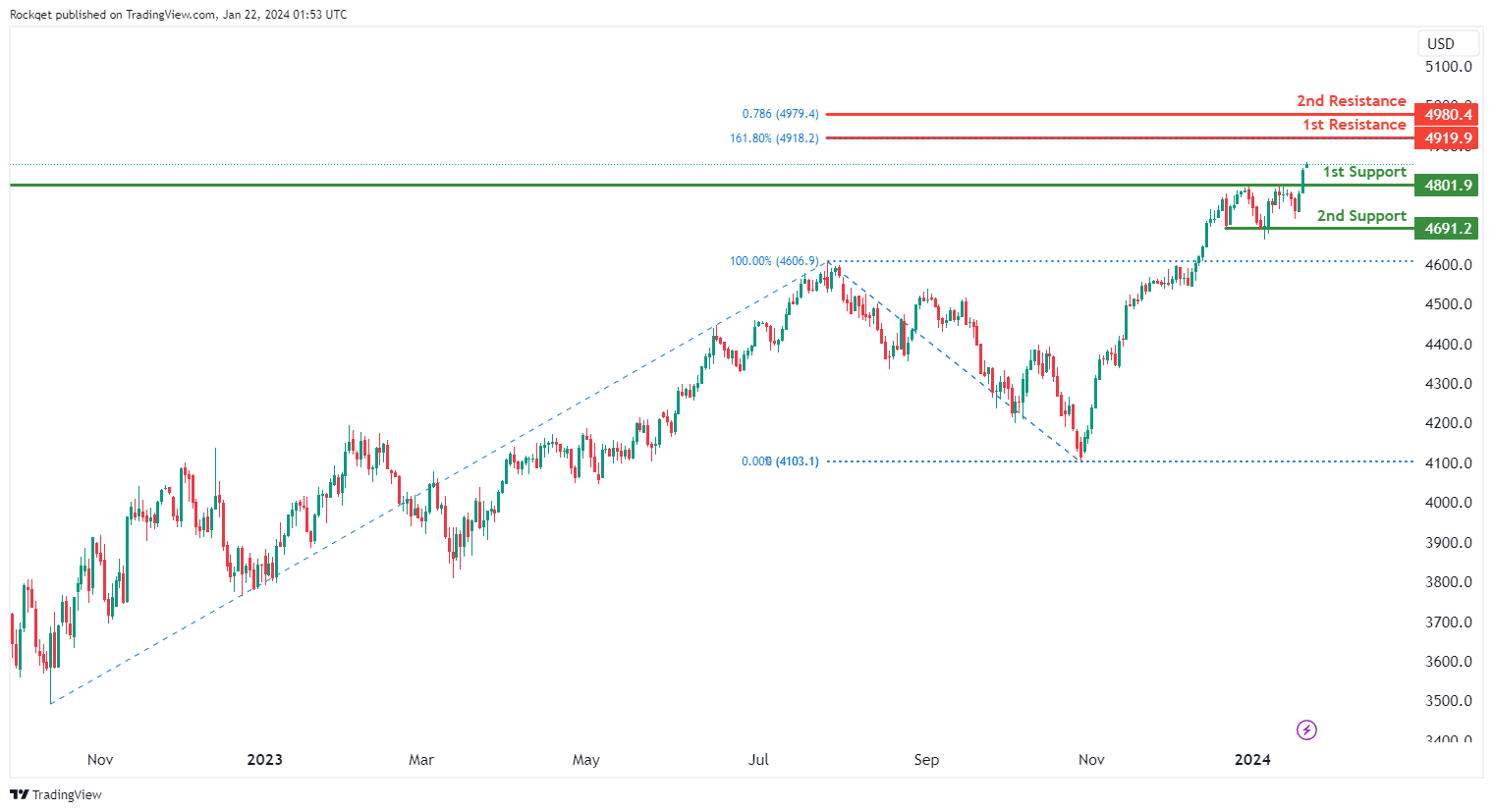
The US500 (S&P 500) chart currently exhibits an overall bullish momentum. In this context, there is a potential scenario for price to rise towards the 1st resistance.
The 1st resistance level at 4,919.90 is identified as a resistance that aligns with the 161.80% Fibonacci extension level. Higher up, the 2nd resistance level at 4,980.40 is noted as a resistance that aligns with the 78.60% Fibonacci projection level, further reinforcing its significance as a potential resistance zone.
To the downside, the 1st support level at 4,801.90 is identified as a pullback support. Further below, the 2nd support level at 4,691.20 is also noted as a pullback support, further reinforcing its importance as a key support level.
BTC/USD:
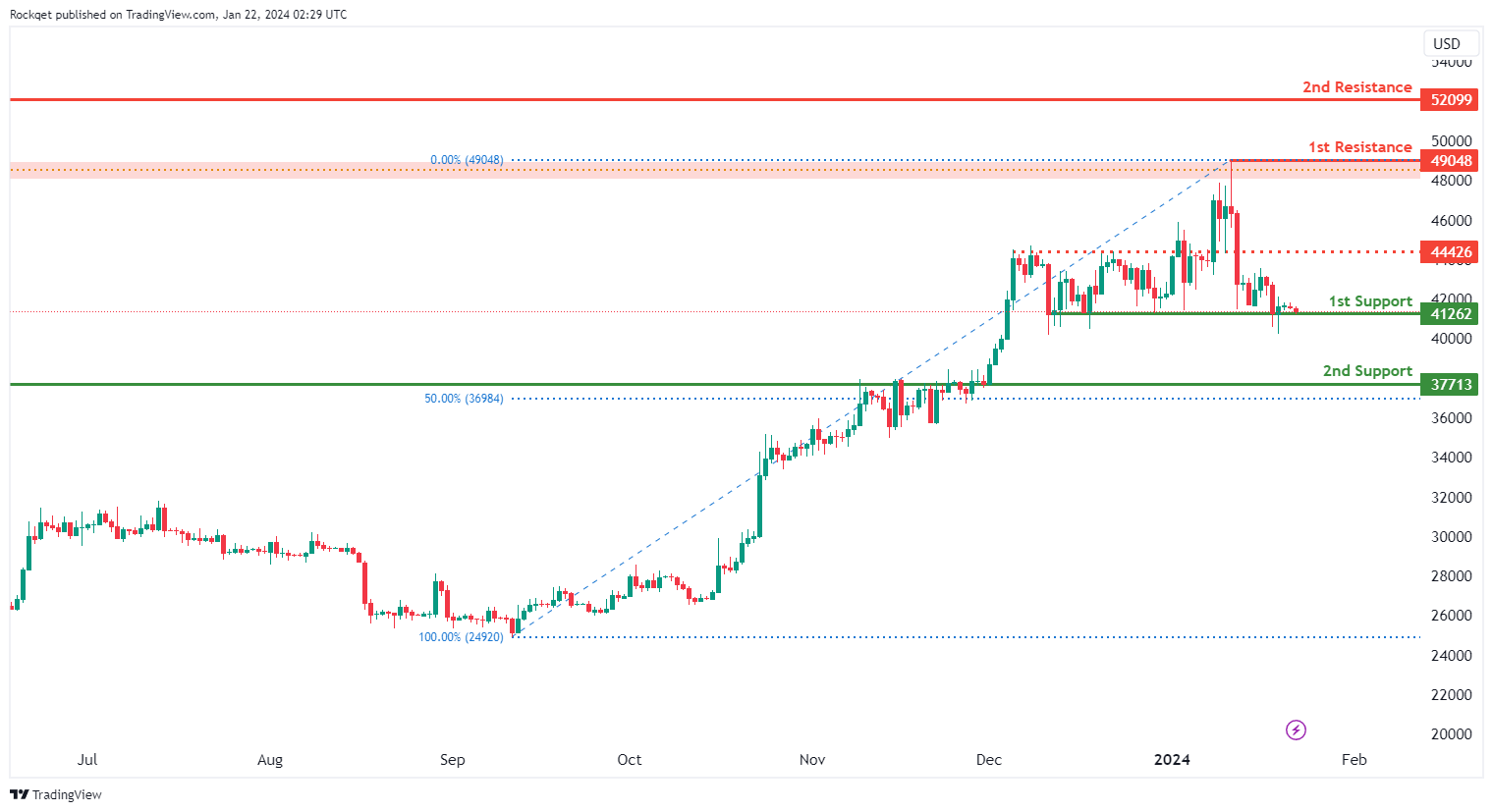
The BTC/USD (Bitcoin) chart currently exhibits an overall bullish momentum. However, there is a potential scenario for price to fall towards the 1st support before making a bullish bounce to resume the uptrend.
The 1st support level at 41,262.00 is identified as a pullback support. Further below, the 2nd support level at 37,713.00 is marked as an overlap support that aligns close to the 50.00% Fibonacci retracement level, further reinforcing its importance as a key support level.
To the upside, the intermediate resistance level at 44,426.00 is identified as an overlap resistance while the 1st resistance level at 49,048.00 is marked as a swing-high resistance that aligns close to the 61.80% Fibonacci retracement level. Higher up, the 2nd resistance level at 52,099.00 is also noted as a swing-high resistance, suggesting a potential barrier for further upside movement.
ETH/USD:
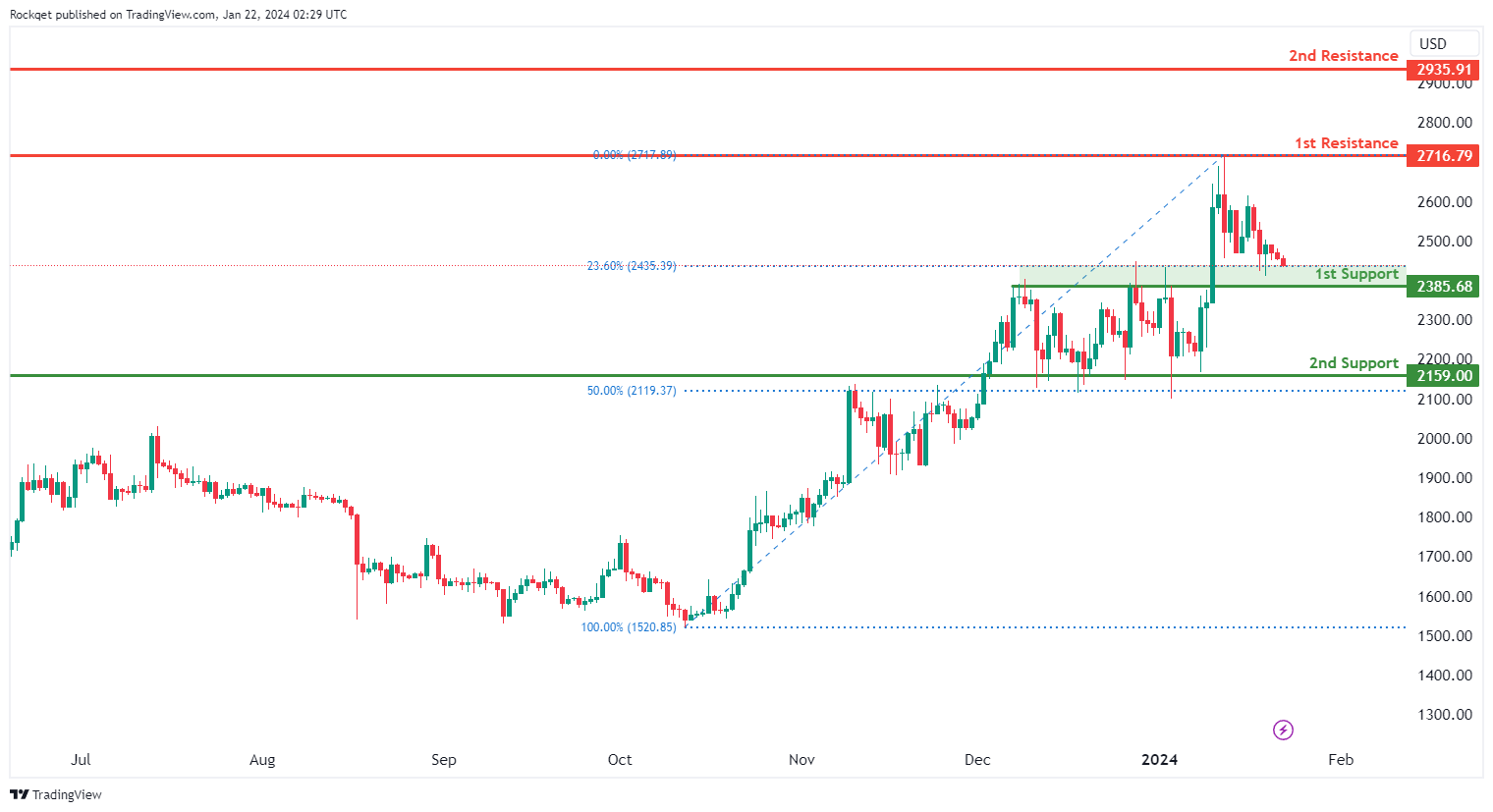
The ETH/USD (Ethereum) chart currently exhibits an overall bearish momentum. However, there is a potential scenario for price to fall towards the 1st support before making a bullish bounce to resume the uptrend.
The 1st support level at 2,385.68 is identified as a pullback support that aligns close to the 23.60% Fibonacci retracement level. Further below, the 2nd support level at 2,159.00 is marked as an overlap support that aligns close to the 50.00% Fibonacci retracement level, further reinforcing its importance as a key support level.
To the upside, the 1st resistance level at 2,716.79 is identified as an overlap resistance. Higher up, the 2nd resistance level at 2,935.91 is noted as a pullback resistance, suggesting a potential barrier for further upside movement.
WTI/USD:
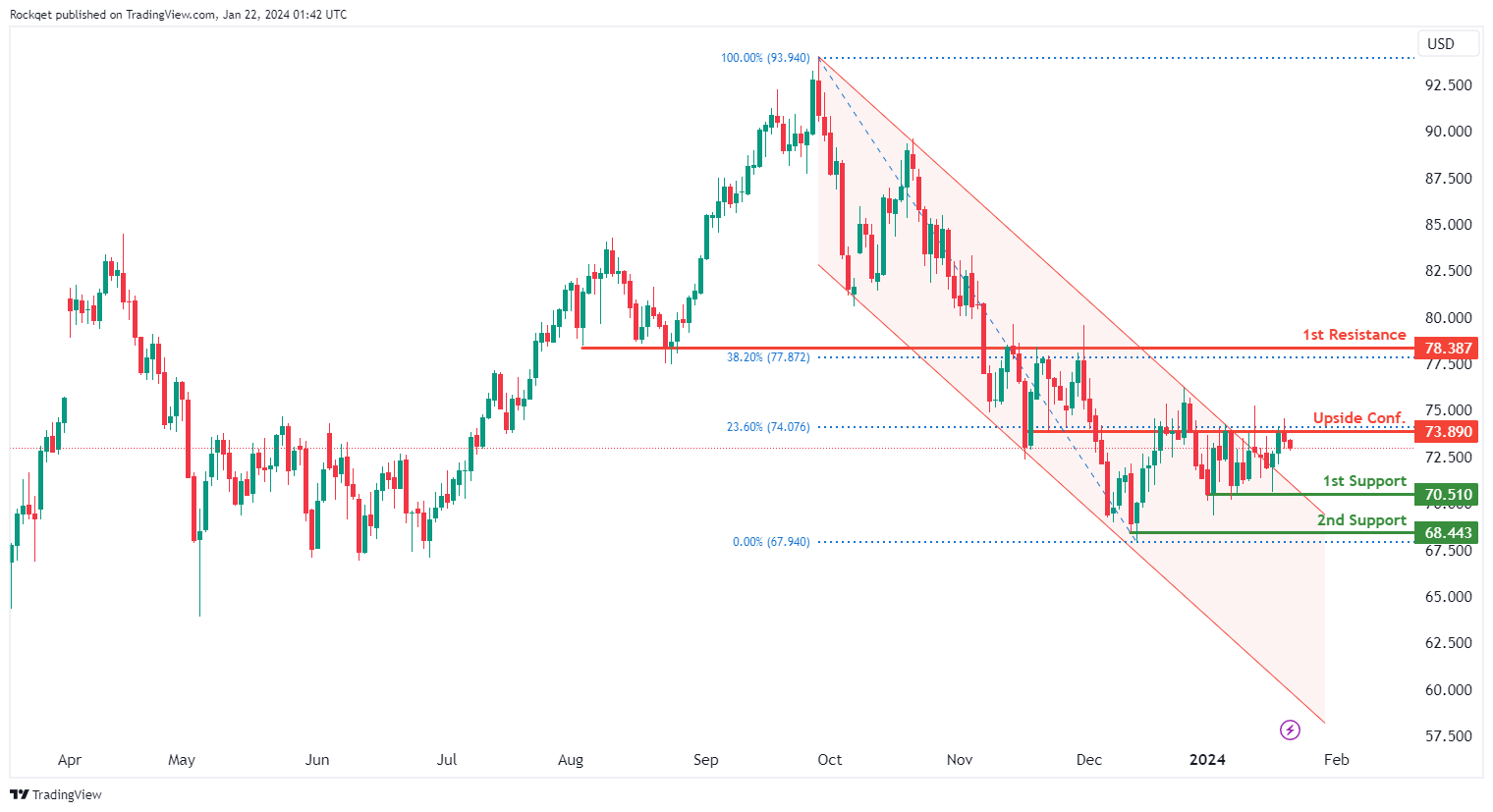
The WTI (West Texas Intermediate) chart currently exhibits an overall bearish momentum. However, price has broken above the upper trendline of the bearish channel. In this context, there is a potential scenario for price to rise towards the 1st resistance should it break above the Upside Confirmation level.
The Upside Confirmation level at 73.89 is identified as an overlap resistance that aligns with the 23.60% Fibonacci retracement level. Higher up, the 1st resistance level at 78.38 is also noted as an overlap resistance that aligns close to the 38.20% Fibonacci retracement level, suggesting a potential barrier for further upside movement.
To the downside, the 1st support level at 70.51 is identified as a pullback support. Further below, the 2nd support level at 68.44 is marked as a swing-low support, further reinforcing its importance as a key support level.
XAU/USD (GOLD):
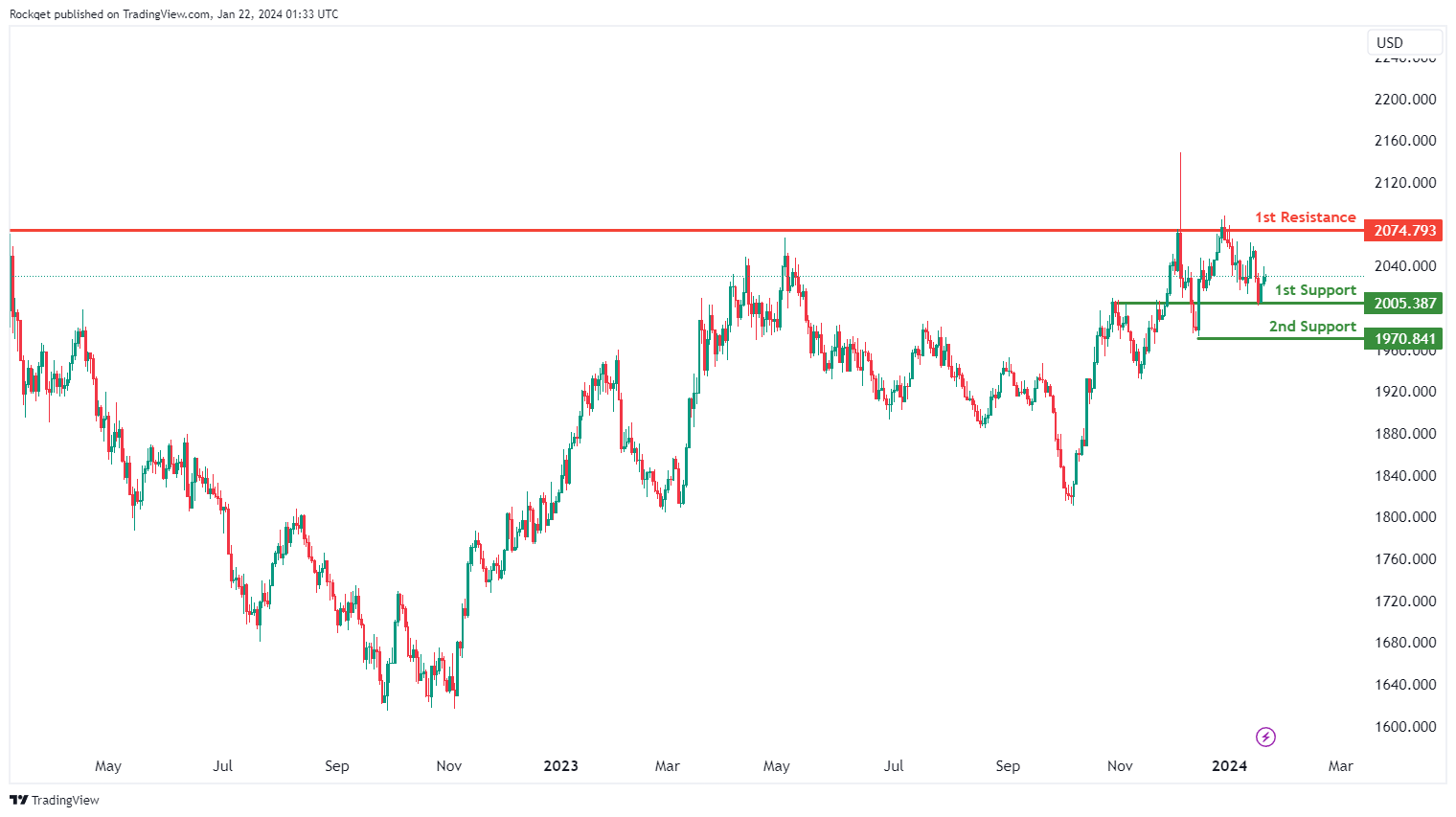
The XAUUSD (Gold/US Dollar) chart presently displays a bullish overall momentum, indicating strength in the price of gold. This bullish momentum implies the possibility of a bullish continuation towards the 1st resistance level.
The 1st resistance level at 2074.79 is identified as an overlap resistance, signifying its historical significance as both a support and resistance level. It may serve as a potential hurdle for further upward price movement.
On the support side, the 1st support at 2005.38 is recognized as an overlap support, underlining its importance as a level where price has previously found both support and resistance. This level could offer potential buying interest, acting as a temporary support for XAUUSD.
The 2nd support at 1970.84 is categorized as a swing low support, pointing to its significance as a previous low point on the chart, which might serve as a support level during price pullbacks.
PBoC holds 1-yr and 5-yr LPR steady
People's Bank of China announced today that it would maintain one-year loan prime rate at 3.45%, a level unchanged since August last year. Similarly, five-year rate, critical for mortgage financing, remains steady at 4.2%, consistent since its last reduction in June. This decision follows PBoC's unexpected move last week to keep its medium-term lending facility rate stable.
PBoC's decision to hold rates steady comes amid a sluggish economic environment in China, coupled with increasing deflationary pressures. Despite these challenges, the central bank appears reluctant to employ interest rate reductions as a tool to stimulate the economy, primarily due to concerns over the depreciating Yuan. PBoC might continue to avoid further rate cuts until Yuan regains some stability, to prevent exacerbating the currency's depreciation.
USD/CNH's break of 55 D EMA last week suggests that the corrective pull back from 7.3679 has completed at 7.0870 already. That came after drawing support from 38.2% retracement of 6.6971 to 7.3679 at 7.1117. Further rise is now mildly in favor as long as 7.1589 minor support holds, back to retest 7.3679 high.