Sample Category Title
EUR/GBP Daily Outlook
Daily Pivots: (S1) 0.8641; (P) 0.8669; (R1) 0.8695; More…
EUR/GBP retreated after hitting 0.8695 and intraday bias is turned neutral first. Risk is mildly on the upside as long as 0.8618 support holds. Above 0.8695 will target 0.8740 first. Firm break there will target 0.8788 resistance next.
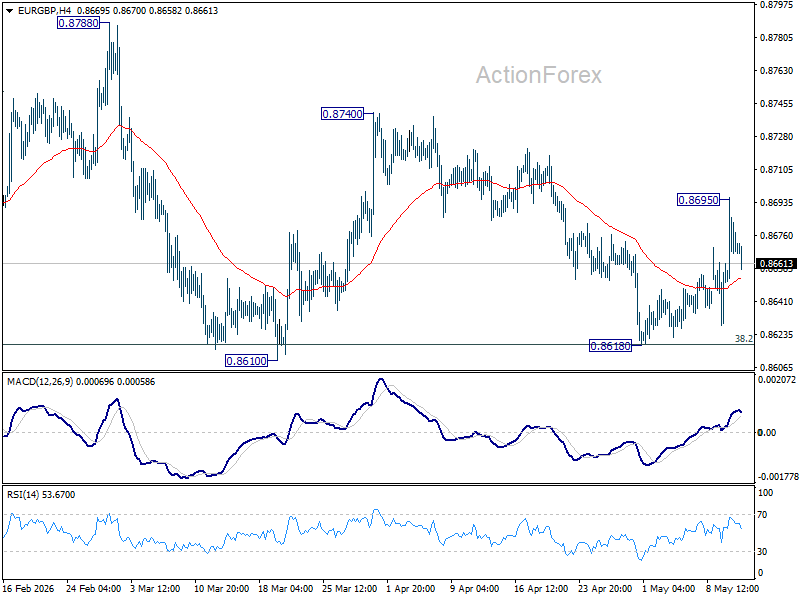
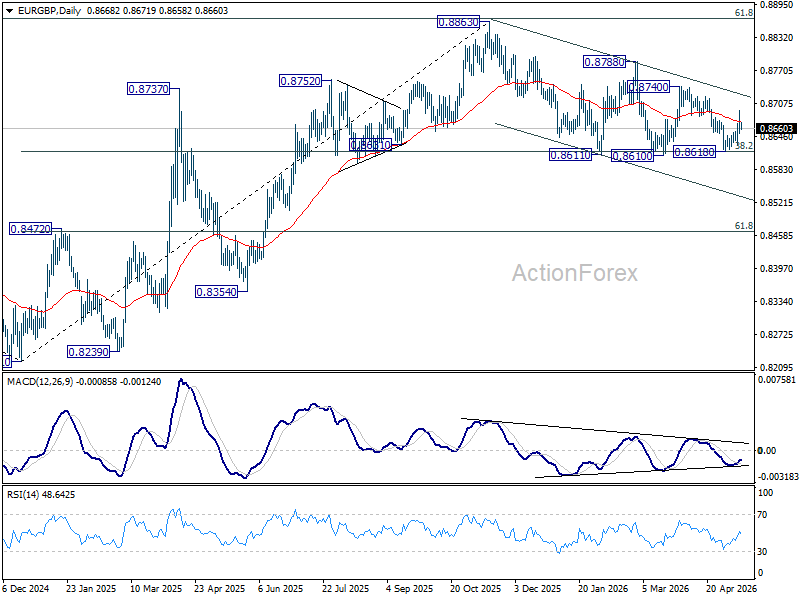
In the bigger picture, focus is back on 38.2% retracement of 0.8821 to 0.8863 at 0.8618. Strong rebound from there will retain medium term bullishness. Rise from 0.8221 should resume through 0.8863 at a later stage. Nevertheless, sustained break of 0.8618 will confirm that whole rise from 0.8221 has completed at 0.8863. Deeper decline should then be seen to 61.8% retracement at 0.8466 at least.
EUR/AUD Daily Outlook
Daily Pivots: (S1) 1.6169; (P) 1.6231; (R1) 1.6262; More...
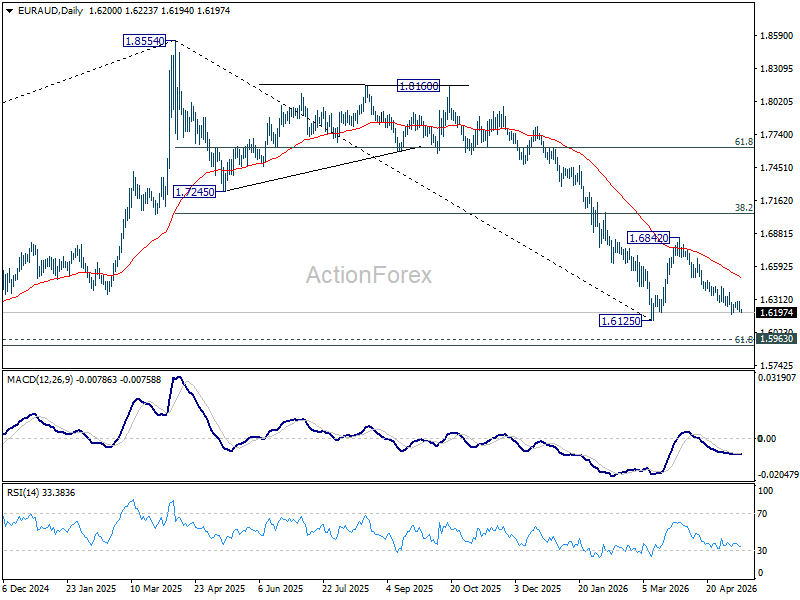
Intraday bias in EUR/AUD remains neutral for the moment, and further fall is expected with 1.6371 resistance intact. On the downside, decisive break of 1.6125 will resume larger fall from 1.8554. Nevertheless, break of 1.6371 resistance will indicate short term bottoming, and turn bias back to the upside for stronger rebound to 55 D EMA (now at 1.6494).
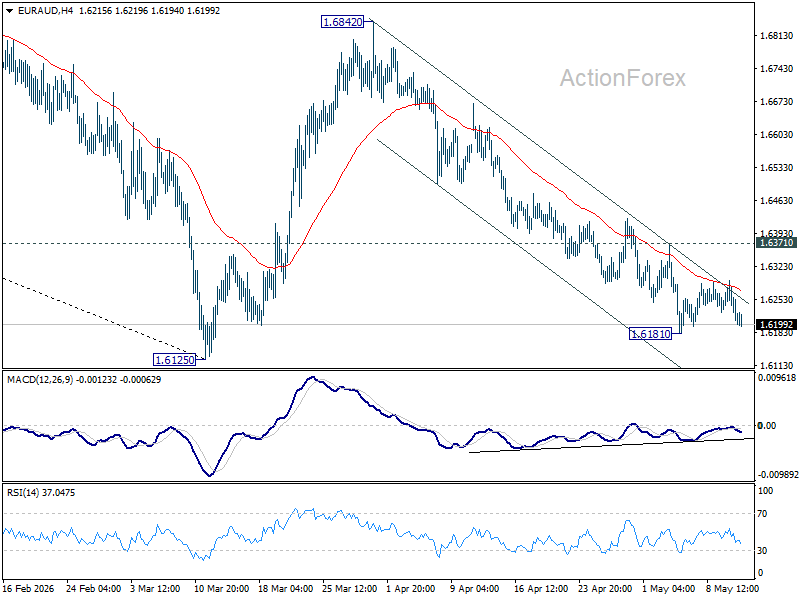
In the bigger picture, fall from 1.8554 (2025 high) is in progress and deeper decline should be seen to 61.8% retracement of 1.4281 to 1.8554 at 1.5913, which is slightly below 1.5963 structural support. Decisive break there will pave the way back to 1.4281 (2022 low). For now, risk will stay on the downside as long as 55 W EMA (now at 1.7039) holds, even in case of strong rebound.
EUR/CHF Daily Outlook
Daily Pivots: (S1) 0.9151; (P) 0.9162; (R1) 0.9173; More....
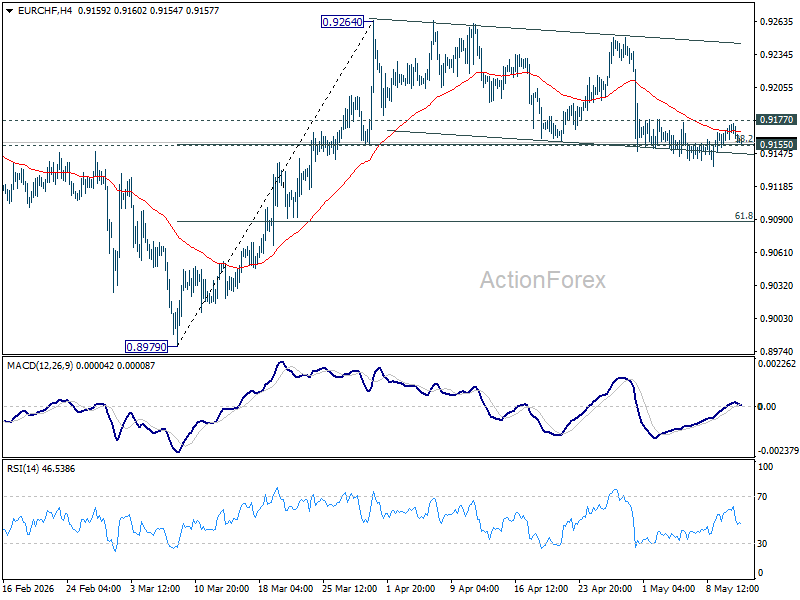
Intraday bias in EUR/CHF remains neutral at this point. On the upside, break of 0.9177 minor resistance will turn bias back to the upside for 0.9264 resistance. However, sustained trading below 0.9155 cluster support (38.2% retracement of 0.8979 to 0.9264 at 0.9155) will turn bias back to the downside for deeper pullback to 61.8% retracement at 0.9088 and possibly below.
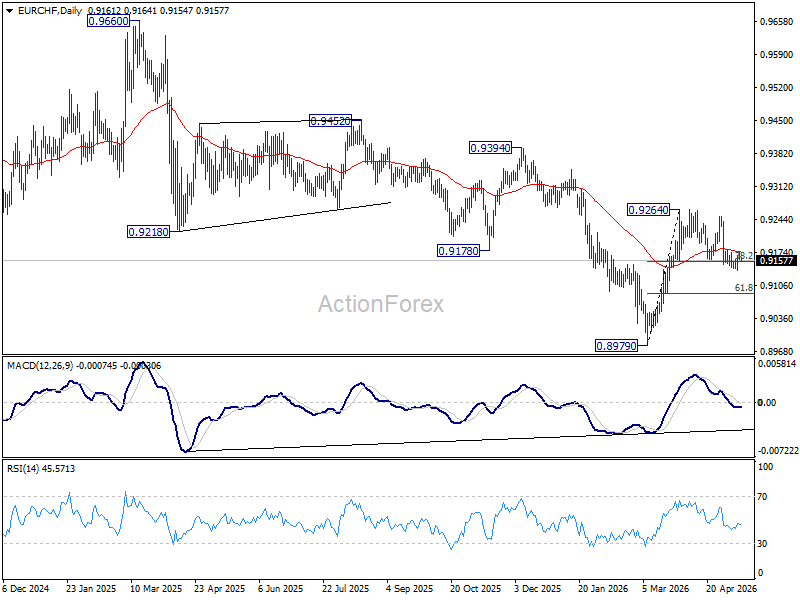
In the bigger picture, considering bullish convergence condition in W MACD, a medium term bottom should be in place at 0.8979. Sustained trading above 55 W EMA (now at 0.9241) will add more credence to this case. Further break of 0.9394 resistance will pave the way to 0.9660 resistance next. However rejection by the 55 W EMA will set up another fall through 0.8979 low at a later stage.
EUR/USD Daily Outlook
Daily Pivots: (S1) 1.1709; (P) 1.1748; (R1) 1.1775; More….
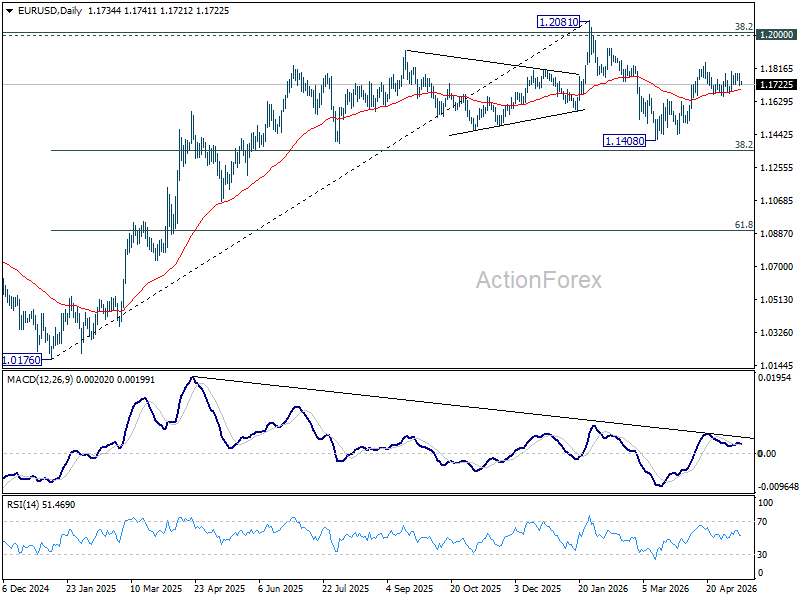
Range trading continues in EUR/USD and intraday bias stays neutral. Further rise is expected with 1.1642 support intact. On the upside, firm break of 1.1848 will target 1.2081 high next. However, firm break of 1.1662 support will indicate the the rebound from 1.1408 has completed, and bring deeper decline back towards this low instead.
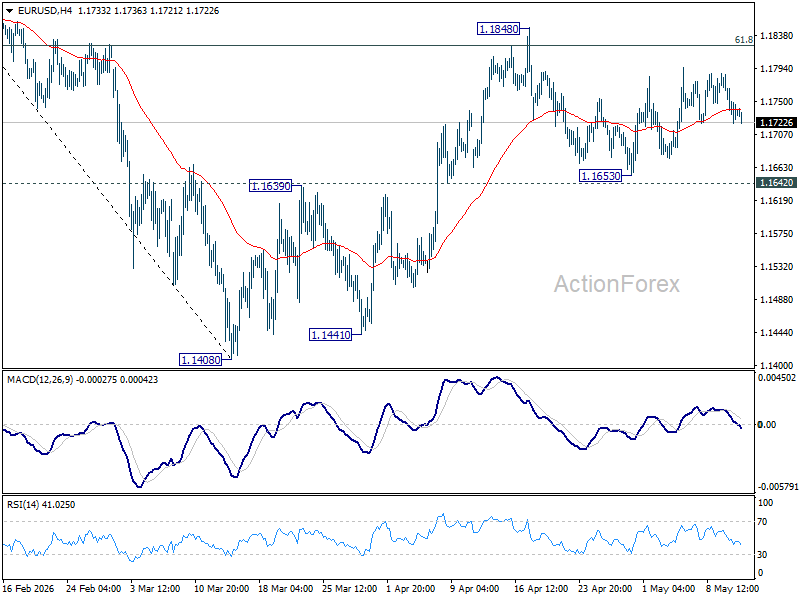
In the bigger picture, the strong support from 38.2% retracement of 1.0176 to 1.2081 at 1.1353 suggests that the pullback from 1.2081 is more likely a corrective move. Strong support was also found in 55 W EMA (now at 1.1539). Focus is back on 1.2 key cluster resistance level. Decisive break there will carry long term bullish implications. Nevertheless, break of 1.1408 support will revive the case of medium term bearish trend reversal.
USD/JPY Daily Outlook
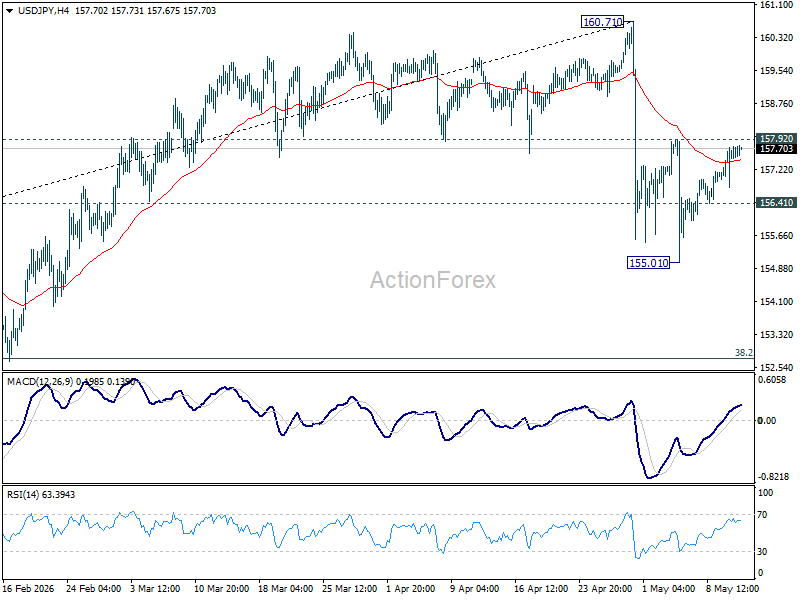
Daily Pivots: (S1) 156.96; (P) 157.36; (R1) 157.99; More...
Intraday bias in USD/JPY stays neutral at this point. On the downside, below 156.41 minor support will bring retest of 155.01. Firm break there will resume the fall from 160.71 to 152.25 support next. On the upside, however, firm break of 157.92 will indicate that pullback from 160.71 has completed, and turn bias back to the upside for stronger rebound.
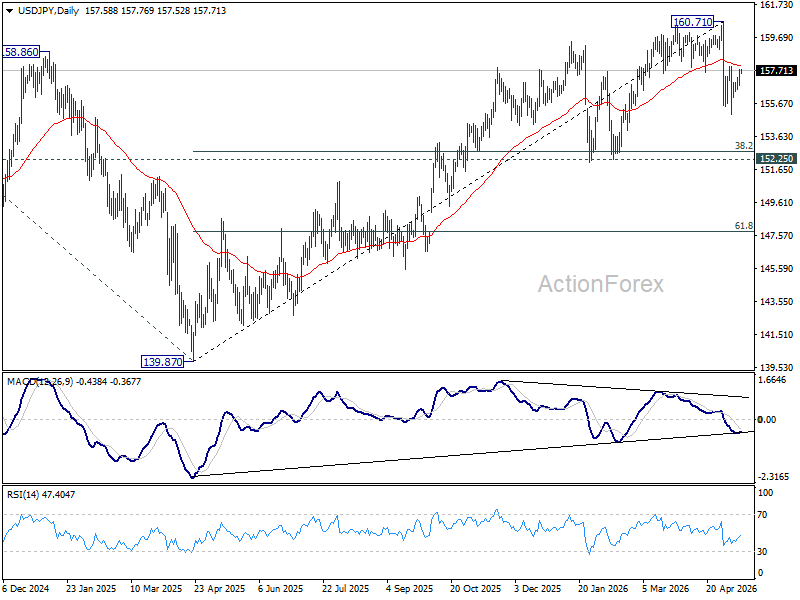
In the bigger picture, for now, corrective pattern from 161.94 (2024 high) is still seen as completed at 139.87. Rise from there is seen as resuming the long term up trend. So, break of 161.94 is expected at a later stage to resume the long term up trend. However, sustained break of 55 W EMA (now at 154.13) will dampen this view and bring deeper fall back towards 139.87 to extend the pattern from 161.94.
GBP/USD Daily Outlook
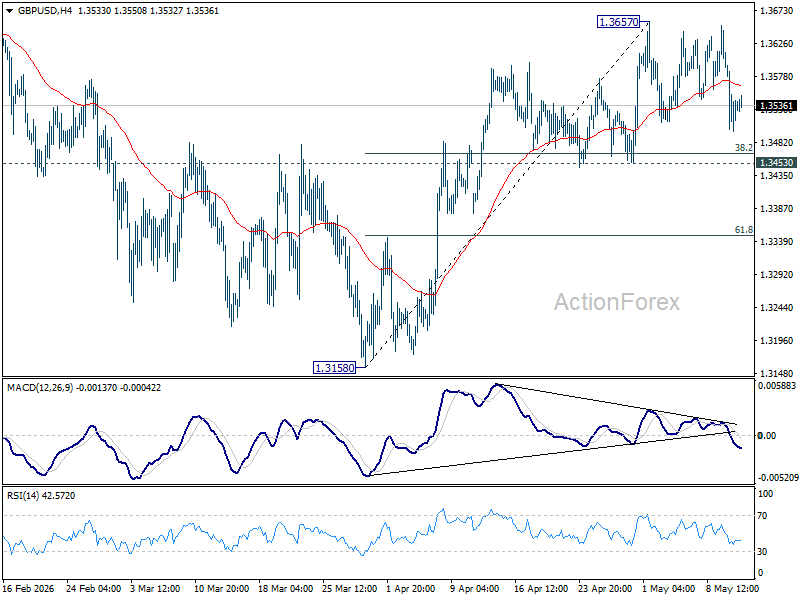
Daily Pivots: (S1) 1.3488; (P) 1.3548; (R1) 1.3597; More...
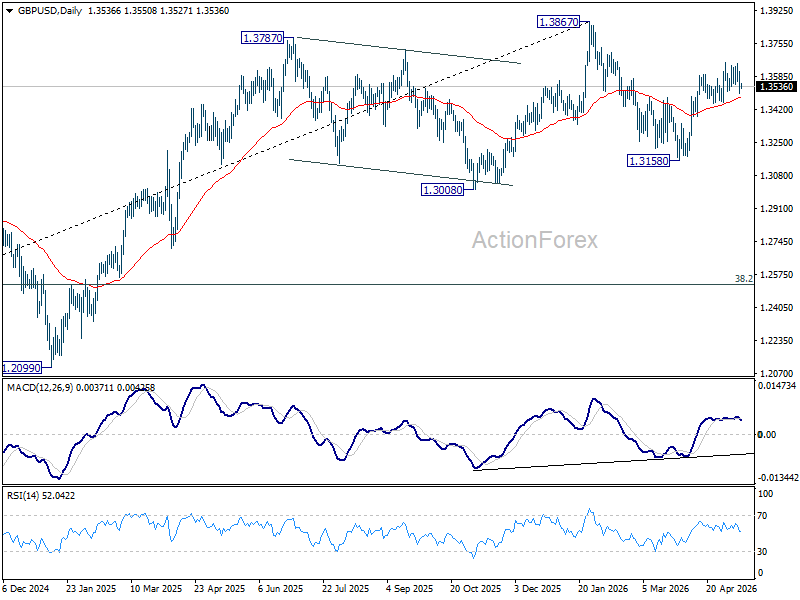
Intraday bias in GBP/USD remains neutral for the moment. Further rise is expected with 1.3453 support intact. On the upside, firm break of 1.3657 will resume the rally fro 1.3158 to retest 1.3867 high. However, decisive break of 1.3453 will argue that the rebound has already completed, and turn bias to the downside for retesting 1.3158 instead.
In the bigger picture, current development suggests that price actions from 1.3867 are merely a corrective pattern within the broader up trend from 1.0351 (2022 low). With 1.3008 support intact, medium term bullishness is maintained and break of 1.3867 is in favor for a later stage, towards 1.4248 key resistance (2021 high).
USD/CHF Daily Outlook
Daily Pivots: (S1) 0.7770; (P) 0.7796; (R1) 0.7827; More….
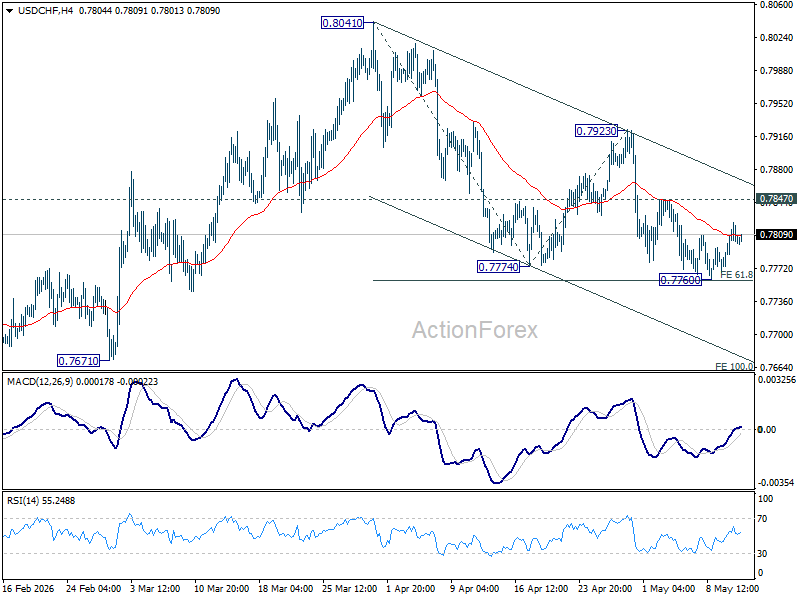
USD/CHF is staying in range trading and intraday bias remains neutral for the moment. With 0.7847 resistance intact, further decline is expected. On the downside, decisive break of 0.7760 will resume the whole decline form 0.8041, and target 100% projection of 0.8041 to 0.7774 from 0.7923 at 0.7656. However, firm break of 0.7847 resistance will indicate short term bottoming, and bring stronger rebound back to 0.7923 resistance.
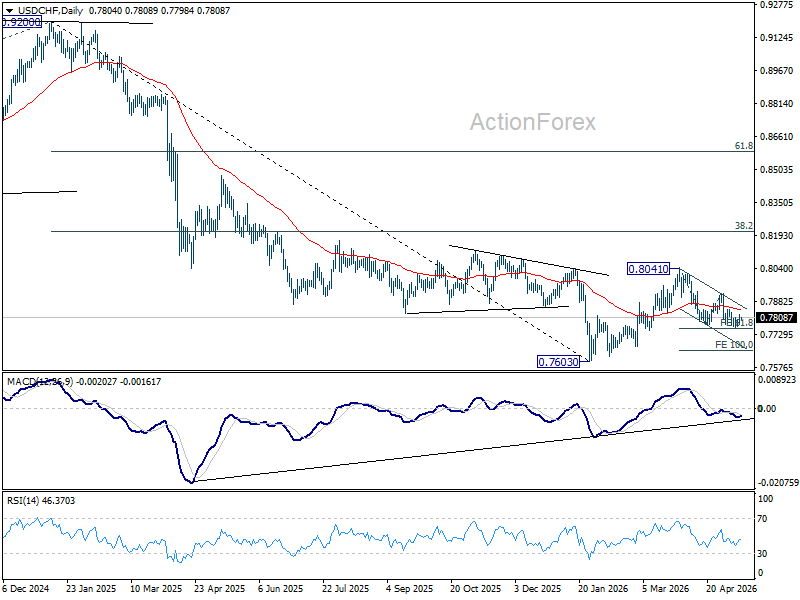
In the bigger picture, as long as 55 W EMA (now at 0.8051) holds, fall from 0.9200 is expected to continue, as part of the larger down trend. Firm break of 0.7603 will target 100% projection of 1.0146 (2022 high) to 0.8332 from 0.9200 at 0.7382.
AUD/USD Daily Report
Daily Pivots: (S1) 0.7214; (P) 0.7232; (R1) 0.7257; More...
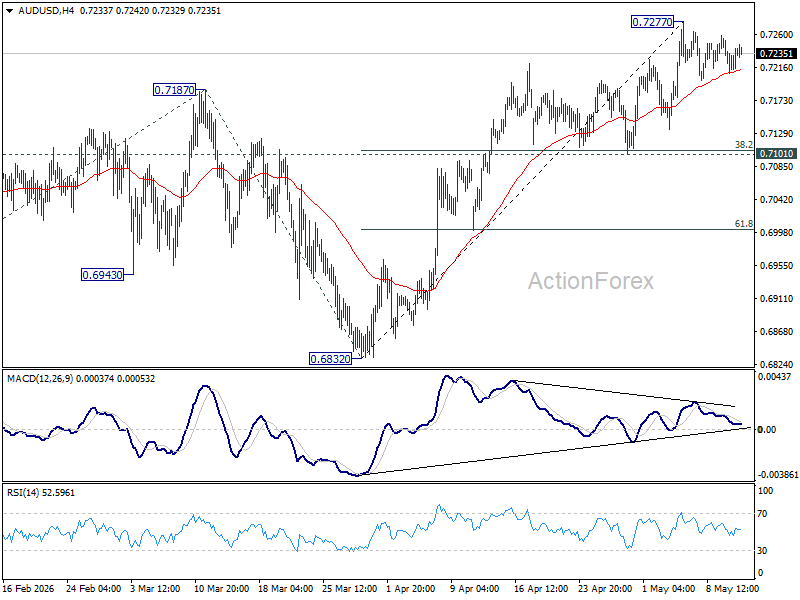
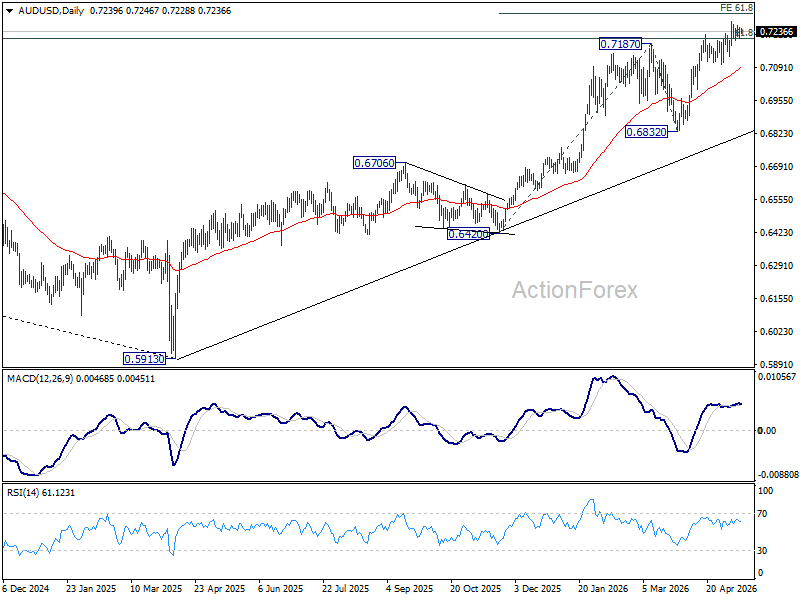
Intraday bias in AUD/USD remains neutral as consolidations continue below 0.7277. With 0.7101 support intact, further rally is expected. On the upside, above 0.7277 will resume larger up trend and target 61.8% projection of 0.6420 to 0.7187 from 0.6832 at 0.7306.
In the bigger picture, rise from 0.5913 (2024 low) is still in progress. Decisive break of 61.8% retracement of 0.8006 to 0.5913 at 0.7206 will solidify the case that it's already reversing the down trend from 0.8006 (2021 high). Further rally should then be seen to retest 0.8006. For now, outlook will remain bullish as long as 0.6832 support holds, in case of pullback.
PPI to Test CPI Signals
In focus today
In the US, April PPI data is due for release. Yesterday's CPI print showed sticky monthly services and super-core inflation, reinforcing concerns around persistent underlying price pressures. Markets will watch whether PPI confirms similar price momentum.
In the euro area, we will receive the second estimate of GDP growth in Q1. Focus is on the data on employment growth, which we expect at 0.1% q/q.
In Sweden, the final figures for April inflation are expected to confirm the low preliminary numbers, with CPIF at 0.8% y/y and underlying inflation at 0% y/y. We will also get an answer to what contributed to the low services inflation. It could be administrative prices, but there is also considerable uncertainty around travel related services, which vary greatly depending on the season. This year there is a new measurement method for certain hotels and new information for air travel.
In addition to the inflation details, we will also receive the Riksbank minutes from last week's rate announcement,.
Due to Ascension Day, Danske Morning Mail returns on Monday, 18 May. During the break, key releases include US retail sales and UK March/Q1 GDP on Thursday, while Thursday-Friday sees President Trump's visit to China to meet President Xi Jinping. We do not expect major breakthroughs, though smaller deals on trade, fentanyl and rare earth security are possible. Read more in Research US-China - Xi-Trump meeting preview: We expect no game changers, 12 May.
Economic and market news
What happened yesterday
In the US, headline inflation rose 0.6% m/m SA, in line with expectations, while core inflation was stronger than expected at 0.4% m/m SA (cons 0.3% m/m). Shelter rose 0.6% m/m and "super-core" (core services ex shelter) picked up to around 0.45% m/m, the highest in three months, underlining that domestic service price pressures remain uncomfortably firm. By contrast, core goods inflation was flat at 0.0% m/m, suggesting limited pass-through so far from higher commodity prices and keeping underlying pressures largely concentrated in services, reinforcing a cautious Fed. Read more in Global Inflation Watch - Shelter inflation boosts US CPI in April, 12 May.
In US monetary policy space, the Senate confirmed Kevin Warsh to a 14-year term as Federal Reserve governor by a 51-45 vote and is expected to vote as soon as today on a concurrent four-year term as Fed chair, positioning him to succeed Jerome Powell. Although Powell's term as chair formally ends on Friday, he stated last month that he will remain on the Fed board as a governor.
In the euro area, the German ZEW survey was slightly better than expected in May. The assessment of the current situation fell to -77.8 (cons: -78.0) from -73.7 while expectations improved to -10.2 (cons: -19.5, prior: -17.2). Despite the small improvement, expectations remain at very low levels as the industry-heavy German economy is expected to take a hit from higher energy prices. However, as the April manufacturing PMIs remained above 50 and the ZEW current assessment in May fell only to levels similar to what we saw in the last months of 2025, we are yet to see a significant hit on the German industry.
In the UK, more than 90 MPs called for PM Starmer to step down, and four ministers handed in their resignation yesterday. Bond markets fear looser fiscal policy in case of a change of leadership, which drove 30Y Gilt yields to the highest levels since 1998. If Starmer resigns, it could also open up for a more hawkish policy stance from the Bank of England, which was reflected in market pricing yesterday.
Equities: Global equities ended the day lower by 0.3% yesterday, after being down 1% at the lows. For once, semi-conductors in the S&P500 were among the weakest performers closing 1.4% lower, after being down about 4.5% earlier in the day. We will not overdo conclusions on such setback after an impressive 35% run over the past month. The defensive sectors, led by healthcare and staples, were among the top performers with gains of 1.9% and 1.6%, respectively in a broad based defensive outperformance. S&P500 closed down 0.2%, Nasdaq 0.7% lower, and Russell2000 down about 1%. Asian equities are mostly in green this morning after an initial setback. US and European futures are mostly in green today.
FI and FX: European yields ended the day higher across the board with 10Y Bunds breaking above 3.10% while 2Y EUR swap rates rose to close to 2.90% with now 85bp worth of hikes priced in for the ECB. The combination of higher energy prices, cautious risk sentiment and hot US CPI pushed EUR/USD lower yesterday. US inflation was faster than expected both in headline (3.8%; cons. 3.7%) and core terms (2.8%; cons. 2.7%). EUR/GBP was on the rise following mounting pressure for UK PM Starmer to resign. With up to 80 Labour MPs having called for Starmer to resign and six ministerial aides quit yesterday, prediction markets have ramped up bets of Starmer being out to around 70% by June and 85% by YE 2026. The SEK underperformed all G10 peers yesterday, with EUR/SEK pushing above 10.90 and USD/SEK rising to the 9.30-level. With no specific news out of Sweden, and Swedish rates moving mostly in line with European dittos in a larger risk-off move. Looking ahead, the rest of the week is quiet in terms of tier-1 data, but focus remains on Iran and the Trump-Xi meeting starting tomorrow.
USD/CAD Daily Outlook
Daily Pivots: (S1) 1.3667; (P) 1.3695; (R1) 1.3722; More...
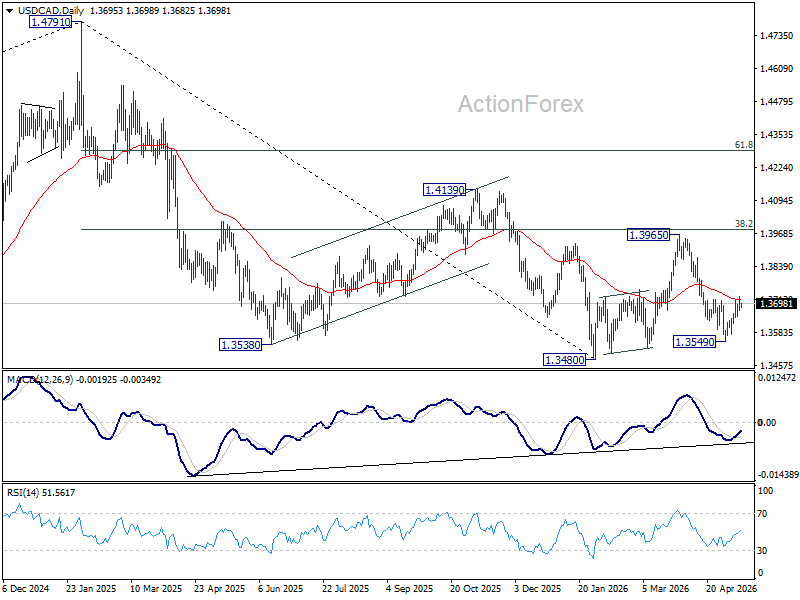
USD/CAD's breach of 1.3709 resistance indicates short term bottoming at 1.3549, on bullish convergence condition in 4H MACD. Rise from there is seen as the third leg of the corrective pattern from 1.3480. Intraday bias is mildly on the upside for further rise towards 1.3965 resistance. On the downside, though, break of 1.3646 minor support will bring retest of 1.3549 instead.
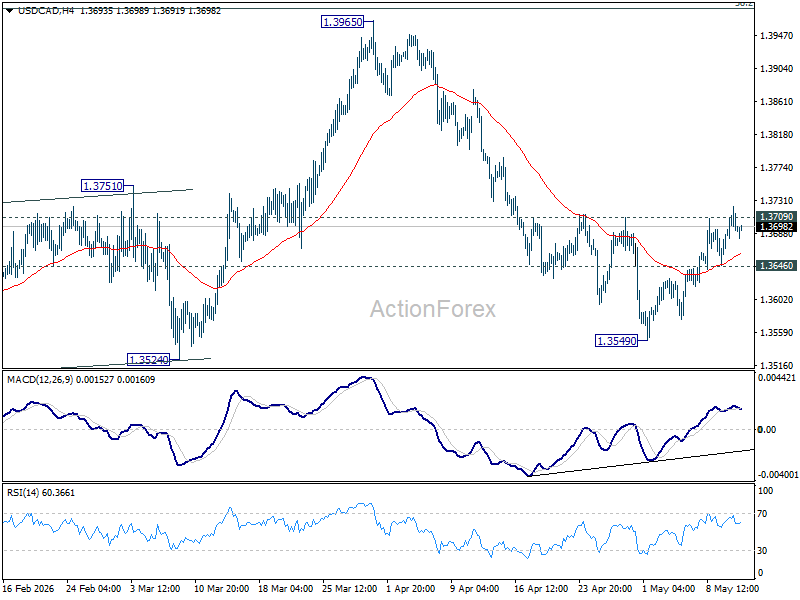
In the bigger picture, price actions from 1.4791 are seen as a corrective pattern to the whole up trend from 1.2005 (2021 low). Deeper fall could be seen, as the pattern extends, to 61.8% retracement of 1.2005 to 1.4791 at 1.3069. However, decisive break of 38.2% retracement of 1.4791 to 1.3480 at 1.3981 will argue that the correction has completed with three waves down to 1.3480 already.