Sample Category Title
Fed’s Barkin: I’m waiting for inflation to crack
In a CNBC interview, Richmond Fed President Thomas Barkin shared his thoughts on inflation, emphasizing the importance of core inflation, which is still running slightly above 5% year over year. He acknowledged recent positive news regarding energy prices but maintained that there is more work to be done to bring core inflation down to desired levels.
Although Barkin did not explicitly state his position on another rate hike at the Fed's upcoming policy meeting in May, he emphasized the importance of closely monitoring jobs and inflation data, both of which remain relatively robust.
He said, "I'm waiting for inflation to crack ... It's moving in the right direction ... but in the absence of a month or two months or three months with inflation at our target, it's hard to make the case that we're compellingly headed there."
BoC Governor Tiff Macklem comments on weak growth and rate cut expectations
Following BoC's decision to keep interest rates unchanged at 4.50%, Governor Tiff Macklem addressed concerns about the country's economic growth during a press conference. He acknowledged the weak growth projections, stating, "We are seeing inflation come down even as the economy continues to grow. That is encouraging. But yes, we do expect growth to be weak. It's expected to be weak through the rest of the year, pick up gradually over the course of next year."
Regarding the potential for negative growth quarters, Macklem clarified that the central bank is forecasting "small positives," but conceded that "you can't rule out that there's going to be a couple quarters of small negatives." He emphasized that BoC is not forecasting a major contraction or significant increases in unemployment, distancing the current situation from a typical recession.
Addressing market expectations of a rate cut, Macklem said, "based on the information we have today, the implied expectation in the market that we're going to be cutting our policy rate later in the year, that doesn't look today like the most likely scenario to us." This statement suggests that the central bank may not follow the market's anticipated course of action, given the current data available.
Dollar Index: Dollar Loses Ground after US CPI Surprise
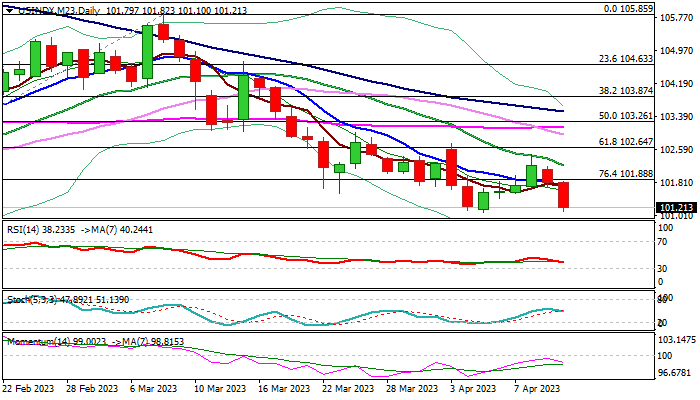
The dollar’s bears accelerated after US inflation surprised lower in March, boosting risk appetite and pushing the greenback to one-week low.
Fresh weakness (the dollar was down nearly 0.7% since data release) is pressuring pivotal support at 101.07 (Apr 5 low), ahead of key support at 100.66 (2023 low of Feb 2), loss of which would confirm an end of correction (100.66/105.46) and signal continuation of larger downtrend from 114.72 (2022 peak, posted on Sep 28).
Daily technical studies are in full bearish configuration and contribute to negative outlook, although fresh bears may face increased headwinds, as expectations for Fed’s 0.25% hike in May are high, after report showed that underlying inflation remains elevated that requires further action from the US central bank.
Fading concerns from the recent banking crisis also ease pressure on the Fed and give policymakers more room to focus on its main task – pushing inflation to the central bank’s 2% target.
Res: 101.53; 101.88; 102.22; 102.46
Sup: 101.07; 100.66; 100.00; 99.30
Bank of Canada Maintains Pause, Cautions on Cyclical Strength
The Bank of Canada maintained the overnight rate at 4.5%, while stating that it will continue with Quantitative Tightening (QT).
Regarding the recent resurgence in economic momentum, the report stated, "economic growth in the first quarter looks to be stronger than was projected in January, with a bounce in exports and solid consumption growth. While the Bank’s Business Outlook Survey suggests acute labour shortages are starting to ease, wage growth is still elevated relative to productivity growth. Strong population gains are adding to labour supply and supporting employment growth while also boosting aggregate consumption."
On rising prices, it stated that "inflation in many countries is easing in the face of lower energy prices, normalizing global supply chains, and tighter monetary policy. At the same time, labour markets remain tight and measures of core inflation in many advanced economies suggest persistent price pressures, especially for services."
On the future path of policy, the Bank "continues to assess whether monetary policy is sufficiently restrictive to relieve price pressures and remains prepared to raise the policy rate further if needed to return inflation to the 2% target."
Key Implications
The BoC held the line in today's announcement. While it acknowledged that the economy is exhibiting cyclical strength as evidenced by strong employment gains and a bounce-back in consumer spending, it appears confident that growth is set to slow in the coming months. This slowdown, though delayed, has kept the faith that inflation will continue to decelerate, hitting 3% year-on-year this summer.
Over the last couple of weeks, the timing of rate cuts has been pushed out, with markets now expecting the first cut to occur in December (from September). This reflects the economy's cyclical rebound, which will keep underlying cyclical inflationary pressures (supercore) elevated through this year. As the BoC acknowledged, this could make "getting inflation the rest of the way back to 2%" more difficult. Given this backdrop, we think the best policy for the BoC is to keep rates stable until cyclical inflation dynamics turn decisively lower.
ECB’s Holzmann calls for vigorous action, de Guindos cautious on core inflation
ECB Governing Council member Robert Holzmann told German newspaper Boersen Zeitung that the persistence of inflation currently calls for further action: "The persistence of inflation currently argues for another 50 basis points (in May)." Holzmann emphasized that failing to act vigorously now would exacerbate the inflation problem and ultimately necessitate even stricter measures.
Holzmann also noted a consensus among ECB Governing Council members: "There is a great deal of common understanding in the ECB Governing Council that we have not yet reached the end of the line when it comes to key interest rates. We must continue to act decisively and continue to raise key interest rates noticeably even beyond May."
In a separate occasion, ECB Vice President Luis de Guindos expressed caution regarding core inflation: "We believe core inflation provides a better signal of medium-term inflationary trends," de Guindos said in Madrid. "Headline inflation will continue to decelerate, but on core inflation, we are not so optimistic."
Gold in Demand
Despite its proximity to historical highs, the short-term momentum suggests that buying will intensify even on minor pullbacks. A week earlier, gold made a local high of $2030 and then corrected by 2.25%. The intraday chart on Monday afternoon clearly shows a bullish trend. The intermittent spikes in the Asian session were not sustained, but this trendline remained in force.
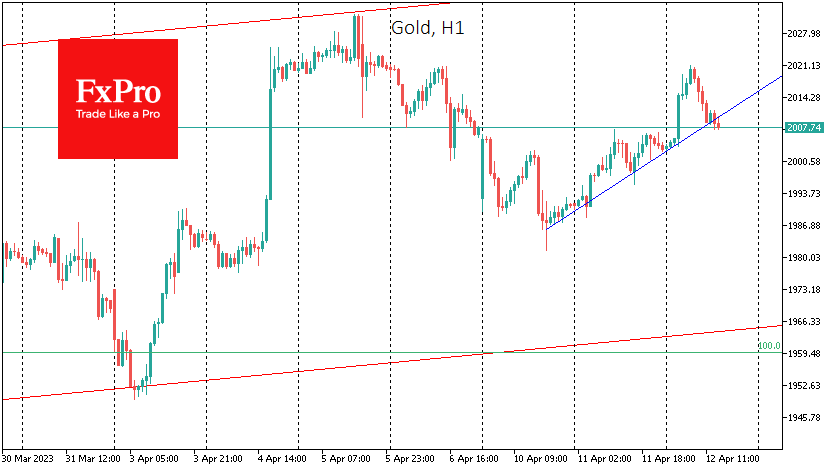
It appears more like a large buyer building up its long position than speculating on the news. This mini-trend will be challenged if it falls below $2008. The final break of this trend will come when it falls below the previous local lows of around $2002.
But it is worth taking a step back and looking at the more fundamental trends. The amplitude of gold’s move on March 20-21 created a broad and rising range in which gold has been trading. The lower boundary is now $1965, and the upper edge is $2040.
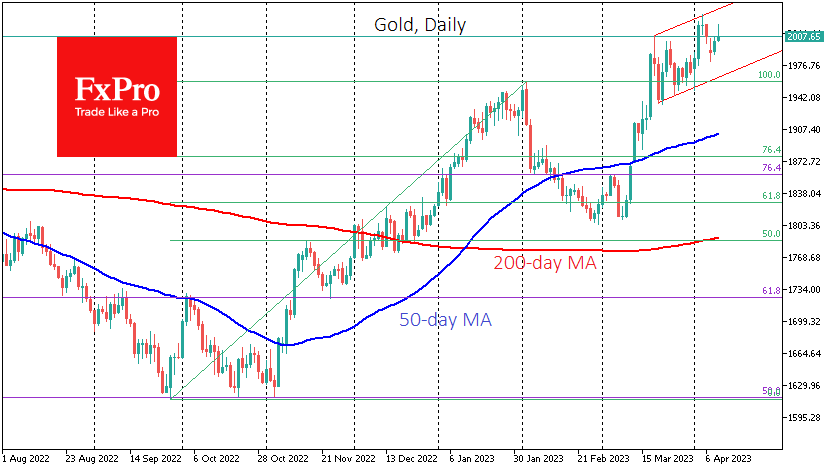
A further step back in time suggests that gold is now in bullish momentum, having completed an almost canonical Fibonacci retracement after rallying from the September-November lows to the February peak. The final target for this pattern is the $2170 area, which is nearly $100 above the historical highs.
If gold does rewrite the highs, it will be in an even longer-term growth cycle with a potential target of $2650. This is no longer a target for this quarter but for next year.
The most exciting thing is that the big buyers in the last few quarters could be the central banks of the big emerging markets, such as China and Saudi Arabia. In this case, gold is an alternative to dollar-denominated government bonds, which look politically unpalatable in the short term, whereas gold is politically neutral.
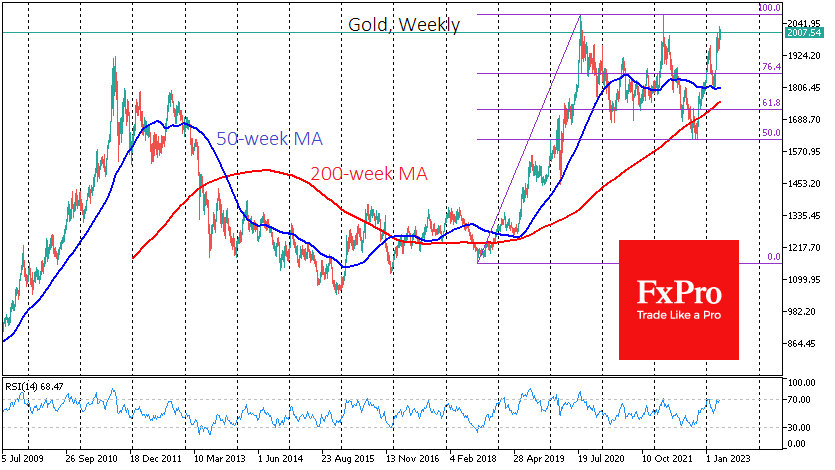
Nevertheless, it is worth recognising that, contrary to the long-term bullish picture for gold. The blow could be pretty painful for short-term buyers. Gold remains in a long-term bullish trend as long as it trades above $1950-1960. A pullback here could become a reality in the event of high inflation data or continued hawkish Fed rhetoric in the coming weeks, seriously punishing the most desperate bulls.
Sunset Market Commentary
Markets
FX trading was extremely subdued in the run up to today’s US CPI release. Core bonds continued their post-payrolls drift south with the front end of the curve underperforming. Headline March US CPI eventually slowed from 0.4% M/M to 0.1% M/M (vs 0.2% M/M expected) with the annual figure falling from 6% Y/Y to 5% Y/Y (vs 5.1% Y/Y and lowest since May 2021). Core inflation printed exactly in line with consensus at 0.4% M/M (from 0.5%) and 5.6% Y/Y (from 5.5%; first increase since September 2022). Diving into the numbers shows core services rising by 0.4% M/M to be up 7.1% Y/Y with shelter costs increasing by 0.8% M/M and 8.2% Y/Y. The bigger inflation picture was thus by and large in line with forecasts. However, the market reaction was again quite large. Markets have become extremely sensitive to deviations from consensus, especially to the downside, since the collapse of some regional banks. We’ve seen the same reaction function last week following ISM’s, JOLTS and ADP employment. It led the Fed to drop forward guidance on ongoing rate increases with the March dot plot penciling in a final 25 bps move before pausing to watch how the fallout from the collapse of the likes of SVB would affect the economy. Several Fed governors expect a credit crunch to slow growth and help tackle inflation. Their guestimate is that it could have the effect of 1 to 3 additional 25 bps rate hikes. Tonight’s FOMC Minutes of that meeting could provide more insight on the issue. Our view is still that stubborn core inflation won’t allow the Fed to put its guard down in the inflation battle. Pausing too soon risks becoming the bigger policy mistake, allowing inflation to re-accelerate later on. Anyway, that’s not how markets look at it and we fear the current reaction function will remain the default one in coming weeks/months. US Treasury yields currently lose up to 4 bps at the front end of the curve (2-yr), but they are recovering from intraday lows (>-15 bps). US Treasuries in the process massively outperform German Bunds with Bund yields rising 5.9 bps (30-yr) to 7.8 bps (2-yr). The dollar spiked lower on the release with EUR/USD currently testing the March high at 1.0973. The YTD high at 1.1033 remains out of reach for the moment. The trade-weighted dollar (DXY) changes hands at 101.60, just above the March low at 101.41. EUR/GBP (0.8814) followed the move higher in EUR/USD, exiting the narrow 0.8750-0.88 range for the first time since April. The YTD low at 100.82 is still further away. European stock markets gain around 0.5% with key US indices opening 0.6%-0.8% stronger.
News Headlines
Hungarian inflation barely eased in March, coming down from a 27-year high of 25.4% to 25.2% Y/Y. Monthly dynamics remain very strong, coming in at 0.8% M/M. Food inflation is once again a key driver, registering a 1.5% M/M increase. But excluding that component (amongst other ones) shows no improvement, on the contrary. Core inflation even accelerated from 25.2% to 25.7% with sticky services inflation rising 1.9% M/M or 13% Y/Y. The latter combined with a 16% Y/Y wage dynamic could slow the disinflationary process in coming months. Today’s inflation print gives the central bank no room to cut rates anytime soon. KBC Economics expects the hawkish stance from the NBH to remain with us in the following weeks, making a cut in April unlikely and in May at the very least uncertain. Once started, the O/N tender rate (currently 18%) may be cut at a 100 bps/meeting pace. The Hungarian forint reacted stoic with EUR/HUF trading unchanged at around 375.70. In a broader perspective, the currency had a good run since mid-March, bringing it to around the strongest levels in a year.
Fewer German companies plan to increase prices in the next three months, the ifo Institute’s latest survey finds. For the economy as a whole, price expectations balance fell for a sixth month straight from 29.2 points to 27.2. This compares to a peak/series high of 60.6 points set in April 2022. The current reading is nevertheless markedly higher than the long-term average of 14.3. The easing was broad-based across sectors, with construction and manufacturing taking the lead, trade followed at a distance. Companies in the services sector on the other hand marginally strengthened their price plans again, from 31.7 to 34.7 points.
BoC stands pat, returning inflation to 2% could prove to be more difficult
As widely expected, BoC kept overnight rate unchanged at 4.50%, with Bank Rate and deposit rate held at 4.75% and 4.50% respectively. In the statement, the BoC mentioned that the "Governing Council continues to assess whether monetary policy is sufficiently restrictive to relieve price pressures and remains prepared to raise the policy rate further if needed."
The central bank projects weak GDP growth through the remainder of this year, with a gradual strengthening next year. BoC now expects Canada's economy to grow by 1.4% this year and 1.3% in 2024 before picking up to 2.5% in 2025.
The bank anticipates CPI inflation to fall quickly to around 3% in the middle of this year and then decline more gradually to the 2% target by the end of 2024. "Recent data is reinforcing Governing Council's confidence that inflation will continue to decline in the next few months," the statement noted.
However, BoC also highlighted that returning inflation to 2% "could prove to be more difficult", as inflation expectations are coming down slowly, service price inflation and wage growth remain elevated, and corporate pricing behavior has yet to normalize.
(BOC) Bank of Canada maintains policy rate, continues quantitative tightening
The Bank of Canada today held its target for the overnight rate at 4½%, with the Bank Rate at 4¾% and the deposit rate at 4½%. The Bank is also continuing its policy of quantitative tightening.
Inflation in many countries is easing in the face of lower energy prices, normalizing global supply chains, and tighter monetary policy. At the same time, labour markets remain tight and measures of core inflation in many advanced economies suggest persistent price pressures, especially for services.
Global economic growth has been stronger than anticipated. Growth in the United States and Europe has surprised on the upside, but is expected to weaken as tighter monetary policy continues to feed through those economies. In the United States, recent stress in the banking sector has tightened credit conditions further. US growth is expected to slow considerably in the coming months, with particular weakness in sectors that are important for Canadian exports. Meanwhile, activity in China's economy has rebounded, particularly in services. Overall, commodity prices are close to their January levels. The Bank's April Monetary Policy Report (MPR) projects global growth of 2.6% this year, 2.1% in 2024, and 2.8% in 2025.
In Canada, demand is still exceeding supply and the labour market remains tight. Economic growth in the first quarter looks to be stronger than was projected in January, with a bounce in exports and solid consumption growth. While the Bank's Business Outlook Survey suggests acute labour shortages are starting to ease, wage growth is still elevated relative to productivity growth. Strong population gains are adding to labour supply and supporting employment growth while also boosting aggregate consumption. Housing market activity remains subdued.
As more households renew their mortgages at higher rates and restrictive monetary policy works its way through the economy more broadly, consumption is expected to moderate this year. Softening foreign demand is expected to restrain exports and business investment. Overall, GDP growth is projected to be weak through the remainder of this year before strengthening gradually next year. This implies the economy will move into excess supply in the second half of this year. The Bank now projects Canada's economy to grow by 1.4% this year and 1.3% in 2024 before picking up to 2.5% in 2025.
CPI inflation eased to 5.2% in February, and the Bank's preferred measures of core inflation were just under 5%. The Bank expects CPI inflation to fall quickly to around 3% in the middle of this year and then decline more gradually to the 2% target by the end of 2024. Recent data is reinforcing Governing Council's confidence that inflation will continue to decline in the next few months. However, getting inflation the rest of the way back to 2% could prove to be more difficult because inflation expectations are coming down slowly, service price inflation and wage growth remain elevated, and corporate pricing behaviour has yet to normalize. As it sets monetary policy, Governing Council will be particularly focused on these indicators, and the evolution of core inflation, to gauge the progress of CPI inflation back to target.
In light of its outlook for growth and inflation, Governing Council decided to maintain the policy rate at 4½%. Quantitative tightening continues to complement this restrictive stance. Governing Council continues to assess whether monetary policy is sufficiently restrictive to relieve price pressures and remains prepared to raise the policy rate further if needed to return inflation to the 2% target. The Bank remains resolute in its commitment to restoring price stability for Canadians.
Information note
The next scheduled date for announcing the overnight rate target is June 7, 2023. The Bank will publish its next full outlook for the economy and inflation, including risks to the projection, in the MPR on July 12, 2023.
EUR/USD Mid-Day Outlook
Daily Pivots: (S1) 1.0868; (P) 1.0898; (R1) 1.0943; More...
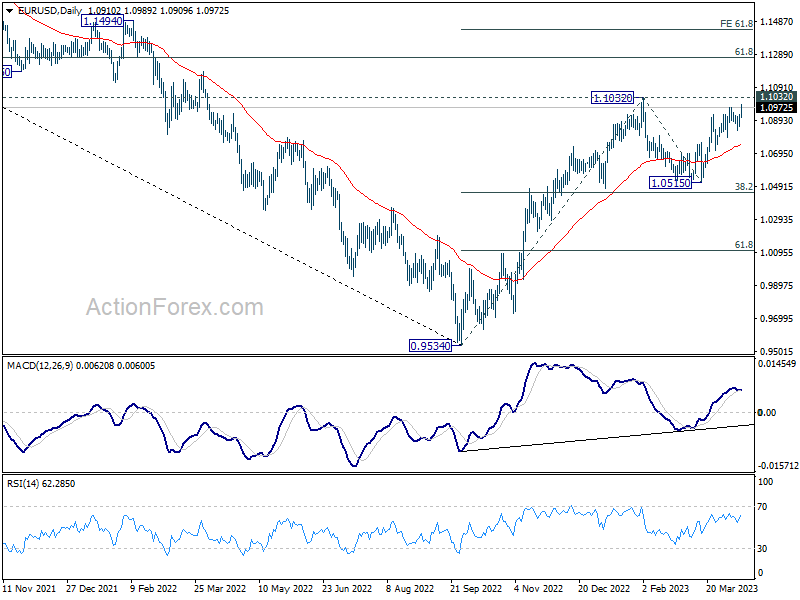
Intraday bias in EUR/USD is back on the upside as rise from 1.0525 resumes by breaking through 1.0972. Further rally should be seen to 1.1032 high. Decisive break there resume larger up trend from 0.9534 to 1.1273 fibonacci level. Nevertheless, break of 1.0830 support will now indicate rejection by 1.1032, and turn bias back to the downside for 1.0711 support and below.
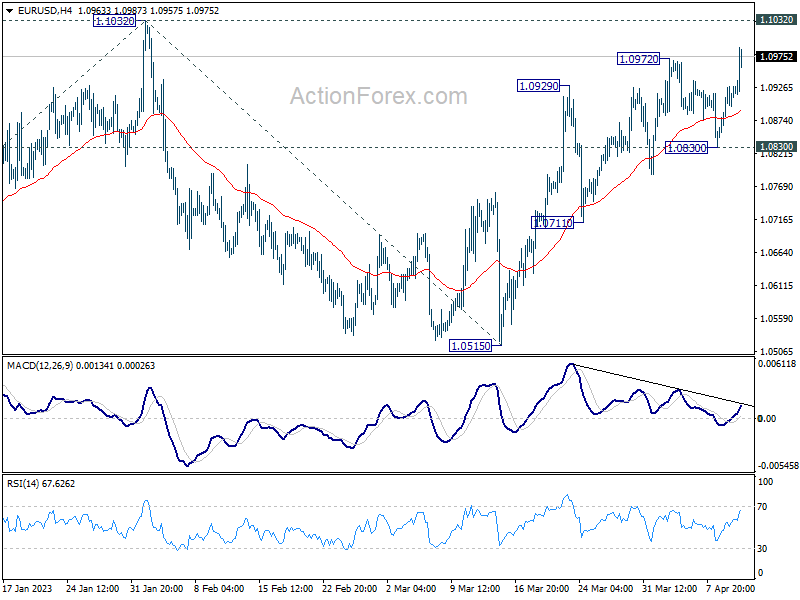
In the bigger picture, rise from 0.9534 (2022 low) is in progress with 38.2% retracement of 0.9534 to 1.1032 at 1.0460 intact. The strong support from 55 week EMA (now at 1.0625) was also a medium term bullish sign. Next target is 61.8% retracement of 1.2348 (2021 high) to 0.9534 at 1.1273. Sustained break there will solidify the case of bullish trend reversal and target 1.2348 resistance next (2021 high).