Sample Category Title
BoE’s Tenreyro foresees need for looser monetary policy
BoE Monetary Policy Committee member Silvana Tenreyro, a known dove, remarked in a speech that the data sinve November has evolved most like her downside scenario, noting a sharp decline in high-frequency private-sector regular pay growth.
She explained that with the Bank Rate at 4.25%, the restrictive policy is likely to "drag demand well below its potential, loosening the labour market and pulling down on inflation." As a result, she believes that "inflation is likely to fall well below target."
Tenreyro voted for no change in the Bank Rate in recent months, instead of further tightening, as she believes a looser stance is necessary to achieve the inflation target in the medium term.
She expressed her expectation that the current high level of the Bank Rate "will require an earlier and faster reversal, to avoid a significant inflation undershoot."
Full speech of Silvana Tenreyro here.
Eurozone PPI at -0.5% mom, 13.2% yoy in Feb
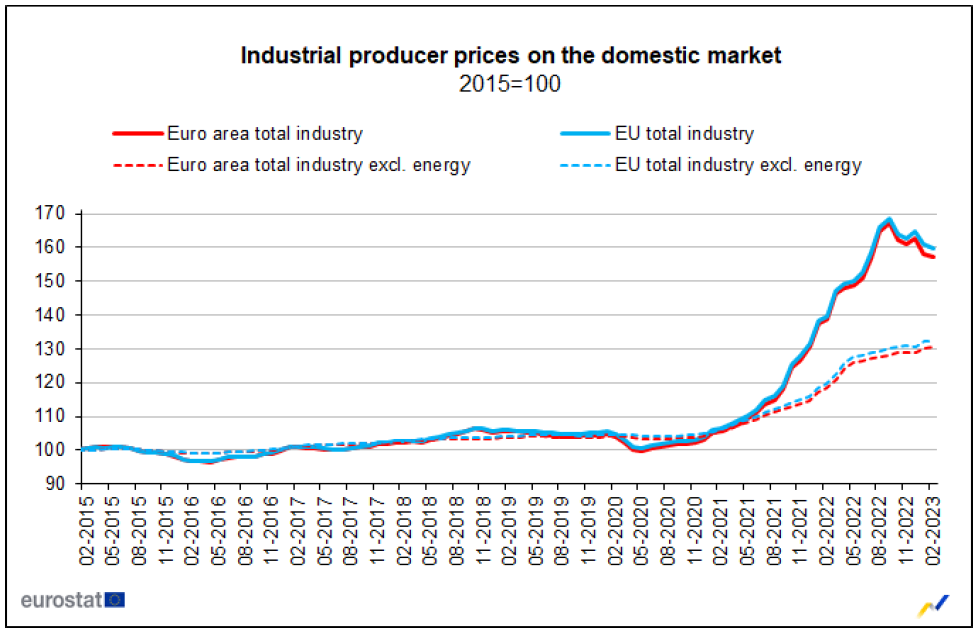
Eurozone PPI came in at -0.5% mom, 13.2% yoy in February below expectation of -0.3% mom, 13.2% yoy. For the month, industrial producer prices decreased by -1.6% in the energy sector and by 0.1% for intermediate goods, while prices increased by 0.3% for capital goods, by 0.4% for durable consumer goods and by 0.6% for non-durable consumer goods. Prices in total industry excluding energy increased by 0.2%.
EU PPI stood at -0.6% mom, 14.5% yoy. The largest monthly decreases in industrial producer prices were recorded in Bulgaria (-7.9%), Greece (-3.3%) and Belgium (-3.2%), while the highest increases were observed in Slovakia (+11.5%), Slovenia (+2.7%) and Portugal (+2.5%).
ECB survey: Moderating inflation expectations, improved growth outlook
ECB has released its Consumer Expectations Survey results for February 2023, which demonstrate a continuing moderating inflation expectations and uptick in growth outlook. The results suggest that consumers may be regaining some confidence in the Eurozone's economic recovery prospects.
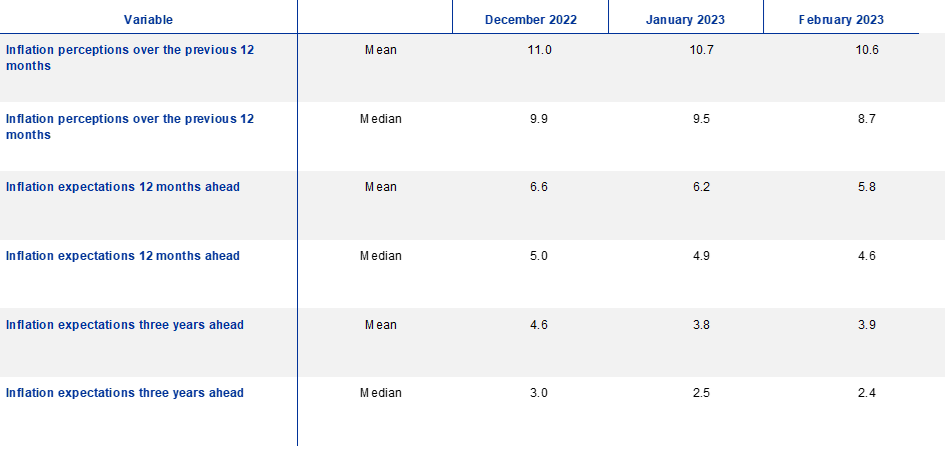
Median inflation expectations for the coming year dropped from 4.9% in January to 4.6%, compared to 5.0% in December. In addition, expectations for inflation three years ahead also saw a slight decrease, from 2.5% to 2.4%, in contrast to December's 3.0%.
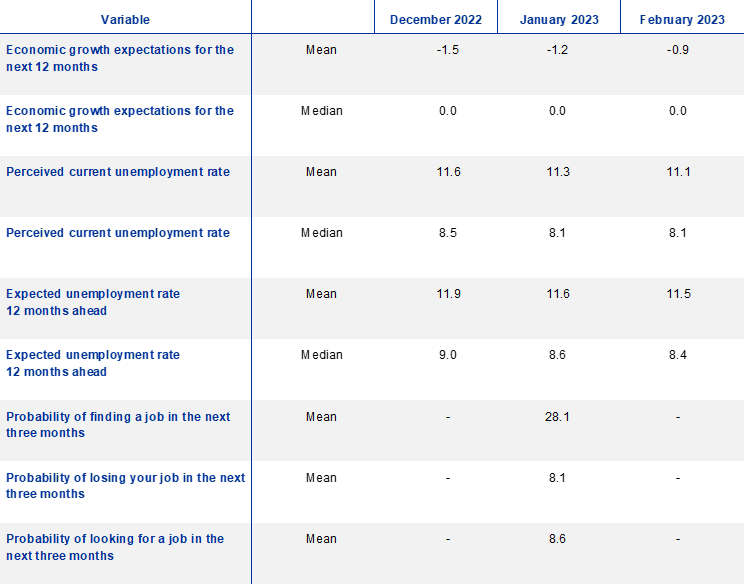
On a positive note, mean economic growth expectations for the next 12 months experienced an improvement. The figure rose from January's 1.2% to -0.9%, a better outcome when compared to December's -1.5%.
GBPUSD Rises to a Fresh 9-Month High
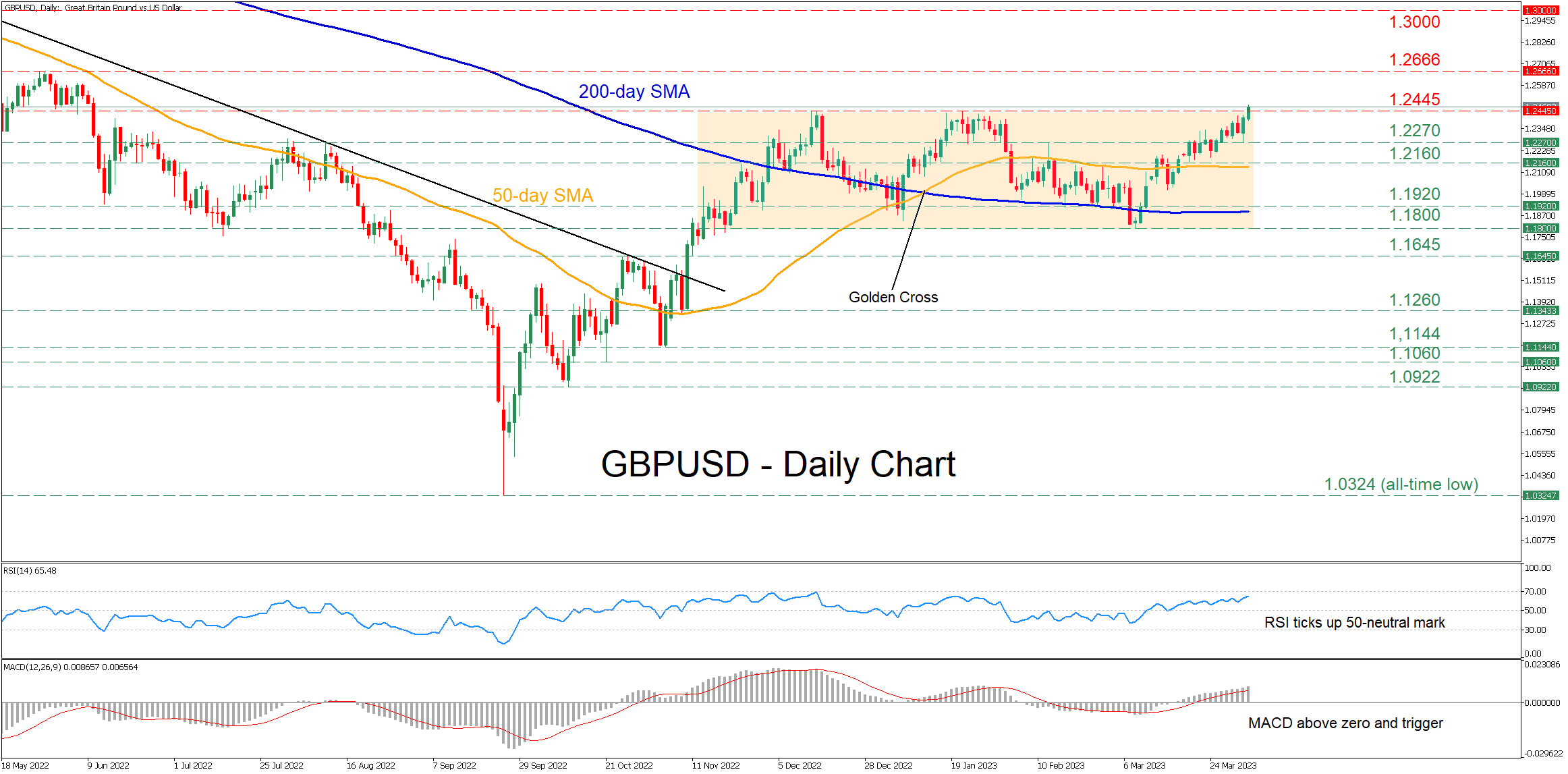
GBPUSD has been experiencing significant swings within a rectangle pattern for the past four months. In the short term, the pair has been in a recovery mode after hitting the bottom of its range and in today's session it managed to surpass the crucial 1.2445 area , which has acted as strong resistance both in December and January.
The momentum indicators currently suggest that near-term risks are tilted to the upside. Specifically, the RSI is climbing above its 50-neutral mark, while the MACD histogram is strengthening above both zero and its red signal line.
If bullish pressures intensify, the price could initially attempt to close above 1.2445, which is the upper boundary of its rectangle pattern. Surpassing that zone, the pair could ascend towards the May 2022 peak of 1.2666. A break above the latter may open the door for the 1.3000 psychological mark.
Alternatively, if the rebound falters and the price moves to the downside, the 1.2270 region could act as the first line of defense. If that barricade fails, the bears could target the 1.2160 support, which lies very close to the 50-day simple moving average (SMA). Further retreats may then cease at the 1.1920 hurdle.
In brief, GBPUSD stormed to a fresh nine-month high after breaking above the crucial 1.2445 zone , which has curbed its upside twice in the past four months. Therefore, a successful close above that area could signal the beginning of a sustained uptrend.
EUR/USD: Bulls Hold Grip and Ready for Further Gains
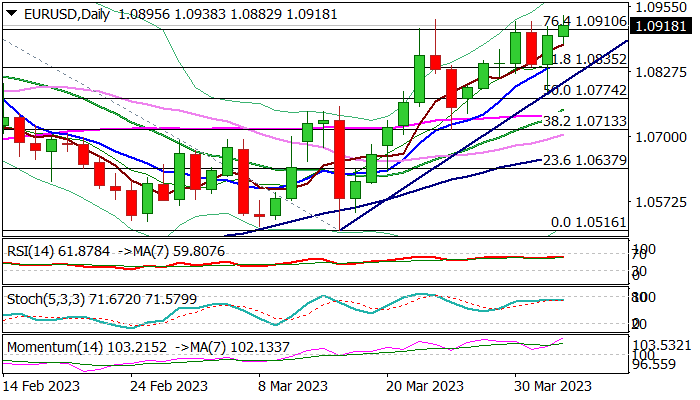
Fresh acceleration higher is probing through pivotal barrier at 1.0930 (Mar 23 spike high) after three-day consolidation and signaling that the euro holds firm tone.
Fresh bulls were sparked by much better than expected German export/import data for February, which boosts optimism about stronger economic growth and underpins near-term action.
The action is supported by positive daily studies which show strengthening bullish momentum and moving averages forming multiple bull-crosses, while daily cloud is thickening and adding to support.
Initial bullish signal in expected on eventual close above Fibo barrier at 1.0910 (76.4% retracement of 1.1032/1.0516) which has so far resisted five attacks, with break of 1.0930 high to confirm and open way towards 1.1000/32 (psychological/2023 high of Feb 2).
Near-term bias is expected to remain with bulls as long as the price stays above rising 10DMA (1.0850), which tracks the action for over two weeks.
Res: 1.0930; 1.1000; 1.1032; 1.1070.
Sup: 1.0882; 1.0850; 1.0800; 1.0774.
JP225 Index Bulls Remain in Control, But Biggest Battle Has Not Occurred Yet
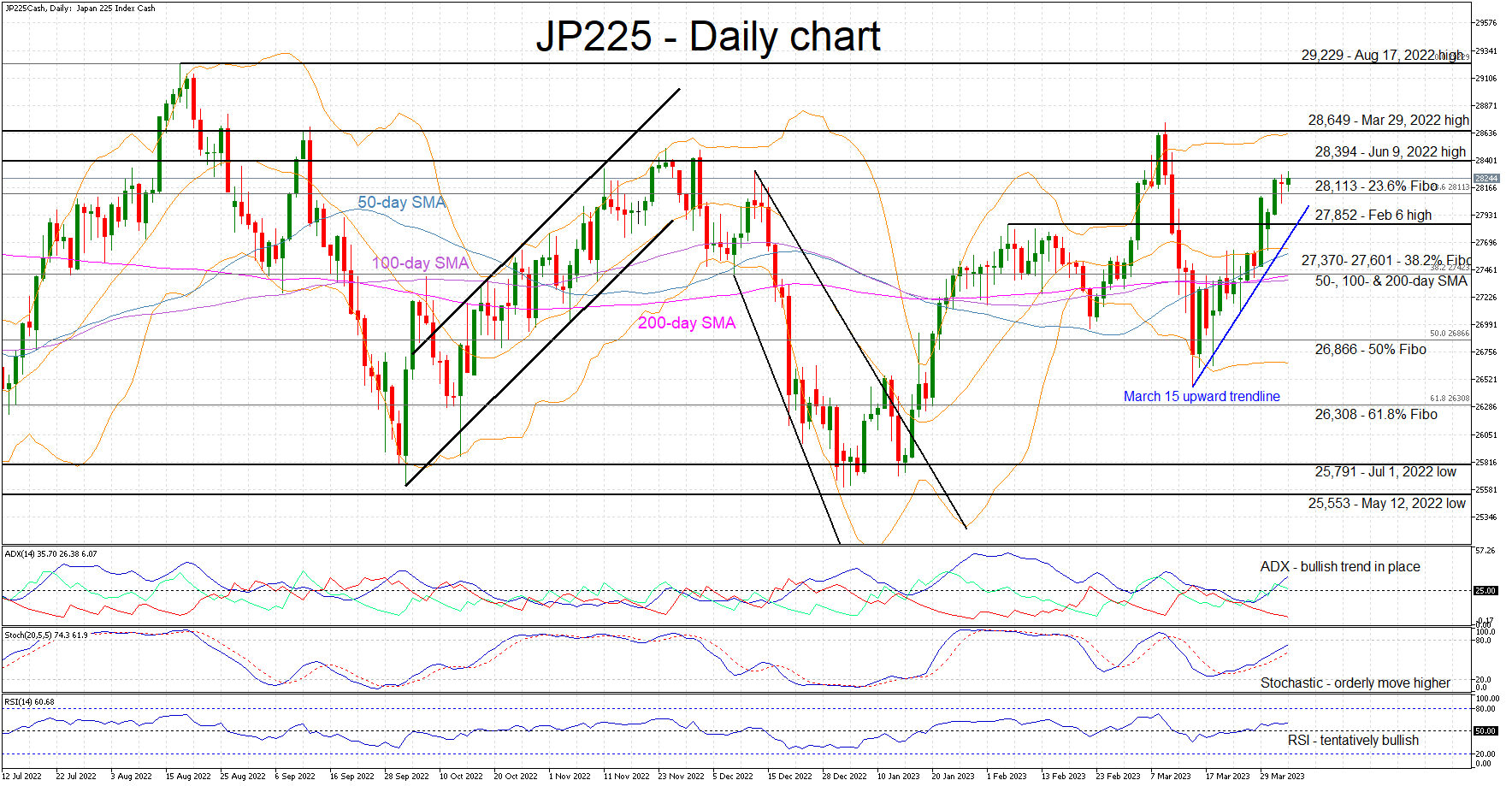
The JP225 cash index has been on an aggressive upward path since the March 15 low of 26,457. It managed to break some key levels with relative ease, revealing the underlying strength of this upmove. The bulls will feel a lot better if the index achieves a higher high soon. Until this occurs, the current move could be seen as just a correction and hence a lower low could be on the cards next. Interestingly, the convergence of the simple moving averages (SMAs) is a typical sign that a sizeable move is imminent.
The overall technical picture is overwhelmingly positive for the bulls. The Average Directional Movement Index (ADX) is rushing higher, confirming the presence of a strong bullish trend in JP225. The usually conservative RSI is showing tentative bullish signs, but it is again overshadowed by the stochastic oscillator. This is moving higher, towards its overbought territory in a rather orderly fashion.
If the bulls maintain the market reins, their initial targets would be at the June 9, 2022 high and the Mar 29, 2022 high of 28,394 and 28,649 respectively. Even higher, the August 17, 2022 high of 29,229 appears to be very attractive from the bulls’ standpoint.
Should the bears regain market control, they would face the 23.6% Fibonacci retracement level of the March 8, 2022 – August 17, 2022 uptrend at 28,113 and the February 6 high at 27,852. If they successfully break these levels, a key support area will come next. The 27,370-27,601 range, defined by the 38.2% Fibonacci retracement and the 50-, 100- and 200-day SMAs, will probably put up a stronger fight.
To conclude, the JP225 bulls have been enjoying the rally. They have the support from momentum indicators, but an even stronger move higher is needed to achieve a trend change.
EURJPY Holds Bullish Bias Near Key Resistance Zone
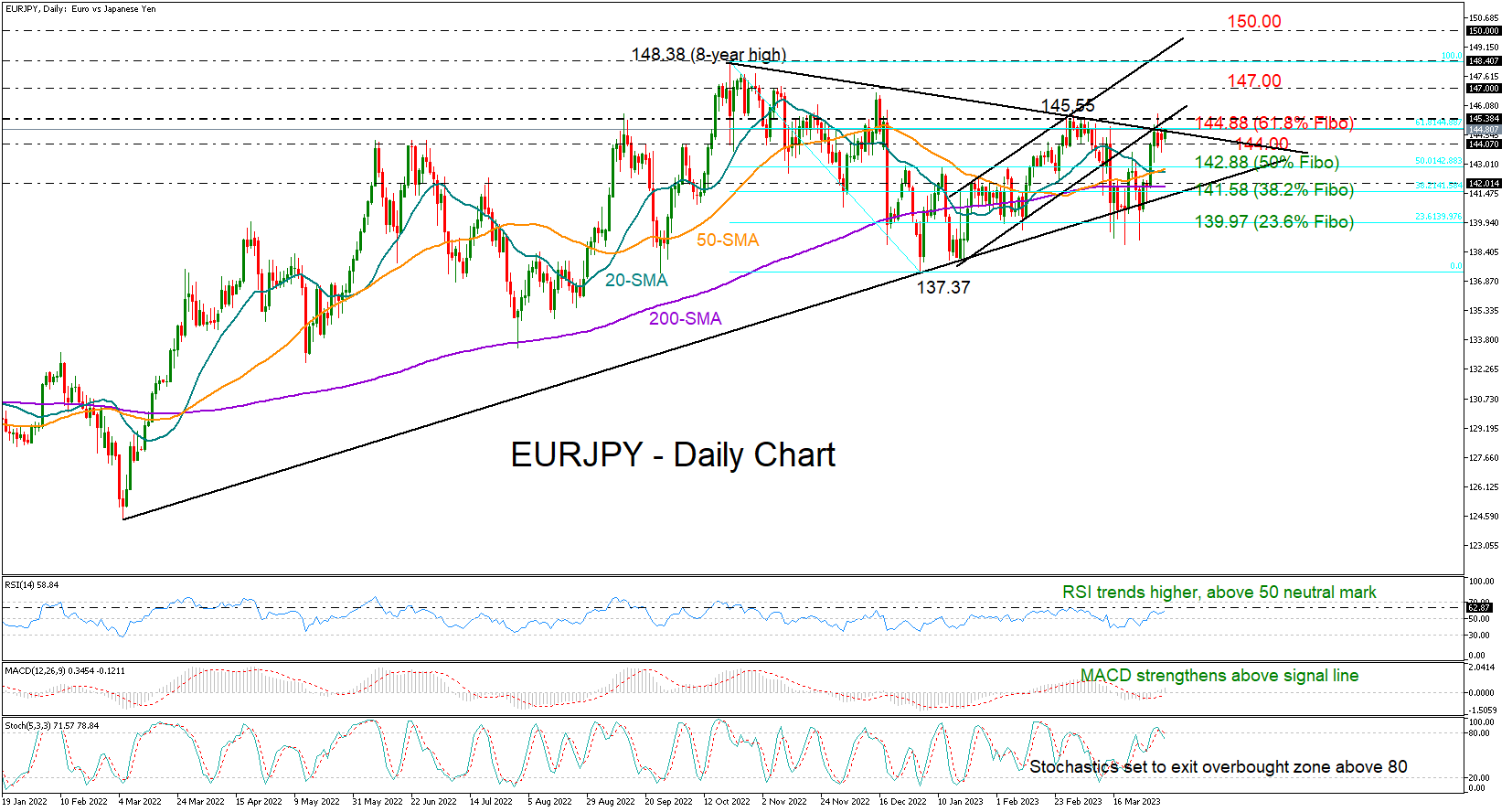
EURJPY has been in quiet trading mode over the past couple of days, being constrained within the 144.00-144.88 zone. The pair lost momentum after its impressive rebound stuck around the 61.8% Fibonacci retracement of the 148.38-137.37 downleg last week.
Overbought conditions have yet to be confirmed. Although the Stochastic oscillator looks for a downside reversal after peaking above 80, the rising RSI has yet to reach its 70 overbought level. Meanwhile, the MACD continues to strengthen within the positive area, reflecting improving market sentiment.
Yet, for the recovery to continue, the bulls will need to pierce through the 144.88 wall and enter the broken bullish channel above 145.35. If that turns out to be the case, the pair would next target the channel’s upper boundary seen around 148.40 and near October’s top. Breaking that ceiling, the spotlight will immediately fall on the 150.00 psychological level, where the pair peaked in 2014.
Alternatively, a close below 144.00 could activate fresh selling pressures, bringing the 50% Fibonacci mark of 142.88 under the spotlight. Failure to hold here could squeeze the price straight to the crucial support trendline, which has been holding up the market for more than a year now. Notably, the 200-day simple moving average (SMA) and the 38.2% Fibonacci of 141.58 are also in the neighborhood. Hence, a decisive step lower is expected to press the price aggressively towards the 23.6% Fibonacci of 139.97.
In brief, EURJPY is trading neutral at the moment, with investors likely waiting for a clear break above the 144.88-145.35 region or below 144.00 to direct the market accordingly.
EUR/USD Struggles to Maintain Balance Amidst Mixed Market Signals
The EUR/USD pair is trading close to the 1.0900 level on the first Tuesday of April. The market is taking into consideration the latest data on the Core PCE index, which grew by only 0.3% m/m in February, lower than the expected figures. The year-to-year data also dropped by 5.0%, which could be a reason for the Federal Reserve System to pause in its monetary policy tightening.
Despite the fact that no meetings of the Fed management are scheduled for April, investors will keep a close eye on important statistics from the US this week. This includes the PMI in services and production, the factory orders report, and the employment market statistics of last month.
Looking at the technical analysis, the EUR/USD pair has formed a structure of a declining impulse to 1.0788 on H4, and the market is currently consolidating above this level. There is a possibility of a link of growth to 1.0850, followed by a decline to 1.0707, from where the wave could extend to 1.0595. The MACD confirms this scenario, with its signal line above zero and aiming downwards to renew the lows.
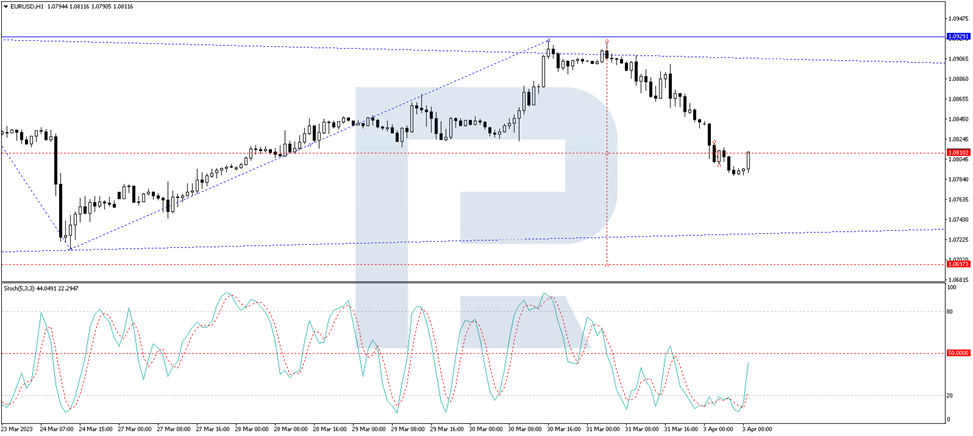
On H1, the EUR/USD pair has completed the structure of a declining wave to 1.0788, and a consolidation range is forming above this level. The price is expected to break the range upwards, reaching 1.0850, and then decline to 1.0697. The target is local, and this is only half of the declining wave. The Stochastic oscillator confirms this scenario, with its signal line near 50, expected to grow to 80 and then fall to 20.
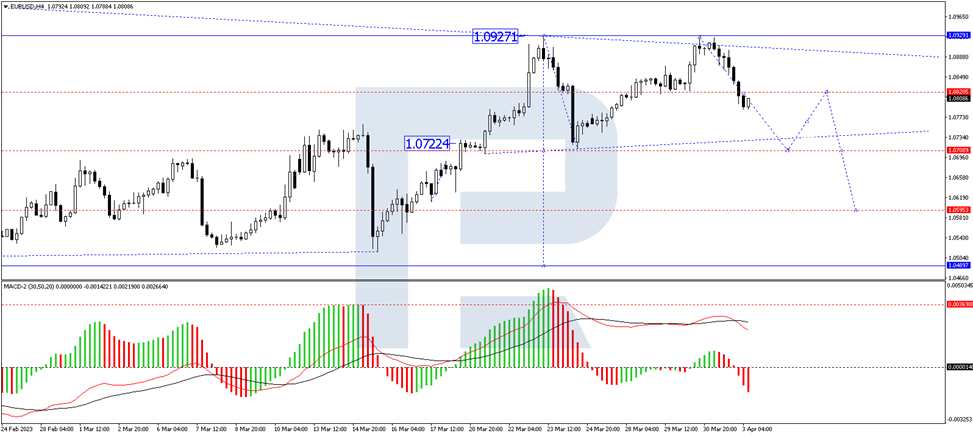
Overall, the market is closely monitoring the data releases from the US this week and waiting for further signals from the Federal Reserve System to make a weighted decision on its monetary policy.
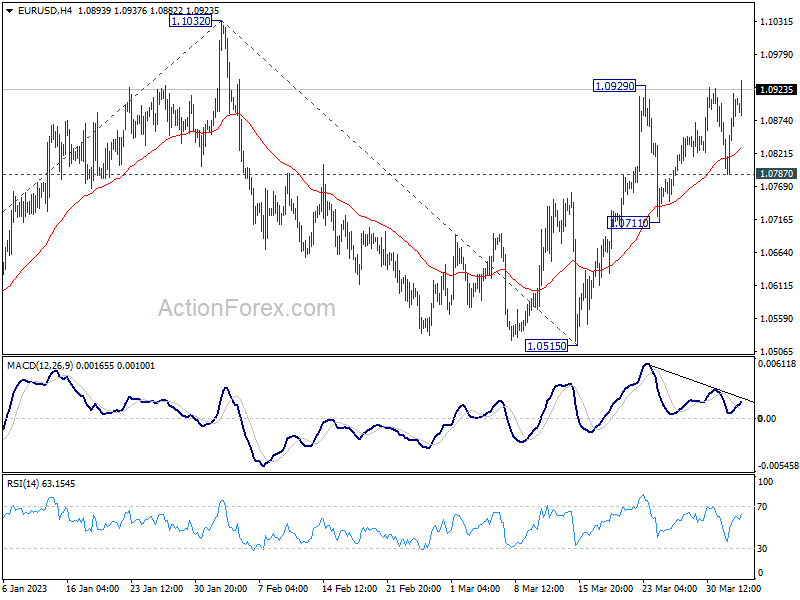
EUR/USD Daily Outlook
Daily Pivots: (S1) 1.0822; (P) 1.0869; (R1) 1.0951; More...
EUR/USD's breach of 1.0929 suggests rally resumption. Intraday bias is back on the upside for 1.1032 high first. Decisive break there will resume larger up trend from 0.9534 to 1.1273 fibonacci level next. On the downside, break of 1.0787 support will turn bias back to the downside for 1.0711 support instead.
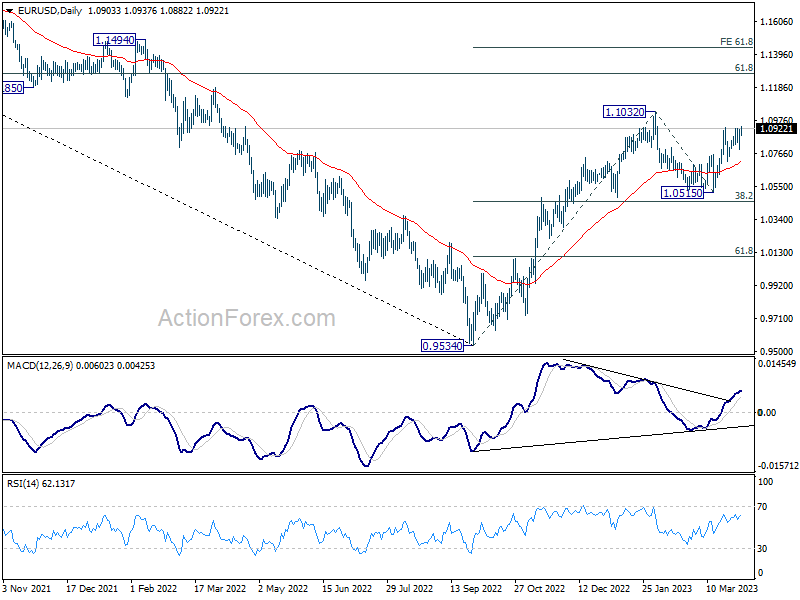
In the bigger picture, rise from 0.9534 (2022 low) is in progress with 38.2% retracement of 0.9534 to 1.1032 at 1.0460 intact. The strong support from 55 week EMA (now at 1.0625) was also a medium term bullish sign. Next target is 61.8% retracement of 1.2348 (2021 high) to 0.9534 at 1.1273. Sustained break there will solidify the case of bullish trend reversal and target 1.2348 resistance next (2021 high).
GBP/USD Daily Outlook
Daily Pivots: (S1) 1.2320; (P) 1.2372; (R1) 1.2470; More...
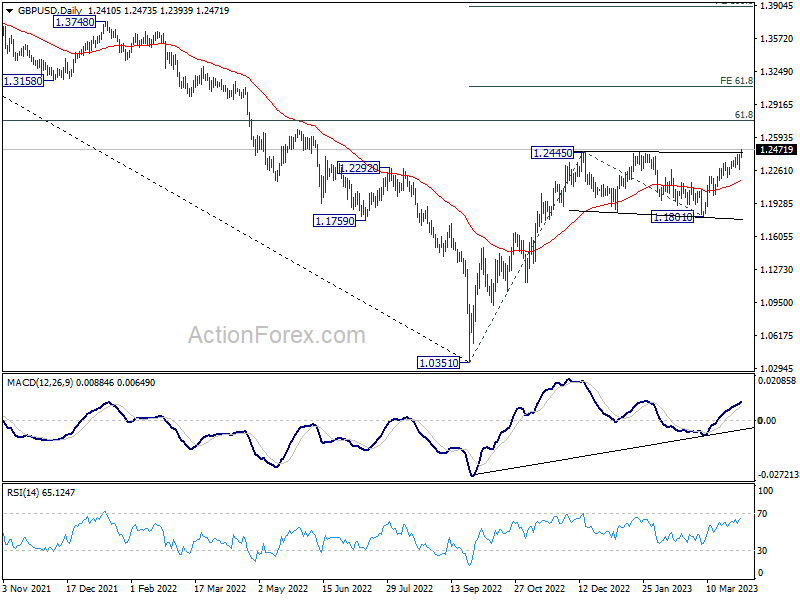
GBP/USD's rally today and break of 1.2445/6 indicates resumption of whole rise from 1.3051. Intraday bias is back on the upside for 1.2759 fibonacci level. Firm break there will target 61.8% projection of 1.0351 to 1.2445 from 1.1801 at 1.3095. On the downside, break of 1.2273 support is needed to indicate short term topping. Otherwise, outlook will stay bullish in case of retreat.
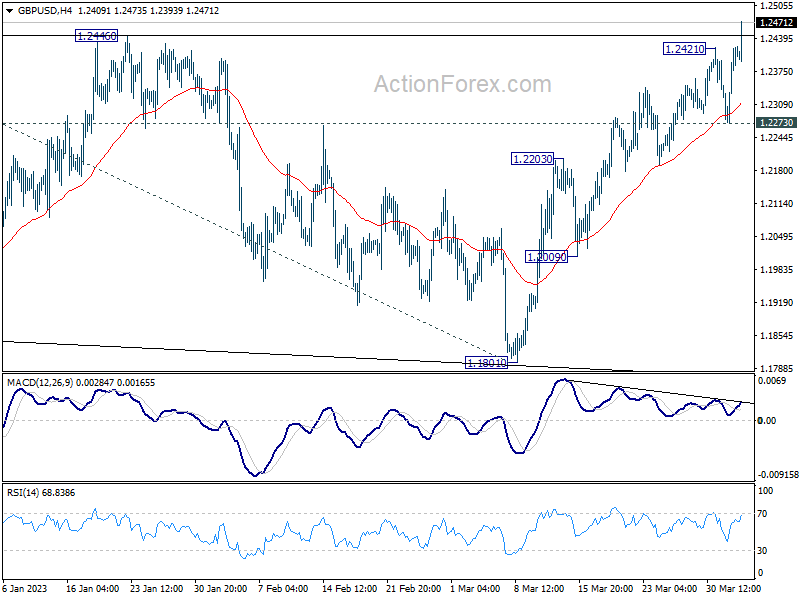
In the bigger picture, the rise from 1.0351 medium term term bottom (2022 low) is in progress for 61.8% retracement of 1.4248 (2021 high) to 1.0351 at 1.2759. Sustained break there will add to the case of long term bullish trend reversal. Further break of 61.8% projection of 1.0351 to 1.2445 from 1.1801 at 1.3095 could prompt upside acceleration to 100% projection at 1.3895. For now, this will remain the favored case as long as 1.1801 support holds, even in case of deep pull back.