

Sample Category Title
GBP/USD Mid-Day Outlook
Daily Pivots: (S1) 1.2320; (P) 1.2372; (R1) 1.2470; More...
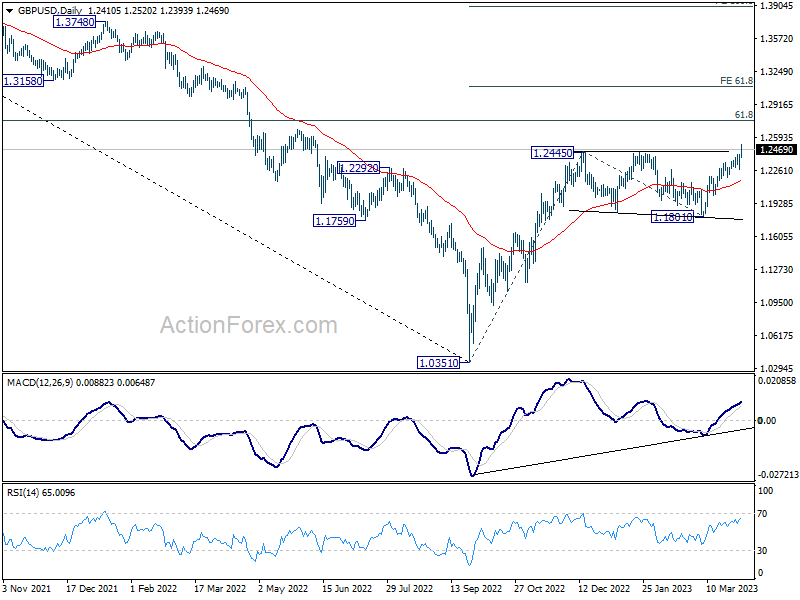
Intraday bias in GBP/USD remains on the upside for the moment. Up trend from 1.0351 is resuming and further rise should be seen to 1.2759 fibonacci level. Firm break there will target 61.8% projection of 1.0351 to 1.2445 from 1.1801 at 1.3095. On the downside, below 1.2393 minor support will turn intraday bias neutral first. But retreat should be contained above 1.2203 resistance turned support to bring another rally.
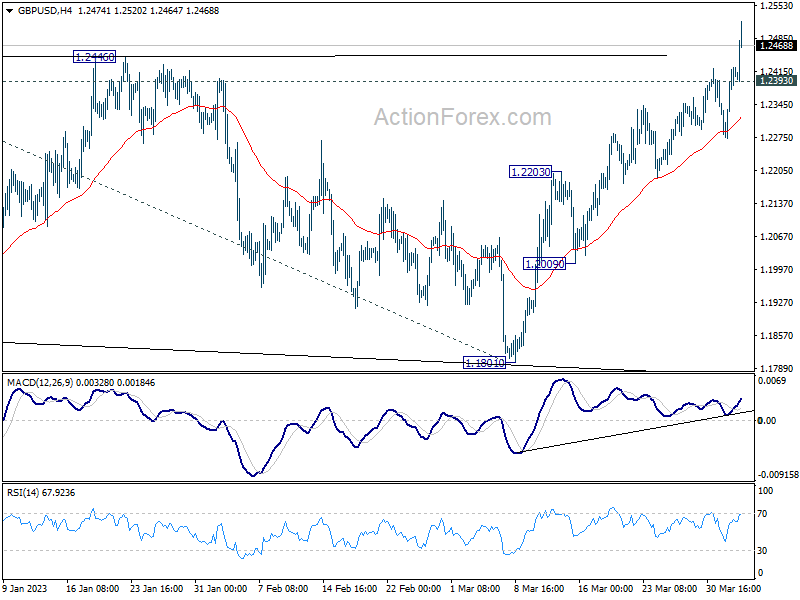
In the bigger picture, the rise from 1.0351 medium term term bottom (2022 low) is in progress for 61.8% retracement of 1.4248 (2021 high) to 1.0351 at 1.2759. Sustained break there will add to the case of long term bullish trend reversal. Further break of 61.8% projection of 1.0351 to 1.2445 from 1.1801 at 1.3095 could prompt upside acceleration to 100% projection at 1.3895. For now, this will remain the favored case as long as 1.1801 support holds, even in case of deep pull back.
Sterling Soars to 10-Month High Against Dollar, Brushing Off Dovish BoE Comments
Sterling surges to a 10-month high against Dollar today, as comments from a lone dove on the Bank of England's Monetary Policy Committee seem to have little impact. Pound's strength against Euro and Swiss Franc suggests a one-sided movement. Meanwhile, Australian Dollar remains the weakest performer following RBA's decision to hold interest rates steady. With Yen and Kiwi also weak, risk sentiment appears directionless. Dollar's performance is mixed, with the market awaiting tomorrow's ISM services report and Friday's non-farm payroll employment data for further inspiration.
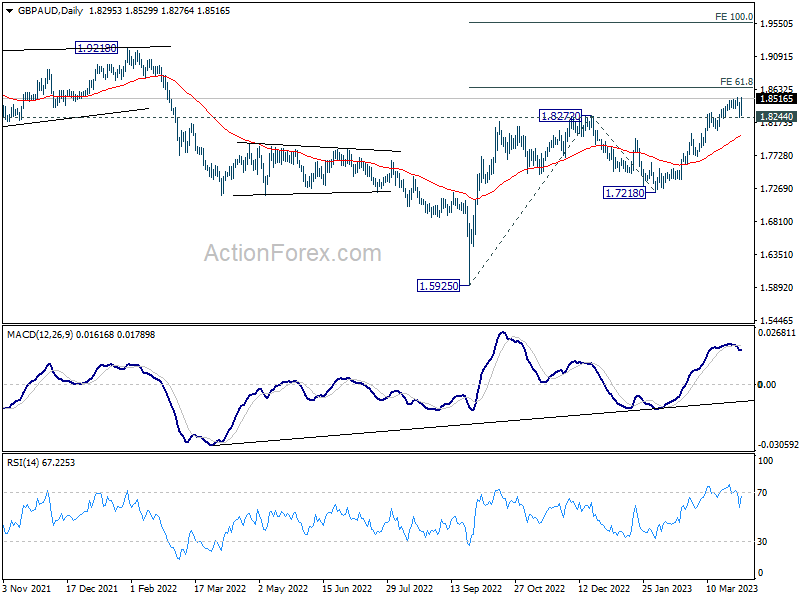
Technically, GBP/AUD appears poised to resume its uptrend from 1.5925, passing last week's high at 1.8532. However, the near-term upside momentum has not been too convincing, as evidenced by daily MACD readings. A significant obstacle lies at the 61.8% projection of 1.5925 to 1.8272 from 1.7218 at 1.8668. Rejection from this level, followed by a break of 1.8244 support, could signal a deeper pullback towards the 55 day EMA (now at 1.7984). On the other hand, a decisive break of 1.8668 might trigger sharper upside acceleration, targeting 1.9218 resistance and above. The market is likely to see a clearer picture on the cross within April.
In Europe, at the time of writing, FTSE is up 0.08%. DAX is up 0.85%. CAC is up 0.57%. Germany 10-year yield is up 0.078 at 2.332. Earlier in Asia, Nikkei rose 0.35%. Hong Kong HSI dropped -0.66%. China Shanghai SSE rose 0.49%. Singapore Strait Times rose 0.92%. Japan 10-year JGB yield rose 0.0453 to 0.416.
BoE's Tenreyro foresees need for looser monetary policy
BoE Monetary Policy Committee member Silvana Tenreyro, a known dove, remarked in a speech that the data sinve November has evolved most like her downside scenario, noting a sharp decline in high-frequency private-sector regular pay growth.
She explained that with the Bank Rate at 4.25%, the restrictive policy is likely to "drag demand well below its potential, loosening the labour market and pulling down on inflation." As a result, she believes that "inflation is likely to fall well below target."
Tenreyro voted for no change in the Bank Rate in recent months, instead of further tightening, as she believes a looser stance is necessary to achieve the inflation target in the medium term.
She expressed her expectation that the current high level of the Bank Rate "will require an earlier and faster reversal, to avoid a significant inflation undershoot."
ECB survey: Moderating inflation expectations, improved growth outlook
ECB has released its Consumer Expectations Survey results for February 2023, which demonstrate a continuing moderating inflation expectations and uptick in growth outlook. The results suggest that consumers may be regaining some confidence in the Eurozone's economic recovery prospects.
Median inflation expectations for the coming year dropped from 4.9% in January to 4.6%, compared to 5.0% in December. In addition, expectations for inflation three years ahead also saw a slight decrease, from 2.5% to 2.4%, in contrast to December's 3.0%.
On a positive note, mean economic growth expectations for the next 12 months experienced an improvement. The figure rose from January's 1.2% to -0.9%, a better outcome when compared to December's -1.5%.
Eurozone PPI at -0.5% mom, 13.2% yoy in Feb
Eurozone PPI came in at -0.5% mom, 13.2% yoy in February below expectation of -0.3% mom, 13.2% yoy. For the month, industrial producer prices decreased by -1.6% in the energy sector and by 0.1% for intermediate goods, while prices increased by 0.3% for capital goods, by 0.4% for durable consumer goods and by 0.6% for non-durable consumer goods. Prices in total industry excluding energy increased by 0.2%.
EU PPI stood at -0.6% mom, 14.5% yoy. The largest monthly decreases in industrial producer prices were recorded in Bulgaria (-7.9%), Greece (-3.3%) and Belgium (-3.2%), while the highest increases were observed in Slovakia (+11.5%), Slovenia (+2.7%) and Portugal (+2.5%).
RBA holds cash rate steady, maintains tightening bias
RBA has decided to keep the cash rate target unchanged at 3.60% amid ongoing uncertainty, but maintained its tightening bias. The central bank stated that some further tightening might be necessary, depending on developments in the global economy, household spending, inflation, and the labor market outlook.
In the official statement, RBA noted, "The Board expects that some further tightening of monetary policy may well be needed to ensure that inflation returns to target."
RBA's central forecast anticipates inflation to decline over the next couple of years, reaching around 3% by mid-2025. The statement highlighted that "medium-term inflation expectations remain well anchored, and it is important that this remains the case."
Despite the slowing growth in the Australian economy, labor market remains very tight. However, as economic growth slows, RBA expects unemployment to increase. The Board remains alert to the risk of a "price-wages spiral", given the limited spare capacity in the economy and the historically low rate of unemployment.
GBP/USD Mid-Day Outlook
Daily Pivots: (S1) 1.2320; (P) 1.2372; (R1) 1.2470; More...
Intraday bias in GBP/USD remains on the upside for the moment. Up trend from 1.0351 is resuming and further rise should be seen to 1.2759 fibonacci level. Firm break there will target 61.8% projection of 1.0351 to 1.2445 from 1.1801 at 1.3095. On the downside, below 1.2393 minor support will turn intraday bias neutral first. But retreat should be contained above 1.2203 resistance turned support to bring another rally.
In the bigger picture, the rise from 1.0351 medium term term bottom (2022 low) is in progress for 61.8% retracement of 1.4248 (2021 high) to 1.0351 at 1.2759. Sustained break there will add to the case of long term bullish trend reversal. Further break of 61.8% projection of 1.0351 to 1.2445 from 1.1801 at 1.3095 could prompt upside acceleration to 100% projection at 1.3895. For now, this will remain the favored case as long as 1.1801 support holds, even in case of deep pull back.
Economic Indicators Update
| GMT | Ccy | Events | Actual | Forecast | Previous | Revised |
|---|---|---|---|---|---|---|
| 22:00 | NZD | NZIER Business Confidence Q1 | -66 | -70 | ||
| 23:50 | JPY | Monetary Base Y/Y Mar | -1.00% | 2.00% | -1.60% | |
| 04:30 | AUD | RBA Interest Rate Decision | 3.60% | 3.60% | 3.60% | |
| 06:00 | EUR | Germany Trade Balance (EUR) Feb | 16.0B | 16.9B | 16.7B | |
| 09:00 | EUR | Eurozone PPI M/M Feb | -0.50% | -0.30% | -2.80% | |
| 09:00 | EUR | Eurozone PPI Y/Y Feb | 13.20% | 13.50% | 15.00% | 15.10% |
| 12:30 | CAD | Building Permits M/M Feb | 8.60% | 2.20% | -4.00% | -3.70% |
| 14:00 | USD | Factory Orders M/M Feb | -0.30% | -1.60% |
GBPUSD Wave Analysis
- GBPUSD under the bullish pressure
- Likely to rise to resistance level 1.2600
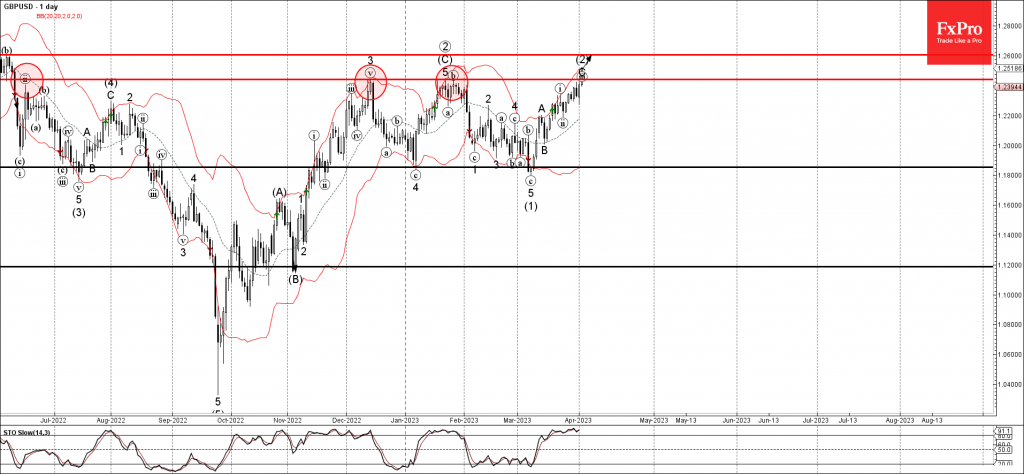
GBPUSD under the bullish pressure after the price broke the key resistance level 1.2440 (which has been reversing the price from the middle of 2022, as can be seen below).
The breakout of the resistance level 1.2440 accelerated the C-wave of the active ABC correction (2).
Given the strongly bullish sterling sentiment sent today, GBPUSD can then be expected to rise further toward the next resistance level 1.2600 (target for the completion of the active wave C).
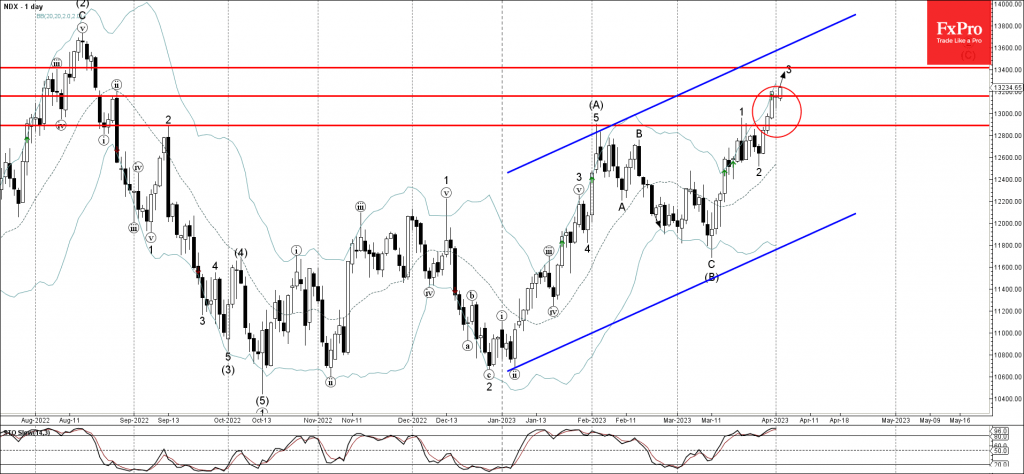
Nasdaq-100 Wave Analysis
- Nasdaq-100 broke resistance area
- Likely to rise to resistance level 13400.00
Nasdaq-100 index recently broke the resistance area located between the resistance levels 12885.00 (which has been reversing the price from the start of February) and 13160.00
The breakout of this resistance area accelerated the active impulse wave 3 of the intermediate impulse wave (C) from last month.
Given the clear daily uptrend, Nasdaq-100 index can then be expected to rise further toward the next resistance level 13400.00 (target price for the completion of the active impulse wave 3).
Bitcoin’s Intense Shake-Up
Market picture
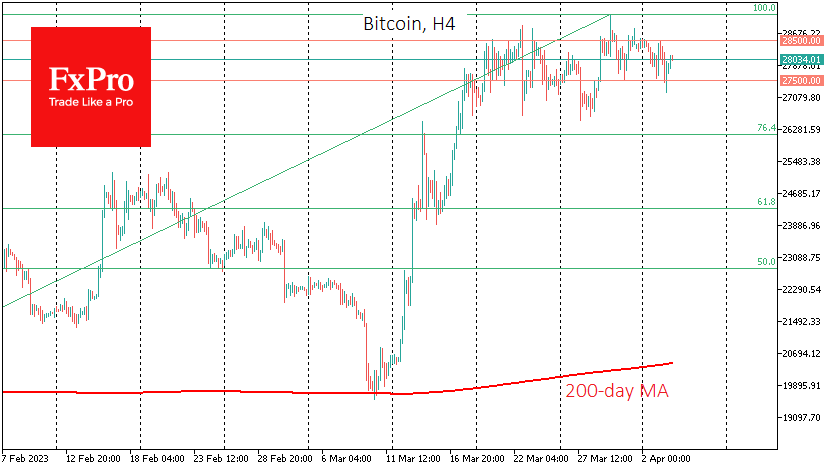
Bitcoin has been experiencing intense ups and downs this week but remains close to $28K. This dynamic is looks like a quarterly portfolio shakeout, and predicting the next local move is difficult.
At the same time, we note the slight downward slope of local highs and lows. The Q1 successes have created a demand for profit-taking. In the coming days, it is worth keeping an eye on the trading range boundaries.
According to CryptoQuant, the number of BTCs in exchange wallets is rising. Since the end of March, traders have sent coins to exchanges to sell later.
An accelerated decline at $27.5K would raise the prospect of a deeper correction to $25K, where the price could go quickly. A consolidation above $28.5K would indicate that the sideways trend of the last two weeks is over and that the price is ready to move higher.
According to CoinShares, investments in crypto funds increased by a modest $2.5 million last week, following a $160 million increase the week before. Bitcoin investments rose by $9 million, while Ethereum fell by $3 million.
News background
BTC miners reported their best results since May last year. Bitcoin mining companies collectively generated $755 million in revenue in March.
Two law firms are suing Binance for $1 billion for promoting unregistered securities. This is the second lawsuit against the exchange, on top of one from the CFTC last week.
According to Kaiko, Binance’s spot market share has dropped significantly in the past week. The CFTC’s investigation could last for years, so the outflow of funds will continue.
Markets Stabilise After Surprise OPEC+ Cut
European shares were painted green on Tuesday even as oil prices extended gains following the unexpected production cuts from OPEC+ on Sunday. However, a sense of caution lingered in the air with US equity futures pointing to a mixed open amid the prospects of higher oil prices fueling fears of higher inflation. In the currency space, the dollar found itself pressured by weak economic data and expectations around the Fed potentially pivoting down the road. Gold struggled for direction while WTI crude ventured towards $81 after surging more than 6% in the previous session.
The next few days promise to be eventful for financial markets thanks to the latest developments concerning OPEC+, with more volatility expected despite the holiday-shortened week. Investors will be presented with key economic data from major economies, speeches by financial heavyweights, and the US jobs report on Friday. The spike in oil prices and renewed fears around rising inflation are likely to spice things up, together with thin liquidity on Friday which could result in whippy price action across the board.
In overnight news, the Reserve Bank of Australia (RBA) left its key interest rate unchanged in April marking its first pause since lifting rates in May 2022. However, the RBA left the door open to future rate hikes in the future to ensure that inflation returned to target. Markets responded by sending the Australian dollar lower across the board.
Are Oil bulls back in town?
Oil prices have certainly kicked off the new quarter on a solid note.
The global commodity extended gains this morning after surging over 6% on Monday following the OPEC+ shock decision to cut production over the weekend. Given how this announcement came just a day after OPEC members indicated that they would keep production policy unchanged, the cartel completely caught markets off-guard. OPEC+ decided to lower oil output by over 1 million barrels per day starting in May as a “precautionary measure” aimed at promoting market stability. Nevertheless, the prospects of higher oil prices in the face of tighter supply could spark fears around rising inflation. In the meantime, WTI has staged a sharp rebound and is currently approaching resistance around $82. A strong breakout and weekly close above this point could open the door toward $90.
All eyes on the NFP report
Friday’s March nonfarm payrolls (NFP) report could play in role in determining whether the Federal Reserve raises interest rates by 25 basis points this month. Expectations are rising over rates reaching their peak with the chances of another 25-basis point move in April currently priced at 67%, according to Fed funds futures. The US economy is projected to have created 240,000 jobs in March with the unemployment rate unchanged at 3.6% and average hourly earnings rising 4.3% year-on-year. A stronger-than-expected report is likely to feed expectations around the Fed cautiously raising interest rates while paying attention to the US banking sector. Alternatively, further signs of a weakening labour markets may fuel speculation around the Fed pausing its rate hikes, before cutting them into the latter part of the year. It will be interesting to see how the Fed reacts to the latest developments concerning OPEC+ and whether this will invite hawks back into the scene.
The dollar has kicked off Q2 on a negative note with the Dollar Index extending losses on Tuesday. Prices remain under pressure with downside momentum potentially taking the DXY towards 101.50 in the short term.
Commodity Spotlight – Gold
Gold struggled for direction Tuesday as oil prices hijacked the spotlight.
It feels like the precious metal could be waiting for a fresh fundamental spark and this could come in the form of the US jobs report on Friday. A stronger-than-expected US jobs report may be bad news for zero-yielding gold, as markets evaluate the possibility of the Fed raising interest rates further. Alternatively, a disappointing NFP report could feed speculation around the Fed pivoting, ultimately supporting gold bulls. Looking at the technical picture, gold has found itself back within a choppy range with support at $1950 and resistance at $2000. Prices are likely to range until a weekly close is achieved above or below the identified support or resistance levels.
How Can OPEC’s Decision Affect the Forex Market?
Well, well, well, looks like the OPEC Conference had an Extraordinary 183rd Meeting on the 31st of March, and made some changes. They gave the International Energy Agency (IEA) the boot and replaced them with Wood Mackenzie and Rystad Energy as their secondary sources for oil supply and demand data. So, what's the big deal? Well, this move could have some serious ripple effects on the financial markets. Investors and traders will be keeping a close eye on how this change impacts oil prices and how it may affect their portfolios. Time will tell if this move will be a wise one or if it'll backfire. Let's see if this adds up - technically speaking.
USDCAD
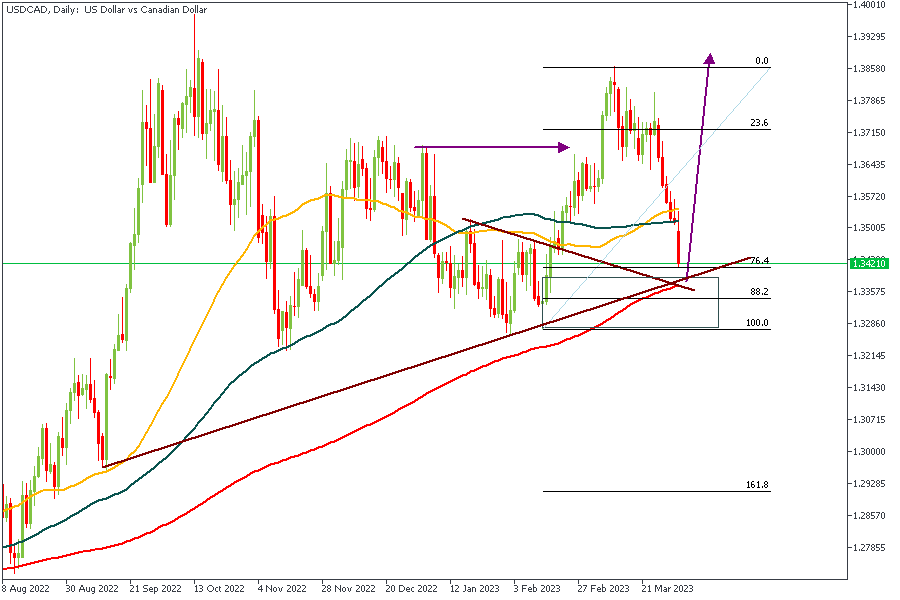
The Daily timeframe of USDCAD presents us with some of the usual confirmations; Fibonacci retracement levels, MA support, drop-base-rally demand zone, and a few extras. The confluence of the two trendlines aligning as a support is a major indication of bullish intention, but when you combine that with the 200-Day MA as a support, you literally get an 80% valid trade sentiment. I'm personally keeping my eyes peeled on this one.
Analysts’ Expectations:
- Direction: Bullish
- Target: 1.37100
- Invalidation: 1.32800
EURCAD
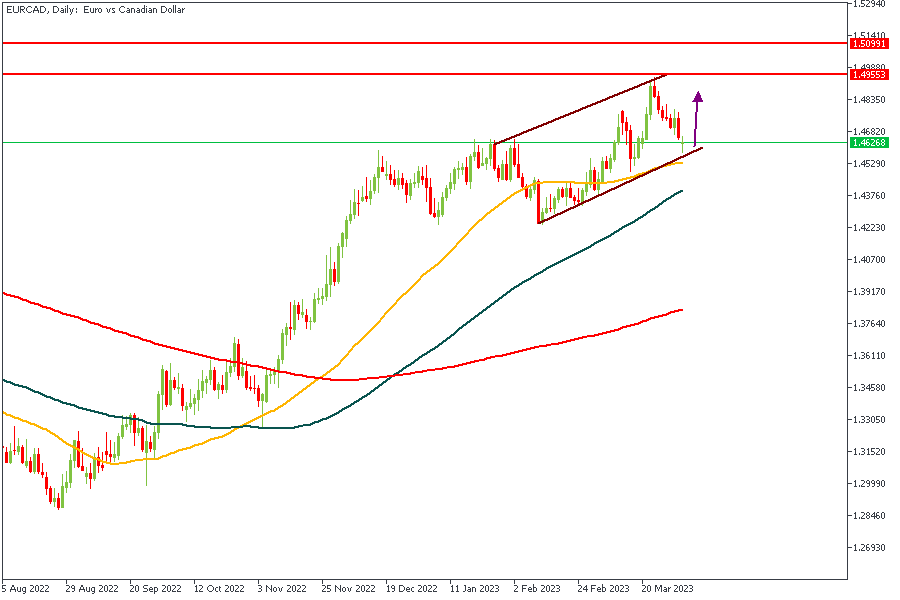
EURCAD is currently trading inside a channel and approaching a key resistance from the weekly supply zone. It is important to note how the 50-Day MA fits perfectly with the trendline support and the drop-base-rally demand zone which I apparently didn't notice I'd forgotten to mark until now (but I'm hoping you can see it nonetheless). On this one, I'm voting once again in support of the bulls, with my primary target set at the weekly supply zone as marked.
Analysts’ Expectations:
- Direction: Bullish
- Target: 1.49500
- Invalidation: 1.45100
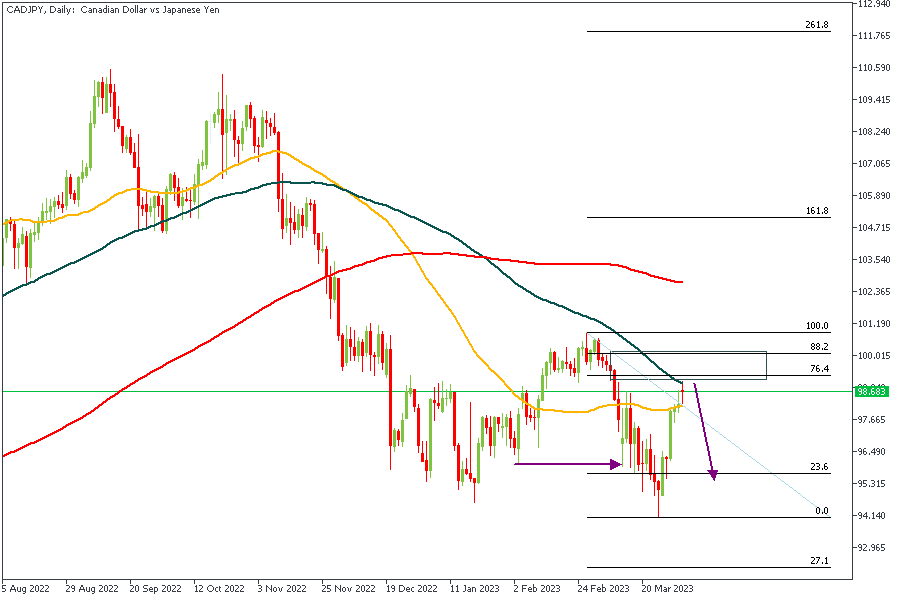
CADJPY
CADJPY is looking bearish from every angle. First, we have the break of the previous marked low, then the Fibonacci retracement level, and supported by the 100-Day MA, which is another major factor to consider. That's not all though. We also have an elusive AMD (Accumulation-Manipulation-Distribution) pattern.
Analysts’ Expectations:
- Direction: Bearish
- Target: 95.600
- Invalidation: 101.110
NZDCAD
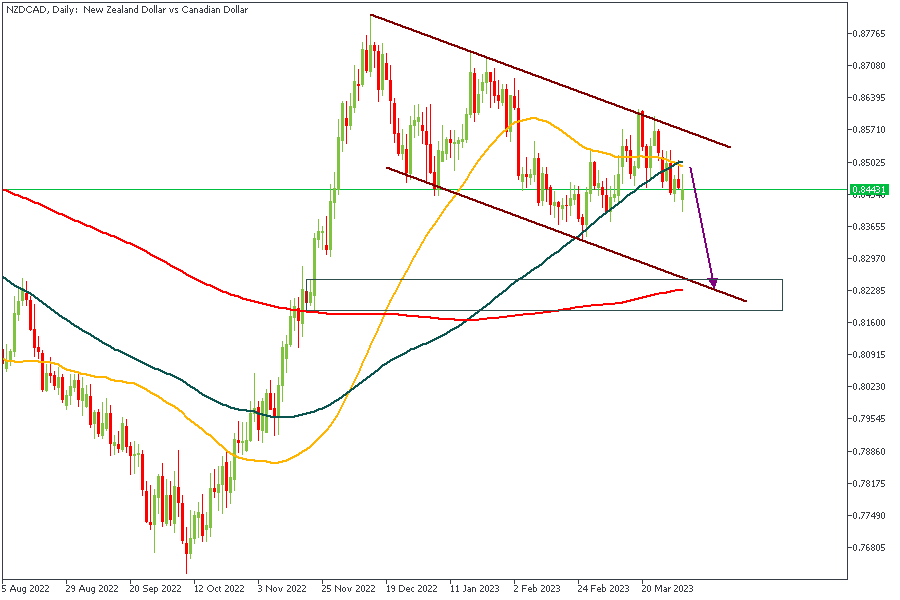
NZDCAD and CADJPY have a few things in common. The sentiment on both pairs, for example, is bearish; then we also have a hidden AMD pattern and a break below the previous low. Considering that price is trading within a channel and has only recently been rejected from the trendline resistance, I believe it is only logical to expect price to swoop down to the trendline support, 200-Day MA, and rally-base-rally demand zone lying just below.
Analysts’ Expectations:
- Direction: Bearish
- Target: 0.82645
- Invalidation: 0.85628
CONCLUSION
The trading of CFDs comes at a risk. Thus, to succeed, you have to manage risks properly. To avoid costly mistakes while you look to trade these opportunities, be sure to do your due diligence and manage your risk appropriately.
NZD/USD – New Zealand Dollar in Holding Pattern ahead of Reserve Bank Decision
The New Zealand dollar is almost unchanged ahead of the Reserve Bank of New Zealand (RBNZ) rate decision on Wednesday (New Zealand time). The US releases JOLTS Job Openings.
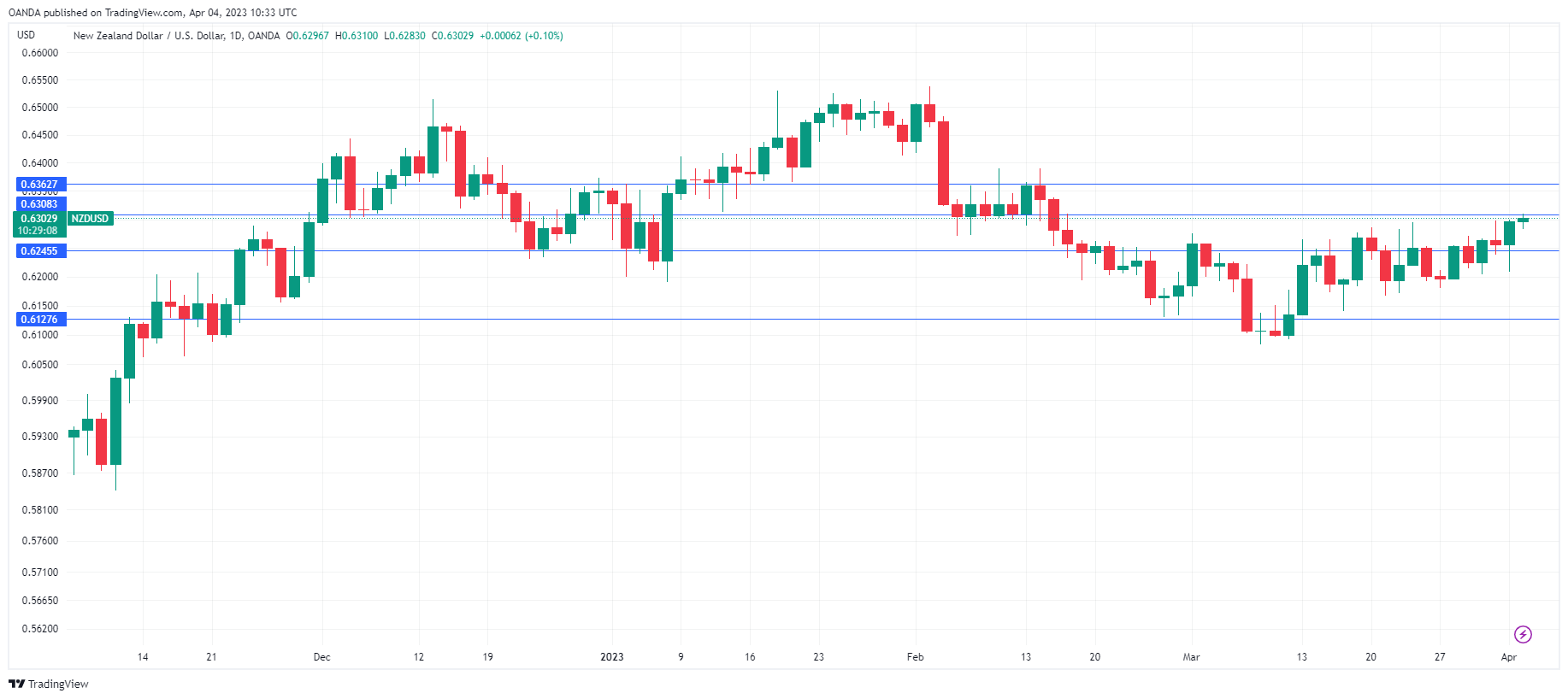
NZD/USD is trading quietly at the 0.63 line in the European session.
RBNZ expected to hike by 25 bp
The RBNZ is widely expected to raise rates by 25 basis points, which would bring the benchmark cash rate to 5.0%. Over the past year, the RBNZ has delivered oversize hikes of 50 and even 75 basis points, marking an aggressive rate-tightening cycle in order to contain red-hot inflation. The battle with inflation has been slow, as CPI came in at 7.2% in Q4 2022, unchanged from the third quarter.
The sharp rise in rates and weak global demand have battered the New Zealand economy. GDP declined by 0.6% in Q4 2022, and the cyclone in February will have a negative impact on GDP for Q1. This backdrop supports the RBNZ taking a break from its relentless rate hikes at the upcoming meeting. In February, the RBNZ projected a terminal rate of 5.50%, but with the economy showing signs of strain, the central bank might end the current cycle at 5.25%, especially if inflation heads south. We could even see a rate cut before the end of the year.
In the US, the highlight of the week is nonfarm payrolls on Friday. After a better-than-expected reading of 311,000 in March, the consensus estimate stands at 240,000 which is still decent. The Fed will be looking at nonfarm payrolls as an important factor in its rate decision in May. Currently, the odds of a 25bp increase are at 59% and a pause at 39%, according to the CME Group. This week’s employment releases kick off with JOLTS Job Openings later today. The estimate stands at 10.49 million, following the prior reading of 10.82 million.
NZD/USD Technical
- NZD/USD tested resistance at 0.6310 earlier in the day. Above, there is resistance at 0.6362
- 0.6245 and 0.6127 are providing support
AUD/USD – Aussie Dips as RBA Keeps Rates Unchanged
The Australian dollar is in negative territory following the RBA decision to pause rates at 3.60%. The US releases JOLTS Job Openings, which is expected to fall to 10.40 million, following a prior reading of 10.82 million.
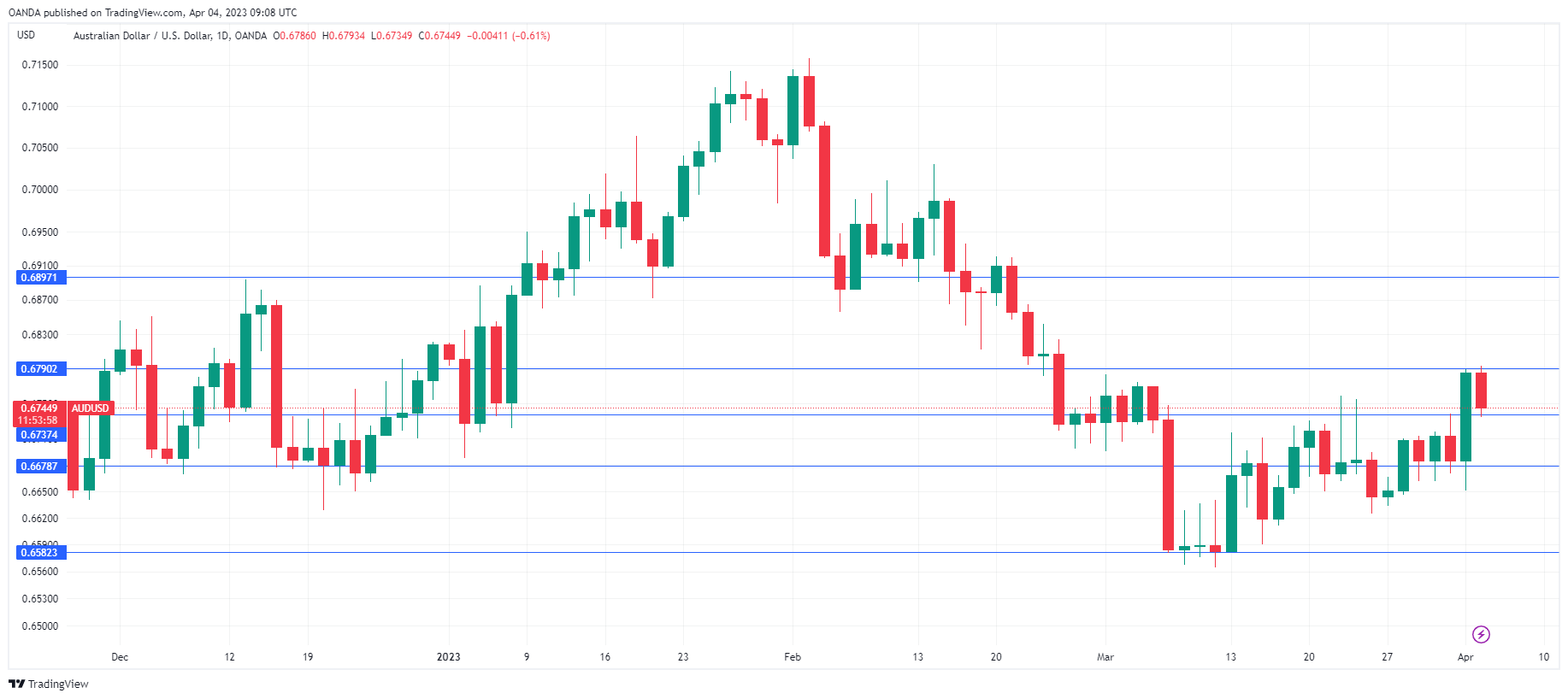
In the European session, AUD/USD is trading at 0.6744, down 0.61%.
RBA takes a breather
The streak is over. After raising rates 10 consecutive times, the Reserve Bank of Australia (RBA) has taken a pause, holding the benchmark cash rate at 3.60%. The decision was widely expected by the markets, but the Australian dollar has nevertheless lost ground, as Governor Lowe’s statement was on the dovish side.
Lowe defended the pause by saying that the RBA had raised rates by 350 points since May and there was a lag until the full effect would be felt. As well, there had been a “substantial” slowing in household spending and a slowdown in the Australian economy.
As for the banking crisis, Lowe noted that the Australian banking system was solid, but the crisis was expected to lead to tighter financial conditions which would be an additional headwind for the global economy”. Lowe is being cautious about the banking crisis, reassuring listeners that Australia’s banks are safe but that doesn’t mean there won’t be any fallout.
The markets picked up on nuances in the language of the statement, which read, “some further tightening of monetary policy may well be needed.” The use of “may” replaced “will” in last month’s statement, suggesting a more dovish rate path.
Governor Lowe did an adequate job of explaining the pause in rates, but inflation remains more than triple the target of 2%, so clearly, the fight against inflation is far from over. Lowe will be hoping that inflation continues to drop before the next meeting on May 2nd, which would provide support for another pause in rates.
AUD/USD Technical
- There is resistance at 0.6790 and 0.6897
- AUD/USD has support at 0.6678 and 0.6582
BoE’s Tenreyro foresees need for looser monetary policy
BoE Monetary Policy Committee member Silvana Tenreyro, a known dove, remarked in a speech that the data sinve November has evolved most like her downside scenario, noting a sharp decline in high-frequency private-sector regular pay growth.
She explained that with the Bank Rate at 4.25%, the restrictive policy is likely to "drag demand well below its potential, loosening the labour market and pulling down on inflation." As a result, she believes that "inflation is likely to fall well below target."
Tenreyro voted for no change in the Bank Rate in recent months, instead of further tightening, as she believes a looser stance is necessary to achieve the inflation target in the medium term.
She expressed her expectation that the current high level of the Bank Rate "will require an earlier and faster reversal, to avoid a significant inflation undershoot."
Full speech of Silvana Tenreyro here.