

Sample Category Title
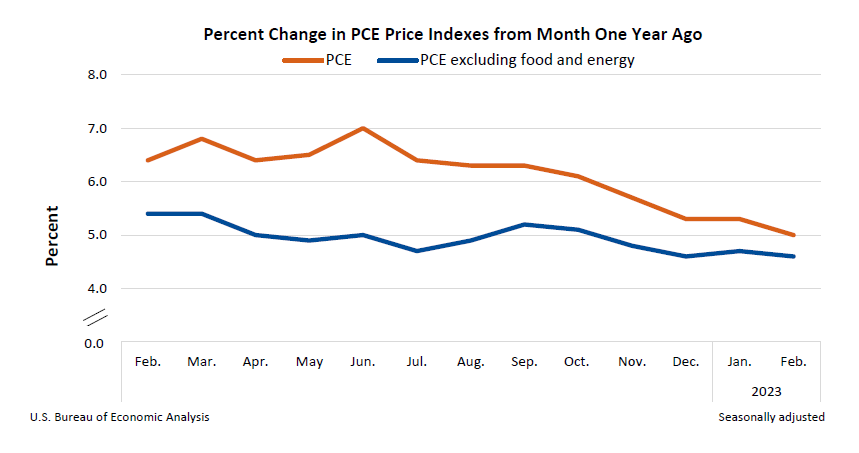
US PCE price index slowed to 5% yoy, core PCE down to 4.6% yoy
US personal income rose 0.3% mom or USD 72.9B in February, matched expectation. Personal spending rose 0.2% mom or USD 27.9B below expectation of 0.3% mom.
PCE price index rose 0.3% mom, above expectation of 0.2% mom. Core PCE price index, excluding food and energy, rose 0.3% mom, below expectation of 0.4% mom. Prices for goods increased 0.2% mom and prices for services increased 0.3% mom. Food prices increased 0.2% mom and energy prices decreased -0.4 mom.
From the same month one year ago, PCE price index slowed from 5.3% yoy to 5.0% yoy, below expectation of 5.3% yoy. Core PCE price index slowed from 4.7% yoy to 4.6% yoy, below expectation of 4.7% yoy.
Canada GDP grew 0.5% mom in Jan, to grow further 0.3% mom in Feb
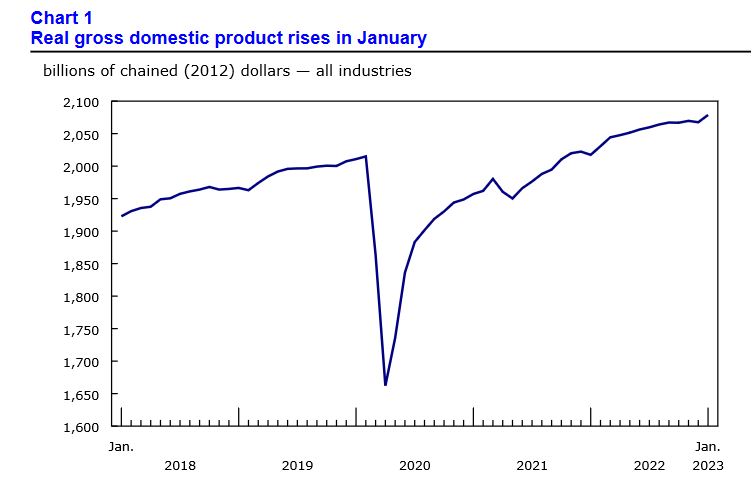
Canada GDP grew 0.5% mom in January, above expectation of 0.3% mom. Goods-producing industries grew 0.4% mom while services-producing industries grew 0.6% mom. 17 of 20 industrial sectors posted increases.
Advance information indicates that real GDP increased 0.3% mom in February. Increases in the mining, quarrying, and oil and gas extraction, manufacturing, and finance and insurance sectors were slightly offset by decreases in construction, wholesale trade, and accommodation and food services.
EUR/USD Pair Moved into a Positive Zone Above 1.0880
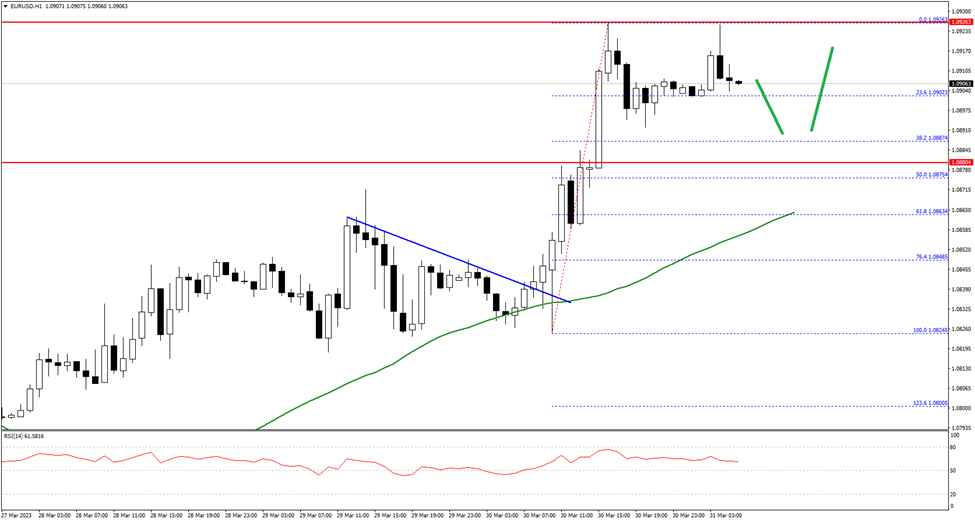
The Euro started a fresh increase above the 1.0850 resistance zone against the US Dollar. The EUR/USD pair even cleared the 1.0880 level to move into a positive zone.
It tested the 1.0925 zone and is currently consolidating gains well above the 50 hourly simple moving average. On the upside, an immediate resistance is near the 1.0925 level.
The next major resistance is near the 1.0950 level. A break above the 1.0950 resistance level could start another increase. In the stated case, it could rise towards the 1.1000 resistance.
Conversely, the pair might start a downside correction below 1.0900 on FXOpen. The next key support is near 1.0880, below the pair could drop towards the 1.0865 level or the 50 hourly simple moving average. Any more losses might send the pair towards the 1.0820 level in the near term.
EUR/USD: Bulls on Hold after EU and Ahead of US Data
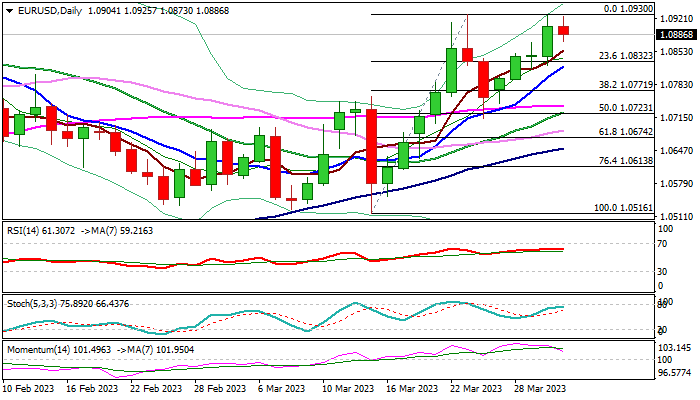
The Euro edged lower after bulls faced a double failure just under pivotal barrier at 1.0930 (Mar 23 spike high).
Dips were so far shallow, with limited negative impact from weaker than expected German labor data and suggesting limited consolidation before final break higher and acceleration towards targets at 1.1000/32 (psychological/2023 high of Feb 2).
The single currency remains underpinned by renewed risk appetite as tensions in banking continue to fade and confidence restores, with the EU inflation data adding to hawkish outlook on ECB monetary policy.
Although the bloc’s annualized inflation fell below expectations and posted record drop in March (6.9% vs 7.1% f/c and Feb 8.5%) signaling that inflation remains in a steady downtrend which accelerated in March, so called core inflation which excludes volatile components and seen as a better gauge of underlying price pressures, continues to rise and hit new record high in March (7.5% vs 7.4% In Feb).
The European Central Bank, after a series of rate hikes, stood aside in announcing their next actions and signaled that the further steps will be data dependent, but the latest comments from a number of policymakers that further raising of interest rates is likely to be needed to put high inflation under control and push it towards 2% target, add to positive signals for euro.
All eyes are now on US inflation and consumer spending data, due later today and expected to provide fresh direction for dollar.
US PCE price index, Fed’s closely watched gauge of inflation, is forecasted to drop to 5.1% in Feb after unexpected jump to 5.4% in Jan, warning that inflation regained traction after a steady descend in past few months.
Consumer spending, which accounts for more than two thirds of US economic activity, is expected to rise by 0.3% in Feb after unexpected 1.8% jump in Jan, which fueled market expectations for fed’s further policy tightening.
The picture on daily chart remains bullish but weaker positive momentum, signals a pause in the latest rally.
Bulls need a weekly close above cracked Fibo barrier at 1.0910 (76.4% retracement of 1.1032/1.0516) after last week’s failure and sustained break of 1.0930 pivot to spark fresh acceleration higher.
Rising 10DMA (1.0820) offers solid support, which should contain dips, although deeper pullback towards 1.0771/57 (Fibo 38.2% of 1.0516/1.0930 / top of thickening daily cloud) cannot be ruled out.
Only extension and close below cloud base (1.0727) would sideline bulls and signal a double-top (1.0930/26).
Res: 1.0930; 1.0951; 1.1000; 1.1032.
Sup: 1.0873; 1.0832; 1.0820; 1.0771.
Bitcoin Adjusting First Quarter Gains
Market picture
The crypto market’s capitalisation fell by 1.1% over the past day to 1.17 trillion, which resembles profit-taking after 50% of market growth in the first quarter of this year.
Bitcoin underwent an even more active sell-off the night before, losing about 2% in 24 hours, but holding near $ 28K, bringing the result of the first quarter to 70%. A full correction from these levels involves a pullback to $ 26K or even $ 25K.
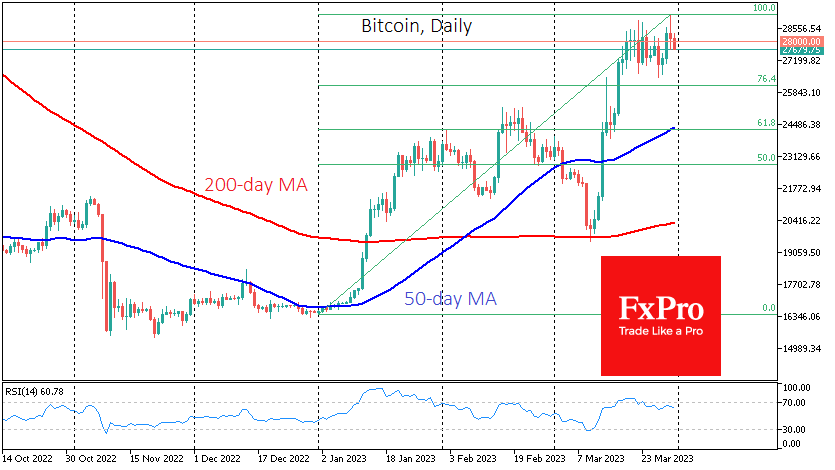
The fact that the stock market has maintained a positive bias over the past day, and the dollar has been declining, additionally supports the idea of a local shake-up of crypto portfolios, but not the return of pessimism. If this happens, anxiety will kick in when the decline is under $ 25K.
News background
The US Securities and Exchange Commission (SEC) has charged the cryptocurrency platform Beaxy with brokerage and clearing activities without proper registration.
Gensler called on the government to allocate $2.4 billion to the SEC to prosecute unregistered crypto companies more effectively. He says, “the cryptocurrency market is the Wild West, where people put hard-earned money at risk by investing it in high-risk assets.”
Senator from the US Democratic Party, Elizabeth Warren, called for an “anti-crypto army”. In her future election campaign, she plans to pay special attention to the problems of cryptocurrency companies and the formation of a broad coalition of opponents of crypto assets.
Part of the digital division of the Stuttgart Stock Exchange (Boerse Stuttgart), Blocknox has received a cryptocurrency custodian license from the German Federal Financial Supervisory Authority (BaFin).
GBP/USD: Cable Eases after Mixed UK Data, But Larger Bulls Still Intact
Cable eases from new 2-month high in early European trading on Friday, as markets digest mixed data.
UK Q4 GDP ticked above expectations, signaling that the economy started to gain traction after contracting in in the third quarter and current account gap narrowed significantly, but house price index came well below expectations, partially offsetting positive impact.
Markets shift focus towards EU and US inflation figures, another key events today, the last day of the first quarter of 2023, which would add to expected increased volatility.
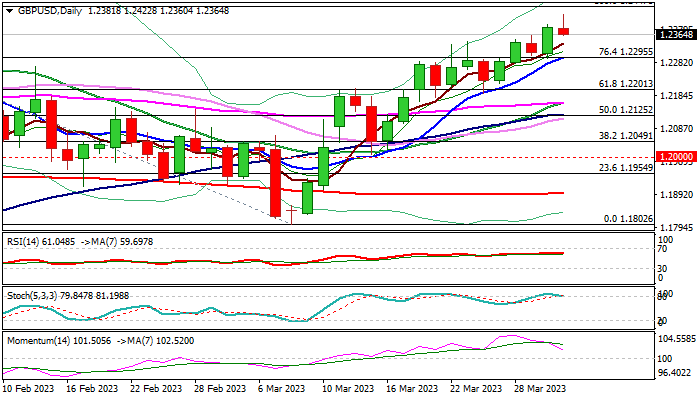
The GBPUSD probed above 1.2400 mark for the first time since early February, but gains were so far short-lived, putting temporarily aside expectations for final push towards ley barriers at 1.2447 (tops of Dec 14 / Jan 23).
Overall bullish picture on daily chart suggests shallow correction before bulls regain traction, with solid supports at 1.2300 zone (rising 10DMA/broken Fibo 76.4% of 1.2447/1.1802) to ideally contain however, stochastic is reversing from overbought territory and sharp loss of bullish momentum warn of possible deeper pullback.
Broken Fibo 61.8% level and a higher base at 1.2200 zone should hold extended dips to mark pullback as healthy correction and keep larger bulls in play.
Res: 1.2402; 1.2422; 1.2447; 1.2500.
Sup: 1.2337; 1.2300; 1.2219; 1.2190.
Eurozone CPI slowed to 6.9% yoy in Mar, core CPI ticked up to 5.7% yoy
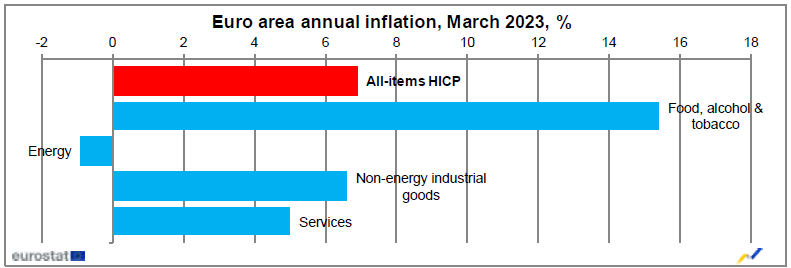
Eurozone CPI slowed from 8.5% yoy to 6.9% yoy in March, below expectation of 7.2% yoy. CPI core (all item ex energy, food, alcohol & tobacco) roes from 5.6% yoy to 5.7% yoy, matched expectations.
Looking at the main components , food, alcohol & tobacco is expected to have the highest annual rate in March (15.4%, compared with 15.0% in February), followed by non-energy industrial goods (6.6%, compared with 6.8% in February), services (5.0%, compared with 4.8% in February) and energy (-0.9%, compared with 13.7% in February).
Is the Sell-off in USDCAD Overdone?
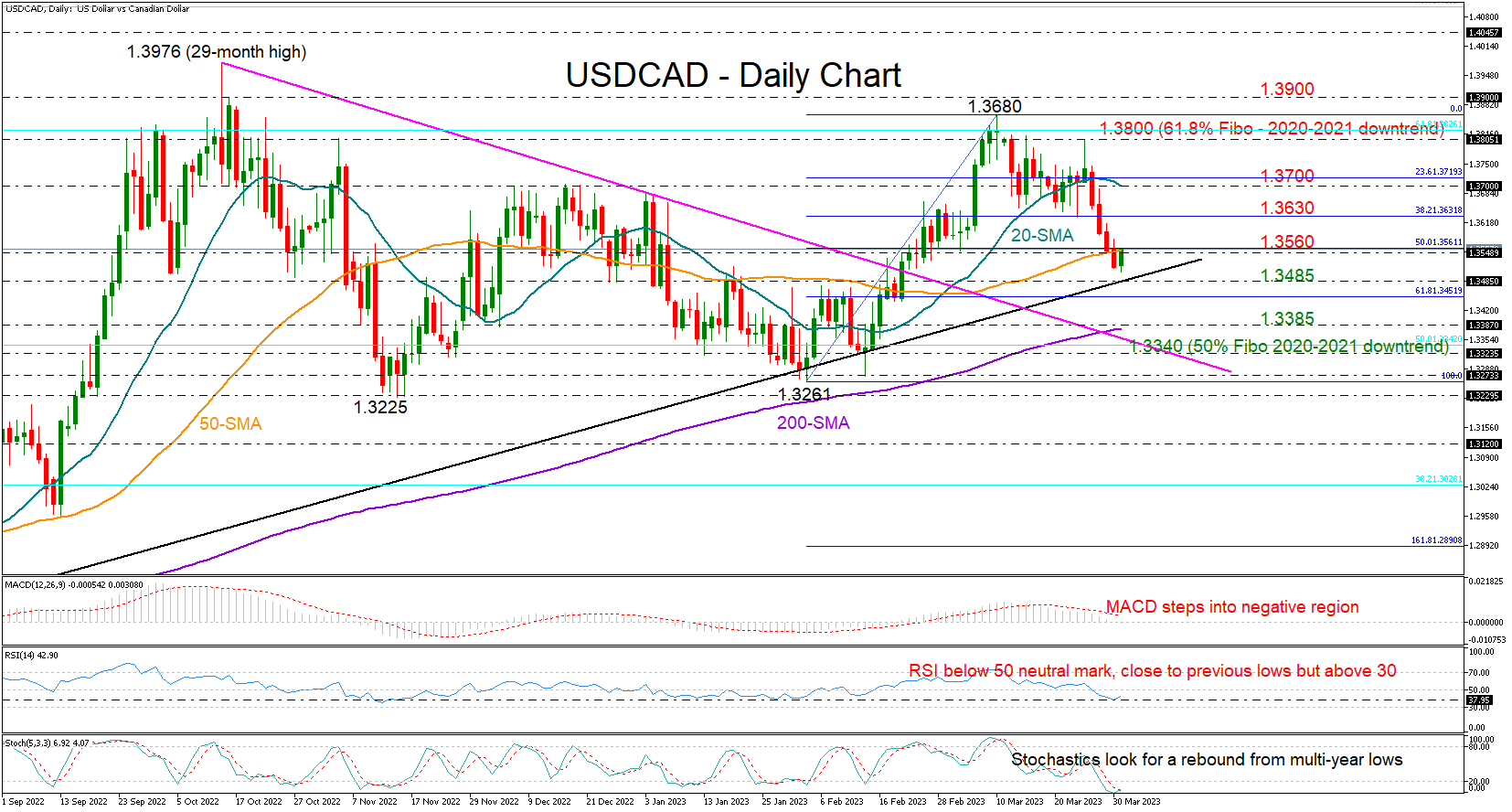
USDCAD is set to close the month on a negative note despite the rally to a five-month high of 1.3860 on March 10th.
Having dived back below its 20- and 50-day simple moving averages (SMAs) after the formation of a bearish doji candlestick near the 61.8% Fibonacci retracement of the 2020-2021 downtrend, the pair is currently eyeing the important support trendline that connects all the lows from June at 1.3485.
Meanwhile, the Stochastic oscillator is trying to bounce from multi-year lows, increasing speculation that the latest bearish wave is overdone. That said, the RSI, although near its previous lows, it has yet to enter oversold territory, while the MACD has just stepped into the negative zone, both suggesting that the bears may stay on course.
A clear close below the trendline could forcefully press the price towards the 1.3400-1.3385 zone, where the 200-day SMA is converging. Slightly lower, the 50% Fibonacci level of 1.3340 and the broken resistance trendline from October’s highs may next come to the rescue, likely postponing a test at the lower boundary of the six-month-old range seen at 1.3273-1.3225. A break lower would worsen the medium-term outlook.
Alternatively, a bounce back above the 50-day SMA at 1.3560 could reach the 1.3630 barrier, which represents the 38.2% Fibonacci retracement level of the previous upleg. Another successful move higher could challenge the 20-day SMA at 1.3700 before crawling swiftly up to the key 1.3800 resistance.
Summing up, downside risks keep lingering in the USDCAD market, though with the pair flirting with a crucial support region at the moment, a pause or an upside reversal cannot be excluded in the coming sessions.
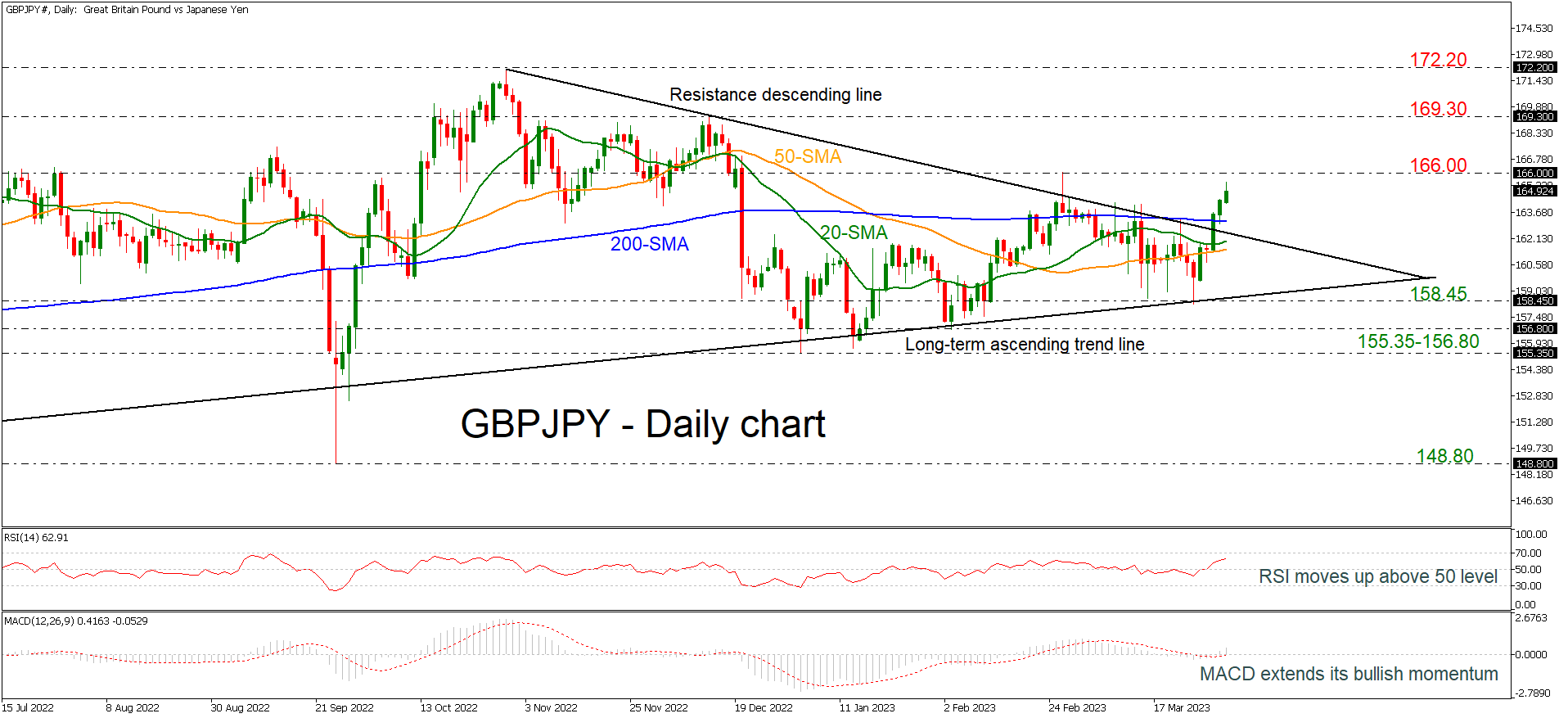
GBPJPY Surpasses the Descending Line, Suggesting More Gains
GBPJPY is extending its buying interest above the medium-term descending line and the simple moving averages (SMAs), suggesting more gains in the near term. The pair rebounded off the 158.45 support and the long-term uptrend line, with the next crucial resistance level coming from the 166.00 psychological mark.
From the technical perspective, the RSI is heading north in the bullish territory and is approaching the overbought region, while the MACD is extending its movement above its trigger and zero lines.
In the positive scenario, immediate resistance would come from the 166.00 key level ahead of the next peak of 169.30, registered in December 2022. More advances could open the way for a retest of the top at 172.20, achieved in October 2022.
On the other hand, a decline below the 200-day SMA may take the price to re-challenge the short-term SMAs around 161.70 before meeting the 158.45 support. Beneath this level, which overlaps with the uptrend line, the 155.35-156.80 zone may halt the bearish actions towards 148.80.
To sum up, the current short-term bias is bullish as the pair jumped above the significant downtrend line of the triangle as well as the long-term phase.
Rising Interest Rate Support Further Propelled the Euro
Markets
Yesterday, first German regional CPI’s (North Rhine Westphalia) and Spanish headline CPI declining from 6.0% to 3.1% (HICP) suggested EMU March inflation slowed faster than expected. European yields nosedived up to 10 bps+ at the open. Maybe the ECB had more room keep a wait-and-see approach than indicated until now. However, the story wasn’t that straightforward. Markets even found themselves wrongfooted. Other regional German CPI release showed a monthly rise of up to 1.0%. German HICP inflation in the end printed at 1.1% M/M, resulting in a higher than expected 7.8% Y/Y (from 9.3%). The monthly dynamics indicate inflation stickiness to persist. Spanish core CPI easing only marginally from 7.6% to 7.5% also put the positive headline surprise in perspective. EMU interest rates staged an impressive intraday reversal. Bund yields even finished the day between 9.5 bps (2.-y) and 1.3 bps (30-y) higher. Both the 2-y and 10-y yield arrived at first resistance near 2.75% and 2.40% respectively. US yield moves again were far less outspoken. US jobless claims stayed just below 200k, but that didn’t change the dynamics. The US curve inverted slightly further (2-y +2 bps; 30-y -2.5 bps). Fed members Collins, Kashkari and Barkin in one way or another acknowledged inflationary risks, but took a balance approach as they ponder the impact of recent turmoil on lending. Equity markets weren’t disturbed by the intraday yields rebound. The Euro Stoxx 50 gained 1.28% and is less than 1.0% from the early March top. US indices gained between 0.43% (Dow) and 0.73% (Nasdaq). Rising interest rate support further propelled the euro. EUR/USD came within reach of the 1.093 top (close 1.0905). The decline of the yen slowed (USD/JPY closed 132.70). EUR/GBP again finished near the 0.88 pivot.
Contrary to yesterday, Asian equities this morning join yesterday’s positive momentum from WS gaining up to 1.0%. China official PMI’s were strong (composite 57 from 56.4), indicating the recovery is gaining traction, especially in the services sector (58.2). Japanese activity data (Feb retail sales, production) also printed strong. Tokyo CPI (ex-fresh food and energy) rose from 3.1% to 3.4%, for now with little impact on the 10-y yield (0.325%). US Treasuries and the dollar are trading little changed this morning. Later today, the calendar is well filled with the EMU flash CPI (headline expected 1.1% M/M and 7.10% Y/Y from 8.50%, core seen rising from 5.6%, to 5.7%). In the US, core PCE deflator (February) probably will make little progress toward the 2.0% target (0.4% M/M and 4.70%Y/Y). Also keep and eye at the Chicago PMI. Inflation data might confirm that there still work to be done for a sustained return to 2.0%, but after this week’s rebound in yields, a meaningful upward surprise is probably needed to extend the move (Cf resistance levels in German yields supra). A constructive risk sentiment, might keep the dollar in the defensive. EUR/USD breaking beyond 1.093 might open the way for a revisit of the 1.1033 YTD top.
News Headlines
South Africa’s central bank jacked up rates yesterday by 50 bps to 7.75%, double the 25 bps move expected by analysts. The rationale behind the larger-than-anticipated hike was another upward revision to inflation, which is now seen at 6% this year, from 5.4% before. Average price increases for 2024 and 2025 are seen at 4.9% (+0.1 ppt) and 4.5% (unch.). Core inflation should ease from 5.1% in 2023 to 4.5% in 2025. Risks remain tilted to the upside, SARB governor Kganyago said. The growth picture doesn’t look too bright, due to the largescale power outages and delivered monetary tightening. GDP in 2023 could come in at a mere 0.2% before picking up to 1% and 1.1% in the years thereafter. For this reason markets start pricing in rate cuts from November already. The South African rand yesterday nevertheless profited, appreciating from USD/ZAR 18.10 to 17.82, the strongest ZAR level in a month.