

Sample Category Title
EUR/CHF Weekly Outlook
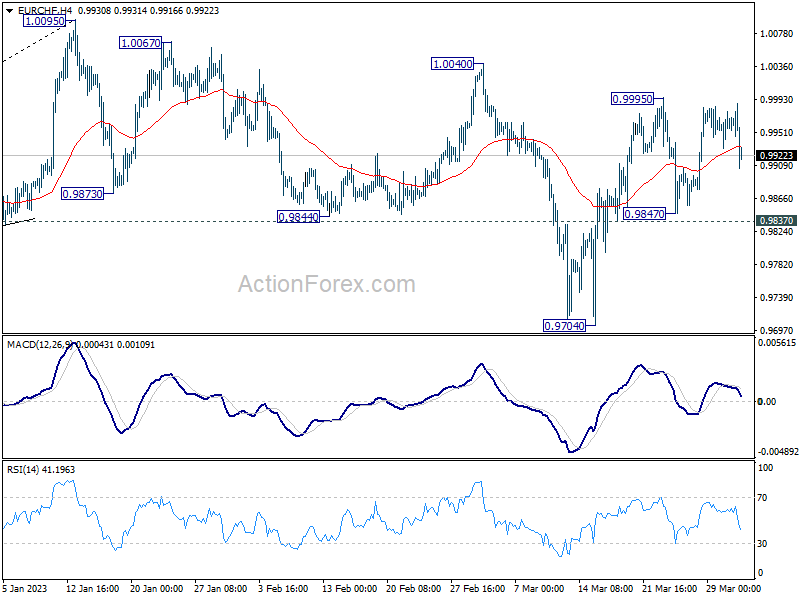
EUR/CHF stayed in range below 0.9995 last week but with 0.9837 minor support intact, near term outlook stays cautiously bullish. Initial bias remains neutral this week first. Correction from 1.0095 could have completed at 0.9704 already. Break of 0.9995 will affirm this bullish case and target a retest on 1.0095 high. However, break of 0.9837 will dampen this bullish view and turn bias back to the downside for 0.9704 support instead.
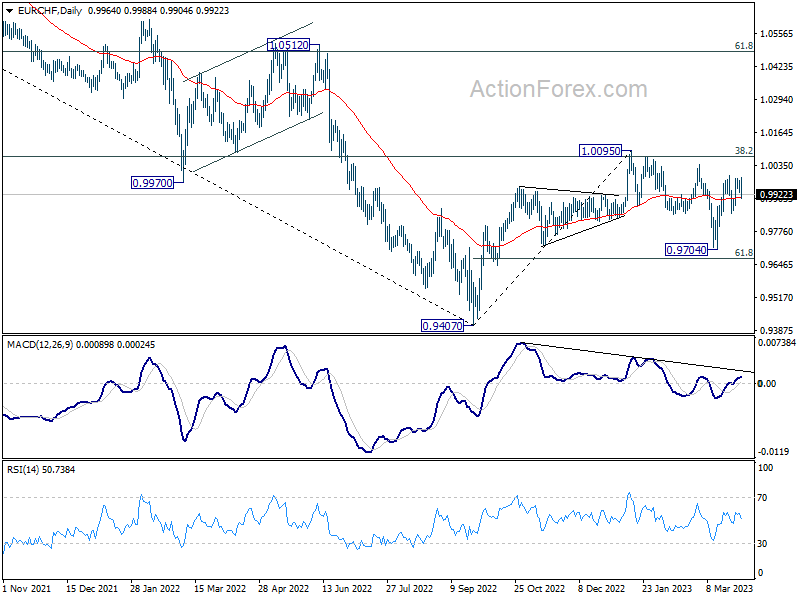
In the bigger picture, prior rejection by 55 week EMA (now at 1.1002) and 38.2% retracement of 1.1149 to 0.9407 at 1.0072 suggests that medium term outlook is staying bearish. That is, down trend from 1.2004 is not completed yet and is in favor to resume through 0.9407 at a later stage. However, decisive break of 1.0095 resistance will raise the chance of bullish trend reversal. Rise from 0.9407 should then target 1.0505 cluster resistance (2020 low at 1.0505, 61.8% retracement of 1.1149 to 0.9407 at 1.1484).
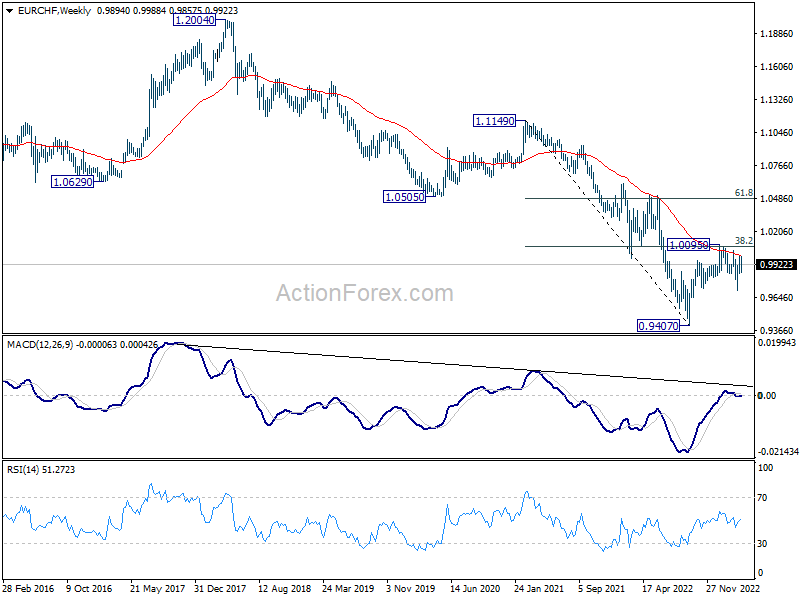
In the long term picture, it's still way too early too call for bullish trend reversal with upside capped well below 55 month EMA and 1.0505 support turned resistance (2020 low). The multi-decade down trend could still continue.

Summary 4/3 – 4/7
Monday, Apr 3, 2023
| GMT | Ccy | Events | Consensus | Previous |
|---|---|---|---|---|
| 23:50 | JPY | Tankan Large Manufacturing Outlook Q1 | 4 | 6 |
| 23:50 | JPY | Tankan Large Manufacturing Index Q1 | 3 | 7 |
| 23:50 | JPY | Tankan Non - Manufacturing Outlook Q1 | 16 | 11 |
| 23:50 | JPY | Tankan Non - Manufacturing Index Q1 | 20 | 19 |
| 23:50 | JPY | Tankan Large All Industry Capex Q1 | 9.90% | 19.20% |
| 00:30 | JPY | Manufacturing PMI Mar F | 48.6 | 48.6 |
| 01:00 | AUD | TD Securities Inflation M/M Mar | 0.40% | |
| 01:30 | AUD | Building Permits M/M Feb | 10.20% | -27.60% |
| 01:45 | CNY | Caixin Manufacturing PMI Mar | 51.7 | 51.6 |
| 06:30 | CHF | CPI M/M Mar | 0.40% | 0.70% |
| 06:30 | CHF | CPI Y/Y Mar | 3.20% | 3.40% |
| 07:30 | CHF | SVME PMI Mar | 48.9 | 48.9 |
| 07:45 | EUR | Italy Manufacturing PMI Mar | 51.0 | 52 |
| 07:50 | EUR | France Manufacturing PMI Mar F | 47.7 | 47.7 |
| 07:55 | EUR | Germany Manufacturing PMI Mar F | 44.4 | 44.4 |
| 08:00 | EUR | Eurozone Manufacturing PMI Mar F | 47.1 | 47.1 |
| 08:30 | GBP | Manufacturing PMI Mar F | 48.0 | 48.0 |
| 13:30 | CAD | Manufacturing PMI Mar | 52.4 | |
| 13:45 | USD | Manufacturing PMI Mar F | 49.3 | 49.3 |
| 14:00 | USD | ISM Manufacturing PMI Mar | 47.5 | 47.7 |
| 14:00 | USD | ISM Manufacturing Prices Paid Mar | 50 | 51.3 |
| 14:00 | USD | ISM Manufacturing Employment Index Mar | 49.1 | |
| 14:00 | USD | Construction Spending M/M Feb | 0.00% | -0.10% |
| 14:30 | CAD | BoC Business Outlook Survey | ||
| 22:00 | NZD | NZIER Business Confidence Q1 | -70 | |
| 23:50 | JPY | Monetary Base Y/Y Mar | 2.00% | -1.60% |
| GMT | Ccy | Events | |
|---|---|---|---|
| 23:50 | JPY | Tankan Large Manufacturing Outlook Q1 | |
| Forecast: 4 | Previous: 6 | ||
| 23:50 | JPY | Tankan Large Manufacturing Index Q1 | |
| Forecast: 3 | Previous: 7 | ||
| 23:50 | JPY | Tankan Non - Manufacturing Outlook Q1 | |
| Forecast: 16 | Previous: 11 | ||
| 23:50 | JPY | Tankan Non - Manufacturing Index Q1 | |
| Forecast: 20 | Previous: 19 | ||
| 23:50 | JPY | Tankan Large All Industry Capex Q1 | |
| Forecast: 9.90% | Previous: 19.20% | ||
| 00:30 | JPY | Manufacturing PMI Mar F | |
| Forecast: 48.6 | Previous: 48.6 | ||
| 01:00 | AUD | TD Securities Inflation M/M Mar | |
| Forecast: | Previous: 0.40% | ||
| 01:30 | AUD | Building Permits M/M Feb | |
| Forecast: 10.20% | Previous: -27.60% | ||
| 01:45 | CNY | Caixin Manufacturing PMI Mar | |
| Forecast: 51.7 | Previous: 51.6 | ||
| 06:30 | CHF | CPI M/M Mar | |
| Forecast: 0.40% | Previous: 0.70% | ||
| 06:30 | CHF | CPI Y/Y Mar | |
| Forecast: 3.20% | Previous: 3.40% | ||
| 07:30 | CHF | SVME PMI Mar | |
| Forecast: 48.9 | Previous: 48.9 | ||
| 07:45 | EUR | Italy Manufacturing PMI Mar | |
| Forecast: 51.0 | Previous: 52 | ||
| 07:50 | EUR | France Manufacturing PMI Mar F | |
| Forecast: 47.7 | Previous: 47.7 | ||
| 07:55 | EUR | Germany Manufacturing PMI Mar F | |
| Forecast: 44.4 | Previous: 44.4 | ||
| 08:00 | EUR | Eurozone Manufacturing PMI Mar F | |
| Forecast: 47.1 | Previous: 47.1 | ||
| 08:30 | GBP | Manufacturing PMI Mar F | |
| Forecast: 48.0 | Previous: 48.0 | ||
| 13:30 | CAD | Manufacturing PMI Mar | |
| Forecast: | Previous: 52.4 | ||
| 13:45 | USD | Manufacturing PMI Mar F | |
| Forecast: 49.3 | Previous: 49.3 | ||
| 14:00 | USD | ISM Manufacturing PMI Mar | |
| Forecast: 47.5 | Previous: 47.7 | ||
| 14:00 | USD | ISM Manufacturing Prices Paid Mar | |
| Forecast: 50 | Previous: 51.3 | ||
| 14:00 | USD | ISM Manufacturing Employment Index Mar | |
| Forecast: | Previous: 49.1 | ||
| 14:00 | USD | Construction Spending M/M Feb | |
| Forecast: 0.00% | Previous: -0.10% | ||
| 14:30 | CAD | BoC Business Outlook Survey | |
| Forecast: | Previous: | ||
| 22:00 | NZD | NZIER Business Confidence Q1 | |
| Forecast: | Previous: -70 | ||
| 23:50 | JPY | Monetary Base Y/Y Mar | |
| Forecast: 2.00% | Previous: -1.60% | ||
Tuesday, Apr 4, 2023
| GMT | Ccy | Events | Consensus | Previous |
|---|---|---|---|---|
| 04:30 | AUD | RBA Interest Rate Decision | 3.60% | 3.60% |
| 06:00 | EUR | Germany Trade Balance (EUR) Feb | 16.9B | 16.7B |
| 09:00 | EUR | Eurozone PPI M/M Feb | -0.30% | -2.80% |
| 09:00 | EUR | Eurozone PPI Y/Y Feb | 13.50% | 15.00% |
| 12:30 | CAD | Building Permits M/M Feb | -4.00% | |
| 14:00 | USD | Factory Orders M/M Feb | -0.30% | -1.60% |
| GMT | Ccy | Events | |
|---|---|---|---|
| 04:30 | AUD | RBA Interest Rate Decision | |
| Forecast: 3.60% | Previous: 3.60% | ||
| 06:00 | EUR | Germany Trade Balance (EUR) Feb | |
| Forecast: 16.9B | Previous: 16.7B | ||
| 09:00 | EUR | Eurozone PPI M/M Feb | |
| Forecast: -0.30% | Previous: -2.80% | ||
| 09:00 | EUR | Eurozone PPI Y/Y Feb | |
| Forecast: 13.50% | Previous: 15.00% | ||
| 12:30 | CAD | Building Permits M/M Feb | |
| Forecast: | Previous: -4.00% | ||
| 14:00 | USD | Factory Orders M/M Feb | |
| Forecast: -0.30% | Previous: -1.60% | ||
Wednesday, Apr 5, 2023
| GMT | Ccy | Events | Consensus | Previous |
|---|---|---|---|---|
| 02:00 | NZD | RBNZ Interest Rate Decision | 5.00% | 4.75% |
| 06:00 | EUR | Germany Factory Orders M/M Feb | 0.40% | 1.00% |
| 06:45 | EUR | France Industrial Output M/M Feb | 0.60% | -1.90% |
| 07:45 | EUR | Italy Services PMI Mar | 53 | 51.6 |
| 07:50 | EUR | France Services PMI Mar F | 55.5 | 55.5 |
| 07:55 | EUR | Germany Services PMI Mar F | 53.9 | 53.9 |
| 08:00 | EUR | Eurozone Services PMI Mar F | 55.6 | 55.6 |
| 08:30 | GBP | Services PMI Mar F | 52.8 | 52.8 |
| 09:00 | EUR | Italy Retail Sales M/M Feb | 0.50% | 1.70% |
| 12:15 | USD | ADP Employment Change Mar | 200K | 242K |
| 12:30 | CAD | Trade Balance (CAD) Feb | 2.2B | 1.9B |
| 12:30 | USD | Trade Balance (USD) Feb | -68.5B | -68.3B |
| 13:45 | USD | Services PMI Mar F | 53.8 | 53.8 |
| 14:00 | USD | ISM Services PMI Mar | 54.5 | 55.1 |
| 14:30 | USD | Crude Oil Inventories | -7.5M |
| GMT | Ccy | Events | |
|---|---|---|---|
| 02:00 | NZD | RBNZ Interest Rate Decision | |
| Forecast: 5.00% | Previous: 4.75% | ||
| 06:00 | EUR | Germany Factory Orders M/M Feb | |
| Forecast: 0.40% | Previous: 1.00% | ||
| 06:45 | EUR | France Industrial Output M/M Feb | |
| Forecast: 0.60% | Previous: -1.90% | ||
| 07:45 | EUR | Italy Services PMI Mar | |
| Forecast: 53 | Previous: 51.6 | ||
| 07:50 | EUR | France Services PMI Mar F | |
| Forecast: 55.5 | Previous: 55.5 | ||
| 07:55 | EUR | Germany Services PMI Mar F | |
| Forecast: 53.9 | Previous: 53.9 | ||
| 08:00 | EUR | Eurozone Services PMI Mar F | |
| Forecast: 55.6 | Previous: 55.6 | ||
| 08:30 | GBP | Services PMI Mar F | |
| Forecast: 52.8 | Previous: 52.8 | ||
| 09:00 | EUR | Italy Retail Sales M/M Feb | |
| Forecast: 0.50% | Previous: 1.70% | ||
| 12:15 | USD | ADP Employment Change Mar | |
| Forecast: 200K | Previous: 242K | ||
| 12:30 | CAD | Trade Balance (CAD) Feb | |
| Forecast: 2.2B | Previous: 1.9B | ||
| 12:30 | USD | Trade Balance (USD) Feb | |
| Forecast: -68.5B | Previous: -68.3B | ||
| 13:45 | USD | Services PMI Mar F | |
| Forecast: 53.8 | Previous: 53.8 | ||
| 14:00 | USD | ISM Services PMI Mar | |
| Forecast: 54.5 | Previous: 55.1 | ||
| 14:30 | USD | Crude Oil Inventories | |
| Forecast: | Previous: -7.5M | ||
Thursday, Apr 6, 2023
| GMT | Ccy | Events | Consensus | Previous |
|---|---|---|---|---|
| 01:30 | AUD | Trade Balance (AUD) Feb | 11.12B | 11.69B |
| 01:45 | CNY | Caixin Services PMI Mar | 55.0 | 55.0 |
| 05:45 | CHF | Unemployment Rate Mar | 1.90% | 1.90% |
| 06:00 | EUR | Germany Industrial Production Feb | -0.40% | 3.50% |
| 07:00 | CHF | Foreign Currency Reserves (CHF) Mar | 771B | |
| 08:30 | GBP | Construction PMI Mar | 53.6 | 54.6 |
| 11:30 | USD | Challenger Job Cuts Mar | 77.77K | |
| 12:30 | USD | Initial Jobless Claims (Mar 31) | 200K | 198K |
| 12:30 | CAD | Net Change in Employment Mar | 21.8K | |
| 12:30 | CAD | Unemployment Rate Mar | 5.00% | |
| 14:00 | CAD | Ivey PMI Mar | 52.0 | 51.6 |
| 14:30 | USD | Natural Gas Storage | -47B | |
| 23:30 | JPY | Labor Cash Earnings Y/Y Feb | 1.40% | 0.80% |
| 23:30 | JPY | Overall Household Spending Y/Y Feb | 4.90% | -0.30% |
| GMT | Ccy | Events | |
|---|---|---|---|
| 01:30 | AUD | Trade Balance (AUD) Feb | |
| Forecast: 11.12B | Previous: 11.69B | ||
| 01:45 | CNY | Caixin Services PMI Mar | |
| Forecast: 55.0 | Previous: 55.0 | ||
| 05:45 | CHF | Unemployment Rate Mar | |
| Forecast: 1.90% | Previous: 1.90% | ||
| 06:00 | EUR | Germany Industrial Production Feb | |
| Forecast: -0.40% | Previous: 3.50% | ||
| 07:00 | CHF | Foreign Currency Reserves (CHF) Mar | |
| Forecast: | Previous: 771B | ||
| 08:30 | GBP | Construction PMI Mar | |
| Forecast: 53.6 | Previous: 54.6 | ||
| 11:30 | USD | Challenger Job Cuts Mar | |
| Forecast: | Previous: 77.77K | ||
| 12:30 | USD | Initial Jobless Claims (Mar 31) | |
| Forecast: 200K | Previous: 198K | ||
| 12:30 | CAD | Net Change in Employment Mar | |
| Forecast: | Previous: 21.8K | ||
| 12:30 | CAD | Unemployment Rate Mar | |
| Forecast: | Previous: 5.00% | ||
| 14:00 | CAD | Ivey PMI Mar | |
| Forecast: 52.0 | Previous: 51.6 | ||
| 14:30 | USD | Natural Gas Storage | |
| Forecast: | Previous: -47B | ||
| 23:30 | JPY | Labor Cash Earnings Y/Y Feb | |
| Forecast: 1.40% | Previous: 0.80% | ||
| 23:30 | JPY | Overall Household Spending Y/Y Feb | |
| Forecast: 4.90% | Previous: -0.30% | ||
Friday, Apr 7, 2023
| GMT | Ccy | Events | Consensus | Previous |
|---|---|---|---|---|
| 05:00 | JPY | Leading Economic Index Feb P | 97.5 | 96.6 |
| 12:30 | USD | Nonfarm Payrolls Mar | 240K | 311K |
| 12:30 | USD | Unemployment Rate Mar | 3.60% | 3.60% |
| 12:30 | USD | Average Hourly Earnings M/M Mar | 0.30% | 0.20% |
| GMT | Ccy | Events | |
|---|---|---|---|
| 05:00 | JPY | Leading Economic Index Feb P | |
| Forecast: 97.5 | Previous: 96.6 | ||
| 12:30 | USD | Nonfarm Payrolls Mar | |
| Forecast: 240K | Previous: 311K | ||
| 12:30 | USD | Unemployment Rate Mar | |
| Forecast: 3.60% | Previous: 3.60% | ||
| 12:30 | USD | Average Hourly Earnings M/M Mar | |
| Forecast: 0.30% | Previous: 0.20% | ||
The Weekly Bottom Line: Quiet End to a Volatile Quarter
U.S. Highlights
- FOMC voting members noted the interest rate path will depend on incoming data and highlighted the uncertainty surrounding the effects of regional bank stress on credit availability.
- Inflation remained relatively elevated, despite moderating last month, as total and core PCE inflation both rose 0.3% month-on-month (m/m) in February.
- Pending home sales in February surpassed expectations by a notable margin as modest price declines and lower mortgage rates supported activity at the start of the year.
Canadian Highlights
- As part of a $67 billion, five-year spending pledge, this week’s federal budget outlined necessary investments in Canada’s clean energy transition. Funds were also put towards health care and cost-of-living relief.
- These measures do come with a cost however, as the government’s deficit remains elevated in the near term, and does not return to balance over the forecast horizon. This leaves the government less flexibility to address a potential economic downturn.
- There were no traces of weakness in the January GDP report, however. GDP expanded 0.5% m/m that month, and Statcan’s flash estimate signals solid growth took place in February.
U.S. - Quiet End to a Volatile Quarter
The last week of the first quarter was relatively quiet as markets continued to digest last week’s Federal Reserve decision and the potential implications of regional bank stress on credit conditions. In terms of economic data, we received updates on housing, consumption, and inflation. Equity markets drifted higher on the week, with the S&P 500 up 2.5%, while the 2-year Treasury yield rose by roughly 30 basis-points (bps) to sit at 4.1% as of the time of writing – still about 90bps below its cyclical peak of 5% at the start of the month.
Starting off on Sunday, we heard from Minneapolis Fed President Neel Kashkari. Reiterating Chair Powell’s statements from last week, Kashkari noted that the banking system is resilient, but that uncertainty remained regarding the extent to which stress in the banking sector may lead to a credit crunch. For this reason, Kashkari assessed that “it’s too soon to make any forecasts about the next interest rate meeting [in May]”. This marks a notable deviation from his comments on March 1st that he was open to a 50bps hike in March. The uncertainty is also reflected in the market’s sentiment about the Fed’s May decision – now pricing the odds of a hike at basically a coin toss.
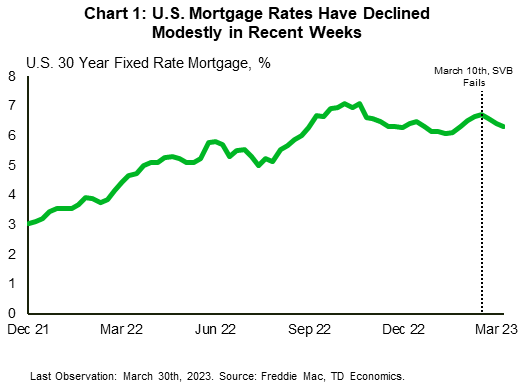
Housing data surprised to the upside this week, with pending home sales rising by 0.8% month-on-month (m/m) in February, down from the 1.8% rise seen in January, but well above the consensus expectation of a 3% m/m decline. This relative strength was likely front-loaded in the month, as mortgage rates rose by roughly 50bps in February. Pending home sales tend to lead final sales by 1-2 months, so this could be an indicator that the spring housing market may begin with some strength, particularly considering that mortgage rates have fallen by roughly 30bps since March 10th (Chart 1). However, stretched affordability and still relatively high financing costs are expected to remain notable headwinds moving forward.
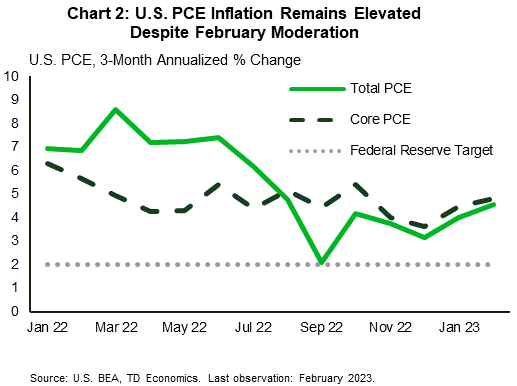
The pulse check on the American consumer this week showed that personal income grew by 0.3% m/m in February, decelerating from January’s gain of 0.6%. This helped to push personal spending up by 0.2% m/m, with housing and health care services seeing the largest increases. Total and core PCE inflation both rose by 0.3% m/m, decelerating relative to January but remaining elevated (Chart 2). More recent data showed that consumer confidence rose in March on a modestly improved outlook for six months ahead, whereas the consumer assessment of the current economic situation deteriorated. The survey cut-off was 10 days after SVB failed, so it is likely that this reading only partially captures the consumer response to recent banking sector stress.
Looking ahead to next week, markets will be closely watching the March employment data release on Friday, with consensus expectations for job growth to cool and the unemployment rate to remain unchanged. This will be one of the more important updates between now and the May Fed meeting, as policymakers continue to look for signs of labor market cooling and its subsequent easing effect on price growth.
Canada – Solid GDP Print Casts Doubt on Cuts
In the current environment, no news is good news for financial markets. A relative dearth of bad financial headlines supported risk-on sentiment this week, pushing Canadian equities and bond yields higher. It also encouraged some flight away from the U.S. Dollar, resulting in about a one cent appreciation in the loonie (as of writing) to just under $US 0.74.
It is premature to expect that we are out of the woods yet with respect to financial market risks. And, even if things don't materially worsen on that end, economic growth is still likely to slow significantly in coming quarters. Against that slowing backdrop the federal government released their budget this week. In our view, Budget 2023 delivered necessary investments in Canada's clean energy transition to keep the country competitive with the hefty subsidies in the U.S. Inflation Reduction Act. Specifically, the budget allocated $21 billion in net new spending towards green initiatives through tax credits and access to lower tax rates for zero-emissions manufacturers.
These measures were part of more than $67 billion (about 0.5% of GDP annually) in new spending pledged by the government over the next five years. Other major initiatives were split across the previously announced healthcare transfers to provinces (totaling $22 billion), expanding the dental care insurance program to low-and-middle income families, and other "cost-of-living" measures. The latter amounts to an extension of last year's the GST rebate which is a more targeted measure than some of the so-called "inflation-relief" funds that have been doled out by provinces over the past year. It will boost household incomes and consumption in the near-term.
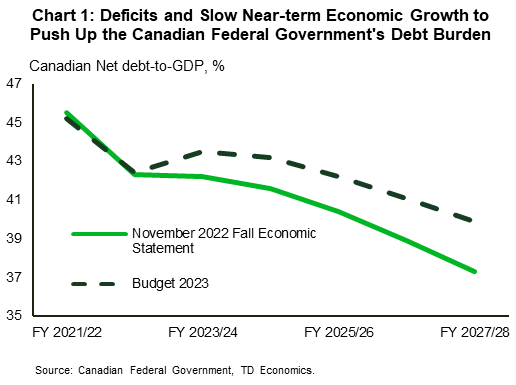
Policymakers' decision to have their debt burden hang high over the next few years does in theory leave them less fiscal room to deal with a recession if one unfolds (Chart 1). The federal government also maintains a projected deficit through FY 2027/28, versus its November projection of a small surplus that year. Considering the economic backdrop, our preference would have been for the government to build in more prudence.
Although Canada's economic performance is expected to deteriorate as the year wears on, there was no trace of that in today's GDP report for January (Chart 2). Quite the contrast, in fact, as industry-based GDP expanded at an above-consensus 0.5% m/m pace in January, supported by rebounds in several industries. What's more, preliminary data points to a 0.3% gain during February. All in, it looks like GDP could record growth north of 2% (annualized) in the first quarter. There's a high bar for the Bank of Canada to resume interest rate hikes. This solid economic data casts doubts that cuts are on the horizon in the second half of this year, as the market currently expects, and underpins our recent forecast change to move cuts out to 2024. 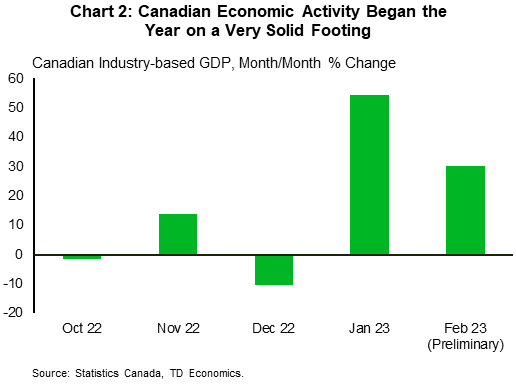
Week Ahead – Focus on the US Jobs Report as the Fed Ponders More Rate Hikes
US
There are no prizes for guessing what the highlight next week will be. The US jobs report is widely regarded as being the most important economic report each month, although inflation probably currently just about edges it. The March report is expected to show a slower pace of job growth, albeit still strong at 240,000, and wages growing at a decent rate. That may not be enough to stop the Fed from tightening another 25 basis points in May, although that’s something markets can’t currently make their minds up on. It remains a coin toss.
ISM manufacturing surveys on Monday will also be eyed, alongside JOLTS job openings on Tuesday, ISM services on Wednesday, and jobless claims on Thursday.
Eurozone
A shortened week for some in the eurozone due to the Good Friday bank holiday. The rest of the week isn’t looking much more interesting at this point, with final PMI surveys the only highlight and even these may not be overly impactful.
UK
It’s also a shortened week for the UK and much like the euro area, the rest of the week is a little thin on major economic releases or events. The highlight will probably be appearances from BoE policymakers, the most notable of which being Huw Pill and Silvana Tenreyro on Tuesday.
Russia
A relatively quiet week with a few pieces of data standing out, notably the PMI surveys on Monday and Wednesday, as well as fourth quarter GDP figures on Friday.
South Africa
The SARB surprised markets and raised rates by 50 basis points in March, taking the policy rate to 7.75%. This is despite the fact that inflation is currently only a little above target at 7% while core is well within at 5.2%. February’s upside surprise may have caused some concern and inspired a more hawkish outlook but the central bank may still refrain from further rate hikes in the future. There are no major data releases due next week.
Turkey
March inflation data will be the core focus next week, with the annual reading seen moderating a little further to 51.33%. That’s still far too high albeit not sufficiently so to discourage the central bank from slashing interest rates should it opt to continue, as we’ve seen over the last year or so.
Switzerland
Inflation data next week will be eyed for signs of slowing, easing pressure on the central bank to continue tightening. Inflation is only a little above target and is expected to slip back to 3.2% in March but that may not be enough for the SNB, which has promised more if necessary. Markets are currently pricing in a 60% chance of another 25 basis point hike in June, with a 40% chance of that being 50.
China
China’s house prices rose in most cities in February, signaling the start of an upturn, and the property sector is likely to turn neutral from being a growth drag in the first half of the year and even provide a small boost in the second half. After the lifting of pandemic restrictions, consumer services experienced a dramatic rebound. Following a year-on-year drop of 14.1% in December last year, catering and retail sales in February surged by 9.2% annually. Suppressed demand was particularly evident during the Spring Festival holiday, with domestic tourism revenue increasing by 30% compared with a year ago.
The Caixin PMIs on Monday and Thursday will be in focus next week, while bank holidays early in the week may mean activity is more muted.
India
Markets are currently split between a 25 basis point hike and none from the RBI next week. Slightly punchier inflation at the start of the year may swing it in favor of one final hike in the cycle although recent turmoil in the US and European banks could tip the balance the other way. Either way, the end is nigh for rate hikes in India.
Australia
Australia’s CPI annual rate for February came in at 6.8%, lower than the previous reading of 7.8%, which may support considering a pause on interest rate hikes at the April meeting. At the same time, Australian retail sales for February initially recorded a monthly rate of 0.2%, exceeding market expectations of 0.1% but showing a significant decline from the 1.8% recorded in January.
New Zealand
Chief Economist at Reserve Bank of New Zealand Paul Conway stated that high and widespread inflation is due to solid demand exceeding supply. It is determined to bring inflation and inflation expectations back to target levels. The official cash rate (OCR) is currently slightly above the neutral level and has achieved the expected tightening effect. The RBNZ is expected to hike by 25 basis points to 5% on Wednesday.
Japan
Next week the focus will be on the Tankan large enterprises’ business conditions and the final PMI readings.
Singapore
Retail sales and PMI data are the only notable economic releases next week.
Weekly Economic & Financial Commentary: The Calm Before the Storm
Summary
United States: The Calm Before the Storm
- This week brought glimpses of market stabilization after weeks of turmoil. Although consumers seem unfazed by the uproar, tighter credit conditions coming down the pipeline will likely weigh on growth. Meanwhile, inflation continues to advance at a stubbornly high pace, adding to the case for a 25 bps hike in May.
- Next week: ISM PMIs (Mon & Wed), Trade Balance (Wed), Nonfarm Payrolls (Fri)
International: Sticky Eurozone Core Inflation
- The Eurozone is a perfect example of how inflation can be "sticky" coming down. While headline CPI inflation has receded from its peak, core inflation, which strips out volatile components like food and energy, has continued to push higher and remains stubbornly elevated.
- Next week: Japan Tankan Survey (Mon), RBA Rate Decision (Tue), RBNZ Rate Decision (Wed)
Credit Market Insights: Survey Says... Declining Demand for Consumer Credit
Recently released data from the New York Fed's credit access survey support the premise that consumers are finding it increasingly difficult to draw on credit. Consumer demand for credit declined 4.8% between October 2022 and February 2023, the third-largest decline reported in the tri-annual survey data going back to 2013.
Topic of the Week: Pandemic Population Shifts Slowed Down in 2022
- One significant change brought on by the pandemic was a rapid decline in net domestic migration for many large counties in the United States. According to new data published this week by the Census Bureau, outmigration from those counties slowed down in 2022. A sharp rebound in international migration was another noteworthy change.
Dollar Preparing to Stare into the Abyss
The dollar index is ending with a decline for the fourth of the last five weeks, almost completely erasing the gains from February’s rise. Although it cannot be ruled out that the quarterly portfolio shakeout will create traction in the Dollar, it is still more likely that the US currency will fall further in the coming quarters.
We consider the sharp reversal of the Dollar from rising to falling at the end of September a turning point. Before that, the DXY had been gaining following an increasingly tight monetary policy stance by the Fed. But after last September’s meeting, hopes of an imminent end to tightening loomed on the horizon for financial markets.
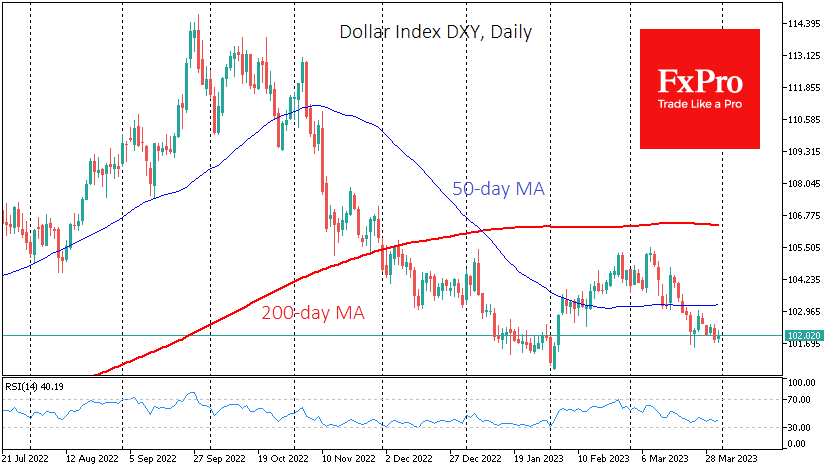
The link between the Dollar and Fed policy expectations has become even closer this year. In January, the Dollar was accelerating its fall as markets were banking on a rate cut even before the end of the year. There was a sharp reversal in February when high inflation put a 50-point hike back on the FOMC agenda for March. In March, these expectations melted away with the banks.
The banks’ problems are tightening financial conditions as rates do, according to Powell at a press conference on 22 March. This was a hint that further rate rises are not guaranteed.
In contrast, other regions may need to continue their crusade for inflation, thereby reducing the spreads of debt securities yields.
This is a typical story in the currency market, with the Fed at the forefront of the monetary cycle, which initially forms 12-18 months of dollar growth on rate hikes, but then triggers a move in the opposite direction. In the last six months, we have seen the quite typical and understandable reversal of the Dollar.
Last year, the rise in the Dollar also helped with inflation, bringing the expected policy reversal closer to easing. However, now it is the turn of other developed country currencies, where central banks will try to tighten financial conditions to suppress inflation.
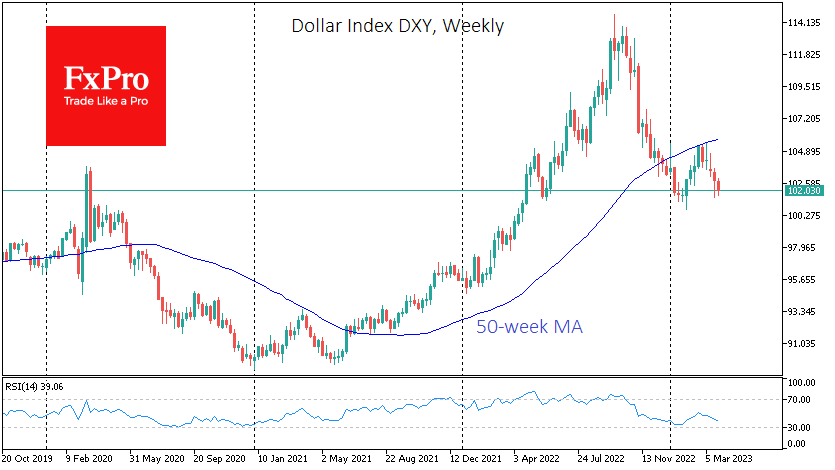
We also see the beauty of the technical picture in the Dollar. Thanks to the rise in February, the oversold nature of the Dollar has been removed. That said, on the weekly timeframes, the DXY rebound in March lost strength on the approach to the 50-week average, leaving it within a long-term bearish trend.
If we are right, the immediate downside target looks to be the area of the year’s low at 100.7 on the DXY against the current 102. A consolidation below that level would cause the Dollar to stare into the abyss, where there is only minor technical support in the area of the 90.00 level.
RBA Will Likely Hold Rates, But a Hawkish Pause Might Still Save the Aussie
The Reserve Bank of Australia meets on Tuesday to set interest rates and is expected to announce its decision at 4:30 GMT. Investors are anticipating that the central bank will bring to a halt its run of 10 straight meetings of rate increases as inflation finally appears to have peaked and economic growth has lost some momentum lately. A pause would be negative for the Australian dollar, but much will depend on whether the RBA maintains a tightening bias.
No spillover from banking crisis
There’s been little if any direct impact from the banking crisis on Australia’s financial system, and the fallout is not anticipated to be a major headwind for the economy either. Yet, the aussie has suffered some collateral damage as it’s failed to capitalize much on the US dollar’s weakness. The ensuing risk-off sentiment has been one factor that’s been a major drag on the risk-sensitive aussie, but a more significant change since the crisis is that rate hike expectations for central banks globally, not just the Fed, have been sharply scaled back.
For the Australian currency, this is likely having an outsized effect in spite of the economy not being very vulnerable to the turmoil, primarily because the RBA was already on the verge of pausing its tightening cycle. After quite a bit of flip-flopping in recent months, the RBA put a pause back on the table at the March meeting, even before the banking panic began.
Inflation has probably peaked
Hot inflation data scuppered the RBA’s plans to press the pause button earlier this year. The consumer price index surged by 8.4% year-on-year in December, but price pressures appear to be easing now. The annual CPI rate moderated for the second straight month in February to 6.8%, giving the green light to policymakers to call time on rate hikes.
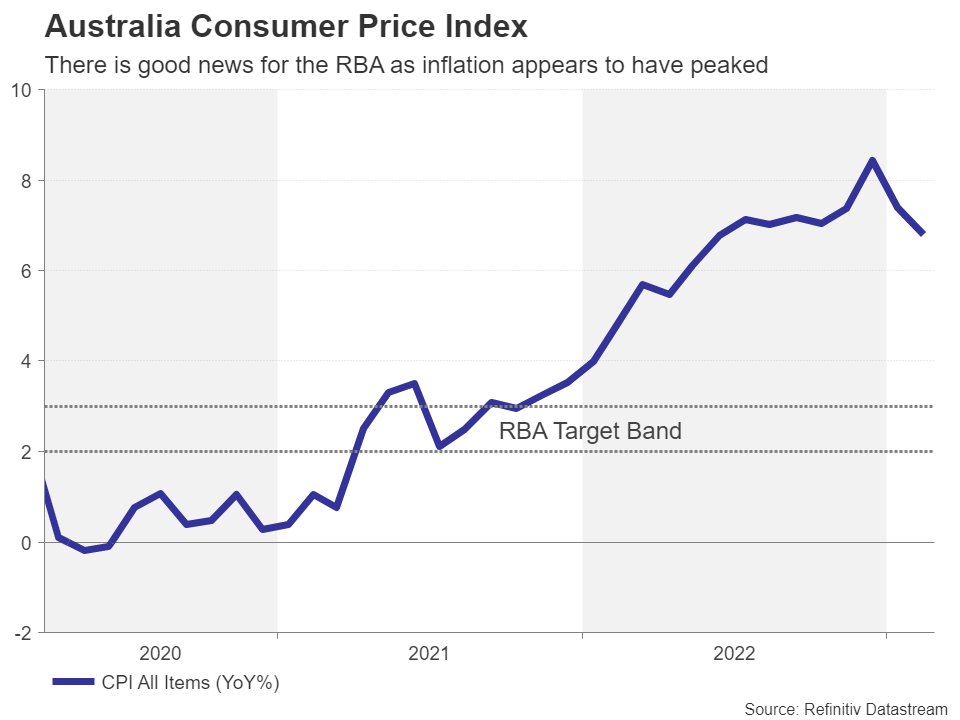
When adding the uncertainty sparked by the banking crisis into the mix, as well as the RBA being mindful about increasing the burden on households any more than it already has amid cracks in the housing sector, a pause seems almost like a done deal on Tuesday. Moreover, both the manufacturing and services PMIs fell back into contractionary territory in March, raising doubts about the rebound seen at the beginning of the year.
There’s still some juice in the economy
However, the economic picture isn’t quite so simple. The labour market bounced back strongly in February, with the jobless rate edging back down to 3.5%. The outlook for the country’s exports has also brightened following China’s reopening. Most surprisingly of all, some housing indicators point to a modest recovery in house prices being underway.
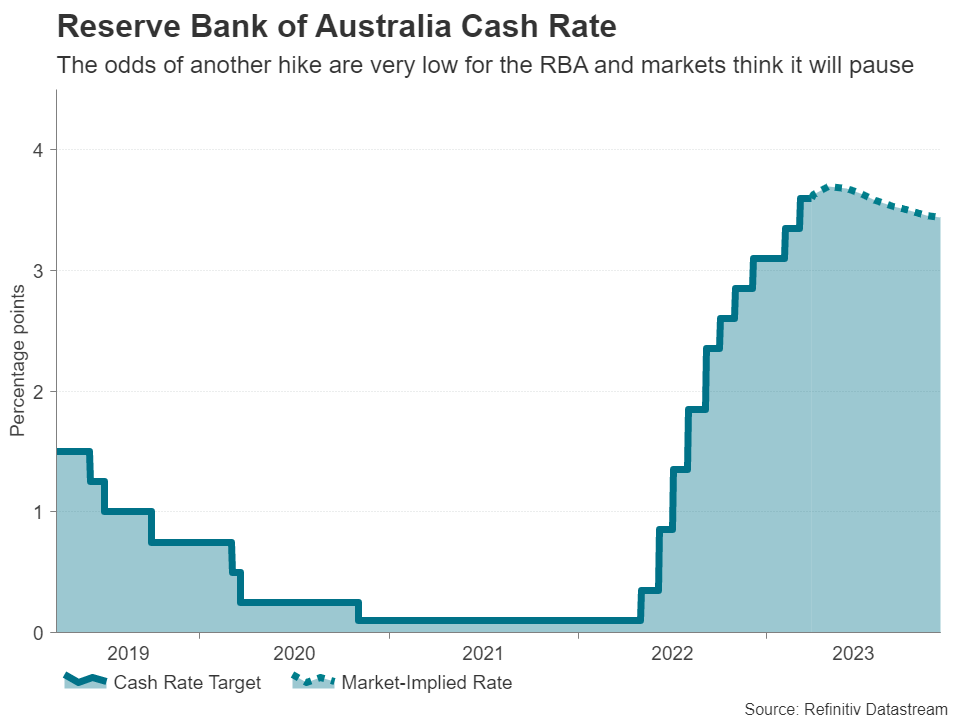
This then raises the question of what kind of forward guidance will the RBA provide to accompany a potential pause. At the last meeting, the Bank kept its language that “further tightening of monetary policy will be needed” and only hinted that the next hike might not necessarily come in April. However, there was a more explicit signal of a pause a day later in a speech by Governor Philip Lowe.
Will the RBA keep rate hike door open?
It’s very unlikely that the RBA will completely rule out further rate increases in April given that the Australian economy is not quite flirting with recession and the jobs market remains tight. However, how policymakers phrase the language around the likelihood for future tightening is what will matter most for shaping rate hike expectations post the meeting.
Should the Bank keep its guidance about the need for further rate increases over the coming months even if it decides to hold policy unchanged in April, this would be the most hawkish outcome for the aussie. A somewhat less hawkish scenario is if the statement says that some modest tightening “may” be required. However, if the RBA makes a complete dovish pivot and flags that it is likely done raising rates, this could deal a major blow to the aussie.
Aussie bulls face a tough battle
The local dollar has already retraced half its gains since February from the October 2022 low versus its US counterpart and faces several major hurdles on the upside. The 200-day moving average, the 38.2% Fibonacci, the $0.68 handle and the 50-day moving average all lie between $0.6750 and $0.6823.
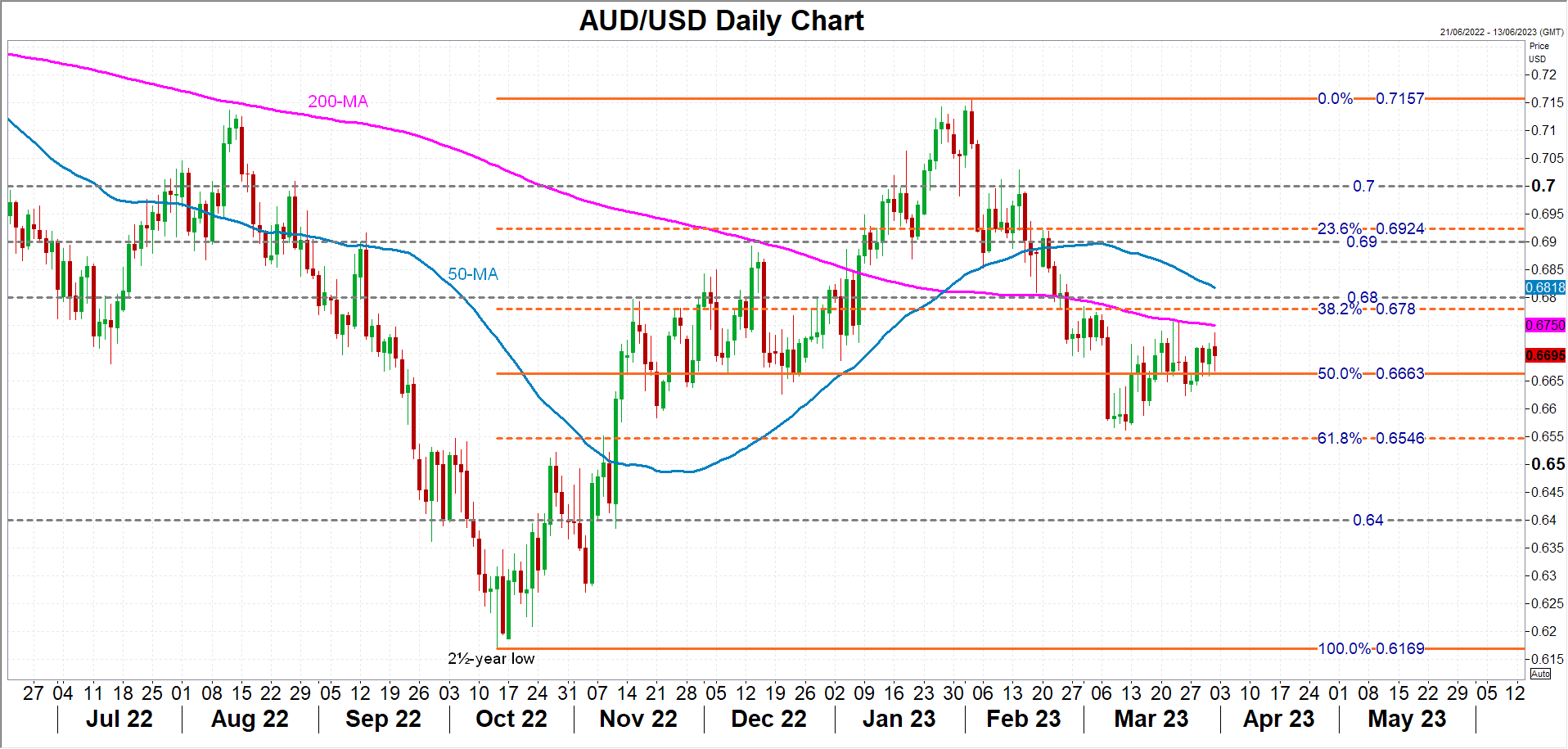
Without a strong enough tightening bias from the RBA, it will be difficult for the aussie to climb back above its moving averages and the February peak of $0.7157 seems increasingly out of reach.
To the downside, a test of the 61.8% Fibonacci of $0.6546 would become almost certain in the event of a clear pause and aussie/dollar could soon be headed for the $0.64 level.
It’s worth bearing in mind, however, that any weakness in the pair could be short-lived if the Fed also decides to go on pause when it meets in May.
Week Ahead – Nonfarm Payrolls to Set the Tone for US Dollar
With the banking turmoil receding, market participants will turn their attention back to economic releases. The spotlight will fall on the US employment report, where another strong reading could temper speculation that the Fed will start cutting rates soon, helping the wounded dollar to recover. Meanwhile in Australia and New Zealand, central banks are expected to take different paths.
Fed on collision course
It’s been a wild month for global markets, marked by bank failures and financial instability. The main casualty of all this turbulence has been the US dollar, as investors ramped up bets that the Fed will be forced to slash interest rates by the fall to prevent any damage to the real economy.
And yet, the economic data pulse tells a different story. Economic growth in the first quarter is estimated to exceed 3% according to the Fed’s GDPNow model, the labor market is exceptionally strong, and the ‘super core’ inflation measure the Fed focuses on is running at 6.9%.
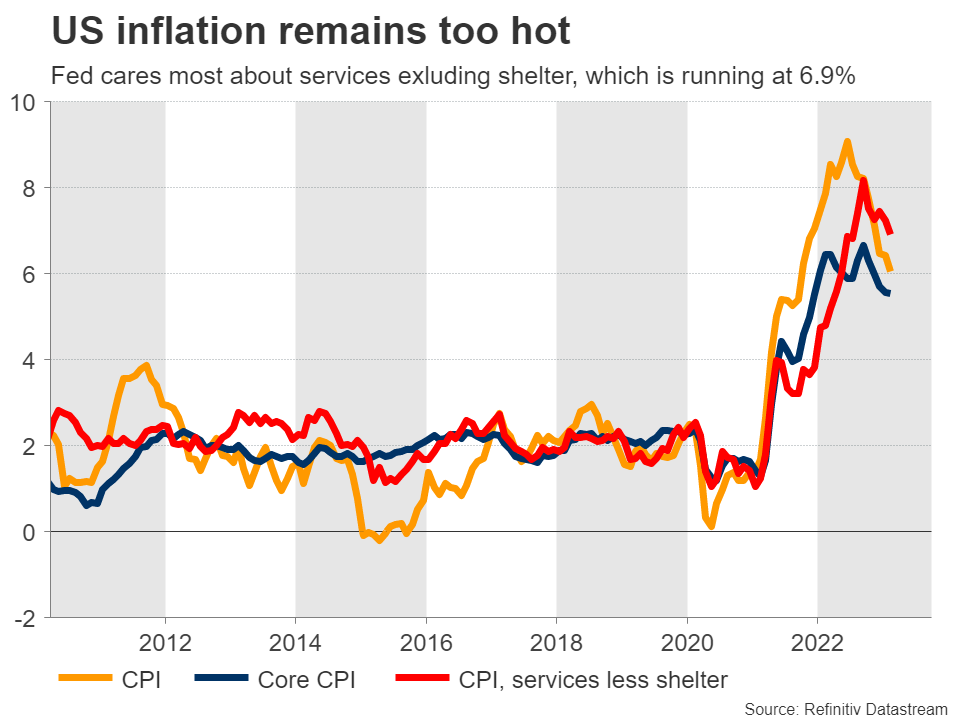
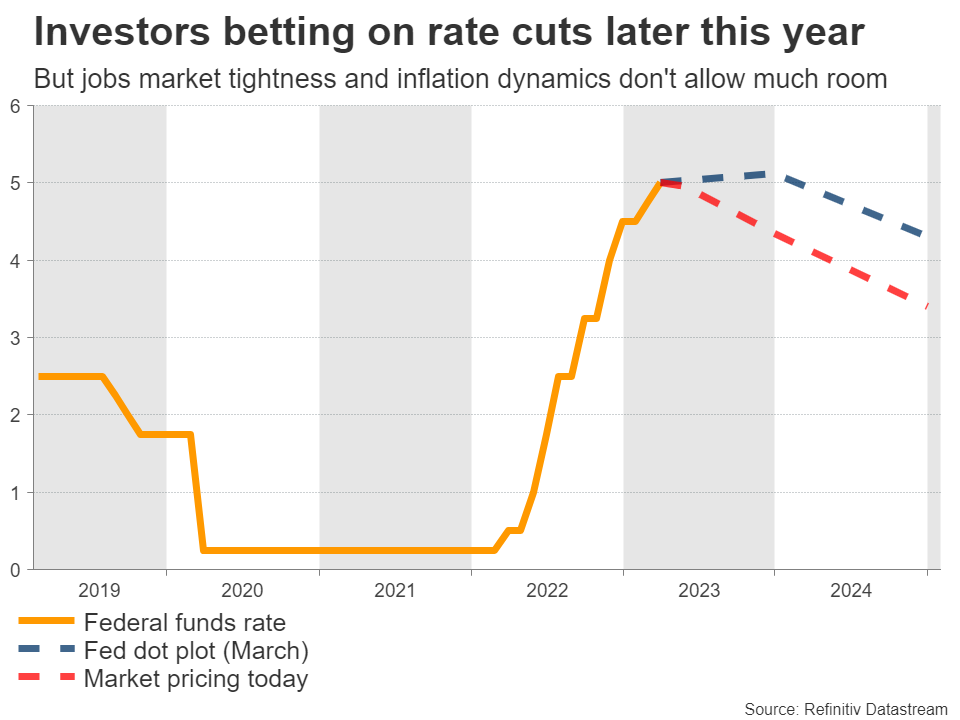
In fact, the latest business surveys point to a resurgence in US economic momentum, with demand recovering and inflationary forces regaining power. None of this is consistent with an economy that requires rate cuts soon, yet traders expect rates to close the year at 4.3%, well below the Fed’s projections for rates at 5% by year-end.
One of those bets will be wrong, which puts investors on a collision course with the Fed. The final say will inevitably come down to incoming data, starting with next week’s employment report on Friday.
Nonfarm payrolls are seen at 240k in March, while the unemployment rate is expected unchanged near 3.6%, remaining near multi-decade lows. These rosy forecasts are supported by early indicators such as the S&P Global business surveys, which signaled the fastest pace of job growth in six months. Similarly, applications for unemployment benefits remained historically low.
Wage growth might be an element that surprises investors. Forecasts point to slower earnings growth in yearly terms, but business surveys highlighted upward pressure on wages. A surprisingly strong print could resurrect inflation concerns, and push back against rate-cut speculation, helping the bruised dollar to recover.
Note that US markets will be closed for the Good Friday holiday, but the employment report will be released normally. This means that liquidity will be thin and the FX market will be the only game in town, which can amplify the reaction in the dollar.
Other releases during the week include the ISM surveys, with the manufacturing print out on Monday ahead of the non-manufacturing index on Wednesday. Both are considered leading economic indicators, so they will be closely watched.
RBA and RBNZ meetings
Over in Australia, the Reserve Bank is expected to hit the ‘stop’ button in its tightening cycle when it meets on Tuesday. Traders are assigning only a 15% probability for a rate increase, with the other 85% pointing to no action.
This follows a streak of disappointing data, from softer retail sales to cooling inflation, which have convinced investors the RBA will take the sidelines. There’s also concern about the housing market, as Australia has a high portion of adjustable rate mortgages that will reset at higher interest rates, directly impacting homeowners.
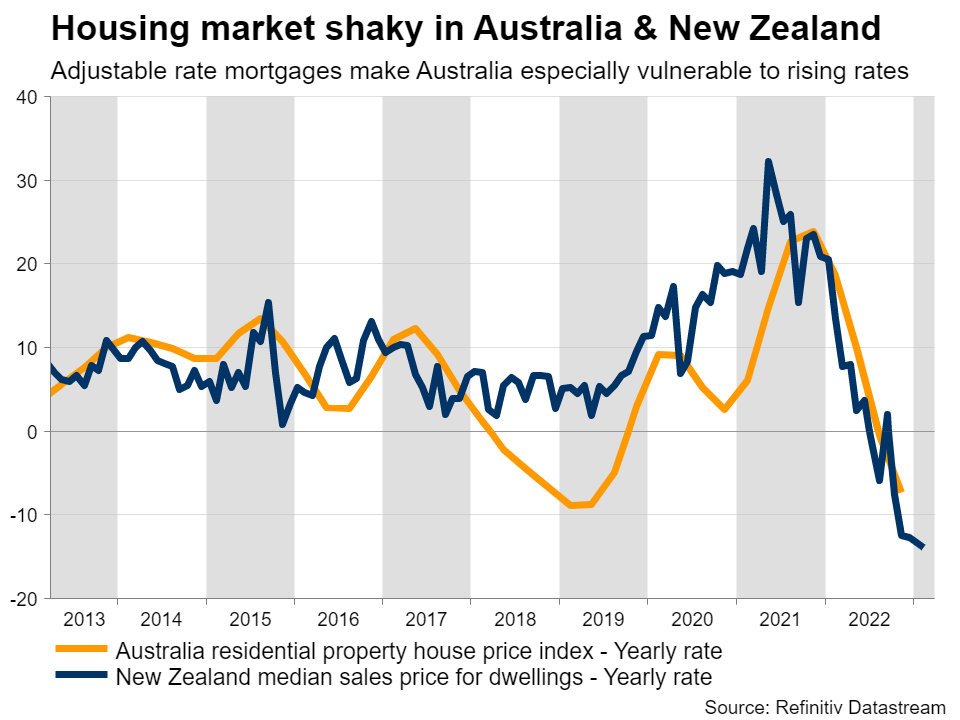
Hence, the focus of this meeting will be on whether policymakers keep the door open for any further action in the future. Of course, the bigger variable for the Australian dollar will be the fate of the global economy, and whether recession concerns come to fruition.
Crossing into New Zealand, a rate increase of 25 bps has been fully priced in when the central bank meets on Wednesday. In fact, traders are betting that if this doesn’t happen, the alternative will be a 50bps move, rather than a pause.
It’s difficult to draw any real conclusions from the economic data. Arguing for a cautious approach is the unexpected contraction in GDP last quarter, the steep decline in house prices, and the turmoil in global banking. However, the jobs market is on fire and ‘soft’ indicators are improving, with business surveys and electronic card spending firing up.
Hence, it’s a mixed picture, which supports a 25bps rate increase as a ‘middle of the road’ solution. The real question is whether the RBNZ will signal this might be the end of the tightening cycle, which seems unlikely judging from the strength of domestic data.
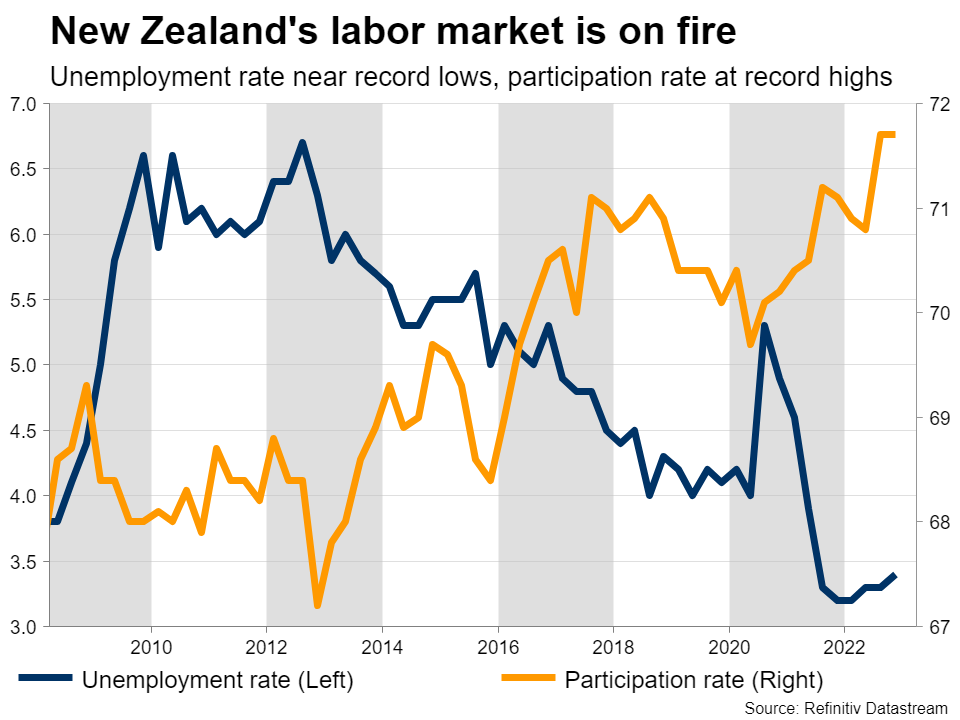
A generally hawkish message could help the kiwi dollar regain some poise, although it’s difficult to be optimistic in the bigger picture. The New Zealand and Australian dollars ultimately trade like proxies for global growth risks, leaving them vulnerable to sudden turns in the market mood as investors grapple with an unstable macro environment.
Staying in the commodity-currency complex, Canadian employment data will be released on Thursday, one day ahead of the US jobs numbers.
Finally, the Bank of Japan’s Tankan survey for Q1 will hit the markets early on Monday, providing clues about the economic outlook and helping investors decide whether the central bank will tighten policy in April when the new governor takes over.
Research US – Upbeat Macro Data Keeps the Fed on a Tightening Bias
- Macro and banks' balance sheet data covering the period after SVB's collapse shows that immediate negative consequences to real economy have been modest.
- The March Jobs Report and CPI will be the final key releases before Fed's May meeting. We see Core CPI at +0.4% m/m, and look for 250k NFP growth.
The series of stronger-than-expected macro data releases seen in February appears to have continued into March. This is consistent with the most acute banking sector risks now seemingly easing, as Fed's emergency lending facilities have improved even the smaller US banks' liquidity buffers above pre-pandemic levels. The combined use of the facilities edged lower this week and interbank lending markets remain calm for now.
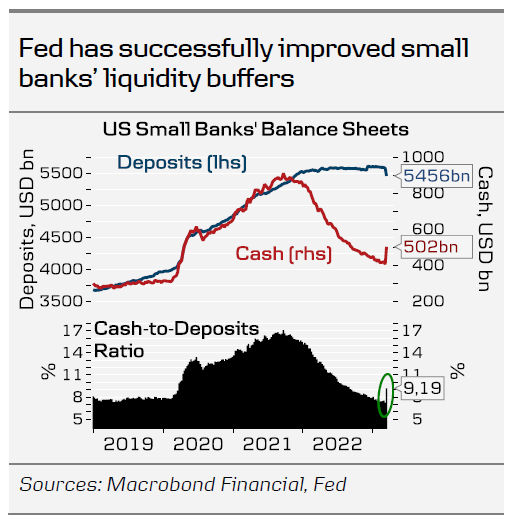
Bank deposits as a whole are declining due to Fed's QT reducing the supply of money in the system, and not due to money being pulled out of the banks. Money can only exit the banking system via cash withdrawals (which remain stable) or reverse repos to the Fed. Money market funds have seen sizable inflows over the recent weeks, likely reflecting some deposit outflows from smaller banks, risk aversion from equities and relatively high short-term interest rates, but as the use of Fed's reverse repo facility has been little affected, the amount of total bank deposits has not been affected.
The risk of a 'credit crunch' weighing on regional bank lending has drastically weighed on markets' expectations of future growth, inflation and consequently also the level of nominal yields. The focus has been on commercial real estate, a sector hit by both lower demand for office space and rising yields. Small banks account for more than 70% of total bank lending to CRE sector, and practically all of the lending growth seen over the past 5 years.
That said, Fed's Senior Loan Officer Survey suggests that small banks' credit standards for non-residential CRE lending have tightened already since Q3 2022, largely in line with developments seen in broader financial conditions. Around USD50bn of regional banks' CRE loans will mature in 2023, which is only 4% of the total CRE loans issued by small US banks. While the rapid monetary policy tightening combined with regional banks' past years' looser regulation could pose longer-term challenges, we think markets might overestimate the near-term negative growth impact from the banks' lower lending appetite. Furthermore, market-based financial conditions indices, such as our in-house 'growth tax' measure or the GS index, have actually eased, as the decline in yields, mortgage rates and oil prices has more than compensated for the wider credit spreads.
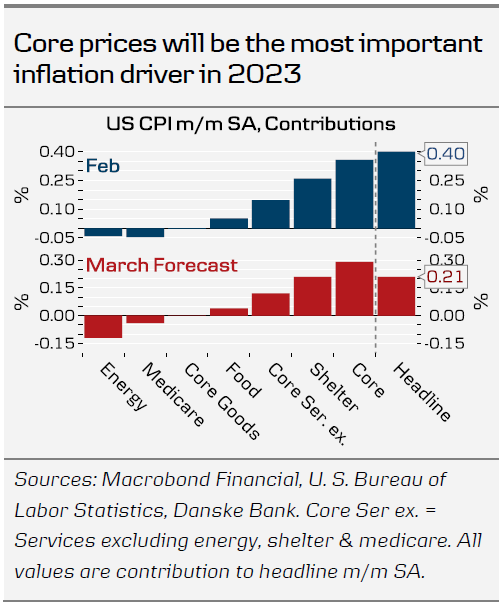
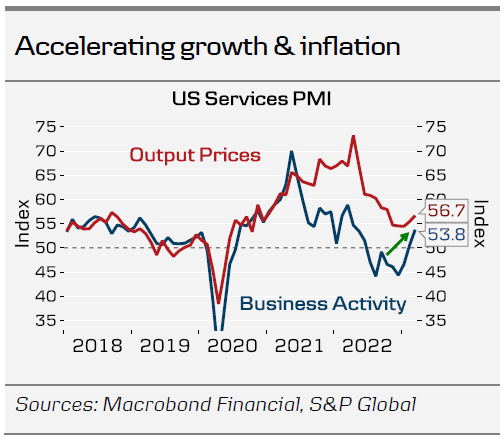
The March Flash PMI data, largely collected after SVB's collapse, pointed towards a clear pick-up in economic growth. Furthermore, inflation pressures in the services sector, closely followed by the Fed, appeared to accelerate. While lower energy prices will ease March headline inflation to around +0.2% m/m, we expect core inflation to remain elevated at +0.4%. We also think employment growth remained upbeat in March, and look for +250k NFP gain in the next week's Jobs report. Altogether, we see central banks sticking to the tightening bias for now. As focus turns back towards macro data, we think markets are likely to reverse some of the Fed's rate cut pricing for 2023.
Weekly Focus – Inflation Worries Moving Up the Agenda Again
We continue to see large volatility in money and bond markets, as market participants struggle to assess the future path of interest rates with banking uncertainty on the one hand and data mostly pointing to continued high core inflation on the other. Fed data showed the second weekly decline in a row in US banks' use of liquidity measures, but worries persist over especially regional banks, as well as over what effect the rise in interest rates may have on commercial real estate, which again could affect the wider financial system. Our expectation is that these concerns will gradually fade and that central banks will hike interest rates further, but we also recognise that visibility is low.
Euro area inflation declined significantly to 6.9% y/y in March, from 8.5% y/y in February. However, that decline was driven by energy prices, aided by the German "price brake" that came into effect in March. Core inflation stands at 5.7% y/y and (by our calculation) a seasonally adjusted 0.4% m/m, which is clearly too high and likely to be the focus of the ECB, rather than the declining headline. PMI and IFO data showed decent improvements in businesses' assessment of both the current situation and the near future in March, across industries but especially in services. Across the euro area, pricing expectations are declining in manufacturing and to some extend retail, but not really in services. This supports the view that the pass-through of energy and other costs while decline as a driver of core inflation, but that wages to some extend will take over.
US PMIs and consumer confidence from Conference Board surprised on the upside, supporting the view that troubles in the banking industry have not at this point caused a large increase in concerns more broadly. Consumer inflation expectations remain high at 6.3%, and their assessment of the labour market, although slightly downgraded, is still very positive.
China's official PMI declined for manufacturing in March to a still decent level of 51.9, whereas the index for services rose even further, to 58.2. Taiwan's President Tsai Ing-wen is on a 10 day visit to Central America and the US, and it is likely that she will meet with the new speaker of the US House of Representatives Kevin McCarthy. His predecessor triggered a strong response from China by visiting Taiwan last year, but the question is how strong a response a meeting on US soil will get.
With next week being Easter week, it is likely to be fairly quiet in Nordic and other European markets. However, the US labour market report on Friday (Good Friday) is a key data release. Most indicators continue to point to a strong US labour market, and job growth was likely high again in March, which could support the case for a further US rate hike. During the following week, we get hard data for Euro Area industrial production and retail sales in February, which will likely show that both of these sectors continue to struggle, as services are currently the stronger part of the economy. US CPI for February is of course also key to watch.
On Tuesday April 4, we will publish our Nordic Outlook with our views and fresh forecasts for the global and Nordic economies. Weekly Focus will be back on April 14. We wish all readers a happy Easter.