

Sample Category Title
Sunset Market Commentary
Markets
European interest rate markets took somewhat of a hesitant/cautious start after yesterday’s sharp intraday swings. With financial stability issues moving to the background, inflation took center stage today. French inflation enjoyed the positive impact from a big March 2022 base effect, easing from 7.3% to 6.6% Y/Y (HCPI). However, the monthly rise stayed elevated (0.9% M/M), putting a floor for any correction on recent yield-rebound. German retail sales and labour market data were softer than expected but were ignored. EMU inflation followed the expected script. Headline Y/Y inflation for similar technical reasons dropped from 8.5% to 7.1% Y/Y, but European consumers also still saw prices of their basket of goods and services rising by a bumpy 0.9% M/M. Core inflation even set a new record of 5.7% Y/Y. Markets again hesitated. The inflationary narrative remained straight forward, but data didn’t bring the big surprise needed to force a swift break beyond important technical barriers as German yields were fighting obvious resistance levels (2-y 2.77% area, 10-y 2.4% area). US and German yields traded little changed to marginally higher going in to the release of the US PCE deflators. Both the headline and the core measure eased marginally more than expected at 0.3% M/M and 5% Y/Y and 0.3% M/M and 4.6% Y/Y respectively. Spending slowed to 0.2% M/M but coming on the back of an exceptionally strong January growth (2%) The report doesn’t change the inflation picture in a profound way, especially as it is a bit outdated. Even so, for yields it was enough to call off any further attempts to extend this week’s rebound. US yields are declining 1.5 bps for the 2-y to 3/3.5 bps for longer maturities. German yields decline 3 bps (2-y) to 4.5 bps (10-y). Even so, in a weekly perspective German yields still keep a weekly gain of 35 bps (2-y) to about 20 bps for the 10-y yield. Money markets now again fully discount the ECB depo rate be raised to at least to 3.5%. The US 2-y yield this week gains 33 bps. The 10-y adds 15 bps. US money markets still only see about 50% chance for an additional Fed rate hike in May or June. However, money markets scaled back about 50 bps rate cuts for the end of this year. The ebbing of financial uncertainty, even as it leads to higher yields, continues to support equity gains. The EuroStoxx 50 (+ 0.55%) is only a whisker away from the March top. US indices open about 0.5% higher. Brent oil rises near the $80/b level amongst other on better Chinese growthand supply disruptions in Iraq/Kurdish territory.
On FX markets, the euro after a nice rebound, was captured by some end-of-week (quarter?) fatigue. Yesterday and this morning, the EUR/USD 1.0930 correction top was within reach, but the resistance did its job, sending the pair back below the 1.09 big figure (currently 1.0885). To be continued next week. DXY trades marginally stronger at 102.32, but the technical picture remains fragile, with 101.91 support still nearby. The yen further reverses gains from mid this month (USD/JPY 133.15). Sterling gains a few ticks against the euro but EUR/GBP trading still holds and extremely tight range near 0.88.
News Headlines
The Bank of Japan expanded the range of its planned bond purchases for the next quarter. It will buy bonds in a range between JPY 100bn and 500bn compared to 200-400bn previously. As such it allows itself to scoop up less govies, which has become less (and even un)necessary since the recent financial market turbulence kicked bond yields, including Japan’s, lower. Its 10y yield hit a seven month low of 0.177% mid-March. Recovering since then to 0.35% today, it is still well below the 0.50% upper bound. Before the turmoil the BoJ was buying record amounts to prevent the yield from pushing higher.
Polish inflation eased from 18.4% to 16.2% in March on a 1.1% monthly increase. Fuel, gas and electricity prices all fell m/m with fuel even flat in yearly terms. Food prices on the other hand still rose a significant 2.3% m/m. The decline was slightly less than hoped-for (16%) but it is most likely the start of an ongoing deceleration in the months ahead. KBC Economics estimates that core inflation, officially released on April 17, ticked higher to around 12.2%, suggesting the inflation battle by the National Bank of Poland is far from over. It is no secret that governor Glapinski and a dovish MPC majority is increasingly leaning towards rate cuts. But given high (and rising core) inflation, that is premature. Polish swap yields raced higher in the wake of the release, adding 3.2 to 8 bps, deepening the curve inversion. The Polish zloty appreciated marginally to EUR/PLN 4.67.
ECB’s Villeroy: Battle Against Inflation Not Over
ECB Governing Council member Francois Villeroy de Galhau stated that ECB's mission to bring inflation back towards 2% by between end-2024 and end-2025 would only be considered successful when underlying inflation, excluding energy and food prices, is under control.
Villeroy emphasized that the ECB would not give up prematurely, saying, "Although we have completed most of our rate-hiking journey, we may possibly still have a little way to go."
He added that since it takes an estimated one to two years for rate hikes to impact inflation, the 3.5 percentage points in increases implemented by ECB since July would have a "fairly powerful impact" in the future.
EUR/USD Edges Lower as Eurozone Inflation Slides
EUR/USD is slightly lower on Friday. In the European session, EUR/USD is trading at 1.0883, down 0.21%. The euro continues to look sharp and is poised to record its fifth winning week in a row. Eurozone headline inflation fell sharply, but the core rate ticked higher. In the US, the Core PCE Price Index was within expectations.
Eurozone CPI falls to 6.9%
ECB policy makers must be pinching themselves today, after eurozone headline inflation tumbled to 6.9% in March, down from 8.5% in February and below the 7.1% estimate. The massive drop was driven by the sharp decline in energy prices. Inflation hasn’t been below 7% since February 2022, but the news was not all good, as March core inflation accelerated to a record 7.5%, up from 7.4% in February. Core inflation is seen as a more accurate gauge of inflation trends, which could spell trouble for the ECB in its battle to contain inflation.
The ECB didn’t flinch from hiking rates by 50 basis points earlier in the month, even though it was in the midst of the banking crisis. With core inflation remaining stubbornly high, the central bank will have to remain aggressive with its rate path. ECB President Lagarde has suggested that the banking crisis, which shook the financial markets, could dampen demand and lower inflation, but so far, that hasn’t been the case with core inflation.
Core Price PCE softens to 0.3%
What can we expect from the Federal Reserve? Market pricing has been on a roller-coaster. It was only a few weeks ago that Jerome Powell’s hawkish testimony on the Hill had the markets expecting a 50-basis point hike, but the banking crisis squelched any thoughts of an oversize hike. The likelihood of a 25-bp hike is currently at 57% and a pause at 43%, according to the CME Group. The core PCE price index dropped to 0.3% m/m in February, vs. 0.5% in January and the estimate of 0.4%. On an annualized basis, the index ticked lower to 4.6%, in February, vs. 4.7% in January, which was also the estimate. This is within expectations and thus unlikely to have any impact on the Fed rate decision. EUR/USD showed little reaction to the release.
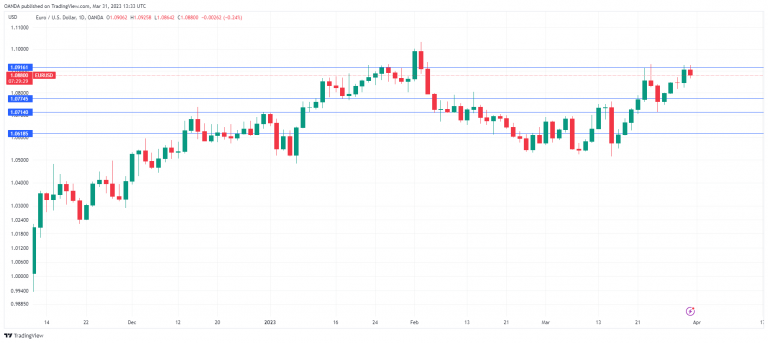
EUR/USD Technical
- EUR/USD faces resistance at 1.0916, followed by 1.1072
- There is support at 1.0774 and 1.0618
US: Spending Slows, PCE Deflator Rises Less Than Expected
Personal income growth accelerated to 0.3% month-on-month (m/m) in February, from 0.6% m/m in January, but above market expectations for a more modest gain of 0.2% m/m. Compensation of employees (+0.3% m/m) accounted for most of the growth.
Subtracting inflation and taxes, real personal disposable income rose 0.2% m/m in February, slowing from an upwardly revised reading of 1.5% in January. January's outsized gain was largely driven by an assumption of lower expected capital gains taxes.
Personal consumption gained 0.2% on the month, from an upwardly revised reading of 2.0% m/m in January. This was lower than 0.3% increase expected by the consensus. Services spending rose by 0.2% m/m while goods were flat.
- Within services, increases in housing and health care were partly offset by a decrease in food services and accommodation.
- Within goods, increases in gasoline and other energy goods, “other” nondurables (led by pharmaceuticals), and food & beverage were offset by a decrease in motor vehicles and parts (mainly new and used light trucks).
Adjusting for inflation, real spending fell 0.1% m/m, on par with the consensus estimate. Both goods and services declined by 0.1% in real terms in February. Perhaps speak to the revisions though as they appear meaningful.
The personal consumption price deflator rose 0.3% m/m, and 5.0% on a year-on-year (y/y) basis – slightly lower than the expected 5.1% y/y reading and slower than 5.4% y/y reading in January.
The Fed's preferred measure of inflation – core PCE – rose 0.3% m/m (vs. 0.4% consensus forecast) from a downwardly revised 0.5% m/m in January, decelerating to 4.6% year-on-year (from 4.7% in January). This was on par with market expectations.
The personal saving rate was 4.6% in February, just a notch below the 4.7% reading in January.
Key Implications
The first quarter's spending is still tracking strong, at roughly a 4% (annualized) pace, but this impressive pace is mostly driven by revisions. It appears that January's weather-induced spending impulse has faded. Today's tepid growth is borderline flat and could be erased with revisions and a negative print in March. In any case, we expect consumer spending to slow in the second quarter. It's too early to tell whether the bank turmoil will result in a further tightening of consumer credit, but judging by metrics as recent as February, consumers will face some headwinds as lenders have already reduced credit availability.
Inflation is still running hot, and the Fed will only see one more reading before they next meet in May. Provided there's no further contagion across the banking sector, and market sentiment remains more even keel, we suspect the Fed will push ahead with one more 25 basis-point rate hike in May before pausing to better gauge the cumulative impact of its tightening.
Canada’s Economy Bounces Back in January, Points to a Strong February
The Canadian economy expanded by 0.5% month/month (m/m) in January, above Statistics Canada's flash estimate of 0.3% m/m. The flash estimate showed a +0.3% m/m change for February.
January's increase in activity was broad based, with output expanding in 17 of the 20 industries. The service-producing sector rose by 0.6% m/m, while the goods-producing sector rose by 0.4% m/m.
The gain was led by the wholesale trade sector (+1.8% m/m), with StatCan noting strength in "construction and industrial equipment". Mining, quarrying and oil and gas extraction returned to growth (1.1% m/m) following the Kansas oil spill which negatively impacted the Canadian supply chain for crude.
The service sector's expansion was led by accommodation and food services, up 4.0% m/m, while arts, entertainment and recreation increased 2.1% m/m. StatCan noted the help from the World Junior hockey tournament and a slew of NHL home games in January.
Key Implications
Canadian economic data keep trending higher. With today's print and the flash estimate for February, GDP is likely going to clock in above 2% (quarterly annualized). This is a big rebound from the 0% growth recorded over the final quarter of 2022. We have been talking about this rebound narrative for quite some time. With employment growth blowing past expectations, alongside massive government income supports, consumers are back to their high spending ways. This has raised the floor for GDP in Canada.
Canadian government yields are rising this morning, with the Canada 2-year up nearly 5 basis points, narrowing the gap with U.S. Treasuries. This doesn't mean the BoC will raise rates again, but implies that the BoC may delay cutting in the back half of this year. There is no need for the BoC to hike rates again given the lagged effects of past interest rate rises, but the massive cuts previously priced in markets were too pessimistic. We'd argue that financial markets are now coming into balance, recognizing the current upturn in economic momentum.
USD/JPY Mid-Day Outlook
Daily Pivots: (S1) 132.28; (P) 132.62; (R1) 133.04; More...
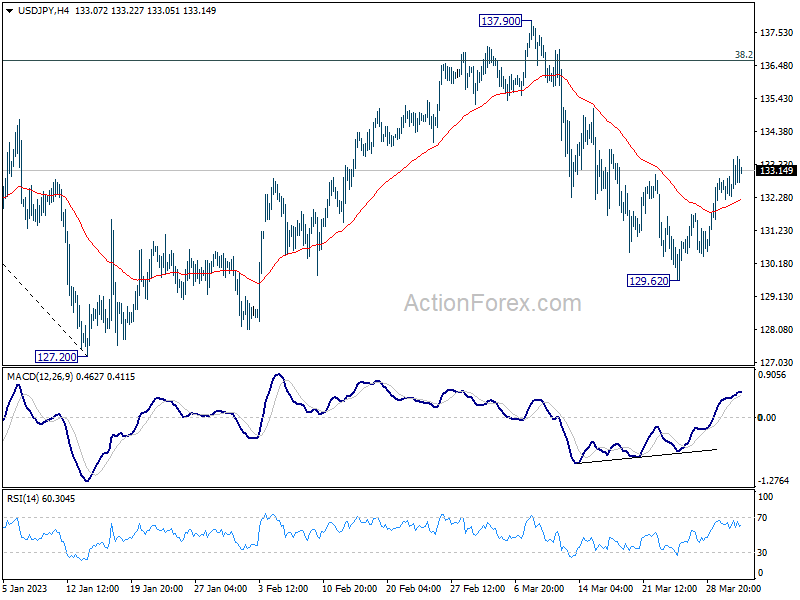
Intraday bias in USD/JPY is mildly on the upside for the moment. Rebound from 129.62 is seen as the third leg of the corrective pattern from1 27.20. Further rally would be seen towards 137.90 resistance. On the downside, though, break of 129.62 will bring retest of 127.20 low.
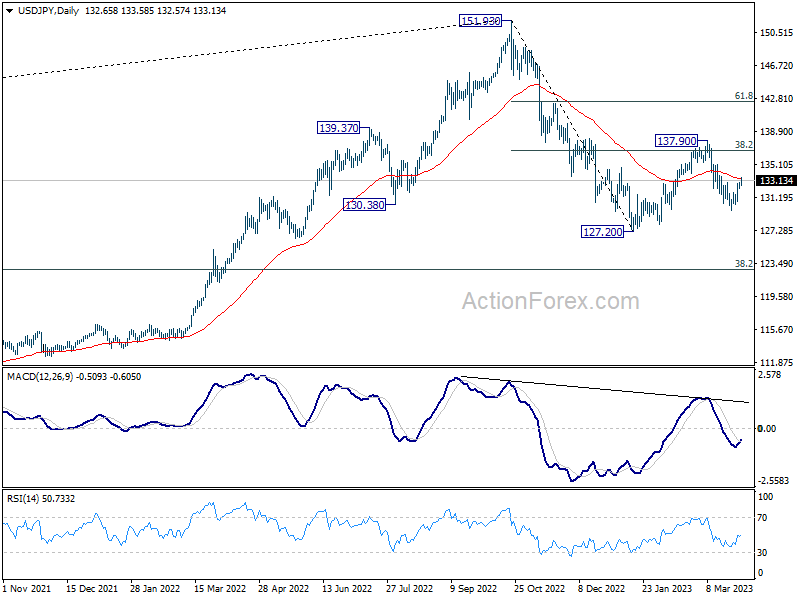
In the bigger picture, corrective pattern from 127.20 might be extending. But after all, down trend from 151.93 is expected to resume at a later stage. Break of 127.20 will resume this down trend and target 61.8% projection of 151.93 to 127.20 from 137.90 at 122.61. This will now be the favored case as long as 137.90 resistance holds.
USD/CHF Mid-Day Outlook
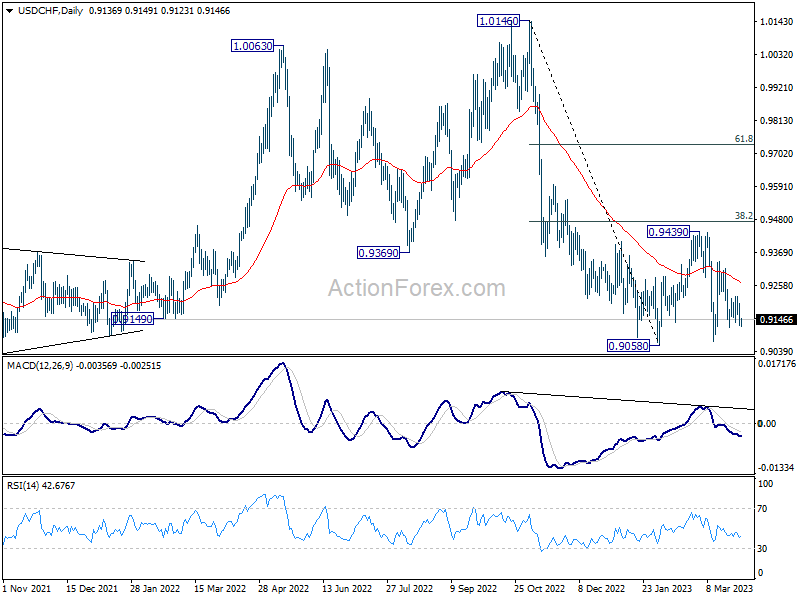
Daily Pivots: (S1) 0.9107; (P) 0.9153; (R1) 0.9181; More...
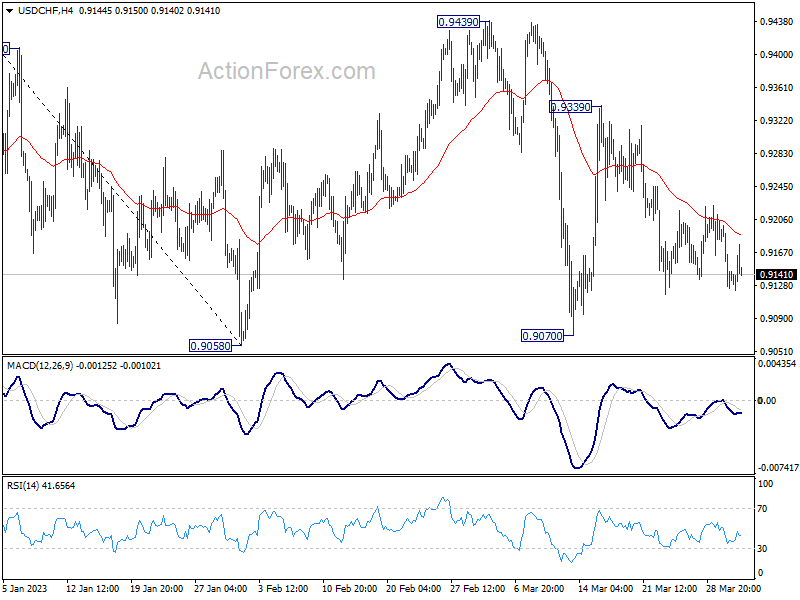
No change in USD/CHF's outlook as range trading continues. Intraday bias remains neutral for the moment. Corrective pattern from 0.9058 low is extending. Another rise cannot be ruled out, but upside should be limited by 0.9474 fibonacci level. On the downside, firm break of 0.9058 will resume larger down trend from 1.1046.
In the bigger picture, fall from 1.1046 (2022 high) should still be in progress with 38.2% retracement of 1.0146 to 0.9058 at 0.9474 intact. Prior rejection by 55 week EMA was a medium term bearish sign. Break of 0.9058 will resume such decline towards 0.8756 support (2021 low). But overall, this fall is still as a leg in the long term range pattern from 1.0342 (2016 high). So, downside should be contained by 0.8756 to bring reversal.
GBP/USD Mid-Day Outlook
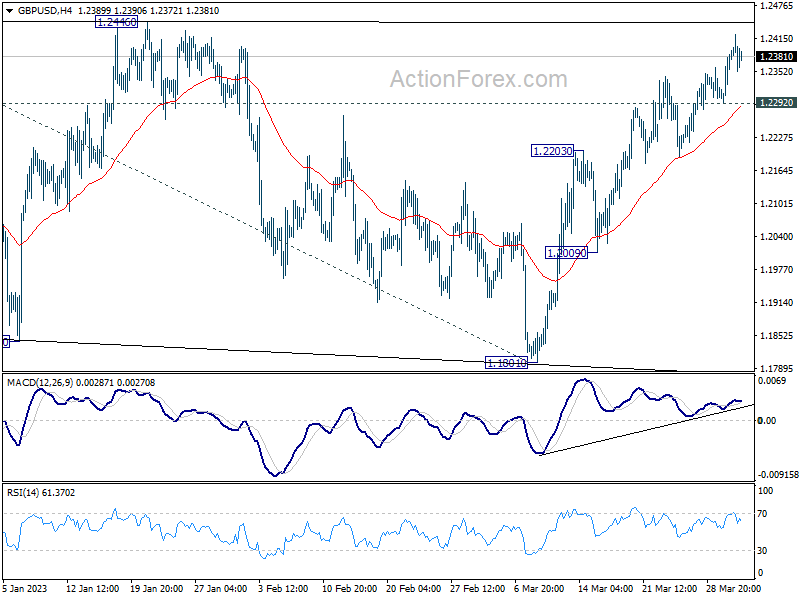
Daily Pivots: (S1) 1.2324; (P) 1.2359; (R1) 1.2423; More...
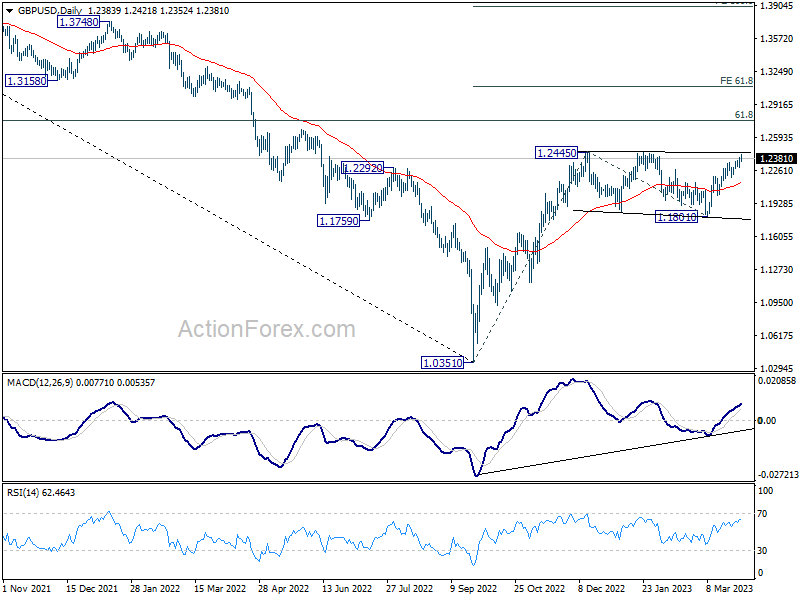
Intraday bias in GBP/USD stays on the upside at this point. Decisive break of 1.2445/6 resistance zone will resume larger rally from 1.0351, and target 1.2759 fibonacci level. On the upside, below 1.2292 minor support will turn intraday bias neutral first. But further rally will remain in favor as long as 1.2203 resistance turned support holds.
In the bigger picture, the rise from 1.0351 medium term term bottom (2022 low) is in progress for 61.8% retracement of 1.4248 (2021 high) to 1.0351 at 1.2759. Sustained break there will add to the case of long term bullish trend reversal. Further break of 61.8% projection of 1.0351 to 1.2445 from 1.1801 at 1.3095 could prompt upside acceleration to 100% projection at 1.3895. For now, this will remain the favored case as long as 1.1801 support holds, even in case of deep pull back.
EUR/USD Mid-Day Outlook
Daily Pivots: (S1) 1.0818; (P) 1.0845; (R1) 1.0872; More...
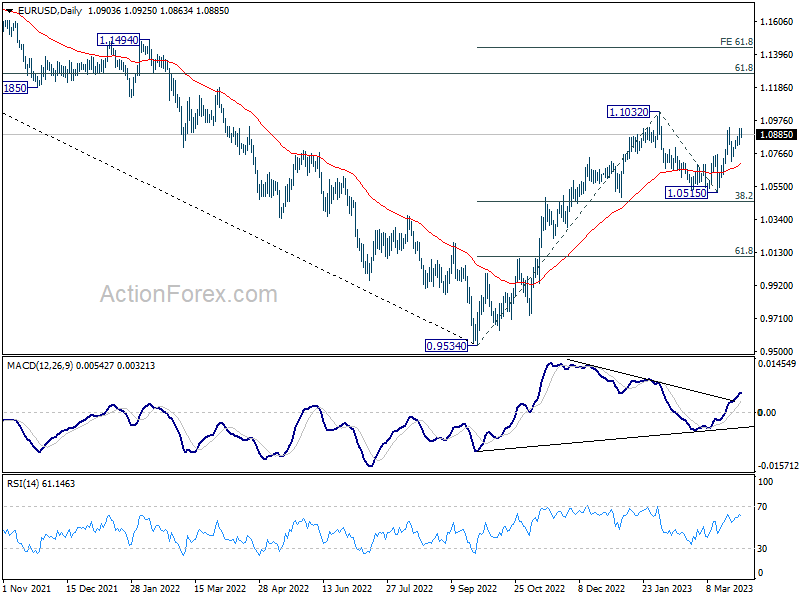
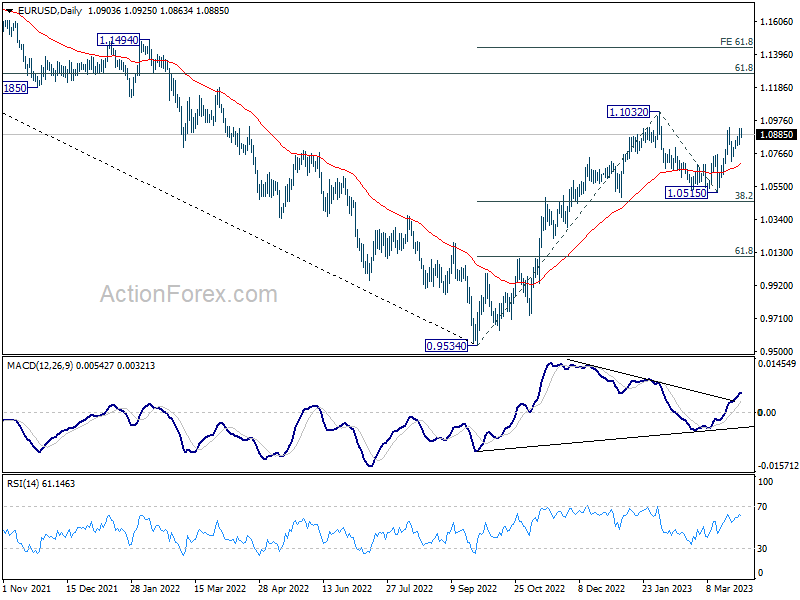
Intraday bias in EUR/USD remains neutral for the moment. On the upside, break of 1.0929 will resume the rally from 1.0515 to retest 1.1032 high. Decisive break there will resume larger up trend from 0.9534 to 1.1273 fibonacci level next. On the downside, though, break of 1.0711 will turn bias to the downside to extend the corrective pattern from 1.1032 with another decline.
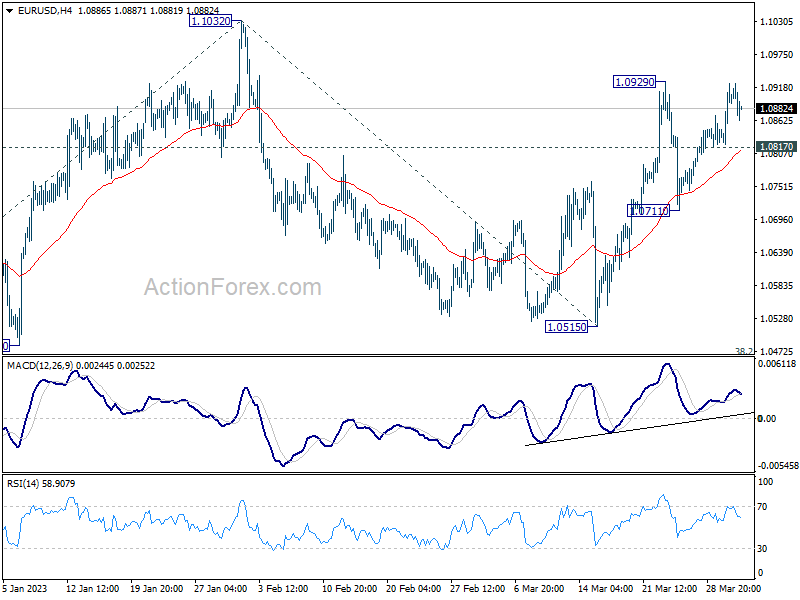
In the bigger picture, rise from 0.9534 (2022 low) is in progress with 38.2% retracement of 0.9534 to 1.1032 at 1.0460 intact. The strong support from 55 week EMA (now at 1.0623) was also a medium term bullish sign. Next target is 61.8% retracement of 1.2348 (2021 high) to 0.9534 at 1.1273. Sustained break there will solidify the case of bullish trend reversal and target 1.2348 resistance next (2021 high).
Inflation Data Fails to Stir Markets; Canadian Dollar Unmoved
The inflation data from Eurozone and the US has left traders somewhat disappointed, as it triggered minimal volatility in the markets. Eurozone headline inflation slowed more than anticipated, while core inflation aligned with consensus. In the US, both headline and core PCE inflation fell short of expectations. Canadian Dollar also remained stagnant despite better-than-expected monthly GDP growth. As the markets take a breather, traders may anticipate a more dynamic comeback in the first week of May.
In Europe, at the time of writing, FTSE is up 0.32%. DAX is up 0.59%. CAC is up 0.65%. Germany 10-year yield is down -0.030 at 2.344. Earlier in Asia, Nikkei rose 0.93%. Hong Kong HSI rose 0.45%. China Shanghai SSE rose 0.36%. Singapore Strait Times rose 0.05%. Japan 10-year JGB yield rose 0.0043 to 0.330.
US PCE price index slowed to 5% yoy, core PCE down to 4.6% yoy
US personal income rose 0.3% mom or USD 72.9B in February, matched expectation. Personal spending rose 0.2% mom or USD 27.9B below expectation of 0.3% mom.
PCE price index rose 0.3% mom, above expectation of 0.2% mom. Core PCE price index, excluding food and energy, rose 0.3% mom, below expectation of 0.4% mom. Prices for goods increased 0.2% mom and prices for services increased 0.3% mom. Food prices increased 0.2% mom and energy prices decreased -0.4 mom.
From the same month one year ago, PCE price index slowed from 5.3% yoy to 5.0% yoy, below expectation of 5.3% yoy. Core PCE price index slowed from 4.7% yoy to 4.6% yoy, below expectation of 4.7% yoy.
Canada GDP grew 0.5% mom in Jan, to grow further 0.3% mom in Feb
Canada GDP grew 0.5% mom in January, above expectation of 0.3% mom. Goods-producing industries grew 0.4% mom while services-producing industries grew 0.6% mom. 17 of 20 industrial sectors posted increases.
Advance information indicates that real GDP increased 0.3% mom in February. Increases in the mining, quarrying, and oil and gas extraction, manufacturing, and finance and insurance sectors were slightly offset by decreases in construction, wholesale trade, and accommodation and food services.
Eurozone CPI slowed to 6.9% yoy in Mar, core CPI ticked up to 5.7% yoy
Eurozone CPI slowed from 8.5% yoy to 6.9% yoy in March, below expectation of 7.2% yoy. CPI core (all item ex energy, food, alcohol & tobacco) roes from 5.6% yoy to 5.7% yoy, matched expectations.
Looking at the main components , food, alcohol & tobacco is expected to have the highest annual rate in March (15.4%, compared with 15.0% in February), followed by non-energy industrial goods (6.6%, compared with 6.8% in February), services (5.0%, compared with 4.8% in February) and energy (-0.9%, compared with 13.7% in February).
Also released, Eurozone unemployment rate was unchanged at 6.6% in February. Germany unemployment rate ticked up from 5.5% to 5.6% in February, retail sales dropped -1.3% mom, import prices dropped -2.4% mom. France consumer spending dropped -0.8% mom in February.
UK GDP was finalized at 0.1% qoq qoq in Q4. Swiss retail sales rose 0.3% yoy in February
Japan reported strong industrial production and retail sales growth
Japan reported strong industrial production growth of 4.5% mom in February, surpassing expectations of 2.8% mom growth. The seasonally adjusted production index for the manufacturing and mining sectors reached 94.8, with the industry ministry predicting a 2.3% mom increase in March and a 4.4% mom advance in April.
Retail sales also exceeded expectations, rising 6.6% yoy compared to the anticipated 5.9% yoy. However, the unemployment rate increased from 2.4% to 2.6%, higher than the expected 2.4%.
Inflation in Tokyo experienced a slight decline, with the March CPI dropping from 3.4% yoy to 3.3% yoy, still above the expected 2.7% yoy. The core CPI (excluding fresh food) eased from 3.3% yoy to 3.2% yoy, meeting expectations. Meanwhile, the core-core CPI (excluding fresh food and energy) rose from 3.2% yoy to 3.4% yoy, surpassing the anticipated 3.3% yoy.
EUR/USD Mid-Day Outlook
Daily Pivots: (S1) 1.0818; (P) 1.0845; (R1) 1.0872; More...
Intraday bias in EUR/USD remains neutral for the moment. On the upside, break of 1.0929 will resume the rally from 1.0515 to retest 1.1032 high. Decisive break there will resume larger up trend from 0.9534 to 1.1273 fibonacci level next. On the downside, though, break of 1.0711 will turn bias to the downside to extend the corrective pattern from 1.1032 with another decline.
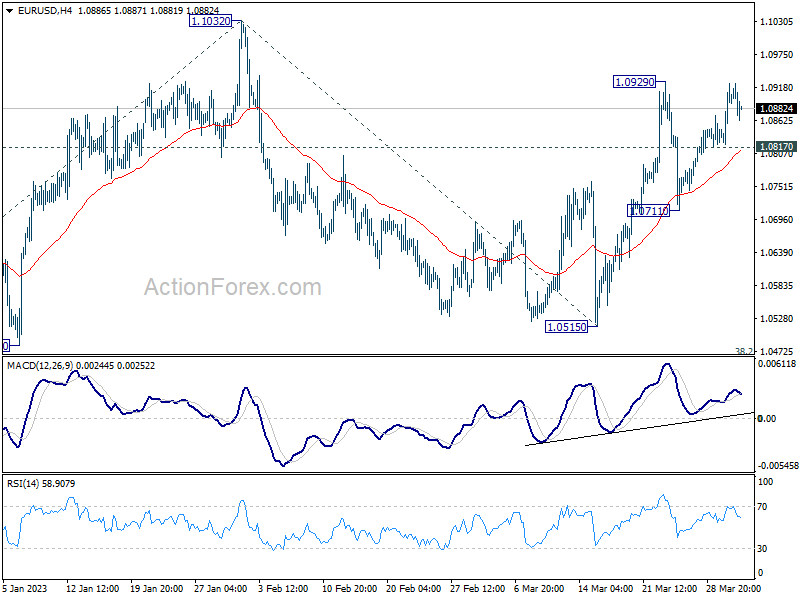
In the bigger picture, rise from 0.9534 (2022 low) is in progress with 38.2% retracement of 0.9534 to 1.1032 at 1.0460 intact. The strong support from 55 week EMA (now at 1.0623) was also a medium term bullish sign. Next target is 61.8% retracement of 1.2348 (2021 high) to 0.9534 at 1.1273. Sustained break there will solidify the case of bullish trend reversal and target 1.2348 resistance next (2021 high).
Economic Indicators Update
| GMT | Ccy | Events | Actual | Forecast | Previous | Revised |
|---|---|---|---|---|---|---|
| 23:30 | JPY | Tokyo CPI Core Y/Y Mar | 3.20% | 3.20% | 3.30% | |
| 23:30 | JPY | Unemployment Rate Feb | 2.60% | 2.40% | 2.40% | |
| 23:50 | JPY | Industrial Production M/M Feb P | 4.50% | 2.80% | -5.30% | |
| 23:50 | JPY | Retail Trade Y/Y Feb | 6.60% | 5.90% | 6.30% | |
| 00:30 | AUD | Private Sector Credit M/M Feb | 0.30% | 0.30% | 0.40% | |
| 01:00 | CNY | NBS Manufacturing PMI Mar | 51.9 | 51.9 | 52.6 | |
| 01:00 | CNY | Non-Manufacturing PMI Mar | 58.2 | 54.3 | 56.3 | |
| 05:00 | JPY | Housing Starts Y/Y Feb | -0.30% | -0.50% | 6.60% | |
| 06:00 | GBP | GDP Q/Q Q4 F | 0.10% | 0.00% | 0.00% | |
| 06:00 | GBP | Current Account (GBP) Q4 | -2.5B | -17.5B | -19.4B | -12.7B |
| 06:00 | EUR | Germany Import Price Index M/M Feb | -2.40% | -0.80% | -1.20% | |
| 06:00 | EUR | Germany Retail Sales M/M Feb | -1.30% | 0.50% | -0.30% | 0.10% |
| 06:30 | CHF | Real Retail Sales Y/Y Feb | 0.30% | -1.00% | -2.20% | |
| 06:45 | EUR | France Consumer Spending M/M Feb | -0.80% | 0.20% | 1.50% | 1.70% |
| 07:55 | EUR | Germany Unemployment Change Feb | 16K | 2K | 2K | |
| 07:55 | EUR | Germany Unemployment Rate Feb | 5.60% | 5.50% | 5.50% | |
| 09:00 | EUR | Eurozone Unemployment Rate Feb | 6.60% | 6.70% | 6.70% | 6.60% |
| 09:00 | EUR | Eurozone CPI Y/Y Mar P | 6.90% | 7.20% | 8.50% | |
| 09:00 | EUR | Eurozone Core CPI Y/Y Mar P | 5.70% | 5.70% | 5.60% | |
| 12:30 | CAD | GDP M/M Jan | 0.50% | 0.30% | -0.10% | |
| 12:30 | USD | Personal Income M/M Feb | 0.30% | 0.30% | 0.60% | 0.50% |
| 12:30 | USD | Personal Spending Feb | 0.20% | 0.30% | 1.80% | 2.00% |
| 12:30 | USD | PCE Price Index M/M Feb | 0.30% | 0.20% | 0.60% | |
| 12:30 | USD | PCE Price Index Y/Y Feb | 5.00% | 5.30% | 5.40% | 5.30% |
| 12:30 | USD | Core PCE Price Index M/M Feb | 0.30% | 0.40% | 0.60% | |
| 12:30 | USD | Core PCE Price Index Y/Y Feb | 4.60% | 4.70% | 4.70% | |
| 13:45 | USD | Chicago PMI Mar | 43.6 | 43.6 | ||
| 14:00 | USD | Michigan Consumer Sentiment Mar F | 63.4 | 63.4 |