

Sample Category Title
EUR/CHF Daily Outlook
Daily Pivots: (S1) 0.9851; (P) 0.9896; (R1) 0.9942; More...
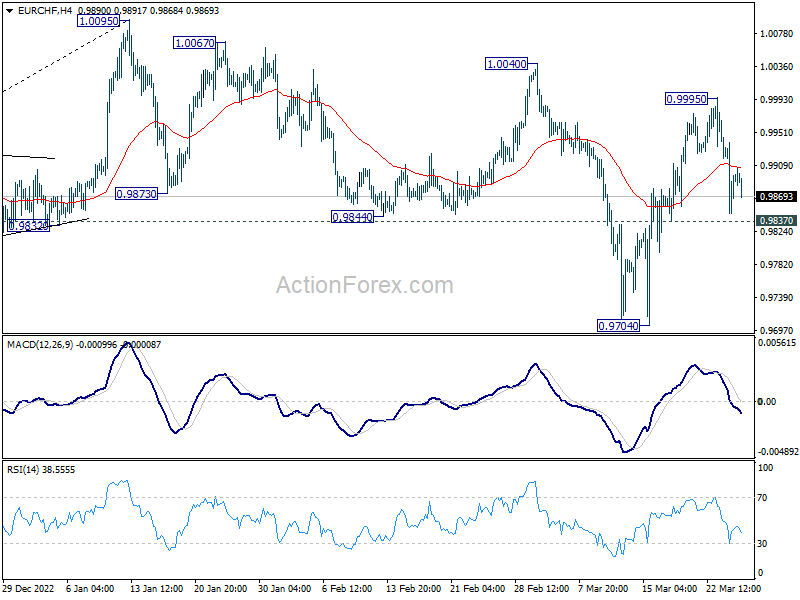
Intraday bias in EUR/CHF remains neutral for the moment. Another rise will remain mildly in favor as long as 0.9837 minor support holds. Break of 0.9995 will affirm the case that correction from 1.0095 has completed at 0.9704. Further rally should be seen through 1.0040 to retest 1.0095 high. However, firm break of 0.9837 will dampen this bullish view and turn bias back to the downside for 0.9704 support instead.
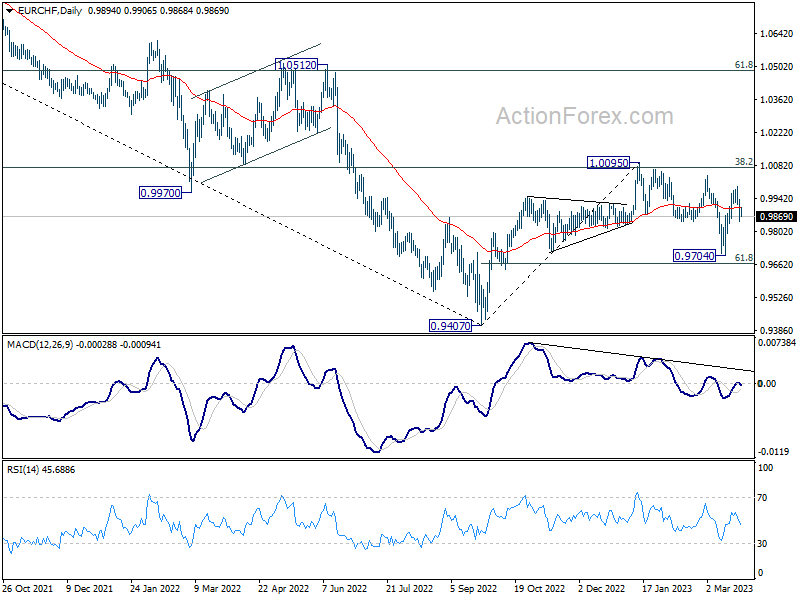
In the bigger picture, prior rejection by 55 week EMA (now at 1.1002) and 38.2% retracement of 1.1149 to 0.9407 at 1.0072 suggests that medium term outlook is staying bearish. That is, down trend from 1.2004 is not completed yet and is in favor to resume through 0.9407 at a later stage. However, decisive break of 1.0095 resistance will raise the chance of bullish trend reversal. Rise from 0.9407 should then target 1.0505 cluster resistance (2020 low at 1.0505, 61.8% retracement of 1.1149 to 0.9407 at 1.1484).
USD/CAD Daily Outlook
Daily Pivots: (S1) 1.3701; (P) 1.3753; (R1) 1.3797; More....
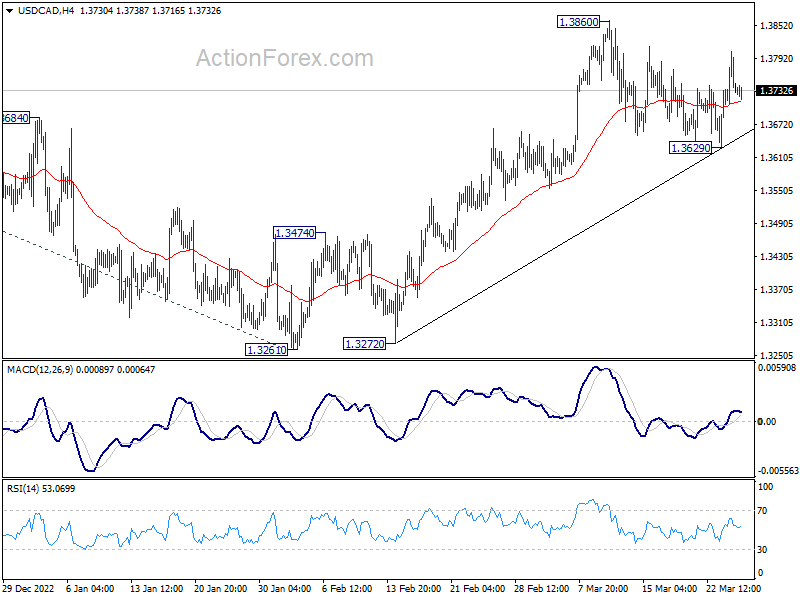
Intraday bias in USD/CAD remains neutral as consolidation from 1.3860 could extend. But further rally is expected as long as 1.3629 support holds. Firm break of 1.3860 will target 1.3976 high. However, break of 1.3629 will mix up the near term outlook and bring deeper pullback to 55 day EMA (now at 1.3584).
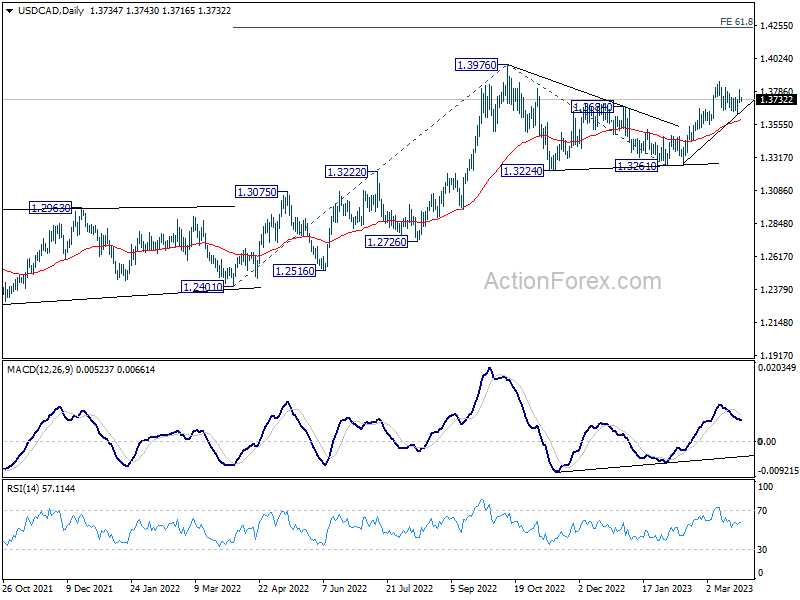
In the bigger picture, the up trend from 1.2005 (2021 low) is still in progress. Break of 1.3976 will confirm resumption and target 61.8% projection of 1.2401 to 1.3976 from 1.3261 at 1.4234. Firm break there will pave the way to long term resistance zone at 1.4667/89 (2016, 2020 highs). On the downside, break of 1.3261 support is needed to confirm medium term topping. Otherwise, outlook will remain bullish even in case of deep pull back.
AUD/USD Daily Report
Daily Pivots: (S1) 0.6615; (P) 0.6655; (R1) 0.6684; More...
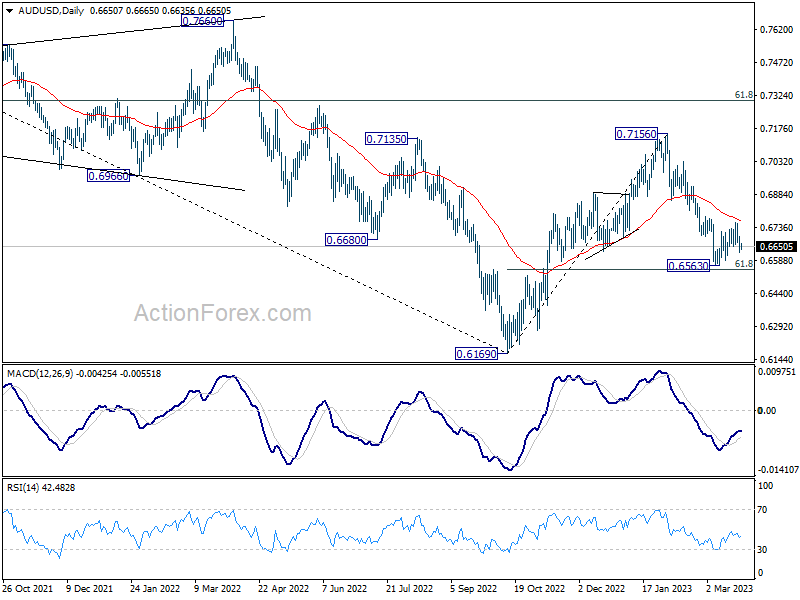
Intraday bias in AUD/USD remains mildly on the downside for 0.6563 low. Corrective recovery from there could have completed at 0.6758 already. Decisive break of 0.6546 fibonacci level will carry larger bearish implication. On the upside, however, break of 0.6758 resistance will now be a strong signal of bullish reversal and turn bias back to the upside.
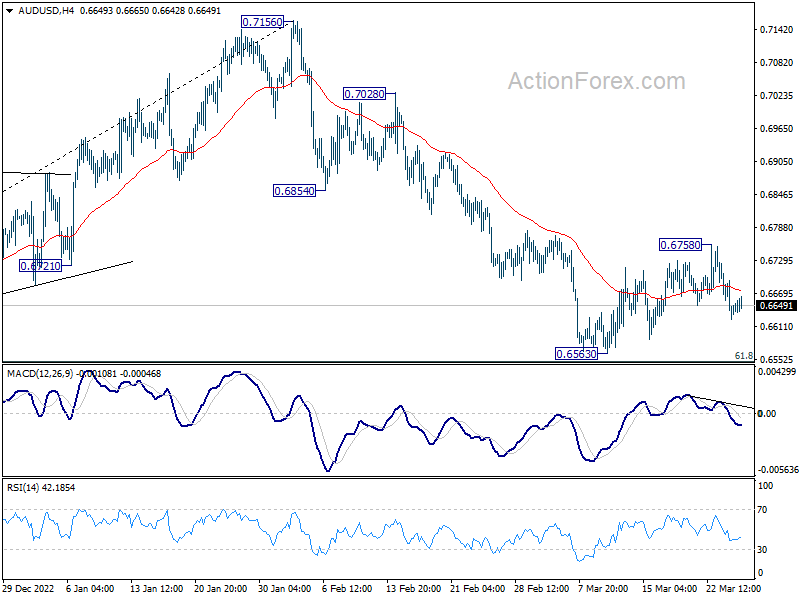
In the bigger picture, as long as 61.8% retracement of 0.6169 to 0.7156 at 0.6546 holds, the decline from 0.7156 is seen as a correction to rally from 0.6169 (2022 low) only. Another rise should still be seen through 0.7156 at a later stage. However, sustained break of 0.6546 will raise the chance of long term down trend resumption through 0.6169 low.
EUR/USD Daily Outlook
Daily Pivots: (S1) 1.0702; (P) 1.0771; (R1) 1.0828; More...
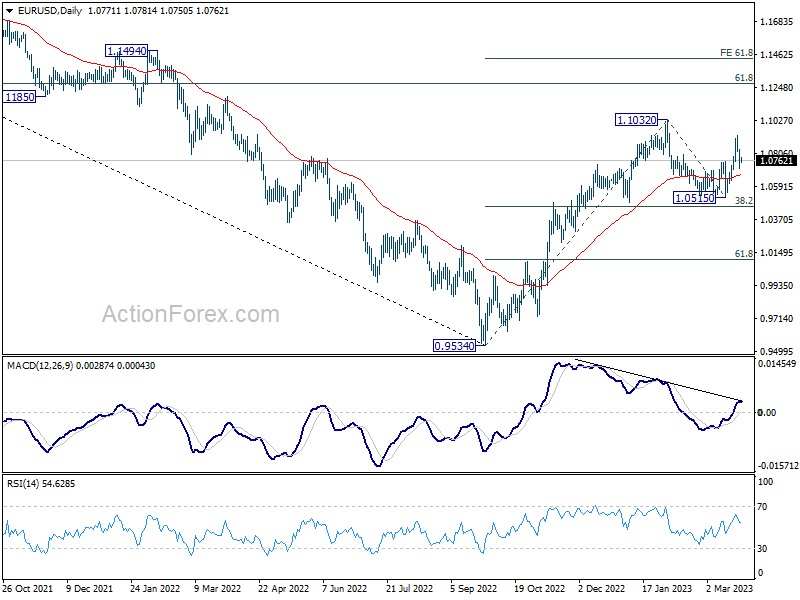
Intraday bias in EUR/USD remains neutral for the moment. Strong rebound from current level, followed by break of 1.0929 will reaffirm near term bullishness, and extend the rise from to retest 1.1032 high. Firm break there will resume larger up trend from 0.9534 to 1.1273 fibonacci level next. However, sustained trading below 4 hour 55 EMA (now at 1.0740) will likely extend the corrective pattern from 1.1032 and bring deeper decline back towards 1.0515.
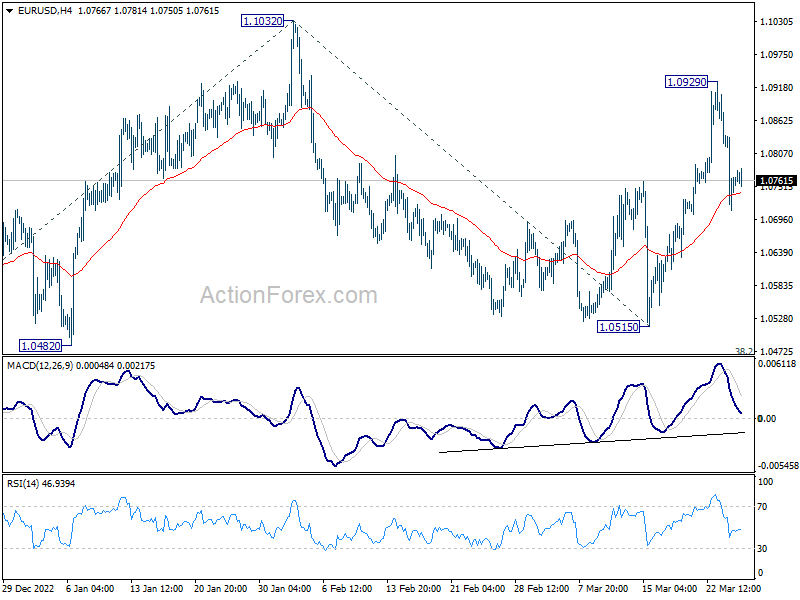
In the bigger picture, rise from 0.9534 (2022 low) is in progress with 38.2% retracement of 0.9534 to 1.1032 at 1.0460 intact. The strong support from 55 week EMA (now at 1.0623) was also a medium term bullish sign. Next target is 61.8% retracement of 1.2348 (2021 high) to 0.9534 at 1.1273. Sustained break there will solidity the case of bullish trend reversal and target 1.2348 resistance next (2021 high).
GBP/USD Daily Outlook
Daily Pivots: (S1) 1.2185; (P) 1.2239; (R1) 1.2287; More...
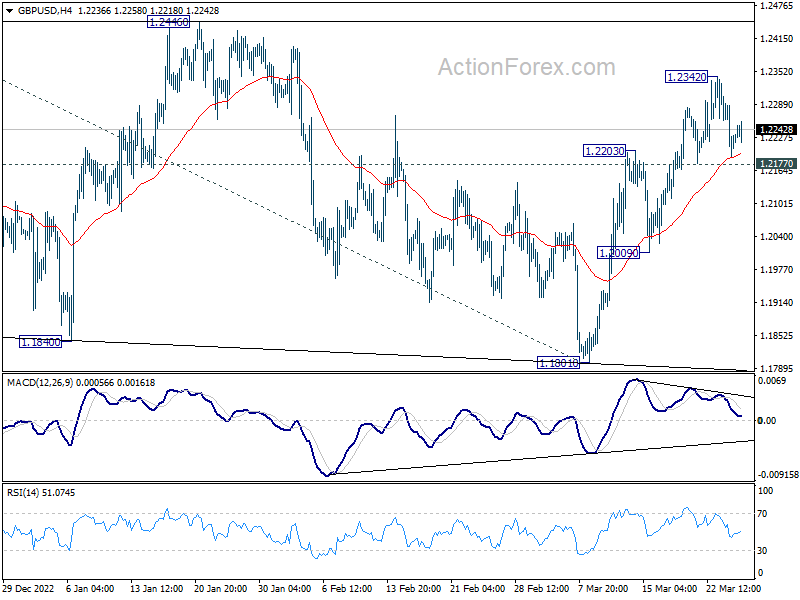
Intraday bias in GBP/USD remains neutral for the moment, and further rise in expected with 1.2177 minor support intact. On the upside, break of 1.2342 will target 1.2445/6 resistance zone. Firm break there will resume larger rally from 1.0351, and target 1.2759 fibonacci level. On the downside, however, break of 1.2177 minor support will argue that corrective pattern from 1.2445 is extending with another falling leg, and turn bias to the downside for 1.2009 support instead.
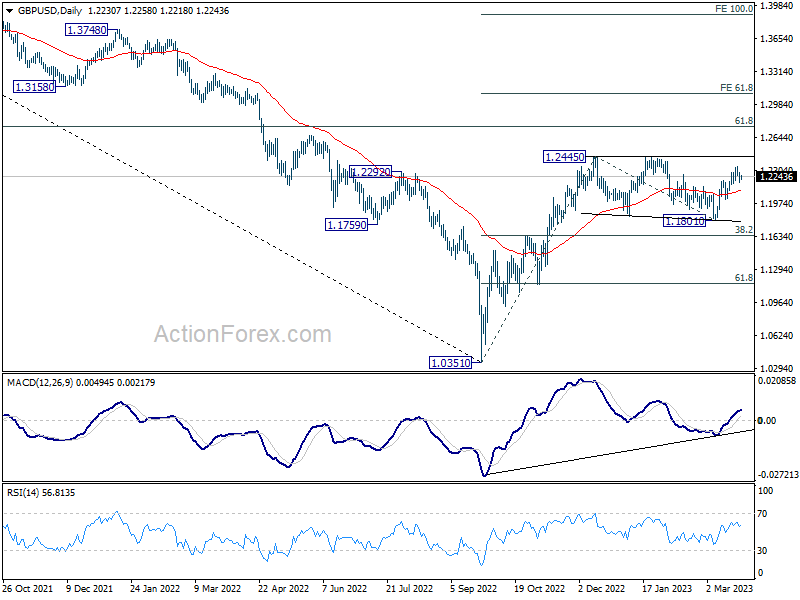
In the bigger picture, price action from 1.2445 are seen as a corrective pattern to rise from 1.0351 medium term bottom (2022 low). Resumption of the rally from 1.0351 is expected and break of 1.2446 will target 61.8% retracement of 1.4248 (2021 high) to 1.0351 at 1.2759. This will remain the favored case as long as 38.2% retracement of 1.0351 to 1.2445 at 1.1645 holds.
USD/CHF Daily Outlook
Daily Pivots: (S1) 0.9160; (P) 0.9189; (R1) 0.9227; More...
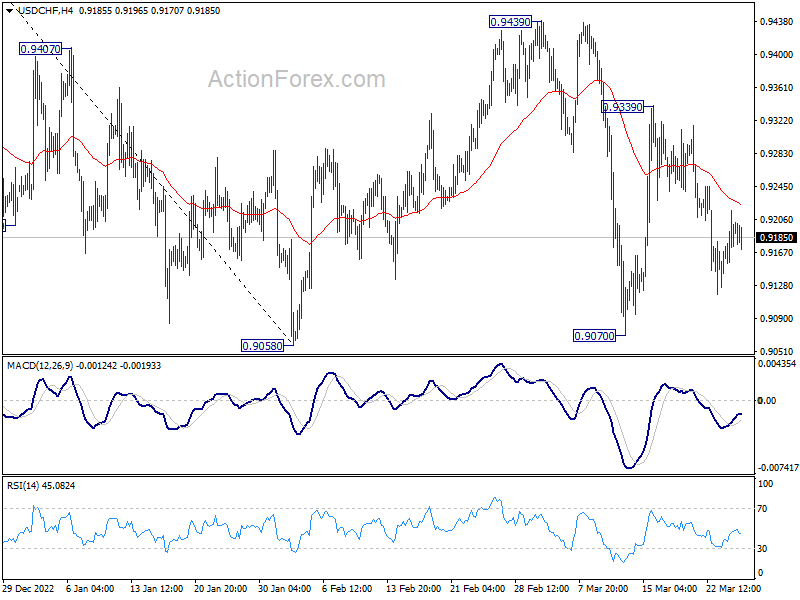
Intraday bias in USD/CHF remains neutral for the moment. Outlook is unchanged that corrective pattern from 0.9058 low is in progress. Another rise cannot be ruled out, but upside should be limited by 0.9474 fibonacci level. On the downside, firm break of 0.9058 will resume larger down trend from 1.1046.
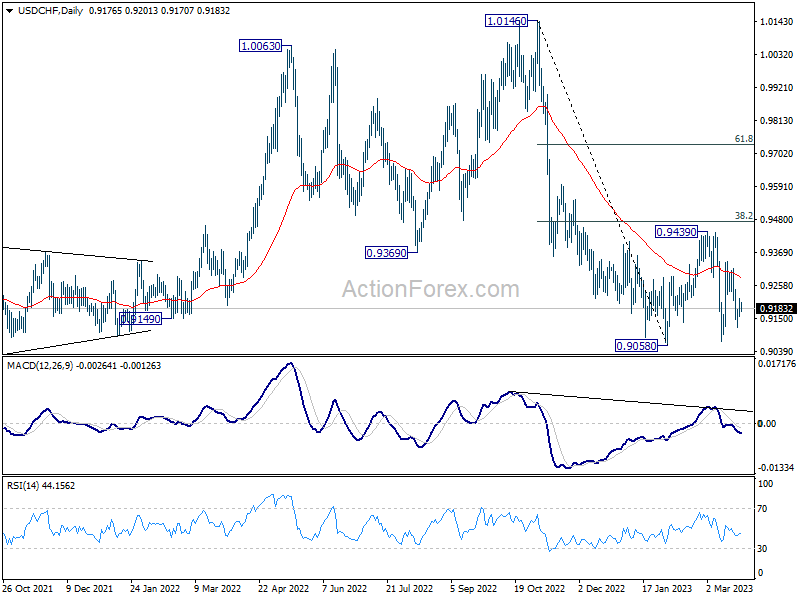
In the bigger picture, fall from 1.1046 (2022 high) should still be in progress with 38.2% retracement of 1.0146 to 0.9058 at 0.9474 intact. Prior rejection by 55 week EMA was a medium term bearish sign. Break of 0.9058 will resume such decline towards 0.8756 support (2021 low). But overall, this fall is still as a leg in the long term range pattern from 1.0342 (2016 high). So, downside should be contained by 0.8756 to bring reversal.
GBP/USD: Bullish Reversal With a Leading Diagonal – More Upside after Set-back
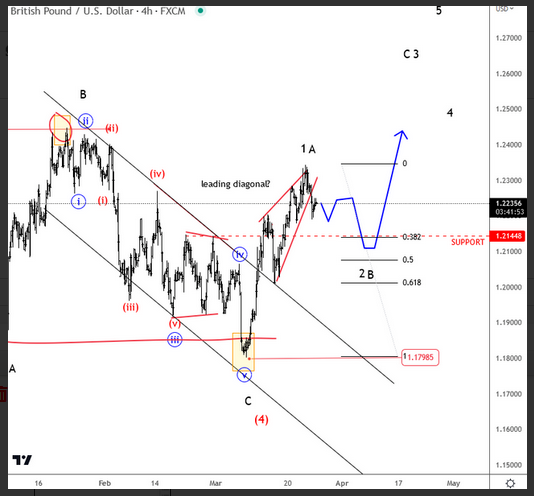
Cable reached a multy-year low after a capitulation back in September 2022. Notice that the price is looking impulsive on a daily chart up to 1.23-1.24 resistance where bulls will try to form a breakout, but after a fourth wave pullback which was more complex than we thought, but this one looks finished now after recent nice and strong recovery out of a downward channel and also above 1.2060 bullish level. As such, we will favor more upside after any near-term pullback, possibly in B/2 after a potential leading diagonal in wave A/1 that might find a top. Support is at 1.2145 followed by 1.2.
DAX Attempts to Bounce Back
USD/CAD tests support
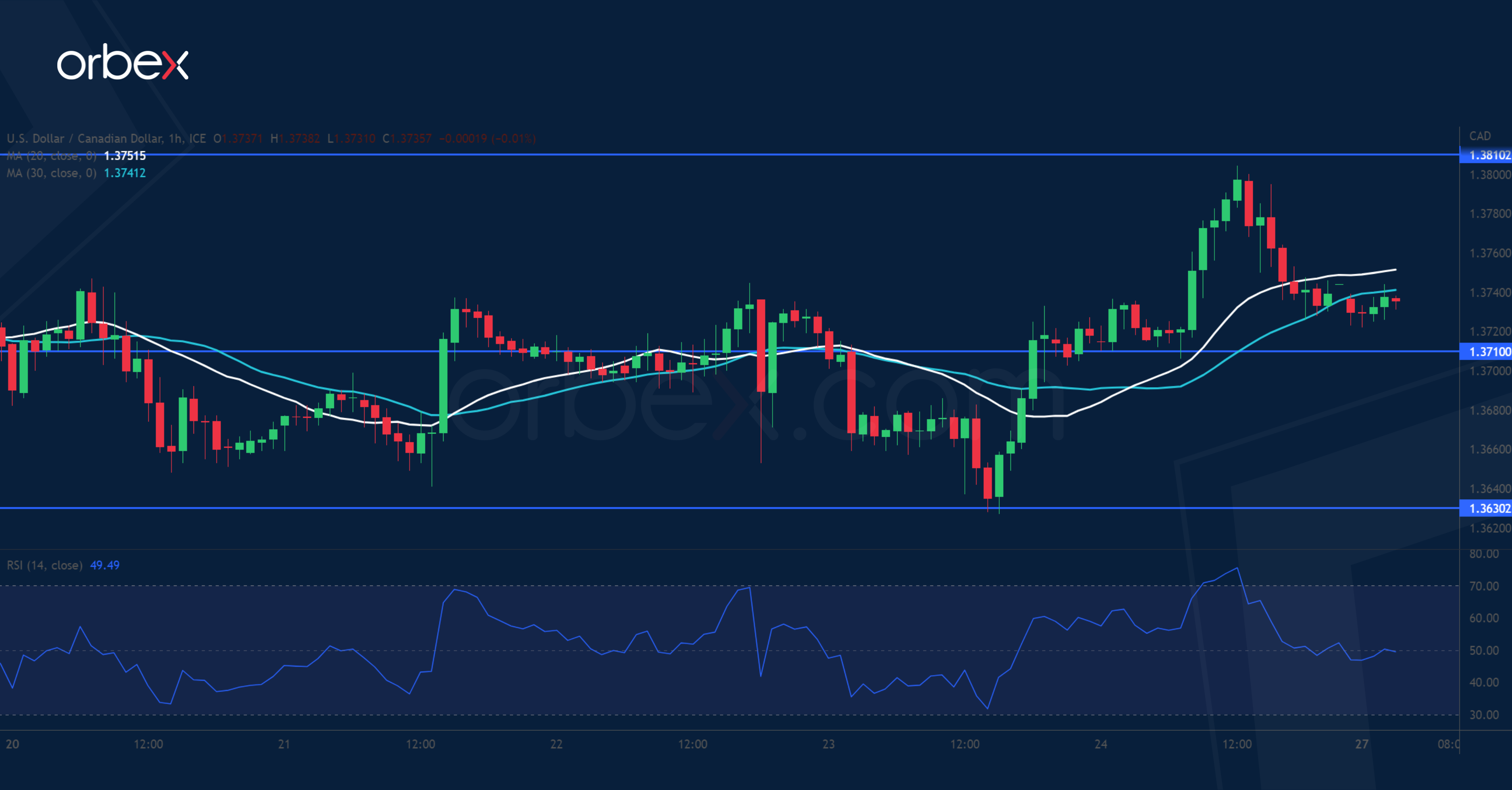
The Canadian dollar bounced on upbeat retail numbers in January. On the daily chart, the upward bias remains intact with the two-week long pullback securing solid buying over 1.3630 at the confluence of the 20-day SMA and the base of the March breakout rally. A surge above 1.3740 forced sellers to cover, stirring up volatility in the process. A close above 1.3810 would resume the uptrend above October’s high of 1.3970. As the RSI returns to neutral territory, 1.3710 is the closest level to expect renewed interest.
EUR/GBP seeks support
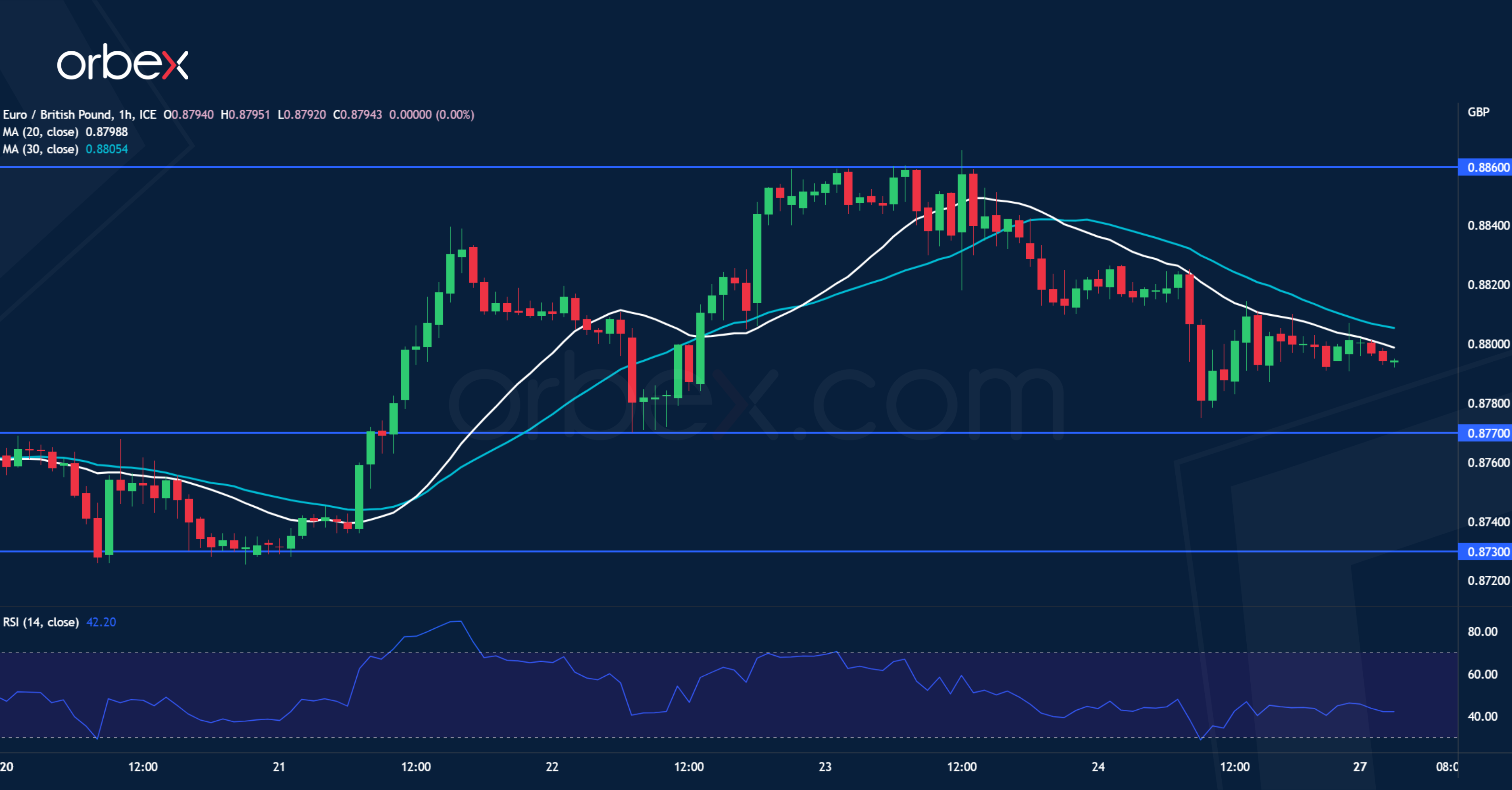
The euro fell as plunging European banking stocks weighed on sentiment. A drop below the first support at 0.8810 has dented the momentum. 0.8770 is the next level to see if buyers would be able to keep the latest rebound valid, or they would be up against a wall if the pair revisits the critical floor at 0.8730. Its breach would lay the foundation for a bearish reversal in the medium-term. The RSI’s oversold condition attracted some bargain hunters and a close above 0.8860 would open the door to this month’s high of 0.8920.
DAX 40 holds on to gains
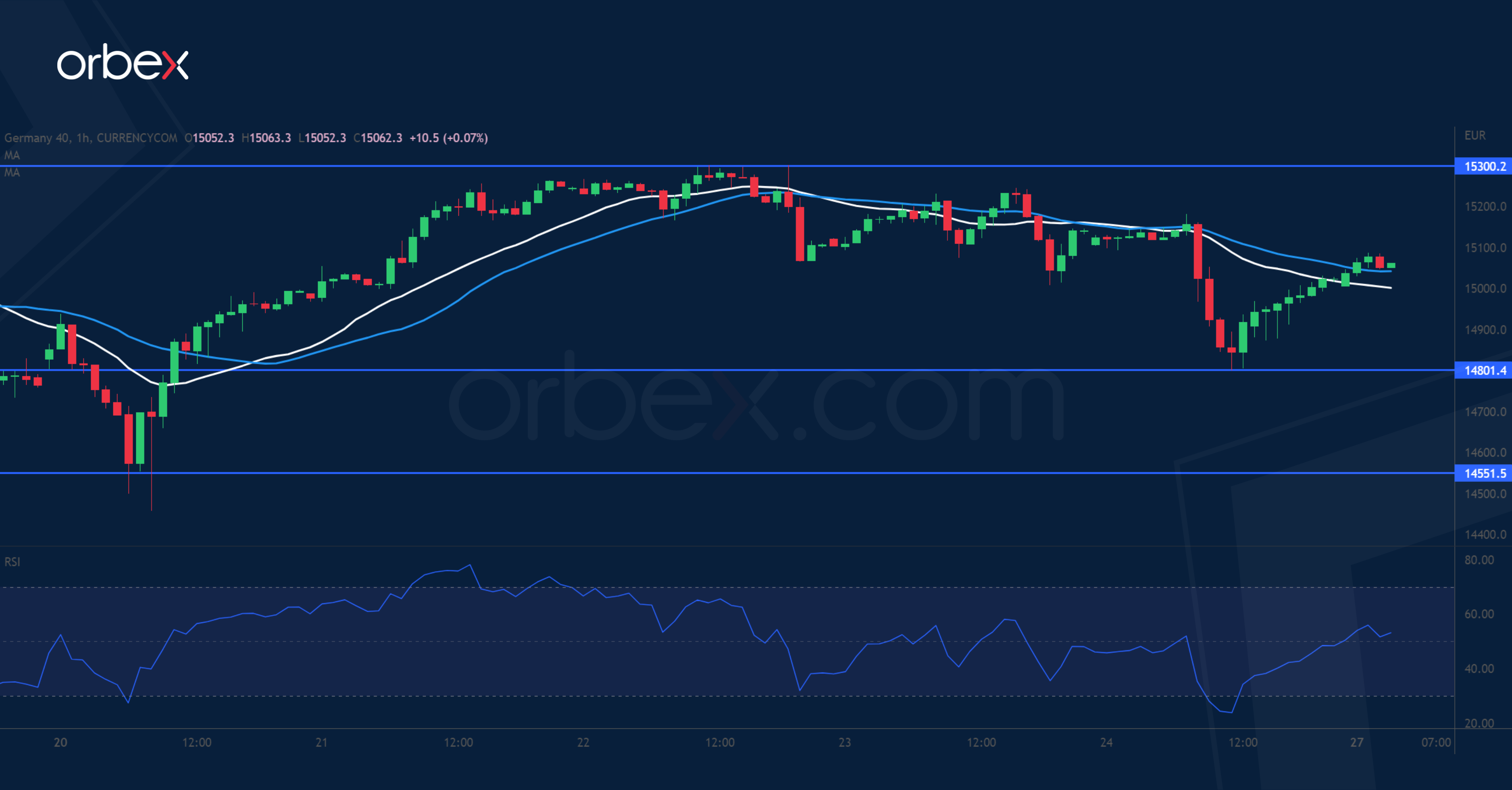
The Dax 40 pared losses as central bankers tried to ease fears of a liquidity crisis. The bulls have had a hard time pushing beyond the area of congestion formed by the support-turned-resistance of 15300 and the 20-day SMA. A break below the psychological level of 15000 took out some weak hands. The demand zone around 14800 goes back to January’s bullish breakout and is critical to keep the bounce valid. As the trading range narrows between these significant levels, a breakout on either side would dictate the next move.
Process of Restoring Confidence Will Take Quite Some Time
Markets
On Friday, market fears on financial stability focused on Europe. Deutsche Bank was in the eye of the storm after it announced to call a Tier 2 subordinated bond. While this in se shouldn’t be a source of concern, it apparently added to market nervousness. European equities nosedived and core bonds again received a strong safe have bid. The financial stability concerns overshadowed the macro-economic narrative as European PMI printed stronger than expected. The S&P global EMU composite PMI for March unexpectedly jumped from 52.0 to 54.1 (unchanged expected). Strength especially came from the services sector (55.6 from 52.7). The picture of the manufacturing sector remains much less brilliant (47.1 from 48.5). Even so, the global index suggests solid EMU growth in the first quarter, with ongoing job growth while price indices also remained at elevated levels. For now, the report only confirms the ECB’s assessment, that it will probably have to do more work to bring inflation lower in a sustainable way. Later in the session, US PMI’s showed a similar picture with the composite PMI rising from 50.1 to 53.8. The move was supported by both an improvement in the manufacturing sector (49.3 from 47.3) and even more in the services sector (53.8 from 50.6). Sentiment gradually improved in the US session after the publication of the US PMI’s. Even so, at the end of the day core yields still closed the session in red. US yields declined between 6.6 bps (2-y) and 3.2 bps (5-y).Despite recent financial turmoil, Fed Bullard still indicated that he sees the peak rate in the US policy rate at 5.50%/5.75%. Fed’s Bostic also defended the Fed’s latest rate hike as inflation remains too high. German yields dropped another 13.3 bps (2-y) to 3.3 bps (30-y). In both cases, yields closed well off the intra-day lows. A similar pattern developed in equity markets. The Eurostoxx 50 closed the session with a loss of 1.82%. US indices managed to reverse a negative open to close with gains of about 0.5%. The financial stability focus turning to Europe this time also hit the euro. EUR/USD dropped sharply early in European dealings. In the end EUR/USD still closed just above 1.0750. DXY jumped from the 102.50 area to close at 103.12. The yen slightly outperformed the dollar (USD/JPY close 130.7). Sterling again show relative resilience despite the risk-off. EUR/GBP closed near 0.88.
This morning, Asian (equity) markets show no clear directional trend. Fed Kashkari during the weekend indicated that recent stress might raise the risk of US recession. Even so, US yields regain a few bps this morning. The USD DXY index trades little changed just north of 103. Later today, the eco calendar is rather thin. The German IFO business climate is expected to hold little changed near 91.0. Even is case of a positive surprise, it probably won’t be a game-changer. Key question is whether/when concerns on financial stability will gradually subside. Even if no new ‘individual cases’ come in the spotlights, the process of restoring confidence will take quite some time. The US 2-y yield returning above the 4.0% barrier in a sustainable ay could be a first indication that stress is easing. In this respect, also keep an eye at a $42bln sale of US 2-y Treasuries after recent sharp decline in short term yields. After the USD rebound end last week, the picture between the euro and the dollar now looks again more balanced. Some further range trading in the 1.05/1.093 area might be on the cards.
News and views
The IMF’s managing director Georgieva warned of increased risks to financial stability and said there’s vigilance needed following the recent turmoil. “The rapid transition from a prolonged period of low interest rates to much higher rates necessary to fight inflation inevitably generates stresses and vulnerabilities”. Policymakers have acted decisively and the provision of dollar liquidity has been enhanced. That eased market stress to some extent but uncertainty remains high, Georgieva added. The huge amount of monetary tightening combined with Ukraine war and “scarring” from the pandemic according to the IMF is expected to slow global economic growth below 3%.
According to chairman of the Office for Budget Responsibility Richard Hughes the UK economy is about 4% smaller because of the Brexit. He said it’s a shock of the order of magnitude like the one coming from the pandemic and the energy crisis. The OBR earlier this month estimated that the volume of UK imports and exports will be 15% lower than if the UK had remained in the EU, with the full effects visible after 15 years. Hughes identified other factors weighing on economic growth too, including declining productivity, a shrinking workforce and stagnant investment. The UK is the only development economy that has not yet fully recovered to pre-pandemic GDP levels.
It Keeps on Giving
Sentiment is mixed, as the Deutsche Bank selloff revived the banking stress on Friday.
The DBK shares fell 8% and its CDS spiked after the bank announced to redeem a tier 2 subordinated bond earlier.
The announcement was supposed to restore confidence regarding the bank’s balance sheet. But it revived a confidence crisis instead.
Despite the bank stress on both sides of the Atlantic, both, the Federal Reserve (Fed), the European Central Bank (ECB), the Bank of England (BoE) and the Swiss National Bank (SNB) haven’t refrained from hiking the interest rates over the past two weeks, weighing – not necessarily on the health of the banks’ balance sheets, but on worries regarding the health of the banks’ balance sheets.
Today, it appears that the banking crisis is more of a confidence crisis than a fact-based panic – as it was the case in 2007 when banks really had a bunch of toxic assets in their balance sheets.
But confidence is the bread and butter of the banking sector. And watching the 166-year-old Credit Suisse go under did no good to anyone last Monday.
And even though Mr. Powell, Madame Lagarde, Mr. Bailey and Mr. Jordan kept their policy stance unchanged despite the mounting stress in banks, if other banks, the size of Deutsche Bank, get sucked in this confidence crisis, we could well see the interest rate expectations point more seriously at a pivot in major central banks’ tightening plans.
In numbers
The German 2-year yield fell on Friday, on DBK stress, and the US 2-year yield tanked to 3.55%, the lowest since last September.
Activity on Fed funds futures gives more than 85% chance for a no rate hike in May.
Besides the Fed, the Bank of Canada (BoC) and the Reserve Bank of Australia (RBA) are also seen as central banks that could rapidly go back to cutting the interest rates.
And the ECB could well be next on that list.
The EURUSD got hit with the freshly emerging DBK stress on Friday, the pair fell to 1.0713 on Friday, after it was preparing to flirt with the 1.10 offers last week, on the back of persistently hawkish ECB and increasingly dovish Fed expectations.
But if stress over DBK gets worse, we could well see the ECB rate hike expectations hammered. And that could put the single currency under a renewed downside pressure.
Of course, the dovish swing in major central bank expectations, except for the Bank of Japan (BoJ) which cannot go more dovish than it already is, are supportive for the Japanese yen - not because the yen is a safe haven currency but because the dovish other central bank expectations simply reduce the gap between the BoJ and the others. The USDJPY is testing the 130 support to the downside, and could clear it sustainably depending on how much more stress is waiting the market in the next few days, and weeks.
If you are looking for the best performing assets of the bank crisis, I’d say, consider gold, which gained almost $200 per ounce since the SVB collapsed, and Bitcoin, which gained around $10K during the same period.
And that equity appetite?
For equities, it looks like the falling yields overweigh the recession fears right now, even though the yields are falling due to recession worries which are triggered by the banking crisis which should restrict credit.
It is therefore a bit surprising to see the stock indices navigate this well the bank turmoil.
Yes, the Stoxx 600 lost 1.37% on Friday thanks to DBK, and yes the S&P500 looked ugly on Friday’s open, but the index closed the session 0.56% higher, above the 200-DMA.
And US and European futures point at a positive start to the week.
Besides the banks?
Besides the banks, we will still keep an eye on a couple of important data points this week, including the latest GDP and PCE update from the US, fresh inflation estimate for the Eurozone, Australia and Japan.
But how much they will matter depends on what happens on the… banks front.