

Sample Category Title
Summary 3/27 – 3/31
Monday, Mar 27, 2023
| GMT | Ccy | Events | Consensus | Previous |
|---|---|---|---|---|
| 23:50 | JPY | Corporate Service Price Index Y/Y Feb | 1.80% | 1.60% |
| 08:00 | EUR | Germany IFO Business Climate Mar | 92 | 91.1 |
| 08:00 | EUR | Germany IFO Current Assessment Mar | 94 | 93.9 |
| 08:00 | EUR | Germany IFO Expectations Mar | 87.4 | 88.5 |
| 08:00 | EUR | Eurozone M3 Money Supply Y/Y Feb | 3.30% | 3.50% |
| GMT | Ccy | Events | |
|---|---|---|---|
| 23:50 | JPY | Corporate Service Price Index Y/Y Feb | |
| Forecast: 1.80% | Previous: 1.60% | ||
| 08:00 | EUR | Germany IFO Business Climate Mar | |
| Forecast: 92 | Previous: 91.1 | ||
| 08:00 | EUR | Germany IFO Current Assessment Mar | |
| Forecast: 94 | Previous: 93.9 | ||
| 08:00 | EUR | Germany IFO Expectations Mar | |
| Forecast: 87.4 | Previous: 88.5 | ||
| 08:00 | EUR | Eurozone M3 Money Supply Y/Y Feb | |
| Forecast: 3.30% | Previous: 3.50% | ||
Tuesday, Mar 28, 2023
| GMT | Ccy | Events | Consensus | Previous |
|---|---|---|---|---|
| 00:30 | AUD | Retail Sales M/M Feb | 0.40% | 1.90% |
| 11:00 | GBP | BoE Quarterly Bulletin | ||
| 12:30 | USD | Goods Trade Balance (USD) Feb P | -89.9B | -91.5B |
| 12:30 | USD | Wholesale Inventories Feb P | 0.20% | -0.40% |
| 13:00 | USD | Housing Price Index M/M Jan | -0.20% | -0.10% |
| 13:00 | USD | S&P/CS Composite-20 HPI Y/Y Jan | 4.50% | 4.60% |
| 14:00 | USD | Consumer Confidence Mar | 101.7 | 102.9 |
| GMT | Ccy | Events | |
|---|---|---|---|
| 00:30 | AUD | Retail Sales M/M Feb | |
| Forecast: 0.40% | Previous: 1.90% | ||
| 11:00 | GBP | BoE Quarterly Bulletin | |
| Forecast: | Previous: | ||
| 12:30 | USD | Goods Trade Balance (USD) Feb P | |
| Forecast: -89.9B | Previous: -91.5B | ||
| 12:30 | USD | Wholesale Inventories Feb P | |
| Forecast: 0.20% | Previous: -0.40% | ||
| 13:00 | USD | Housing Price Index M/M Jan | |
| Forecast: -0.20% | Previous: -0.10% | ||
| 13:00 | USD | S&P/CS Composite-20 HPI Y/Y Jan | |
| Forecast: 4.50% | Previous: 4.60% | ||
| 14:00 | USD | Consumer Confidence Mar | |
| Forecast: 101.7 | Previous: 102.9 | ||
Wednesday, Mar 29, 2023
| GMT | Ccy | Events | Consensus | Previous |
|---|---|---|---|---|
| 00:30 | AUD | Monthly CPI Y/Y Feb | 7.40% | |
| 06:00 | EUR | Germany Gfk Consumer Confidence Apr | -29 | -30.5 |
| 08:00 | CHF | Credit Suisse Economic Expectations Mar | -12.3 | |
| 08:30 | GBP | Mortgage Approvals Feb | 42K | 40K |
| 08:30 | GBP | M4 Money Supply M/M Feb | 0.90% | 1.30% |
| 13:00 | CHF | SNB Quarterly Bulletin | ||
| 14:00 | USD | Pending Home Sales M/M Feb | -2.20% | 8.10% |
| 14:30 | USD | Crude Oil Inventories | 1.1M | |
| 21:45 | NZD | Building Permits M/M Feb | -1.50% |
| GMT | Ccy | Events | |
|---|---|---|---|
| 00:30 | AUD | Monthly CPI Y/Y Feb | |
| Forecast: | Previous: 7.40% | ||
| 06:00 | EUR | Germany Gfk Consumer Confidence Apr | |
| Forecast: -29 | Previous: -30.5 | ||
| 08:00 | CHF | Credit Suisse Economic Expectations Mar | |
| Forecast: | Previous: -12.3 | ||
| 08:30 | GBP | Mortgage Approvals Feb | |
| Forecast: 42K | Previous: 40K | ||
| 08:30 | GBP | M4 Money Supply M/M Feb | |
| Forecast: 0.90% | Previous: 1.30% | ||
| 13:00 | CHF | SNB Quarterly Bulletin | |
| Forecast: | Previous: | ||
| 14:00 | USD | Pending Home Sales M/M Feb | |
| Forecast: -2.20% | Previous: 8.10% | ||
| 14:30 | USD | Crude Oil Inventories | |
| Forecast: | Previous: 1.1M | ||
| 21:45 | NZD | Building Permits M/M Feb | |
| Forecast: | Previous: -1.50% | ||
Thursday, Mar 30, 2023
| GMT | Ccy | Events | Consensus | Previous |
|---|---|---|---|---|
| 00:00 | NZD | ANZ Business Confidence Mar | -43.3 | |
| 08:00 | EUR | Italy Unemployment Feb | 8.00% | 7.90% |
| 08:00 | EUR | ECB Economic Bulletin | ||
| 09:00 | EUR | Eurozone Economic Sentiment Mar | 99.7 | 99.7 |
| 09:00 | EUR | Eurozone Industrial Confidence Mar | 0.9 | 0.5 |
| 09:00 | EUR | Eurozone Services Sentiment Mar | 10.1 | 9.5 |
| 09:00 | EUR | Eurozone Consumer Confidence Mar F | -19.2 | |
| 12:00 | EUR | Germany CPI M/M Mar P | 0.40% | 0.80% |
| 12:00 | EUR | Germany CPI Y/Y Mar P | 8.90% | 8.70% |
| 12:30 | USD | Initial Jobless Claims (Mar 24) | 195K | 191K |
| 12:30 | USD | GDP Price Index Q4 F | 3.90% | 3.90% |
| 12:30 | USD | GDP Annualized Q4 F | 2.70% | 2.70% |
| 14:30 | USD | Natural Gas Storage | -72B | |
| 23:30 | JPY | Tokyo CPI Core Y/Y Mar | 3.20% | 3.30% |
| 23:30 | JPY | Unemployment Rate Feb | 2.40% | 2.40% |
| 23:50 | JPY | Industrial Production M/M Feb P | 2.80% | -5.30% |
| 23:50 | JPY | Retail Trade Y/Y Feb | 5.90% | 6.30% |
| GMT | Ccy | Events | |
|---|---|---|---|
| 00:00 | NZD | ANZ Business Confidence Mar | |
| Forecast: | Previous: -43.3 | ||
| 08:00 | EUR | Italy Unemployment Feb | |
| Forecast: 8.00% | Previous: 7.90% | ||
| 08:00 | EUR | ECB Economic Bulletin | |
| Forecast: | Previous: | ||
| 09:00 | EUR | Eurozone Economic Sentiment Mar | |
| Forecast: 99.7 | Previous: 99.7 | ||
| 09:00 | EUR | Eurozone Industrial Confidence Mar | |
| Forecast: 0.9 | Previous: 0.5 | ||
| 09:00 | EUR | Eurozone Services Sentiment Mar | |
| Forecast: 10.1 | Previous: 9.5 | ||
| 09:00 | EUR | Eurozone Consumer Confidence Mar F | |
| Forecast: | Previous: -19.2 | ||
| 12:00 | EUR | Germany CPI M/M Mar P | |
| Forecast: 0.40% | Previous: 0.80% | ||
| 12:00 | EUR | Germany CPI Y/Y Mar P | |
| Forecast: 8.90% | Previous: 8.70% | ||
| 12:30 | USD | Initial Jobless Claims (Mar 24) | |
| Forecast: 195K | Previous: 191K | ||
| 12:30 | USD | GDP Price Index Q4 F | |
| Forecast: 3.90% | Previous: 3.90% | ||
| 12:30 | USD | GDP Annualized Q4 F | |
| Forecast: 2.70% | Previous: 2.70% | ||
| 14:30 | USD | Natural Gas Storage | |
| Forecast: | Previous: -72B | ||
| 23:30 | JPY | Tokyo CPI Core Y/Y Mar | |
| Forecast: 3.20% | Previous: 3.30% | ||
| 23:30 | JPY | Unemployment Rate Feb | |
| Forecast: 2.40% | Previous: 2.40% | ||
| 23:50 | JPY | Industrial Production M/M Feb P | |
| Forecast: 2.80% | Previous: -5.30% | ||
| 23:50 | JPY | Retail Trade Y/Y Feb | |
| Forecast: 5.90% | Previous: 6.30% | ||
Friday, Mar 31, 2023
| GMT | Ccy | Events | Consensus | Previous |
|---|---|---|---|---|
| 00:30 | AUD | Private Sector Credit M/M Feb | 0.30% | 0.40% |
| 01:00 | CNY | NBS Manufacturing PMI Mar | 51.9 | 52.6 |
| 01:00 | CNY | Non-Manufacturing PMI Mar | 54.3 | 56.3 |
| 05:00 | JPY | Housing Starts Y/Y Feb | -0.50% | 6.60% |
| 06:00 | GBP | GDP Q/Q Q4 F | 0.00% | 0.00% |
| 06:00 | GBP | Current Account (GBP) Q4 | -17.5B | -19.4B |
| 06:00 | EUR | Germany Import Price Index M/M Feb | -0.80% | -1.20% |
| 06:00 | EUR | Germany Retail Sales M/M Feb | 0.50% | -0.30% |
| 06:30 | CHF | Real Retail Sales Y/Y Feb | -1.00% | -2.20% |
| 06:45 | EUR | France Consumer Spending M/M Feb | 0.20% | 1.50% |
| 07:00 | CHF | KOF Leading Indicator Mar | 101.9 | 100 |
| 07:55 | EUR | Germany Unemployment Change Feb | 2K | 2K |
| 07:55 | EUR | Germany Unemployment Rate Feb | 5.50% | |
| 09:00 | EUR | Eurozone Unemployment Rate Feb | 6.70% | 6.70% |
| 09:00 | EUR | Eurozone CPI Y/Y Mar P | 7.20% | 8.50% |
| 09:00 | EUR | Eurozone Core CPI Y/Y Mar P | 5.70% | 5.60% |
| 12:30 | CAD | GDP M/M Jan | 0.00% | -0.10% |
| 12:30 | USD | Personal Income M/M Feb | 0.30% | 0.60% |
| 12:30 | USD | Personal Spending Feb | 0.30% | 1.80% |
| 12:30 | USD | PCE Price Index M/M Feb | 0.20% | 0.60% |
| 12:30 | USD | PCE Price Index Y/Y Feb | 5.30% | 5.40% |
| 12:30 | USD | Core PCE Price Index M/M Feb | 0.40% | 0.60% |
| 12:30 | USD | Core PCE Price Index Y/Y Feb | 4.40% | 4.70% |
| 13:45 | USD | Chicago PMI Mar | 43.6 | 43.6 |
| 14:00 | USD | Michigan Consumer Sentiment Mar F | 63.4 | 63.4 |
| GMT | Ccy | Events | |
|---|---|---|---|
| 00:30 | AUD | Private Sector Credit M/M Feb | |
| Forecast: 0.30% | Previous: 0.40% | ||
| 01:00 | CNY | NBS Manufacturing PMI Mar | |
| Forecast: 51.9 | Previous: 52.6 | ||
| 01:00 | CNY | Non-Manufacturing PMI Mar | |
| Forecast: 54.3 | Previous: 56.3 | ||
| 05:00 | JPY | Housing Starts Y/Y Feb | |
| Forecast: -0.50% | Previous: 6.60% | ||
| 06:00 | GBP | GDP Q/Q Q4 F | |
| Forecast: 0.00% | Previous: 0.00% | ||
| 06:00 | GBP | Current Account (GBP) Q4 | |
| Forecast: -17.5B | Previous: -19.4B | ||
| 06:00 | EUR | Germany Import Price Index M/M Feb | |
| Forecast: -0.80% | Previous: -1.20% | ||
| 06:00 | EUR | Germany Retail Sales M/M Feb | |
| Forecast: 0.50% | Previous: -0.30% | ||
| 06:30 | CHF | Real Retail Sales Y/Y Feb | |
| Forecast: -1.00% | Previous: -2.20% | ||
| 06:45 | EUR | France Consumer Spending M/M Feb | |
| Forecast: 0.20% | Previous: 1.50% | ||
| 07:00 | CHF | KOF Leading Indicator Mar | |
| Forecast: 101.9 | Previous: 100 | ||
| 07:55 | EUR | Germany Unemployment Change Feb | |
| Forecast: 2K | Previous: 2K | ||
| 07:55 | EUR | Germany Unemployment Rate Feb | |
| Forecast: | Previous: 5.50% | ||
| 09:00 | EUR | Eurozone Unemployment Rate Feb | |
| Forecast: 6.70% | Previous: 6.70% | ||
| 09:00 | EUR | Eurozone CPI Y/Y Mar P | |
| Forecast: 7.20% | Previous: 8.50% | ||
| 09:00 | EUR | Eurozone Core CPI Y/Y Mar P | |
| Forecast: 5.70% | Previous: 5.60% | ||
| 12:30 | CAD | GDP M/M Jan | |
| Forecast: 0.00% | Previous: -0.10% | ||
| 12:30 | USD | Personal Income M/M Feb | |
| Forecast: 0.30% | Previous: 0.60% | ||
| 12:30 | USD | Personal Spending Feb | |
| Forecast: 0.30% | Previous: 1.80% | ||
| 12:30 | USD | PCE Price Index M/M Feb | |
| Forecast: 0.20% | Previous: 0.60% | ||
| 12:30 | USD | PCE Price Index Y/Y Feb | |
| Forecast: 5.30% | Previous: 5.40% | ||
| 12:30 | USD | Core PCE Price Index M/M Feb | |
| Forecast: 0.40% | Previous: 0.60% | ||
| 12:30 | USD | Core PCE Price Index Y/Y Feb | |
| Forecast: 4.40% | Previous: 4.70% | ||
| 13:45 | USD | Chicago PMI Mar | |
| Forecast: 43.6 | Previous: 43.6 | ||
| 14:00 | USD | Michigan Consumer Sentiment Mar F | |
| Forecast: 63.4 | Previous: 63.4 | ||
Canada’s Federal Budget Will Be Unveiled Amid Rising Economic Uncertainty
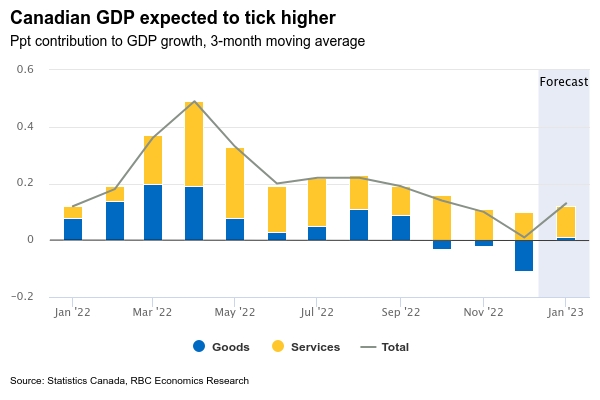
The Canadian economy has shown resilience so far this year. But there remain pockets of weakness, and headwinds from aggressive interest rate increases continue to build. It’s against this mixed economic backdrop that Finance Minister Chrystia Freeland will release the federal budget Tuesday.
First the strengths: Statistics Canada’s advance estimate for January GDP was up 0.3% from December. And a strong February labour market report suggests output probably continued to rise in that month too. Though oil production likely edged lower again in January as the sector continued to deal with a range of (mostly) transitory disruptions, the manufacturing sector has been a bright spot, with January sales surging higher. Retail sales also rose 1.4% (1.5% excluding price impacts) in January although the early estimate for February was for a 0.6% decline.
Now the weaknesses: The housing market continues to soften. Though home resales are showing signs of stabilization, new construction has declined in eight of the last nine months. And home prices continue to edge lower. The impacts of interest rates have substantially lagged the Bank of Canada’s hikes. But they are increasingly weighing on household purchasing power as loans are gradually renewed at higher rates. This will cut into household purchasing power and spending in the months ahead.
Climate policy, and more specifically, Canada’s response to the massive U.S. Inflation Reduction Act, will headline the March 28 budget. Though an overheating economy has pushed inflation higher, it has also boosted government revenues. Still, plans to return the budget to balance remain at best aspirational. Fiscal tracking suggests scope for a smaller budget deficit for fiscal 2022/23 than the $36 billion shortfall expected in the Fall Economic Statement. And the FES also assumed a $31 billion deficit for fiscal 2023/24 with no return to balance until 2027/28. Some targeted relief to help more vulnerable groups cope with higher living costs is expected next week. But Freeland has already acknowledged that turning on the fiscal spending taps too much would just add “fuel on the fire of inflation.”
Week ahead data watch
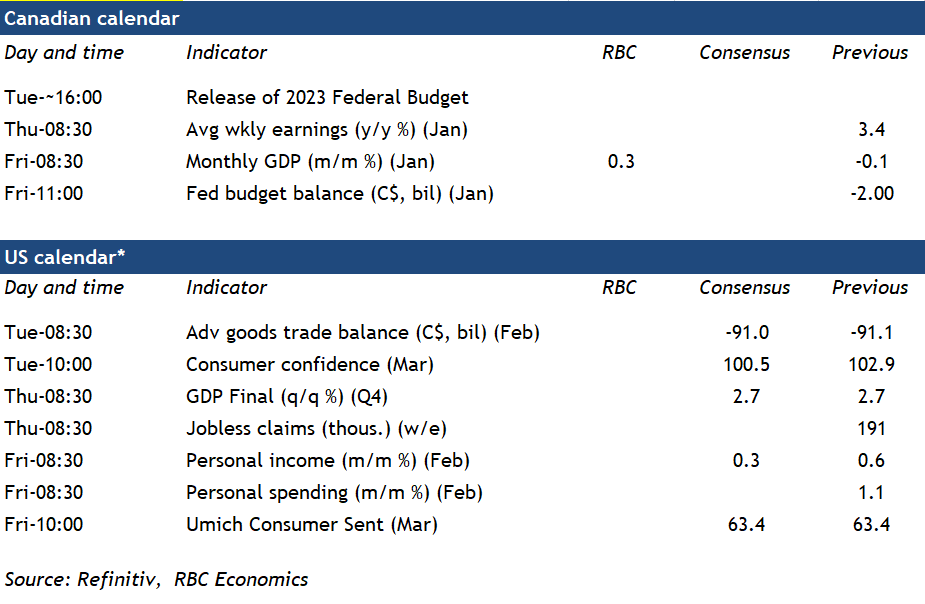
Canada’s SEPH employment report should show continued job gains in January given the 150,000 surge earlier reported in the more recent LFS employment data. But job vacancies data will be closely monitored for signs of further softening in hiring demand, even if that weakness has yet to flow through to employment counts.
The Weekly Bottom Line: Canada Inflation Moving in the Right Direction
U.S. Highlights
- The Federal Reserve delivered a modest 25-basis point hike this week amid banking stress, lifting the policy rate to a range of 4.75-5.00% – a level that’s just a hair below its previous peak back in 2007.
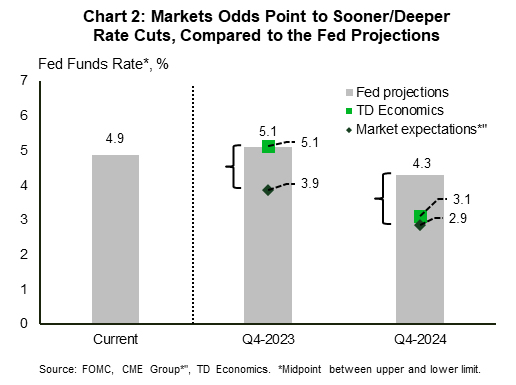
- Fed projections show the policy rate peaking at 5.1% in 2023, implying one more hike for the year, while next year a series of cuts are forecast to bring the rate down to 4.3%. Market expectations, however, are titled toward a lower rate environment in both years.
- Existing home sales rose 14.5% in February, recording the first increase after twelve consecutive months of declines.
Canadian Highlights
- Canadian Consumer Price Inflation was the main event this week. It showed a steady deceleration in price pressures, with total inflation falling to 5.2% year-on-year (y/y), from 5.9% y/y in January.
- The driver of easing inflation has been the steady decline in the price of goods, with gasoline prices leading the way, down 4.7% y/y .
- The services side of the economy has not budged. It is still hovering around its 30-year high, at 5.3% y/y. This kept Core CPI excluding food and energy steady at 4.9% y/y.
U.S. - Fed Delivers Small Hike Amid Banking Stress
Stuck between a rock and a hard place, the Fed appears to have taken a middle-of-the-road approach in setting monetary policy this week. Inflation, which remains well above target and has shown moderate signs of acceleration recently coupled with strong job growth, meant that the Fed could have opted for a more hawkish stance at Wednesday’s FOMC meeting. Fed Chair Powell nodded to this possibility in his testimony to Congress two weeks ago. However, the ongoing banking turmoil has upended this narrative. Instead of leaving the rate unchanged, – an option that was closely considered – Fed officials ultimately went with a 25-basis point hike, lifting the policy rate to 4.75-to-5.00%.
In taking this decision, the Fed acknowledged the risks from the banking turmoil, including the potential negative impact on the real economy from tighter credit conditions for households and businesses. Tighter credit conditions could do some of the Fed’s work for it in reducing inflationary pressures, substituting for further hikes. However, as Chair Powell noted in the press conference, it’s not clear how significant and how sustained the credit tightening will be. The Fed is keeping the door open to some further monetary tightening for now, but changes in the language of the FOMC statement suggest that it is very close to wrapping up its hiking cycle.
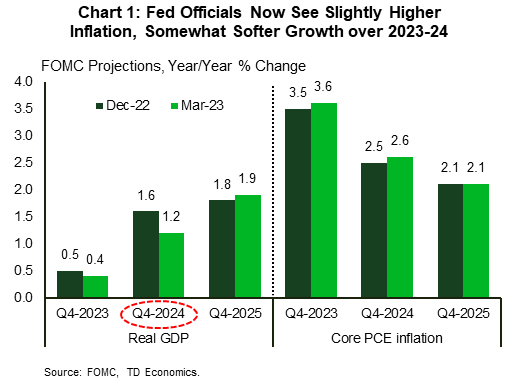
Along with the policy decision, the Fed also issued an update to its quarterly economic projections. Fed officials now expect inflation to remain slightly higher by the end of 2023 and 2024 compared to their view in December. Meanwhile, economic growth is expected to come in a bit softer over this same period, with a downgrade to the 2024 growth profile the most noticeable difference (Chart 1).
Policy rate expectations remained unchanged for 2023, with most Fed officials expecting the rate to peak to 5.1%, which implies one more hike this year. Market expectations, however, are not in tune with this view. The current pricing suggests that the Fed is done hiking rates, and that rate “cuts” will follow suit shortly this summer. Moving on to next year, while Fed officials have penciled in a series of rates cuts that will bring the policy rate down to 4.3%, market expectations remain more dovish, with the gap between the two forecasts widening (Chart 2). Our projection is aligned more closely with the Fed this year, but as growth slows into next year, we anticipate that in 2024 the Fed will loosen monetary policy more than it projects to steady the economic ship.
Reiterating Chair Powell’s view, the degree of credit tightening from the recent banking turmoil remains a major source of uncertainty for the outlook. On this front, it appears that authorities will need to stay alert in putting out more fires. Across the Atlantic, after finding a solution to the Credit Suisse troubles, the attention has now turned to another Global Systemically Important Bank (G-SIB), Deutsche Bank, after a surge this week in the cost of insuring the lender’s debt against default. With banking developments front and center, economic data played second fiddle, but a strong housing report did bring some cheer.
Canada – Inflation Moving in the Right Direction
The release of Canadian Consumer Price Inflation (CPI) was Canada's economic headliner this week. With total CPI decelerating to 5.2% year-on-year (y/y) in February (from 5.9% y/y in January), markets continued to price greater odds that the Bank of Canada will start to cut rates as early as July. This pushed government of Canada bond yields even lower - the Canada 2-year yield was down another 20 basis points (bps) this week, after falling 80 bps over the prior two weeks. Although this has been a significant move, the U.S. 2-year has fallen by even more (-135 bps), causing Canada/U.S. yield differentials to narrow. This has put a floor under the Canadian dollar at 72.5 U.S. cents, even as commodity prices have been falling.
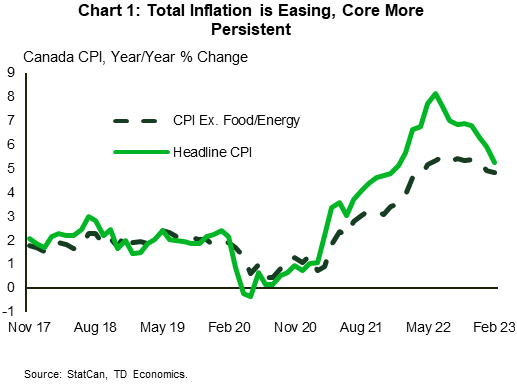
The easing in headline CPI was driven once again by a fall in energy prices (Chart 1 ). Total energy inflation has dropped in six of the last eight months, unwinding all the energy inflation witnessed after Russia invaded Ukraine. The drop in gasoline prices was the driver here, with prices at the pump down 4.7% compared to last year and down 27.9% since last spring. This has caused total goods inflation to go from its peak of 11.2% y/y in June 2022, to 5.27% y/y in February. Even more impressive is that on a three-month annualized basis, goods prices are in deflation at -0.9%, led by durable goods prices, which are falling by -4.8% (Chart 2).
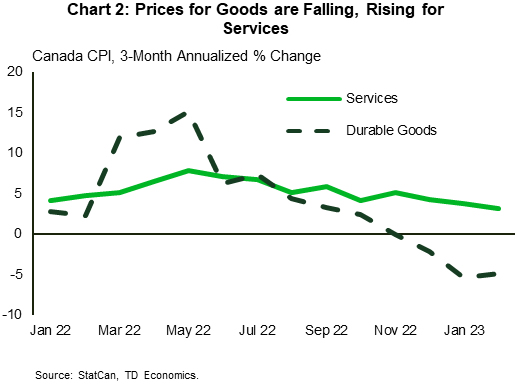
While the easing in goods inflation will act as a tailwind for the BoC in its efforts to bring price growth to the upper edge of its target band of 1% to 3% by the middle of 2023, core inflation metrics have been less agreeable. CPI excluding food and energy was unchanged in February at 4.9% y/y. This is due to the consistent pressure coming from the service side of the economy. Even though goods inflation is moving lower on falling commodity prices and the unwind of supply chain issues, services inflation is still hovering around 30-year highs, at 5.3% y/y. With wages as the main driver of services inflation, the recent upturn in average hourly earnings to 5.4% y/y in February (from 4.5% y/y in January) is a concern.
The increase in wages mirrors the recent revival in economic momentum. With the labour market averaging 67 thousand jobs gained per month since October (nearly 5x the trend rate of job growth), and the government supplementing peoples' incomes through a host of support programs, Canadians have seen incomes rise. Naturally, this has caused people to resume spending at a rapid clip. Retail sales released this morning confirmed this trend, rising 1.4% month-on-month in January. As we outlined in our recent paper on cyclical inflation in Canada (supercore), the current surge in spending risks pushing inflation higher over the coming months. For the BoC, which voiced its concern that "inflation could get stuck materially above the 2% target" in its policy meeting deliberations this week, the cyclical strength in recent data will further complicate matters.
Bitcoin & Gold – Safe Haven Amid Bank Crisis
Investor confidence in the global financial system has been shaken by the collapse of Silicon Valley Bank and Credit Suisse. As a result, many are turning to bearer assets, such as gold and bitcoin, to store value outside of the system without relying on third parties. This has led to a surge in demand for physical gold bars and coins, with some investors even calling for hyperbitcoinisation. With a potential target of around $35,000, both gold and bitcoin may continue to increase in value. Hyperbitcoinisation is a hypothetical scenario in which Bitcoin is widely accepted by merchants and individuals alike, leading to its price rising dramatically and it becoming the dominant form of money in use.
How does this reflect on the Technical Analysis side of things? Let's see;
US Dollar - 4H
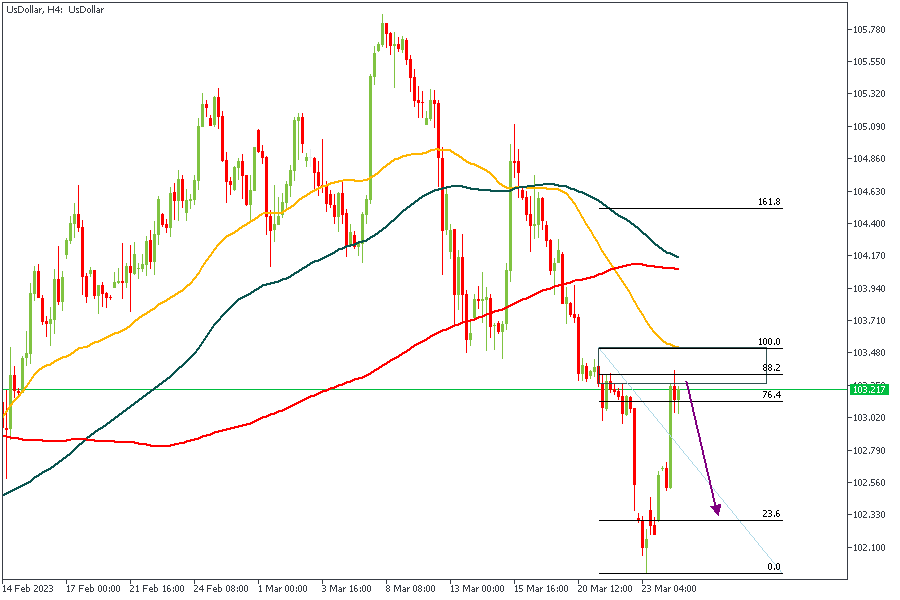
The US Dollar (DXY) after a long bearish run has commenced a move that can be considered as a retracement move; since it has not yet broken through any major price levels yet. This retracement has, however, reached the 88% of the Fibonacci retracement, and there is also the 50-period MA acting as a resistance. Should this play out and the Dollar indeed gets weaker, we can expect to see higher prices on Gold and Bitcoin as investor flock into these 'safe havens.'
Analysts’ Expectations:
- Direction: Bearish
- Target: 102.330
- Invalidation: 103.600
XAUUSD - 1H
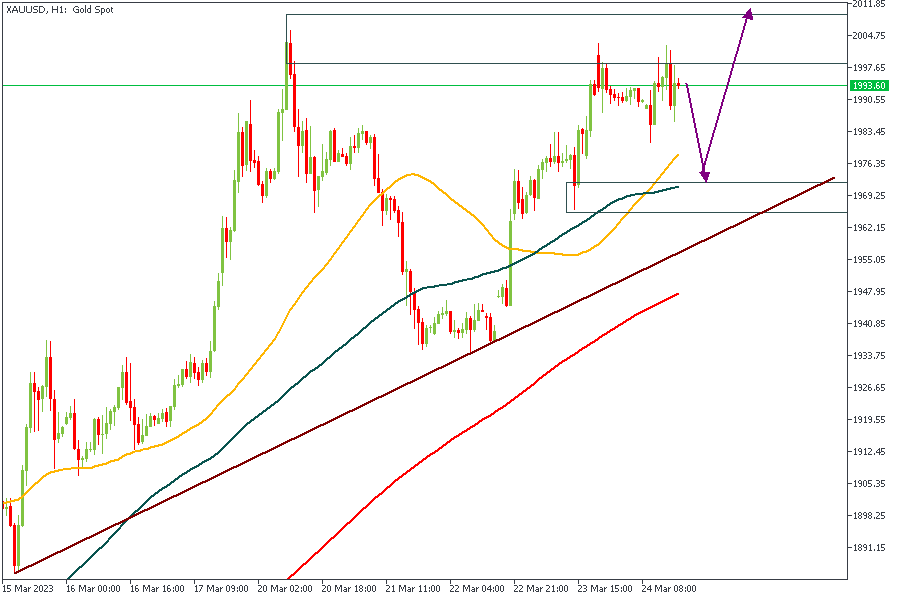
XAUUSD is currently stalking the supply zone at the $2004 price region. If price should be rejected from that zone, I have marked out the $1970 area as a point of interest where we may get to see Gold resume its bullish momentum. The presence of the 50 and 100 MAs is an added confirmation of the bullish intent.
Analysts’ Expectations:
- Direction: Bullish
- Target: $2011.00
- Invalidation: $1962.70
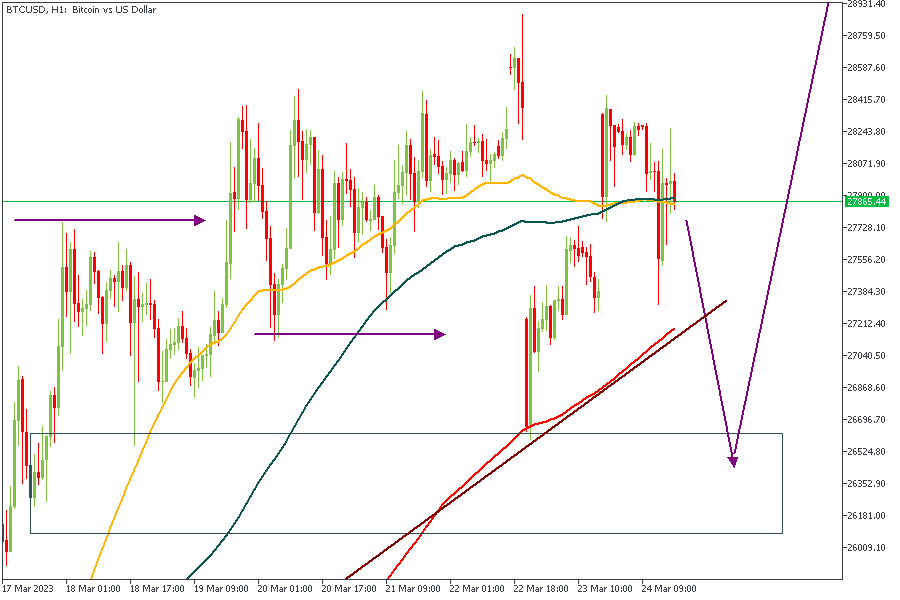
BTCUSD - 1H
BTCUSD (Bitcoin) began a bull-run early this month and has since then maintained a strong bullish sentiment with very abrupt retracements. The current price action on Bitcoin suggests, however, that another retracement could occur - based on the attenuation around the 100 MA. My expectation is that Bitcoin dips slightly lower than the 200 MA and the trendline support, before resuming its bullish momentum.
Analysts’ Expectations:
- Direction: Bearish
- Target: $28,000
- Invalidation: $26,000
CONCLUSION
The trading of CFDs comes at a risk. Thus, to succeed, you have to manage risks properly. To avoid costly mistakes while you look to trade these opportunities, be sure to do your due diligence and manage your risk appropriately.
Weekly Economic & Financial Commentary: Fed Tightening – The End is Nigh
Summary
United States: Federal Reserve Hikes the Fed Funds Rate by 25 bps
- The FOMC hiked the federal funds rate by 25 bps on Wednesday amid continued strength in the labor market and elevated inflation. However, the Committee noted that recent financial system stresses have created considerable uncertainty in the economic outlook and, by extension, the monetary policy outlook.
- Next week: Cons. Confidence (Tue), GDP & Corp. Profits (Thu), Personal Income & Spending (Fri)
International: Central Bank Bonanza
- The Federal Reserve was not the only central bank assessing monetary policy this week. Central banks across Europe and the emerging markets also met to decide the direction of interest rates. As far as G10 institutions, the Bank of England and Swiss National Bank were in the spotlight. In the emerging markets, focus was dedicated to the Brazilian Central Bank.
- Next week: Central Bank of Colombia (Thu), Central Bank of Mexico (Thu), Eurozone CPI (Fri)
Interest Rate Watch: Fed Tightening: The End is Nigh
- The FOMC's post-meeting statement and latest projections suggest that recent stress in the financial system has pulled forward the end of the Fed's tightening cycle. We look for one more 25 bps hike in May before the FOMC holds at 5.00%-5.25% through most of this year.
Credit Market Insights: Consumer Credit Conditions Continue to Tighten
- The latest report from the Federal Reserve Bank of New York’s Survey of Consumer Expectations shows that consumers were already demanding and receiving less credit in February.
Topic of the Week: The Role of Small Banks in U.S. Lending
- Amid turmoil in the financial sector, regional banks have come under pressure. How integral are smaller banks to the broader U.S. economy?
Dollar Index: Intermediate Double Zigzag Likely to Complete Bearish Trend
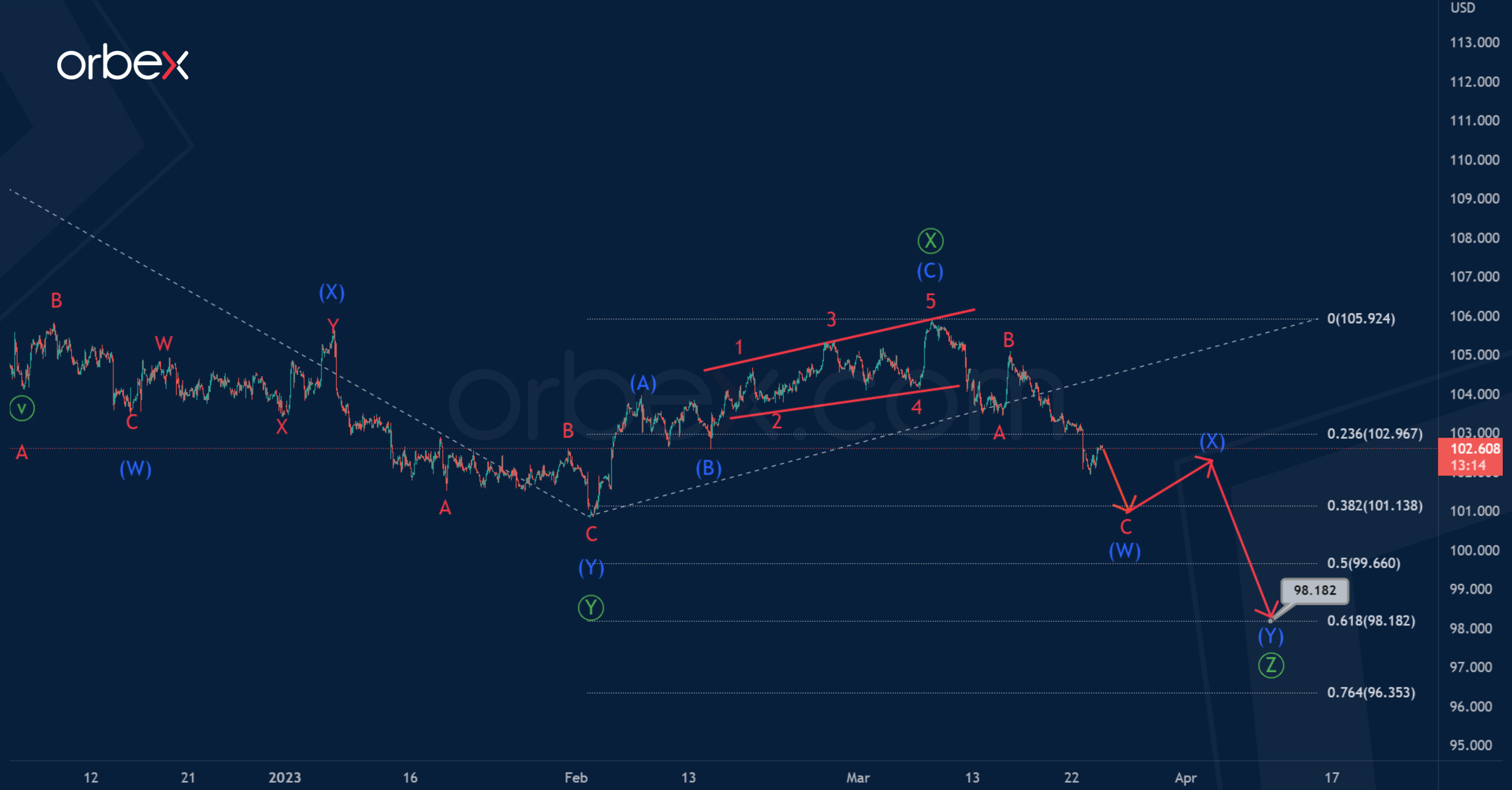
DXY seems to be forming a triple zigzag pattern consisting of primary sub-waves Ⓦ-Ⓧ-Ⓨ-Ⓧ-Ⓩ. The sub-waves Ⓦ-Ⓧ-Ⓨ-Ⓧ look finished. The actionary wave Ⓨ is a double zigzag, the second intervening wave Ⓧ is a standard zigzag.
In the near future, the price depreciation in the primary wave Ⓩ is expected to continue. Judging by the initial part, it can take the form of an intermediate double zigzag.
The final of the bearish trend is expected closer to the 98.182 mark. At that level, primary wave Ⓩ will be at 61.8% of wave Ⓨ.
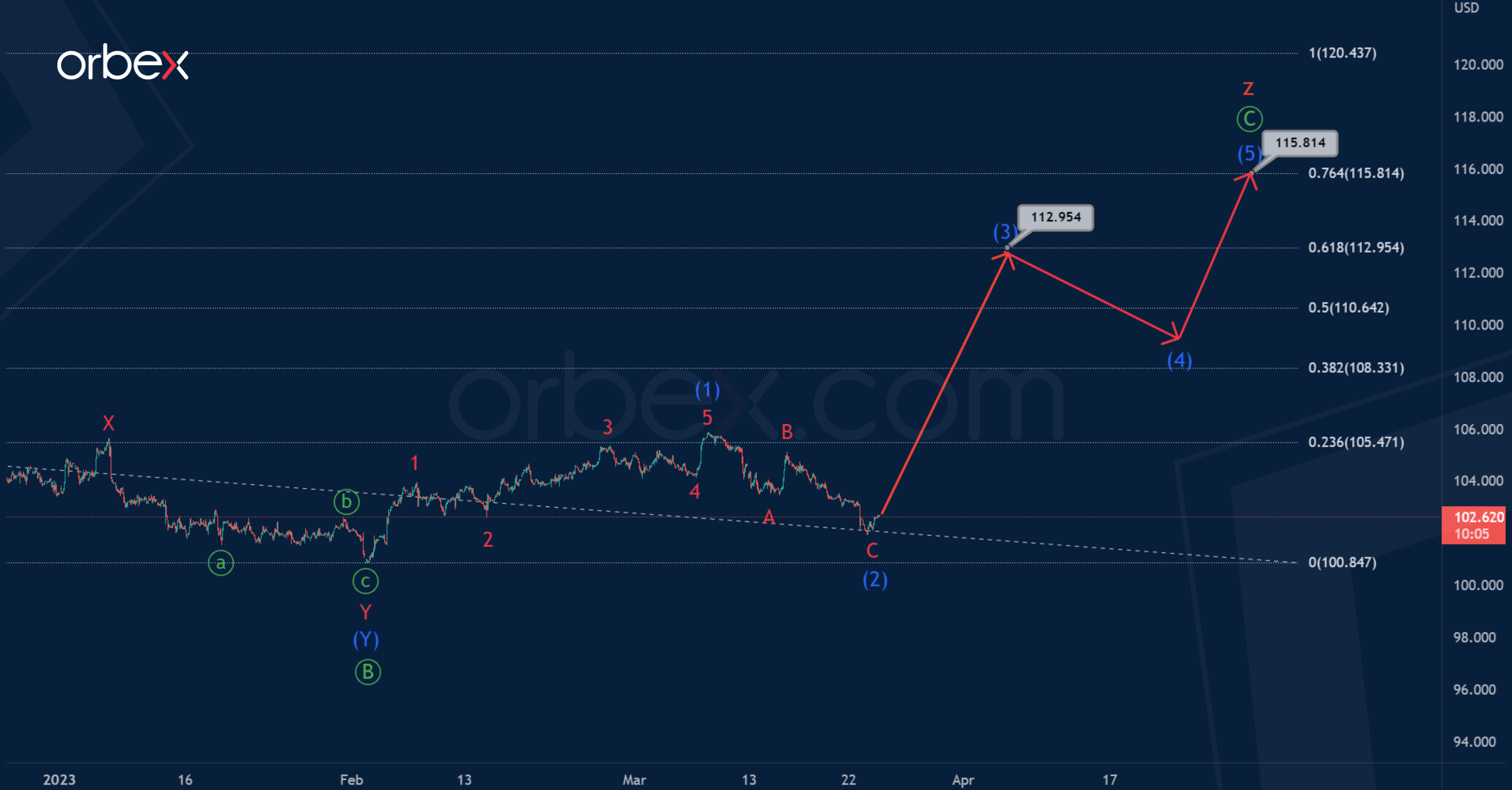
Let's consider an alternative scenario, where the last part of the bullish correction trend is being built – a triple zigzag w-x-y-x-z, that is, a wave z is being formed.
The structure of the wave z is similar to the zigzag Ⓐ-Ⓑ-Ⓒ. In it, the first impulse Ⓐ and the correction Ⓑ in the form of an intermediate double zigzag have already been completed. The entire wave z may end near 115.81. At that level, it will be at the 76.4% Fibonacci extension of wave y.
The first target, to which the bulls can first reach, is the end of the intermediate impulse (3). Its end is possible near 112.95.
Can Gold Move Above $2,000/oz?
Gold got a boost following the Fed's rate decision and managed to poke above $2,000/oz briefly on Thursday. But resistance seems to have been sufficiently strong to keep price action below that level. Given the latest turmoil in the markets and the change in the Fed's position, is there a fundamentals reason for gold to break through? Or can we expect resistance to hold out?
The change at the Fed
The initial reaction from the market was that the Fed had pulled off a "dovish" hike. The increase in the interest rate was according to expectations, but the policy statement changed the language from "ongoing rate hikes" to "some additional firming" of the interest rate. This was widely interpreted as opening the door to a pause. In fact, for the moment, most traders are currently forecasting no rate hike at the next Fed meeting.
Fed Chair Powell's comments afterward, in which he took a decidedly more hawkish stance, reverted that situation a bit. The dot-plot of forecasts from FOMC members showed that their expectations for rates hadn't changed, despite the chaos in the banking sector. Powell's comments were in those lines, suggesting confidence in the backstop for banks meant that the Fed could keep up fighting inflation.
What does that mean for Gold?
Although Powell talked tough, the market is once again not believing him and the rate forecasts of the FOMC members. Not only is the market effectively pricing in a pause, but it's also pricing in a drop in rates this year. That's much to the contrary of what the Fed is saying. The market is once again believing that the Fed will be forced to cut rates to deal with a building recession.
That's extra good for gold this time around. Usually, recessions are a good time to have gold, as investors flock to safe havens. But, over the past year or so, that hasn't been the case because the Fed was still expected to keep hiking as inflation came down. That meant that holding treasuries, which pay dividends, was a better investment than gold, which doesn't pay dividends.
It comes down to inflation expectations
But now that the Fed is expected to quit hiking while inflation is high, the logic that had kept gold from advancing over the last year or so is fading. If inflation is expected to remain high for a long-ish period of time, holding gold is a good option. Even if Treasuries do pay interest, if the interest rate is below the inflation rate, then holding gold is more profitable.
Interest rates are still below inflation at the moment, and if the Fed actually does quit fighting inflation over economic growth concerns, then inflation could remain elevated for a long time. Treasury yields have come down substantially as investors pile into safe havens ahead of an expected difficult period for the markets. That also reduces the attractiveness of treasuries compared to gold.
What that means is that the fundamentals are lining up to push gold higher - as long as the markets are correct in their assessment of the Fed. If the banking situation calms further over the next six weeks, and expectations return for the Fed to keep tightening, then gold could lose its mojo. Gold traders would do well to pay close attention to yields, and particularly the 2-year yield, over the coming weeks.
Eurozone Data Takes Centre Stage, But the Market is On the Lookout for Banking Headlines
With the market remaining on its toes regarding the ongoing banking sector issues, next week brings significant data in the euroland in the form of business surveys and inflation data. The ECB is clearly interested in these economic releases, particularly following last meeting’s change of strategy. However, there is a lingering fear about further negative banking news that could possibly derail the ECB’s tightening effort and put a stop to the euro’s rally.
Central banks would like some quiet time
The universe appears to have moved a few months forward in just three weeks, from the ballooning rate hike projections and the talk about a 6% Fed funds rate in the US to the current subdued rate expectations. Central bankers must have had their world turning upside down over the past weeks, but up to now they have behaved calmly and found some short-term solutions. Whether these would work in the long-term is another story, but central bankers have to remain focused on the economic situation as inflation remains a global issue, while meeting their financial stability responsibilities. A bit of quiet time is a very precious commodity from their standpoint at this juncture.
Following on the path laid down by Lagarde et al last week, Fed chairman Powell announced a rate hike and a possible early end to the current tightening cycle. This abrupt change in the central banks’ strategy is the result of the recent banking sector woes. The collapse of three small US banking institutions and the Credit Suisse saga are expected to significantly impact the overall bank lending and borrowing appetite, potentially rendering further rate hikes unnecessary. The interesting fact from the ECB’s perspective remains that there have not been any euro area bank casualties. If the situation progresses according to the wishes of both the ECB and bank regulators, the market will have a chance next week to refocus on economic releases. At the end of the day, Lagarde laid out the revamped “data dependent” strategy and thus raised the importance of next week’s data.
CPI is the main dish on next week’s menu
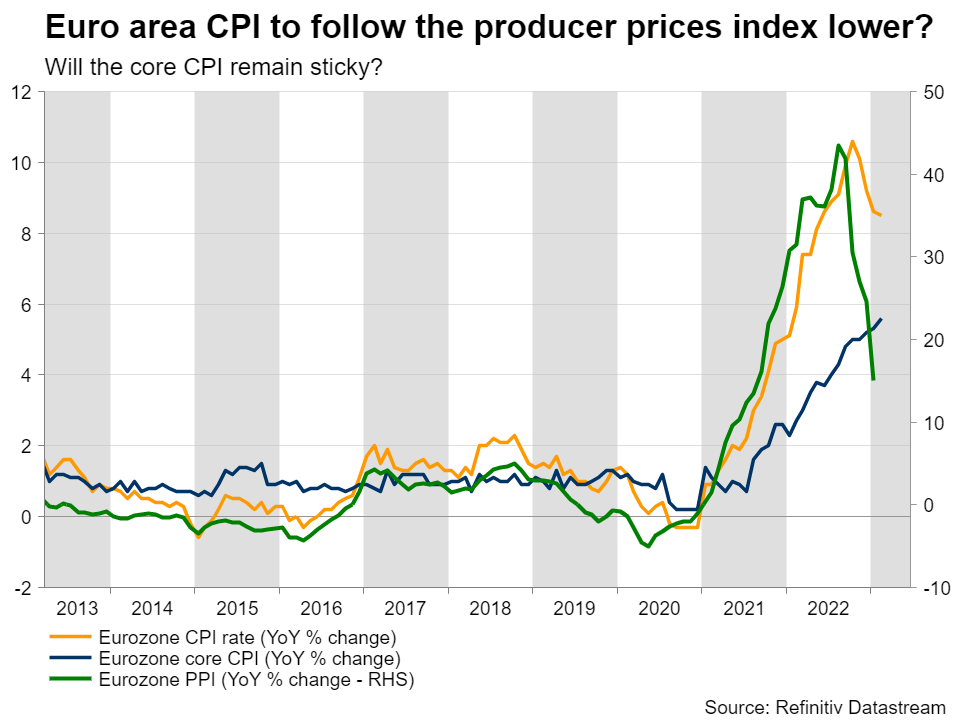
Inflation prints produced the strongest post-announcement volatility during 2022. This appears to have abated somewhat lately, but it is expected to escalate again going forward. On Thursday, we will get a barrage of February CPI prints for the key German states and the preliminary German number, if there are no unforeseen issues like last month. On the following day, the preliminary euro area figure will be released, and the market will be focused on both the trend and the outright level of the inflation figures. The headline number has been on a gentle downward trend, pleasing the ECB, but the same cannot be said for the core component. It has been making higher highs, and a similar print on Friday could result in a plethora of comments from the ECB hawks about the appropriate response at the next rate-setting meeting, especially if it prints above 6% on Friday. On Wednesday morning, the GfK Consumer confidence survey may give us some early hints about the current consumer appetite.
IFO survey on Monday
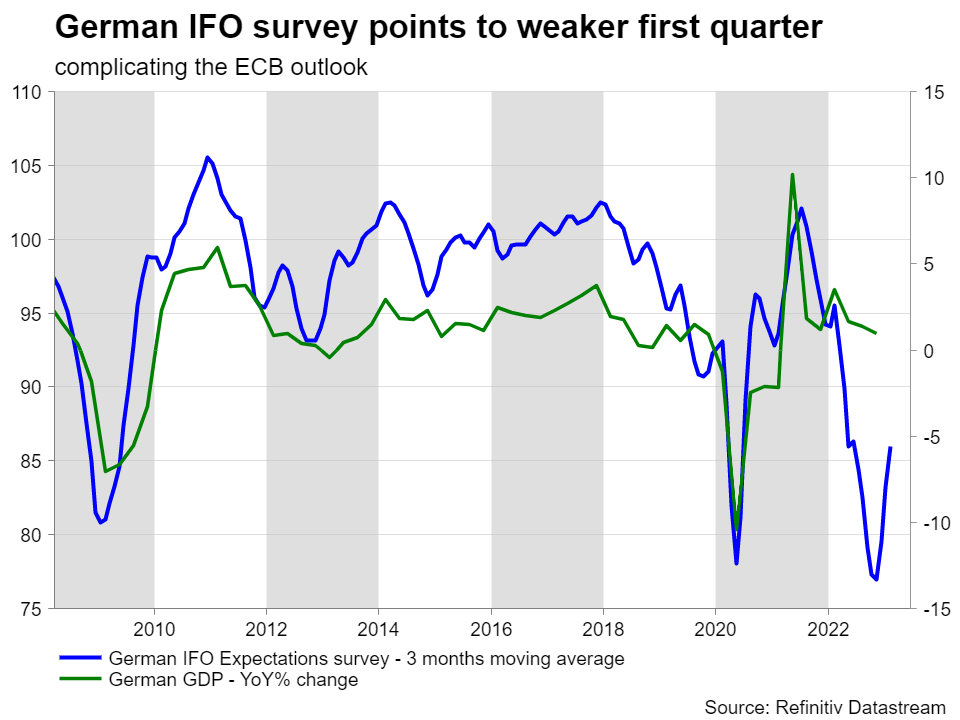
Next week, though, will start on an equally high note as the German IFO survey will be published on Monday morning. The March edition of the most closely watched leading indicator for the German GDP is unlikely to escape from the March performance of both the ZEW survey and PMIs. It is worth noting that part of the IFO survey responses might have come before the Credit Suisse saga and hence Monday’s results might not be entirely representative of the troubling sentiment on the ground. Having said that, the IFO expectations component is already pointing to a weak first quarter GDP, and another print on Monday towards the 75 area would probably cement these bearish expectations.
Swissie remains under pressure against the euro
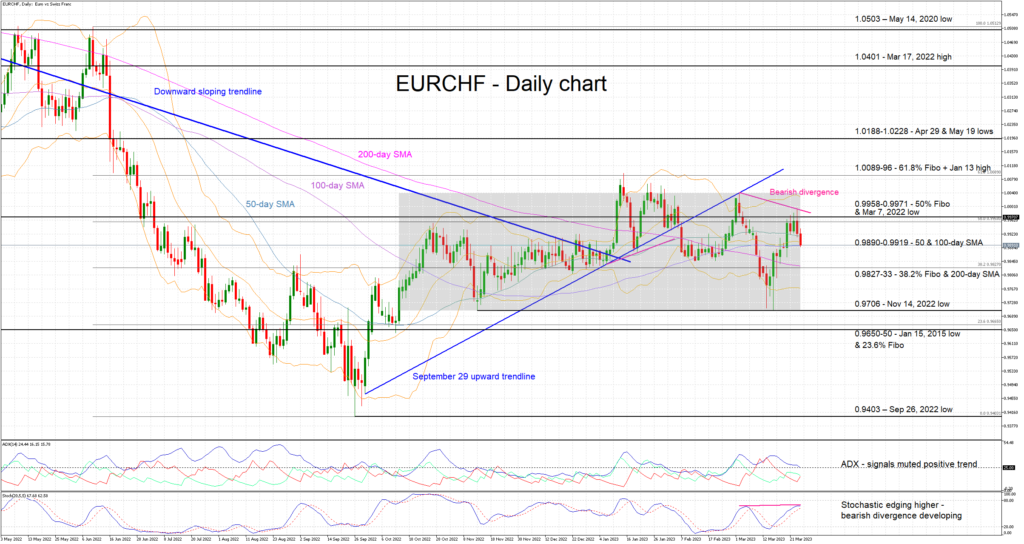
Considering the recent economic developments, the market has managed to not get carried away. Stock indices have somewhat recovered from the early March low and euro/dollar remains elevated but far from the early February high of 1.1032. Gold and Bitcoin have clearly been the main beneficiaries of the recent market rout as they continue to keep their gains. This could potentially reveal increased hesitation from investors at this stage.
The euro/swissie pair has understandably received increasing attention recently. Since October 13, 2022, this pair has actually been trading inside the 0.9706-1.0041 range. More recently, the Credit Suisse woes allowed the swissie bears to stage a quick recovery towards the busy 0.9960 level. The area extending up to 1.0096 has been a landmine for euro bulls and, at the moment, the overall technical picture is not overly supportive of their intentions. Particularly, the developing bearish divergence between the stochastic oscillator and euro/swissie could derail their plans to aim for a new 2023 high. On the other hand, the appetite by the swissie bulls will be tested at the 50- and 100-day simple moving averages.
Week Ahead – Eurozone and US Inflation to Come Under the Microscope After Rate Decisions
Amid ongoing jitters about the fallout from the banking sector, inflation will fall back into the limelight next week. The flash CPI readings for the euro area as well as the PCE inflation figures out of the United States will grab most of the headlines, in an otherwise quiet week. Australia will also get inflation data, and in Japan, Tokyo prices will be watched. Hot CPI numbers could roil markets as central banks have indicated that they are not about to take their eye off the ball during these turbulent times.
Will PCE inflation further complicate the Fed’s rate path?
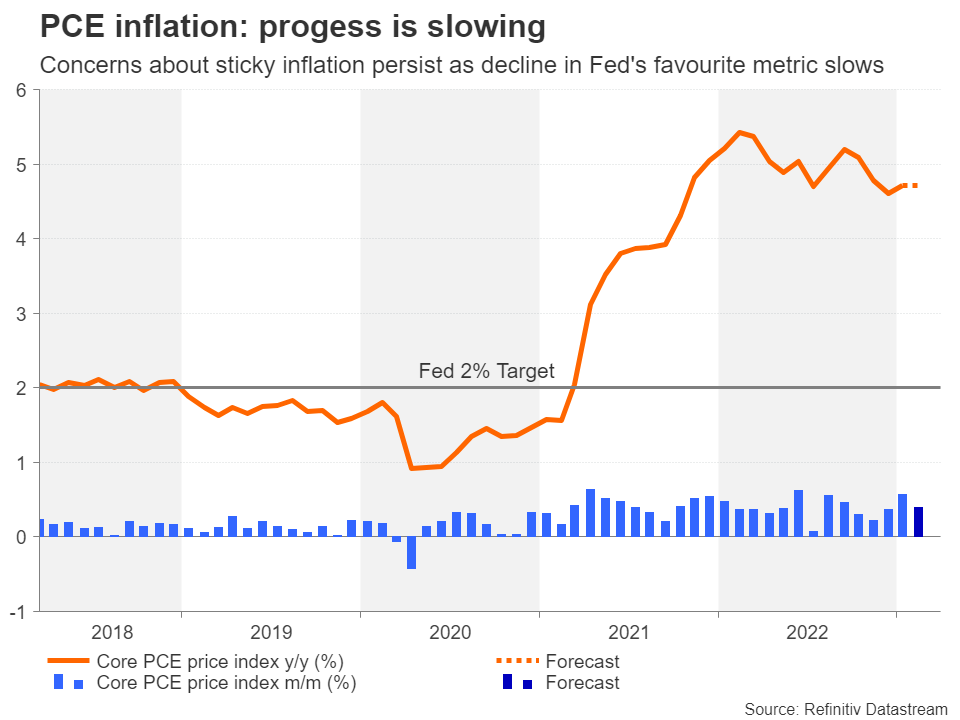
Hot on the heels of the FOMC meeting and the banking crisis, investors will have to digest another dose of inflation data out of America. The PCE inflation report comes out on Friday along with personal income and spending numbers. Whilst there’s been good progress in overall price pressures easing in recent months, the Fed is focusing its efforts these days on services inflation, and on that, Chair Jerome Powell’s latest assessment is that there has not been any progress when excluding housing components.
Policymakers will get the chance to take another look at February prices, this time in the form of the core PCE price index. The Fed pays a lot more attention to this particular measure of inflation so any upside surprises could boost bets of a follow-up 25-basis-point rate hike in May, which at the moment, the odds are constantly swinging above and below 50%.
The strength of the consumer will be in focus too, with the Conference Board’s closely watched consumer confidence gauge out on Tuesday and the personal consumption print due Friday. The former is more forward looking so any deterioration in the March figure might be associated with the blow up of regional banks.
In other data, housing indicators from S&P Corelogic Case-Shiller Index (Tuesday) and pending home sales (Wednesday) will be important amid signs that the sector is rebounding after falling off a cliff last year when the Fed’s tightening campaign went into overdrive. The final estimate of Q4 GDP is due Thursday, and finally, the Chicago PMI will round up Friday’s releases.
With market sentiment still quite fragile in the aftermath of the bank collapses, investors are more likely to react negatively to strong data as they would give the Fed less reason to be cautious. However, this may not necessarily lift the US dollar much, as even in the most bullish scenario, the Fed’s terminal rate has permanently shifted lower.
Eurozone inflation expected to edge down again
The European Central Bank may have dropped its forward guidance in March, but since that meeting, policymakers have been eager to signal that further rate increases are nevertheless likely in the coming months as inflation remains far above their 2% target. Headline inflation could ease below 8% when the flash estimates for March are published on Friday. However, the bigger headache for the ECB is the continued climb in the underlying measures of inflation.
When excluding food, energy, alcohol and energy, the consumer price index is forecast to creep up to 5.8% in March from 5.6% in February.
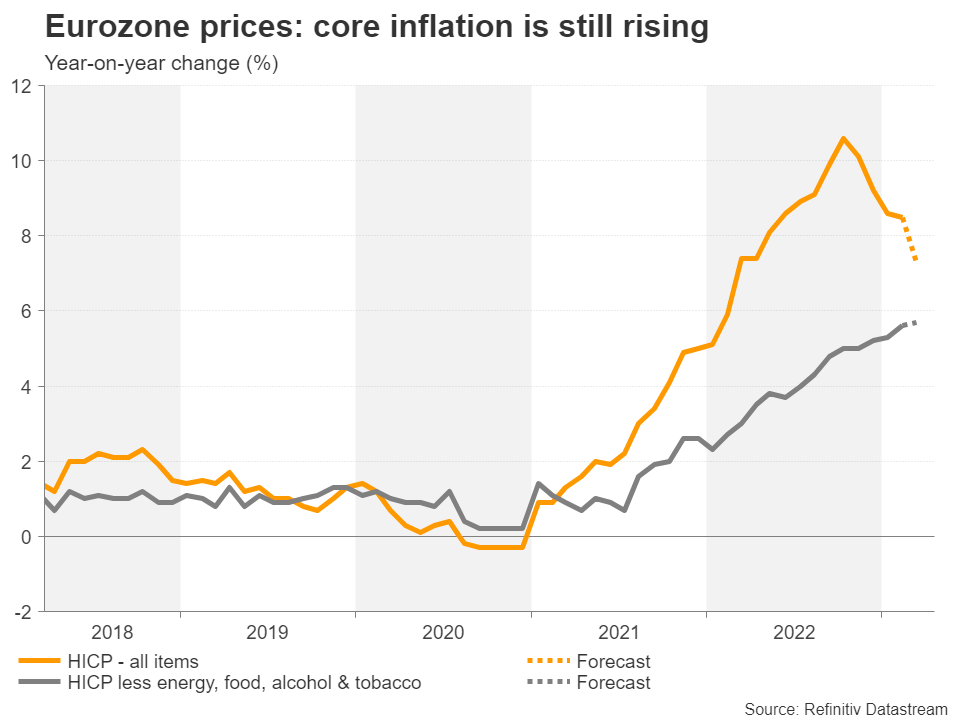
The longer this trend continues, the greater the odds that the ECB will remain on a tightening path and the possibility of that happening whilst the Fed goes on pause is buoying the euro. Having consolidated over the last couple of months, the euro has a good chance of surpassing its February 2 peak of $1.1033 as long as the impact from the banking crisis on the Eurozone economy remains contained.
It’s a different matter in the US, however, where there is a heightened risk of a credit squeeze even if there aren’t any fresh casualties from the fallout of Silicon Valley Bank’s collapse. Powell himself has highlighted the danger that credit conditions are likely to tighten regardless of whether there are further rate increases, as banks turn more cautious and hand out fewer risky loans.
That’s not to say, though, that the European economies won’t feel any aftershocks and investors will be on alert for any dip in business confidence. The March surveys will kick off on Monday with Germany’s Ifo business climate index, followed by the Eurozone economic sentiment indicator on Thursday.
Aussie eyes CPI data as RBA pause hangs in the balance
The Reserve Bank of Australia started its debate about pausing long before the banking turmoil and will probably be even more inclined to do so at its April meeting. Markets have currently priced in about 90% probability of a pause and inflation figures due on Wednesday could push those bets closer to 100% if they unexpectedly decline further.
The RBA is hoping that inflation peaked in December when it hit 8.4% before sharply dropping to 7.4% in February. Another fall in March would be seen as sealing the deal for an April pause, although such an outcome would not bode well for the Australian dollar.
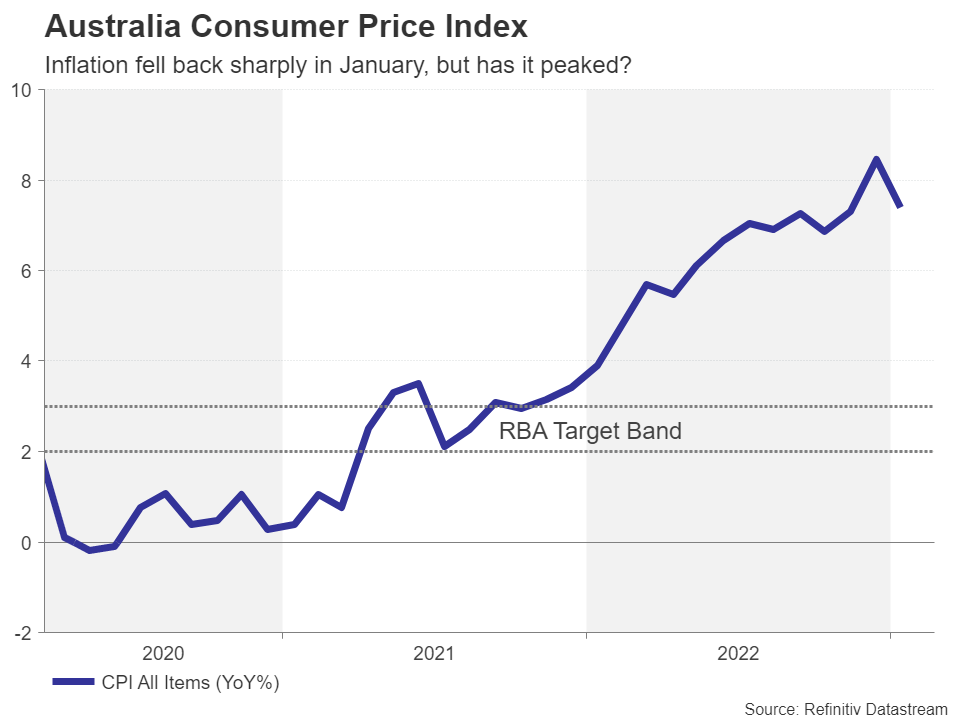
Alternatively, stronger-than-expected CPI readings would be positive for the aussie, and there could be some upside too from manufacturing PMIs out of China on Friday should they point to a further rebound in the economy in March.
Japan’s inflation picture still unclear
Sticking to the Asia-pacific region, it’s a data heavy week in Japan, with the flurry primarily taking place on Friday. Preliminary industrial production stats, retail sales and the jobless rate, all for February, are on the agenda. But of most interest to investors will likely be the March CPI prints for the Tokyo region, which are seen as a precursor for the nationwide numbers published much later.
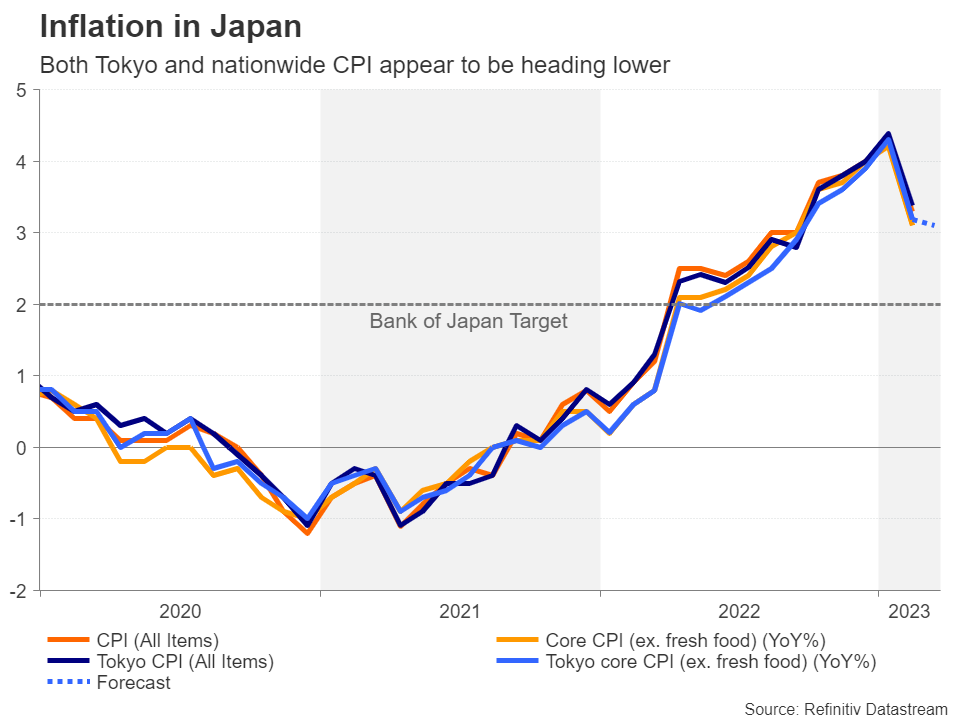
Japan’s inflation rate eased back sharply in February, taking the pressure off the Bank of Japan to further scale back its stimulus policies. The March forecast is that core CPI in Tokyo continued to moderate slightly. The yen, which has been on a roll lately against its US counterpart, might struggle to extend its gains if the forecasts are met.
However, in the event that inflation reverses higher again, this could intensify speculation of some sort of policy action by the BoJ at its April meeting, as it would come on the back of the Spring wage negotiations where labour unions agreed to an inflationary pay deal that averages at 3.8% y/y.
Weekly Focus – Central Banks Hold Steady Course Despite Banking Jitters
After UBS' takeover of Credit Suisse and the wipe-out of AT1 bondholders, risk sentiment remained on shaky grounds this week. Investors took courage from comments from European regulators that reiterated that common equity instruments are first in line to absorb losses before AT1s. Yields started to rebound and markets have now repriced the ECB peak rate back to 3.5%. As more time lapses (without more negative news on the banking turmoil), more focus will return to macro data - which still warrants further repricing higher in our view. President Lagarde delivered a fairly balanced speech at the ECB watchers conference, stressing that policymakers will maintain a data-dependent approach that allows it to respond to inflation risks, but also aid financial markets if threats emerge. She also repeated that if the ECB's baseline holds there will be more ground to cover in terms of future rate hikes.
After ECB remained in tightening mode last week, also the Federal Reserve chose to hold a steady course this week and hiked policy rates by 25bp. That said, both the statement and Fed chair Powell's comments were tilted to the dovish side, highlighting that the 'recent (banking sector) developments are likely to result in tighter credit conditions for households and businesses and to weigh on economic activity, hiring, and inflation'. US Treasury yields declined again after the meeting and EUR/USD ticked higher. Equity markets came under renewed pressure after US Treasury Secretary Yellen commented that the US is not considering a 'blanket insurance' for bank deposits. For now, we stick to our call of a final Fed hike in May, and no rate cuts through 2023 (see also Fed review: A cautious 25bp hike, 22 March). Bank of England also hiked its policy rate by 25bp to 4.25%, after inflation surprisingly accelerated again in February (see also Bank of England Review - Set for another 25bp hike in May, 23 March).
Chinese President Xi Jinping concluded his three-day-visit in Moscow. During the visit China's peace proposal was discussed, but also a deepening trade relationship. We have doubts that China's peace proposal will gain traction, as it has been widely criticized by the US, and Ukraine and Russia are very far from each other in their individual demands. A key concern that could escalate global tensions has been whether China would deliver weapons to Russia, but so far there are few indications of this.
With the big central bank meetings out of the way, developments in the banking sector will continue to set the tone for markets in the near-term. In the US, focus remains on any signs of tightening bank credit standards, the use of Fed's liquidity facilities and FOMC commentary. In light of ECB's data-dependence, markets will also keep a close eye on the euro area HICP figures for March released on Friday. Despite a further decline in headline inflation to 7.9%, we expect them to show still a picture of strong underlying inflation pressures, with core inflation remaining unchanged at 5.6%. The official Chinese PMIs are also on the agenda on Friday. After the rebound in February, we look for a moderation in March, as the initial post-covid lift in activity is likely to fade. However, overall PMIs in both manufacturing and services should still signal above-trend growth, and thus a continued recovery.