Sample Category Title
USD/JPY Mid-Day Outlook
Daily Pivots: (S1) 130.35; (P) 131.50; (R1) 132.46; More...
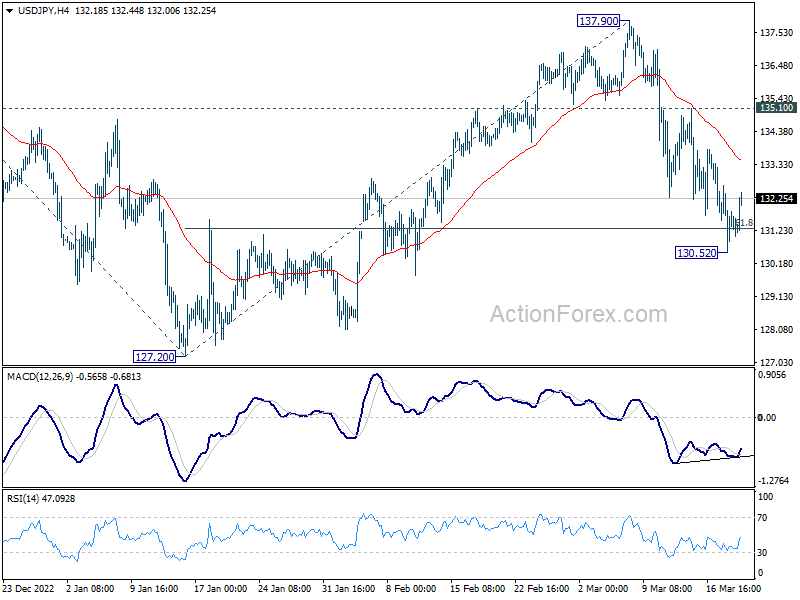
A temporary low should be in place at 130.52 in USD/JPY. Intraday bias is turned neutral first. But further decline is expected as long as 135.10 resistance holds. The current favored is that rebound from 127.20 has completed at 137.90 already. Sustained trading below 61.8% retracement of 127.20 to 137.90 at 131.28 will pave the way to retest 127.20 low next. However, break of 135.10 will turn bias back to the upside for 137.90 instead.
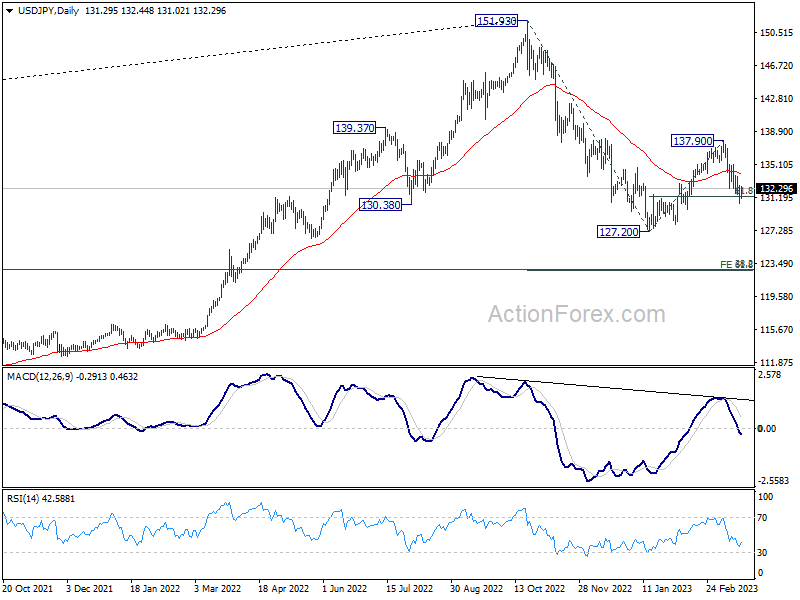
In the bigger picture, rebound from 127.20 should have completed at 137.90 as a corrective move, with strong break of 55 day EMA. The down trend from 151.93 (2022 high) is not over yet. Break of 127.20 will resume this down trend and target 61.8% projection of 151.93 to 127.20 from 137.90 at 122.61. This will now be the favored case as long as 137.90 resistance holds.
USD/CHF Mid-Day Outlook
Daily Pivots: (S1) 0.9251; (P) 0.9281; (R1) 0.9323; More...
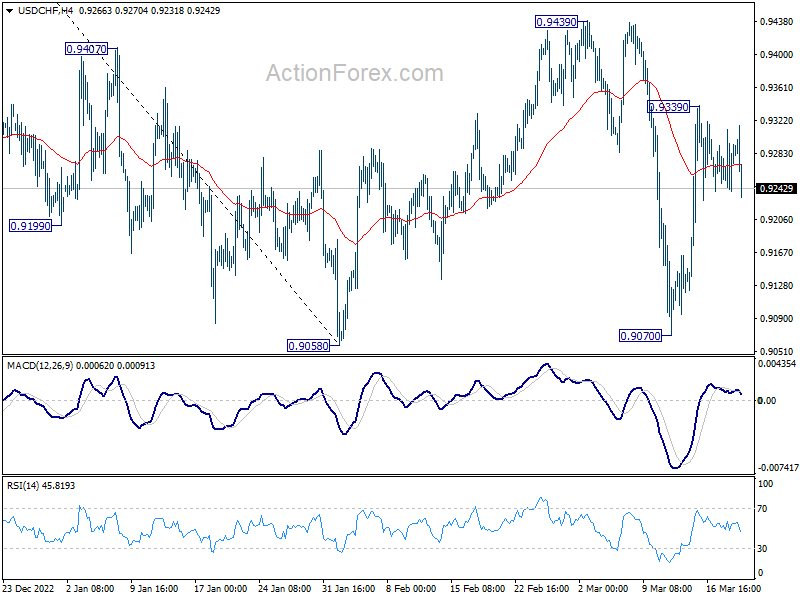
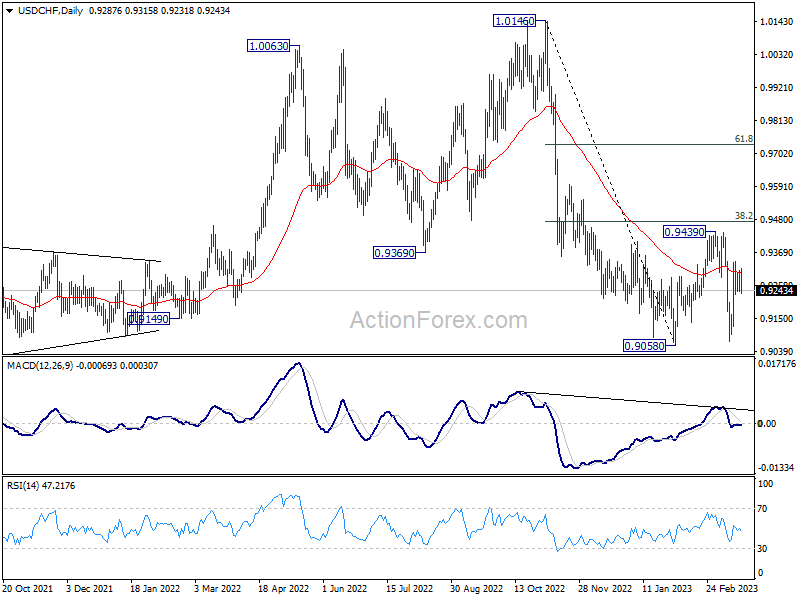
USD/CHF is staying in tight range below 0.9339 and intraday bias remains neutral. Corrective pattern from 0.9058 low should still be in progress with rise from 0.9070 as the third leg. Above 0.9339 will target 0.9439 resistance and possibly above. But overall, outlook will stay bearish as long as 0.9474 fibonacci level holds, and another decline through 0.9058 is expected at a later stage.
In the bigger picture, fall from 1.1046 (2022 high) should still be in progress with 38.2% retracement of 1.0146 to 0.9058 at 0.9474 intact. Rejection by 55 week EMA was a medium term bearish sign. Break of 0.9058 will resume such decline towards 0.8756 support (2021 low). But overall, such fall is still as a leg in the long term range pattern from 1.0342 (2016 high). So, downside should be contained by 0.8756 to bring reversal.
GBP/USD Mid-Day Outlook
Daily Pivots: (S1) 1.2202; (P) 1.2244; (R1) 1.2320; More...
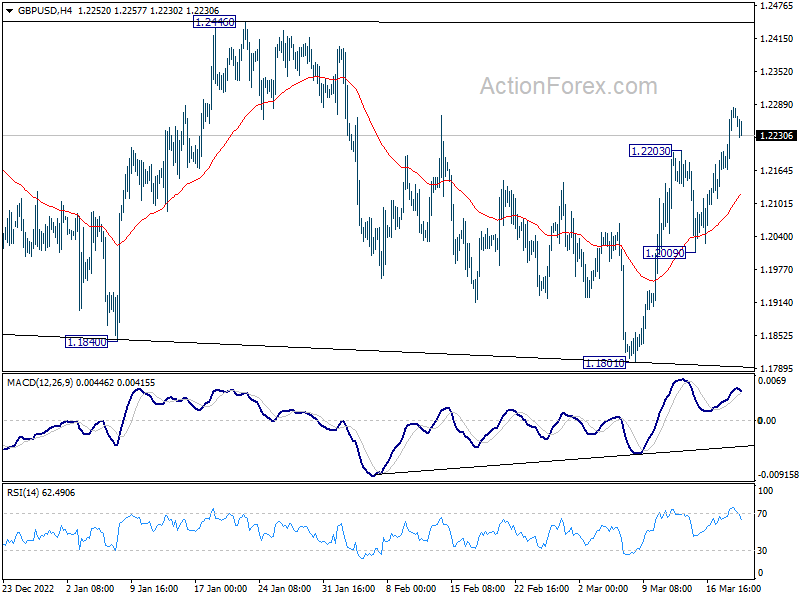
GBP/USD's rise from 1.1801 should be in progress and intraday bias stays on the upside for 1.2445/6 resistance zone. As noted before, corrective pattern from 1.2445 could have completed with three waves to 1.1801 already. Firm break of 1.2445/6 will resume larger rise from 1.0351, and target 1.2759 fibonacci level. For now, outlook will stay cautiously bullish as long as 1.2009 support holds, in case of retreat.
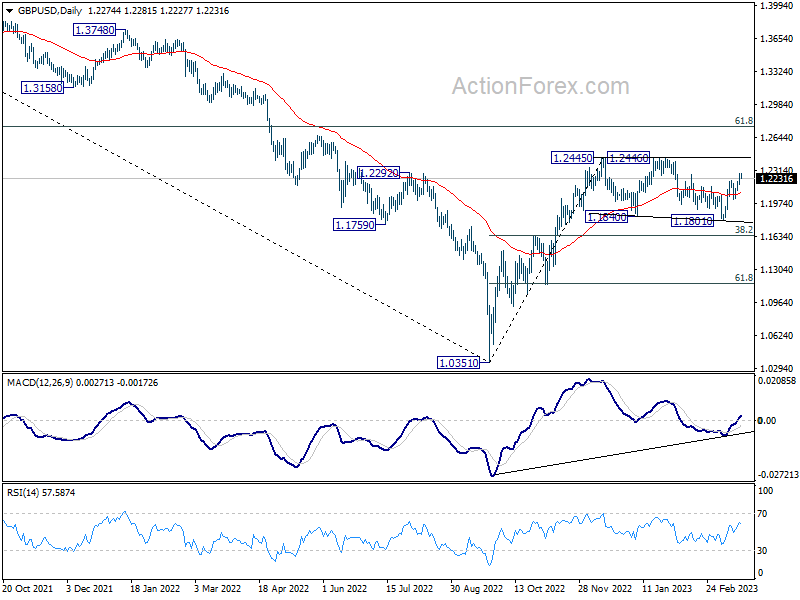
In the bigger picture, price action from 1.2445 are seen as a corrective pattern to rise from 1.0351 medium term bottom (2022 low). Resumption is expected as a later stage and firm break of 1.2446 will target 61.8% retracement of 1.4248 (2021 high) to 1.0351 at 1.2759. This will remain the favored case as long as 38.2% retracement of 1.0351 to 1.2445 at 1.1645 holds.
Crude Oil Finds Support
By the start of European trading on Monday, WTI had lost over 20% from its high of $80.96 on 7 March to a low of $64.36. The sell-off that intensified last week may well be giving way to a new buying impulse in oil. Oil is broadly back in long-term equilibrium, and it would take a significant shift in the supply/demand balance to trigger a further sell-off or a new round of growth.
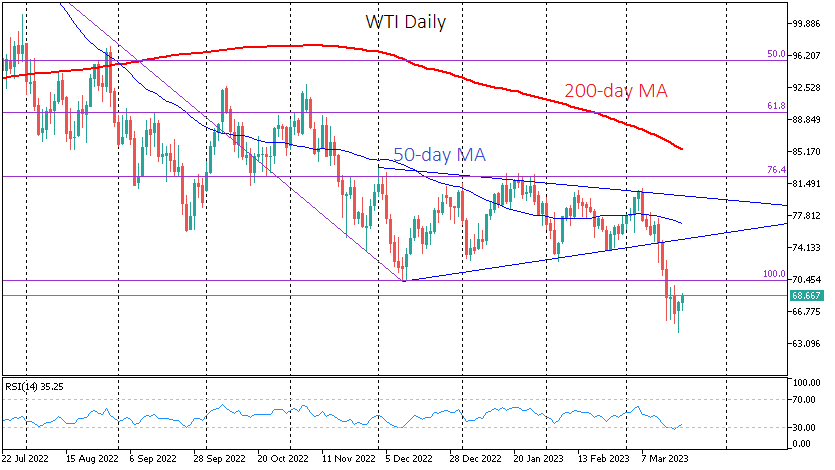
Between December and early March, prices consolidated in a narrowing range with an equilibrium point near $77/bbl. This pattern had a good chance of breaking the lower end of the spectrum.
Powell’s speech to Congress sent oil out of risky assets on fears of a sharp rate hike. However, the lower boundary of the triangle was stormed by WTI on the contrary, on fears that the banking crisis would slow economic growth and dampen demand.
Technical factors played an equally important role in the bearish move: a break of the three-month range triggered a capitulation by medium-term speculators, reinforcing the downward movement.
The March sell-off took oil into the over-bought territory on the daily RSI. Yesterday’s intraday reversal, complemented by today’s buying, brought the index back into neutral territory, signalling at least a corrective bounce.
Moving to higher timeframes, after a short-term dip, oil buyers yesterday came back below the 200-week moving average, which acts as a long-term trend indicator. Yesterday’s approach to the $64 level has also been a turning point for oil over the past four years, working as resistance until April 2021 and support after that.
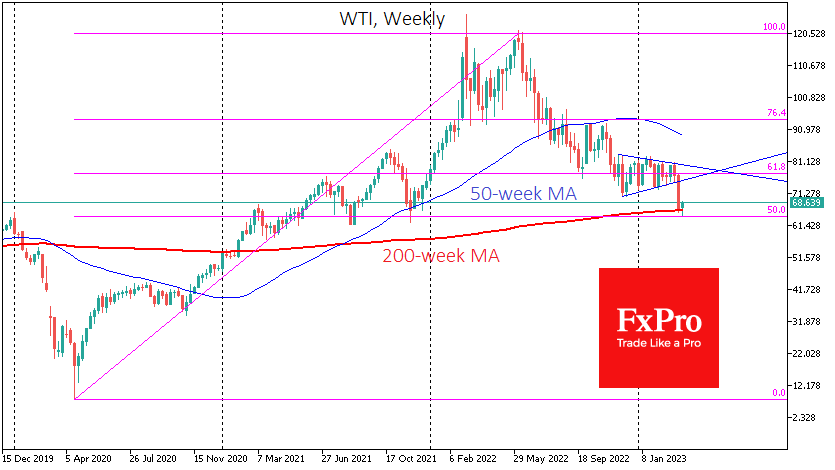
Yesterday’s lows were also close to 50% of the entire spot trading range from the lows of April 2020 to the highs of June last year.
A change in fundamentals would be needed for oil to go permanently lower. For now, we are seeing attempts by central banks to stabilise banks, bringing back demand for risky assets. At the very least, this buys time for the oil to recover in the short term.
A pullback from meaningful levels could see WTI bounce back to $71.50 or even $74 in the coming weeks. However, a sustained rally above oil would require more than a technical shake-out but a change in the fundamental backdrop.
Canada: Inflation Cools Further in February
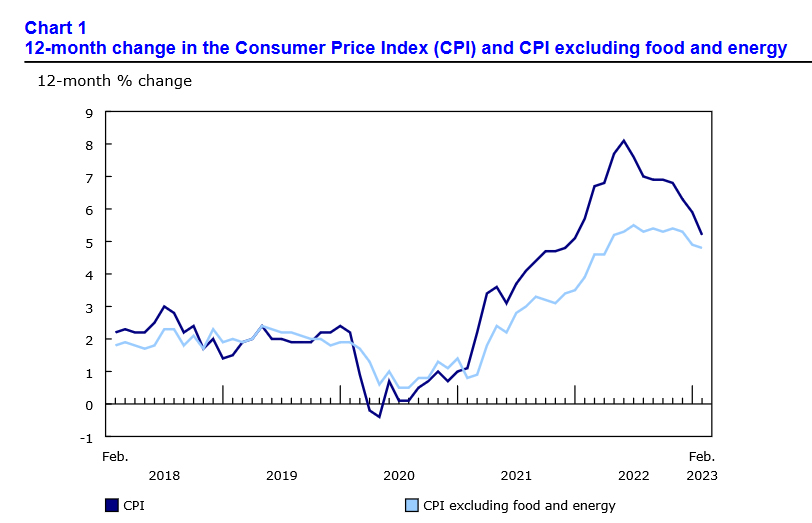
Consumer price inflation continued to ease up in February, at 5.2% versus a year ago (y/y), from 5.9% in January. That is a couple of ticks lower than forecasters were expecting.
For the first time in over two years, energy prices declined on a year-on-year basis – 0.6% y/y. Gasoline prices led the drop, and are down 4.7% versus a year ago.
Food inflation also cooled in February, but remained at an eye-popping 9.7% y/y, versus 10.4% in January.
Shelter inflation continued to cool, but was still up 6.1% y/y in February. Homeowners' replacement costs slowed to 3.3% y/y, however the mortgage interest cost index continued to rise at a faster year-over-year pace amid the higher interest rate environment, rising 23.9% in February, the largest increase since July 1982.
There were a couple of areas where price pressures picked up on a monthly basis. Clothing and footwear inflation rose 0.7% m/m, after a 0.3% m/m decline in January and household operations, furnishings and equipment rose 0.9% m/m after a 0.4% decline in January.
Underlying inflation pressures cooled modestly in February. CPI ex-food and energy eased one tick to 4.8% y/y from 4.9% in January. The BoC's core inflation gauges also eased in February, with CPI-trim at 4.8% y/y (5.1% in Jan.) and CPI-median at 4.9% y/y (5.0% in Jan.).
Year-on-year changes can be heavily influence by base effects, and zeroing in on inflation trends over the past three months shows that the BoC core measures are running at 3.8% on an annualized basis for median and 3.3% for trim. This suggests that underlying inflation pressures will head lower on a year-on-year basis in the coming month.
Key Implications
Inflation in Canada continues to cool from it's peak pace last year. However, with the core measures just below 5% y/y, they still have a way to go before they are comfortably within the Bank of Canada's target 1-3% range. As outlined in our recent forecast, we expect that to be achieved in the second half of the year.
There was nothing in today's inflation report that would move the Bank of Canada off of its pause on interest rate moves. Unlike the Federal Reserve, domestic inflation trends mean the BoC can ride out the current volatility in financial markets driven by stresses in the banking sector internationally
USD/CHF – Swiss Franc Climbs Higher, SNB Meeting Eyed
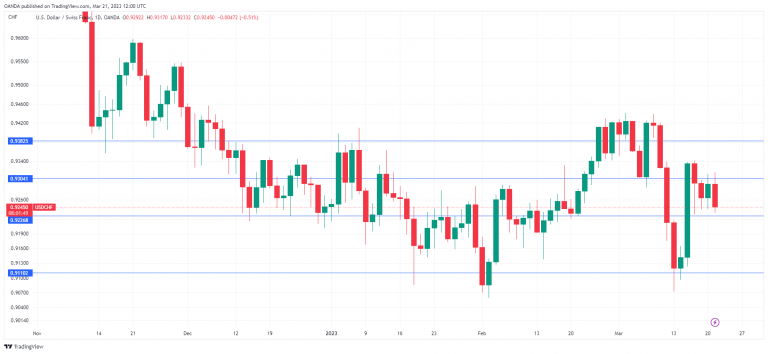
The Swiss franc is showing some strength on Tuesday. In the European session, USD/CHF is trading at 0.9238, down 0.58%.
SNB expected to hike but by how much?
The turmoil which has roiled the financial markets over the past week has eased today. European stock markets are steady, and shares of UBS and Credit Suisse are both higher. The extraordinary measures taken on the weekend, namely, the emergency takeover of Credit Suisse by UBS and the coordinated move by six major central banks to boost liquidity appear to have had a calming effect on jittery investors. These moves may have achieved the critical goal of containing the contagion in the banking system and avoiding a full-scale financial crisis.
The bank crisis has shocked investors, as Credit Suisse, the second largest bank in Switzerland, has toppled like a deck of cards, with its share price plunging to below one Swiss franc. The consolidated Swiss banking sector has lost a key player in a matter of days, and the stellar reputation of the Swiss banking system has been dealt a huge blow. One analyst went as far as stating that the demise of Credit Suisse has turned Switzerland into a “financial banana republic”.
The volatility in the foreign exchange markets has paled in comparison to the turmoil in the equity and commodity markets. Still, the Swiss franc has lost ground against the US dollar and the euro since last week, when Credit Suisse collapsed. This points to the Swissie losing some of its attraction as a safe-haven asset.
In the midst of the bank crisis, the Swiss National Bank (SNB) holds a policy meeting on Thursday. The markets have priced at 50/50 the odds of a 25 or 50 basis point increase. Like the ECB, SNB policymakers face a dilemma of whether to remain aggressive in the fight against inflation or to ease up due to concerns over the turmoil in the Swiss banking sector. The ECB opted for the 50-bp move and we’ll have to wait and see if the SNB follows suit.
USD/CHF Technical
- USD/CHF faces resistance at 0.9304 and 0.9382
- 0.9226 and 0.9110 are providing support
EUR/USD Mid-Day Outlook
Daily Pivots: (S1) 1.0660; (P) 1.0696; (R1) 1.0759; More...
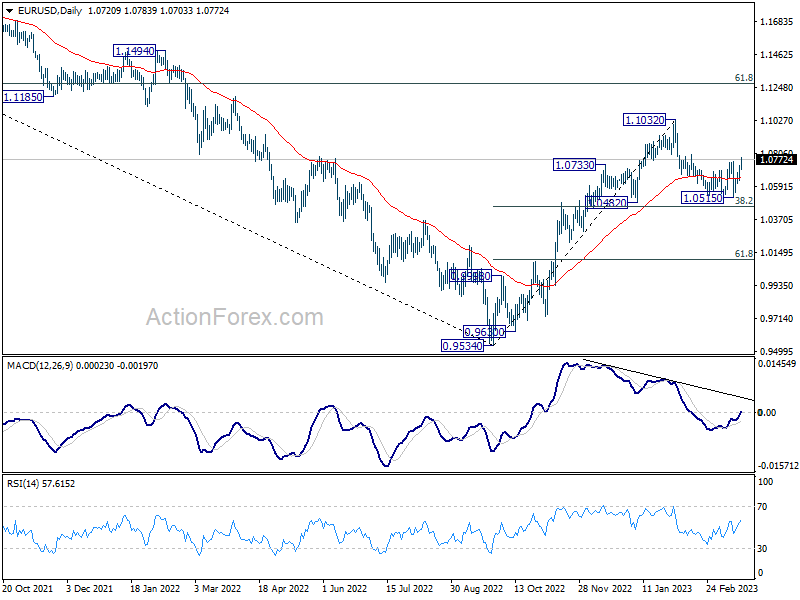
EUR/USD's break of 1.0759 resistance suggests that correction from 1.1032 has completed at 1.0515 already. That came after defending both 1.0482 support and 38.2% retracement of 0.9534 to 1.1032 at 1.0258. Intraday bias is back on the upside for retesting 1.1032 high next. On the downside, below 1.0703 minor support will turn intraday bias neutral again first.
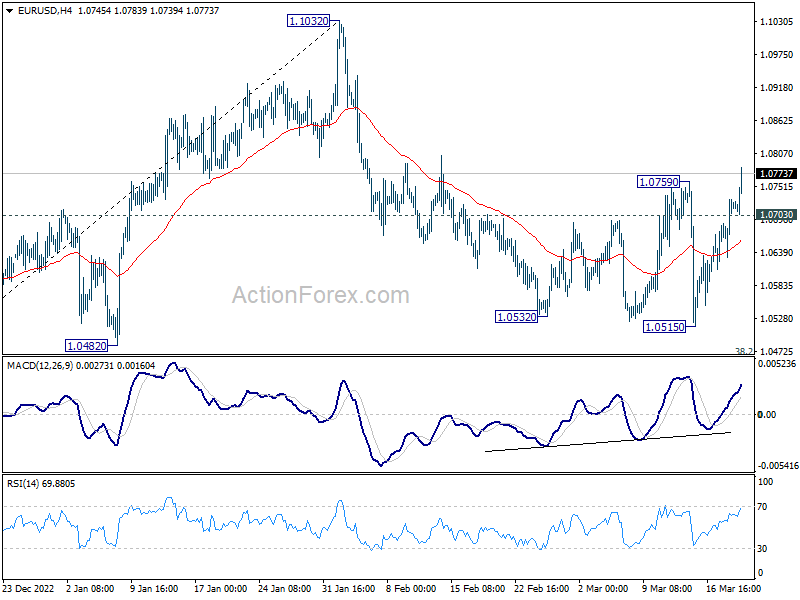
In the bigger picture, as long as 1.0482 support holds, rise from 0.9534 (2022 low) should continue to 61.8% retracement of 1.2348 (2021 high) to 0.9534 at 1.1273. However, sustained break of 1.0482 will bring deeper fall to 61.8% retracement of 0.9534 to 1.1032 at 1.0106, with risk of breaking through 0.9534 eventually.
Euro Strengthens Despite Poor German Economic Sentiment
Euro rises broadly today partly as overall sentiment stabilized. Technical also play a role as the common currency defended near term support levels against both Sterling and Aussie. Poor Germany economic sentiment data was basically ignored by the markets. Market participants appeared to dismiss the poor economic sentiment data from Germany, with the belief that the decline could be temporary
Simultaneously, Swiss Franc and Dollar are making recoveries against other currencies. Canadian Dollar showed little response to lower-than-anticipated CPI readings, which essentially reinforced BoC's decision to maintain the current interest rate levels, at least for the near future. Other commodity currencies, however, are exhibiting weakness. Australian Dollar, for instance, is facing pressure following the RBA minutes, suggesting a potential pause in their next meeting.
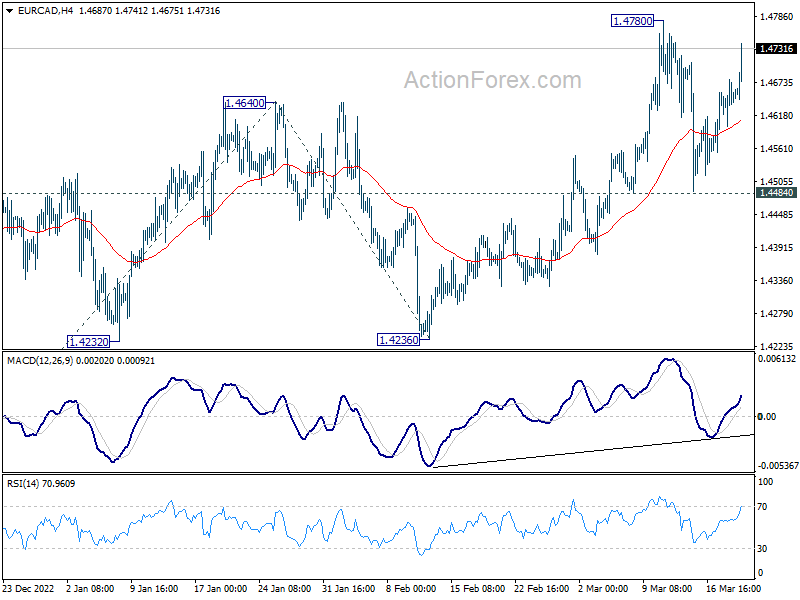
Technically, EUR/USD's break of 1.0759 resistance is taken as an indication of near term reversal. That is, further rise is now likely to be seen back to retest 1.1032 high. Two focuses will now be on 1.4780 resistance in EUR/CAD and 1.6200 resistance in EUR/AUD. Break of these two levels should solidify Euro's upside momentum.
In Europe, at the time of writing, FTSE is up 1.81%. DAX is up 1.87%. CAC is up 1.82%. Germany 10-year yield is up 0.1525 at 0.273. Earlier in Asia, Hong Kong HSI rose 1.36%. China Shanghai SSE rose 0.64%. Singapore Strait Times rose 1.09%. Japan was on holiday.
Canada CPI slowed to 5.2% yoy in Feb, below expectation of 5.4% yoy
Canada CPI slowed from 5.9% yoy to 5.2% yoy in February, below expectation of 5.4% yoy. Excluding food and energy, CPI slowed slightly from 4.9% yoy to 4.8% yoy. All-items CPI excluding mortgage interest costs slowed from 5.4% yoy to 4.7% yoy.
On a monthly basis, CPI rose 0.4% mom, slowed from January's 0.5% mom, and below expectation of 0.5% mom. Decline in energy prices were offset by rise in mortgage interest costs.
Meanwhile, CPI median decreased from 5.0% yoy to 4.9% yoy above expectation of 4.8% yoy. CPI trimmed fell from 5.1% yoy to 4.8% yoy, below expectation of 4.9% yoy. CPI common declined from 6.6% yoy to 6.4% yoy, below expectation of 6.5% yoy.
German ZEW fell sharply to 13 in Mar, reflecting financial markets pressure
German ZEW Economic Sentiment deteriorated sharply from 28.1 to 13.0 in March, below expectation of 14.9. Current Situation index also dropped from -45.1 to -46.5, below expectation of -44.3.
Eurozone ZEW Economic Sentiment dropped from 29.7 to 10.0, below expectation of 16.0. Eurozone Current Situation dropped -3 pts to -44.6.
ZEW President Professor Achim Wambach said: "The international financial markets are under strong pressure. This high level of uncertainty is also reflected in the ZEW Indicator of Economic Sentiment.
"The assessment of the earnings development of banks has deteriorated considerably, although it still remains slightly positive. The estimates for the insurance industry have also declined significantly."
RBA Minutes: To reconsider a pause at next meeting
The minutes of RBA's meeting on March 7 indicate that the central bank is considering a more cautious approach in tightening monetary policy, as uncertainty surrounding the economic outlook persists. The RBA members observed that "further tightening of monetary policy would likely be required to ensure that inflation returns to target." However, they also noted the restrictive nature of current monetary policy and the economic uncertainty, stating that "it would be appropriate at some point to hold the cash rate steady."
During the meeting, RBA members agreed to "reconsider the case for a pause at the following meeting, recognizing that pausing would allow additional time to reassess the outlook for the economy." The decision on when to pause will be determined by incoming data and the board's assessment of the economic situation.
The RBA acknowledges that "the outlook for consumption remained a key source of uncertainty." The central bank will closely monitor upcoming data releases on employment, inflation, retail trade, and business surveys, as well as developments in the global economy, to inform their decision-making.
EUR/USD Mid-Day Outlook
Daily Pivots: (S1) 1.0660; (P) 1.0696; (R1) 1.0759; More...
EUR/USD's break of 1.0759 resistance suggests that correction from 1.1032 has completed at 1.0515 already. That came after defending both 1.0482 support and 38.2% retracement of 0.9534 to 1.1032 at 1.0258. Intraday bias is back on the upside for retesting 1.1032 high next. On the downside, below 1.0703 minor support will turn intraday bias neutral again first.
In the bigger picture, as long as 1.0482 support holds, rise from 0.9534 (2022 low) should continue to 61.8% retracement of 1.2348 (2021 high) to 0.9534 at 1.1273. However, sustained break of 1.0482 will bring deeper fall to 61.8% retracement of 0.9534 to 1.1032 at 1.0106, with risk of breaking through 0.9534 eventually.
Economic Indicators Update
| GMT | Ccy | Events | Actual | Forecast | Previous | Revised |
|---|---|---|---|---|---|---|
| 21:45 | NZD | Trade Balance (NZD) Feb | -714M | -1800M | -1954M | -2113M |
| 00:30 | AUD | RBA Minutes | ||||
| 07:00 | CHF | Trade Balance (CHF) Feb | 3.31B | 3.45B | 5.08B | 4.85B |
| 07:00 | GBP | Public Sector Net Borrowing (GBP) Feb | 15.9B | 10.5B | -6.2B | -9.1B |
| 10:00 | EUR | Germany ZEW Economic Sentiment Mar | 13 | 14.9 | 28.1 | |
| 10:00 | EUR | Germany ZEW Current Situation Mar | -46.5 | -44.3 | -45.1 | |
| 10:00 | EUR | Eurozone ZEW Economic Sentiment Mar | 10 | 16 | 29.7 | |
| 12:30 | CAD | CPI M/M Feb | 0.40% | 0.50% | 0.50% | |
| 12:30 | CAD | CPI Y/Y Feb | 5.20% | 5.40% | 5.90% | |
| 12:30 | CAD | CPI - Core M/M Feb | 0.30% | 0.10% | ||
| 12:30 | CAD | CPI Median Y/Y Feb | 4.90% | 4.80% | 5.00% | |
| 12:30 | CAD | CPI Trimmed Y/Y Feb | 4.80% | 4.90% | 5.10% | |
| 12:30 | CAD | CPI Common Y/Y Feb | 6.40% | 6.50% | 6.60% | |
| 14:00 | USD | Existing Home Sales Feb | 4.17M | 4.00M |
Canada CPI slowed to 5.2% yoy in Feb, below expectation of 5.4% yoy
Canada CPI slowed from 5.9% yoy to 5.2% yoy in February, below expectation of 5.4% yoy. Excluding food and energy, CPI slowed slightly from 4.9% yoy to 4.8% yoy. All-items CPI excluding mortgage interest costs slowed from 5.4% yoy to 4.7% yoy.
On a monthly basis, CPI rose 0.4% mom, slowed from January's 0.5% mom, and below expectation of 0.5% mom. Decline in energy prices were offset by rise in mortgage interest costs.
Meanwhile, CPI median decreased from 5.0% yoy to 4.9% yoy above expectation of 4.8% yoy. CPI trimmed fell from 5.1% yoy to 4.8% yoy, below expectation of 4.9% yoy. CPI common declined from 6.6% yoy to 6.4% yoy, below expectation of 6.5% yoy.
Euro Extends Rally, Market Turmoil Eases
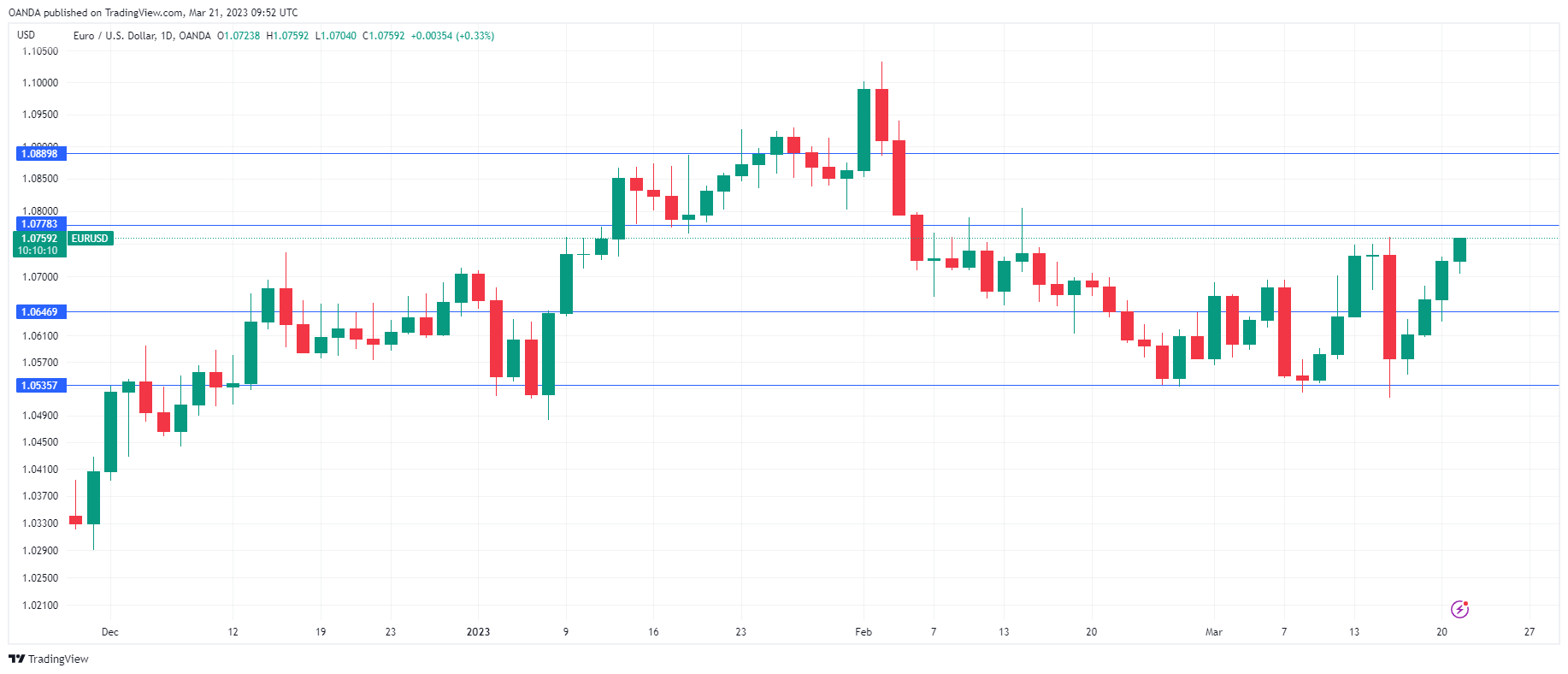
The euro has put together a 3-day rally and is up again on Tuesday. In the European session, EUR/USD is trading quietly at 1.0756, up 0.30%.
Financial markets settle down
Let’s start with some good news. European stock markets have settled down and are in positive territory. The euro took a bath last Wednesday and plunged 1.47% as Credit Suisse shares tumbled, but the currency has battled back and recovered these losses. The emergency takeover of Credit Suisse by UBS and the joint announcement by six major central banks to boost liquidity have provided some reassurance to the markets that the banking system is not in danger of collapse.
That’s not to say that this nasty bank crisis is behind us. Investors are still trying to come to terms with the lightning collapse of three US banks and Credit Suisse, the second-largest bank in Switzerland, all in just 11 days. Another US bank, First Republic, received an emergency injection of $30 billion from some major US banks, but this may not prove to be enough, as depositors are estimated to have removed $89 billion and the bank’s shares are in freefall.
In light of the bank crisis, central banks will have to weigh their moves carefully and re-evaluate rate policy. The ECB didn’t flinch and delivered a 50-basis point move as promised. Had the ECB decided not to go ahead with the 50-bp hike, it risked losing credibility. As well, the ECB’s primary focus remains containing inflation. With eurozone inflation running at an 8.5% clip, the ECB needed another oversize rate hike.
Could the financial crisis turn out to be a blessing in disguise? Perhaps, according to ECB President Lagarde. On Monday, Lagarde told European lawmakers that market turmoil could dampen demand and “might actually do part of the work that would otherwise be done by monetary policy and interest rate hikes”. Lagarde reiterated that more rate hikes were needed to curb inflation, but didn’t make any commitments as to the pace of rate hikes, which makes sense, given that the current crisis is not over.
EUR/USD Technical
- EUR/USD is putting pressure on resistance at 1.0778. Next is 1.0890
- There is support at 1.0647 and 1.0535