

Sample Category Title
RBA Board Takes a Dovish Tilt
The RBA softens rate outlook just when it is increasing its inflation forecast – unusual approach.
The Minutes of the November Monetary Policy Meeting make a clear case for adopting a steady approach to the policy process.
The key section of the Minutes contains a new dimension to the discussion on policy. The advantage of hiking by 25 basis points at the November meeting after having scaled back to 25 basis points in October is “acting consistently would support confidence in the monetary policy framework among financial market participants and the community more broadly.”
That approach would seem to be somewhat inconsistent with the assertion that has appeared in these and previous Minutes, “The size and timing of future interest rate increases will continue to be determined by the incoming data and the Board’s assessment of the outlook for inflation and the labour market.”
When we saw the September quarter Inflation Report, underlying inflation had lifted by 1.8% in the September quarter, significantly higher than the market (and Westpac’s view) of 1.5%, while the broadening of the inflation pressures (nearly 80% of components rising by 3% or more over the year) caused us to lift our forecast for the December and March quarters.
Despite the Minutes noting that the print was “a little above the Bank’s forecast” we note that the Bank raised its forecast for underlying inflation in 2022 from 6% to 6.5% - a significant revision by any standards while surprisingly keeping the 2023 underlying inflation forecast steady at 3.8% and lifting the 2024 forecast for underlying inflation from 3% to 3.2%.
For the record we believe the underlying inflation forecast for the year to June 2023 should be lifted by more than 1% compared to the Board’s adjustment of 0.5%.
This may be partly due to the Bank’s lowering the economic growth forecast (1.8% to 1.4% in 2023) – correctly responding to higher interest rates; lower real wages (higher inflation); and the negative wealth effect.
The Minutes do note that at the November meeting the Board considered both the 25 basis point and 50 basis point options.
Apart from the new “stability” argument the well known points about: full effects of higher rates were yet to be felt in mortgage payments”; “house prices had declined”; wages growth was lagging; and the negative wealth effect had seen a large effect on consumer spending in past cycles were repeated.
But surprisingly, given the uplift in the inflation outlook, there is a hint of a more dovish Board than we have seen recently.
While the Minutes acknowledge, “members did not rule out returning to larger increases” it is highly unlikely that a decision to lift the size of increases would be made by this Board.
Balancing that view is a new insight, “the Board is prepared to keep rates unchanged for a period while it assesses the state of the economy and the inflation outlook.”
The description of the interest rate outlook is also moderated, somewhat.
“The Board … expects to increase interest rates further over the period ahead.” (November Minutes) compared to “likely to require further increases in interest rates over the period ahead.” (October Minutes)
The concept of “drawing out policy adjustments would also help to keep public attention focussed for a longer period on the Board’s resolve to return inflation to target.”, which figured in the October Minutes is not used in these Minutes - trying to lower the expectations for the peak in the terminal rate perhaps.
We do not get a sense as to whether the Board believes that policy is now in the contractionary zone. The Minutes point out that “interest rates were still fairly low in a historical context”. However, the “dovish tilt” in the Minutes implies that the Board assesses that policy is now restrictive – a clear assessment of the current stance of policy would have been welcome.
Review of Forward Guidance
The Board noted that the key complication for forward guidance was to use a time based form of guidance to support the yield target policy. That is an appropriate conclusion and we support the initial decision to use the yield target policy.
In retrospect, the rapid recovery in the economy and associated build up in inflation pressures rendered the policy combination was unworkable. Nevertheless the initial effectiveness of the yield target policy compared to the cumbersome expensive QE policy that was subsequently introduced (and would have been embraced much earlier if not for the Yield Target policy) was., at the time, and given the prevailing forecasts an entirely defensible strategy.
In future the Forward Guidance Policy will be qualitative in nature; flexible and conditional on the policy objectives. Guidance on interest rates will not always be provided.
Forecasts will be published on a regular basis but the Board does not intend to publish its own forecast of the policy path.
That approach is still subject to uncertainty. The practice of using market pricing and market economists’ forecasts for the policy rate effectively means that the forecasts for the policy targets, particularly inflation, may be misleading.
Consider the current situation where the inflation target is not achieved in the forecasting horizon (3.2% by end 2024).
The legitimate question arises as to whether the Board is comfortable to be so far out of line with other central banks or it is just a victim of inappropriate market pricing.
It would be much better to see the Board forecasting its preferred policy outcome with the associated implications for the economy.
If it felt that the impact on the economy of achieving the inflation target too quickly was too severe (note its reference to “ many major central banks …. were more likely to err on the side of doing too much rather than too little”) then it would forecast an extended period outside the target range. That would be a more transparent approach to policy than providing a series of forecasts that are reliant on external parties’ forecasts of the policy rate.
Under that approach it would not be necessary to publish the path of the policy rate.
Conclusion
The Minutes point to a “dovish tilt” to policy where rate hikes in the period ahead are “expected” rather than “likely” and, for the first time, a possible pause has been noted.
That does not put the December move of 25 basis points in any doubt but markets will be encouraged to speculate on further downward pressure on the terminal rate.
However, rising and broadening inflation; likely boosts to wages growth; tight labour markets; and the huge risk that this “flirting” with easy policy can risk boosting inflation psychology still point to the need for the Board to stay the course (in our view, a terminal rate of 3.85% by May) to allow the policy objectives to be achieved.
Technical Outlook and Review
USD/JPY:
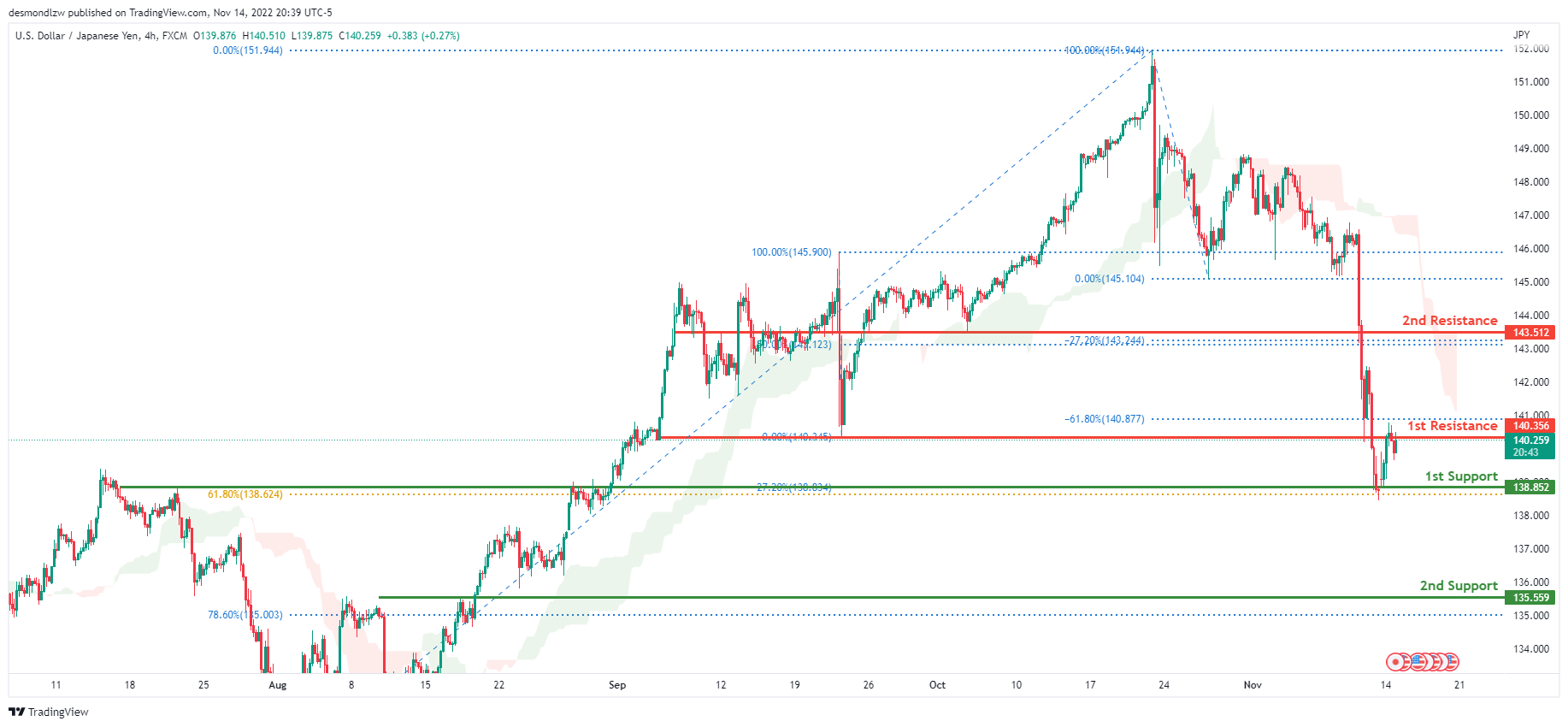
The current general bias for USDJPY on the H4 chart is bearish. To add confluence to this, the price is below the Ichimoku cloud which indicates a bearish market. If the bearish momentum continues, expect USDJPY to break the 1st support line at 138.852 where the -27.2% Fibonacci expansion line is located and head towards the 2nd support line at 135.554 where the 78.6% Fibonacci line is located. In an alternative scenario, price could go back up to break the 1st resistance at 140.356, where the -61.8% Fibonacci expansion line and previous low are located before heading towards the 2nd resistance line at 143.512 where the -27.2% Fibonacci expansion line and 50% Fibonacci line are located.
Areas of consideration:
- H4 time frame, 1st resistance at 140.356
- H4 time frame, 2nd resistance at 143.512
- H4 time frame, 1st support at 138.852
- H4 time frame, 2nd support at 135.554
DXY:
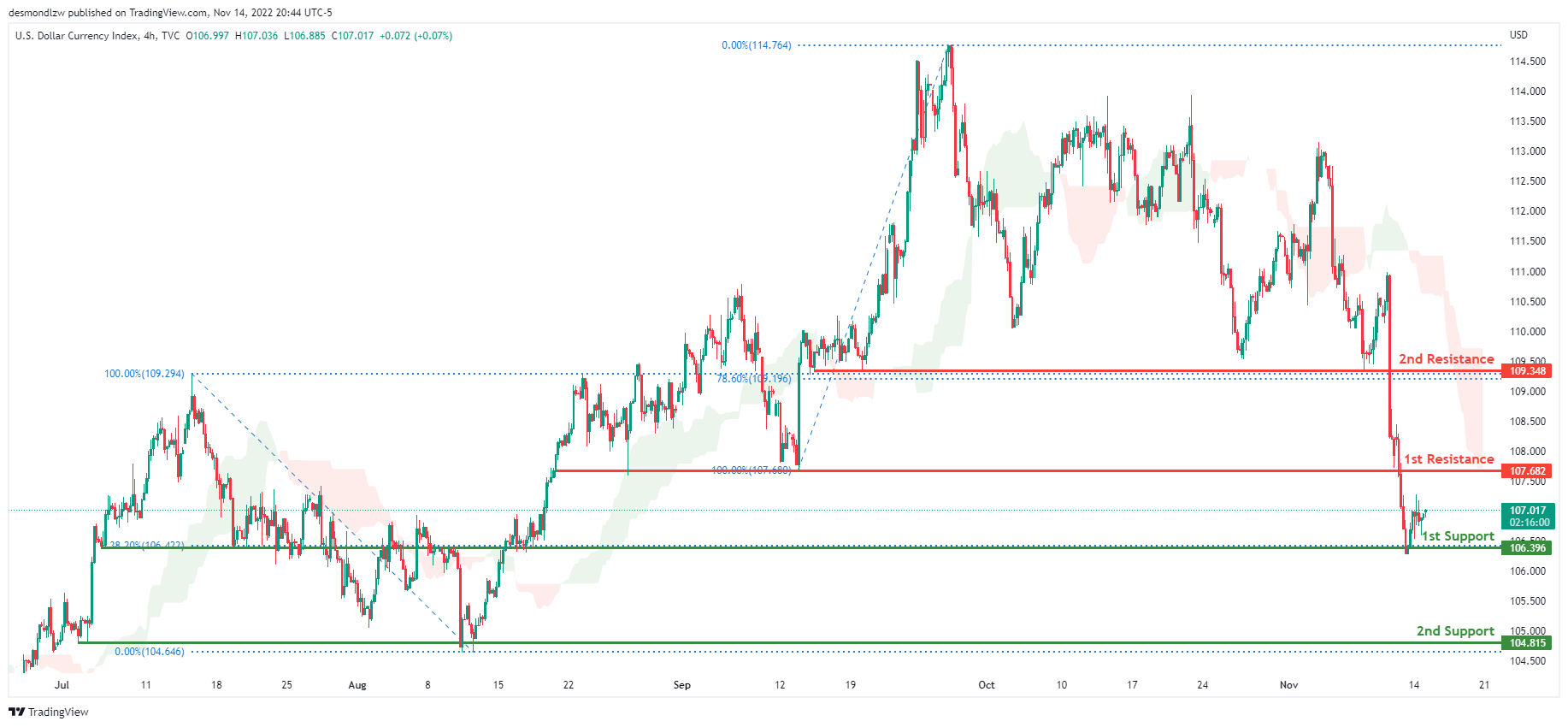
On the H4 chart, the overall bias for DXY is bearish. To add confluence to this, the price is below the Ichimoku cloud which indicates a bearish market. If this bearish momentum continues, price could break the 1st support line at 106.396 where the 38.2% fibonacci line is located, before heading towards the 2nd support at 104.815 where the previous low and the 0% Fibonacci line are located. In an alternative scenario, price could head back up and retest the 1st resistance line at 107.682, where the previous low and 100% Fibonacci line are located.
Areas of consideration:
- H4 time frame, 1st resistance at 107.682
- H4 time frame, 1st support at 106.396
- H4 time frame, 2nd support at 104.815
EUR/USD:
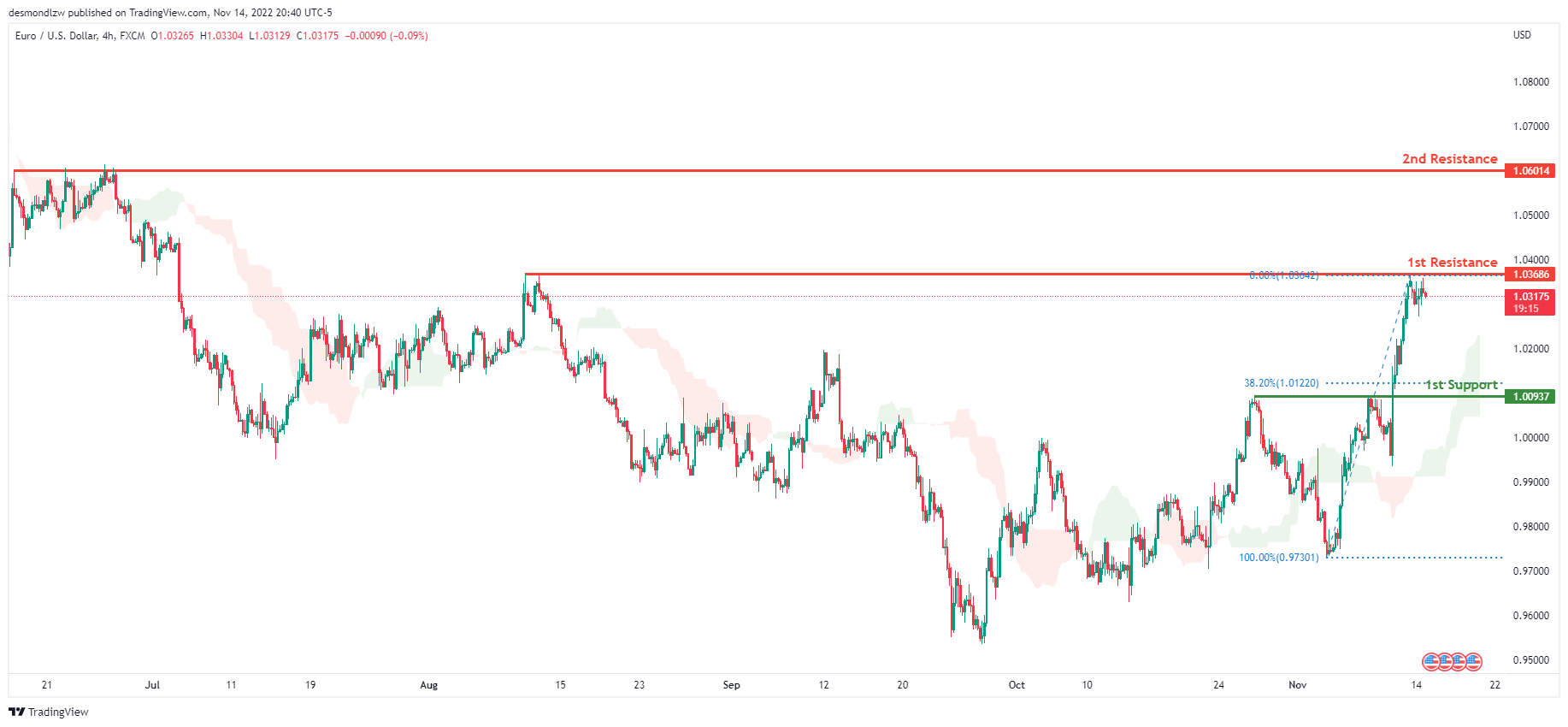
On H4, with the price moving above the ichimoku cloud, we have a bullish bias that the price will rise to the first resistance level at 1.03686, which corresponds to the swing high and the 0% fibonacci extension. If the first resistance is breached, the second resistance is at 1.06014, the previous swing high. Alternatively, the price could fall to the first support level at 1.00937, which corresponds to the 38.2% fibonacci retracement.
Areas of consideration :
- H4 1st resistance at 1.03686
- H4 1st support at 1.00937
GBP/USD:
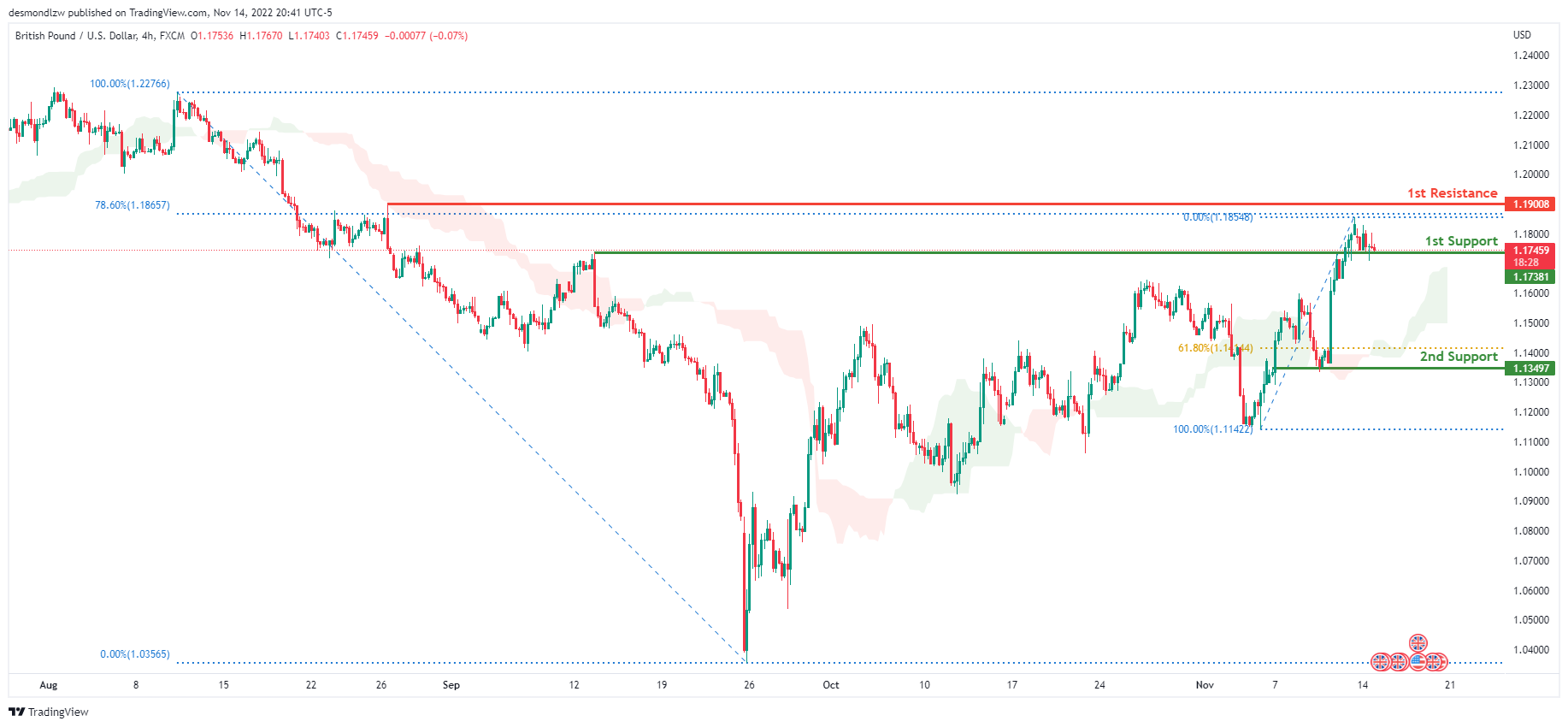
On the H4, the price is moving above the ichimoku cloud, suggesting that the price may rise to the first resistance level at 1.19008, which corresponds to the 78.6% fibonacci and the previous swing high. Alternatively, the price may break the first support level at 1.17381, which is the previous swing high, before moving on to the second support level at 1.13497, which is the 61.8% Fibonacci line.
Areas of consideration:
- H4 1st resistance at 1.19008
- H4 1st support at 1.17381
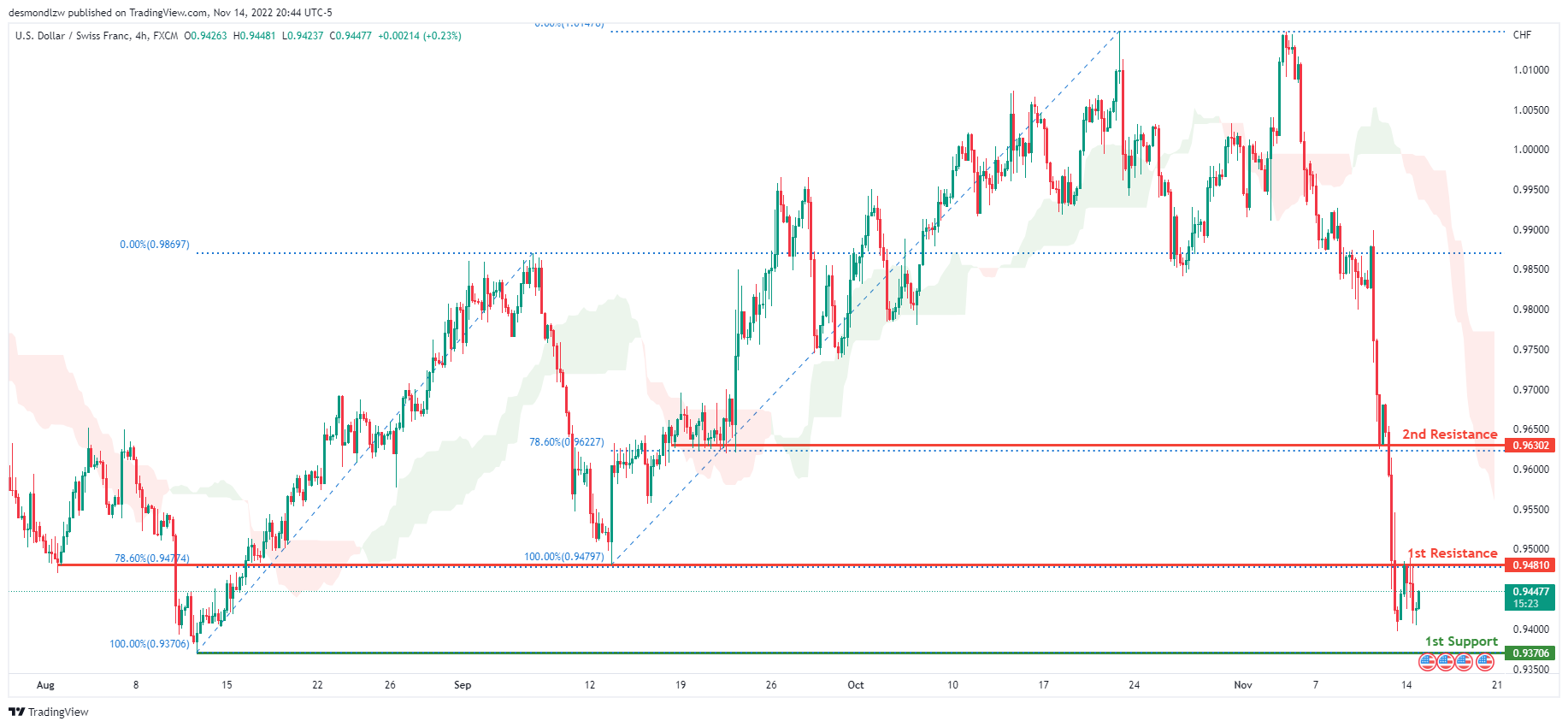
USD/CHF:
The overall bias for USDCHF on the H4 chart is bearish. In addition, the price is below the Ichimoku cloud, indicating a bearish market. If the current bearish trend continues, the price might move towards the first support line at 0.93706, where the previous low was located. In an alternate scenario, price could rise to retest the first resistance line at 0.94810, which is also the 78.6% Fibonacci line. If the first resistance line is broken, the second resistance line is at 0.96302, which is the 78.6% Fibonacci line.
Areas of consideration
- H4 1st support at 0.93706
- H4 1st resistance at 0.94810
- H4 2nd resistance at 0.96302
XAU/USD (GOLD):
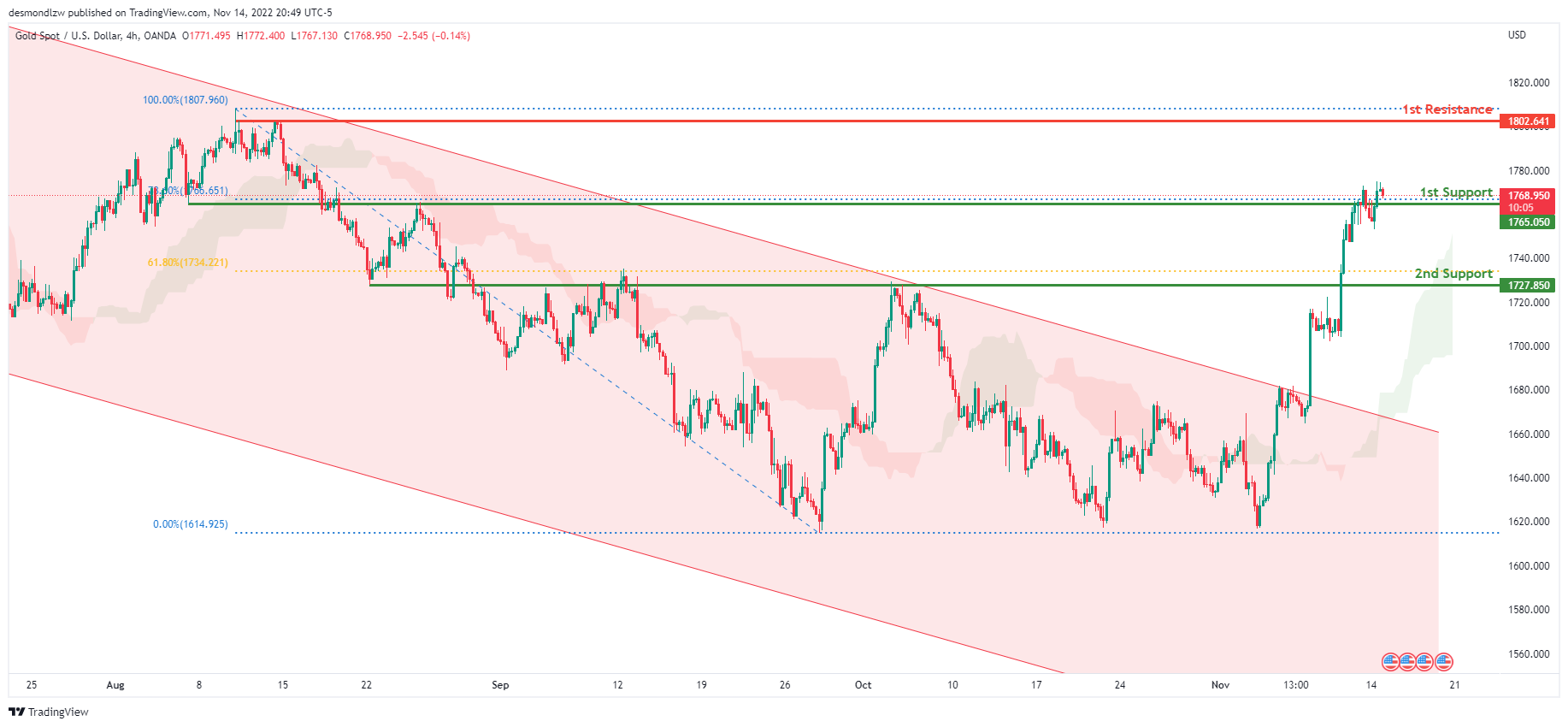
On H4, with the price breaking the descending channel and above the ichimoku cloud, we can expect the price rise towards the 1st resistance at 1802.641, where the previous swing high is. Alternatively, the price may drop to the 1st support at 1765.050, which is in line with the 78.6% fibonacci line.
Areas of consideration:
- H4 time frame, 1st resistance at 1765.483
- H4 time frame, 1st support at 1727.850
AUD/USD:
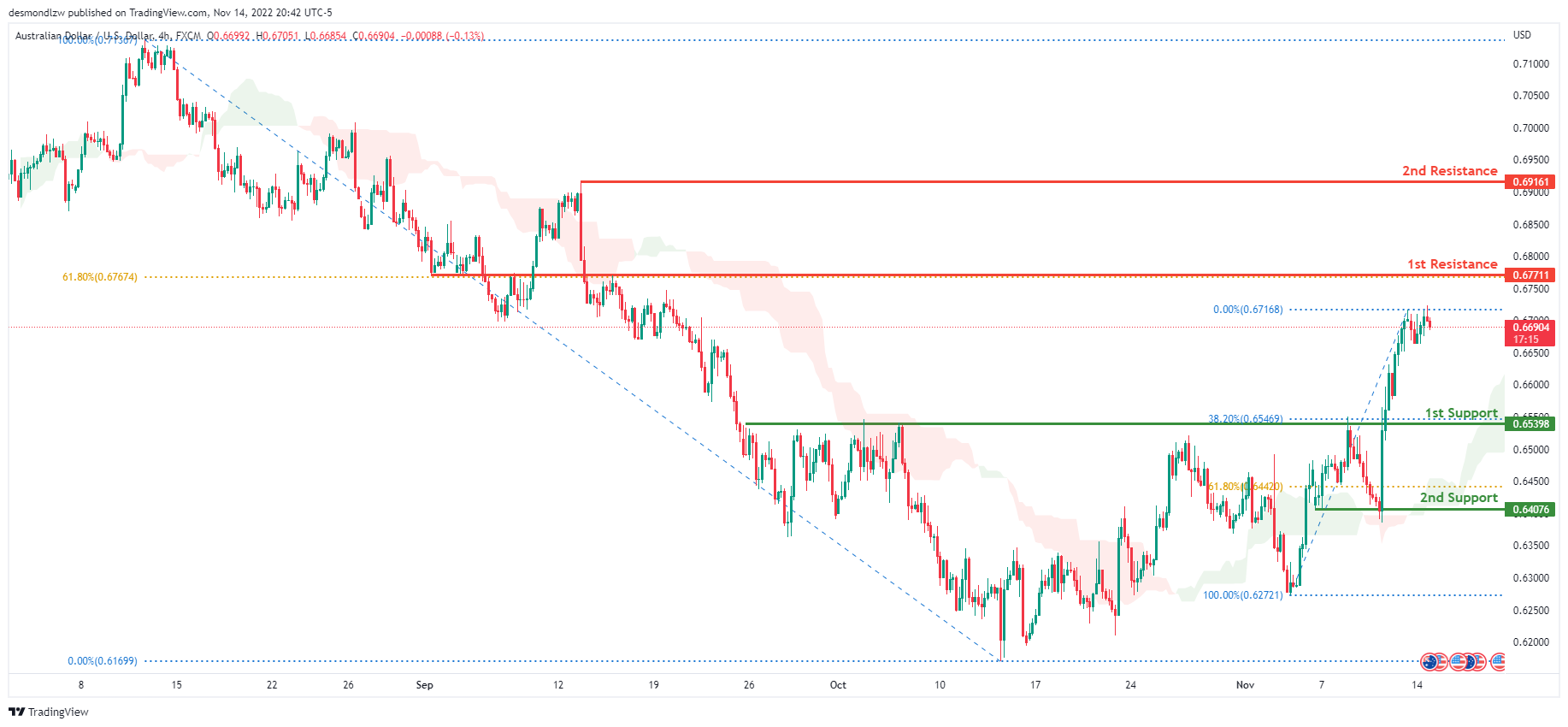
With the price moving above the ichimoku cloud on the H4, we have a bullish bias that the price will rise to the first resistance at 0.67711, which is in line with the 161.8% fibonacci line. If the first resistance is broken, the second should be at 0.69161, the previous swing high. Alternatively, the price could fall to the first support level at 0.65398, which is marked by the 38.2% Fibonacci line.
Areas of consideration
- H4, 1st resistance at 0.67711
- H4, 1st support at 0.65398
NZD/USD:
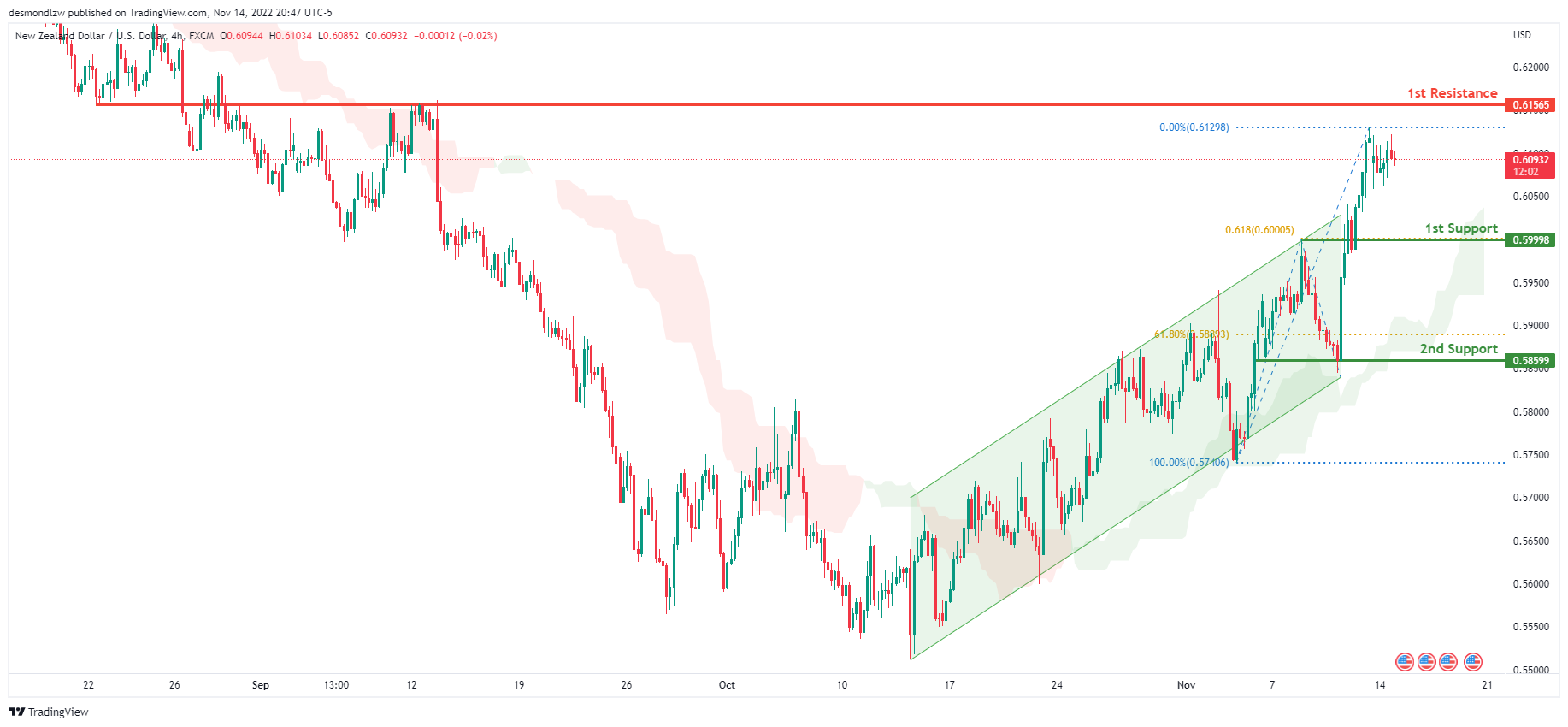
On the H4 chart, the price is moving above the Ichimoku cloud and has broken out of the ascending channel. If this bullish momentum continues, the price may head towards the 1st resistance at 0.61565, which is in line with the previous swing high and 0% fibonacci line. Alternatively, the price may head back towards the 1st support at 0.59998, where the 61.8% Fibonacci projection line is located.
Areas of consideration:
- H4 time frame, 1st resistance at 0.61565
- H4 time frame, 1st support at 0.59998
USD/CAD:
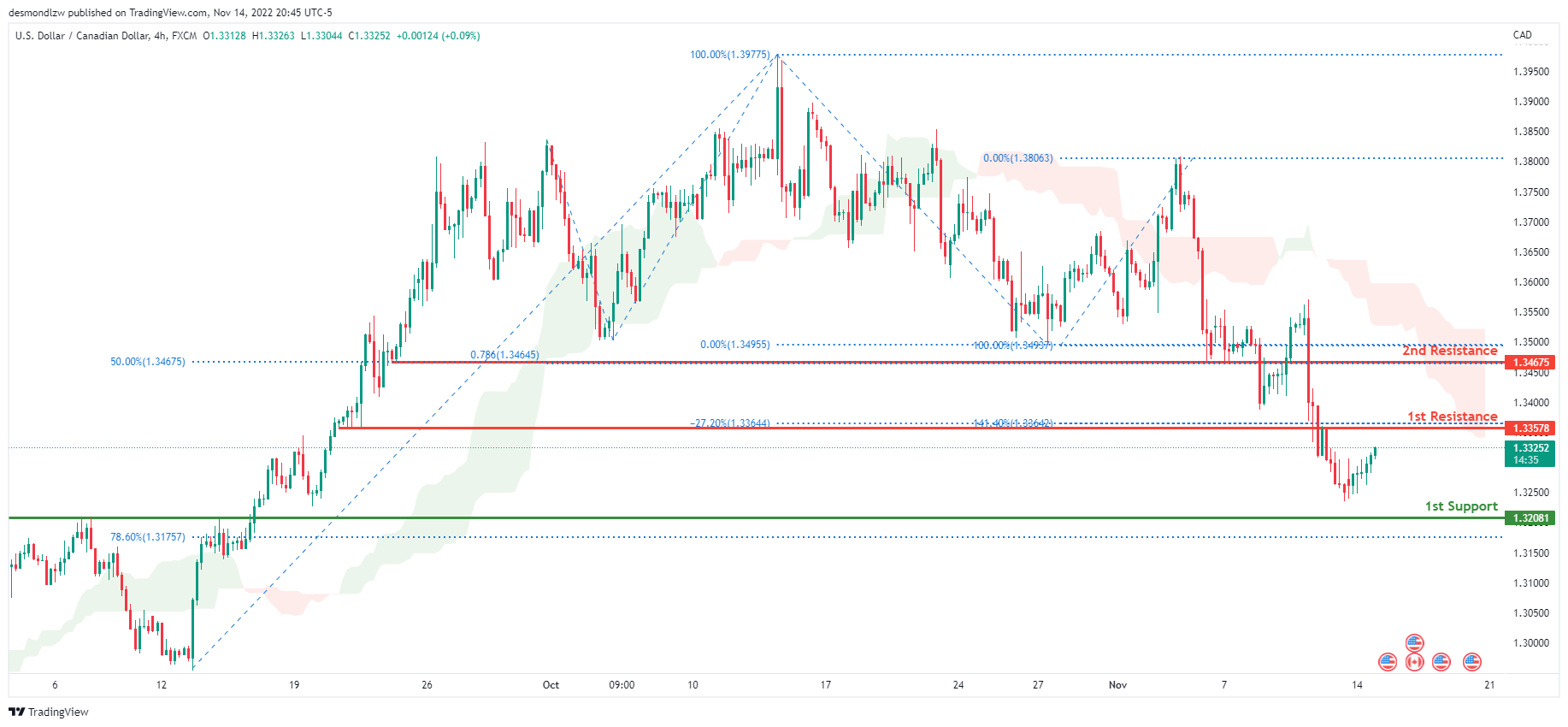
On the H4 chart, the overall bias for USDCAD is bearish. To add confluence to this, the price is below the Ichimoku cloud which indicates a bearish market. If this bearish momentum continues, expect the price to head down towards the 1st support line at 1.32081, where the 78.6% Fibonacci line is located.. In an alternative scenario, price could head back up breaking the 1st resistance line at 1.33578, where the -27.2% Fibonacci expansion line and 141.4% Fibonacci line are located.
Areas of consideration:
- H4 time frame, 1st resistance at 1.33578
- H4 time frame, 1st support at 1.32081
OIL:
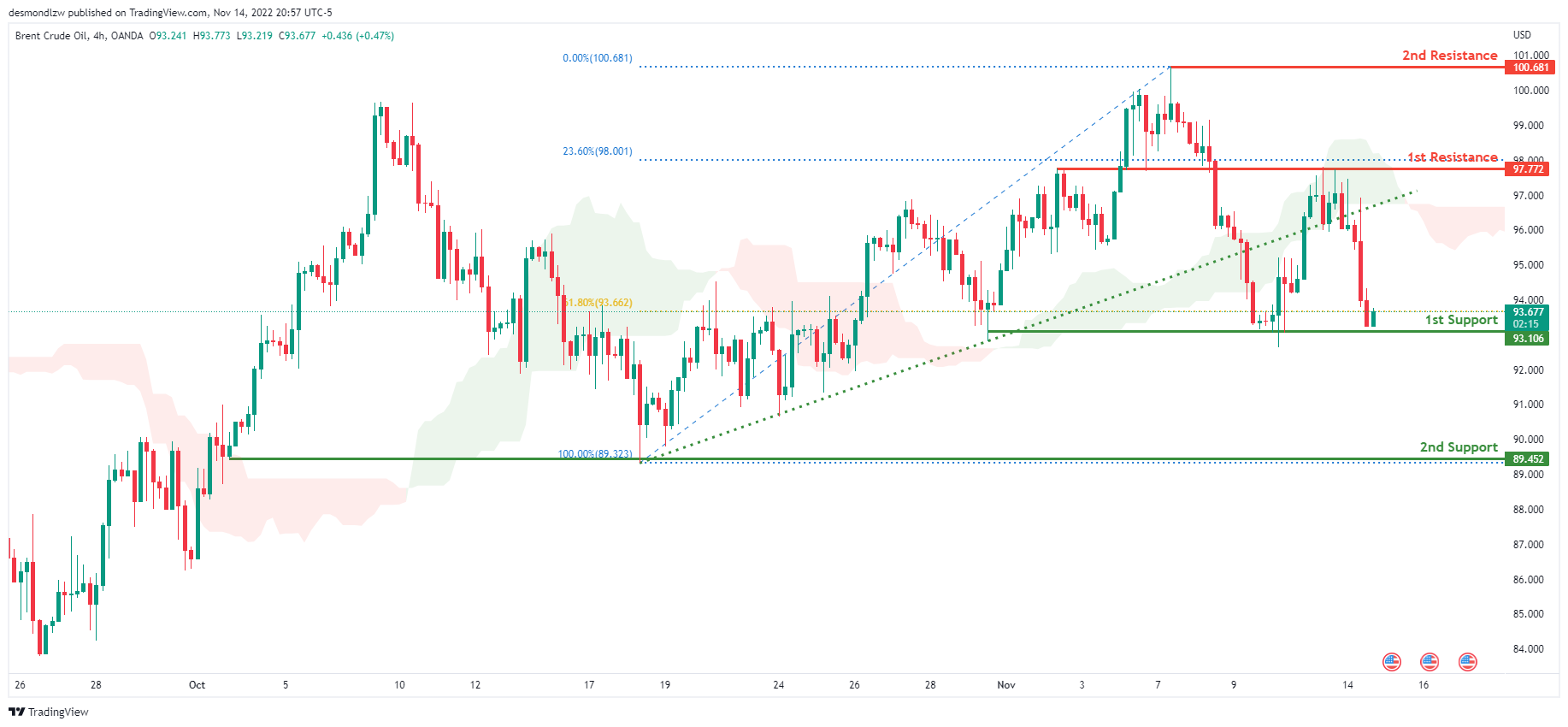
Looking at the H4 chart, the current overall bias for Oil is bearish. To add confluence to this, the price is below the Ichimoku cloud which indicates a bearish market. If this bearish momentum continues, expect price to break the 1st support at 93.106 where the previous swing low and 61.8% Fibonacci line are located before heading towards the 2nd support at 89.452, where the previous swing low lies. In an alternative scenario, price could head back up to retest the 1st resistance line at 97.772 where the 23.6% Fibonacci line is located.
Areas of consideration:
- H4 time frame, 1st resistance at 97.772
- H4 time frame, 1st support at 93.106
- H4 time frame, 2nd support at 89.452
Dow Jones Industrial Average:
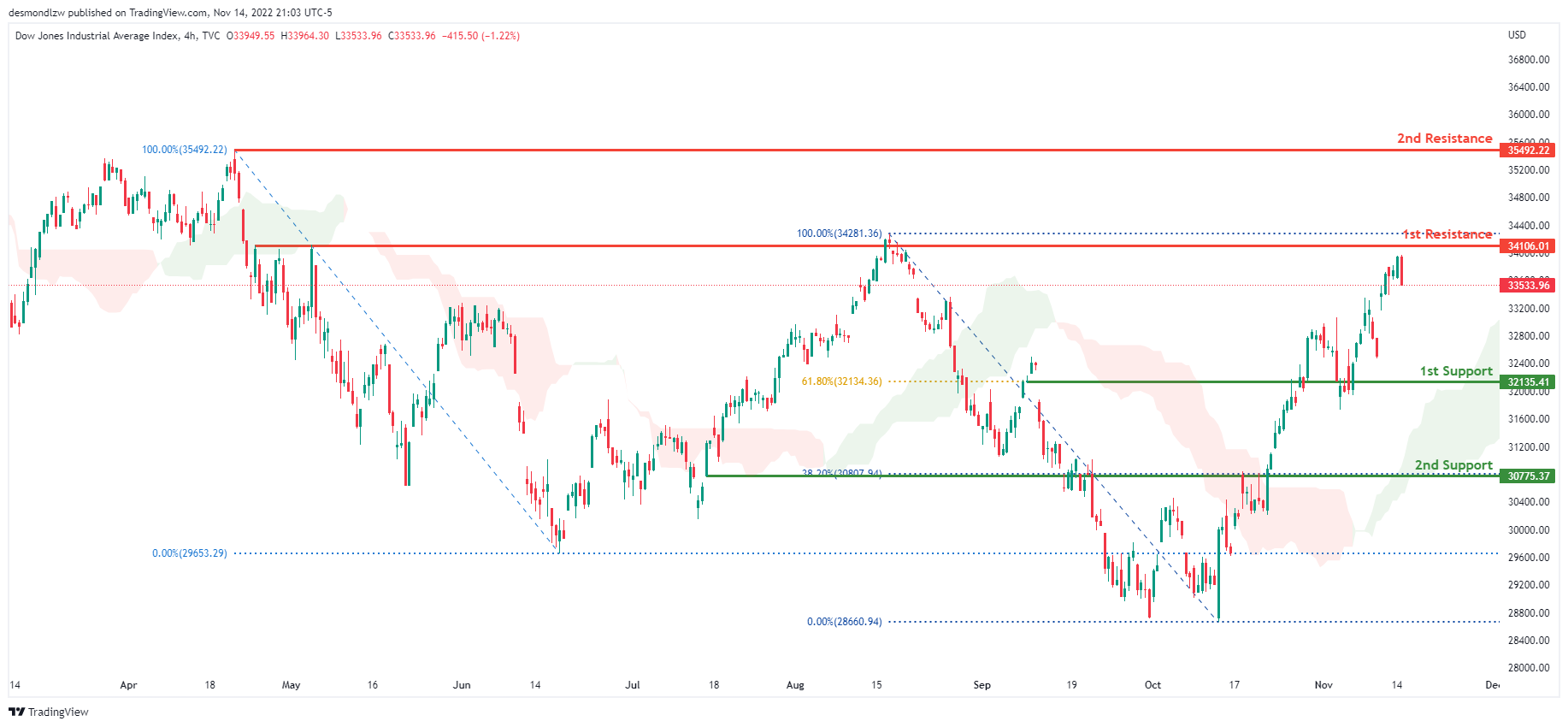
On the H4 chart, the overall bias for DJI is bullish. To add confluence to this, the price is above the Ichimoku cloud which indicates a bullish market. If this bullish momentum continues, expect the price to possibly head towards the 1st resistance at 34106.01 where the previous high and 100% Fibonacci line is located. In an alternative scenario, price could head towards the 1st support line at 32135.41, where the 61.8% Fibonacci line is located.
Areas of consideration:
- H4 time frame, 1st support at 32135.41
- H4 time frame, 1st Resistance at 34106.01
DAX:
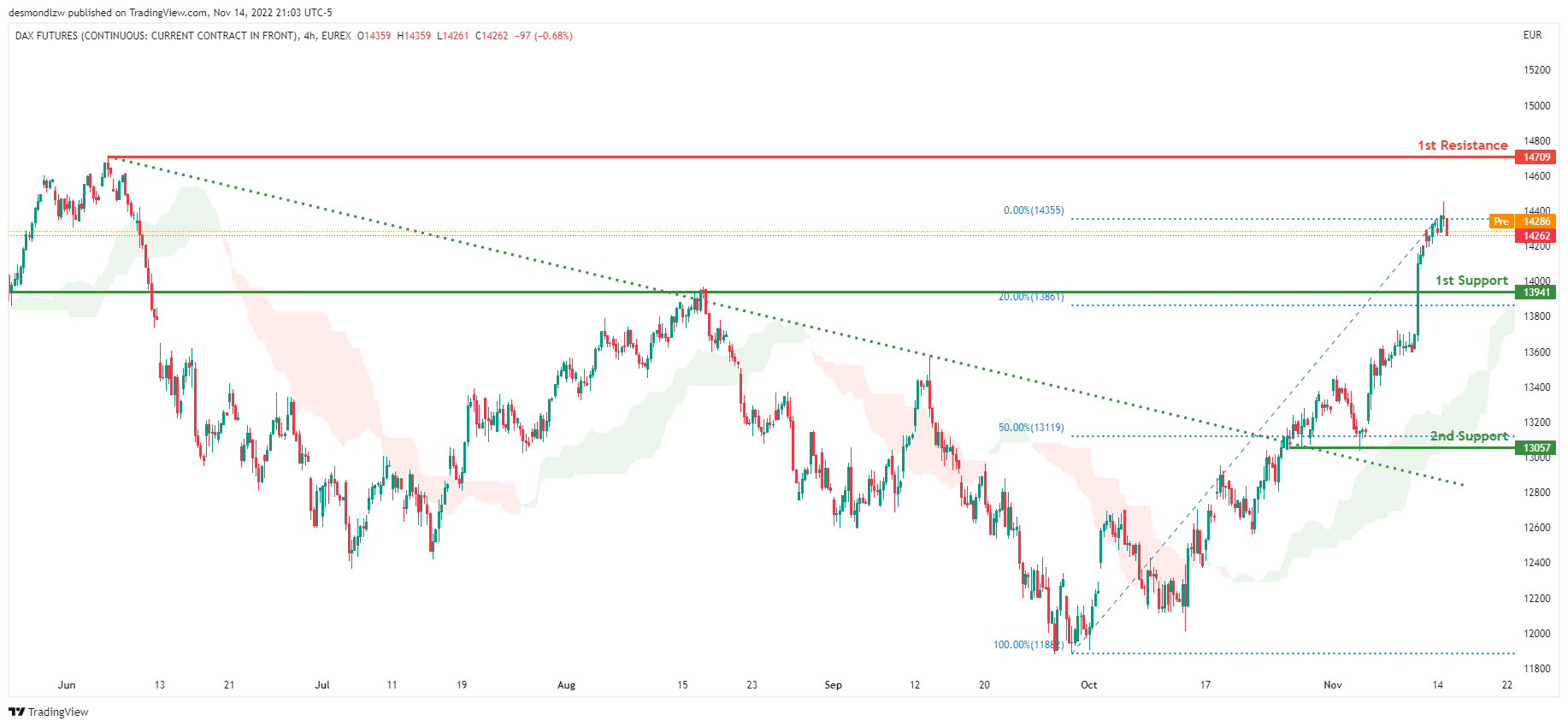
The H4 chart shows a bullish bias, with price breaking through the descending trendline and rising above the Ichimoku cloud. Price is expected to maintain its bullish momentum and rise to the first resistance level at 14709, where the previous swing high is located. Alternatively, the price could fall to the first support level at 13941, which corresponds to the 20% Fibonacci line.
Areas of consideration:
- H4 time frame, 1st resistance is at 14709
- H4 time frame, 1st support is at 13941
ETHUSD:
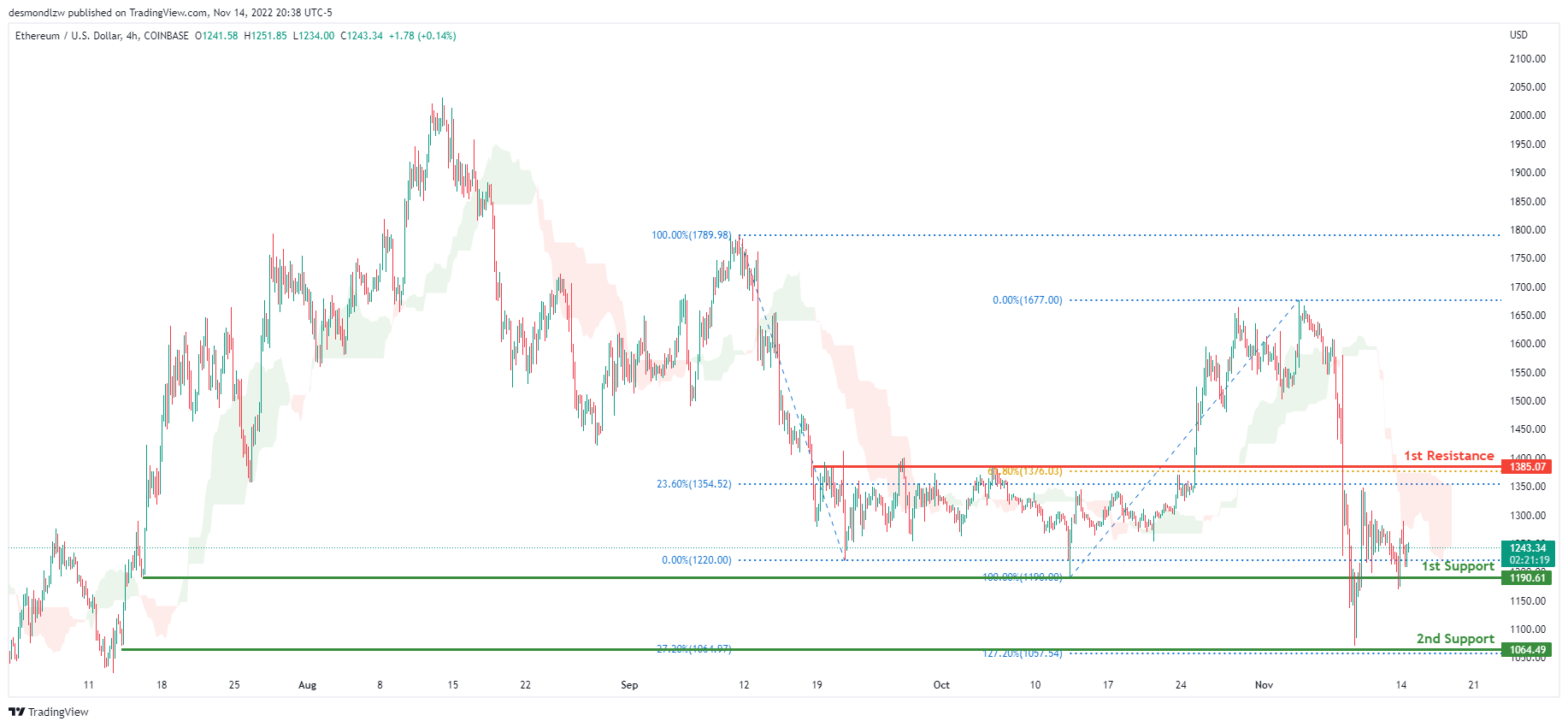
Looking at the H4 chart, the current overall bias for ETHUSD is bearish, with price currently under the Ichimoku cloud indicating a bearish market. If this bearish momentum continues, expect the price to break the 1st support line at 1190.61 where the previous low and 100% Fibonacci line was located and head towards the 2nd support at 1064.49 where the -27.2% Fibonacci expansion line and 127.2% Fibonacci extension line are located. In an alternative scenario, price could head back up to retest the 1st resistance line at 1385.07, where the 23.6% and 61.8% Fibonacci lines are located.
Areas of consideration:
- H4 time frame, 1st resistance of 1385.07
- H4 time frame, 1st support at 1190.61
- H4 time frame, 2nd support at 1064.49
BTCUSD:
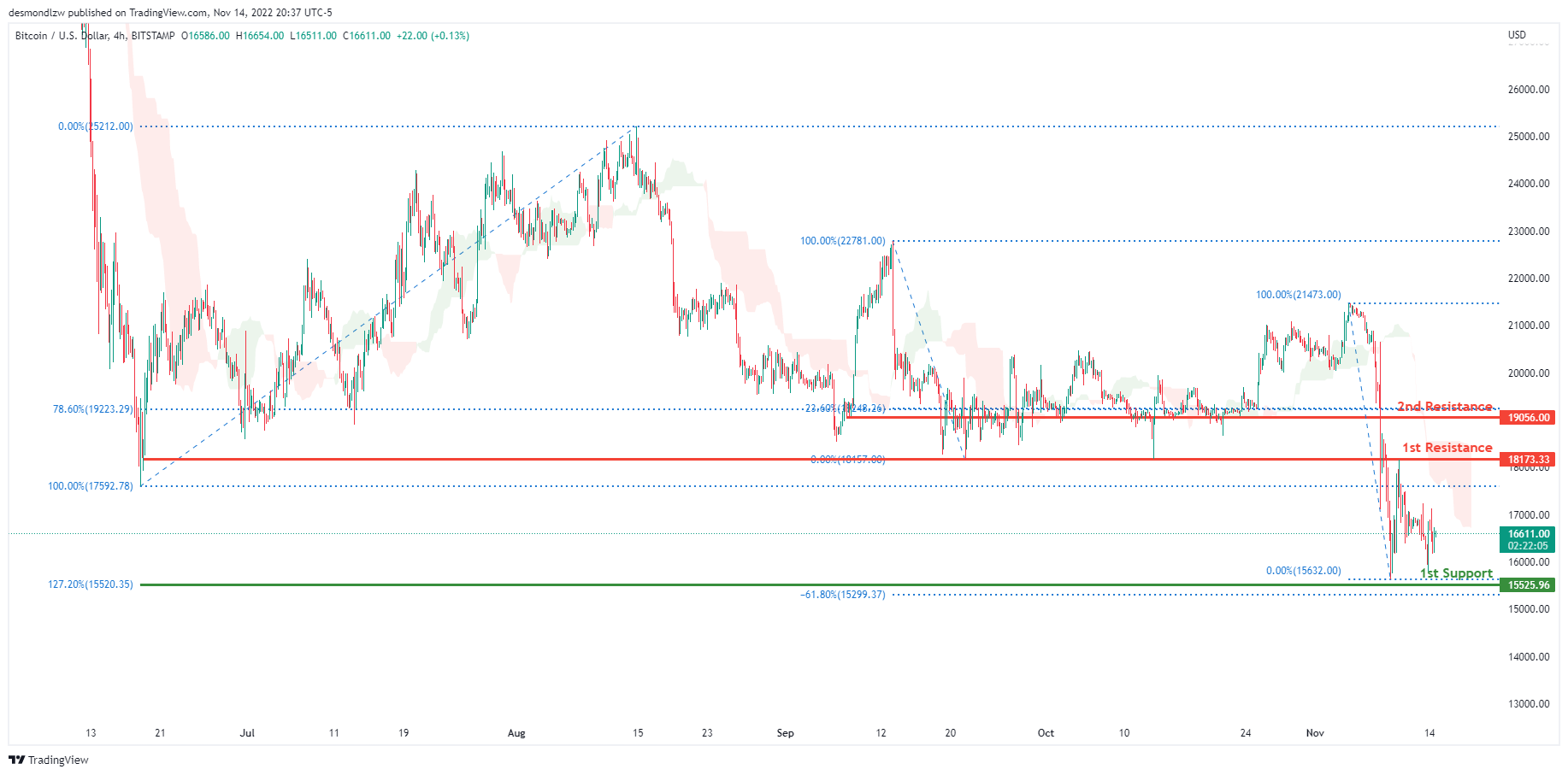
On the H4 chart, the overall bias for BTCUSD is bearish. To add confluence to this, the price is below the Ichimoku cloud which indicates a bearish market. If this bearish momentum continues, expect the price to head towards the 1st support line at 15525.96, where the 127.2% Fibonacci extension line and -61.8% Fibonacci expansion line is located. In an alternative scenario, price could head back up to retest the 1st resistance line at 18173.33, where the previous low and 0% Fibonacci line is located.
Areas of consideration:
- H4 time frame, 1st resistance 18173.33
- H4 time frame, 1st support at 15525.96
S&P 500:
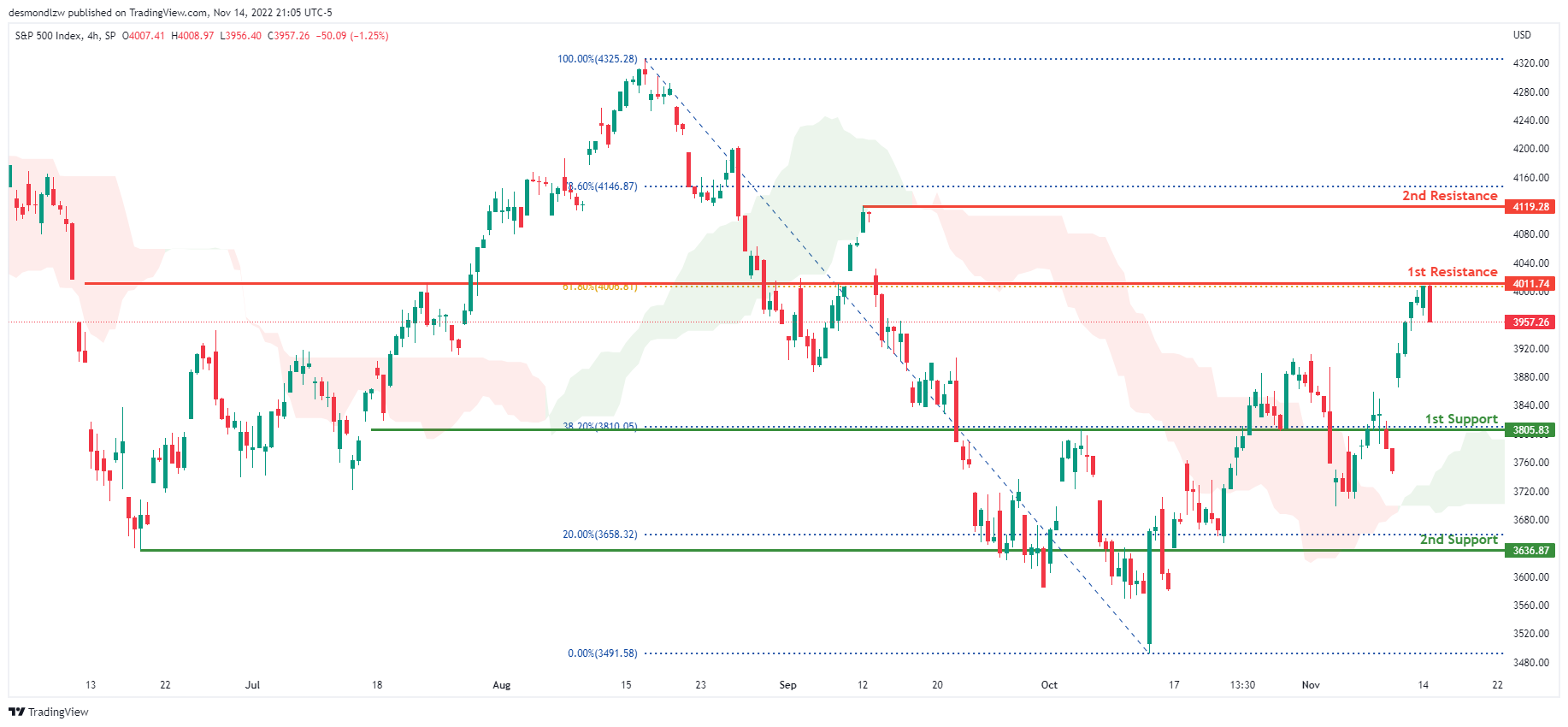
The overall bias for the S&500 on the H4 chart is bullish, with prices above the Ichimoku cloud. If the bullish momentum continues, the price will rise to the first resistance line at 4011.74, where the 61.8% Fibonacci line is located. If the first resistance line is broken, the second resistance line is at 4119.28, which is the previous swing high and the 78.6% Fibonacci line. In an alternate scenario, price could return to the first support line at 3805.83, where the 38.2% Fibonacci line is located.
Areas of consideration:
- H4 time frame, 1st support at 3805.83
- H4 time frame, 1st resistance at 4011.74
- H4 time frame, 2nd resistance at 4119.28
China retail sales contracted -0.5% yoy in Oct
China industrial production rose 5.0% yoy in October, below expectation of 5.2% yoy. Retail sales dropped -0.5% yoy, much worse than expectation of 1.0% yoy. That's also the first decline since May. Fixed asset investment rose 5.8% ytd yoy, below expectation of 5.9%.
"We will focus on expanding effective demand, deepening structural reform on the supply side, continuing to stabilise employment and prices, stabilizing expectations, stimulating market vitality more, consolidating the economic recovery to a sound basis, and try to achieve better development results," the NBS said in a statement.
Japan GDP contracted -0.3% qoq in Q3
Japan GDP contracted -0.3% qoq in Q3, much worse than expectation of 0.3% qoq. In annualized term, GDP contracted -1.2%, versus expectation of 1.1%. GDP deflator dropped -0.5% yoy, versus expectation of -0.2% yoy.
During the quarter, imports rose strongly by 5.2% yoy on higher energy costs and weak Yen exchange rate. Exports grew only 1.9% qoq and led to a decline in net exports, which dragged GDP down. Domestically, private consumption grew 0.3% qoq only.
"Increased imports due to the easing of supply constraints and a temporary increase in payments for external services contributed to the negative growth," Chief Cabinet Secretary Hirokazu Matsuno said.
"The environment surrounding households and businesses is becoming more difficult, with declining real household incomes and rising corporate costs," Matsuno added.
RBA minutes: Not ruling out returning to larger hikes
Minutes of RBA's November 1 meeting revealed that board members consider both a 25 bps or a 50bps rate hike. There were "arguments in favour of both courses of action", but the case for 25bps was stronger.
"Acknowledging the uncertainty, members did not rule out returning to larger increases if the situation warranted," the minutes noted. "Conversely, the Board is prepared to keep rates unchanged for a period while it assesses the state of the economy and the inflation outlook. Interest rates are not on a pre-set path."
At the meeting, RBA raised the cash rate target by 25bps to 2.85%.
(RBA) Minutes of the Monetary Policy Meeting of the Reserve Bank Board
Hobart – 1 November 2022
Members present
Philip Lowe (Governor and Chair), Michele Bullock (Deputy Governor), Mark Barnaba AM, Wendy Craik AM, Ian Harper AO, Carolyn Hewson AO, Steven Kennedy PSM, Carol Schwartz AO, Alison Watkins AM
Others present
Luci Ellis (Assistant Governor, Economic), Christopher Kent (Assistant Governor, Financial Markets), Carl Schwartz (Deputy Head, Domestic Markets Department)
Anthony Dickman (Secretary)
International economic developments
Members commenced their discussion of international economic developments by observing that inflation abroad had remained high. Inflation outcomes for the major advanced economies had continued mostly to surprise on the upside – noticeably for the euro area, where higher prices for food and energy had boosted headline inflation. Core inflation had remained high in both the United States and the euro area, with services prices increasing strongly in these economies.
Domestic demand had held up in most advanced economies in preceding quarters, reflecting relatively high levels of retail spending and a further transition in spending from goods to services following the pandemic. Nonetheless, the outlook for output growth had deteriorated for most countries, driven by the effects of inflation and higher interest rates on household budgets. In China, economic activity had been adversely affected by further lockdowns in pursuit of the authorities' approach to managing COVID-19.
Members noted that gas prices in the euro area had declined as storage levels reached capacity and mild weather in the northern hemisphere autumn helped to reduce demand relative to previous years; prices were, however, still above levels prevailing before the pandemic. A similar pattern of price decline had occurred in the market for thermal coal, though the price was still several times pre-pandemic levels. Prices of industrial-related commodities, including base metals and iron ore, had fallen to levels seen at the beginning of 2022.
Labour markets in most advanced economies had remained very tight but had not tightened any further over the preceding month. There were tentative signs of an inflection point in some countries, with falls in employment being recorded recently. By contrast, US employment had continued to grow and unemployment was still very low, although survey data suggested that jobs had become easier to fill in recent months.
Domestic economic developments
Turning to the domestic economy, members observed that economic growth in the September quarter appeared to have been solid, including in household spending. The increase in the value of retail sales in September and other indicators suggested that spending in the September quarter as a whole had risen by around 1½ per cent in real terms.
Members noted the apparent divergence between indicators of consumer sentiment and household spending and discussed the outlook for spending. On the one hand, after a period of catching up following pandemic-related lockdowns and an increase in spending as the year-end approached, growth in spending might slow because of the negative effects of inflation and higher interest rates. While labour income had been rising strongly – underpinned by the tight labour market and solid growth in employment and hours worked in the first half of the year – aggregate real household income had been eroded by inflation and rising interest rates. This was compounded by the effect of falling housing prices on wealth, which would occur over a prolonged period and lead to lower levels of spending on consumer durables. On the other hand, households in aggregate had built up significant savings buffers and it was possible that these would sustain strong growth in consumption in an environment of strong demand for labour.
Bad weather and capacity constraints from supply-chain problems and labour shortages had delayed activity in dwelling and private non-residential construction in the June and September quarters. Capacity constraints continued to affect the outlook; investment plans were delayed in both the private and public sectors. Together with the effect of higher interest rates and continued housing price declines on dwelling investment, ongoing capacity constraints had led to a downgrade in the Bank's forecasts of these components of investment. Members noted that the outlook for machinery and equipment investment remained positive overall.
The Bank's central forecast for GDP growth had been revised down a little, with growth of around 3 per cent expected in 2022 and 1½ per cent in 2023 and 2024. The forecast slowdown reflects the combined effects of higher interest rates and lower real wages and wealth on private domestic demand, as well as the broader effects of slower growth in the global economy.
Members discussed the September quarter inflation data, which were a little above the Bank's forecast. Over the year to the September quarter, the Consumer Price Index (CPI) inflation rate was 7.3 per cent – the highest it had been in more than three decades. In underlying terms, inflation was a little over 6 per cent, with most components of the CPI rising at annualised rates of more than 3 per cent.
Members noted that supply-chain issues and strong demand had continued to boost inflation for new dwellings and consumer durables. However, it was expected that, as supply-chain issues are resolved, declines in transport and other input prices will, over time, flow through to retail prices. Groceries inflation was very high compared with historical data, and the recent floods on the east coast were expected to affect food prices further in coming quarters.
Members discussed the outlook for energy prices, noting the very large forecast increases in electricity and gas prices that had been outlined in the October 2022–23 Australian Government Budget, and which had been factored into the Bank's revised inflation forecast. Members noted the likelihood of second-round effects on inflation from higher energy prices.
Members discussed the housing market. They noted that rental vacancy rates were low and that many people continue to desire more space than in the past, in part to accommodate working from home. When the international border was closed and the flow of new migrants dried up, rents in Sydney and Melbourne had been quite weak, which had the effect of holding back rent inflation. More recently, rapid growth in advertised rents had led to a pick-up in rent inflation across the country, which was forecast to continue. On the other hand, demand for new detached housing had fallen considerably since the start of 2022; prices for established housing nationally had declined by around 5 per cent since their peak in April.
Following analysis of the September quarter inflation data, the Bank's central forecast was for CPI inflation to reach 8 per cent by the end of 2022 (revised up from 7¾ per cent previously) and for underlying inflation to be 6½ per cent (revised up from 6 per cent previously). Both headline and underlying inflation were then expected to decline to a little above 3 per cent by the end of 2024 and continue declining in the following year. Higher electricity and gas prices were expected to slow the return of inflation to the target range.
Labour market data for September indicated that employment growth had slowed. The labour market remained tight, with job vacancies and advertisements at very high levels. Members noted that, over preceding months, the strong demand for labour had translated into relatively little additional employment as spare capacity in the labour market had largely been absorbed. The central forecast was for the unemployment rate to remain around 3½ per cent until mid-2023, before increasing to around 4¼ per cent by the end of 2024 as economic growth slows.
Members discussed the review of the Bank's forecasts over the preceding year. The review focused mainly on the inflation forecasts, with the inflation outcomes having been significantly higher than the Bank and other forecasters had expected a year earlier. In common with other forecasting models used in Australia and abroad, the Bank's models underestimated inflation. They are not well equipped to deal with large supply shocks and underestimated the impact of global inflation. Changes in firms' price-setting behaviour had also affected inflation outcomes. Over the year, the inflation forecasts have increasingly incorporated upward adjustments informed by liaison, international experience and specific knowledge of developments in sectors of the economy.
International financial markets
Members observed that financial markets had been volatile over the preceding month, consistent with ongoing uncertainty about the global inflation outlook and the path of policy interest rates. Central banks in most advanced economies had continued the rapid and synchronised tightening of monetary policy.
Over the preceding month, market participants had revised up their expectations for further increases in policy rates in some advanced economies. Most advanced economy central banks had signalled the likelihood that policy rates would be raised further, with some noting that policy rates would need to reach restrictive levels and remain there for some time to return inflation to target. Members noted that some central banks, including the US Federal Reserve, had observed early signs of moderation in growth in demand. Commentary from the European Central Bank and the Bank of England had continued to highlight the risk of recession in their economies, largely due to persistently high energy prices and higher interest rates.
Government bond yields had risen in most advanced economies over the preceding month and volatility had increased notably. In the United Kingdom, government bond yields had been particularly volatile since the government's announcement of a debt-financed fiscal package in late September. Members noted that UK bond yields had subsequently retraced some of the earlier sharp rise following temporary bond purchases by the Bank of England, announcements that the government would not proceed with most of the fiscal stimulus measures in the mini budget and the appointment of a new Prime Minister.
Private sector financing conditions had tightened further in most advanced economies. Corporate bond yields and credit spreads had risen, although equity prices in most major markets had changed little.
Members noted that the US dollar had appreciated considerably over 2022, particularly against the Japanese yen. Several Asian central banks had intervened in their foreign exchange markets in response to depreciation of their currencies against the US dollar. The Australian dollar had depreciated over prior months but was little changed on a trade-weighted basis over 2022.
In China, volatility in financial markets had increased following the conclusion of the National Congress meeting in October. Equity prices had declined sharply and the Chinese renminbi had depreciated further against the US dollar to around its lowest level since 2007. Property developers remained under significant stress and authorities had announced further targeted measures to support the sector. In most emerging market economies, central banks had increased policy rates further in response to high inflation.
Domestic financial markets
Members noted that Australian financial markets had followed global trends, but generally with more moderate moves. This had been particularly evident in yields on Australian Government Securities, with differentials to US Treasuries continuing to decline, consistent with expectations for a lower peak in the policy rate in Australia than in the United States. Near-term expectations for the cash rate, as implied by market pricing, had decreased over the preceding month following the Board's decision in October to increase the cash rate by 25 basis points, rather than 50 basis points. At the time of the November meeting, market pricing implied that financial market participants applied approximately a 75 per cent likelihood of a 25 basis point increase in the cash rate and a 25 per cent likelihood of a 50 basis point increase. Market pricing implied that the cash rate was expected to be a little above 3 per cent by the end of 2022 and peak slightly above 4 per cent in mid-2023. By contrast, market economists expected the peak in the cash rate to be a little lower than this.
As a result of the increase in home loan interest rates that had already occurred over the year, housing mortgage payments were set to rise further in the period ahead. This included the effect of fixed interest rate loans rolling off over time. Members noted that, given the cumulative increase in interest rates prior to the November meeting, scheduled housing mortgage payments as a share of household income were expected to increase to levels not seen since around 2010. Payments into offset and redraw accounts were still high, but somewhat less over 2022 than the preceding year. Housing loan commitments had declined further for both owner-occupiers and investors, reflecting the effect of monetary policy on housing lending. The fall to date in housing loan commitments had been broadly in line with historical responses to increases in the cash rate.
Review of the RBA's approach to forward guidance
Members reviewed the use of forward guidance regarding the cash rate over the COVID-19 pandemic period and discussed the approach to its use in the future. The discussion was based on a paper commissioned by the Board.
Members observed that, prior to the pandemic, the Board had used forward guidance to varying degrees, with the guidance generally being qualitative in nature. However, during the pandemic, forward guidance became more specific and prominent as part of the package of monetary policy responses. Since raising the cash rate earlier in 2022, forward guidance had returned from this more specific form to its earlier more qualitative form.
Members also observed that, together with other monetary policy measures, the Board's stronger forward guidance had worked to lower funding costs and support the economy in the early stages of the pandemic, when the health and economic outlook appeared dire. The policy response had helped shore up confidence during a period of significant uncertainty and disruption. It had also provided insurance against very bad economic outcomes at a time when there was limited scope to lower the cash rate further.
However, the specific approach to forward guidance had presented substantial communication challenges, which subsequently attracted extensive criticism. The forward guidance had been state-based – that is, with reference to economic conditions – but at various times had included a time-based element.
Members noted that the time-based element of the forward guidance had been prominent in media and market commentary and had come to dominate the interpretation of the Board's forward guidance. As a result, the Bank had attracted extensive criticism when the cash rate was increased much earlier than the time-based element of the Board's conditional guidance had suggested. The time-based element of forward guidance and the term for the yield target had been mutually reinforcing. Members noted that the message about the likely timing of future cash rate increases had been complicated by the yield target. The time-based aspect of the forward guidance had not been well suited to the unprecedented global events; moreover, its removal while the yield target remained in place would have significantly affected the credibility of the yield target. A greater emphasis on upside risks to the outlook might have led to an earlier decision to modify the time-based element of forward guidance.
The experience with forward guidance over the pandemic period highlights the communication challenges in combining state-based and time-based elements in forward guidance, particularly with a yield target. The Board is committed to learning from this experience. Many major advanced economy central banks also experienced communication challenges with the combination of state-based and time-based elements in forward guidance through the pandemic. Members noted the public's interest in understanding the factors that drive the Board's decisions and that this understanding is an important element in ensuring policy effectiveness and accountability.
Based on its review, the Board decided that its approach to forward guidance will henceforth be based on the following considerations:
- Where forward guidance is appropriate, ordinarily it will be qualitative in nature. Given the inherent uncertainty in the world, forward guidance will generally be flexible and conditionality will likely focus on the Board's policy objectives – namely, inflation and unemployment – rather than the drivers of these variables (e.g. wages). It will typically focus on the short term and be narrative in nature.
- Forward guidance on interest rates will not always be provided, although the Board will continue to outline how monetary policy settings will be adjusted in response to evolving economic conditions.
- The Board will continue to publish forecasts on a regular basis, along with an assessment of the various risks. The Board does not intend to publish its own forecasts of the expected policy path.
- When policy rates are at, or near, the effective lower bound, a stronger form of forward guidance will be considered, taking into account lessons on the benefits of flexibility and using scenarios to prepare for a range of possible outcomes.
Members agreed to publish the review of the RBA's approach to forward guidance.
Considerations for monetary policy
In considering the policy decision, members noted that inflation in Australia remained too high, as was the case in most countries. Global factors were a key part of the explanation, but strong domestic demand relative to the ability of the economy to meet that demand was contributing to high inflation. Inflation in the September quarter was a little higher than had been expected and had contributed to a modest upward revision of the Bank's central forecast. So far, medium-term inflation expectations and wages growth remained consistent with inflation returning to target. Members emphasised the importance of this continuing to be the case.
Members noted that the Australian economy had continued to grow solidly. Growth in output was expected to moderate over the following year as the global economy slows, the bounce-back in spending on services runs its course, and growth in household consumption slows in the face of higher inflation and tightening financial conditions.
The labour market remained very tight and many firms were having difficulty hiring workers. Employment growth had slowed over preceding months as spare capacity in the labour market had become limited. The central forecast was for the unemployment rate to increase gradually as economic growth slows.
Wages growth had continued to pick up from the low rates of recent years, although it remained lower than in many other advanced economies. The tight labour market conditions and higher inflation were expected to result in a further pick-up in wages growth. Given the importance of avoiding a price-wage spiral, the Board will continue to pay close attention to both the evolution of the price-setting behaviour of firms and labour costs in the period ahead.
In view of the high current rate of inflation and the forecast for inflation, members agreed that a further increase in the cash rate was necessary to achieve a more sustainable balance of demand and supply in the Australian economy. Price stability is a prerequisite for a strong economy and a sustained period of full employment. The Board's priority is therefore to return inflation to the 2 to 3 per cent target range over time, while keeping the economy on an even keel. Members saw the path to achieving this balance as a narrow one clouded in uncertainty.
One of these sources of uncertainty is the outlook for the global economy, which had deteriorated over prior months. Another is how household spending in Australia will respond to the tighter financial conditions. The Board recognised that monetary policy operates with a lag and that the full effect of the increase in interest rates was yet to be felt in mortgage payments, consumer confidence was low and housing prices were declining. Working in the other direction, household spending had remained strong and people had been finding jobs, gaining more hours of work and receiving higher wages. Many households had also built up large financial buffers and the saving rate remained higher than prior to the pandemic. Nevertheless, members observed that a reduction in household saving would be needed if recent rates of consumption growth were to be sustained.
Members again considered two options for the size of the increase in the cash rate: a 25 basis point increase or a 50 basis point increase.
The arguments for a 25 basis point increase rested largely on the fact that the cash rate had been increased materially in a short period of time and that there were lags in the operation of policy. While consumption had held up so far, the higher interest rates and high inflation were putting pressure on household budgets at a time when housing prices were also falling. The full effects of higher interest rates were yet to be felt in mortgage payments. However, the tightening of monetary policy was having a clear effect on the housing market, where prices had declined after earlier large increases and the demand for housing loans had fallen. Previous episodes of lower housing prices and turnover had seen a large effect on consumer spending, in part through the wealth channel of transmission.
Members noted that wages growth had not reached levels that would be inconsistent with the inflation target. While future trends were uncertain, wages growth remained below that in a number of other advanced economies. Members also gave weight to the evidence of some easing in global supply-chain issues and a decline in some commodity prices. In addition, increases in policy rates in advanced economies were likely to entail a period of significantly lower output growth, which would reduce global inflationary pressures.
In considering the size of the increase, members also discussed the value of the Board acting in a consistent manner. Having moved by 25 basis points in the previous month, they considered whether the flow of information since then warranted a 50 basis point move at the November meeting. The Board agreed that acting consistently would support confidence in the monetary policy framework among financial market participants and the community more broadly.
As was the case in October, the arguments for an increase of 50 basis points stemmed from the current inflation environment and the upside risks to inflation from the labour market, rents and energy costs. Inflation was at a 30-year high in advanced economies and was broadly based. Any new supply shocks – including in energy markets – could push inflation even higher than forecast in Australia. The tightness of the labour market, with the unemployment rate at its lowest level in almost 50 years, suggested wages growth would pick up further. A risk to the inflation outlook over the medium term was the possibility that price- and wage-setting behaviour would shift, resulting in domestic inflationary pressures becoming more persistent. In their discussion, members noted that many major central banks had been raising policy rates quickly and were more likely to err on the side of doing too much rather than too little. It was also noted that interest rates were still fairly low in a historical context.
Members acknowledged that there were arguments in favour of both courses of action. Given that the cash rate had been increased significantly since May and the full effect of that increase lay ahead, members concluded that the case to increase the cash rate by 25 basis points at the present meeting was the stronger one. Acknowledging the uncertainty, members did not rule out returning to larger increases if the situation warranted. Conversely, the Board is prepared to keep rates unchanged for a period while it assesses the state of the economy and the inflation outlook. Interest rates are not on a pre-set path.
The Board agreed on the importance of returning inflation to target and expects to increase interest rates further over the period ahead in its effort to establish a more sustainable balance of demand and supply in the Australian economy. The Board will continue to monitor the global economy, household spending and price- and wage-setting behaviour closely. The size and timing of future interest rate increases will continue to be determined by the incoming data and the Board's assessment of the outlook for inflation and the labour market. The Board remains resolute in its determination to return inflation to target and will do what is necessary to achieve that outcome.
The decision
The Board decided to increase the cash rate target by 25 basis points to 2.85 per cent. It also increased the interest rate on Exchange Settlement balances by 25 basis points to 2.75 per cent.
SNB Jordan: High probability for another rate hike in Dec
SNB Chairman Thomas Jordan said yesterday, "it cannot be excluded that the SNB will raise interest rates in December," given that interest rates are still low.
"There is a high probability that the SNB will have to tighten its monetary policy further," he said. "The next meeting will be in December and there is a high probability that it will be necessary to tighten monetary policy again to make sure that inflation can be fought sufficiently."
Fed Brainard: Appropriate soon to move to a slower pace
Fed Vice Chair Lael Brainard said yesterday, "I think it will probably be appropriate soon to move to a slower pace of increases, but I think what's really important to emphasize is... we have additional work to do."
"It's really going to be an exercise on watching the data carefully and trying to assess how much restraint there is and how much additional restraint is going to be necessary, and sustained for how long, and those are the kinds of judgments that lie ahead for us," she said.
"It makes sense to move to a more deliberate and a more data dependent pace as we continue to make sure that there's restraint that will bring inflation down over time," she said.
"As we go forward...risks are going to be two sided if we get into more restrictive or further into restrictive territory," she said, "so we'll be balancing those considerations."
GBP/USD: Resistance Turned Support At 1.1600
Key Highlights
- GBP/USD was able to clear the 1.1600 and 1.1700 resistance levels.
- A key bullish trend line is forming with support near 1.1600 on the 4-hours chart.
- EUR/USD started a consolidation phase below the 1.0350 resistance.
- Gold price is showing signs of more gains above $1,770.
GBP/USD Technical Analysis
The British Pound formed a base above the 1.1150 level against the US Dollar. GBP/USD started a steady increase and was able to settle above the 1.1500 resistance.
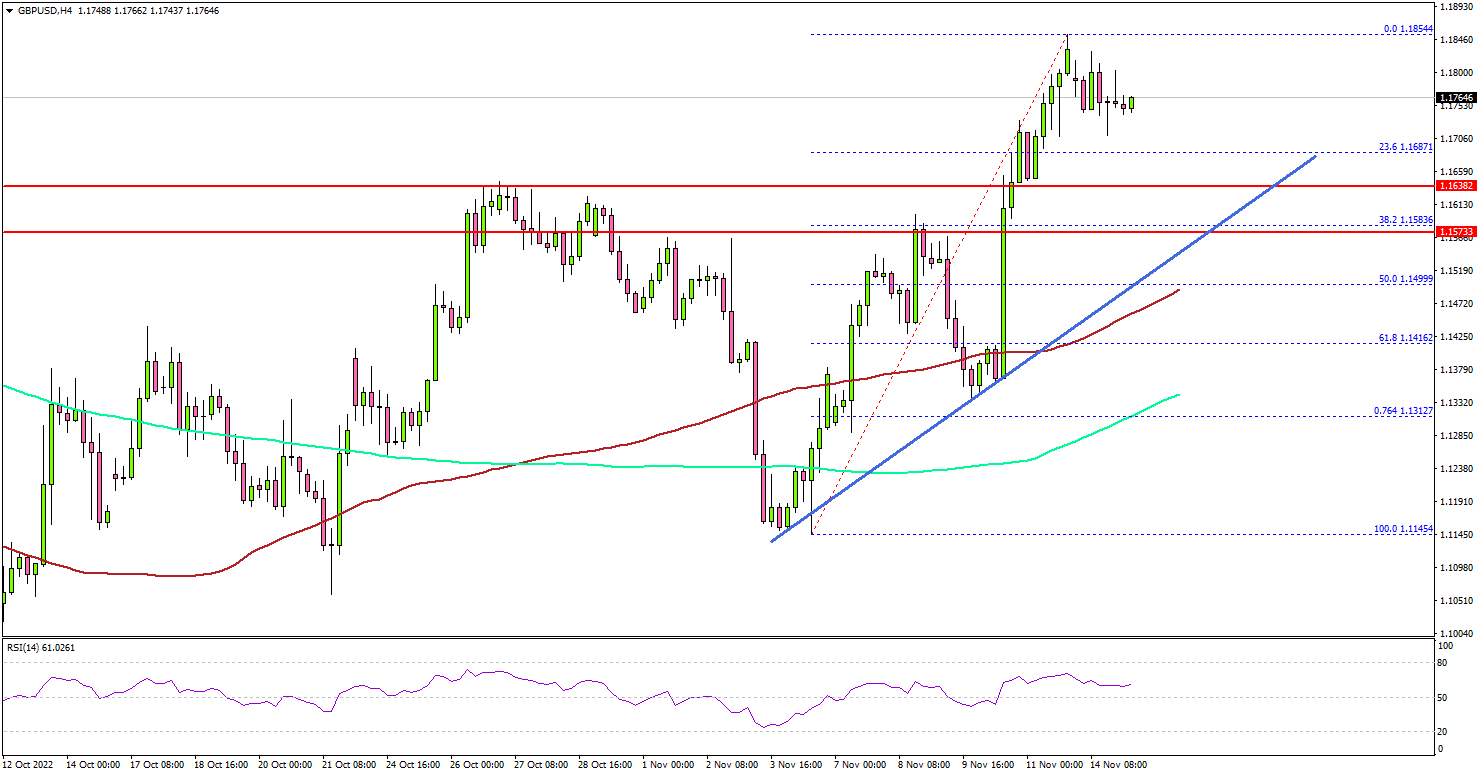
Looking at the 4-hours chart, the pair gained bullish momentum above the 1.1600 resistance, the 100 simple moving average (red, 4-hours) plus the 200 simple moving average (green, 4-hours).
The upward move was such that the pair even climbed above the 1.1700 and 1.1750 levels. It traded as high as 1.1854 before there was a minor downside correction. An initial support is near the 1.1650 level.
The next major support is near the 1.1620 zone. The main support sits at 1.1600. There is also a key bullish trend line forming with support near 1.1600 on the same chart. A close below the 1.1600 level might start another strong decline. In the stated case, GBP/USD could decline towards the 1.1250 support.
On the upside, an immediate resistance is near 1.1850 level. The next major resistance may perhaps be near 1.1920. Any more gains could set the pace for a move towards the 1.2000 level, above which it could even test 1.2150.
Looking at gold price, the bulls seem to be in control and they might aim more gains above the $1,770 level in the coming sessions.
Economic Releases
- UK Claimant Count Change for Oct 2022 – Forecast -12.6K, versus +25.5K previous.
- UK ILO Unemployment Rate for Sep 2022 (3M) – Forecast 3.5%, versus 3.5% previous.
- Euro Zone Gross Domestic Product Q3 2022 (Preliminary) (QoQ) - Forecast 0.2%, versus 0.2% previous.