

Sample Category Title
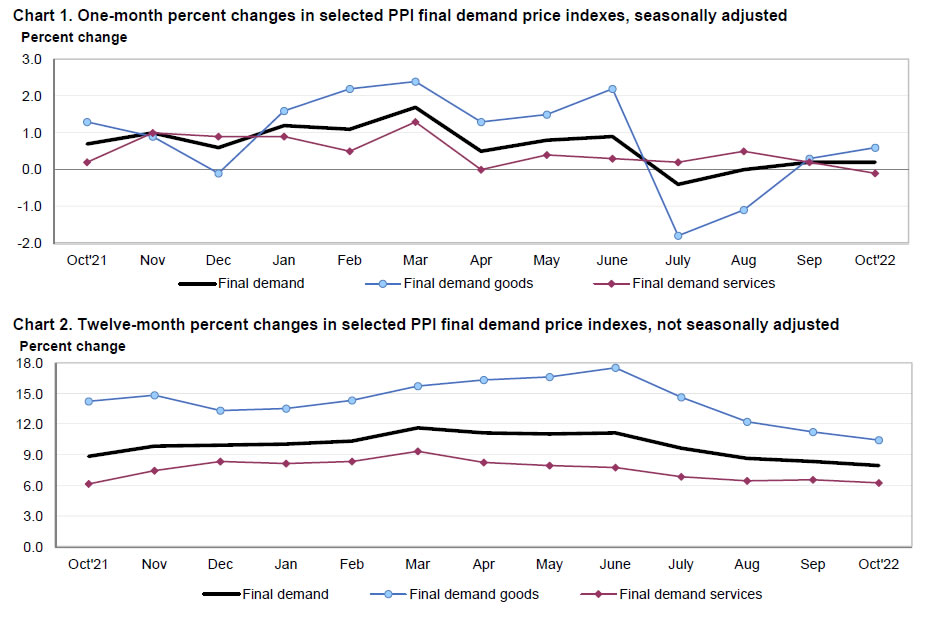
US PPI at 0.2% mom, 8.0% yoy in Oct
US PPI for final demand rose 0.2% mom in October, below expectation of 0.5% mom. Prices for goods rose 0.6% mom while services dropped -0.1% mom. PPI less foods, energy and trade services rose 0.2% mom.
For the 12 months period, PPI slowed from 8.4% yoy to 8.0% yoy. PPI less foods, energy, and trade services rose 5.4% yoy.
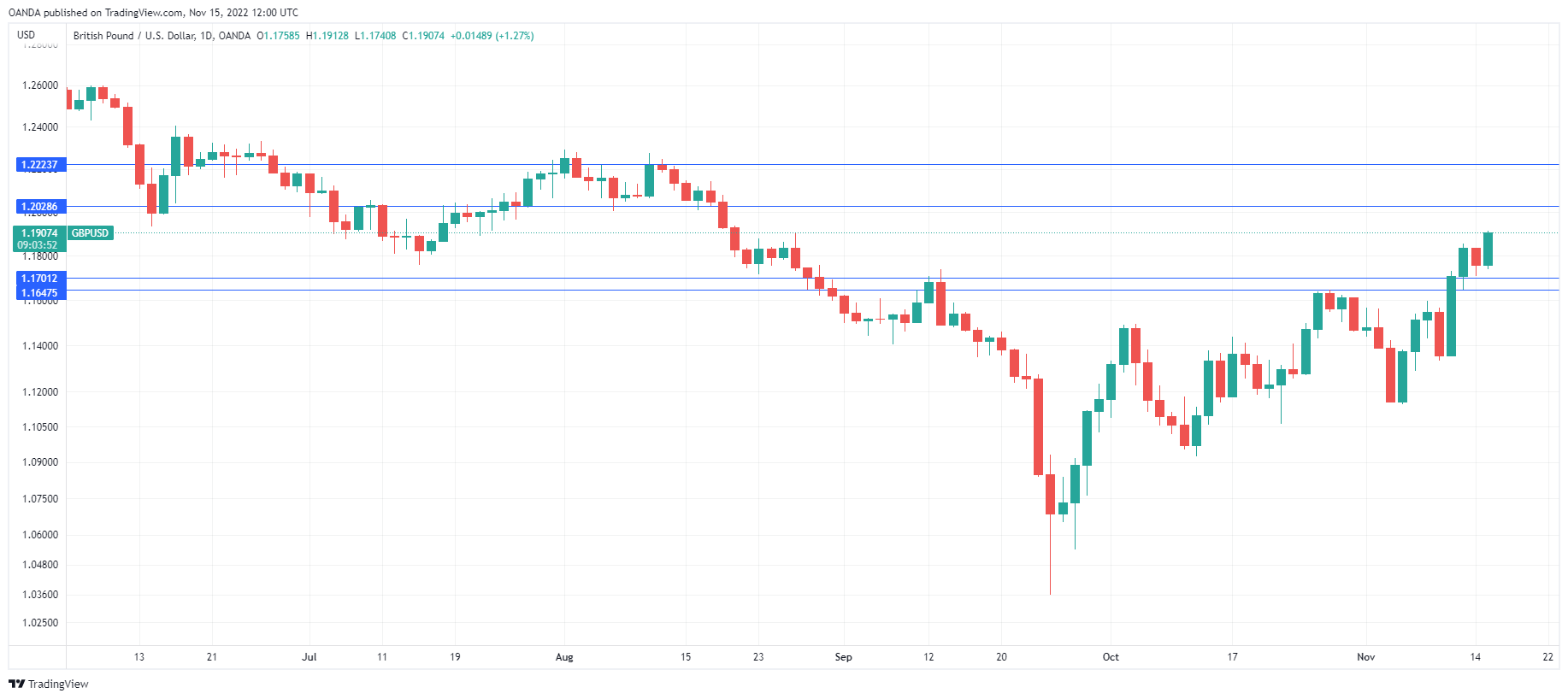
Pound Soars Despite Weak Job Data
The British pound has reversed directions on Tuesday and posted sharp gains. In the European session, GBP/USD is trading at 1.1902, up 1.22%. The pound has punched above 1.19 for the first time since August 19th.
UK wage growth a headache for BOE
The UK employment report was soft, with unemployment ticking higher to 3.5%, up from 3.4%. Unemployment rose by 3.3 thousand, down from 3.9 thousand but well off the consensus of -12.6 thousand. The BoE will be most concerned about the increase in wage growth, which will create even more inflation, at a time when inflation is above 10%. Wages excluding bonuses rose to 5.7%, up from 5.5% and ahead of the consensus of 5.6%. There isn’t much slack to speak of in the labour market and the BoE will be under pressure to continue hiking aggressively, even though this will hurt the struggling UK economy.
The Fed may be breathing a bit easier today, as the exuberance which sent the stock markets flying last week appears to have subsided. Investors jumped all over the soft inflation report, as risk sentiment soared and the US dollar retreated. Fed members have responded by sticking to a hawkish script, as any dovish signals could complicate its battle to bring down inflation. Fed Vice Chair Brainard said on Monday that she favored slowing the pace of rate hikes, but that further hikes were required in order to bring down inflation.
Brainard’s stance was echoed by Fed member Waller who said that while the Fed may ease up on the size of future rate hikes, it should not be seen as a “softening” in its fight against inflation. Waller added that the 7.7% inflation reading in October was “enormous”, a possible rebuke of the exuberance shown by investors to the drop in inflation.
GBP/USD Technical
- GBP/USD has broken through several resistance lines today. The next resistance lines are 1.2030 and 1.2224
- 1.1703 and 1.1648 are providing support
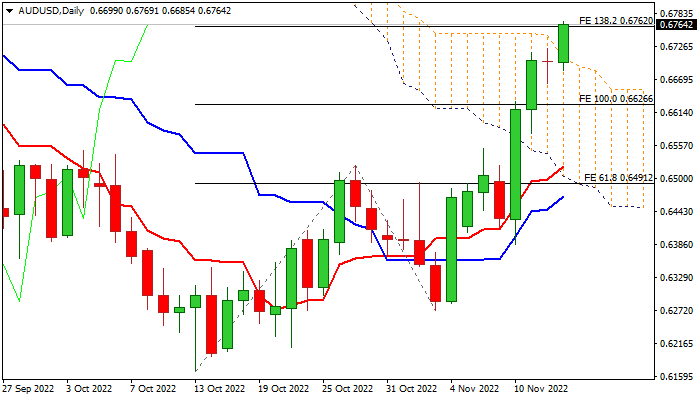
AUDUSD: Aussie Hits Two-Month High in Extension of Steep Ascend
The Australian dollar rose to two-month high on Tuesday, in extension of the latest strong bullish acceleration, lifted by renewed risk sentiment on significantly weaker US dollar.
The pair is running on extended third wave of five-wave cycle from 0.6170 (Oct 13 low) which hit 138.2% Fibonacci expansion (0.6762), also Fibo 61.8% retracement of 0.7136/0.6170 descend.
Another bullish signal was generated on today’s break above descending thick daily cloud.
Bulls need a clear break of 0.6762 barrier to open way towards targets at 0.6845/0.6908 (FE 161.8%/Fibo 76.4% retracement, respectively).
Daily Tenkan-sen and Kijun-sen in bullish setup and strong bullish momentum underpin the action, though strongly overbought stochastic warns that bulls may take a breather in coming sessions.
Dip-buying remains favored, ideally above broken 100DMA/daily cloud top at 0.6700 zone, but deeper pullback cannot be ruled out, with significant supports seen at 0.6653 (broken Fibo 50% retracement) and 0.6600 (lower 20-d Bollinger band).
Res: 0.6805; 0.6845; 0.6908; 0.6956.
Sup: 0.6698; 0.6653; 0.6600; 0.6539.
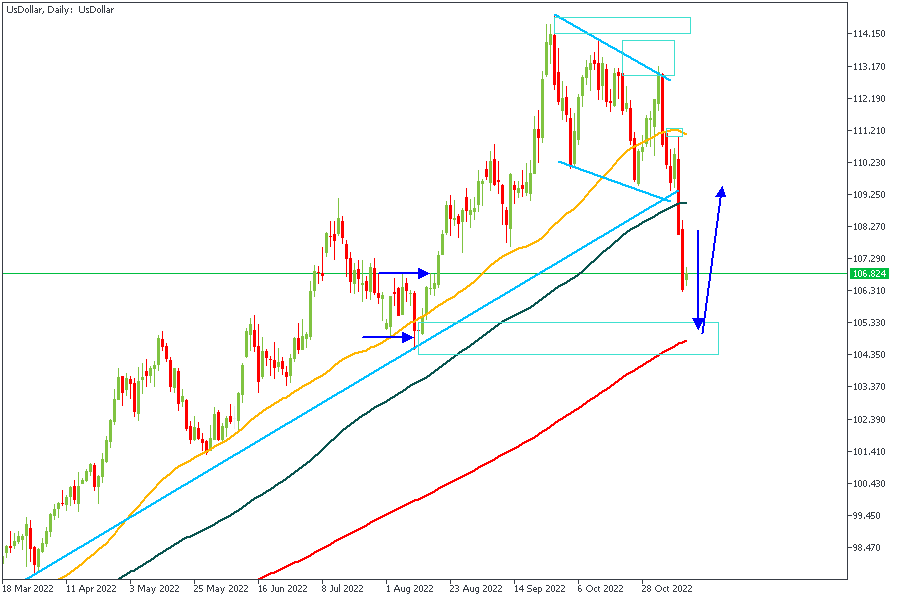
Trade Idea: Major Currency Pairs to Watch Out For This Week
It is general knowledge that the Major currency pairs are pairs that have the US Dollar as either the base or quote currency. As a result, our trade ideas for major pairs will begin first with an analytical review of the US Dollar chart.
As you can see from the chart above, the US Dollar on the Daily timeframe has broken below the 100-Day Moving Average and is expected to reach the 200-Day average as its next target. We also observe the presence of a solid drop-base-rally demand zone resting within the region of the MA. This implies that we can expect a temporary weakness in the Dollar until price reaches the expected area of interest. With the incoming release of the PPI and Empire State Manufacturing Index on Tuesday, I personally will be expecting the figures to favour the Dollar.
EURUSD
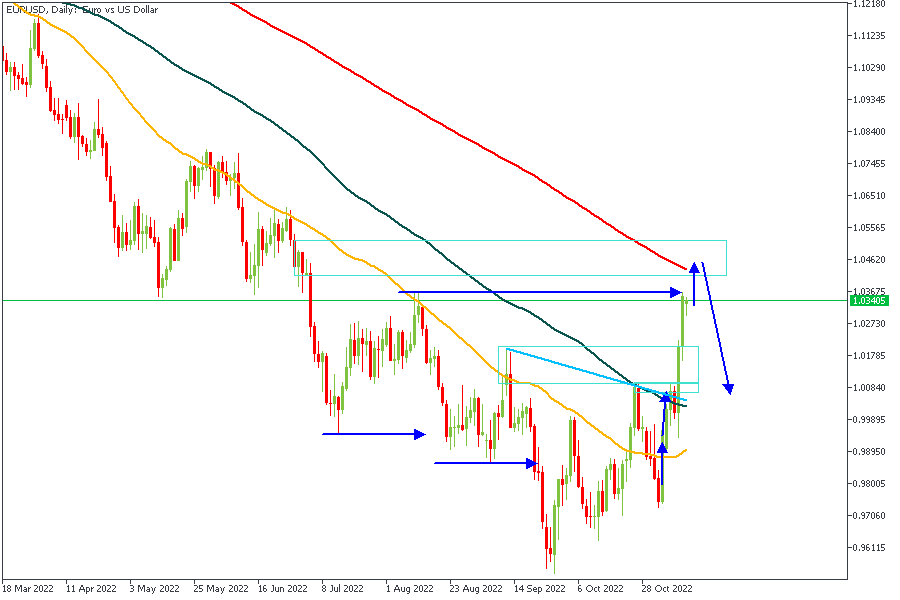
The Daily timeframe on EURUSD presents a clear selling opportunity from the retest of the 200-Day Moving Average as well as the drop-base-drop supply zone occurring within the range. It is also noteworthy that we have seen a tentative grab of liquidity right before price taps into our area of interest.
GBPUSD
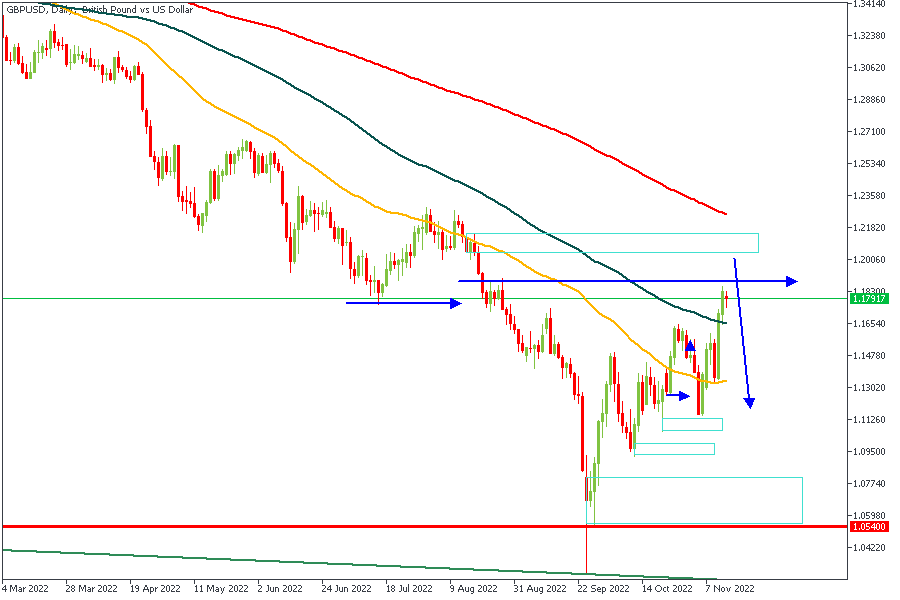
This week I am expecting GBPUSD to continue its downward trend from the 200-Day moving average. Price will most likely tap into the drop-base-drop supply zone after taking out liquidity from the high marked by the arrowed line. The PPI figures should contribute some volatility to help this play out smoothly.
USDJPY
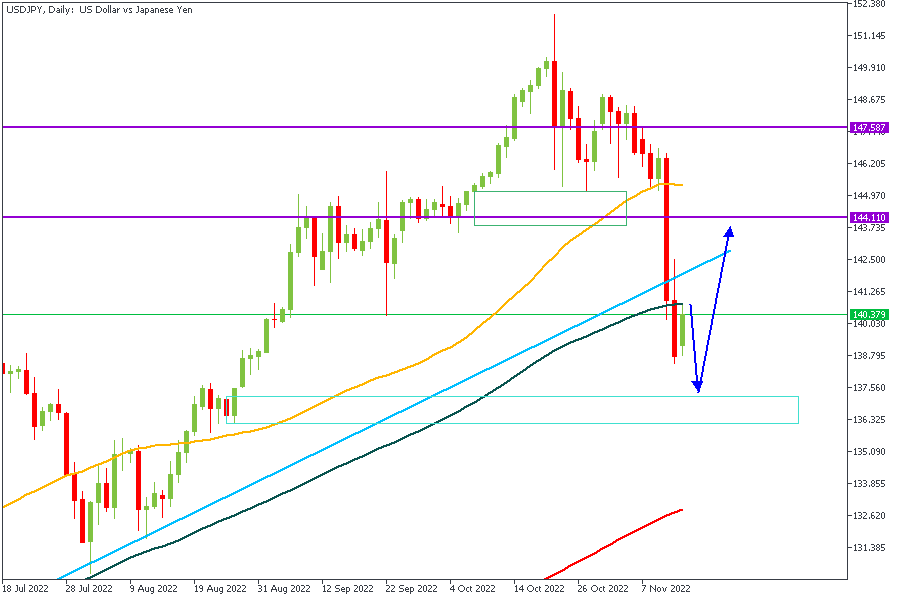
USDJPY broke below the 100-Day Moving Average and created a divergence. This signifies an impending change of direction which will likely commence from the rally-base-rally demand zone marked by the hollow rectangle. The bias is bullish for the time being once the reaction from the demand zone has been confirmed.
AUDUSD
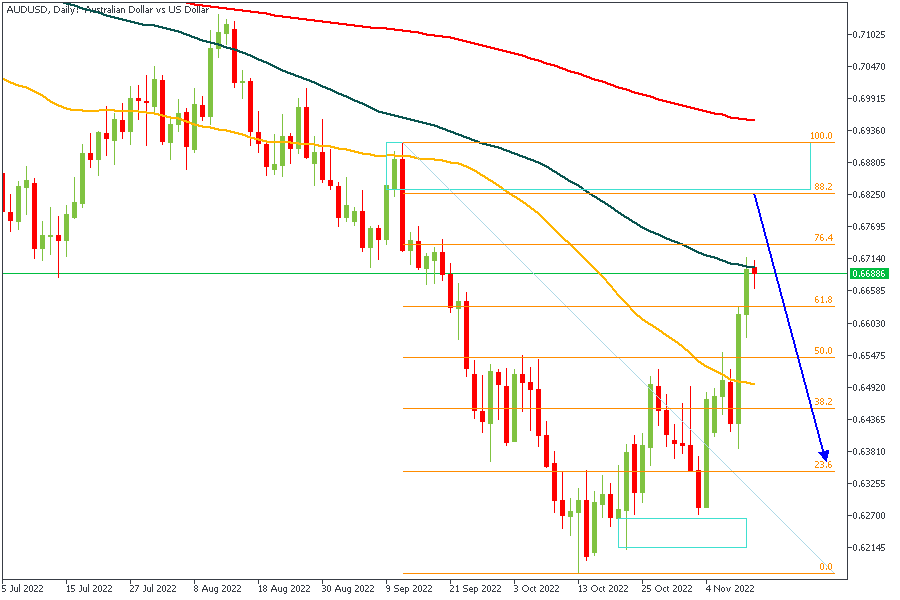
Even though price is currently trading at the 100-Day moving average, the momentum suggests a likely break above the MA in order to create a divergence and also give room for price to recover the imbalance between the 76.4% and 88.2% of the Fibonacci retracement. Once this move has been completed, I will be looking for opportunities to short the market.
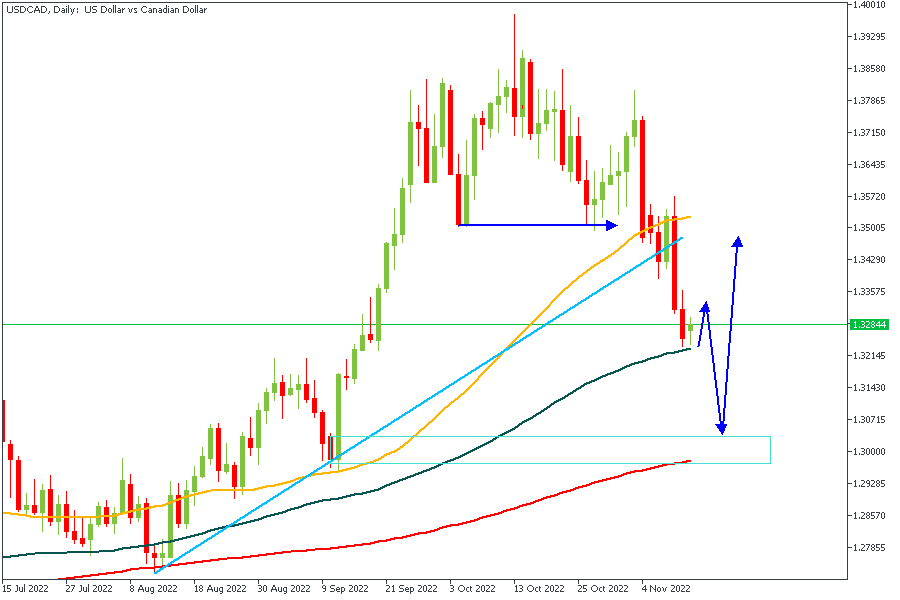
USDCAD
My expectation from USDCAD can easily be interpreted from the arrow directions. To break it down, however, I am anticipating a sleek drop in prices to the 1.30300 regions for a solid rejection from the drop-base-rally demand zone, and the 200-Day Moving Average confluence.
CONCLUSION
It is important to understand that the trading of CFDs comes at a risk; if not properly managed, you may lose all of your trading capital. To avoid costly mistakes while you look to trade these opportunities, be sure to do your own due diligence and manage your risk appropriately.
WTI Oil: Bears Remain Firmly in Play on Demand Worries and Reinforced by Daily Bearish Engulfing
WTI oil remains in red in early Tuesday’s trading and extends Monday’s strong fall (down 4.1% for the day).
The oil prices came under increased pressure on news of rising Covid cases in China, which revived demand worries and add to downside risk, despite China partially eased its tough Covid rules last week.
Fresh weakness after repeated rejection at psychological $90 barrier extended below narrowing daily cloud on Tuesday that adds to negative signals, as bears pressure Fibo support at $84.22 (76.4% of $81.29/$93.72 upleg.
Daily studies turned bearish, as south-heading 14-d momentum is deeply in the negative territory and moving averages in bearish setup, with Tuesday’s bearish engulfing adding to downside risk.
Clear break of 84.22 Fibo level to expose troughs at $83.00/$82.60 zone, guarding more significant support at $81.29 (Oct 18 higher low) loss of which to confirm a double-top pattern ($93.60/72) and increase downside pressure.
Broken Fibo 61.8% ($86.04) reinforced by converged 5/55 DMA’s, should ideally keep the upside protected.
Res: 85.78; 86.04; 87.23; 88.08.
Sup: 83.04; 82.64; 81.71; 81.29.

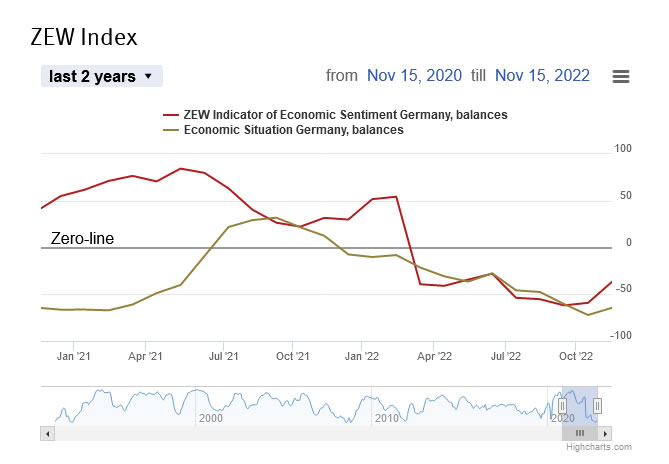
German ZEW rose sharply to -36.7, related to hope that inflation will fall soon
Germany ZEW Economic Sentiment rose from -59.2 to -36.7 in November, much better than expectation of -54.1. Current Situation index rose from -72.2 to -64.5, above expectation of -67.5.
Eurozone ZEW Economic Sentiment rose from -59.7 to -38.7, above expectation of -55.0. Current Situation index rose 5.5pts to -65.1.
"The ZEW Indicator of Economic Sentiment rises again in November. This is likely to be related above all to the hope that inflation rates will fall soon. In this case, policymakers would not have to hit the brakes on monetary policy as hard and/or for as long as feared. However, the economic outlook for the German economy is still clearly negative," comments ZEW President Professor Achim Wambach.
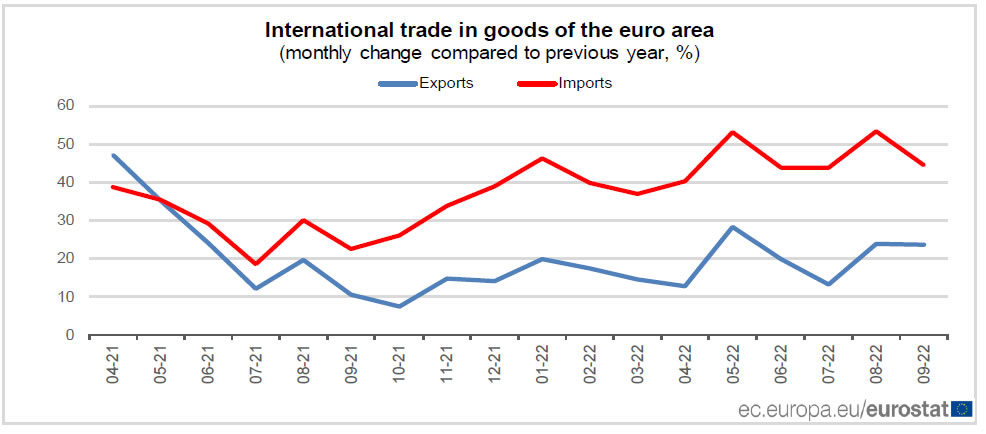
Eurozone goods exports rose 23.6% yoy in Sep, imports rose 44.5% yoy
In September, Eurozone goods exports, to the rest of the world, grew 23.6% yoy to EUR 210.1B. Goods imports rose 44.5% yoy to EUR 294.0B. Goods trade deficit came in at EUR -34.4B. Intra-Eurozone trade rose 27.3% yoy to EUR 247.6B.
In seasonally adjusted terms, Eurozone exports rose 1.6% mom to EUR 250.0B. Imports dropped -2.0% mom to EUR 287.7B. Trade deficit narrowed from EUR -47.6B to EUR -37.7B. Intra-Eurozone trade dropped from EUR 241.8B to EUR 238.9B.
Full trade balance release here.
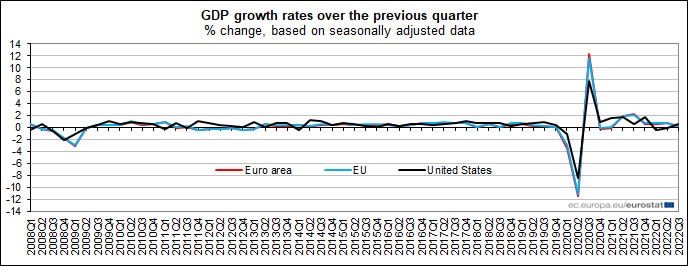
According to the second estimate, Eurozone GDP grew 0.2% qoq in Q3, slowed from Q2's 0.8% qoq. Employment grew 0.2% qoq, slowed from Q2's 0.4% qoq.
Will Australian Jobs Report Justify the RBA’s Need for Caution?
Employment numbers out of Australia will be watched on Thursday (00:30 GMT) as the country’s central bank ponders how much further to tighten policy. Higher interest rates have been attributed to the downturn in Australia’s housing market, but up until recently, policymakers were hopeful that the strong labour market would cushion the economy against a broader slowdown. Is the soft patch in the jobs market just temporary, or will there be a rebound in October?
RBA worried about housing market
The Reserve Bank of Australia was a bit late in the game when it came to joining its global peers in hiking interest rates. Nevertheless, the cash rate has risen by a whopping 275 basis points in a short period of time so it’s understandable that policymakers want to tread more carefully going forward. But striking the right balance in terms of doing enough to contain inflation while managing the downside risks to growth will probably be more difficult than they envisioned.
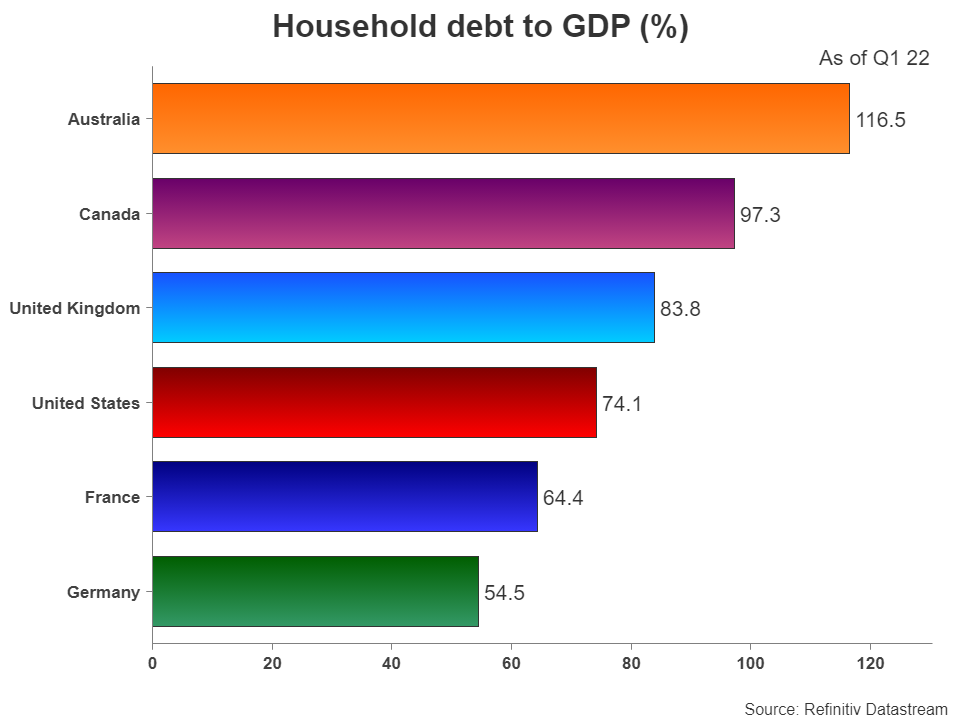
Households have been hit hard by the rapid and steep increase in borrowing costs. Not only does Australia have very high household debt levels, but it also has a large portion of households on variable mortgages, making consumers very sensitive to any changes in interest rates. House prices are now falling in every major Australian city, with places like Sydney and Melbourne recording the largest declines.
Jobs market has lost some steam
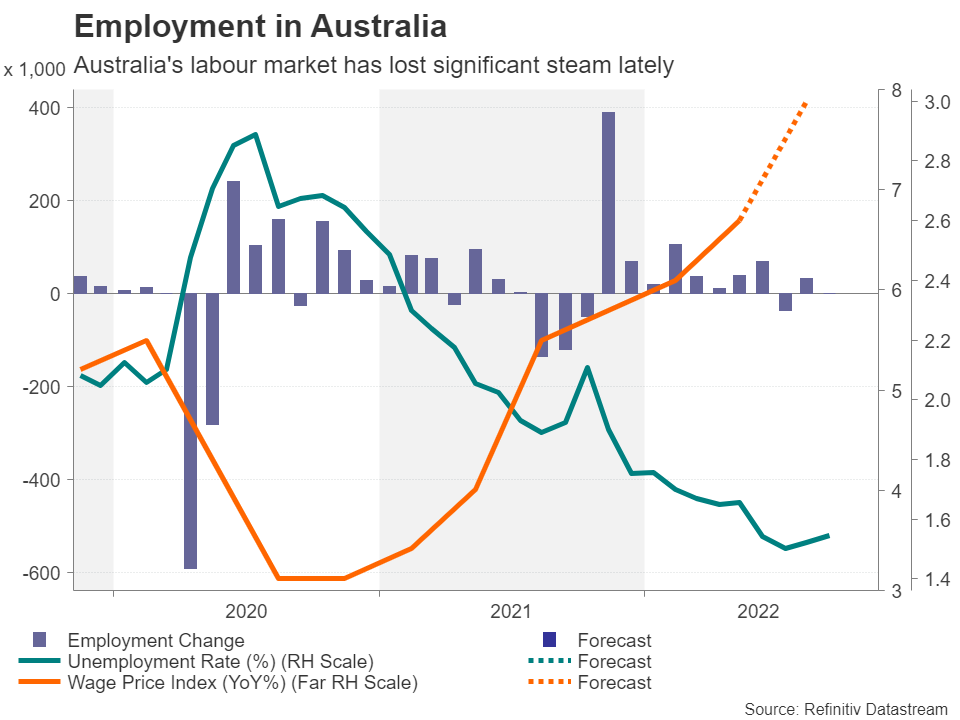
But it’s not just the property sector that’s struggling. The entire services economy has been stagnant since late summer according to the S&P Global PMI gauge, and even the labour market is slowing. Jobs growth has been flat since July and the unemployment rate has ticked up slightly. The forecast for October is a little better. Economists expect a gain of 15k jobs versus a paltry increase of 900 jobs in September. Though, the jobless rate is expected to edge up again from 3.5% to 3.6%.
Ahead of the employment figures, the wage price index will also catch investors’ attention on Wednesday (00:30 GMT). Despite the tightest labour market in decades, wage growth has so far been disappointing. It hit 2.6% y/y in the second quarter and is forecast to have accelerated to 3.0% in the third quarter – less than half the rate of inflation, which hit 7.3% in the same period.
Overly cautious?
Taking all this into consideration, the RBA might be right to be pre-emptively cautious, even if inflation possibly hasn’t peaked yet. China’s growing economic woes have been another source of worry, although exports remain strong for now.
But just how much of a dovish pivot is this for the RBA? After all, it’s one of the few central banks in the world that meets 11 times a year – something that gives it extra flexibility to adjust the pace of rate hikes s as it sees fit. This confusion or potential miscommunication may end up wrongfooting investors who could be underestimating the RBA’s resolve to get inflation down. Money markets have priced in an almost 25% probability that the RBA will keep rates on hold at its next meeting in December seem overdone based on the information available.
Aussie rebounds as dollar rally falters
Yet, when it comes to the Australian dollar, the dovish expectations may not necessarily be particularly detrimental at a time when the US dollar is finding itself increasingly on the backfoot. The aussie has retraced more than 60% of the August-October downfall as investors have upped their bets that the Fed is nearing the end of its tightening cycle, pressuring the greenback.
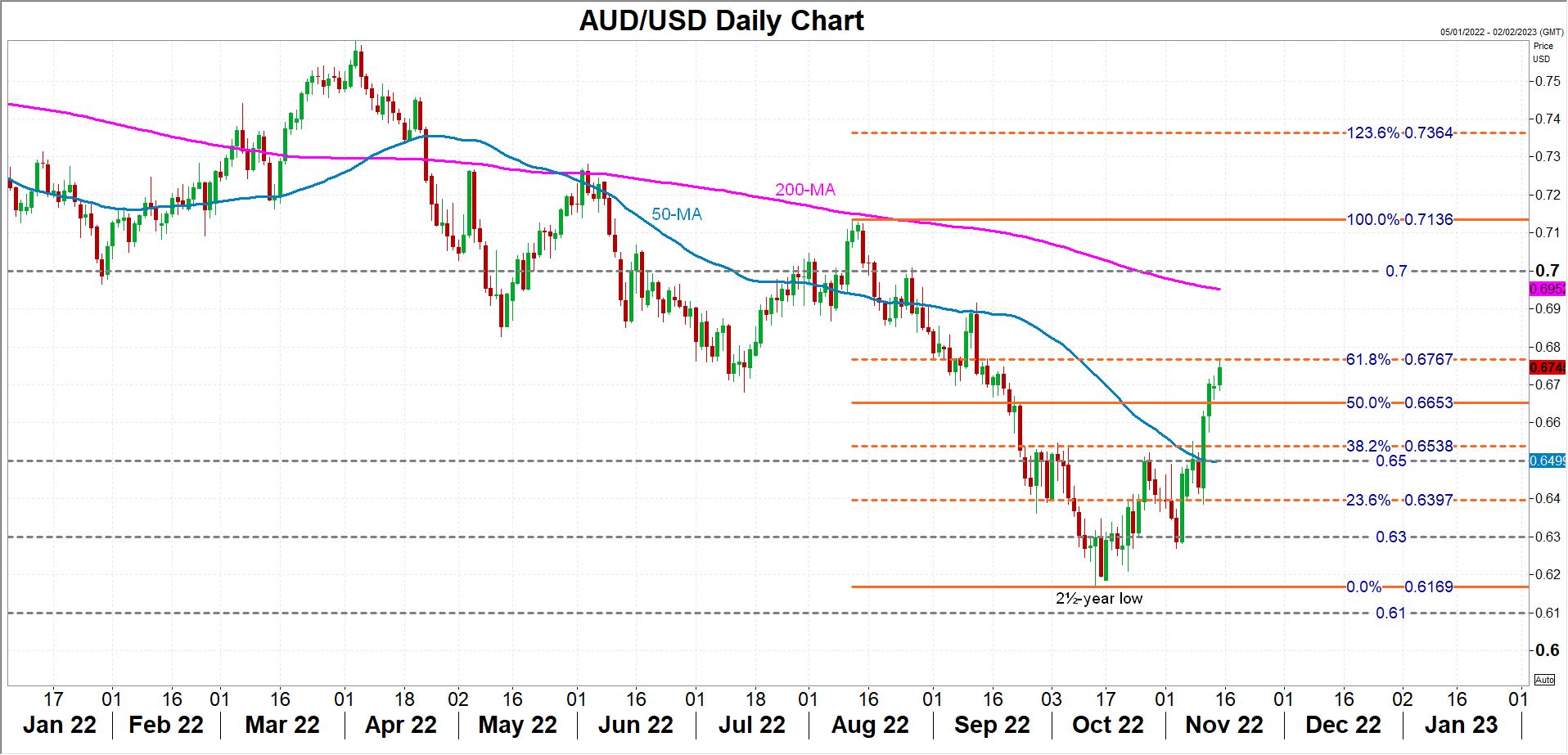
If the aussie manages to break above the 61.8% Fibonacci retracement at $0.6767, its gains could stretch until the 200-day moving average (MA) around $0.6950. However, the battle around the $0.70 barrier is likely to be a lot tougher.
In the event that the employment data adds to concerns about the Australian economy, the aussie could fall back towards its 50-day MA in the $0.65 region. If broken, the next psychological levels of $0.64 and $0.63 are likely to be tested too.
The RBA next meets on December 6, but prior to that, the recently launched monthly reading of CPI on November 30 may provide a further clue on the final policy decision of the year.
Wounded US Dollar Turns to Retail Sales for Direction
Hopes that inflation is finally cooling down led traders to unwind bets that the Fed will raise rates beyond 5%, dealing a heavy blow to the US dollar last week. The next event is the retail sales report this week. It will reveal how demand is holding up, helping investors decide whether the selloff in the dollar was an overreaction or the beginning of a trend reversal.
Fed bets
The latest US inflation data came as a bombshell for markets, causing a drastic rethinking around how quickly and how high the Fed will lift interest rates. With mounting signs that inflation has started to cool, the conclusion was that the Fed will ‘only’ raise rates by half a percentage point next month and the peak will be below 5%.
This shift inflicted severe damage on the dollar, which lost more than 4% against the euro in a single week as US yields came crashing down, eroding its interest rate advantage. Admittedly though, this sharp reaction was probably driven by one-sided positioning. Since ‘long dollar’ was a very crowded trade, huge reversals can happen merely as traders lock in profits.
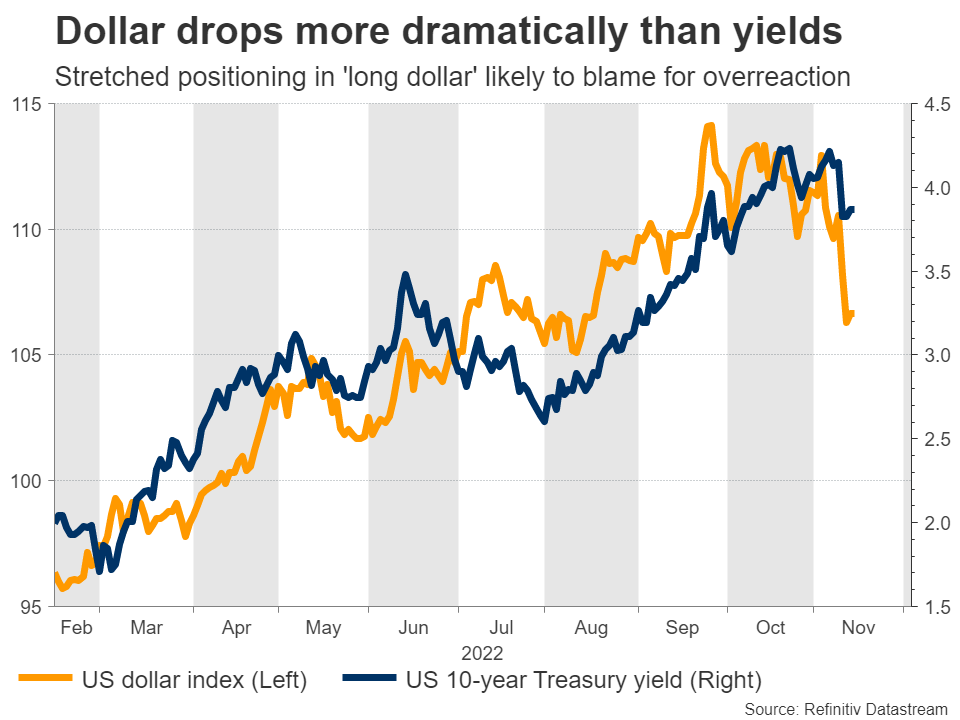
Most importantly, the story around the Fed hasn’t changed enough to warrant such dramatic moves. While inflation might have peaked, it is still running at almost four times the Fed’s target and there is no telling how quickly it will come down. With China slowly relaxing its zero-covid strategy too, commodity prices could come back to life, boosting inflationary pressures again.
Drawing conclusions from one data point is never a good idea, so it is difficult to say at this stage whether the latest market moves were an overreaction or the beginning of the end for the dollar’s rally. The picture will become clearer on Wednesday, with the latest batch of US retail sales.
Slowing down
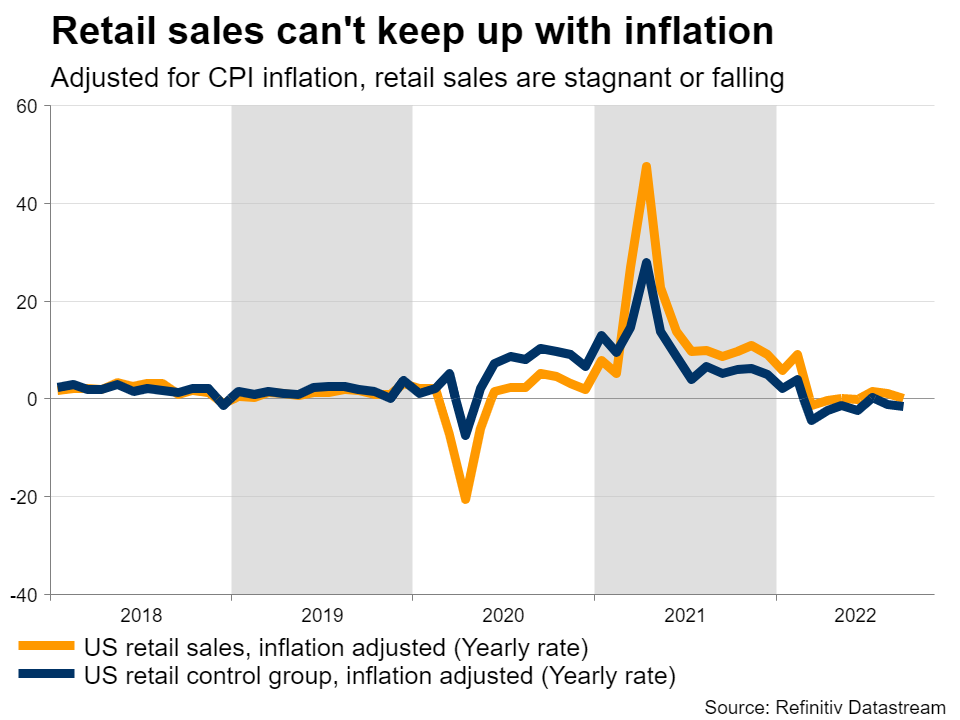
In October, retail sales are expected to have risen by 1% after stagnating the previous month, while the retail control group that is used in GDP estimates is projected to clock in at 0.3%, a slight deceleration from September. In yearly terms, both are set to slow dramatically, as much stronger numbers drop out of the 12-month calculation.
Bear in mind that retail sales numbers are not adjusted for inflation. Once we account for inflation running at 7.7%, retail sales are basically stagnant from last year. That’s a worrisome sign, but the counter is that consumption has shifted towards services and away from goods since last year, so focusing on retail sales as a proxy of demand is not wise.
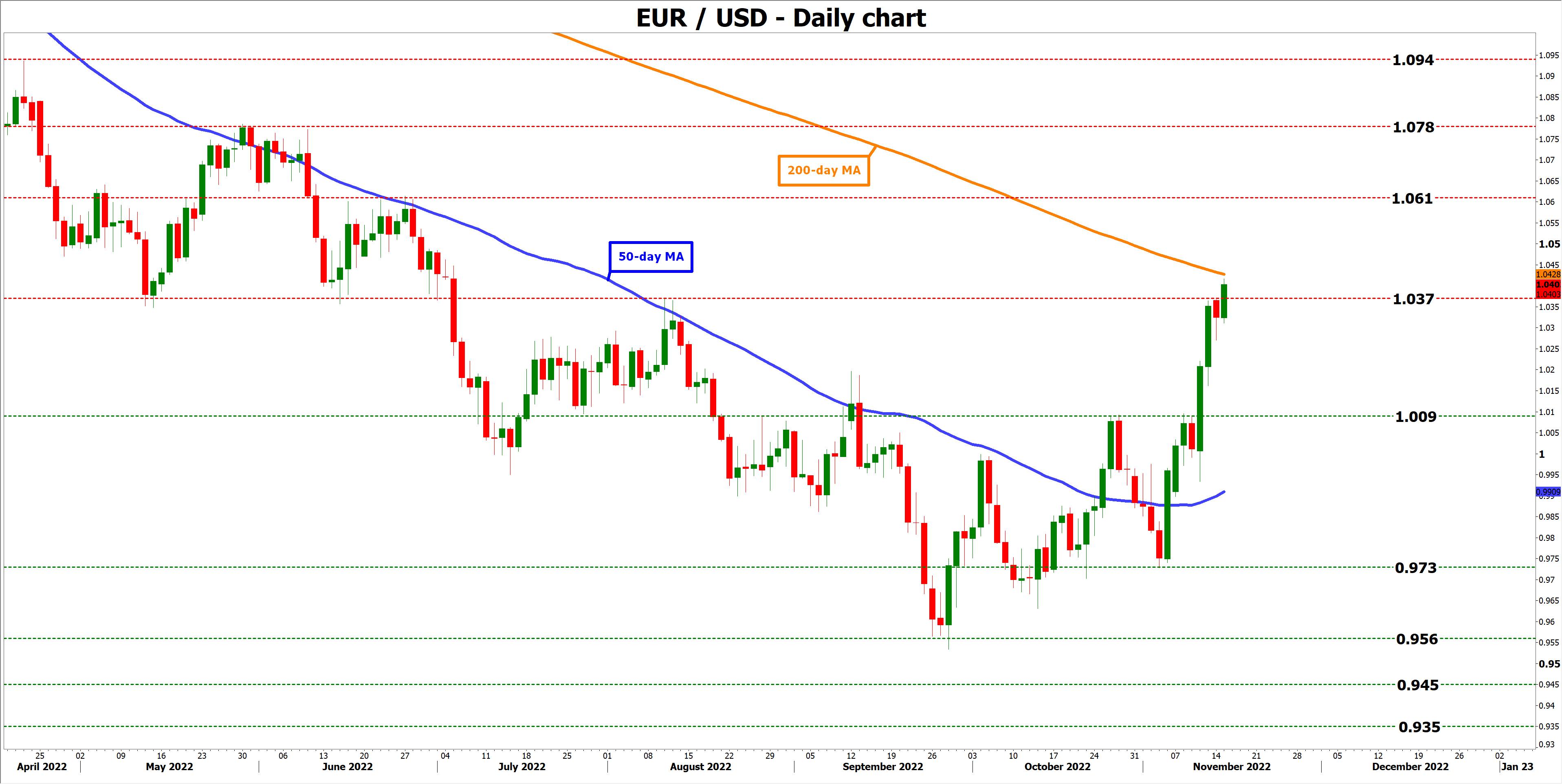
In any case, the dollar will most likely react to any surprises. Prints that surpass expectations would be the best outcome for the currency, as that could revive speculation for Fed rates to exceed 5% in this cycle. In this case, euro/dollar could edge back below 1.0370, and perhaps aim for another test of the 1.0090 region.
On the flipside, a disappointing dataset could reinforce the narrative that the Fed will be more cautious. That could propel euro/dollar even higher, with a move above the 200-day moving average at 1.0428 opening the door towards the 1.0610 zone.
Big picture
All told, the dollar is currently at a crossroads. Most of the elements that fueled this stunning rally seem to be losing their kick, for instance with inflation cooling down but potentially yet to peak in other economies, and big government spending packages off the table now that Congress will likely be divided.
Meanwhile, the outlook for other major currencies has started to improve. A sharp decline in European energy prices paints a brighter picture for the Eurozone economy, nerves around UK politics have calmed for now, and the Bank of Japan seems to be gearing up for policy changes.
Markets don’t move in straight lines and the dollar might still have one ‘last hurrah’ left, especially if the global economy falls into recession. Still, this ferocious rally seems to be on its last legs.
ETH and BTC Under Pressure from the Pros
Market picture
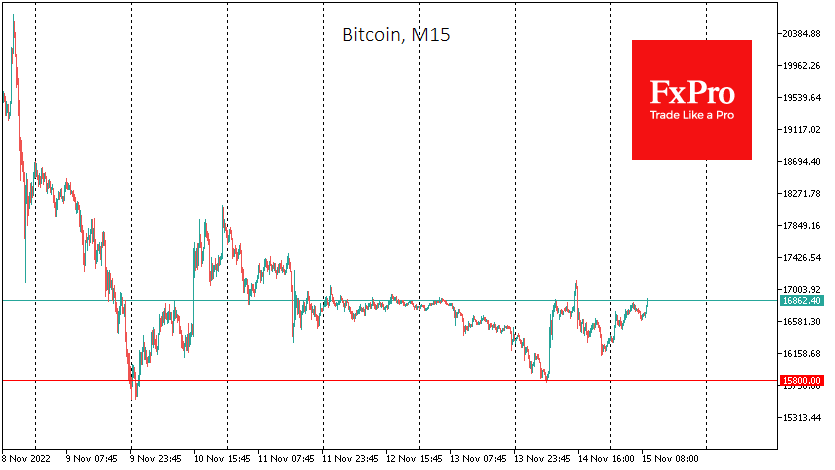
Bitcoin is trading in the $16.7K area (+1.6% in 24 hours), a significant consolidation area of the past five days. It was helped back to these levels by the news of Binance launching a fund to help cryptocurrency companies experiencing temporary liquidity difficulties. The news has stopped a wave of selloffs but has yet to be able to turn the market up.
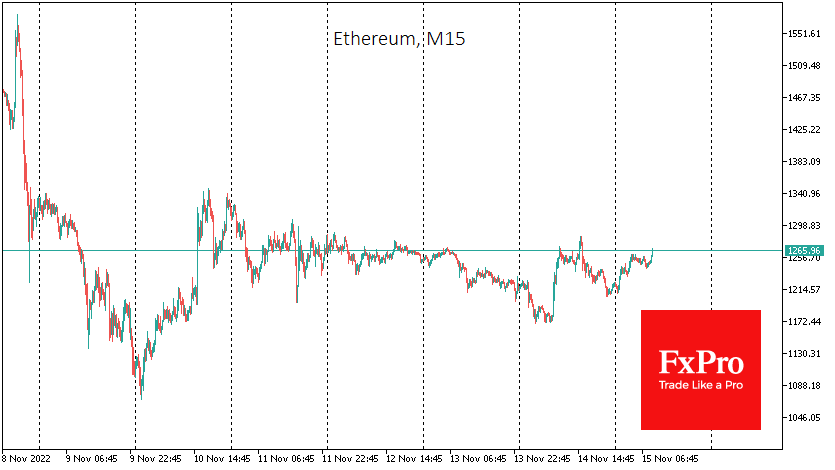
On the intraday charts of BTCUSD, there is a notable resistance area near the current price. In Ethereum, the situation is very similar, and the price fails to develop a growth above $1250 (+2.2% in 24 hours). The two most popular cryptocurrencies have the widest share of institutional investors, whose confidence in the sector has been eroded recently. It is their professional unloading into the market that we are now seeing on the charts.
The entire crypto market is more enthusiastic, adding 4.3% in capitalisation overnight to $841B, according to CoinMarketCap estimates.
According to CoinShares, investments in cryptocurrencies rose last week to their highest in three months. Inflows of $42M compared to outflows of $16M a week earlier. Bitcoin investments rose by $19M, and Ethereum by $3M. Investments in funds that allow shorts on bitcoin increased by $13M. Altcoin basket products attracted the highest since June by $8M. Investors saw the FTX collapse as an investment opportunity, CoinShares noted.
According to Glassnode, BTC withdrawals from cryptocurrency exchanges reached an all-time high of 106,000 BTC for the month. Previously, the market has only experienced similar BTC outflows three times in history.
News background
Binance CEO Changpeng Zhao and MicroStrategy founder Michael Saylor urged users to store assets in cold wallets, especially during “market turbulence”. According to Bloomberg, FTX customers are unlikely to get their funds back.
Elon Musk said the crypto winter could be long, but bitcoin would eventually survive.
The collapse of FTX showed that the cryptocurrency industry needs “prudent regulation”, US Treasury Secretary Janet Yellen said. The consequences of the incident could have been much worse if the crypto market had been more connected to the traditional financial system, she said.