

Sample Category Title
GBP/USD: Cable Cracks Psychological 1.20 Barrier
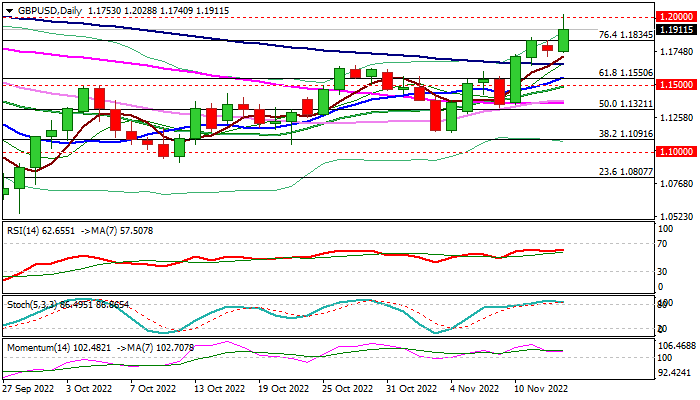
Cable dented psychological 1.20 barrier and traded above this level for the first time since mid- August, in fresh acceleration higher after bulls paused for consolidation on Monday.
Weaker dollar on better than expected US PPI data which added to hopes that US inflation has peaked and holding in downward trajectory, provided fresh boost to sterling.
Bulls broke above 1.1834 (Fibo 76.4% of 1.2293/1.0348) where the action was repeatedly rejected in past two days and added to bullish signals on probe above 1.20 barrier.
Close above 1.1834 to keep bulls intact, though overbought conditions on daily chart cannot rule out deeper pullback towards broken 100DMA (1.1651) where dips should be contained.
Res: 1.2000; 1.2028; 1.2048; 1.2100
Sup: 1.1834; 1.1749; 1.1710; 1.1651
EURUSD: Euro Hits Multi-Month High on Probe Above 200DMA
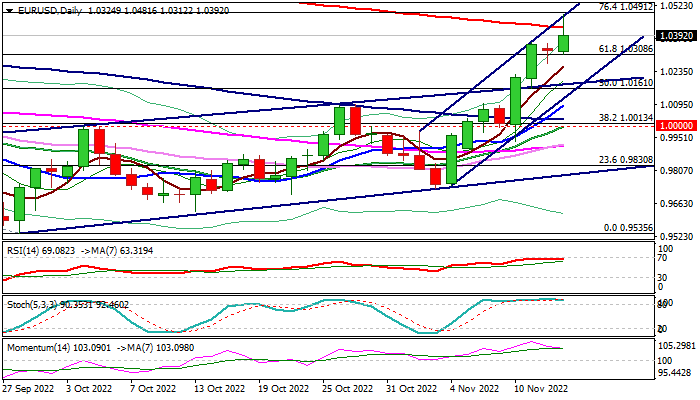
The Euro resumed its steep uptrend after bulls took a brief breather on Monday and cracked 200DMA (1.0428), hitting the highest in 4 –1/2 months.
Fresh advance peaked at 1.0481, just ahead of barriers at 1.0491/1.0500 (Fibo 76.4% of 1.0786/0.9535 bear-leg/psychological).
Subsequent easing below 200DMA warn that bulls face strong headwinds at pivotal resistance zone, as daily studies are overbought and strong bullish momentum is easing, though the action is still lacking firmer signal of pullback as stochastic is ranging deeply in the overbought territory and RSI is moving around the overbought borderline.
Broken Fibo 61.8% (1.0308) offers initial and solid support, with extended dips expected to find ground above broken upper borderline of bull-channel (1.0197) to keep bulls in play.
Sustained break above 200DMA would generate initial bullish signal which would look for confirmation on lift above pivotal 1.0500 zone and open way towards targets at 1.0786/1.0844 (May 30 peak/base of falling weekly cloud).
Res: 1.0428; 1.0491; 1.0550; 1.0614.
Sup: 1.0364; 1.0308; 1.0259; 1.0197.
European Final CPIs and Yield Gap
With all the focus on G20 and COP27, many European leaders have been out of the continent. News has been relatively sparse, which has allowed the shared currency to drift higher. In the last couple of weeks, it made a couple of runs at parity before finally breaking through thanks to US CPI figures. That opens the question of whether the trend will continue higher, or there will be a return to parity.
For now, the market has to run without proximal intervention from central banks. Both the ECB and the Fed won't meet until a month from now. Thus, focus has to remain on data. Recent data has been relatively good for both economies. But with the different postures of the central banks, market reaction has been in opposite directions.
Wait.. data has been good?
The most recent macro data from Europe was September industrial production that came in above expectations. But that had more to do with forecasts being relatively low due to higher energy prices and reports through the summer that businesses were either reducing output on winding down operations. Since the expectations were priced in, it's a relatively good result.
The main issue is that Europe has high and growing inflation, while recent trends in the US suggest inflation is slowing down. Better economic data means the ECB can keep hiking. Meanwhile, lower inflation in the US means that the Fed could be less aggressive.
How wide can the gap get
The main driver of the Euro below parity with the dollar was the gap in real interest rates. Sure, there was also an effect from general market uncertainty driving investors to the safety of the dollar. But, real yields tell the story about whether it's worth more to have funds in dollars or Euros. Or, more accurately considering the circumstances, which loses less value.
With America's high interest rates and slowing inflation, it means that holding dollars loses less value than holding Euros with lower interest rates and higher inflation. But, that situation might have reached its, and be about to reverse. As inflation in the shared economy pushes into the double digits, the ECB will be under more pressure to raise rates. With inflation coming down, the Fed could slow hiking. Meaning that the real rate gap could be about to shrink, and that could push the Euro higher.
So, no return to parity?
Not necessarily. Over the last couple of days, Fed officials have come out to say that the market is getting ahead of itself on speculation that rates won't be rising as fast. And ECB officials have been relatively quiet over the past few days. The initial move higher in the EURUSD was driven more by speculation than reaction to direction from either central bank.
Europe is still facing a challenging winter, and that might keep the ECB from tightening for a while longer. Meanwhile, US core inflation is still triple the Fed's target. Both sides of the Atlantic seem to agree that inflation is pushing recession risk. Hence, the argument that they have to care about a recession is likely also an argument that they will double down on the fight against inflation.
Eurozone October Final CPI is expected to be confirmed at 10.7%, up from 9.9% in September.
Pound Clears the Way Up
The British pound is on the offensive, having risen to a three-month high against the dollar thanks to a developing correction in the latter, market stabilisation following the change of government and pro-inflationary news.
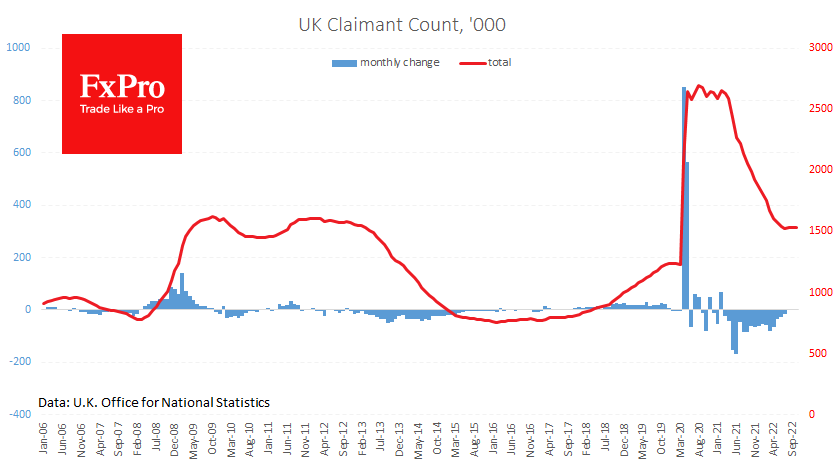
Jobless claims rose by 3.3K in October after a 3.9K increase in September. September’s data was an impressive revision from the initially reported 25.5K jump. Statistics now point to stabilisation in the number of unemployed near 1.5m – 2009-2013 levels. A month ago, the UK labour market was losing jobs rather briskly.
More positivity comes from the wage dynamics. Taking bonuses into account, they are up 6% in the three months to August, better than the 5.5% a month earlier. In addition, rumours are circulating about the Prime Minister’s intention to raise the minimum wage, which could further push wages.
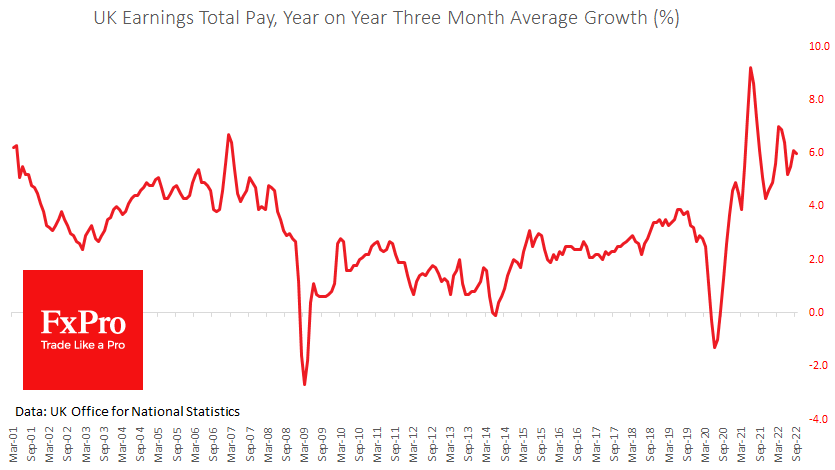
A more substantial than previously estimated labour market and new signs of rising wages create more incentive for the Bank of England to raise interest rates actively.
GBPUSD surpassed 1.19 on Tuesday, adding more than 15% to the lows at 1.0330 set on September 26th. The Cable overcame a pullback of more than 38.2% of the amplitude of the decline from the highs of 2021 to the lows of September, a significant Fibonacci retracement level. Breaking this mark indicates that we see more than a corrective bounce in the Pound before a new round of decline.
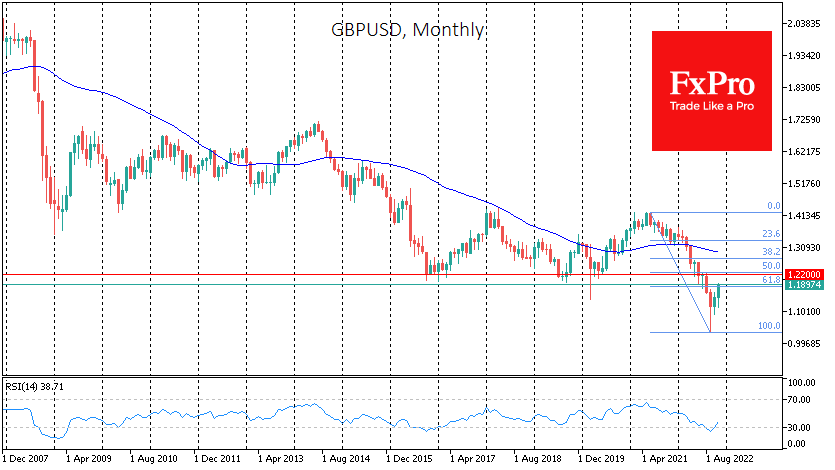
However, despite the impressive size of the rally of the last almost two months, the Pound still has the potential to rally further due to the extreme previous oversold condition. The nearest local bullish target looks to be the 1.2200 area, where the pair received support on declines in 2016, 2019 and 2020.
There are chances that this area will now turn into an equally significant resistance. This area is also close to the 50% mark of the decline, a move above which could clear the way further up.
DXY: Bears Have Established Their Positions
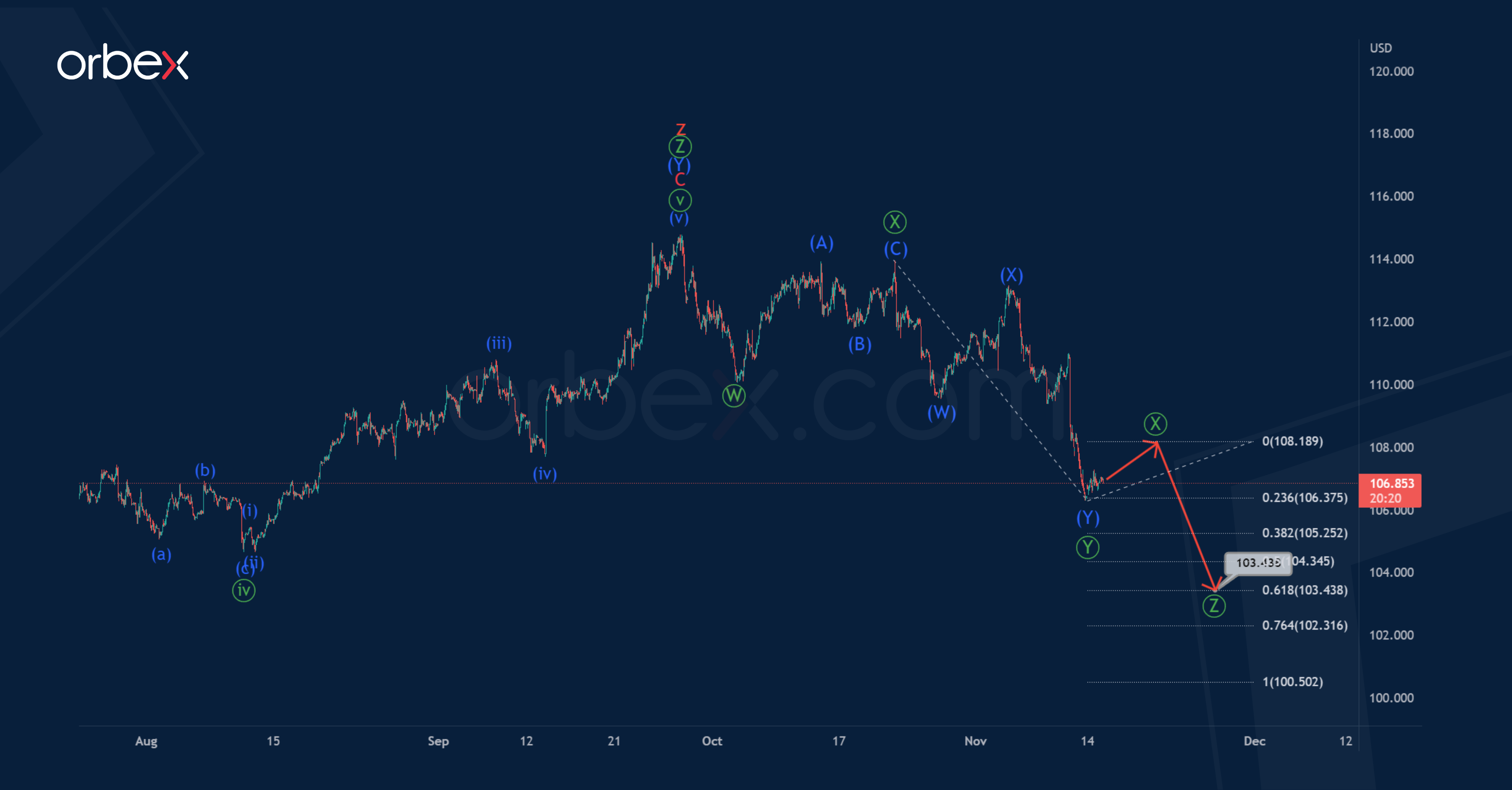
The 1H timeframe of the DXY index shows the completion of the global corrective trend, which took the form of a triple zigzag consisting of five main cycle waves w-x-y-x-z.
Thus, at present, the market could begin the formation of the initial part of a new bearish trend.
It is assumed that the bears form a triple zigzag pattern. The sub-waves look completed. In the near future, after a slight correction in the intervening wave, the price is expected to continue falling in the primary wave. Its end is expected to reach 103.43. At that level, it will be at 61.8% of wave.
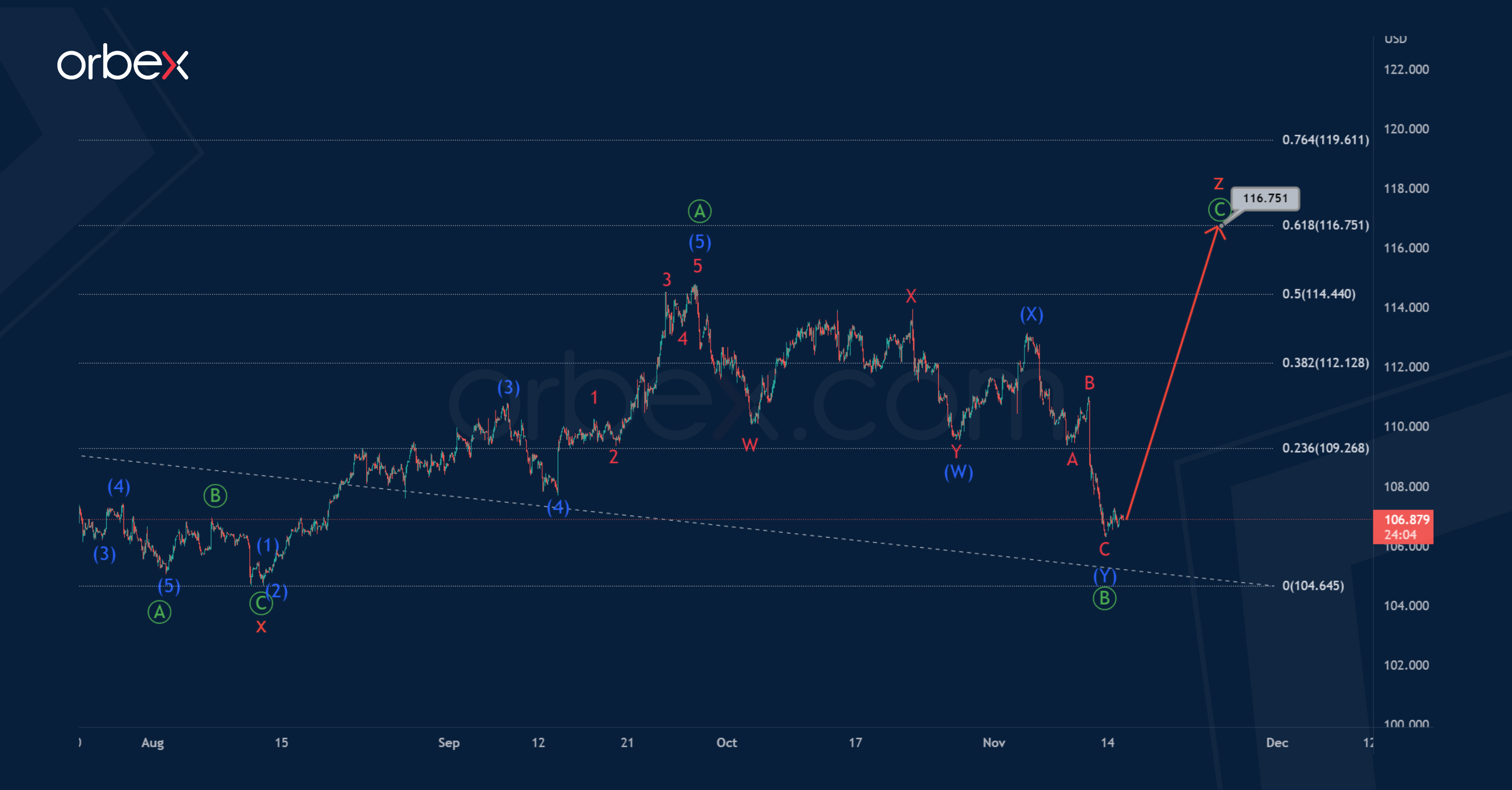
Let's consider an alternative option in which the formation of a cycle triple zigzag will continue.
Most likely, at the level of 104.64, the bearish cycle wave x was completed, which took the form of a standard zigzag of the primary degree. After that, an upward impulse price movement in the wave z began.
The wave z may take the form of a zigzag, where the first impulse and the correction in the form of an intermediate double zigzag are already completed.
The entire wave z may complete its pattern near 116.75. At that level, it will be at the 61.8% Fibonacci extension of wave y.
USD/JPY Mid-Day Outlook
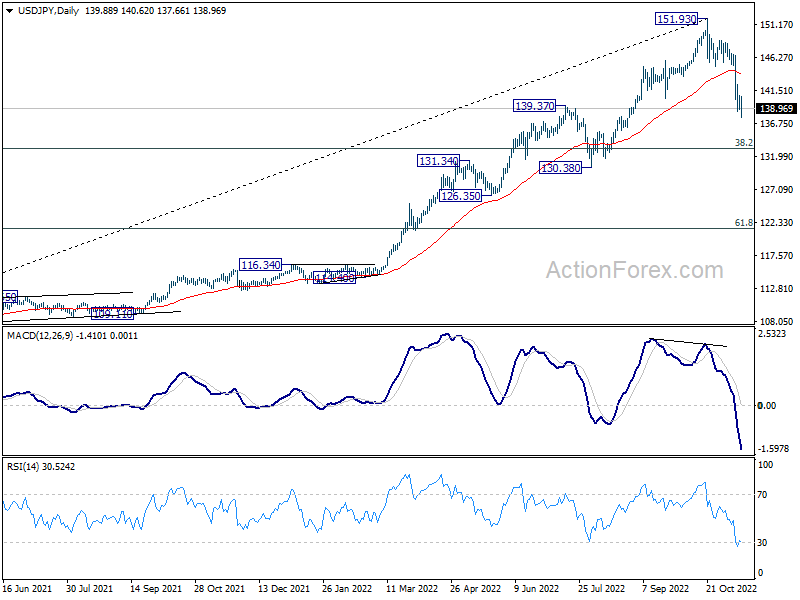
Daily Pivots: (S1) 138.89; (P) 139.84; (R1) 140.88; More...
USD/JPY's fall from 151.93 resumed after brief consolidations and intraday bias is back on the downside. Current decline should target 133.07 fibonacci level, as a correction to the larger up trend. On the upside, above 140.79 minor resistance will turn intraday bias neutral and bring consolidations first, before staging another decline.
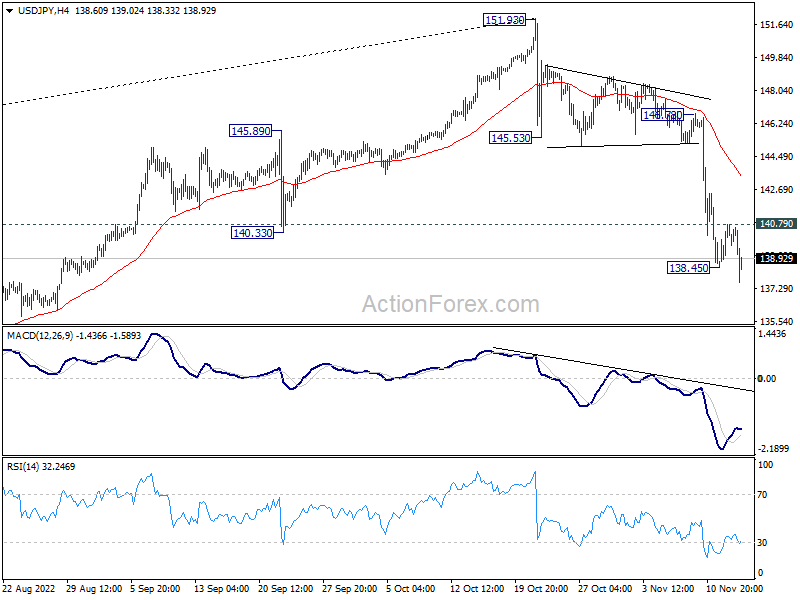
In the bigger picture, a medium term top should be formed at 151.93. Fall from there is correcting larger up trend from 102.58. It's too early to call for bearish trend reversal. But even as a corrective move, such decline should target 38.2% retracement of 102.58 to 151.93 at 133.07, or further to 55 week EMA (now at 130.58).
USD/CHF Mid-Day Outlook
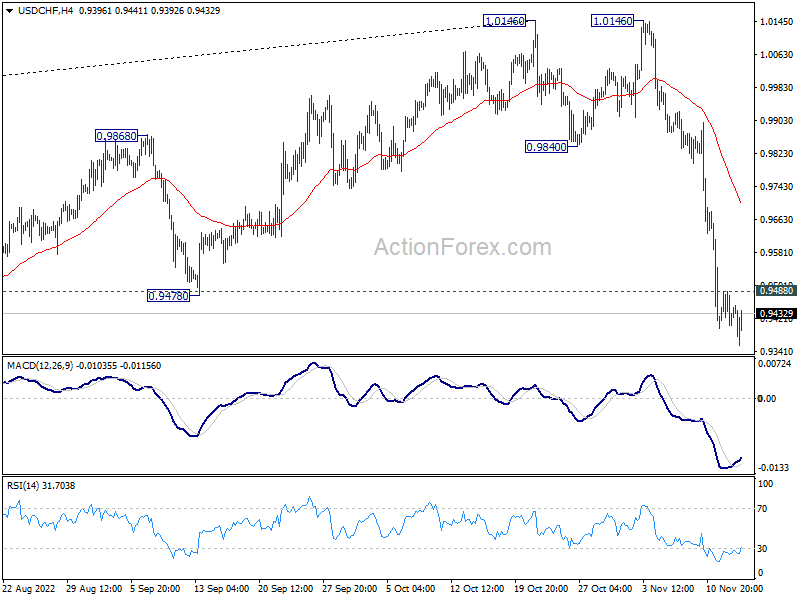
Daily Pivots: (S1) 0.9395; (P) 0.9442; (R1) 0.9479; More...
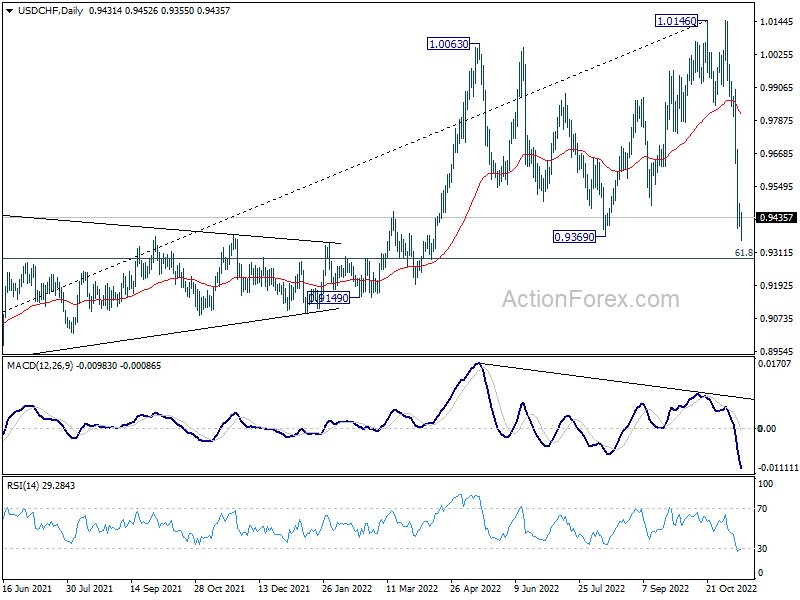
Intraday bias in USD/CHF remains on the downside despite some loss of downside momentum. Next target is 0.9369 support is already met and next target is 0.9287 fibonacci level. On the upside, break of 0.9488 minor resistance will turn intraday bias neutral first and bring consolidation, before staging another decline.
In the bigger picture, rise from 0.8756 (2021 low) has completed at 1.0146, well ahead of 1.0342 long term resistance (2016 high). Based on current downside momentum, fall from 1.0146 might be a medium term down trend itself. Break of 61.8% retracement of 0.8756 to 1.0146 at 0.9287 will pave the way to 0.8756. In any case, risk will stay on the downside as long as 55 day EMA (now at 0.9821) holds.
EUR/USD Mid-Day Outlook
Daily Pivots: (S1) 1.0278; (P) 1.0319; (R1) 1.0366; More...
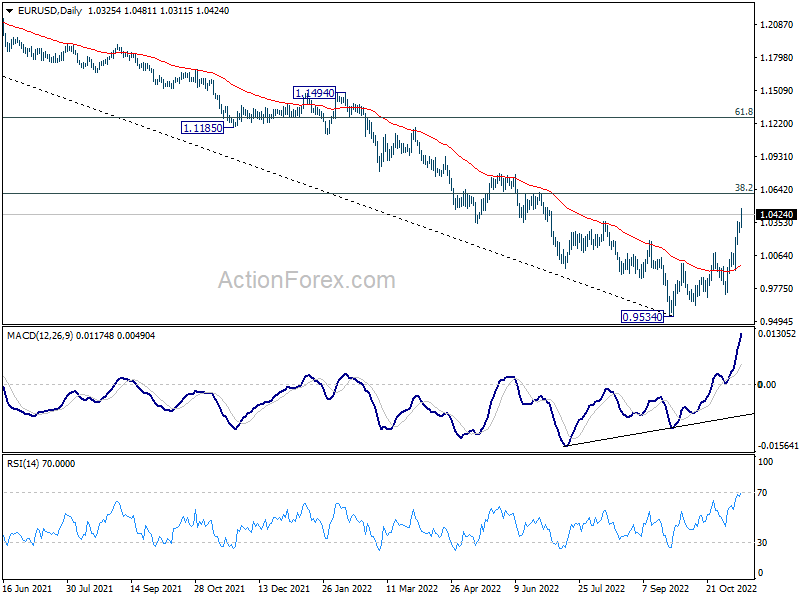
EUR/USD's rally from 0.9534 continues today and intraday bias stays on the upside. Next target is 1.0609 fibonacci level. On the downside, below 1.0270 minor support will turn intraday bias neutral and bring consolidations first, before staging another rally.
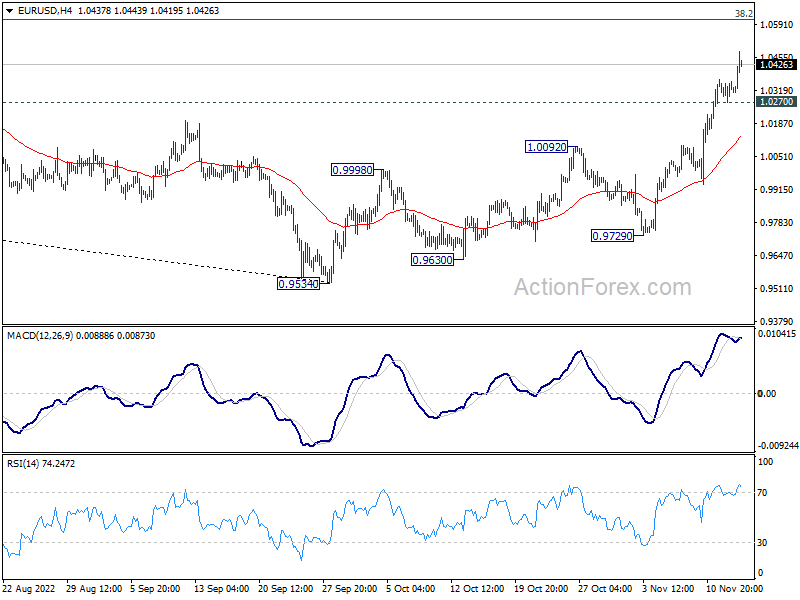
In the bigger picture, a medium term bottom was in place at 0.9534, on bullish convergence condition in daily MACD. Even as a corrective rise, rally from 0.9534 should target 38.2% retracement of 1.2348 (2021 high) to 0.9534 at 1.0609. Sustained trading above 55 week EMA (now at 1.0566) will raise the chance of trend reversal and target 61.8% retracement at 1.1273. This will now remain the favored case as long as 1.0092 resistance turned support holds.
GBP/USD Mid-Day Outlook
Daily Pivots: (S1) 1.1703; (P) 1.1766; (R1) 1.1821; More...
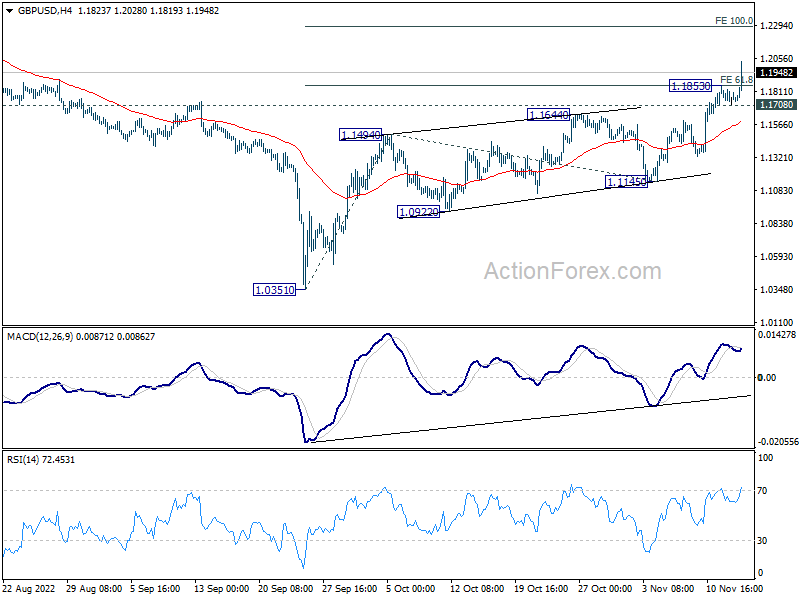
GBP/USD's rise from 1.0351 resumed after brief retreat and intraday bias is back on the upside. With break of 61.8% projection of 1.0351 to 1.1494 from 1.1145 at 1.1851, next target will be 100% projection at 1.2288. On the downside, break of 1.1708 minor support will turn intraday bias neutral and bring consolidation again, before staging another rally.
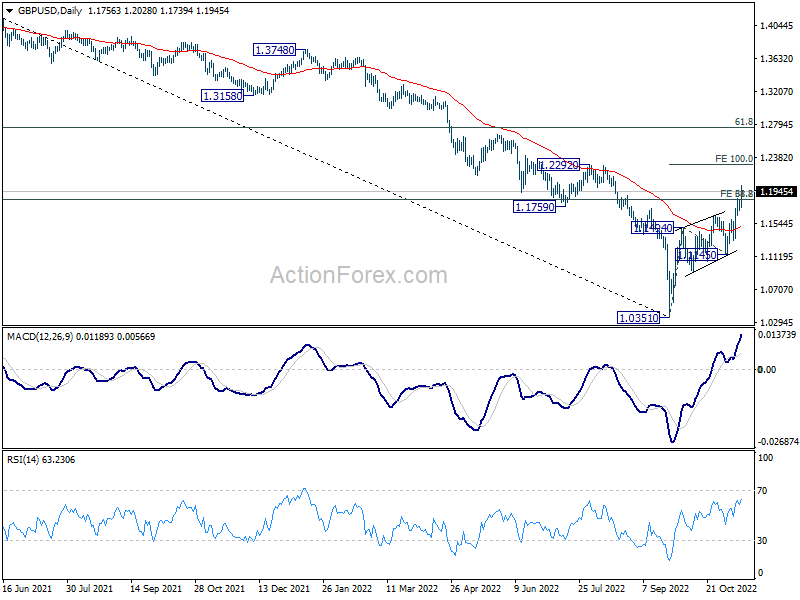
In the bigger picture, current development suggests that rise from 1.0351 is a medium term bottom. Rise from there is at least correcting whole down trend from 1.4248 (2021 high). Further rise is expected as long as 1.1145 support holds. Sustained break of 38.2% retracement of 1.4248 to 1.0351 at 1.1840 should pave the way to 61.8% retracement at 1.2759 and possibly above.
Dollar Selloff Resumes, Sterling in Pole Position
Dollar selloff resumes today on the back of extended rally in the stock markets and decline in treasury yields. Selloff in particularly apparent against Euro and Sterling, and to a slightly lesser extent Aussie. Yen also manages to resumes recent rally against the greenback. But Swiss Franc is lagging behind, as dragged down by selloff against other Europeans.
Technically, Sterling appears to have an advantage over Euro, with EUR/GBP dipping today. Break of 0.8689 minor support will likely resume the fall from 0.9267 through 0.8570 low. Nevertheless, firstly, the cross will have too take out mentioned 0.8689 minor support first. Secondly, the Pound will also face some tests from economic data release, and more importantly, the government's new budget later in the week.
In Europe, at the time of writing, FTSE is up 0.33%. DAX is up 0.88%. CAC is up 1.09%. Germany 10-year yield is down -0.062 at 2.084. Earlier in Asia, Nikkei rose 0.10%. Hong Kong HSI rose 4.11%. China Shanghai SSE rose 1.64%. Singapore Strait Times rose 0.44%. Japan 10-year JGB yield rose 0.0012 to 0.244.
US PPI at 0.2% mom, 8.0% yoy in Oct
US PPI for final demand rose 0.2% mom in October, below expectation of 0.5% mom. Prices for goods rose 0.6% mom while services dropped -0.1% mom. PPI less foods, energy and trade services rose 0.2% mom.
For the 12 months period, PPI slowed from 8.4% yoy to 8.0% yoy. PPI less foods, energy, and trade services rose 5.4% yoy.
Also released, Empire State manufacturing index rose sharply from -9.1 to 4.5 in November, above expectation of -7.
German ZEW rose sharply to -36.7, related to hope that inflation will fall soon
Germany ZEW Economic Sentiment rose from -59.2 to -36.7 in November, much better than expectation of -54.1. Current Situation index rose from -72.2 to -64.5, above expectation of -67.5.
Eurozone ZEW Economic Sentiment rose from -59.7 to -38.7, above expectation of -55.0. Current Situation index rose 5.5pts to -65.1.
"The ZEW Indicator of Economic Sentiment rises again in November. This is likely to be related above all to the hope that inflation rates will fall soon. In this case, policymakers would not have to hit the brakes on monetary policy as hard and/or for as long as feared. However, the economic outlook for the German economy is still clearly negative," comments ZEW President Professor Achim Wambach.
Eurozone goods exports rose 23.6% yoy in Sep, imports rose 44.5% yoy
In September, Eurozone goods exports, to the rest of the world, grew 23.6% yoy to EUR 210.1B. Goods imports rose 44.5% yoy to EUR 294.0B. Goods trade deficit came in at EUR -34.4B. Intra-Eurozone trade rose 27.3% yoy to EUR 247.6B.
In seasonally adjusted terms, Eurozone exports rose 1.6% mom to EUR 250.0B. Imports dropped -2.0% mom to EUR 287.7B. Trade deficit narrowed from EUR -47.6B to EUR -37.7B. Intra-Eurozone trade dropped from EUR 241.8B to EUR 238.9B.
According to the second estimate, Eurozone GDP grew 0.2% qoq in Q3, slowed from Q2's 0.8% qoq. Employment grew 0.2% qoq, slowed from Q2's 0.4% qoq.
UK payrolled employees rose 74k in Oct, unemployment rate at 3.6% in Sep
In October, UK payrolled employees rose 0.2% mom or 74k. Comparing with October 2021, payrolled employees rose 2.7% yoy or 772k. Median monthly pay rose 6.0% yoy. Claimant counts rose 3.3k, versus expectation of -12.6k.
In the three months to September, comparing to the previous three month period, unemployment was down -0.2% to 3.6%. Employment rate was unchanged at 75.5%. Economic inactivity rate rose 0.2% to 21.6%. Average earnings excluding bonus rose 5.7% yoy. Average earnings including bonus rose 6.0% yoy.
RBA minutes: Not ruling out returning to larger hikes
Minutes of RBA's November 1 meeting revealed that board members consider both a 25 bps or a 50bps rate hike. There were "arguments in favour of both courses of action", but the case for 25bps was stronger.
"Acknowledging the uncertainty, members did not rule out returning to larger increases if the situation warranted," the minutes noted. "Conversely, the Board is prepared to keep rates unchanged for a period while it assesses the state of the economy and the inflation outlook. Interest rates are not on a pre-set path."
At the meeting, RBA raised the cash rate target by 25bps to 2.85%.
Japan GDP contracted -0.3% qoq in Q3
Japan GDP contracted -0.3% qoq in Q3, much worse than expectation of 0.3% qoq. In annualized term, GDP contracted -1.2%, versus expectation of 1.1%. GDP deflator dropped -0.5% yoy, versus expectation of -0.2% yoy.
During the quarter, imports rose strongly by 5.2% yoy on higher energy costs and weak Yen exchange rate. Exports grew only 1.9% qoq and led to a decline in net exports, which dragged GDP down. Domestically, private consumption grew 0.3% qoq only.
"Increased imports due to the easing of supply constraints and a temporary increase in payments for external services contributed to the negative growth," Chief Cabinet Secretary Hirokazu Matsuno said.
"The environment surrounding households and businesses is becoming more difficult, with declining real household incomes and rising corporate costs," Matsuno added.
China retail sales contracted -0.5% yoy in Oct
China industrial production rose 5.0% yoy in October, below expectation of 5.2% yoy. Retail sales dropped -0.5% yoy, much worse than expectation of 1.0% yoy. That's also the first decline since May. Fixed asset investment rose 5.8% ytd yoy, below expectation of 5.9%.
"We will focus on expanding effective demand, deepening structural reform on the supply side, continuing to stabilise employment and prices, stabilizing expectations, stimulating market vitality more, consolidating the economic recovery to a sound basis, and try to achieve better development results," the NBS said in a statement.
GBP/USD Mid-Day Outlook
Daily Pivots: (S1) 1.1703; (P) 1.1766; (R1) 1.1821; More...
GBP/USD's rise from 1.0351 resumed after brief retreat and intraday bias is back on the upside. With break of 61.8% projection of 1.0351 to 1.1494 from 1.1145 at 1.1851, next target will be 100% projection at 1.2288. On the downside, break of 1.1708 minor support will turn intraday bias neutral and bring consolidation again, before staging another rally.
In the bigger picture, current development suggests that rise from 1.0351 is a medium term bottom. Rise from there is at least correcting whole down trend from 1.4248 (2021 high). Further rise is expected as long as 1.1145 support holds. Sustained break of 38.2% retracement of 1.4248 to 1.0351 at 1.1840 should pave the way to 61.8% retracement at 1.2759 and possibly above.
Economic Indicators Update
| GMT | Ccy | Events | Actual | Forecast | Previous | Revised |
|---|---|---|---|---|---|---|
| 23:50 | JPY | GDP Q/Q Q3 P | -0.30% | 0.30% | 0.90% | |
| 23:50 | JPY | GDP Deflator Y/Y Q3 P | -0.50% | -0.60% | -0.30% | |
| 00:30 | AUD | RBA Meeting Minutes | ||||
| 02:00 | CNY | Industrial Production Y/Y Oct | 5.00% | 5.20% | 6.30% | |
| 02:00 | CNY | Retail Sales Y/Y Oct | -0.50% | 1.00% | 2.50% | |
| 02:00 | CNY | Fixed Asset Investment YTD Y/Y Oct | 5.80% | 5.90% | 5.90% | |
| 04:30 | JPY | Industrial Production M/M Sep F | -1.70% | -1.60% | -1.60% | |
| 07:00 | GBP | Claimant Count Change Oct | 3.3K | -12.6K | 25.5K | |
| 07:00 | GBP | Unemployment Rate (3M) Sep | 3.60% | 3.50% | 3.50% | |
| 07:00 | GBP | Average Earnings Excluding Bonus 3M/Y Sep | 5.70% | 5.60% | 5.40% | |
| 07:00 | GBP | Average Earnings Including Bonus 3M/Y Sep | 6.00% | 6.00% | 6.00% | |
| 10:00 | EUR | Eurozone Trade Balance (EUR) Sep | -37.7B | -39.4B | -47.3B | -47.6B |
| 10:00 | EUR | Eurozone GDP Q/Q Q3 P | 0.20% | 0.20% | 0.20% | |
| 10:00 | EUR | Eurozone Employment Change Q/Q Q3 P | 0.20% | 0.30% | 0.40% | |
| 10:00 | EUR | Germany ZEW Economic Sentiment Nov | -36.7 | -54.1 | -59.2 | |
| 10:00 | EUR | Germany ZEW Current Situation Nov | -64.5 | -67.5 | -72.2 | |
| 10:00 | EUR | Eurozone ZEW Economic Sentiment Nov | -38.7 | -55 | -59.7 | |
| 13:30 | CAD | Manufacturing Sales M/M Sep | 0.00% | -0.50% | -2.00% | -1.90% |
| 13:30 | CAD | Wholesale Sales M/M Sep | 0.10% | -0.20% | 1.40% | 1.90% |
| 13:30 | USD | Empire State Manufacturing Index Nov | 4.5 | -7 | -9.1 | |
| 13:30 | USD | PPI M/M Oct | 0.20% | 0.50% | 0.40% | 0.20% |
| 13:30 | USD | PPI Y/Y Oct | 8% | 8.30% | 8.50% | 8.40% |
| 13:30 | USD | PPI Core M/M Oct | 0.00% | 0.40% | 0.30% | 0.20% |
| 13:30 | USD | PPI Core Y/Y Oct | 6.70% | 7.20% | 7.20% |