Sample Category Title
NZDUSD Consolidates Gains Near September’s High
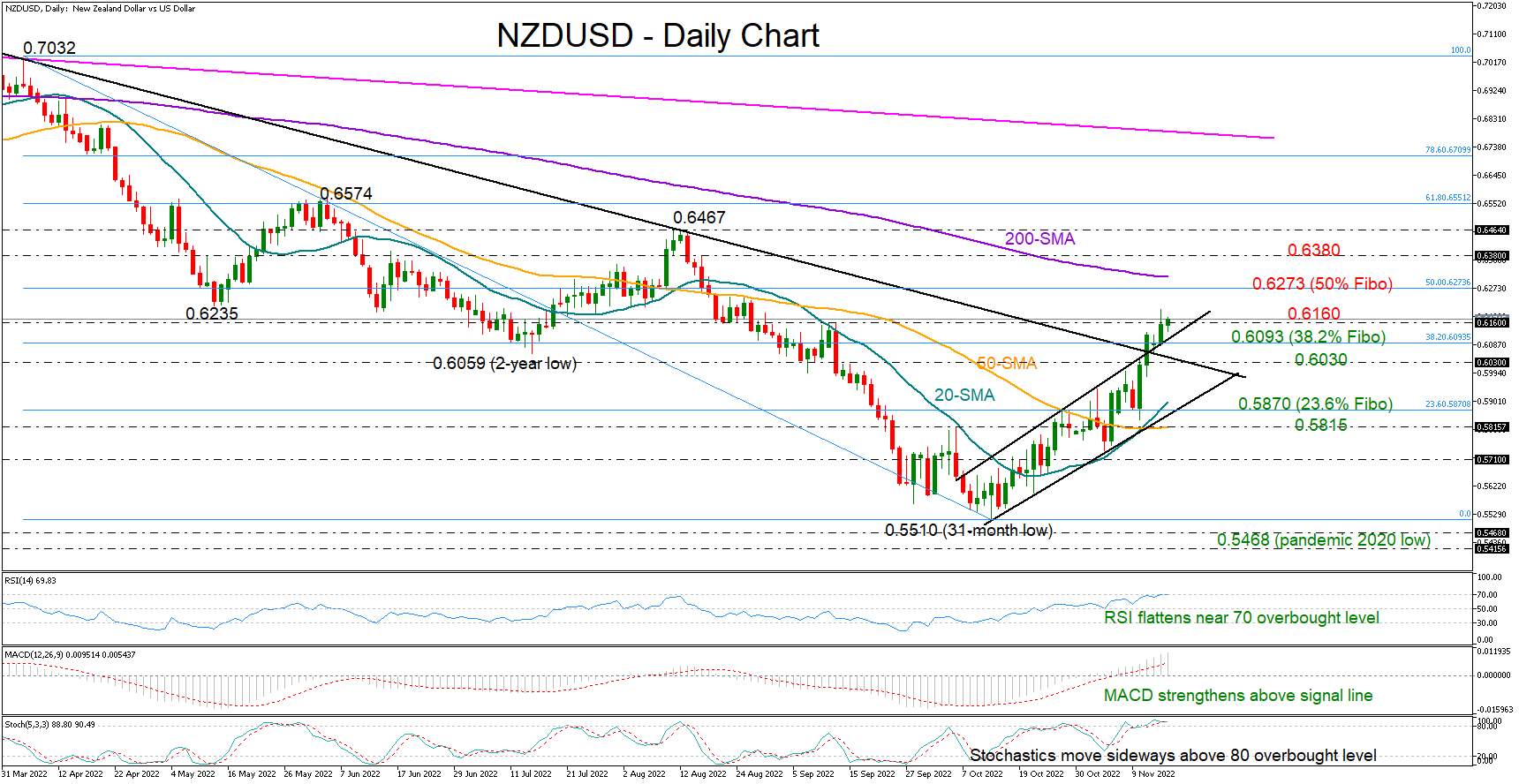
NZDUSD finished Tuesday’s session below September’s high of 0.6160 despite touching the 0.6200 level.
Previously, the pair set a nice foothold around the broken bullish channel at 0.6093, defending its short-term uptrend off 31-month lows. The 38.2% Fibonacci retracement of the 0.7032-0.5510 downleg cemented that floor as well.
But the bears could be just around the corner as the price is struggling to gain fresh positive momentum and the RSI and the stochastics are flagging overbought conditions. Selling interest, however, may remain muted unless the 0.6093-0.6030 base collapses. If that proves to be the case, the price could tumble to test the 20-day simple moving average (SMA) and the channel’s lower boundary currently seen around the 23.6% Fibonacci of 0.5870. A drop below the 50-day SMA and the 0.5815 barrier would neutralize the short-term outlook.
On the upside, a clear close above the 0.6160 resistance could motivate fresh buying up to the 50% Fibonacci of 0.6273. Another extension above the 200-day SMA and the 0.6380 handle could bring the August high of 0.6467 back under the spotlight.
In summary, although the bullish bias is intact in NZDUSD, buyers may stay on the sidelines until the price successfully claims the 0.6160 barricade.
US Oil: How Soon is the End of the Ending Diagonal?
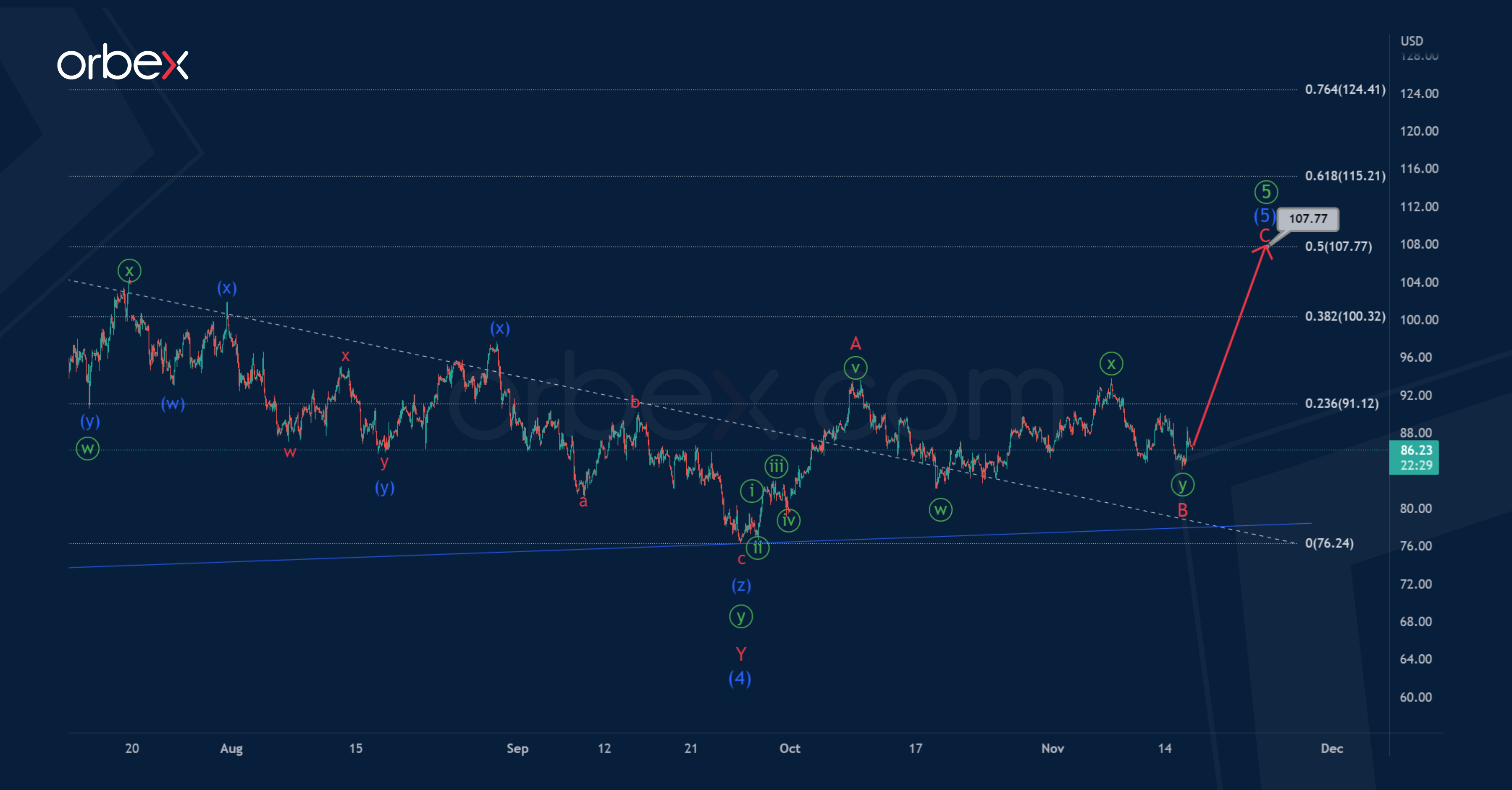
In the long term, USOIL seems to be forming a primary wave ⑤, which takes the form of an intermediate ending diagonal. On the 1H timeframe, we see its second half.
An intermediate correction (4) in the form of a minor double zigzag may have been completed at 76.24.
In the last section of the chart, we see the formation of an intermediate wave (5). It is assumed that the intermediate wave (5) will take the form of a standard 3-wave zigzag A-B-C, where the impulse A and correction B are completed.
The end of this construction is possible near 107.77. At that level, wave (5) will be at the 61.8% Fibonacci extension of impulse (3).
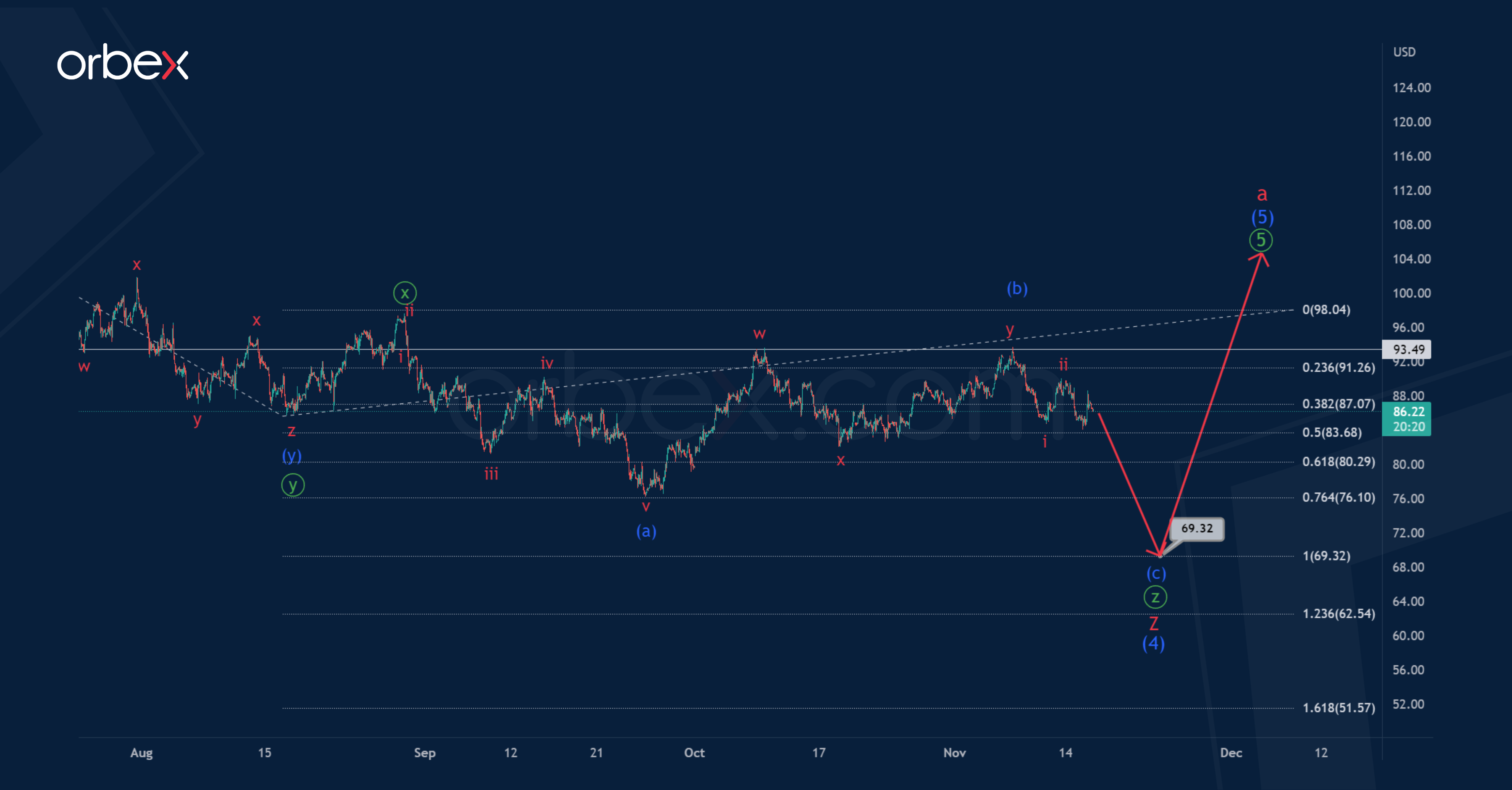
Alternatively, the construction of the intermediate correction (4) can be continued. It is assumed that it will have the form of a triple zigzag W-X-Y-X-Z, where the minor sub-waves W-X-Y-X can be completed.
Thus, in the near future, the downward movement is expected to continue in the final actionary sub-wave Z, which could be completed in the form of a minute triple zigzag ⓦ-ⓧ-ⓨ-ⓧ-ⓩ.
The price of oil may fall to 69.32. At that level, minute actionary waves ⓨ and ⓩ will be equal.
XAUUSD Hits Major Resistance
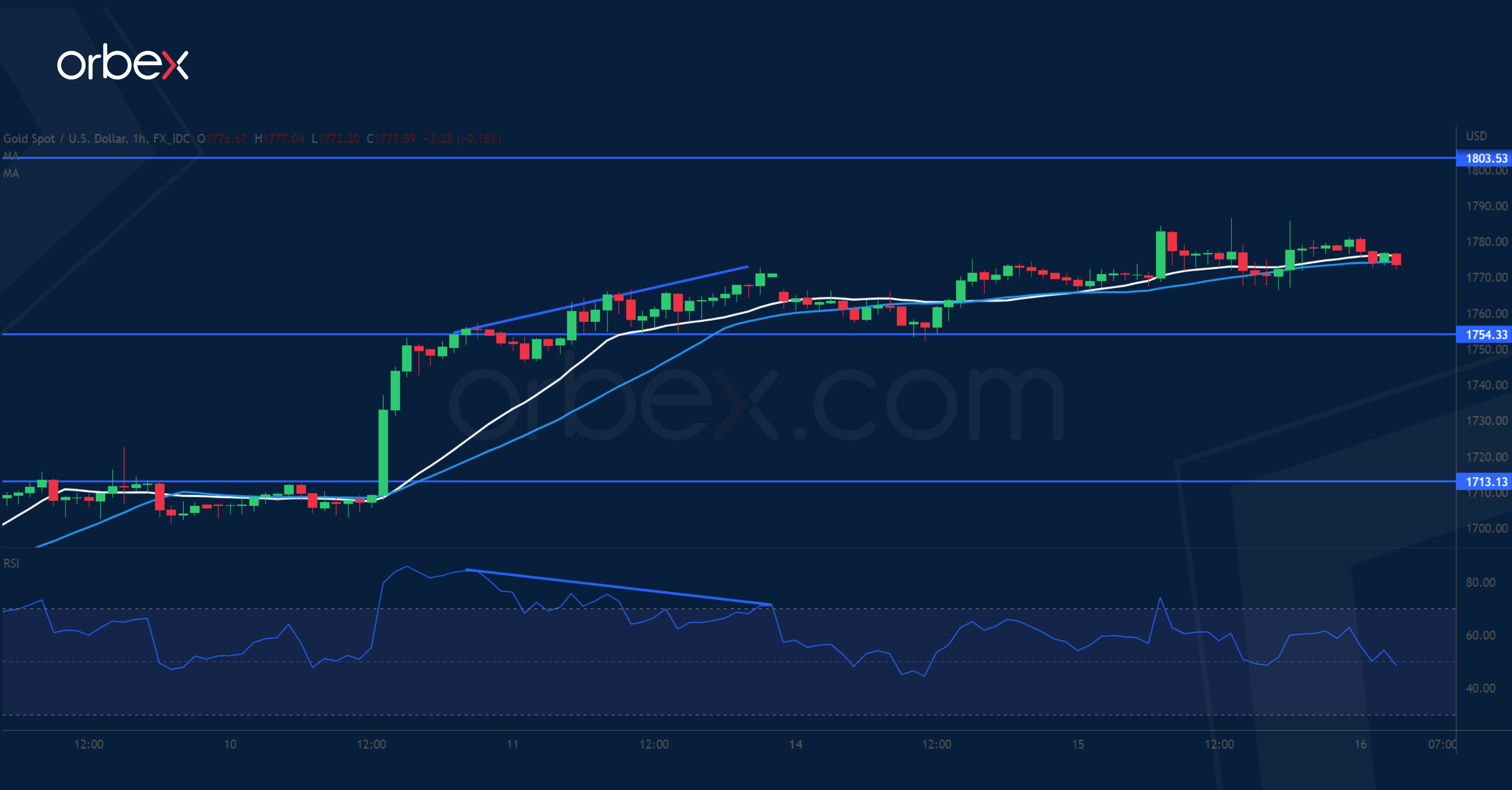
Gold stays muted as rising bond yields accompany the US dollar’s comeback. Momentum buying has pushed the precious metal near August’s high of 1803. The RSI’s multiple tops in the overbought zone and a bearish divergence indicate exhaustion and the rally may lose steam around the major supply zone. 1754 is the closest support and its breach would lead to further weakness. Then the precious metal could be vulnerable to both profit-taking and renewed selling. 1713 would be the bulls’ second line of defence.
GBPJPY Attempts to Bounce
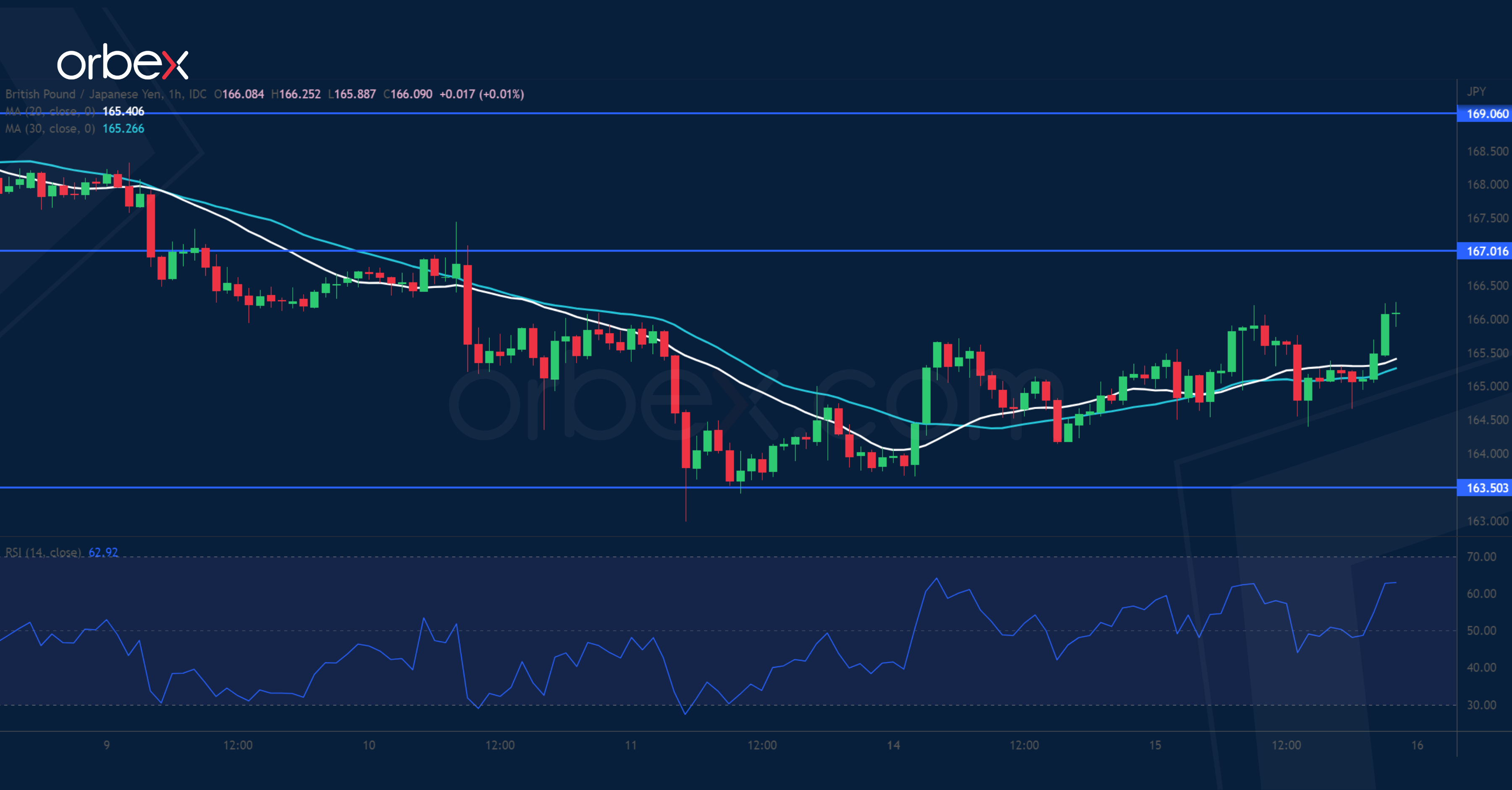 The pound struggles over a rise in the UK’s unemployment rate. The pair has been hovering above 163.50 at the base of a bullish breakout in mid-October. This suggests that the bulls are still in the game and are probing for the bottom. After all, on the daily chart, the directional bias remains up despite a choppy price action. The area between the round numbers 166.00 and 167.00 is the first hurdle. Its break could pave the way for a rally above 169.00. On the downside, 162.00 is another support in case of further hesitation.
EURUSD Hits Resistance
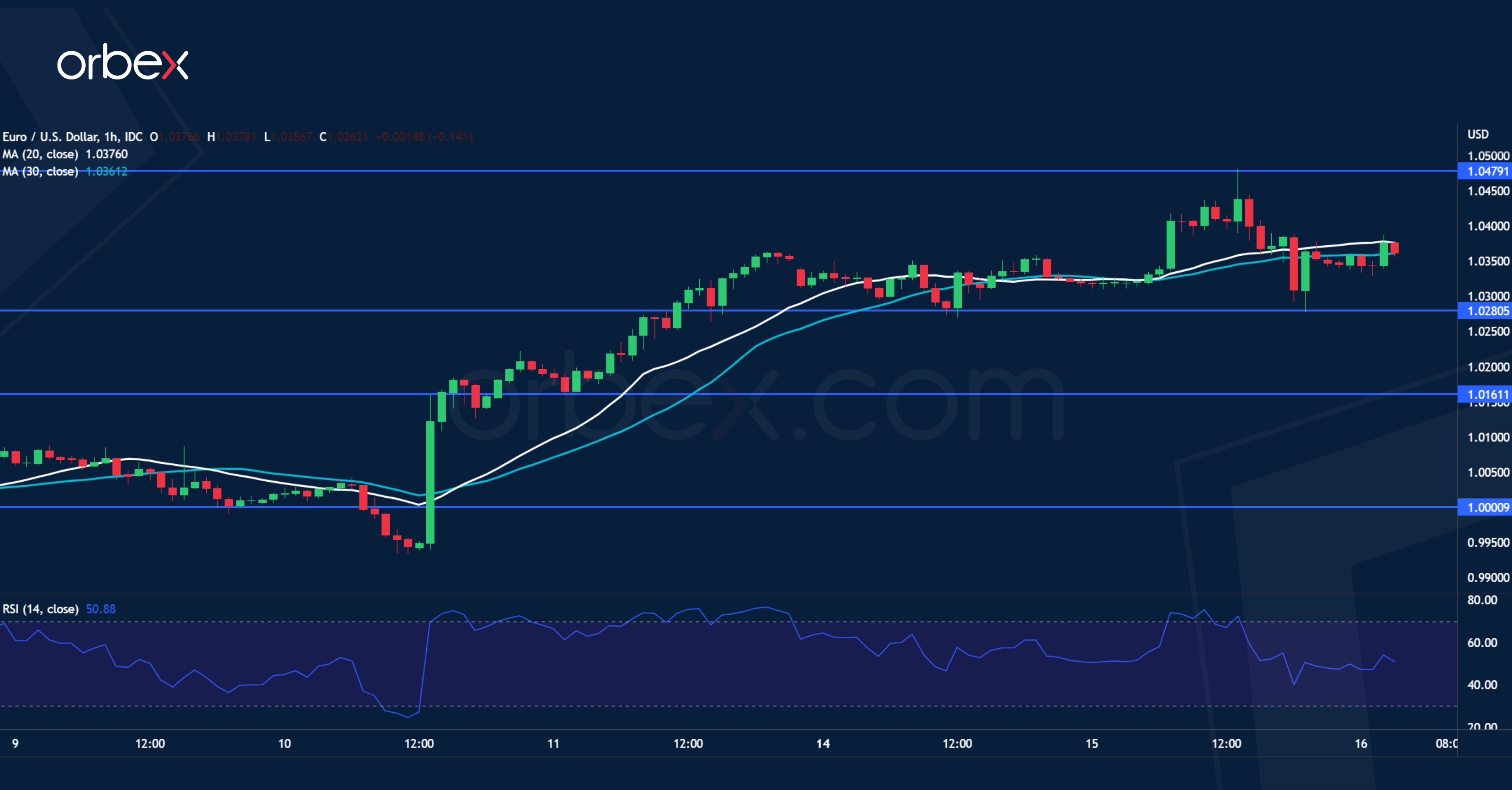
The euro slipped after ECB policymakers cautioned about fast rate hikes. The vertical ascent is a sign of a short-squeeze against medium-term positions as the pair approaches the July high of 1.0480. Its breach would lift offers to another daily resistance at 1.0600. However, the RSI’s overbought situation combined with a mean reversion pressure could trigger a retracement. 1.0280 is the first support and its invalidation could give an excuse for profit-taking. Then 1.0160 would be a second level to expect follow-ups.
All of a Sudden the Intraday EUR/USD Rally Started Losing Steam
Markets
EUR/USD yesterday pierced key resistance at 1.0341/50/68 (2017 low/May2022 low/August2022 high). The technical break fast-tracked the pair’s rally, in first instance towards 1.04. Lower-than-expected US producer price inflation served as second accelerator towards 1.0475. Next intermediate resistance at 1.0516 (50% retracement on this year’s EUR/USD decline) all of a sudden came within striking distance. To know that the pair set a multi-year low at 0.9536 at the very end of September. However, all of a sudden the intraday EUR/USD rally started losing steam. The Russian missile attack on Kiev served as a harsh reminder that there are two sides to the EUR/USD equation. It’s one thing for the dollar to correct lower as the Fed prepares to slow down its tightening efforts. It’s another thing for the single currency to take the baton from the weak dollar and extend the EUR/USD correction higher on euro strength. The Kiev bombings and the stray rocket on Polish territory (un- or friendly fire?) reminded investors that the Russian war in Ukraine isn’t over despite the recent ground recovered by Ukrainian forces. EUR/USD came off its high to drop almost two big figures intraday and close below 1.0350. The pair changes hands around 1.0380 as US President Biden said that the missile strike (on Polish territory) was unlikely to be fired from Russia. NATO is still investigating the issue though. Should Russia nevertheless be responsible, it would be the first attack on NATO soil since the start of the Russian invasion and mark a new escalation in the war.
Core bonds recovered more ground yesterday with US Treasuries outperforming German Bunds. US yields lost 5.1 bps (2-yr) to 9.4 bps (5-yr). Apart from the very front end of the curve, US yields all trade clearly below first support levels (necklines of double top formations), calling for more short term correction/consolidation. The German yield curve bull flattened with yields giving away 1.1 bp (2-yr) to 5.2 bps (30-yr). German yields for now hold above similar technical necklines. Stock markets gained up 0.7% in Europe and 1.45% in the US.
Today’s eco calendar is heavy and interesting in the US with retail sales and industrial production data. Especially retail sales are worth looking at. Signs that US consumption is relatively holding up even as inflation bites a hole in people’s pockets could slow the current correction on this year’s big market trends. Speeches by ECB/Fed governors are wildcards as is the developing NATO investigation. UK inflation this morning accelerated more than expected to 2% M/M with the Y/Y reading spiking from 10.1% to 11.1%. Underlying core CPI stabilized at 6.5% Y/Y. Sterling tried to gain on the number, but failure to do so prompted a leap higher towards 0.8760.
News Headlines
In an annual review, the IMF indicated that Australian growth is expected to slow after the country showed one of the strongest recoveries from the pandemic in the developed world. The IMF expects 3.7% growth this year, but this expected to slow to 1.7% in the fiscal year 2023/2024. Amongst other factors, the decline in housing prices is seen as an important factor behind the slowdown in growth. Despite the expected economic slowdown, the agency still advises the country to continue tightening both monetary and fiscal policy to further rebalance domestic demand and reduce inflationary pressures in the economy. In this respect, the IMF sees need for additional tightening from the Reserve Bank of Australia even as it already raised the policy rate by 275 bps. Aside from the IMF report, Australian wage statistics for Q3 published this morning showed a further acceleration to 1.0% Q/Q and 3.1% Y/Y (from 2.6%). However, the gain probably won’t change the broader assessment of the RBA on wage growth as a driver of domestic inflation. The Aussie dollar, which had a good run since mid-October gained modestly with AUD/USD trading at 0.6765.
Member of the MPC of the central bank of Poland, Henryk Wnorowski, in a television interview kept the door open for the Polish central bank (NBP) to resume raising interest rates after the hiking cycle was paused at 6.75% since the early October meeting. For example if the recent projections of the NBP were to materialize or if inflation expectations become de-anchored. In its inflation report published earlier this week, the NBP only sees inflation returning within the 2.5% -/+ 1% target band late in 2025, assuming an unchanged policy rate of 6.75%.
British Inflation Hits 11%
US stocks extended rally yesterday, as the unexpected easing in producer prices beefed up the optimism that the Federal Reserve (Fed) would soften the monetary tightening and the better-than-expected New York Empire State Manufacturing index hinted that the US economy is holding up well.
News that Russian missiles fell to Poland somehow killed a part of that falling-inflation, resilient growth optimism. But escalation of the tensions have been avoided so far, with US President Joe Biden saying that the missile was ‘unlikely’ fired from Russia.
On the index level, the geopolitical fears remained short-lived, and the S&P500 finally rebounded to close the session 0.87% higher, a touch below the 4000 psychological mark, and Nasdaq jumped 1.45%, and flirted with its 100-DMA for the first time since mid-September.
On the individual level, TSM was one of the biggest gainers of the session. The shares jumped more than 10% on news that Warren Buffet’s Berkshire Hathaway took around $5 billion stake in the company. Investors concluded that Buffet thinks that the selloff may have hit a bottom after a nearly 60% dive since the beginning of the year, which wiped out $250 billion in value.
And that’s not all
The sun continues shining for TSM, as Apple said that they will being sourcing chips for its devices from a plant in Arizona that will be run by TSM.
We also saw Apple jump more than 1% to $150 per share yesterday, but that was mostly on the back of a broad Fed optimism.
Elsewhere, Walmart surpassed both earnings and revenue expectations in the Q3, as the company could successfully pass inflation on its clients. Sales rose nearly 9%, and inventories grew only 13%, compared to 25% a quarter earlier. Cherry on top, Walmart announced a $20-billion buyback. Walmart shares jumped 6.5% yesterday, and stepped into the positive trend that was building between March 2021 and May 2022.
Latest from US midterms
US midterms moved closer to clarity yesterday. The Republicans are now just one seat away from controlling the House, while Democrats have the majority in the Senate, and the December 6 runoff will tell how tight the majority will be.
What does it mean? It means that Republicans will likely block Democrats juicy spending packages, and Biden’s windfall taxes targeting oil and gas companies could never see the daylight.
Oil up on geopolitical jitters, lower US inventories
US crude gained on the geopolitical concerns after the Poland attack, and on a more-than-5-million-barrel decline in US oil inventories last week. The more official EIA data is due today, and the expectation is a 2-mio-barrel draw.
US Dollar softens
In the FX, the US dollar eased after the mixture of soft PPI and solid Empire Manufacturing revived the dovish Fed expectations.
The EURUSD traded briefly above its 200-DMA, near 1.0420 on the back of a broadly softer greenback. Better-than-expected improvement in the German ZEW economic sentiment index gave an additional boost to the single currency.
In Britain, Cable hit the 1.20 for the first time since this summer. On the data front, UK inflation data showed that inflation in the UK hit 11.1% in October vs 10.7% penciled in by analysts. That, combined with wages that rose at the fastest pace in over a year revived the hawkish Bank of England (BoE) expectations, although, the BoE insisted that the rate hikes won’t be as aggressive as the Fed’s due to unideal macroeconomic conditions.
Rishi Sunak will announce the British budget this Thursday and may need to squeeze the Brits hard to fill in the budget gap. According to a survey on Bloomberg, Britain needs £185 billion pounds to fund its budget.
But because Liz Truss’ tax cuts backfired big time, Rishi Sunak will be relatively comfortable in announcing higher taxes, including windfall taxes on energy companies’ eye-watering profits.
Today, we will be watching the US retail sales, the Canadian inflation, the BoE monetary policy report hearings, Andrew Bailey testify before Parliament, Christine Lagarde speak, Siemens, Cisco and another US retailer Target release earnings.
Yields Continue to Decline
Market movers today
The G20 summit concludes in Bali and we look out for whether the communiqué indeed rejects an 'era of war' as previously rumoured.
Market focus will be on the US retail sales for October, especially after last week's inflation downside surprise. Slowing consumption remains a necessary (though not sufficient) condition for a sustainable easing in inflation pressures. But it would not be the first time that US consumer spending has surprised on the upside amid elevated wage growth and high savings.
UK inflation could take another jump up in October, largely driven by a rise in utility bills. Bank of England Governor Bailey will appear before the Treasury committee to answer questions about monetary policy. ECB President Lagarde will give a speech in Frankfurt.
The 60 second overview
Last night, we heard initial reports of a Russian missile strike on Polish soil, near the Ukrainian border at the same time as a missile attack on Ukraine. Since then, however, both President Biden and his Polish counterparty Duda have questioned whether the missile was fired from Russia and there is still great uncertainty on the matter. President Duda has further commented that he is likely to invoke NATO article 4, meaning that the alliance will meet and discuss before any potential response and it is reported that NATO ambassadors will hold an emergency meeting this morning. Until we get more clarity on the matter, geopolitical tensions are likely to run high for the time being.
However, the missile attack on Ukraine was strongly condemned by NATO and G7. The Polish currency has weakened modestly vs. the EUR, 10Y US Treasury yields declined a few bps yesterday, but the yield has risen this morning in Asian trade. The missile attack will most likely also dominate the conclusions from the G20 meeting that ends today.
Yesterday, there were more comments from various Federal Reserve officials that the inflationary pressure is easing and that the size/pace of rate hikes is likely to slow.
We have UK inflation for October today and expectations are for a jump up to 10.7% in headline inflation compared to 10.1% in September, mainly driven by the new energy price cap (+27%) introduced in October. The core inflation on the other hand, is expected to print 6.4%, down from 6.5% in September. However, we do note that the range for estimates is very broad according to Bloomberg, both regarding the estimate for core and headline and the risk seems rather to be skewed towards the downside in core inflation.
Equities: Equities continued its march higher but with growth and quality stocks taking the lead again. This was driven a second confirmation on lower inflation ahead from the PPI figure. Equities even defied the news that Russian missiles killed two at the Polish border (i.e. NATO territory). Most sectors higher but communication services and retail leading. Futures are unchanged this morning.
FI: There was a solid rally in global fixed income markets yesterday driven from the long end of the curve. 10Y Bunds declined some 5-6bp, while 10Y Treasuries declined 6bp. Furthermore, the German ASW-spreads continue to tighten. The missile attack on Ukraine and the hits on Poland supported safe-haven flows into Treasuries.
FX: Initial reports of a Russian missile hitting Polish soil last night triggered a classic risk-off movement in FX: stronger USD and JPY, weaker SEK and even more weakness within CEE, where PLN took the blunt of the hit. These move have reversed somewhat over the night as there are conflicting reports whether the missile actually is from Russia or not. Nevertheless, tensions are running high.
Credit: Sentiment remains very strong in credit markets and yesterday iTraxx Xover tightened 13.5bp, closing in 463bp, while Main tightened 3bp to close in 93bp.
Nordic macro
In Sweden, Prospera's November money market inflation expectations are out at 08.00 CET. This is unlikely to rock the market as yesterday's October inflation print solidified the 75bp rate hike that the market is already pricing (Riksbank's forecast is 50bp). It would take a huge upside move in 5y expectations to, say, raise the bet for 100bp hike next week and that seems unlikely.
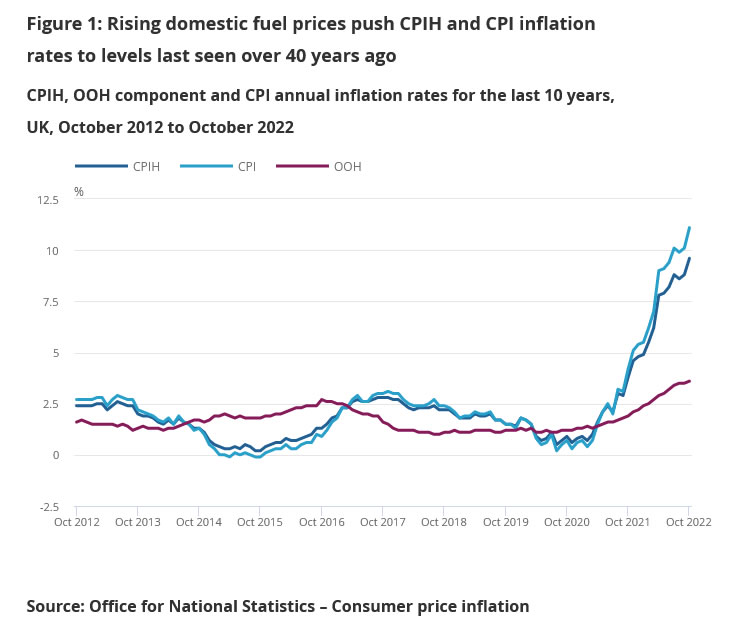
UK CPI accelerated further to 11.1% yoy in Oct despite energy price guarantee
UK CPI accelerated from 10.1% yoy to 11.1% yoy in October, above expectation of 10.6% yoy. That's highest level since 1981 based on modelled data. Core CPI was unchanged at 6.5% yoy, above expectation of 6.4% yoy.
ONS said, "Despite the introduction of the government's Energy Price Guarantee, gas and electricity prices made the largest upward contribution to the change in both the CPIH and CPI annual inflation rates between September and October 2022."
"Rising food prices also made a large upward contribution to change with transport (principally motor fuels and second-hand car prices) making the largest, partially offsetting, downward contribution to the change in the rates."
Also released, PPI input came in at 0.6% mom, 19.2% yoy, versus expectation of 1.0% mom, 17.7% yoy. PPI output was at 0.3% mom, 14.8% yoy, versus expectation of 0.0% mom, 14.8% yoy. PPI core output was at 0.5% mom, 13.3% yoy, versus expectation of 1.3% mom, 14.0% yoy.
GBP/JPY Daily Outlook
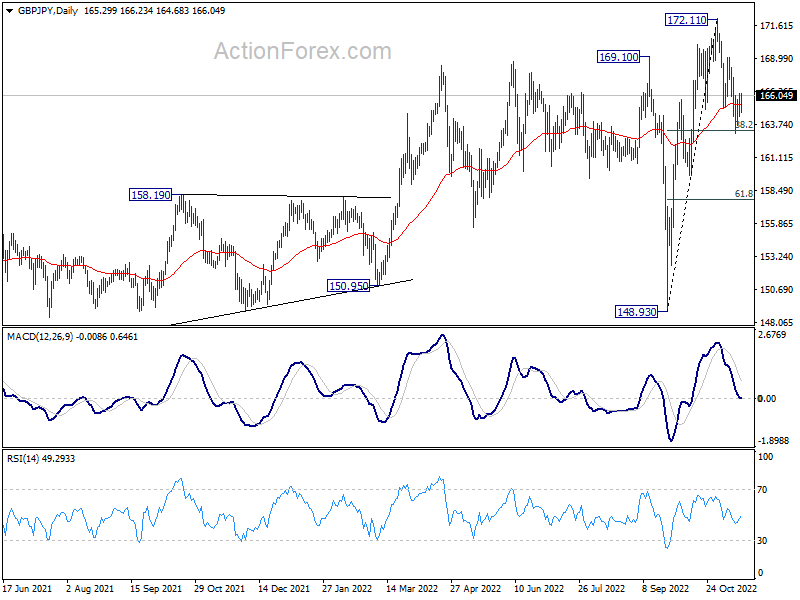
Daily Pivots: (S1) 164.42; (P) 165.32; (R1) 166.25; More...
Intraday bias in GBP/JPY stays neutral first. Strong rebound from current level, followed by break of 166.06 minor resistance will turn bias back to the upside for retesting 172.11 high. However, sustained trading below 38.2% retracement of 148.93 to 172.11 at 163.25 will bring deeper decline to 61.8% retracement at 157.78 and possibly below.
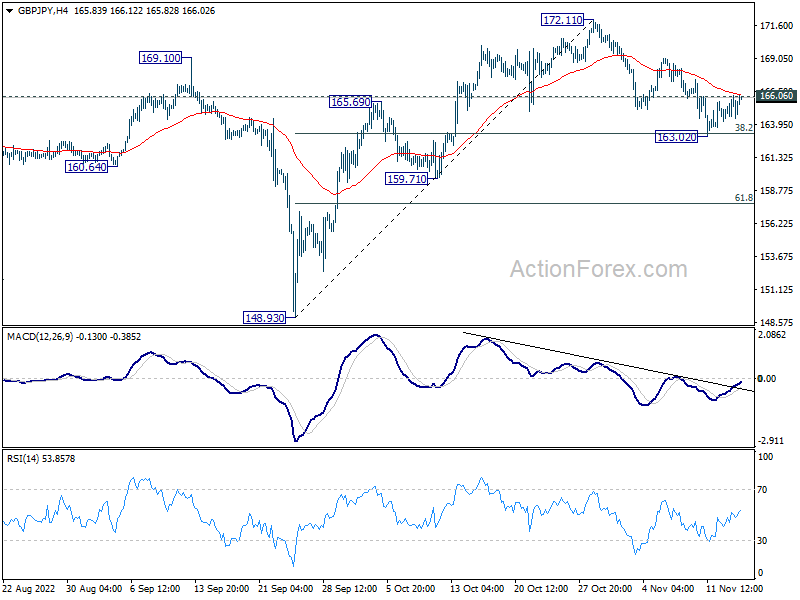
In the bigger picture, there is no clear sign of medium term topping yet. Up trend from 123.94 (2020 low) could still resume through 172.11 high at a later stage. However, firm break of 159.71 support will argue that it's already in correction to the up trend from 123.94, and deeper decline would be seen back towards 148.93 support.