Sample Category Title
Sterling and Loonie Shrug Inflation Data, Markets Tread Water
The financial markets are generally quiet today, with European indexes and US futures trading slightly lower into US session. In the currency markets, most major pairs and crosses are stuck inside yesterday's range, with Yen and Dollar on the softer side, Euro and Swiss Franc on the firmer side. Sterling and Canadian Shrug respecting inflation data. Aussie and Kiwi are mixed.
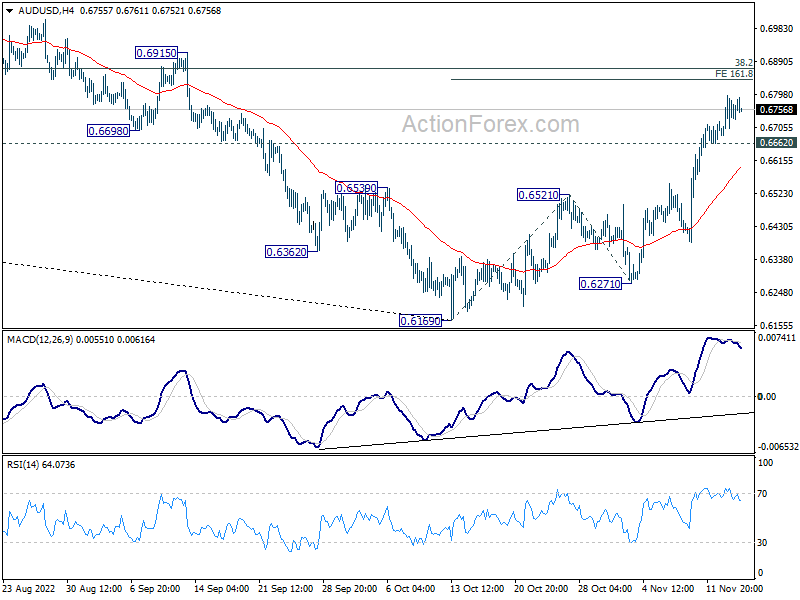
Technically, while Dollar's selloff might have lost momentum, it's far too early to call for a reversal. Levels to note included 1.0092 support in EUR/USD, 0.6521 support in AUD/USD, 0.9680 minor resistance in USD/CHF and 1.3494 resistance in USD/CAD. As long as these level holds, near term sentiment is still against the greenback.
In Europe, at the time of writing, FTSE is down -0.16%. DAX is down -0.83%. CAC is down -0.39%. Germany 10-year yield is down -0.079 at 2.034. Earlier in Asia, Nikkei rose 0.14$. Hong Kong HSI dropped -0.47%. China Shanghai SSE dropped -0.45%. Singapore Strait Times dropped -0.28%. Japan 10-year JGB yield rose 0.0014 to 0.244.
US retail sales rose 1.3% mom in Oct, ex-auto sales up 1.3% mom
US retail sales rose 1.3% mom to USD 694.5B in October, above expectation of 0.9% mom. Ex-auto sales rose 1.3% mom, above expectation of 0.4% mom to USD 565.1B. Ex-gasoline sales rose 1.0% mom to USD 630.4B.
Comparing with October 2021, total sales were up 8.3% yoy. Total sales in the three months through October were up 8.9% yoy.
Fed George: Maybe we even have economic contraction to slow inflation
Kansas City Fed President Esther George told the WSJ, "'I have not in my 40 years with the Fed seen a time of this kind of tightening that you didn't get some painful outcomes".
"I'm looking at a labor market that is so tight, I don't know how you continue to bring this level of inflation down without having some real slowing, and maybe we even have contraction in the economy to get there."
Canada CPI unchanged at 6.9% yoy in Oct
Canada CPI was unchanged at 6.9% yoy in October, slightly below expectation of 7.0% yoy. Excluding food and energy, prices slowed slightly from 5.4% to 5.3% yoy.
On a monthly basis, CPI rose 0.7% mom, below expectation of 0.8% mom, largely driven by the 9.2% mom rise in prices for gasoline.
Comparing to 5.6% you rise in average hourly wages, on average, prices rose faster than wages.
ECB de Guindos: Will discuss balance sheet reduction in December
ECB Vice President Luis de Guindos said, "we will discuss about the reduction of our balance sheet," at December meeting.
"I think this is important in terms of both to reduce the excess liquidity that we see in the marketplace, and secondly as well to alleviate the situation of scarcity of collateral," he added.
De Guindos also noted, "it's very difficult to have financial stability without price stability," adding that "the main risk now for financial stability, for growth, is to have inflation at very high levels."
UK CPI accelerated further to 11.1% yoy in Oct despite energy price guarantee
UK CPI accelerated from 10.1% yoy to 11.1% yoy in October, above expectation of 10.6% yoy. That's highest level since 1981 based on modelled data. Core CPI was unchanged at 6.5% yoy, above expectation of 6.4% yoy.
ONS said, "Despite the introduction of the government's Energy Price Guarantee, gas and electricity prices made the largest upward contribution to the change in both the CPIH and CPI annual inflation rates between September and October 2022."
"Rising food prices also made a large upward contribution to change with transport (principally motor fuels and second-hand car prices) making the largest, partially offsetting, downward contribution to the change in the rates."
Also released, PPI input came in at 0.6% mom, 19.2% yoy, versus expectation of 1.0% mom, 17.7% yoy. PPI output was at 0.3% mom, 14.8% yoy, versus expectation of 0.0% mom, 14.8% yoy. PPI core output was at 0.5% mom, 13.3% yoy, versus expectation of 1.3% mom, 14.0% yoy.
Japan machine orders dropped -4.6% mom in Sep
Japan private-sector machine orders dropped sharply by -4.6% mom in September, much worse than expectation of 0.7% mom. That followed a -5.8% mom decline in August.
Nevertheless, for October-December period, manufacturers surveyed by the Cabinet Office are expecting core orders to rise 3.6%.
The government also downgraded its view on machinery orders to "recovery is stalling", from "economy was picking up".
Australia Westpac leading index signals sustained weak growth next year
Australia Westpac Leading Index dropped from -1.09% to -1.19% in October, a new post-pandemic low. Westpac said the is consistent with "sustained weak growth" in 2023. It expects GDP growth to slow from around 3.4% in 2022 to just 1% next year.
It added, "key drivers of the slowdown are: monetary policy tightening; falling commodity prices; and softness in jobs growth as capacity constraints bite."
Regarding RBA policy, Westpac expects another 25bps rate hike at the December 6 meeting. And, "a mooted pause in the tightening is unlikely to occur in 2022 or the early months of 2023 as the Bank continues to underperform its inflation objectives."
GBP/USD Mid-Day Outlook
Daily Pivots: (S1) 1.1729; (P) 1.1878; (R1) 1.2016; More...
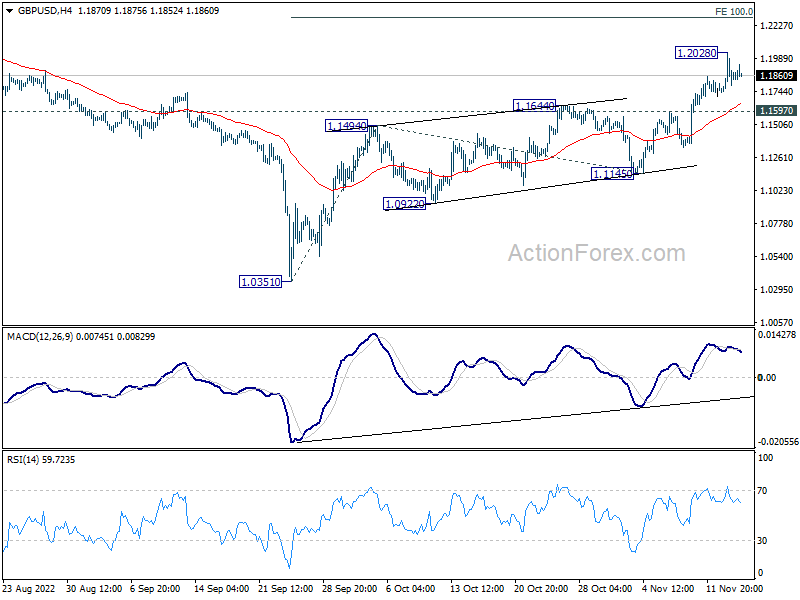
Intraday bias in GBP/USD is turned neutral with a temporary top formed at 1.2028, and more consolidations would be seen. Downside of retreat should be contained by 1.1597 minor support to bring another rally. On the upside, above 1.2028 will resume the rise from 1.0351 to 100% projection of 1.0351 to 1.1494 from 1.1145 at 1.2288.
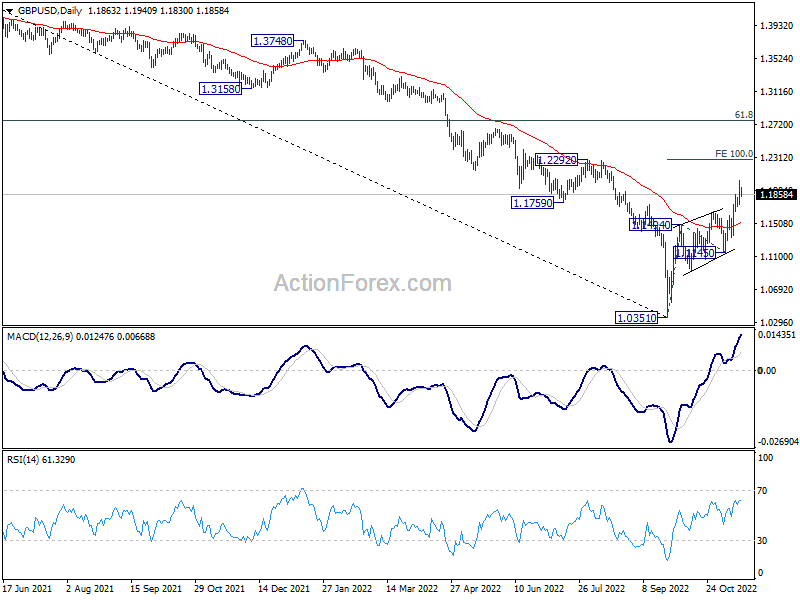
In the bigger picture, rise from 1.0351 medium term bottom is at least correcting whole down trend from 1.4248 (2021 high). Further rise is expected as long as 1.1145 support holds. Next target is 61.8% retracement of 1.4248 to 1.0351 at 1.2759
Economic Indicators Update
| GMT | Ccy | Events | Actual | Forecast | Previous | Revised |
|---|---|---|---|---|---|---|
| 23:30 | AUD | Westpac Leading Index M/M Oct | -0.10% | 0.00% | ||
| 23:50 | JPY | Machinery Orders M/M Sep | -4.60% | 0.70% | -5.80% | |
| 00:30 | AUD | Wage Price Index Q/Q Q3 | 1.00% | 0.90% | 0.70% | 0.80% |
| 04:30 | JPY | Tertiary Industry Index M/M Sep | -0.40% | 0.60% | 0.70% | |
| 07:00 | GBP | CPI M/M Oct | 2.00% | 1.70% | 0.50% | |
| 07:00 | GBP | CPI Y/Y Oct | 11.10% | 10.60% | 10.10% | |
| 07:00 | GBP | Core CPI Y/Y Oct | 6.50% | 6.40% | 6.50% | |
| 07:00 | GBP | RPI M/M Oct | 2.50% | 1.80% | 0.70% | |
| 07:00 | GBP | RPI Y/Y Oct | 14.20% | 13.40% | 12.60% | |
| 07:00 | GBP | PPI Input M/M Oct | 0.60% | 1.00% | 0.40% | 0.90% |
| 07:00 | GBP | PPI Input Y/Y Oct | 19.20% | 17.70% | 20.00% | 20.80% |
| 07:00 | GBP | PPI Output M/M Oct | 0.30% | 0.00% | 0.20% | 0.30% |
| 07:00 | GBP | PPI Output Y/Y Oct | 14.80% | 14.80% | 15.90% | 16.30% |
| 07:00 | GBP | PPI Core Output M/M Oct | 0.50% | 1.30% | 0.70% | 0.80% |
| 07:00 | GBP | PPI Core Output Y/Y Oct | 13.30% | 14.00% | 14.00% | 14.40% |
| 13:15 | CAD | Housing Starts Oct | 267k | 275K | 300K | 299k |
| 13:30 | CAD | CPI M/M Oct | 0.70% | 0.80% | 0.10% | |
| 13:30 | CAD | CPI Y/Y Oct | 6.90% | 7.00% | 6.90% | |
| 13:30 | CAD | CPI Median Y/Y Oct | 4.80% | 4.80% | 4.70% | |
| 13:30 | CAD | CPI Trimmed Y/Y Oct | 5.30% | 5.30% | 5.20% | |
| 13:30 | CAD | CPI Common Y/Y Oct | 6.20% | 5.90% | 6.00% | 6.20% |
| 13:30 | USD | Retail Sales M/M Oct | 1.30% | 0.90% | 0.00% | |
| 13:30 | USD | Retail Sales ex Autos M/M Oct | 1.30% | 0.40% | 0.10% | |
| 13:30 | USD | Import Price Index M/M Oct | -0.20% | -0.50% | -1.20% | |
| 14:15 | USD | Industrial Production M/M Oct | 0.20% | 0.40% | ||
| 14:15 | USD | Capacity Utilization Oct | 80.40% | 80.30% | ||
| 15:00 | USD | Business Inventories Sep | 0.50% | 0.80% | ||
| 15:00 | USD | NAHB Housing Market Index Nov | 36 | 38 | ||
| 15:30 | USD | Crude Oil Inventories | -2.0M | 3.9M |
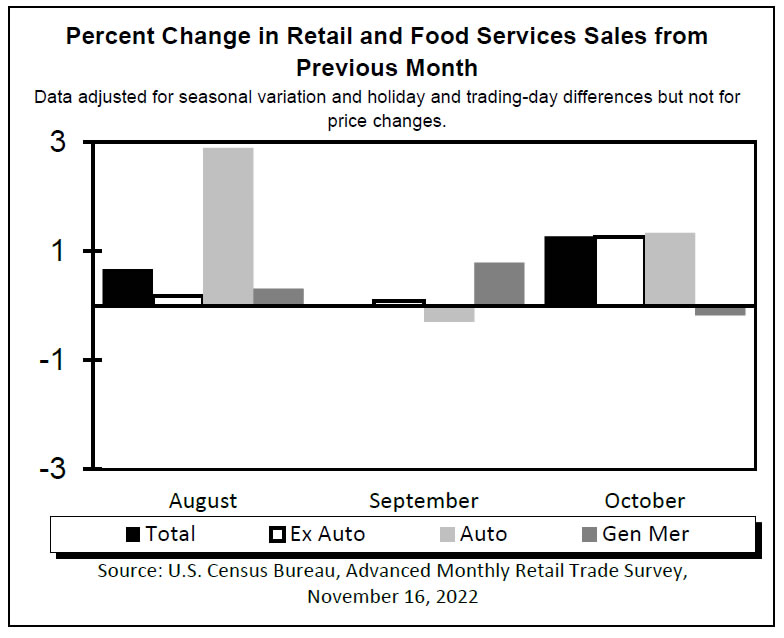
Canada CPI unchanged at 6.9% yoy in Oct
Canada CPI was unchanged at 6.9% yoy in October, slightly below expectation of 7.0% yoy. Excluding food and energy, prices slowed slightly from 5.4% to 5.3% yoy.
On a monthly basis, CPI rose 0.7% mom, below expectation of 0.8% mom, largely driven by the 9.2% mom rise in prices for gasoline.
Comparing to 5.6% you rise in average hourly wages, on average, prices rose faster than wages.
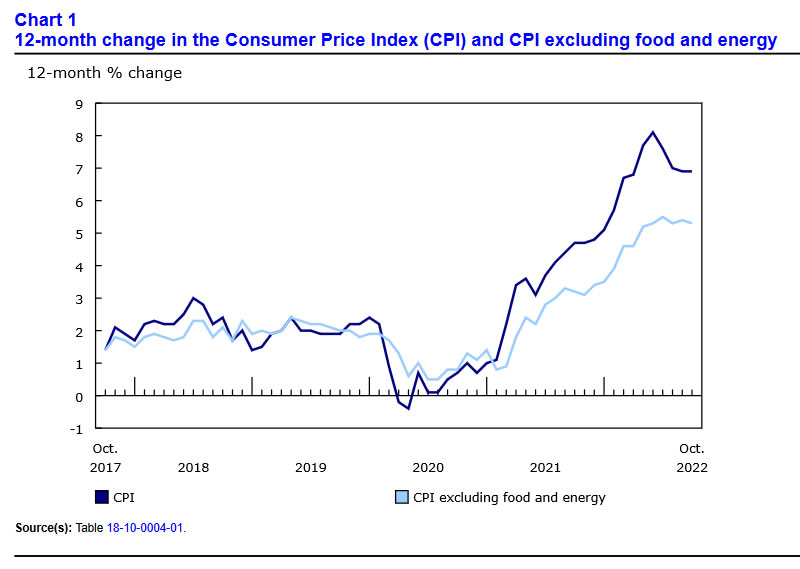
US retail sales rose 1.3% mom in Oct, ex-auto sales up 1.3% mom
US retail sales rose 1.3% mom to USD 694.5B in October, above expectation of 0.9% mom. Ex-auto sales rose 1.3% mom, above expectation of 0.4% mom to USD 565.1B. Ex-gasoline sales rose 1.0% mom to USD 630.4B.
Comparing with October 2021, total sales were up 8.3% yoy. Total sales in the three months through October were up 8.9% yoy.
Australia October Unemployment and Stronger Aussie?
The AUDUSD has been trending higher for about a month at this point, but a substantial amount of that could be attributed to events outside of Australia. The latest data releases give reasons to expect a stronger Aussie, but the actions from the RBA in the recent past give reasons for a weaker currency. How to match these differences?
Rewinding a bit
A couple of days ago, the RBA released its minutes from the last meeting. This was when it caught the market by surprise by raising rates less than expected. What got a lot of attention was the reason: Worries about liquidity. This happened in the wake of the BOE having to step in to support the bond market after the disastrous mini-budget.
Australian inflation has been climbing over the last year, but not at the same rate as in other major economies. Granted, Australia only keeps track of inflation on a quarterly basis, but the rate isn't really near the double digits of the UK and the EU. Nor has the RBA been as aggressive as the Fed in getting inflation to come back down.
Where policy is heading
The concerns about liquidity stem from real yields being really low, particularly in the UK. Subtracting the loss of value due to inflation from the interest paid on debt, investors end up fairly in the negative. Meaning there is little interest to buy into debt, particularly longer term debt when there is uncertainty about how the government will make its payments.
Australia, as a commodity currency, usually attracts investor interest with relatively high interest rates. But real rates are substantially negative for the moment. Interest rates in the most recent bond auctions have actually come down, likely as a result of expecting inflation to be controlled in the future. This causes a particular problem for the RBA, because it means that people might be looking to stay out of the market for a short period of time, pending inflation coming under control. But if the RBA raises rates aggressively, they could face a liquidity problem in the short term, similar to the UK.
Threading the needle
Yesterday's wage price index came in above expectations, showing that inflationary pressures have started to filter through to wages. That is something concerning for the central bank as that can keep pushing prices higher despite monetary policy.
From the minutes of the RBA meeting, it shows that the board considered both 25bps and 50bps options, and that there is no pause. 50bps is still on the table. In other words, the final rate is likely to be unchanged, just the pace at which the RBA gets there. This helps alleviate some of the liquidity pressure in the short term, but helps anchor expectations that inflation will come down.
What to look out for
Tomorrow's employment figures are likely to be important in the context of labor tightness. If there is sufficient room to keep hiring employees, then wage pressure on inflation is likely to be less. Which could give the RBA more room to go for 50bps at their next meeting.
Australia's October unemployment rate is expected to remain steady at 3.5%, after adding 15K jobs, up from 0.9K in September.
Fed George: Maybe we even have economic contraction to slow inflation
Kansas City Fed President Esther George told the WSJ, "'I have not in my 40 years with the Fed seen a time of this kind of tightening that you didn't get some painful outcomes".
"I'm looking at a labor market that is so tight, I don't know how you continue to bring this level of inflation down without having some real slowing, and maybe we even have contraction in the economy to get there."
ECB de Guindos: Will discuss balance sheet reduction in December
ECB Vice President Luis de Guindos said, "we will discuss about the reduction of our balance sheet," at December meeting.
"I think this is important in terms of both to reduce the excess liquidity that we see in the marketplace, and secondly as well to alleviate the situation of scarcity of collateral," he added.
De Guindos also noted, "it's very difficult to have financial stability without price stability," adding that "the main risk now for financial stability, for growth, is to have inflation at very high levels."
The Probable Peak of UK Inflation
The UK Consumer Price Index delivered another “positive” surprise, adding 2% for October, above the average forecast of 1.7%. Annual inflation accelerated to 11.1% against 10.1% previously and the forecast 10.7%. Inflationary pressures are much stronger here than in the USA and China, which reported a stronger-than-expected slowdown last month but are in line with continuing escalating price tensions in Europe.
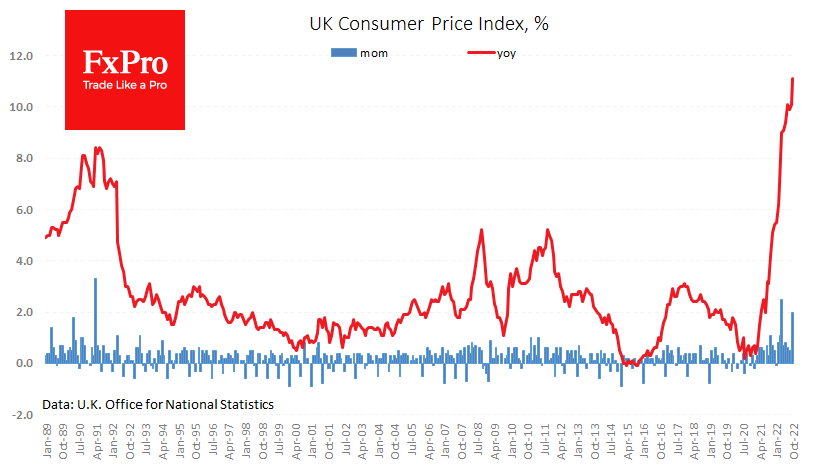
Producer prices are slowing their growth rate. PPI input prices added 0.6% m/m and 19.2% y/y against 20.7% a month earlier and peaked at 24.3% in June. From July to October, this index added 0.66%, suggesting an annulated increase of just under 2% – a decisive cooling, though not a price correction.
The PPI of producer price output slowed to 14.7% from 16.3% in September and a peak of 17.3% in July. For the three months, the index added 0.8%, reaching a trajectory of 3.3% in annulated terms.
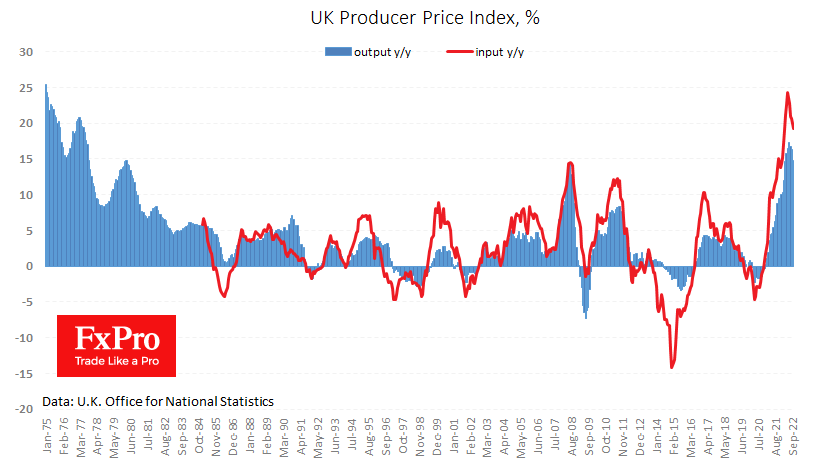
Producer price development suggests that the following inflation report in November will show a deceleration of consumer price inflation. So, the current 11.1% y/y CPI could be the peak level for years.
Investors and traders are more concerned about how this will affect Bank of England policy and, thus, the British markets. It may not affect it because the BoE had earlier forecasted inflation beyond 11%, so inflation stays on the trajectory that the BoE envisages.
Anyway, the central bank’s comments will not be long in coming as there will be a hearing of its members in a special parliamentary committee later today. As these hearings coincide with the release of the new inflation data, the focus will be on this issue.
The Bank of England will likely highlight the work on rate hikes that started in November 2021 and hint at further hikes in the foreseeable future in increased increments of 50-75 points. It also cannot be ruled out that hawkish comments will accelerate the strengthening of GBPUSD into the 1.2200 area, from where we saw the start of the last peak in August. A decisive move higher would signify the markets’ belief that the UK is on the road to recovery, having avoided the worst-case scenario.
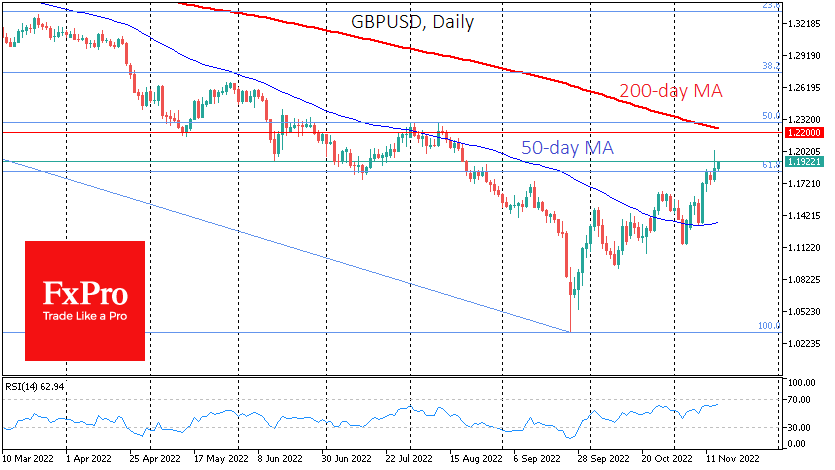
Pound Rises Even as Inflation Tops 11%
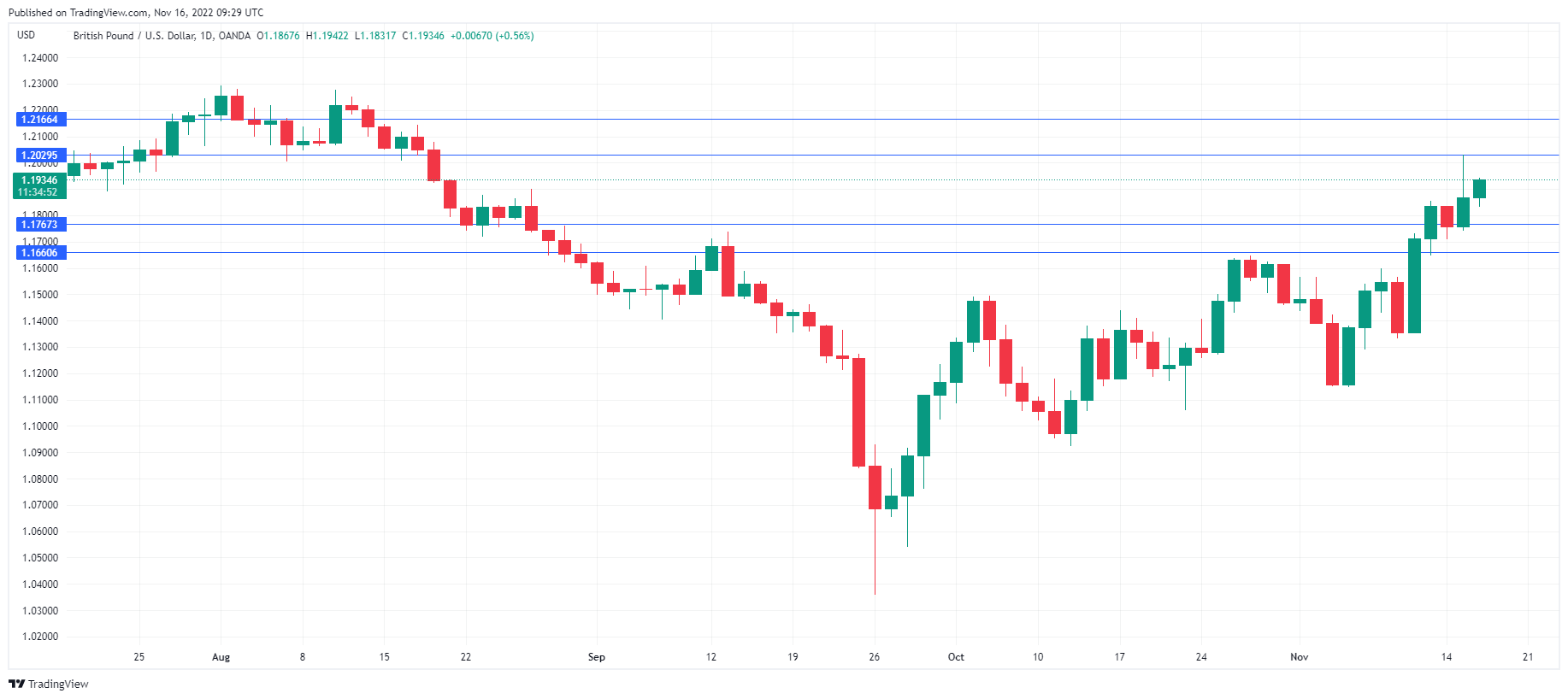
The British pound has moved higher on Wednesday. In the European session, GBP/USD is trading at 1.1934, up 0.56%. The pound roared on Tuesday, gaining close to 1% and punching past the 1.20 line for the first time in three months.
It has been a busy time for sterling, which has been marked by sharp swings that would make an exotic currency blush. The pound’s volatility has been especially pronounced in the month of November. The US dollar has hit a rocky patch and the pound has taken full advantage, climbing 3.5% this month.
It’s up, up, up for UK inflation
UK inflation continues to rise and hit a staggering 11.1% in October, a 41-year high. The upward trend continued despite the government introducing an energy price guarantee. Inflation jumped from 10.1% in September and ahead of the consensus of 10.7%. Core CPI remained unchanged at 6.5%, but was higher than the forecast of 6.4%. The Bank of England hasn’t been able to stem rising inflation despite tightening policy but will be hoping that its jumbo 0.75% hike earlier in November will take a bite out of the next inflation report.
The UK economy is facing a double-whammy of high inflation and a recession, and all eyes will be on Finance Minister Jeremy Hunt, who will announce the government budget on Thursday. Hunt will aim to restore the government’s credibility and stability, after the recent political soap opera which resulted in three different prime ministers in a matter of months and significant financial instability.
The UK employment report on Tuesday was lukewarm, with unemployment ticking higher to 3.5%, up from 3.4%. The Bank of England will be concerned about the increase in wage growth, which will create even more inflation. Wages excluding bonuses rose to 5.7%, up from 5.5% and ahead of the consensus of 5.6%. The BoE will be under pressure to continue hiking aggressively, even though this will hurt the struggling UK economy.
GBP/USD Technical
- GBP/USD has pushed above resistance at 1.1878. The next resistance is 1.2030
- 1.1767 and 1.1660 are providing support
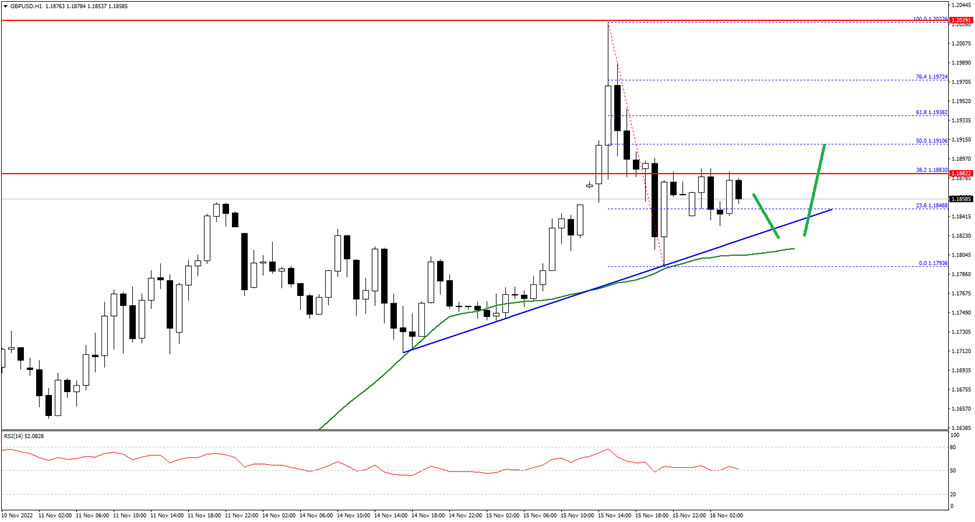
GBP/USD Pair is Now Consolidating Near 1.1850
The British Pound started a fresh increase from the 1.1600 support zone against the US Dollar. The GBP/USD pair gained pace for a move above the 1.1800 resistance zone.
The pair even settled above the 1.1840 level and the 50 hourly simple moving average. It is now consolidating near the 1.1850 level, with an immediate resistance at 1.1880 on FXOpen.
If there is a clear upside break above the 1.1880 resistance, the pair could rise steadily towards the 1.1940 level in the near term. The next major resistance sits near the 1.2000 level.
On the downside, the first major support is near the 1.1840 level. The main support is forming near the 1.1825 level, a connecting trend line on the hourly chart, and the 50 hourly simple moving average. A break below the 1.1825 support could even push the pair below the 1.1800 support.
USDJPY Consolidates above Previous Lows
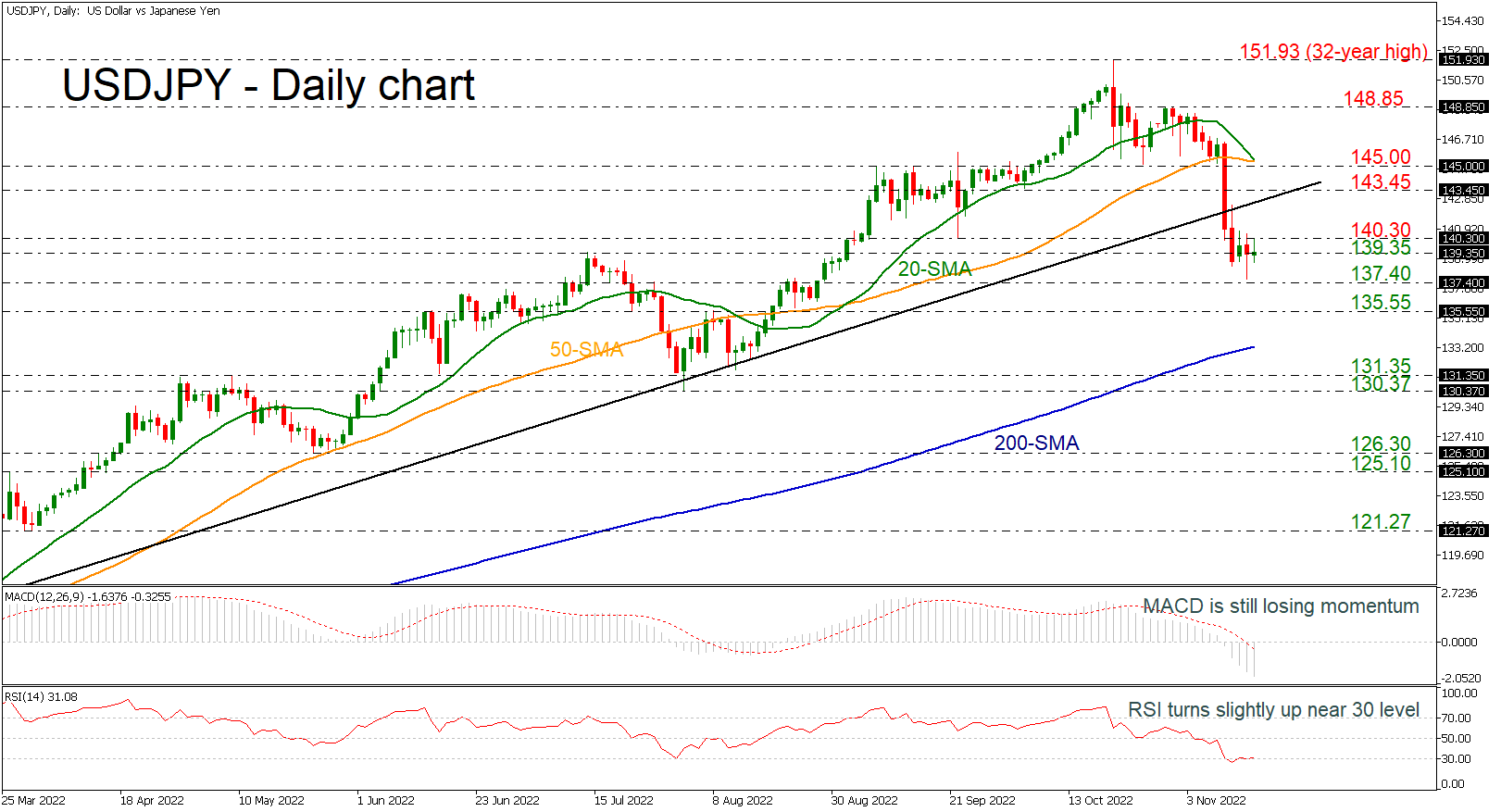
USDJPY is moving sideways after the selling interest that started in the preceding week. The drop beneath the long-term ascending trend line is shifting the market to neutral with the technical oscillators endorsing the previous negative movement. The MACD is losing momentum below its trigger and zero lines, indicating more losses, while the RSI is still holding in the negative territory but is pointing slightly up.
Further losses should see the 137.40 support ahead of the next low of 135.55. A drop below the 200-day simple moving average (SMA) at 133.20 may act as a strong rebound for the bulls. However, more declines could shift the bias to bearish, meeting 130.37-131.35.
In the event of an upside reversal and a jump above the 140.30 resistance, it could drive the price towards the diagonal line and the 143.45-145.00 region. Marginally higher, the bearish cross within the 20- and the 50-day SMAs at 145.35 may switch the outlook back to bullish, hitting the 148.85 barrier.
All in all, USDJPY is currently failing to endorse the negative structure but any more downside movements beneath the 200-day SMA could change the broader picture to bearish.