

Sample Category Title
Australia employment grew 32.3k in Oct, unemployment rate dropped to 3.4%
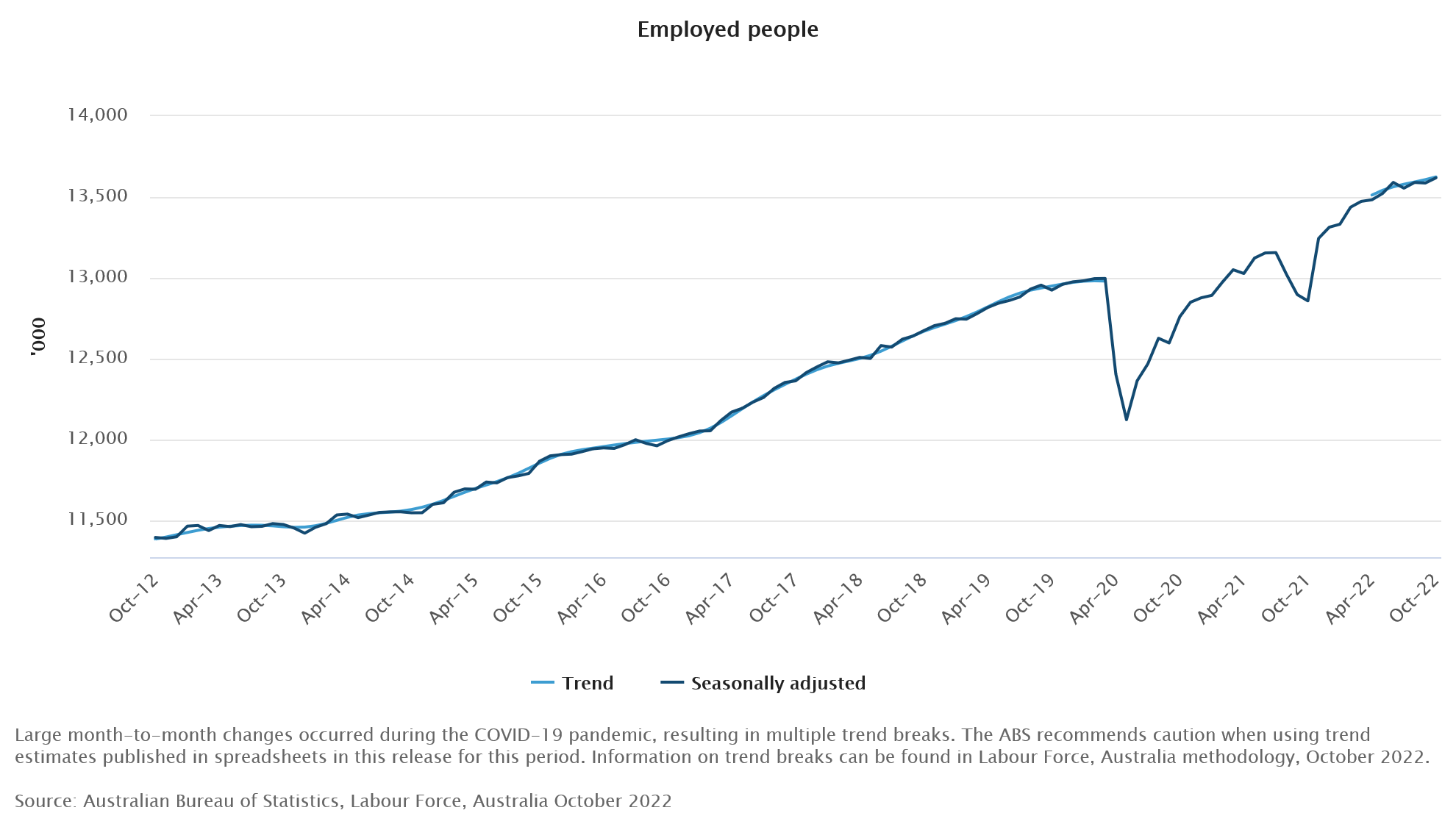
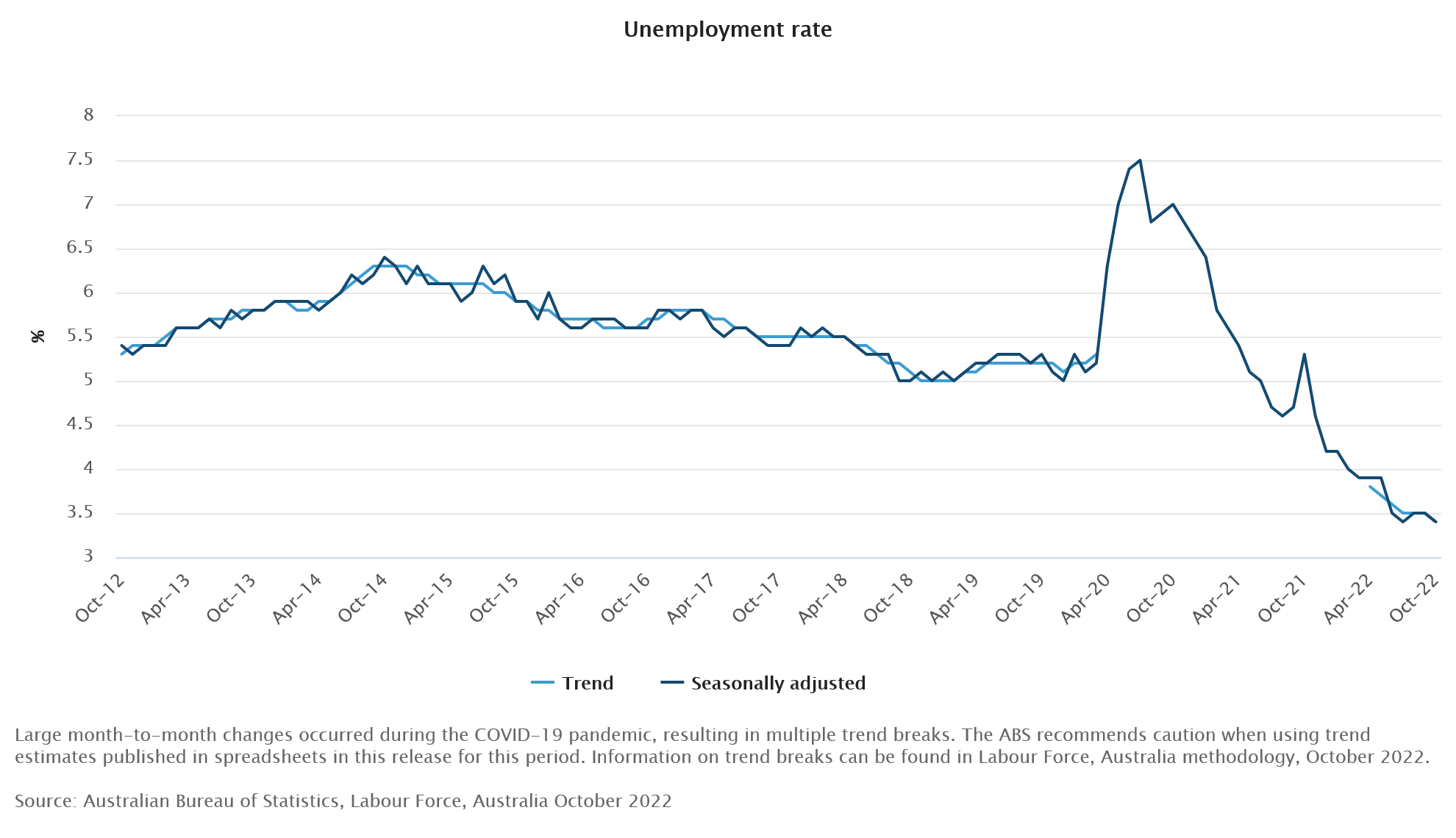
Australia employment rose 32.2k in October, above expectation of 15.0k. Unemployment rate dropped from 3.5% to 3.4%, below expectation of 3.5%. Participation rate was unchanged at 66.5%. Monthly hours worked in all jobs rose 2.3% mom.
"Although employment in seasonally adjusted terms rose 0.2 per cent in October 2022, the underlying trend estimate was monthly growth of around 0.12 per cent. This was below the average for the 20 years prior to the pandemic of 0.16 per cent," Bjorn Jarvis, head of labour statistics at the ABS said.
"This indicates that while employment has continued to grow, the rate of growth has slowed to below the longer-term average. It has been below this average for the past 5 months."
Japan trade deficit hit another record as import surged
Japan's exports rose 25.3% yoy to JPY 9.00T in October, after shipments of cars and electronics components increased. Imports rose 53.5% yoy to JPY 11.16T, hitting a historical high, as led by crude oil, liquefied natural gas and coal.
Trade deficit came in at JPY -2.16T, a record for the month. Also, Japan has seen as record trade deficit for each month in the past six months, on rising energy and raw material costs, as well as weak Yen exchange rates.
US-bound exports rose 36.5% yoy to JPY 1.78T while imports rose 47.1% yoy to JPY 1.06T. Exports to China rose 7.7% yoy to JPY 1.72T while imports rose 39.3% yoy to JPY 2.39T.
In seasonally adjusted term, exports rose 2.2% mom to JPY 8.91T. Imports rose 4.2% mom to JPY 11.21T. Trade deficit came in at JPY -2.30T.
BoJ Kuroda: May take a long time to achieve price stability with wage hikes
BoJ Governor Haruhiko Kuroda told the parliament that it may "take a long time" to achieve the "price stability target, involving wage hikes". He reiterated that the central bank needs to continue with its monetary easing to support a fragile recovery.
At the same session, Executive Director Shinichi Uchida said it was too early to discuss exit from monetary stimulus. "When exiting, the point will be adjusting long-term and short-term policy rates and the BoJ's balance sheet," Uchida said. "The order and mixture of those factors would differ depending on economy, prices and financial situations at the time."
Fed Waller more comfortable to hike 50bps in Dec, but no judgement before more data
Fed Governor Christopher Waller said in a speech that while the slowdown in CPI in October was "welcome news", "we must be cautious about reading too much into one inflation report"
"I don't know how sustained this deceleration in consumer prices will be," he said.And, it's "way too early to conclude that inflation is headed sustainably down"
Despite raising interest rates from near 0% to 3.75-4.00% in nine months, "policy is barely in restrictive territory today, so more interest rate hikes are needed to get inflation down," he said.
"The Committee will reach the terminal rate well before inflation reaches 2 percent because of the abundance of evidence that it takes months, and perhaps even longer, for the full effects of a rate increase to work through the economy."
"Looking toward the FOMC's December meeting, the data of the past few weeks have made me more comfortable considering stepping down to a 50-basis-point hike. But I won't be making a judgement about that until I see more data, including the next PCE inflation report and the next jobs report."
Australia: October Labour Force; Employment Lifts As Absences Fade
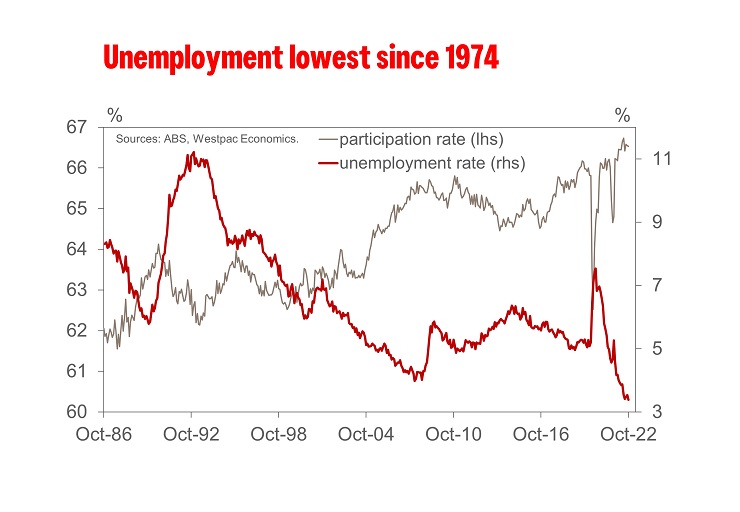
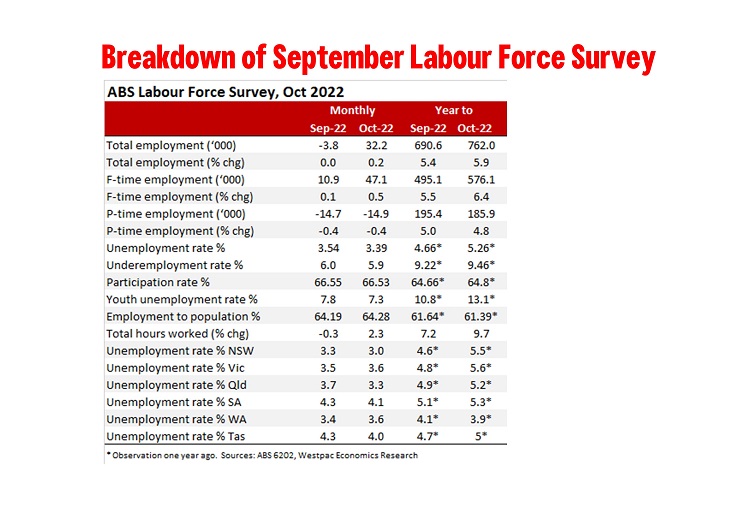
Total employment: 32.2k from -3.8k (revised from 0.9k); unemployment rate: 3.4% from 3.5% (unrevised 3.5%); participation rate: 66.5% from 66.5% (revised 66.6%). It was a strong update even though holidays, sickness and floods continue to hold back the recovery. Unemployment is now the lowest level since November 1974.
Total employment gained 32.2k or 0.2% in October while September employment was revised from 0.9k to -3.8k. In the year total employment has grown 762.0k or 5.9%.
The size of the gain in employment was enough to lift the employment to population ratio 0.1ppt to 64.3%
Participation was flat at 65.5% (at two decimal places it fell from 65.55% to 65.53) which is just under the historical high of 66.7%. Due to the moderation in participation there was a smaller 11.7k gain in the labour force resulting in a -20.6k drop in the number of unemployment with the unemployment rate falling 0.1ppt to 3.4% (3.54% and 3.39% respectively at two decimal places).
At 3.4% the unemployment rate is low the lowest since November 1974.
Westpac’s forecast unemployment rate at end 2022 is 3.3%.
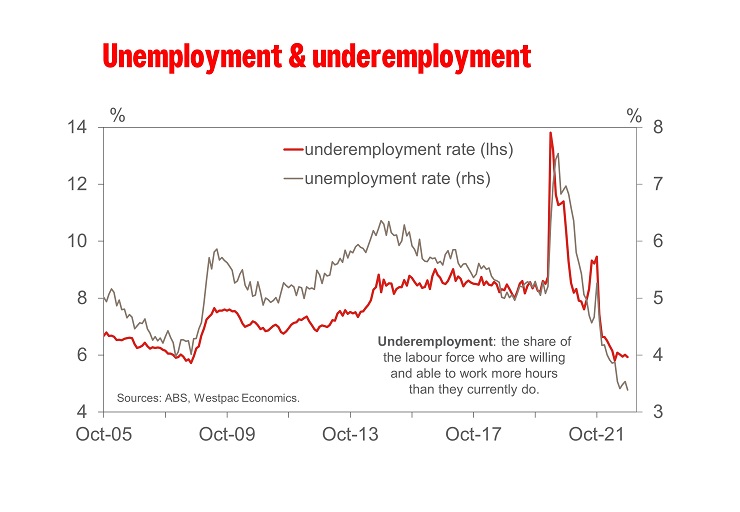
Underemployment, those employed who are willing and able to work more hours if offered them, fell 0.1ppt to 5.9%, 2.8ppt points below the pre-pandemic rate. However, as you can note in the chart, since May the unemployment rate has fallen 0.5ppt while the underemployment rate has been tracking sideways and is now up 0.1ppt. Given how tight the labour market is it is somewhat surprising we have not seen underemployment fall with unemployment.
The underutilisation rate, which combines the unemployment and underemployment rates, fell 0.2ppt 9.3% which is 4.6ppt below March 2020, and the lowest rate since March 1982.
There has been an interesting shift in gender outcomes. Since January 2021 female employment has grown much more strongly (+371.6k/6.1%) than males (338.9k/5.0%) but in October male employment lifted 24.0k/0.3% compared to the smaller 8.3k/0.1% gain for females. The saw the unemployment rate for men fall 0.3ppt to 3.2%, the lowest rate since November 1974. For women, unemployment was steady at 3.6%.
The participation rate fell 0.1ppt for men to 70.9% and was steady for women at 62.3%. A falling participation for men with a robust lift in employment suggest the gain was all demand driven and employers are facing, at the margin, a tighter labour market for males than females.
Seasonally adjusted monthly hours worked increased by 2.3 per cent, stronger than the growth in employment (0.2 per cent). This stronger growth in hours partly reflected fewer employed people than usual taking leave during October.
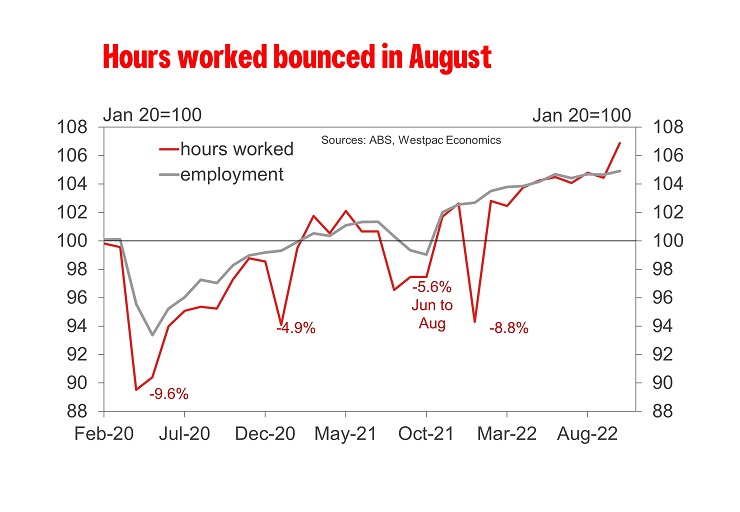
In September we noted that the number of people working fewer hours because they were sick was around 14% higher than the pre-COVID level. While still high it was down from the two to three times higher levels earlier in 2022.
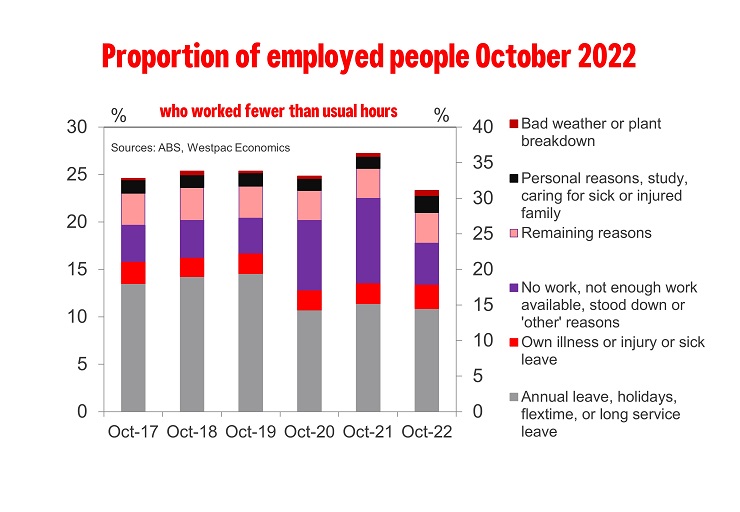
For October, the ABS noted that the number of people working fewer hours because they were on annual leave increased between September and October, consistent with school holidays and public holidays. However, the number of people on annual leave in October 2022 was around 10% less than we typically see in October. Some of this difference may reflect people who would normally have taken annual leave being sick instead, with around 30% more people than usual working reduced hours in October due to sickness.
Again in October greater than usual sickness is still impacting on the data but it is no longer two-to-three times higher than usual as it was early 2022. October was the first month in 2022 where the number of people working less than usual dropped below 500k (467k).
The widespread catastrophic flood across NSW, Victoria and Tasmania saw the number of people working reduced hours due to bad weather increase from 66k in September to 100k in October.
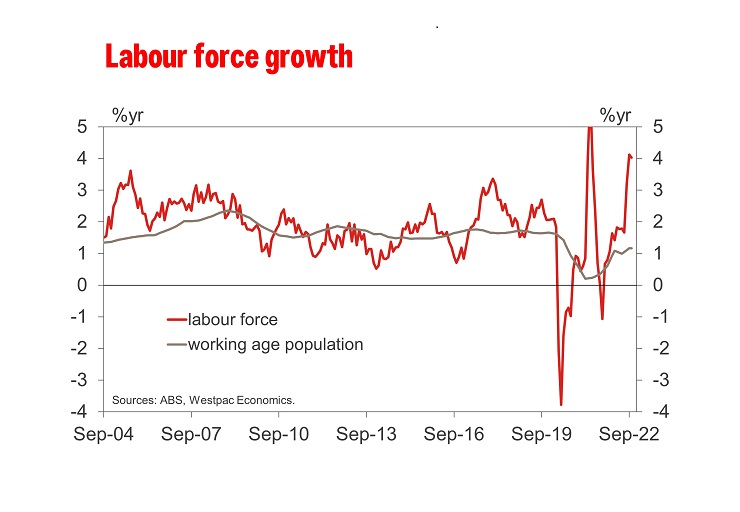
We should also note that the Labour Force Survey continues to report a pickup in immigration with annual growth in the working age population lifting from 0.6%yr last December to 1.2%yr in October. Prior to COVID annual growth in the working age population peaked at 1.7%yr in 2018/2019.
By state unemployment fell in NSW (-0.3ppt to 3.0%), Qld (-0.4ppt to 3.3%), SA (0.2ppt to 4.1%) and Tasmania (-0.3ppt to 4.0%) while it lifted in Victoria (0.1ppt to 3.6%) and WA (0.2ppt to 3.6%).
Crude Oil Price Dips, Can This Key Support Hold?
Key Highlights
- Crude oil price started a fresh decline from well above $90.
- A major bearish trend line is forming with resistance near $87.20 on the 4-hours chart.
- Gold price started a consolidation phase after a strong move above $1,750.
- Bitcoin price remains at risk of more losses unless it clears $17,500.
Crude Oil Price Technical Analysis
Crude oil price started a fresh decline from the $93.50 zone against the US Dollar. The price gained pace and traded below the $90.00 support zone.
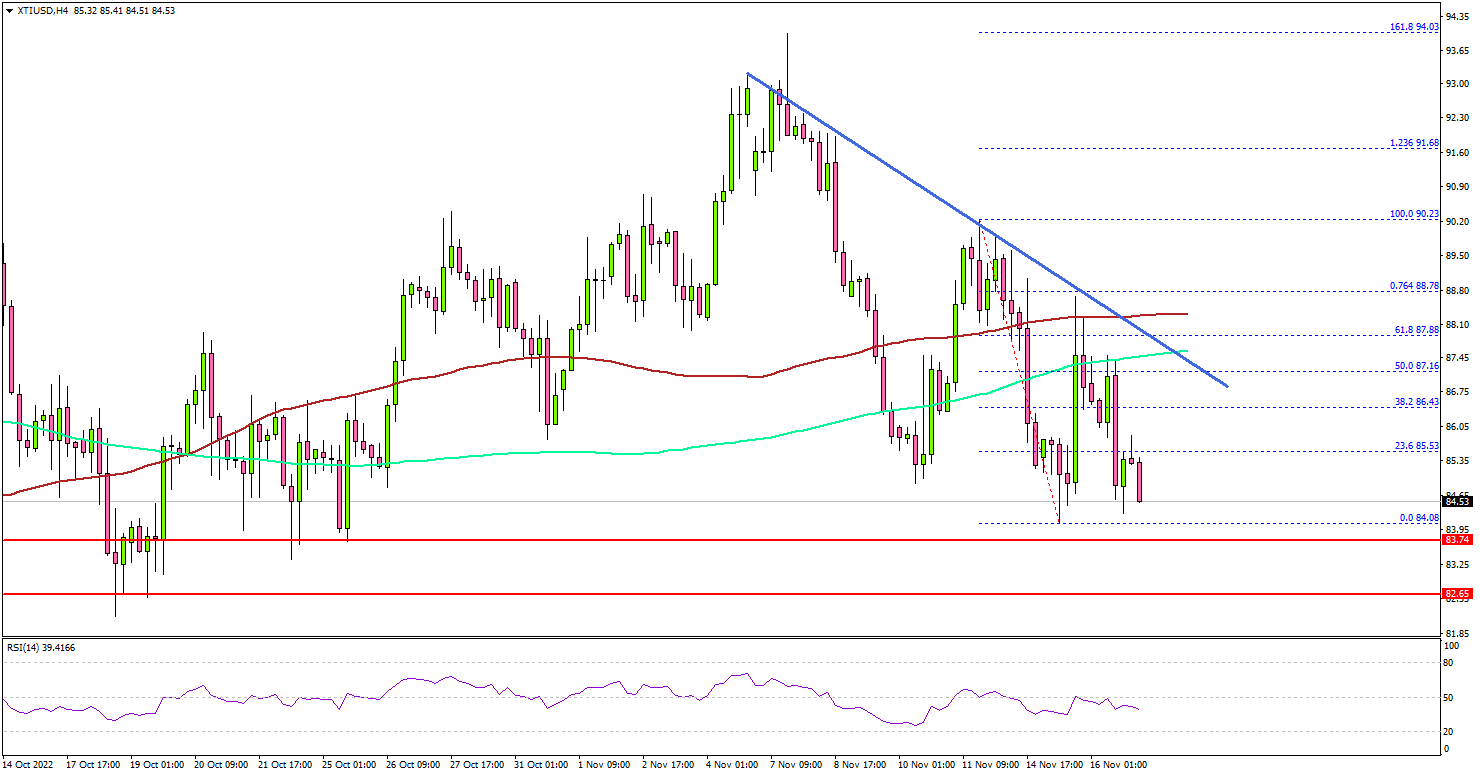
Looking at the 4-hours chart of XTI/USD, there was a break below the $88.80 support zone. The price even settled below the $88.00 level, the 100 simple moving average (red, 4-hours), and the 200 simple moving average (green, 4-hours).
The bears seem to be in control, with an immediate support near the $84.00 zone. The next major support is near $82.65 zone. Any more losses might call for a test of the $80.00 support zone in the coming days.
On the upside, the price might face sellers near the $86.50 zone. The next major resistance is near $87.00 and a connecting bearish trend line, above which the price could test the 100 simple moving average (red, 4-hours).
A clear move above the 100 simple moving average (red, 4-hours) and the $88.80 resistance could open the doors for a steady increase in the coming sessions.
Looking at gold price, there was a steady increase above the $1,750 and $1,760 resistance. It is now consolidating gains below the $1,800 level.
Economic Releases to Watch Today
- US Initial Jobless Claims - Forecast 225K, versus 225K previous.
- US Housing Starts for Oct 2022 (MoM) – Forecast 1.410M, versus 1.439M previous.
- US Building Permits for Oct 2022 (MoM) – Forecast 1.512M, versus 1.564M previous.
USDCAD Wave Analysis
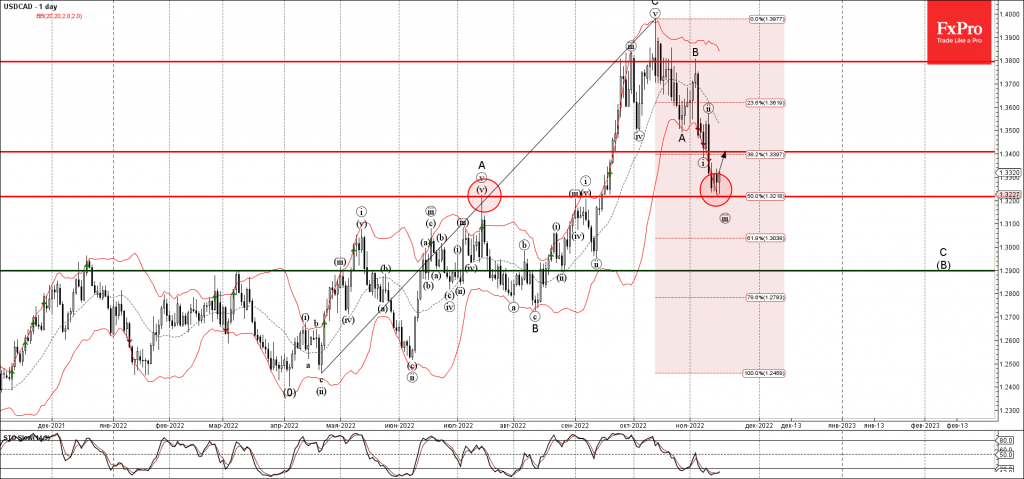
- USDCAD reversed from support level 1.3215
- Likely to fall to resistance level 1.3400
USDCAD recently reversed up from the key support level 1.3215 (previous monthly high from the start of July), lower daily Bollinger Band, intersecting with the 38.2% Fibonacci correction of the downward impulse from October.
The upward reversal from the support level 1.3215 stopped the earlier short-term impulse wave (iii) of the higher impulse waves C and (B).
Given the clear daily uptrend and the oversold daily Stochastic, USDCAD can be expected to rise further toward the next resistance level 1.3400 (former low of wave (i) from the start of November).
Fed Daly: 4.75% – 5.25% is reasonable for policy rate end-point
San Francisco Fed President Mary Daly told CNBC that "consumers are preparing for slower economy, that's a good start." She added that Fed wants to see "economy slow" to "get inflation down", and "slower inflation, labor market are encouraging ".
She also said "pausing" the tightening cycle is "not part of the discussion" right now. The focus is on "level of rates". She added, "I still think 5% is reasonable" as an "ending place for rates". Also, "a range of 4.75% - 5.25% is reasonable for policy rate end-point."
BoE Bailey: We see some evidence of supply chain shock coming off
BoE Governor Andrew Bailey said in a Treasury Committee hearing, "The economy was hit by a huge shock in terms of the pandemic. What we've had since then is a series of supply shocks, which have reduced the supply capacity of the economy relative to demand. There was a supply chain shock in the recovery from Covid. We see some evidence of that shock coming off."
Bailey added that the job market remains "tight". But, "employers have now begun to say that they are seeing some reduction and competition for hiring," he added. "As yesterday's labor market statistics demonstrated, it's still a very tight labor market."
Deputy Governor Ben Broadbent said, recession in the UK "could quite easily turn out to be a little bit shorter or a little bit longer. "There's a lot of uncertainty, including about the length. We could well be in another quarter of contraction right now."
MPC member Swati Dhingra warned, "There is a risk of overtightening. There's already about a fairly sizable chunk of the previous rate rises that have got to take effect in terms of what they do to GDP."
Dhingra also noted, "it's undeniable" that "we're seeing a much, much bigger slowdown in trade in the UK compared to the rest of the world" and "we're definitely performing below trend in terms of the exports numbers in terms of the inputs, even probably a bit bigger than that."