Sample Category Title
Fed Bullard: Policy rate not yet sufficiently restrictive
St. Louis Fed President James Bullard said, "even under these generous assumptions, the policy rate is not yet in a zone that may be considered sufficiently restrictive". And, "to attain a sufficiently restrictive level, the policy rate will need to be increased further."
"Thus far, the change in the monetary-policy stance appears to have had only limited effects on observed inflation, but market pricing suggests disinflation is expected in 2023," Bullard said.
Yen Dips ahead of Key Inflation Data
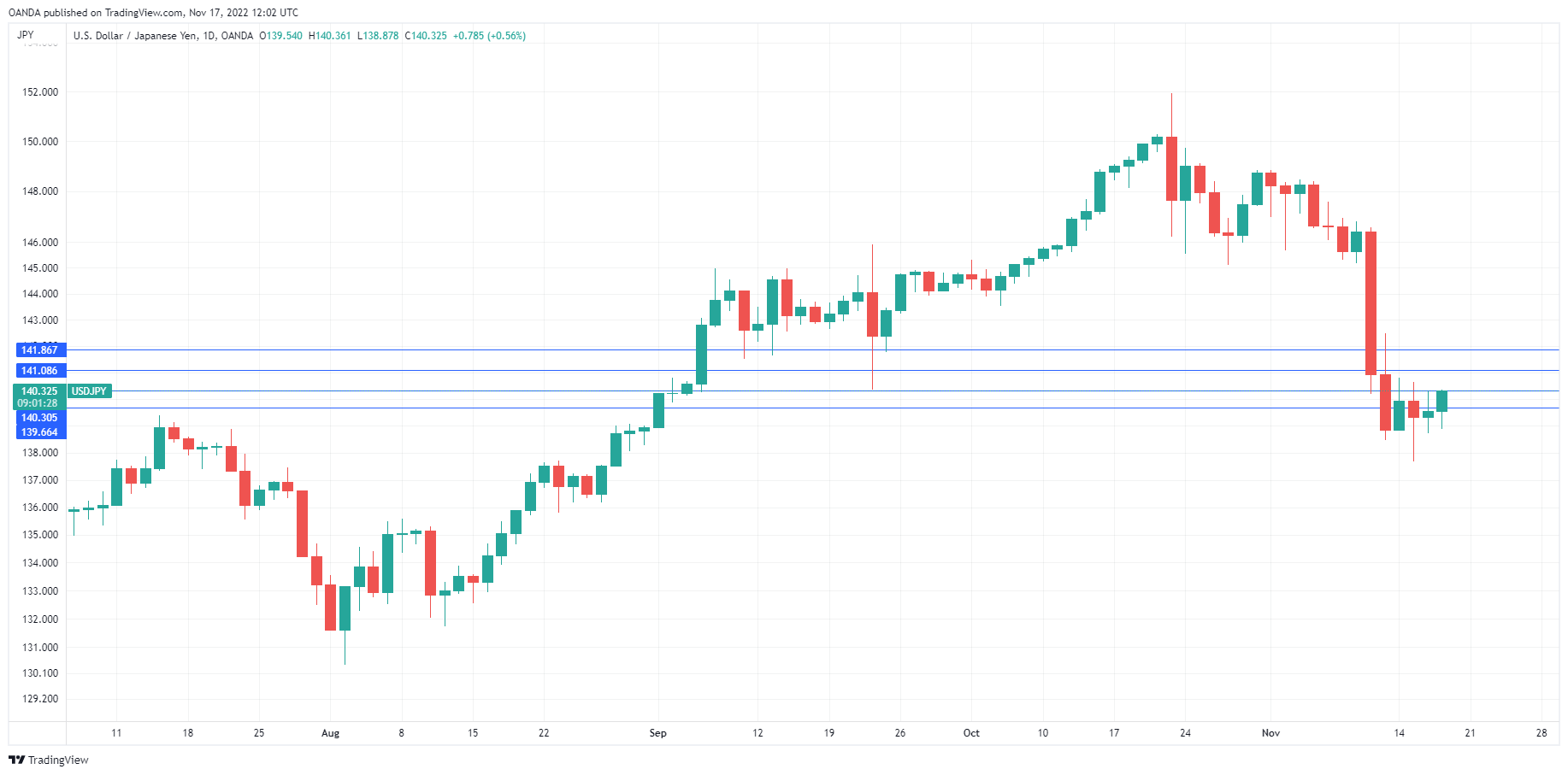
The Japanese yen continues to flirt with the 140 level. In the European session, USD/JPY is trading at 140.25, up 0.51%.
Japan releases the October National CPI later today, which is expected to rise to 3.5%, following the September reading of 3.0%. Inflation has been on the rise and is above the BoJ’s target of 2%, although these are levels that other major central banks can only dream about. The Bank of Japan has no plans to change its ultra-loose policy, even though inflation is above the target and the yen remains weak. BoJ Governor Kuroda reiterated his well-worn script earlier today that the rise in inflation is transitory, adding that he expects CPI to drop below 2% in fiscal year 2023. The yen has been on a tear in November, with gains of close to 6%, but that is more a case of dollar weakness rather than any newfound yen strength. With the Fed planning another oversize rate hike in December, the US/Japan rate differential will continue to weigh on the yen.
Fed sends a hawkish message
The investor exhilaration which sent the stock markets rallying after the soft inflation report has taken a pause. Fed policy makers responded with a hawkish message, reminding the markets that the Fed was planning to raise rates higher than they had anticipated. The Fed speak may or may not have convinced investors to settle down, but a strong US retail sales report clearly did the trick. The headline and core releases both posted strong gains of 1.3%, dampening sentiment that the Fed would pivot and ease its tightening. The US economy remains resilient and appears able to absorb further rate hikes without triggering a deep recession. Interest rates are expected to peak at 5% or slightly higher, which means that the Fed is highly likely to continue tightening into next year.
USD/JPY Technical
- USD/JPY has support at 140.30 and 139.66
- There is resistance at 141.08 and 141.86
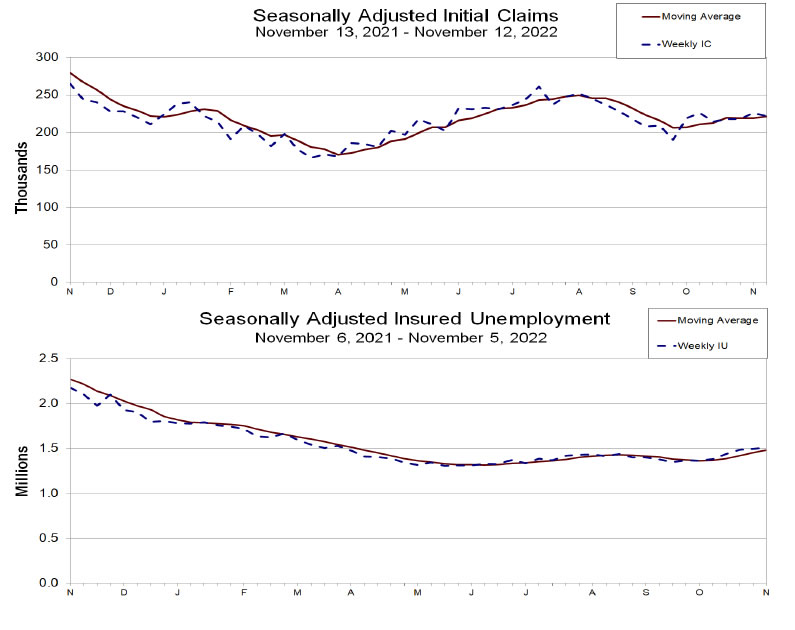
US initial jobless claims dropped to 222k
US initial jobless claims dropped -4k to 222k in the week ending November 12, above expectation of 220k. Four-week moving average of initial claims rose 2k to 221k.
Continuing claims rose 13k to 1507 k in the week ending November 5. Four-week moving average of continuing claims rose 31k to 1482k.
Aussie Slides Despite Strong Job Data
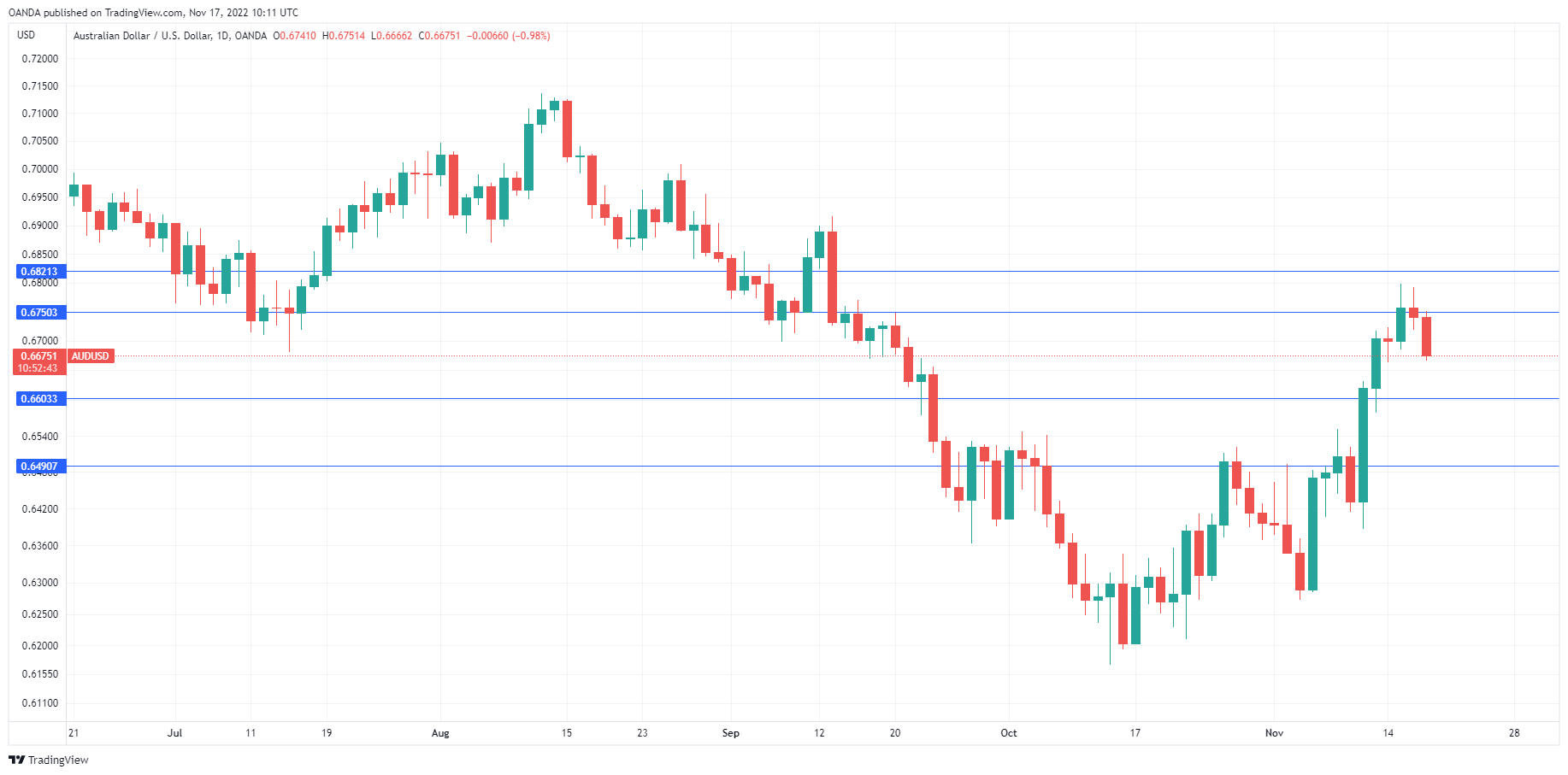
The Australian dollar is considerably lower on Thursday. In the European session, AUD/USD is trading at 0.6671, down 1.02%.
Employment data shines
Australia’s tight labor market got even tighter in October. Total employment jumped by 32,200, up from just 900 in September. The numbers were especially encouraging as full-time employment jumped by 47,100, up from 10,900 prior. The unemployment rate of 3.5%, which was already running at a 50-low, inched lower to 3.4%.
The excellent numbers are unlikely to change the Reserve Bank of Australia’s rate policy. The RBA has eased the pace of rate hikes considerably, with two straight increases of a modest 0.25%. The markets have priced in another 0.25% hike at the December 6th meeting, which would bring the cash rate to 3.10%. With rates expected to peak in early 2023 around 3.5% or 3.6%, the end appears in sight for the current rate-tightening cycle.
The robust labour market has put upward pressure on wages, which burst higher on Wednesday with a gain of 3.1% YoY in the third quarter, its strongest quarterly gain since 2013. The Reserve Bank of Australia will be wary of a spectre of a wage-price spiral if wages continue to accelerate, which would greatly complicate efforts to curb inflation.
US retail sales for October pointed to consumer resilience, despite high interest rates and stubbornly sticky inflation. The headline and core releases both came in at 1.3%, above expectations and a strong rebound from the September data (0.0% headline, 0.1% core). This indicates that the US economy can handle additional rate hikes, with the Fed expected to raise rates to 5.0% or slightly higher. With the benchmark rate sitting at 4.0%, investors would do well to keep in mind that there is still some life left in the current rate-tightening cycle.
AUD/USD Technical
- 0.6603 and 0.6490 are providing support
- There is resistance at 0.6750 and 0.6821
Dollar Index Looks for Fresh Direction Signals to Exit Near-Term Sideways Mode
Bears are pausing for the second day after being accelerated by lower than expected inflation numbers which suggested that the Fed may ease its aggressive policy tightening stance, but better than expected US retail sales in October questioned bears, prompting traders to stay on hold and await more signals.
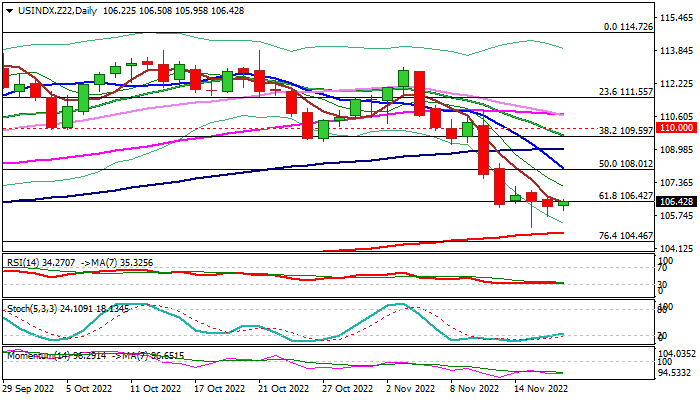
Downtrend from 20-year peak (114.72, Sep 28) spiked to three-month low at 105.15 on Tuesday, but faced strong headwinds on approach to rising 200DMA (104.89), confirmed by long tails of daily candles of Tue/Wed.
Bears cracked pivotal Fibo support at 106.42 (61.8% of 101.29/114.72 upleg) weighed by last week’s massive bearish candle, but require weekly close below 106.42 for confirmation and signal of bearish continuation.
On the other side, signals of stall and possible bounce are developing on a weekly chart, where long-legged Doji is forming, stochastic is oversold and momentum indicator overextended, with oversold daily studies contributing to the notion.
Markets need to digest data which suggest that the US economy may enter the upward trajectory and escape from recession, however, pressure on dollar over Fed’s potential downsizing interest rate hikes would likely persist.
Overall structure on all larger timeframes remains bearish, as reversal pattern has formed on monthly chart (though still requiring confirmation on monthly close below pivotal Fibo level at 104.95 )38.2% of 89.15/114.72).
Oversold weekly and daily studies suggest limited recovery, which should be capped under 109.00 zone (100DMA / 20WMA) to keep bears in play.
Expect initial positive signal on close above 107.14 (Monday’s high / lower 20-d Bollinger band) which would look for a verification on lift and violation of falling 10DMA (108.02).
Conversely, repeated close below 106.42 Fibo support would signal that recovery attempts lose traction and bears keep control, though firmer bearish signal to be expected on drop below Tuesday’s spike low (105.15) which would signal attack at 200DMA.
Res: 107.14; 107.87; 108.02; 109.00.
Sup: 105.70; 105.15; 104.89; 104.46.
Eurozone CPI finalized at 10.6% yoy in Oct, core CPI at 5.0% yoy
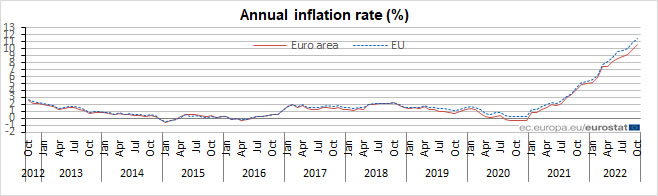
Eurozone CPI was finalized at 10.6% yoy in October, up from September's 9.9% yoy. CPI core (all item ex energy, food, alcohol, & tobacco), was finalized at 5.0% yoy, up from prior month's 4.8% yoy. The highest contribution to annual inflation rate came from energy (+4.44%), followed by food, alcohol & tobacco (+2.74%), services (+1.82%) and non-energy industrial goods (+1.62%).
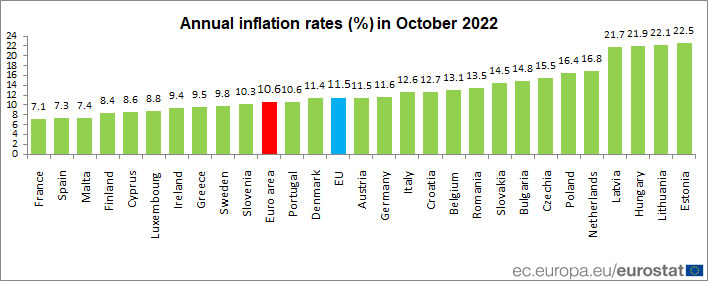
EU CPI was finalized at 11.5% yoy, up from September's 10.9% yoy. The lowest annual rates were registered in France (7.1%), Spain (7.3%) and Malta (7.4%). The highest annual rates were recorded in Estonia (22.5%), Lithuania (22.1%) and Hungary (21.9%). Compared with September, annual inflation fell in eleven Member States, remained stable in three and rose in thirteen.
EURUSD: Double Failure at 200DMA and Overbought Conditions Warn of Pullback
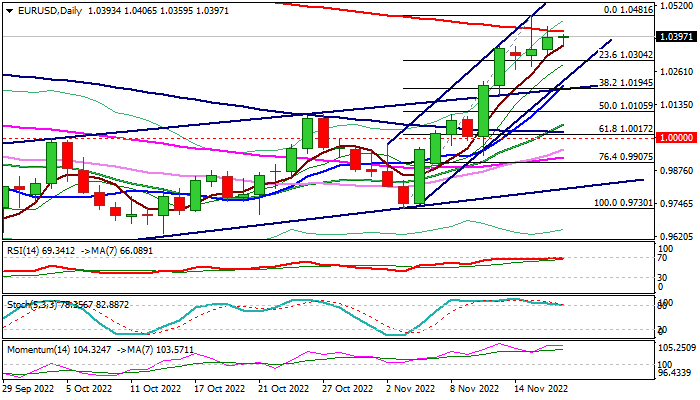
The Euro is trading within a narrow range in early Thursday’s and still constructive, but warnings about bulls running out of steam are growing.
Long upper shadows of daily candles in past two days and double failure to register daily close above significant barrier provided by falling 200DMA (1.0417) add to risk of bull trap and possible pullback.
Stochastic is about to reverse from overbought territory and bullish momentum started to fade, adding to initial negative signals. Larger bulls are likely to take a breather on overextended daily studies and a partial profit-taking after the latest steep bullish acceleration from 0.9730 (Nov 3 trough).
Expect initial bearish signal on today’s bearish close, preferably below Fibo support 1.0304 (23.6% of 0.9730/1.0304, with dips to find firm ground at 1.0200 zone (rising 10DMA / broken bull-channel upper boundary trendline / Fibo 38.2%) and keep bulls in play.
Conversely, the pair would keep bullish bias while holding above 1.0304 pivot, but may hold in extended consolidation as long as action stays capped by 200DMA.
Bullish scenario requires final break of 200DMA to signal bullish continuation of recovery leg from 0.9535 (Sep 20 low) through pivotal 1.05 zone which would unmask June tops (lower platform at 1.0600/15 zone).
Res: 1.0417; 1.0491; 1.0550; 1.0614.
Sup: 1.0363; 1.0304; 1.0271; 1.0200.
GBP/JPY Daily Outlook
Daily Pivots: (S1) 165.22; (P) 165.80; (R1) 166.88; More...
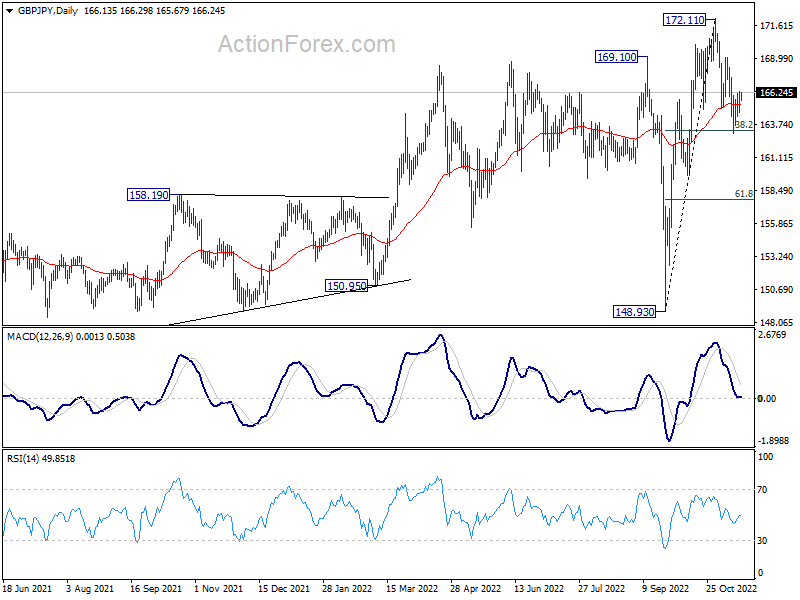
Intraday bias in GBP/JPY stays neutral first and outlook is unchanged. Strong rebound from current level, followed by break of 166.06 minor resistance will turn bias back to the upside for retesting 172.11 high. However, sustained trading below 38.2% retracement of 148.93 to 172.11 at 163.25 will bring deeper decline to 61.8% retracement at 157.78 and possibly below.
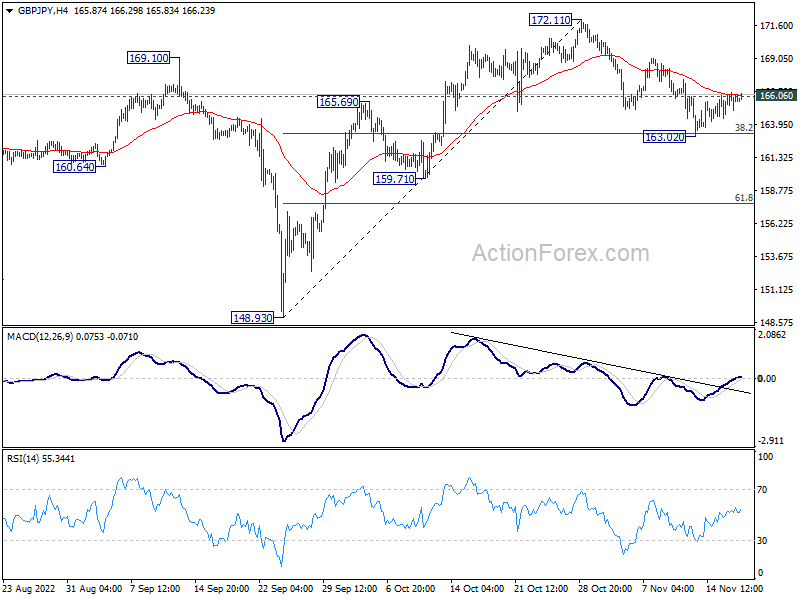
In the bigger picture, there is no clear sign of medium term topping yet. Up trend from 123.94 (2020 low) could still resume through 172.11 high at a later stage. However, firm break of 159.71 support will argue that it's already in correction to the up trend from 123.94, and deeper decline would be seen back towards 148.93 support.
EUR/JPY Daily Outlook
Daily Pivots: (S1) 143.91; (P) 144.70; (R1) 145.84; More....
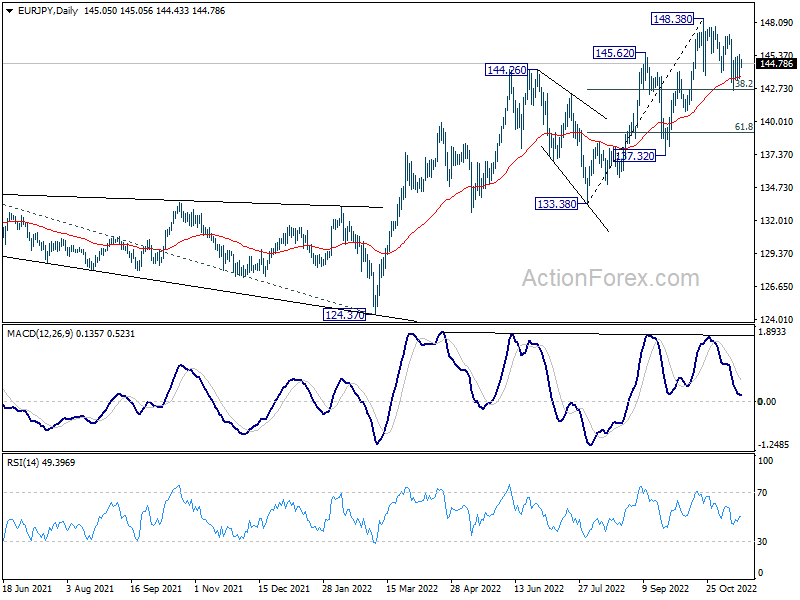
Outlook in EUR/JPY remains unchanged and intraday bias stays mildly on the upside. Correction from 148.38 might have completed at 142.54, after hitting 38.2% retracement of 133.38 to 148.38 at 142.65. Further rally would be seen to retest 148.38 high. However, on the downside, sustained break of 142.65 will bring deeper fall to 61.8% retracement at 139.11 and possibly below.
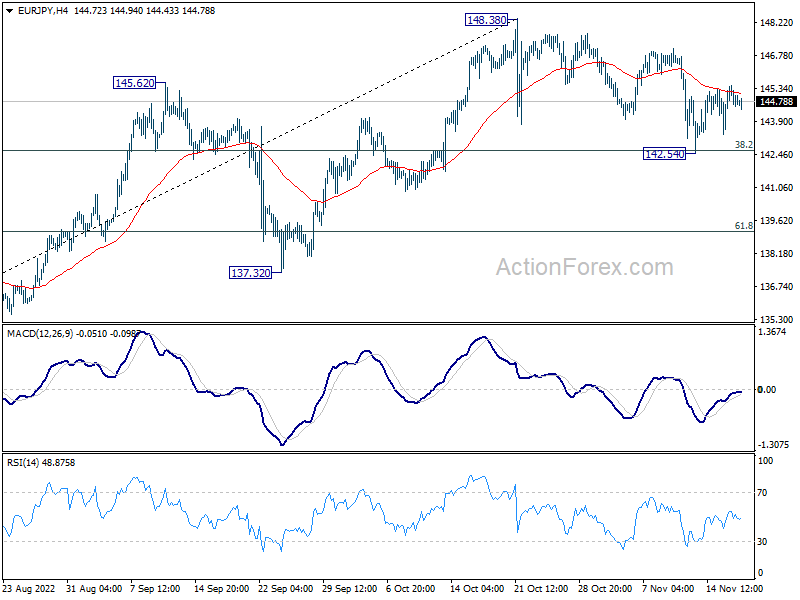
In the bigger picture, there is no clear sign of medium term topping yet. Up trend from 114.42 (2020 low) could still resume through1 48.38 to 149.76 (2014 high). However, break of 137.32 support argue that a medium term correction has already started to correct the whole up trend from 144.42.
EUR/GBP Daily Outlook
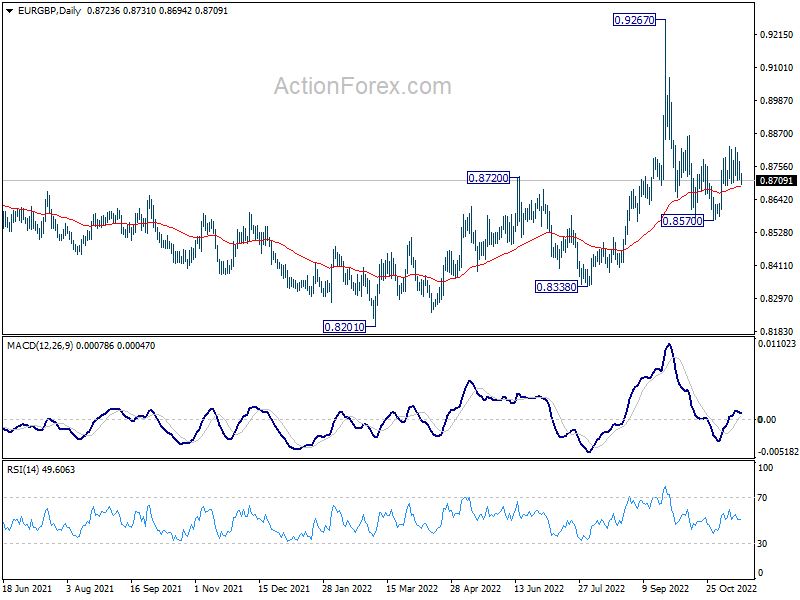
Daily Pivots: (S1) 0.8699; (P) 0.8737; (R1) 0.8761; More...
Outlook in EUR/GBP remains unchanged and intraday bias stays neutral. On the upside, break of 0.8827 will resume the rise from 0.8570 to 0.8869. Sustained break there will pave the way back to retest 0.9267 high. On the downside, below 0.8689 minor support will turn bias back to the downside for 0.8570 instead.
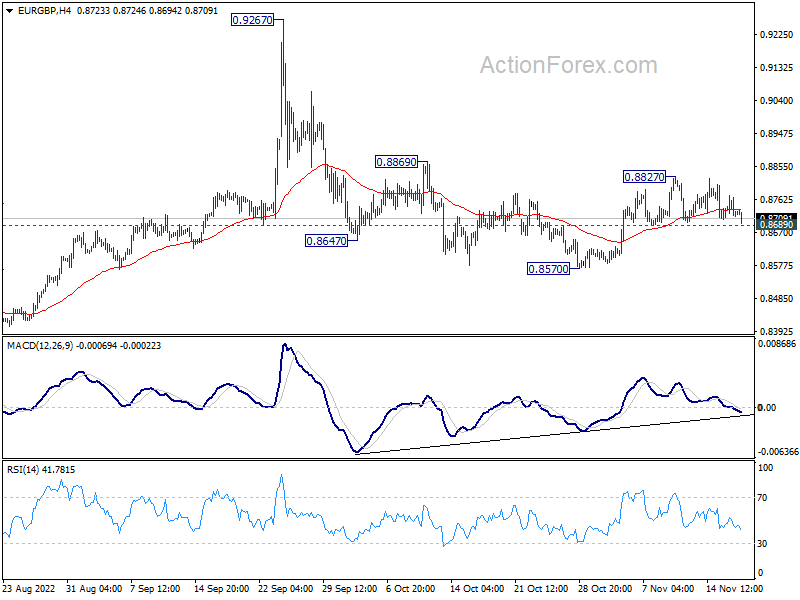
In the bigger picture, current development suggests that fall from 0.9267 is a down leg inside long term range pattern. Deeper fall could be seen towards 0.8201/8338 support zone. But strong support should be seen there to bring reversal. Nevertheless, firm break of 0.8869 resistance will turn favor to the case that such decline is merely a correction in the up trend from 0.8201. That is, further rally would be seen at a later stage through 0.9267.