Sample Category Title
Dollar Softens after Short-Lived Recovery, Consolidations Continue
The forex markets continue to stay in consolidative mode in Asian session. Dollar's recovery attempt overnight was rather short-lived. Sterling also regains some ground after initial reaction to the UK government's new budget. Yen is also soft despite strong CPI data from Japan. Overall, New Zealand Dollar is the strongest for the week so far, followed by Sterling and then Euro. Swiss Franc is the worst followed by Yen, and then Canadian.
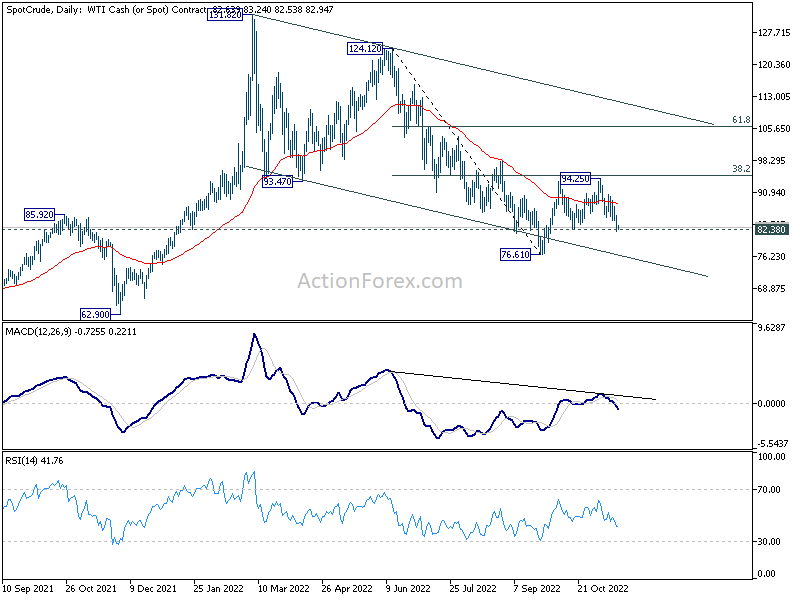
Technically, WTI oil's breach of 82.38 support raises the chance that corrective recovery from 76.61 has completed with three waves up to 94.25. That came after rejection by 38.2% retracement of 124.12 to 76.61. Sustained trading below 82.38 will affirm the case of down trend resumption through 76.61 low. If happens, that could put extra pressure on Canadian Dollar, in particular against other commodity currencies.
In Asia, at the time of writing, Nikkei is down -0.13%. Hong Kong HSI is up 0.31%. China Shanghai SSE is down -0.05%. Singapore Strait Times is down -0.48%. Japan 10-year JGB yield is down -0.0029 at 0.246. Overnight, DOW dropped -0.02%. S&P 500 dropped -0.31%. NASDAQ dropped -0.35%. 10-year yield rose 0.083 to 3.775.
Fed Kashkari: We cannot be overly persuaded by one month's data
Minneapolis Fed President Neel Kashkari said yesterday, "I need to be convinced that inflation has at least stopped climbing, that we're not falling further behind the curve, before I would advocate stopping the progression of future rate hikes," adding, "we're not there yet."
Kashkari acknowledged that October CPI data provided "some evidence that inflation is at least plateauing." Yet, "we cannot be overly persuaded by one month's data."
"It's an open question of how far we are going to have to go with interest rates to bring that demand down in the balance," he said.
SNB Maechler sees risk of more persistent inflation
SNB board member Andrea Maechler said yesterday, "our mandate is to bring down inflation and we will use the tools we have to do so... If we see our inflation forecast above 2 percent, we will continue to raise rates."
"Inflation started with shocks but it's no longer just shock-driven," Maechler said. "We see inflation as having the risk of being more persistent."
"It's very important that we maintain the focus on implementing the policies to reach price stability in a consistent and sustainable way."
Regarding Swiss Franc exchange rate, she said the appreciation "has been actually helping us keep our inflation much lower than in some of our neighboring countries."
Yet, she added, "We're willing - if the exchange rate were to rise too rapidly, too high - to use intervention to buy foreign exchange... We're also willing, if the exchange rate were to become too weak, to sell exchange rate but we're not yet ready to reduce our balance sheet as a policy in itself. This is not the right time."
Japan CPI core hits 40-yr high, BoJ Kuroda rules out rate hike
Japan headline CPI rose from 3.0% to 3.7% yoy in October, above expectation of 2.7% yoy. CPI core (all item ex-fresh food) rose from 3.0% to 3.6% yoy, above expectation of 3.5% yoy. That's the highest level in 40 years since 1982. CPI core-core (all item ex-fresh food and energy) rose from 1.8% yoy to 2.5% yoy, above expectation of 1.9% yoy.
BoJ Governor Haruhiko Kuroda said that core inflation was rising "quite a bit" but he expects it to slow back to below 2% in the next fiscal year.
"Raising interest rates now could delay Japan's economic recovery," Kuroda told the parliament. "I'm not saying the BOJ cannot raise rates indefinitely. I'm saying that it's inappropriate to raise rates now, in light of current economic and price developments."
"It's difficult to sustainably achieve our 2% inflation target unless nominal wages rise steadily," Kuroda said. "We'll continue with our monetary easing to support the economy and achieve our 2% inflation target in a sustained, stable fashion backed by wage growth.
Looking ahead
UK retail sales is the only feature in European session. Canada will release IPPI and RMPI later in the day, while US will release existing home sales.
USD/CAD Daily Outlook
Daily Pivots: (S1) 1.3288; (P) 1.3344; (R1) 1.3384; More....
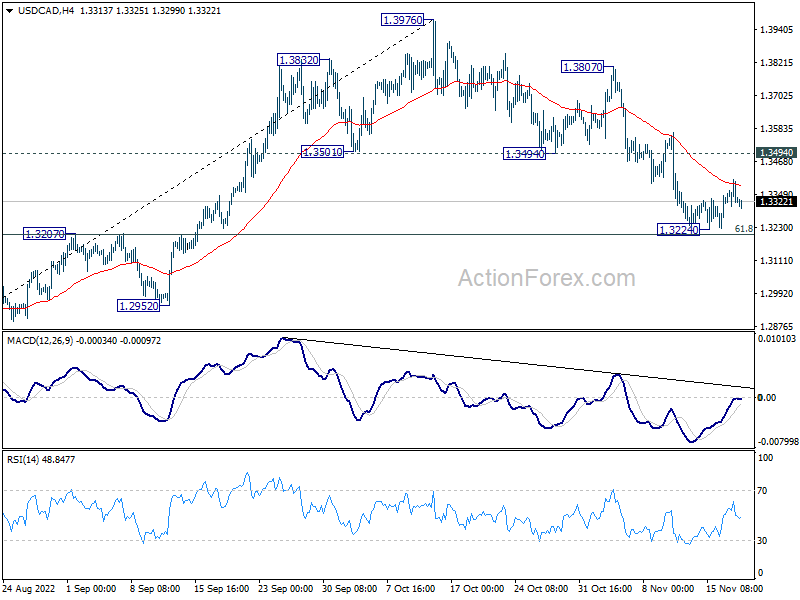
Intraday bias in USD/CAD remains neutral for the moment. On the upside, break of 1.3494 support turned resistance will argue that fall from 1.3976 has completed with three waves down to 1.3224. Further rally would then be seen back to 1.3807 resistance first. However, sustained trading below 1.3207 cluster support (61.8% retracement of 1.2726 to 1.3976 at 1.3204) will carry larger bearish implication and target 1.2952 support next.
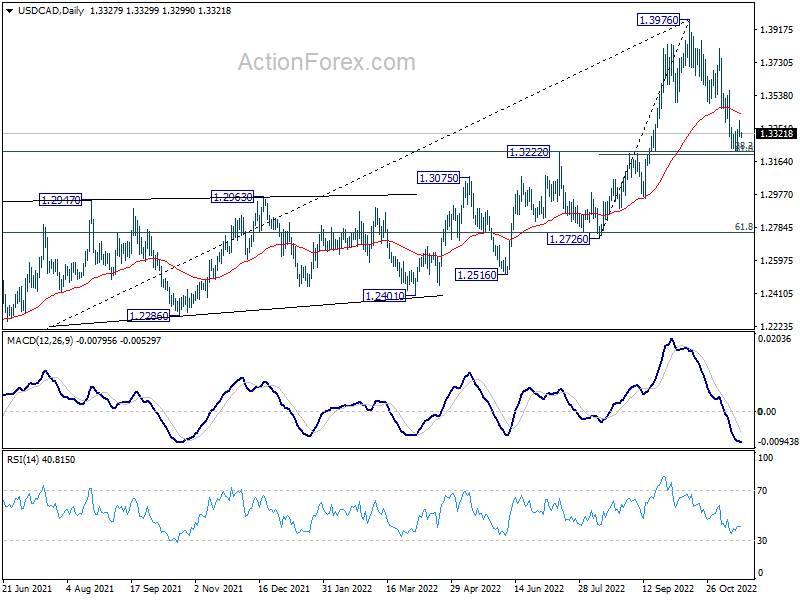
In the bigger picture, as long as 1.3222 cluster support (38.2% retracement of 1.2005 to 1.3976 at 1.3223) holds, larger up trend from 1.2005 (2021 low) is still expected to resume through 1.3976 high at a later stage. . However, firm break of 1.3222/3 will indicate that the trend might have reversed. Deeper fall would be seen to next cluster support at 1.2726 (61.8% retracement at 1.2758).
Economic Indicators Update
| GMT | Ccy | Events | Actual | Forecast | Previous | Revised |
|---|---|---|---|---|---|---|
| 23:30 | JPY | National CPI Core Y/Y Oct | 3.60% | 3.50% | 3.00% | |
| 00:01 | GBP | GfK Consumer Confidence | -44 | -46 | -47 | |
| 07:00 | GBP | Retail Sales M/M Oct | 0.30% | -1.40% | ||
| 07:00 | GBP | Retail Sales Y/Y Oct | -6.50% | -6.90% | ||
| 07:00 | GBP | Retail Sales ex-Fuel M/M Oct | 0.60% | -1.50% | ||
| 07:00 | GBP | Retail Sales ex-Fuel Y/Y Oct | -6.70% | -6.20% | ||
| 13:30 | CAD | Industrial Product Price M/M Oct | 0.20% | 0.10% | ||
| 13:30 | CAD | Raw Material Price Index Oct | -1.00% | -3.20% | ||
| 15:00 | USD | Existing Home Sales Oct | 4.36M | 4.71M |
Japan CPI core hits 40-yr high, BoJ Kuroda rules out rate hike
Japan headline CPI rose from 3.0% to 3.7% yoy in October, above expectation of 2.7% yoy. CPI core (all item ex-fresh food) rose from 3.0% to 3.6% yoy, above expectation of 3.5% yoy. That's the highest level in 40 years since 1982. CPI core-core (all item ex-fresh food and energy) rose from 1.8% yoy to 2.5% yoy, above expectation of 1.9% yoy.
BoJ Governor Haruhiko Kuroda said that core inflation was rising "quite a bit" but he expects it to slow back to below 2% in the next fiscal year.
"Raising interest rates now could delay Japan's economic recovery," Kuroda told the parliament. "I'm not saying the BOJ cannot raise rates indefinitely. I'm saying that it's inappropriate to raise rates now, in light of current economic and price developments."
"It's difficult to sustainably achieve our 2% inflation target unless nominal wages rise steadily," Kuroda said. "We'll continue with our monetary easing to support the economy and achieve our 2% inflation target in a sustained, stable fashion backed by wage growth.
SNB Maechler sees risk of more persistent inflation
SNB board member Andrea Maechler said yesterday, "our mandate is to bring down inflation and we will use the tools we have to do so... If we see our inflation forecast above 2 percent, we will continue to raise rates."
"Inflation started with shocks but it's no longer just shock-driven," Maechler said. "We see inflation as having the risk of being more persistent."
"It's very important that we maintain the focus on implementing the policies to reach price stability in a consistent and sustainable way."
Regarding Swiss Franc exchange rate, she said the appreciation "has been actually helping us keep our inflation much lower than in some of our neighboring countries."
Yet, she added, "We're willing - if the exchange rate were to rise too rapidly, too high - to use intervention to buy foreign exchange... We're also willing, if the exchange rate were to become too weak, to sell exchange rate but we're not yet ready to reduce our balance sheet as a policy in itself. This is not the right time."
Fed Kashkari: We cannot be overly persuaded by one month’s data
Minneapolis Fed President Neel Kashkari said yesterday, "I need to be convinced that inflation has at least stopped climbing, that we're not falling further behind the curve, before I would advocate stopping the progression of future rate hikes," adding, "we're not there yet."
Kashkari acknowledged that October CPI data provided "some evidence that inflation is at least plateauing." Yet, "we cannot be overly persuaded by one month's data."
"It's an open question of how far we are going to have to go with interest rates to bring that demand down in the balance," he said.
USD/JPY Could Recover But This Resistance Is Key
Key Highlights
- USD/JPY declined heavily after it broke the 145.50 support zone.
- A major bearish trend line is forming with resistance near 143.80 on the 4-hours chart.
- EUR/USD and GBP/USD started a downside correction.
- Oil price might dive if there is a close below $82.65.
USD/JPY Technical Analysis
The US Dollar started a major decline from well above the 148.00 level against the Japanese Yen. USD/JPY declined below the 146.50 and 145.50 support levels.
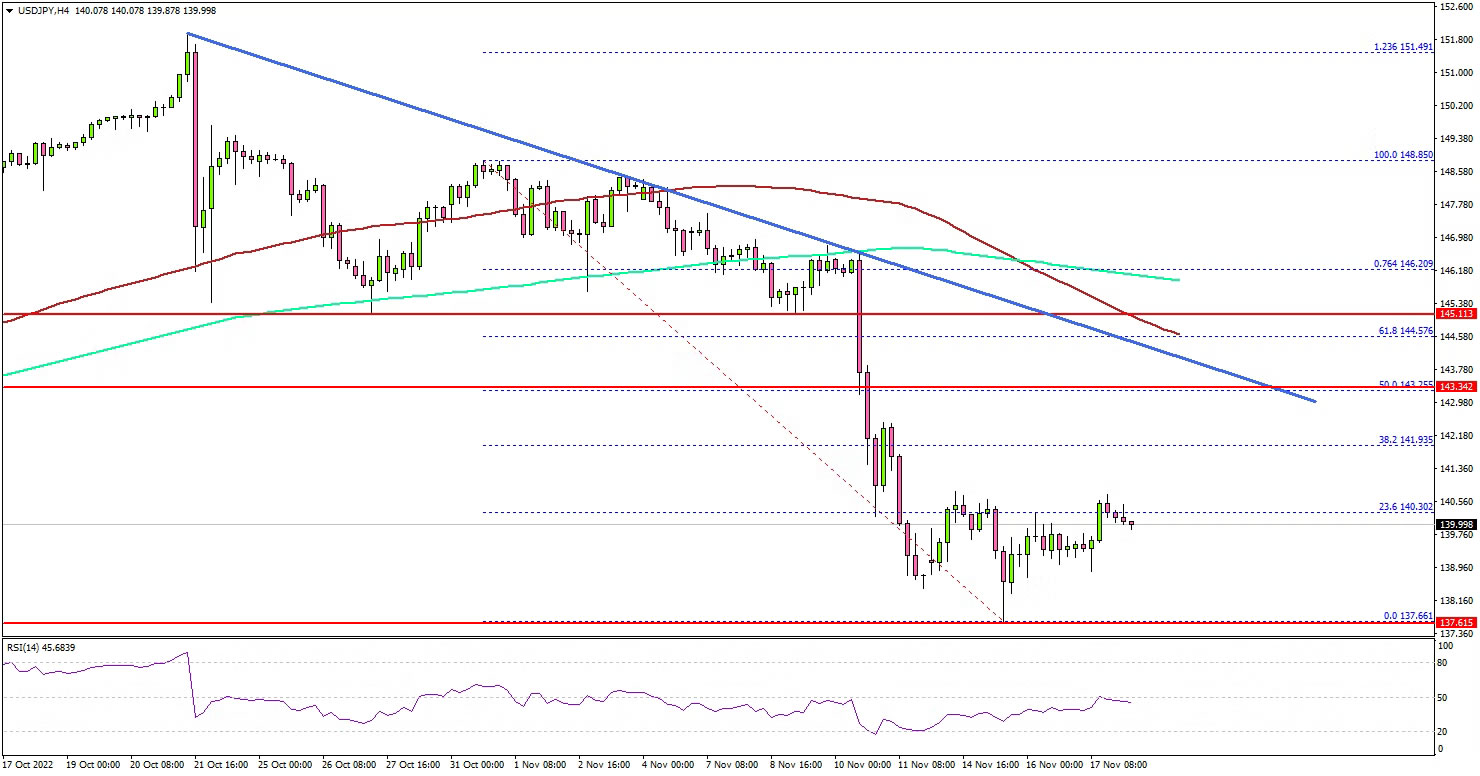
Looking at the 4-hours chart, the pair gained bearish momentum below the 143.80 level, the 100 simple moving average (red, 4-hours) plus the 200 simple moving average (green, 4-hours).
The bears even pushed the pair below the 140.00 level. It traded as low as 137.66 and is currently correcting losses. There was a minor increase above the 140.00 level. The pair climbed above the 23.6% Fib retracement level of the downward move from the 148.85 swing high to 137.66 low.
On the upside, an immediate resistance is near 141.50 level. The next major resistance may perhaps be near 142.00. Any more gains could set the pace for a move towards the 143.80 resistance zone.
There is also a major bearish trend line forming with resistance near 143.80 on the same chart, above which it could even test 145.00.
An initial support is near the 139.20 level. The next major support is near the 138.80 zone. The main support sits at 138.00. A close below the 138.00 level might start another strong decline. In the stated case, USD/JPY could decline towards the 135.00 support.
Looking at oil price, there was a downside extension below the $85.50 level and there is a risk of more losses in the near term.
Economic Releases
- UK Retail Sales for Oct 2022 (YoY) - Forecast -6.5%, versus -6.9% previous.
- UK Retail Sales for Oct 2022 (MoM) - Forecast 0%, versus -1.4% previous.
- US Existing Home Sales for Oct 2022 (MoM) - Forecast -0.1%, versus -1.5% previous.
Platinum Wave Analysis
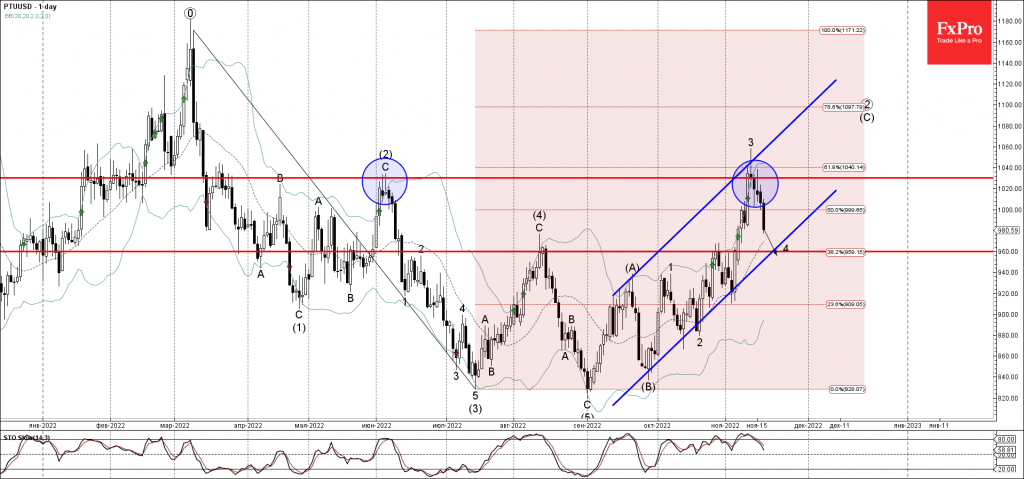
- Platinum reversed from resistance level 1030.00
- Likely to fall to support level 960.00
Platinum recently reversed down from the key resistance level 1030.00 (previous multi-month high from June) intersecting with the upper daily Bollinger Band and the resistance trendline of the daily up channel from September.
The downward reversal from the resistance level 1030.00 started the active short-term corrective wave 4.
Platinum can be expected to fall further toward the next support level 960.00 (target price for the completion of the active wave 4).
USDCHF Wave Analysis
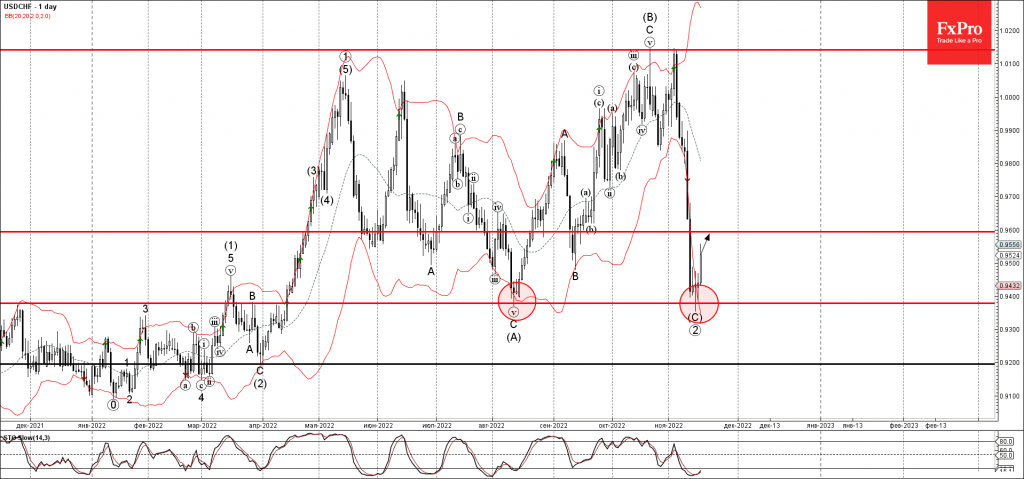
- USDCHF reversed from support level 0.9400
- Likely to rise to resistance level 0.9600
USDCHF currency pair recently reversed up from the key support level 0.9400 (previous multi-month low from August, which stopped wave (A)) standing below the lower daily Bollinger Band.
The upward reversal from the support level 0.9400 stopped the earlier medium-term impulse wave (C).
G20: What Did the Leaders Decide?
The G20 summit took place in Bali, Indonesia, on November 2022. Industrialized and developing countries of the G20 account for 80% of global economic activity and two-thirds of the world's population. The leaders of the 17 met in Indonesia to discuss all the hot topics of the world.
The summit's official themes were financial stability, health care, sustainable energy, and digital transformation. However, tensions over Russia's invasion of Ukraine took center stage and complicated host Indonesia's efforts to reach a consensus on these topics.
The condemnation of the Russian-Ukrainian conflict
Initially, the summit was supposed to be devoted to finding ways to restore the global economy after the Covid-19 pandemic. However, Russia's aggression against Ukraine changed priorities.
Many G20 members see the war in Ukraine as a factor holding back global economic growth, increasing inflation, disrupting supply chains, enhancing energy and food security, and raising risks to financial stability. Besides, the leaders of the G20 countries discussed the threat of using nuclear weapons due to the Russian invasion. The final communiqué said: "The use or threat of use of nuclear weapons is unacceptable."
However, Saudi Arabia, India, Brazil, and China refrained from condemning Russia. Furthermore, Indonesian President Joko Widodo called on Western leaders to soften the rhetoric against the Russian Federation at the G20 summit.
Biden and Xi’s meeting highlights
After a nearly three-year absence from the world stage, Chinese leader Xi Jinping embarked on face-to-face meetings with Western leaders in Bali to restore China's global influence. The meeting with Joe Biden was crucial.
China's relations with the US and its allies have deteriorated to varying degrees in recent years due to rising geopolitical tensions, disputes over trade, the origins of the Covid-19 pandemic, and Beijing's growing partnership with Moscow despite Russia's war on Ukraine.
After a three-hour meeting on Monday with US President Joe Biden, Xi held talks with the leaders of four America’s allies - Australia, France, the Netherlands, and South Korea.
Macron wants more power
Many believe that French President Emmanuel Macron used the G20 summit to renew France's strategic ambitions in the Asia-Pacific region. He met with regional heavyweights, including Chinese President Xi Jinping and Indian Prime Minister Narendra Modi, as part of the summit.
Above all, he hopes for "recognition" of France's ambitions and influence at the Asia-Pacific Economic Cooperation summit Thursday and Friday in Bangkok, where France will be the first European country invited.
Emmanuel Macron is making this vast territory, stretching from East Africa to Western America's coast, a strategic priority, where France has a lot of land and maritime areas. This enormous maritime space means France is interested in environmental and fisheries issues and the fight against ocean-related human trafficking.
Yen’s reaction to G20
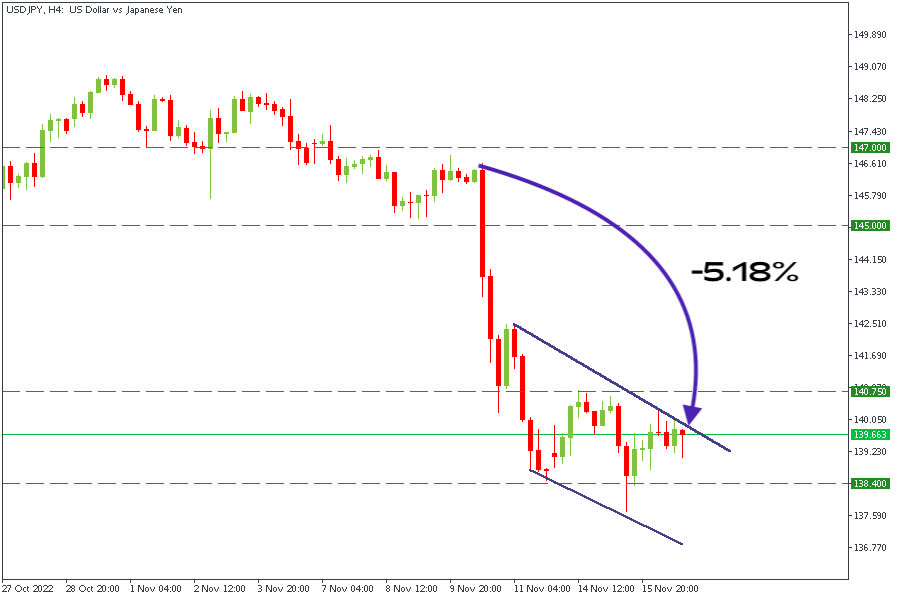
The news that emerged on the G20 caught the attention of USDJPY traders as the yen jumped against the USD to a new high since 1998, the day before the summit started, raising expectations for Japanese intervention. Attention at the meeting turned to the first reading of Japan's third-quarter (Q3) Gross Domestic Product (GDP) and US retail sales for October, amid hopes of easing divergence between the policies of the Fed and the Bank of Japan.
USDJPY has lost more than 5% in the last week. Now the price is consolidating between 140.750 and 138.400.
Conclusion
In general, this year’s summit showed that even if the world’s leaders have different opinions about certain topics, such things as world peace and wealth are priorities for everybody.
Pound Takes a Dive, Retail Sales Next
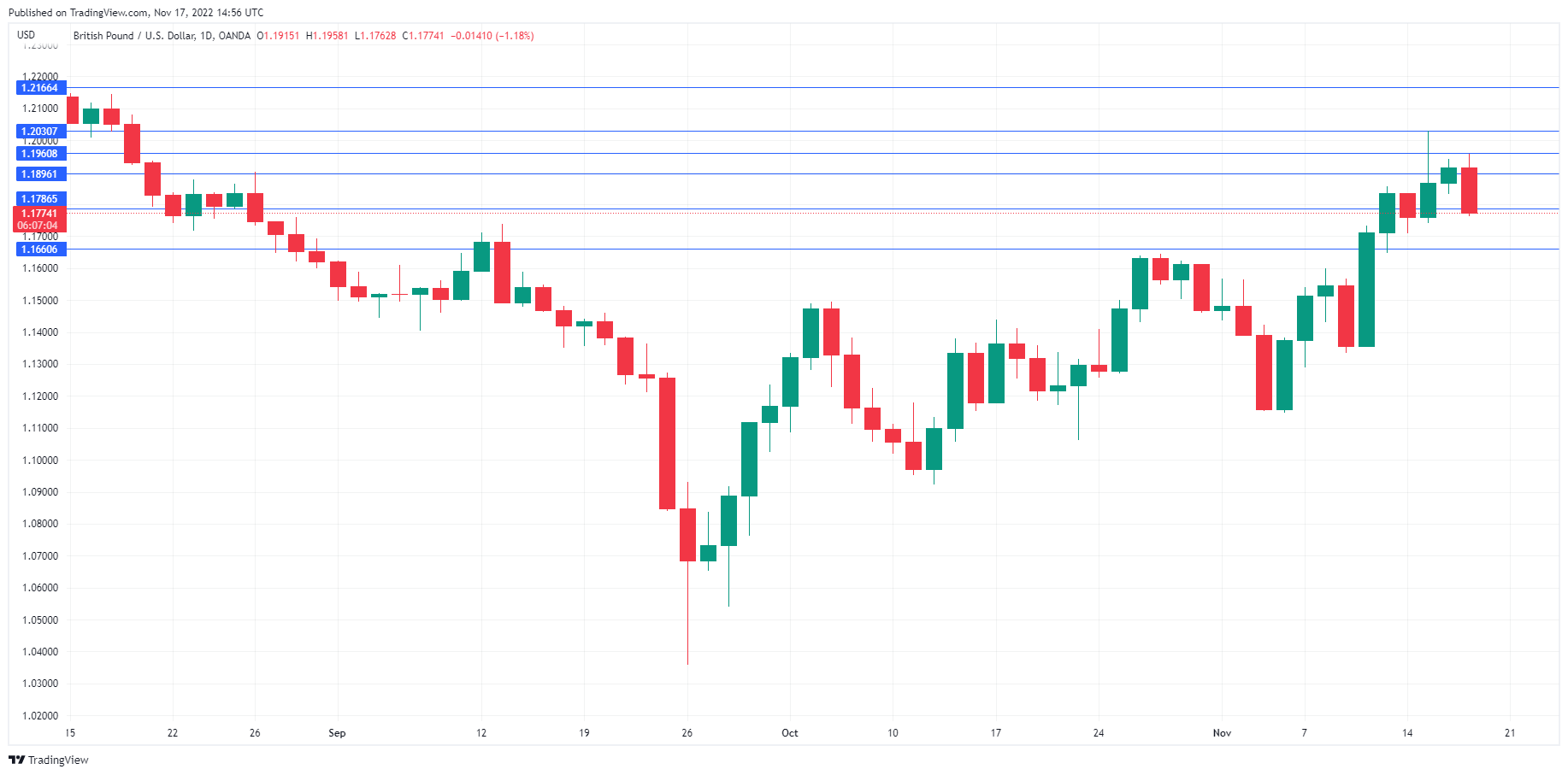
The British pound is sharply lower on Thursday as the US dollar has rebounded against the major currencies. In the North American session, GBP/USD is trading at 1.1787, down 1.07%. We continue to see sharp swings from the pound in November.
Autumn Statement emphasizes austerity
Jeremy Hunt’s Autumn Statement was much more in keeping with the difficult economic times than the ill-fated mini-budget back in September, which set off a financial crisis and emergency intervention from the Bank of England. The Finance Minister’s budget outlined major spending cuts and tax hikes and Hunt stated that the government and the BoE were working in “lockstep”. The fiscal austerity in the new budget is a step in the right direction, but the pound nevertheless has taken a tumble today.
The Office for Budget Responsibility (OBR) forecast indicated that the UK is currently in a recession, which will see unemployment jump from 3.5% to 4.9%. The BoE’s outlook is even worse, with unemployment forecast to hit 6.5% and negative growth expected in the second half of this year, throughout 2023 and into the first half of 2024. GDP declined by 0.2% in the third quarter, and the headwinds look formidable for the UK economy and the British pound.
The investor euphoria which sent the stock markets rallying after the soft inflation report has taken a pause, and the US dollar has rebounded. Fed policy members sought to dispel any thoughts of a Fed pivot, reminding the markets that the Fed was planning to raise rates higher than they had anticipated. The hawkish Fed speak may or may not have convinced investors to settle down, but a strong US retail sales report clearly did the job.
The headline and core releases both posted strong gains of 1.3%, dampening sentiment that the Fed was turning dovish. US consumers continue to spend despite inflation and rising rates, an indication that the Fed can continue to raise rates and probably avoid a deep recession. Interest rates are expected to peak at 5% or slightly higher, which means that the Fed is highly likely to continue tightening into next year.
GBP/USD Technical
- There is resistance at 1.1961 and 1.2030
- GBP/USD has broken below support at 1.1896 and 1.1786. Below, there is support at 1.1660