

Sample Category Title
Will Japan’s CPI Inflation Help the Yen’s Recovery?
Japan will update its CPI inflation data on Thursday at 23:30 GMT, with investors projecting a bold acceleration in the pace of price increases. Although the Bank of Japan (BoJ) keeps sticking stubbornly to its ultra-easy policy, recent comments disclosed willingness for a hawkish change. If the data intensifies the debate for an earlier exit, the rally in the yen could gain another leg.
Yen's outlook is still fragile
It was a devastating year for the yen as the ultra-easy monetary policy in Japan forced investors to seek higher interest rates elsewhere to compensate for high inflation. The BoJ’s multi-billion-dollar FX intervention proved ineffective in stopping the yen from melting until a shift in Fed rate expectations came to the rescue - for free. Specifically, growing speculation that the Fed may use less aggressive rate increases to bring down inflation next year boosted the currency by more than 5% against the US dollar last week, making investors wonder whether the bad times for the yen have passed.
The problem now is that if the BoJ keeps defending its accommodative policy settings amid an uncertain global growth outlook, the yen could easily fall again on hard times. Speaking at a news conference last week, the BoJ chief Haruhiko Kuroda argued that there are signs of peaking inflation in the economy, telegraphing that a hawkish reversal is unnecessary.
A tweak in policy expected, but eyes on wage growth
However, the latest summary of opinions showed that policymakers are now more open to the possibility of a policy normalization. Surprisingly, Kuroda himself backed the scenario of a flexible yield curve control in the future earlier this month, though only if inflation returns sustainably to the 2.0% target. However, unlike his counterparts in other advanced economies, he claimed solid wage increases might be a prerequisite for price stability.
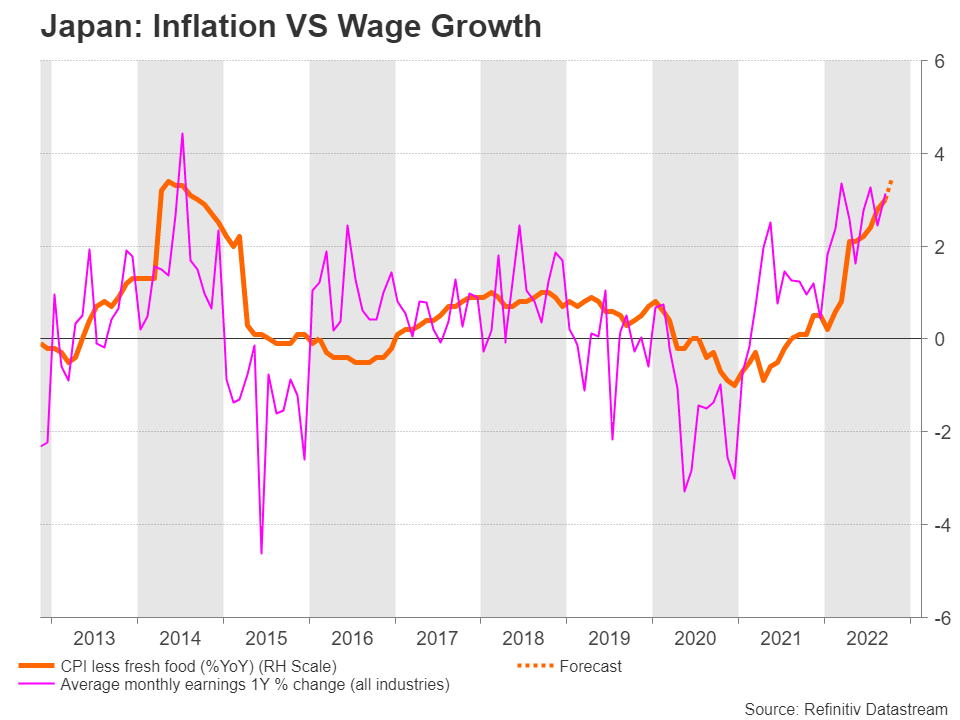
Hence, wage negotiations in March, which involve talks between blue-chip firms and labor unions, could be vital before the central bank reviews any stimulus reduction plans. Note that Kuroda will not seek a reappointment when his term ends in April. Therefore, that could be a good timing for his predecessor to pilot monetary policy into the tightening era, especially if Rego, Japan’s largest labor organization, gets a green light for its 5% pay increase proposal.
CPI inflation
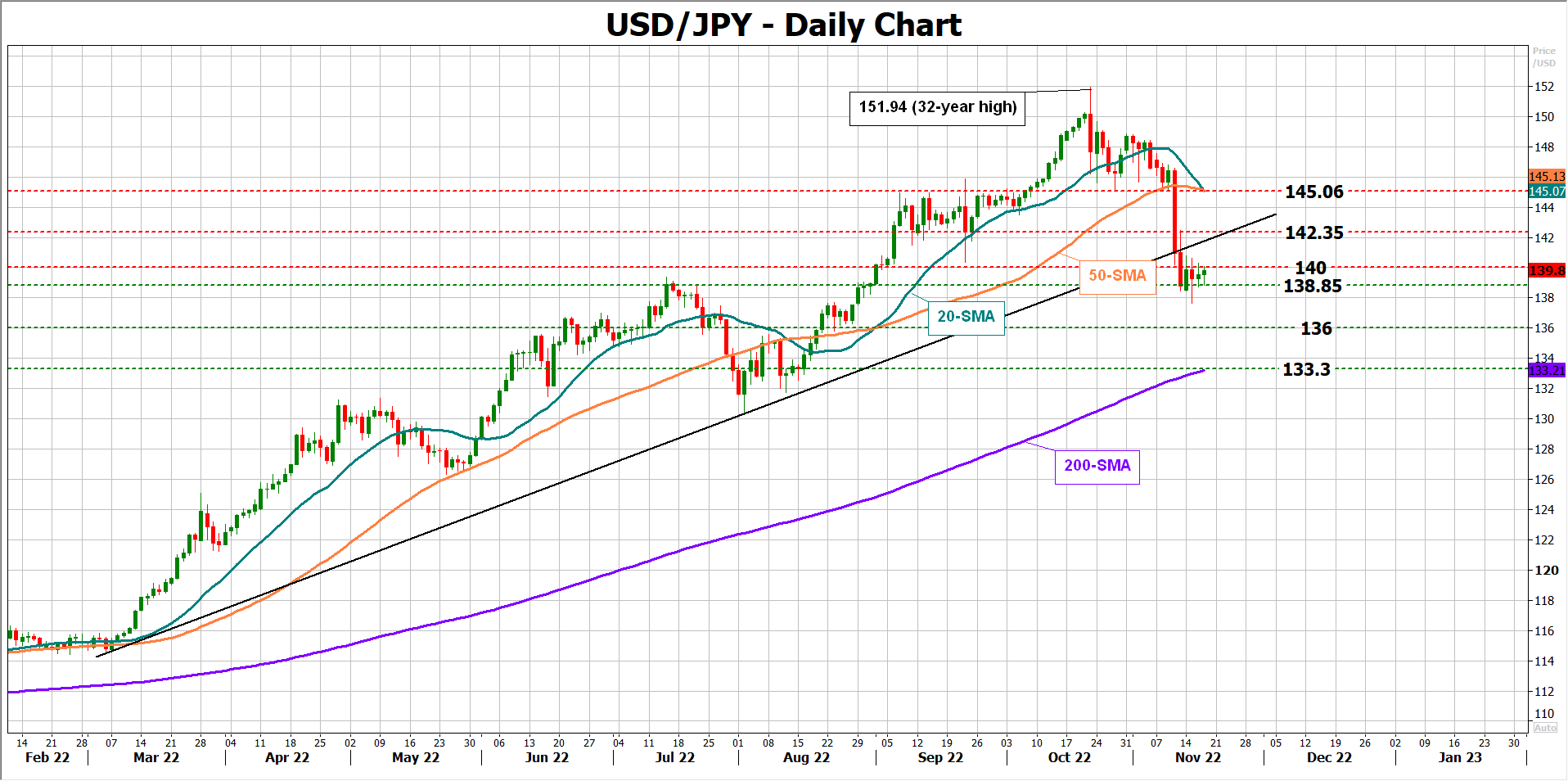
Still, some government officials have claimed that structural changes in wages can take a long time, and the central bank should not wait that long to exit stimulus. Another spike in the core CPI inflation, which is expected to have unlocked a new forty-year high at 3.5% y/y in October from 3.0% previously, may urge the need for an earlier policy shift. In this case, dollar/yen could breach the 138.85 base and slide towards 136.00. Even lower, the door will open for the 200-day simple moving average (SMA) and the 134.00 number. With the US dollar barely finding any fresh bullish catalysts these days, the yen could easily steal further ground.
Alternatively, a US-like downside surprise in the CPI would endorse Kuroda’s accommodative strategy as inflation is not that far above the BoJ’s 2.0% target. Consequently, dollar/yen could crawl back above the 140.00 level with scope to meet the 142.35 bar. A durable move above the latter may next pause near the 20- and 50-day SMAs at 145.00.
Sunset Market Commentary
Markets
It was D-day in the UK today: Finance Minister Hunt presented the delayed Autumn Statement. The budget fell under close scrutiny by financial markets after the Truss/Kwarteng tandem unsettled them big time with their massive unfunded spending and tax cuts. Hunt’s budget was a near 50-50 mix of tax increases and spending cuts. He is seeking £55bn by a.o. lowering the threshold at which the top 45% income tax rate is levied while the other income tax thresholds and those for national insurance and inheritance tax were frozen for an extra two years. Hunt also raised the windfall tax on oil and gas companies and introduced a new 45% tax on electricity generators. These measures will raise the overall tax burden to the highest since WWII. Public spending will grow but slower than the economy and departmental budgets will have real-term spending cuts. There are supportive measures as well. There’s a one-year extension beyond April of the cap on energy bills but at £3000 instead of the previous £2500. To address the squeeze on households, the government hands out cost-of-living payments next year between £150-900. Hunt raised the national living wage by a record 9.7% and kept the triple lock in place, meaning welfare and pension payments will both increase in line with inflation. The aim of his program is to tackle inflation, get the debt ratio falling and have borrowing below 3% of GDP over time, Hunt said. The supportive measures meanwhile are expected to lead to a shallower downturn and targeted investments in energy, infrastructure and innovation should lift long-term growth. The Office of Budget Responsibility ran the numbers and projects GDP next year at -1.4%, a sharp revision from March (+1.8%) before picking up in 2024 again by 1.3% vs 2.1% seen in March. Unemployment could peak at just below 5% in two years’ time. Inflation would fall from 9.7% this year to 7.4% in 2023 (+3.3 ppts) and a mere 0.6% in 2024 (-0.9 ppts). The debt ratio will peak at 97.6% in FY 2025-26 and 2026-27 and the budget deficit would go from 2.5% FY 2023-24 to between 0.2-0.5% in the four years thereafter. UK assets traded volatile during Hunt’s budget presentation as markets try to gauge the impact. Daily changes in UK yields currently vary between +6 bps (30y) to +14 bps (2y), flattening the curve. BoE expectations have slightly been revised upwards but the terminal rate stays about the same at 4.5%. Sterling loses, allowing EUR/GBP to rebound from 0.8721 support to 0.876 currently. GBP/USD loses more than a percent to 1.178 amid broad dollar strength.
The greenback was already a bit better in shape today after the recent sell-off before Fed’s Bullard give a little push in the back extra. He said rates needed to be raised further, adding that current tightening only has had a limited effect on observed inflation. According to the monetary Taylor rule, 5% is the bare minimum. Bullard is just the most recent one in a series of Fed governors clearly pushing back against the hefty market repricing. EUR/USD dips to 1.032 after meeting resistance from the 1.04 big figure and the 200MdA. DXY climbs from an intraday low at 106.1 to 107. Core bonds pared some of their gains over the previous days with USTs underperforming in the wake of Bullard’s comments. US yields rise 8.1-8.5 bps in the 2y-10y bucket. German yields add 1.6 bps (30y) to 4.5 bps (5y) with the 10y trying to settle north of 2% again. Equities drop a little over 1% in Europe and the US.
News Headlines
Bloomberg cites people close to negotiations between the EU and Hungary. They suggest that the EC won’t issue its verdict on Hungary’s investment and reform proposals at the planned November 22 EC meeting. That leaves little time before the final gathering on December 6 to evaluate the proposals. Budapest sent those to end a rule-of-law dispute and unfreeze recovery funds related to the pandemic. Without EC approval by the end of the year, Hungary loses 70% of the pre-allocated funds (€4.1bn). The EC currently prioritizes an aid plan for Ukraine (€18bn) and a proposal for a minimum corporate tax rate. Both dossiers are being held hostage by… Hungary. The forint loses more ground today with EUR/HUF testing previous support (now resistance) at EUR/HUF 416.
Ukrainian infrastructure minister Kubrakov said that the initiative for safe transportation of agricultural products across the Black Sea has been extended for another 120 days. The deal between Ukraine and Russia is overlooked by the UN and by Turkey and also known as the grain export agreement. The initial deal took effect on August 1 and helped alleviating the global food (price) crisis. Ukraine is still pushing for a one-year extension and to include ports in the Mykolayiv region in addition to ports in the Odesa province.
WTI Oil Futures Retreat Below 50-day SMA
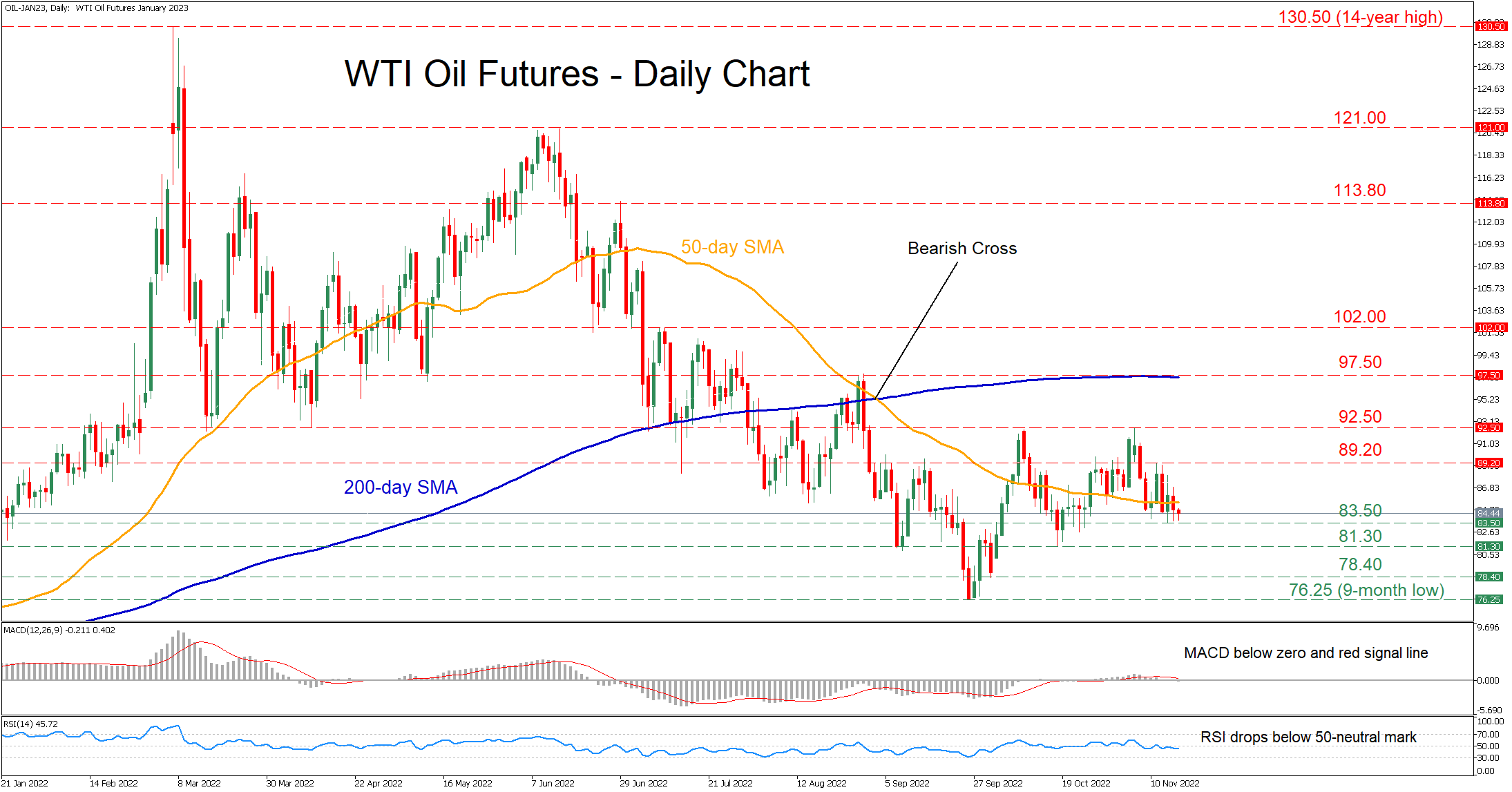
WTI oil futures (January delivery) have been stuck in a downtrend since mid-June when the price failed to surpass the 121.00 mark. Although the commodity managed to regain some ground after bouncing at the nine-month low of 76.25, the price has dropped again below its 50-day simple moving average (SMA).
The momentum indicators currently suggest that bearish forces are strengthening. Specifically, the RSI has dived beneath the 50-neutral mark, while the MACD histogram is retreating below both zero and its red signal line.
If selling pressures persist, the recent support of 83.50 could act as the first line of defense. Should that floor collapse, the bears could then aim for 81.30 before the spotlight turns to 78.40. A violation of the latter may trigger a retreat towards the nine-month low of 76.25.
On the flipside, if buyers regain control, oil futures might ascend towards the recent resistance of 89.20. Piercing through this region, the November high of 92.50 could come under examination. Conquering this barricade, further advances could then stall at the 97.50 region, which overlaps with the 200-day SMA.
Overall, WTI oil futures appear to be losing ground as negative momentum intensifies. For that bearish sentiment to alter, the price needs to initially cross above the 50-day SMA.
ETHUSD Rangebound after Decline Pauses
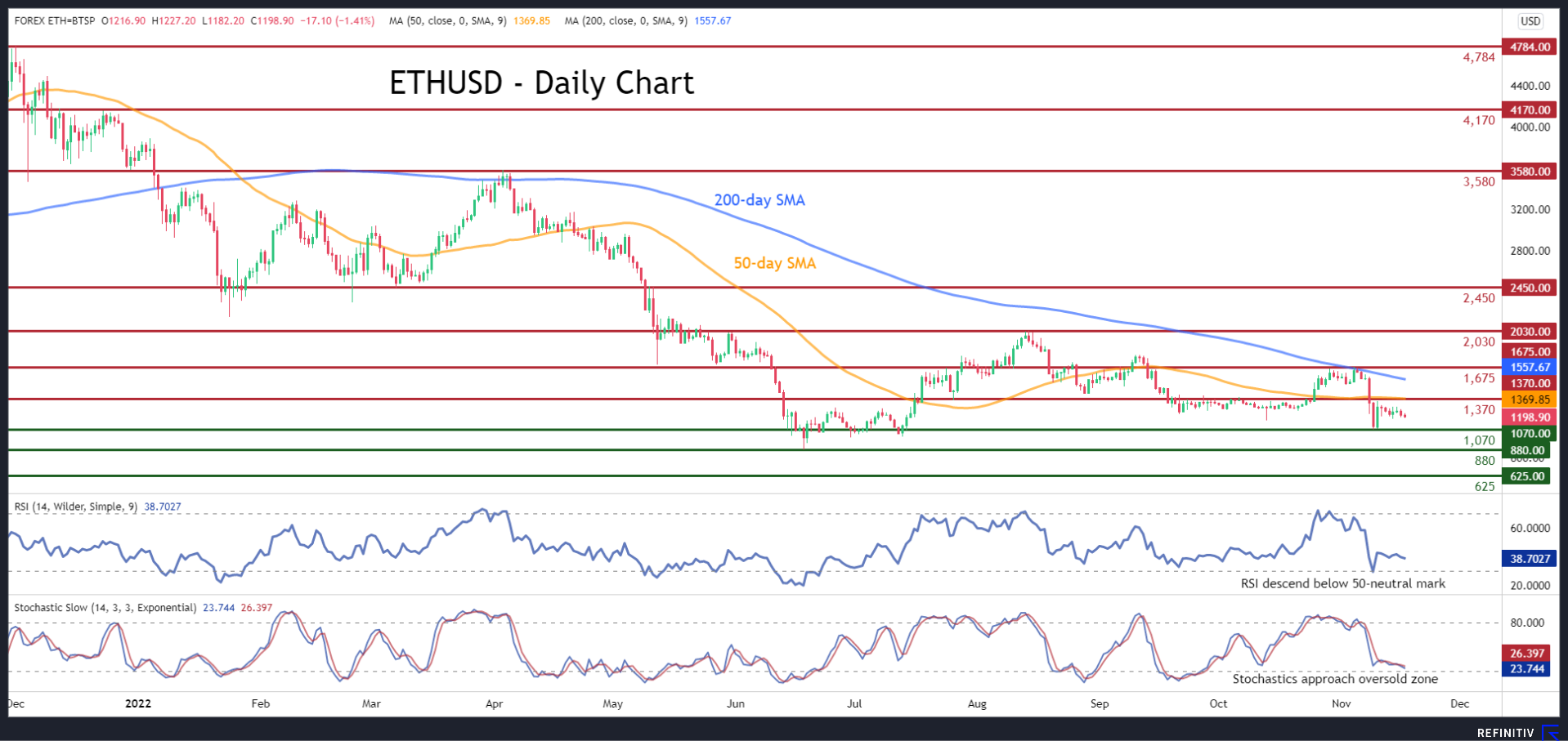
ETHUSD (Ethereum) has experienced a sharp decline in the short term, with the price hitting a fresh four-month low of 1,070. However, the cryptocurrency managed to recover some ground and has been trading sideways in the last few daily sessions.
The momentum indicators currently reflect that near-term risks remain tilted to the downside. Specifically, the RSI is declining beneath its 50-neutral mark, while the stochastic oscillator is descending near its 20-oversold region.
Should sellers push the price lower, immediate support could be met at the recent low of 1,070. If that floor collapses, Ethereum could test the 2022 low of 880. Failing to halt there, the price could decline to form fresh multi-month lows, where the December 2020 resistance of 625 may provide downside protection.
On the flipside, bullish actions could propel the price towards the 50-day simple moving average (SMA), currently at 1,370. Piercing this threshold, the bulls could aim for the recent peak of 1,675 before the spotlight turns to the trend reversal point of 2,030. Even higher, further advances might come to a halt at the 2,450 support territory, which could now act as resistance.
Overall, ETHUSD appears to be in a consolidation mode after it encountered tough support. Hence, a break above or below its tight range is likely to be followed by a significant move towards the same direction.
Stalled Rebound
The risk rebound in the markets has stalled and equity markets are down around 1% on Thursday following quite a good run over the last month.
The day we've all been waiting for
The Autumn Statement has been a long time coming after the disastrous mini-budget almost two months ago. The UK's fiscal credibility was in the gutter, the pound was crushed and borrowing costs soared. Since then, a lot has changed and today's budget highlighted just how much that is the case.
Fully regaining credibility won't be easy but markets appear far happier now than they were back in September. The pound is lower on the day but only marginally so and the bulk of the announcements will have been priced in as they were leaked in recent days. Borrowing costs are slightly higher on the day and Bank Rate is expected to peak around 4.5%, still very high but far from the levels reached in September.
All in all, the government may be pleased with how today has gone but time will tell whether the public agrees as everyone pours over what was quite an extensive budget. It's not just the markets that needed convincing today after all, with a little over two years until the next election and a significant deficit still to overcome in the polls.
US data reinforces Fed position on rates despite weak housing
The latest US economic data represented a continuation of what we've seen for months. A housing market suffering under the pressure of higher interest rates and a labour market that is incredibly resilient to them. While the former may be a concern for the central bank as it further raises rates in the months ahead, the latter remains the reason why many at the Fed support such moves as it increases the possibility of inflation remaining stubborn on the way back down.
Oil slips amid easing geopolitical risk and China woes
Oil prices are slipping as we move through the week, with easing geopolitical risk and Chinese demand weighing. Prices spiked earlier in the week after missiles landed in Poland, risking a dramatic escalation in the war in Ukraine. Thankfully, those fears have abated and the situation de-escalated which has seen oil gains unwound.
China remains a downside risk for oil in the near term, despite its recent relaxation of certain Covid curbs. A surge in cases in major cities, mass testing, and restrictions will hit economic activity despite recent measures which will weigh on demand in the world's second-largest economy. Still, Brent remains within its $90-$100 range for now and OPEC+ may continue to ensure that largely remains the case.
Gold stalls but the future may be looking bright
We're seeing more risk aversion in the markets today after a strong rebound in recent weeks. Gold has performed well in this period, particularly in the aftermath of the Fed decision and jobs report and then after the inflation data. The PPI numbers further supported the view that inflation is easing and could be sustained which saw gold rally towards $1,780 where it stalled.
It is now paring gains for a second day, off around 1%, but still holding onto the bulk of the gains of recent weeks. If the data continues to improve on the inflation side, we could see gold build on recent gains as the dollar eases and yields are pared back. That's a big "if" after what we've seen this year but the data we've seen in recent weeks has been very promising.
Risks remain tilted to the downside
The ripple effects of the FTX debacle continue to flow through the crypto industry revealing other vulnerabilities and weighing heavily on prices even amid a broader financial market risk rebound. Bitcoin is trading relatively flat today around $16,500 but the risks remain skewed to the downside amid immense uncertainty.
EUR/USD Mid-Day Outlook
Daily Pivots: (S1) 1.0338; (P) 1.0388; (R1) 1.0445; More...
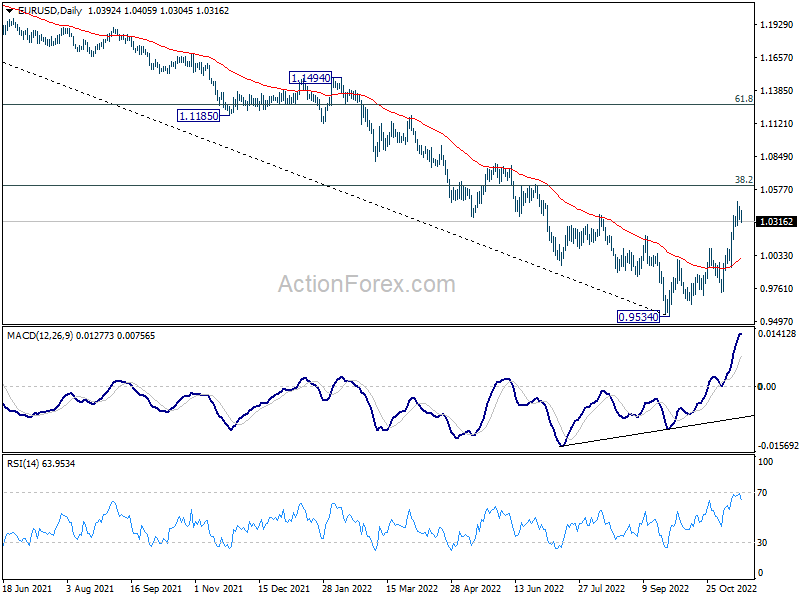
EUR/USD dips lower as consolidation from 1.0481 continues and intraday bias stays neutral. Downside of retreat should be contained by 1.0092 resistance turned support to bring another rally. Break of 1.0481 will resume the rise from 0.9534 and target 1.0609 fibonacci level.
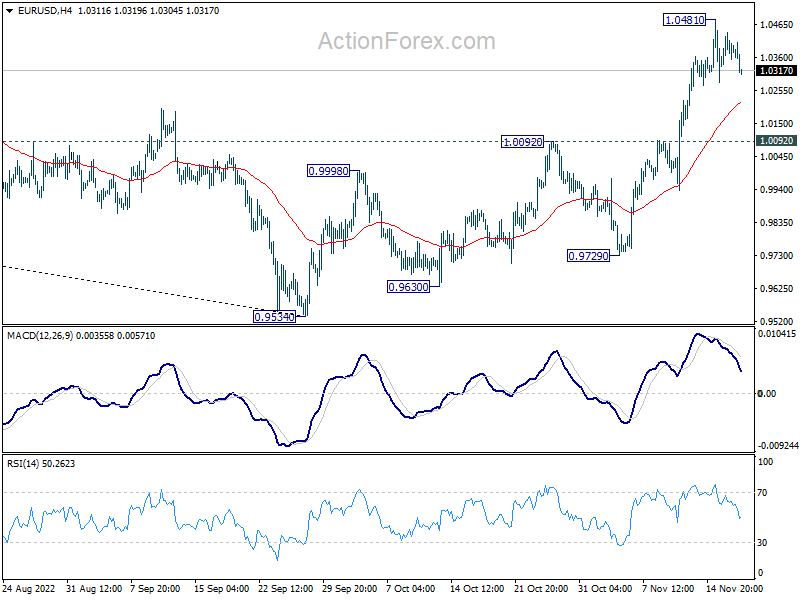
In the bigger picture, a medium term bottom was in place at 0.9534, on bullish convergence condition in daily MACD. Even as a corrective rise, rally from 0.9534 should target 38.2% retracement of 1.2348 (2021 high) to 0.9534 at 1.0609. Sustained trading above 55 week EMA (now at 1.0566) will raise the chance of trend reversal and target 61.8% retracement at 1.1273. This will now remain the favored case as long as 1.0092 resistance turned support holds.
USD/JPY Mid-Day Outlook
Daily Pivots: (S1) 138.74; (P) 139.52; (R1) 140.30; More...
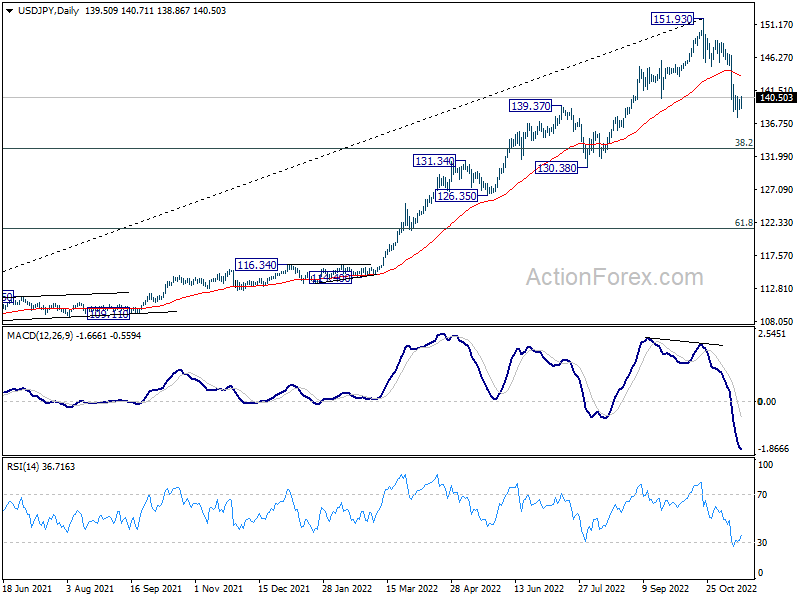
USD/JPY's consolidation from 137.66 is extending and intraday bias remains neutral for the moment. Stronger rise cannot be ruled out, but upside should be limited below 145.16 support turned resistance. Break of 137.66 will resume the decline from 151.93, to 133.07 fibonacci level, as a correction to the larger up trend.
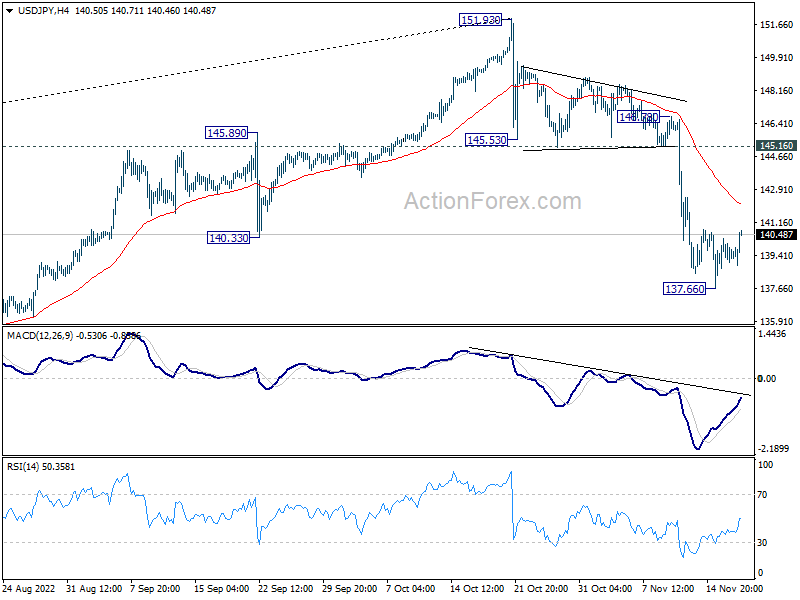
In the bigger picture, a medium term top should be formed at 151.93. Fall from there is correcting larger up trend from 102.58. It's too early to call for bearish trend reversal. But even as a corrective move, such decline should target 38.2% retracement of 102.58 to 151.93 at 133.07, or further to 55 week EMA (now at 130.58).
USD/CHF Mid-Day Outlook
Daily Pivots: (S1) 0.9399; (P) 0.9434; (R1) 0.9483; More...
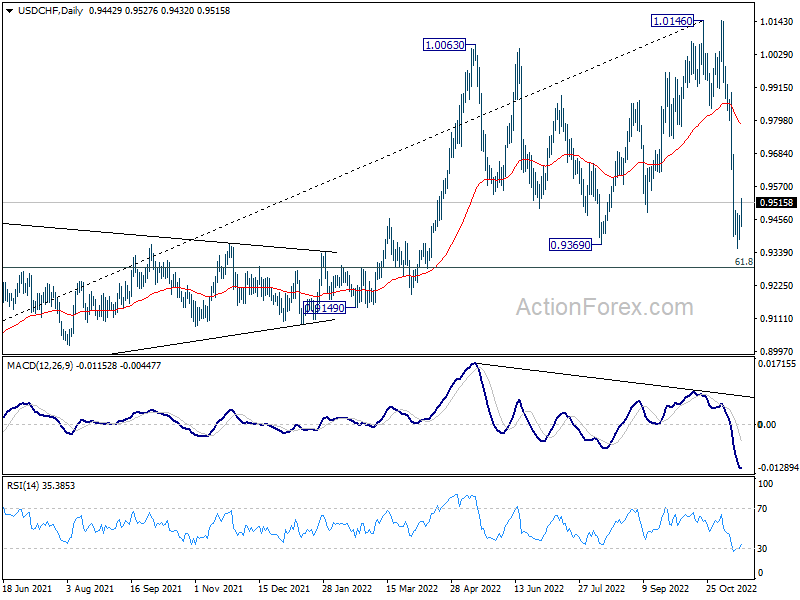
USD/CHF's recovery from 0.9355 extends higher today and intraday bias stays neutral. Upside of recovery should be limited below 0.9680 minor resistance to bring another decline. Below 0.9355 will resume the fall from 1.0146 to 0.9287 fibonacci level.
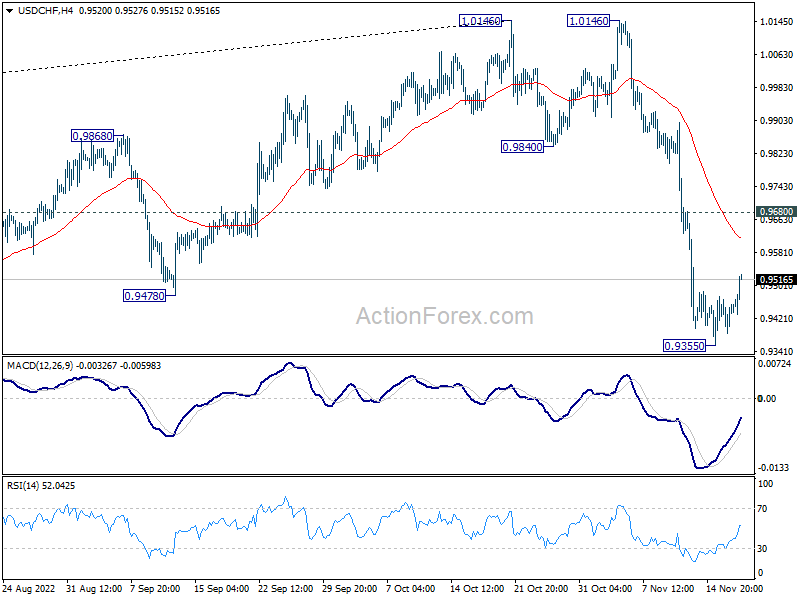
In the bigger picture, rise from 0.8756 (2021 low) has completed at 1.0146, well ahead of 1.0342 long term resistance (2016 high). Based on current downside momentum, fall from 1.0146 might be a medium term down trend itself. Break of 61.8% retracement of 0.8756 to 1.0146 at 0.9287 will pave the way to 0.8756. In any case, risk will stay on the downside as long as 55 day EMA (now at 0.9793) holds.
GBP/USD Mid-Day Outlook
Daily Pivots: (S1) 1.1851; (P) 1.1896; (R1) 1.1961; More...
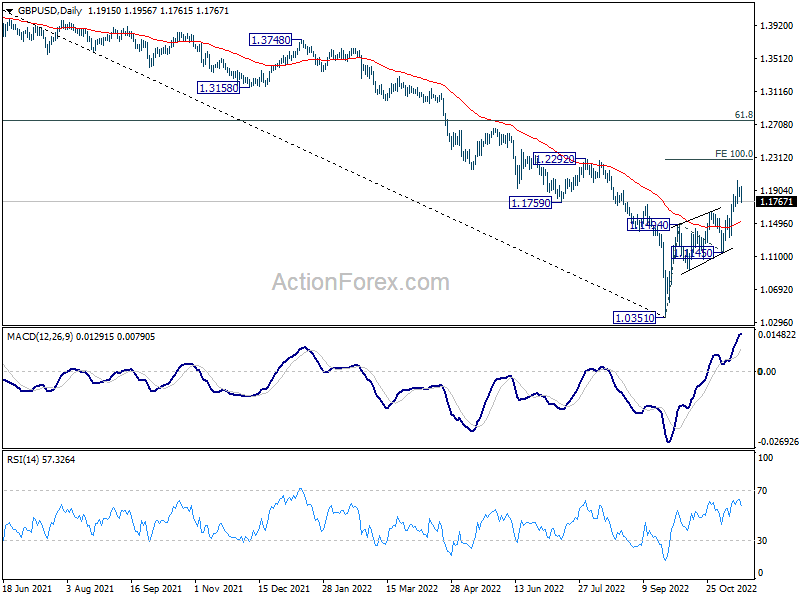
GBP/USD's retreat from 1.2028 extends lower today but stays above 1.1597 resistance turned support. Intraday bias remains neutral first. Further rise is expected, and break of 1.2028 will target 100% projection of 1.0351 to 1.1494 from 1.1145 at 1.2288. However, sustained break of 1.1597 will bring deeper fall to 1.1145 support instead.
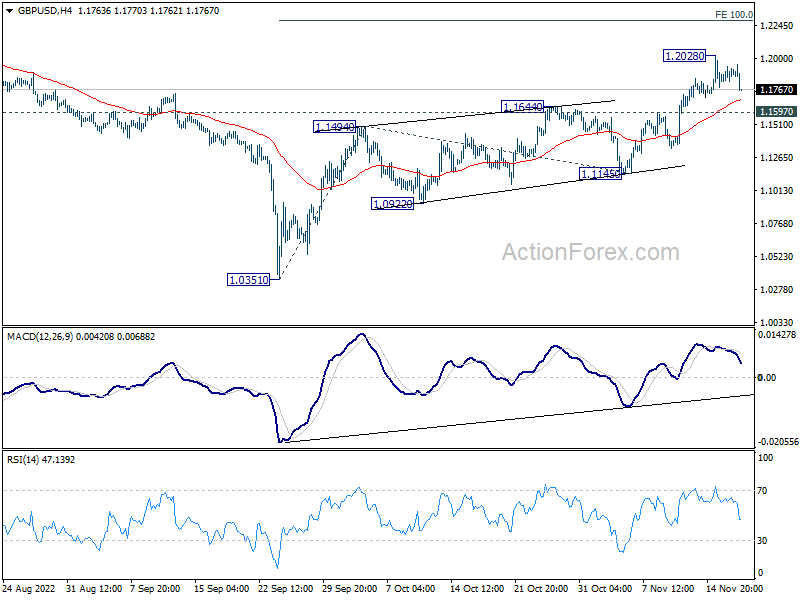
In the bigger picture, rise from 1.0351 medium term bottom is at least correcting whole down trend from 1.4248 (2021 high). Further rise is expected as long as 1.1145 support holds. Next target is 61.8% retracement of 1.4248 to 1.0351 at 1.2759.
Dollar Recovery Picks Up Momentum, Sterling Lower after Budget
Dollar's recovery is starting pick up momentum in early US session, as risk off sentiment deepens. The development is reflected in broad based selloff in Australian and New Zealand Dollar. Sterling is also weak as mild reaction to UK's new budget statement. Canadian Dollar and Euro are the firmer ones next to Dollar, while Yen and Swiss Franc are mixed.
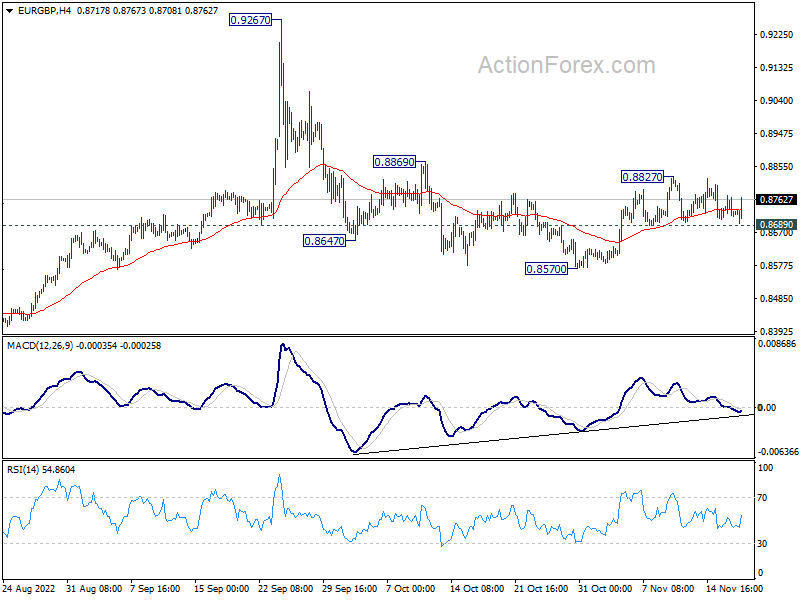
Technically, as Sterling dips, focus is back on 0.8827 resistance in EUR/GBP. Break there will resume larger rebound from 0.8570. Further break of 0.8869 resistance will pave the way to retest 0.9267 high. That, if happens, could add further pressure to the Pound elsewhere.
In Europe, at the time of writing, FTSE is down-0.71%. DAX is down -0.54%. CAC is down -1.15%. Germany 10-year yield is up 0.033 at 2.031. Earlier in Asia, Nikkei dropped -0.35%. Hong Kong HSI dropped -1.15%. China Shanghai SSE dropped -0.15%. Singapore Strait Times rose 0.61%. Japan 10-year JGB yield rose 0.0034 to 0.249.
Fed Bullard: Policy rate not yet sufficiently restrictive
St. Louis Fed President James Bullard said, "even under these generous assumptions, the policy rate is not yet in a zone that may be considered sufficiently restrictive". And, "to attain a sufficiently restrictive level, the policy rate will need to be increased further."
"Thus far, the change in the monetary-policy stance appears to have had only limited effects on observed inflation, but market pricing suggests disinflation is expected in 2023," Bullard said.
US initial jobless claims dropped to 222k
US initial jobless claims dropped -4k to 222k in the week ending November 12, above expectation of 220k. Four-week moving average of initial claims rose 2k to 221k.
Continuing claims rose 13k to 1507 k in the week ending November 5. Four-week moving average of continuing claims rose 31k to 1482k.
Philly Fed survey dropped from -8.7 to 19.4 in November, below expectation of -6.
Eurozone CPI finalized at 10.6% yoy in Oct, core CPI at 5.0% yoy
Eurozone CPI was finalized at 10.6% yoy in October, up from September's 9.9% yoy. CPI core (all item ex energy, food, alcohol, & tobacco), was finalized at 5.0% yoy, up from prior month's 4.8% yoy. The highest contribution to annual inflation rate came from energy (+4.44%), followed by food, alcohol & tobacco (+2.74%), services (+1.82%) and non-energy industrial goods (+1.62%).
EU CPI was finalized at 11.5% yoy, up from September's 10.9% yoy. The lowest annual rates were registered in France (7.1%), Spain (7.3%) and Malta (7.4%). The highest annual rates were recorded in Estonia (22.5%), Lithuania (22.1%) and Hungary (21.9%). Compared with September, annual inflation fell in eleven Member States, remained stable in three and rose in thirteen.
BoJ Kuroda: May take a long time to achieve price stability with wage hikes
BoJ Governor Haruhiko Kuroda told the parliament that it may "take a long time" to achieve the "price stability target, involving wage hikes". He reiterated that the central bank needs to continue with its monetary easing to support a fragile recovery.
At the same session, Executive Director Shinichi Uchida said it was too early to discuss exit from monetary stimulus. "When exiting, the point will be adjusting long-term and short-term policy rates and the BoJ's balance sheet," Uchida said. "The order and mixture of those factors would differ depending on economy, prices and financial situations at the time."
Japan trade deficit hit another record as import surged
Japan's exports rose 25.3% yoy to JPY 9.00T in October, after shipments of cars and electronics components increased. Imports rose 53.5% yoy to JPY 11.16T, hitting a historical high, as led by crude oil, liquefied natural gas and coal.
Trade deficit came in at JPY -2.16T, a record for the month. Also, Japan has seen as record trade deficit for each month in the past six months, on rising energy and raw material costs, as well as weak Yen exchange rates.
US-bound exports rose 36.5% yoy to JPY 1.78T while imports rose 47.1% yoy to JPY 1.06T. Exports to China rose 7.7% yoy to JPY 1.72T while imports rose 39.3% yoy to JPY 2.39T.
In seasonally adjusted term, exports rose 2.2% mom to JPY 8.91T. Imports rose 4.2% mom to JPY 11.21T. Trade deficit came in at JPY -2.30T.
Australia employment grew 32.3k in Oct, unemployment rate dropped to 3.4%
Australia employment rose 32.2k in October, above expectation of 15.0k. Unemployment rate dropped from 3.5% to 3.4%, below expectation of 3.5%. Participation rate was unchanged at 66.5%. Monthly hours worked in all jobs rose 2.3% mom.
"Although employment in seasonally adjusted terms rose 0.2 per cent in October 2022, the underlying trend estimate was monthly growth of around 0.12 per cent. This was below the average for the 20 years prior to the pandemic of 0.16 per cent," Bjorn Jarvis, head of labour statistics at the ABS said.
"This indicates that while employment has continued to grow, the rate of growth has slowed to below the longer-term average. It has been below this average for the past 5 months."
GBP/USD Mid-Day Outlook
Daily Pivots: (S1) 1.1851; (P) 1.1896; (R1) 1.1961; More...
GBP/USD's retreat from 1.2028 extends lower today but stays above 1.1597 resistance turned support. Intraday bias remains neutral first. Further rise is expected, and break of 1.2028 will target 100% projection of 1.0351 to 1.1494 from 1.1145 at 1.2288. However, sustained break of 1.1597 will bring deeper fall to 1.1145 support instead.
In the bigger picture, rise from 1.0351 medium term bottom is at least correcting whole down trend from 1.4248 (2021 high). Further rise is expected as long as 1.1145 support holds. Next target is 61.8% retracement of 1.4248 to 1.0351 at 1.2759.
Economic Indicators Update
| GMT | Ccy | Events | Actual | Forecast | Previous | Revised |
|---|---|---|---|---|---|---|
| 21:45 | NZD | PPI Input Q/Q Q3 | 0.80% | 2.60% | 3.10% | |
| 21:45 | NZD | PPI Output Q/Q Q3 | 1.60% | 2.10% | 2.40% | |
| 23:50 | JPY | Trade Balance (JPY) Oct | -2.30T | -2.23T | -2.01T | -2.04T |
| 00:30 | AUD | Employment Change Oct | 32.2K | 15.0K | 0.9K | -3.8K |
| 00:30 | AUD | Unemployment Rate Oct | 3.40% | 3.50% | 3.50% | |
| 07:00 | CHF | Trade Balance (CHF) Oct | 4.14B | 3.70B | 4.0B | 4.19B |
| 09:00 | EUR | Italy Trade Balance (EUR) Sep | -0.01B | -4.05B | -9.57B | |
| 10:00 | EUR | Eurozone CPI Y/Y Oct F | 10.60% | 10.70% | 10.70% | |
| 10:00 | EUR | Eurozone CPI Core Y/Y Oct F | 5.00% | 5.00% | 5.00% | |
| 13:30 | USD | Building Permits Oct | 1.53M | 1.52M | 1.56M | |
| 13:30 | USD | Housing Starts Oct | 1.43M | 1.42M | 1.44M | 1.49M |
| 13:30 | USD | Initial Jobless Claims (Nov 11) | 222K | 220K | 225K | 226K |
| 13:30 | USD | Philadelphia Fed Survey Nov | -19.4 | -6 | -8.7 | |
| 15:30 | USD | Natural Gas Storage | 66B | 79B |