Sample Category Title
ECB press conference live stream
https://www.youtube.com/watch?v=mZpX62pgD0I
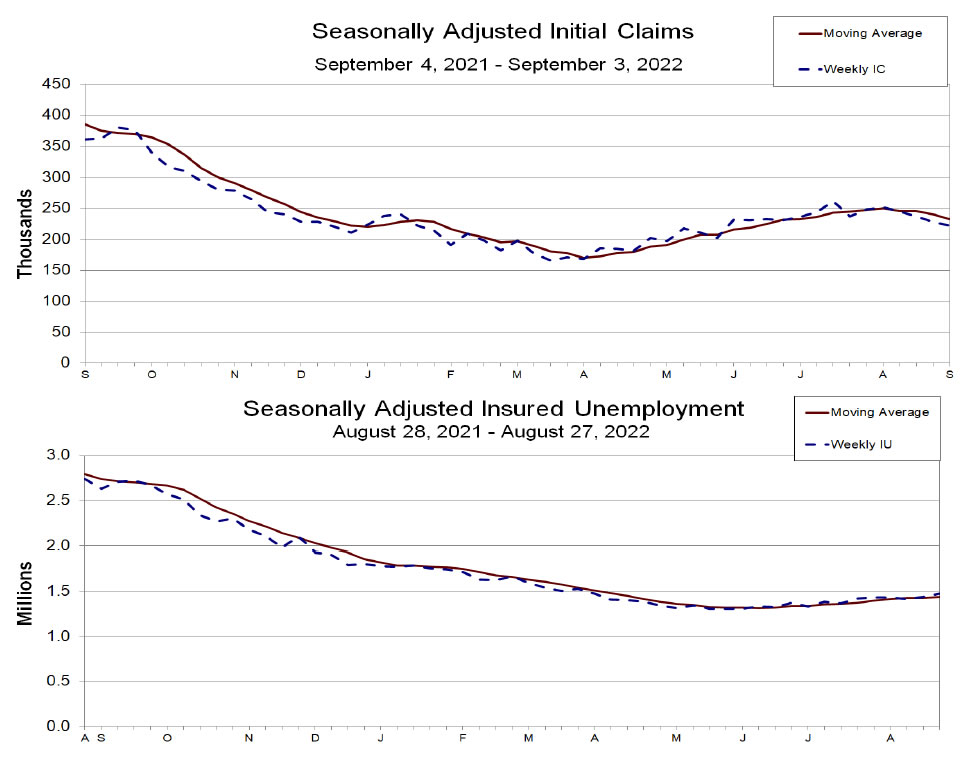
US initial jobless claims dropped to 222k, vs exp. 243k
US initial jobless claims dropped -6k to 222k in the week ending September 3, lower than expectation of 243k. Four-week moving average of initial claims dropped -7.5k to 233k.
Continuing claims rose 36k to 1473k in the week ending August 27. Four-week moving average of continuing claims rose 10.75k to 1439k.
ECB hikes 75bps, more hikes over the next several meetings
ECB raises the three key interest rates by 75bps today. The main refinancing , marginal lending facility and deposit facility rates are 1.25%, 1.50% and 0.75% respectively. The Governing Council also expects to raise interest rates further over the "next several meetings". Decisions will continue to be "data-dependent" and follow a "meeting-by-meeting approach".
ECB staff projections now show inflation averaging 8.1% in 2022, 5.5% in 2023, and then 2.3% in 2024. Recent data point to a "substantial slowdown" in growth, with the economy expected to "stagnate later in the year and in Q1 of 2023. Staff now projects the economy to grow by 3.1% in 2022, 0.9% in 2023, and then 1.9% in 2024.
(ECB) Monetary policy decisions
The Governing Council today decided to raise the three key ECB interest rates by 75 basis points. This major step frontloads the transition from the prevailing highly accommodative level of policy rates towards levels that will ensure the timely return of inflation to the ECB's 2% medium-term target. Based on its current assessment, over the next several meetings the Governing Council expects to raise interest rates further to dampen demand and guard against the risk of a persistent upward shift in inflation expectations. The Governing Council will regularly re-evaluate its policy path in light of incoming information and the evolving inflation outlook. The Governing Council's future policy rate decisions will continue to be data-dependent and follow a meeting-by-meeting approach.
The Governing Council took today's decision, and expects to raise interest rates further, because inflation remains far too high and is likely to stay above target for an extended period. According to Eurostat's flash estimate, inflation reached 9.1% in August. Soaring energy and food prices, demand pressures in some sectors owing to the reopening of the economy, and supply bottlenecks are still driving up inflation. Price pressures have continued to strengthen and broaden across the economy and inflation may rise further in the near term. As the current drivers of inflation fade over time and the normalisation of monetary policy works its way through to the economy and price-setting, inflation will come down. Looking ahead, ECB staff have significantly revised up their inflation projections and inflation is now expected to average 8.1% in 2022, 5.5% in 2023 and 2.3% in 2024.
After a rebound in the first half of 2022, recent data point to a substantial slowdown in euro area economic growth, with the economy expected to stagnate later in the year and in the first quarter of 2023. Very high energy prices are reducing the purchasing power of people's incomes and, although supply bottlenecks are easing, they are still constraining economic activity. In addition, the adverse geopolitical situation, especially Russia's unjustified aggression towards Ukraine, is weighing on the confidence of businesses and consumers. This outlook is reflected in the latest staff projections for economic growth, which have been revised down markedly for the remainder of the current year and throughout 2023. Staff now expect the economy to grow by 3.1% in 2022, 0.9% in 2023 and 1.9% in 2024.
The lasting vulnerabilities caused by the pandemic still pose a risk to the smooth transmission of monetary policy. The Governing Council will therefore continue applying flexibility in reinvesting redemptions coming due in the pandemic emergency purchase programme portfolio, with a view to countering risks to the transmission mechanism related to the pandemic.
Key ECB interest rates
The Governing Council decided to raise the three key ECB interest rates by 75 basis points. Accordingly, the interest rate on the main refinancing operations and the interest rates on the marginal lending facility and the deposit facility will be increased to 1.25%, 1.50% and 0.75% respectively, with effect from 14 September 2022.
Following the raising of the deposit facility rate to above zero, the two-tier system for the remuneration of excess reserves is no longer necessary. The Governing Council therefore decided today to suspend the two-tier system by setting the multiplier to zero.
Asset purchase programme (APP) and pandemic emergency purchase programme (PEPP)
The Governing Council intends to continue reinvesting, in full, the principal payments from maturing securities purchased under the APP for an extended period of time past the date when it started raising the key ECB interest rates and, in any case, for as long as necessary to maintain ample liquidity conditions and an appropriate monetary policy stance.
As concerns the PEPP, the Governing Council intends to reinvest the principal payments from maturing securities purchased under the programme until at least the end of 2024. In any case, the future roll-off of the PEPP portfolio will be managed to avoid interference with the appropriate monetary policy stance.
Redemptions coming due in the PEPP portfolio are being reinvested flexibly, with a view to countering risks to the monetary policy transmission mechanism related to the pandemic.
Refinancing operations
The Governing Council will continue to monitor bank funding conditions and ensure that the maturing of operations under the third series of targeted longer-term refinancing operations (TLTRO III) does not hamper the smooth transmission of its monetary policy. The Governing Council will also regularly assess how targeted lending operations are contributing to its monetary policy stance.
***
The Governing Council stands ready to adjust all of its instruments within its mandate to ensure that inflation stabilises at its 2% target over the medium term. The Transmission Protection Instrument is available to counter unwarranted, disorderly market dynamics that pose a serious threat to the transmission of monetary policy across all euro area countries, thus allowing the Governing Council to more effectively deliver on its price stability mandate.
The President of the ECB will comment on the considerations underlying these decisions at a press conference starting at 14:45 CET today.
Oil Lost Big Support, Aiming for $75 and then $40
Oil broke a major support line on Wednesday, falling to its lowest since January. The significance of the breakout is further underlined by its strength, with an intraday drop of more than 6%.
Oil prices fell right below the highs of the previous momentum in October last year. The basis, which the market bulls had been building all last month, could not withstand the economic slowdown leading to a decline in demand and a rising dollar.
On the weekly charts, you can see that the technical reversal pattern got confirmation in the first days of September, on the close of last week’s candlestick. Those same weekly charts also show a bearish divergence in the price and RSI, which triggered the reversal in early June.
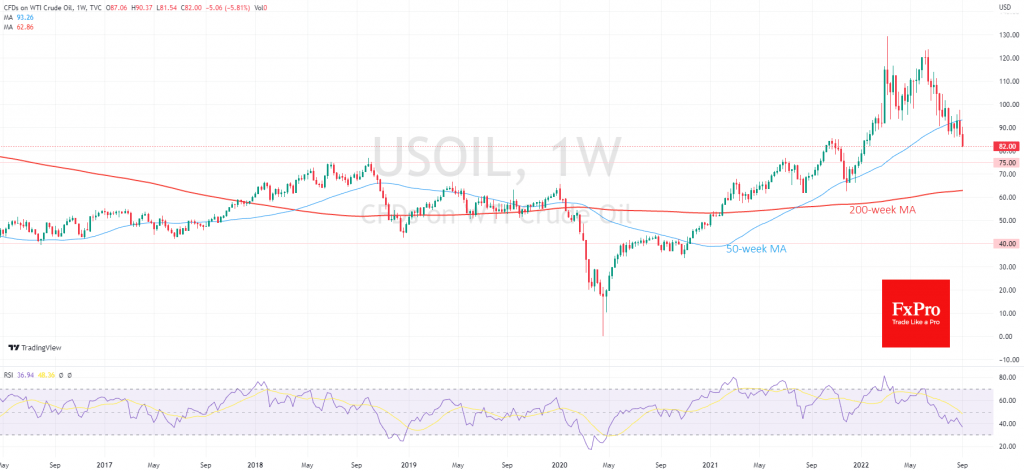
The last time a similar technical pattern we saw in 2018. Incidentally, the coincidence of the situations reinforces that the Fed was in an active policy tightening cycle when markets seriously feared a recession. At that time, Crude lost more than 40% to $42 from a peak near $75, coming close to the long-term break-even point.
In the second part of the last week, the price failed to stay above the 50-week average, which we consider the one-year average. This failure triggered a liquidation of long positions, further amplified the move.
From a technical analysis point of view, the move still has significant downside potential. Last time, oil went deep into the oversold territory before it found the strength to reverse.
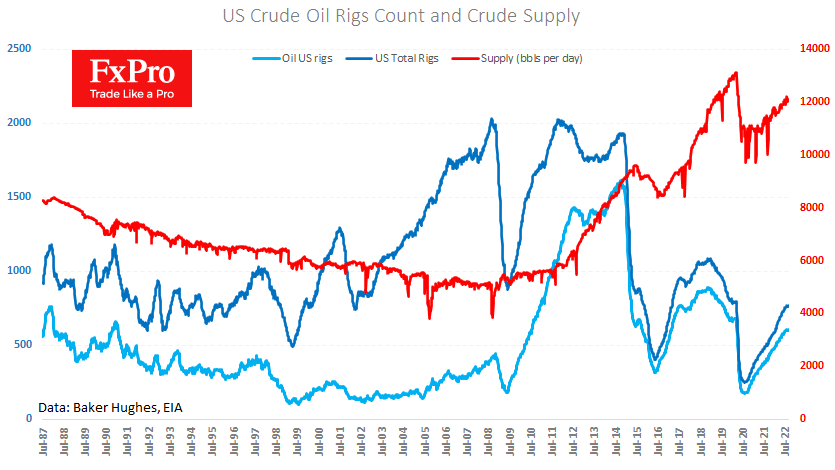
Traders and investors should be prepared that the bears may not end this game until producers start to withdraw from the market. For now, the latest data shows US production at 12.1M BPD, with Russia and Saudi Arabia each producing around 10M BPD. These are appropriate levels for healthy economic growth. For a slowing world, it is too much.
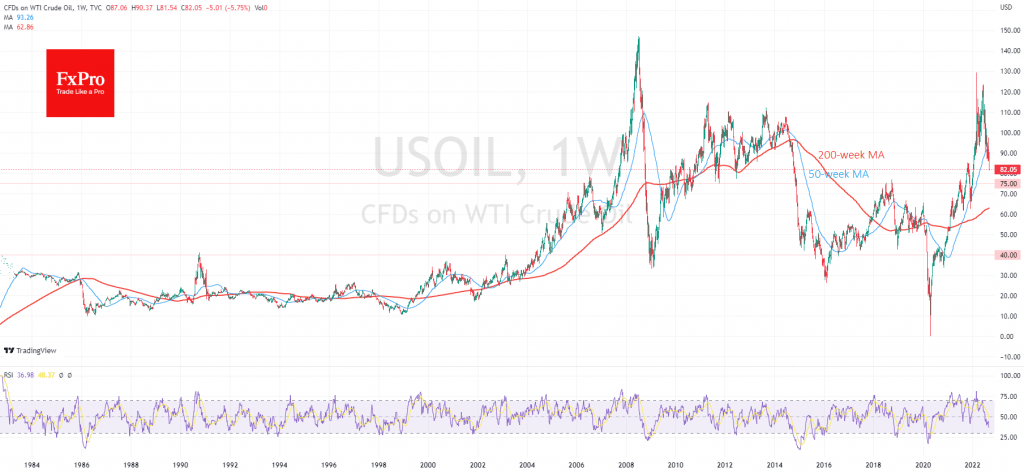
In our view, the $40 level again acts as an ambitious target for the bears, as it has been over the last 18 years. Like it did for this period, it can create chaos in the oil-producing countries and the whole sector. If we look that far down, we need to look to the $75 a barrel area, near which oil repeatedly reversed in 2018. Here it is likely that the OPEC+ cartel will put tighter price support measures back on the agenda by reducing production more aggressively.
GBP/USD: Sterling Consolidating Above New Multi-decade Low
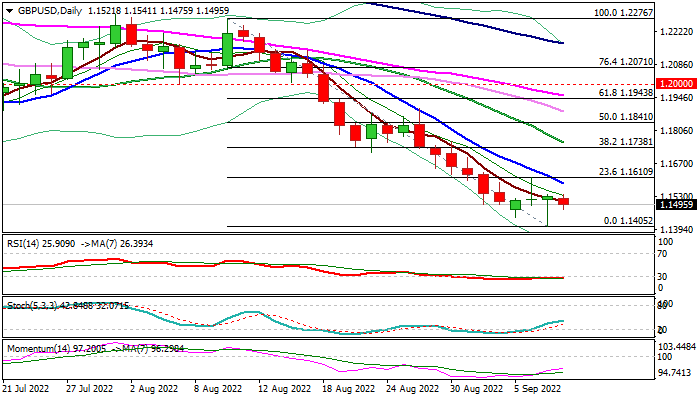
Cable remains at the back foot following Wednesday’s brief probe below 2020 low (1.1410) that posted new lowest since 1985.
Subsequent bounce left Hammer candlestick, generally bullish signal, which so far did not provide any positive reaction, as the outlook for pound remains increasingly bearish.
Markets will closely watch the first steps of new UK Prime Minister Liz Truss, who said that the government will set out a bold plan of action to support households and businesses and also to boost domestic energy supply, including both, short and long-term solutions, though she did not provide any detail about the plan.
BOE officials expect new plan to ease short-term inflationary pressure that would partially ease mounting worries as inflation already hit a double-digit levels and according to some forecast, may rise up to 20% if crisis with energy supplies deepens.
The policymakers, however, remain cautious, as some leaked details of the plan signal a massive government spending that would exceed pandemic furlough scheme that could fuel inflation.
Cable returned to red on Thursday, with near-term action so far holding within a narrow range, formed after strong rejections on both sides on Tuesday and Wednesday.
Overall technical picture remains firmly bearish, with extended consolidation likely to precede fresh weakness.
Sustained break of 2020 low would generate strong signal of bearish continuation of larger downtrend from 2007, which was paused for consolidation since 2016 until now and unmask 1985 low at 1.0520.
Near-term action faces initial resistance at 1.1583 (falling 10DMA), ahead of more significant barrier at 1.1610 (consolidation range top / Fibo 23.6% of 1.2276/1.1405), which should ideally cap and keep bearish structure intact.
Res: 1.1541; 1.1583; 1.1648; 1.1693.
Sup: 1.1475; 1.1405; 1.1352; 1.1300.
EUR/USD: Recovery Faces Headwinds at Parity, All Eyes on ECB
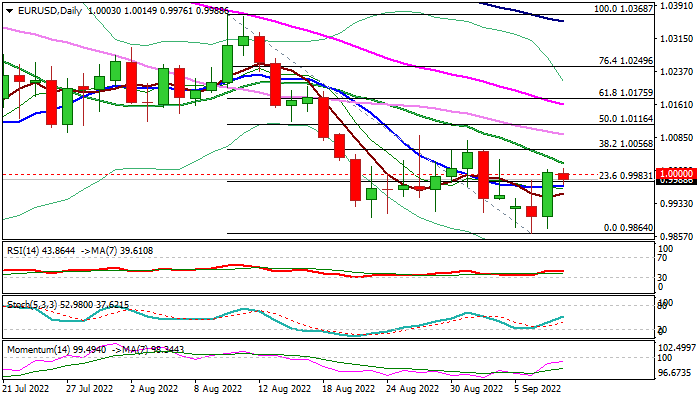
The Euro edges lower in early European trading on Thursday, following 1.02% bounce on Wednesday, as recovery is facing strong headwinds from parity area, now reverted to significant resistance.
Technical studies on daily chart have slightly improved after Wednesday’s rally closed above 10DMA (0.9974) and 14-d momentum accelerated higher from the deep negative zone, though overall structure remains firmly bearish on increasingly negative fundamentals, suggesting limited recovery before bears re-take control.
The ECB’s policy meeting is the key event today, with wide expectations that the central bank will go for a big size rate hike to fight soaring inflation, which is getting increasingly entrenched and strongly hurts households and economic activity.
Expectations about the size of rate hike are divided between 50 and 75 basis points, with some expecting even more aggressive decision, but more important will be a signal that the ECB will establish in the tightening track and continue to raise interest rates in the coming months.
The policymakers are aware of the negative effects of higher interest rates which would further undermine already fragile economic conditions, as the economy is likely to enter recession during the winter.
All these factors continue paint the outlook in the dark colors, with growing fears that the conditions may deteriorate and exceed the most pessimistic expectations.
Near-term action faces immediate support at 0.9974 (10DMA), with return and close below here to soften near-term tone and generate initial signal of recovery stall,.
This would bring in play scenario of retest of key support at 0.9864 (Sep 6 new 20-year low) loss of which would risk acceleration towards 0.9620/00 zone (lows of Sep/Aug 2002).
Conversely, sustained break above parity, would generate positive signal, which would look for a verification on clear break above 1.0055/79 (Fibo 38.2% of 1.0364/0.9864 bear-leg / Aug 31 lower top).
Res: 1.0000; 1.0055; 1.0079; 1.0091.
Sup: 0.9974; 0.9955; 0.9900; 0.9864.
RBA Expects More Rate Hikes in the Coming Months
"When I spoke at the Anika Foundation event last year, CPI inflation in Australia had been below 2 percent for a number of years and, in underlying terms, was just 1.6 percent. Today, CPI inflation has risen to 6.1 percent, and underlying inflation is 4.9 percent. These are the highest rates in many years." - Lowe.
Speaking at the Anika Foundation Fundraiser in Sydney, the governor of the Reserve Bank of Australia revealed that the current discrepancies between the annual inflation forecasts and the actual values have caught everyone by surprise. Last year, the RBA forecasted 2022 inflation rates to be just 1.75%, whereas so far this year, there are reasons to expect 7.75% CPI inflation rates - a big forecast miss! To counteract this, Mr. Lowe has established the need for the RBA to continue hiking interest rates in hopes of reaching the flexible inflation rate targets. He made it clear, however, that the pace of hikes would be much slower.
AUDCAD
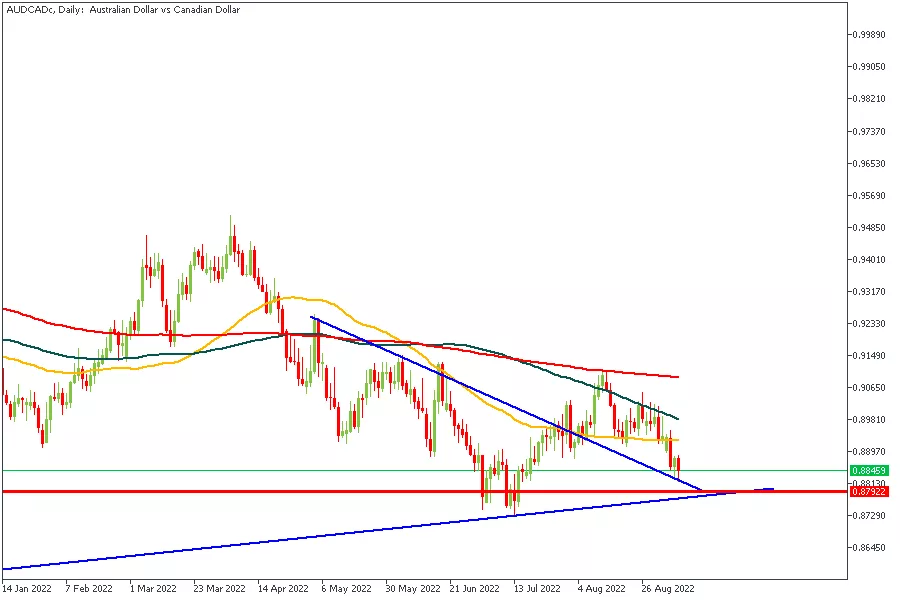
As we expect continued hikes in interest rates from the RBA and forecasted increases in unemployment rates by the national statistical office of Canada (to be released Friday, 09th September), fundamental factors seem to support a bullish correction on AUDCAD. Technically speaking, the market is trading close to the Daily Support at 0.87922 and has retested a major trendline from 2020.
AUDNZD
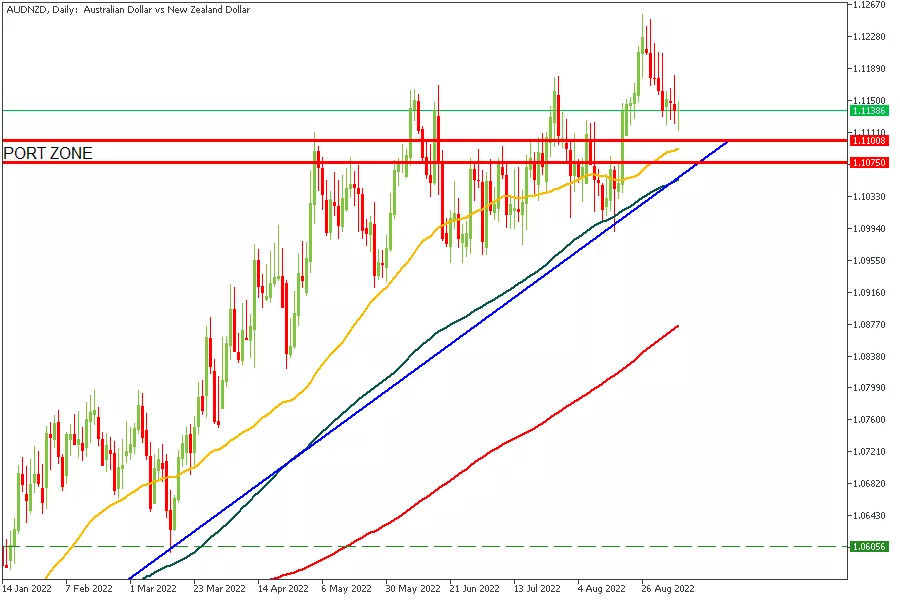
The Daily Support zone between 1.11008 and 1.10750 is already within reach of the current price action on AUDNZD, and offers the Moving Average 50 and a major trendline as a confluence(img.02)
AUDUSD
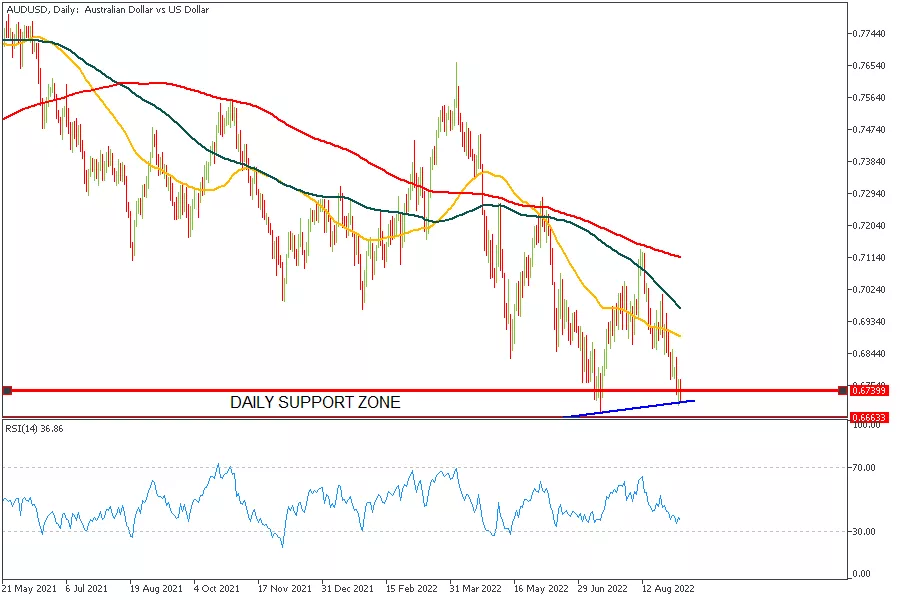
The major trendline aside, price is also trading between the daily support zone at 0.67399 & 0.66633, thus increasing the chances of a bullish correction, possibly back to the 50-MA or even higher.
Bitcoin: Bears Let Off Steam But Went No Further
Market picture
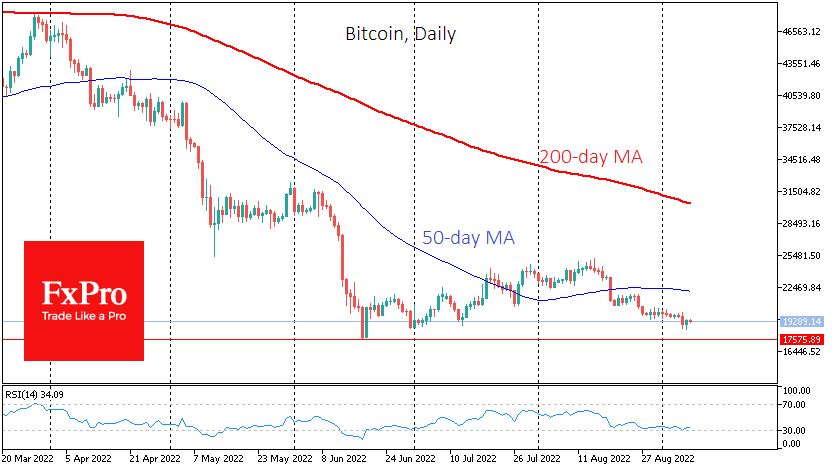
Bitcoin has rebounded 3% in the last 24 hours to $19.3K. On Wednesday, it updated 2.5-month lows just above $18.5K before getting buyers’ support. Ethereum almost bounced back from its last dip, adding 8% to $1640.
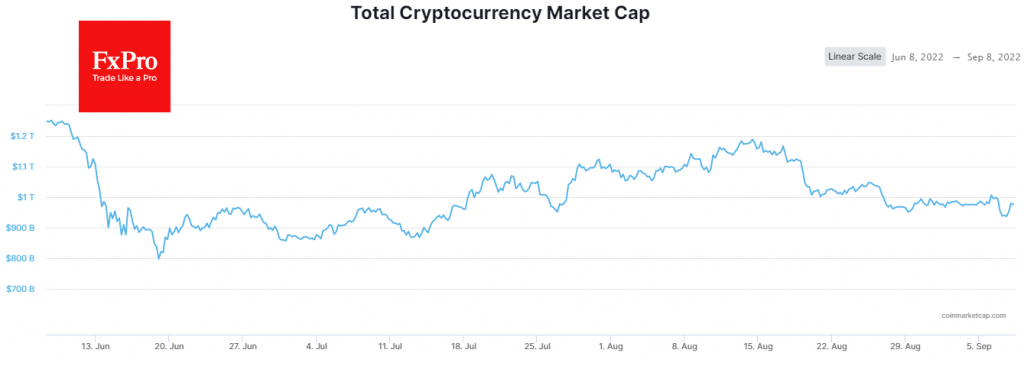
The entire crypto market has added 4.5% to $980bn over the past day, according to CoinMarketCap. The Fear and Greed Index fell to 20 by early Thursday, the lower bound of this index since July.
In the US session, the first cryptocurrency was able to turn to the upside, following equities and the general feeling that the worst moment of the sell-off is over.
While the current optimism may be premature, there is a double bottom and price divergence with the RSI chart on the BTCUSD daily chart. It will only be possible to talk about it more confidently after the week closes on the plus side and, even better, when it returns above $20K.
News background
Investments in liquid cryptocurrencies and blockchain continue to decline steadily, so don’t expect any meaningful market growth until late 2022, according to audit firm KPMG.
Arthur Hayes, former head of BitMEX, called for saving in bitcoin in the face of war and the coming crisis. According to him, BTC cannot be confiscated like any assets in banks.
According to Whale Alert, whales have started moving Ethereum to cryptocurrency exchanges. This could indicate possible asset sales on the back of The Merge’s upcoming update, which will take place in a week.
The UK’s Financial Conduct Authority (FCA) has urged citizens not to trust social media investment advice and cryptocurrency Influencers, as they will be unable to protect their rights if they lose their invested funds.
AUDUSD Flirts with July’s Low; Outlook Discouraging
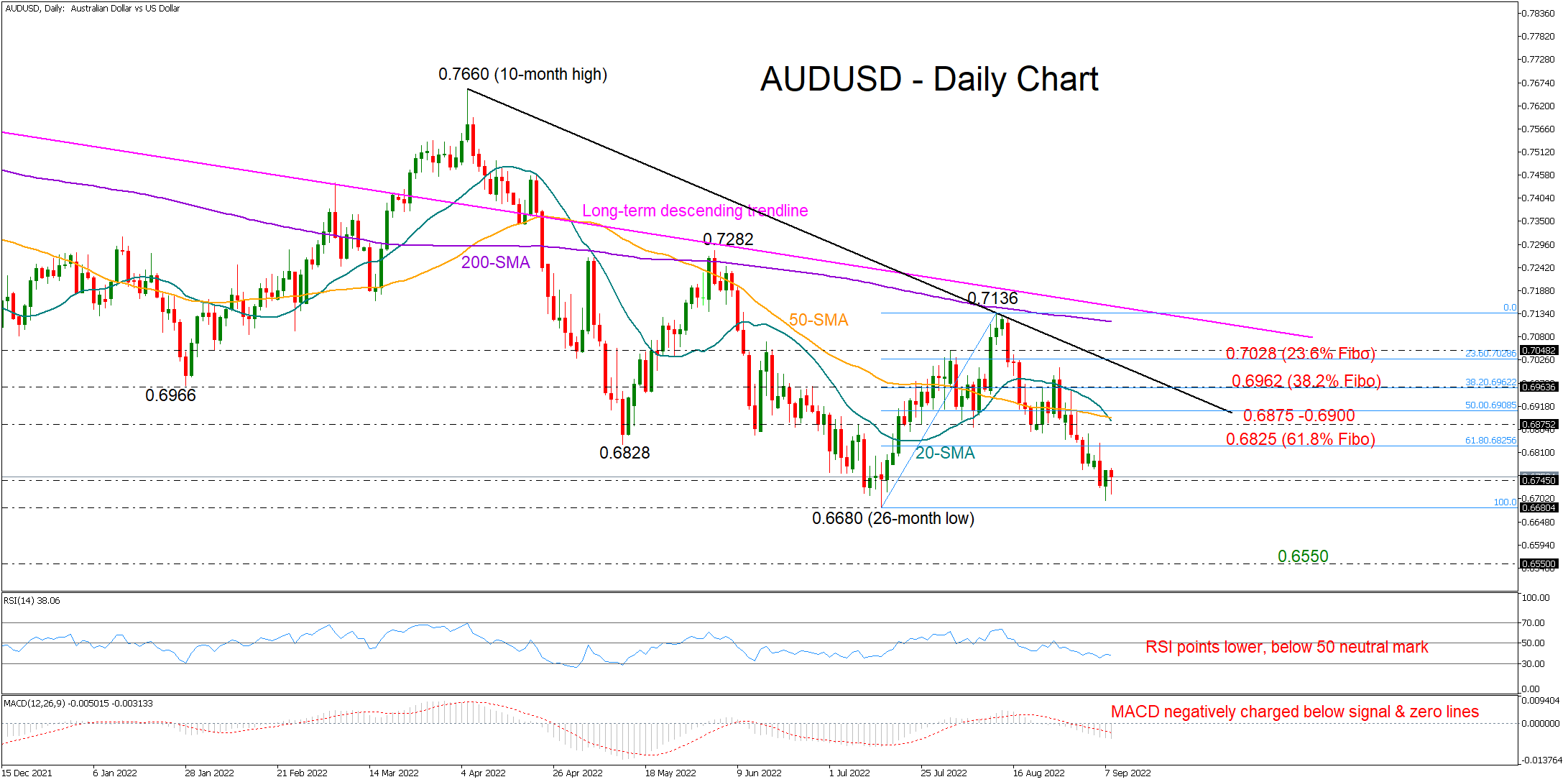
AUDUSD almost touched July’s 26-month low of 0.6680 on Wednesday before bouncing up to finish the session with mild gains.
The soft upward move, however, was not enough to shift the odds to the bullish side as the RSI keeps pointing downwards well below its 50 neutral mark, while the MACD remains negatively charged below its zero and signal lines too.
Hence, the bears may stay on board for now, aiming for an aggressive attack towards the next barrier of 0.6550 once the base around 0.6680 gives way. Even lower, selling pressures could further intensify to meet the 0.6400 round level last active during April-May 2020. This is also where the 161.8% Fibonacci extension of the previous bullish wave is placed.
Otherwise, a continuation higher may initially re-challenge the weekly bar of 0.6825, where the 61.8% Fibonacci happens to be. Then, if the 0.6875 – 0.6900 constraining zone, which encapsulates the 20- and 50-day simple moving averages (SMAs) and the 50% Fibonacci, proves fragile this time, the recovery could extend towards the tentative descending trendline at 0.6962.
All in all, AUDUSD maintains a discouraging outlook near July’s low. A close lower is expected to motivate a sharp decline towards 0.6550.