Sample Category Title
European Central Bank Delivers Record Rate Hike, Signals Further Tightening
Summary
- Against a backdrop of persistent and elevated inflation, the European Central Bank (ECB) delivered a record rate hike at today's monetary policy announcement, raising its Deposit Rate by 75 basis points to 0.75%.
- The ECB also said inflation remains far too high and that it expects to raise interest rates further over the next several meetings. Of particular note, the ECB revised up its 2023 CPI inflation projection to 5.5%.
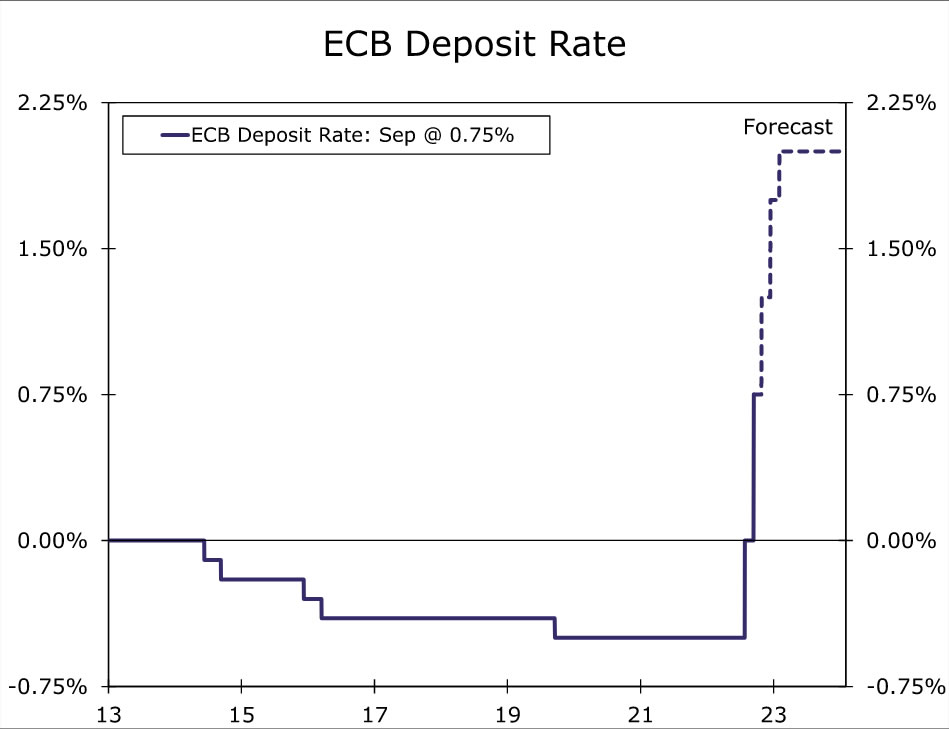
- Thus, even with a softer outlook for economic growth, we now forecast the ECB will raise its Deposit Rate another 50 basis points in late October, and also 50 basis points in December, lifting the Deposit rate to 1.75% by the end of this year. We expect a final 25 basis point rate increase to 2.00% in early 2023. We subsequently expect the European Central Bank to hold interest rates steady through the rest of 2023.
- From a currency perspective, we still expect some further declines in the euro in the near-term, but see prospects for a euro rebound versus the U.S. dollar in 2023, with the latter likely weighed down by the anticipation and eventual implementation of Federal easing by late next year.
European Central Bank Goes Big
Against a backdrop of persistent and elevated inflation, the European Central Bank (ECB) delivered a record rate hike at today's monetary policy announcement. The ECB raised its Deposit Rate by 75 basis points to 0.75%, matching the consensus forecast. Just as importantly, we viewed the central bank's accompanying comments as mildly hawkish on balance, and expect the ECB to keep raising interest rates into early next year. Among the more hawkish elements of the ECB announcement, the central bank said:
- Inflation remains far too high and is likely to stay above target for an extended period.
- Over the next several meetings, it expects to raise interest rates further to dampen demand and guard against the risk of a persistent upward shift in inflation expectations.
- It has significantly revised up its inflation projections and now expects CPI inflation to average 8.1% in 2022, 5.5% in 2023 and 2.3% in 2024.
- The Transmission Protection Instrument is available to counter unwarranted, disorderly market dynamics that pose a serious threat to the transmission of monetary policy across all euro area countries, thus allowing the Governing Council to more effectively deliver on its price stability mandate.
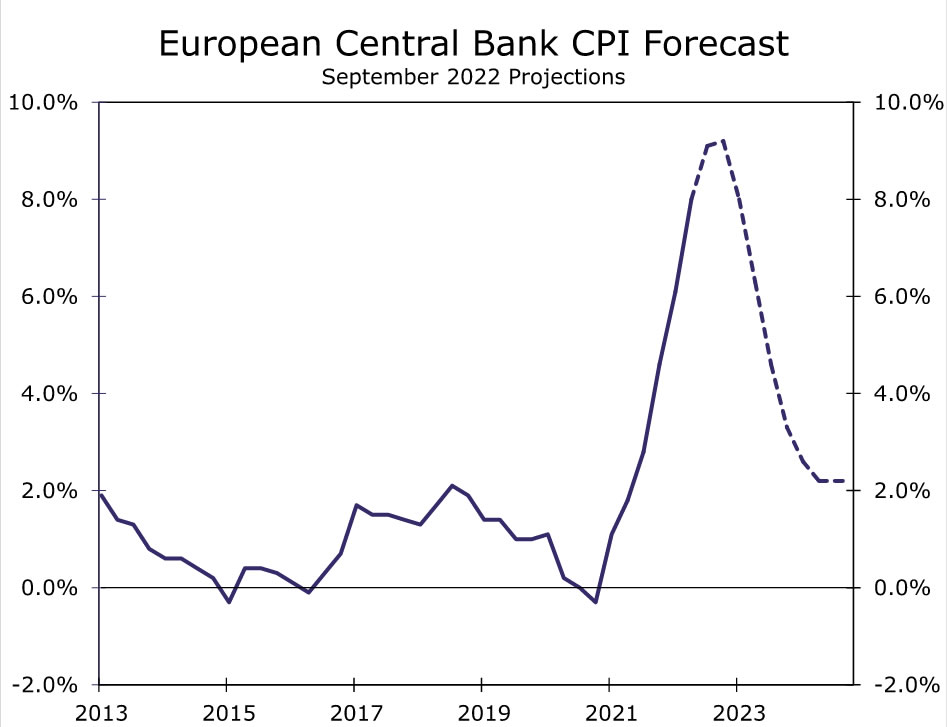
The last comment is perhaps noteworthy, in that it suggests ECB policymakers will not cut their monetary policy tightening cycle short simply due to fears of fragmentation across Eurozone bond markets.
With respect to reinvestments, the ECB said it intends to keep reinvesting proceeds from bonds maturing under the Asset Purchase Program for an extended period, and to keep reinvesting proceeds from the Pandemic Emergency Purchase Program until at least the end of 2024. There did not appear to be any in depth discussion of quantitative tightening at today's ECB meeting.
Finally, on the less hawkish, or more dovish side, the ECB acknowledged a slowdown in growth momentum, saying the Eurozone economy would likely stagnate in late 2022 and early 2023. More broadly, the ECB lowered its Eurozone GDP growth projections to 3.1% for 2022, just 0.9% for 2023, and 1.9% for 2024. The ECB said today's interest rate increase "front loads" some of the transition to a more normal monetary policy stance and that, going forward, future policy rate decisions will continue to be data-dependent and follow a meeting-by-meeting approach.
ECB Policymakers Signal More to Come
A key takeaway from today's monetary policy announcement is that even after the forceful start to its rate hike cycle, the ECB is signaling that it believes interest rates will remain on an upward path for some time yet. This is reflected explicitly in its expectation that it will raise interest rates for the next several meetings, its observation that inflation remains far too high, and the significant upward revision to its 2023 CPI inflation forecast in particular, to 5.5%.
Against this backdrop and following today's record rate increase, we now forecast the European Central Bank will raise its Deposit Rate another 50 basis points in late October and also 50 basis points in December, lifting the Deposit rate to 1.75% by the end of this year. We expect a final 25 basis point rate increase to 2.00% in early 2023. That would lift the ECB's policy rate to what is perceived as the upper end of a neutral range. In addition, as the depth of Eurozone economic recession becomes clearer, and also as underlying inflation perhaps begins to abate, we believe those factors will be influential in seeing the European Central Bank bringing its rate hike cycle to an end by early next year. However, with inflation likely to remain well above target, and the ECB's policy rate close to rather than well above its neutral range, we subsequently expect the European Central Bank to hold interest rates steady through the rest of 2023. From a currency perspective, we still expect some further declines in the euro in the near-term, given the Fed remains firmly in tightening mode for now and with the Eurozone economic outlook less than stellar. We do expect some rebound in the euro in 2023 as a steady ECB monetary policy outlook sees the euro outperform against the U.S. dollar, with the latter likely weighed down by the anticipation and eventual implementation of Federal Reserve monetary easing by late 2023.
Winter is Coming
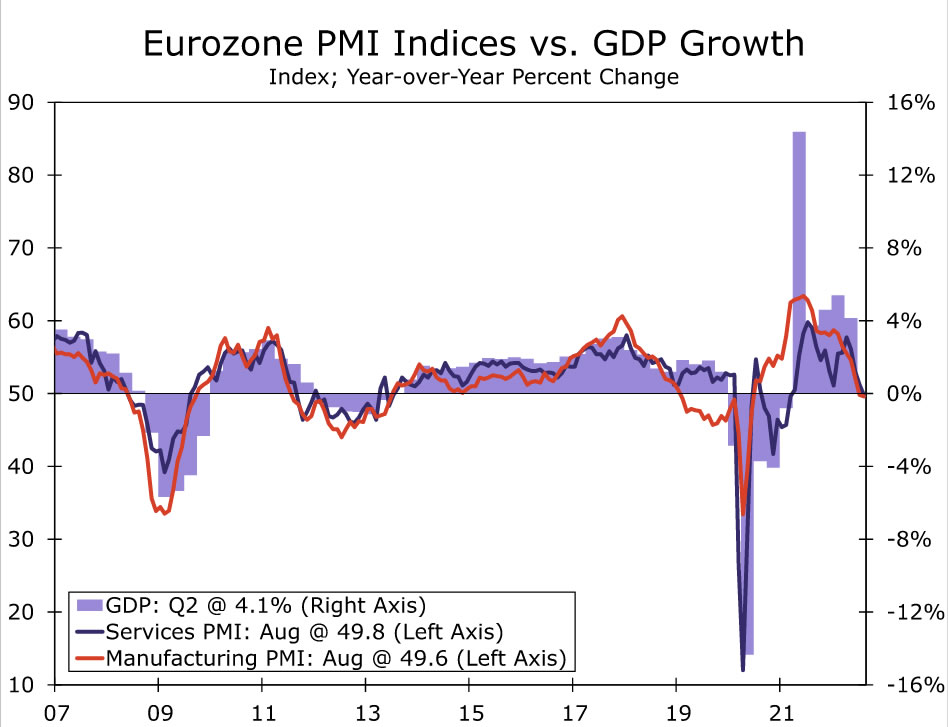
As the European Central Bank alluded to, economic growth is likely to slow sharply over the second half of this year, a factor we believe may be influential in eventually bringing the ECB's monetary tightening cycle to an end. The detailed Eurozone Q2 GDP figures, also released this week, highlighted a favorable quarter for the region's economy. Overall GDP growth rose 0.8% quarter-over-quarter and 4.1% year-over-year, more than initially estimated. In addition, the expenditure breakdown showed consumer spending increasing by 1.3% quarter-over-quarter, and fixed investment spending rising 0.9%. As a result, Eurozone final domestic demand rose a solid 1.0% in Q2.
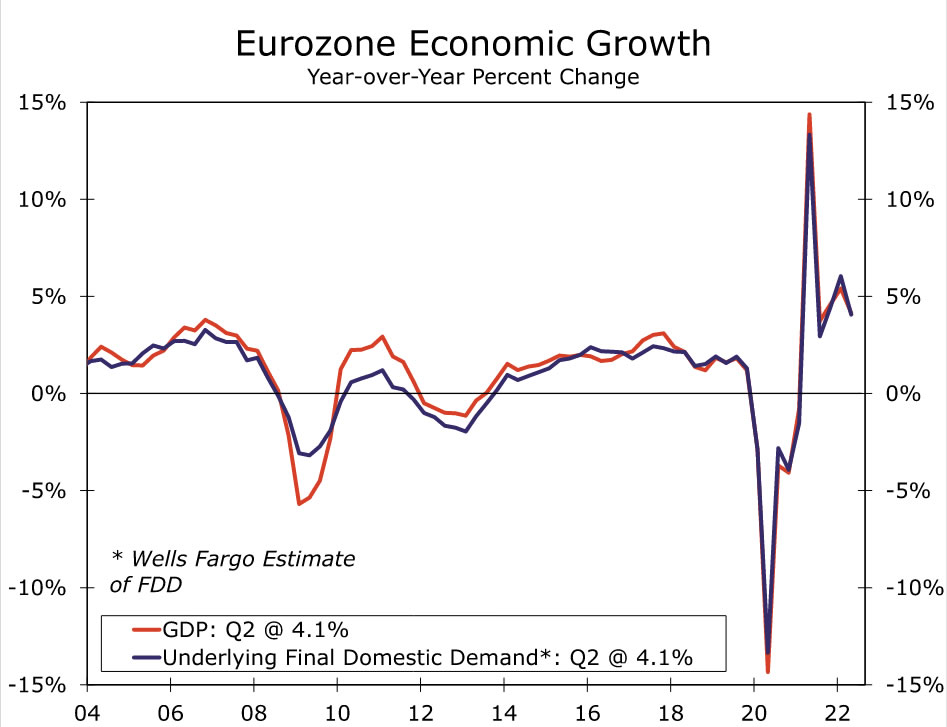
However, while the full income details are not yet available for Q2, those same GDP figures showed employee compensation rising 1.1% quarter-over-quarter, but being outpaced by a 1.8% rise in the private consumption deflator, meaning that real employee compensation actually fell 0.7% in Q2. More recently, survey data in particular suggests slower growth, and indeed Eurozone recession, remains likely in the months ahead. For August, the Eurozone manufacturing PMI of 49.6 and the services PMI of 49.8 were both below the breakeven 50 level, and consistent with a contracting Eurozone economy. That suggests our outlook for Eurozone recession beginning by late this year remains on course, which should also see the ECB bring its tightening cycle to an end by early 2023.
Sliding Yen Has Tokyo Worried
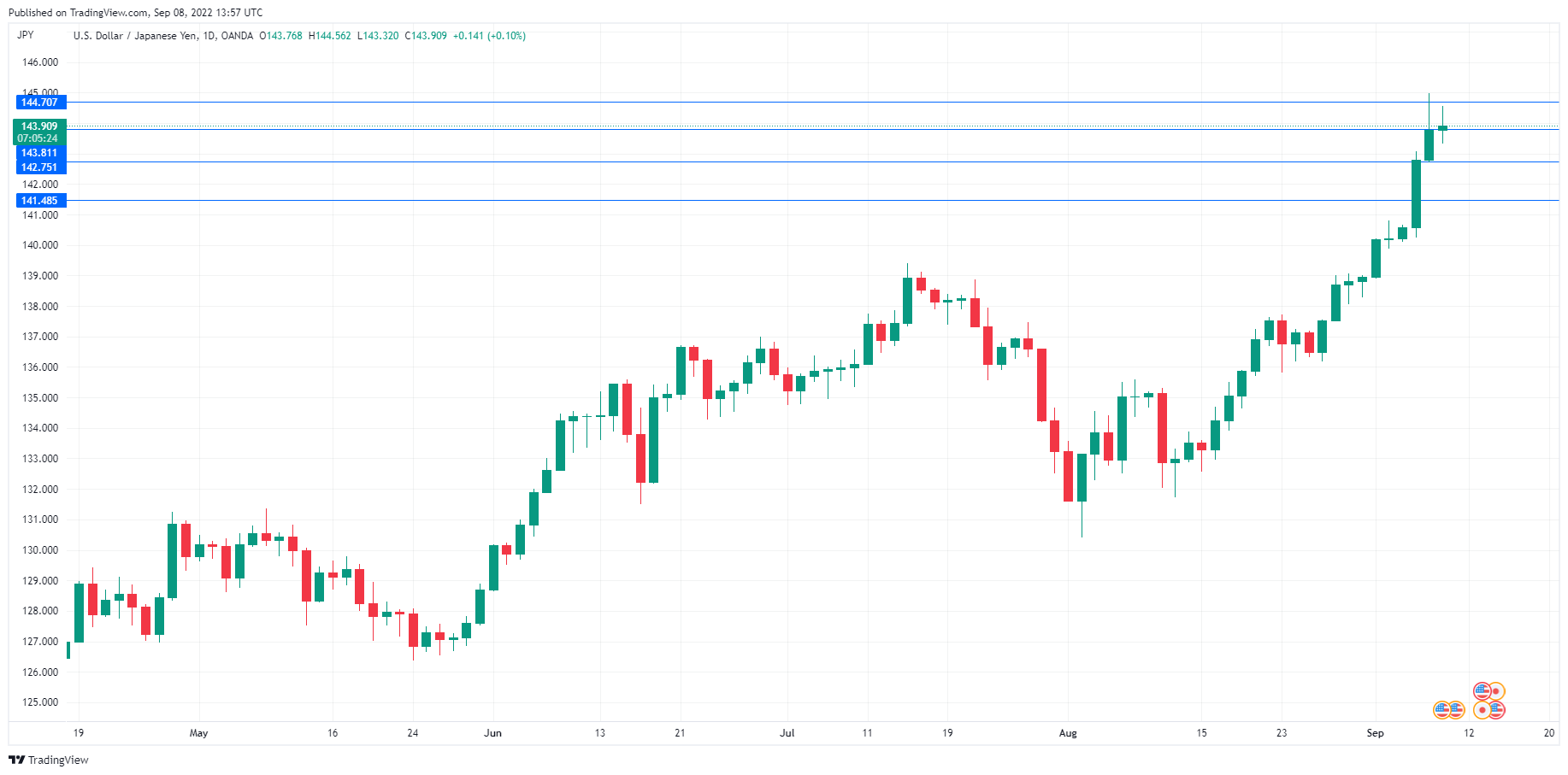
The Japanese yen remains under pressure. In the North American session, USD/JPY is trading at 143.96, up 0.14%. The yen came within a whisker of the 145 line on Wednesday, touching 144.99.
Japan sounds alarm as yen slips
The yen continues its nasty slide. USD/JPY has jumped about 8% since August 1st, and continues to record new 24-year highs. It’s not just that the yen is trading close to 145, but the speed at which the Japanese currency is depreciating. USD/JPY broke above the 140 line on September 1st and the dollar onslaught has continued without letup.
The yen’s most recent fall has, predictably, resulted in Japanese officials sounding the alarm. Masato Kanda, Japan’s top currency official, said today that the government and the BoJ were “extremely worried” about the recent yen moves, and are watching the currency markets with a strong sense of urgency. Kanda added that “the government is ready to take action in the currency market”, but his remarks have done nothing to stop the yen’s downswing.
Investors have heard this rhetoric time and time again, without any action from Tokyo. The last time Japan intervened in the currency markets to prop up the yen was in 2011, and the BoJ is committed to an ultra-loose policy to support growth, and Governor Kuroda has ruled out tightening policy until inflation remains sustainably above 2%, along with higher wage growth. Inflation is running close to 3%, but this is mainly due to higher import costs, which the BoJ considers a temporary cause of rising inflation.
With the government unlikely to intervene and the BoJ suppressing any rate increases, the yen is at the mercy of the US/Japan rate differential, which has been moving higher. With the Fed expected to remain aggressive, the yen is likely to continue heading lower.
USD/JPY Technical
- There is support at 142.75 and 141.48
- USD/JPY is testing resistance at 143.81. Above, there is resistance at 144.70, which was tested on Wednesday
ETHUSD Extends Rebound But 50-Day SMA Caps Advance
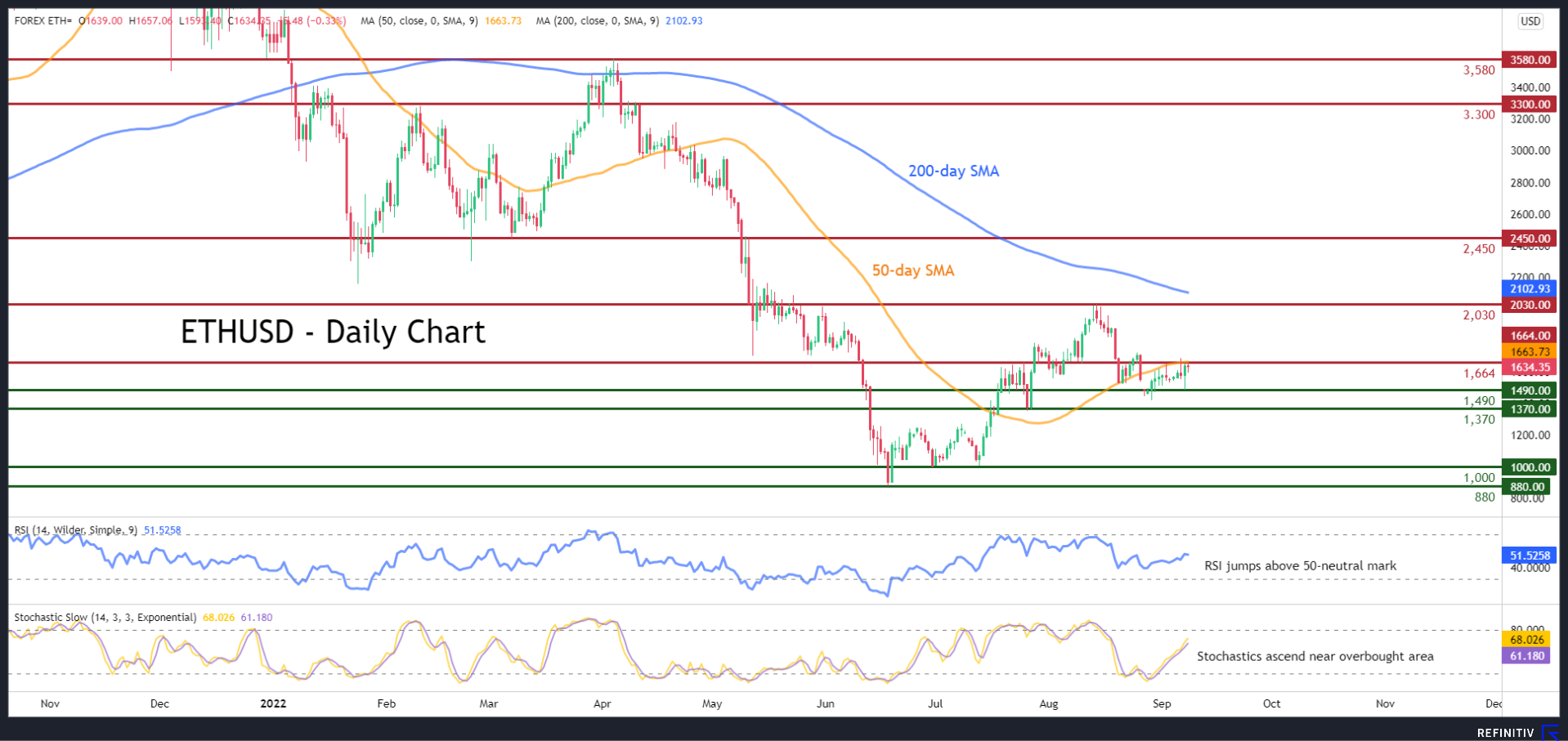
ETHUSD has been gaining some ground in the short-term after its latest decline came to a halt at the 1,420 region. However, the recent price recovery has been repeatedly held down by the ascending 50-day simple moving average (SMA).
The momentum indicators suggest that near-term risks are tilted to the upside. Specifically, the stochastic oscillator is ascending near the 80-overbought area, while the RSI has jumped above its 50-neutral mark.
Should positive momentum strengthen, the cryptocurrency could encounter initial resistance at the 50-day SMA, currently at 1,664. Conquering this barricade, the bulls could then aim for the August peak of 2,030 before the attention shifts to 2,450. Any further upside moves might then stall at the 3,300 hurdle.
On the flipside, should the price drift lower, the recent support region of 1,490 may act as the first line of defence. Diving beneath that region, Ethereum could decline towards 1,370 or lower to test the crucial 1,000 psychological mark. A violation of the latter might then set the stage for the 2022 low of 880.
Overall, ETHUSD’s recovery appears to be strengthening but the 50-day SMA has proved to be a tough resistance barrier for the bulls. Nevertheless, a drop beneath the 1,370 floor could shift the short-term picture back to negative.
EURAUD Climbs above 1.4805, Maintains Bullish Bias
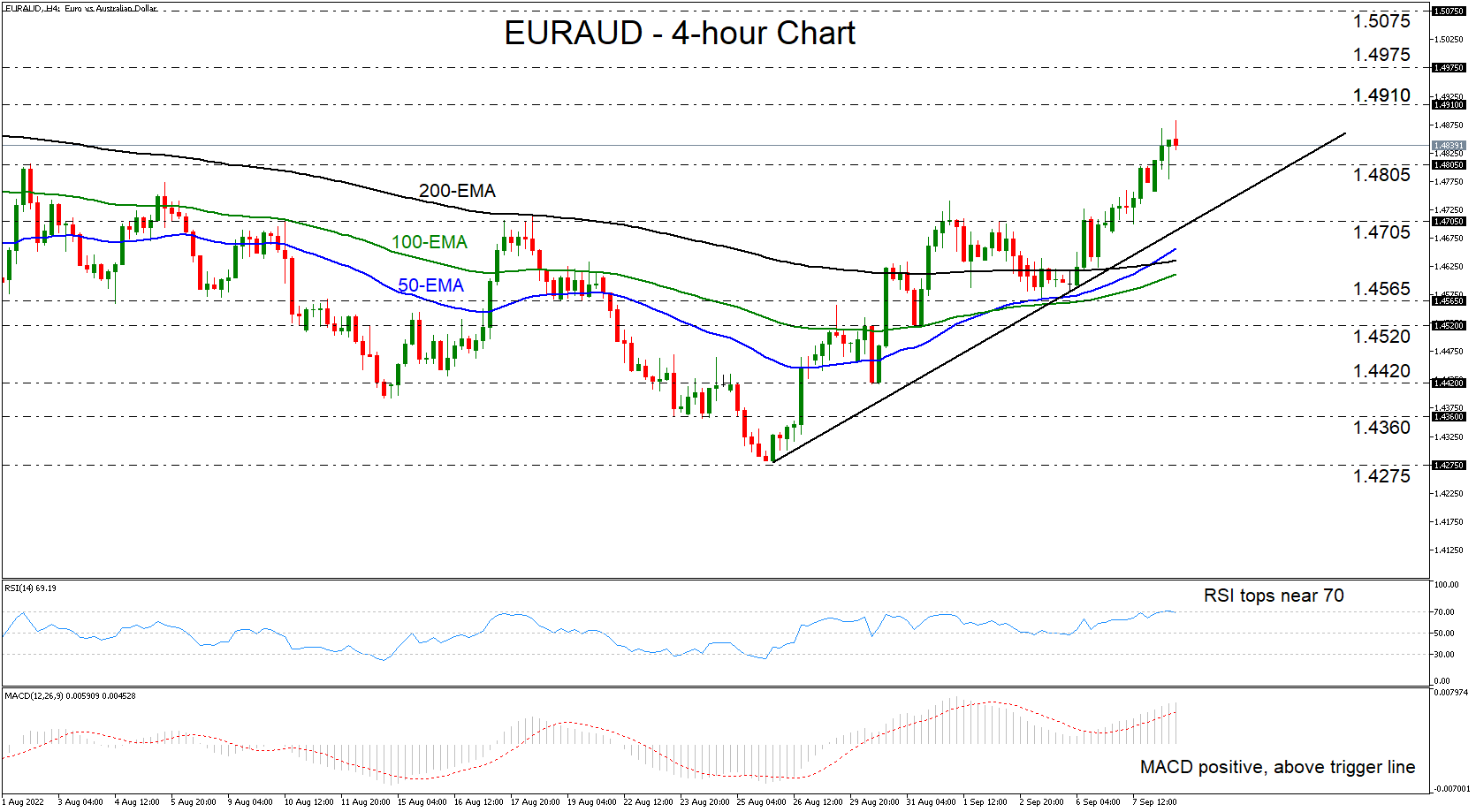
EURAUD has been in a rally mode since Tuesday, when it hit support slightly above the 50- and 100-period exponential moving averages (EMAs), thereby allowing the drawing of an upside support line from the low of August 26. Today, the pair emerged above the 1.4805 barrier, marked by the high of August 2, while the price action remains one of higher highs and higher lows, suggesting that the short-term bias remains bullish.
Both the RSI and the MACD detect upside speed, with the former lying near 70 and the latter running above both its zero and trigger lines. That said, the RSI is showing signs of topping, highlighting the risk of a small setback before the next bullish march.
The bulls could take the reins from somewhere above the aforementioned upside line, and perhaps aim for the 14910 zone, which acted as a temporary ceiling between July 12 and 21. If it doesn’t hold this time around, its break could see scope for extensions towards the high of July 11 at 1.4975, or even the 1.5075 hurdle, marked by the inside swing lows of June 30 and July 5.
On the downside, the bullish case may be scrapped upon a break below 1.4565. The pair would not only be below the upside line, but also below all the moving averages. After that, initial support may be found at 1.4520, the break of which could pave the way towards the low of August 30 at around 1.4420.
In brief, EURAUD has been trending north since August 26, as marked by an upside support line. Combined with the fact that the pair is also trading above all the plotted moving averages, this suggests that the path of least resistance remains to the upside.
ECB Hiked Policy Rates by 75 bps
Markets
The ECB hiked its policy rates by 75 bps: 0.75% for the deposit rate and 1.25% for the marginal lending rate. That makes a cumulative 125 bps tightening over just two meetings. All else equal, we expect another 75 bps move in October as part of the central bank’s frontloading efforts in transitioning away from the prevailing highly accommodative level of policy rates.
The central bank clearly commits to more rate hikes over the next several meetings to further dampen demand and guard against the risk of a persistent upward shift in inflation expectations. Data dependence and the meeting-by-meeting approach fit in the strategy of abolishing forward guidance when it comes to policy rates. Once bitten, twice shy after having to backtrack on its promise regarding both the timing and the size of the inaugural rate hike. The ECB sounds determined in battling what it labels as far too high inflation.
ECB staff once more upward revised quarterly inflation forecasts: 8.1% for 2022 (from 6.8% in June), 5.5% in 2023 (from 3.5%) and 2.3% in 2024 (from 2.1%). The central bank thus doesn’t envision a return towards the 2% inflation target over the policy horizon even if these forecasts imply a continuation of the tightening cycle. Risks remain primarily on the upside of the new outlook.
ECB President Lagarde at the Q&A session specifically mentioned euro weakness as adding to the ECB’s (inflation) woes. Underlying inflation is at elevated levels, but the wage dynamic remains contained overall. On the economic front, the central bank fears the EMU economy will stagnate later in the year and in Q1 2023. Very high energy prices bite into disposable incomes while supply bottlenecks still constrain economic activity. Consumer and business confidence is adversely affected. New GDP forecasts stand at 3.1% for this year (from 2.8% in June, thanks to better H1 performance), 0.9% in 2023 (from 2.1%) and 1.9% in 2024 (from 2.1%). Economic risks are clearly tilted to the downside of expectations.
The ECB keeps its reinvestment policy for maturing assets under APP (“for an extended period of time past the date when it started raising the key ECB interest rates”) and PEPP (“until at least the end of 2024”) unchanged. Last week, first rumours popped up that the central bank by the end of this year will also release a blueprint for quantitative tightening (ie balance sheet reduction). Finally, it’s worth mentioning that the two-tier system for the renumeration of excess reserves is no longer necessary following the raising of the deposit rate above zero.
Core bonds extended their sell-off during Lagarde’s press conference. The German yield curve bear flattens with yields rising by 8.5 bps (30-yr) to 14.6 bps (2-yr). European bonds clearly underperform US Treasuries which rise by 2.9 bps (30-yr) to 6.4 bps. The euro initially tried to make more headway above parity, but didn’t succeed. The sell-off in core bonds triggered a new downleg on stock markets (-1%) and peripheral spread widening (Italy 10y: + 8 bps). Lagarde’s clumsy mentioning that 75 bps rate hikes are not the norm even sparked a new euro sell-off with EUR/USD diving back below 0.9950. News Headlines
Hungarian inflation in August rose by a less-than-expected 1.8% m/m, slowing from 2.3% the month before. Price rose 15.6% on a yearly basis, increasing from 13.7% in July but missing forecasts of 15.9%. Core measures hit 19% y/y. Food prices surged more than 30.9%, explaining much of the price gains. Inflation will probably peak around 20% in the autumn following the rollback of household energy subsidies. It keeps pressure on the Hungarian central bank to keep tightening aggressively. Last month, it raised rates by 100 bps to 11.75%. Hungarian swap yields dropped more than 30 bps at the front end of the curve today. Money markets nevertheless still discount a terminal rate of 14%+. The Hungarian pared initial losses, trading around EUR/HUF 395, stable vs. yesterday’s close.
Euro Dips after ECB Rate Hike. Dollar Regains Ground
Euro dips broadly after ECB delivered a 75bps rate hike without additional hawkish surprise. But Aussie and Kiwi are the worst performers for today so far. Swiss Franc is rallying, thanks to buying against Euro, while Dollar is trading slightly firmer. Yen and Sterling are both consolidating this week's losses.
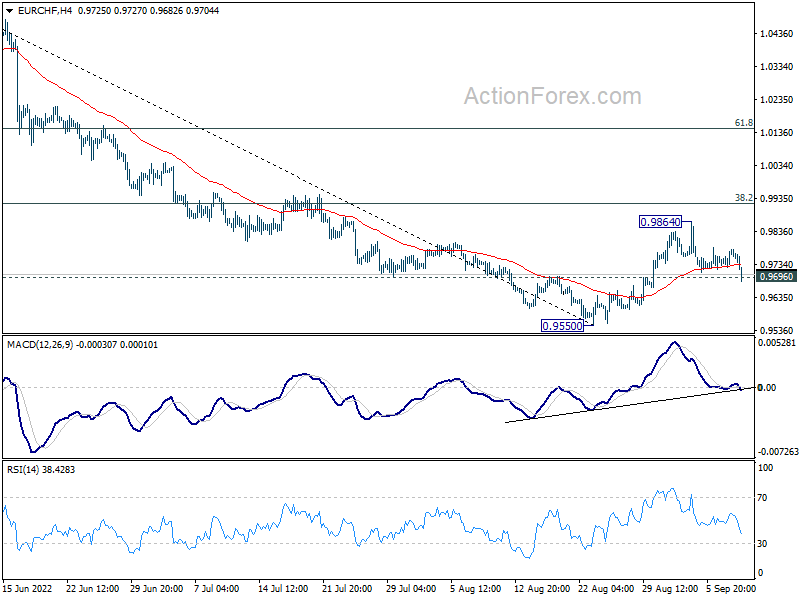
Technically, EUR/CHF's break of 0.9696 minor support could be a sign that Euro sellers are back. Deeper fall is in favor to retest 0.9550 low and break will resume larger down trend. Let's see if that will happen.
In Europe, at the time of writing, FTSE is down -0.68%. DAX is down -1.40%. CAC is down -0.80%. Germany 10-year yield is up 0.082 at 1.658. Earlier in Asia, Nikkei rose 2.31%. Hong Kong HSI dropped -1.00%. China Shanghai SSE dropped -0.33%. Singapore Strait Times rose 0.71%. Japan 10-year JGB yield rose 0.0042 to 0.252.
US initial jobless claims dropped to 222k, vs exp. 243k
US initial jobless claims dropped -6k to 222k in the week ending September 3, lower than expectation of 243k. Four-week moving average of initial claims dropped -7.5k to 233k.
Continuing claims rose 36k to 1473k in the week ending August 27. Four-week moving average of continuing claims rose 10.75k to 1439k.
ECB hikes 75bps, more hikes over the next several meetings
ECB raises the three key interest rates by 75bps today. The main refinancing , marginal lending facility and deposit facility rates are 1.25%, 1.50% and 0.75% respectively. The Governing Council also expects to raise interest rates further over the "next several meetings". Decisions will continue to be "data-dependent" and follow a "meeting-by-meeting approach".
ECB staff projections now show inflation averaging 8.1% in 2022, 5.5% in 2023, and then 2.3% in 2024. Recent data point to a "substantial slowdown" in growth, with the economy expected to "stagnate later in the year and in Q1 of 2023. Staff now projects the economy to grow by 3.1% in 2022, 0.9% in 2023, and then 1.9% in 2024.
RBA Lowe: Case for slower tightening becomes stronger as rate rises
RBA Governor Philip Lowe reiterated in a speech that "further increases in interest rates will be required over the months ahead". But policy is "not on a pre-sent path" due to uncertainties. Also, "all else equal, the case for a slower pace of increase in interest rates becomes stronger as the level of the cash rate rises."
Lowe also highlighted three sources of uncertainty to the economy. The first is the "global economic environment", including the US, Europe and China. He said, "some slowing in the global economy will help bring inflation down, but a sharp slowing would make the job of delivering a soft landing here in Australia much harder."
The second source is "how inflation expectations and the inflation psychology in Australia adjust to the period of high inflation". The third is "how households respond to higher interest rates".
EUR/USD Mid-Day Outlook
Daily Pivots: (S1) 0.9918; (P) 0.9965; (R1) 1.0053; More...
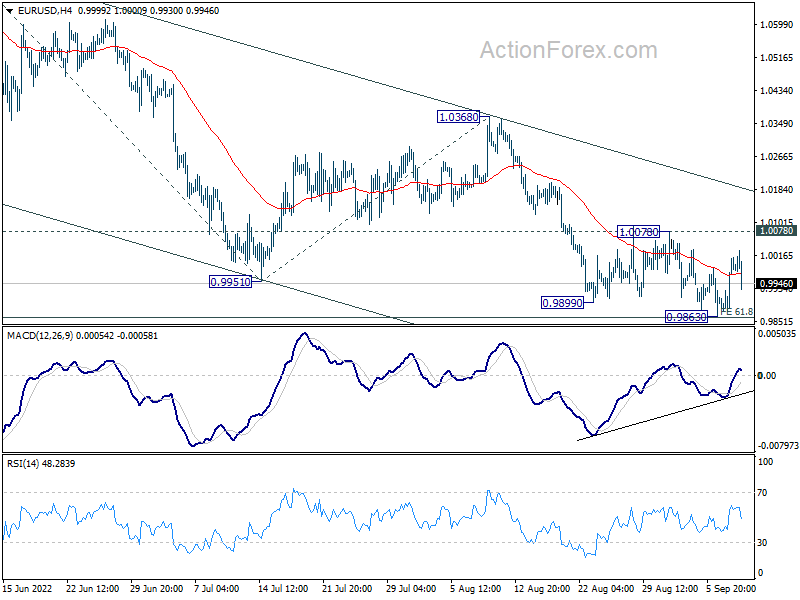
Intraday bias in EUR/USD remains neutral and further decline is expected with 1.0078 resistance intact. Decisive break of 61.8% projection of 1.0773 to 0.9951 from 1.0368 at 0.9860 should prompt downside acceleration to 100% projection at 0.9546. On the upside, however, firm break of 1.0078 will indicate short term bottoming, and turn bias back to the upside for 1.0368 resistance instead.
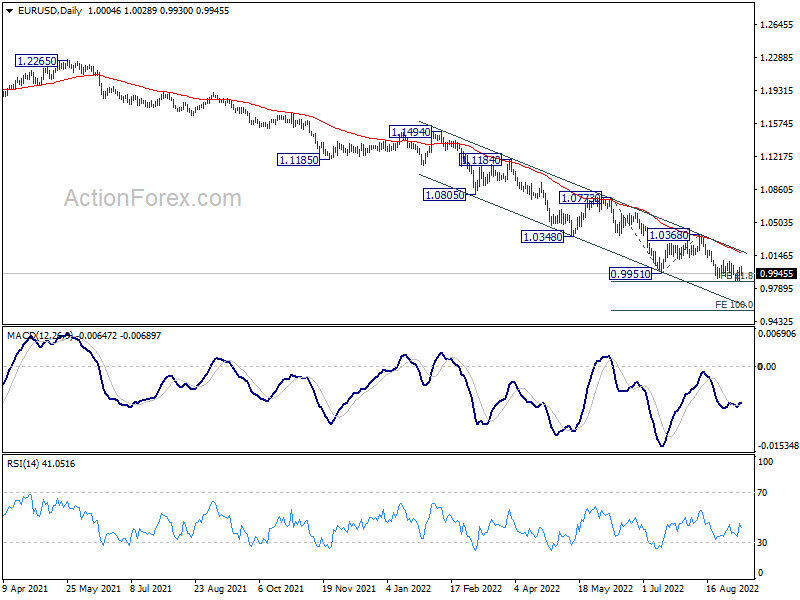
In the bigger picture, down trend from 1.6039 (2008 high) is still in progress. Next target is 100% projection of 1.3993 to 1.0339 from 1.2348 at 0.8694. In any case, outlook will stay bearish as long as 1.0368 resistance holds, even in case of strong rebound.
Economic Indicators Update
| GMT | Ccy | Events | Actual | Forecast | Previous | Revised |
|---|---|---|---|---|---|---|
| 23:01 | GBP | RICS Housing Price Balance Aug | 53% | 61% | 63% | 62% |
| 23:50 | JPY | Bank Lending Y/Y Aug | 1.90% | 1.90% | 1.80% | 1.70% |
| 23:50 | JPY | GDP Q/Q Q2 F | 0.90% | 0.70% | 0.50% | |
| 23:50 | JPY | GDP Deflator Y/Y Q2 F | -0.30% | -0.40% | -0.40% | |
| 23:50 | JPY | Current Account (JPY) Jul | -0.63T | 0.02T | 0.84T | |
| 01:30 | AUD | Trade Balance (AUD) Jul | 8.73B | 14.50B | 17.67B | |
| 05:00 | JPY | Eco Watchers Survey: Current Aug | 45.5 | 44 | 43.8 | |
| 05:45 | CHF | Unemployment Rate Aug | 2.10% | 2.20% | 2.20% | |
| 06:45 | EUR | France Trade Balance (EUR) Jul | -14.5B | -12.2B | -13.1B | |
| 12:15 | EUR | ECB Main Refinancing Rate | 1.25% | 1.25% | 0.50% | |
| 12:30 | USD | Initial Jobless Claims (Sep 2) | 222K | 243K | 232K | 228K |
| 12:45 | EUR | ECB Press Conference | ||||
| 14:30 | USD | Natural Gas Storage | 55B | 61B | ||
| 15:00 | USD | Crude Oil Inventories | -2.0M | -3.3M |
EUR/USD Mid-Day Outlook
Daily Pivots: (S1) 0.9918; (P) 0.9965; (R1) 1.0053; More...
Intraday bias in EUR/USD remains neutral and further decline is expected with 1.0078 resistance intact. Decisive break of 61.8% projection of 1.0773 to 0.9951 from 1.0368 at 0.9860 should prompt downside acceleration to 100% projection at 0.9546. On the upside, however, firm break of 1.0078 will indicate short term bottoming, and turn bias back to the upside for 1.0368 resistance instead.
In the bigger picture, down trend from 1.6039 (2008 high) is still in progress. Next target is 100% projection of 1.3993 to 1.0339 from 1.2348 at 0.8694. In any case, outlook will stay bearish as long as 1.0368 resistance holds, even in case of strong rebound.
GBP/USD Mid-Day Outlook
Daily Pivots: (S1) 1.1449; (P) 1.1494; (R1) 1.1583; More...
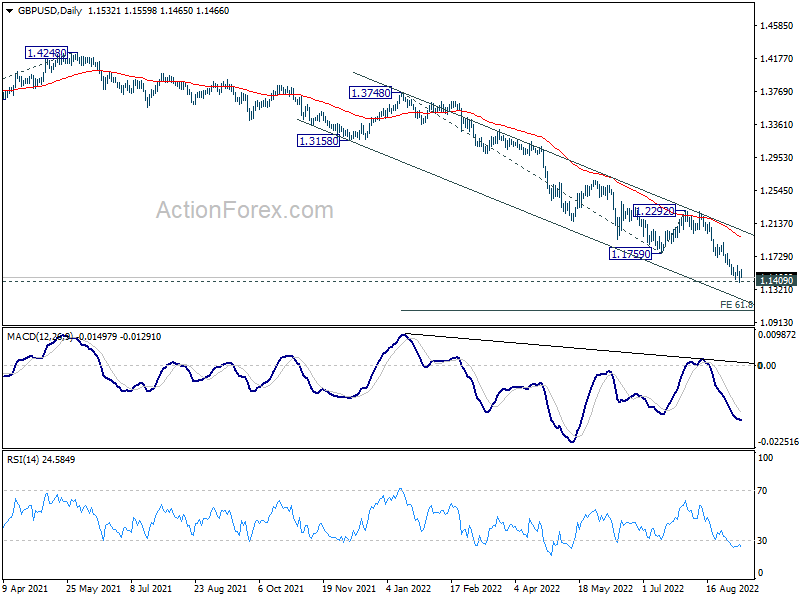
Intraday bias in GBP/USD remains neutral for the moment. Further decline is in favor as long as 1.1608 minor resistance holds. Firm break of 1.1409 will resume larger down trend to 61.8% projection of 1.3748 to 1.1759 from 1.2292 at 1.1063 next. Considering bullish convergence condition in 4 hour MACD, break of 1.1608 will indicate short term bottoming, and turn bias back to the upside for 55 day EMA (now at 1.1956).
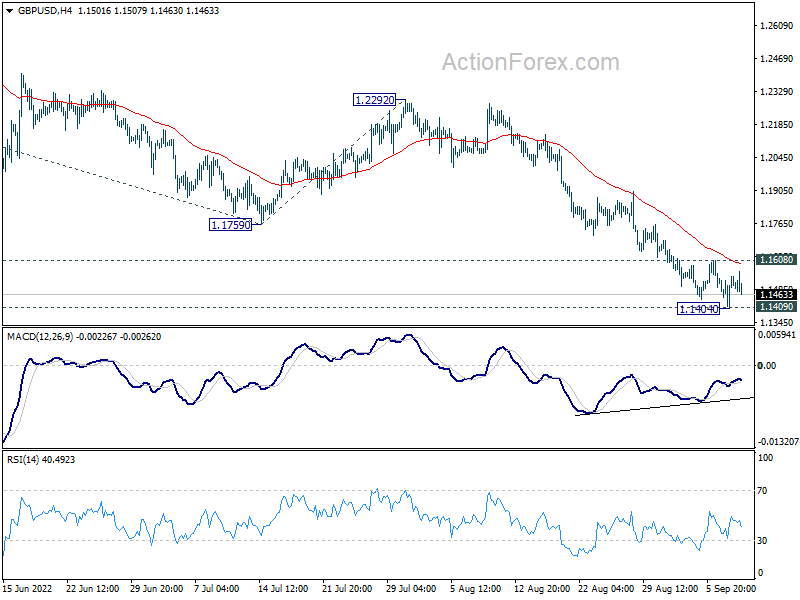
In the bigger picture, based on current momentum, fall from 1.4248 (2018 high) is probably resuming long term down trend from 2.1161 (2007 high). Sustained break of 1.1409 will target 61.8% projection of 1.7190 (2014 high) to 1.1409 (2020 low) from 1.4248 (2021 high) at 1.0675. This will remain the favored case for now as long as 1.2292 resistance holds.
USD/CHF Mid-Day Outlook
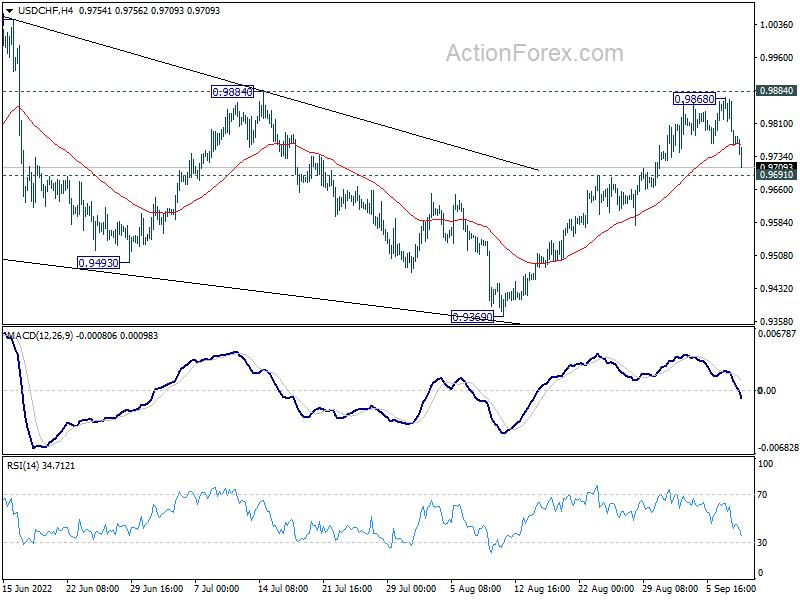
Daily Pivots: (S1) 0.9726; (P) 0.9798; (R1) 0.9836; More...
Intraday bias in USD/CHF stays neutral first and further rally is expected as long as 0.9691 support holds. On the upside, break of 0.9884 resistance will argue that larger up trend is ready to resume through 1.0063 high. On the downside, however, break of 0.9691 minor support will dampen this view and turn bias back to the downside for 0.9369 support instead.
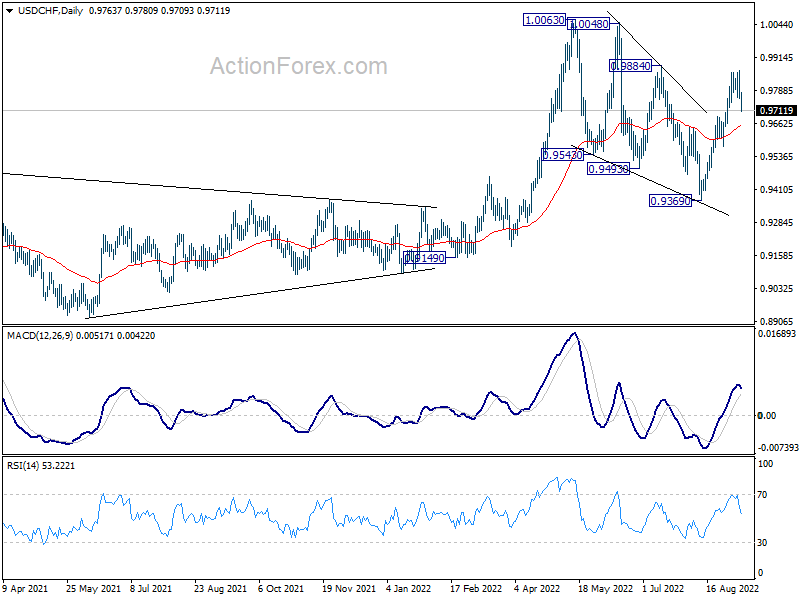
In the bigger picture, current development suggests that up trend from 0.8756 (2021 low) is still in progress. Sustained break of 1.0063 will target 100% projection of 0.9149 to 1.0063 from 0.9369 at 1.0283, and then 1.0342 (2016 high). For now, this will remain the favored case as long as 0.9369 support holds, even in case of deep pull back.
USD/JPY Mid-Day Outlook
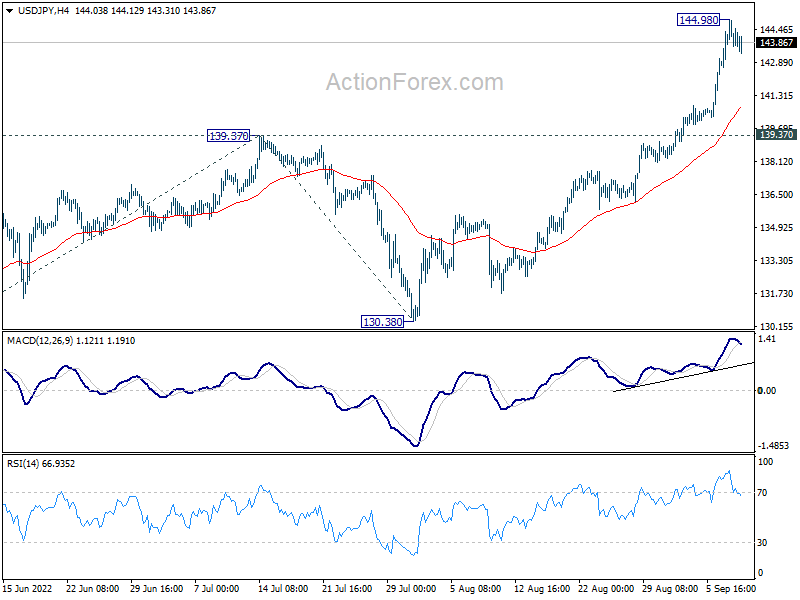
Daily Pivots: (S1) 142.63; (P) 143.81; (R1) 144.94; More...
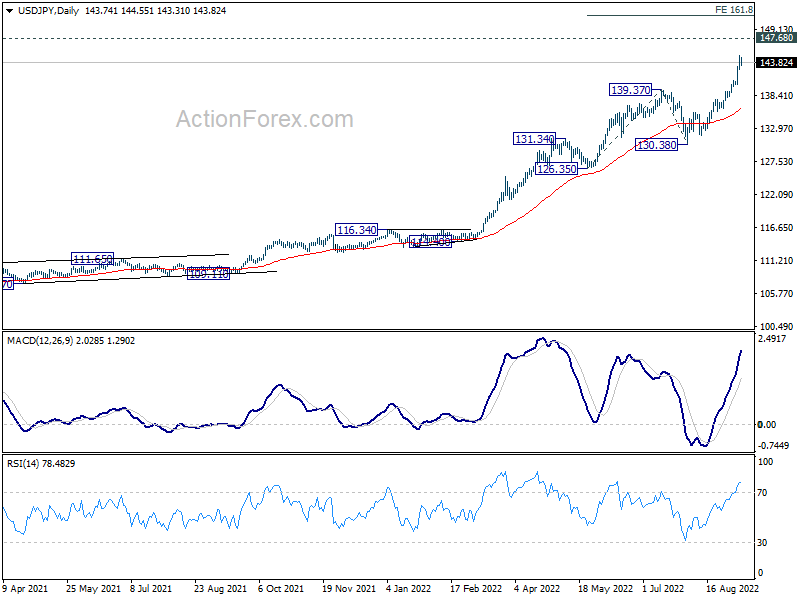
A temporary top is formed at 144.98 in USD/JPY with current retreat. Intraday bias is turned neutral for consolidations. Downside should be contained by 139.37 resistance turned support to bring another rally. Break of 144.98 will resume larger up trend to 147.68 long term resistance. Break there will target 161.8% projection of 126.35 to 139.37 from 130.38 at 151.44 next.
In the bigger picture, up trend from 101.18 is still in progress, as part of the whole up trend from 75.56 (2011 low). Further rise should be seen to 147.68 (1998 high). For now, break of 130.38 support is needed to be the first indication of medium term topping. Otherwise, outlook will stay bullish even in case of deep pull back.