

Sample Category Title
Fed Evans: We need to be increasing interest rates up to a substantially higher level
Chicago Fed President Charles Evans said yesterday, "I think that we've got a good plan in place. We could very well do 75 in September. My mind is not made up. I do know that we need to be increasing interest rates up to a substantially higher level than where they are now."
"I think the precise path is less important than just constantly telling people, we're on this path, this is what we're going to do, inflation is job one, we're going to handle this," Evans said.
"Unemployment is 3.7% right now. I'm optimistic that we're going to be able to navigate this and keep unemployment to about 4.5% by the time we're done," he said. "That would still be a pretty good outcome, although it will be costly for some."
"I would prefer to find an appropriate spot to pause and monitor how things are going, rather than go much higher -- potentially overshoot," he said. "I wouldn't say that I'm advocating sort of pausing at 3.5%, because I think 4 is more likely."
BoC Rogers: We need a period of lower growth to balance things out
BoC Senior Deputy Governor Carolyn Rogers said yesterday, "our primary focus will be to judge how monetary policy is working to slow demand, how fast supply challenges are resolved, and most importantly, how both inflation and inflation expectations respond."
"Because we are in a period of excess demand, we need a period of lower growth to balance things out and bring demand back in line with supply," Rogers said.
"By front-loading interest rates now, we're trying to avoid the need for even higher rates down the road and a more pronounced slowing of the economy," she said.
SNB Jordan: At the moment, franc appreciation tends to help rather than hurt
SNB Chairman Thomas Jordan said yesterday, "you cannot say we have passed the zenith and now it is certainly heading lower. If it comes to a power shortage situation, to a complete gas shortage in Europe, then it cannot be excluded that inflation pressure rises again. You have to be very cautious."
Jordan declined to comment on currency interventions. But he added, "at the moment it is rather so that given the inflationary pressure an appreciation of the franc tends to help rather than hurt."
Cliff Notes: Market Unease Over Inflation Expectations to Persist
Key insights from the week that was.
For Australia, GDP was the focus this week along with the RBA’s September decision and a speech by Governor Lowe. Globally, central bank decisions and views on the outlook remained key.
Q2 GDP for Australia met the market’s expectation at 0.9%, 3.6%yr. As expected, household consumption drove growth in the quarter, consumption’s strong 2.2% gain in the 3 months to June coming as a result of the economy’s progressive re-opening and as spending was supported by both robust nominal income gains and a further reduction in the savings rate. While discretionary services spending remains materially below pre-pandemic levels, in coming months households will feel the full effect of the rapid rise in interest rates and the hit to real incomes from historic inflation, limiting further upside. We continue to expect consumption growth to decelerate to a pace well below trend from Q4 2022 through end-2023, taking GDP growth with it. At December 2023, annual GDP growth is expected to have slowed to just 1.0%yr.
The consequences for growth of an abrupt tightening cycle and the hit to discretionary spending capacity from inflation are clearly on the mind of the RBA. Having taken policy to a broadly neutral stance with a fourth consecutive 50bp increase in the cash rate at their September meeting, the Governor’s decision statement recognised that consumer sentiment is weak and household wealth falling, with “the full effects of higher interest rates yet to be felt in mortgage payments”. As discussed this week by Chief Economist Bill Evans, with policy “normalised”, a slower pace of rate hikes is likely to prove prudent from here.
That being said, with inflation yet to peak and, as per the Governor’s speech, risks remaining for inflation expectations, we are still some way from this hiking cycle ending. Westpac continues to see four further 25bp increases to a 3.35% peak in February 2023 after which the stance of policy is set to remain on hold to end-2023 as inflation retreats back to the top of the RBA’s target range.
Q2’s trade and financial account data is also worthy of comment. In the quarter, the current account widened sharply to a surplus equivalent to 3.0% of GDP as a result of a record trade surplus circa 7% of GDP. The flip-side of the record profitability of our mining sector however is an outsized flow of dividends to foreign shareholders. As a result, Australia’s net income deficit has once again jumped higher to around 4% of GDP, a percentage point above the average since 1980.
Underlying this result though is a favourable structural change in the equity return Australians are receiving from their rapidly growing overseas investments. Highlighting the significance of this trend, over calendar 2021, Australia’s net foreign liabilities declined by 15% of GDP to 36% of GDP with 65% of the reduction the result of equity investment abroad and favourable price changes.
While prices have moved adversely since, presumably this is temporary and, all the while, new capital is being invested. Splitting the equity outflow between direct and portfolio holdings (the difference being whether an investor’s equity interest is more or less than 10%), it becomes apparent that the buoyant appetite of Australian super funds for offshore assets (both listed and unlisted) is a primary driver of this trend, one that is likely to endure. Such a sizeable, steady outflow of capital, with little-to-no immediate offset from distributed returns, could have a substantial and lasting dampening impact on the Australian dollar.
Over in the US, this week’s mixed data highlights the variable conditions faced by businesses across the nation. The ISM services PMI edged higher in August; although respondents seemed cautious on the outlook, with the production and new order indexes printing above 60 as employment held around 50 – the divide between expansion and contraction. In stark contrast, the S&P Global services PMI was very weak, coming in at 43.7, around 3.5 points below the July read. Our take on these two outcomes is that large service providers have the market position and pricing power to weather a weak economy; however, the smaller providers picked up by S&P Global do not. The combined effect seems most likely to be a stagnant economy, the latest Beige Book indicating economic activity was “unchanged, on balance”.
Speaking towards the end of the week, Chair Powell kept to a hard line against inflation. Clear in his remarks was a need to act swiftly against these risks so as to not allow expectations of higher inflation to become entrenched. History suggests this will limit the need for contractionary policy and the ill effects for the economy. For the upcoming September meeting, this points to another outsized increase. Whether it is 50bps (as we currently forecast) or 75bps will depend on the pulse of core inflation in August, due for release next week.
Either outcome will take the fed funds rate to the top end of the FOMC’s neutral range for policy, allowing a return to 25bp increments for the remaining hikes of the cycle. To our mind, given underlying inflation dynamics and the absence of activity growth, 3.375% at end-2022 is the most appropriate peak rate for this cycle, particularly as it is to be held for 12 months. Though, the market continues to see modest risk of a higher peak, and some FOMC members agree. 75bp increases by both the Bank of Canada and European Central Bank this week (following 100bp and 50bp hikes respectively at their last meetings) fanned these expectations.
Looking more closely at the ECB’s decision, concerns around the intensity and breadth of inflation and the risk of de-anchoring inflation expectations were clearly front-of-mind for the Committee. Indeed, they now see annual headline inflation at 8.1% in 2022 and holding above target to end-2024. Regarding growth, the ECB’s sanguine baseline view sees output growth only stalling to March 2023 before a robust rebound takes hold, with 1.9% growth forecast through 2024.
However, these outcomes depend heavily on how current risks evolve. The ECB knows this well and estimates that a “downside scenario” – involving protracted conflict and compromised energy security – could see growth print 2ppts lower over the forecast horizon relative to their baseline projection. That inflation is not expected to be materially different in such circumstances supports the ECB’s intent to deliver further rate hikes into year-end, the pace and scale of which will depend critically on incoming data.
USD/JPY Consolidates, Signs of Downside Correction Emerge
Key Highlights
- USD/JPY rallied and traded to a new multi-year high close to 145.00.
- A connecting bullish trend line is forming with support near 143.00 on the 4-hours chart.
- EUR/USD recovered a few points, but faced sellers near 1.0060.
- Gold and oil price might struggle to start a steady recovery wave.
USD/JPY Technical Analysis
The US Dollar started a major increase above the 140.00 resistance against the Japanese Yen. USD/JPY cleared the 142.00 resistance to continue higher.
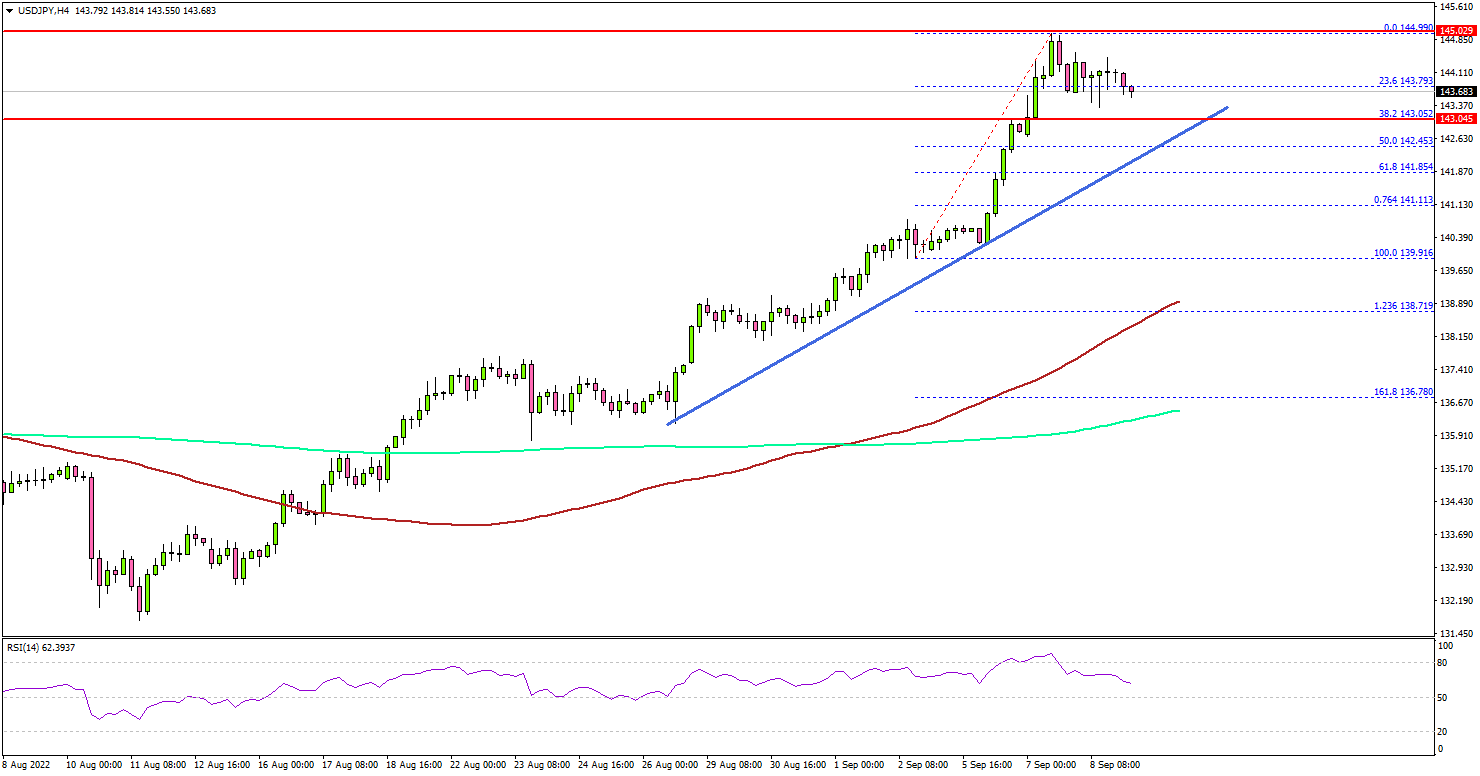
Looking at the 4-hours chart, the pair settled above the 142.50 level, the 100 simple moving average (red, 4-hours), and the 200 simple moving average (green, 4-hours).
The pair even climbed above the 144.00 level. It traded to a new multi-year high close to 145.00 and recently started a consolidation phase. If the bulls remain in action, the pair could even clear the 145.00 resistance.
The next major resistance is near 146.20, above which the pair may perhaps rise towards the 147.50 level. The main hurdle sits near the 150.00 level.
If there is a downside correction, the pair might find bids near the 143.50 level. There is also a connecting bullish trend line forming with support near 143.00 on the same chart. A downside break below the trend line support might spark more losses.
The next major support is near the 142.50 level, below which the pair could even test the 142.00 level. Any more losses might send USD/JPY towards the 140.00 support.
Looking at crude oil price, there was a sharp decline below the 85.80 support zone and traded close to the $81.20 support.
Economic Releases
- Canada’s employment Change payrolls for August 2022 – Forecast 15K, versus -30.6K previous.
- Canada’s Unemployment Rate for August 2022 - Forecast 5.0%, versus 4.9% previous.
EURJPY Wave Analysis
- EURJPY reversed from key resistance level 144.30
- Likely to fall to support level 142.00
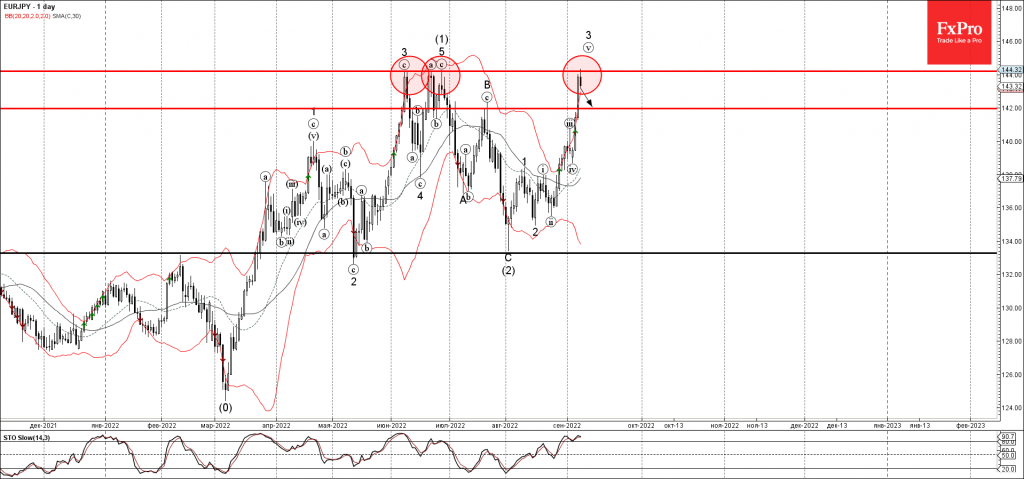
EURJPY currency pair recently reversed down from the key resistance level 144.30 (which has been reversing the price from the start of June) standing above the upper daily Bollinger Band.
The downward reversal from the resistance level 144.stopped the previous impulse waves (v), 3 and (3).
Given the overbought daily Stochastic – EURJPY can be expected to fall further toward the support level 142.00 (top of wave B from July).
GBPCHF Wave Analysis
- GBPCHF broke key support level 1.1300
- Likely to fall to support level 1.1100
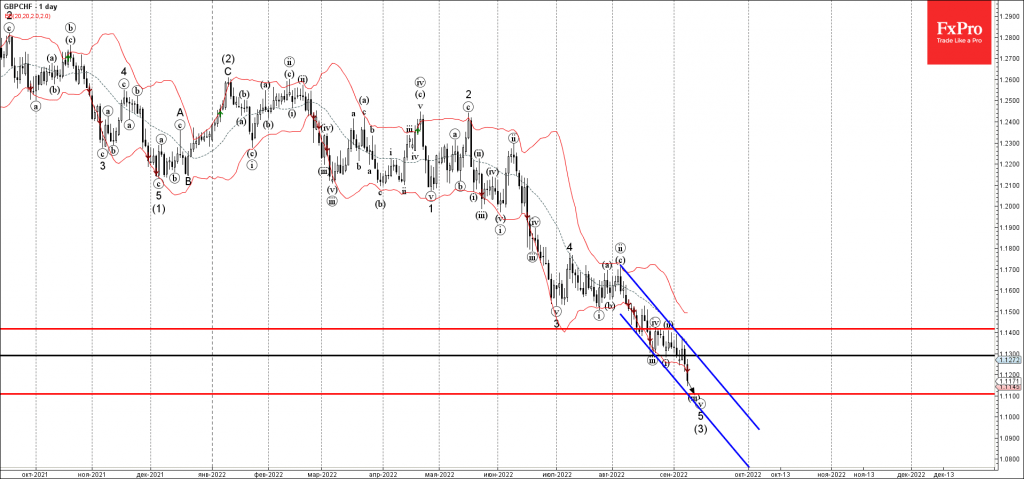
GBPCHF currency pair recently broke through the key support level 1.1300 (which stopped the earlier minor impulse waves (iii) and (i)).
The breakout of the support level 1.1300 accelerated the active impulse waves (iii), 5 and (3).
Given the clear daily downtrend and strong Swiss franc bullishness seen today – GBPCHF can be expected to fall further toward the support level 1.1100 (target for the completion of the active impulse waves (iii), 5 and (3).)
Eco Data 9/9/22
[php_everywhere instance="1"]
Upcoming China Inflation and Commodity Demand
Earlier this week, the PBOC made a "surprise" announcement cutting the reserve requirement ratio (RRR) for banks. The "surprise" is in quotes, because even though it wasn't pre-announced, the economic situation was such that a lot of analysts were speculating that it was just a matter of time. The economic situation in China has been moving in such a way that a move like that was necessary.
The yuan has been moving higher, getting close to hitting the 7.0 handle, which hasn't been seen since the middle of 2020. The action by the PBOC could be expected to weaken the currency, potentially leading the exchange rate above that key level. That has potential implications for quite a few other currencies in the region.
Why it matters
The RRR is the PBOC's main policy tool. Essentially, it regulates how much money banks can loan out by varying the level of currency they must keep in reserve. Because banks create money on debt, this has multiplying effects on the amount of money in circulation. A cut in the rate implies more inflationary pressure; and an increase implies further monetary tightening.
Which is why there is increased attention on the data expected tomorrow. China July inflation rate is expected to come in at an annual 2.8% compared to 2.7% prior. But it comes on the basis of a deceleration in the monthly rate to 0.2% from 0.5% prior. Meanwhile, producer prices are expected to slow down to 3.1% from 4.2% prior.
The broader effects
China's economy has been under pressure due to rolling lockdowns. Just this morning, the second largest city, Chengdu, announced that it would extend lockdowns as the number of covid cases increased. With inflation creeping up and the economy facing challenges, the PBOC has to decide whether it's going to prioritize supporting the economy or keeping inflation under wraps.
The latest moves of the PBOC suggest the former. Last month, they lowered the Loan Prime Rate (the other primary policy tool), and last week the China Economic Daily called for another cut. This would make it easier for borrowers to get credit, potentially supporting the economy. But, also increasing the monetary base.
What it means for commodity currencies
With lower interest rates and rising inflation, naturally the yuan has been weakening. This might help improve the situation for exports, assuming that factories can produce in light of the lockdowns. But it also makes it harder for Chinese firms to import raw materials, because of higher cost.
Part of this problem can be mitigated by buying in yuan, such as energy from Russia as was recently agreed. But it might mean that there will be less demand for Australian and New Zealand exports. On the other hand, the increased capital expenditure could help Japanese machinery exports.
Fed Powell: We need to act now, strongly as we have be doing
Fed chair Jerome Powell said in a conference, "We need to act now, forthrightly, strongly as we have been doing (on inflation). My colleagues and I are strongly committed to this project and will keep at it."
"Demand is very, very strong still in the labor market. We're still printing new payroll job numbers at a high level, wages are running at elevated levels," Powell said. "By our policy interventions, what we hope to achieve is a period of growth below trend, which will cause the labor market to get back into better balance, and that will bring wages back down to levels that are more consistent with 2 per cent inflation."
"It is very important that inflation expectations remain anchored," Powell said. "The longer that inflation remains well above target the greater the concern that the public will start to just naturally incorporate higher inflation into its economic decision making,. Our job is to make sure that doesn't happen."