Sample Category Title
Is Bitcoin making a comeback? It needs to be proven
Market picture
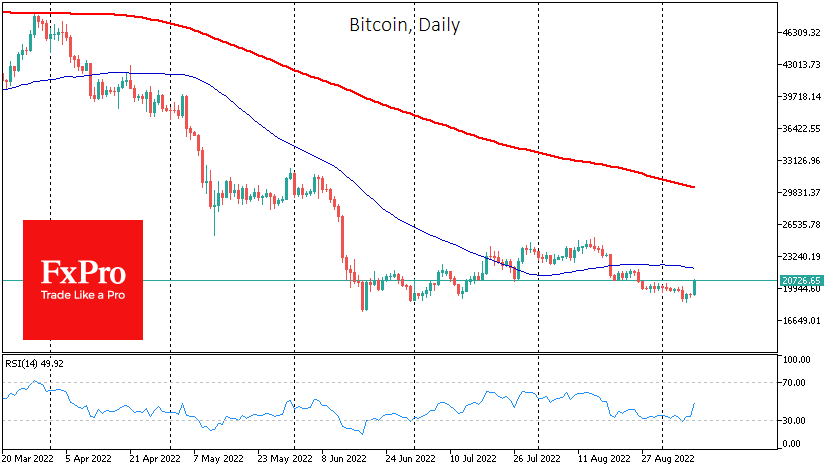
Bitcoin was little changed on Thursday, ending around $19,400, but added more than 7% on Friday morning. So, in a period with relatively low liquidity, the BTCUSD has won back over two weeks of a slow slide down in one move.
Does this look like a reversal? For now, it is more like an attempt to make a pump in a low-liquid market. However, closing the week at current or higher levels would be a bullish sign, but it would be premature to turn bullish before.
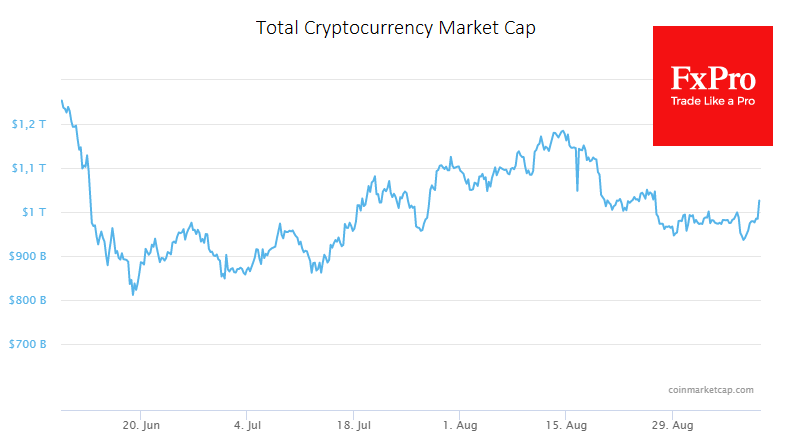
The overall capitalisation of the crypto market is adding 5.7% as it has yet to keep up with the flagship. However, there is a local victory here as well – crossing the 1 trillion mark – which needs to be held at least until the end of the week before we can talk about a bullish victory.
News background
The number of institutional investors in Ethereum could grow after the move to PoS due to more attractive returns, according to Chainalysis. Stacking ETH would offer investors up to 10-15% per annum, making it an attractive alternative to bonds.
Former BitMEX CEO Arthur Hayes suggested that if The Merge update is successful, Ethereum will reach the $3,000 mark this year. According to him, a sharp decline in the coin’s issuance rate would boost ETH’s growth.
According to Coincub research, Germany is the best country for crypto investors in terms of tax policy, whereas Italy, Switzerland, Singapore, and Slovenia follow.
Pound Soars as US Dollar Retreats
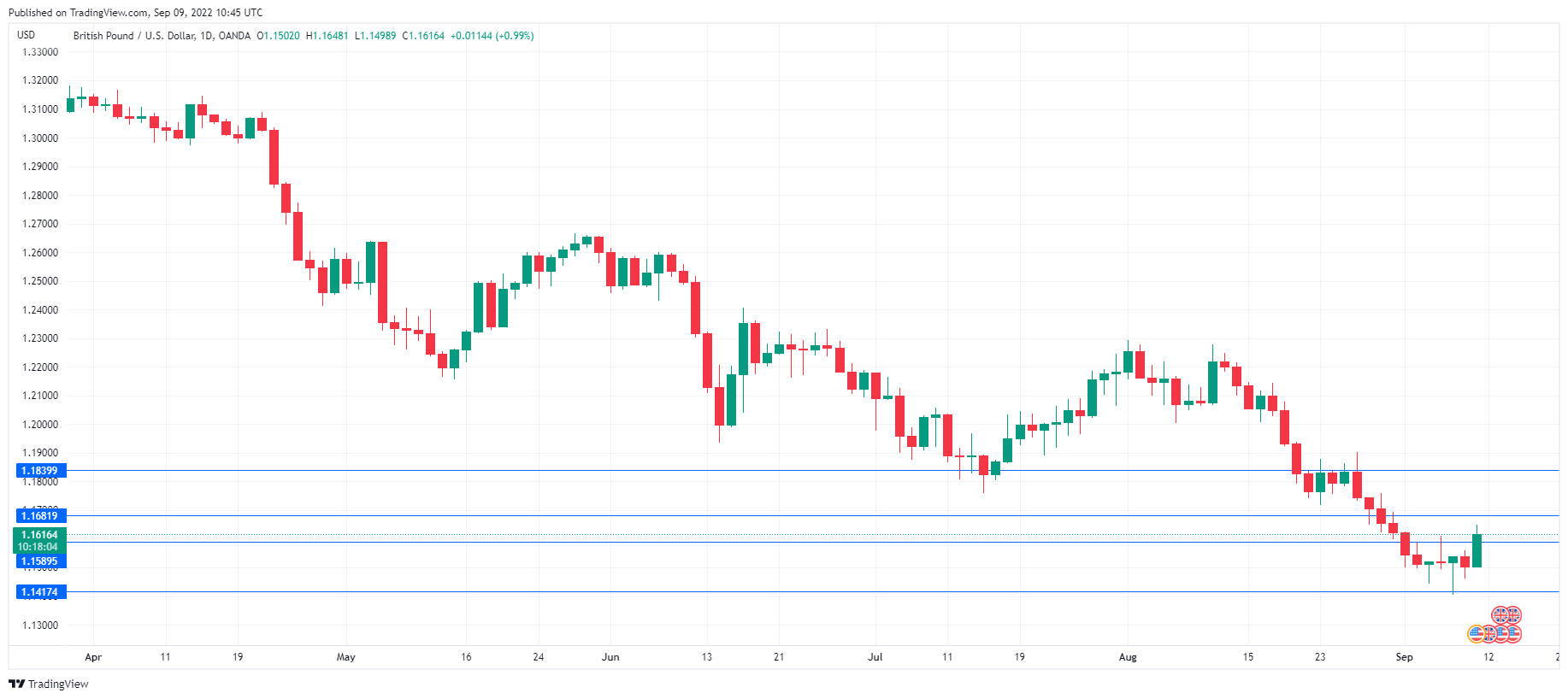
GBP/USD has recorded sharp gains today. In the European session, GBP/USD is trading at 1.1608, up 0.92% on the day. Still, the pound remains vulnerable – on Wednesday, it fell to 1.1407, its lowest level since 1985. Looking ahead to next week, there is a data dump on Monday, with GDP and Manufacturing Production the key events.
It’s a very light calendar today, with no UK data and only one minor US event. Even so, the British pound has jumped on the bandwagon as the US dollar is broadly lower. The US dollar has taken a break after some impressive gains, as the pound has fallen some 500 points in just three weeks. With the US economy in good shape while the UK struggles, GBP/USD could resume its downtrend shortly.
In the UK, PMIs have been pointing to weak conditions across the economy. The August manufacturing and construction PMIs pointed to contraction, with readings below the neutral 50.0 line. The Services PMI managed to remain in expansion territory, but just barely, at 50.9. Inflation remains red hot, hitting 10.1% in July, which has caused a severe cost-of-living crisis.
Incoming Prime Minister Truss has pledged to cap energy bills, at a cost of some 132 billion pounds, which will provide households with some badly-needed relief. Truss inherits a struggling economy and her initial policy moves will be closely watched. Deutsche Bank has warned that an “unfunded and untargeted fiscal expansion” by the new government could raise inflation expectations and lead to a “sterling crisis”.
What’s next for the Federal Reserve? The next meeting is on September 21st, with the Fed looking to raise rates by either 50 or 75 basis points. Next week’s inflation report could be a major factor in the Fed’s decision. Fed Chair Powell and other members have stated that curbing inflation is “priority number one”, and if inflation falls, it will raise speculation that the Fed plans to ease up, which would weigh on the US dollar. In July, inflation unexpectedly fell, and market exuberance about a change in Fed policy sent the US dollar sharply lower, despite the Fed saying its stance had not changed.
GBP/USD Technical
- 1.1589 has switched to support. Below, there is support at 1.1417
- There is resistance at 1.1682 and 1.1839
EUR/USD: Recovery Gains Traction But Looks for Further Positive Signals
Recovery picks up on Friday and cracks 1.01 barrier, driven by a hawkish stance from the ECB, following central bank’s decision to raise interest rates by 75 basis points and remaining on track for further tightening, along with weaker dollar, dented by tough rhetoric from Japan, warning about intervention to stop the free fall of yen.
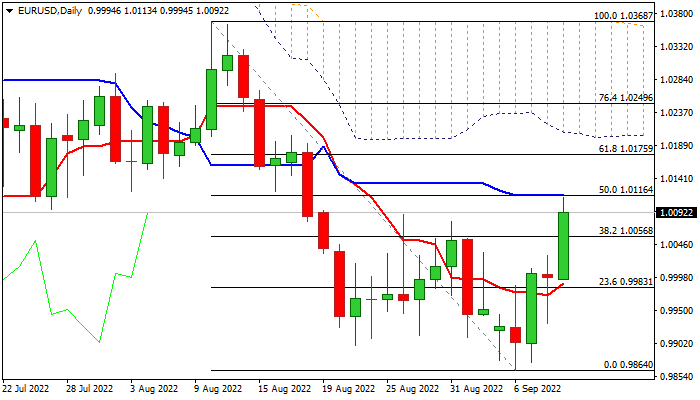
Strong rise of bullish momentum on daily chart and break above pivotal Fibo barrier at 1.0056 (38.2% 1.0368/0.9864) underpin the action, which faces headwinds from daily Kijun-sen (1.0116).
Bulls need to register a weekly close above Aug 26 spike high at 1.0089 to keep positive bias for extension towards daily cloud base (1.0201).
Caution on return and close below 20DMA (1.0016) that would signal possible recovery stall.
Res: 1.0116; 1.0154; 1.0173; 1.0201.
Sup: 1.0056; 1.0016; 1.0000; 0.9983.
GBP/USD: Cable Bounces to the Highest in Sep on Profit Taking, Weaker Dollar
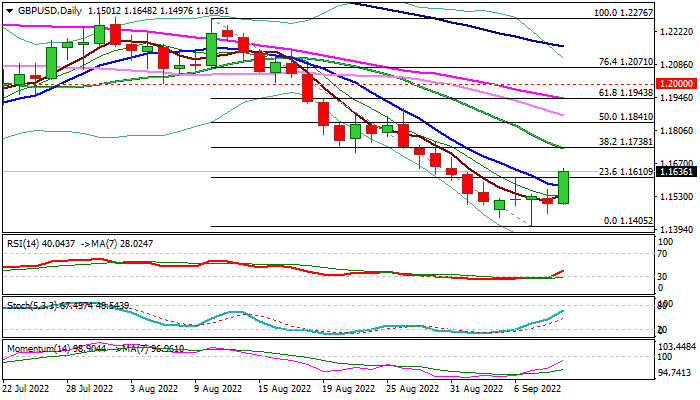
Cable jumps above 1.16 barrier on Friday, hitting the levels last traded on Aug 31, as dollar bulls started to lose steam, additionally deflated by intervention signals from Japan.
Fresh advance was sparked by a profit-taking after sterling hit the lowest in 37 years on Wednesday, but the action was strongly rejected at this zone and is likely to fail to register a weekly close below cracked key support at 1.1410 (2020 low).
Renewed optimism has been fueled by the action from new UK PM Liz Truss, who decided to cap soaring consumer energy bills for two years, to cushion strong negative impact from the energy crisis caused by the war in Ukraine and sanctions on Russia.
Improving daily techs on price’s rally above 1.1584/1.1610 pivots (10DMA / Fibo 23.6% of 1.2276/1.1405 bear-leg) and 14-d momentum in steep ascend, underpin near-term action.
The pair is on track for the first weekly gain after three consecutive weeks of losses, with initial positive signal to be boosted by close above 1.1600 zone, though verification of the signal will require extension and break of next key barrier at 1.1738 (Fibo 38.2%, reinforced by falling 20DMA).
Stronger recovery so far looks as a likely scenario, as weekly and monthly studies are oversold and fundamentals started to improve, although larger picture remains firmly bearish and the outlook is negative, suggesting that bounce would just provide better levels to re-enter bearish market.
Res: 1.1693; 1.1738; 1.1760; 1.1841.
Sup: 1.1610; 1.1584; 1.1536; 1.1497.
USD/JPY: Intervention Warnings Lift yen from 24-Year Low
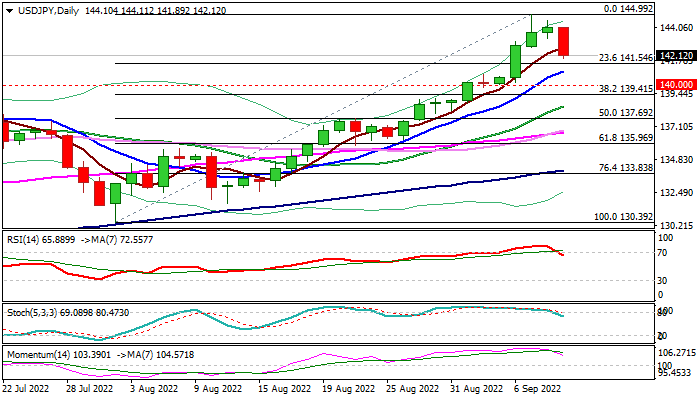
The USDJPY accelerates lower in European trading on Friday, (down 1.4% for the session), as Japanese officials ramped up warnings about possible intervention to stop yen’s strong fall, as the currency hit the lowest in 24 years against the dollar and eyes 1998 peak at 147.68.
The widening gap between the Bank of Japan and US Federal reserve policies was the main reason of yen’s fall, as the US central bank maintains very hawkish stance and remains on track for further rate hikes, while the BoJ sticks to its ultra-loose monetary policy.
Fresh weakness leads the pair towards the first bearish daily close after ten straight days of gains, with growing signs of correction from lose of bearish momentum on daily chart and stochastic and RSI indicators heading south after reversing from overbought territory.
Bears eye pivotal support at 141.54 (daily Tenkan-sen / Fibo 23.6% of 130.39/144.99 rally), break of which is needed to confirm initial bearish signal and open way for deeper correction and expose psychological 140 support.
Otherwise, pullback’s stall at this zone would signal that larger bulls remain fully in play and just taking a breather before resuming.
Res: 142.67; 143.31; 144.11; 144.99.
Sup: 141.89; 141.54; 141.02; 140.00.
USD/CAD Slides ahead of Canada Employment Data
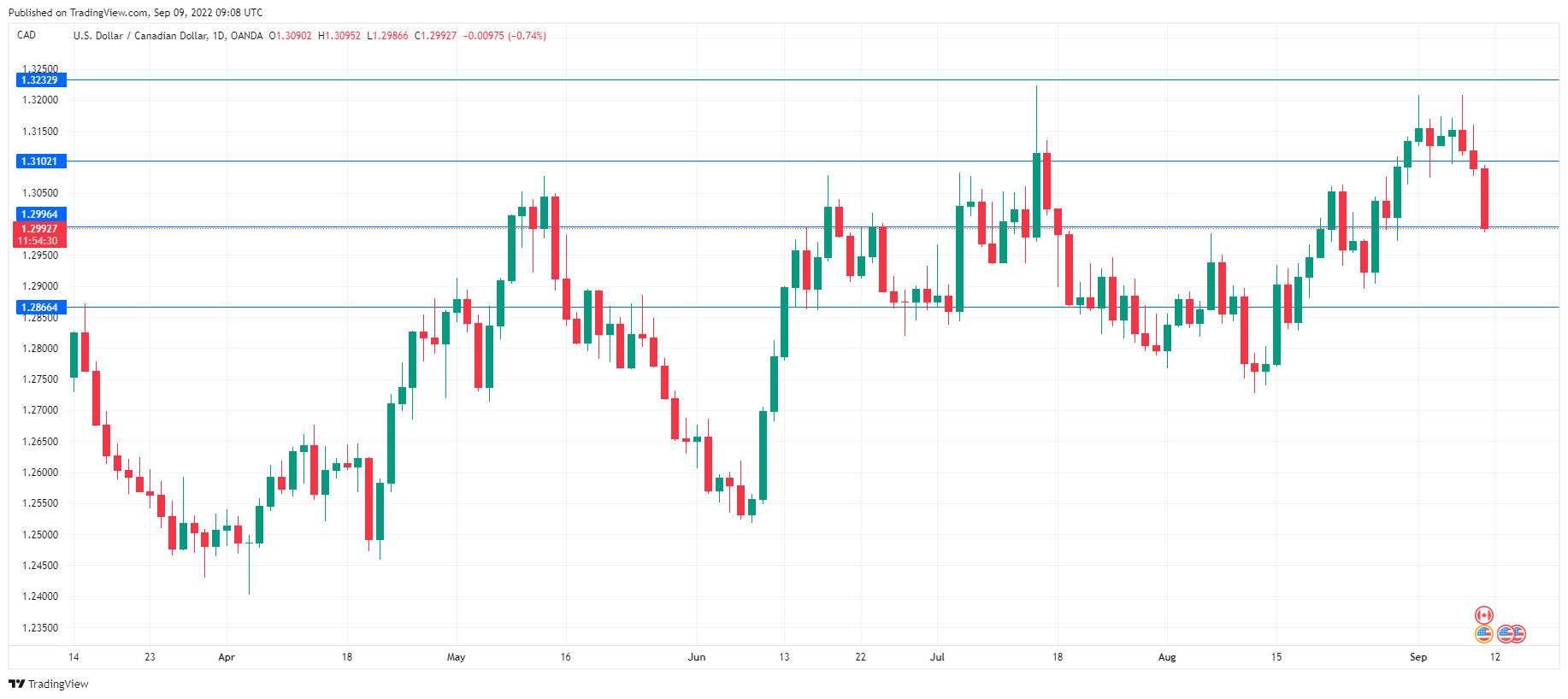
The Canadian dollar usually is calm prior to the North American session, but USD/CAD has posted steady gains in the Asian and European sessions. USD/CAD is trading at 1.2993, down 0.73% on the day.
Canada’s job market expected to rebound
Canada releases the August employment report later today, with a market consensus of 15.0 thousand. The economy has shed jobs over the past two months, as the labour market appears to be losing momentum. This could affect future rate policy, as a weaker labour market may force the BoC to ease up on rate hikes earlier than it would like.
The BoC delivered a 0.75% hike this week, following the super-size 1.00% increase in July. This brings the benchmark rate to 3.25%, the highest rate among the major central banks. Governor Macklem has said that the BoC is committed to front-loading rate increases now in order to avoid even higher rates down the road, which means that the Bank can relax in October, with a 0.25% hike or possibly no move at all. Inflation in July surprised by dropping to 7.6%, down from 8.1% in June. It’s too early to determine if inflation has peaked based on one release, but another decline would signal that tighter policy is bringing down inflation, which would allow the Bank to ease up on rate hikes.
The BoC considers its neutral rate around 2.50%, and with the benchmark rate currently at 3.25%, the Bank’s policy is currently restrictive. This should dampen growth as well as inflation. Canada’s economy grew by 3.3% in Q2, below the estimate of 4.4%, but still a positive signal that the BoC could succeed in its delicate task of guiding the slowing economy to a soft landing.
USD/CAD Technical
- There is resistance at 1.3102 and 1.3232
- USD/CAD is testing support at 1.2996, followed by support at 1.2866
EUR/USD is Showing Positive Signs above $ 1.0084
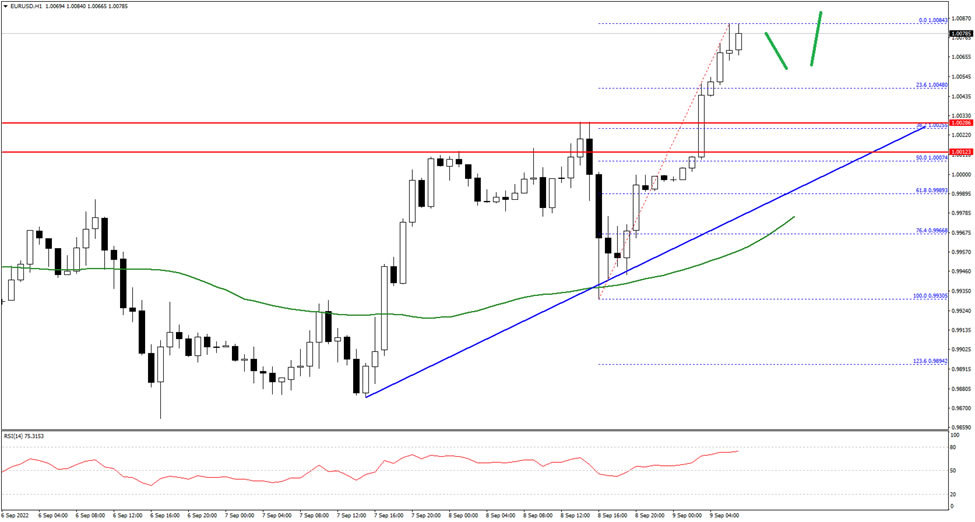
The Euro started an upside correction from the 0.9870 level against the US Dollar. The EUR/USD pair was able to clear the 0.9920 and 0.9950 resistance levels.
There was close above the 1.0000 level and the 50 hourly simple moving average. The pair is now showing positive signs and traded as high as 1.0084. An immediate resistance on the upside is near 1.0085. The first major resistance is near the 1.0100 level.
The next major resistance is near the 1.0120 level. A break above the 1.0120 resistance level could start a decent upward move. In the stated case, it could even surpass 1.0200 on FXOpen.
Conversely, the pair might start another decline below 1.0050. The next key support is near 1.0000, below the pair could decline towards the 0.9980 level. Any more losses might send the pair towards the 0.9920 level.
ECB Knot: we only have one problem on our plate – inflation
ECB governing council member Klaas Knot told Dutch radio BNR today, "We expect inflation to keep rising in the coming months, so that means we only have one problem on our plate: inflation. And that will mean that we will have to slow economic growth at least a bit to reduce inflation".
Another Governing Council member Peter Kazimir said , "Inflation remains unacceptably high. The priority now is to vigorously continue the normalization of monetary policy." While not commenting on the terminal rate of the current cycle, he said that ECB was still "quite far" from neutral rate.
Francois Villeroy de Galhau said, the central bank must be "orderly and determined" with rate hike. He expects inflation to stay high next year and come back to 2% target by 2024.
US Oil: Intermediate Correction Completion Hints at a Price Rise in a New Impulse
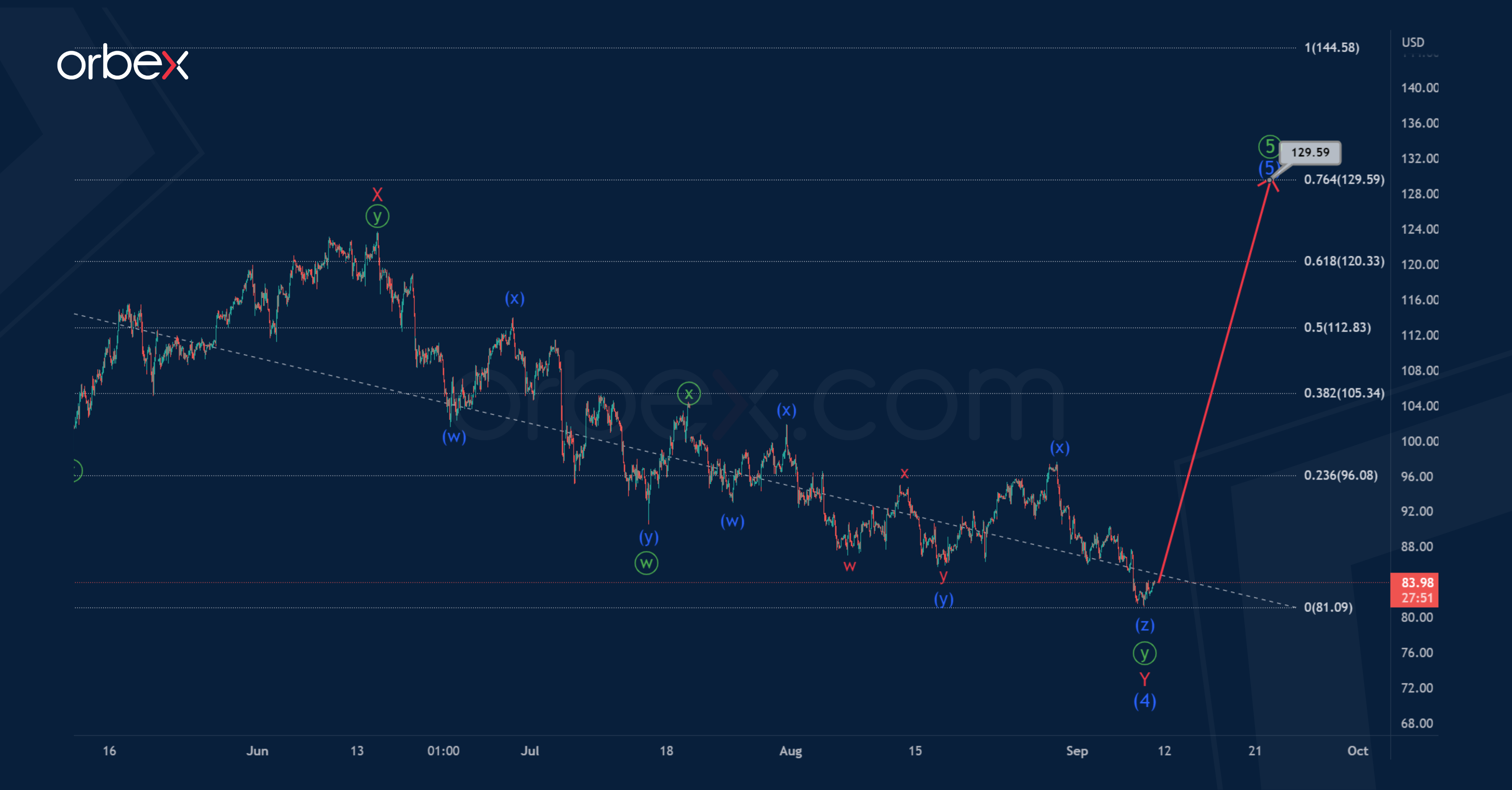
USOIL suggests the development of the final part of the global impulse wave a of the cycle degree.
The 1H timeframe shows the markup of the final primary wave ⑤, which takes the form of an intermediate impulse.
An intermediate correction (4) in the form of a minor double zigzag may have been completed recently. Thus, in the last section of the chart, we see that the price has started to rise in the intermediate wave (5). It is assumed that the intermediate wave (5) will take the form of a standard impulse.
The end of the specified pattern is possible near 129.59. At that level, wave (5) will be at the 76.4% Fibonacci extension of impulse (3).
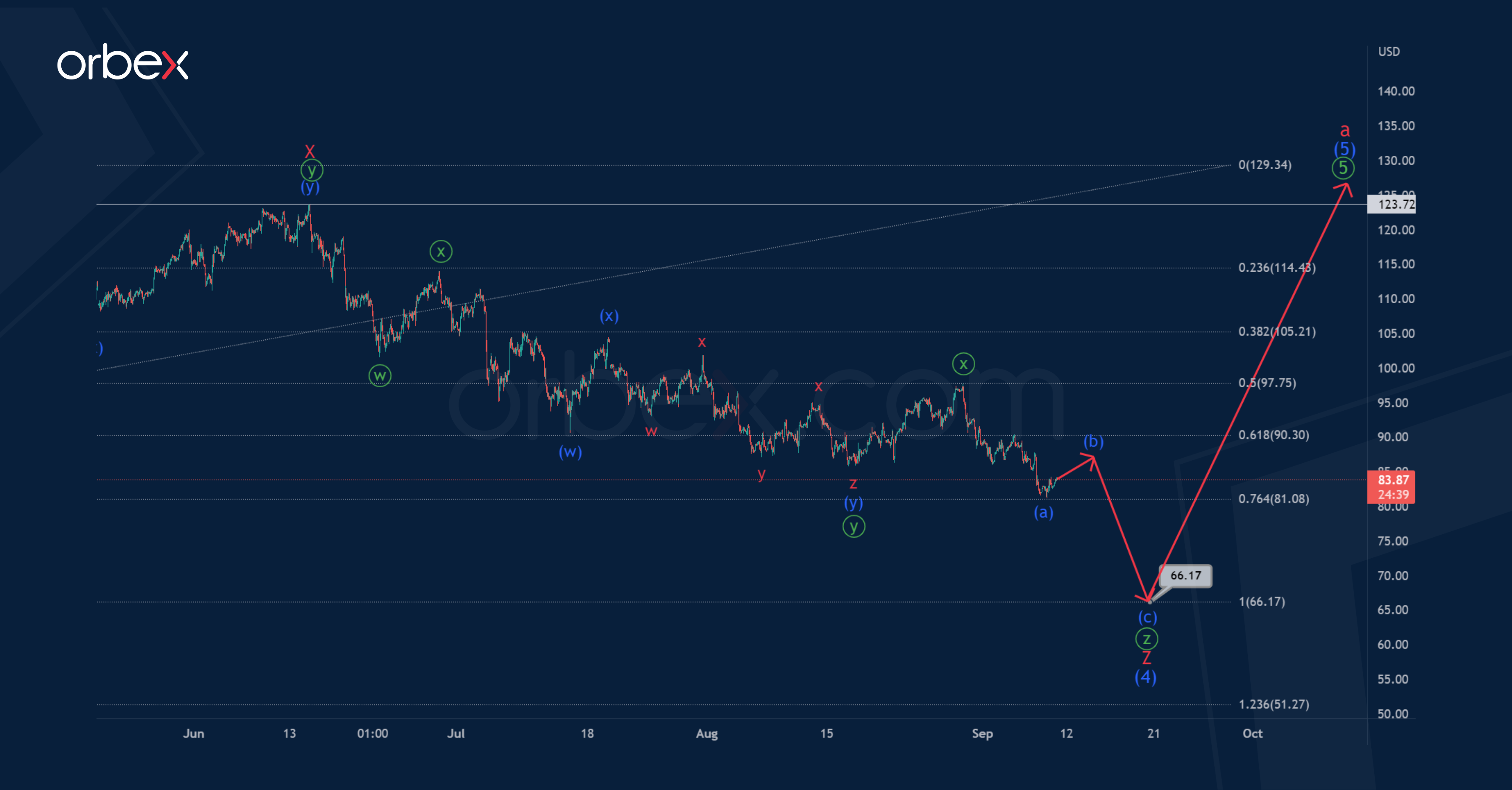
However, the construction of the intermediate correction (4) can be continued. Thus, let's consider the second scenario. Perhaps it will have the form of a triple zigzag W-X-Y-X-Z.
The minor sub-waves W-X-Y-X look complete. Thus, in the near future, the downward movement is expected to continue in the actionary wave Z, which can be completed in the form of a minute triple zigzag ⓦ-ⓧ-ⓨ-ⓧ-ⓩ.
The price of oil may fall to the level of 66.17.
After reaching this level, the market is expected to grow above the maximum – 123.72.
ECB Hike Sends Euro Soaring
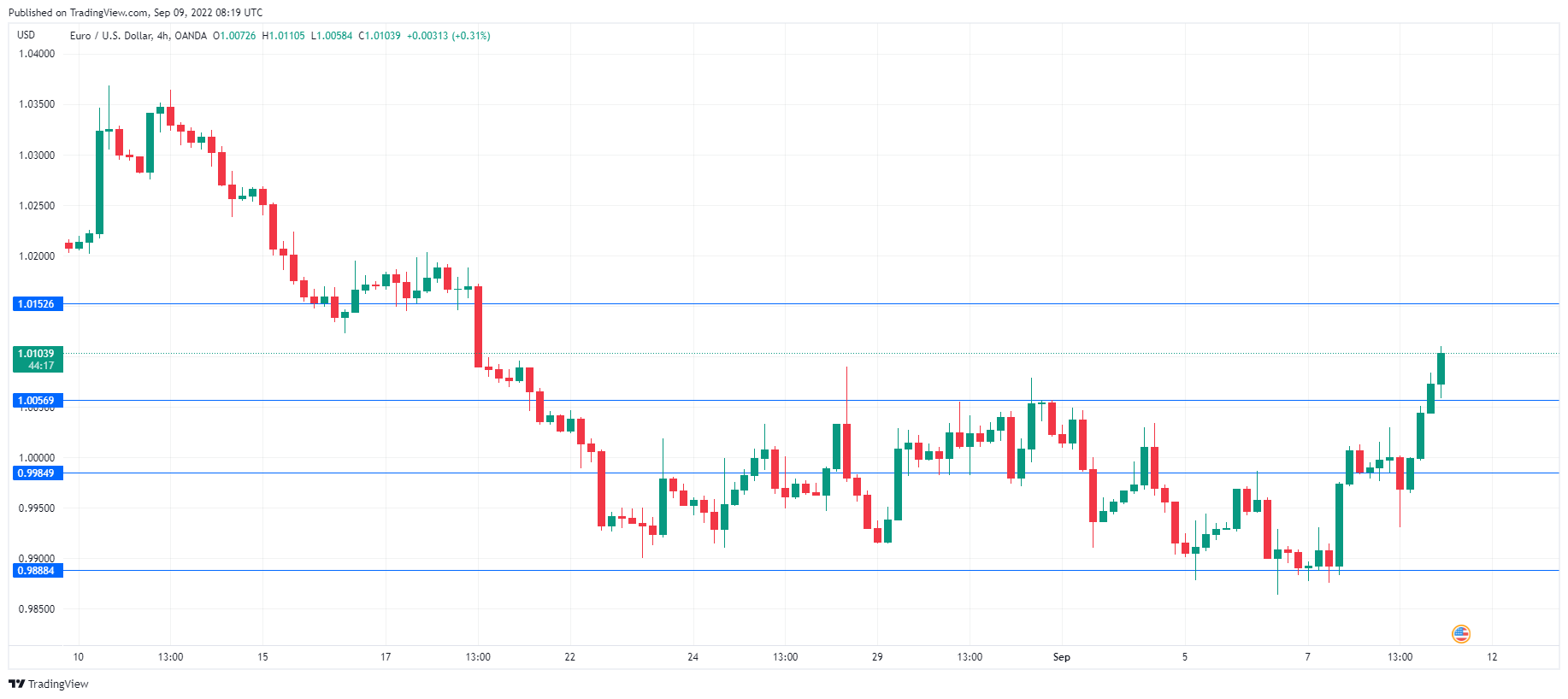
EUR/USD hasn’t posted a winning week since August, but a spectacular rise today should put that trend to rest. In the European session, the euro is trading at 1.0102, up an impressive 1.03%.
ECB delivers
There were plenty of expectations ahead of Thursday’s ECB meeting, as the markets waited to see if the ECB would raise rates by 0.75% or play it safe with a smaller hike. Earlier in the week, eurozone yields and the euro dropped on reports that the ECB was looking at a 0.60% increase. In the end, the ECB came out with all guns firing, raising rates by 0.75% for only the second time in its history.
The main driver behind the dramatic move is spiralling inflation, which hit 9.1% in August. The ECB is lagging behind other central banks, with the benchmark rate currently at 1.25%. This will not tame inflation, and at the meeting, the ECB revised upwards its inflation forecast for 2023, from 3.5% to 5.5%. At the same time, the ECB is sending a powerful message that it is serious about curbing inflation by tightening, even at the risk of a recession. Investors have reacted positively to the move, sending the euro sharply higher.
What’s next for the ECB? Christine Lagarde was unambiguous when said that she is planning more rate hikes “because inflation remains far too high and is likely to stay above our target for an extended period”. Lagarde went further, saying there could be up to four more hikes in the current rate-tightening cycle. The markets have priced in 0.50% increases for the October and December meetings.
Lagarde & Co. have clearly shown that they are willing to pay the price for higher rates, which is weaker growth that could result in a recession. The weak economic climate in Germany and the eurozone has been exacerbated by a potential energy crisis, with Russian President Putin declaring yesterday that he might cut off energy exports to Western Europe. Putin may or may not be bluffing, as the eurozone scrambles to find alternatives to Russian oil and gas before winter.
EUR/USD Technical
- There is resistance at 1.0056 and 1.0152
- 0.9984 has switched to support, followed by 0.9888