Sample Category Title
Summary 9/12 – 9/16
Monday, Sep 12, 2022
[php_everywhere instance="1"]
Tuesday, Sep 13, 2022
[php_everywhere instance="2"]
Wednesday, Sep 14, 2022
[php_everywhere instance="3"]
Thursday, Sep 15 2022
[php_everywhere instance="4"]
Friday, Sep 16 2022
[php_everywhere instance="5"]
Weekly Economic & Financial Commentary: Quiet Data Week Ahead of Critical CPI Report
Summary
United States: Quiet Data Week Ahead of Critical CPI Report
- It was a light data week following the U.S. Labor Day holiday. The ISM services index came in stronger than expected, and the underlying details pointed to service sector resilience with business activity and new orders notching their highest reading this year.
- Next week: CPI (Tuesday), Retail Sales (Thursday), Industrial Production (Thursday)
International: European Central Bank Delivers Record Rate Hike
- Against a backdrop of persistent and elevated inflation, the European Central Bank (ECB) delivered a record rate hike at this week's monetary policy announcement, raising its Deposit Rate by 75 bps to 0.75%. The ECB also said it expects to raise interest rates further, revised up its CPI inflation projections, and said that inflation remains far too high. Against this backdrop, we now forecast the European Central Bank will raise its Deposit Rate another 50 bps in late October and also 50 bps in December, lifting the Deposit Rate to 1.75% by the end of this year. We expect a final 25 bp rate increase to 2.00% in early 2023.
- Next week: U.K. CPI (Wed.), Australia Employment (Thu.), China Retail Sales & Industrial Output (Fri.)
Credit Market Insights: Mortgage Rates on a Tear
- Mortgage rates darted higher this past month as the average 30-year fixed-rate mortgage rose for the third straight week to 5.89%, up from 5.66% the previous week and 4.99% a month ago. The 90 bps rise since early August has pushed mortgage rates to their highest since 2008 and topped an earlier high of 5.81% set in June.
Topic of the Week: The Beige Book Offers Some Clues
- The Fed's Beige Book, released eight times per year, offers timely insight on regional economic activity. Overall economic activity was little changed from the prior report, while the outlook over the next six to 12 months weakened.
Week Ahead – All About Inflation, BoE Decision Pushed Back, Xi to Meet Putin
As the world mourns the death of Queen Elizabeth II, the longest-serving British monarch, a series of royal protocols will now unfold. Her majesty was a reassuring constant throughout a world that was always changing. The world will now reflect on memories of her Majesty.
The financial world will see some scheduling changes but will mostly roll on. The Bank of England has postponed the committee’s rate decision until September 22nd, while the Office of National Statistics will still release key GDP, inflation, unemployment and retail sales data.
The main economic data release for the trading week is the US inflation report. If US inflation decelerates even further in August, Wall Street might grow confident that the Fed may be done with its interest rate hiking cycle by the end of the year. It might be premature for calls that the Fed is getting close to slowing their pace of rate hikes, but a couple more cooler-than-expected inflation reports might do the trick.
US
It is all about inflation and Wall Street is looking for further signs that pricing pressures are easing. The August inflation report is expected to show an 8.1% price increase on the year, which would be an improvement from the 8.5% pace seen last month. Core inflation however might not be decelerating and that could keep the Fed committed to aggressive tightening. This is the last major economic release before the September 21st FOMC meeting that has most economists expecting another 75 basis-point rate increase. Other key data includes a couple Fed regional surveys and the preliminary consumer sentiment report for September.
EU
With so long to go until the next ECB meeting, it can be easy to be a little dismissive of the economic data but that won’t be possible next week. The central bank hiked interest rates by 75 basis points in September and could do so again next month. Which is what makes next week so interesting. Not only do we get the revised inflation data, we also hear from a number of policymakers including Christine Lagarde over the weekend.
What’s more, European Commission President Ursula von der Leyen will deliver her state of the European Union address to the European Parliament on Wednesday which investors will no doubt pay close attention to.
UK
The country is in mourning after the passing of Queen Elizabeth II and over the next week, little else will matter.
That said, the economy is in a precarious position and facing a recession, one new Prime Minister Liz Truss will hope her energy plan will significantly ease. But with inflation still at eye-watering levels, the Bank of England has a big job on its hands. The rate decision has been postponed by a week in light of the Queen’s passing. We will get the latest interest rate decision along with the latest inflation, labour market, retail sales and GDP data.
Russia
The CBR is expected to cut rates again next week, taking the key rate from 8% to 7.5%. Inflation falling and a strong rouble have allowed for that and further cuts may follow.
South Africa
Another quiet week with retail sales on Wednesday the only notable release.
Turkey
A selection of economic data next week with the highlight being the unemployment rate. In reality, it doesn’t matter when the central bank keeps cutting rates regardless of soaring inflation.
Switzerland
Light on the data next week with PPI inflation the only release. The SNB looks likely to hike again in a couple of weeks, with 75 basis points heavily backed. Given its history of policy surprises, we can’t discount the possibility of a move before then.
China
The annual rate of foreign direct investment in China (from the beginning of the year to August) and the annual rate of retail sales in China in August will be a focus for the yuan in the short term. The release of important US data will also have a significant impact on the CNY, so it is also important to focus on the upcoming US CPI data for August. If the data has fallen significantly, it may support the yuan in the short term. Equally, a lot is now priced in for the dollar which could soon favour non-US currencies if we see a case of “buy the rumour, sell the fact”.
It’s also worth noting that a lot of effort is being made to support the economy at a time of severe growth headwinds including Covid lockdowns. Further policy surprises may be on the horizon.
Chinese President Xi is expected to meet with Russian President Putin at the Shanghai Cooperation Organisation summit in Uzbekistan.
India
A selection of economic data next week with the most notable being inflation and industrial output. The former in particular may soon allow the RBI to slow the pace of tightening.
Australia & New Zealand
Australia’s unemployment rate for August is due on Thursday. Global risk aversion has risen over the past few weeks which has been detrimental to the risk-sensitive Australian dollar. This, coupled with recent PMI releases from a number of countries falling below the 50 level has also been unfavourable to commodity currencies.
The recent NZ ANZ Commodity Price Index came in at -3.3% MoM, missing expectations of -1.3% and the previous reading of -2.2%, following the pullback in commodity prices. New Zealand’s second-quarter GDP will be released next Thursday, while the manufacturing PMI for August will be released on Friday. Even if the data is positive, it may only be a short-term positive for the New Zealand dollar.
Japan
The divergence between the Fed’s tightening cycle and the Bank of Japan’s steady approach continues to support the dollar against the yen. The pair has soared above 140 this week which has prompted an onslaught of commentary from Japanese officials warning of a possible response. At the moment, it appears to be all talk which is why markets are shrugging it off. If next week’s release of Japanese economic data is positive, it could provide short-term support for the yen.
Singapore
A light data week with unemployment the only notable number on Monday.
Markets
Energy
Oil prices rebounded late in the week after collapsing more than 5% on Wednesday on renewed global growth concerns. With policymakers around the world still hawkish on interest rates, most notably in the US, and China locking down major cities in its zero-tolerance fight against Covid, the demand outlook is weakening.
After such a long period of supply driving the crude price, it’s demand that appears to be dominating now with traders anticipating a slowdown, maybe even a recession next year. I can only imagine how OPEC+ is taking the recent price moves, with its warnings and token cut seemingly falling on deaf ears. An emergency meeting may well be on the cards ahead of its scheduled October gathering.
Gold
Gold enjoyed a little reprieve on Wednesday, as yields pared recent gains and the dollar pulled off its highs. I’m not sure we should get too excited about gold’s resurgence just yet. The rebound means crucial $1,680 support continues to hold for now but given the backdrop of hawkish central banks and immense uncertainty in the markets, I’m not sure traders are ready to abandon the dollar just yet.
That said, it will be interesting if gold can manage to catapult itself back above $1,730 as that would suggest – in the short term at least – it has found some favour in the markets. With a double bottom perhaps forming in gold, a break of $1,730 could indicate a much more significant corrective move, even if the longer-term trend is still very much against it.
Cryptos
It will be a busy week in the cryptoverse as the long awaited Ethereum Merge is expected to be completed and as many crypto influencers will speak at the Cryptocurrency Seminar in New York.
Bitcoin’s correlation with equities is still holding up despite increasing retail pessimism. After breaking below the $20,000 level, many investors are waiting to see if Bitcoin will retest the summer lows.
The Week Ahead
Saturday, Sept. 10
Economic Data/Events:
- Second day of EU finance ministers’ meeting in Prague.
- Greek PM Mitsotakis delivers a speech on policy priorities
Sunday, Sept. 11
Economic Data/Events:
- China FDI (to be released this week)
- US President Joe Biden to commemorate anniversary of the Sept. 11, 2001, terrorist attacks
- Sweden’s parliamentary election.
- Russia holds regional elections.
- Japan’s southern island prefecture of Okinawa holds a gubernatorial election.
Monday, Sept. 12
Economic Data/Events:
- India industrial production, CPI
- Italy industrial production
- Japan machine tool orders
- New Zealand net migration
- Turkey current account, unemployment rate
- UK industrial production, services index, trade balance
- ECB’s Schnabel makes opening remarks at the central bank’s annual research conference
- The SALT conference takes place in New York City
- International Atomic Energy Agency Board of Governors meeting in Vienna.
Tuesday, Sept. 13
Economic Data/Events:
- US CPI, NFIB Small Business Optimism, monthly budget statement
- Australia household spending, consumer confidence, business conditions
- China medium-term lending
- Germany CPI, ZEW survey expectations
- Japan PPI, machinery orders
- Mexico international reserves
- New Zealand home sales, food prices
- Spain CPI
- Thailand consumer confidence
- Turkey industrial production
- UK jobless claims, unemployment
- Congressional primary elections in Delaware, Rhode Island and New Hampshire
- UK Prime Minister Truss takes questions in the House of Commons.
- US Census Bureau releases 2021 income, poverty and health insurance statistics.
- The 77th UN General Assembly opens in New York
Wednesday, Sept. 14
Economic Data/Events:
- US PPI
- Euro area industrial production
- Hong Kong industrial production, PPI
- India trade, wholesale prices
- Israel trade
- Japan industrial production, capacity utilization, trade balance
- Philippines overseas remittances
- New Zealand BoP
- South Africa retail sales
- UK CPI, retail price index, factory output prices, house price index
- EIA Crude Oil Inventory Report
- Chinese President Xi Jinping is expected to travel to Kazakhstan for a state visit.
- European Commission President von der Leyen delivers the State of the Union speech in Strasbourg.
- ECB’s Villeroy delivers the IMF’s annual Michel Camdessus Central Banking Lecture.
- The Business Roundtable releases its quarterly CEO Economic Outlook Index.
Thursday, Sept. 15
Economic Data/Events:
- US business inventories, empire manufacturing, retail sales, initial jobless claims, industrial production
- China industrial production, fixed-asset investment and retail sales.
- Australia unemployment, consumer inflation expectations
- Canada existing home sales
- France CPI
- India BoP
- Israel CPI
- Japan trade, tertiary index, Bloomberg economic survey
- New Zealand GDP, PMI
- Poland CPI
- Chinese President Xi Jinping is expected to meet Russian leader Putin in Uzbekistan. Putin may also speak with Turkish President Erdogan.
- ECB’s de Guindos gives the keynote speech at the annual International Conference in Lisbon.
- The Ethereum blockchain’s software upgrade, the so-called Merge, is expected to happen this week
Friday, Sept. 16
Economic Data/Events:
- US University of Michigan consumer sentiment, TIC flows
- Canada housing starts
- China home sales, property investment, retail sales, industrial production, fixed assets, surveyed jobless rate
- Euro area CPI, new car registrations
- Italy CPI, trade balance
- Japan department store sales
- New Zealand manufacturing PMI
- Russia rate decision: Expected to cut Key Rate by 50bps to 7.50%
- Singapore non-oil domestic exports, electronic exports
- Thailand foreign reserves, forward contracts, car sales
- ECB’s Rehn delivers the keynote speech at the Bank of Finland/Center for Economic Policy Research joint conference on “Monetary Policy in the Post-Pandemic era.”
- NATO military chiefs meet in Estonia
Sovereign Rating Updates:
- Belgium (Fitch)
- Iceland (Fitch)
- Belgium (S&P)
- Spain (S&P)
- European Union (Moody’s)
- Greece (Moody’s)
- Greece (DBRS)
The Weekly Bottom Line: Fedspeak Solidifies Bets for Supersized Hike
U.S. Highlights
- The ISM Services index expanded at the fastest pace in four months with demand components rising and supply side challenges normalizing.
- The Fed’s Beige book pointed to a further softening in demand, while also suggesting that labor markets remained tight.
- A hot labor market is contributing to the Fed’s hard line on inflation emphasized in speeches this week. This solidified market expectations for a three-quarter hike in September.
Canadian Highlights
- The Bank of Canada increased the overnight rate by another 75 basis points, to 3.25% this week, matching market expectations.
- The labour market continued to cool in August. Employment fell by 40k jobs, marking the third consecutive monthly decline, and the unemployment rate rose by 0.5 percentage points. However, wage growth continued to accelerate.
- Higher interest rates are beginning to slow the economy and increase headwinds for borrowers. Still, getting inflation back to target will take time, and the BoC is not ready to hit the pause button just yet.
U.S. - Fedspeak Solidifies Bets for Supersized Hike
The first post-Labor-Day week was scant on economic data, but markets had plenty of remarks from FOMC members to digest. Fed speakers’ hawkish message led Treasury yields higher, with the 2-Year yield up 12 basis points (bps) and the 10-Year yield up 10 bps on the week, at time of writing. The economic data was largely second tier sentiment surveys, which sent some conflicting signals.
The ISM Services index rose in August, expanding at the fastest pace in four months. The underlying measures remained on the right track. The demand components - such as business activity and new orders – reached above 60 for the first time since December and March, respectively. Meanwhile, supply-side challenges continue to normalize with employment subindex moving into the expansionary territory, supplier deliveries times returning to their pre-pandemic average, and prices paid component easing.
Yet, the reading came as a surprise as consensus was pricing a moderation, and the other services flash indicator – the IHS Markit PMI – contracted in August. Demand components were especially contrasting, as the ISM index suggested strengthening while the IHS Markit pointed to a looming demand destruction (Chart 1). The differences in methodology explain the divergence in the signals: the ISM index includes a broader range of industries (including construction and mining) and reflects business conditions of its members who tend to be larger and more established companies. The IHS measure therefore better reflects the sentiment of small- and medium-sized enterprises, but we find that the ISM index has stronger historical correlations with services spending.
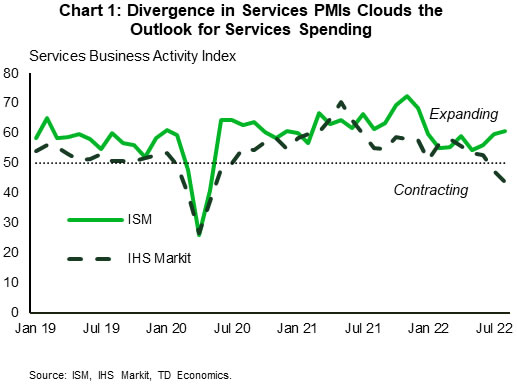
While this divergence clouds the outlook, we expect the truth to lie somewhere in the middle, with current economic activity remaining unchanged. This sentiment was echoed in the Fed’s Beige book that gathers anecdotal information on current economic conditions through July and August across Federal Reserve Bank districts. The report characterizes consumer spending as “steady” and points to expectations for further softening of demand over the next six to twelve months. On the other hand, respondents indicated that labor market conditions remained tight, but also pointed to a slower pace of wage increases and moderating salary expectations.
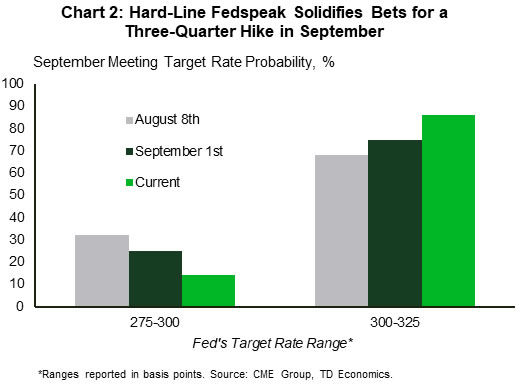
The tightness of labor market is a big part of why the Fed takes a hardline inflation fighting stance. FOMC speakers took every opportunity to reinforce their unanimity on this front ahead of the central bank’s black-out period prior to its September 21st rate decision. Chair Powell was very explicit by stating that the Committee wants to soften growth enough to “cause the labor market to get back into better balance, and then that will bring wages back down to levels that are more consistent with 2% inflation over time.” Investors heard it loud and clear with the federal funds futures markets now have greater conviction that the Fed will hike 75 basis to 3.25% (Chart 2). Moreover, the market appears less convinced that there will be rate cuts next year, buying into the Vice Chair Brainard’s “we are in this for as long as it takes to get inflation down” mantra.
Canada - BoC Hiked Again with More to Come
The Bank of Canada has clearly taken the "go big or go home" expression to heart this week by delivering another large increase in its key interest rate (report). Following the 75-basis point hike the overnight rate rose to 3.25% - the highest level in over 14 years. The increase was bang on market expectations, leading to a muted market reaction, even as the statement was quite hawkish, stating that "given the outlook for inflation, the Governing Council still judges that the policy interest rate will need to rise further."
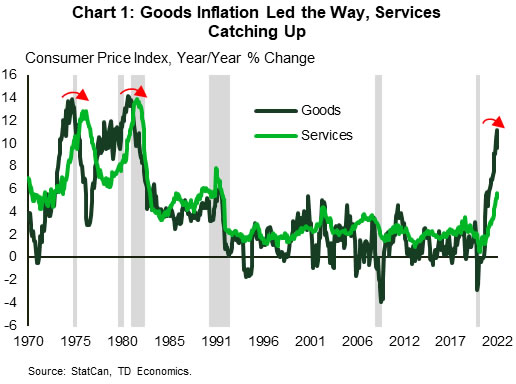
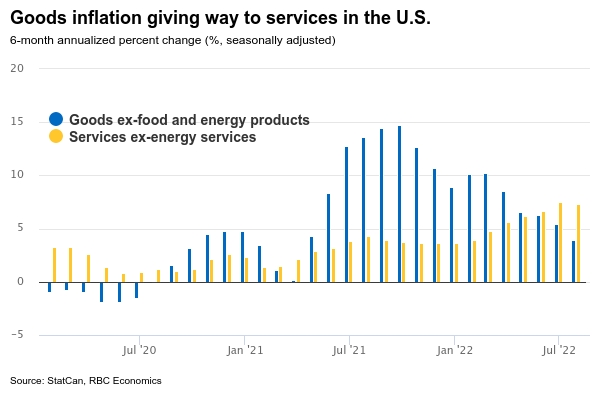
Indeed, as we wrote in this week's report, the Bank still has the long and winding road ahead of it as it tries to wrestle inflation back to its 2% target. The recent declines in gasoline and other commodity prices have helped to bring headline inflation lower from its peak in June. However, the bad news is that the core inflation (which excludes food and energy) continues to move up, as the past surge in goods prices and healthy wage gains have passed through to prices for services. Past episodes of high inflation in the 70s and early 80s tell us that services prices are stickier. They lag goods' prices in that they take longer to rise, but once they begin to accelerate, they can continue to increase even in an economic downturn (Chart 1). This raises the risk of a longer period of high inflation despite slowing growth.
In addition to this, there is a lag between changes to interest rates and their impact on consumer demand and inflation. Interest rate sensitive sectors– such as housing – cool quickly, but it takes longer for higher interest rates to reach other parts of the economy. This may further delay the normalization of inflation. Indeed, this was re-iterated by Senior Deputy Governor Carolyn Rogers in her speech this week, where she stated that "getting inflation back to 2% will take some time."
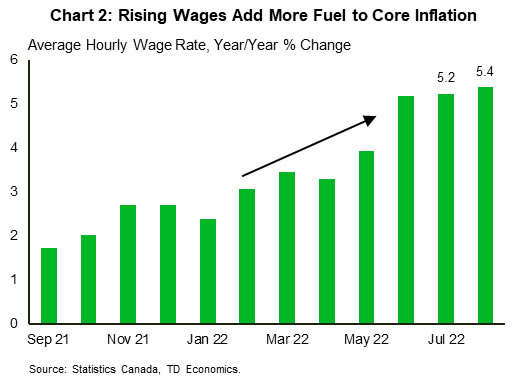
Rising wages are also adding more fuel to core inflation, as evidenced by today's jobs report. Even as the labour market cooled further in August, with the economy shedding 40k on the month and employment down 113k since May, wage growth continued to accelerate (Chart 2). Average hourly wages were up 5.4% from a year ago – a pick-up from a 5.2% pace in July. All in all, while economic growth is cooling, the economy still has a lot of momentum. As such, we see further upside to the overnight rate, which could reach 4% by the end of this year, as the Bank vowed to "not sleep easy until we can get inflation back to target."
Until that happens, borrowers will not sleep easy either. Next week's release of the national balance sheet and financial flow accounts for Q2 is expected to show the first of many increases in the household debt service ratio (DSR). The DSR is expected to eclipse its pre-pandemic peak by early 2023. By the end of 2023, total debt servicing costs are projected to be 30% higher relative to 2022Q1, with the average borrower spending an extra $2500 per year on debt.
Forward Guidance: U.S. Inflation to Fall Alongside Energy Prices
U.S. headline inflation likely trended lower in August, largely due to lower oil prices, which fell to nearly 19% from their June peak. But beyond energy prices, year-over-year core CPI growth likely rose—a signal that the Fed will need to continue its aggressive hiking path to tame inflation. That core price growth will be despite some further easing in goods-price inflation. Indeed, goods-sector inflation has begun to unwind even as services sector inflation escalates. Shelter costs are a huge component of this, with home rent costs reporting their highest growth in over three decades. But prices in the travel and hospitality sectors are growing too. Meantime, global supply chain constraints continue to ease, and commodity prices continue to fall. Used vehicle prices fell 4% month-over-month, but food prices continue to tick higher.
At its next meeting on Sept 21, the Fed will consider its “overarching focus” to bring inflation back down to 2%. While lower energy prices mean headline CPI is heading in the right direction, it’s still well above the Fed’s 2% medium-term goal. And since energy prices are just one component of headline growth, the Fed will keep a close eye on next week’s core inflation numbers.
Week ahead data watch:
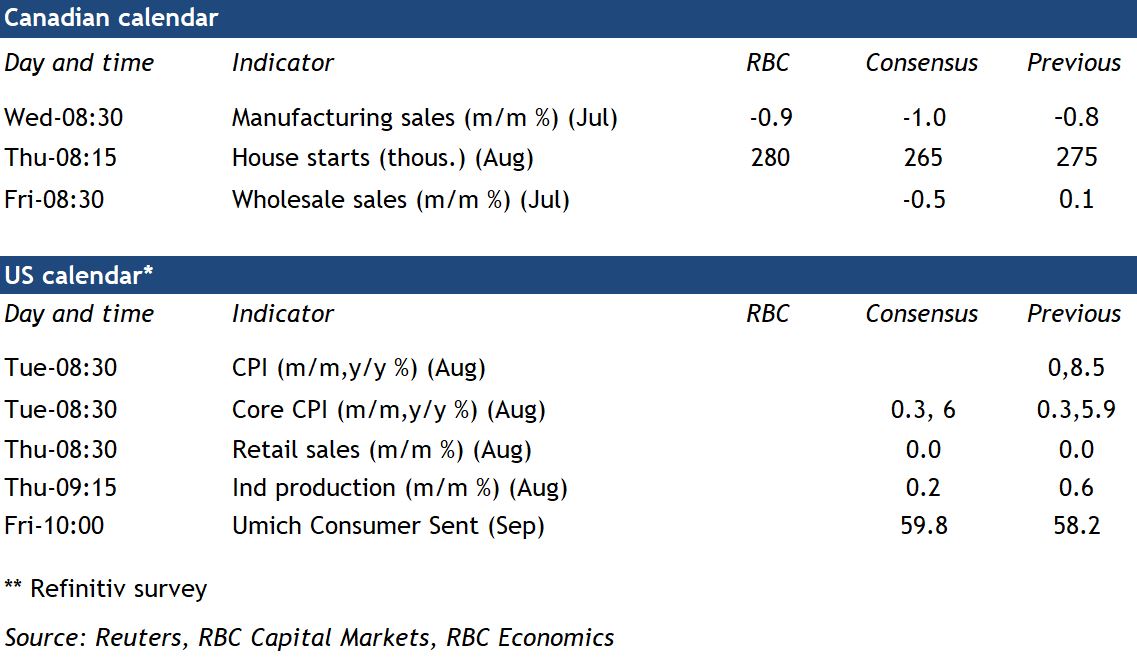
Housing starts likely stayed strong through August. Building permit issuance has averaged 288,000 units in each of the last three months even as resales cool off.
Manufacturing sales likely fell 0.9% in July, as per Statistics Canada’s flash estimates. Petroleum, coal products, and primary metal industries accounted for the largest share of the decline. But this is largely a price effect, since petroleum and coal prices fell significantly between July and August. With this in mind, sales volumes likely increased in these industries despite posted nominal declines.
Week Ahead – US Inflation on the Menu, BoE Postpones Meeting
Another pivotal week lies ahead for currency traders, with the latest US inflation report set to decide whether the dollar’s relentless rally will finally cool off. Meanwhile, the Bank of England rate decision has been postponed for September 22, as the nation mourns the passing of Queen Elizabeth II. Sterling remains in the hands of global forces.
Inflation cooldown
It’s been a glorious year for the US dollar so far. The reserve currency is essentially the only asset that has gained ground over the last nine months, riding a perfect wave of widening interest rate differentials, safe-haven flows, and an absence of alternatives.
The Fed poured gasoline on this rally recently when Chairman Powell pledged to do whatever it takes to eradicate inflation, even if that means a period of economic pain. He reinforced the notion that interest rates will need to be kept high for some time, sending traders scrambling to price in a ‘higher for longer’ path.
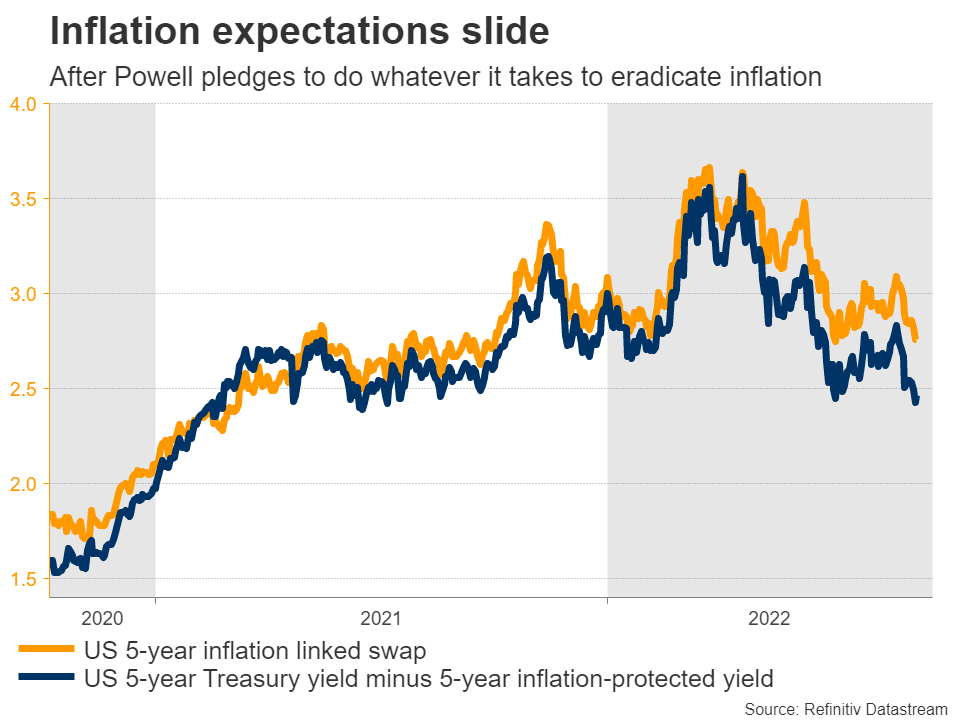
Encouraged by a labor market that is essentially at full employment, the Fed chief is convinced the economy can absorb this blow without sliding into a deep recession. Markets are currently pricing in an 85% probability for another three-quarter point increase this month and a terminal rate of just under 4% to be reached early next year.
Naturally, the upcoming data will be a crucial piece of this puzzle. The CPI inflation report for August is out on Tuesday and forecasts point to a negative monthly print, which would drag the yearly rate down too. Gasoline prices kept sliding during the month and business surveys from S&P Global suggest services companies raised their selling prices at the slowest pace in one-and-a-half years, adding credence to the forecast.
A second consecutive month of softening price pressures would be music to the ears of Fed officials, but it wouldn’t be enough to get them off their warpath. The Fed’s second-in-command, Lael Brainard, said this week it would take “several” months of low inflation readings before they become confident inflation is moving down to its 2% target.
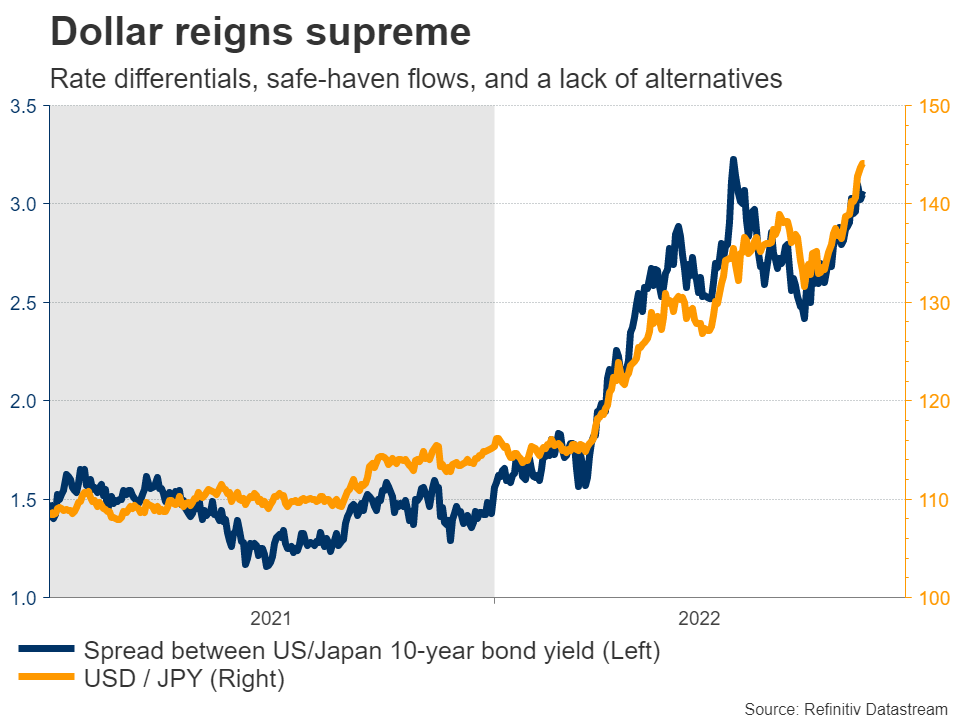
As for the dollar, even a disappointing inflation print is unlikely to change the overall trend. The markets could start flirting with a half-point Fed hike this month and that might deal a blow to the greenback, but it is difficult to envision a reversal while Europe is suffering from energy shortages, the yen is in freefall, and China’s property crisis is deepening.
Retail sales for August will follow on Thursday, ahead of the latest University of Michigan consumer survey on Friday, which has turned into a market-moving release lately.
BoE pushes back meeting
Over in the United Kingdom, the Bank of England has postponed its rate decision by one week, now scheduled for September 22. Market pricing is leaning towards a half-point rate increase, assigning a 65% probability to this scenario against a 35% chance for a larger move of three-quarters of a percent.
It’s a tough choice for the BoE. Business surveys point to an economy that's already contracting as demand crumbles under the weight of the cost-of-living crisis. Along with the government’s plan to cap energy prices, which will likely prevent inflation from reaching the 13% peak the BoE envisioned in its latest forecasts, there is a strong case that policymakers should play it safe and opt for the smaller move.
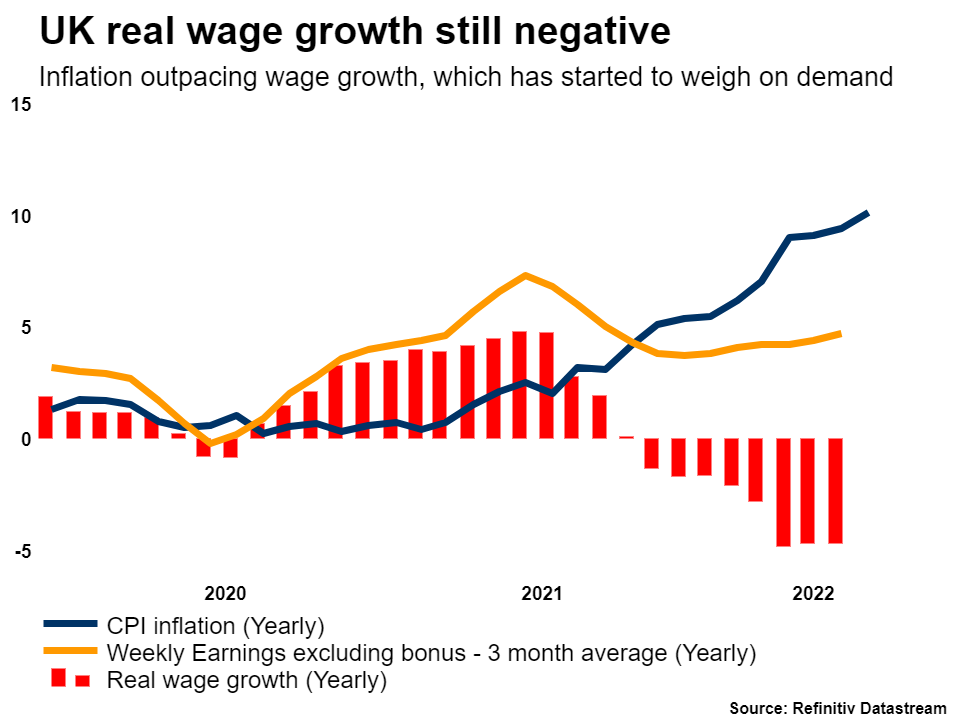
The problem with that is the exchange rate. Sterling has already depreciated dramatically, second only to the collapsing Japanese yen this year. Going for half measures would invite further weakness, exacerbating inflationary pressures.
There’s a barrage of data releases ahead of the rate decision that will help shape market expectations. The show will kick off on Monday with GDP stats for July, ahead of the employment report for the same month on Tuesday, and the latest inflation data on Wednesday. Then on Friday, retail sales for August are due out.
As for sterling, the most important variable won’t be how hard the BoE strikes next week but rather what happens with stock markets. Because of the UK’s chronic twin deficits, the pound has developed a tremendous sensitivity to global risk sentiment, with Cable trading in lockstep with the S&P 500 most of the time.
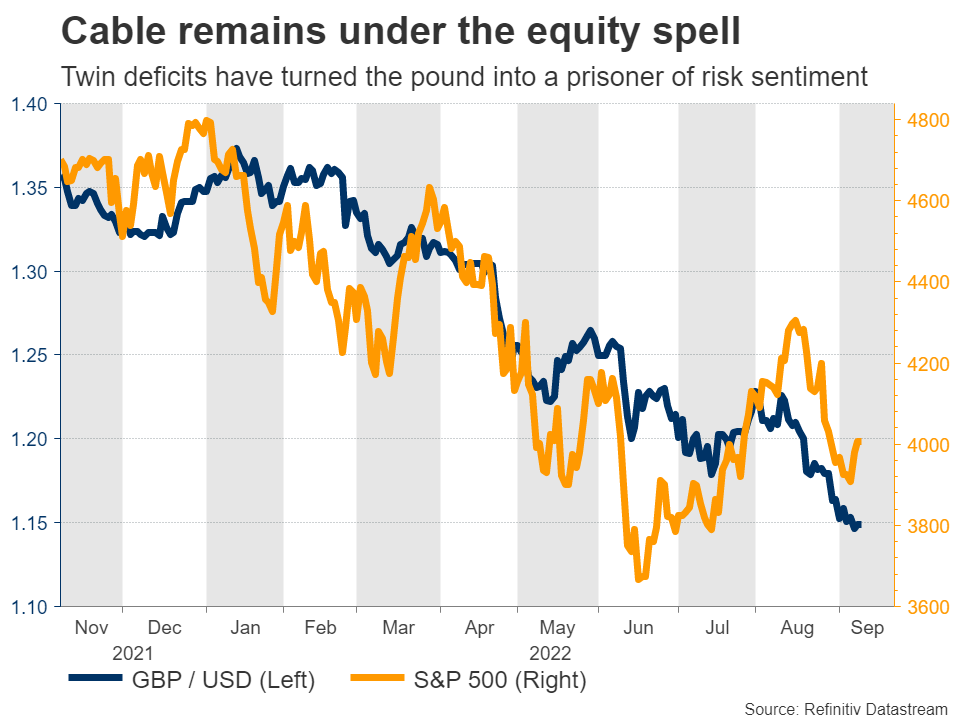
In this respect, the outlook for stocks remains challenging. The Fed is hell-bent on keeping rates high until inflation is vanquished, the pace of quantitative tightening doubled up last week, valuations are still not cheap, and a series of earnings downgrades might be imminent if Europe and China continue to roll over.
A glance at China
Finally, the monthly data dump from China that includes retail sales and industrial production will be released on Friday. Investors will pay close attention to assess the damage from a property sector in freefall and the recent lockdowns of major cities.
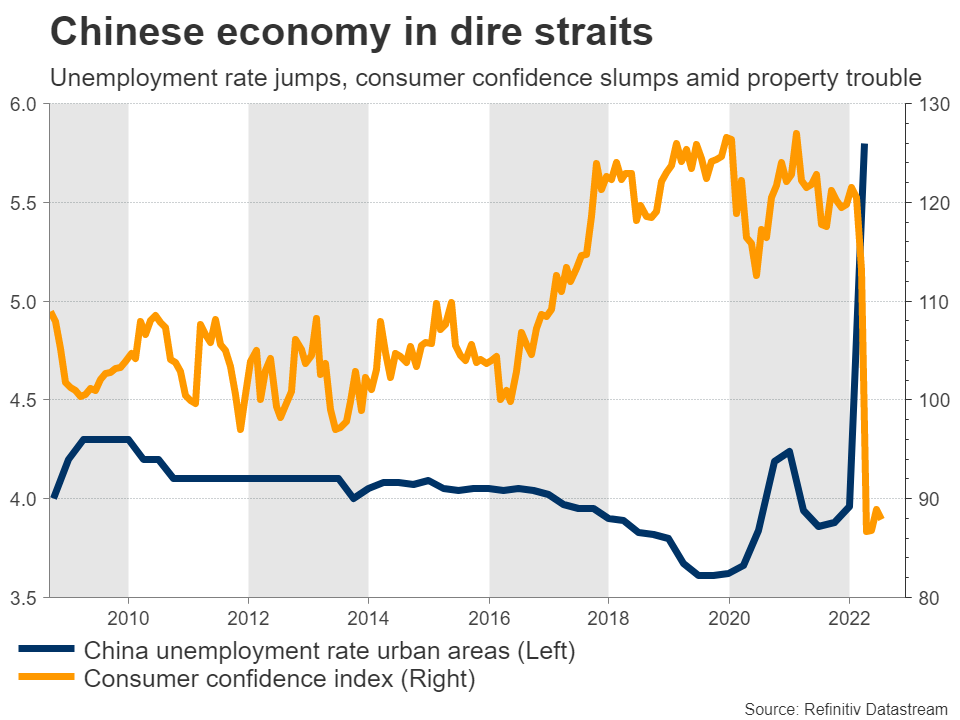
Ahead of this dataset, Australia’s latest jobs numbers and New Zealand’s GDP print for Q2 will hit the markets on Thursday. Although both of these economies are solid domestically, it is difficult to be optimistic on their currencies considering their high exposure to China.
With the Chinese economy struggling, demand for the raw materials that Australia and New Zealand export will inevitably take a sharp hit, which paints a gloomy picture for growth.
The BOJ Doesn’t Want to Help the Yen
Over the past year, the yen has been moving lower against the dollar mainly because of the overall USD strength. But there’s more behind the weakness of the JPY, including the global economic downturn, monetary policy decisions, and the deflationary model of Japan. How low could the currency go, and what drives USDJPY? Here’s what we’ve got.
Why is the Yen weak?
First of all, the USD has been bullish for more than a year. The US dollar index has gained almost 19% since May 2021, pushing all other currencies lower against it. Over a period of 16 months, the index rose from 89.570 to 110.785. Some analysts still believe the greenback will soar even more to the 20-year high of 120.500.
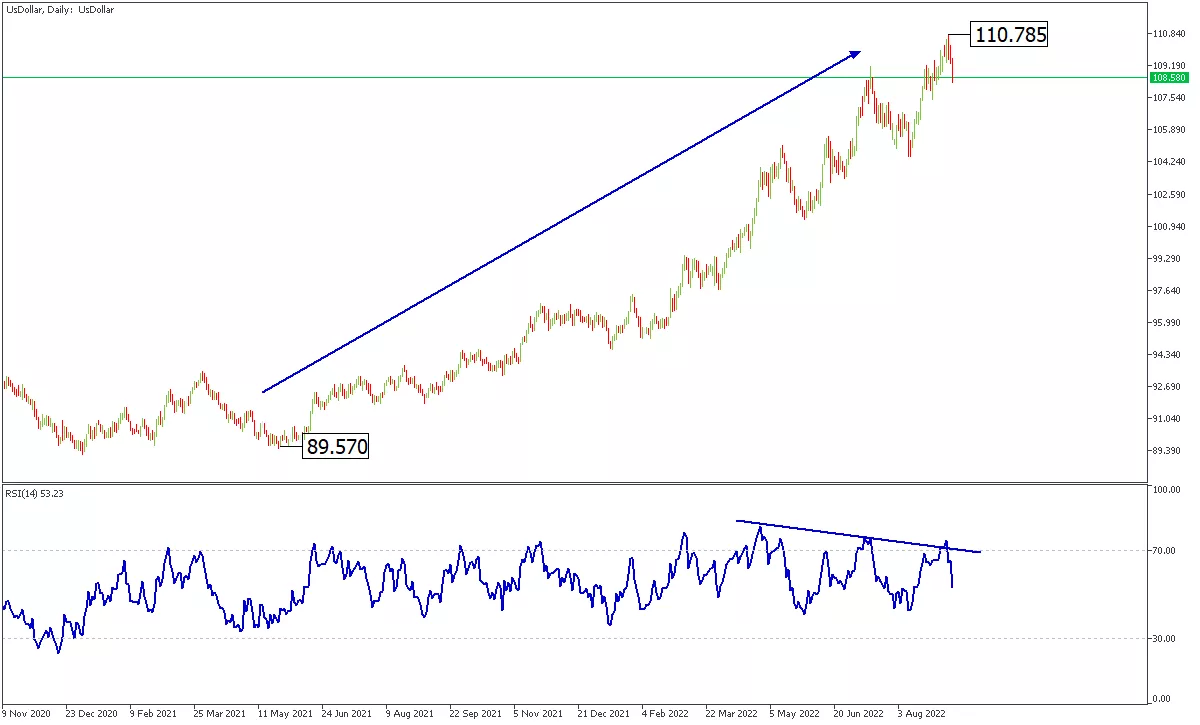
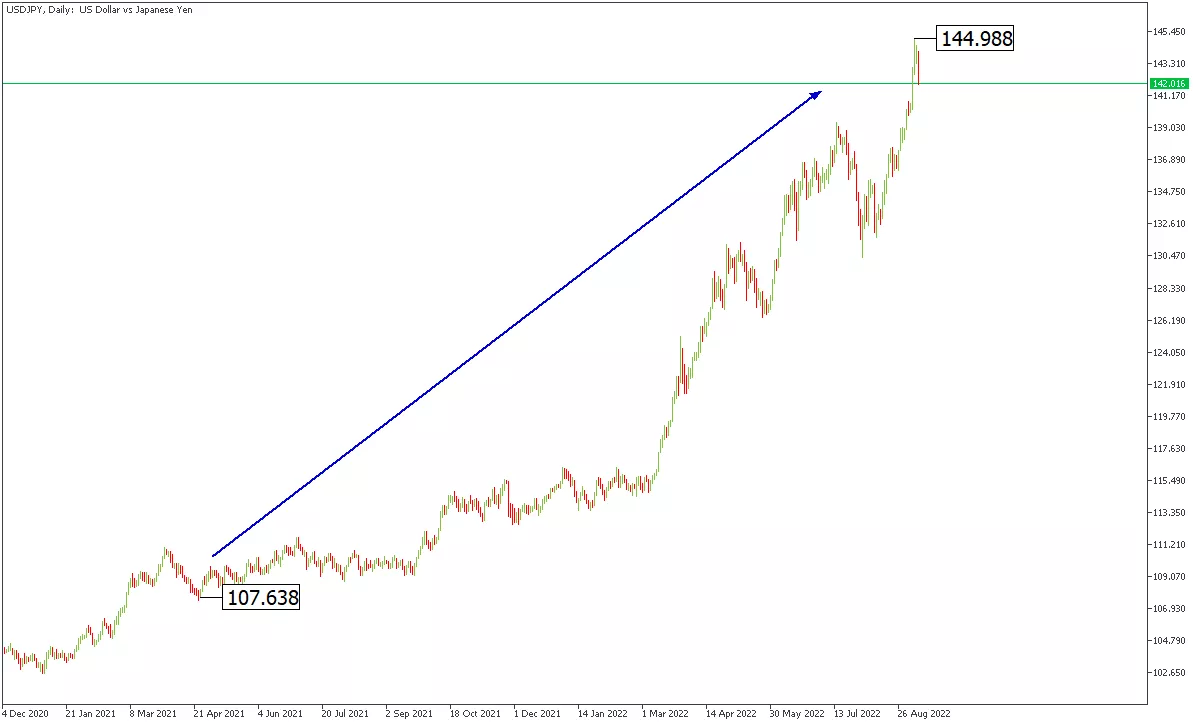
I’ll discuss the monetary policy that resulted in the USD strength later in this article. What’s important is that no matter what currency we are talking about, they all suffered from the USD strength, and the JPY isn’t an exclusion. The yen lost 34.5% over the same period, moving from 107.63 to almost 145.00 yen per US dollar.
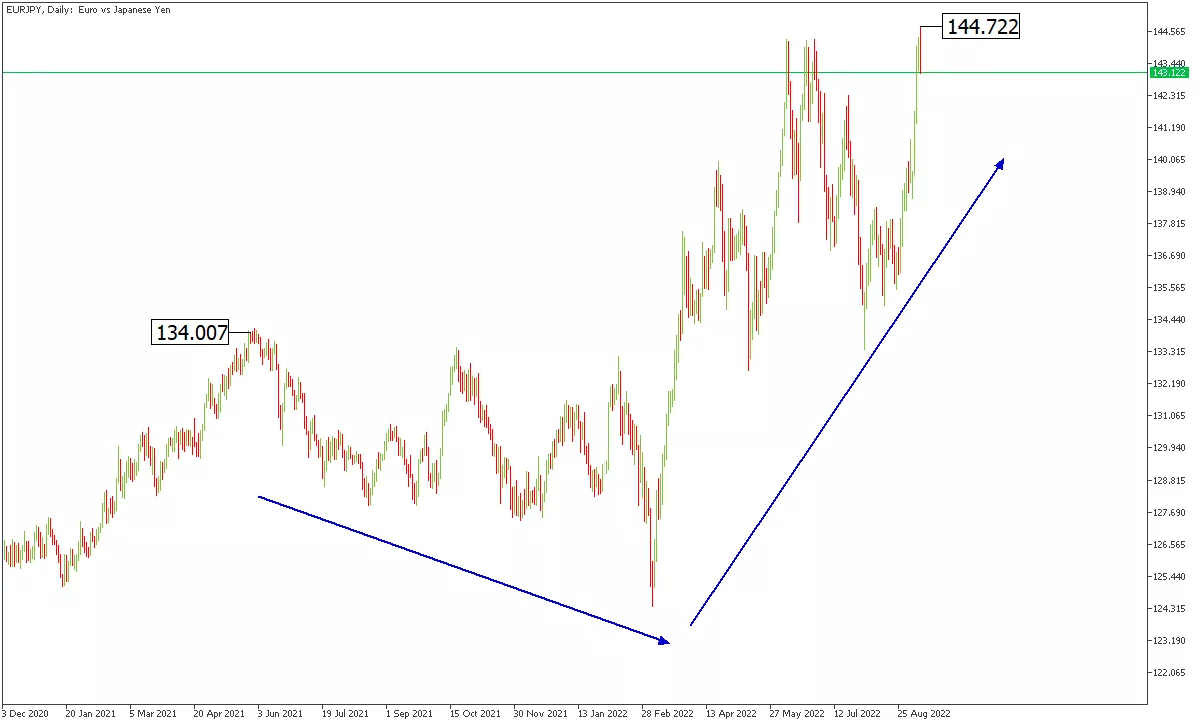
However, if to look at the EURJPY chart, the yen lost only 8% over the last 16 months, indicating that the reason isn’t confined to the USD. The JPY itself is weakening comparably fast. Thus, the fundamental reasons behind the movement should be substantial.
The first reason is Japanese monetary policy. In contrast to the US Federal Reserve, which has been hiking interest rates more aggressively to control inflation, the Bank of Japan (BOJ) has chosen a more dovish and loose policy after many years of deflation.
Deflation is a decrease in the general price level of goods and services.
Deflation occurs when the inflation rate falls below 0%.
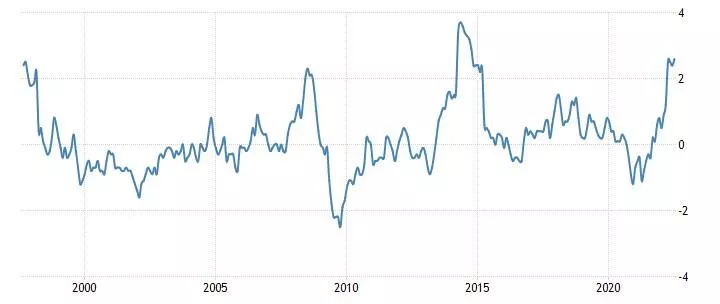
Japan is more often a deflationary country. Source: tradingeconomics.com
Because of deflation and Japan’s current account surlus, the yen is considered a safe-haven asset. This currency is primarily safe from unexpected volatile movements and provides a place for institutional investors to hold their funds. There’s a flip side, however. A deflationary economy often lacks growth because people don’t want to send their funds and prefer to accumulate them instead. And Japan isn’t an exclusion.
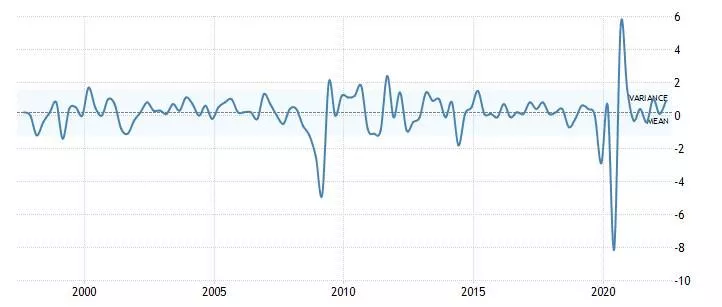
GDP change in Japan. Source: tradingeconomics.com
Over the last 25 years, the Japanese economy has grown by an average of 1.6% per year. This result is one of the worst in the world (Japan is 158 out of 193 countries). Governments try to maintain a low-but-positive inflation rate to speed up the economy. For example, the Fed aims at long-term inflation to be 2%.
Rising prices stimulate people to spend more money, boosting the economy and making everyone happier. The bank’s final target is to reach a 2% inflation (a little above 2.5% now) to “facilitate higher corporate profits and improved labor market conditions, and thereby generate a virtuous cycle in which wages and prices are sustained increases.” That’s why the Bank of Japan doesn’t want to lower inflation.
In addition, Japanese Prime Minister Fumio Kishida is considering printing more money to inject into the financial system. Although the primary goal of the stimulus is to fight inflation (as the bank said), printing money is a way to speed up the economy.
Printing money is a standard measure to help the economy in the present, but in the future it’ll result in even higher inflation and possible recession. As for me, this strategy has failed several times, and this time is no different. However, Japan may have to do its best to help people in times of worldwide recession.
What will happen with the yen?
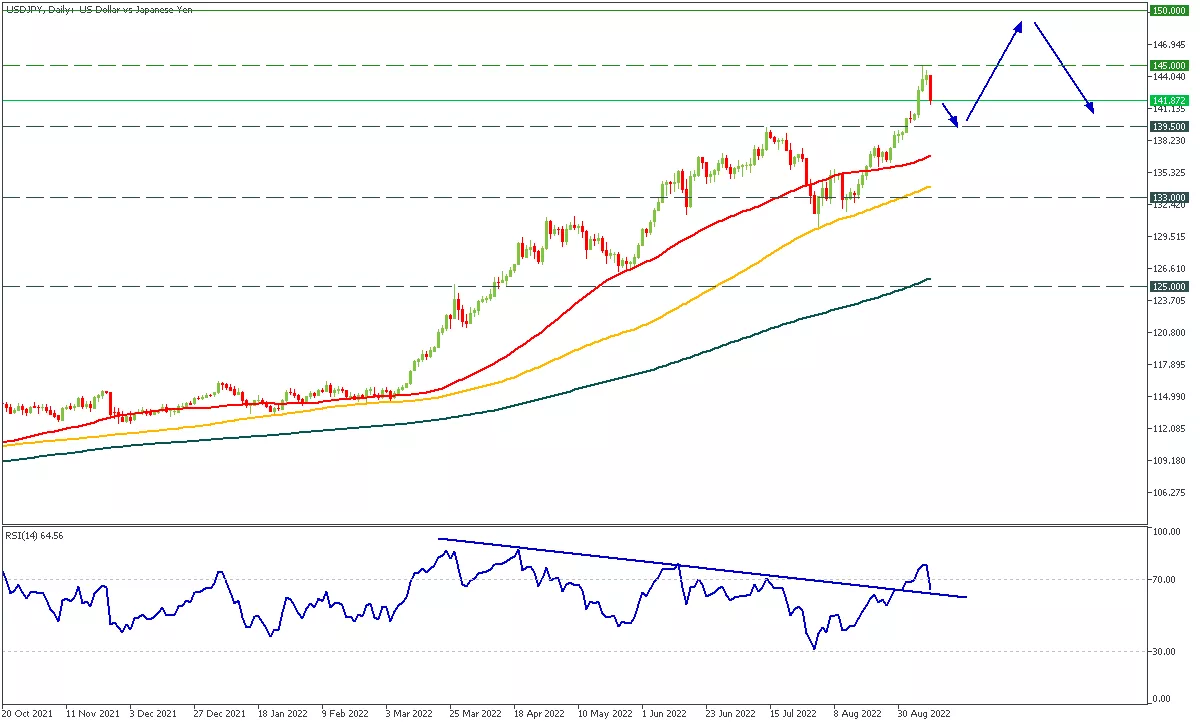
The BOJ governor Kuroda is discussing possible interventions into the JPY price to support the currency. I think these interventions will be either weak or short-term. Thus, they won’t affect the currency enough to stop it from falling. However, we may see a correction of USDJPY to the 139.50 support line. After that, I expect a consolidation with fake breakouts in both directions.
If nothing changes, monetary measures from the BOJ will weaken the yen further, pushing the USDJPY pair to the resistance of 150.00. It may happen over the next several weeks, so I consider this a mid-term trade worth trying. However, the level of 150.00 is a robust resistance line. The BOJ will likely take more serious measures to stop the yen;s depreciation. Thus, consolidation will likely occur at the 150.00 resistance, with a possible trend change.
USDJPY daily chart
Resistance: 145.00, 150.00
Support: 139.50, 133.00, 125.00
Weekly Focus – The Inflation Fight Continues
The main event this week was the ECB's decision to hike policy rates by 75bp highlighting that central banks are very much in inflation fighting mode despite the outlook for recession. ECB governor Christine Lagarde stressed though, that 75bp hikes is not the new norm but that the ECB needed to move further to a neutral rate. She emphasised the data dependency, but also a meeting-by-meeting approach to calibrate policy rates. She guided that at most five meetings with rate hikes were expected, including the ones we have just had. Our forecast remains another 50bp hike in October and 25bp hike in December but recognize the possibility of hikes continuing into next year.
Otherwise gas and electricity prices have taken centre stage this week following Russia's continued closure of the NordStream 1 pipeline. Governments have scrambled to come up with measures to cap electricity bills, guarantee credit for utility companies in need of liquidity due to the price spike and power saving measures in the public sectors. EU energy ministers meet today to coordinate policies. In many cases the policies to mitigate the energy costs are not fully funded, which means fiscal policies are again being eased. This will all else equal require more monetary tightening to compensate for the fiscal easing in order to get inflation down. More hikes from European central banks are thus being priced sending bond yields higher again. Prices on gas and electricity have actually come down somewhat this week following focus on power saving measures and risk of a deeper economic downturn. Electricity prices are now down 35% from the peak in August.
Outside the gas and electricity space global price pressures are actually easing when it comes to goods inflation. Oil prices declined below USD90 per barrel this week (the lowest level since January) despite a cut in oil production by OPEC+ members of 100,000 barrels. Oil prices are now down 30% from the peak in March. Freight rates from Shanghai to Los Angeles dropped another 15% this week compared to last week and have taken back more than half of the sharp rise seen in 2020 and 2021. The decline in commodity and freight prices reflect weaker goods demand in US and Europe and with less pricing power amid weaker sales and high inventories, this should contribute to lower inflation in goods prices. However, in order to get service inflation down as well, more slack is needed in labour markets to bring down wage growth. Hence, central banks will need to keep tightening until they see clear signs that labour markets are turning.
China has seen some recurrence of covid outbreaks in some of its big cities with Chengdu entering lockdown and Shenzhen also implementing restrictions. So far it has had limited impact on supply chains but if it spreads to more cities on China's east coast it may come. Equity markets have moved mostly sideways this week bringing a halt to the past weeks declines. EUR/USD hit a new cycle low below 0.99 on Tuesday but recovered following the ECB meeting. We still look for EUR/USD to trend lower over the next year.
Next week all eyes will be on US inflation, which is one of the last important data points before the Fed will decide on a 75bp or 50bp hike on their meeting in two weeks. US retail sales and the German ZEW index will give further clues to the outlook for recession.
UK Data Ahead of the BoE Next Week
Earlier this week, cable dropped to lows not seen in decades. Since then, it has bounced back a bit, but it spun up speculation about what to expect from the BOE next week. Some analysts are pointing to the widening interest rate cap between the pound and dollar. The BOE started raising rates first, but has been slower to tighten policy and inflation has outpaced the US. With more double-digit inflation expected, pressure is mounting on the BOE to take more drastic action.
But there isn't any certainty about what the bank will do next week. Although a small majority are expecting another 50bps hike, there is a growing contingent calling for a 75bps hike. Both of the major peers, the ECB and Fed, have not only already done "triple" rake hikes, but are widely expected to do so at their next meetings. But, there's a problem trying to figure out what the BOE will do, which is that there is a series of key data expected to be released early next week ahead of the meeting. Those data points might shape policy expectations right up to the meeting, so we could have increased cable volatility through the coming days.
What could move the markets
On Monday we have the release of monthly GDP, expected to show another month of negative growth, though not as much as before. UK July GDP is expected to come in at -0.1% compared to -0.6% in June.
On Tuesday it's the turn of employment figures. The BOE has not been particularly worried about the job market as it's focusing primarily on inflation. But the earnings data could be relevant for demand-side pressures on prices. And that, in turn, could be impacted by how tight the labor market is. So lower wages and increasing claimant count, as expected, might be an argument in favor of a 50bps hike instead of a 75bps one.
UK August Claimant count is expected to deteriorate a bit to -4K from -10.5K in July. Remember that the more negative this number is, the better it is for the economy, since it's the number of people seeking job benefits. July's unemployment rate is expected to remain steady at 3.8%. But July Average Earnings are expected to slow growth to 4.6% compared to 5.1% prior. Note that this is in the context of inflation of 10.1%, implying further erosion of employee purchasing power.
On Wednesday is the most important data, since the BOE is trying to get inflation down. But there aren't any forecasts for inflation this far out. Particularly after the ONS delayed publication of statistics for Friday until next week, due to the passing of the Queen.
Although it's expected that inflation will increase, a higher CPI would increase pressure on the BOE to take more drastic action. This could be the point at which markets definitively price in expectations for the BOE, which meets the very next day.
Also on Wednesday is the release of PPI figures, which are seen as a precursor to the trend in inflation. It's not expected for inflation to meaningfully adjust if producers have to keep raising prices. However, there could be a little less relevance this time around as the potential energy cost reduction plan from the new Government could help reduce costs. However, the exact mechanism and inflation impact has still not been sketched out. Chancellor Kwarteng is expected to give more details later in the month.
USD/CAD Seen in Late Stages of an Ending Diagonal
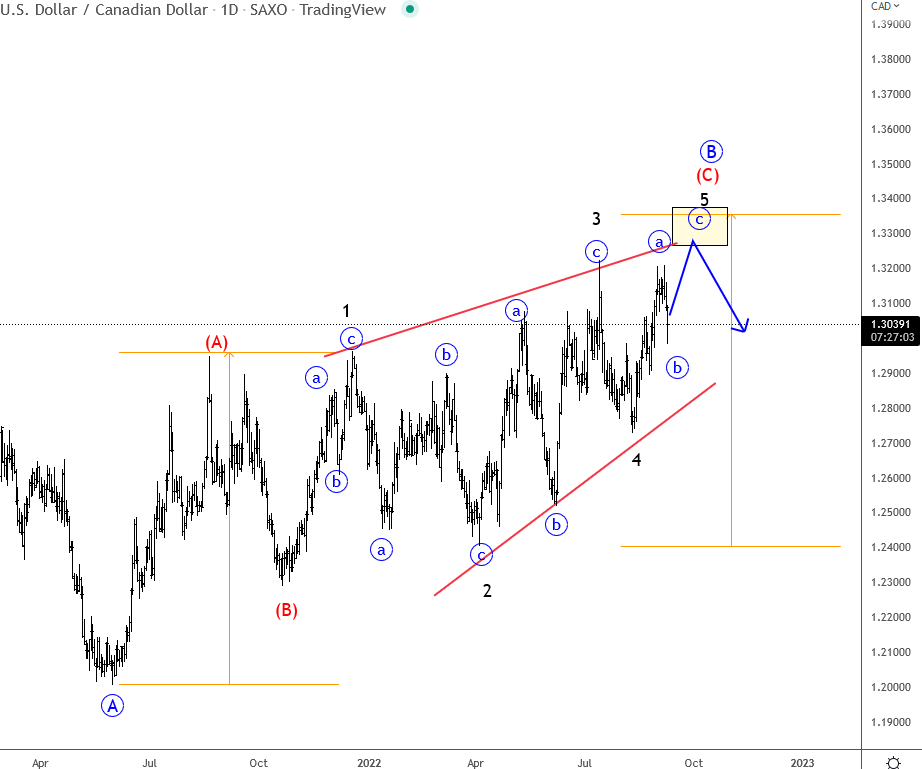
USDCAD is coming lower, after 75bp increased by BoC, but Rogers noted that the rates will need to be rised further. At the same time, we see USD making a strong reversal across the board while crude oil is trying to stabilize near 80-82USD. This makes a perfect case for some bearish price action. However this reversal can be temporary as we are now tracking wave b pullback that can belong to a higher degree fifth wave of an ending diagonal. Ideall resistance is at 1.3300/1.3400 area.
I think that later this year or in 2023 current USD bull cycle can come to an end, but of course this will depend on further FEDs interest rate policy decision. As soon as FED will signal that they are approaching end of the cylce the USD will be expected to turn south across the board.