Sample Category Title
WTI Futures Retreat to 7-month Low as Negativity Persists
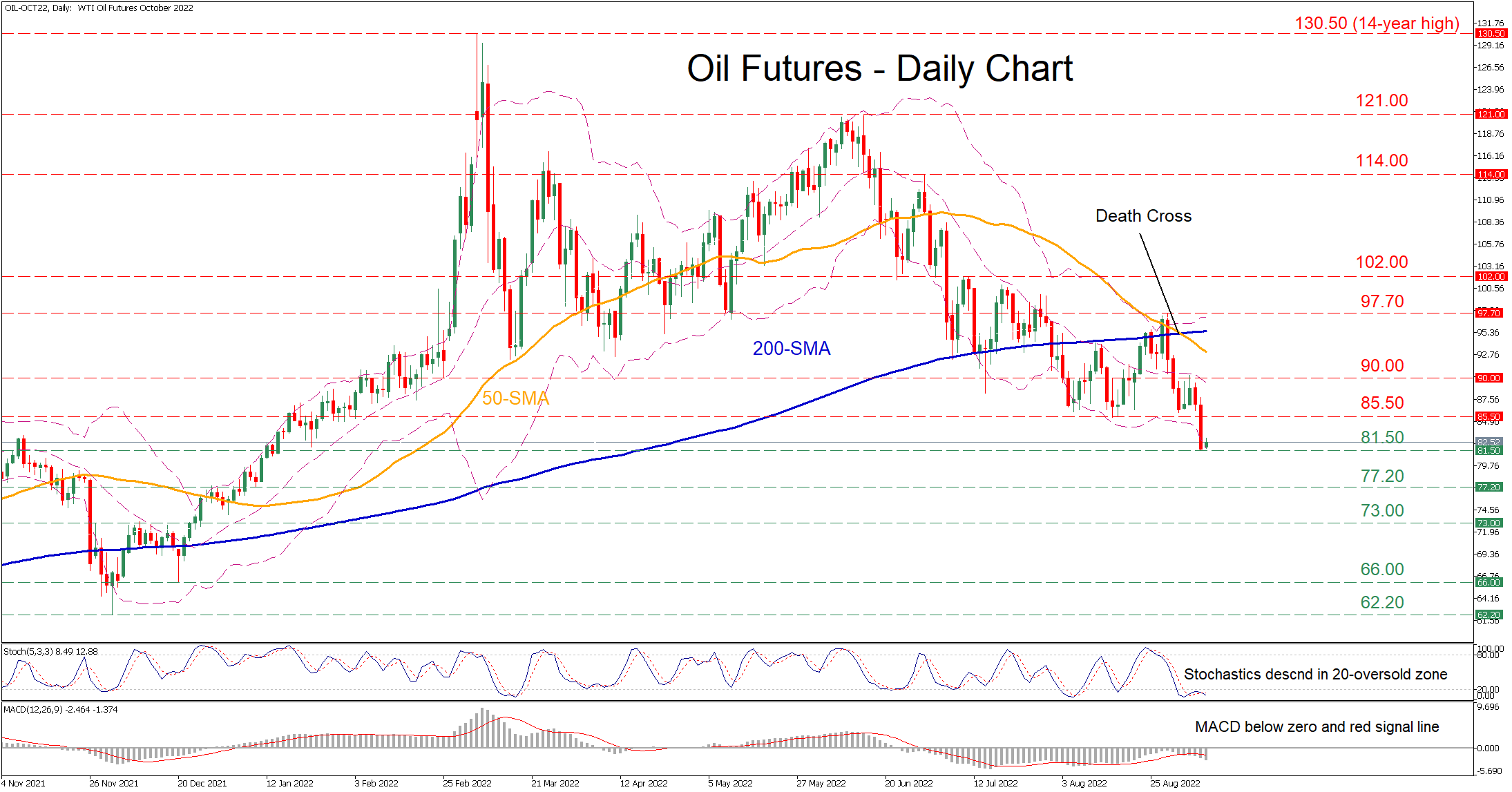
WTI oil futures (October delivery) have been losing ground since mid-August when the price failed to surpass the 97.70 mark. Moreover, apart from the price trading below its lower Bollinger band, the 50-day simple moving average (SMA) has dropped beneath the 200-day SMA completing a ‘death cross’, both reinforcing the thesis for a sustained bearish outlook.
The momentum indicators also suggest that near-term risks are tilted to the downside. Specifically, the stochastic oscillator is descending in the 20-oversold zone, while the MACD histogram is extending its retreat beneath both zero and its red signal line.
To the downside, further declines could cease at the seven-month low of 81.50. Dipping beneath that region, the bears could target 77.20 before the spotlight turns to the December 2021 resistance zone of 73.00. Even lower, the December support of 66.00 may prove to be a tough hurdle for the commodity to overcome.
On the flipside, bullish actions could propel the price towards the recent support zone of 85.50, which may now act as resistance. Conquering this barricade, the price might ascend towards 90.00 or higher to challenge the August peak of 97.70. A break above the latter could open the door for the 102.00 region.
Overall, WTI oil futures’ short-term picture is likely to deteriorate even further as the commodity appears to be facing tremendous downside pressure. For that bearish tone to reverse, the price needs to jump above the 97.70 ceiling.
XAU/USD: It Seems that Bulls are Ready to Form a Cycle Wave z
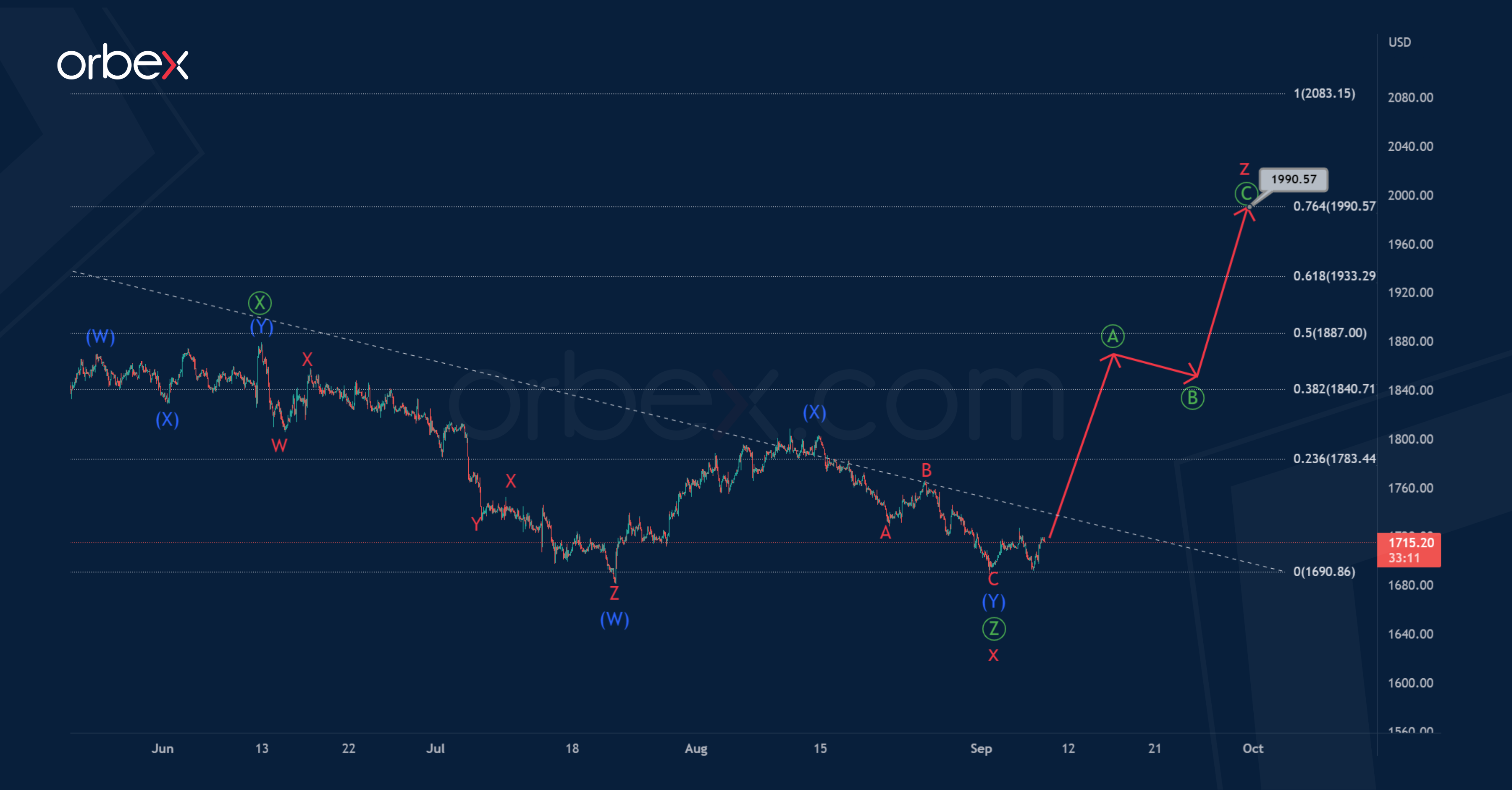
The current structure of the XAUUSD pair hints at a global correction pattern, which takes the form of a cycle triple zigzag.
The last section of the chart shows the structure of the bearish cycle intervening wave x, which looks completed in the form of a primary triple zigzag Ⓦ-Ⓧ-Ⓨ-Ⓧ-Ⓩ.
Perhaps, after the completion of the cycle wave x, the market turned around and began to move up. That is, the initial part of the cycle wave z is being built now. It may take the form of a primary standard zigzag Ⓐ-Ⓑ-Ⓒ, as shown in the chart.
The price of gold in the wave z may rise to 1990.57. At that level, it will be at 76.4% of previous actionary wave y of the cycle degree.
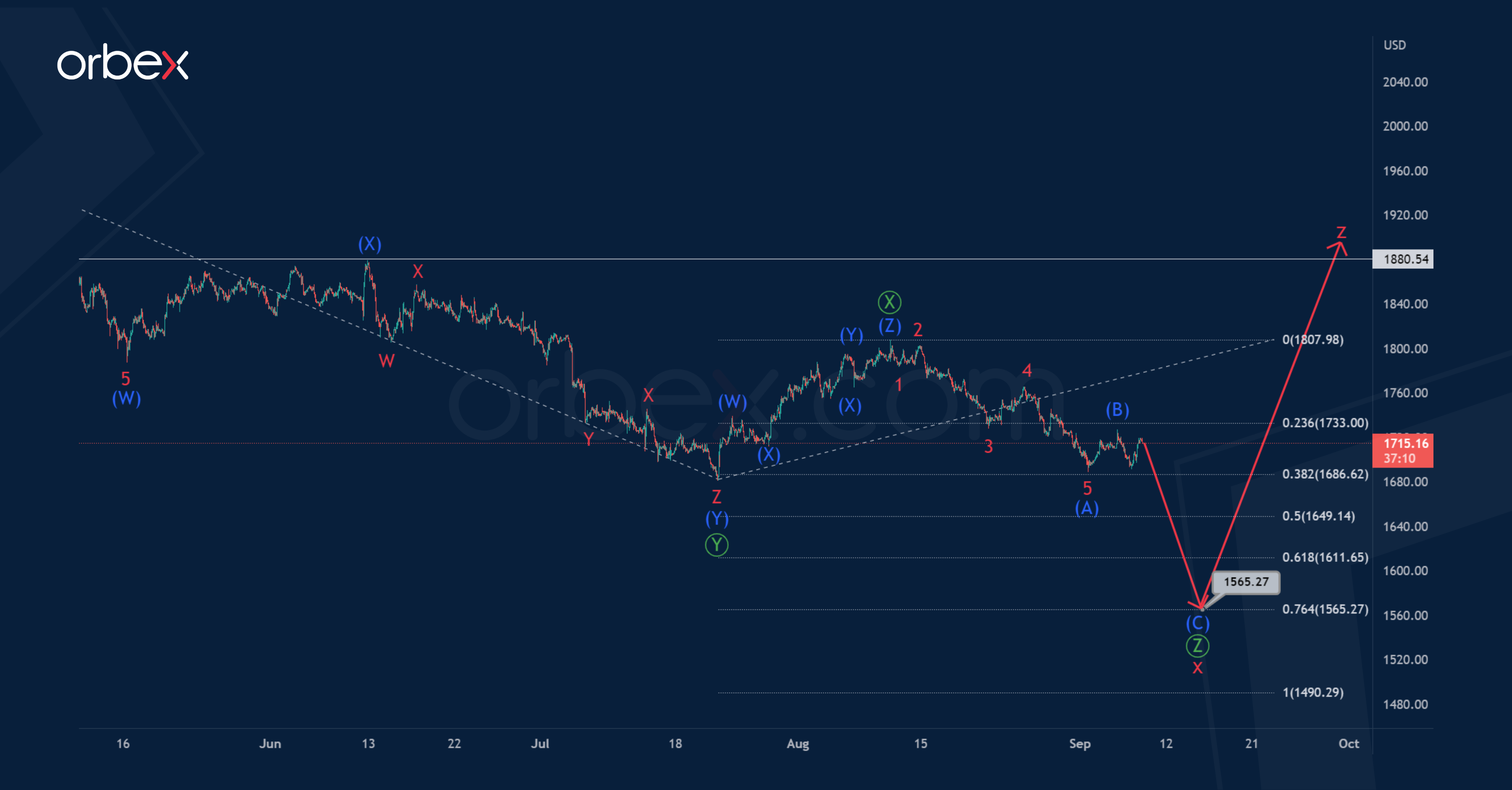
In the second view, the downward movement of the pair is expected to continue in the cycle wave x. Wave x is also a triple zigzag Ⓦ-Ⓧ-Ⓨ-Ⓧ-Ⓩ. However, the final primary wave Ⓩ is still under development.
A downward movement of XAUUSD is expected in the near future. The primary wave Ⓩ may take the form of an intermediate zigzag (A)-(B)-(C).
The final of the correction pattern zigzag (A)-(B)-(C) is possible near 1565.27. At that level, it will be at 76.4% of primary wave Ⓨ.
Only after reaching the specified level, the development of the cycle wave z will begin.
USD/CAD Hits Resistance
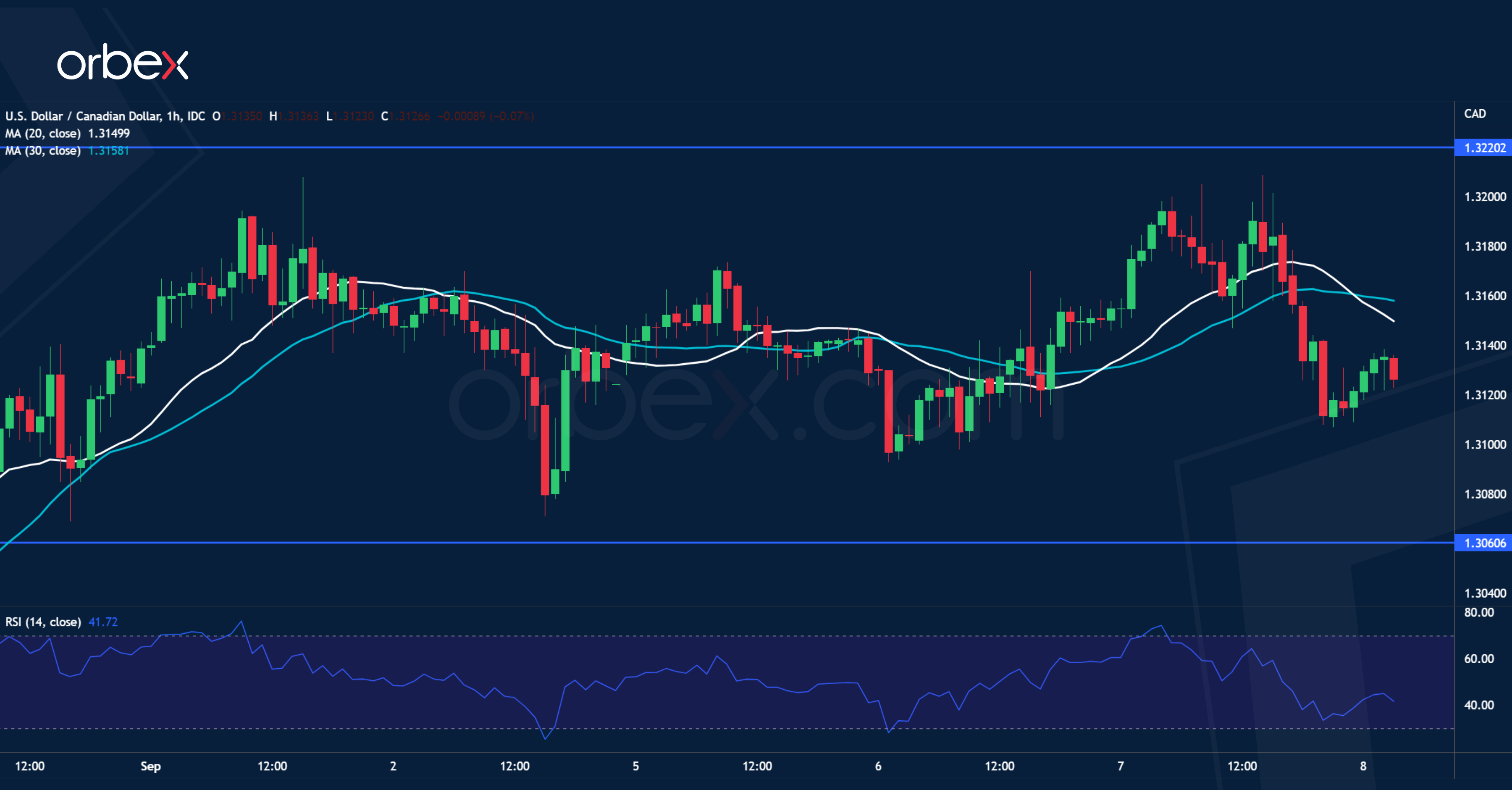
The Canadian dollar found support after the BoC raised interest rates by 75 bps as expected. The pair has been hovering under July’s high at 1.3220. A bullish MA cross on the daily chart and a series of higher lows indicate that the buying pressure has been building up. A breakout would remove the lid and attract momentum buyers. Then 1.3400 near its two-year high would be the next target. The price action is testing 1.3060, a key demand zone from the latest accumulation. Its breach could force the bulls to bail out.
USD/JPY in Limited Pullback
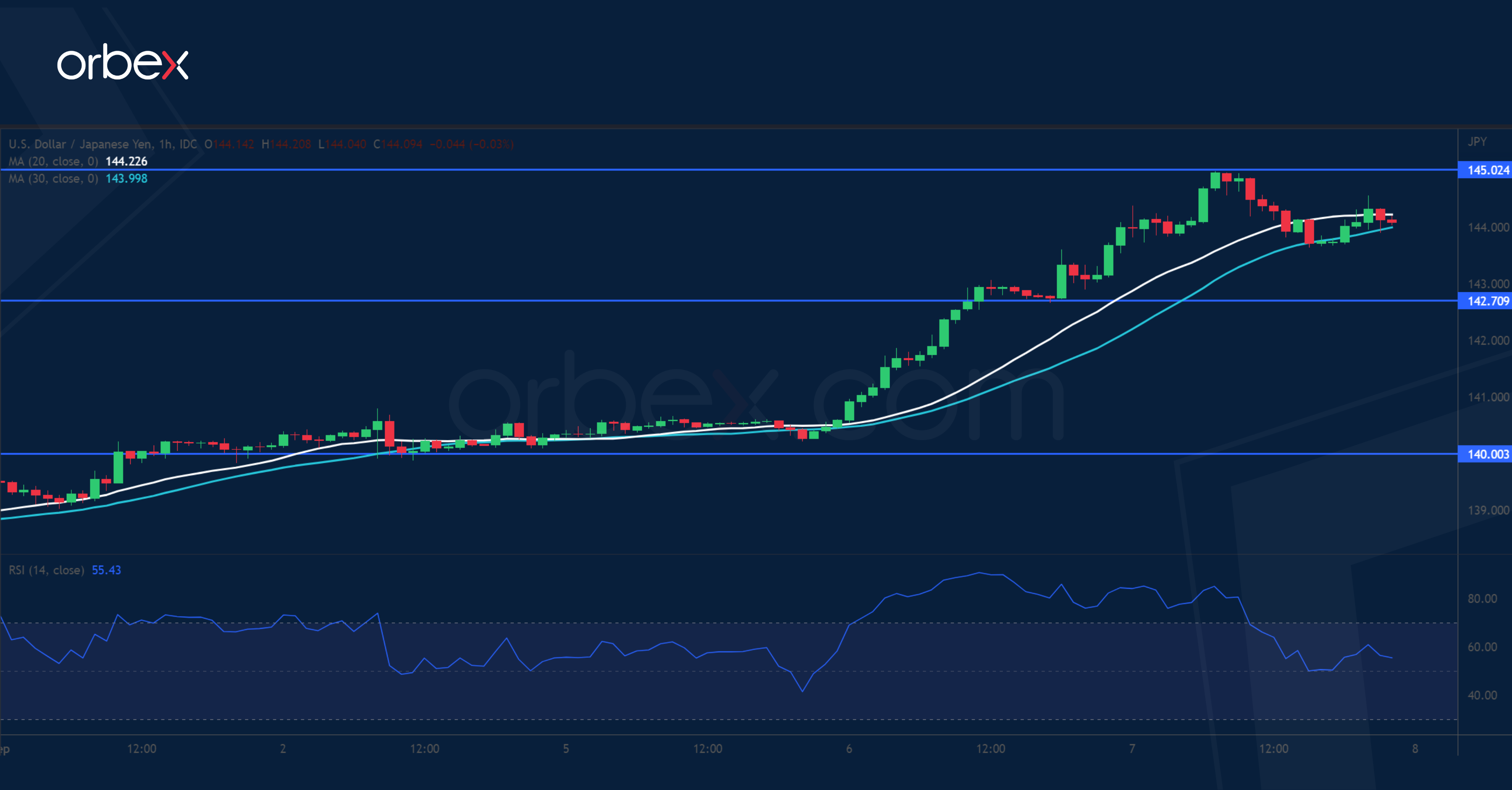
The Japanese yen recoups some losses as the Q2 GDP growth beats expectations. The dollar’s rally gained momentum after it lifted July’s high at 139.40. 145.00 is a hurdle and may see some profit-taking after the RSI soared into overbought territory. Past that, the pair could continue towards its 24-year high at 147.50. As sentiment remains extremely bullish, a pullback would be seen as an opportunity to stake in with 142.70 as the closest support. Further down, the psychological level of 140.00 would be the bulls’ stronghold.
EUR/USD Attempts to Break Out
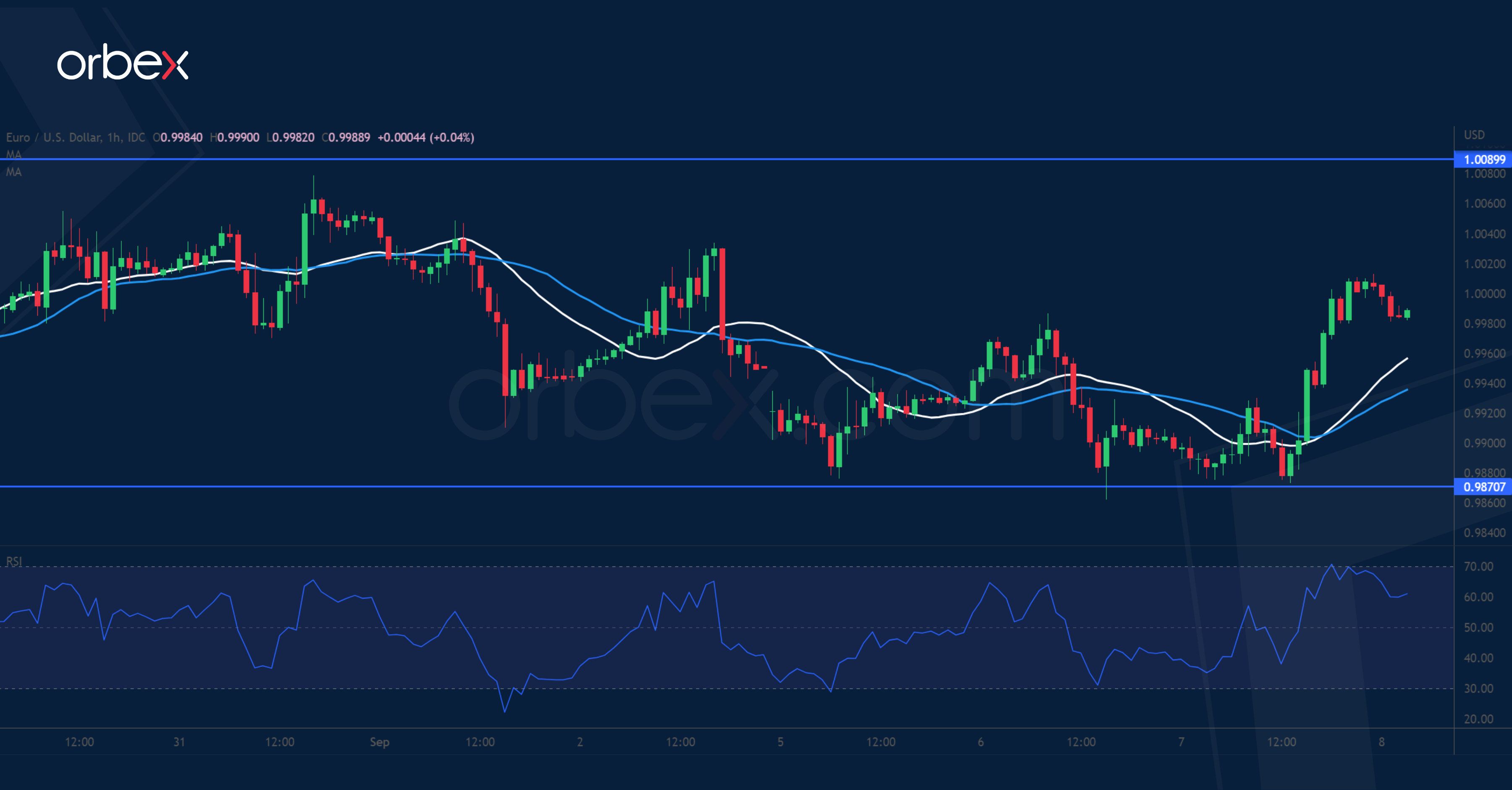
The euro recoups losses as traders expect a 50bp interest rate increase by the ECB. A bearish MA cross on the daily chart following a brief consolidation shows that the mood remains cautious at best. A failure to hold onto 0.9900 was a reminder of a strong bearish bias. However, a break above the first resistance at 0.9980 is an encouraging sign. The single currency will need a solid catalyst to propel it above the supply zone at 1.0090 and to make a recovery sustainable. Otherwise, the fresh support at 0.9870 could be at risk.
Daily Technical Analysis
EUR/USD
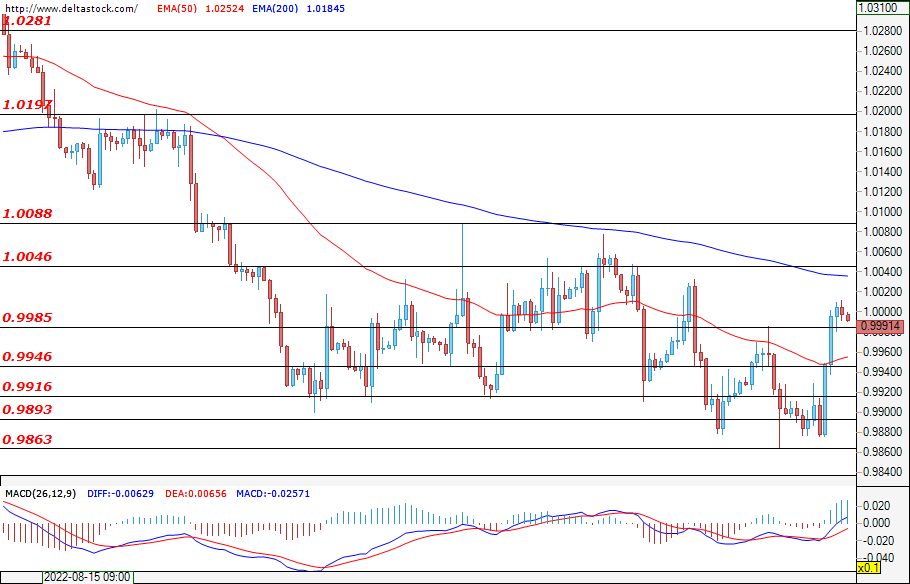
The single European currency recovered some of its recent losses against the dollar and the price breached the resistance at 0.9985. If the bullish attack continues, then a successful violation on the next target at 1.0046, followed by a breach of the important zone at 1.0088, could easily continue the recovery and strengthen the positive expectations for the future path of the pair. If the bears prevail and manage to violate the zone at 0.9985, which is now acting as support, then they could easily lead the EUR/USD towards a test of the lower level at 0.9916. Important news for investors today will be the expected European Central Bank interest rate decision at 12:15 GMT, as well as the data оn the U.S. initial jobless claims later at 12:30 GMT.
USD/JPY
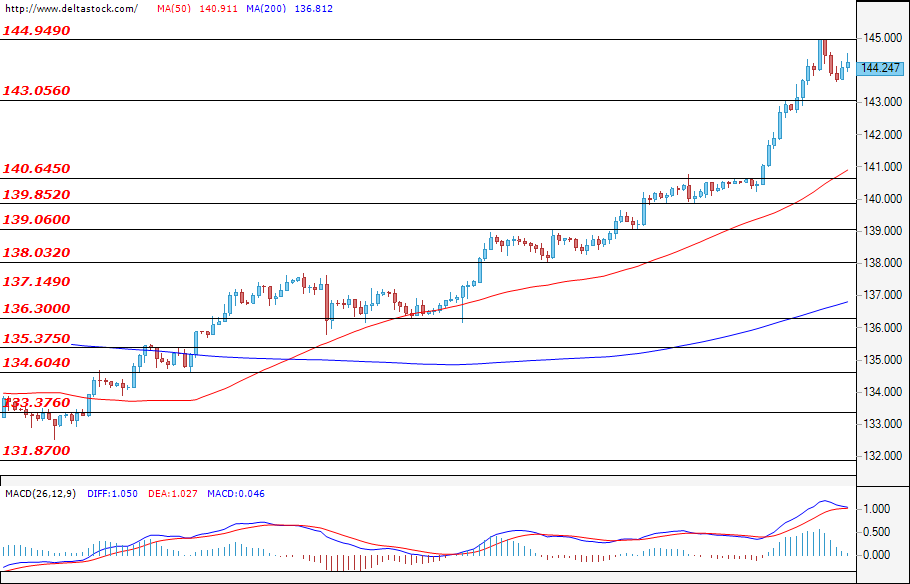
The historic appreciation of the dollar against the yen continued yesterday, and after the test of the important zone at 144.94, the price consolidated around the current level of 144.24. If the positive sentiment remains unchanged, then a new attack on the high at 145.00 could be the most probable scenario. A successful breach here could easily lead to new gains and could head the USD/JPY towards levels at around 146.60. The first support for the bears could be found at 143.05. A potential deeper correction is expected to remain limited to 140.64.
GBP/USD
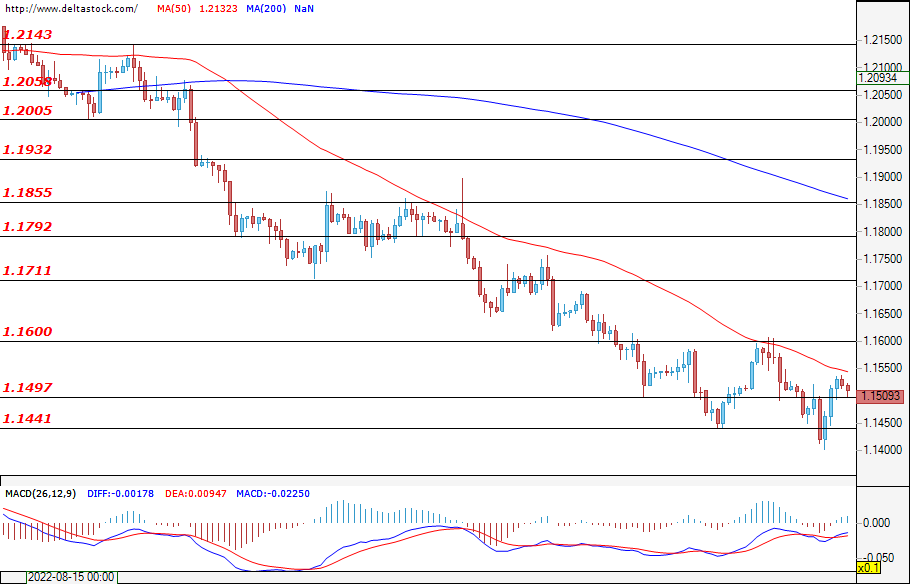
The bearish momentum faded, and after the unsuccessful test of the low at 1.1441, the Cable appreciated. During the early hours of today`s trading, the price is hovering above the zone at 1.1497, and if the bulls prevail, then a successful attempt for a violation of the higher resistance at 1.1600 could easily head the pair towards the local high at 1.1711 and could lead to a change in the current sentiment of the market participants. If the bears instead re-enter the market, their first target would be the mentioned level at 1.1497. A breach of the lower zone at 1.1441 could mark the current move as corrective and could lead to a continuation of the pound sell-off against the dollar.
EUGERMANY40
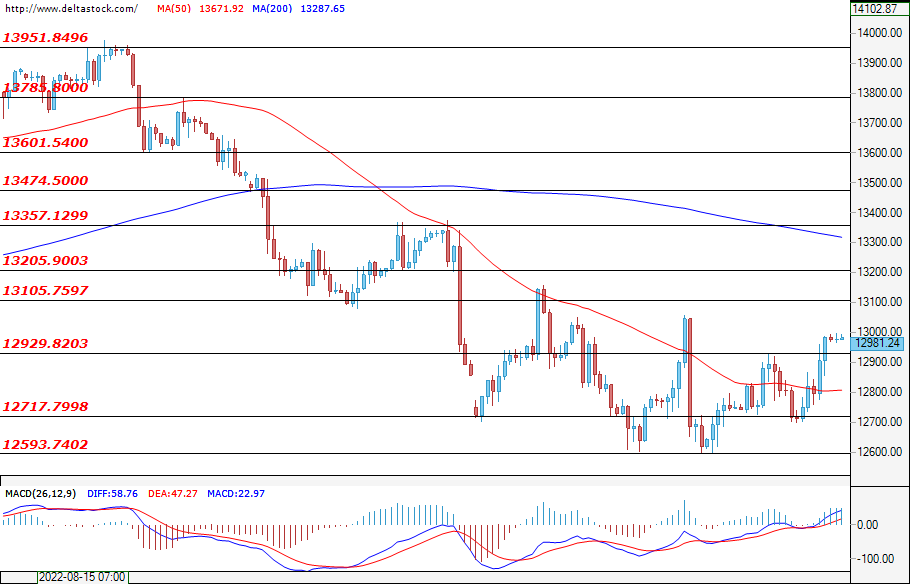
The support zone at 12717 successfully withheld the bearish attack and the German index recovered some of its recent losses. The price breached the close resistance at 12929, and at the time of writing the analysis, it has consolidated around the psychological level at 13000. A violation of the next target at 13105, followed by a breach of 13205, could easily lead to a rally and could pave the way for a test of the important zone at 13357. If the bears re-enter and manage to overcome the support at 19929, then a test of the lower zone at 12717 could be a highly probable scenario, but only a successful attempt and а breach of the low at 12593 could strengthen the negative expectations for the future path of the EUGERMANY40 and could deepen the depreciation towards 12400.
US30
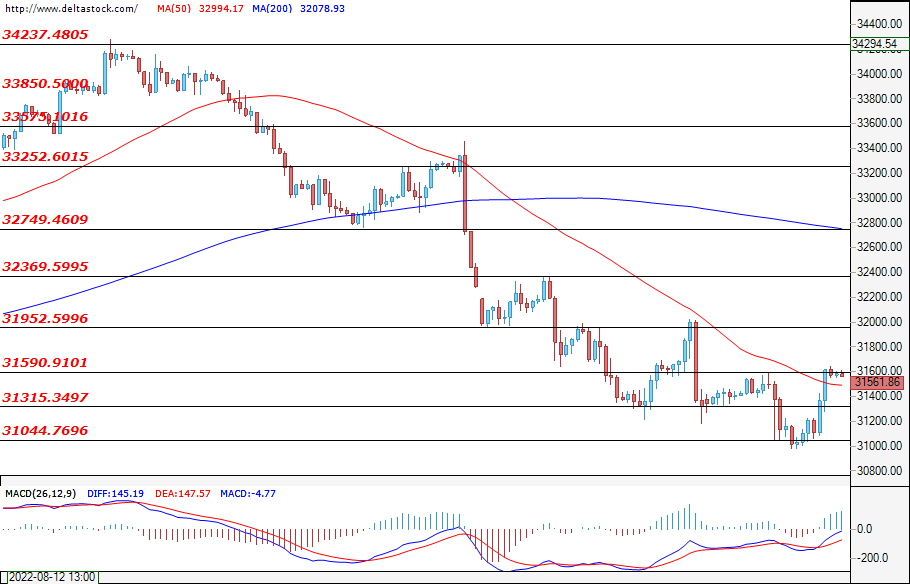
As with the other world leading indices, the US30 also appreciated, and during the early hours of today, the price is holding positions around the resistance zone at 31590. A confirmed breach for the bulls, followed by a violation of the upper target at 31952, could lead to a continuation of the recovery and could head the index for a test of the major zone at 32369. Worse-than-expected data in the U.S. for its initial jobless claims (today; 12:30 GMT) could help the bears prevail. Their first support can be found at the zone of 31315. A successful violation of the lower target at 31044 could deepen the decline and could easily lead to future losses for the index.
The Bar Lagarde Needs to Meet is Set at 75 bps
Markets
The biggest move in core bonds happened on UK soil. Gilt yields crashed 20bps at the front end of the curve. Some BoE officials, testifying before Parliament, pointed out that the new government’s energy plans would curb inflation. Markets figured it could potentially lower the need for rate hikes.
Other elements playing in favour of bonds, not only UK’s, were faltering energy prices. Brent oil ($88/b, -5.7%) fell through key support at $92.09. Gas (Dutch TTF) tanked 12% as a flurry of price-curbing proposals to be tabled at tomorrow’s EU summit rolled over the screens. The German yield curve bull flattened, changing between 1.3 bps and 7.8 bps. Bunds outperformed UST’s until Brainard came to talk.
The Fed vice-chair stressed the central bank’s commitment to bring inflation back to target though cautioned risks will become two-sided at one point. She added that uncertainty on the lag of monetary policy effects create risks for overtightening. US yields eventually declined 7.3 bps to 9.6 bps across the curve.
The dollar lost some ground as a result. EUR/USD rebounded more than a big figure from sub 0.99 to parity. There was certainly some euro strength involved too. The common currency took heart from easing gas prices. USD/JPY tested the 145 barrier before closing at 143.74. DXY couldn’t stay north of 110. Evaporating short-end rate support hurt sterling. EUR/GBP jumped to 0.8675. GBP/USD however avoided a close sub 1.15 on the back of a weaker dollar. Equities recovered, especially in the US. The Nasdaq closed more than 2% higher.
The Asian session runs smoothly this morning. Stocks thrive in Japan and Australia. The latter is supported by RBA governor Lowe hinting at a slower tightening pace than the 50 bps at the last four meetings. Australian yields tumble more than 16 bps (3-5y) and the Aussie dollar lags peers this morning. The US dollar firms a bit. USD/JPY settles above 144, EUR/USD hovers around 1.
Core bonds extend yesterday’s correction higher going into Fed Powell’s speech on monetary policy - the last one before the blackout period kicks in - and the ECB meeting today. The bar Lagarde needs to meet is set at 75 bps. Doing so, as we expect given that new inflation forecasts will again have been revised upwards materially, should keep the downside in European yields protected. After today’s meeting, money markets currently discount 75 bps additional tightening for the final two meetings of this year (which we find too conservative). Renewed upward yield pressure thus depends on the ECB president’s hawkishness and commitment on frontloading. If Lagarde delivers, the euro may find some support, but possibly not more than in a daily perspective. Aside from the rate hike, we’ll watch the Q&A for hints regarding balance sheet reduction (a plan before the end of the year?) and the ECB’s approach to the matter of TLTRO’s (reversed tiering, early repayment incentives?).
News Headlines
The Bank of Canada as expected raised the overnight rate by 75bps to 3.25%. In July, the BoC hiked by 100bps. The BoC signals further hikes to bring inflation back to its 2% target. The economy operates in excess demand and labour markets remain tight. Inflation eased in July to 7.6% from 8.1% due to a drop in gasoline prices, but core inflation remains upwardly oriented, indicating a further broadening of price pressures, particularly in services. The market currently discounts the policy rate between 3.75% and 4.0% by the end of this year/early next year. So a scenario of 50 bps in October and 25 bps in December isn’t fully priced in. The Canadian dollar strengthened from USD/CAD 1.32+ to USD/CAD 1.312. However, part of this move was due to an overall USD correction.
The National Bank of Poland further slowed the pace of tightening to 25bps, bringing the policy rate to 6.75%. Activity in Q2 slowed (-2.3% Q/Q and 5.3% Y/Y, from 8.5% in Q1) and the NBP expects that process to continue over the next quarters. Still, the labour market remains strong. Inflation (Aug) increased to 16.1%. A big part is due to external factors but enterprises passing through higher costs is raising core inflation too. Upward prices pressures might persist short-term, but interest rate hikes, slower growth and fading impact op supply shocks will ease inflation over time. This also should be supported by a strong zloty which the NBP estimates undervalued. Further steps are data dependent. Governor Glapinski will comment on the rate decision later today. Recently he indicated that the rate hike cycle might be nearing its end. The zloty yesterday rebounded slightly to EUR/PLN 4.712.
50 or 75bp?
Yesterday, the Bank of Canada (BoC) raised its policy rate by 75bp at yesterday’s meeting, as expected.
Today, the European Central Bank (ECB) will decide by how much they will be raising their policy rates. There are two camps: The 75bp-hike camp believes that the ECB should hike the rates relatively faster to tame the surging inflation in the EZ. The 50bp-hike camp argues that a 75bp hike is too much for an economy that faces a terrible recession – amid the worsening energy crisis.
Released yesterday, the latest GDP report from Europe came in slightly better-than-expected in the second quarter, but obviously, there is nothing to be optimistic about. Europeans built many sectors relying on the cheap Russian energy, like industrial and chemical sectors, and Russia cutting supply to zero, is obviously a big blow to these economies, which should rethink their energy model. And it is not simple, and the energy transition won’t happen overnight. Therefore, and understandably, growth expectations are falling for Europe, and are falling quite sharply for next year. In 2023, the Eurozone is expected to grow no more than 1.4%, and the British GDP growth is seen no more than 0.8%. And I believe, these expectations are still optimistic.
So, what will the ECB do? What CAN the ECB do? Nothing magic and life-changing, really.
The European inflation problem is much related to the energy crisis. Much more than the US, where a part of inflation is due to excessive demand and surging wages, which could be controlled with higher rates. So, raising rates may partially work for the US, and bring inflation down. But raising the interest rates in Europe won’t get the Russians to restore the gas flow back to Europe, and fix things. This is what many people, including the ex-ECB chief Mario Draghi defend.
BUT, a steeper rate hike policy could at least slow down the euro’s depreciation, and have a cooling effect on inflation. I say, slow down, because at this point, there is not much to do to stop the bleeding in the euro. The euro will likely continue losing weight, along with the European economies. But the slower the slide, the better for the economies.
Therefore, a 75bp hike could help the euro slide slower, although there is no quick fix to the European energy crisis, and the recession is what the Europeans will be dealing with this winter, with or without higher rates.
Strong dollar hasn’t been bad for the US exports
With the stronger US dollar, you would expect the US exports to slow. But the contrary is happening. The US trade deficit fell to $70.7 billion in July, from $80.9 billion in June and an all-time high of $106.9 billion revealed in March. There has been a slight rise in exports combined with a sharp decline in imports. That’s the opposite of what should’ve happened in theory.
White House said that the fact that ‘real goods exports reached record levels is an encouraging sign of the resilience of the American economy’, and ‘a reflection of the President's economic plan, which has helped position American manufacturers to win in key areas from semiconductors to clean energy’. Or the Ukraine war just helped the US export more energy. Full stop.
Stocks rebound, but gains remain fragile
US equities had a strong rebound yesterday. The S&P500 advanced 1.83%, while Nasdaq jumped 2%. Apple gained a bit less than 1% as it revealed the new iPhone.
But the latest words from the Federal Reserve (Fed) members weren’t softish, at all. The Fed’s Vice Chair Lael Bainard repeated that the rates will be hiked to restrictive levels, and they will stay there for ‘some time’. This means there will be no cut to be anticipated just yet.
Loretta Mester said that the US benchmark rate will go above 4% in the early 2023, and that there will be no cut to be anticipated just yet.
The Fed Chair Powell is due to speak today as well, and he will also repeat that there will be no easing to be anticipated just yet.
And they will keep repeating this until the market gets it right: there is no policy easing, and lowering rates in horizon for the Fed. So, it’s normal that some big investors continue warning that the bottom in equities is not hit just yet. The Big Short’s Michael Burry is one of them.
Commo & precious metals
Gold bounced back above the $1700 mark, thanks to a broad retreat in the US dollar. But the risks remain tilted to the downside as long as the dollar’s strength remains the main catalyzer of price action.
Bitcoin hit $18500 yesterday, and will likely encounter solid offers into the $20K, unless we see a sustainable rebound in other risk assets, like equities. But fundamentally, there is little reason to bet for a sustainable risk rebound.
And the US crude dived near 6% to $81.50 a barrel, as the global recession fears outweighed the supply side concerns.
ECB to Deliver a 75bp Rate Hike – Nationalbanken to Exit Negative Policy Rates
Market movers today
The highlight today will be the ECB meeting, where we look for a 75bp hike in all three policy rates (see also ECB Research: We expect 75bp at the meeting next week, 29 August). Hawkish comments from ECB members have recently highlighted that persistently high inflation takes precedence over the deteriorating growth outlook and upward revisions in the inflation projections should also support a larger rate move. Markets price in a 65% probability of a 75bp move, while analysts remain split 50-50, setting the stage for an interesting meeting.
We expect Danmarks Nationalbank to follow the rate hike from ECB 1:1 and in our base case to raise its key policy rate to 0.65% thereby marking the end to negative policy rates in Denmark. An announcement would come at 17:00 CET.
In Norway, GDP figures for July are on the agenda and we expect the mainland economy to expand by 0.2% m/m, confirming that growth is very much on the wane.
Markets will continue to follow EU signals ahead of the EU energy minister meeting tomorrow on emergency tools to handle to the energy crisis. Price caps, windfall profit taxes and emergency credit lines for energy participants look set to be discussed as possible tools.
The 60 second overview
Markets. Yesterday's session was characterised by a drop in oil and natural gas prices, a move lower in yields, a weaker USD and a general relief rally in duration sensitive equity sectors. The drop in both global yields and oil prices eased some of the upward pressure on USD/JPY after the cross earlier this week hit the highest level since 1998. Overnight the moves have extended into Asian markets with most of the big Asian equity indices trading in green. Western equity futures are flat.
Oil prices. This week's drop in oil prices has sent Brent crude back below USD 90/bbl for the first time since February. Interestingly, the recent drop follows Monday's announcement that OPEC+ intends to cut output by 100K bbls highlighting the growing demand concern from OPEC+ amid new COVID lockdowns in China and rising recession fears in Western economies. Our baseline case is for Brent crude to trade close to USD 100/bbl for the rest of the year but front-loaded monetary tightening and new lockdowns in China pose a clear downside risk to that call.
Fed speakers. Several Fed board members have been on the wire reiterating their determination to bringing inflation under control. As we approach the silent period ahead of the 21 September Fed meeting both rates pricing and analyst expectations seem to shift towards a 75bp hike. Our call remains for a 75bp hike. We expect the Fed to keep tightening policy until there is a clear picture the economy is weakening and the labour market softening in order to conclude that underlying inflation pressures are coming down towards their 2% target.
Bank of Canada (BoC) hiked policy rates in yesterday's session for the fifth time in this hiking cycle. While BoC surprised markets in July with a 100bp hike yesterday's hike was of an expected 75bp which brings the target for the overnight rate to 3.25%. As has been the case for many other central banks recently, BoC has also deemed it necessary to frontload monetary tightening. BoC stated that the longer inflation expectations are elevated the greater the risk that elevated inflation becomes entrenched. BoC stated its expectations that policy rates will have to rise further and the extent will depend on incoming data. Short-end rates rose upon announcement while the move in CAD FX was very modest.
Reserve Bank of Australia (RBA). Overnight a speech from Governor Lowe moved markets as Lowe alluded to the case for slower rate hikes moving forward. Tuesday morning RBA hiked its cash rate target by 50bp to 2.35% with rates markets pricing in slightly less than 3 additional hikes of the same size. Following the speech 2Y AUD swap rates dropped more than 10bp while AUD/USD fell roughly 20 pips.
Equities: Equities finally stopped the bleeding yesterday. Lift-off driven by US, Nasdaq, cyclical growth stocks with VIX declining. Broadly speaking, all the stuff that has suffered for almost a month got some relief yesterday as long bond yields dropped significantly and the oil price dropped to a level suggesting US headline inflation may plunge when the October reading is due in a couple of months. No surprise to see energy stocks as a major loser yesterday and tech, consumer cyclical and utilities outperforming. US indices all closing higher with Dow +1.4%, S&P 500 +1.8%, Nasdaq +2.1% and Russell 2000 +2.2%. Positive sentiment carrying over to Asia this morning with broad based gains led by Japanese stocks rising 2%.
FI: European curves bull flattened yesterday, with most of the move happening early in the day. Bunds ended 5bp lower amid BTPs-Bund spread tightening 5bp. The front-end was repriced slightly lower, in particular in the 2023 segment, likely on spill-overs from dovish comments from the BoE, but for today's ECB meeting markets now price in 66bp. Bund ASW spread has tightened significantly since Tuesday, where Bund ASW is now 10bp tighter at 90bp and Schatz-ASW have tightened 20bp.
FX: Yesterday's session was generally characterised by a relief rally in the European natural gas sensitive currencies like HUF, PLN and EUR. The USD traded on the back foot while the upward pressure on USD/JPY eased amid lower yields and energy prices. EUR/USD is back trading close to parity.
Credit: Credit markets saw a second day in a row with strong issuance in Europe's primary market before ECB's next meeting and rate decision Wednesday. In Scandi space SKF issued a EUR400m 6-year green bond at MS+95bp after initial price talks of MS+135bp and initial size talk of EUR300m - a clear testament to strong demand for high quality issuers in Scandi space. The deal order book was above EUR2.5bn - again a clear sign of strong interest. Overall on market level iTraxx Main was 3bp tighter at 114bp while Xover was 15bp tighter at 558bp.
GBP/JPY Daily Outlook
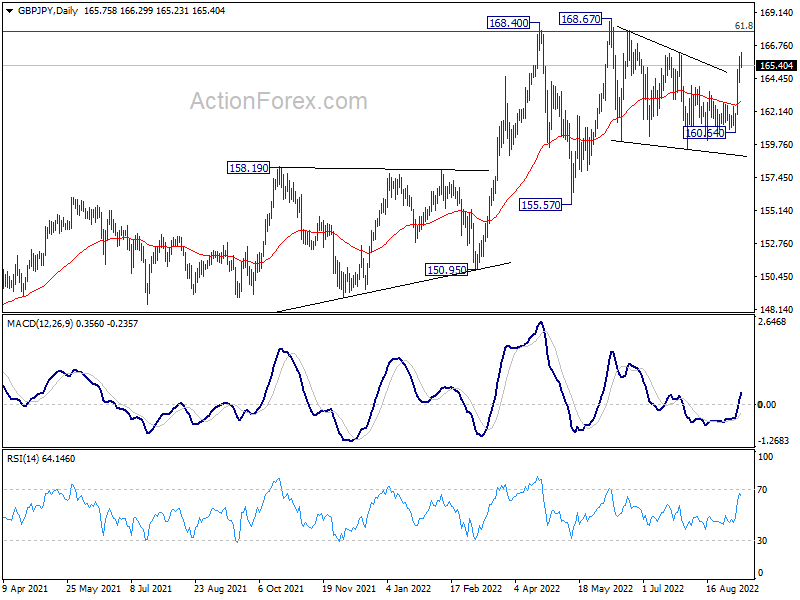
Daily Pivots: (S1) 164.70; (P) 165.35; (R1) 166.51; More...
Intraday bias in GBP/JPY stays on the upside for the moment. Firm break of 166.31 resistance will argue that larger up trend is ready to resume through 168.67 high. On the downside, below 164.16 minor support will turn intraday bias neutral first, and would probably extend the corrective pattern from 168.67 with more sideway trading.
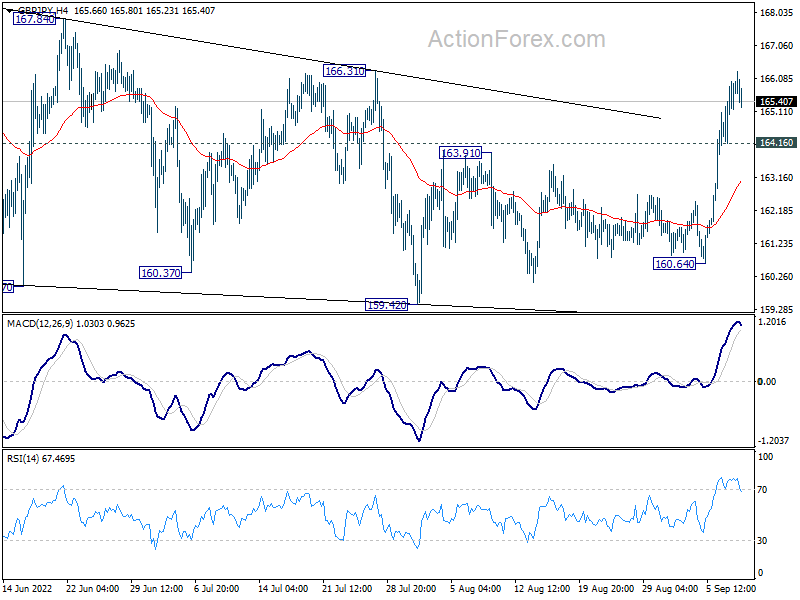
In the bigger picture, up trend from 123.94 (2020 low) is still in progress. Sustained break of 61.8% retracement of 195.86 (2015 high) to 122.75 (2016 low) at 167.93 will be a long term bullish signal, and could pave the way back to 195.86 high. This will remain the favored case as long as 155.57 support holds, even in case of deep pull back.