Sample Category Title
Eco Data 9/8/22
[php_everywhere instance="1"]
Yen Breaks Down, But FX Intervention Won’t Change Much
The Japanese yen has resumed its terrifying downtrend, crushed under the boot of a central bank that refuses to follow other economies in raising interest rates. With inflation dynamics still subdued, traders are betting the Bank of Japan won’t lift a finger to stop the yen’s bleeding when it meets in two weeks and that the government won’t dare intervene in the FX market.
Freefall
It has been an excruciating year for the Japanese currency, which has lost 25% of its value against the US dollar, tormented by one of the greatest episodes of monetary policy divergence in modern history. Central banks across the world are raising interest rates with incredible speed to fight sky-high inflation, but the Bank of Japan refuses to participate.
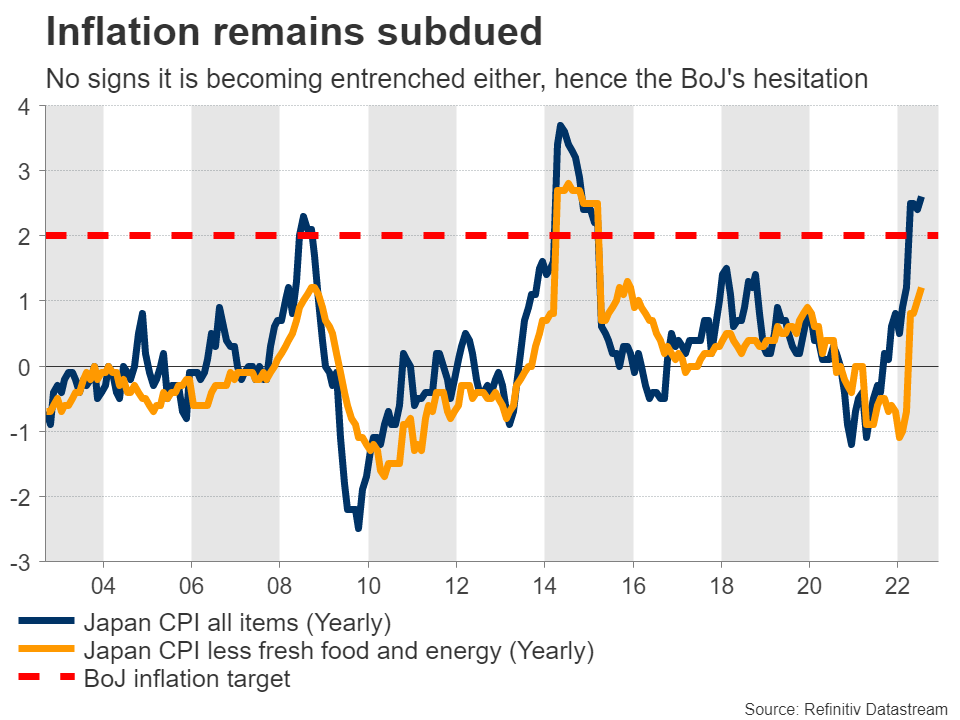
That’s because there isn’t much inflation to fight. Excluding food and energy, inflation in Japan is running at 1.2%, far from the danger zone. Most importantly, wage growth and inflation expectations remain suppressed, so it doesn’t seem like inflation is becoming entrenched. Ergo, the BoJ is convinced this is a global supply shock that will dissipate soon.
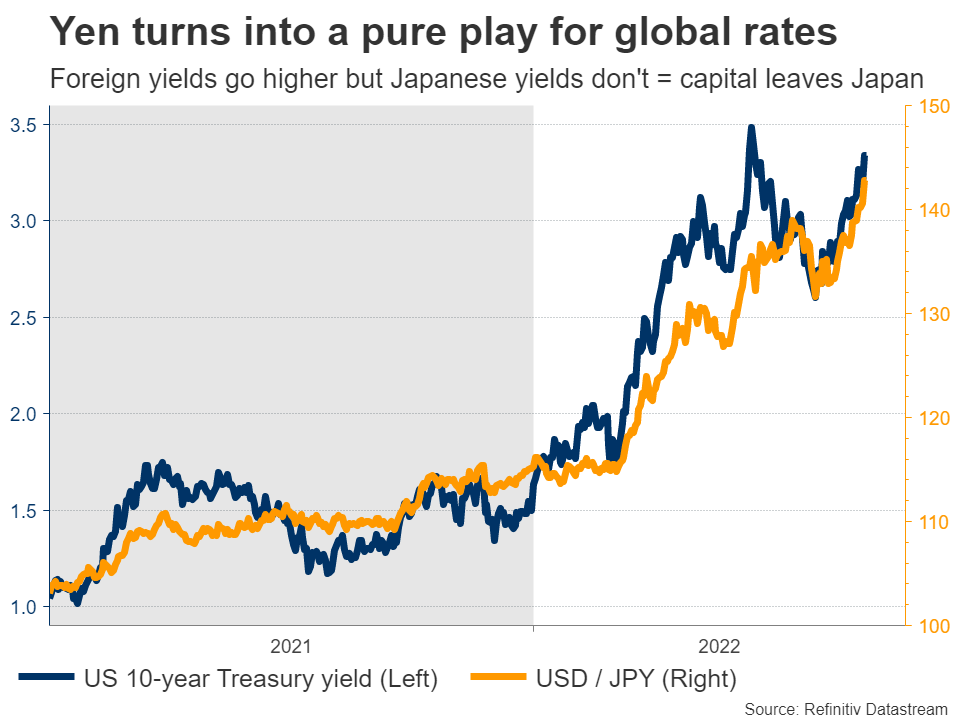
With interest rates moving higher everywhere except for Japan, rate differentials have widened, devastating the yen. Capital is flowing out of the country, searching for better returns abroad. This has turned the yen into a pure play for global rates, trading in lockstep with bets around what the Fed will do, instead of behaving like a safe-haven asset.
Another thorn in the yen’s side has been the shift in trade flows. The nation used to run a chronic trade surplus but with energy prices going ballistic and Japan importing most of its power from abroad, it has flipped into a trade deficit. Coupled with tourists being prohibited from visiting the island, demand for the yen has evaporated.
No FX intervention (yet)
Speculation is running rampant about intervention in the FX market to prevent further declines in the yen. Finance Minister Suzuki described the recent moves as “rapid” and “one-sided”, escalating his verbal warnings in an attempt to chase speculators away.
However, intervention remains unlikely. For starters, Japan would need to intervene alone because neither Europe nor the US would agree to weaken their own currencies and amplify inflationary pressures, simply to help Japan deal with a crisis partly of its own making. Solo intervention implies a lower probability of success, it requires a ton of FX reserves, and it could even backfire with a failed attempt giving traders the green light to enter new short bets.
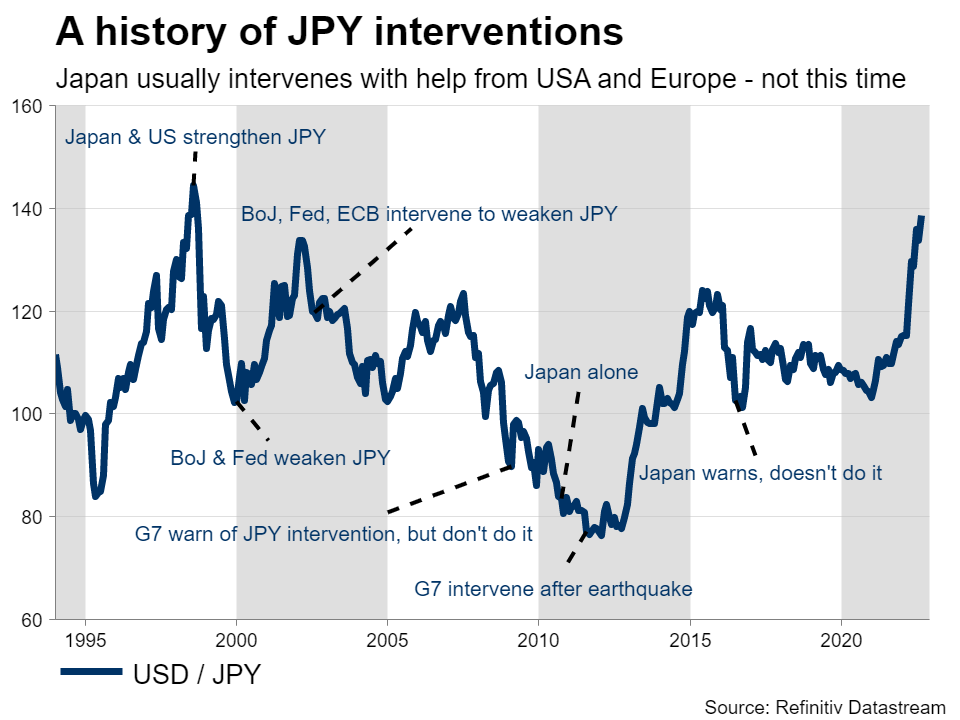
And despite the salvo of verbal warnings, the rhetoric doesn’t point to imminent action. Past instances of intervention were preceded by the finance minister describing the moves as “disorderly”, which hasn’t happened yet. After that, the next step would be an emergency meeting between the central bank and the Finance Ministry to discuss exchange rates.
In other words, we are still in the early stages of the intervention process and the officials are reluctant to truly threaten it, because they know it won’t succeed without global assistance. That said, there is a political limit to how much further the yen can fall. If the depreciation continues at such a frightening pace, Tokyo might still pull the trigger, even if only to flush out speculators.
BoJ sticks to its guns
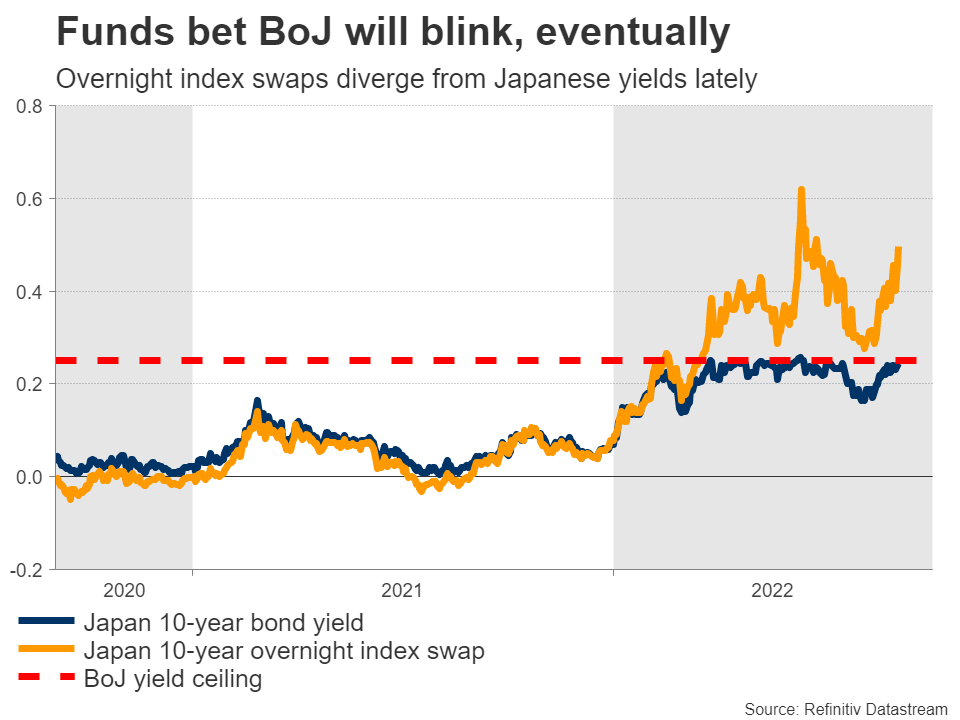
A simpler way to stabilize the yen would be for the BoJ to tighten policy, for instance by raising the ceiling it has imposed on Japanese yields or abandoning it entirely. After all, this is the strategy that slaughtered the yen. By preventing domestic yields from rising beyond a certain point, the selling pressure on the yen intensifies the more foreign central banks raise rates.
Yet the BoJ doesn’t appear ready to pivot. Speaking last month, Governor Kuroda doubled down on his commitment to ultra-loose policy, saying there is no other choice until wages and prices are rising in a sustainable manner. Kuroda has also argued that a small increase in rates won’t be enough to turn the tide in the yen, pointing to other currencies that have been ravaged despite their central banks jumping into action.
Currency traders seem to have absorbed the message and are trying to frontrun the BoJ decision in two weeks by selling the yen. This is also a meeting without updated inflation forecasts, so any dramatic policy shifts would be strange.
While market participants seem confident nothing will change this month, there is a growing sense the BoJ will ultimately be forced to capitulate. Bets that Japanese yields will breach the current ceiling have intensified again, with overnight index swaps rising sharply. Implied volatility has also spiked, which suggests some big players are hedging against massive yen moves.
Is the bottom close?
All told, it’s difficult to call for any trend reversal while the interest rate chasm between the Fed and the BoJ grows wider. There’s probably some more downside in store, with the dollar/yen chart pointing to a fierce battle around the 147 region, which was a reversal point back in 1998.
Of course, there are some elements that could resurrect the yen. If wage growth or inflation expectations begin to creep higher by October, that could spark speculation about the BoJ adjusting its yield ceiling higher.
Alternatively, the paradigm shift could come from the dollar side of the equation. Should investors sense that the Fed’s tightening cycle is coming to an end or that the US economy is slipping into recession, that would allow rate differentials to compress again and breathe life back into the yen.
Until one of these occurs, the picture remains gloomy.
WTI Oil: Oil Price Falls to Pre-War Levels in Turbulent Conditions
The WTI oil fell further on Wednesday, accelerating to new multi-month low (levels last seen a day before the war in Ukraine started) as sentiment was soured again on deteriorating fundamentals.
Oil prices came under fresh pressure on growing fears that looming recession would further hurt global demand that so far countered threats that Russia will completely stop oil and gas supplies after the European Union announced plan to impose cap on Russia’s energy resources.
The situation in the oil market remains turbulent, with oil supplies expected to be tighter towards the end of the year, with strong negative impact from the energy shortage during the winter, to mainly focus the Europe.
Adding to the key factors that drive oil prices was a release of the US strategic reserves and continuous fall in US crude stocks, while the OPEC sticks to its existing policies and refusing to make a significant increase in oil production.
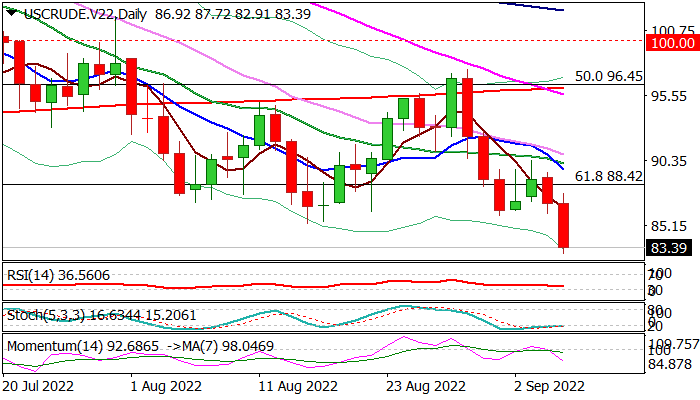
Near-term technical picture is showing rising bearish sentiment on daily chart, with formation 30/200DMA death-cross and 10/20DMA bear-cross, maintaining downside pressure.
Last week’s close below pivotal Fibo support at $88.42 (61.8% of $62.42/$130.48 rally) added to negative signals and opened way towards $80 (round-figure) and $78.48 (Fibo 76.4%). Upticks should be capped under broken Fibo 61.8% level ($88.42) to keep bears intact.
Res: 85.35; 87.72; 88.40; 90.00.
Sup: 80.00; 79.19; 78.48; 76.48.
BoC Opts for Another Oversized Hike and Firm Tightening Bias
- BoC goes big again with a 75 bp hike in September
- 3.25% overnight rate puts monetary policy in ‘restrictive’ territory
- Statement flags further tightening to come, but pace likely to slow
The BoC continued on its steepest rate-hiking path in decades, following up July’s 100 bp increase with a slightly smaller (but still oversized) 75 bp hike today. The move was in line with expectations and lifts the overnight rate to 3.25%, slightly above the 2-3% range the BoC considers neutral. With monetary policy now in ‘restrictive’ territory debate will heat up over just how much further rates need to rise, if at all. The BoC pushed back against calls for a pause after today’s hike, saying “Governing Council still judges that the policy interest rate will need to rise further.” That said, it hinted that the pace of rate hikes will slow going forward as it assess the impact of tightening thus far. Our forecast assumes one more 25 bp increase in October, though today’s meeting suggests upside risk to our call for the overnight rate to peak at 3.50%.
Beyond a very clear tightening bias, today’s statement leaned slightly hawkish with the BoC taking little solace in a gasoline price-driven decline in headline inflation in July. It noted core measures continued to move higher and we think that could be the case again in August. While some of the external drivers of inflation (oil and other commodity prices, shipping costs, supply chain bottlenecks) are easing the BoC will want to see core measures moving lower before it pauses rate hikes. Governing Council will also be watching for improvement in the inflation expectations components of its quarterly business and consumer surveys. Worrying trends in the July BOS and CSCE contributed to the BoC’s surprise 100 bp hike later that month, and today’s statement noted short-term inflation expectations remain high.
Finally, while Q2 GDP came in softer than expected, the BoC emphasized strong domestic demand and a housing market that is pulling back “as anticipated.” But the economy carried little momentum into Q3, and the bank reiterated its expectation that growth will moderate in the second half of the year—a slowdown that’s needed to bring demand more in line with supply. The BoC is hoping to pull that off without tipping the economy into recession, though getting inflation under control remains its top priority. We continue to expect a mild recession in 2023.
Sunset Market Commentary
Markets
Core bonds recovered some of the lost ground today. Notable outperformer: UK Gilts. Yields in the UK drop 5 bps at the long end to a whopping 23 bps at the front end of the curve. The sharp decline follows comments from several BoE policy makers, including chief economist Pill, in their appearance before Parliament saying that the proposed price cap on energy would reduce inflation. Tenreyro said the UK economy still has to see the impact of BoE tightening and wants to go slowly when there is a lot of uncertainty. Markets took it as a signal that the central bank may go slower in frontloading interest rate hikes than previously expected, ignoring a more hawkish show by Catherine Mann (inflation spikes are becoming embedded). Governor Bailey stuck to the sidelines in terms of future policy. He did write off PM Truss’s pre-election proposal for the BoE to focus on money supply to conduct policy rather than inflation as not a useful guide. The UK central bank meets next week and markets have dialed back 80% odds for a 75 bps hike to a little over 50% today. There were some spillovers to other core markets. Yields in Germany ease 6.3 bps (30y) to 9.2 bps (5y) and 2.4-4.2 bps in the US. Tomorrow’s ECB meeting is an additional reason for investors to hold a more defensive approach. Energy commodities trade on the back foot. Dutch gas futures slid 5%, oil prices drop 1.5%. Russian president Putin lambasted Europe’s plans for a price cap on gas. He said Russia won’t supply oil, fuel and gas if those caps get introduced. According to a draft plan seen by Bloomberg, other proposals that will be brought on the table at Friday’s European energy summit include a €200/MWh price cap on non-gas generated electricity, a power-demand cut of 10 to 15% across the bloc or one of 5% during peak hours.
Currency markets are again spiced with outright dollar strength. The Japanese yen is once again a sitting duck. In spite of verbal interventions from Japanese government officials this morning, general risk aversion (stocks down 1%) and correcting core bond yields, USD/JPY jumps a little less than 1.5% or more than 2 big figures. USD/JPY tested 145. But EUR/JPY, too, is in a sweet spot, trading at 143.27 (up from 141.43) and nearing previous cycle highs/resistance levels around 144.25. The trade-weighted USD index (DXY) pushed through 110(.72). EUR/USD slipped sub 0.99 for a third time in row but we do stress it’s a dollar-move and not euro weakness. Sterling’s relief rally on PM Truss’s (so far not yet definitive) energy plans turned out to be very short-lived. Losing massive front-end rate support, the pound drops from EUR/GBP 0.86 to 0.866. GBP/USD forfeited 1.15 support to test crucial support at the 2020 low of 1.1421. Breaking below this level would mean a return to levels last seen in … 1985. CE currencies show remarkable forint strength (see below) while the zloty holds stable after the NBP raised rates by an expected 25 bps to 6.75%.
News Headlines
Industrial production in Hungary showed resilient in July. Production grew 1.1% M/M (from 0.7% in June), bringing WDA growth at 6.6% Y/Y. According to the Hungarian Statistical office, growth was mainly driven by activity in the manufacture of transport equipment, as well as the production of computer, electronic and optical products. Production in the sectors of food products, beverages and tobacco products was lagging the broader production dynamics. The forint today outperformed regional peers with EUR/HUF declining from opening levels just below 405 to currently trade below 400.
Czech July retail sales showed a further loss of momentum. Sales (ex. motors vehicle sales) in real terms declined 0.6% M/M to be 7.2% lower compared to the same month last year. Sales of non-food products declined 0.5% M/M. Food product sales decreased 0.3% in a monthly perspective. Only sales of pharmaceutical and medical goods were reported in positive territory year-on-year. The strongest yearly declines occurred in information and communication equipment (-15.1 %), other household equipment (-12.0%) and culture and recreation goods. The Czech korona underperformed other reactional currencies. EUR/CZK eased marginally to trade at 24.6.
USD/CAD Mid-Day Outlook
Daily Pivots: (S1) 1.3108; (P) 1.3139; (R1) 1.3181; More...
Range trading continues in USD/CAD and intraday bias stays neutral. Further rise is expected with 1.2971 support intact. On the upside, decisive break of 1.3222 will resume larger up trend from 1.2005. Next target is 100% projection of 1.2005 to 1.2947 from 1.2401 at 1.3343.
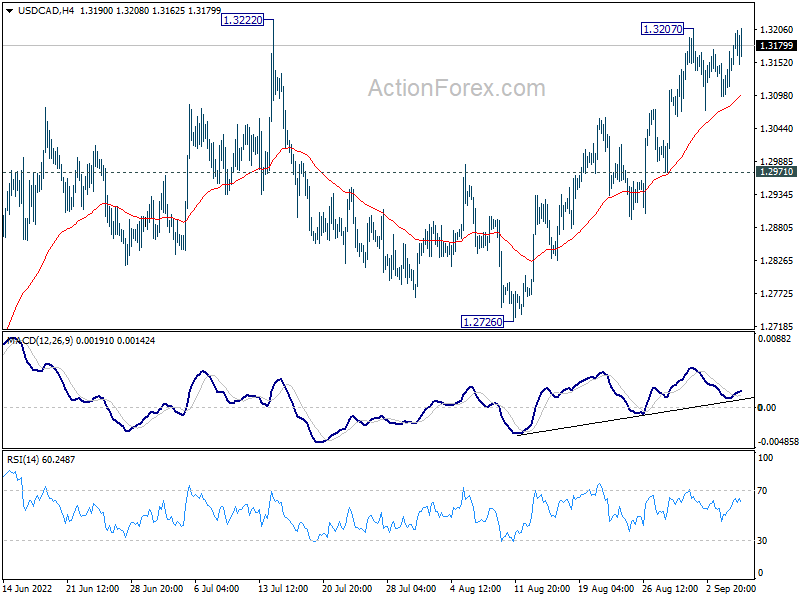
In the bigger picture, down trend from 1.4667 (2020 high) should have completed at 1.2005, after defending 1.2061 long term cluster support. Rise from there should target 61.8% retracement of 1.4667 to 1.2005 (2021 low) at 1.3650. This will remain the favored case now as long as 1.2516 support holds.
CAD Steady after BoC Hike, GBP Pressing Pandemic Low
Canadian Dollar is steady in early US session after BoC delivered 75bps rate hike and maintained hawkish bias. Dollar remains the strongest one for the week, but continues to pick up momentum against Euro. Yen is still the runaway loser, while selloff in Sterling is intensifying. Aussie and Kiwi are clearly weighed down by risk-off sentiment for now.
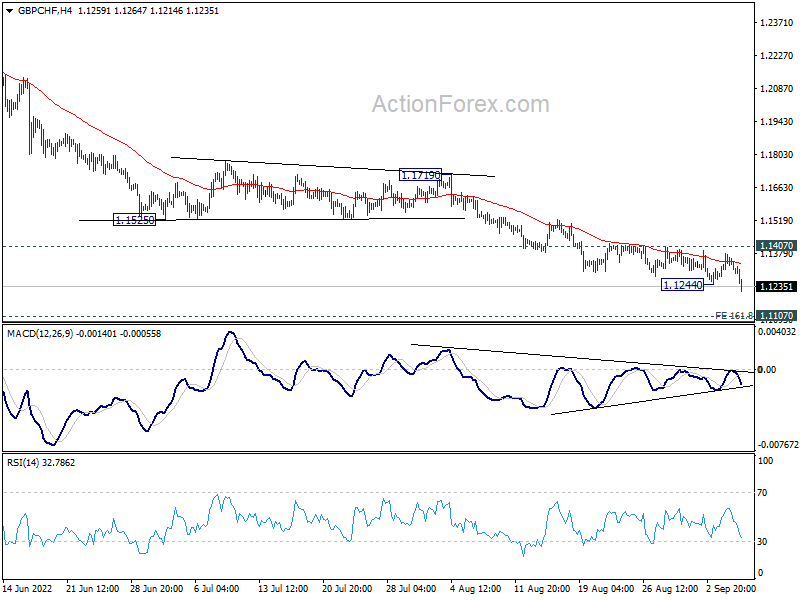
Technically, GBP/CHF's down trend resumed after brief recovery and breaks through 1.1244 temporary low. Next target is 1.1107 (2020 low). Some support might be seen there to bring rebound on first attempt. But that would depends on GBP/USD's reaction to 1.1409 (2020 low too).
In Europe, at the time of writing, FTSE is down -0.82%. DAX is up 0.09%. CAC is down -0.25%. Germany 10-year yield is down -0.0662 at 1.574. Earlier in Asia, Nikkei dropped -0.71%. Hong Kong HSI dropped -0.83%. China Shanghai SSE rose 0.09%. Singapore Strait Times dropped -0.41%. Japan 10-year JGB yield rose 0.0063 to 0.247.
BoC hikes 75bps, rates need to rise further
BoC raises the overnight rate target by 75bps to 3.25%. Correspondingly, the Bank Rate and deposit rate are now at 3.50% and 3.25% respectively. Hawkish bias is maintained as the Governing Council "still judges that the policy interest rate will need to rise further."
"As the effects of tighter monetary policy work through the economy, we will be assessing how much higher interest rates need to go to return inflation to target," BoC added.
BoC also noted that core inflation "continued to move up" with data indicating a "further broadening of price pressures, particularly in services". It warned, "the longer this continues, the greater the risk that elevated inflation becomes entrenched."
The economy "continues to operate in excess demand and labour markets remain tight". BoC expects the economy to "moderate in the second half of this year, as global demand weakens and tighter monetary policy here in Canada begins to bring demand more in line with supply."
Canada exports dropped -2.8% mom in Jul, imports down -1.8% mom
Canada merchandise exports dropped -2.8% mom to CAD 68.3B in July. That's the first contraction in 2022, with declines observed in 6 of 11 production sectors. Total imports dropped -1.8% mom to CAD 64.2B, the first decline since January. Contractions were observed in 7 of the 11 production sections.
Trade surplus narrowed from CAD 4.9B to CAD 4.1B, larger than expectation of CAD 3.8B.
US trade deficit narrowed to USD 70.6B in Jul
US exports rose USD 0.5B to USD 259.3B in July. Imports dropped USD -9.7B to USD 329.9B. Trade deficit narrowed from USD -79.6B to USD -70.6B, versus expectation of USD -70.2B. The decrease in goods and services deficit reflected a decreased in goods deficit to USD -91.1B, and an increase of service surplus to USD 20.4B.
Goods deficit with EU decreased USD 5.7B to USD -11.9B. Deficit with China decreased USD 3.9B to USD -33.0B. Deficit with Mexico increased USD 2.0B to USD -11.7B.
BoE Pill: Truss's gas plan could lower headline inflation
BoE Chief Economist Huw Pill said plans by new Prime Minister Liz Truss on energy costs could help slowing inflation. He told the Parliament's Treasury Committee today, "one of the things that does seem to be under consideration ... is a change to the relationship between gas prices and retail gas prices in a direction that will lower headline inflation, relative to what we were forecasting,"
Governor Andrew Bailey said, "It's not for us to comment on what fiscal policy will be and we will wait and see what it is ... but I do very much welcome the fact that there will be, as I understand it, announcements this week because I think that will help to, in a sense, frame policy and that's important."
MPC member Silvana Tenreyr favors a more tentative approach on tightening. She said, "When close to the equilibrium rate, gradual rate rises allow us to react before we tighten too far into contractionary territory, as we observe the lagged impact of policy and demand on the labor market. They also do not preclude voting for more forceful rate increases in future, should adverse wage-price dynamics take hold."
On the other hand Catherine Mann reiterated her stance that "a more forceful set of moves in Bank Rate earlier on opens the potential for a policy hold, or even reversal, later depending on the evolution of both inflation and demand relative to supply."
Japan officials concerned by one-sided move in Yen, warned of necessary action
As Yen tumbles further to fresh 24-year low against Dollar, Japan Finance Minister Shunichi Suzuki cautioned that "recent moves are rather rapid and one-sided . We need to be watching developments with strong interest."
Chief Cabinet Secretary Hirokazu Matsun said at a news briefing, "I'm concerned about rapid, one-sided moves in the currency market recently. If such moves continue, we will take necessary action."
Australia GDP grew 0.9% qoq in Q2, driven by household spending and exports
Australia GDP grew 0.9% qoq in Q2, matched expectations. Household spending rose 2.2% for the quarter, contributing 1.1% pts to GDP. Net trade contributed 1.0% pts to GDP, driven by exports which rose 5.5%, partially offset by 0.7% rise in imports. Terms of trade rose 4.6% with export and import prices up strongly.
Sean Crick, head of National Accounts at the ABS, said: "Rises in household spending and exports drove growth in the June quarter. This is the third consecutive quarter of economic growth, following a contraction in the September quarter 2021, which was impacted by the Delta outbreak."
Australia AiG services rose to 53.3, businesses highlight interest rate as concern
Australia AiG Performance of Services Index rose 1.6 pts to 53.3 in August. Looking at some details, sales rose 2.6 to 51.9. Employment rose 0.8 to 53.2. New orders rose 6.7 to 57.3. Input prices dropped -5.6 to 68.7. Selling prices dropped -2.2 to 61.2. Average waged dropped -1.3 to 67.6.
Innes Willox, Chief Executive of Ai Group, said: "Services remained in expansion in August, pointing to the overall resilience of the sector with sales, employment and new orders all higher than in July.... Price and wages pressures continued into August although the pace of increase in input prices eased somewhat. With service businesses highlighting interest rates as a key area of concern, the Reserve Bank's decision yesterday to raise the cash rate by another 50 basis points to 2.35% will further fuel their fears of a fall in spending in the months ahead."
USD/CAD Mid-Day Outlook
Daily Pivots: (S1) 1.3108; (P) 1.3139; (R1) 1.3181; More...
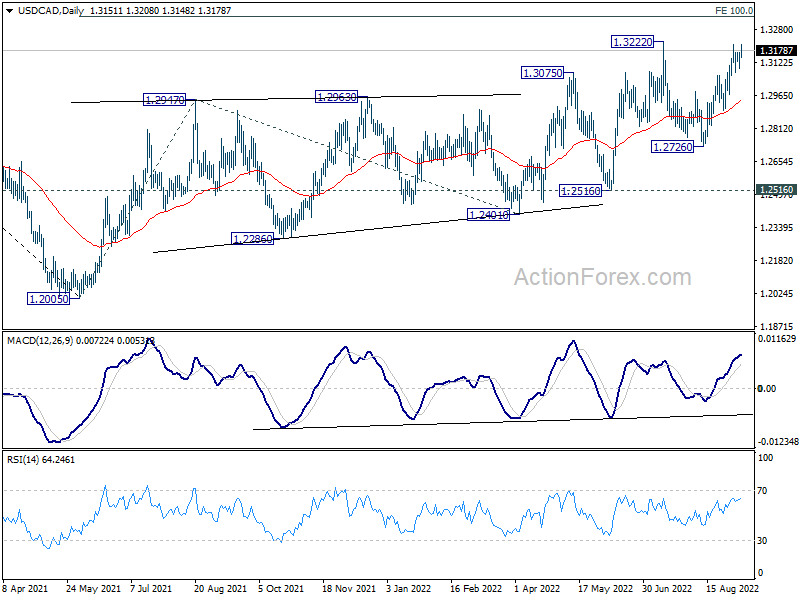
Range trading continues in USD/CAD and intraday bias stays neutral. Further rise is expected with 1.2971 support intact. On the upside, decisive break of 1.3222 will resume larger up trend from 1.2005. Next target is 100% projection of 1.2005 to 1.2947 from 1.2401 at 1.3343.
In the bigger picture, down trend from 1.4667 (2020 high) should have completed at 1.2005, after defending 1.2061 long term cluster support. Rise from there should target 61.8% retracement of 1.4667 to 1.2005 (2021 low) at 1.3650. This will remain the favored case now as long as 1.2516 support holds.
Economic Indicators Update
| GMT | Ccy | Events | Actual | Forecast | Previous | Revised |
|---|---|---|---|---|---|---|
| 22:30 | AUD | AiG Performance of Services Index Aug | 53.3 | 51.7 | ||
| 01:30 | AUD | GDP Q/Q Q2 | 0.90% | 0.90% | 0.80% | |
| 02:00 | CNY | Trade Balance (USD) Aug | 79.4B | 91.8B | 101.3B | |
| 02:00 | CNY | Exports (USD) Y/Y Jul | 7.10% | 18.00% | ||
| 02:00 | CNY | Imports (USD) Y/Y Aug | 0.30% | 2.30% | ||
| 02:00 | CNY | Trade Balance (CNY) Aug | 536B | 650B | 683B | |
| 02:00 | CNY | Exports (CNY) Y/Y Aug | 11.80% | 23.90% | ||
| 02:00 | CNY | Imports (CNY) Y/Y Aug | 4.60% | 7.40% | ||
| 05:00 | JPY | Leading Economic Index Jul P | 99.60% | 100.7 | 100.9 | |
| 06:00 | EUR | Germany Industrial Production M/M Jul | -0.30% | -0.50% | 0.40% | |
| 07:00 | CHF | Foreign Currency Reserves (CHF) Aug | 860B | 849B | 850B | |
| 08:00 | EUR | Italy Retail Sales M/M Jul | 1.30% | 0.20% | -1.10% | |
| 09:00 | EUR | Eurozone GDP Q/Q Q2 | 0.80% | 0.60% | 0.60% | |
| 09:00 | EUR | Eurozone Employment Change Q/Q Q2 F | 0.40% | 0.30% | 0.30% | |
| 12:30 | USD | Trade Balance (USD) Jul | -70.6B | -70.2B | -79.6B | |
| 12:30 | CAD | International Merchandise Trade Jul | 4.05B | 3.8B | 5.0B | 4.9B |
| 14:00 | CAD | BoC Interest Rate Decision | 3.25% | 3.25% | 2.50% | |
| 14:00 | CAD | Ivey PMI Aug | 60.9 | 48.3 | 49.6 | |
| 18:00 | USD | Fed's Beige Book |
BoC hikes 75bps, rates need to rise further
BoC raises the overnight rate target by 75bps to 3.25%. Correspondingly, the Bank Rate and deposit rate are now at 3.50% and 3.25% respectively. Hawkish bias is maintained as the Governing Council "still judges that the policy interest rate will need to rise further."
"As the effects of tighter monetary policy work through the economy, we will be assessing how much higher interest rates need to go to return inflation to target," BoC added.
BoC also noted that core inflation "continued to move up" with data indicating a "further broadening of price pressures, particularly in services". It warned, "the longer this continues, the greater the risk that elevated inflation becomes entrenched."
The economy "continues to operate in excess demand and labour markets remain tight". BoC expects the economy to "moderate in the second half of this year, as global demand weakens and tighter monetary policy here in Canada begins to bring demand more in line with supply."
(BOC) Bank of Canada increases policy interest rate by 75 basis points, continues quantitative tightening
The Bank of Canada today increased its target for the overnight rate to 3¼%, with the Bank Rate at 3½% and the deposit rate at 3¼%. The Bank is also continuing its policy of quantitative tightening.
The global and Canadian economies are evolving broadly in line with the Bank's July projection. The effects of COVID-19 outbreaks, ongoing supply disruptions, and the war in Ukraine continue to dampen growth and boost prices.
Global inflation remains high and measures of core inflation are moving up in most countries. In response, central banks around the world continue to tighten monetary policy. Economic activity in the United States has moderated, although the US labour market remains tight. China is facing ongoing challenges from COVID shutdowns. Commodity prices have been volatile: oil, wheat and lumber prices have moderated while natural gas prices have risen.
In Canada, CPI inflation eased in July to 7.6% from 8.1% because of a drop in gasoline prices. However, inflation excluding gasoline increased and data indicate a further broadening of price pressures, particularly in services. The Bank's core measures of inflation continued to move up, ranging from 5% to 5.5% in July. Surveys suggest that short-term inflation expectations remain high. The longer this continues, the greater the risk that elevated inflation becomes entrenched.
The Canadian economy continues to operate in excess demand and labour markets remain tight. Canada's GDP grew by 3.3% in the second quarter. While this was somewhat weaker than the Bank had projected, indicators of domestic demand were very strong – consumption grew by about 9½% and business investment was up by close to 12%. With higher mortgage rates, the housing market is pulling back as anticipated, following unsustainable growth during the pandemic. The Bank continues to expect the economy to moderate in the second half of this year, as global demand weakens and tighter monetary policy here in Canada begins to bring demand more in line with supply.
Given the outlook for inflation, the Governing Council still judges that the policy interest rate will need to rise further. Quantitative tightening is complementing increases in the policy rate. As the effects of tighter monetary policy work through the economy, we will be assessing how much higher interest rates need to go to return inflation to target. The Governing Council remains resolute in its commitment to price stability and will continue to take action as required to achieve the 2% inflation target.
Information note
The next scheduled date for announcing the overnight rate target is October 26, 2022. The Bank will publish its next full outlook for the economy and inflation, including risks to the projection, in the MPR at the same time.
EUR/USD Mid-Day Outlook
Daily Pivots: (S1) 0.9852; (P) 0.9919; (R1) 0.9974; More...
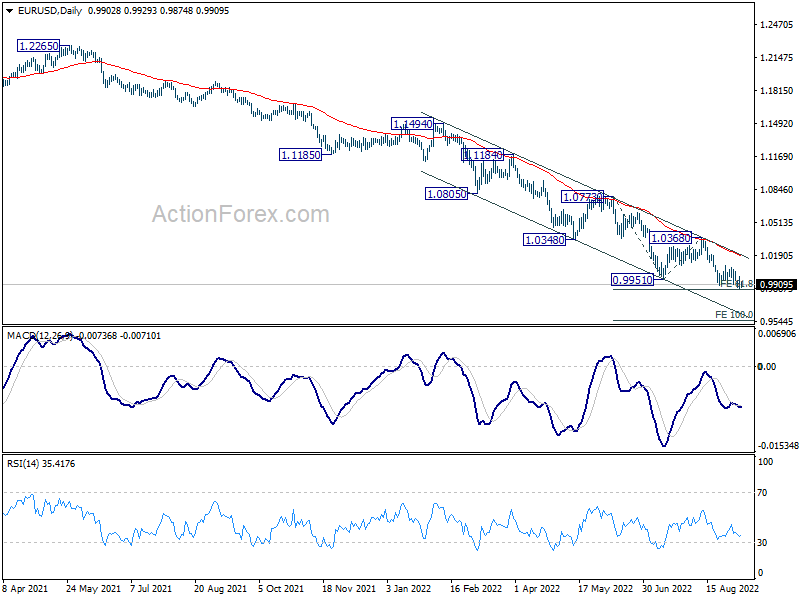
Outlook in EUR/USD stays bearish even though downside momentum is a bit unconvincing. Decisive break of 61.8% projection of 1.0773 to 0.9951 from 1.0368 at 0.9860 should prompt downside acceleration to 100% projection at 0.9546. On the upside, however, firm break of 1.0078 will indicate short term bottoming, and turn bias back to the upside for 1.0368 resistance instead.
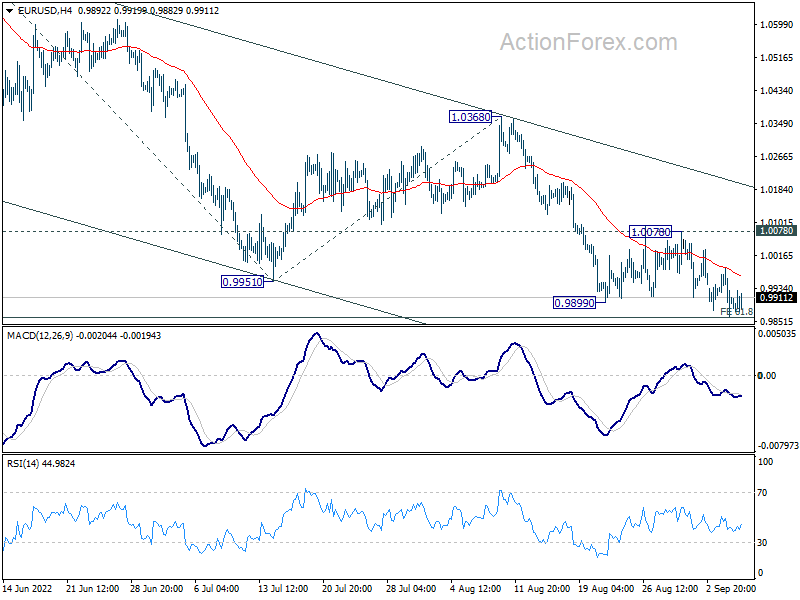
In the bigger picture, down trend from 1.6039 (2008 high) is still in progress. Next target is 100% projection of 1.3993 to 1.0339 from 1.2348 at 0.8694. In any case, outlook will stay bearish as long as 1.0368 resistance holds, even in case of strong rebound.