Sample Category Title
Canadian Dollar Steady ahead of BoC Meeting
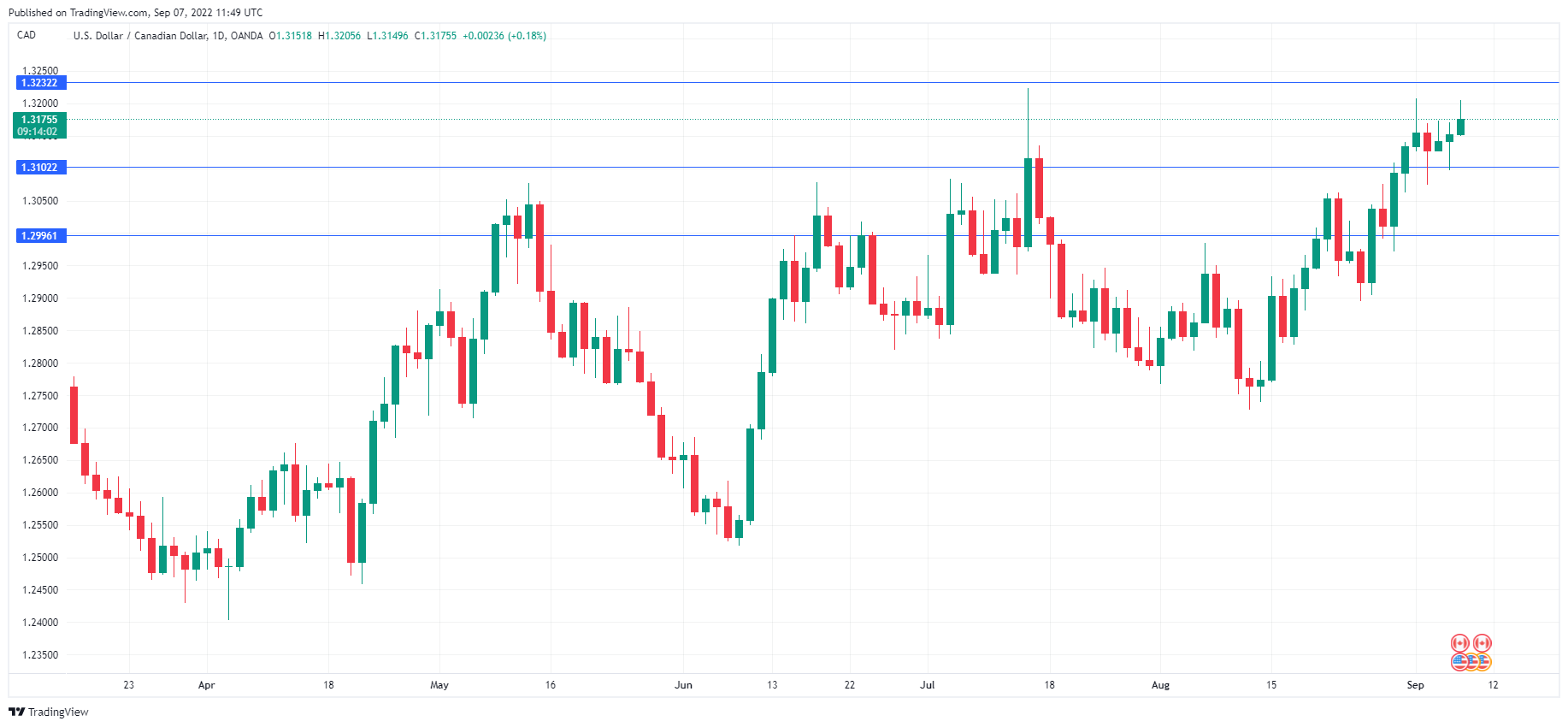
The Canadian dollar has edged higher today. In the European session, USD/CAD is trading at 1.3173, up 0.17%.
BoC expected to remain aggressive
The Bank of Canada meets later today and policy makers are expected to keep their foot on the pedal and deliver a sizeable hike of 0.75%. This follows the surprise super-size increase of 1.00% in July, which brought the benchmark rate to 2.50%. The BoC considers its neutral rate around 2.50%, which means that rates are headed to restriction territory in a bid to curb red-hot inflation. There was some good news as July CPI dropped to 7.6%, down from 8.1% in June, but this has not changed the BoC’s policy. In July, Governor Macklem responded to the drop in CPI by saying the Bank was committed to acting forcefully against inflation in order to avoid a sharper economic downturn.
There had been some expectations that the BoC might implement another 1.00% increase at today’s meeting, but those expectations were dampened by last week’s disappointing GDP release for Q2. The economy grew by 3.3%, well short of the consensus of 4.4%, which means that the likely outcome of today’s meeting is a 0.75% hike.
At the July meeting, Macklem said that the BoC was committed to front-loading rate increases now in order to avoid even higher rates down the road. Assuming Macklem’s stance hasn’t changed, this means that the BoC will shift into low gear in October, with a small rate hike of 0.25% or possibly no increase at all. If the next inflation report shows another drop, the BoC will be able to breathe easier and ease up on its rate-tightening cycle.
USD/CAD Technical
- USD/CAD faces resistance at 1.3232, followed by 1.3338
- There is support at 1.3102 and 1.2996
Forex Implications of the New UK Prime Minister
In general terms, the economic policy of the UK under the new government is expected to remain very similar. For example, the new Chancellor Kwasi Kwarteng might have had differences in public image with former chancellor Sunak, but in practice, agrees on most major issues. In fact, the argument between them was mostly along the lines of who was most in favor of the policies.
That having been said, a change of the occupant of No. 10 is an opportunity to do a bit of a course correction. After all, the prior PM was quite unpopular, and the point of a changing leadership is to find a new direction. So, some changes are to be expected, particularly on the front that could be seen as garnering popular support. But, the question for traders is:
How does this affect the markets?
The most notable is in respect to dealing with the energy crisis, which took on increasing new dimensions over the summer. That was when Johnson was still in a caretaker role, and therefore wouldn't be announcing any major new policy. Though we should remember that the UK already had an energy emergency a year ago, with petrol stations running out of fuel in some places. While largely fueled by consumer panic, there was an underlying logistics issue. Now, there is a different problem.
The new PM is proposing a program to spend as much as £200B in order to keep down energy prices for consumers and businesses. That amounts to a little over 7.4% of the UK's nominal GDP for last year (and could be even higher if the BOE's projections of a recession comes true). With multi-decade high inflation, increased spending (or, at least, the monetary expansion to support it) might have quite a few economists rather worried. In particular, some traders have been speculating that cable could fall down to parity, like the Euro already has.
What about the nuts and bolts?
Of course there have been other measures announced, such as rescinding the raise in National Insurance. However, since a little over a third of the UK's energy needs come from overseas, that is the issue most likely to impact forex markets.
While in general, increasing spending based on debt tends to lead to higher inflation, exactly how the mechanism is implemented could have different kinds of effects. And, so far, the details have not been forthcoming, though more information is expected tomorrow.
Getting a handle on the implications
So far, the promise has been to cap household energy bills. There are a wide range of mechanisms to achieve that, and they all have different inflation implications. The basic issue is that capping energy prices would allow UK households to have more disposable income, at a time that the BOE is trying to tamp down demand with higher rates. It might mean the BOE takes a stronger position starting at the next meeting to head off inflation.
If the price cap mechanism is achieved through some sort of direct subsidy to energy bills, that would imply higher domestic spending by the government. Which would increase inflationary pressure. However, if the price cap was more similar to Spain's, where the government would subsidize input costs for generators, then the inflationary effect might be less.
However, if the BOE takes a stronger stance in raising rates, a stronger pound might additionally help offset the cost of energy and lower inflation. Another reason that BOE policy might look more like the US' than Europe's in the near term.
BoE Pill: Truss’s gas plan could lower headline inflation
BoE Chief Economist Huw Pill said plans by new Prime Minister Liz Truss on energy costs could help slowing inflation. He told the Parliament's Treasury Committee today, "one of the things that does seem to be under consideration ... is a change to the relationship between gas prices and retail gas prices in a direction that will lower headline inflation, relative to what we were forecasting,"
Governor Andrew Bailey said, "It's not for us to comment on what fiscal policy will be and we will wait and see what it is ... but I do very much welcome the fact that there will be, as I understand it, announcements this week because I think that will help to, in a sense, frame policy and that's important."
MPC member Silvana Tenreyro favors a more tentative approach on tightening. She said, "When close to the equilibrium rate, gradual rate rises allow us to react before we tighten too far into contractionary territory, as we observe the lagged impact of policy and demand on the labor market. They also do not preclude voting for more forceful rate increases in future, should adverse wage-price dynamics take hold."
On the other hand Catherine Mann reiterated her stance that "a more forceful set of moves in Bank Rate earlier on opens the potential for a policy hold, or even reversal, later depending on the evolution of both inflation and demand relative to supply."
The Crypto Market Has Not Withstood the Pressure
Market picture
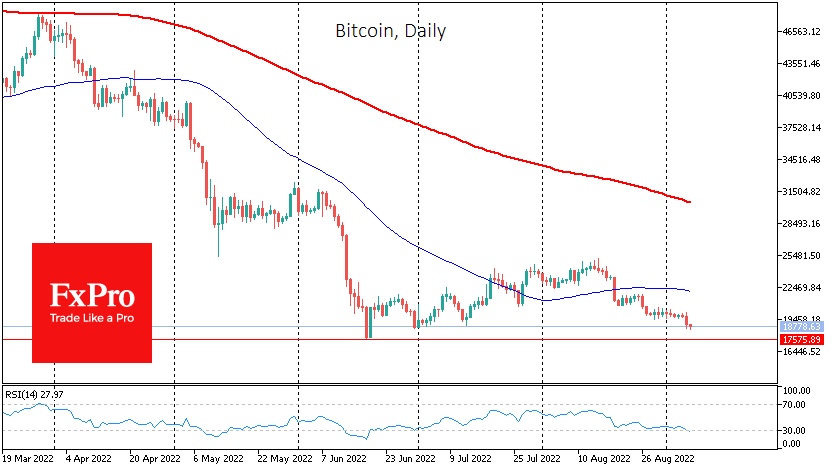
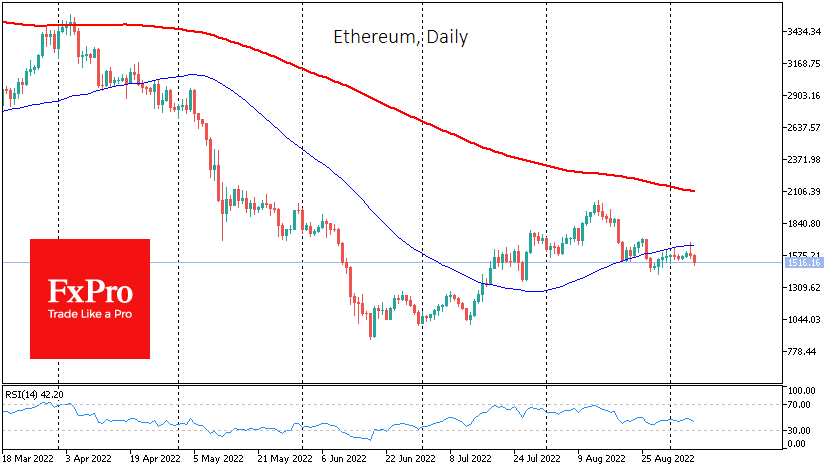
Bitcoin lost more than 5% to $18.8K in 24 hours, ending an extended lull. Ethereum loses more than 8.5%, falling to $1520.
The crypto market’s capitalisation is down 5.8% to $940B, according to CoinMarketCap, which is in line with the amplitude of the crypto flagship’s decline. As is often the case, BTC was the first to go, and only hours later, the sell-off spread to the entire sector.
Continued pressure in equity markets eventually forced the crypto bulls to retreat. The local situation focuses on whether the previous low $17575 will hold or the sell-off won’t stop this time.
It is worth bearing in mind that this time the closing of the stop outs may cause the price to slip down to $13K. However, in our view, chances are high that there will be some lull near current levels, as BTCUSD has entered the oversold area on the daily charts.
News background
Glassnode says bitcoin could fall to $17,000 based on on-chain indicators analysis. At the same time, the long-term outlook for the first cryptocurrency remains ‘constructive’, as evidenced by the growing number of coins at HODLers.
The International Monetary Fund (IMF) has called for global regulation of cryptocurrencies, which have evolved from niche products into payment instruments, speculative investments and hedging tools.
Europol praised blockchain technology as a tool for fighting crime. The agency said Blockchain’s ability to track transactions makes finding and recovering stolen funds easier.
The Ethereum team has activated the Bellatrix upgrade. The upgrade is the last step before migrating the core network to the PoS algorithm. The Merge is set to complete on 15 September.
GBPJPY Rallies Towards New 6-week High
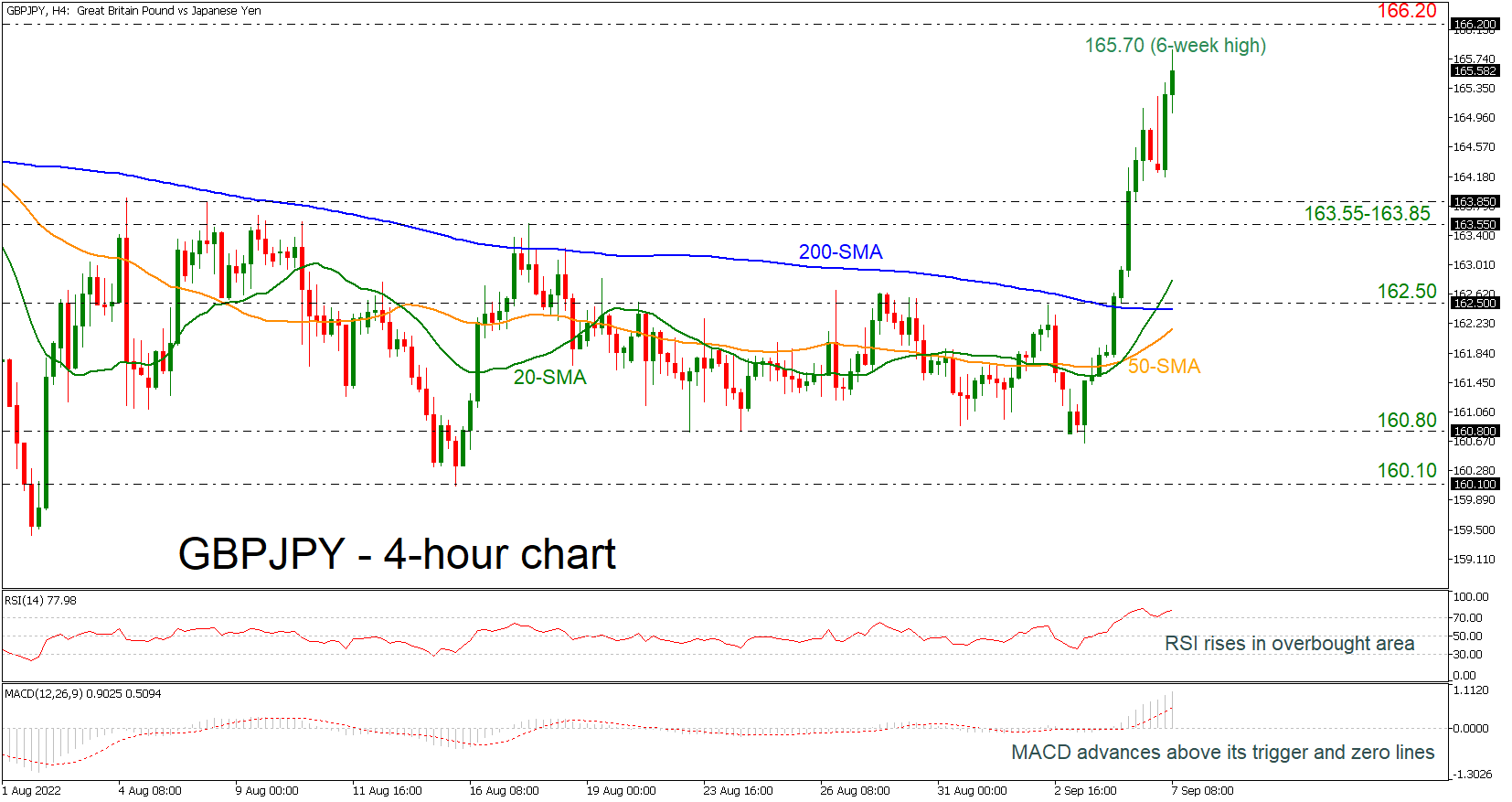
GBPJPY surged to a fresh six-week high of 165.70 earlier today, penetrating to the upside of the 163.55-163.85 area. The 20- and 200-period simple moving averages (SMAs) posted a bullish crossover, endorsing the strong bullish rally. The RSI indicator is rising in the overbought territory, while the MACD is strengthening the positive momentum above its trigger and zero lines.
More advances could take the market until the 166.20 barrier, reached on July 20 ahead of the next peak on June 22 at 167.80. If buyers claim that zone this time, 168.70 could be another strong obstacle to halt the upside pressures.
On the other hand, the pair may pull back to test the 163.55-163.85 support region. Falling lower, the 20-period SMA at 162.80 and the 162.50 mark, which moves near the 200-period SMA may act as a difficult territory to break.
Summarizing, the short- and medium-term outlooks are showing positive bias and only a drop beneath the 200-period SMA may switch the market to bearish.
NZDUSD Plummets to Fresh 27-month Low
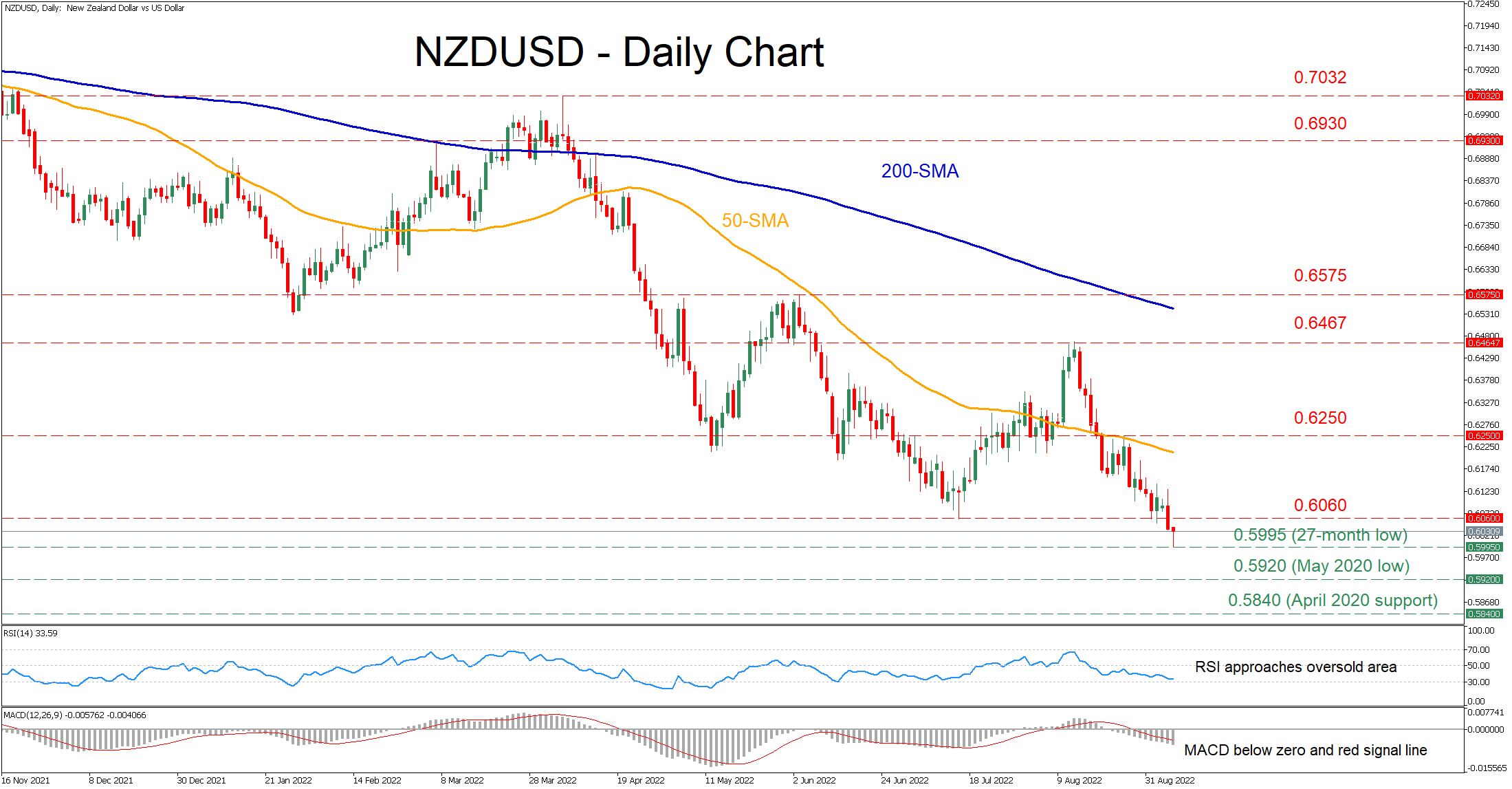
NZDUSD has been trending lower since March, generating a profound structure of lower highs and lower lows. Moreover, in the past few sessions, the technical picture has deteriorated even further, with the price recording a fresh 27-month low of 0.5995.
This negative near-term bias is also reflected by the short-term oscillators. The RSI is descending near the 30-oversold zone, while the MACD histogram is extending its retreat below both zero and its red signal line.
Should selling pressures intensify, the price could encounter support at the 27-month low of 0.5995. If that floor collapses, the pair will dive towards levels not seen in the past two years, where the May 2020 low of 0.5920 could provide downside protection. Failing to halt there, the April 2020 support of 0.5840 may halt any further drops.
To the upside, bullish actions could send the price to test the July low of 0.6060. Crossing above this region, the pair might ascend towards 0.6250 or higher to challenge the recent peak of 0.6467. Piercing through the latter, the June high of 0.6575 could prove to be a tough obstacle for the pair to overcome.
Overall, even if NZDUSD has come under tremendous downside pressure, the momentum indicators currently suggest that the pair has not yet reached oversold levels. Therefore, the price will most likely resume its decline into uncharted waters to fresh multi-year lows.
GBP/JPY Daily Outlook
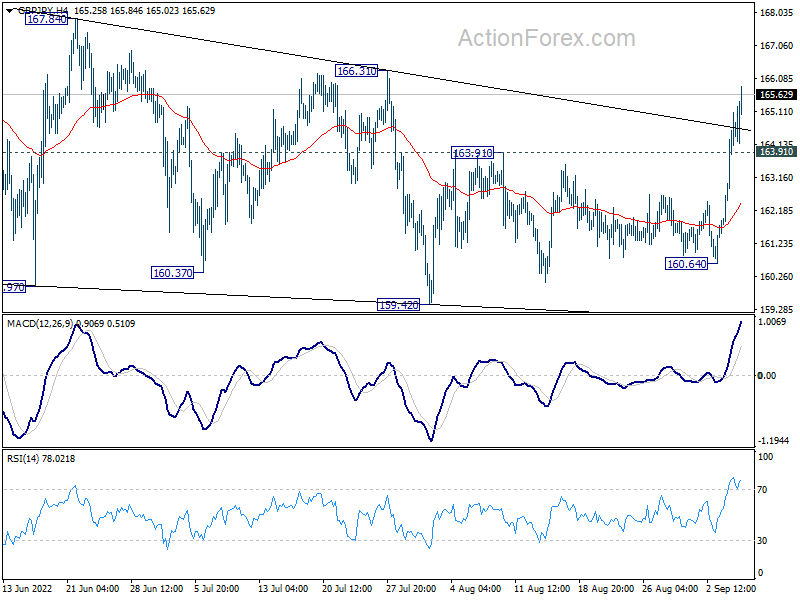
Daily Pivots: (S1) 162.57; (P) 163.84; (R1) 165.75; More...
GBP/JPY's rally continues today and intraday bias stays on the upside. Firm break of 166.31 resistance will argue that larger up trend is ready to resume through 168.67 high. On the downside, below 163.91 minor support will turn intraday bias neutral first, and would probably extend the corrective pattern from 168.67 with more sideway trading.
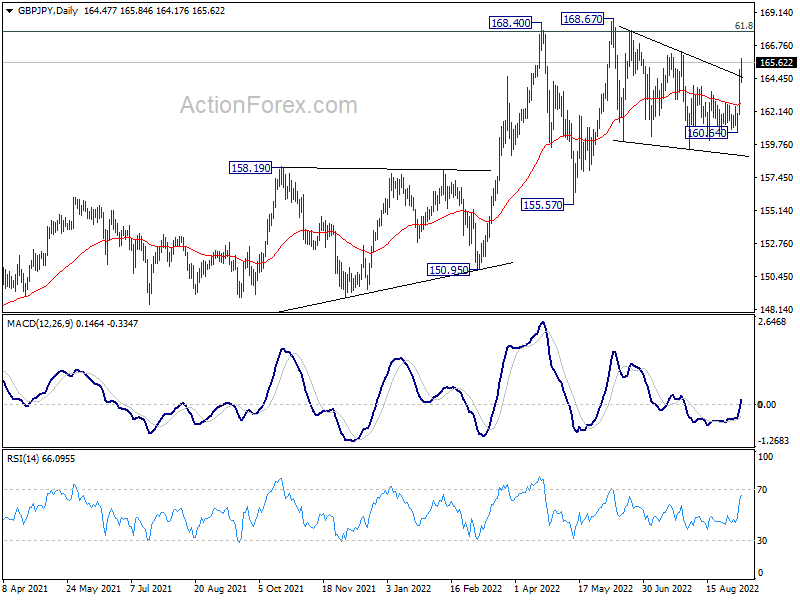
In the bigger picture, up trend from 123.94 (2020 low) is still in progress. Sustained break of 61.8% retracement of 195.86 (2015 high) to 122.75 (2016 low) at 167.93 will be a long term bullish signal, and could pave the way back to 195.86 high. This will remain the favored case as long as 155.57 support holds, even in case of deep pull back.
EUR/JPY Daily Outlook
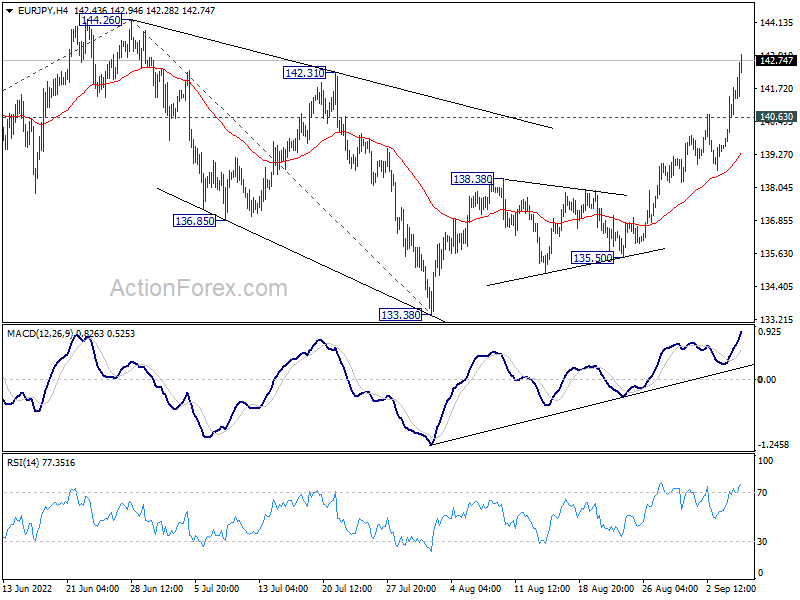
Daily Pivots: (S1) 140.09; (P) 140.92; (R1) 142.27; More....
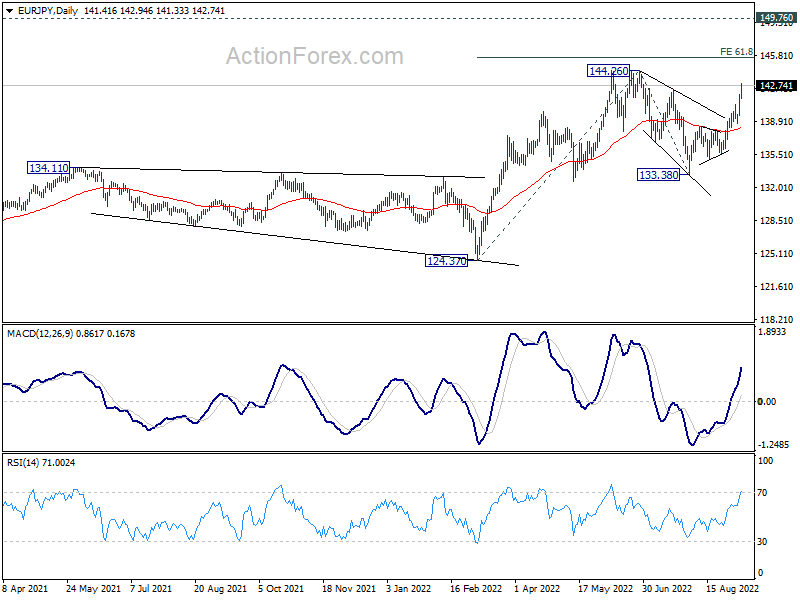
EUR/JPY's rally accelerates today and break of 142.31 suggests that larger up trend is ready to resume. Intraday bias stays on the upside for 144.26 high first. Decisive break there will confirm this bullish case and target 61.8% projection of 124.37 to 144.26 from 133.38 at 145.67. On the downside, below 140.63 minor support will delay the bullish case and turn intraday bias neutral first.
In the bigger picture, up trend from 114.42 (2020 low) is seen as the third leg of the pattern from 109.30 (2016 low). Further rally is in favor as long as 134.11 resistance turned support holds, even in case of deep pull back. Next target is 149.76 (2015 high). However, sustained break of 134.11 will be a sign of medium term bearish reversal and turn focus to 124.37 support for confirmation.
EUR/GBP Daily Outlook
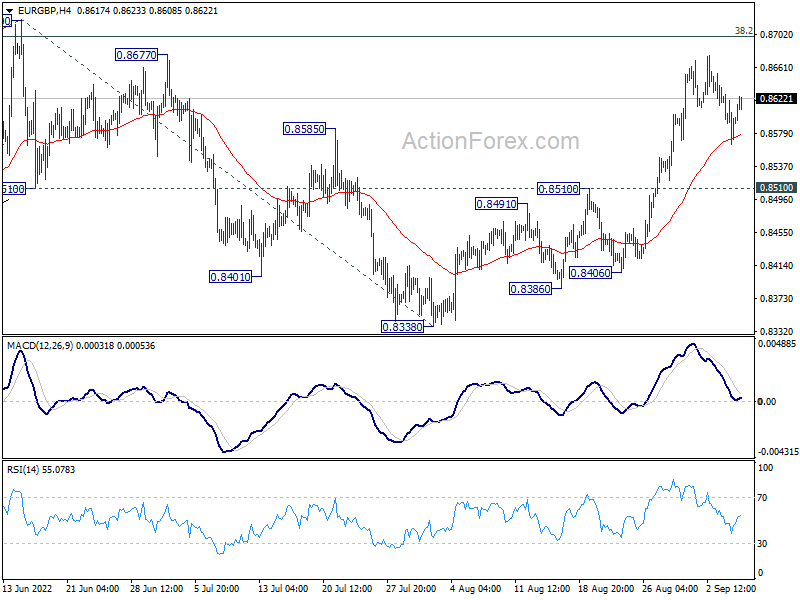
Daily Pivots: (S1) 0.8569; (P) 0.8596; (R1) 0.8625; More...
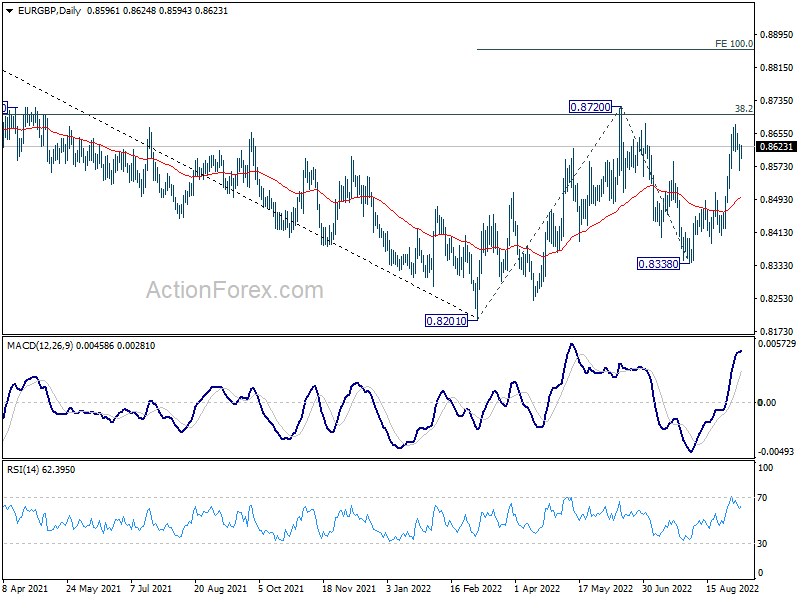
Intraday bias in EUR/GBP remains neutral and outlook is unchanged. On the upside, decisive break of 0.8720 high will carry larger bullish implications. Next target is 100% projection of 0.8201 to 0.8720 from 0.8338 at 0.8857. For now, further rally will remain in favor as long a s0.8510 resistance turned support holds.
In the bigger picture, focus is back on 38.2% retracement of 0.9499 to 0.8201 at 0.8697. Sustained break there will argue that rise from 0.8201 is a medium term up trend, rather than a correction. Next target is 61.8% retracement at 0.9003. Rejection by 0.8697 again will maintain medium term bearishness, for extending the down trend from 0.9499 (2020 high) at a later stage.
EUR/AUD Daily Outlook
Daily Pivots: (S1) 1.4617; (P) 1.4672; (R1) 1.4759; More...
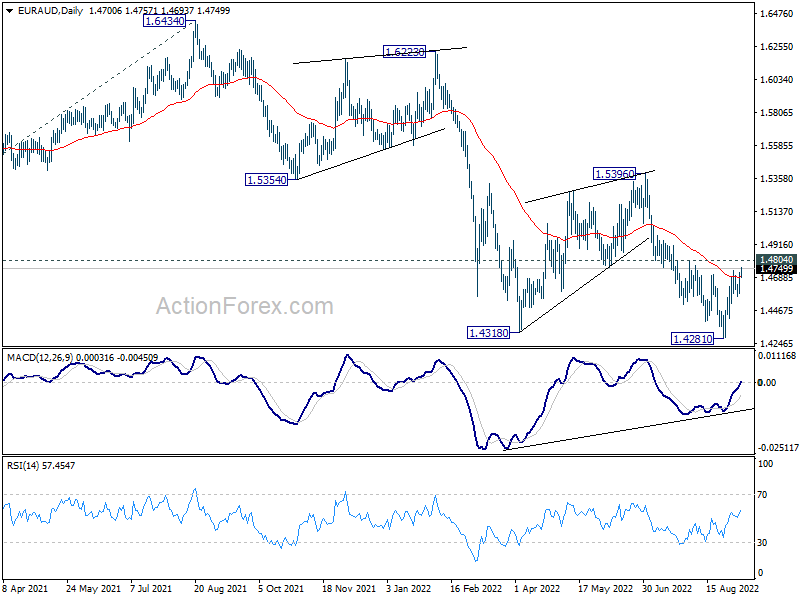
Intraday bias in EUR/AUD is back on the upside as rebound from 1.4281 resumes. Firm break of 1.4804 resistance will bring stronger rally back towards 1.5396. On the downside, below 1.4564 minor support will turn bias back to the downside for 1.4281 low instead.
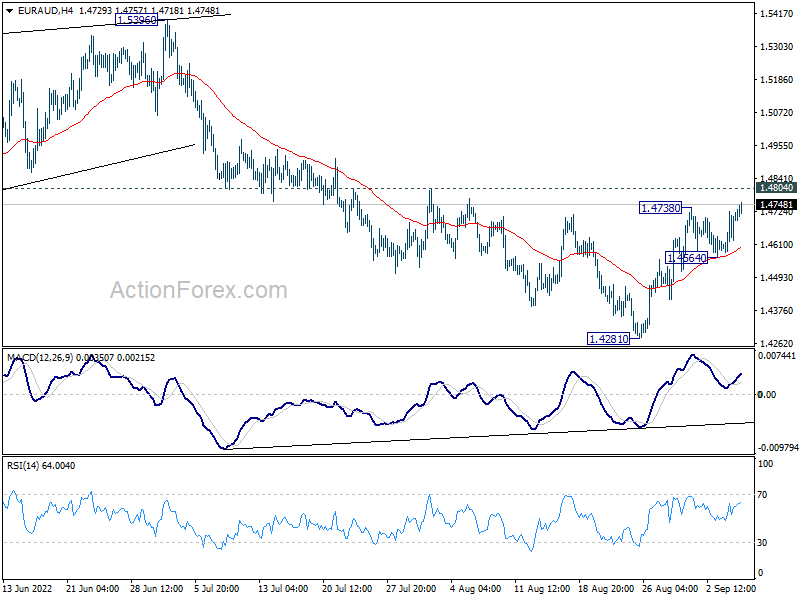
In the bigger picture, down trend from 1.9799 is still in progress. Break of 1.4318 low will target 61.8% projection of 1.9799 to 1.5250 from 1.6434 at 1.3623, which is close to 1.3624 long term support (2017 low). This will remain the favored case now as long as 1.5396 resistance holds.