Sample Category Title
King Dollar Feeds Off Aggressive Fed
King dollar’s scorched-earth ascent to a fresh 20-year peak has clobbered broad swathes of global financial markets, with dollar-denominated assets clearly bearing the brunt. Spot gold has returned into sub-$1700 domain, Brent futures have tumbled to their lowest since February, while bitcoin is on the cusp of erasing almost all of its summer gains.
The greenback has clearly fed off the palpable anguish surrounding a Fed that’s now persistently ultra- aggressive in its battle against multi-decade high inflation. The risk aversion that’s coursing through markets also suggests that global stocks could move much further to the downside over the immediate term, with the FOMC apparently still far from reaching peak hawkishness.
Such angst has also left the buck’s major peers flailing in the greenback’s wake. The pound is hurtling towards its lowest levels since the onset of the pandemic, the yen is trading around levels not seen since 1998, while the euro is extending its path south of parity.
Hawkish ECB to offer little solace for euro
Even ultra-hawkish rhetoric emanating out of the ECB tomorrow isn’t likely to be much of a saving grace for the beleaguered euro. Despite the 65% chance currently priced for a 75bp hike by the ECB on Thursday, markets may see beyond such a supersized move as just front-loading of its intended rate hikes. The ECB’s policy tightening plans may ultimately be curtailed by the depressing outlook for the Eurozone.
Should the ECB instead surprise markets with a relatively dovish 50bp hike tomorrow, that might even open the floor below 0.98 for EURUSD.
UK 100 in Limited Recovery
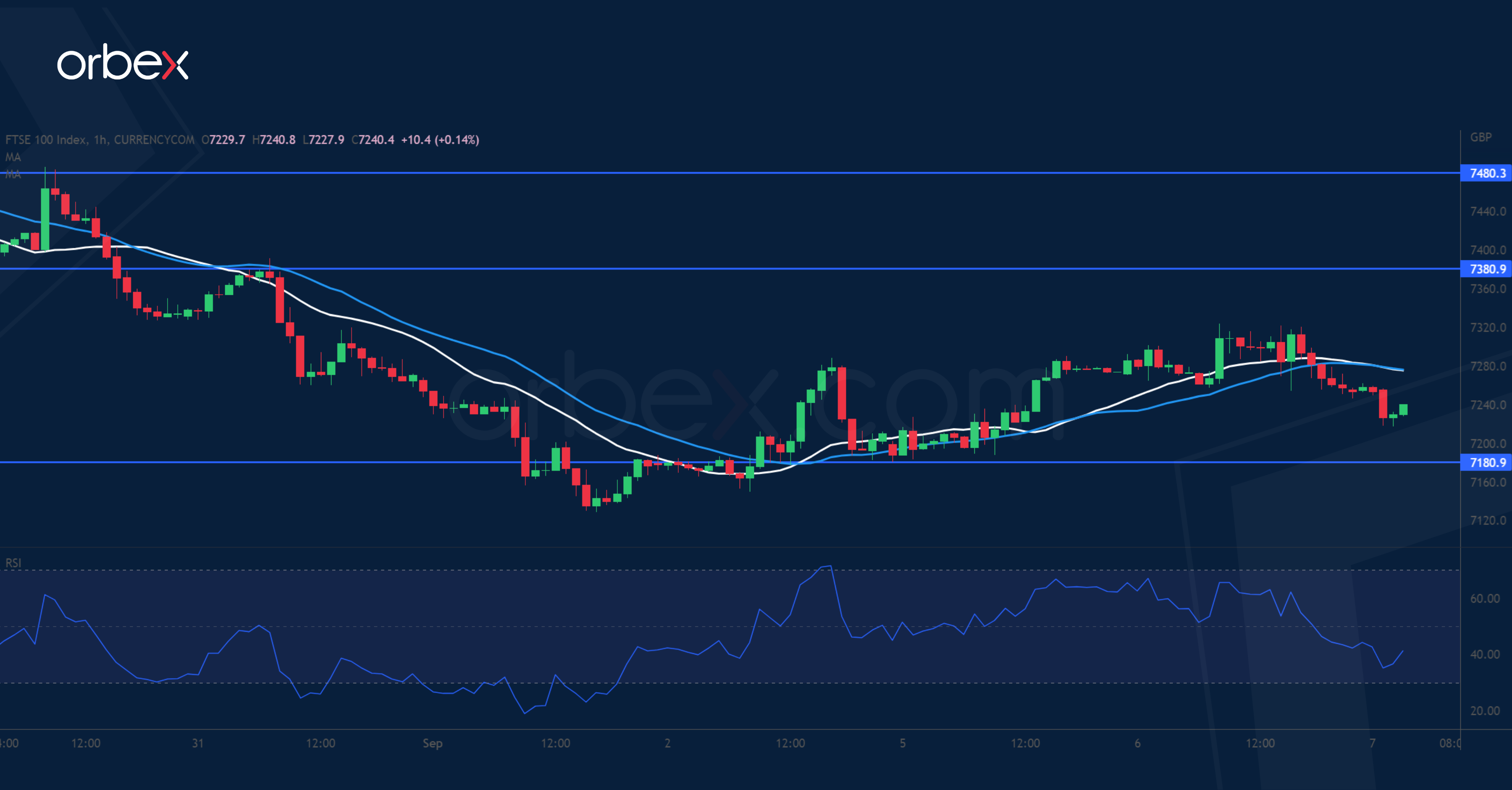
The FTSE 100 struggles as the UK's finances might over-stretch with the energy crisis. On the daily chart, the index is going sideways between two boundaries 7000 and 7640. A breakout on either side would dictate the next direction in the weeks to come. In the meantime, range trading could be the name of the game. The short-term recovery is heading up to 7380, but 7480 from a faded bounce could be a tough level to crack. On the downside, 7180 is the immediate support and 7050 a major level to test the bulls’ resolve.
US Oil Tests Critical Floor
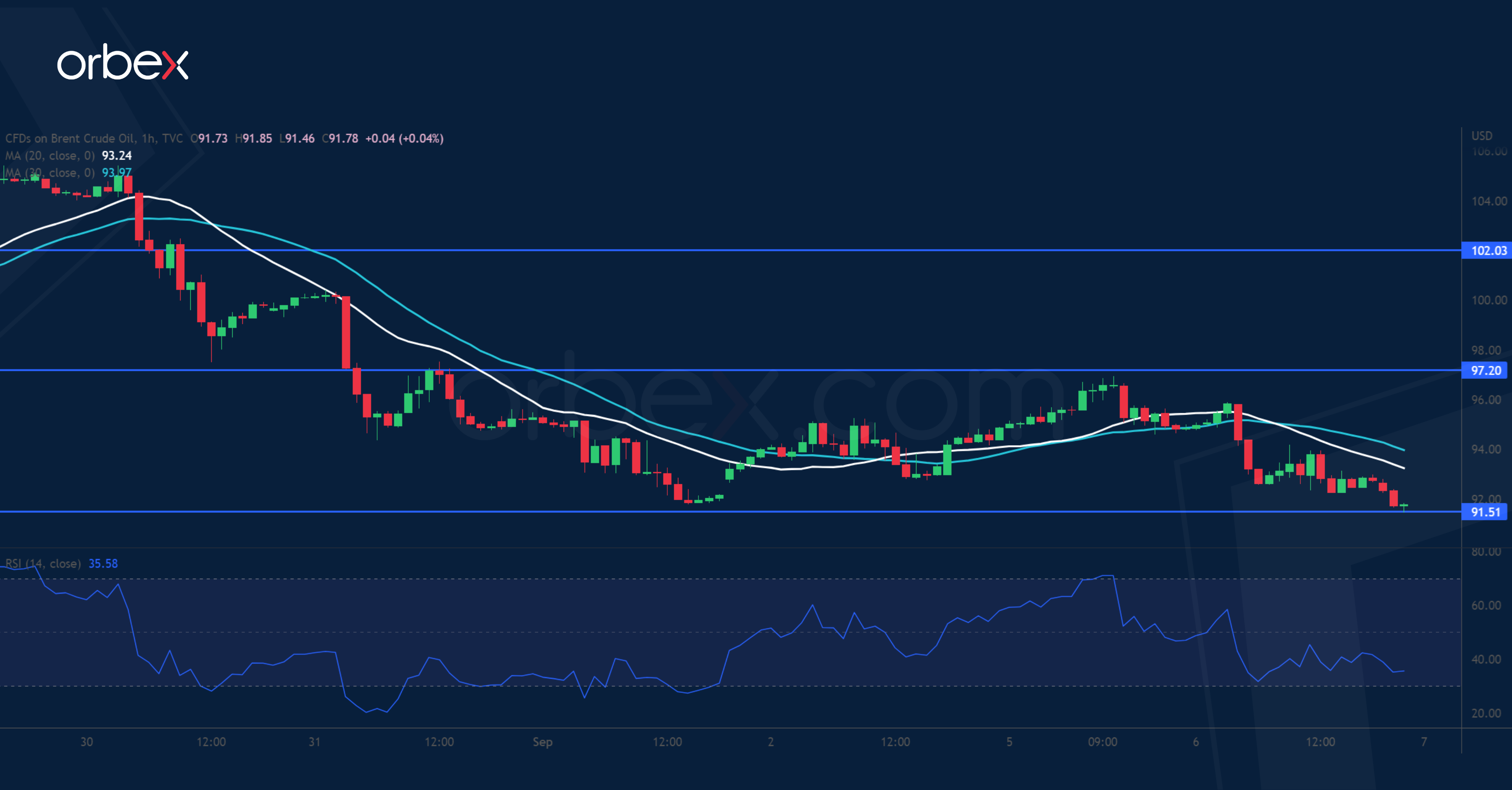
WTI crude weakens due to lingering concerns over demand. The recent bounce has failed to clear the daily resistance at 109.00, given back all its gains instead by retesting the base at 91.50. As sentiment remains pessimistic, the path of least resistance might still be down. A bearish breakout would force the bulls to bail out and attract momentum sellers, exacerbating volatility in the process. A drop below the psychological level of 90.00 could extend losses beyond 85.00. A recovery may be brief with 97.20 as the first resistance.
AUD/USD Struggles for Bids
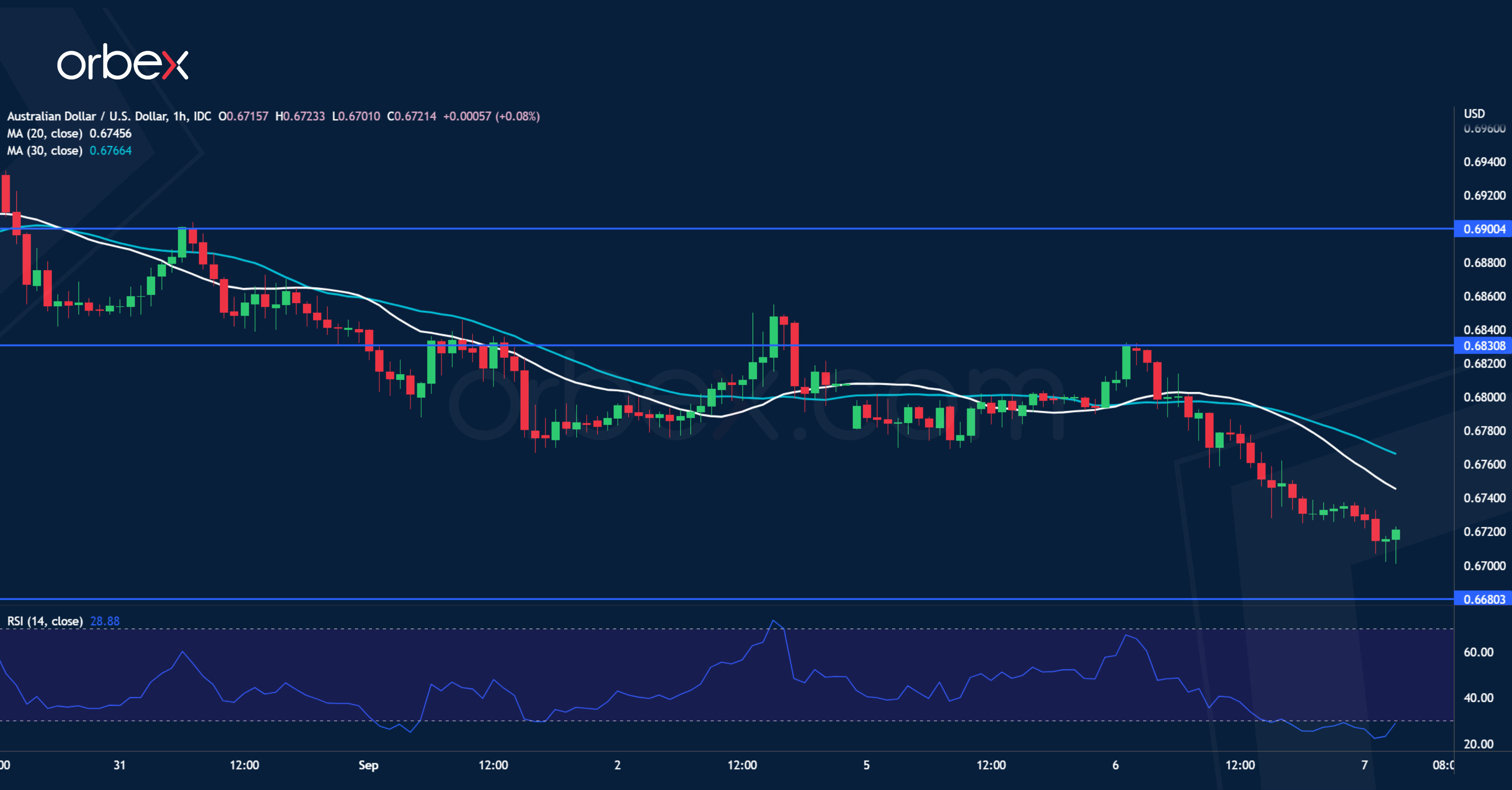
The Australian dollar takes a hit as risk appetite continues to recede across markets despite the RBA’s 50bp hike. A bearish MA cross on the daily chart shows a deterioration in sentiment. A fall below the demand zone near 0.6800 has left the aussie vulnerable. A lack of buying interest may send the pair to the recent lows around 0.6680, which is a critical floor to keep the price afloat in the medium-term. 0.6830 is a fresh hurdle but rebounds have so far been opportunities to sell at a better price.
US Yields Marching Higher
Market movers today
German industrial production for July will give further clues whether recession is approaching in Q3. Factory orders have fallen in recent months, but a notable order backlog may cushion the decline in production.
We expect the Polish central bank to raise rates by 25bp in line with consensus, but with the risk of 50bp rate hike, as Polish inflation surprised on the upside in August, printing at 16% compared with a year earlier.
Bank of Canada will likely hike its policy rate by another 75bp, downshifting from July's surprising 100bp move, after economic activity has been moderating (especially in rate-sensitive housing), but inflation remains too high for comfort.
In Sweden, a triplet of July growth indicators released with the PVI, consumption and GDP indicator. The Debt Office also releases the August borrowing requirement.
The 60 second overview
EU scrambling to meet energy challenges: EU energy ministers will meet for an emergency meeting tomorrow to discuss further how to meet current energy headwinds. Price caps, windfall profit taxes and emergency credit lines for energy participants are set to be discussed. Gas prices continue to fluctuate widely within the day but ended slightly lower yesterday and are still 30% off the recent peak seen two weeks ago.
Higher yields, lower equities and oil prices: A further rise in US 10-year bond yields of 15bp yesterday added to headwinds and recession fears roiling markets. US equities dropped 0.5% yesterday and futures are down a further 0.5% in Asian trading. Oil prices are close to USD 91 per barrel hitting the lowest level since February this year.
US service data a mixed bag: US ISM service surprised again to the upside rising to 56.9 in July from 56.7 painting a robust picture of the sector. On the other hand, service PMI from Markit was revised lower for July to 43.7 from 44.1 showing a much weaker state of services. Markets tend to focus more on the ISM data and the upward surprise here helped underpin a rise in bond yields. We need to see more months of data to get a clearer picture of where services are heading US but we expect the Fed will keep tightening policy until there is a clear picture the economy is weakening and the labour market softening in order to conclude that underlying inflation pressures are coming down towards their 2% target.
Weak Chinese trade data: Chinese exports dropped to 7.1% y/y in August (consensus 13.0% y/y, previous 18.0% y/y) highlighting that China's export engine is weakening on the back of growth headwinds in US and Europe. Imports also dropped to a weak 0.3% y/y (consensus 1.1% y/y, previous 2.3% y/y) highlighting the weakness of China's domestic economy as well. We expect Chinese growth to remain under pressure rest of the year and mainly supported by stimulus measures such as infrastructure investments.
Equities: Global equities down for the eighth day in a row, with MSCI world down almost 10% since the peak less than a month ago. Multiple factors behind the moves with weaker macro momentum, higher yields, escalating energy crisis in Europe and new Covid lockdowns in China. It would be straight forward to blame the move higher in yields for the equity sell-off yesterday. However, we only saw a slight value outperformance and the moves are equally driven by increased recession fear.
Please note how the oil and equity correlation has sifted back to positive lately and the all-dominating fear of stagflation is shifting further towards the fear of too heavy demand and hence recession becoming the dominating fear. VIX ticked higher again yesterday, ending the day close to 27.
In US yesterday, Dow -0.6%, S&P 500 -0.4%, Nasdaq -0.7% and Russell 2000 -1.0%. The negative sentiment continues in Asia this morning with broad-based declines. US futures are down in the ballpark of 0.5% while European futures are down more than 1% this morning.
FI: It was again a very volatile day in the global financial markets on the back of a stronger than expected US ISM service index. Hence, there was a big jump in US Treasury yields yesterday afternoon and solid spill-over effect to the European bond markets. UK government bond yields also rose significantly given the expected fiscal easing by the new UK Prime Minister, Truss. Hence, the markets are once again pricing in more rate hikes by the global central banks despite the rising risk of recession in especially UK and Europe.
FX: EUR/USD retraced lower again yesterday and in overnight trading to below 0.99. Although we still widely consider GBP a range play for the coming months, we see some upside in the near term with the outlook of substantial fiscal easing.
Credit: Credit markets saw significant primary activity on Tuesday as companies rushed to secure new funding ahead of the Fed meeting later this month. In the Scandi space the most prominent issuer was Orsted that issued EUR900m and GBP950m in total. The 9Y fixed EUR tranche was priced at MS+85bp after initial price talks of MS+110bp. Overall the issuance saw high interest and hence was able to tighten the price level.
Overall on market level iTraxx Main was 3bp tighter while Xover was 15bp wider at 571bp.
Nordic macro
A trio of July growth indicators are due for release in Sweden. Firstly, the PVI appears likely to have dropped on a monthly basis, as Manufacturing PMI suggests falling orders and slowing production. The same is true in principle for services and construction production, both part of the PVI. Secondly, the consumption indicator is also likely to have dropped on the back of declining vehicle and retail sales, although the number could have been bolstered by leisure consumption remaining strong. Thirdly, adding an already announced decline in hours worked suggests the July GDP indicator may also give a negative m/m print.
The Swedish National Debt Office is also due to release the August borrowing requirement. The SNDO forecasts a SEK28.7bn surplus. Last month's figure came in around SEK15bn better than expected, primarily due to larger deposits from Svenska Kraftnät (the electricity grid authority) but also due to higher tax revenues. This pattern may well be repeated in August given the high electricity prices and inflation.
USD/JPY Daily Outlook
Daily Pivots: (S1) 141.01; (P) 142.04; (R1) 143.83; More...
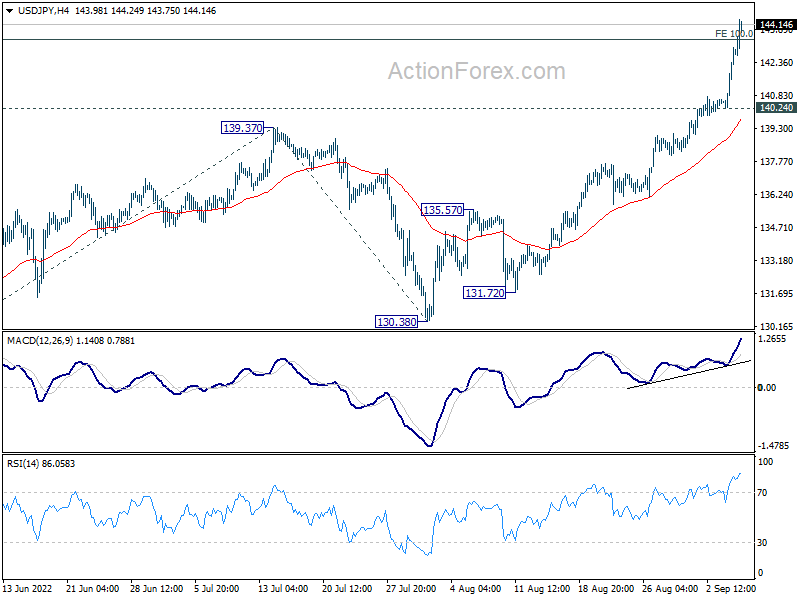
USD/JPY accelerates to as high as 144.37 so far today as up trend continues. 100% projection of 126.35 to 139.37 from 130.38 at 143.40 is already met but there is no sign of topping yet. Intraday bias stays on the upside for 147.68 long term resistance next. On the downside, break of 140.24 minor support is needed to indicate short term topping. Otherwise, outlook will remain bullish in case of retreat.
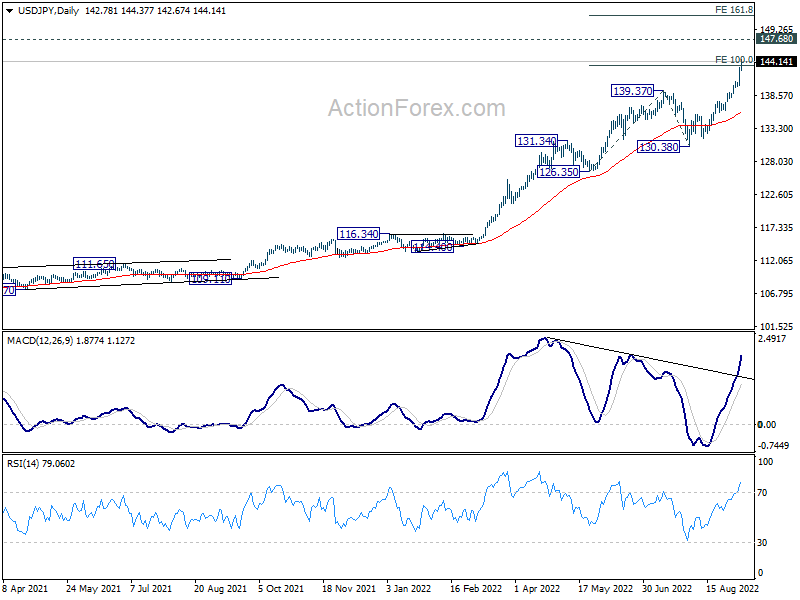
In the bigger picture, up trend from 101.18 is still in progress, as part of the whole up trend from 75.56 (2011 low). Further rise should be seen to 147.68 (1998 high). For now, break of 130.38 support is needed to be the first indication of medium term topping. Otherwise, outlook will stay bullish even in case of deep pull back.
USD/JPY in Unstoppable Rally, Focus Turns to BoC
Dollar is trading broadly higher in Asian session today, as supported by extended rally in US treasury yield. For the same reason, Yen tumbles broadly this week, and the decline is extending. The net result is that USD/JPY reached a new 24-year high and still looks unstoppable. Canadian Dollar is trading with a mixed tone for now, but hopefully, BoC rate decision today will give the Loonie a clear direction to follow.
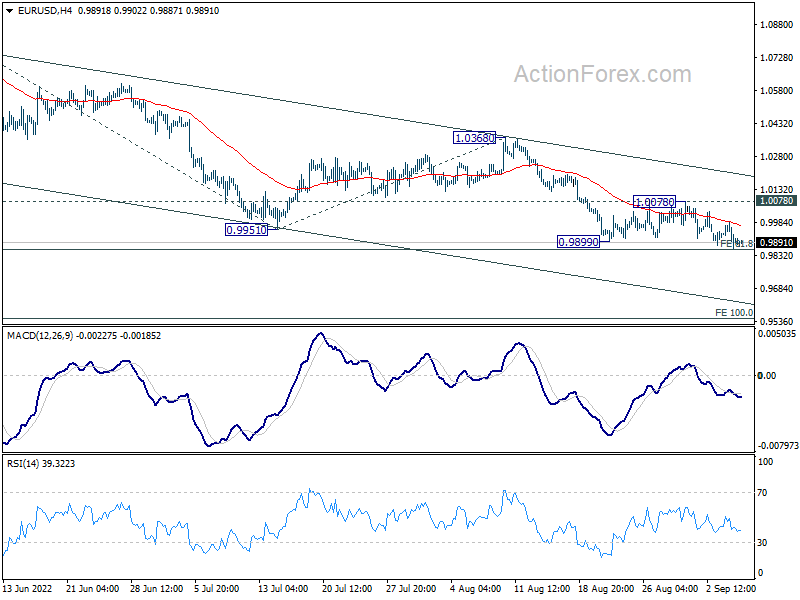
Technically, downside momentum in EUR/USD is far from convincing for now even though 0.9899 support was broken earlier in the week. Euro bears would probably need to wait for clearing ECB risk first, before jumping in. There is prospect of downside acceleration in EUR/USD if 61.8% projection of 1.0773 to 0.9951 from 1.0368 at 0.9860 if taken out decisively. Next target at 100% projection at 0.9546 could be reached quickly if that happens.
In Asia, at the time of writing, Nikkei is down -0.81%. Hong Kong HSI is down -1.80%. China Shanghai SSE is down -0.05%. Singapore Strait Times is down -0.30%. Japan 10-year JGB yield is up 0.0048 at 0.246. Overnight, DOW dropped -0.55%. S&P 500 dropped -0.41%. NASDAQ dropped -0.74%. 10-year yield rose 0.147 to 3.340.
Japan officials concerned by one-sided move in Yen, warned of necessary action
As Yen tumbles further to fresh 24-year low against Dollar, Japan Finance Minister Shunichi Suzuki cautioned that "recent moves are rather rapid and one-sided . We need to be watching developments with strong interest."
Chief Cabinet Secretary Hirokazu Matsuno said at a news briefing, "I'm concerned about rapid, one-sided moves in the currency market recently. If such moves continue, we will take necessary action."
Australia GDP grew 0.9% qoq in Q2, driven by household spending and exports
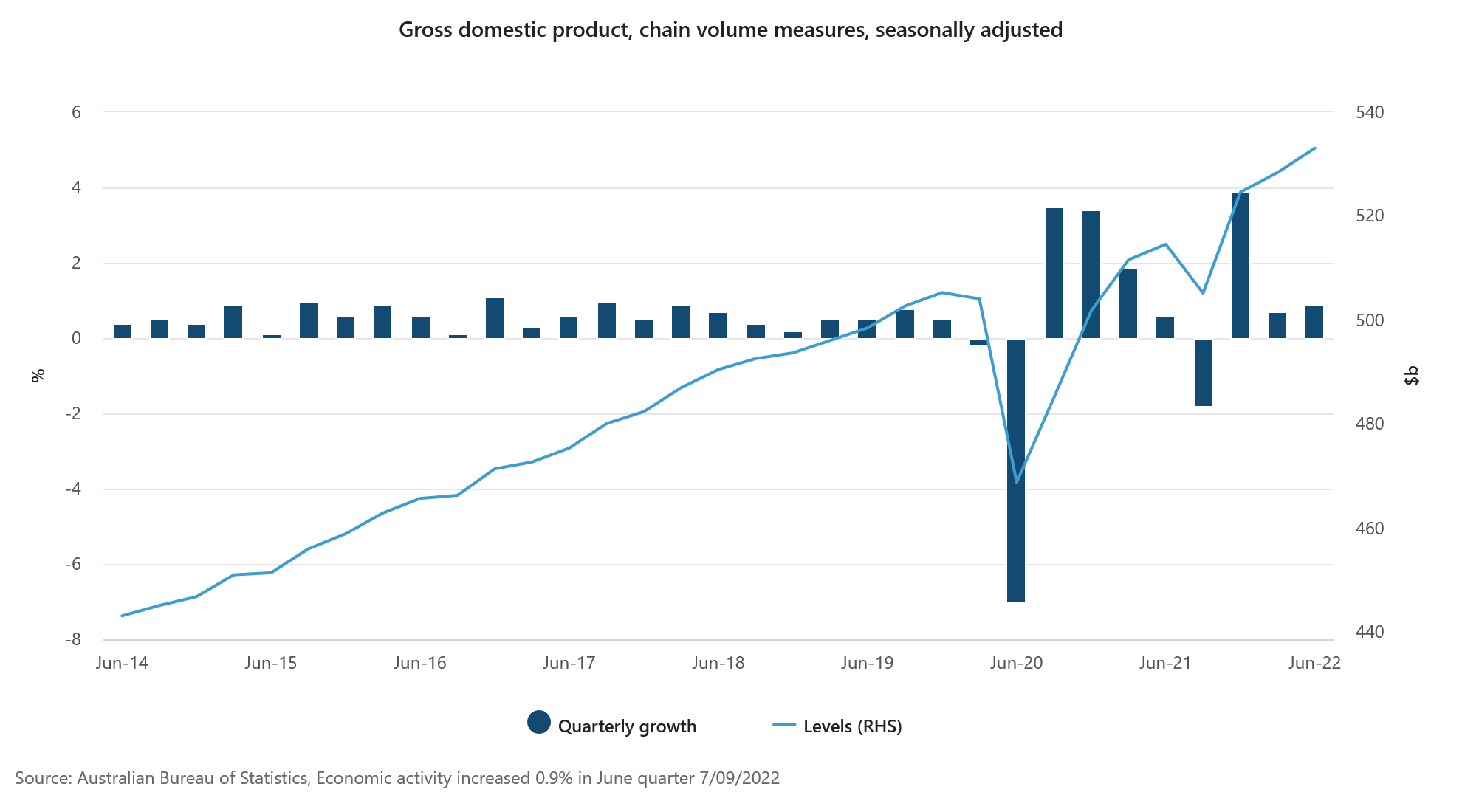
Australia GDP grew 0.9% qoq in Q2, matched expectations. Household spending rose 2.2% for the quarter, contributing 1.1% pts to GDP. Net trade contributed 1.0% pts to GDP, driven by exports which rose 5.5%, partially offset by 0.7% rise in imports. Terms of trade rose 4.6% with export and import prices up strongly.
Sean Crick, head of National Accounts at the ABS, said: "Rises in household spending and exports drove growth in the June quarter. This is the third consecutive quarter of economic growth, following a contraction in the September quarter 2021, which was impacted by the Delta outbreak."
Australia AiG services rose to 53.3, businesses highlight interest rate as concern
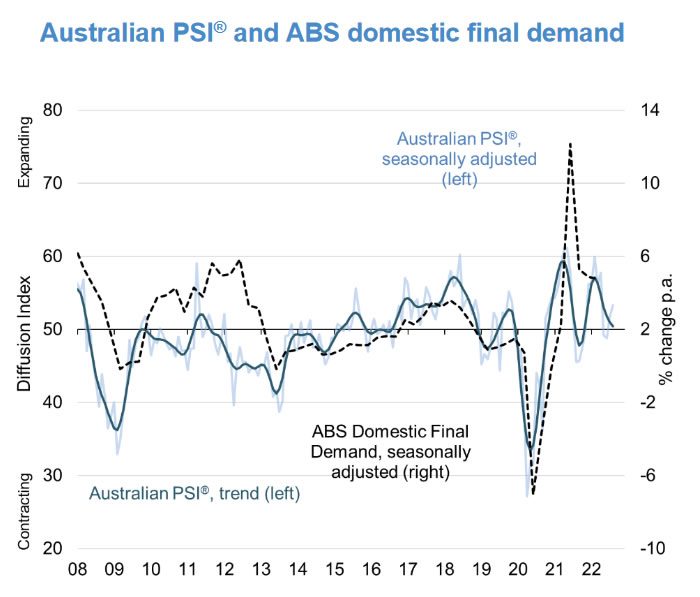
Australia AiG Performance of Services Index rose 1.6 pts to 53.3 in August. Looking at some details, sales rose 2.6 to 51.9. Employment rose 0.8 to 53.2. New orders rose 6.7 to 57.3. Input prices dropped -5.6 to 68.7. Selling prices dropped -2.2 to 61.2. Average waged dropped -1.3 to 67.6.
Innes Willox, Chief Executive of Ai Group, said: "Services remained in expansion in August, pointing to the overall resilience of the sector with sales, employment and new orders all higher than in July.... Price and wages pressures continued into August although the pace of increase in input prices eased somewhat. With service businesses highlighting interest rates as a key area of concern, the Reserve Bank's decision yesterday to raise the cash rate by another 50 basis points to 2.35% will further fuel their fears of a fall in spending in the months ahead."
BoC to hike, AUD/CAD ready for down trend resumption
BoC rate decision is the main focus for today. Markets are expecting a 75bps rate hike to 3.25%. But that's far from being certain. With current interest rate at 2.50% already in neutral range, there are talks that BoC could opt for a smaller hike of 50bps. Yet, there are also arguments for a larger 100bps hike today, followed by a pause. Some wildcard potential is there.
Some previews on BoC:
- Bank of Canada Preview: Will it be 75bps or 100bps?
- Bank of Canada to Hike Again But Could Be Nearing End of Cycle
- Currency Pair of the Week: EUR/CAD
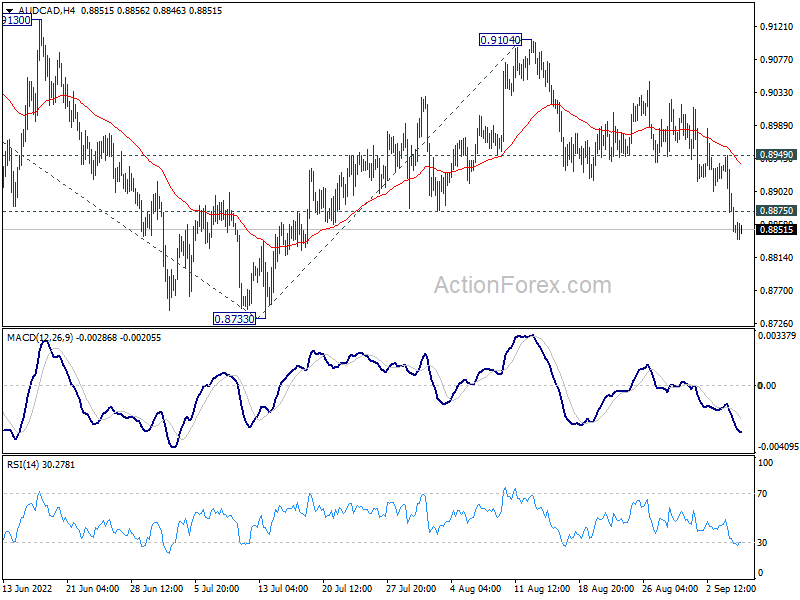
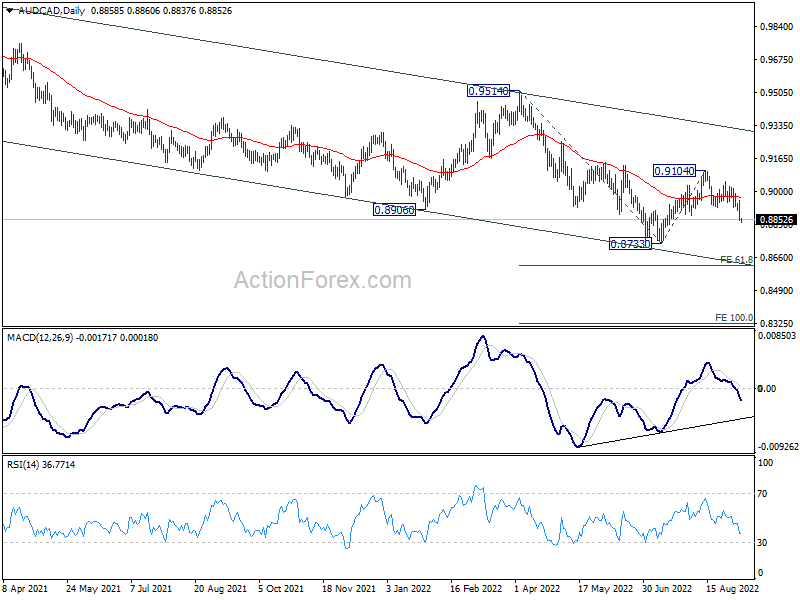
AUD/CAD is making some progress in breaking through 0.8875 minor support this week. The development suggests that corrective rebound from 0.8733 has completed at 0.9104, and larger down trend is ready to resume. Retest of 0.8733 low should be seen first. Decisive break there will confirm this bearish view and target 61.8% projection of 0.9514 to 0.8733 from 0.9104 at 0.8621. However, break of 0.8949 minor resistance, in reaction to BoC, will mix up the outlook.
Elsewhere
Germany industrial production, Swiss foreign currency reserves, Italy retail sales and Eurozone GDP revision will be released in European session. Later in the day, US and Canada will release trade balance.
USD/JPY Daily Outlook
Daily Pivots: (S1) 141.01; (P) 142.04; (R1) 143.83; More...
USD/JPY accelerates to as high as 144.37 so far today as up trend continues. 100% projection of 126.35 to 139.37 from 130.38 at 143.40 is already met but there is no sign of topping yet. Intraday bias stays on the upside for 147.68 long term resistance next. On the downside, break of 140.24 minor support is needed to indicate short term topping. Otherwise, outlook will remain bullish in case of retreat.
In the bigger picture, up trend from 101.18 is still in progress, as part of the whole up trend from 75.56 (2011 low). Further rise should be seen to 147.68 (1998 high). For now, break of 130.38 support is needed to be the first indication of medium term topping. Otherwise, outlook will stay bullish even in case of deep pull back.
Economic Indicators Update
| GMT | Ccy | Events | Actual | Forecast | Previous | Revised |
|---|---|---|---|---|---|---|
| 22:30 | AUD | AiG Performance of Services Index Aug | 53.3 | 51.7 | ||
| 01:30 | AUD | GDP Q/Q Q2 | 0.90% | 0.90% | 0.80% | |
| 02:00 | CNY | Trade Balance (USD) Aug | 79.4B | 91.8B | 101.3B | |
| 02:00 | CNY | Exports (USD) Y/Y Jul | 7.10% | 18.00% | ||
| 02:00 | CNY | Imports (USD) Y/Y Aug | 0.30% | 2.30% | ||
| 02:00 | CNY | Trade Balance (CNY) Aug | 536B | 650B | 683B | |
| 02:00 | CNY | Exports (CNY) Y/Y Aug | 11.80% | 23.90% | ||
| 02:00 | CNY | Imports (CNY) Y/Y Aug | 4.60% | 7.40% | ||
| 05:00 | JPY | Leading Economic Index Jul P | 99.60% | 100.7 | 100.9 | |
| 06:00 | EUR | Germany Industrial Production M/M Jul | -0.50% | 0.40% | ||
| 07:00 | CHF | Foreign Currency Reserves (CHF) Aug | 849B | |||
| 08:00 | EUR | Italy Retail Sales M/M Jul | 0.20% | -1.10% | ||
| 09:00 | EUR | Eurozone GDP Q/Q Q2 | 0.60% | 0.60% | ||
| 09:00 | EUR | Eurozone Employment Change Q/Q Q2 F | 0.30% | 0.30% | ||
| 12:30 | USD | Trade Balance (USD) Jul | -70.2B | -79.6B | ||
| 12:30 | CAD | International Merchandise Trade Jul | $5.05B | |||
| 14:00 | CAD | BoC Interest Rate Decision | 3.25% | 2.50% | ||
| 14:00 | CAD | Ivey PMI Aug | 48.3 | 49.6 | ||
| 18:00 | USD | Fed's Beige Book |
BoC to hike, AUD/CAD ready for down trend resumption
BoC rate decision is the main focus for today. Markets are expecting a 75bps rate hike to 3.25%. But that's far from being certain. With current interest rate at 2.50% already in neutral range, there are talks that BoC could opt for a smaller hike of 50bps. Yet, there are also arguments for a larger 100bps hike today, followed by a pause. Some wildcard potential is there.
Some previews on BoC:
- Bank of Canada Preview: Will it be 75bps or 100bps?
- Bank of Canada to Hike Again But Could Be Nearing End of Cycle
- Currency Pair of the Week: EUR/CAD
AUD/CAD is making some progress in breaking through 0.8875 minor support this week. The development suggests that corrective rebound from 0.8733 has completed at 0.9104, and larger down trend is ready to resume. Retest of 0.8733 low should be seen first. Decisive break there will confirm this bearish view and target 61.8% projection of 0.9514 to 0.8733 from 0.9104 at 0.8621. However, break of 0.8949 minor resistance, in reaction to BoC, will mix up the outlook.
Australia AiG services rose to 53.3, businesses highlight interest rate as concern
Australia AiG Performance of Services Index rose 1.6 pts to 53.3 in August. Looking at some details, sales rose 2.6 to 51.9. Employment rose 0.8 to 53.2. New orders rose 6.7 to 57.3. Input prices dropped -5.6 to 68.7. Selling prices dropped -2.2 to 61.2. Average waged dropped -1.3 to 67.6.
Innes Willox, Chief Executive of Ai Group, said: "Services remained in expansion in August, pointing to the overall resilience of the sector with sales, employment and new orders all higher than in July.... Price and wages pressures continued into August although the pace of increase in input prices eased somewhat. With service businesses highlighting interest rates as a key area of concern, the Reserve Bank's decision yesterday to raise the cash rate by another 50 basis points to 2.35% will further fuel their fears of a fall in spending in the months ahead."
Australia GDP grew 0.9% qoq in Q2, driven by household spending and exports
Australia GDP grew 0.9% qoq in Q2, matched expectations. Household spending rose 2.2% for the quarter, contributing 1.1% pts to GDP. Net trade contributed 1.0% pts to GDP, driven by exports which rose 5.5%, partially offset by 0.7% rise in imports. Terms of trade rose 4.6% with export and import prices up strongly.
Sean Crick, head of National Accounts at the ABS, said: "Rises in household spending and exports drove growth in the June quarter. This is the third consecutive quarter of economic growth, following a contraction in the September quarter 2021, which was impacted by the Delta outbreak."