

Sample Category Title
Yen Selloff as the Main Theme of the Day
Yen's selloff is the main theme today with USD/JPY hitting the highest level in 24 years, above 140 handle. Australian Dollar quickly turns softer after RBA delivered an expected rate hike. On the other hand, Sterling is getting a lift after Liz Truss is set to become the next UK Prime Minister while Euro remains soft. Dollar is mixed for now, awaiting more guidance from overall risk sentiment.
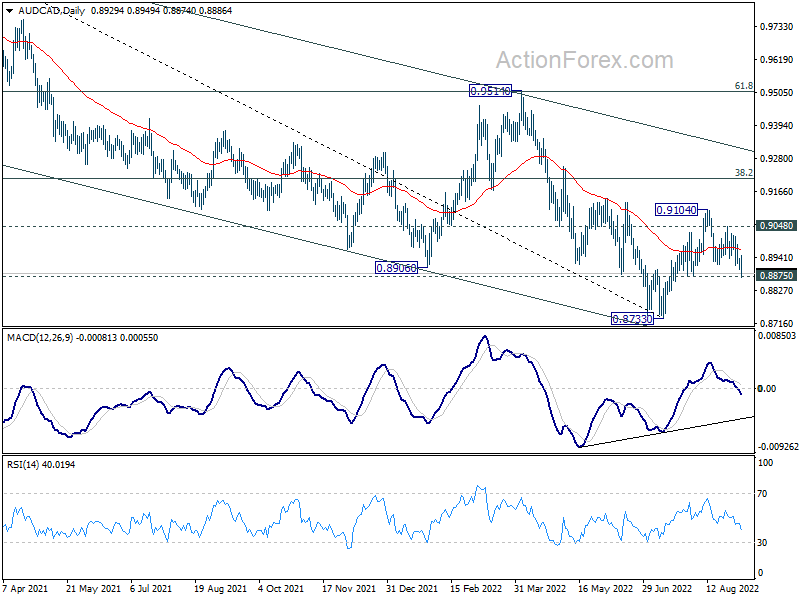
Technically, AUD/CAD is staying within our radar. Now that RBA risk is cleared, the next is tomorrow's BoC rate decision, where a 75bps hike is expected. On the downside, break of 0.8875 support will argue that rebound from 0.8733 has completed, and larger down trend is ready to resume through 0.8733. Let's see if that will happen.
In Europe, at the time of writing, FTSE is up 0.20%. DAX is up 0.94%. CAC is up 0.42%. Germany 10-year yield is down -0.005 at 1.558. Earlier in Asia, Nikkei rose 0.02%. Hong Kong HSI dropped -0.12%. China Shanghai SSE rose 1.36%. Singapore Strait Times rose 0.27%. Japan 10-year JGB yield rose 0.0061 to 0.241.
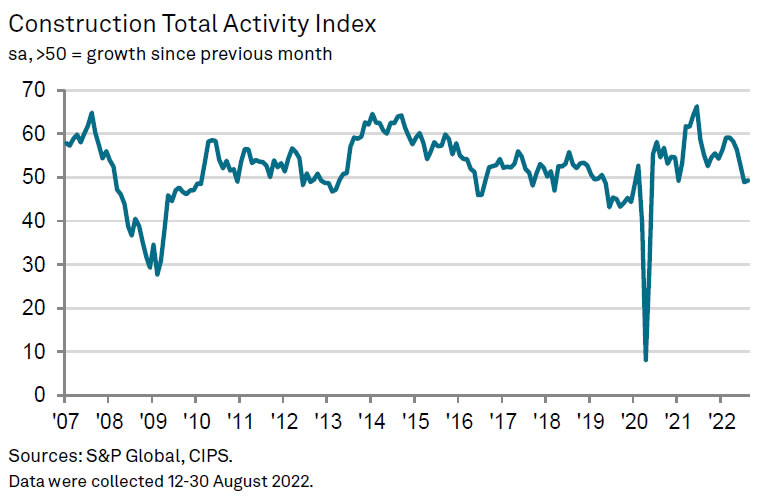
UK PMI construction recovered to 49.2, but further weakness ahead
UK PMI Construction recovered from 48.9 to 49.2 in August, above expectation of 48.0. S&P Global noted that activity was down for the second month running. New orders and employment had softer rises. But supply-chain disruption and inflationary pressures eased.
Andrew Harker, Economics Director at S&P Global Market Intelligence, said: "The UK construction sector looks set to be in for a challenging period, according to the latest PMI data. Not only did construction activity fall for the second month running, but a range of indicators from the survey pointed to further weakness ahead."
RBA hikes 50bps to 2.35%, more over the months ahead
RBA raises cash rate target by 50bps to 2.35% as widely expected. The Board "expects to increase interest rates further over the months ahead", but it's "not on a pre-set path". The size and timing of future hikes will be "guided by the income data and the Board's assessment of the outlook for inflation and the labour market."
Regarding inflation, RBA expects it to peak "later this year". The central forecasts is for CPI to be around 7.75% over 2022, a little above 4% over 2023, and then around 3% over 2024.
The economy is "continuing to grow solidly" as boosted by a "record level of the terms of trade". Labor market is "very tight" while wages growth "has picked up".
It maintained that an important source of uncertainty is household spending, which is facing pressure from higher inflation and higher interest rates.
CAD/JPY upside breakout, targets 108.52, then 109.93
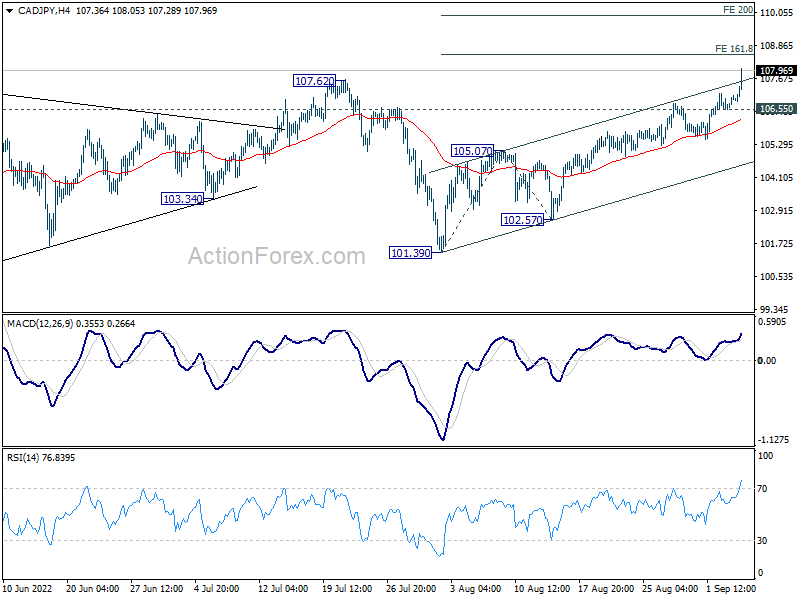
CAD/JPY breaks through 107.62 high today on broad based Yen selloff. The break of near term channel resistance also indicates upside acceleration. Further rally is expected now as long as 106.55 minor support holds. Next near term targets are 161.8% projection of 101.39 to 105.07 from 102.57 at 108.52, and then 200% projection at 109.93.
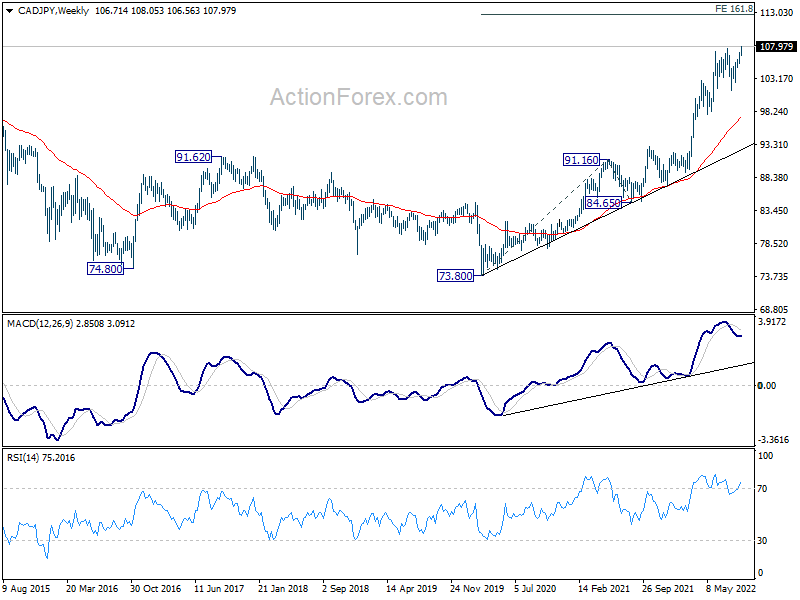
Current development also indicates resumption of long term up trend from 73.80 (2020 low). Next medium term target is 161.8% projection of 73.80 to 91.16 from 84.65 at 112.73.
USD/JPY Mid-Day Outlook
Daily Pivots: (S1) 140.25; (P) 140.45; (R1) 140.79; More...
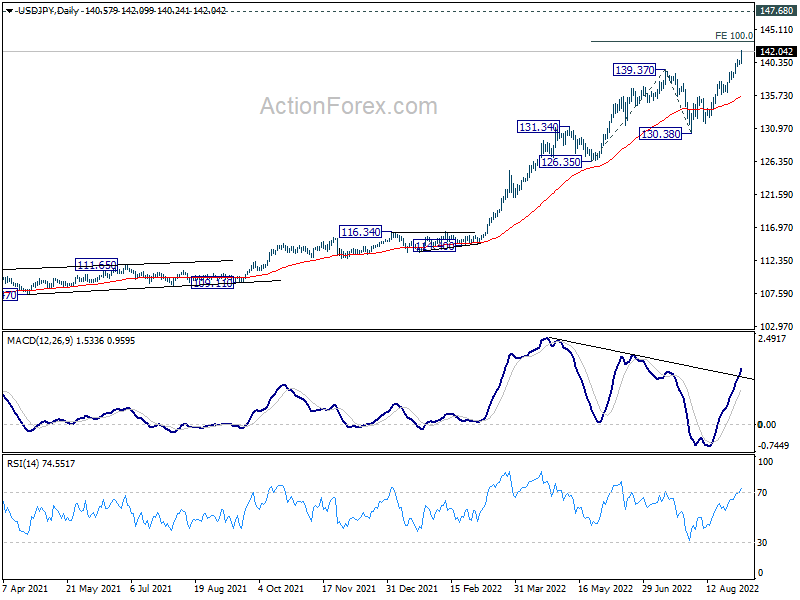
USD/JPY's up trend continues today and hit as high as 142.00 so far. Intraday bias remains on the upside for 100% projection of 126.35 to 139.37 from 130.38 at 143.40. Sustained break there could bring upside acceleration of 147.68 long term resistance. On the downside, below 140.24 minor support will turn intraday bias neutral and bring consolidations first, before staging another rally.
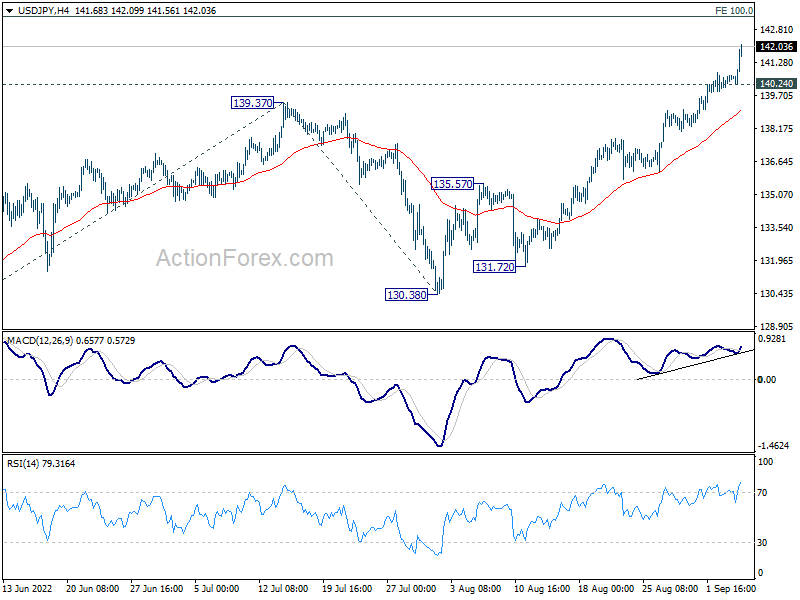
In the bigger picture, up trend from 101.18 is still in progress, as part of the whole up trend from 75.56 (2011 low). Further rise should be seen to 147.68 (1998 high). For now, break of 130.38 support is needed to be the first indication of medium term topping. Otherwise, outlook will stay bullish even in case of deep pull back.
Economic Indicators Update
| GMT | Ccy | Events | Actual | Forecast | Previous | Revised |
|---|---|---|---|---|---|---|
| 23:01 | GBP | BRC Like-For-Like Retail Sales Y/Y Aug | 0.50% | 1.60% | ||
| 23:30 | JPY | Labor Cash Earnings Y/Y Jul | 1.80% | 1.90% | 2.20% | |
| 23:30 | JPY | Overall Household Spending Y/Y Jul | 3.40% | 4.20% | 3.50% | |
| 01:30 | AUD | Current Account Balance (AUD) Q2 | 18.3B | 21.5B | 7.5B | |
| 04:30 | AUD | RBA Interest Rate Decision | 2.35% | 2.35% | 1.85% | |
| 06:00 | EUR | Germany Factory Orders M/M Jul | -1.10% | -0.20% | -0.40% | -0.30% |
| 08:30 | GBP | Construction PMI Aug | 49.2 | 48 | 48.9 | |
| 13:45 | USD | Services PMI Aug F | 44.1 | 44.1 | ||
| 14:00 | USD | ISM Services PMI Aug | 55.4 | 56.7 |
China’s Inflation Goes Against What is Happening Around the World
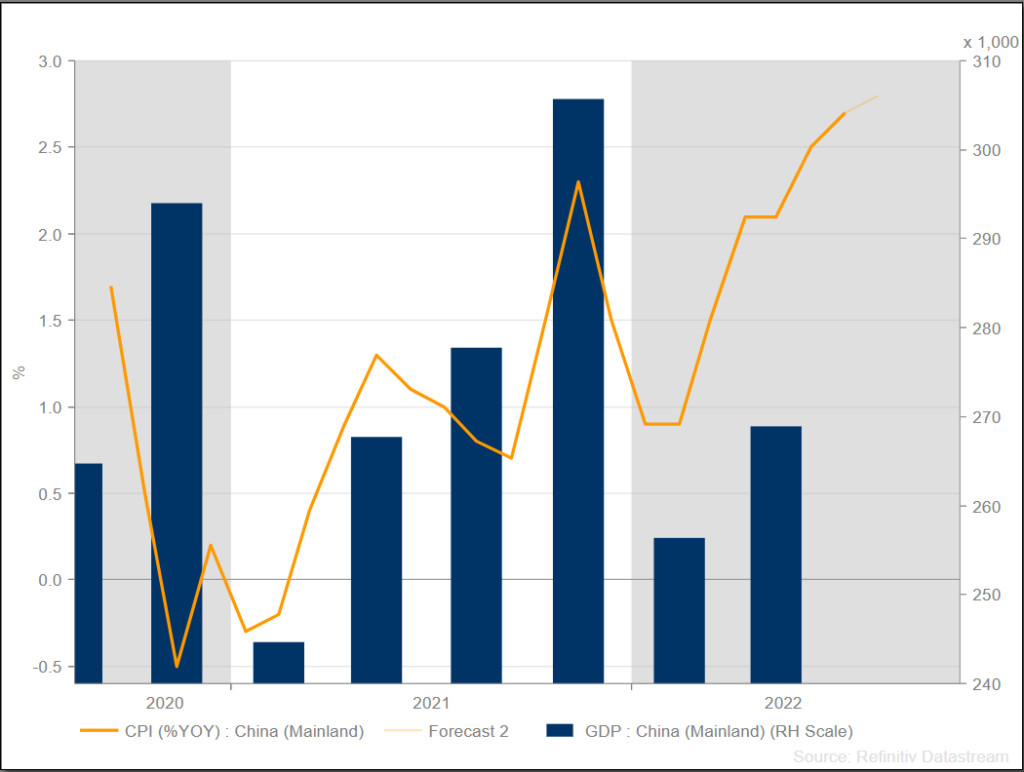
A worldwide slowdown, particularly in China, is alleviating inflationary pressures, particularly for essential imports and commodities. The Chinese CPI data will come out on Friday at 01:30 GMT, giving some signs of the aussie’s next directional movement as it is still in a negative tendency after failed attempts to move higher.
The optimism that the Chinese economy will be the world's largest by the end of the decade has been dimmed by slowing growth. China is a major factor in the reduction of foreign price pressures. The second-largest economy in the world, behind the United States, increased just 0.4% from a year earlier in the second quarter, its lowest growth rate in two years. While widespread Covid-19 lockdowns were responsible for the spring's slowdown, China's property collapse is now exerting a significant drag on GDP.
The decline in investment by developers has dampened the demand for industrial and energy goods. According to figures from the Chinese government, gasoline imports decreased by 36% in July compared to the same month a year prior, while steel imports plummeted by 25%.
Chinese CPI data expected to rise
Inflation rates that are through the roof are putting a strain on major economies throughout the world. Inflation in the United States dropped to 8.5% in July from a 40-year high of 9.1% in June, largely because of cheaper gasoline. U.S. inflation is still high, so the Federal Reserve will likely keep raising interest rates rapidly to bring it down. Meanwhile, after coming in at 2.7% in July, China's annual inflation rate is expected to increase to 2.8% yoy in August. Since July 2020, this is the largest price increase consumers have seen. On a monthly basis, CPI data is predicted to drop to 0.2% versus 0.5%.
During its August meeting, People’s Bank of China (PBOC) reduced its loan prime rates to 3.65%, the second such rate cut of the year. This came as the board of governors of the central bank stepped up its attempts to boost borrowing demand in the face of recurrent Covid-19 outbreaks and a prolonged property market slump. The move occurred after the central bank abruptly lowered the rate on the one-year medium-term lending facility (MLF) and another short-term liquidity instrument last week, in response to data from July indicating that the Chinese economy was losing pace due to sluggish global development.
AUD/USD holds near 6-week low
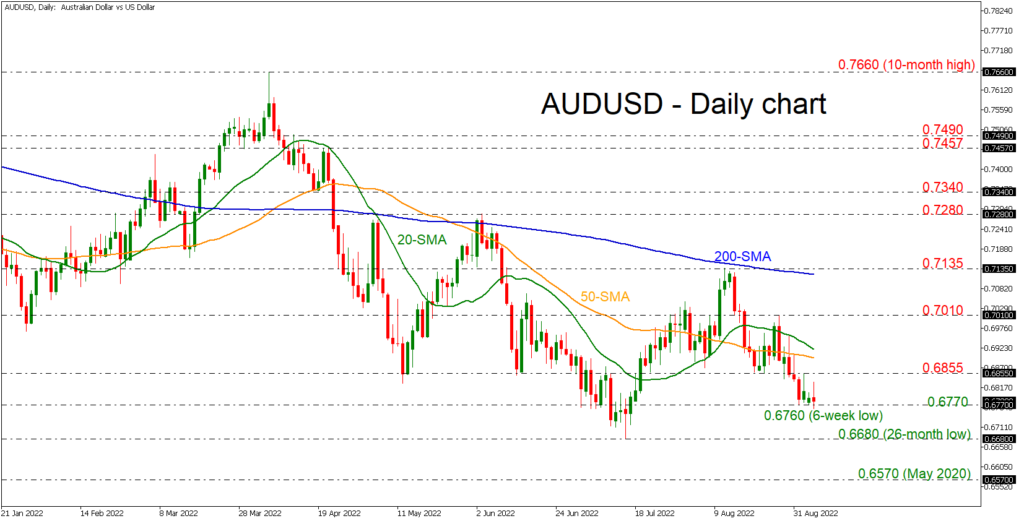
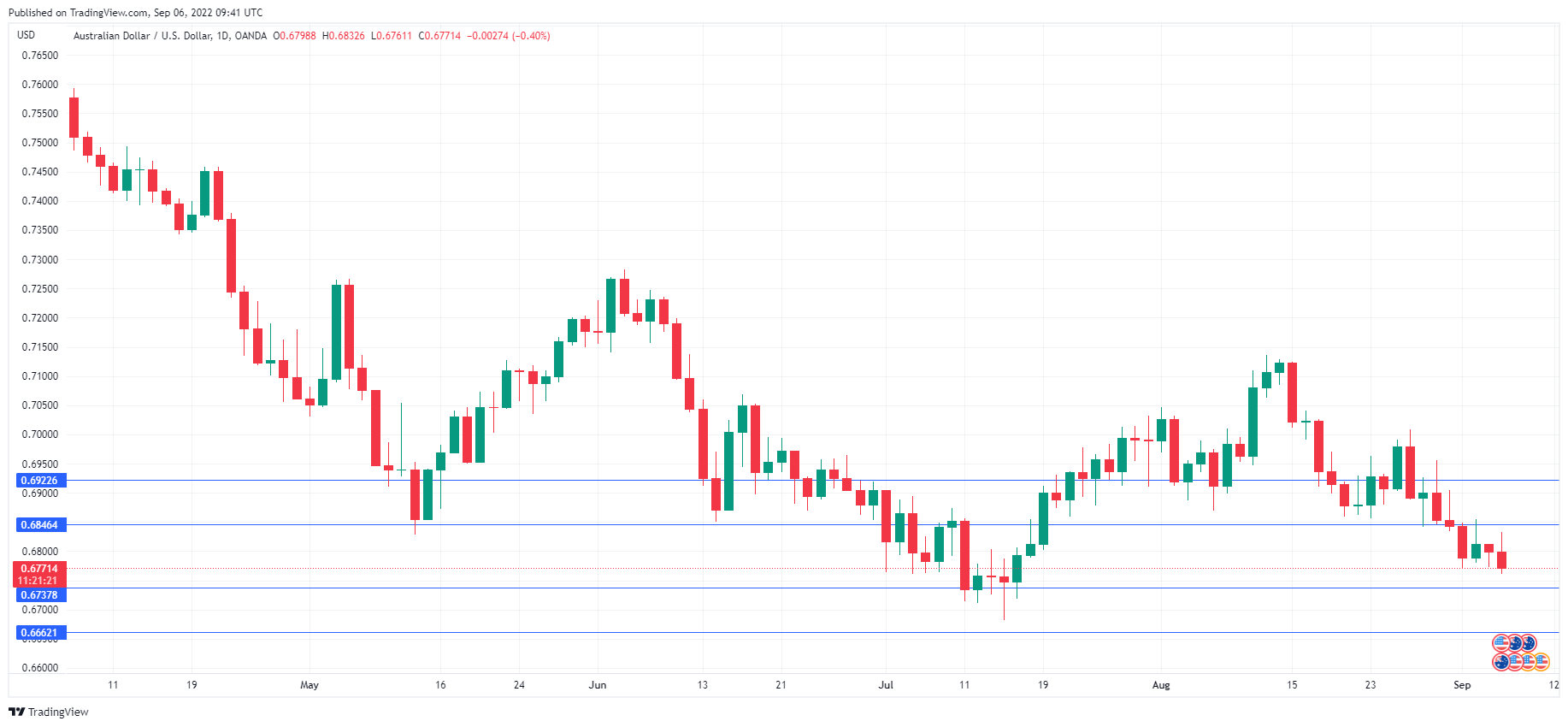
Aussie/dollar is moving near its opening levels today and is still hovering near the six-week low of 0.6760 that was posted earlier today. The pair is still in a negative tendency as it is moving well below the 200-day simple moving average (SMA) and the 20- and 50-day SMAs are in the process to post a bearish crossover if the aussie continues to attract selling interest.
If the 0.6770 strong support is broken and the pair ends a session below it, then the market may move lower and test the 26-month trough of $0.6680 before encountering the significant challenge posed by the inside swing high of May 2020 at $0.6570.
In the positive scenario, the bulls may take the upper hand, with a potential test of the $0.6855 resistance ahead of the 50- and then the 20-day SMAs at $0.6895 and $0.6917 respectively. Moving higher, the $0.7010 barrier may come next, before resting near the 200-day SMA, which is standing marginally below the $0.7135 barricade.
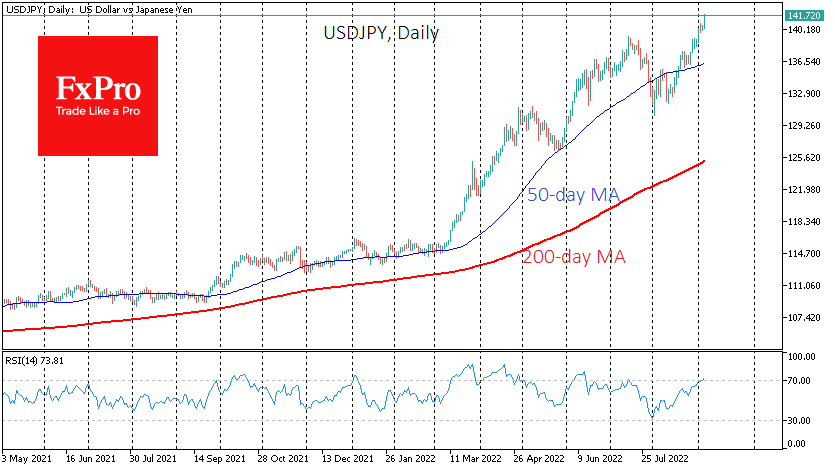
Yen Could Fall to As Low As 150
The Japanese yen is renewing 24-year lows against the dollar, and so far, policymakers have no safe tools to stop this decline.
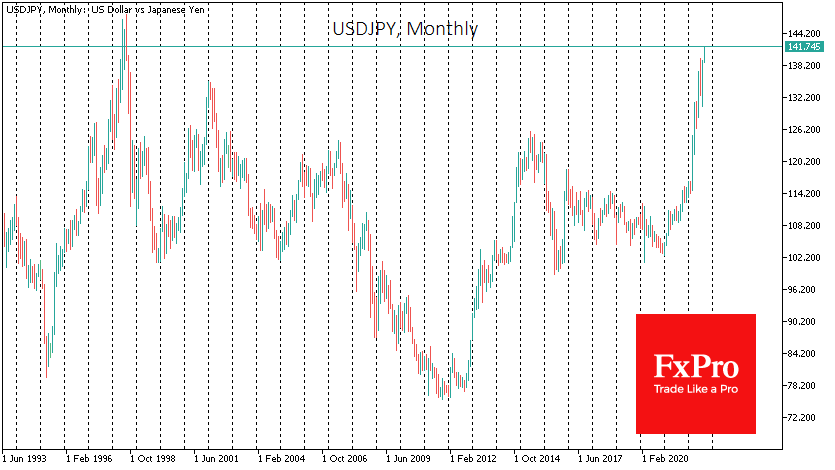
The USDJPY was above 141 on Tuesday morning, last seen in the first half of 1998. At the time near these levels, the Japanese Ministry of Finance intervened in the FX market to stop the collapse of the national currency in a few months. In 1990 it took the USDJPY about three quarters to move above 140 and was a corrective rebound. The pair have not traded consistently above current levels since 1987.
The current pair’s values are almost twice as high as the lows of 2011, which underlines the historical reversal in several directions.
The USDJPY have a tight correlation with the spread between the US and Japan bond yields. As Japan targets yields on its debt market curve, US bond yields are the only variable in the equation. The latter is rising at an unprecedented rate. The Fed only adds fuel to the fire to suppress inflation as quickly as possible and not let inflationary expectations take root.
That said, there are no signs yet that inflation in Japan is recovering. It might sound surprising, but the latest data shows that the rate of wage growth in July has slowed to 1.8% compared to 2.0%. Household spending rose by 3.4% YoY, but this is a weak result compared to 3.5% a month earlier and the expected 4.5%.
Sluggish economic growth and the need to service government debt of roughly 200% of GDP reduces the room for manoeuvre for the Bank of Japan, as a high key rate would multiply the government debt service costs. Sluggish inflation and consumer spending figures also remove the need for tightening monetary policy.
The USDJPY has likely crossed the informal line near 135, entering a deeper decline phase. Suppose the weakening of the yen continues in a relatively calm regime. There may not be any significant stops and turns before 150 (the psychologically important round level) or even 160 (near peak in 1990).
GBPUSD Turns Green Near Pandemic Low
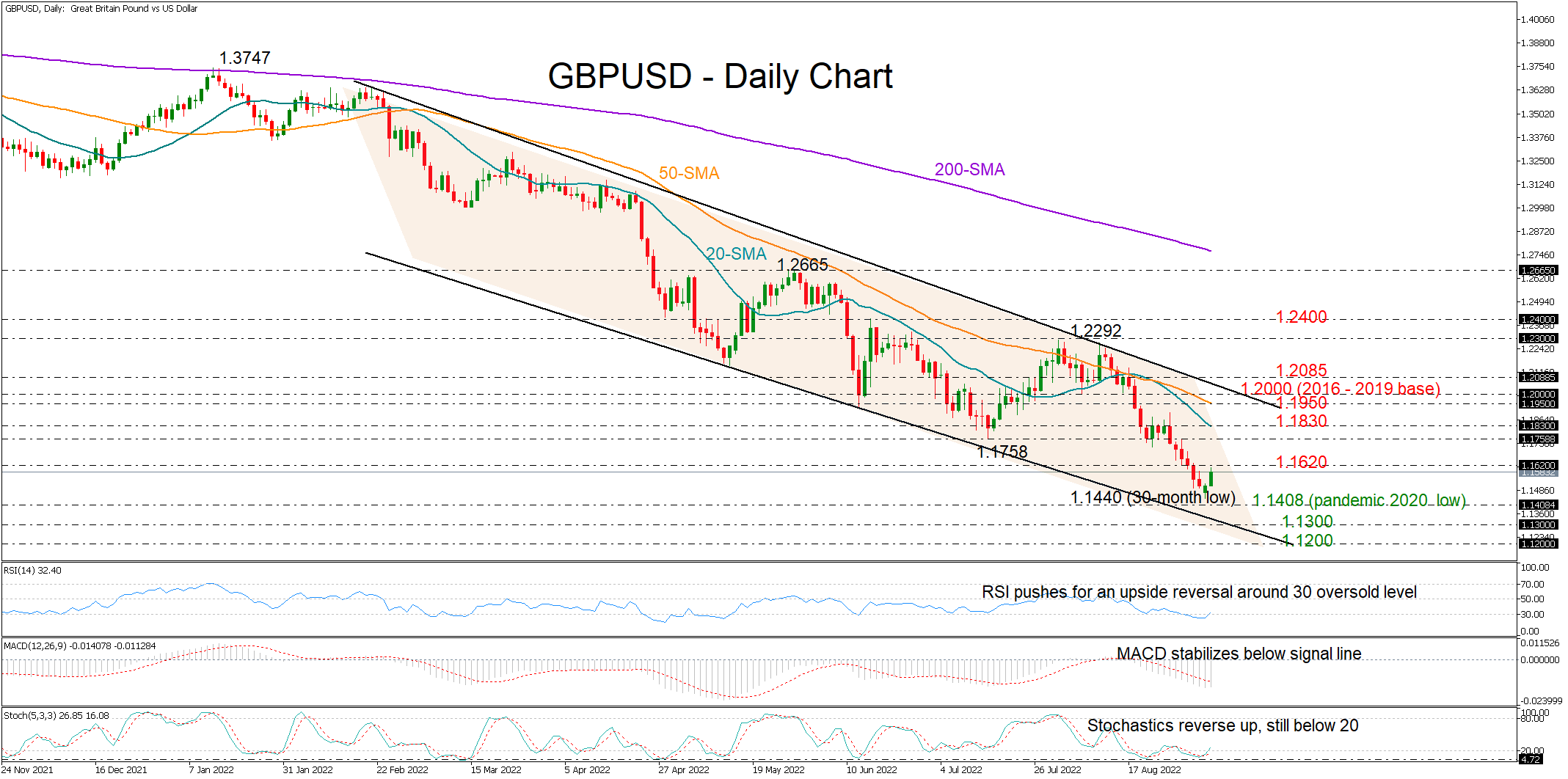
GBPUSD charted a 30-month low just above the pandemic low of 1.1408 on Monday before turning green for the first time after a week.
The price managed to rise as high as 1.1600 earlier today and although some recovery could take place in the near term given the oversold conditions in the market as reflected by the RSI and the stochastics, it is too early to hope for a meaningful rally. The indicators are still stuck in the bearish area, while the pair itself still has some obstacles to overcome before it decides to exit the 2022 bearish channel.
The 1.1620 region, where the price met some restrictions lately, could add some pressure ahead of the 1.1758 barrier in case of a move higher. Then, a decisive close above the 20-day simple moving average (SMA) and the 1.1830 resistance could be the key for an advance towards the 50-day SMA at 1.1950 and the channel’s upper band seen around the 1.2000 crucial boundary. A successful penetration higher and beyond 1.2085 could confirm a direct flight towards the August peak of 1.2292.
If upside pressures fizzle immediately, the bears may push again towards the pandemic low of 1.1408, a break of which would threaten an outlook deterioration below the channel’s lower line seen within the 1.1320 – 1.1300 area. The 1.1200 mark could next come on the radar.
Summarizing, GBPUSD could recoup some lost ground in the coming sessions, though any potential upside reversal will be under scrutiny as downside risks remain in play.
GBP/USD: Bears Take a Breather as Market Looks for Signals about the Action of New UK PM
Cable edged higher in Asian / European trading on Tuesday, boosted by cautious optimism that new UK Prime Minister Liz Truss will manage handle deepening crisis, though market will look for a much more evidence about the action the new government will take.
The key problem that Truss face will be to cap energy costs, as soaring prices strongly hit UK households, by sharply rising cost of living.
The new government is expected to unveil the plan for providing a billions of pounds to help struggling Britain’s households and will also need to answer the questions about fiscal and monetary policy.
This comes a week ahead of Bank of England policy meeting (Sep 15), in which the central bank is expected to hike interest rates for the seventh consecutive time, with around 70% expecting 75 basis points hike to 2.5%, in its fight to bring the double-digit inflation under control.
Technical picture shows fatigue of larger bears as daily studies are oversold, though firm bearish structure and persisting negative fundamentals suggest that corrective action likely will be just positioning for fresh push lower.
Upticks should be ideally capped under daily Tenkan-sen (1.1672), also 50% retracement of 1.1900/1.1443 bear-leg, to keep bears intact for final attack at 2020 low at 1.1410, loss of which would spark stronger acceleration lower.
Res: 1.1618; 1.1672; 1.1703; 1.1761.
Sup: 1.1568; 1.1512; 1.1443; 1.1410.

Aussie Slips after RBA Raises Rates
The Australian dollar is in negative territory today. In the European session, AUD/USD is trading at 0.6763, down 0.51%.
RBA raises by 50bp
The RBA isn’t getting much love, even after raising rates by 50 basis points earlier today. Investors responded to the rate hike by sending the Australian dollar lower, in a repeat of the Aussie’s fall after the August rate hike. The central bank has now raised the cash rate to 2.35% after four successive rate hikes of 50bp. The Australian dollar has lost ground despite the large rate hike, as the markets had priced in the move and aren’t showing any enthusiasm.
Today’s move brings rates close to the neutral level of around 2.5%, which means that the RBA is likely to deliver one more 50bp hike and then scale back to 25bp increases, contingent on inflation and the strength of the labour market. Governor Lowe’s rate statement didn’t add much and made no changes to the inflation forecast.
Lowe will speak about monetary policy on Thursday, and the markets will be looking for some insights.
The RBA expects inflation to peak at just below 8% before the end of the year, dropping to around 3% by 2023. The economy is in relatively good shape, and the central bank is hoping to steer the economy to a soft landing and avoid a recession as higher interest rates slow down economic activity.
Market attention now shifts to the Australian GDP release on Wednesday, with the markets expecting an improvement in Q2. Domestic activity remains strong despite rising inflation, and Australia enjoyed a record trade surplus in June. This is expected to help boost GDP to 3.5% in Q2, following a 3.3% gain in Q1.
AUD/USD Technical
- AUD/USD faces resistance at 0.6846 and 0.6922
- There is support at 0.6737 and 0.6661
Markets Mixed, Central Banks and Energy Shock in Focus
Market sentiment lacked conviction on Tuesday morning despite the Chinese government pledging more efforts to support economic growth. Asian shares were mixed as investors braced for the return of traders from across the pond. US markets were closed yesterday due to the Labor Day holiday, but the Dow and S&P 500 futures are signaling a positive open this afternoon. In Europe, shares tumbled in the previous session thanks to the region’s worsening energy crisis with stock futures pointing to a negative open this morning.
In the currency space, the mighty dollar hit a fresh 20-year high yesterday while the euro sank to levels not seen in two decades. Sterling made fresh cycle lows a few hours before Liz Truss was formally announced as the new Prime Minister of the UK. Looking at commodities, oil bulls were injected with fresh confidence after OPEC+ decided to cut production by 100,000 barrels per day in October to boost prices. With so much already going and more high-risk events in the pipeline, this promises to be an eventful week for markets.
Most importantly, the fierce war against inflation is set to continue with central banks ready for battle. Earlier this morning, the Reserve Bank of Australia hiked interest rates by another 50-basis points to 2.35%, its highest since early 2015. The aussie weakened following the move with prices trading around 0.6780 as of writing. The Bank of Canada rate decision will be on Wednesday and all eyes then turn to the European Central Bank meeting the following day.
Will ECB hawks deliver?
Much attention will be directed towards the ECB meeting later this week. The central bank is expected to fire a monetary bazooka in the form of a 75-basis point rate increase. Indeed, with inflation hitting a record high in August at 9.1%, the central bank needs to employ all tools to tame rampant prices.
It is worth keeping in mind that the Eurozone economy faces the growing risk of recession due to the unsavoury combination of conflict on its borders, rising price pressures, and an energy shock. The latest development concerning Russia’s Gazprom has worsened matters, exposing the economy to downside risks and fueling inflationary pressures as gas prices soar.
According to Bloomberg, traders are predicting a 73% probability of a 75-basis point rate hike in September. If the ECB joins the “jumbo rate hike club” and strikes a hawkish tone, this could open the doors to more supersized hikes in the future. While this could inspire euro bulls, the upside may be capped by the gloomy outlook for the Eurozone. If the ECB catches markets off guard with a 50-basis point hike and strikes a dovish tone, this may send the euro tumbling back towards 0.9900 and below.
What next for the pound?
Sterling tumbled to fresh lows on Monday, as investor confidence continued to deteriorate over the UK economic outlook. Since then, the pound has enjoyed a relief rally, but it is certainly not out of the woods yet. With Liz Truss formally announced as the new Prime Minister after a protracted leadership contest, investors will be keeping a close eye on the government’s next steps in dealing with the current challenges, primarily the soaring rise in energy bills.
Looking at the technical picture, cable is under pressure on the daily charts, but a technical rebound could be in the making. A strong move above 1.1600 could encourage a push towards 1.1760 before bears re-enter the scene.
Commodity spotlight – Oil
Oil prices have received a boost after OPEC+ agreed on Monday to cut supply in an effort to boost prices. This decision was made despite calls from western governments fighting to tame inflation in the face of a growing energy crisis across the world. The cartel will cut production by 100,000 barrels a day from October. Although this was seen as a small cut, it was more symbolic and sent a message to the west that OPEC+ will defend oil prices if needed.
Talking technicals, Brent crude could challenge the 200-day simple moving average at $98.82 if $96 gives way. A move back above the August high at $103.23 may be required to change the longer-term trend.
UK PMI construction recovered to 49.2, but further weakness ahead
UK PMI Construction recovered from 48.9 to 49.2 in August, above expectation of 48.0. S&P Global noted that activity was down for the second month running. New orders and employment had softer rises. But supply-chain disruption and inflationary pressures eased.
Andrew Harker, Economics Director at S&P Global Market Intelligence, said: "The UK construction sector looks set to be in for a challenging period, according to the latest PMI data. Not only did construction activity fall for the second month running, but a range of indicators from the survey pointed to further weakness ahead."
CAD/JPY upside breakout, targets 108.52, then 109.93
CAD/JPY breaks through 107.62 high today on broad based Yen selloff. The break of near term channel resistance also indicates upside acceleration. Further rally is expected now as long as 106.55 minor support holds. Next near term targets are 161.8% projection of 101.39 to 105.07 from 102.57 at 108.52, and then 200% projection at 109.93.
Current development also indicates resumption of long term up trend from 73.80 (2020 low). Next medium term target is 161.8% projection of 73.80 to 91.16 from 84.65 at 112.73.
Bitcoin is Selling off but not getting cheaper
Market picture
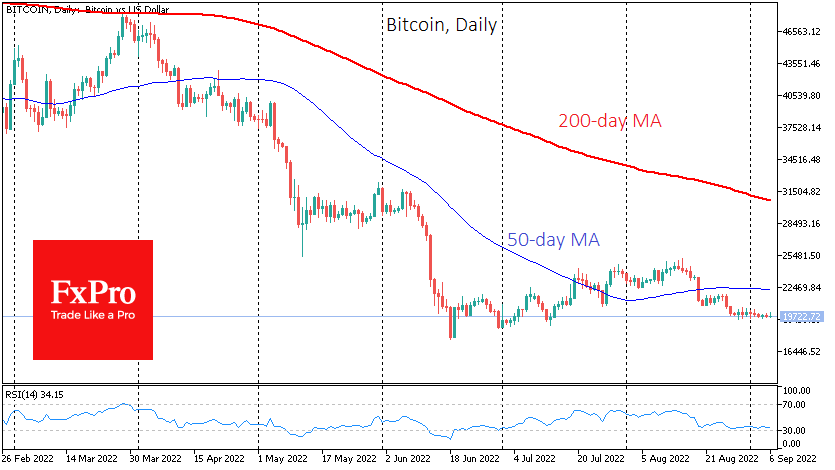
Bitcoin was down 0.7% on Monday, ending at around $19,750. BTC had a quiet day, trading just below the round level $20K amid a US holiday that reduced trading activity.
Ethereum continued to gain weight, adding 4.4% in the last 24 hours to $1640. Top altcoins are mainly in green, with a price range of -0.8% (Shiba Inu) to +2.2% (Solana). Total crypto market capitalisation rose 1% to $993bn and is again hovering around the psychologically important round mark.
With highs in almost two weeks, Ethereum is again testing its 50-day moving average. This successful countering of oppressive sentiment in traditional finance encourages cryptocurrency enthusiasts. However, the second cryptocurrency will need at least a solid consolidation above $1700 to assert growth.
News background
According to CoinShares, net outflows from bitcoin funds were $11 million last week. Investments in funds that allow shorts on bitcoin rose by a record $18 million. That is, only downside bets provided the inflows. This may be good news as it did not cause a price drawdown, but sooner or later, these shorts will need to be closed, pushing the price up.
Miners are selling off bitcoin again. According to CtyptoQuant, miners were among the most active sellers, selling around 4,600 BTC in the last three days.
According to the analytics resource BitInfoCharts, the crypto whale sold 5,000 BTC in 2013. Since then, the value of bitcoins in his wallet has increased almost 30-fold.
Another 5,000 BTC linked to the bankrupt crypto exchange Mt.Gox has arrived, a Telegram channel reported. The funds arrived at the Kraken exchange.
Interestingly, such large transactions occur amid abnormally subdued price fluctuations, leaving us to speculate whether we see the professionalism of sellers and market makers who have fed such volumes without immediate consequence or manifest underlying buyer interest.