Sample Category Title
Aussie Mixed after RBA Hike, Dollar Paring Gains
Australian Dollar is trading mixed, slightly to the soft side, after RBA's expected 50bps rate hike. There is basically no surprise out of the statement. Dollar is paring back some of recent gains while Yen is also soft. On the other hand, Sterling is leading Euro for a rebound while Canadian Dollar is also a touch firmer.
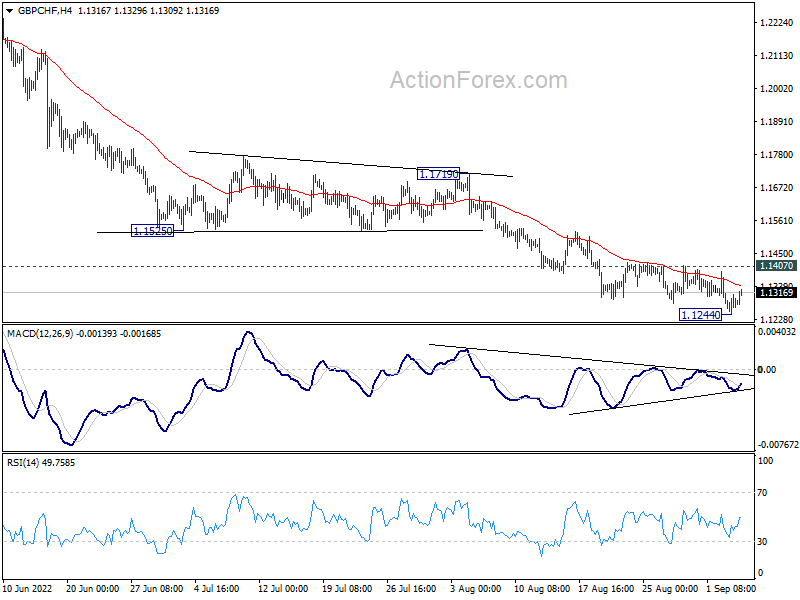
Technically, while Sterling is recovering, upside momentum is hardly convincing so far. GBP/CHF will need to break through 1.1407 minor resistance to indicate short term bottoming first, before having the prospect of stronger rebound. Otherwise, outlook in GBP/CHF will stay bearish, and upside of the Pound could also be capped elsewhere.
In Asia, at the time of writing, Nikkei is up 0.09%. Hong Kong HSI is down -0.42%. China Shanghai SSE is up 1.01%. Singapore Strait Times is up 0.33%. Japan 10-year JGB yield is up 0.004 at 0.239.
RBA hikes 50bps to 2.35%, more over the months ahead
RBA raises cash rate target by 50bps to 2.35% as widely expected. The Board "expects to increase interest rates further over the months ahead", but it's "not on a pre-set path". The size and timing of future hikes will be "guided by the income data and the Board's assessment of the outlook for inflation and the labour market."
Regarding inflation, RBA expects it to peak "later this year". The central forecasts is for CPI to be around 7.75% over 2022, a little above 4% over 2023, and then around 3% over 2024.
The economy is "continuing to grow solidly" as boosted by a "record level of the terms of trade". Labor market is "very tight" while wages growth "has picked up".
It maintained that an important source of uncertainty is household spending, which is facing pressure from higher inflation and higher interest rates.
BoE Mann: Fast and forceful monetary tightening superior to gradualist approach
In a speech, BoE MPC member Catherine Mann said, "inflation today does not simply depend on past inflation but depends as well on markets, firms, and household's expectations, and crucially, how these expectations react to each other, are formed over time, and interact with our and others' policy choices. "
"In this more complex and arguably more realistic and relevant version of the inflation model, a fast and forceful monetary tightening, potentially followed by a hold or reversal, is superior to the gradualist approach."
"This policy strategy would reduce the risks of a more extended and costly tightening cycle later that depends primarily on shrinking aggregate demand."
Yuan hit fresh 2-yr low, shrugging PBoC actions
The People's Bank of China announced yesterday to cut the foreign exchange reserve requirement ratio (RRR) to 6% from 8% beginning September 15. That is, the amount of foreign-exchange deposits banks need to set aside as reserves will be lowered, freeing up funds to buy Yuan.
The move, together with a string of stronger-than expected exchange rate fixings, are seen as a strong signal on PBoC's stance to at least slow Yuan's depreciation. That came when Yuan hit fresh two-year low and with USD/CNH approaching psychological important 7 handle.
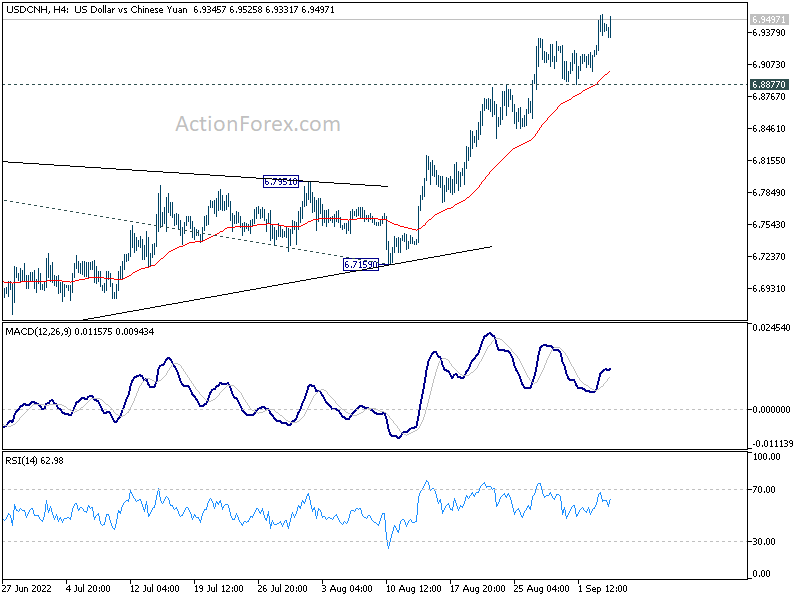
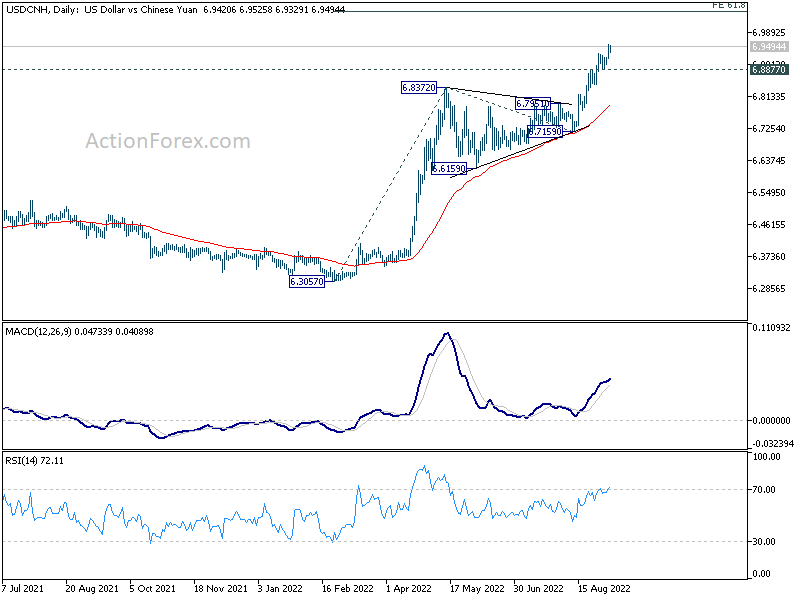
But USD/CNH's rally (Yuan's depreciation) is continuing. There is no sign of topping in USD/CNH as long as 6.8877 support holds, technically. It's still on track to 61.8% projection of 6.3057 to 6.8372 from 6.7159 at 7.0444.
Looking ahead
Germany will release factory orders in European session. UK will publish PMI construction. Later in the day, US will release ISM services.
AUD/USD Daily Report
Daily Pivots: (S1) 0.6779; (P) 0.6792; (R1) 0.6810; More...
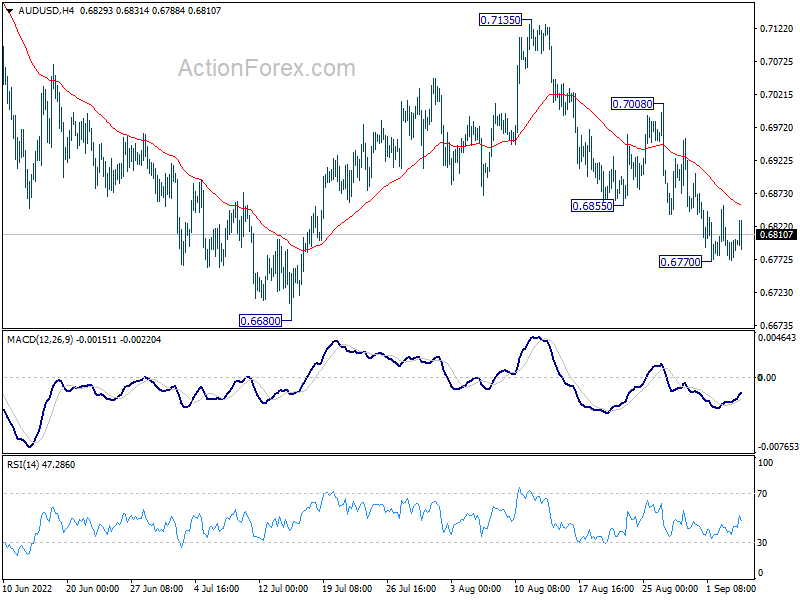
Intraday bias in AUD/USD is turned neutral with a temporary low formed at 0.6770. Further decline is expected as long as 0.7008 resistance holds. Break of 0.6770 will resume the decline from 0.7135 to retest 0.6680 low. Decisive break there will resume larger down trend.
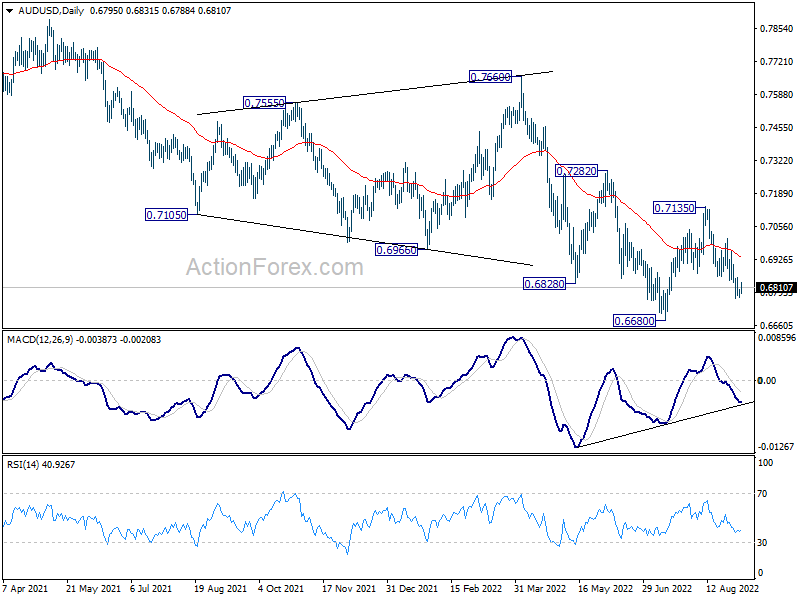
In the bigger picture, price actions from 0.8006 (2021 high) is seen more as a corrective pattern to rise from 0.5506 (2020 low). Or it could also be a bearish impulsive move. In either case, outlook will remain bearish as long as 0.7282 resistance holds. Next target is 61.8% retracement of 0.5506 to 0.8006 at 0.6461.
Economic Indicators Update
| GMT | Ccy | Events | Actual | Forecast | Previous | Revised |
|---|---|---|---|---|---|---|
| 23:01 | GBP | BRC Like-For-Like Retail Sales Y/Y Aug | 0.50% | 1.60% | ||
| 23:30 | JPY | Labor Cash Earnings Y/Y Jul | 1.80% | 1.90% | 2.20% | |
| 23:30 | JPY | Overall Household Spending Y/Y Jul | 3.40% | 4.20% | 3.50% | |
| 01:30 | AUD | Current Account Balance (AUD) Q2 | 18.3B | 21.5B | 7.5B | |
| 04:30 | AUD | RBA Interest Rate Decision | 2.35% | 2.35% | 1.85% | |
| 06:00 | EUR | Germany Factory Orders M/M Jul | -0.20% | -0.40% | ||
| 08:30 | GBP | Construction PMI Aug | 48 | 48.9 | ||
| 13:45 | USD | Services PMI Aug F | 44.1 | 44.1 | ||
| 14:00 | USD | ISM Services PMI Aug | 55.4 | 56.7 |
RBA hikes 50bps to 2.35%, more over the months ahead
RBA raises cash rate target by 50bps to 2.35% as widely expected. The Board "expects to increase interest rates further over the months ahead", but it's "not on a pre-set path". The size and timing of future hikes will be "guided by the income data and the Board's assessment of the outlook for inflation and the labour market."
Regarding inflation, RBA expects it to peak "later this year". The central forecasts is for CPI to be around 7.75% over 2022, a little above 4% over 2023, and then around 3% over 2024.
The economy is "continuing to grow solidly" as boosted by a "record level of the terms of trade". Labor market is "very tight" while wages growth "has picked up".
It maintained that an important source of uncertainty is household spending, which is facing pressure from higher inflation and higher interest rates.
(RBA) Statement by Philip Lowe, Governor: Monetary Policy Decision
At its meeting today, the Board decided to increase the cash rate target by 50 basis points to 2.35 per cent. It also increased the interest rate on Exchange Settlement balances by 50 basis points to 2.25 per cent.
The Board is committed to returning inflation to the 2–3 per cent range over time. It is seeking to do this while keeping the economy on an even keel. The path to achieving this balance is a narrow one and clouded in uncertainty, not least because of global developments. The outlook for global economic growth has deteriorated due to pressures on real incomes from high inflation, the tightening of monetary policy in most countries, Russia's invasion of Ukraine, and the COVID containment measures and other policy challenges in China.
Inflation in Australia is the highest it has been since the early 1990s and is expected to increase further over the months ahead. Global factors explain much of the increase in inflation, but domestic factors are also playing a role. There are widespread upward pressures on prices from strong demand, a tight labour market and capacity constraints in some sectors of the economy.
Inflation is expected to peak later this year and then decline back towards the 2–3 per cent range. The expected moderation in inflation reflects the ongoing resolution of global supply-side problems, recent declines in some commodity prices and the impact of rising interest rates. Medium-term inflation expectations remain well anchored, and it is important that this remains the case. The Bank's central forecast is for CPI inflation to be around 7¾ per cent over 2022, a little above 4 per cent over 2023 and around 3 per cent over 2024.
The Australian economy is continuing to grow solidly and national income is being boosted by a record level of the terms of trade. The labour market is very tight and many firms are having difficulty hiring workers. The unemployment rate declined further in July to 3.4 per cent, the lowest rate in almost 50 years. Job vacancies and job ads are both at very high levels, suggesting a further decline in the unemployment rate over the months ahead. Beyond that, some increase in the unemployment rate is expected as economic growth slows.
Wages growth has picked up from the low rates of recent years and there are some pockets where labour costs are increasing briskly. Given the tight labour market and the upstream price pressures, the Board will continue to pay close attention to both the evolution of labour costs and the price-setting behaviour of firms in the period ahead.
An important source of uncertainty continues to be the behaviour of household spending. Higher inflation and higher interest rates are putting pressure on household budgets, with the full effects of higher interest rates yet to be felt in mortgage payments. Consumer confidence has also fallen and housing prices are declining in most markets after the earlier large increases. Working in the other direction, people are finding jobs, gaining more hours of work and receiving higher wages. Many households have also built up large financial buffers and the saving rate remains higher than it was before the pandemic. The Board will be paying close attention to how these various factors balance out as it assesses the appropriate setting of monetary policy.
The further increase in interest rates today will help bring inflation back to target and create a more sustainable balance of demand and supply in the Australian economy. Price stability is a prerequisite for a strong economy and a sustained period of full employment. The Board expects to increase interest rates further over the months ahead, but it is not on a pre-set path. The size and timing of future interest rate increases will be guided by the incoming data and the Board's assessment of the outlook for inflation and the labour market. The Board is committed to doing what is necessary to ensure that inflation in Australia returns to target over time.
Elliott Wave View: GBPCAD Rally Should Fail for Further Downside
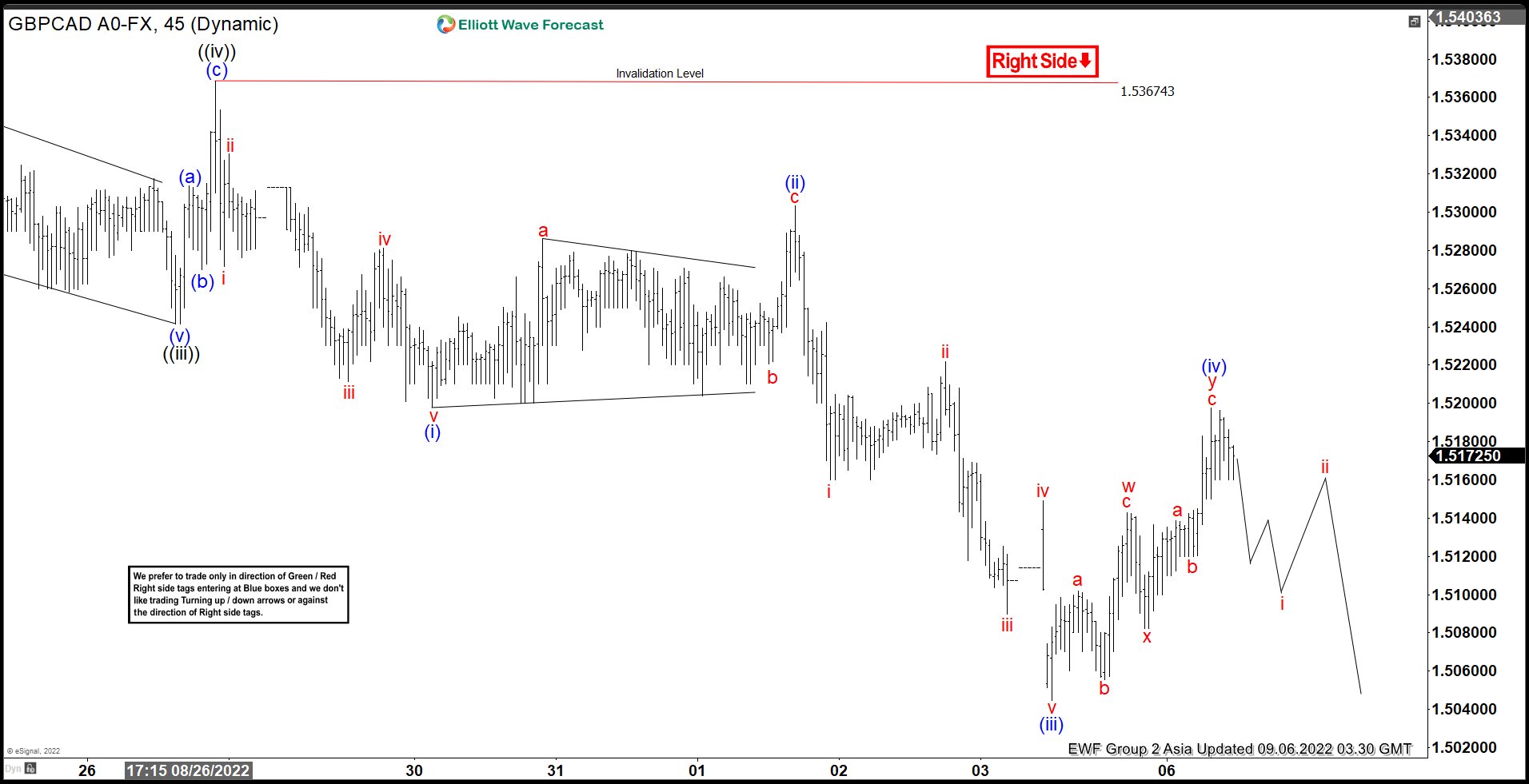
Short Term Elliott Wave View in GBPCAD suggests rally to 1.5367 ended wave ((iv)). Wave ((v)) lower is in progress to complete a cycle from August 2, 2022 high. Internal subdivision of wave ((iv)) unfolded as a zig zag Elliott Wave structure. Up from wave ((iii)), wave (a) ended at 1.5314 and pullback in wave (b) ended at 1.5269. The pair extended higher in wave (c) of ((iv)) towards 1.5367.
GBPCAD turned lower in wave ((v)). Internal subdivision is taking the form of an impulse. Down from wave ((iv)), wave (i) ended at 1.5198 and bounce in wave (ii) ended at 1.5304 as flat correction. The pair extended lower in wave (iii) towards 1.5044. Wave (iv) higher could be done already as double correction. Wave w of (iv) ended at 1.5143. Connector wave x of (iv) finished at 1.5082 and pair then rallied in 3 swings to end wave y of (iv) at 1.5198. We expect further downside from this levels to break 1.5044 low to complete wave (v) and also wave ((v)) in higher degree. As far as pivot at 1.5367 high stays intact, expect that any rally to fail in 3, 7, or 11 swings to continue lower.
GBPCAD 45 Minutes Elliott Wave Chart
Technical Outlook and Review
USD/JPY:
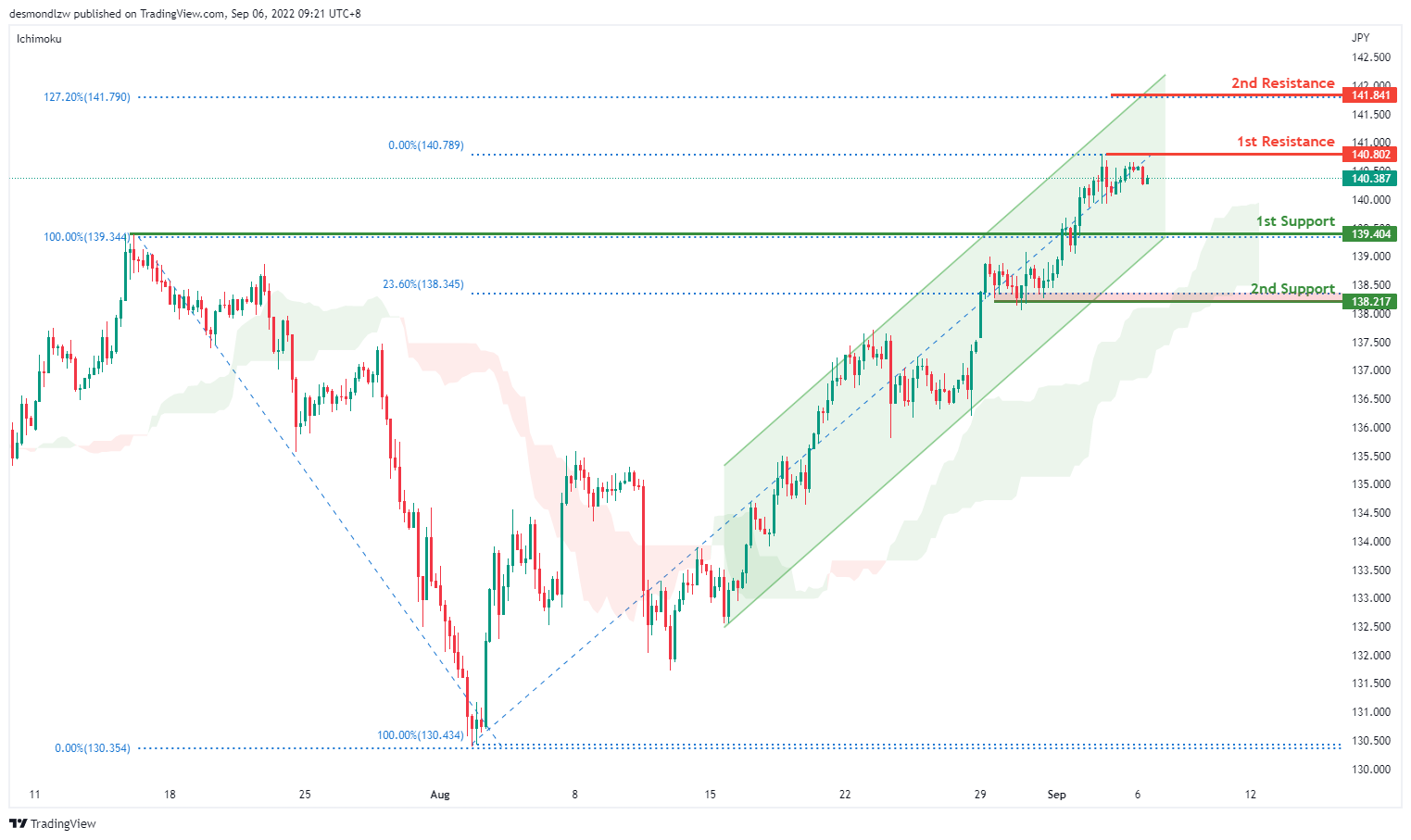
On the H4 chart, price has confirmed a bullish momentum breaking the previous high. We are bullish bias- Price has pulled back slightly but if bullish momentum continues, it should test the first resistance at 140.802 and then the second resistance at 141.841 where the 127.2% extension sits. Alternatively, if price reverses, it might pull back to test the first support at 139.404 where the previous swing high sits then the second support at 138.217 where the 23.6% retracement sits.
Areas of consideration:
- H4 time frame, 1st resistance at 140.802
- H4 time frame, 1st support at 139.404
DXY:
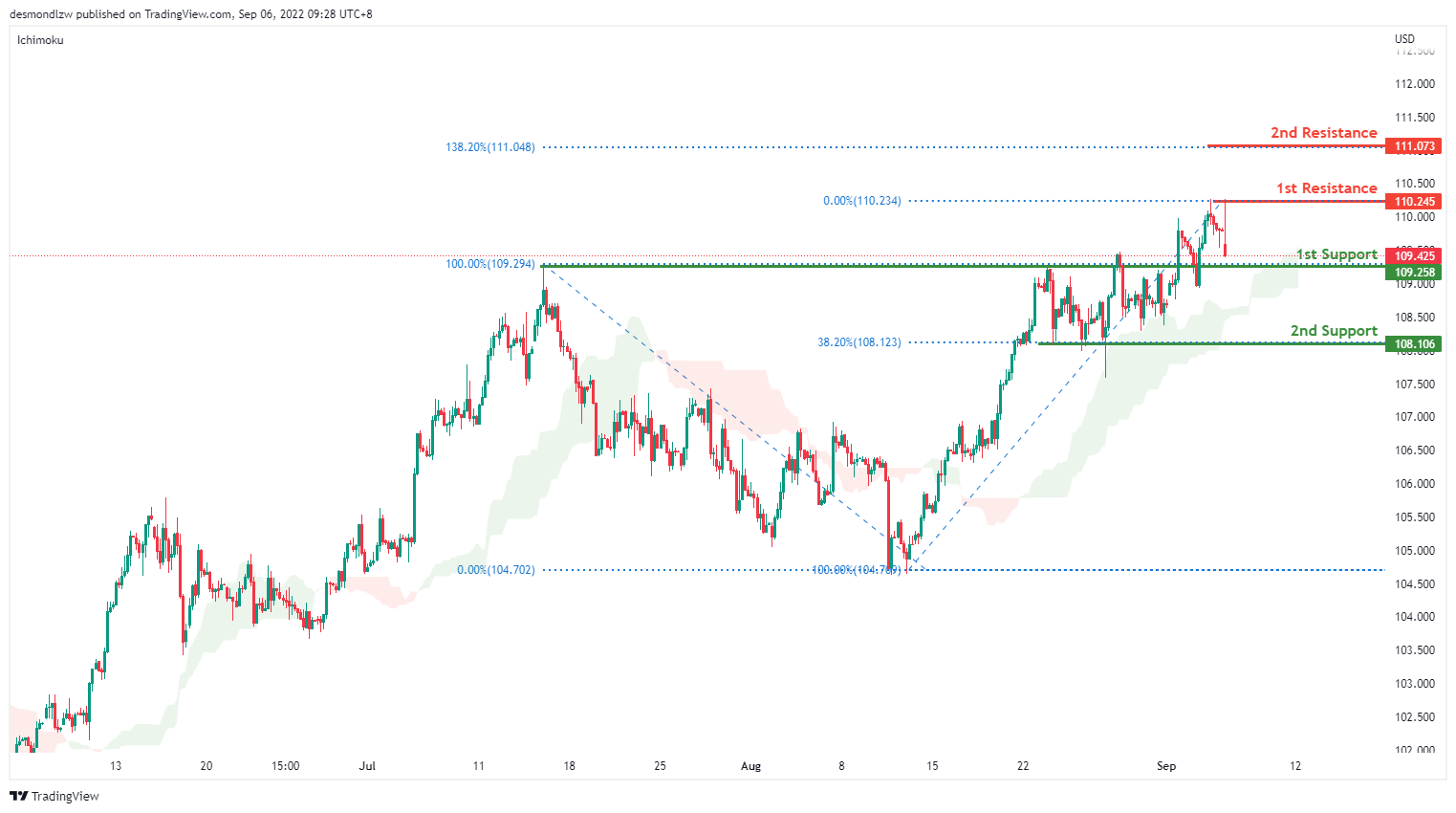
On the H4, price seems to be ranging but it is still moving in an ascending trend and is in a bullish momentum. Price has failed to break the first resistance at 110.245 levels but if bullish momentum continues, it should bring price up to 111.073 where the 138.2% fibonacci extension sits. Alternatively, price might pull back to test the first support at 109.258 where the previous swing high sits and subsequently the second support at 108.106 where the 38.2% retracement sits
Areas of consideration:
- H4 time frame, 1st resistance at 110.245
- H4 time frame, 1st support at 109.258
EUR/USD:
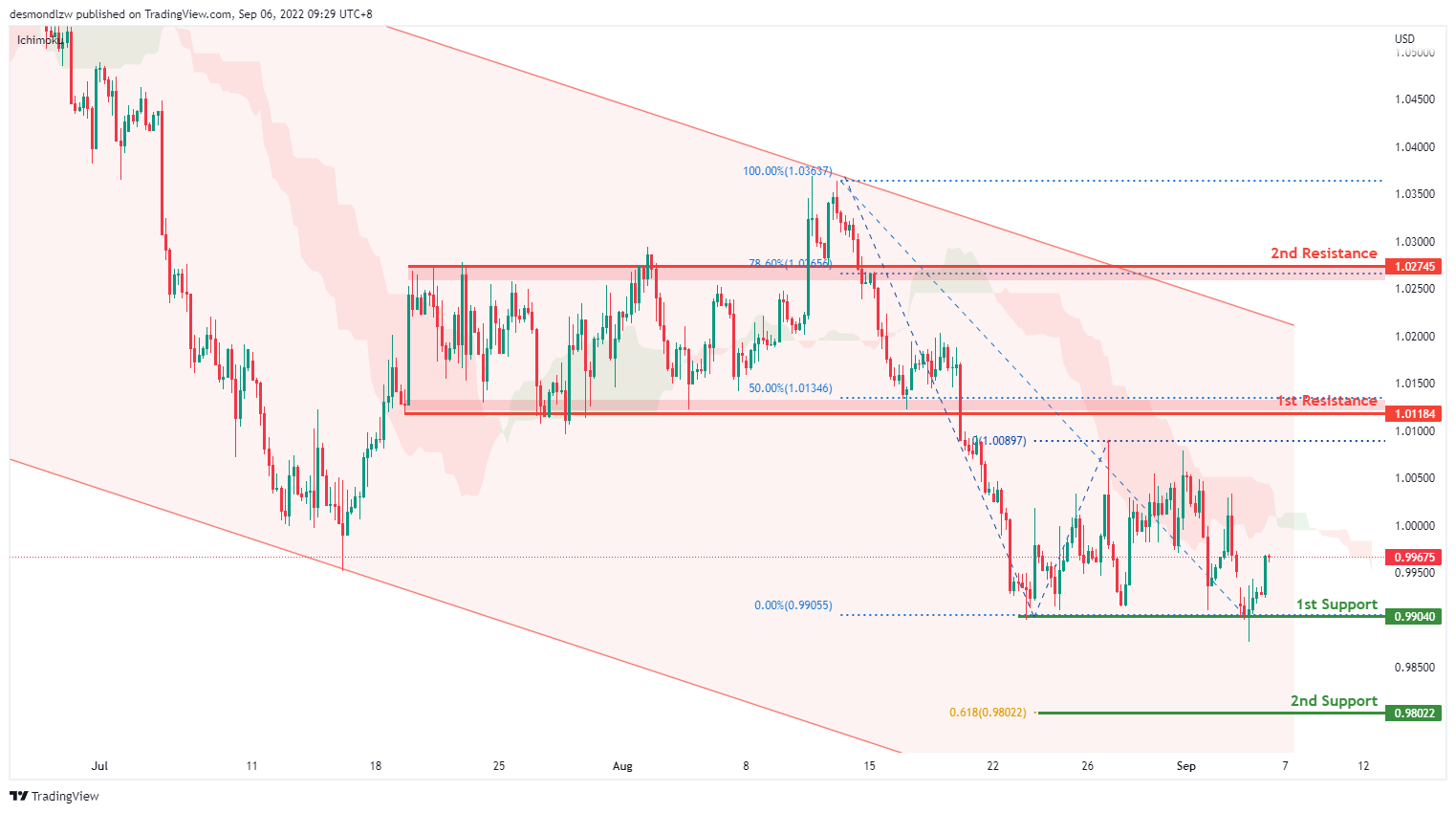
On the H4, price seem to have formed a bottom and is pulling back slightly – we are slightly bullish bias. Price looks like it’s pulling back to test the first resistance at 1.0118 where the previous swing low and 50% retracement sits and subsequently the second resistance at 1.0274 where the 78.6% retracement and swing high sits. If price fail to test the first resistance, it might pull back to test the first support at 0.9904 again and then the second support at 0.9802 where the 61.8% projection sits
Areas of consideration :
- H4 1st resistance at 1.0118
- H4 1st support at 0.9904
GBP/USD:
On the H4, prices seem to still be in a bearish momentum and respecting the ichimoku cloud. Prices have rebounded slightly but if bearish momentum continues it should move toward the first support at 1.1437 levels where the 161.8% extension sits. Alternatively, if it fails to break this level, it might look to test the first resistance at 1.1760 level where the 61.8% projection and 38.2% retracement sits then the second resistance at 1.1921 level where the previous swing low and 78.6% projection sits
Areas of consideration:
- H4 1st resistance at 1.1760
- H4 1st support at 1.1437

USD/CHF:
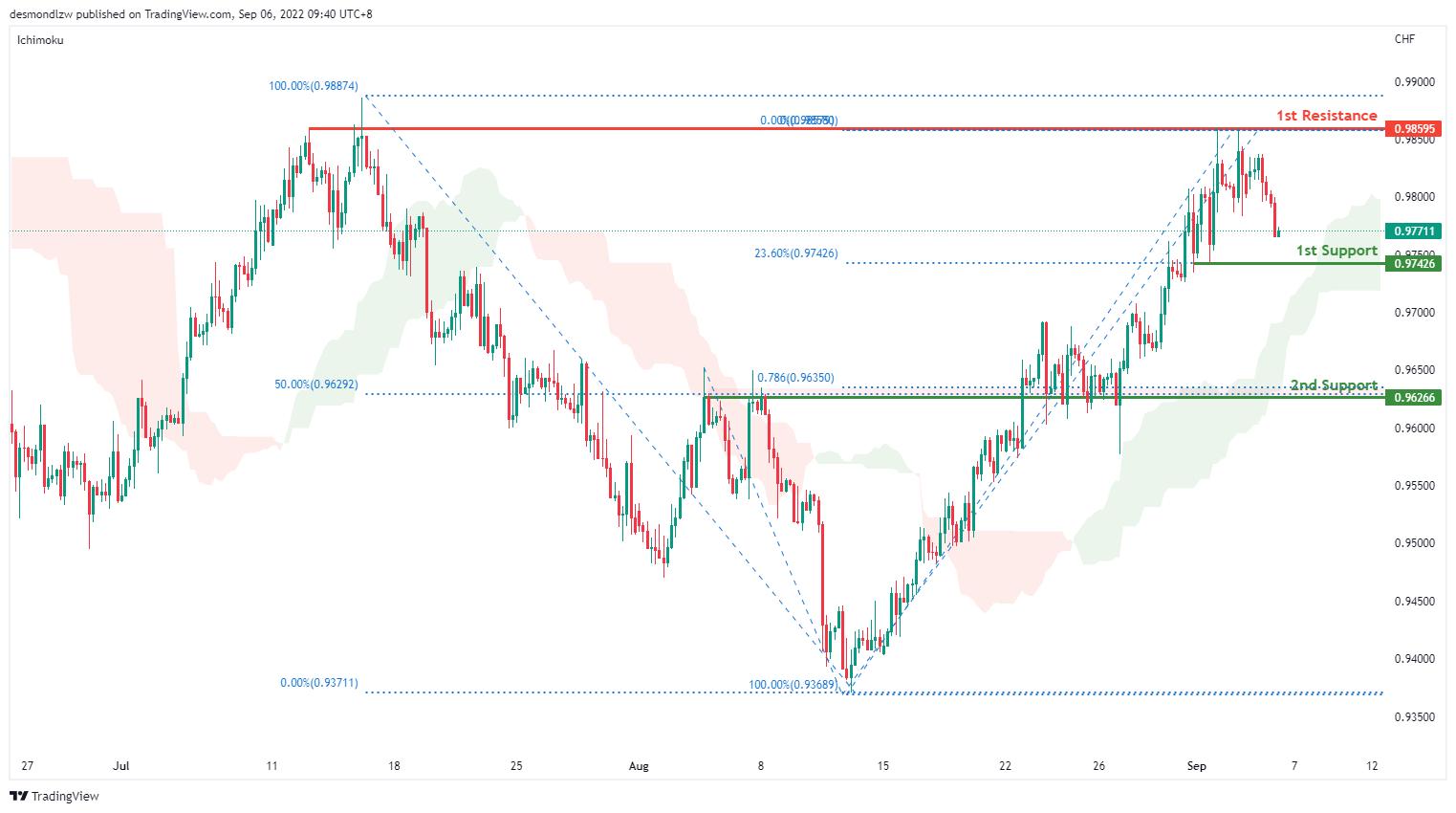
On the H4, with prices moving above the ichimoku cloud and breaking the descending trend, we are bullish. Price has tested the first resistance at 0.9852 where the previous swing high sits and has pulled back slightly. If price do not break the first resistance, it could pull back to test the first support around the 0.9742 levels where the 23.6% retracement and swing low sits, subsequently the second support at 0.9626 where the 50% fibonacci retracement,78.6% projection and previous swing low sits
Areas of consideration
- H4 1st support at 0.9742
- H4 1st resistance at 0.9852
XAU/USD (GOLD):
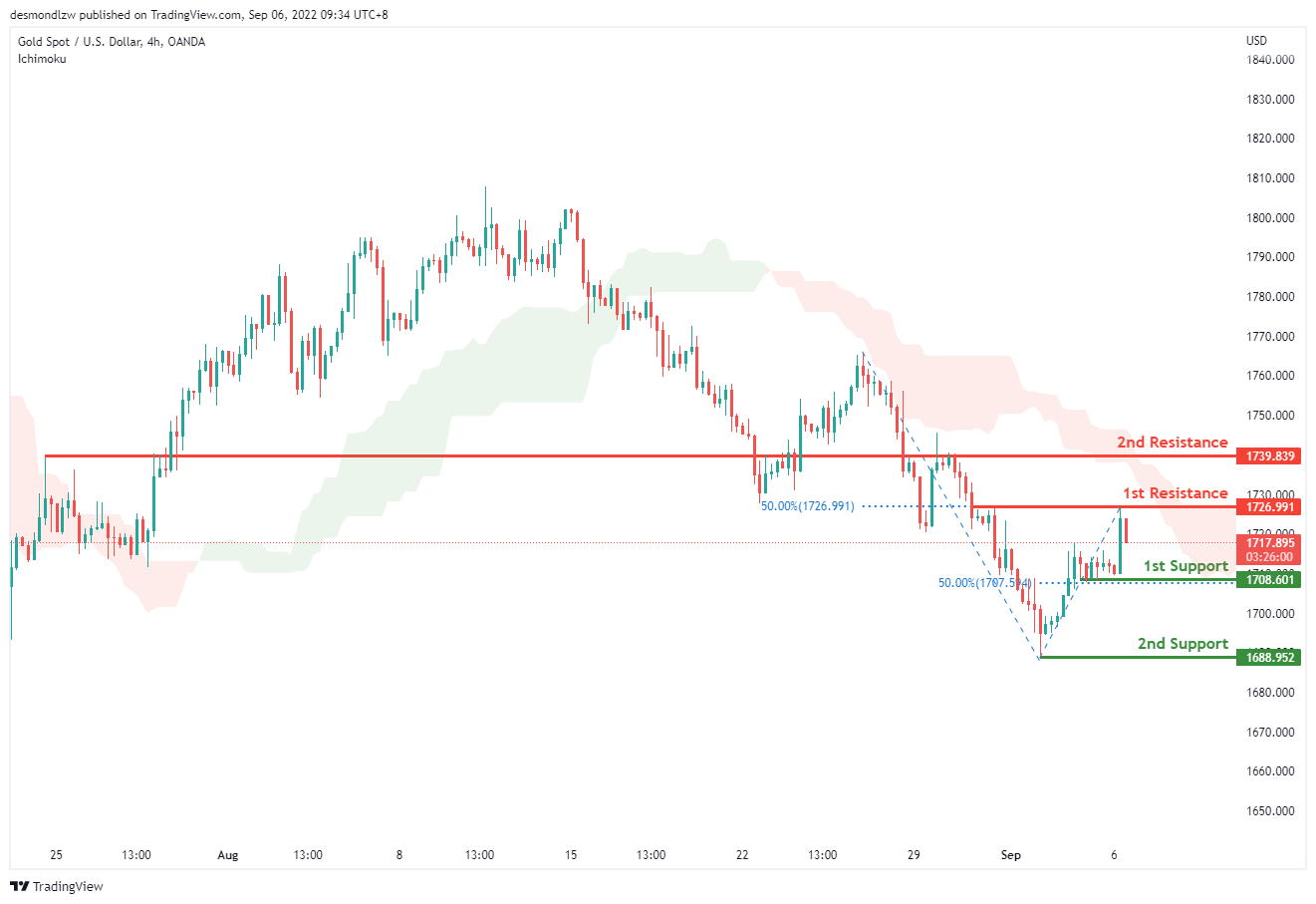
On the H4, with prices below ichimoku cloud, we have a bearish bias that the price may drop to the 1st support at 1708.601, where the 50% fibonacci retracement is. If the price can break this support line, the next support level could be at 1688.952, where the current swing low is. Alternatively, the price may rise to the 1st resistance at 1726.991, where the price tested before and 50% fibonacci retracement is. If the price retest this level and break it, the 2nd resistance could be at 1739.839, which is in line with previous swing highs.
Areas of consideration:
- H4 time frame, 1st resistance at 1726.991
- H4 time frame, 1st support at 1708.601
AUD/USD:
On the H4, with the price moving below the ichimoku cloud and moving within the descending channel, we have a bearish bias that the price may drop from the 1st support at 0.67619, which is in line with the multiple swing lows to the 2nd support at 0.67098, where the swing lows are. Alternatively, the price may rise to the 1st resistance 0.68286, where the 23.6% fibonacci retracement is.
Areas of consideration
- H4 1st support at 0.67619
- H4 2nd support at 0.67098
NZD/USD:
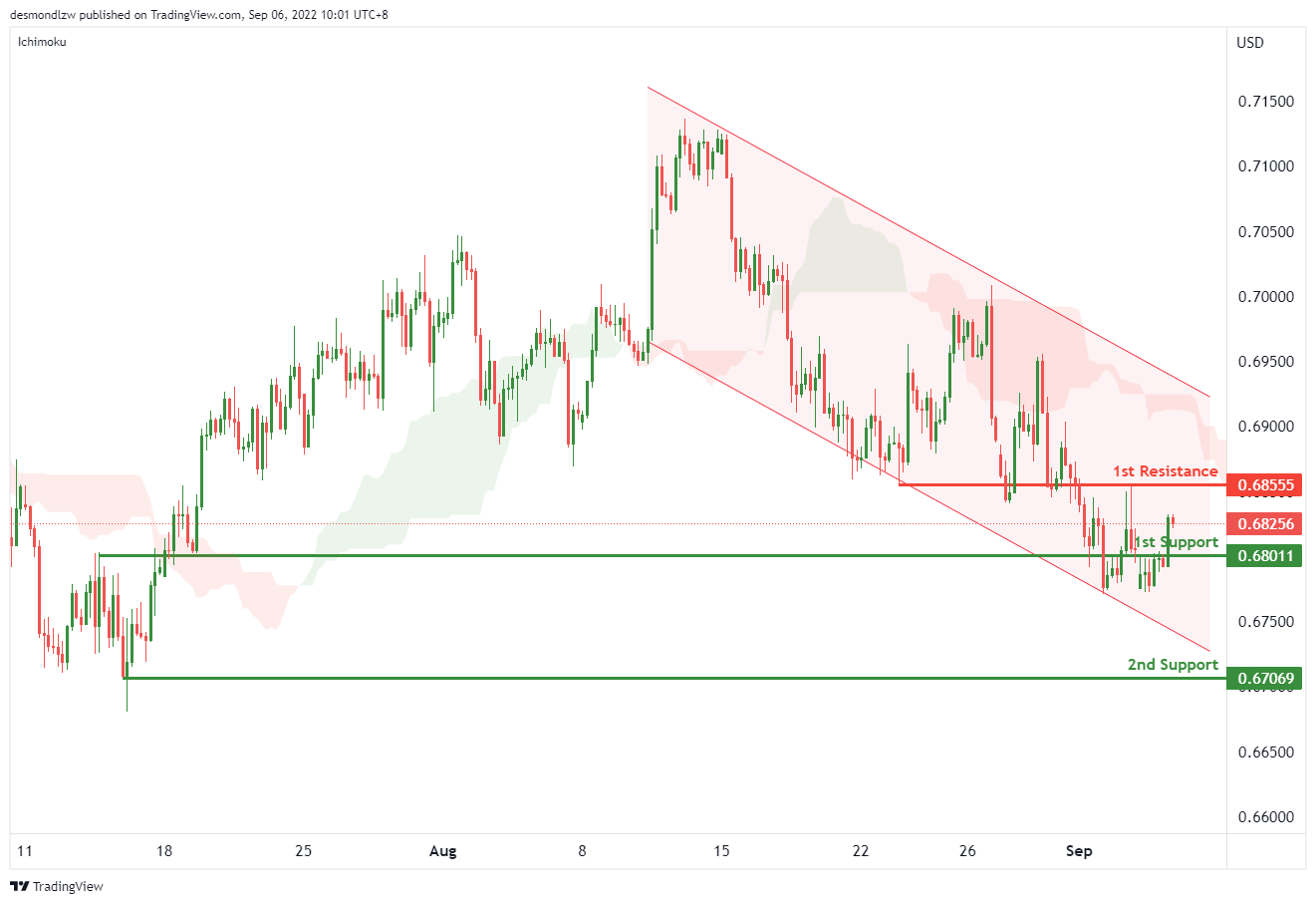
On the H4, with price moving within the descending channel and below ichimoku indicators, we have a bearish bias that the price may drop from the 1st support at 0.68011, which is in line with the overlap support. If the price can break the 1st support, the next support could be at 0.67069, where the swing low is. Alternatively, the price may rise to the 1st resistance at 0.68639, where the overlap resistance is.
Areas of consideration:
- H4 time frame, 1st support at 0.68011
- H4 time frame, 2nd support at 0.67069
USD/CAD:
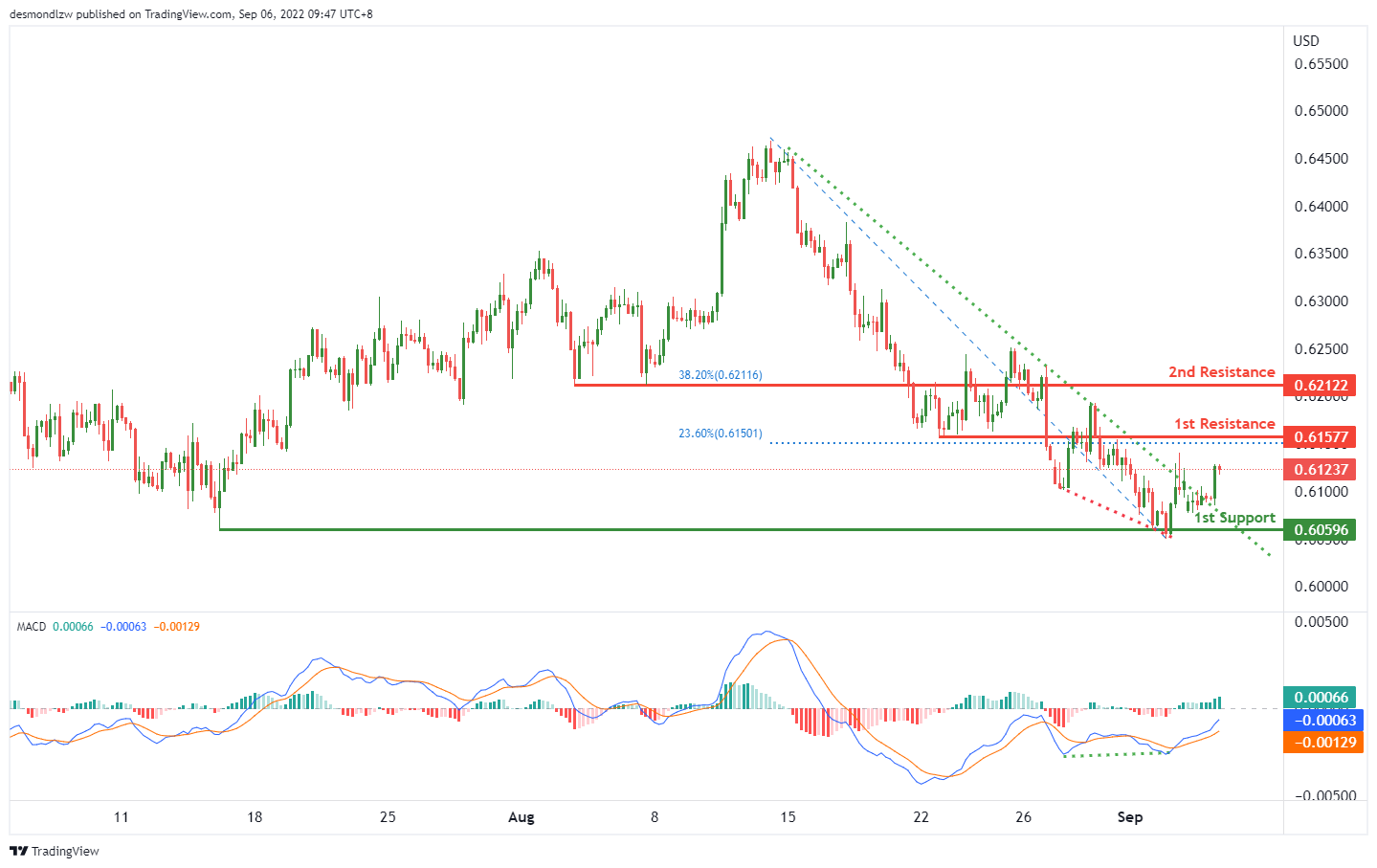
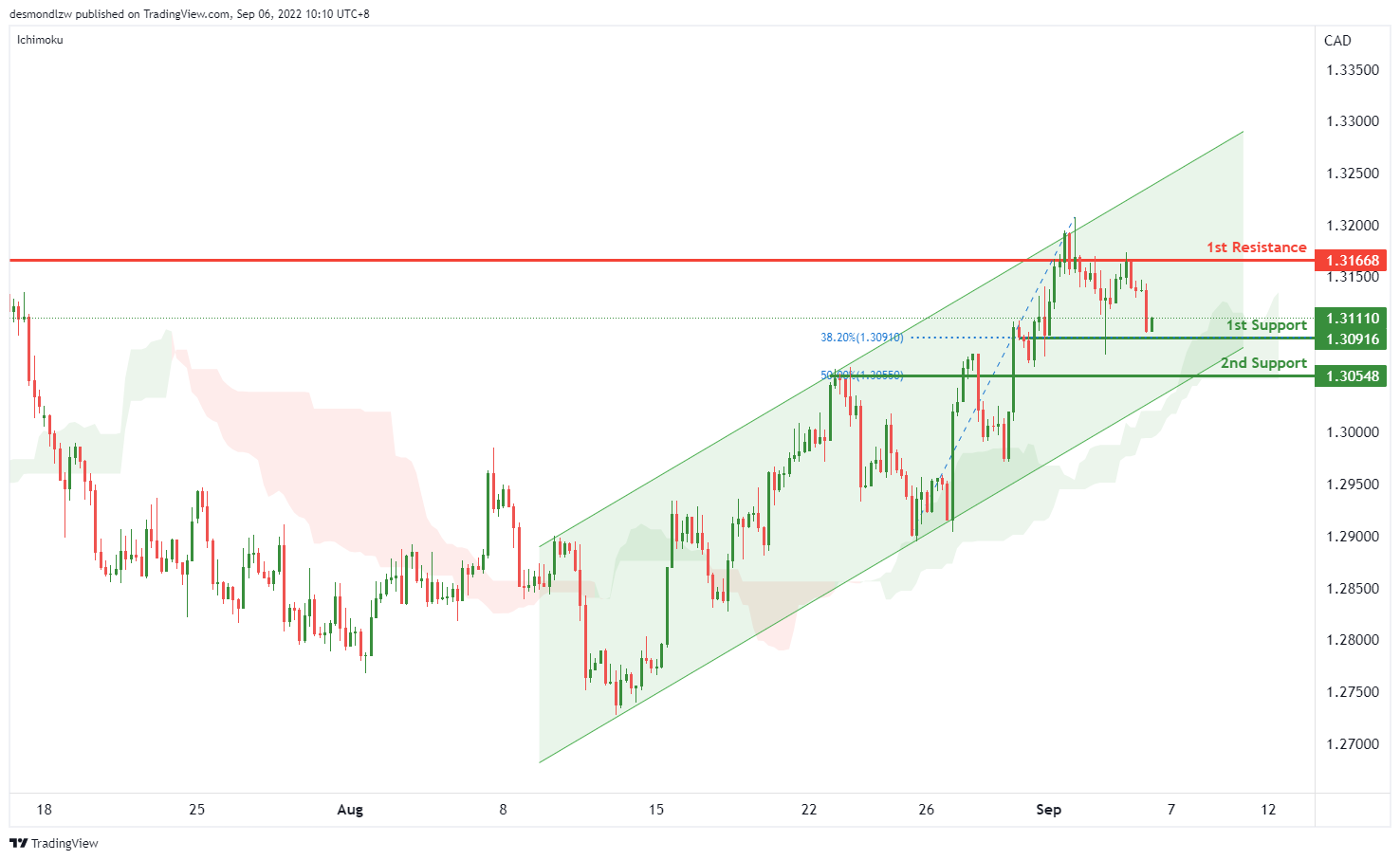
On the H4, with the price moving within the ascending channel, above ichimoku cloud, we have a bullish bias that the price may rise from the 1st support at 1.31069, where the 38.2% fibonacci retracement is to the 1st resistance at 1.31668, where the swing high is. Alternatively, the price may drop to the 2nd support at 1.30545, where the 50% fibonacci retracement and previous swing high are.
Areas of consideration:
- H4 time frame, 1st support at 1.31069
- H4 time frame, 1st resistance at 1.31668
OIL:
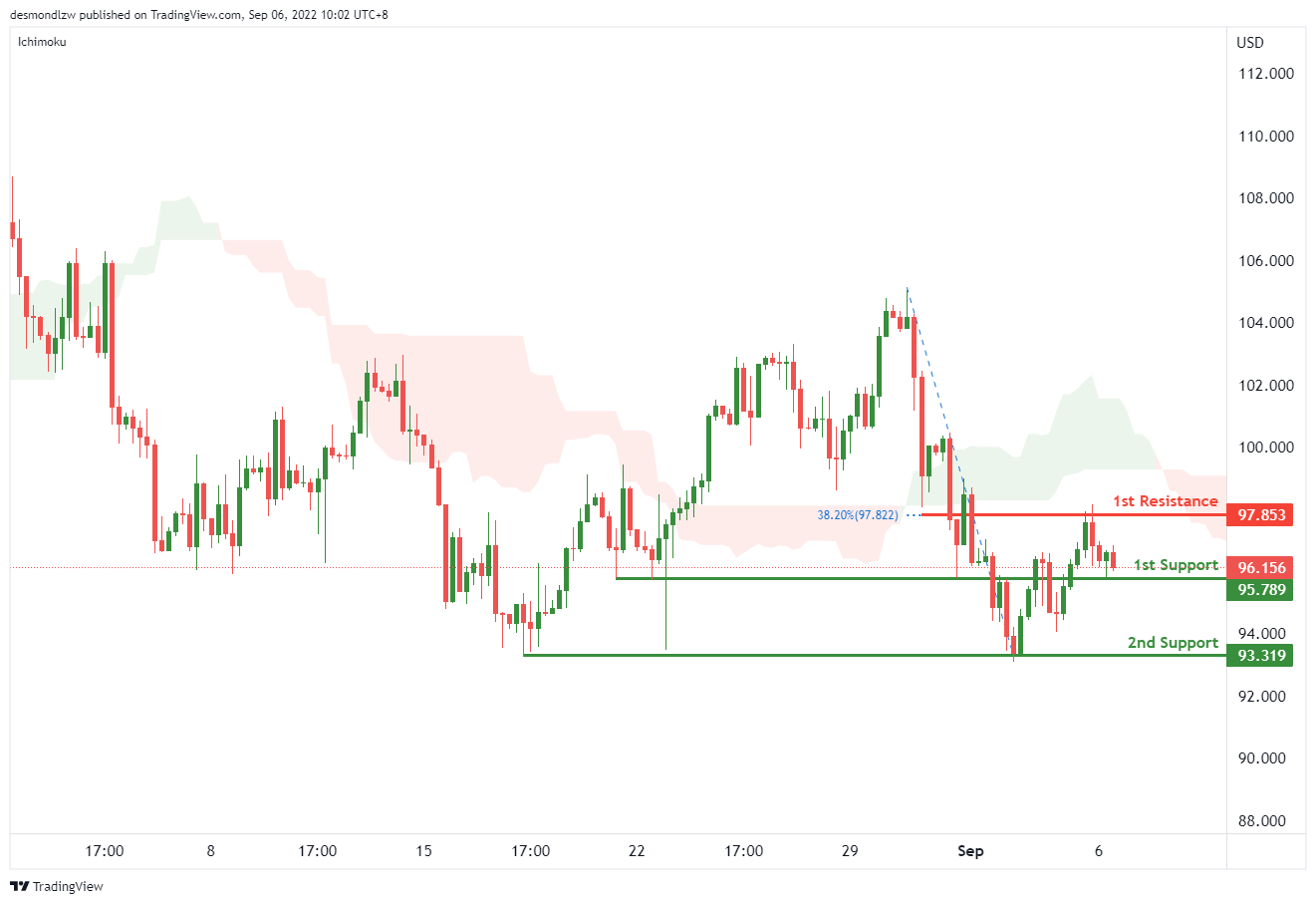
On the H4, with price below ichimoku cloud and dropping from the 1st resistance , we have a bearish bias that the price may drop from the 1st support at 95.789, where the swing lows are. If the price could break the 1st support, the 2nd support could be at 93.319, where the swing lows are. Alternatively, the price may pull back to the 1st resistance at 97.853, where the 38.2% fibonacci retracement and swing high are.
Areas of consideration:
- H4 time frame, 1st support at 95.789
- H4 time frame, 2nd support at 93.319
Dow Jones Industrial Average:
On the H4, with price breaking the ascending trendline and moving below the ichimoku indicator, we have a bearish bias that price will drop to 1st support at 31228 where the swing low support and 78.6% fibonacci projection are. Once there is downside confirmation that price has broken 1st support structure, we would expect bearish momentum to carry price to 2nd support at 30467 where the pullback support and 78.6% fibonacci retracement are. Alternatively, price could rise to 1st resistance at 31904 where the overlap resistance and 23.6% fibonacci retracement are.
Areas of consideration:
- H4 time frame, 1st resistance of 31904
- H4 time frame, 1st support at 31228

DAX:
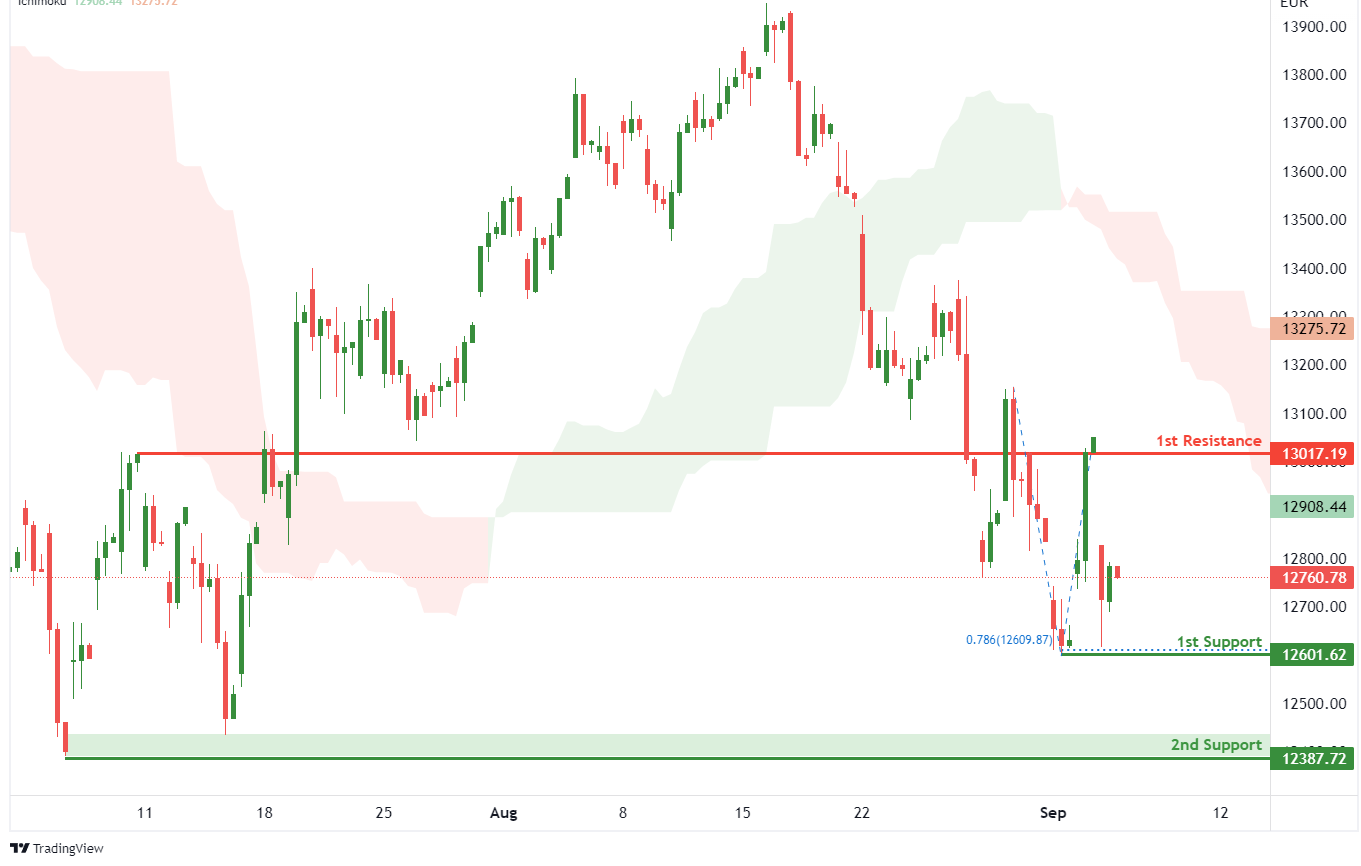
On the H4, with price moving within below the ichimoku indicator, we have a bearish bias that price will drop to 1st support at 12601.62 where the pullback support and 78.6% fibonacci projection are. Once there is downside confirmation that price has broken 1st support structure, we would expect bearish momentum to carry price to 2nd support at 12387.72 where the swing low support is. Alternatively, price could rise to 1st resistance at 13017.19 where the pullback resistance is.
Areas of consideration:
- H4 time frame, 1st resistance of 13017.19
- H4 time frame, 1st support at 12601.62
ETHUSD:
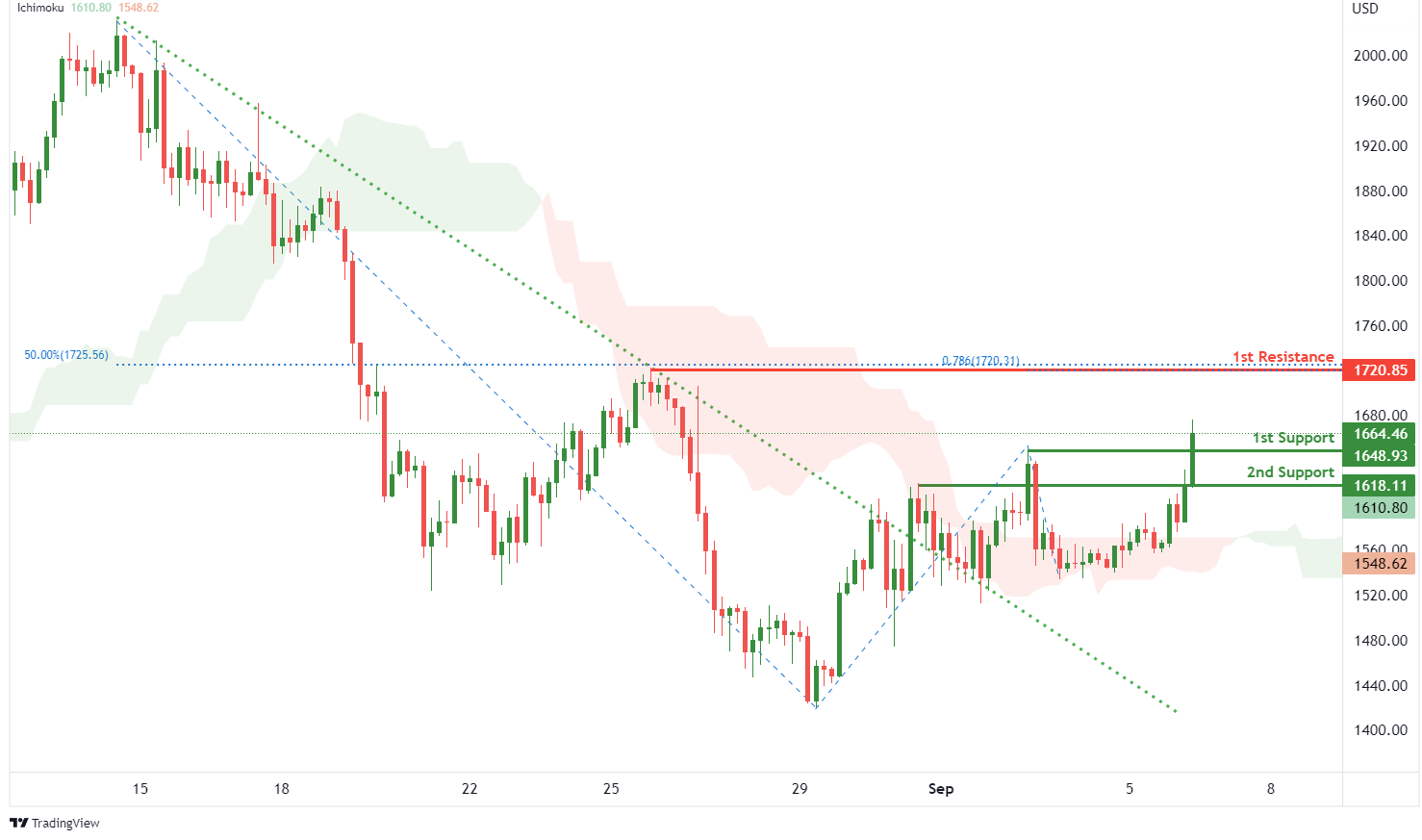
On the H4, with price breaking out of the descending trendline and moving above the ichimoku indicator, we have a bullish bias that price will rise from 1st support at 1648.93 where the pullback support is to the 1st resistance at 1720.85 where the swing high resistance, 78.6% fibonacci projection and 50% fibonacci retracement are. Alternatively, price could break 1st support and drop to 2nd support at 1618.11 where the pullback support is.
Areas of consideration:
- H4 time frame, 1st resistance of 1720.85
- H4 time frame, 1st support at 1648.93
BTCUSD:
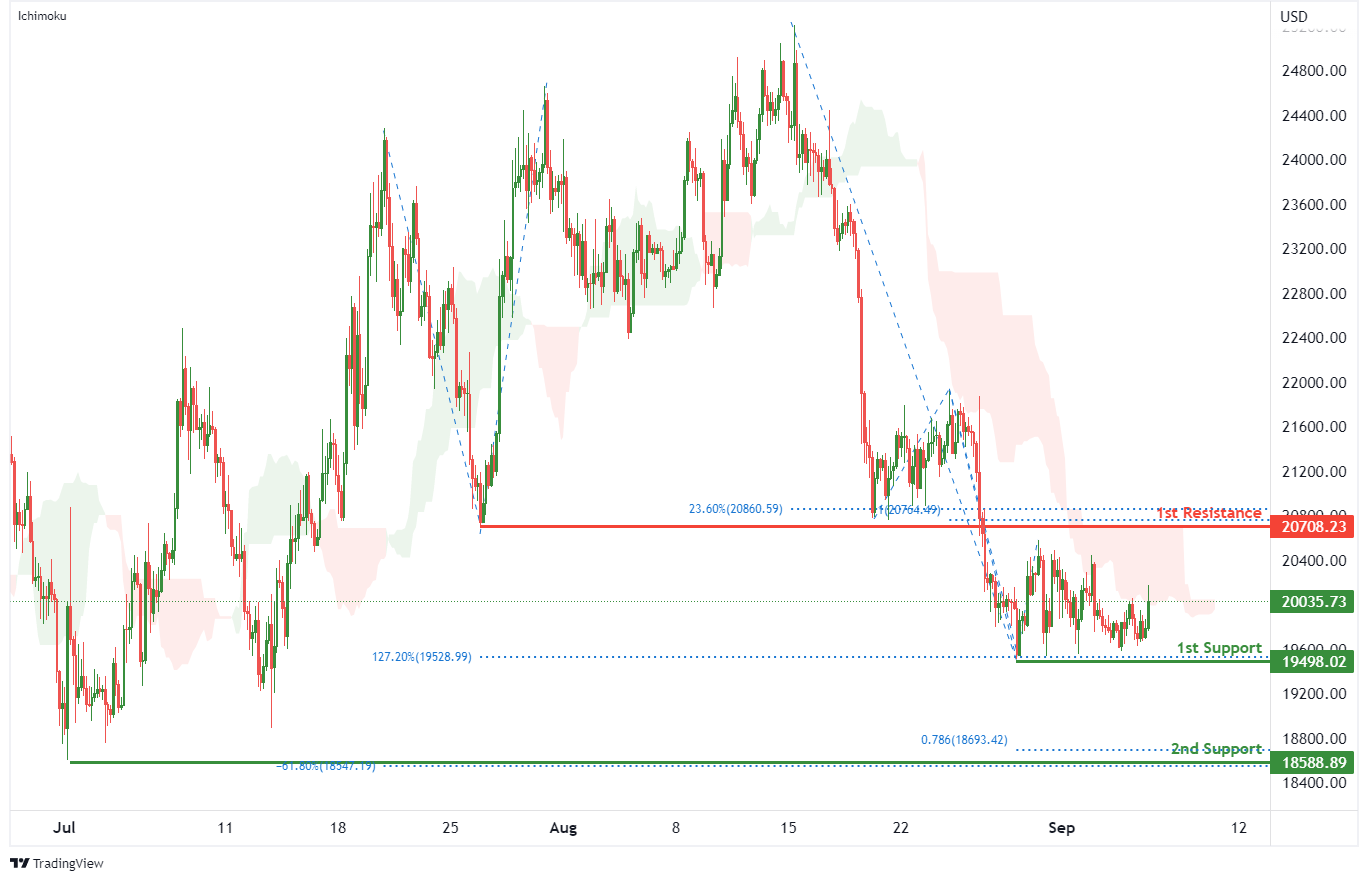
On the H4, with price moving below an ichimoku indicator, we have a bearish bias that price will drop to 1st support at 19498.02 where the swing low support and 127.2% fibonacci extension are. Should price break 1st support structure, we would expect bearish momentum to carry price to 2nd support at 18588.89 where the swing low support, -61.8% fibonacci expansion and 78.6% fibonacci projection are. Alternatively, price could rise to 1st resistance at 20708.23 where the pullback resistance, 100% fibonacci projection and 23.6% fibonacci retracement are.
Areas of consideration:
- H4 time frame, 1st resistance of 20708.23
- H4 time frame, 1st support at 19498.02
S&P 500:
On the H4, with prices breaking out of the ascending trendline and moving below the ichimoku indicator, we have a bearish bias that the price will drop from 1st resistance at 3945.01 where the pullback resistance is to the 1st support at 3722.42 where the swing low support is. Alternatively, price could break 1st resistance structure and rise to 2nd resistance at 4089.97 where the pullback resistance and 38.2% fibonacci retracement are.
Areas of consideration:
- H4 time frame, 1st resistance of 3945.01
- H4 time frame, 1st support at 3722.42

Yuan hit fresh 2-yr low, shrugging PBoC actions
The People's Bank of China announced yesterday to cut the foreign exchange reserve requirement ratio (RRR) to 6% from 8% beginning September 15. That is, the amount of foreign-exchange deposits banks need to set aside as reserves will be lowered, freeing up funds to buy Yuan.
The move, together with a string of stronger-than expected exchange rate fixings, are seen as a strong signal on PBoC's stance to at least slow Yuan's depreciation. That came when Yuan hit fresh two-year low and with USD/CNH approaching psychological important 7 handle.
But USD/CNH's rally (Yuan's depreciation) is continuing. There is no sign of topping in USD/CNH as long as 6.8877 support holds, technically. It's still on track to 61.8% projection of 6.3057 to 6.8372 from 6.7159 at 7.0444.
BoE Mann: Fast and forceful monetary tightening superior to gradualist approach
In a speech, BoE MPC member Catherine Mann said, "inflation today does not simply depend on past inflation but depends as well on markets, firms, and household's expectations, and crucially, how these expectations react to each other, are formed over time, and interact with our and others' policy choices. "
"In this more complex and arguably more realistic and relevant version of the inflation model, a fast and forceful monetary tightening, potentially followed by a hold or reversal, is superior to the gradualist approach."
"This policy strategy would reduce the risks of a more extended and costly tightening cycle later that depends primarily on shrinking aggregate demand."
GBP/USD: Bears Take Break, Upsides Could Be Limited
Key Highlights
- GBP/USD declined heavily below 1.1600 and 1.1500.
- A crucial bearish trend line is forming with resistance near 1.1625 on the 4-hours chart.
- EUR/USD is still struggling to stay above the 0.9900 support zone.
- The US ISM Services PMI could decline from 56.7 to 55.5 in August 2022.
GBP/USD Technical Analysis
The British Pound started a major decline from well above 1.1750 against the US Dollar. GBP/USD gained pace after there was a close below the 1.1650 level.

Looking at the 4-hours chart, the pair declined below the 1.1625 support, the 100 simple moving average (red, 4-hours), and the 200 simple moving average (green, 4-hours).
Finally, there was a move below the 1.1500 level and the pair traded as low as 1.1443. The pair is now consolidating losses above the recent low. On the upside, an initial resistance is seen near the 1.1550 zone.
The first major resistance is near the 1.1600 zone and the 1.1625 level. There is also a crucial bearish trend line forming with resistance near 1.1625 on the same chart.
A clear move above the 1.1625 level might start a steady recovery. In the stated case, GBP/USD may perhaps rise towards the 1.1750 resistance zone. If not, the pair might resume its decline below the 1.1460 level.
A downside break below the 1.1460 support might send the pair towards the 1.1380 support. The next major support is near the 1.1300 level. Any more losses might call for a move towards 1.1200.
Looking at EUR/USD, the pair remains in a bearish zone below the parity level and there could be a sharp decline below the 0.9900 level.
Economic Releases
- US S&P Services PMI for August 2022 – Forecast 44.1, versus 44.1 previous.
- US ISM Services Index for August 2022 – Forecast 55.5, versus 56.7 previous
Eco Data 9/6/22
[php_everywhere instance="1"]
British Pound is in the Midst of Falling
The British pound against the US dollar is devaluating too fast. The GBP/USD pair has already dropped to 1.1477.
On the one hand, the pound is really vulnerable to the USD. On the other hand, today the name of the new had of the Conservative Party will be known, a.k.a. the new Prime Minister of Great Britain. There is too much ambiguity in this issue: it might be either a young politician, head of the Treasury, or the head of Foreign Office, notorious for her political views.
The political imbalance that might increase if Liz Truss is elected, noticeably scares pound fans.
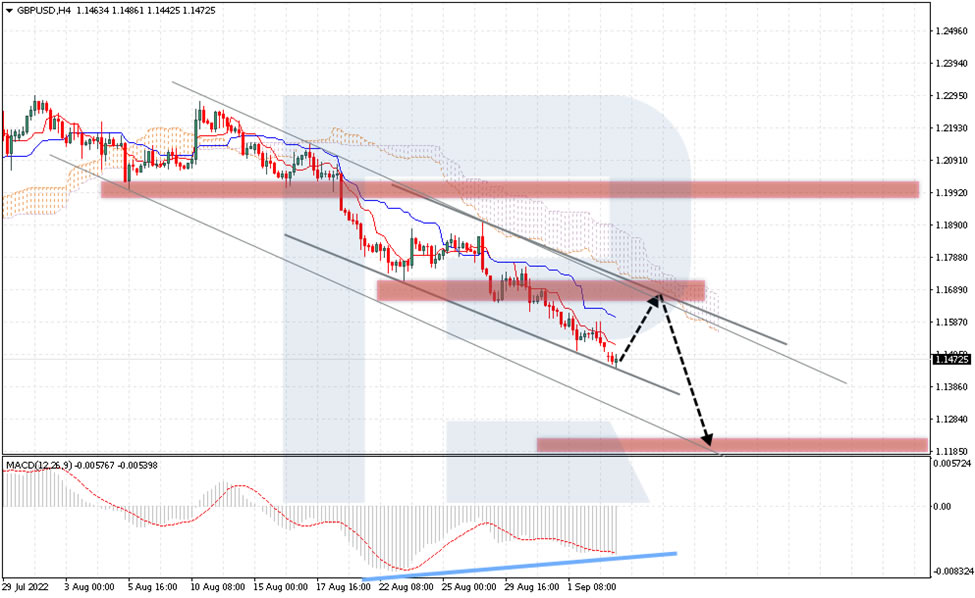
GBP/USD quotes are already testing their long-time lows of 2016 and 2020. The buyers managed to fight back two attacks of the bears on 1.1460. However, if this level is indeed broken away, there are chances to see the pair fall for the width of the sideways movement, in which it has been squeezed since mid-2016. In this case, the goal of the developing downtrend will be 0.8600. The idea will be confirmed if the support level is broken and the price secures under 1.1400. Growth of the quotes above 1.1900 might provoke another attempt to develop a lengthy bullish correction.
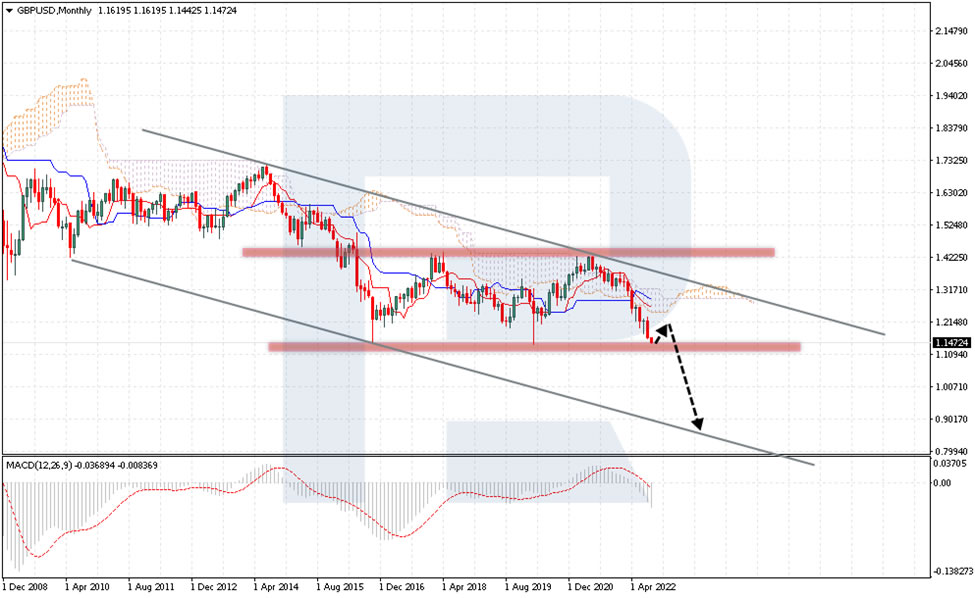
On H4, GBP/USD is going under the Ichimoku Cloud, which presumes a medium-term bearish impulse. A strong resistance level is 1.1640, where goes the upper border of the descending channel. The upward correction is also supported by a bullish divergence forming on the MACD. After a bounce off 1.1640 we may speak about further development of the current downtrend to 1.1180. The scenario can be cancelled by a breakaway of the upper border of the Cloud and securing above 1.1765, after which the correction should develop to 1.2000.