Sample Category Title
With High Inflation, Why Isn’t Gold Rising?
The sales pitch for gold is that it's a hedge against inflation, because it doesn't lose its value. It is a real commodity, unlike fiat currency. Yet, as inflation has skyrocketed around the globe this year, the price of gold has not. In fact, after peaking out in March, it has since trended lower. What gives?
Prices are relative
One of the things to keep in mind, first, is that gold is priced in dollars. So, sure, there has been inflation in many other currencies (with the notable exception of the yen, which is a whole different story). But the dollar has gotten relatively stronger, despite inflation. Partially, because inflation in other currencies has been even bigger.
Take the EURUSD, for example, which popped down to the 0.9900 handle, the lowest in over 20 years. Since the start of this year, the Euro has depreciated over 13% against the dollar, well above the 8.9% annual inflation that was last recorded. In fact, the annual depreciation of the Euro has been almost 17%. That's almost 8% of net benefit for anyone who kept dollars over the last year, despite the highest inflation in the shared currency.
Why does this matter?
It means that Europeans (and Chinese, Indians, Turks, etc) don't need to buy gold to hedge against inflation in their own economies. Holding dollars was a much better investment than keeping money in the bank. So, what's happening to the price of gold really depends on what's going on with the dollar.
But the dollar is worth 8.5% less than it was one year ago. Wouldn't buying gold be an even better option? If we were looking in the past, sure. But when investors decide what to invest in, they are looking to the future. What's the best asset to have in their portfolio going forward, while the inflation readings that we have are for the last year.
It's all about expectations
One of the reasons that the price of gold rolled around in March is because of increased geopolitical tensions. But the other that has been more long lasting is that's when the Fed started hiking rates. Sure, it was expected that inflation would rise for a while, as it takes some time for monetary policy to take effect.
But, eventually, the Fed is going to get inflation under control. Meaning that inflation is expected to go down. More to the point, interest rates are expected to keep rising. People who invest in dollar-denominated fixed income (treasuries, bonds, other securities) would see increasing yields. What that means is that even though inflation is high, in fact, because it's high, there is an expectation of increasing returns for those who hold dollars. Meanwhile, gold doesn't pay dividends or interest.
What about the hedge, then?
In other words, as inflation rises, the more likely the Fed will be to raise rates and drive down that inflation. That makes the dollar get stronger, so in comparison the price of gold goes down.
Gold is a hedge against inflation before it rises. But once there is high inflation, the picture turns around. Assuming the Fed does manage to control inflation. Basically, once inflation is high, it's too late to "hedge" against inflation that already happened.
EUR/USD Mid-Day Outlook
Daily Pivots: (S1) 0.9925; (P) 0.9979; (R1) 1.0016; More...
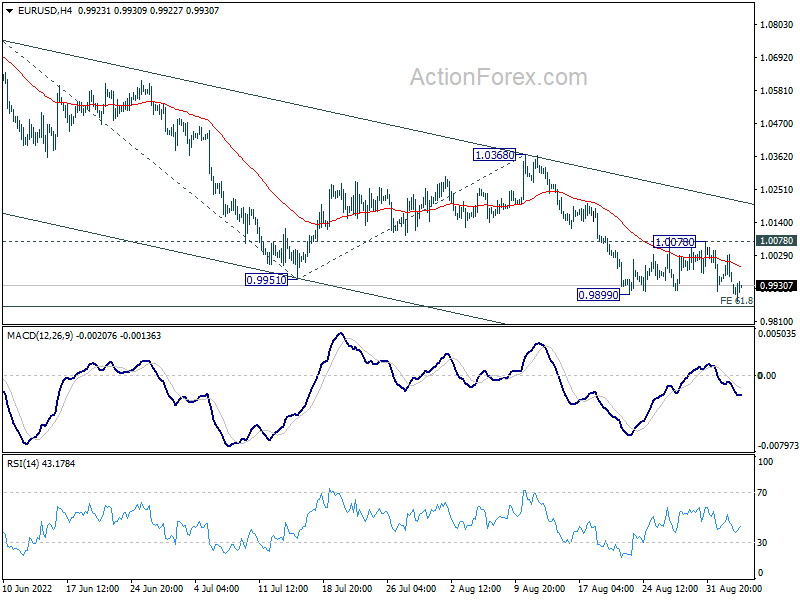
Intraday bias in EUR/USD remains on the downside for 61.8% projection of 1.0773 to 0.9951 from 1.0368 at 0.9860. Firm break there should prompt downside acceleration to 100% projection at 0.9546. On the upside, break of 1.0078 resistance is needed to indicate short term bottoming. Otherwise, outlook will remain bearish in case of recovery.
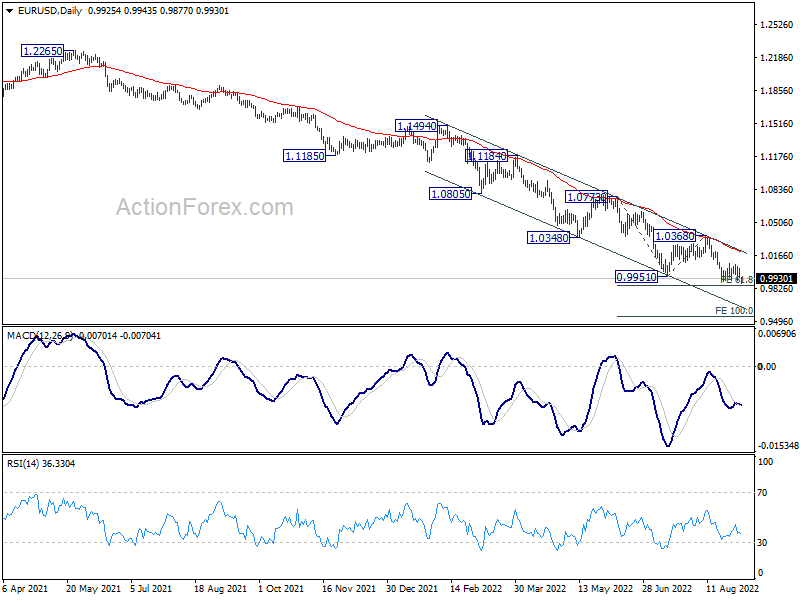
In the bigger picture, down trend from 1.6039 (2008 high) is still in progress. Next target is 100% projection of 1.3993 to 1.0339 from 1.2348 at 0.8694. In any case, outlook will stay bearish as long as 1.0368 resistance holds, even in case of strong rebound.
Euro Staying Weak, But Not Giving Up Yet
Euro remains the worst performer for the day so far, as weighed down by the news that Russia's state-controlled Gazprom would stop gas delivery via the Nord Stream 1 due to a fault. Yet, the common currency is not giving up yet, as losses are relatively limited. Dollar is the strongest one, followed by Swiss Franc and Canadian, But there is no clear follow through buying too. Australian Dollar is mixed, awaiting tomorrow's RBA rate hike.
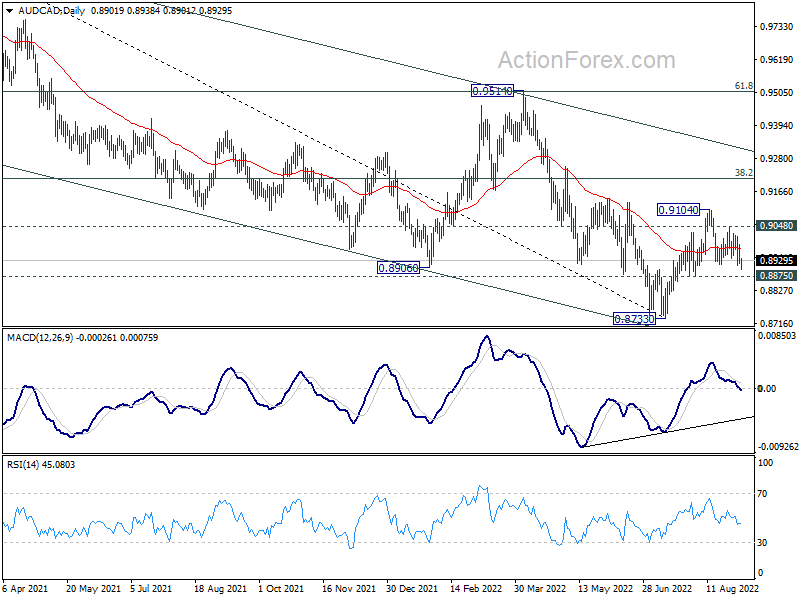
Technically, AUD/CAD is an interesting one to watch with RBA and BoC scheduled for the next two days. Break of 0.8875 support will argue that rebound from 0.8733 has completed, and larger down trend is ready to resume. On the other hand, break of 0.9048 will extend the rebound through 0.9104 and resume the down trend at a later stage.
In Europe, at the time of writing, FTSE is down -0.23%. DAX is down -2.44%. CAC is down -1.53%. Germany 10-year yield is up 0.0479 at 1.571. Earlier in Asia, Nikkei dropped -0.11%. Hong Kong HSI dropped -1.16%. China Shanghai SSE rose 0.42%. Singapore Strait Times rose 0.31%. Japan 10-year JGB yield dropped -0.0075 to 0.235.
Eurozone Sentix investor confidence dropped further to -31.8, a significant recessionary trend already set in
Eurozone Sentix Investor Confidence dropped further from -25.2 to -31.8 in September, below expectation of -27.5. That's also the lowest level since May 2020. Current Situation Index dropped from -16.3 to -26.5, lowest since February 2021. Expectations index dropped from -33.8 to -37.0, lowest since December 2008.
Sentix said: "It is very likely that a significant recessionary trend has already set in... In historical retrospect, it is clear that the extent of the current economic dislocation exceeds the collapse of tech stocks (2003), the euro crisis (2012) and even the collapse in the course of the Corona lockdowns (2020)."
"Although the collapse in 2020 was even sharper, the monetary policy response in the form of trillion-dollar money-printing programmes by central banks quickly led to a turnaround in economic expectations. There are no signs of this at present. Worse still, a look at the sentix thematic indices shows that investors cannot expect any help from either inflation or the central banks."
Eurozone retail sales volume rose 0.3% mom in Jul, EU up 0.3% mom
Eurozone retail sales volume rose 0.3% mom in in July, below expectation of 0.6% mom. volume of retail trade increased by 0.4% for automotive fuels and by 0.1% for food, drinks and tobacco, while it decreased by -0.4% for non-food products.
EUR retail sales volume rose 0.3% mom. Among Member States for which data are available, the highest monthly increases in the total retail trade volume were registered in Germany (+1.9%), the Netherlands (+1.7%), Luxembourg and Poland (both +1.5%). The largest decreases were observed in Austria (-1.8%), Finland (-1.7%) and Spain (-1.0%).
Eurozone PMI composite finalized at 49.8, economy undergoing its weakest spell for nine years
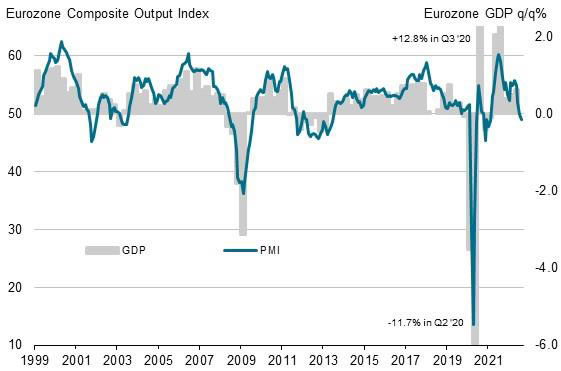
Eurozone PMI Services was finalized at 49.8 in August, down from July's 51.2, a 17-month low. PMI Composite was finalized at 48.9, down from prior month's 49.9, a 18-month low.
Looking at some member states, Ireland PMI Composite dropped to 51.0 (18-month low). Spain dropped to 50.5 (7-month low). France dropped to 50.4 (17-month low). Italy recovered to 49.6, (2-month high). Germany dropped to 46.9 (27-month low).
Chris Williamson, Chief Business Economist at S&P Global Market Intelligence said:
"A second month of deteriorating business conditions in the euro area adds to the likelihood of GDP contracting in the third quarter.... The deterioration is also becoming more broad-based, with services now joining manufacturing in reporting falling output.."
"Although the overall rate of decline remains only modest, commensurate with GDP falling at a quarterly rate of just 0.1%, the latest data point to the economy undergoing its weakest spell for nine years, excluding the downturns seen during the height of the pandemic."
UK PMI services finalized at 50.9 in Aug, composite at 49.6
UK PMI Services was finalized at 50.9 in August, down from July's 52.6. PMI Composite was finalized at 49.6, down from prior month's 51.2, the first contraction reading in 18 months.
Chris Williamson, Chief Business Economist at S&P Global Market Intelligence:
"UK private sector business activity fell for the first time in a year-and-a-half in August as an increasingly severe downturn in manufacturing was accompanied by a near-stalling of the vast services sector...
"Although the survey data are currently consistent with the economy contracting at a modest quarterly rate of 0.1%, deteriorating trends in order books suggest the incoming prime minister will be dealing with an economy that is facing a heightened risk of recession, a deteriorating labour market and persistent elevated price pressures linked to the soaring cost of energy."
Swiss GDP grew 0.3% qoq in Q2, strong private consumption
Swiss GDP grew 0.3% qoq in Q2, below expectation of 0.4% qoq. Looking at some details, manufacturing contracted -0.5%. Construction contracted -1.7%. Trade dropped -2.1%. However, accommodation and food grew strongly by 12.4%.
By expenditure approach, private consumption rose 1.4%. Government consumption was flat. Equipment and software investment rose 2.5%. Exports of goods dropped sharply by -11.5%. Import of goods dropped -0.6% too.
Australia AiG construction rose to 47.9, pull back continued
Australia AiG Performance of Construction Index rose 2.6 pts to 47.9 in August. Activity rose 3.5 to 46.2. Employment dropped -5.3 to 47.7. New orders rose 7.9 to 51.0. Supplier deliveries rose 3.4 to 45.6. Input prices dropped -1.2 to 92.6. Selling prices dropped sharply by -18.6 to 68.5. Average wages rose 1.2 to 77.6.
Peter Burn, Chief Policy Advisor at Ai Group said: "The pull back of the Australian construction sector continued in August with three of the four industry segments recording falls in activity and employment across the industry dropping in the month.... Builders and constructors link much of the fall in activity to rises in interest rates in recent months..... Softer demand was also reflected in the steep fall in the selling price index even though input prices and wage increases remain elevated."
China Caixin PMI services dropped to 55 in Aug, PMI composite down to 53
China Caixin PMI Services dropped slightly from 55.5 to 55.0 in August, above expectation of 54.2. Caixin added that business activity growth held close to July's 15-month high. total new orders rose despite stronger fall in new export business. Optimism around outlook was highest since November.
Wang Zhe, Senior Economist at Caixin Insight Group said: "In August, the Caixin China General Composite PMI dropped to 53 from 54 the previous month. The reading, while marking the second straight monthly drop, remained in expansionary territory. Both supply and demand continued to expand, albeit at a slower pace, with services outperforming manufacturing. Employment remained weak and input costs experienced the slowest increase in 27 months. Market confidence remained stable."
EUR/USD Mid-Day Outlook
Daily Pivots: (S1) 0.9925; (P) 0.9979; (R1) 1.0016; More...
Intraday bias in EUR/USD remains on the downside for 61.8% projection of 1.0773 to 0.9951 from 1.0368 at 0.9860. Firm break there should prompt downside acceleration to 100% projection at 0.9546. On the upside, break of 1.0078 resistance is needed to indicate short term bottoming. Otherwise, outlook will remain bearish in case of recovery.
In the bigger picture, down trend from 1.6039 (2008 high) is still in progress. Next target is 100% projection of 1.3993 to 1.0339 from 1.2348 at 0.8694. In any case, outlook will stay bearish as long as 1.0368 resistance holds, even in case of strong rebound.
Economic Indicators Update
| GMT | Ccy | Events | Actual | Forecast | Previous | Revised |
|---|---|---|---|---|---|---|
| 22:30 | AUD | AiG Performance of Construction Index Aug | 47.9 | 45.3 | ||
| 01:00 | AUD | TD Securities Inflation M/M Aug | -0.50% | 1.20% | ||
| 01:30 | AUD | Company Gross Operating Profits Q/Q Q2 | 7.60% | 4.00% | 10.20% | 9.80% |
| 01:45 | CNY | Caixin Services PMI Aug | 55 | 54.2 | 55.5 | |
| 07:00 | CHF | GDP Q/Q Q2 | 0.30% | 0.40% | 0.50% | |
| 07:45 | EUR | Italy Services PMI Aug | 50.5 | 48.3 | 48.4 | |
| 07:50 | EUR | France Services PMI Aug F | 51.2 | 51 | 51 | |
| 07:55 | EUR | Germany Services PMI Aug F | 47.7 | 48.2 | 48.2 | |
| 08:00 | EUR | Eurozone Services PMI Aug F | 49.8 | 50.2 | 50.2 | |
| 08:30 | EUR | Eurozone Sentix Investor Confidence Sep | -31.8 | -27.5 | -25.2 | |
| 08:30 | GBP | Services PMI Aug F | 50.9 | 52.5 | 52.5 | |
| 09:00 | EUR | Eurozone Retail Sales M/M Jul | 0.30% | 0.60% | -1.20% | -1.00% |
Euro Hits 20-Year Low on Oil Shutdown
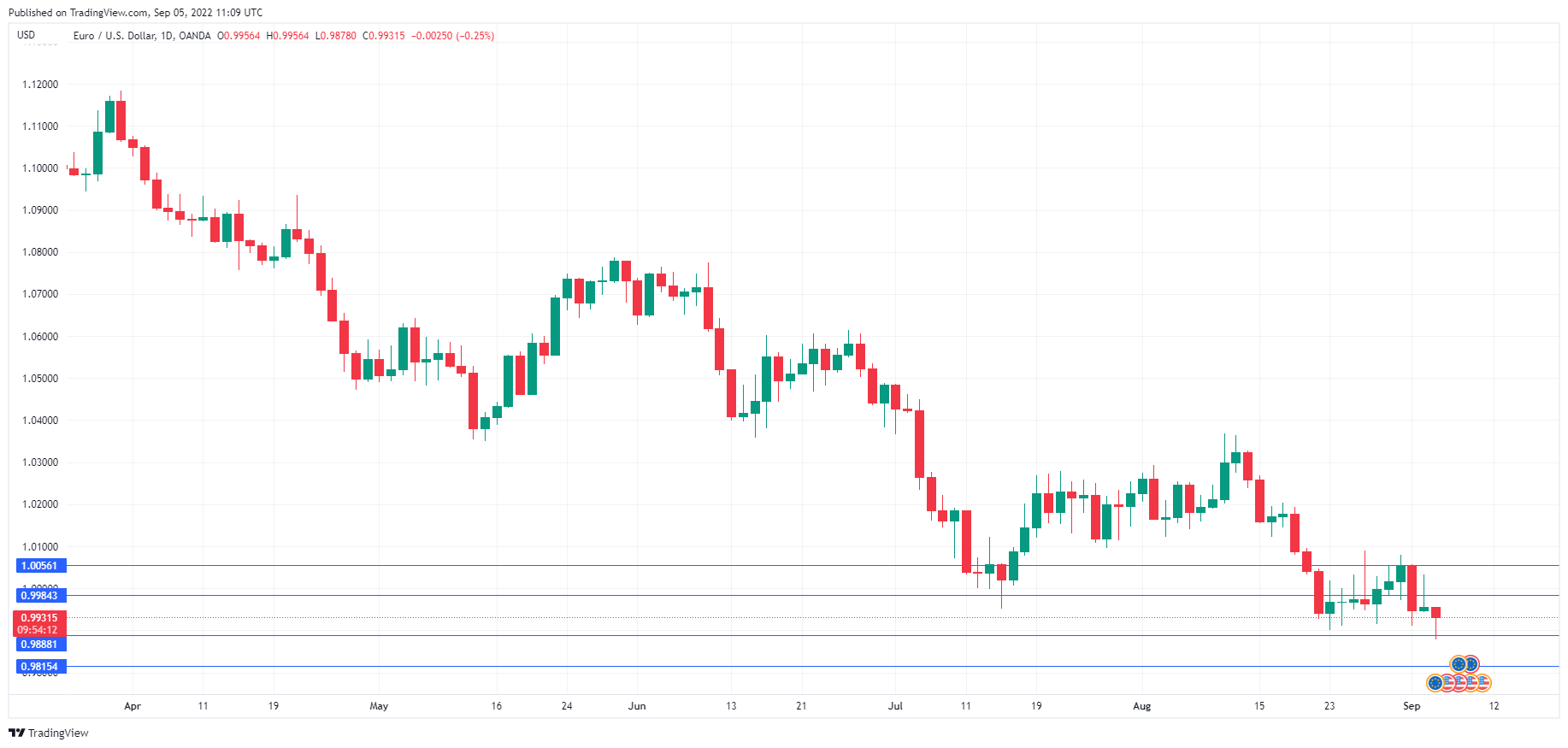
The euro fell below the 0.9900 line earlier in the European session but has pared its losses. Currently, EUR/USD is trading at 0.9937, down 0.19%.
Euro falls on Nord Stream 1 shutdown
US markets are closed for the Labour Day holiday. A US holiday often means a quiet day for the currency markets, but not today. Last week, investors were warily keeping an eye on the latest energy crisis development in Europe. Russian officials shut down the Nord Stream 1 pipeline on Wednesday, citing the need for three days of maintenance. Saturday came and went, and the pipeline remains closed, with Moscow now claiming an oil leak in a turbine. Germany has countered that the pipeline is fully operational, stoking fears that Russia is again weaponising energy exports to Europe. The predictable result has been renewed fears of an energy crisis, which sent the euro to a new 20-year low of 0.9876 earlier today.
Even if Moscow does restore service, this episode is a reminder of Europe’s energy dependence on an unreliable Russia. Germany has greatly reduced its dependence on Russian gas, from 55% prior to Russia’s invasion of Ukraine to just 26%, but if Russia chooses to play hardball and cut off gas supplies, the result will be a full-blown energy shortage for Europe this winter.
There were a host of releases out of Germany and the eurozone today, and the weak data didn’t help the euro at all. Eurozone and German Services PMIs both weakened in August with readings of 49.8 and 47.7, respectively. This points to a contraction in business activity. Eurozone Sentix Investment Confidence remains in deep freeze, and fell to -31.8, down from -25.2 and below the forecast of -27.5. Finally, eurozone retail sales declined -0.9% YoY in July, following a -3.2% reading in June (-0.7% est.) The soft numbers point to weakness in the German and eurozone economies.
The highly-anticipated US nonfarm payrolls on Friday turned out to be a whimper rather than a bang, as the economy produced a solid 315 thousand new jobs, edging above the forecast of 300 thousand. The reading will enable the Fed to continue its aggressive rate-tightening cycle as it relies on a robust US labour market.
EUR/USD Technical
- EUR/USD is testing support at 0.9888. Below, there is support at 0.9816
- There is resistance at 0.9984 and 1.0056
Unstoppable Dollar: It Could Rise to 2001-2002 Highs
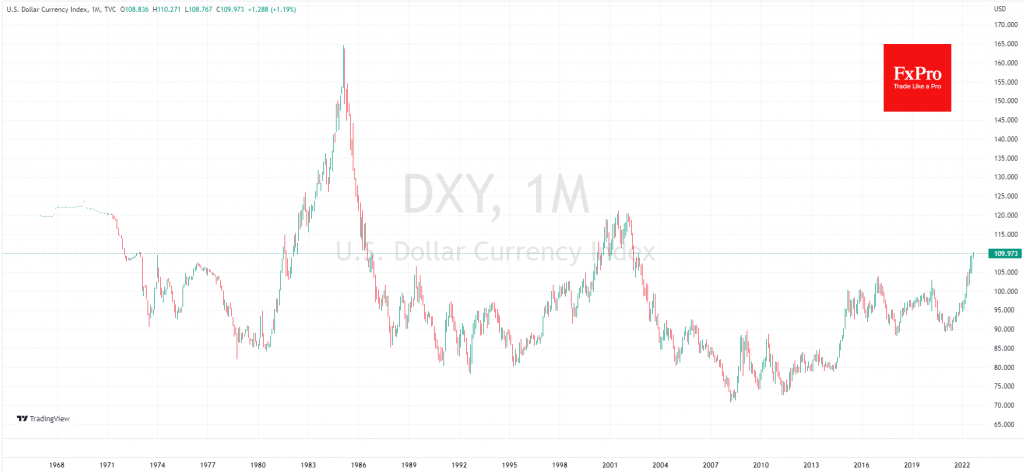
The dollar index rose above 110, updating 20-year highs on Monday morning as a flash reaction to increased pressure on the euro and British pound. European currencies are selling off amid an energy crisis related to Russian gas supplies, which have entirely halted through the Nord Stream pipeline.
Although it caused an emotional response at the start of the day, this news fits in with the long-term upward trend of the dollar since the middle of last year, when all current drivers of the currency market were formed, and their effect remains in force.
The monetary policy differential is the most apparent growth driver for the dollar against the euro and the pound. The ECB is two steps behind the Fed, though it implemented a rare 50-point rate hike in July and is expected to raise it 50-75 points this coming Thursday. The differential between key rate and inflation in the US is lower compared to Europe, and potentially, this differential will only widen in the coming months.
The second important factor is economic resilience. America sells energy to Europe, thereby working to reduce its trade deficit and maintain interest in the extractive industries. In the long run, such a disposition will not allow the ECB to raise and hold rates as high and as long as the Fed can do without risking a deep economic downturn.
A weaker currency often increases the currency’s competitiveness, which restarts the economy. This was the case even during the Greek debt crisis when the cheap euro generated a vast surplus in the balance of payments of Germany and other euro-region core countries.
However, the burden of high energy bills now exceeds the benefit of a weaker single currency, so there is still no sign that the euro has reached a fundamental bottom. We can repeat the same story with minor adjustments for the pound and the yen.
This creates a bullish outlook for the USD index, which might continue to rise to 120, i.e. +9% of the current levels, into the area of the 2001-2002 peaks. In an extreme scenario, such a rate could be reached by the end of the year, although it is more reasonable to expect such an increase in the next six months.
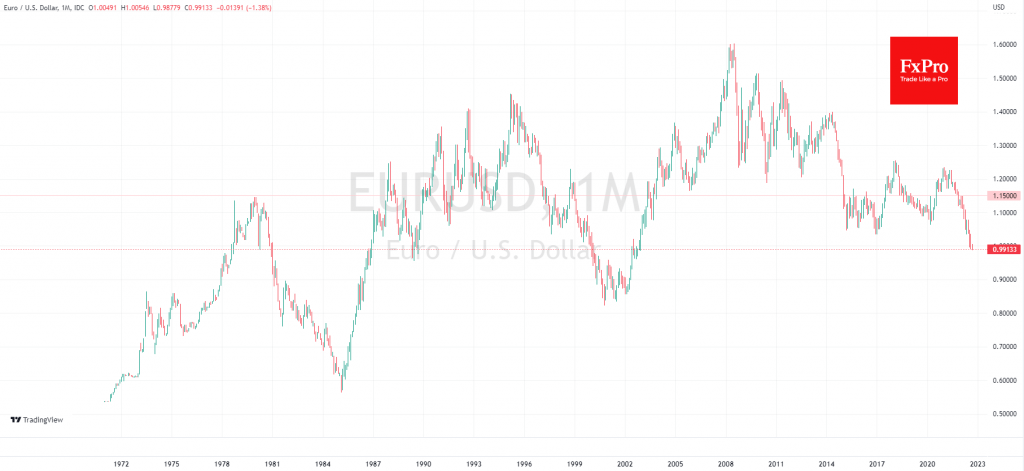
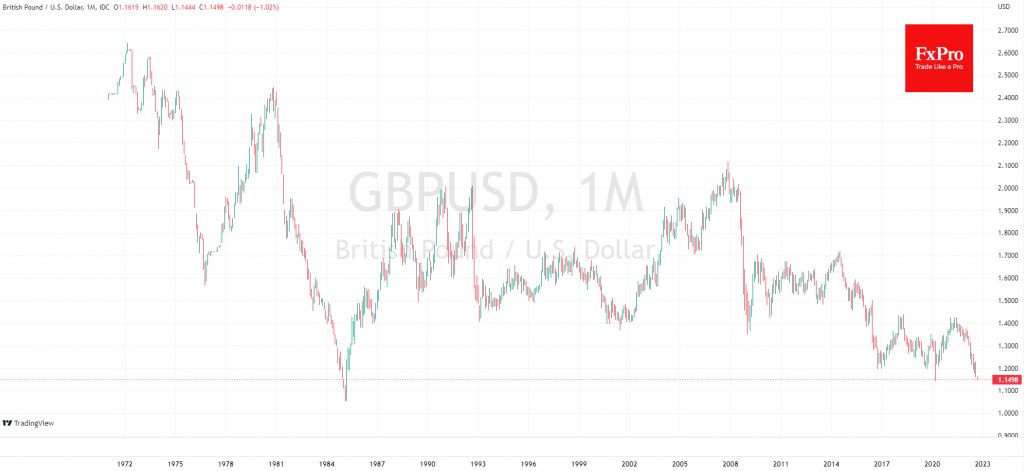
For EURUSD, such prospects open up the potential for a failure below 0.9000. GBPUSD could then go to 1.00-1.05, and USDJPY could break 150. It seems to us that approaching these levels will seriously put the issue of excessive dollar growth, as it was in the mid-1980s, back on the agenda of G7 financial leaders. But that is a matter for the distant future. For now, the dollar trend may well gain traction by helping to reduce inflation in the US.
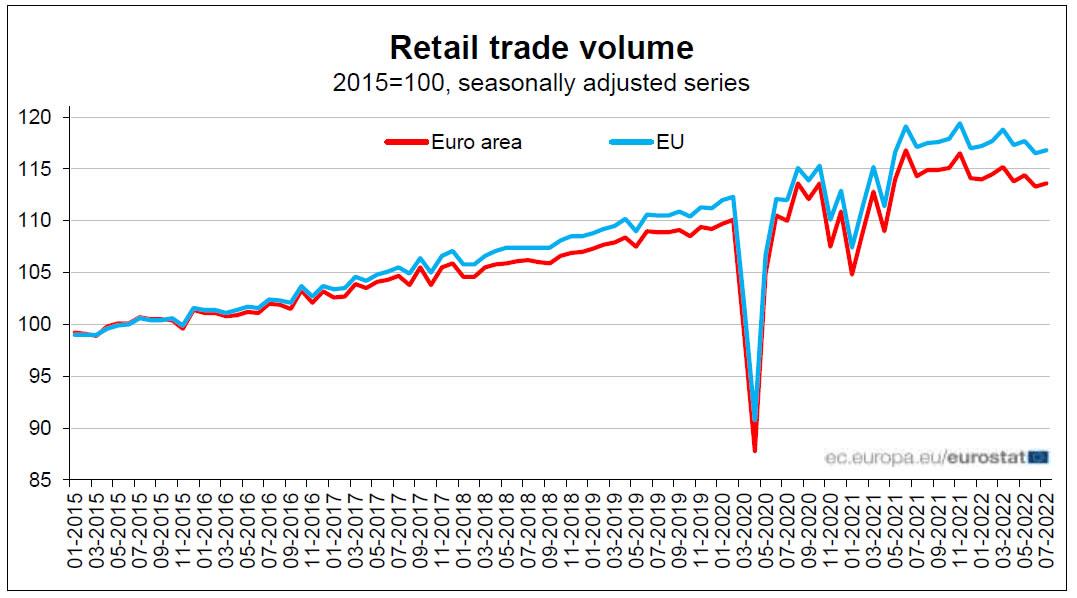
Eurozone retail sales volume rose 0.3% mom in Jul, EU up 0.3% mom
Eurozone retail sales volume rose 0.3% mom in July, below expectation of 0.6% mom. volume of retail trade increased by 0.4% for automotive fuels and by 0.1% for food, drinks and tobacco, while it decreased by -0.4% for non-food products.
EUR retail sales volume rose 0.3% mom. Among Member States for which data are available, the highest monthly increases in the total retail trade volume were registered in Germany (+1.9%), the Netherlands (+1.7%), Luxembourg and Poland (both +1.5%). The largest decreases were observed in Austria (-1.8%), Finland (-1.7%) and Spain (-1.0%).
Risk Aversion Sweeps Across Europe
European stock markets are plunging at the start of the week following a day of mixed trade in Asia, with Gazprom's announcement on Friday weighing heavily on the bloc.
A bank holiday in the US often results in relatively quiet trade everywhere else but that's certainly not looking the case today. The decision not to restart gas flows via Nord Stream 1 after an oil leak was apparently discovered has created enormous uncertainty in Europe going into the winter. The euro slipped to a new 20-year low against the dollar in response to the shutdown.
The decision conveniently came hours after the G7 agreed to an oil price cap and as countries announced they're ahead of schedule in filling gas reserves. Many would argue it was only a matter of time until the decision was taken, with Europe having been squeezed over a number of months for one reason or another.
There have been reports that Gazprom could increase deliveries via Ukraine as a result of the shutdown but it's not clear whether this would be enough to offset the loss of Nord Stream 1. And considering Siemens has claimed that such a leak would not ordinarily affect the operation of a turbine and is easily fixed, you have to wonder whether Russia would actually take that decision. A painful winter lies ahead.
A massive job for the incoming UK PM
The UK will discover who its new Prime Minister will be today, with Liz Truss the standout favourite to win the run-off against Rishi Sunak. Whoever is victorious, the job facing them is enormous, with the economy facing a long recession and eye-watering inflation. Alleviating one while not exacerbating the other will be the first job for the incoming Prime Minister and it won't be easy, to put it mildly. There's a huge amount of pessimism around the UK at the moment, as evident by the pound, which looks on course to fall to its lowest level since 1985 against the dollar.
Chinese headwinds strengthen
China is also facing numerous headwinds going into the end of the year, with Covid once again creating huge uncertainty. Beijing's commitment to its zero-Covid policy has created major challenges for the economy this year and with mass testing taking place over the weekend and lockdowns being extended in Chengdu, that's going to persist.
The pressure is being felt in the yuan which fell for a sixth month in August and is continuing to fall against the dollar. That's despite the best efforts of the PBOC which continues to set the yuan fix stronger than markets expect.
To make matters worse, US President Biden is reportedly weighing up measures to limit US investment in Chinese tech firms. The US is becoming increasingly hawkish toward China and the latest move is another blow to its tech space.
OPEC+ meets after price cap announcement
Today's OPEC+ meeting has been somewhat overshadowed by all the talk of oil price caps and Nord Stream 1. The group is expected to leave output targets unchanged but it's likely that a cut will be at least discussed which, if followed through on, would create more volatility and uncertainty at a time of considerable unease. The economic outlook and potential for a new nuclear deal have weighed on prices recently, much to the frustration of Saudi Arabia in particular.
An output cut won't make them any friends at a time when the world is facing a cost-of-living crisis already and the group has failed to keep up with demand this year. The more sensible option may be to hold this month and revisit in the future when there's more clarity; something that is seriously lacking at this moment in time.
Gold holding up for now
Gold is treading water at the start of the week even as the dollar rallies strongly once more. Traders are favouring the safety of the greenback this morning but that's not damaging appeal for the yellow metal. It's come under considerable pressure in recent weeks as yields have risen and the dollar has bounced back and it's now trading around a key area of support, which may be why we're seeing more resilience.
While $1,700 looks like a psychological barrier, $1,680 is key. A break of that could signal further pressure on gold, especially if accompanied by more aggressive tightening from central banks.
Major support being tested
Bitcoin is continuing to show resilience around $20,000 but that's really being put to the test as risk aversion sweeps through the markets once more. It's down 1% so far today and trading a little below that crucial support level. A significant break at this point could be really damaging, with the following key level below here being the June lows around $17,500. Considering the outlook for risk appetite in the near term, it's not looking good.
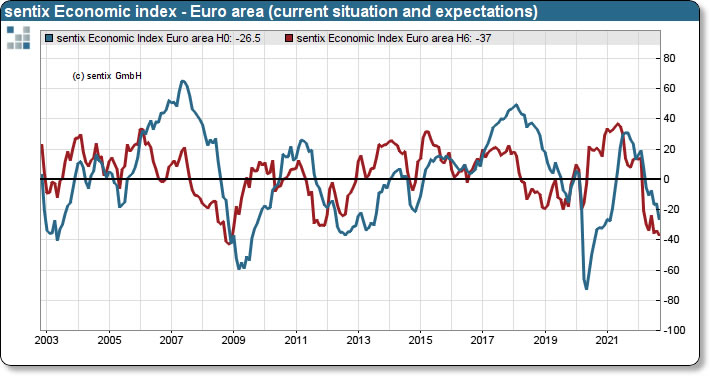
Eurozone Sentix investor confidence dropped further to -31.8, a significant recessionary trend already set in
Eurozone Sentix Investor Confidence dropped further from -25.2 to -31.8 in September, below expectation of -27.5. That's also the lowest level since May 2020. Current Situation Index dropped from -16.3 to -26.5, lowest since February 2021. Expectations index dropped from -33.8 to -37.0, lowest since December 2008.
Sentix said: "It is very likely that a significant recessionary trend has already set in... In historical retrospect, it is clear that the extent of the current economic dislocation exceeds the collapse of tech stocks (2003), the euro crisis (2012) and even the collapse in the course of the Corona lockdowns (2020)."
"Although the collapse in 2020 was even sharper, the monetary policy response in the form of trillion-dollar money-printing programmes by central banks quickly led to a turnaround in economic expectations. There are no signs of this at present. Worse still, a look at the sentix thematic indices shows that investors cannot expect any help from either inflation or the central banks."
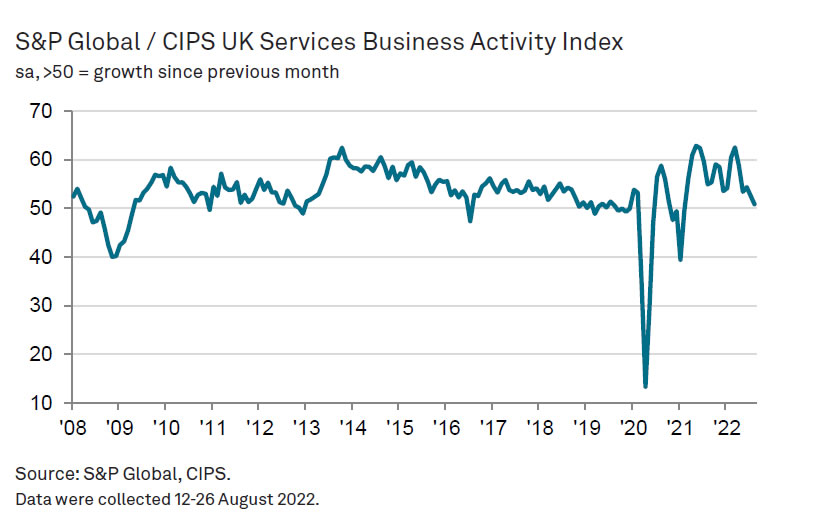
UK PMI services finalized at 50.9 in Aug, composite at 49.6
UK PMI Services was finalized at 50.9 in August, down from July's 52.6. PMI Composite was finalized at 49.6, down from prior month's 51.2, the first contraction reading in 18 months.
Chris Williamson, Chief Business Economist at S&P Global Market Intelligence:
"UK private sector business activity fell for the first time in a year-and-a-half in August as an increasingly severe downturn in manufacturing was accompanied by a near-stalling of the vast services sector...
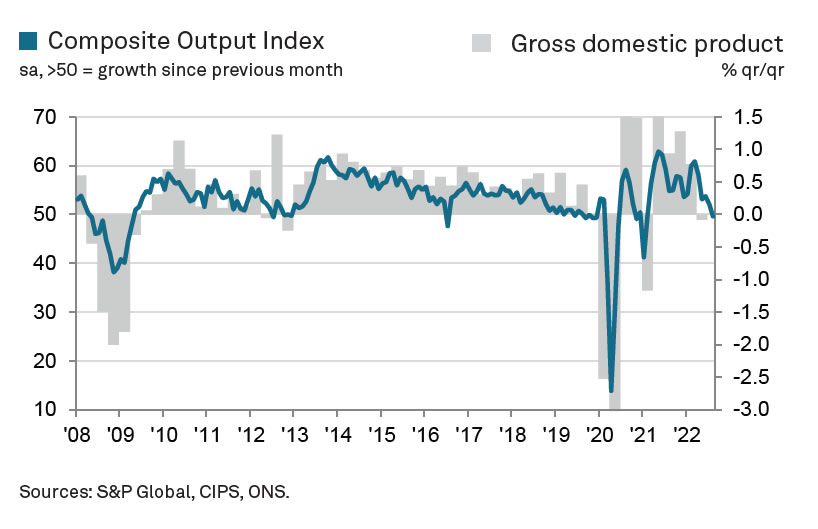
"Although the survey data are currently consistent with the economy contracting at a modest quarterly rate of 0.1%, deteriorating trends in order books suggest the incoming prime minister will be dealing with an economy that is facing a heightened risk of recession, a deteriorating labour market and persistent elevated price pressures linked to the soaring cost of energy."
Eurozone PMI composite finalized at 49.8, economy undergoing its weakest spell for nine years
Eurozone PMI Services was finalized at 49.8 in August, down from July's 51.2, a 17-month low. PMI Composite was finalized at 48.9, down from prior month's 49.9, a 18-month low.
Looking at some member states, Ireland PMI Composite dropped to 51.0 (18-month low). Spain dropped to 50.5 (7-month low). France dropped to 50.4 (17-month low). Italy recovered to 49.6, (2-month high). Germany dropped to 46.9 (27-month low).
Chris Williamson, Chief Business Economist at S&P Global Market Intelligence said:
"A second month of deteriorating business conditions in the euro area adds to the likelihood of GDP contracting in the third quarter.... The deterioration is also becoming more broad-based, with services now joining manufacturing in reporting falling output.."
"Although the overall rate of decline remains only modest, commensurate with GDP falling at a quarterly rate of just 0.1%, the latest data point to the economy undergoing its weakest spell for nine years, excluding the downturns seen during the height of the pandemic."