Sample Category Title
AUD/USD Edges Lower ahead of RBA Decision
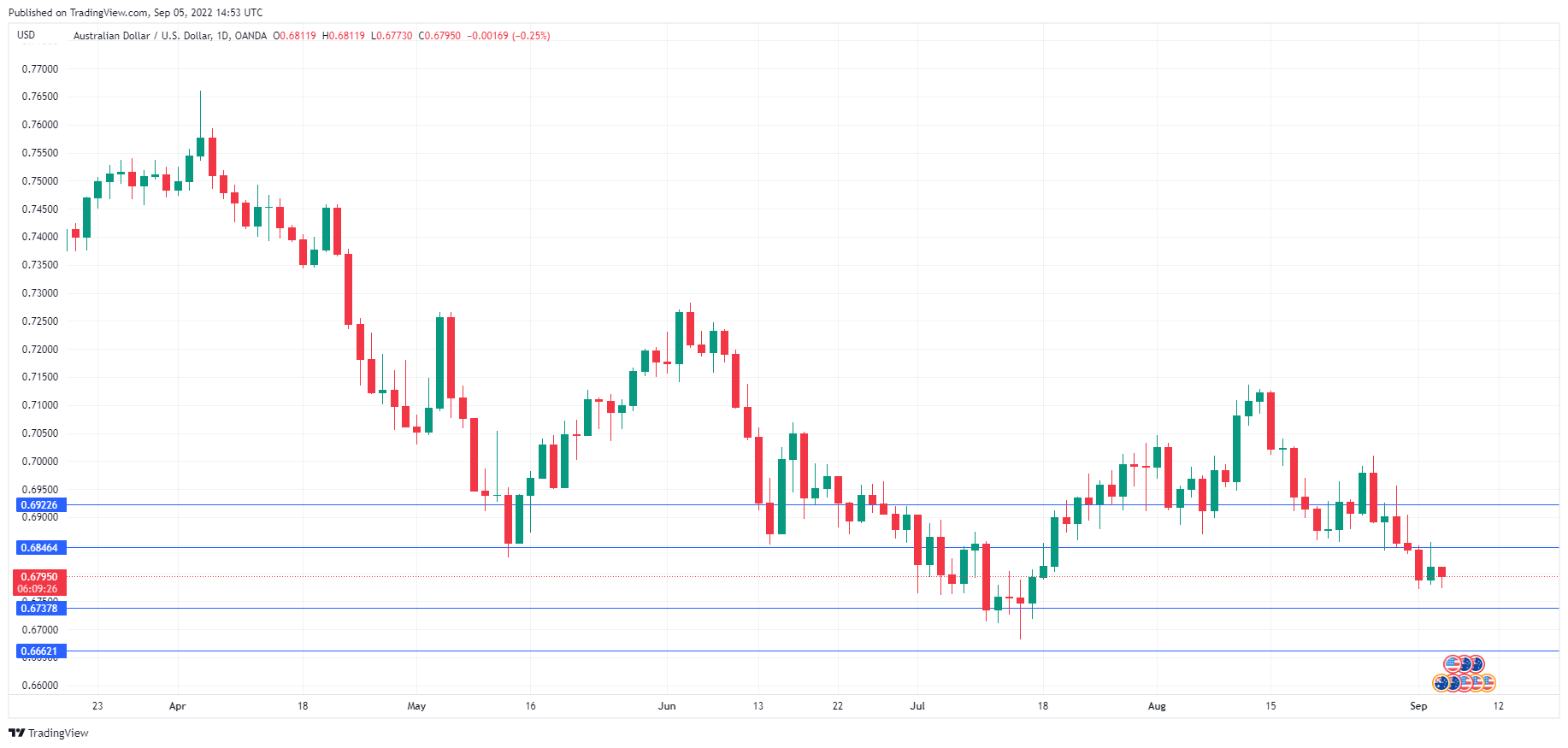
The Australian dollar has started the week with slight losses. In the North American session, AUD/USD is trading at 0.6798, down 0.19%.
Will RBA stay aggressive with a 50bp hike?
The Reserve Bank of Australia meets on Tuesday, with investors unclear as to the size of the next rate move. The markets have priced in a 50 basis point move at 68%, with a modest 25 bp increase at 32%. This means that the RBA will likely deliver a fourth straight rate 50bp rate hike, which would bring the cash rate to 2.35%. The RBA has been waging a battle against rising inflation, which rose to 6.1% in Q2, up from 5.1% in Q1. At the July meeting, the Australian dollar lost ground despite a 0.50% rate hike, and this could be repeated on Tuesday, especially if the RBA opts for a small 0.25% hike.
The central bank has its hands full with rising inflation and a slowing economy. Policy makers are hoping to avoid a recession and guide the economy to a soft landing, but the central bank, like the Fed, has made clear that its paramount goal is to curb inflation and avoid inflation expectations from becoming anchored.
Following the RBA decision, Australia releases GDP for the second quarter. The market consensus stands at 3.5%, which would be an improvement on the 3.3% gain in Q1. Australia recorded a record trade surplus of $A45 billion in Q2, and this should be reflected in a higher GDP
The Aussie remains constrained by weak risk appetite, as the energy crisis in Europe took a turn for the worse on the weekend. The Nord Stream 1 pipeline, which is the main conduit for Russian gas to Europe, failed to reopen on Saturday after three days of maintenance. Russia has now closed the pipeline indefinitely, citing a malfunctioning turbine. Germany is skeptical, to put it mildly, and fears are rising that Moscow is again weaponising energy exports to Europe, which could result in a full-blown energy shortage this winter.
AUD/USD Technical
- AUD/USD faces resistance at 0.6846 and 0.6922
- There is support at 0.6737 and 0.6661
New UK Prime Minister is to Freeze Gas Bills
After the resignation of Boris Johnson in July 2021, the conservative party had to conduct an election. With 57.4% of the vote, Liz Truss will be the new UK Prime Minister (PM) for the next two years. She is about to change a lot in the UK politics, and we are about to tell you everything you need to know.
How did the election go?
Liz Truss got 57.4% of the vote, and Rishi Sunak received 42.6%. It was the first time since 2000 that a new PM got less than 60% of the vote. However, Truss had enough to win the race.
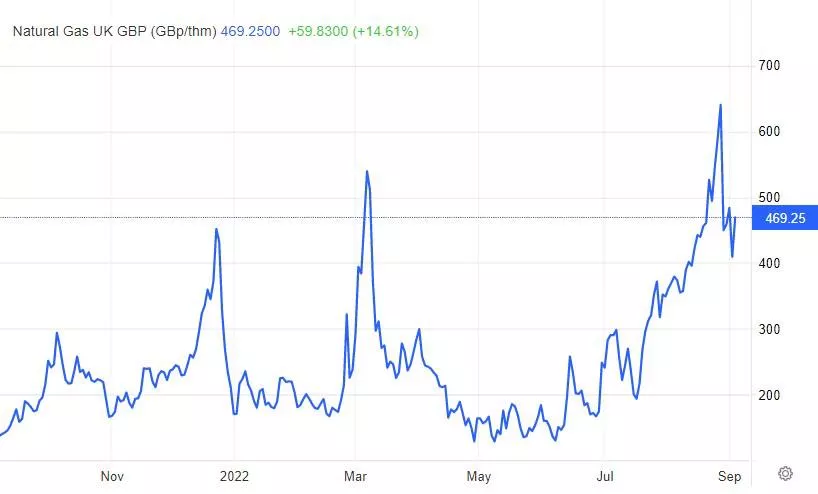
After arriving at 10 Downing Street, Truss will probably start with energy. She will introduce a price freeze for energy bills on Thursday, September 8, to save households and businesses from ever-growing electricity and gas costs. A typical UK household energy bill rose from £1,971 to £3,549 since the Russian invasion of Ukraine started.
Price for the gas in the UK
A published version of the industry plan suggested holding down this year’s energy payments at £2,000 for a typical household. That would leave prices not far off that level into the next decade and require a fund of around £90 billion. At first glance, this measure will help households to withstand this winter. However, households will have to repay the money in the future.
Moreover, it’s possible to see some monetary easing in the nearest term despite the highest inflation in 40 years. This measure is designed to speed up economic growth and help companies and people to hold throughout winter. It will be a different approach than hawkish measures from the Fed and the ECB. Thus, more interesting for us and provides better trading opportunities.
GBP outlook
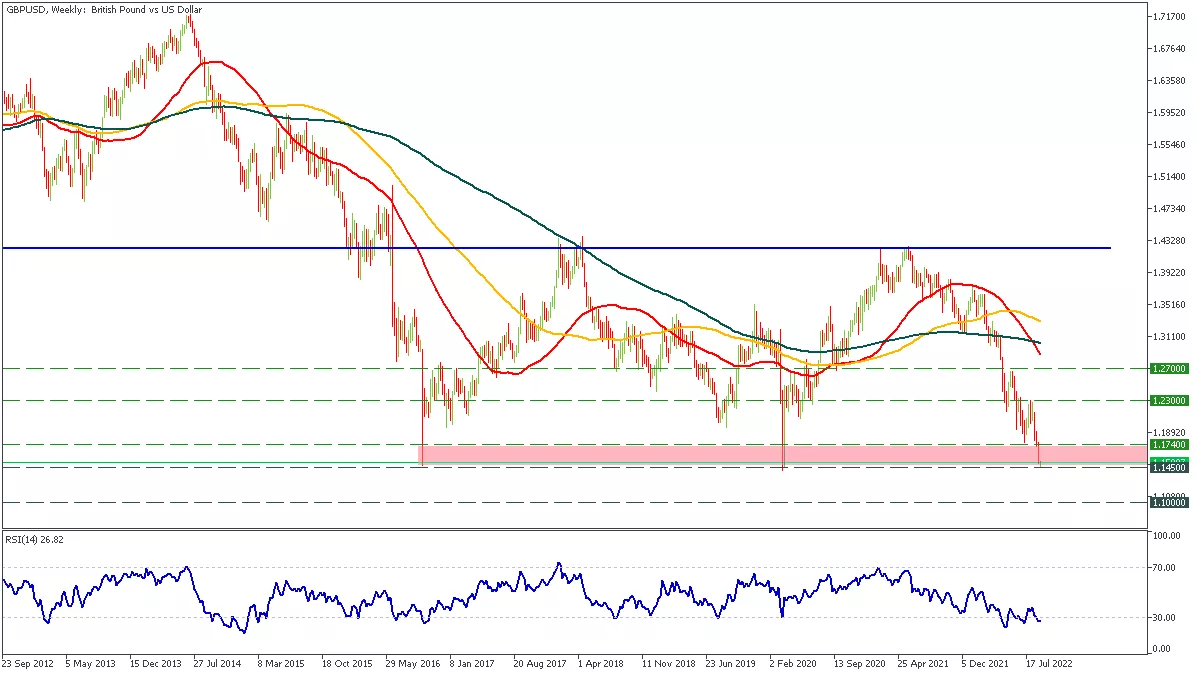
Freezing the energy bills and possible monetary easing may be a solid bearish factor for the GBP. The inflation and high energy prices won’t go away in a year, so without the support of the currency, the GBP may fall below the demand zone and continue the downtrend.
However, the demand zone is a solid support area that may require much time to be broken. If we see strong buying activity, GBPUSD may retest the resistance of 1.1740 over the next several weeks. Otherwise, the pair may reach 1.1000, a 4500-point decline, this year.
GBPUSD weekly chart
- Resistance: 1.1740, 1.2300, 1.2700
- Support: 1.1450, 1.1000
NZDUSD Wave Analysis
- NZDUSD reversed from support zone
- Likely to rise to resistance level 0.6140
NZDUSD currency pair ended last week with the Bullish Engulfing, which the pair formed near the key support level 0.6060 (former monthly low from July) standing near the lower daily Bollinger Band.
The upward reversal from this support zone stopped the previous multi-impulse sequence made of the impulse waves (iii), 5 and (C).
Given the oversold reading on the daily Stochastic – NZDUSD can be expected to rise further toward the resistance level 0.6140.

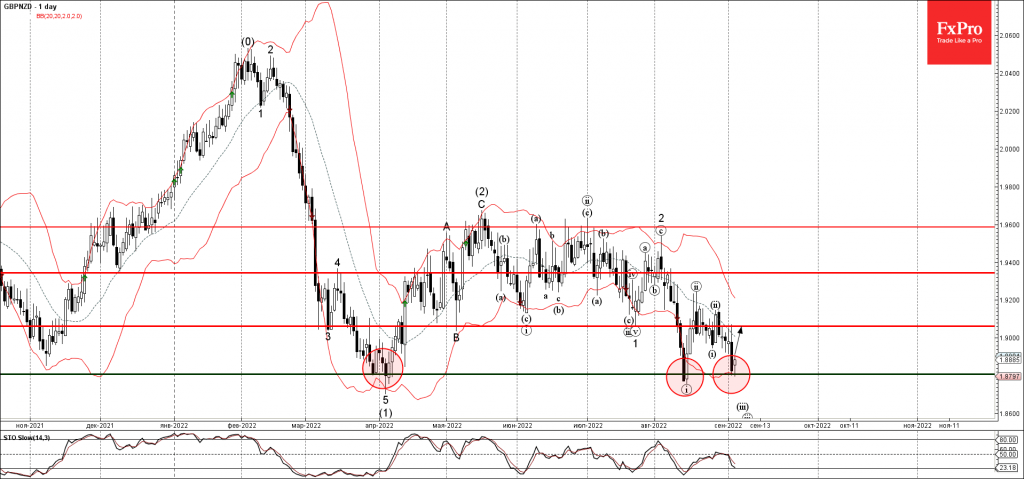
GBPNZD Wave Analysis
- GBPNZD reversed from support zone
- Likely to rise to resistance level 1.9060
GBPNZD currency pair recently reversed up from the support zone located between the long-term support level 1.8800 (previous monthly low from March) intersecting with the lower daily Bollinger Band.
The upward reversal from this support zone stopped the previous short-term downward impulse waves (iii) and 3.
Given the strength of the support level 1.8800 – GBPNZD can be expected to rise further toward the resistance level 1.9060.
Could the ECB Rate Decision Come to the Euro’s Rescue?
It’s not a secret anymore that the eurozone will soon head into a recession but there is something that is even more certain in the region and that is inflation. The European central bank will likely provide more weight on the price risks when it gathers this week, and although it is between a rock and a hard place, it may decide to up the stakes by delivering a Fed-like rate hike. The policy announcement and new economic projections will be out at 13:15 GMT, while Lagarde's press conference will follow shortly after at 13:45 GMT. A bold rate increase and hawkish communication could put a floor under the euro.
ECB to speed up rate hike plans amid energy crunch
Constrained energy supply from Russia will likely keep blackmailing the European Union during the winter months, and the union is already making plans to intervene in the market and alleviate some pain from consumers and businesses. As usual, though, it will be a hard task to get everyone on the same page and apply a common policy throughout the region as each member state has different energy needs in various proportions.
Hence, relying on fiscal policy might be tricky, leaving the ECB the only player in town to fight inflation for now. Eurozone’s consumer prices surprisingly rose at a new record of 9.1% y/y in August and the central bank will have a good reason to act more aggressively than July, when it hiked interest rates by 50 bps. Futures markets are currently certain that policymakers will follow the Fed’s footsteps and approve a sharper 75 bps increase on Wednesday, driving the deposit facility rate up to 0.7% and the refinancing rate to 1.2%.
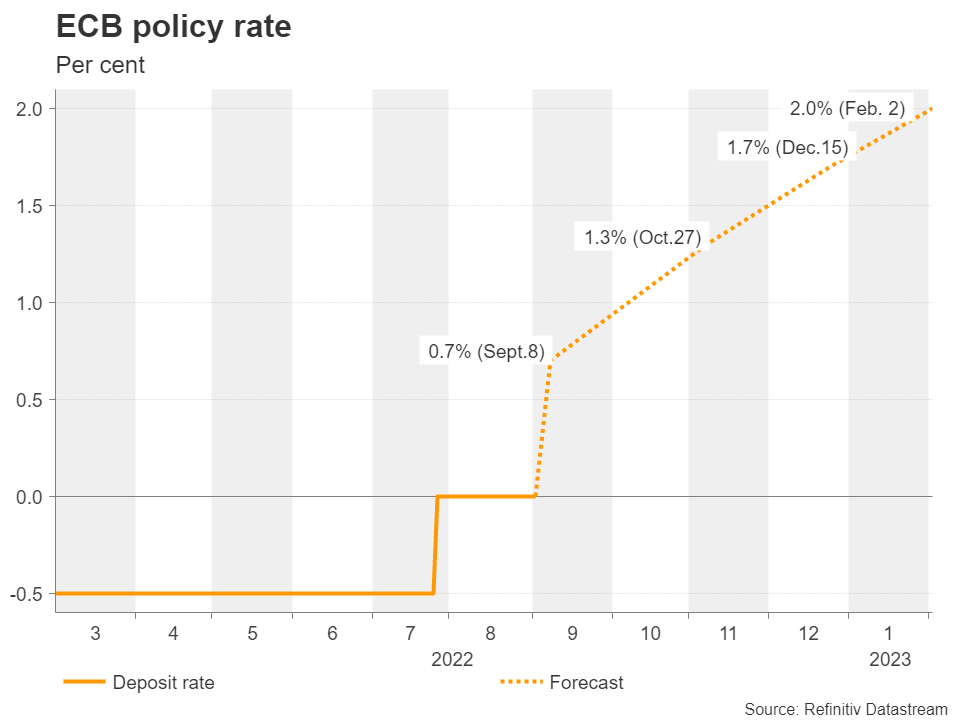
The latest ECB commentary has also revealed the bank's intentions for front loading rate hikes. Despite acknowledging that recession is quite possible, the Latvian policymaker Martin Kazaks said during the Jackson Hole symposium that the next rate increase “should be at least 50bps” as inflation is four times the target and could go even higher before slowing. The latter cannot be ruled out given that the eurozone is still well behind in the tightening cycle and is more exposed to the energy crunch than the US, where price pressures seem to be taking a halt - with some uncertainty - and borrowing costs have been trending up since spring.
Will the ECB save the euro?
The next question that arises at this point is whether the event will finally help the euro to reclaim parity against the dollar after several unsuccessful attempts to stay above that threshold. Well, the scenario of a 75 bps rate increase is fully priced in and did little to positively charge the bulls so far. Investors are also speculating that October’s meeting could result in another bold 0.60 bps rate increase with a probability of 73%. Therefore, the announcement itself may not have the power to stage an exciting rally either on Wednesday if it indeed materializes. Admittedly, the growth outlook will get even darker as the latest data evidence continues to deteriorate, with the August PMI survey diving further in the contraction area on the back of easing demand, high input costs, and falling new orders. Consumer and business confidence indices have also been nosediving.
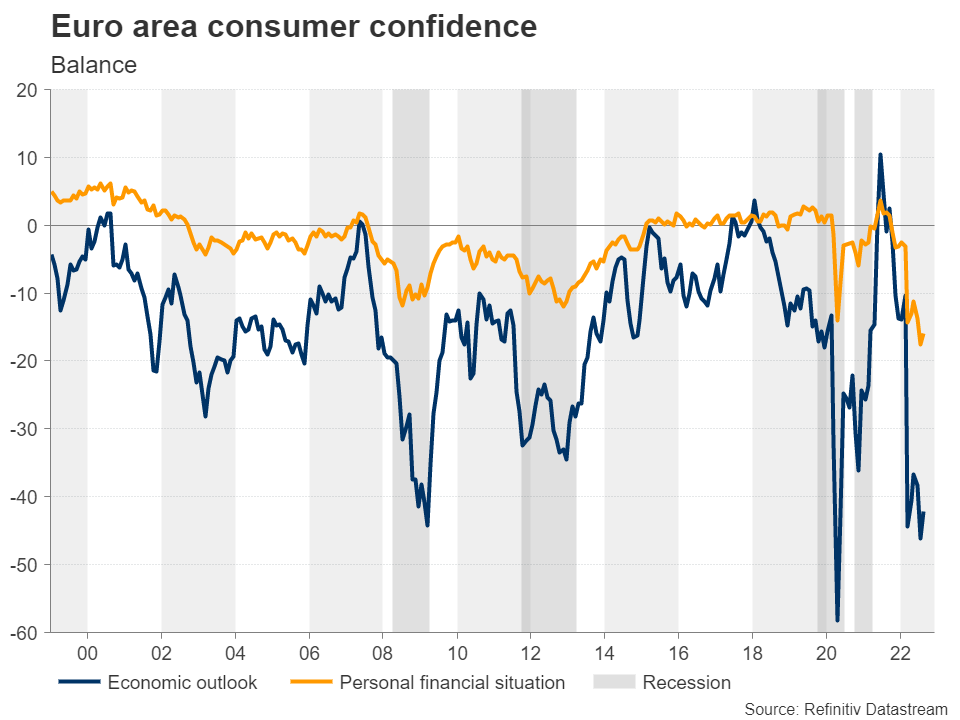
Encouragingly, unlike previous economic shocks, the labor market remains tight, pressing the unemployment rate to a new record low of 6.6% in July. That combined with ongoing negotiations for higher wages in the union as well as the elevated savings rate, which is still hanging above pre-pandemic levels despite its negative trend, may incentivize a more aggressive monetary response to inflation dynamics.
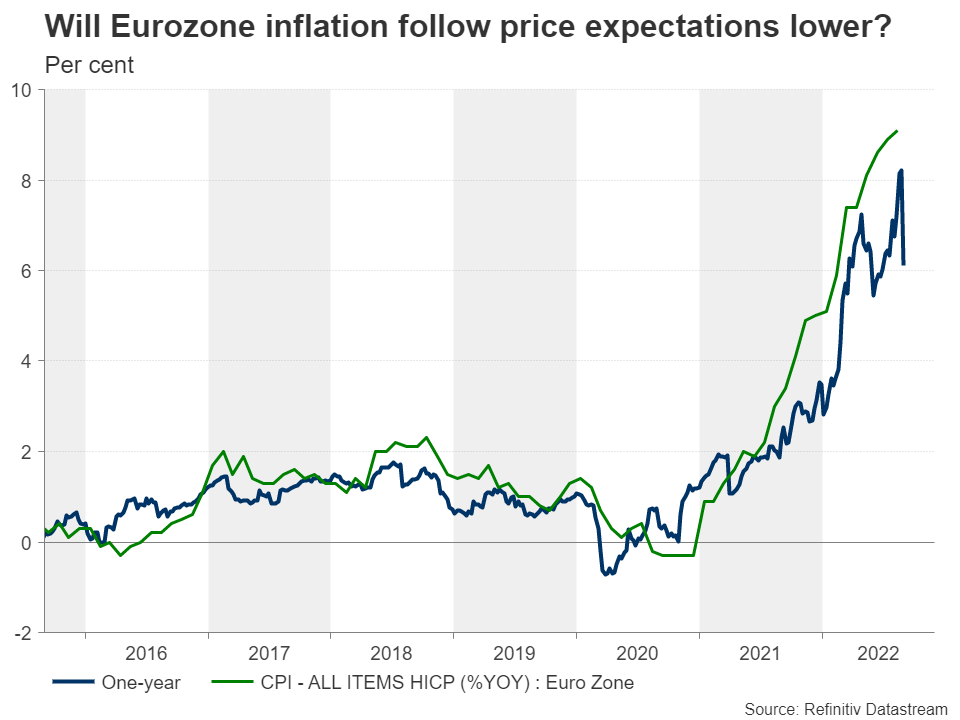
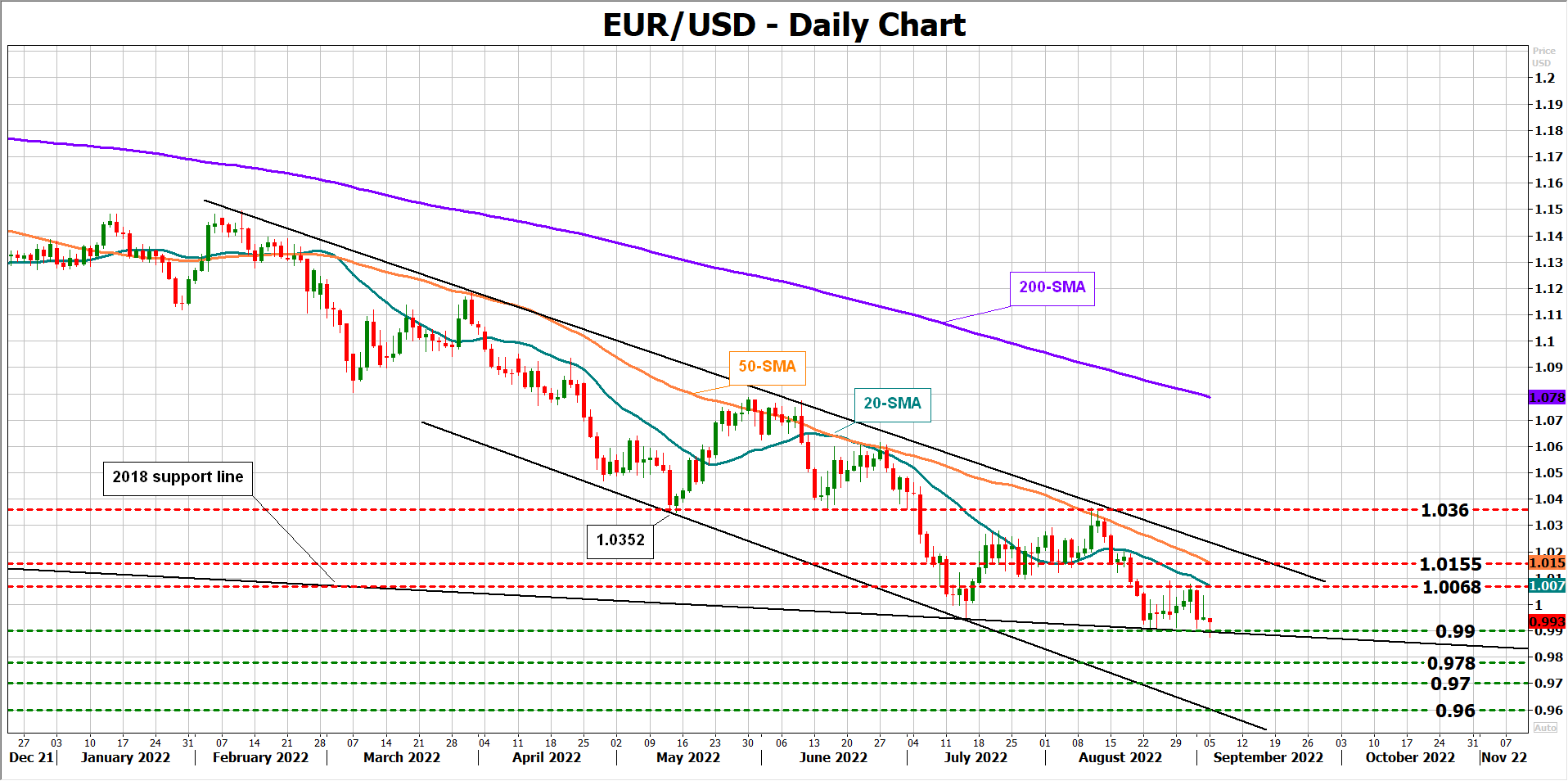
Investors, however, could still drive the common currency higher if the central bank telegraphs a double digit inflation rate in the coming months or generally a high and sticky inflation stretched out to 2024. The headline CPI looks to be moving in tandem with the one-year inflation expectations, which tumbled significantly lately but remained well above the 2.0% target. If upward revisions guide hotter rate increases ahead and Lagarde underlines that fighting inflation will remain the top priority for the central bank even if the economy faces some injuries during her press conference, the euro may reclaim parity and test the 20-day simple moving average (SMA) at 1.0068. A steeper ascent could meet the 50-day SMA at 1.0155, though only a fruitful rally above the 2022 bearish channel and the 1.0200 number would make the bullish wave more credible. Note that longer-term inflation expectations keep hanging above 2.0%.
Alternatively, if policymakers see inflation peaking in the horizon, delivering a safer 50 bps rate hike and choosing a gradual tightening method amid the dull economic backdrop, the euro could slump below the 0.9900 support area to test the 0.9780 – 0.9700 region. Having said that, it’s questionable whether the ECB would enjoy a weakening euro, which will add more upside pressure to import prices.
Whether the bearish trend in euro/dollar will worsen or reverse will depend on how real and brutal the recession risk will appear amid the heightened geopolitical risks in the year ahead. Hence, any guidance updates could be taken with a pinch of salt, as the ECB could adjust its policy accordingly, especially if the weakness in demand results in higher unemployment rates across the bloc.
EUR/USD: Euro Falls Below 0.9900 vs Dollar as Russia Halts Gas Supplies
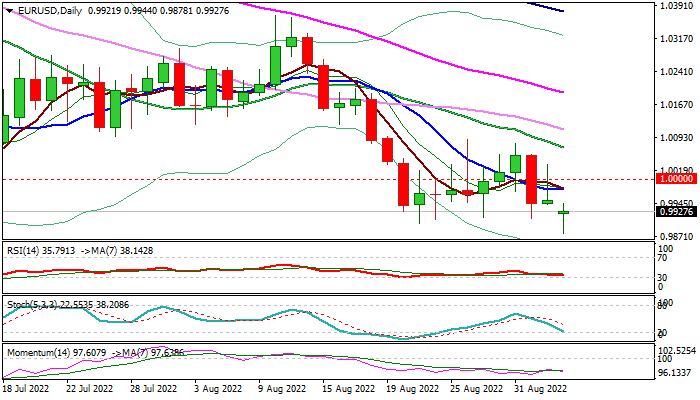
The Euro fell to new 20-year low (0.9873) following probe through 0.9900 round-figure support on Monday.
Negative sentiment was additionally soured as Russia halted gas supplies through the main pipeline that raised fears about further rise of energy prices and slowdown in economic growth.
With fundamental outlook darkening every day, as the winter is approaching and the Europe, highly dependent on Russian energy, faces minimal supplies or possible full stop of supplies, technical studies are in full bearish configuration and add to bearish outlook.
Sustained break of 0.99 handle would risk test of Fibonacci projections at 0.9831 (138.2% of the bear-leg from 1.0079 high) and 0.9789 (Fibo 161.8%), violation of which would unmask Jan 2001 high at 0.9595.
Near-term action should remain below converged 5/10DMA’s (0.9975) to keep bearish bias, however bears look for confirmation on close below former low at 0.9952 (Aug 23) that would generate signal of bearish continuation.
Res: 0.9952; 0.9975; 1.0000; 1.0055.
Sup: 0.9853; 0.9789; 0.9634; 0.9595.
Sunset Market Commentary
Markets
Markets’ sole focus is on Gazprom’s announcement last Friday that gas flows through Nord Stream I will be halted for an undetermined amount of time to fix an oil leakage spotted during scheduled maintenance. The announcement coincides with Friday’s G7 finance ministers’ decision to introduce prices cap on Russian oil exports and comes a week ahead of an emergency power summit by energy ministers on Friday. European gas prices surge over 25% today (Dutch TTF future), ending last week’s correction lower. Oil prices are rallying as well with Brent crude leaping from $93/b to $96.5/b as OPEC+ agreed to cut production by 100k b/d in October. The move completely reverses the September increase. It remains rather small in absolute terms, but nevertheless sends a signal to the market about OPEC+’ sensitivities. They especially fear a setback in oil demand on feeble eco forecasts. It’s also a public secret that the Saudi crown prince likes to see oil trading near $100/b. Core bonds are back in sell-off mode despite the risk-off market climate. Higher energy prices amplify worrisome inflation dynamics which are currently on top of mind of central bankers. They put the benefits of long term anchored inflation expectations above short term economic malaise. In that respect, we still expect a hawkish 75 bps rate hike by the ECB on Thursday. The German yield curve bear flattens with yields rising by 6.4 bps (2-yr) to 4.7 bps (30-yr). 10-yr yield spreads vs Germany widen by 2 bps with Greece (+5 bps) and Italy (+8 bps) underperforming. Today’s announcement of a syndicated long 12y deal (Apr2035) (tomorrow) adds to the underperformance. The Italian 10y yield approaches 4% again with the spreads vs Germany close to testing the June and July (and 2020) high of 240 bps. US markets are closed for Labour today but the US T-Note future follows the global move south. The euro suffers from the combination of higher energy prices, a difficult risk climate (European bourses lose up to 2.5%, though remain above last week’s sell-off lows) and peripheral spread widening. EUR/USD set a new 20-y low at 0.9878, before returning to the low 0.99 area. CEE currencies are even worse off than the single currency today. Liz Truss’ victory over Rishi Sunak as new Conservative leader and prime minister was discounted and didn’t hurt sterling. EUR/GBP trades volatile in the 0.86 big figure.
News Headlines
The People Bank of China reduced the reserve ratio on foreign exchange reserves from 8% to 6% starting from September 15. The reduction intends to raise ‘financial institutions ability to use foreign exchange capital’. Given $953bn of FX reserves end July, the RRR cut is expected to free around $19bn of FX. The higher availability of foreign currency relative to the yuan ceteris paribus should support the Chinese currency. The move is in line with other signals from the PBOC (stronger than expected daily FX fixings) of late that it wants to slow the recent CNY losses. USD/CNY declined from 6.94+ levels to 6.932 after the cut, but the yuan still trades substantially weaker compared to end last week (close near 6.90 on Friday).
Turkish inflation rose 1.47% M/M to 80.2% Y/Y in August (2.37% M/M and 79.60 Y/Y in July). Still, headline inflation was slightly softer than expected. Core inflation accelerated to 66.08% from 61.69%. In a monthly perspective, a 1.78% decline in transportation costs ‘mitigated’ the rise in inflation. The cost of health (7.01% M/M) and education (6.55%) showed the highest monthly increases. Turkish PPI shows tentative signs of slowing at 2.41 % M/M and 143.75% (from 144.61%). The monthly rise in PPI was the slowest since September last year. In new economic forecasts published this weekend, the government raised its full year inflation forecast to 65% and assumes it to slow to 24.9% next year. Growth is expected at 5.0% for 2022 and 2023. A sharp rise in the trade deficit ($105 bn) will propel the current account deficit to 5.9% this year, but the government expects/hopes it to come down to 2.5% in 2023. In line with recent price action, the lira reacted stoic to the inflation data and global sentiment. EUR/TRY even slightly declined to currently trade at 18.08.
USD/JPY Daily Outlook
Daily Pivots: (S1) 139.79; (P) 140.30; (R1) 140.71; More...
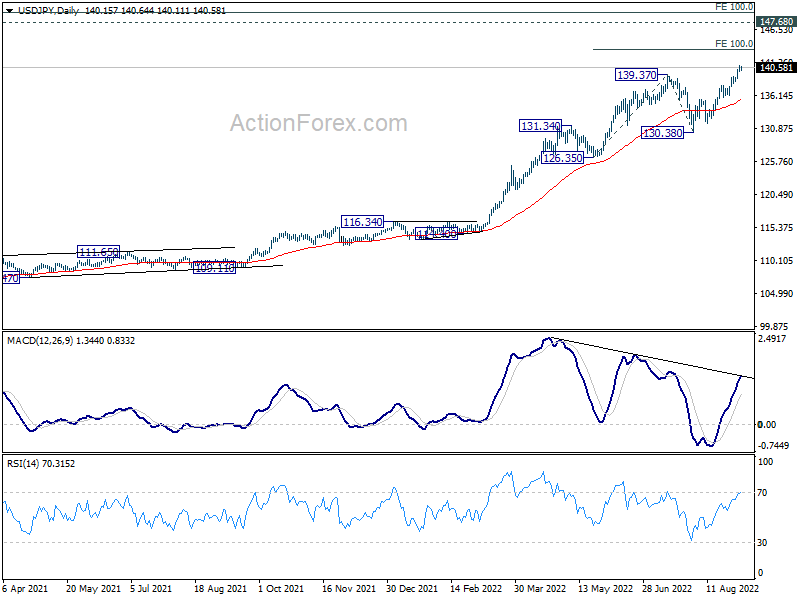
USD/JPY's rally is still in progress. Intraday bias stays on the upside for 100% projection of 126.35 to 139.37 from 130.38 at 143.40. Sustained break there could bring upside acceleration of 147.68 long term resistance. On the downside, below 139.05 minor support will turn intraday bias neutral and bring consolidations first, before staging another rally.
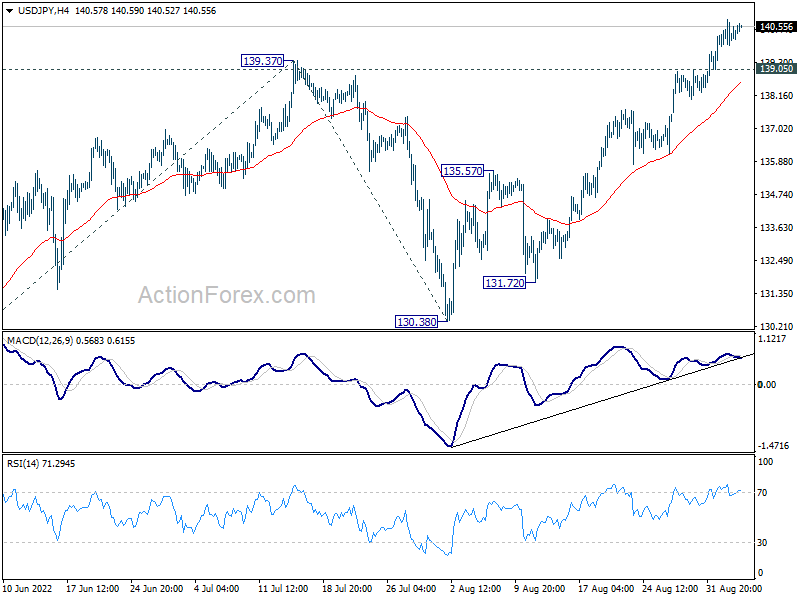
In the bigger picture, up trend from 101.18 is still in progress, as part of the whole up trend from 75.56 (2011 low). Further rise should be seen to 147.68 (1998 high). For now, break of 130.38 support is needed to be the first indication of medium term topping. Otherwise, outlook will stay bullish even in case of deep pull back.
USD/CHF Mid-day Outlook
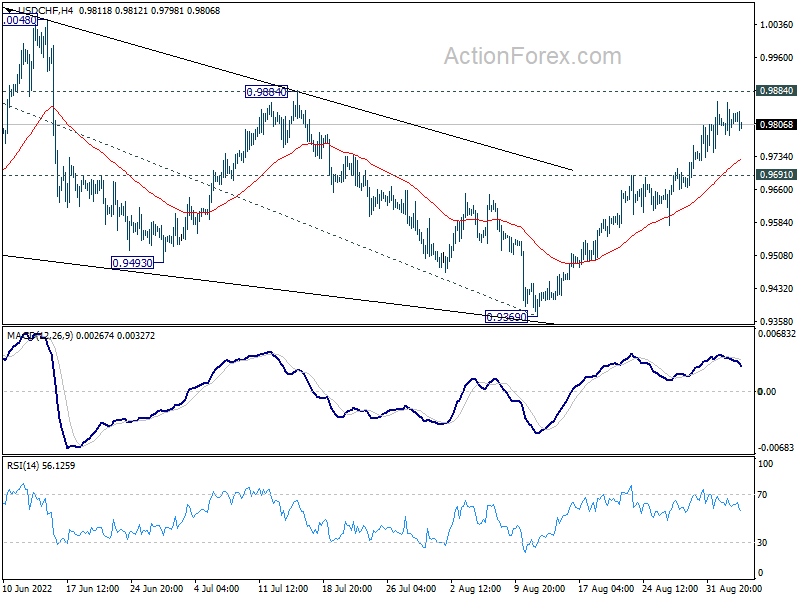
Daily Pivots: (S1) 0.9778; (P) 0.9819; (R1) 0.9853; More...
Intraday bias in USD/CHF is turned neutral as it continued to lose upside momentum. As noted before, triangle correction from 1.0063 could have completed at 0.9369 already. On the upside, break of 0.9884 resistance will argue that larger up trend is ready to resume through 1.0063 high. On the downside, however, break of 0.9691 minor support will dampen this view and turn bias back to the downside for 0.9469 support instead.
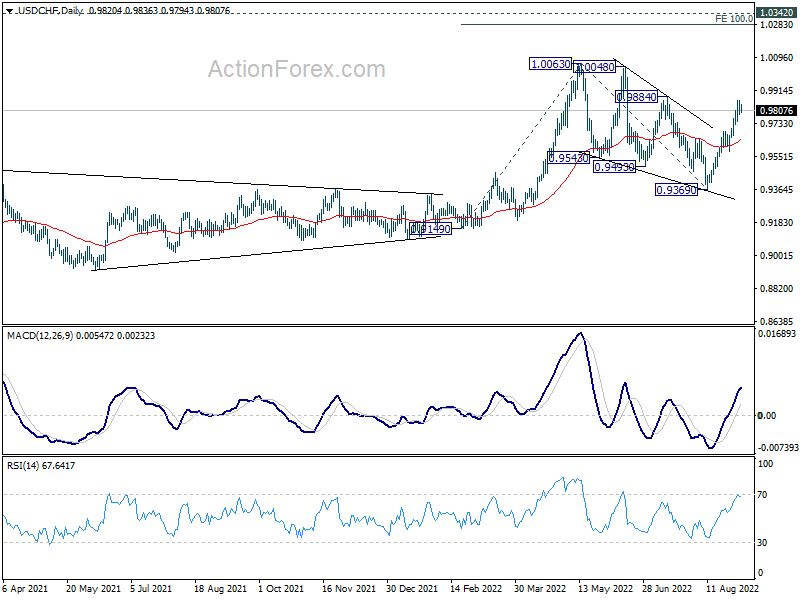
In the bigger picture, current development suggests that up trend from 0.8756 (2021 low) is still in progress. Sustained break of 1.0063 will target 100% projection of 0.9149 to 1.0063 from 0.9369 at 1.0283, and then 1.0342 (2016 high). For now, this will remain the favored case as long as 0.9369 support holds, even in case of deep pull back.
GBP/USD Mid-Day Outlook
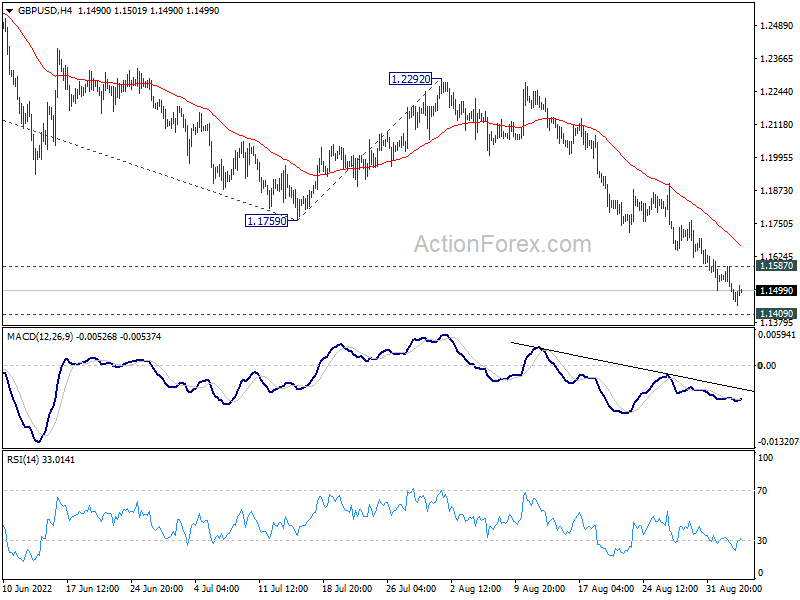
Daily Pivots: (S1) 1.1474; (P) 1.1532; (R1) 1.1567; More...
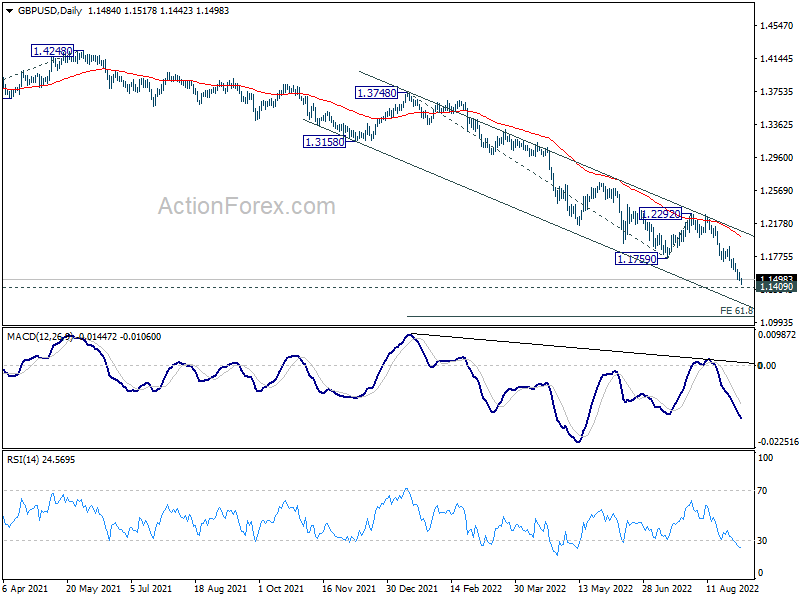
GBP?USD's decline is still in progress and intraday bias stays on the downside for 1.1409 long term support. Firm break there will pave the way to 61.8% projection of 1.3748 to 1.1759 from 1.2292 at 1.1063 next. On the upside, above 1.1587 minor resistance will turn intraday bias neutral and bring consolidations, before staging another decline.
In the bigger picture, based on current momentum, fall from 1.4248 (2018 high) is probably resuming long term down trend from 2.1161 (2007 high). Sustained break of 1.1409 will target 61.8% projection of 1.7190 (2014 high) to 1.1409 (2020 low) from 1.4248 (2021 high) at 1.0675. This will remain the favored case for now as long as 1.2292 resistance holds.