Sample Category Title
Gas Story Dominates Asian Markets this Morning
Markets
US payrolls added a robust 315k but a downward two-month revision, slowing income growth and an unusually large uptick in the participation rate drew the attention. It smoothed off some of the sharpest edges in terms of Fed expectations, boosting risky assets. European stocks inched 2.5% higher but after the close news came that Russia’s Gazprom will keep the gas taps closed after the three-day maintenance period that normally ended on Saturday, citing a “leak”. There were some reports from the Kremlin earlier on the day that suggested this would happen but these were ignored. US indices reversed gains of as much 1.3% into similar-sized losses (Nasdaq) in response. Both risk sentiment as (US) eco data worked in favor of core bonds. The US yield curve bull flattened with changes between -11.2 bps (2y) and -1.6 bps (30y) going into the long weekend with markets closed today for Labor Day. European swap yields fell 2.9 bps (30y) to 7 bps (3y, 5y) but note that these changes date from before the official Gazprom announcement. EUR/USD’s gains (dollar weakness) evaporated quickly. The pair eventually closed more or less unchanged just below parity. It helped the trade-weighted DXY to pare losses to 109.54, down from 109.69. The Japanese yen didn’t profit despite the drop in core bond yields. USD/JPY held above the 140 barrier. EUR/GBP tested resistance in the high 0.86 zone but headed into the weekend at 0.865, awaiting the outcome of the final voting round in the UK leadership race. The result will be announced around noon.
The gas story dominates Asian markets this morning and will most definitely spill over to European dealings. Stock losses remain fairly limited for cash markets in the Asian-Pacific region but futures in Europe point at an ugly -3% opening. Gas prices are poised to surge when markets open. Germany meanwhile announced a €65bn aid package of relief measures, partially funded by a windfall tax on electricity producers. There’s an EU emergency summit on the energy crisis this Friday with a range of measures to be proposed. Oil prices jump more than 2% as investors mull chances for production cuts by OPEC later today. Aside from energy, the ECB will be in focus this week too. Everything is in store, especially with the latest escalation in the energy market, for a 75 bps rate hike on Thursday. But whether (expectations for) a hawkish ECB will suffice for core/European bond yields in the current risk-off environment is doubtful. We expect to see some classic haven flows for the time being. The euro is and will likely remain under pressure, providing another argument for forceful ECB action. EUR/USD sinks below the previous YtD lows sub 0.99 to the weakest level in two decades. The break further deteriorates the technical picture. There’s little in the way for a return to 0.96 in first instance.
News Headlines
The governments of Finland and Sweden announced measures to support (financial) stability in the energy sector as prices in power markets are skyrocketing. Higher prices have sharply raised the amount that energy providers have to put as collateral with exchanges. Both countries set up liquidity facilities including both loans and credit guarantees. Sweden provided loan guaranties worth SEK 250 bln kronor. Finland approved loans and guaranties worth € 10 bln. According to Swedish Finance Minister Damberg the measures were needed to prevent that contagion from turbulences in the energy market to spill over to the rest of the financial markets.
The recovery in the services eased slightly in August according to the Caixin Services PMI. The index eased to 55.0 from 55.5 in July, which was still the highest level in 15 months. The August reading marked the third consecutive month of expansion. Even so, service providing companies continue to face rising input costs and the employment index stayed below the 50-level. The Caixin China composite PMI also eased from 54.0 to 53.0. The Chinese yuan this morning remains under pressure which USD/CNY reaching 6.9375, the weakest level in 2-years for the Chinese currency against the US dollar. A global risk-off context and uncertainty on new regional lockdowns weighing on the economy continue to keep the Chinese currency in the defensive.
Russian Halt to Gas Flows Deals Another Blow to Europe
Market movers today
Energy price developments remain in focus this week after Gazprom said it would fully suspend the Nord Stream natural-gas pipeline to Germany, raising pressure on Europe as governments race to avoid energy shortages this winter. Markets will look out for clues about EU measures to cap the rapid price rises in energy markets ahead of the energy minister meeting on Friday.
The final round of the UK Conservative Party leadership election takes place today, with polls largely favouring Liz Truss to become the UK's next Prime Minister, see Research UK - Truss vs Sunak - and why it matters, 2 September.
Services PMIs for August are released in a range of countries and we look for a further deterioration Swedish Services PMI.
Judging from the German numbers, euro area retail sales could see a small rebound.
Overnight, we expect Reserve Bank of Australia (RBA) to hike by another 50bp. RBA has signalled a data-dependent meeting-by-meeting approach and elevated inflation expectations and tighter labour markets point to further policy tightening.
US markets are closed for the Labour Day holiday. Investors will keep an eye on the OPEC+ meeting today following comments from Saudi Arabia about the possibility of output cuts, despite pressure from the US to increase supply.
The main event this week will be the ECB meeting, where we look for a 75bp hike.
The 60 second overview
Russian halt to gas flows triggers risk-off move in markets: News Friday of the continued closure of the North Stream 1 pipeline spurred a sell-off in equities, pushed bond yields lower and weakened the euro. Energy rationing may have moved one step closer in Europe. The negative sentiment carried over to the Asian markets overnight. Bond markets also got support from a weaker-than-expected US jobs report, which showed softening job growth while more people are returning to the labour market.
German relief package: After gas flows through the North Stream 1 pipeline remain suspended, the German government reached an agreement on a third relief package over the weekend. Amounting to EUR 65bn (on top of EUR 30bn from earlier packages), measures include one-off payments to students and pensioners, increased welfare payments, subsidized public transport tickets, a brake on electricity prices for basic consumption, extension of various KfW programmes, postponed increase in carbon prices and support for an EU wide profit cap on energy companies. According to Finance Minister Lindner the measures will be fully funded and not lead to additional net borrowing, while compliance with the 'debt brake' in 2023 still remains the overarching goal. While the package will probably help mitigate the blow to consumers from rising energy prices, we doubt it will suffice to avoid the German economy falling into recession in H2 22. With demand conditions already weakening and a prolonged Russian gas shut-off increasing the risk of rationing and outright production stops in some industries, Europe is headed for a challenging winter (see also Research Germany - Zeitenwende, 25 July).
Sweden and Finland offers credit guarantee to power companies: The two countries on Sunday announced credit guarantees worth USD 33bn to power companies to avert "technical bankruptcy".
Equities: Equities ended lower Friday after a turnaround in the US cash session. MSCI was lower for six consecutive days with defensive Min Vol outperforming. Huge regional difference as Europe rallied on a goldilocks NFP report. US cash session started out strong but news that Russia decided to keep North stream 1 shut took down the brewing optimism. What's interesting to note is that implied volatility measured by the VIX index fell Friday for the third day in a row. This tells us something about lack of surprise factor or the fact that professional investors are already prepared for market turmoil. Friday performance Dow -1.1%, S&P 500 -1.1%, Nasdaq -1.3% and Russell 2000 -0.7%. Asian markets are mixed this morning with Chinese markets suffering. European futures are down 3% this morning while US futures are slightly higher.
FI: A wait and see market sentiment ahead of the US labour market report was followed by gradually lower yields in the afternoon as the US participation and unemployment rate rose, which may question the wage growth strength in the period ahead. Also central bank pricing was somewhat lower on the back of the NFP where we particular take note of the ECB's at +223bp of hikes priced by summer next year and the 66bp for this week's ECB meeting.
FX: Naturally, 1) the announcement of an G7 oil price cap on Russian oil, 2) the shutdown of NS1 gas to Europe (due to 'maintenance') and 3) Germany's announcement of intervention in the energy market (taxing low-cost energy producers and subsidizing consumption), as well as 4) Swedish liquidity provisions to energy companies are all set to take centre stage as the European energy crisis continues. On Sunday evening, EUR/USD has opened down some 20-30pips from Friday's close. This is quite noticeable given spot is near its short-term low but generally also that early Asian hours see very muted volatility in the currency, in general.
Credit: Credit markets moved sideways on Friday until the release of the US job report, which led to substantial tightening, with iTraxx Main tightening 6.6bp and Xover 30bp.
Nordic macro
During the weekend the Swedish government announced the intention to support electricity produces who are members of Nasdaq Clearing AB with up to SEK 250bn in credit guarantees. The proposal is supposed to pass the Riksdag today before market close and should help avoid possible spill-over-effects to the wider financial market.
After the Swedish august Manufacturing PMI number from last week confirmed a continued decline in activity, we do not expect to see anything different from the Services PMI number being released at CET 8:30 today.
Worsening Energy Crisis, OPEC Decision and UK’s Next PM
The week starts on negative sentiment as Friday’s jobs report couldn’t prevent the selloff from extending in the US. And more importantly for the Europeans, Gazprom didn’t restore gas flow to Europe on Saturday, as planned.
Gazprom said that a leak was detected, and that the pipeline could not operate before it’s fully repaired. But of course, the decision suspiciously came slightly after the G7 countries agreed to impose a price cap on Russian oil, probably around the Russian production cost. It’s unsure whether the plan would work, as there are doubts that some of Russia’s big clients like China, India, or even Turkey would follow G7 in this unprecedented decision. But they may have to, as most of the world’s oil is transported by Western shipping companies, and if they can’t transport the Russian oil anymore - unless people pay the price that Europeans want them to, there would be no oil for them. It will be interesting to watch and see how, and if Europeans could cook the market to their sauce. Russia already said they won’t sell their oil to countries who are not willing to pay the full price, which is fair enough.
The barrel of US crude ended up last week below the $90 mark, while interestingly the TTF futures closed the week having lost nearly 40% since the historical peak a week earlier. But the risks remain tilted to the upside.
Today, investors will be closely watching the OPEC meeting, as Saudi now threatens to cut the oil output to push prices higher, but according to WSJ, Russia doesn’t want another round of output cut.
And Russia is not the OPEC’s only geopolitical headache. There is also the possibility of a nuclear deal between the US and Iran, that titillates the Saudis. OPEC doesn’t want to see around 4 mio barrels of Iranian oil hitting the market, and pulling prices lower. Therefore, they could well use the excuse of an eventual deal to cut output, again.
All in all, this means that even if the demand side us pushing crude prices lower, OPEC wouldn’t let the prices drop too much below the actual levels. Of course, no output cut should send the price of crude back to $85pb. Yet, if OPEC announces another wave of output restrictions, the price of a barrel could jump back to $100 and above.
Euro under pressure
On the FX front, the deepening energy crisis continues weighing on the euro. The EURUSD continues pushing lower before parity this Monday and is testing the 0.99 support at the time of writing, with more chance of breaking this support in the coming hours than the contrary. This week is important for euro traders, as the European Central Bank (ECB) is expected to announce a sizeable rate hike at its Thursday’s policy meeting. Many traders now expect a 75bp rate hike from the ECB this week, while some continue bet on a 50bp hike, on the idea that the ECB cannot carry on jumbo rate hikes, when the Eurozone is threatened by deepening energy crisis, and a sharp fall in economic activity. But the eurozone is also struggling with skyrocketing inflation, argue the hawks.
In all cases, the ECB hawks don’t really matter for the pricing of the euro against the US dollar, and the stronger dollar keeps worsening the energy bills on the continent.
The next UK PM
And it’s also an important day across the Channel, as the Brits will get to know who their next PM will be.
The polls point steadily and increasingly at Liz Truss, unfortunately for the pound, as a Truss victory will push the Bank of England (BoE) expectations into a chaos, as she wants to scrap inflation as the monetary policy target and rely on another metric, like growth for example.
Along with tax cuts, and extra spending to freeze the energy bills for example, the UK’s sputtering macro metrics could be further fuming in the coming quarters under Truss leadership.
Cable kicked off the week below the 1.15 mark. But we could see some profit taking and a ‘sell-the-fact’ rally in sterling when Liz Truss victory is confirmed.
Still, the pound is expected to continue its journey toward parity against the US dollar, as the dollar continues rising relentlessly. The dollar index is already up by more than 0.50% this morning.
GBP/JPY Daily Outlook
Daily Pivots: (S1) 160.91; (P) 161.70; (R1) 162.25; More...
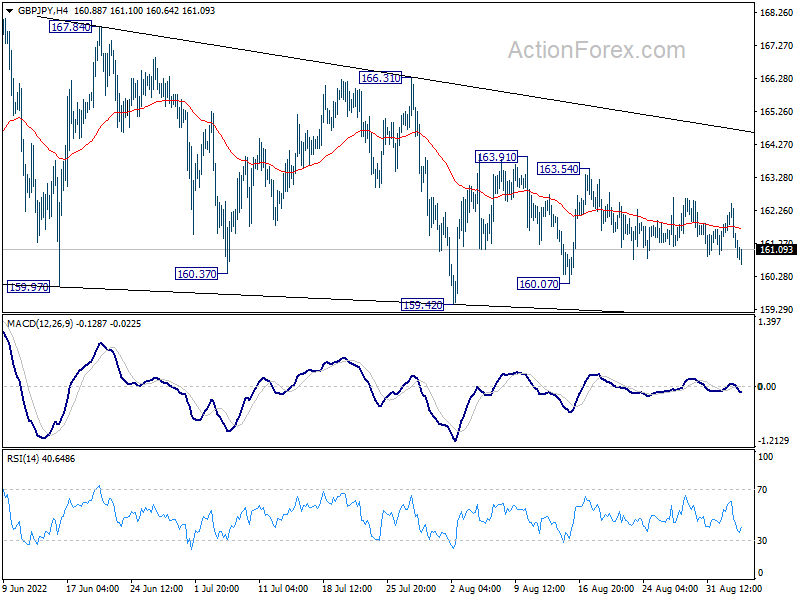
No change in GBP/JPY's outlook as corrective pattern from 168.67 is extending. Intraday bias remains neutral. On the upside, break of 163.91 will bring stronger rise to 166.31 resistance. On the downside, below 160.07 will turn bias to the downside for 159.42 and below.
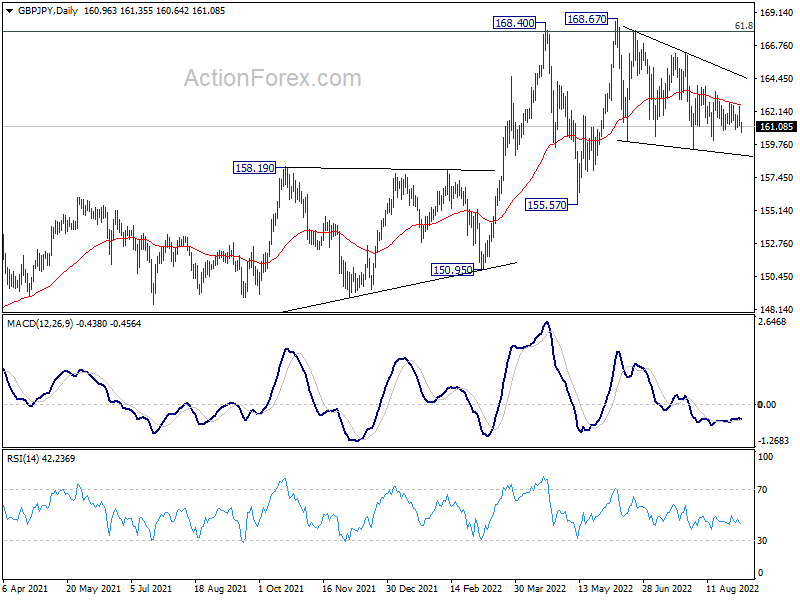
In the bigger picture, up trend from 123.94 (2020 low) is still in progress. Sustained break of 61.8% retracement of 195.86 (2015 high) to 122.75 (2016 low) at 167.93 will be a long term bullish signal, and could pave the way back to 195.86 high. This will remain the favored case as long as 155.57 support holds, even in case of deep pull back.
EUR/JPY Daily Outlook
Daily Pivots: (S1) 139.02; (P) 139.88; (R1) 140.51; More....
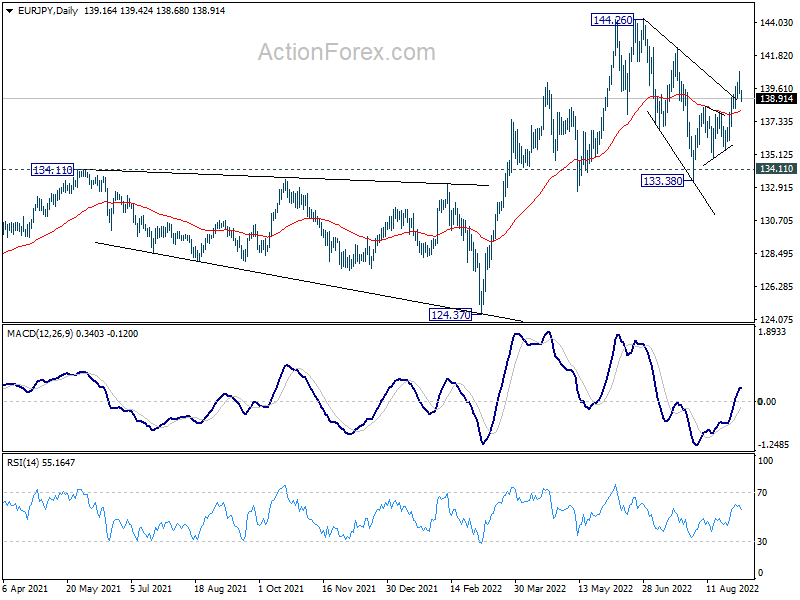
Intraday bias in EUR/JPY is turned neutral with current retreat. But further rise will be mildly in favor as long as 138.24 minor support holds. Break of 140.73 will resume the rebound from 133.38 to 142.31 resistance next. However, on the downside, break of 138.24 will turn bias back to the downside for 135.50 support instead.
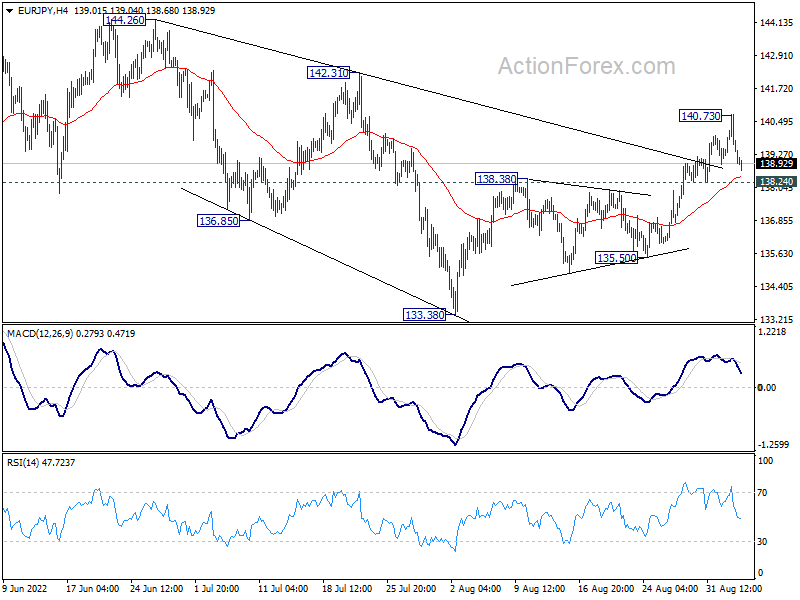
In the bigger picture, up trend from 114.42 (2020 low) is seen as the third leg of the pattern from 109.30 (2016 low). Further rally is in favor as long as 134.11 resistance turned support holds, even in case of deep pull back. Next target is 149.76 (2015 high). However, sustained break of 134.11 will be a sign of medium term bearish reversal and turn focus to 124.37 support for confirmation.
EUR/GBP Daily Outlook
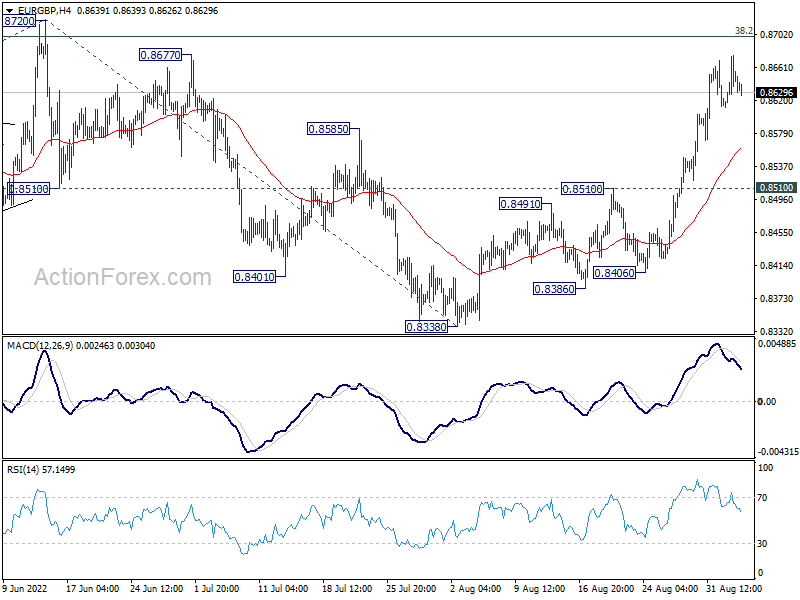
Daily Pivots: (S1) 0.8616; (P) 0.8646; (R1) 0.8679; More...
Intraday bias in EUR/GBP is turned neutral again with current retreat. On the upside, decisive break of 0.8720 high will carry larger bullish implications. Next target is 100% projection of 0.8201 to 0.8720 from 0.8338 at 0.8857. For now, further rally will remain in favor as long a s0.8510 resistance turned support holds.
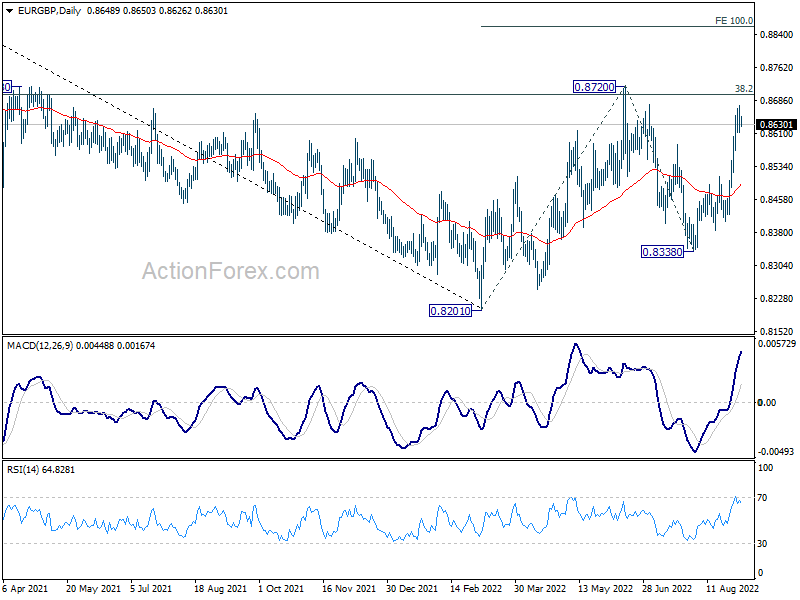
In the bigger picture, focus is back on 38.2% retracement of 0.9499 to 0.8201 at 0.8697. Sustained break there will argue that rise from 0.8201 is a medium term up trend, rather than a correction. Next target is 61.8% retracement at 0.9003. Rejection by 0.8697 again will maintain medium term bearishness, for extending the down trend from 0.9499 (2020 high) at a later stage.
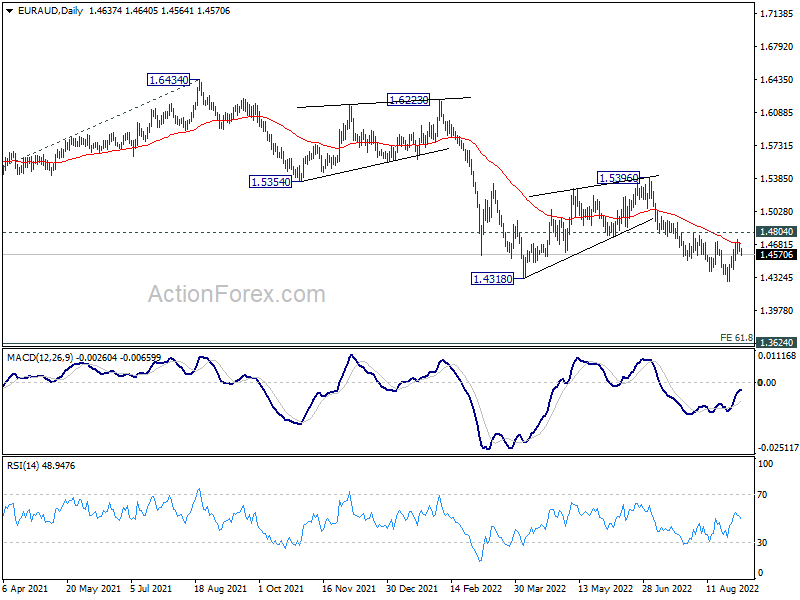
EUR/AUD Daily Outlook
Daily Pivots: (S1) 1.4589; (P) 1.4648; (R1) 1.4685; More...
Intraday bias in EUR/AUD remains neutral for the moment. On the downside, decisive break of 1.4318 low will resume larger down trend to medium term projection level at 1.3623. Nevertheless, firm break of 1.4804 resistance will dampen this bearish view and bring stronger rise back to 1.5396 resistance instead.
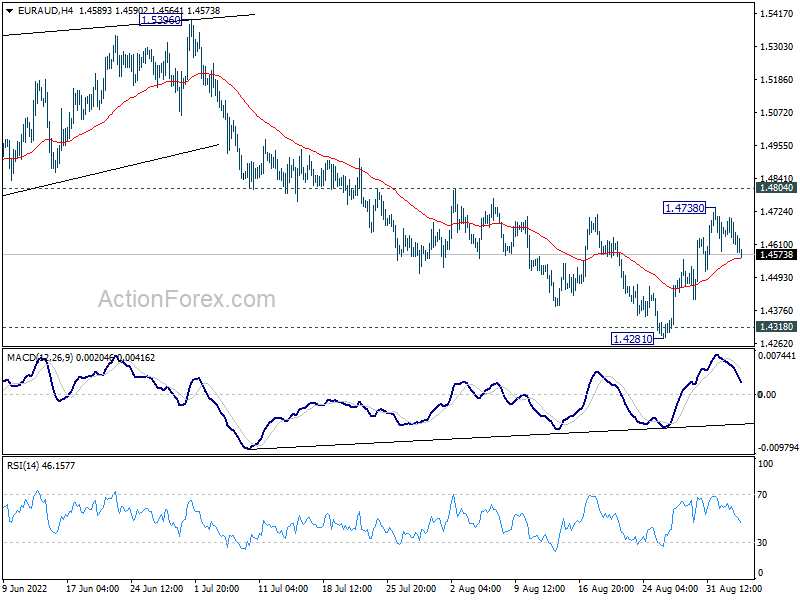
In the bigger picture, down trend from 1.9799 is still in progress. Break of 1.4318 low will target 61.8% projection of 1.9799 to 1.5250 from 1.6434 at 1.3623, which is close to 1.3624 long term support (2017 low). This will remain the favored case now as long as 1.5396 resistance holds.
EUR/CHF Daily Outlook
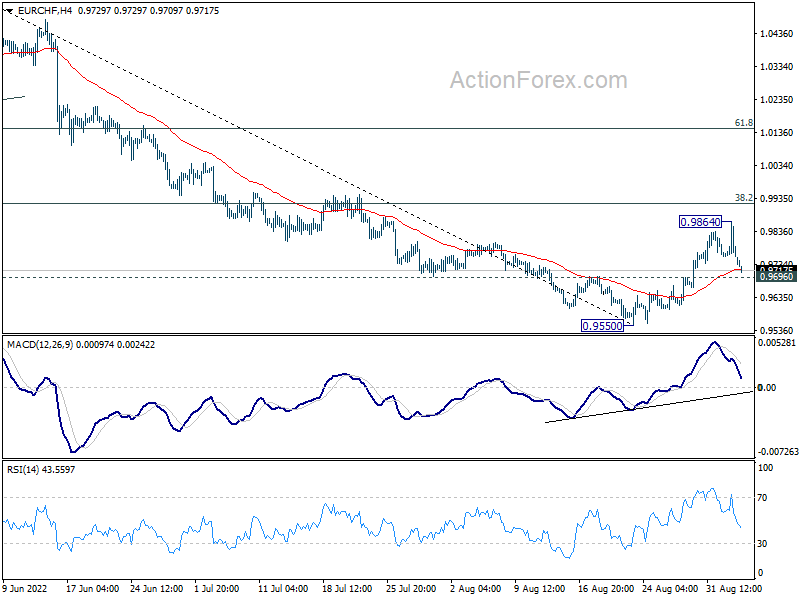
Daily Pivots: (S1) 0.9732; (P) 0.9800; (R1) 0.9838; More....
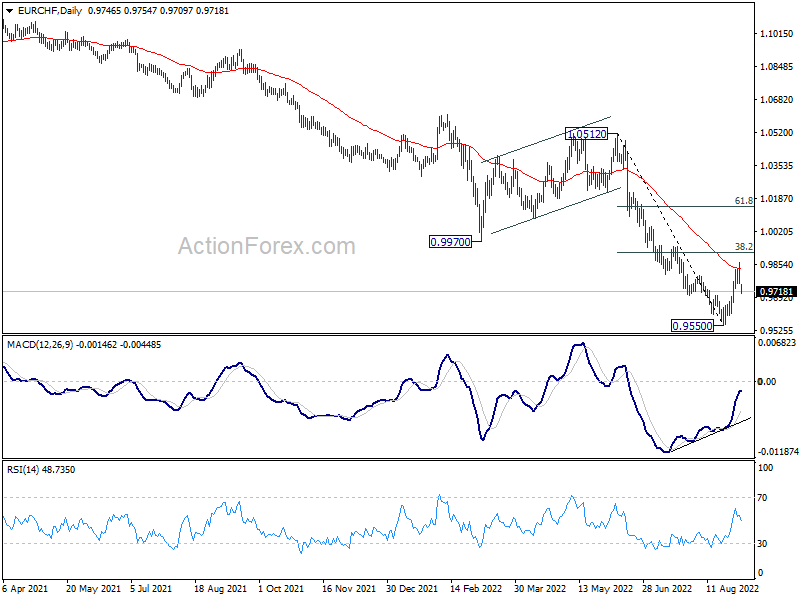
Intraday bias in EUR/CHF remains neutral at this point. Corrective rise from 0.9550 might extend higher. But upside should be limited by 38.2% retracement of 1.0512 to 0.9550 at 0.9917 to bring down trend resumption. On the downside, below 0.9696 minor support will turn bias back to the downside for retesting 0.9550 low.
In the bigger picture, long term down trend from 1.2004 (2018 high) is still in progress. Next target is 138.2% projection of 1.2004 to 1.0505 to 1.1149 at 0.9033. On the upside, break of 0.9970 support turned resistance is needed to be the first sign of medium term bottoming. Otherwise, outlook will stay bearish in case of strong rebound.
AUD/USD Daily Report
Daily Pivots: (S1) 0.6776; (P) 0.6816; (R1) 0.6851; More...
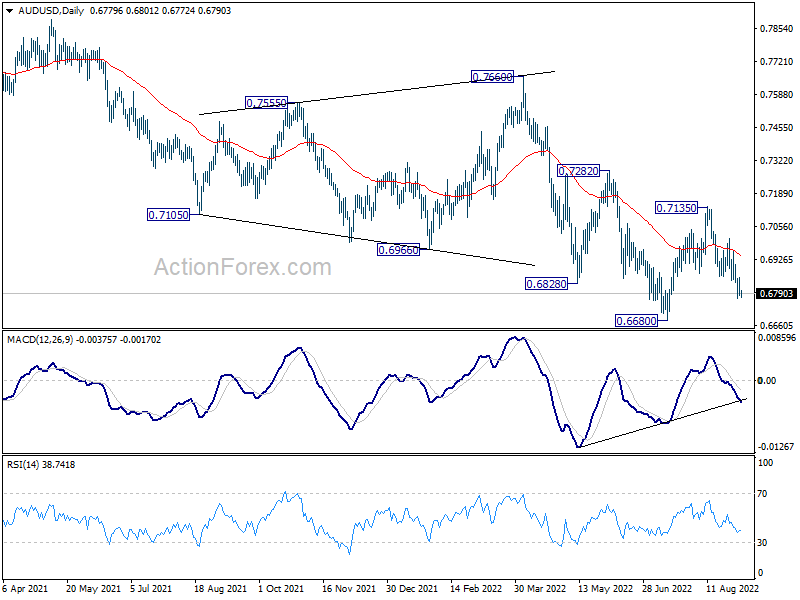
AUD/USD's fall from 0.7135 is in progress and deeper decline should be seen to retest 0.6680 low. Firm break there will resume larger down trend. However, break of 0.7008 will turn bias back to the upside for 0.7135 resistance instead.
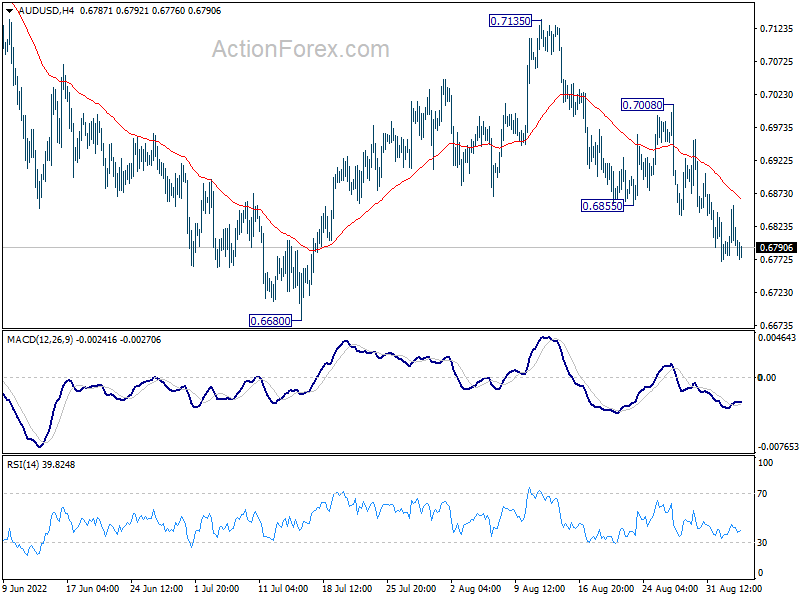
In the bigger picture, price actions from 0.8006 (2021 high) is seen more as a corrective pattern to rise from 0.5506 (2020 low). Or it could also be a bearish impulsive move. In either case, outlook will remain bearish as long as 0.7282 resistance holds. Next target is 61.8% retracement of 0.5506 to 0.8006 at 0.6461.
USD/CAD Daily Outlook
Daily Pivots: (S1) 1.3077; (P) 1.3124; (R1) 1.3172; More...
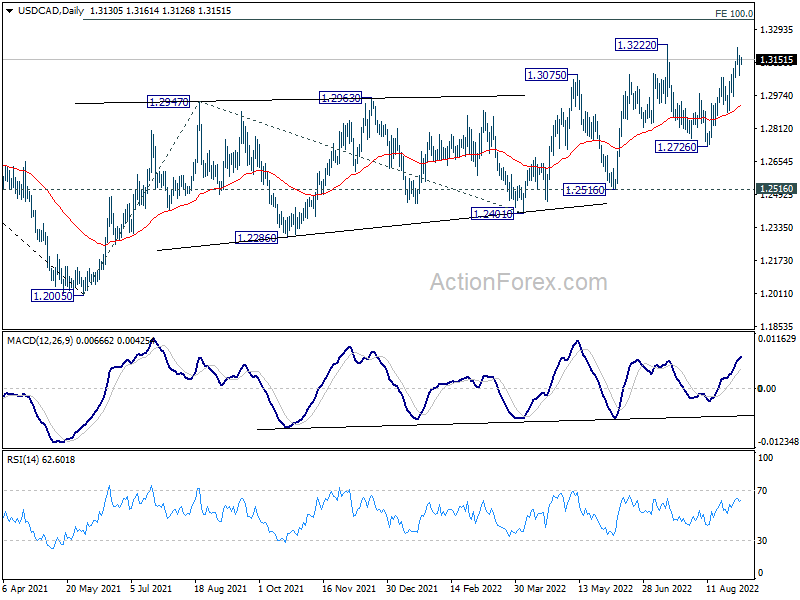
Intraday bias in USD/CAD remains neutral for the moment. But further rise is expected with 1.2971 support intact. On the upside, decisive break of 1.3222 will resume larger up trend from 1.2005. Next target is 100% projection of 1.2005 to 1.2947 from 1.2401 at 1.3343.
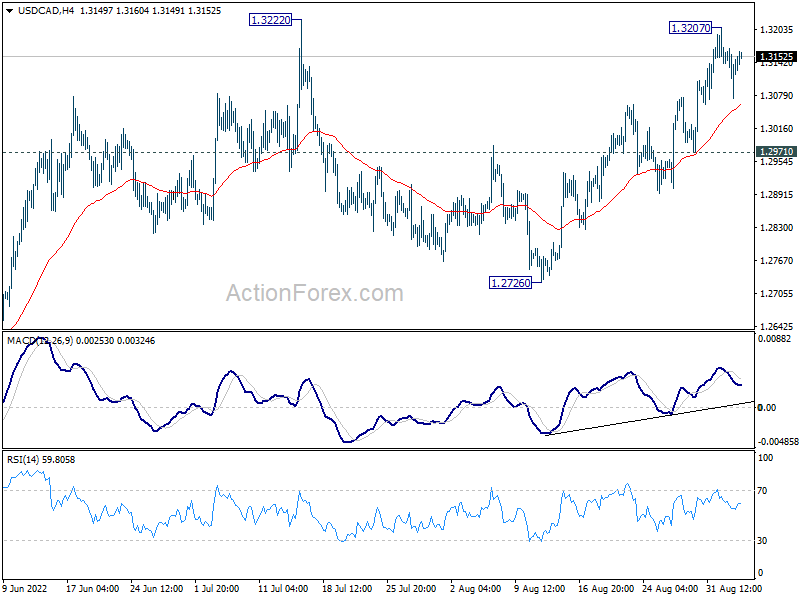
In the bigger picture, down trend from 1.4667 (2020 high) should have completed at 1.2005, after defending 1.2061 long term cluster support. Rise from there should target 61.8% retracement of 1.4667 to 1.2005 (2021 low) at 1.3650. This will remain the favored case now as long as 1.2516 support holds.