

Sample Category Title
EUR/AUD Weekly Outlook
EUR/AUD rebounded notably last week but lost momentum after hitting 1.4738. Initial bias remains neutral this week first, with bearish outlook. On the downside, decisive break of 1.4318 low will resume larger down trend to medium term projection level at 1.3623. Nevertheless, firm break of 1.4804 resistance will dampen this bearish view and bring stronger rise back to 1.5396 resistance instead.
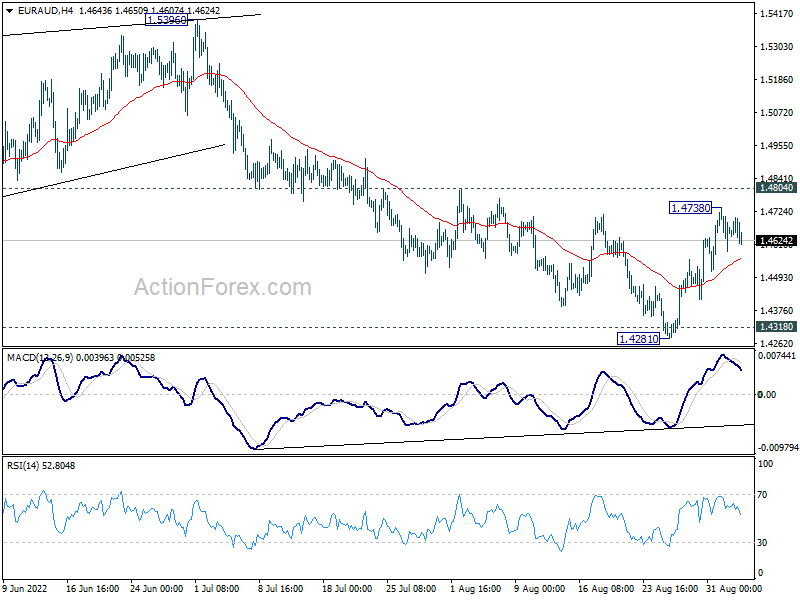
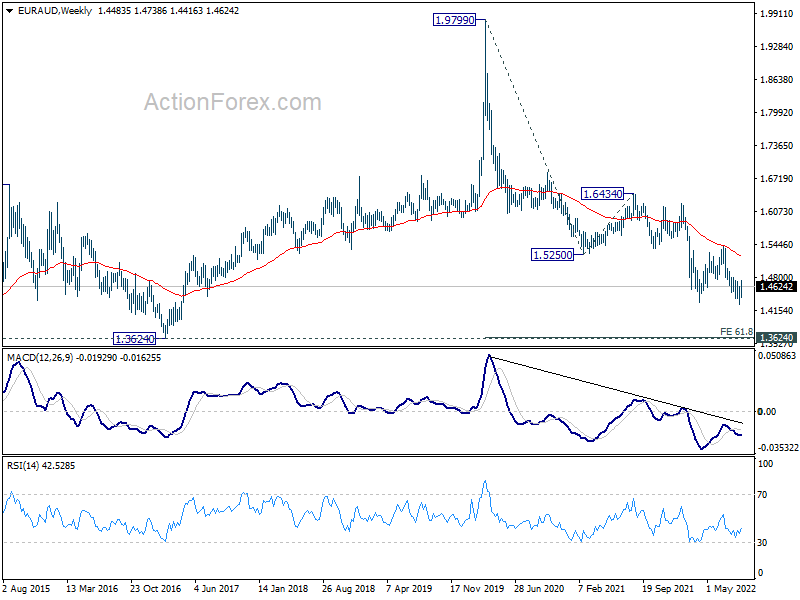
In the bigger picture, down trend from 1.9799 is still in progress. Break of 1.4318 low will target 61.8% projection of 1.9799 to 1.5250 from 1.6434 at 1.3623, which is close to 1.3624 long term support (2017 low). This will remain the favored case now as long as 1.5396 resistance holds.
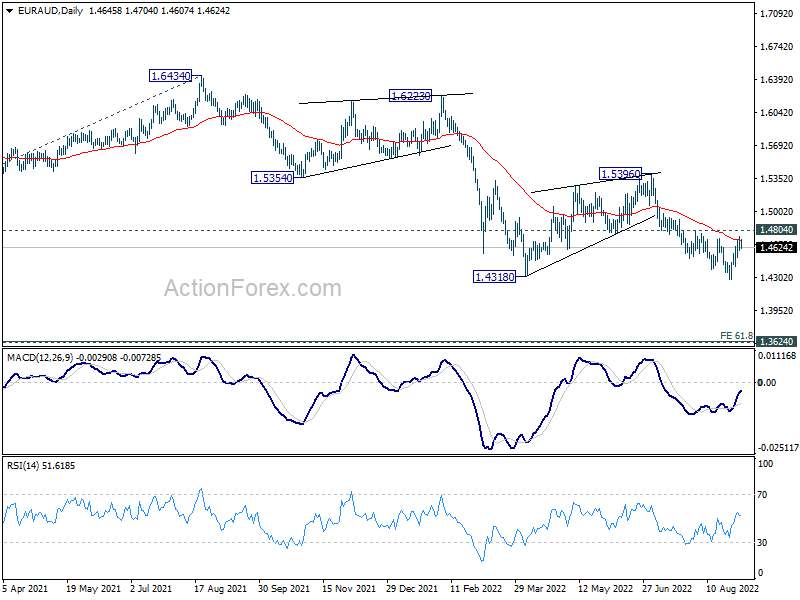
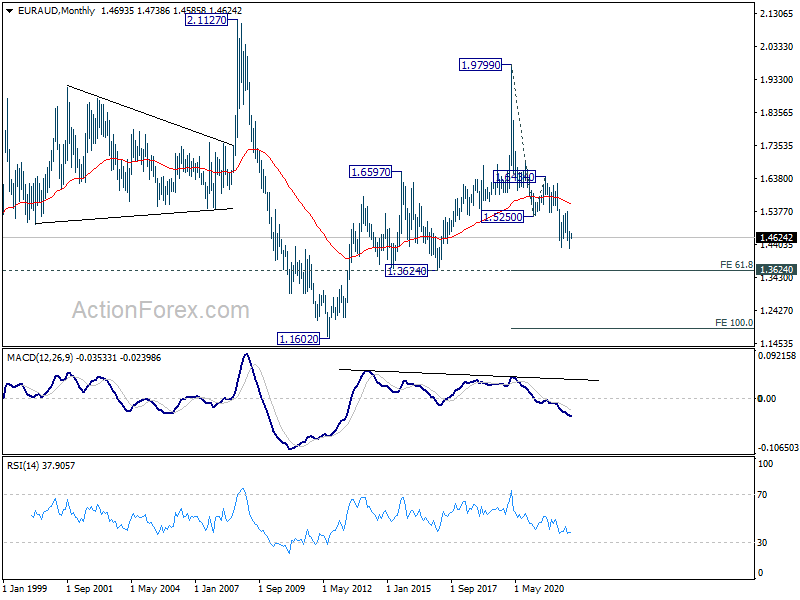
In the longer term picture, fall from 1.9799 (2020 high) is seen as the third leg of the pattern from 2.1127 (2008 high). Deeper fall should be seen to 1.3624 support. Decisive break there would pave the way back to 1.1602 (2012 low). This will remain the favored case as long as 55 month EMA (now at 1.5656) holds.
EUR/CHF Weekly Outlook
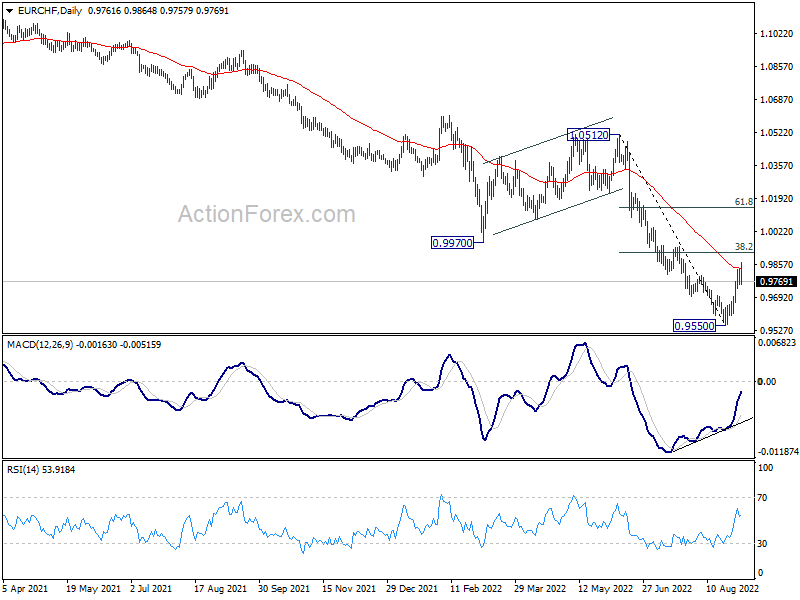
EUR/CHF's rebound last week indicates that 0.9550 was already a short term bottom. Yet, such rebound is seen as a corrective move for now. While further rise cannot be ruled out, upside should be limited by 38.2% retracement of 1.0512 to 0.9550 at 0.9917 to bring down trend resumption. On the downside, below 0.9696 minor support will turn bias back to the downside for retesting 0.9550 low.
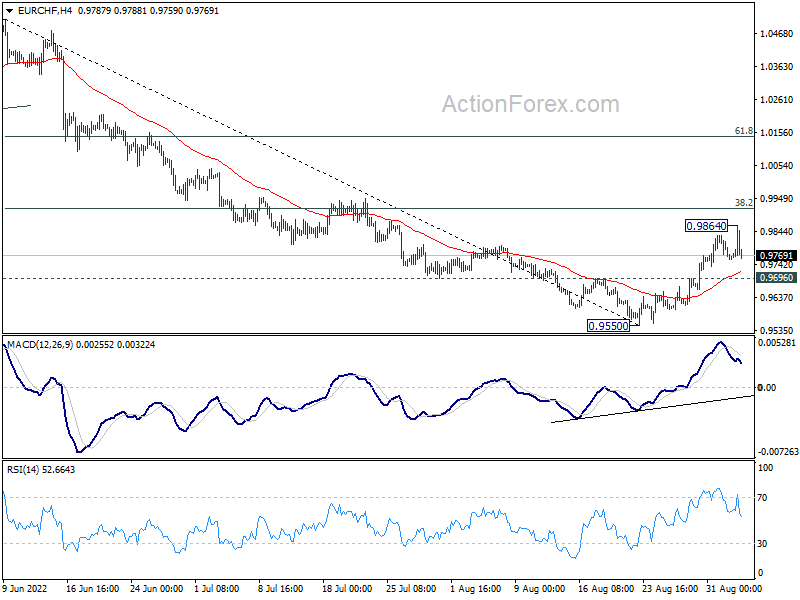
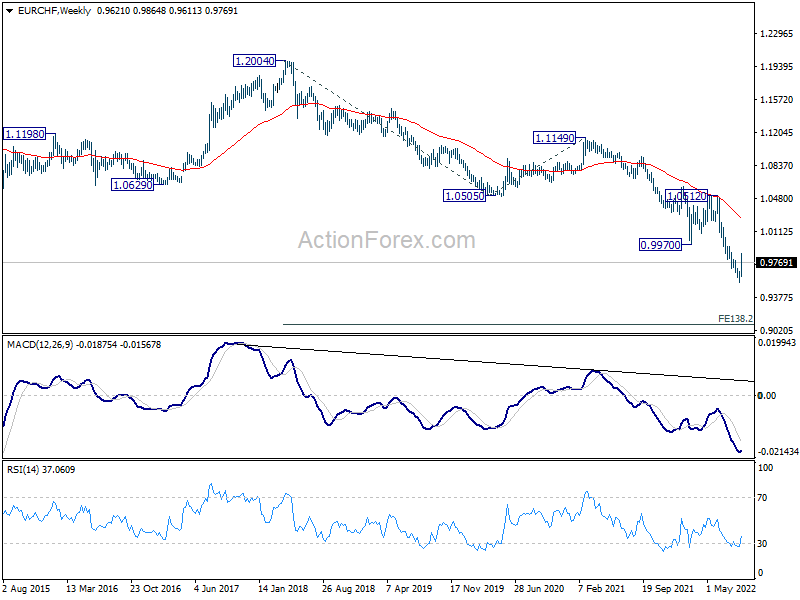
In the bigger picture, long term down trend from 1.2004 (2018 high) is still in progress. Next target is 138.2% projection of 1.2004 to 1.0505 to 1.1149 at 0.9033. On the upside, break of 0.9970 support turned resistance is needed to be the first sign of medium term bottoming. Otherwise, outlook will stay bearish in case of strong rebound.
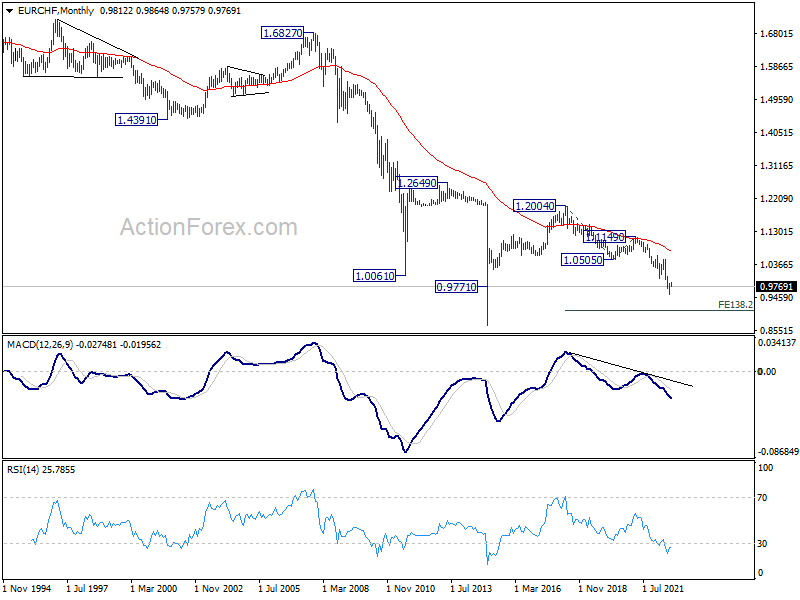
In the long term picture, capped below 55 month EMA, EUR/CHF is seen as extending the multi-decade down trend. There is no prospect of a bullish reversal until firm break of 1.0505 support (2020 low).
Summary 9/5 – 9/9
Monday, Sep 5, 2022
[php_everywhere instance="1"]
Tuesday, Sep 6, 2022
[php_everywhere instance="2"]
Wednesday, Sep 7, 2022
[php_everywhere instance="3"]
Thursday, Sep 8, 2022
[php_everywhere instance="4"]
Friday, Sep 9, 2022
[php_everywhere instance="5"]
Weekly Economic & Financial Commentary: Labor Market Report Complicates FOMC’s Decision on September 21
Summary
United States: August Rush
- Employers added 315K new names to their payrolls in August, but there were an additional 786K people looking for work. Amid such a rush into the labor market, the unemployment rate rose to 3.7%. More job seekers also lifted the participation rate to 62.4% and thus easing some tightness in the labor market even as payrolls expanded.
- Next week: ISM Services (Tue), Trade (Tue), Jobless Claims (Fri)
International: Eurozone Inflation Sets New Record; Canada Chugs Along
- Consumer price inflation in the Eurozone rose to an all-time high yet again in August. Headline CPI quickened to 9.1% year-over-year, while the core measure accelerated to 4.3%. Elsewhere, Canada's economy grew moderately in Q2, with GDP gaining 3.3% (annualized), boosted by solid household and business spending, high commodity prices and a resurgence of growth after COVID lockdowns were lifted.
- Next week: Reserve Bank of Australia (Tue), Bank of Canada (Wed), European Central Bank (Thu)
Interest Rate Watch: Labor Market Report Complicates FOMC's Decision on September 21
- The labor market report for August, which showed a rise in the unemployment rate and moderation in wage pressures, takes some heat off of the FOMC to hike rates by 75 bps on September 21. But CPI data for August, which will be released on September 13, will be crucial in determining how much the committee tightens later this month.
Credit Market Insights: Mississippi Flooding Puts Munis and Infrastructure in the Spotlight
- Record-breaking rainfall dropped more than a foot of rain across the state of Mississippi over the past week. As the water continues to recede, Jackson, the capital of Mississippi, has seen an ongoing issue with municipal water turn into a crisis as more than 180,000 residents are left without clean water for an indefinite period. We examine investment in infrastructure and municipal bonds.
Week Ahead – Rate Hikes Keep Coming
US
The countdown to the September 13 inflation report begins as investors fixate over a wrath of Fed speak, with special attention going towards Chair Powell’s Thursday discussion on monetary policy.
It is a slow start to the trading week as US markets are closed on Monday for Labor Day. Tuesday contains the release of the August ISM services index. Service sector activity is expected to show a modest decline but remain in expansion territory. US trade data will be released on Wednesday, but most of the attention will fall on Lael Brainard’s speech on the economic outlook and the release of the Fed’s Beige Book. Michael Barr will also speak on financial system fairness. Powell’s speech on Thursday could be massive as it will be his first time speaking since the Jackson Hole Symposium. Wall Street is keeping a close eye on initial jobless claims as we still have yet to see any signs of trouble with the labor market as layoffs remain low. Friday’s Fed speak contains appearances by Charles Evans and Christopher Waller.
Earnings season is finishing up, but stocks will definitely remain in focus as more investors are becoming bearish. Apple’s launch event could be huge as they will unveil the iPhone 14 lineup and the next round of smartwatches.
EU
There’s no doubt about what the focus next week will be; the only question on everyone’s mind is will it be 50 basis points or 75? Markets are increasingly favouring the latter despite the ECB previously hinting at the former. That said, prior to the July meeting they effectively told everyone the first hike would be 25 basis points before opting for 50 so we can probably take things with a pinch of salt for now. Other than that, there’s a selection of tier two and three data including final services PMIs, retail sales and revised GDP.
UK
The UK is heading for a recession, one the Bank of England has seen coming for a long time. When it released its forecasts in August, they looked quite shocking. Since then, expectations have lowered further which will make the Monetary Policy Report Hearing on Wednesday all the more interesting.
That aside, we’ll hear from Catherine Mann on Monday and then it’s mostly tier two and three data including final services PMI, construction PMI and consumer inflation expectations.
Russia
Swift action by the CBR after the invasion meant that not only is inflation not the problem many expected it to be, but the central bank has actually been able to cut interest rates below where they were before in order to try and support the economy. CPI data next week could tell us how much further room the central bank has to cut and ease pressure on the currency.
South Africa
A relatively quiet week with GDP data on Tuesday the only major release. Regardless of the number, a large rate hike, perhaps 75 basis points, is likely on the cards in a few weeks.
Turkey
Inflation is expected to surpass 80% shortly after the CBRT decided to continue its easing cycle with a 1% rate cut to 13%. With the central bank refusing to accept responsibility for soaring inflation, the sky’s the limit.
Switzerland
Data last week showed inflation accelerating faster than expected, increasing pressure on the SNB to hike more forcefully. Barring an inter-meeting hike, the focus next week will be on the GDP and unemployment data.
China
This will be a busy week in China as investors keep a close eye on the Chengdu shutdowns and a wrath of economic data that could confirm the trend of weakening economic activity. FX traders are also closely monitoring the yuan and the possible breach of the 7-handle.
China’s trade data could provide more information on how quickly demand is weakening. Both imports and exports are expected to soften, while government stimulus should provide a boost for aggregate social financing.
India
Next week brings the services PMI reading for August. Strong economic data releases will allow the RBI to hike rates even further.
Australia & New Zealand
The greenback’s relentless rally has taken the Australian dollar and kiwi to seven-week lows. The global bond market selloff is being led by a surge in Treasury yields and that’s kept the interest rate differential widely in the greenback’s favour. This week a wrath of economic releases will take a backseat to the RBA rate decision. The RBA may downshift to a slower pace of tightening with only a 25 basis point rate increase. The bank has raised rates by 175 basis points over the last four meetings, but given the grim outlook, a smaller rate hike could be justified. At the beginning of the week, Australia will release services PMI data, inflation readings, ANZ job advertisements, and current account data. Second quarter GDP is expected to show a slight improvement and will be released after the RBA decision.
Economic releases and speeches will be limited for New Zealand. RBNZ Assistant Governor Silk will speak on Wednesday. The ANZ commodity price index for August will be released on Monday. A few other third-tier economic releases will also come out in the latter part of the week.
Japan
The divergence in monetary policy between the Fed and the Bank of Japan may continue to drive the yen’s depreciation against the dollar. The Japanese yen has been struggling as central banks globally remain very hawkish in fighting inflation. The BOJ may need a slight change to their policy which could eventually lead to the abandoning of Yield Curve Control (YCC), but that would require a major reversal of BOJ Gov Kuroda’s decade-long stance of super loose policy.
Several important economic indicators will be released over the next week including the services PMI, household spending, the final reading of second-quarter GDP, current account, bank lending, and the eco watchers survey.
Singapore
There are no major data or risk events in Singapore next week. The Singapore dollar is gaining a lot of attention on Wall Street as many big banks anticipate that Singapore’s central bank (MAS) will extend policy tightening.
Economic Calendar
Saturday, Sept. 3
Economic Events
- Global energy crisis in focus as the Nord Stream 1 gas pipeline is scheduled to reopen after Russia’s unscheduled maintenance
Sunday, Sept. 4
- No major economic events scheduled
Monday, Sept. 5
Economic Data/Events
- US markets closed for Labor Day
- New UK PM is announced
- Thailand CPI
- Singapore global PMI, retail sales
- India services PMI
- Australia inflation gauge, job advertisements, inventories, services PMI
- China Caixin services PMI
- Eurozone retail sales, services PMI
- Japan PMI
- New Zealand commodity prices
- Switzerland GDP
- Taiwan foreign reserves
- OPEC+ meeting on output
- Ukrainian PM Shmyhal attends the EU-Ukraine Association Council meeting in Brussels
- BOE Monetary Policy Committee member Mann speaks
- UK Finance publishes its quarterly household finance review of activity
Tuesday, Sept. 6
Economic Data/Events
- RBA rate decision: Expected to raise interest rates by 50bp to 2.35%
- Australia BoP
- Germany factory orders
- Japan household spending
- Mexico international reserves
- South Africa GDP
- US primary elections scheduled in Massachusetts
Wednesday, Sept. 7
Economic Data/Events
- US trade
- Fed Vice Chair for Supervision Barr speaks at an event hosted by the Brookings Institution
- Cleveland Fed President Loretta Mester speaks on Market News International webcast
- The Fed releases its Beige Book of regional economic activity
- Eurozone GDP
- Australia GDP, foreign reserves
- Canada rate decision: Expected to raise interest rates by 75bps to 3.25%
- Poland rate decision: Expected to raise interest rates by 25bps to 6.75%
- Germany industrial production
- China trade, foreign reserves
- Singapore reserves
- Japan leading index, coincident index
- Apple event, dubbed “Far Out” is expected to feature new iPhones and Apple watches
- BOE Governor Bailey appears before the Treasury Committee
Thursday, Sept. 8
Economic Data/Events
- ECB rate decision: Expected to raise rates by 50bps to 1.00%
- US initial jobless claims
- Fed’s Powell speaks at Cato Institute
- Mexico CPI
- Australia trade
- France trade
- Japan GDP, BoP
- New Zealand manufacturing activity
- South Africa current account, manufacturing production
- Thailand consumer confidence
- Chicago Fed President Evans President speak at College of DuPage economic forum
- Federal Reserve Bank of Minneapolis President Kashkari speaks at the “Toward an Inclusive Recovery” virtual event
- RBA Governor Lowe speaks at the annual Anika Foundation lunch in Sydney
- EIA crude oil inventory report
Friday, Sept. 9
Economic Data/Events
- US wholesale inventories
- Russia CPI, GDP
- France industrial production
- Mexico industrial production
- Canada unemployment
- China CPI, PPI, aggregate financing, money supply, new yuan loans
- Japan money stock
- New Zealand truckometer heavy traffic index, card spending
- Thailand foreign reserves, forward contracts
- EU energy ministers extraordinary meeting to tackle energy crisis in Brussels
- President Biden travels to the new Intel facility in Ohio to discuss the Chips Act
Sovereign Rating Updates
- Finland (Fitch)
- Netherlands (Fitch)
- Norway (S&P)
- Portugal (S&P)
- Ukraine (S&P)
The Weekly Bottom Line: Canada – Full Steam Ahead to Hike Rates
U.S. Highlights
- A strong week for economic data as the ISM manufacturing index and the payrolls report surprised to the upside.
- The details of both reports showed improvements on the supply-side of the economy as falling manufacturer input
- prices and a strong improvement in the labor force shined through.
- The Fed still has its hands full taming inflation, but supply-side improvements could make the job much easier.
Canadian Highlights
- GDP missed expectations but is still running above trend as households continue to consume.
- Household savings came down in the second quarter but is still elevated compared to pre-pandemic levels.
- Based on the recent national accounts data, the Canadian economy is still in a period of excess demand and further rate hikes will be needed next week from the Bank of Canada.
U.S. - Good News on Aggregate Supply
Markets continued to sell off this week as better than expected data dimmed the hopes of a 50-basis point hike by the Fed at its upcoming September meeting. However, there were some reassuring signals in the ISM manufacturing report and the household employment survey that the supply-side of the economy continues to improve and may help moderate inflation. The Fed will continue its hiking cycle, but the supply-side improvements might just make the job of taming inflation a bit easier.
Tuesday’s solid job openings data from the JOLTS survey grabbed headlines. Private openings in July were north of 10 million. Though sky high job openings have become the norm, they are remarkable relative to history and represent the scale of the problem the Fed is looking to solve. To tame inflation, officials are hoping to lower the rate of job openings, without meaningfully raising the unemployment rate. There is little historical precedent for this, but there is also little modern historical precedent for what has transpired in the economy over the past two years. Nonetheless, with job openings still high, the labor market is signaling that employment demand remained robust in July despite rising interest rates.
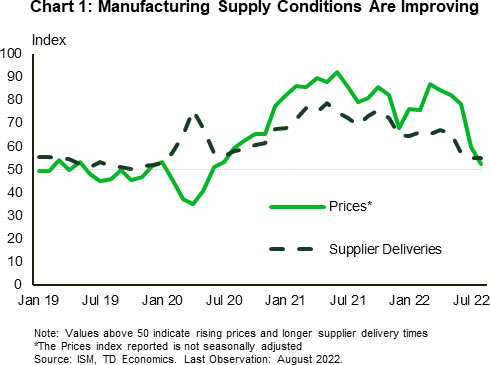
The good economic news continued yesterday as the ISM manufacturing index surprised to the upside in August, registering a healthy 52.8 print. Growth and production were notably slower than earlier in the recovery, but this was to be expected as the economy continues to operate in excess demand territory. The details in the report were also strong. New orders flipped back to growth and employment was up for the month. For the Fed, there was good news on supply chains as the supplier delivery index was unchanged and input price growth eased to its lowest rate since the summer of 2020 [Chart 1].
All of this was a buildup to today’s employment report. Consensus expectations were for nearly 300k new jobs, a print that would register as “good” during any expansion, let alone one that has featured so little bounce-back in the participation rate. Well, the data came in slightly better than expected, with payrolls adding 312k jobs, but it was the household report that had some positive elements. August showed that there was finally a large movement of people back into the labor force, 786k to be exact [Chart 2]. This helped lift the participation rate 0.3 percentage points, to 62.4% and brought some much-needed supply to the labor market. As the labor force expanded faster than employment, the unemployment rate rose to 3.7%. With just a bit more labor supply, average weekly wages moderated to 0.3% month-on-month, from 0.5% the month prior.
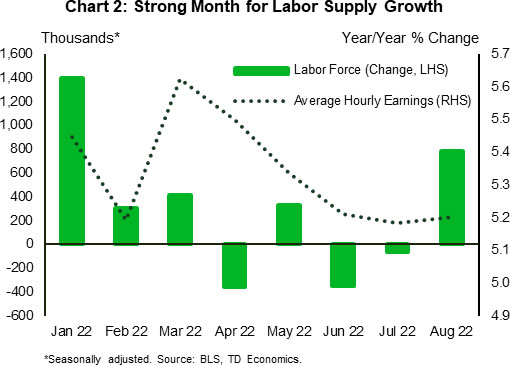
The Fed will see this report as good news. The drum-tight labor market is a key factor in setting wage expectations, and with more workers coming in off the sidelines, it means just a bit less wage pressure. That said, labor markets remain tight as wage growth is still at 5.2% year-on-year, and inflation is still persistently high. The Fed will continue to raise rates to fight inflation, but this week’s data suggest that some of the supply-side factors behind current price growth are finally starting to abate.
Canada - Full Steam Ahead to Hike Rates
All eyes were on GDP numbers this week ahead of the Bank of Canada's interest rate announcement on September 7th. Canada's second quarter GDP numbers came in at 3.3% quarter-on-quarter annualized growth (q/q), and although this was lower than expected, it is still running above trend and outperforming our global counterparts. Though there are signs of slowing ahead, this GDP report justifies the sentiment in the Bank of Canada's most recent Monetary Policy Report that the economy is in excess demand and will require further interest rate hikes. Reflecting this expectation, bond yields rose with the Canada 2-year yield reaching a high of 3.7%, the highest level in 14 years.
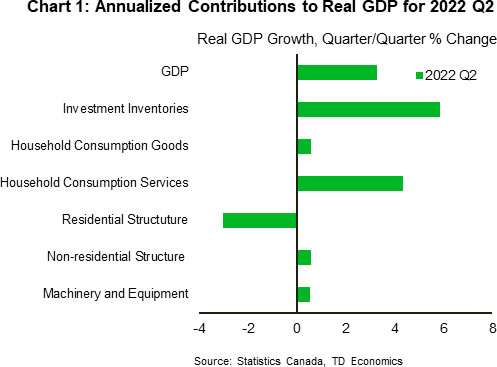
Second quarter Canadian growth was led by strong household consumption, non-residential investment, and inventories (Chart 1). Canadian consumers increased spending by 9.7% q/q, with consumption in services as the key driver (16.4% q/q). This reflected strength in the reopening of the economy post covid lockdowns and the pivot away from goods towards services. Also bolstering growth was non-residential investment in structures (11.1% q/q), as well as machinery and equipment (19.3% q/q). This was powered by the expansion of oil and gas sector companies in western provinces which are capitalizing on higher energy prices. On the flip side, growth in residential structures pulled back significantly (-27.6% q/q), reflecting the impact of the Bank of Canada's aggressive rate hiking cycle. Indeed, in our latest Canadian Housing Outlook report we note that national Canadian home prices in the second quarter have declined by 9% q/q and have room to fall further. This is likely to weigh on residential investment, which will exert downward pressure on GDP growth going forward.
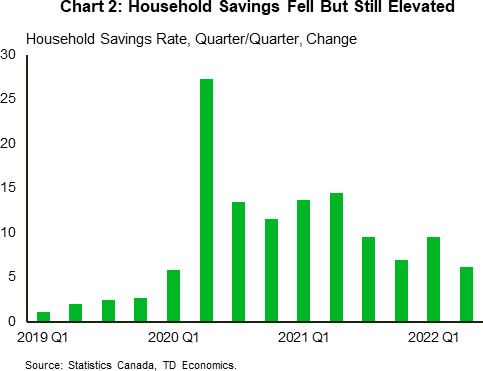
Though real GDP was lower than what most forecasters were expecting, growth in nominal GDP rose to 18% q/q, up from 16% q/q in the first quarter. This drove nominal household disposable income in the second quarter (3.9%), with wages and salaries rising 7.8%. With this income gain, combined with still elevated household consumption, the savings rate came down to 6.2% from 9.5% (Chart 2). With inflation likely to stay high and interest rates set to increase further, we expect that consumers are re-evaluating their spending patterns, which could cause a further fall in the savings rate next quarter.
With this GDP report in its back pocket, we expect the Bank of Canada to continue to raise rates next week, with 50 basis points being the floor, as markets are already pricing in a 75-basis points hike. It is clear that the economy is still operating well beyond excess capacity and is in need of higher interest rates in order to cool current inflationary pressures.
Will Another 50bps Hike by the RBA Lift the Aussie?
With the Australian economy performing relatively well compared to others and inflation rising to its highest in 21 years, the Reserve Bank of Australia (RBA) is all but certain to hike interest rates when it meets on Tuesday, with the decision scheduled to be announced at 04:30 GMT. That said, the big questions on investors’ minds are by how much will officials raise rates, and what could that mean for the Australian dollar.
RBA signals willingness to hike more
At its latest gathering, the RBA decided to lift its cash rate by 50bps, adding that it will take further steps in normalizing monetary conditions, by emphasizing its priority of bringing back inflation to the 2-3% target range, while keeping the economy on an even keel.
This makes it crystal clear that they will most probably raise rates again on Tuesday, but to get an idea with regards to how much, one must dig into their own forecasts. Their latest projections suggest that inflation will continue rising this year, slowing to a little above 4% in 2023, and touching the upper bound of their target range in 2024. Combined with the fact that they expect their economy to continue growing strongly this year, they may not hesitate to hike by another half percentage point.
Can another 50bps help the aussie?
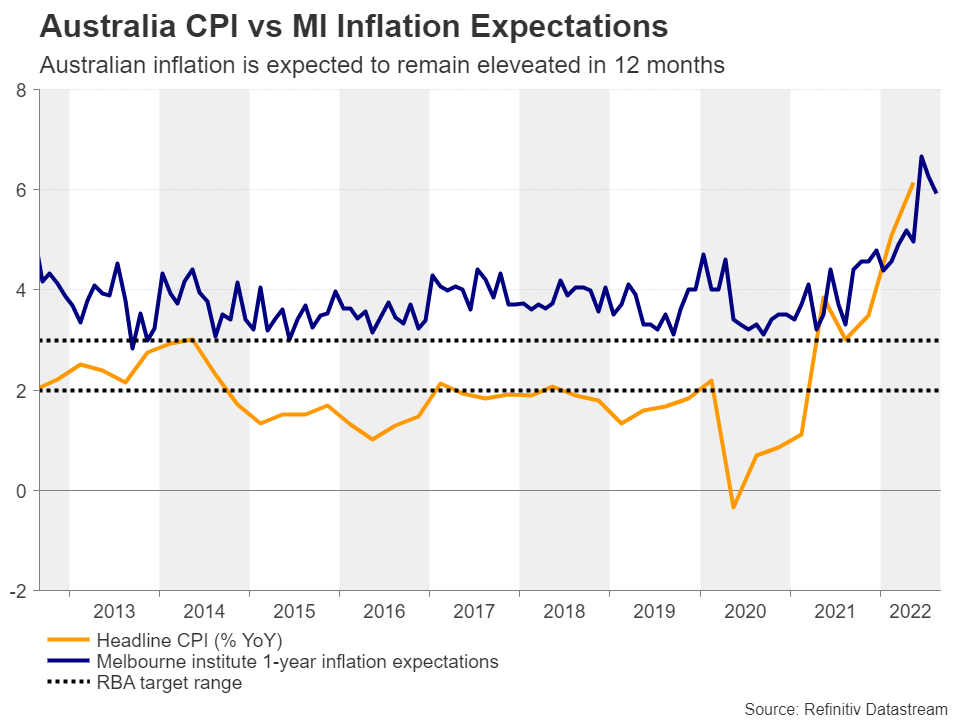
This is what the majority of market participants believe as well, as they assign a nearly 65% probability for such an action, with the remaining 35% pointing to a quarter-point increase. Indeed, with the headline CPI rising to 6.1% in Q2, and the Melbourne Institute projecting that it will stay near those levels in a year’s time, a 50bps hike may be even more likely than the aforementioned probability suggests.
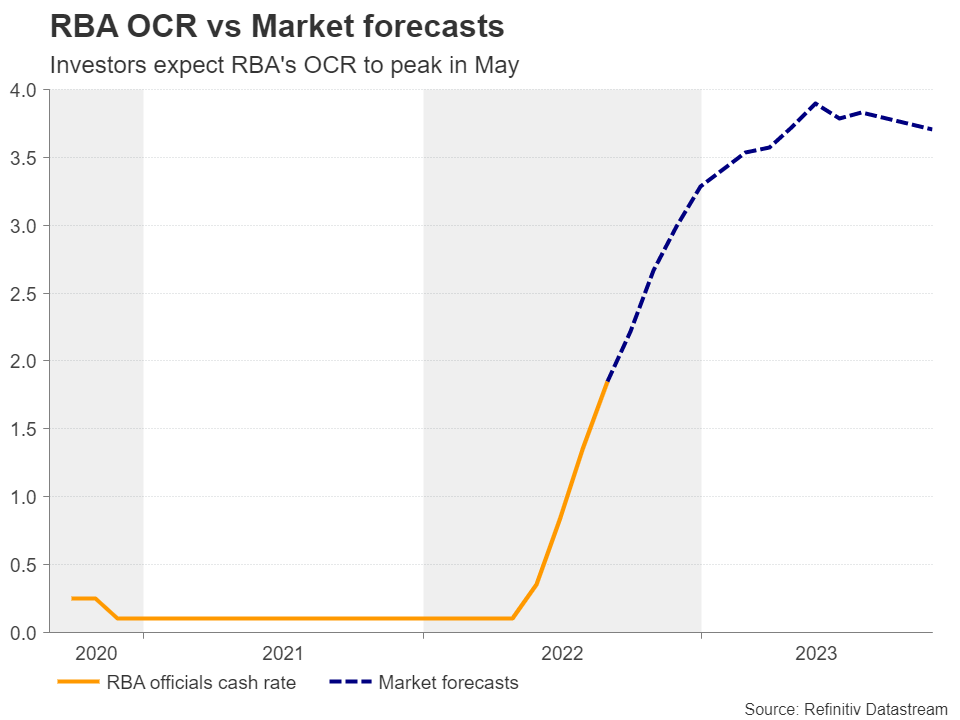
A double hike could lift somewhat the Australian dollar but not much, as this seems to be the base-case scenario. Traders may place more emphasis on the accompanying statement for clues as to how the Bank is planning to move forwards, even if it does not publish updated economic projections this month. Although investors expect another half-point hike on Tuesday, they forecast a path of quarter-point increments from there onwards, and they see a peak at around 3.9% in May. Therefore, for the aussie to gain notably, the Bank may have to appear brave enough to continue with a few more double hikes.
Yet, in a risk-averse environment, the risk-linked aussie may find it hard to sustain any gains against its US counterpart. Not only does the Fed appear to be more aggressive than the RBA, but China’s economic risks amid a resurgence of COVID and a battered property sector are adding to fears over a global recession. China is Australia’s main trading partner, which makes the aforementioned risks more severe for the Australian currency.
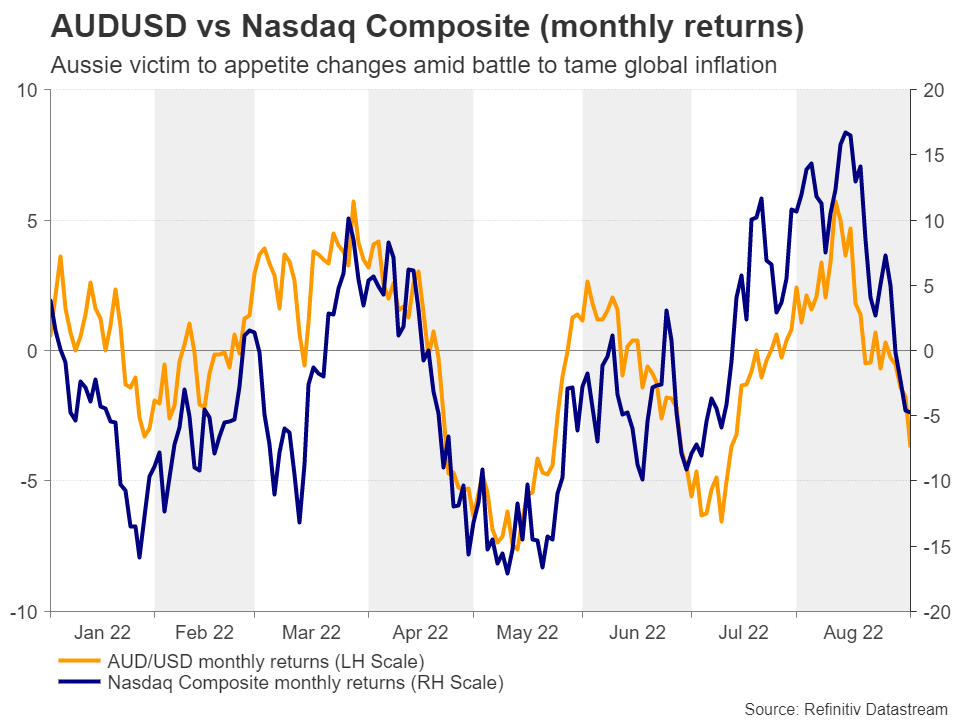
Hard to beat US dollar, but not yen, euro, and pound
Aussie/dollar could rebound above 0.6860 in case of a double hike, but any recovery may remain limited near the high of August 26, at 0.7010. The bears could take charge from there and aim for the 0.6680 territory, defined as a support by the low of July 14. A break lower would confirm a lower low on bigger timeframes and perhaps target the psychological area of 0.6500, which marks the low of May 22, 2020.
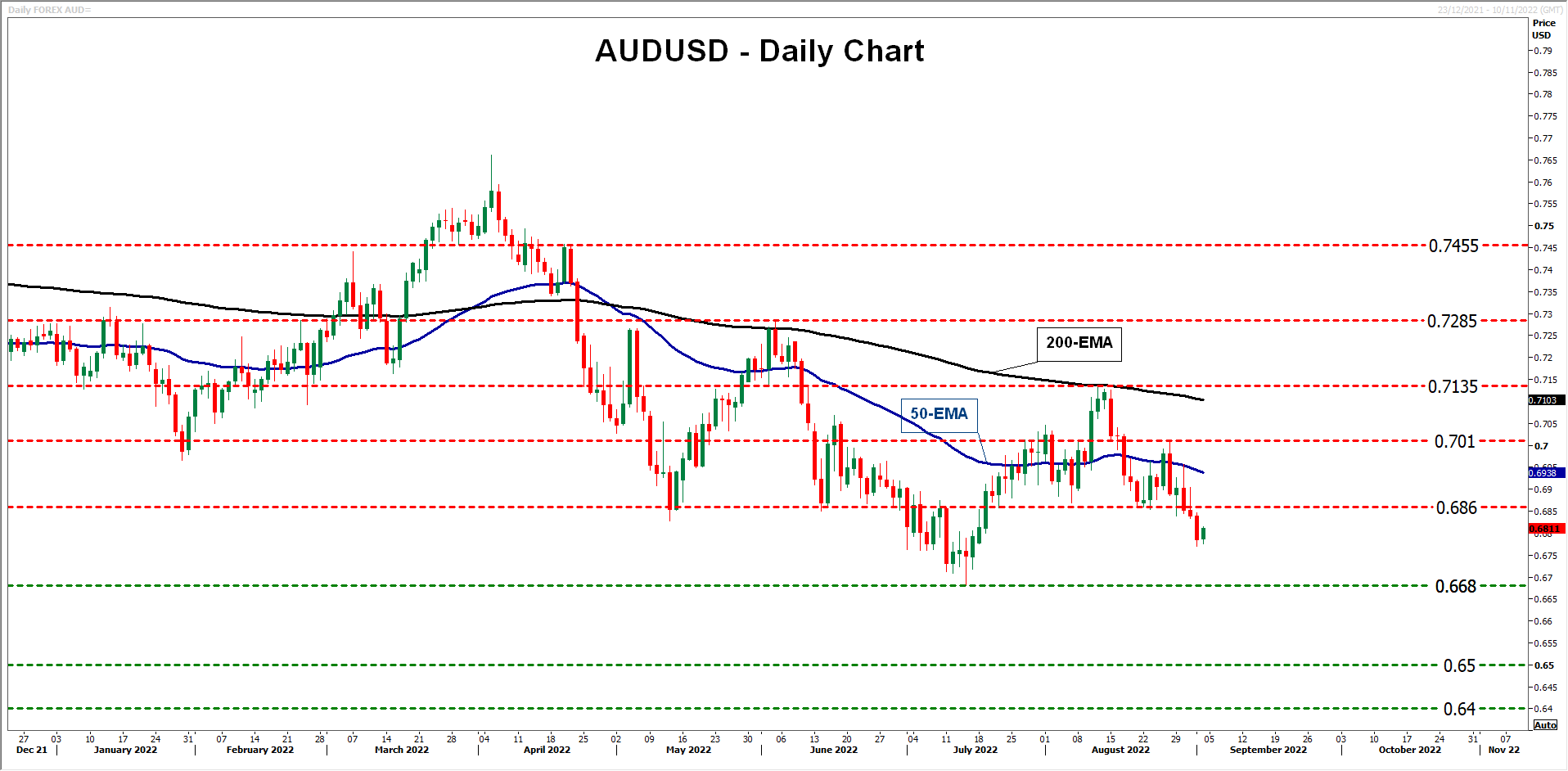
A first sign of a potential reversal may be a break above 0.7135. Aussie/dollar would be above the 200-day EMA and may initially advance towards the high of June 3 at 0.7285. Should the bulls overcome that zone as well, then we could see them marching towards the peak of April 21 at 0.7455.
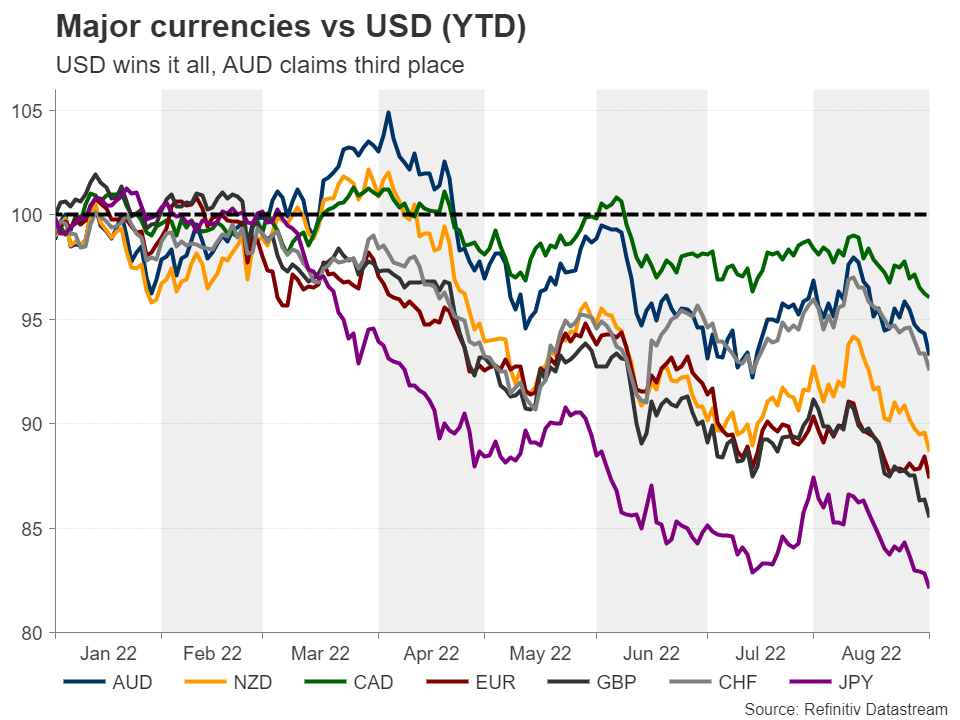
Having said all that though, despite the aussie possibly turning south again against its US counterpart due to risk aversion, it can keep outperforming currencies whose nations are facing bigger recession risks. Those include the euro and the pound, and those whose central banks are stubbornly sticking to an ultra-loose policy, like the yen. After all, year to date, the Australian dollar has been the third best performing currency behind the US and Canadian dollars.
Week Ahead – ECB Decision Highlights Central Bank Trifecta
An action-packed week lies ahead, featuring central bank meetings in the Eurozone, Canada, and Australia, an output decision from the OPEC cartel, and the selection of the next UK prime minister. The ECB will likely steal the show, as policymakers seem prepared to roll out the big guns to defend the sinking euro.
Euro squeeze?
There has been a striking change in tone from the European Central Bank lately. Several officials have stressed the need to raise interest rates forcefully, igniting speculation about a series of shock-and-awe moves, even though business surveys suggest the Eurozone economy is on the verge of recession.
Electricity prices across Europe have spiraled out of control, threatening to kneecap economic growth as consumers and heavy industry get crushed. The catch is that surging prices will also fuel inflationary pressures. It’s a tough spot for the ECB, which has to choose whether the priority is to protect growth or slay inflation.
Their solution is to kill two birds with one stone. Since the Eurozone is a net-importer of energy, a falling euro makes power more expensive, exacerbating the problem. By signaling that they will raise rates with brute force, policymakers are trying to stop the bleeding in the euro, which would help cool inflation and prop up growth.
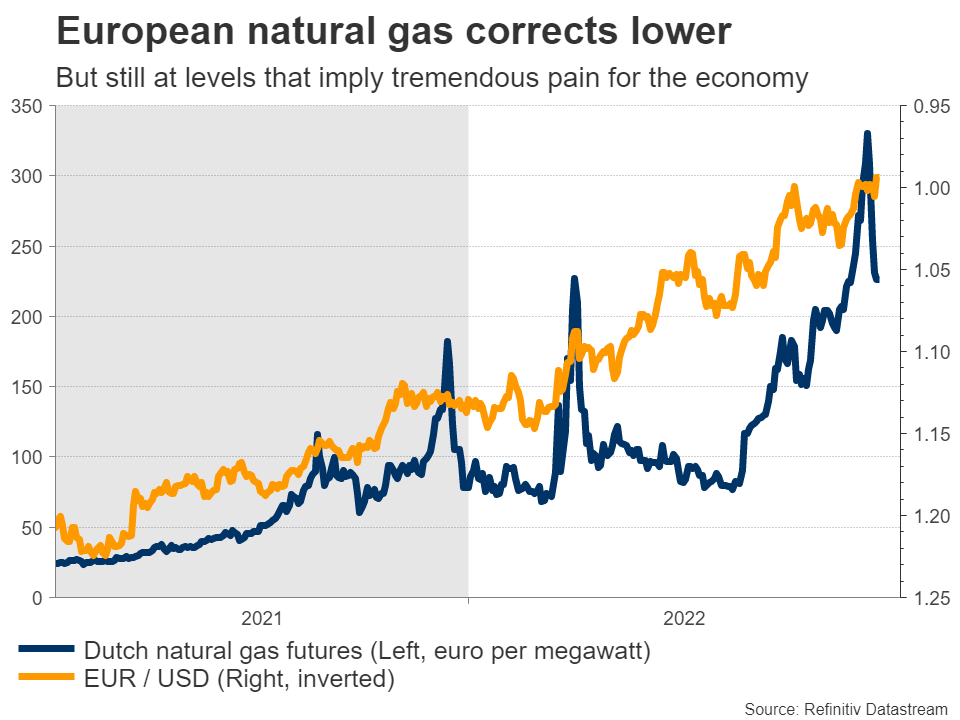
It’s not a perfect solution but it’s something. Allowing the euro to depreciate any further would be catastrophic, so the ECB has to act boldly and defend the currency. Accordingly, markets have priced in around a 80% chance for a three-quarter-point rate increase on Thursday.
Since it is not fully priced in, such a move coupled with some hawkish commentary could boost the euro, triggering a short squeeze rally now that European natural gas prices have also started to cool down. That said, even if euro/dollar rallies all the way up to 1.0370, the downtrend would still be in force.
Bank of Canada and OPEC
Over in Canada, the central bank is widely expected to raise rates by another three-quarters of a percent on Wednesday, something that markets currently assign an 85% probability to.
Faced with a labor market that is essentially at full employment, rampant inflation, and solid growth thanks to oil prices being so elevated, the BoC has been tightening policy at the speed of light. This hike would bring rates to 3.25%, entering restrictive territory.
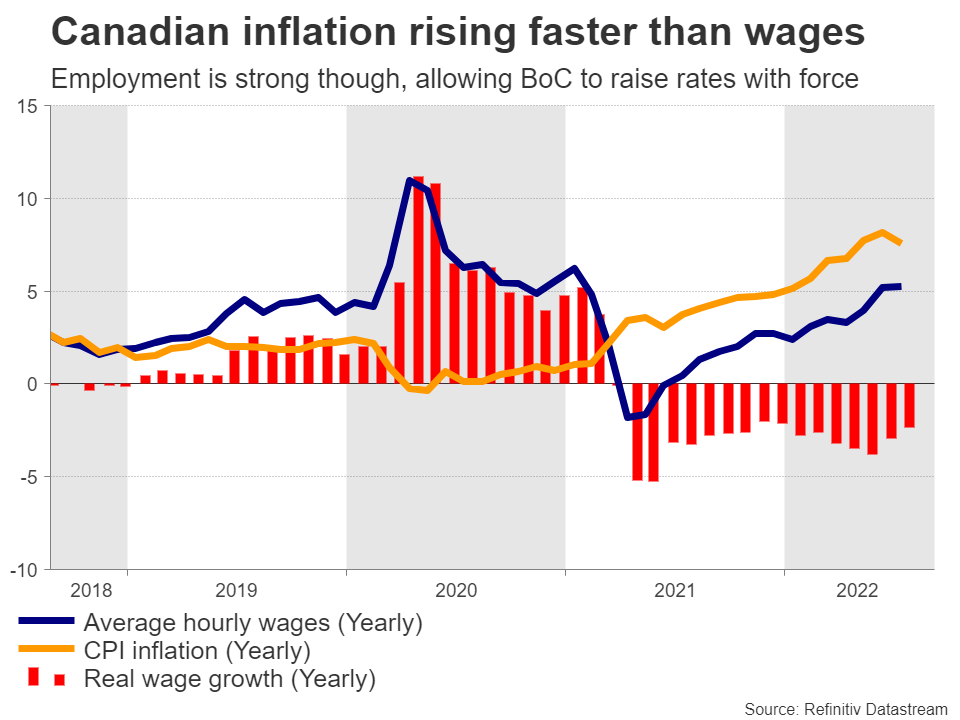
Consequently, the loonie is the second-best performing major currency this year, lagging behind only the almighty US dollar, even despite its sensitivity to volatile stock markets. That said, the risks surrounding the loonie from this meeting seem tilted to the downside.
Having lifted rates into restrictive territory, the BoC could follow in the footsteps of other major central banks and signal that its future moves will depend entirely on incoming data, refusing to pre-commit to any further action. Similar to the Fed, markets might view that as a soft pivot.
Heading into this decision, the loonie will also pay close attention to the OPEC meeting on Monday. The cartel has floated the idea of production cuts to offset the impact of any new barrels from Iran, in case a nuclear deal is reached. However, the market quickly shrugged that off and oil prices reversed lower.
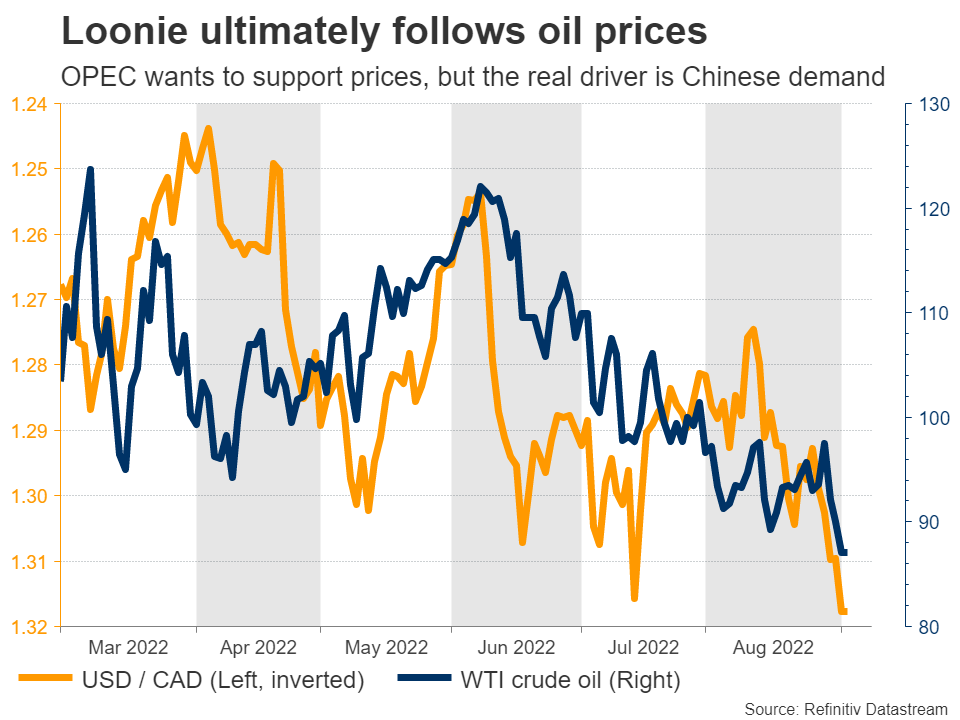
OPEC is already producing far below its quota, so reducing that target might mean little in reality. Instead, the real driver of oil prices will be the demand side of the equation, with China tightening its covid restrictions again.
The week will wrap up with the latest employment report from Canada, out on Friday.
RBA set to lift aussie
Crossing into Australia, the Reserve Bank will conclude its own meeting early on Tuesday. Market participants are leaning towards a half-point rate increase, pricing in almost a 60% probability for such action versus 40% for a smaller, quarter-point move.
From a domestic perspective, there’s no real reason for the RBA to play it cautious. The nation’s unemployment rate is at a record low, consumption is solid, and inflation is firing up. As such, a half-point move seems like the optimal choice, which in turn could boost the Australian dollar.
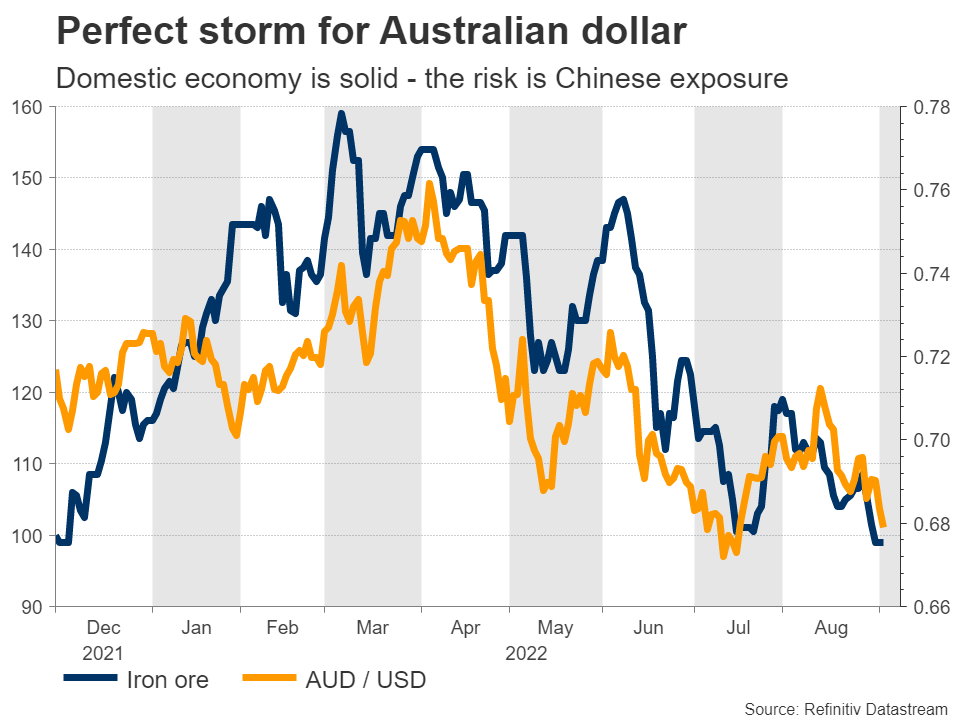
The elephant in the room is China. Australia’s entire economic model relies on China to absorb its commodity exports. With the Chinese property sector in freefall, demand for raw materials is rolling over, which will inevitably impact Australian growth. This risk is hanging over the aussie like a sword, so the overall outlook for the currency seems negative, even if it pops higher after the RBA decision.
On the data front, Australia’s GDP stats for Q2 will be released on Wednesday alongside China’s latest trade numbers. Then on Friday, China’s inflation prints for August will hit the markets.
UK leadership contest
In the United Kingdom, the new leader of the Conservative party and by extension the new prime minister will be announced on Monday. Betting sites suggest foreign secretary Liz Truss is a 10-1 favorite over former chancellor Rishi Sunak, so it seems like a foregone conclusion.
She has vowed to eliminate a planned increase in corporate taxes that would have taken effect next year and reverse a recent increase in national insurance, both of which would add fuel to inflation, putting more pressure on the Bank of England to raise rates.
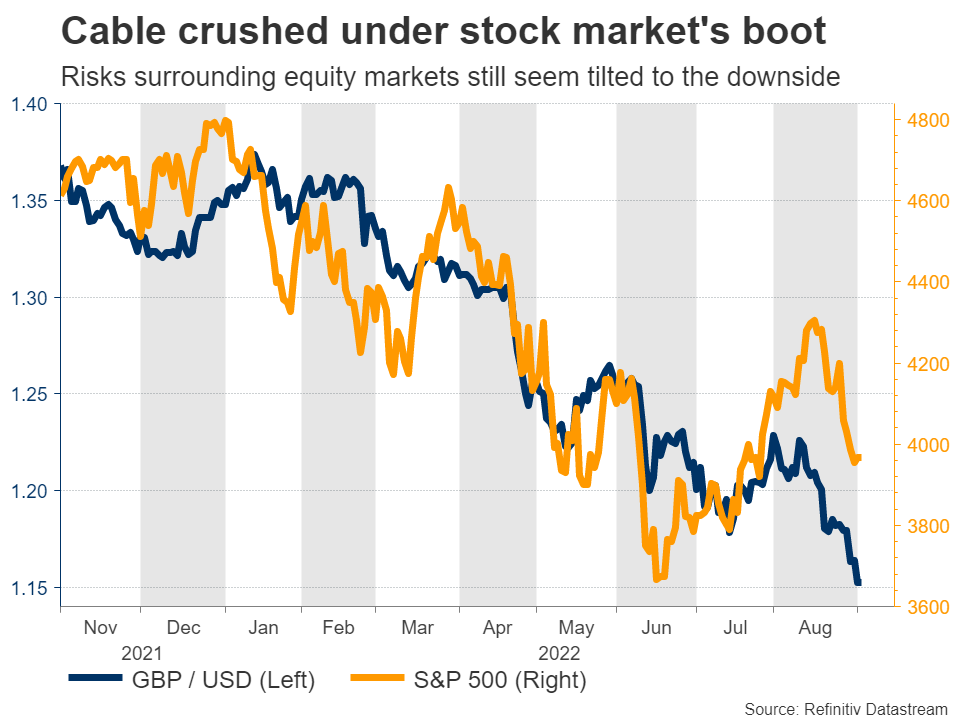
But that might not be enough to rescue the pound, which has been crushed under the boot of a falling stock market. With the Fed committed to keeping rates high until inflation is squashed, the quantitative tightening process doubling in speed this week, and earnings growth already struggling to outpace inflation, there might be more pain on the menu for equities.
Finally in America, Monday is a public holiday, which means US markets will remain closed. The ISM services index for August will follow on Tuesday.
Job’s Not Finished: Bank of Canada to Hike Rates Again
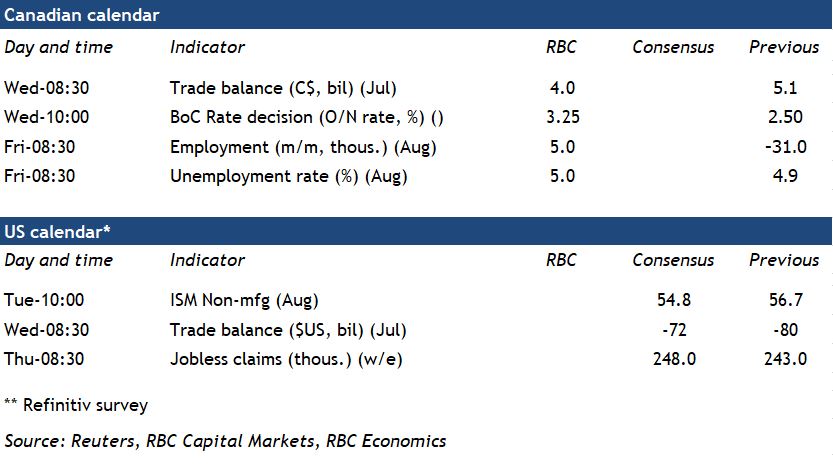
Another hefty 75 bps increase in the overnight rate is what we expect from the Bank of Canada next week. This would take the rate to a restrictive 3.25%, just above the 2% to 3% range the central bank deems “neutral” (the rate at which interest rates are neither adding to nor subtracting from longer-run economic growth trends). And the bank’s commitment to front loading rate hikes in the face of red-hot inflation means an even bigger 100 bps increase (matching July’s hike) can’t be ruled out.
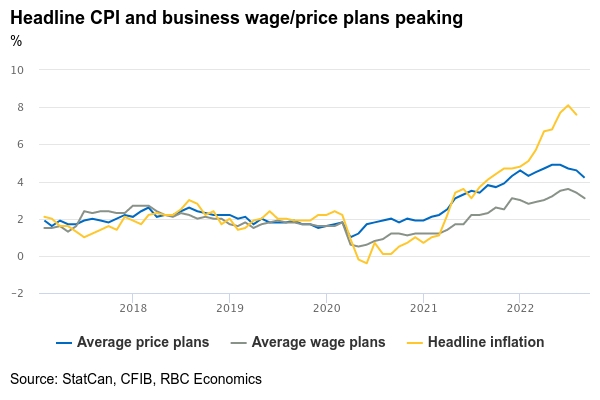
Data releases since the bank’s July meeting have shown marginal improvements. Headline inflation appears to have finally peaked, as have business average wage and price plans, according to Canadian Federation of Independent Business. Global commodity prices turned a corner and supply chain pressures have steadily eased, all of which signal more moderations in inflation trends in the months to come. Home resale markets have also cooled rapidly, following previous rate hikes and rising mortgage borrowing costs.
But at this point, a further softening in household demand is still required to bring inflation back to the bank’s 2% target rate. Labour market conditions are still exceptionally tight—even with softer employment readings in recent months and an expected uptick in the unemployment rate in next week’s August job market numbers. If household demand and inflation pressures wane as expected, the bank could be in a position to halt its tightening cycle soon. Still we expect policymakers to maintain a tightening bias beyond September, and follow up with an additional 25 basis point hike in October, bringing the overnight rate to 3.5%.
Week ahead data watch:
We expect Canadian employment rose by 5,000 jobs in August. This would follow two consecutive monthly declines. These recent sluggish developments stem almost entirely from a lack of available workers, not weakening demand. At over 1 million in June, job vacancies were still well above pre-pandemic levels. We look for an increase in the unemployment rate to 5.0% (which is still very low).
The Canadian merchandise trade surplus likely shrank in July after jumping to $5 billion in June. A 12% drop in oil prices will lower the energy trade surplus.
Weekly Focus -Tightening Talks
Hawkish central bankers: Fed chair Powell struck a fairly hawkish tone in his Jackson Hole speech, signalling that Fed is committed to bringing inflation down even if it requires an extended period of below-trend growth and some weakening in labour market conditions - a message which was also echoed by other FOMC members. ECB seems increasingly ready to follow in the footsteps of the Fed, with discussion of a 75bp rate hike in September gathering pace. Various Governing Council members (including Klaas Knot at our Danske Talks) spoke out in favour of such a move and notably influential ECB member Schnabel gave a hawkish presentation at the Jackson Hole conference, where she argued that a recession and higher unemployment may be needed to bring inflation lower. We have changed our call and now expect a 75bp hike ECB from next week, as inflation risks take precedence over the deteriorating growth outlook (see also Research: New ECB call - We expect 75bp at the meeting next week, 29 August). Both euro area HICP and core inflation rose to new record highs of 9.1% and 4.3%, respectively, in August and with the latest rise in energy commodity prices yet to feed through, an inflation peak is not yet in sight.
Markets roller-coaster: Yields rose across the curve as markets priced in more frontloaded central bank tightening on the back of the coordinated hawkish messages from Jackson Hole, while risk assets saw a setback this week as recession fears intensified. After the surge last week, European gas and electricity prices plunged after the EU said it will intervene in power markets to curtail the strong rise in prices. An emergency meeting of energy ministers on Friday 9 September could bring further clarity on how such a reform, including price caps could look like, although details may take weeks to hash out. EUR/USD started the week by falling below parity, but hawkish ECB comments and the drop in energy prices lent some temporary support to the EUR. We continue to see further downside ahead with a 12M target at 0.95.
The Europe-US divide: The US July JOLTs report provided further evidence of strong labour markets, as job openings rose against expectations to 11.2 million. Consumer confidence rebounded, while near-term inflation expectations eased slightly and ISM manufacturing new orders rebounded back above 50. So far we see little signs of the US being near recession, but we think Fed will be forced to hike the economy into a recession in 2023 (see Research US - Fed continues to guide US economy towards a recession, 1 September). While US data surprised on the upside, the same cannot be said about Europe. Economic sentiment, business climate, service sentiment and industrial sentiment all took a big step lower in August, underscoring the high risk of recession in Europe. Weak PMI readings from Asia during August also suggest challenging times ahead for the European (and global) manufacturing cycle.
Next week: Apart from the ECB meeting on Thursday, energy price developments will remain in focus, in the run up to the EU energy minister meeting on Friday. We will also get clarity whether gas supply through the North Stream 1 pipeline has indeed resumed after the 3 day maintenance period. The final round of the Conservative Party leadership election takes place on Monday with polls largely favouring Liz Truss to become the UKs next Prime Minister (see Research UK - Truss vs Sunak - and why it matters, 2 September).