Sample Category Title
EUR/JPY Breaks Higher
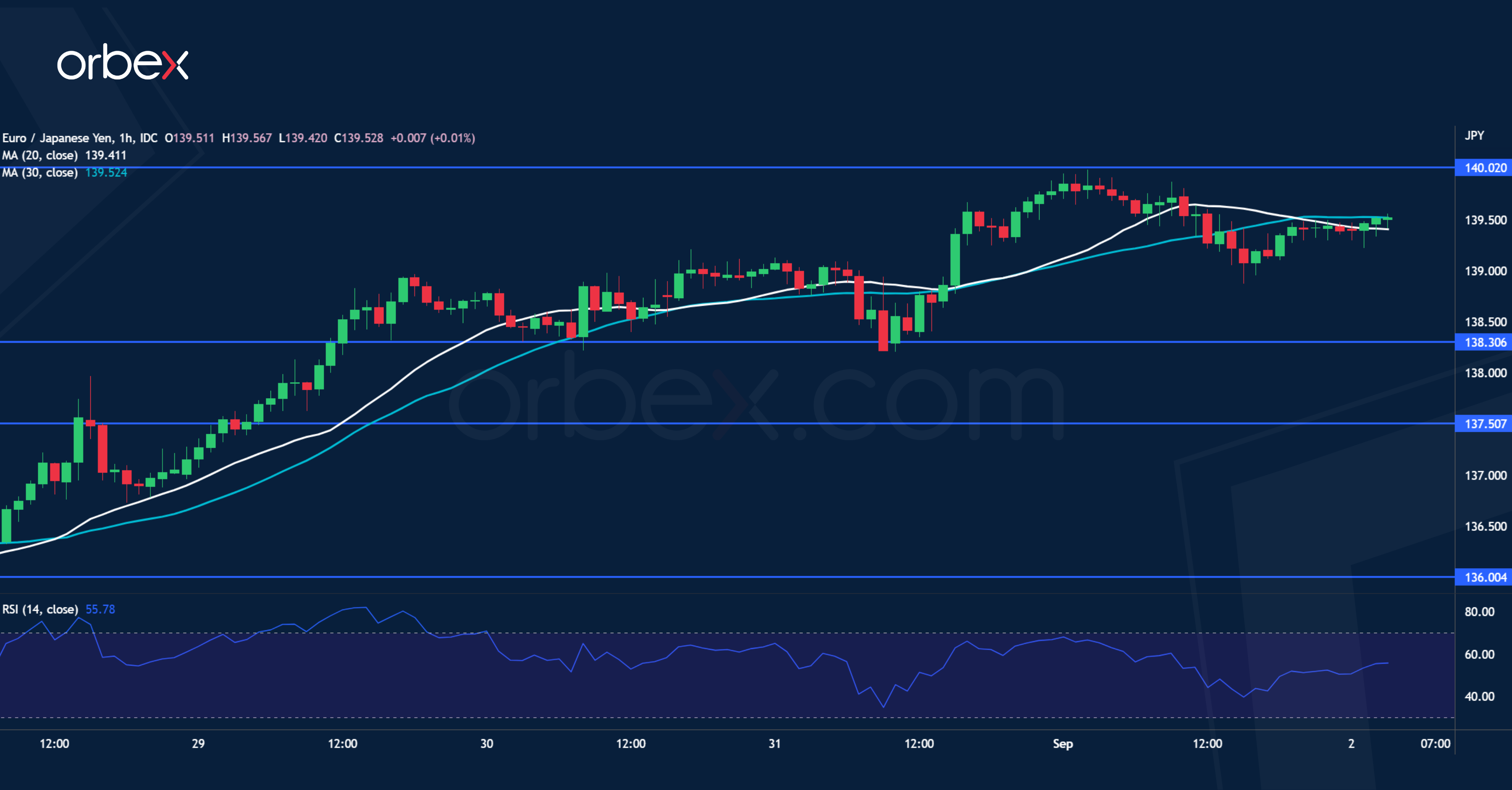
The euro struggles over weaker manufacturing activity across the bloc. A bullish MA cross on the daily chart suggests an improvement in sentiment after the pair bounced off 133.50. The price has consolidated its latest gains after clearing the supply zone around 138.30 and the latter has become a fresh support. The psychological level of 140.00 caused some profit-taking but the directional bias remains up and could attract more follow-ups. July’s high at 142.20 could be the next target when momentum picks up again.
NZD/USD Continues Lower
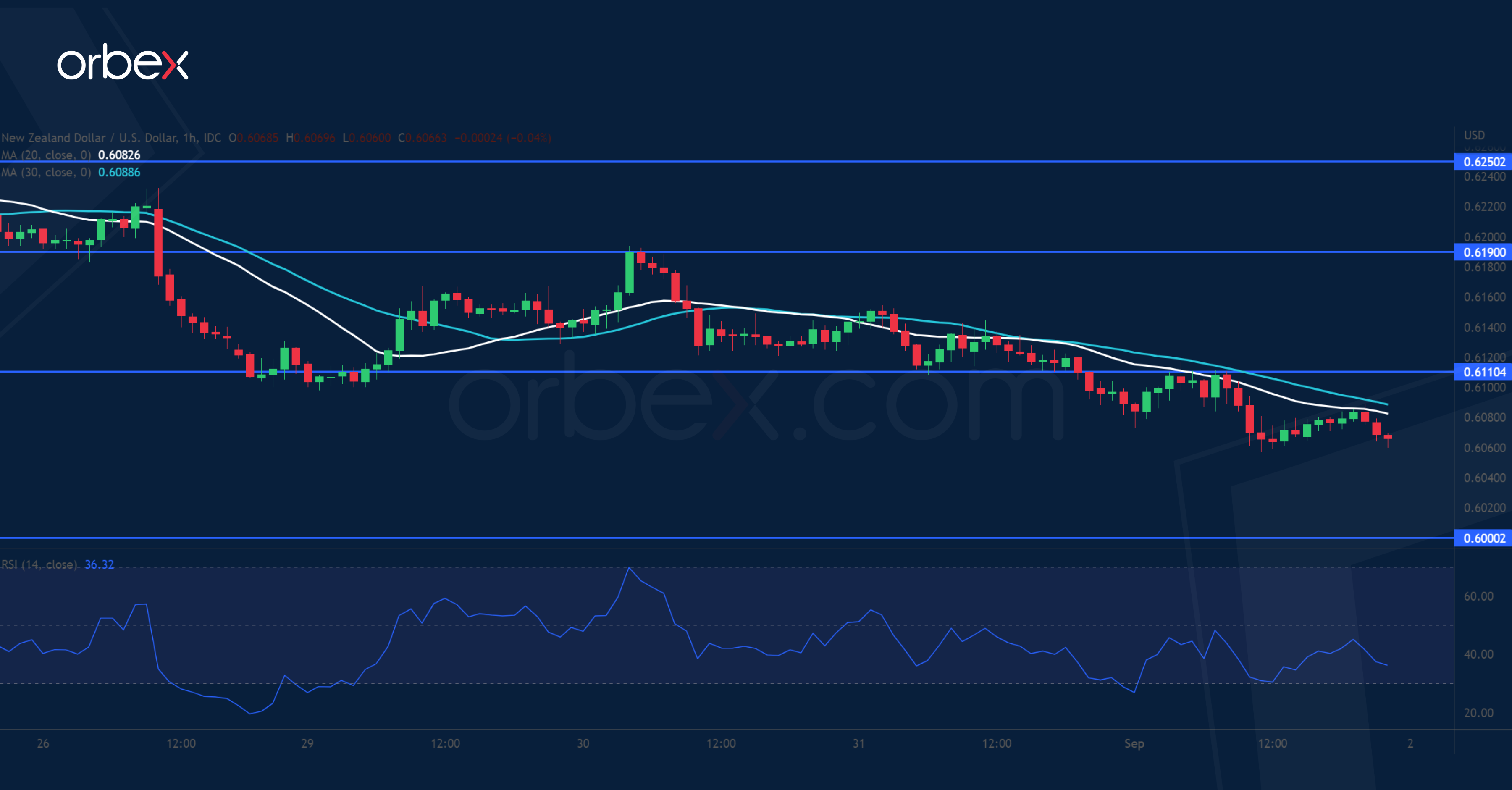
The New Zealand dollar softens as risk appetite continues to subside. A bearish MA cross on the daily chart points to an acceleration to the downside. A short-lived bounce to 0.6190 indicates strong headwinds. The bulls would need to reclaim 0.6250 before a sustained recovery could materialise. Otherwise, 0.6060 at July’s low is a critical floor and its breach could trigger a bearish continuation, sending the pair towards the psychological level of 0.6000. 0.6110 is the first resistance where trend followers may look to sell.
EUR/USD Pair is Consolidating Losses from $0.9910
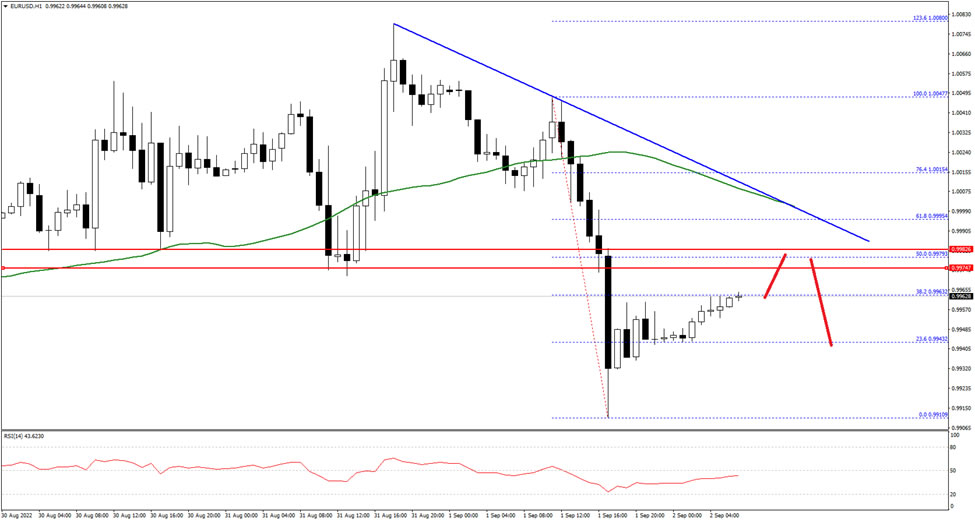
The Euro remained in a bearish zone the key parity level against the US Dollar. The EUR/USD pair even traded below the 0.9925 level before the bulls appeared.
There was close below the 0.9950 level and the 50 hourly simple moving average. A low was formed near 0.9910 and the pair is now consolidating losses. An immediate resistance on the upside is near 0.9975. The first major resistance is near the 1.0000 level.
The next major resistance is near the 1.0015 level. A break above the 1.0015 resistance level could start a decent upward move. In the stated case, it could even surpass 1.0080 on FXOpen.
Conversely, the pair might start another decline below 0.9925. The next key support is near 0.9900, below the pair could decline towards the 0.9865 level. Any more losses might send the pair towards the 0.9840 level.
All Eyes on the Jobs Report
Stock markets in Europe opened positively on Friday after what has been an otherwise rotten week, while Asia was fairly mixed ahead of the US jobs report.
It will be interesting to see whether Europe can maintain the rebound today considering we're heading into the weekend not certain that gas will start flowing through Nord Stream 1 again tomorrow. Grid data suggests it will but until the gas starts actually flowing, it remains a risk. That weekend risk may make investors a little nervous as we progress through the session and could lead to more caution as we approach the close.
The US jobs report could also be a negative catalyst later in the session if it's deemed strong enough to warrant more aggressive tightening from the Fed. We've seen a lot more risk aversion in the markets recently as Fed commentary has finally gotten through to investors.
We're still seeing remarkable resilience in the US data, particularly the labour market, even if some cracks are appearing elsewhere. While the NFP and unemployment will naturally attract the most attention initially, it's the wages that could tip the balance at the central bank, with policymakers concerned about inflation becoming entrenched.
Will Japan intervene as the yen hits a 24-year low?
The yen has been back in focus in recent days, having fallen to a 24-year low against the dollar on Thursday, breaking above 140 in the process. This level has been speculated a lot about in recent months as being the point at which Japanese officials may be tempted to intervene in the markets and comments overnight could further fuel that, with one spokesperson warning moves are being watched with a high sense of urgency.
That doesn't appear to have happened yet and we're not likely to see any shift from the Bank of Japan either if recent commentary is anything to go by. While inflation is currently above its target, that's not expected to last and there's seemingly little appetite to change course. That could mean further declines in the yen until intervention is deemed necessary, although the threat of such action could slow the decline as we've already seen.
JCPOA talks seemingly stall but Macron remains confident
Oil prices are higher today after falling close to their summer lows over the course of the week. The rebound comes as nuclear talks between Iran and the US appear to have stalled, with the former claiming they had sent a "constructive" response to proposals and the latter quickly deeming them "not constructive". While Macron remains hopeful that a deal can be concluded in the coming days, I'm not sure everyone else shares his optimism.
If a deal on the JCPOA is reached, that will make next week's OPEC+ meeting all the more interesting. A deal has been a big downside risk for oil prices recently, something Saudi Arabia sought to counter with warnings of production cuts from the alliance. When and how they would respond isn't clear but it would certainly create some uncertainty around the meeting.
A major breakout is potentially on the cards
Gold is really struggling amid growing expectations of another 75 basis point rate hike from the Fed this month. After breaking below $1,730 earlier in the week, it didn't take long for the yellow metal to test support at $1,700, even breaching it briefly yesterday. A strong jobs report today could tip it over the edge, with key support below then coming around $1,680 where it rebounded in July. It has also bottomed here on a few occasions over the last couple of years which adds to its significance as a major support level.
Treading water ahead of the jobs report
Bitcoin has been treading water around $20,000 over the past week, perhaps with one eye on today's jobs report. This is clearly a major level of support and a significant break of it could see further losses, with $17,500 the next major test being the level it bottomed at in June. Risk appetite in the markets has not been positive recently which has weighed heavily on bitcoin and other risk assets. The jobs report today could compound that if it feeds inflation fears and raises the odds of another 75 basis point Fed hike this month.
GBPJPY Powerless Within a Range
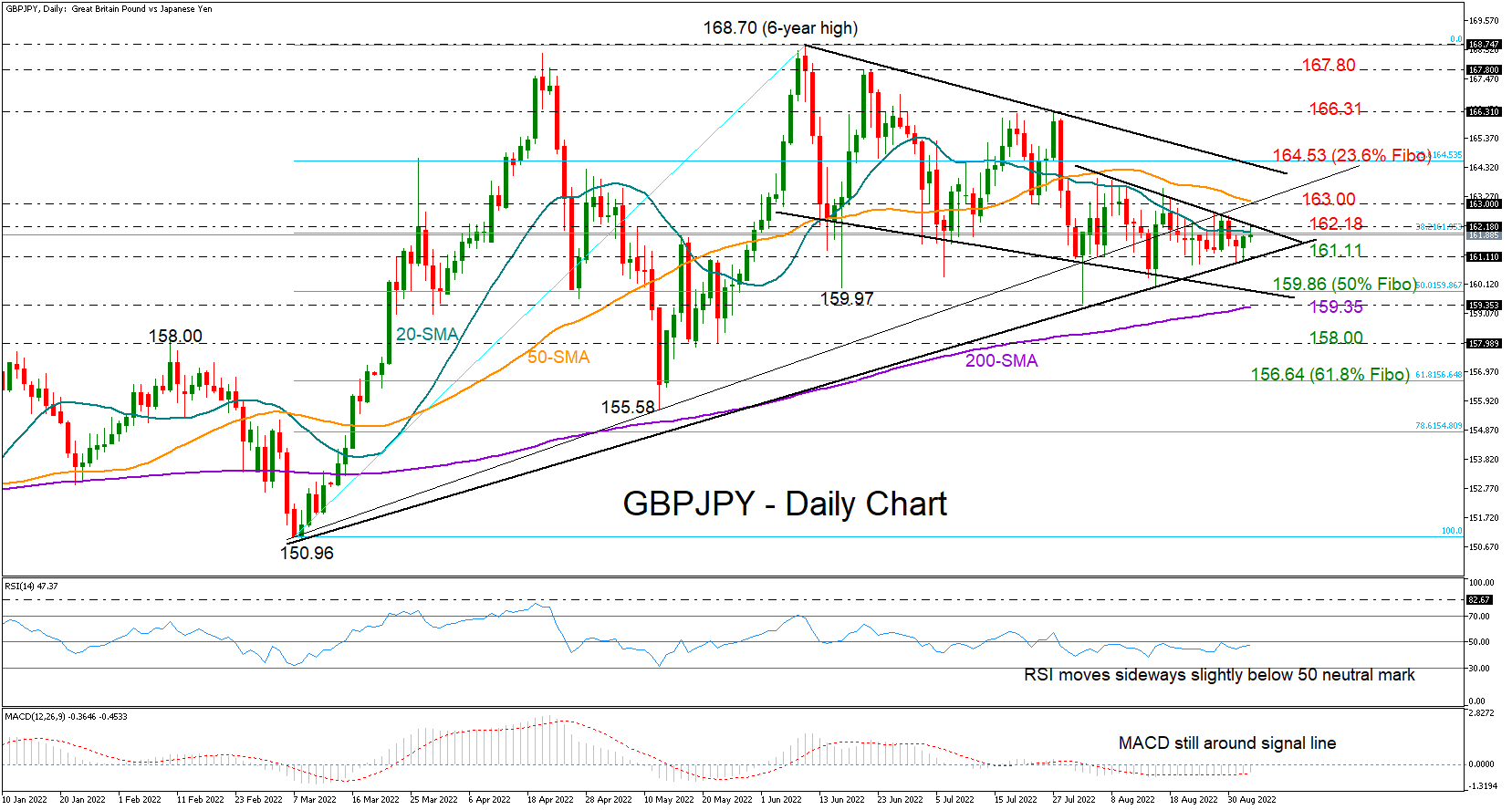
GBPJPY has been congested under its 20-day simple moving average (SMA) for more than a month now despite receiving strong defense from the March ascending trendline.
From a technical perspective, the bulls seem to be lacking incentive as the RSI keeps flattening just below its 50 neutral mark and the MACD remains stable around its red signal line and below zero.
Perhaps a clear break above the 162.18 – 163.00 area, which encapsulates two trendlines, the 50-day SMA, and the 38.2% Fibonacci retracement of the 150.96 – 168.70, is needed to motivate an acceleration towards the surface of the bearish channel at 164.53. Note that the 23.6% Fibonacci is also positioned here. A decisive close above it could brighten the short-term outlook, likely bolstering upside forces up to July’s resistance at 166.31.
On the downside, a close below the March trendline at 161.11 could aggressively pressure the price towards the channel’s lower boundary seen around the 50% Fibonacci of 159.86. Should the 200-day SMA at 159.35 give the green light to the bears too, the pair could dive towards the 158.00 round level, a break of which would downgrade the neutral medium-term trajectory.
In brief, GBPJPY is maintaining a neutral-short-term bias. A move above 162.18 or below 161.11 is likely needed to generate some volatility in the market.
USDCAD Weakens after Bullish Rally in Near Term
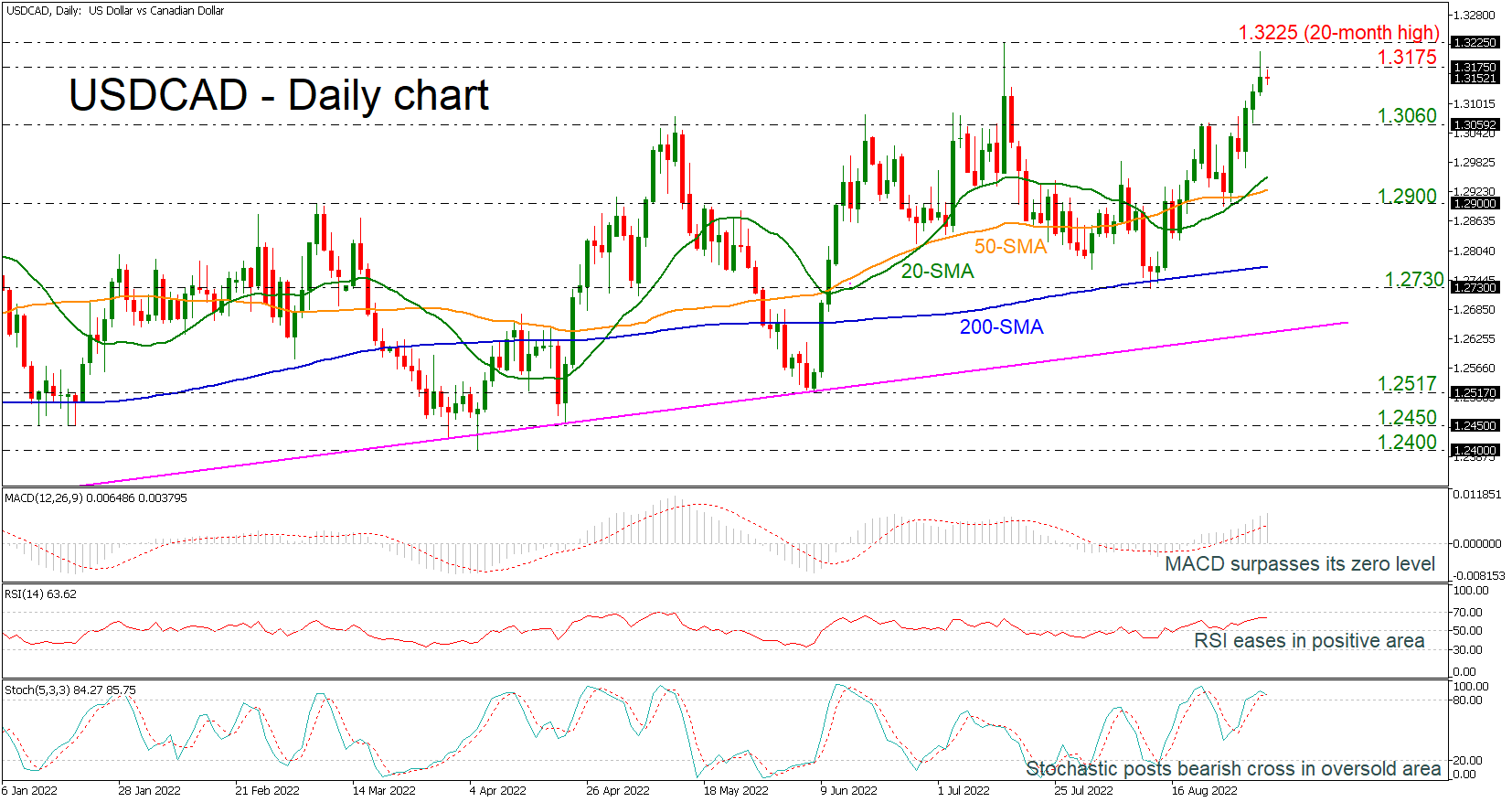
USDCAD is showing some signs of weakness after three straight green days and a spike near the 20-month peak of 1.3225.
In trend indicators, the 20- and 50-day simple moving averages (SMAs) posted a bullish crossover, confirming the bullish bias in the short- and long-term timeframe. The technical oscillators are presenting some contradicting signs. The MACD is holding well above its trigger and zero lines; however, the stochastic created a bearish crossover within its %K and %D lines in the overbought region, while the RSI is ticking lower in the positive area, suggesting a bearish correction.
The 1.3175 barrier and the 20-month high of 1.3225 could challenge any bullish attempts towards a fresh high until 1.3385, registered in October 2020. Hence any breakout at this point may gather extra attention, with the price likely speeding up to 1.3420 – a key barrier during the September 2020 period.
Alternatively, an extension below 1.3060 will strengthen a negative movement, likely activating a fresh bearish wave towards the short-term SMAs at 1.2915 and the 1.2900 psychological mark. Failure to hold above that floor could cause another negative extension towards the 200-day SMA at 1.2775.
In brief, USDCAD is still in positive territory and only a drop underneath the 200-day SMA and the long-term ascending trend line may switch the picture to bearish.
Daily Technical Analysis
EUR/USD
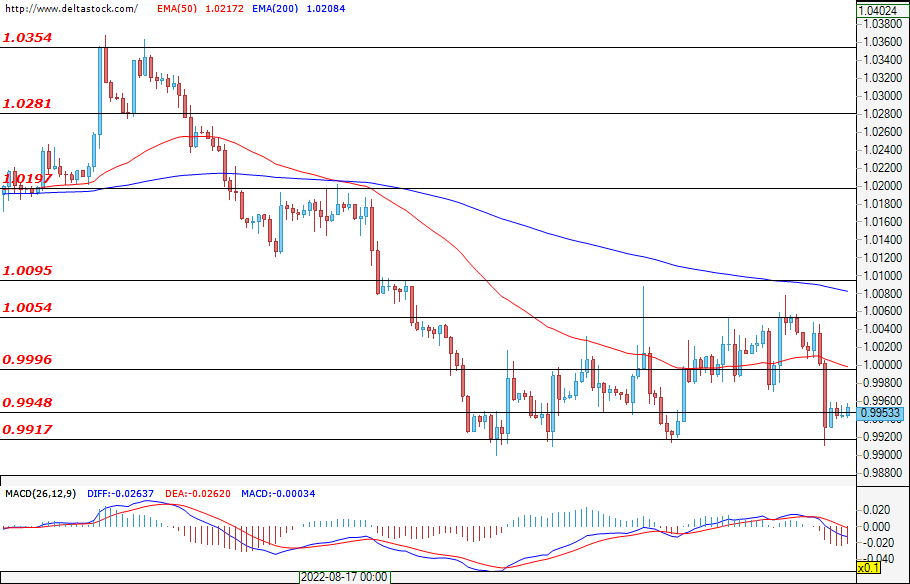
The European common currency lost some ground against the dollar, and after the test of the support at 0.9948, the pair consolidated just above the mentioned zone. If the bearish attack continues, then a confirmed breach of the aforementioned level could easily pave the way for a test of the local low at 0.9917, where a violation could strengthen the negative expectations for the future path of the EUR/USD. If the bulls prevail, then the first resistance for them can be found at the zone of 0.9996, followed by the major target at 1.0054. Important news for investors today will be the U.S. data on non-farm payrolls and that on the unemployment rate (both at 12:30 GMT).
USD/JPY
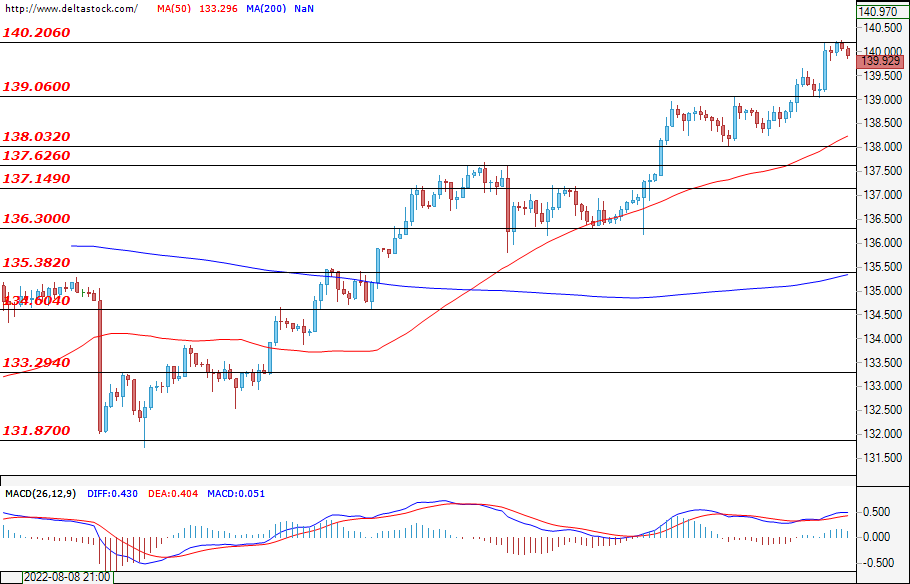
The positive sentiments remained unchanged and the dollar appreciated against the yen. The pair reached historic levels from 1998 and tested the psychological resistance at 140.20. During the early hours of today`s trading, the Ninja is hovering under the mentioned zone, and the expectations are for a new attack for the bulls. A successful breach of this resistance could continue the rally and could easily lead to new gains for the USD against the JPY. If the bullish momentum fades, bears could lead the pair towards the support zone at 139.06, where a violation could deepen the correction towards the lower level at 138.03.
GBP/USD
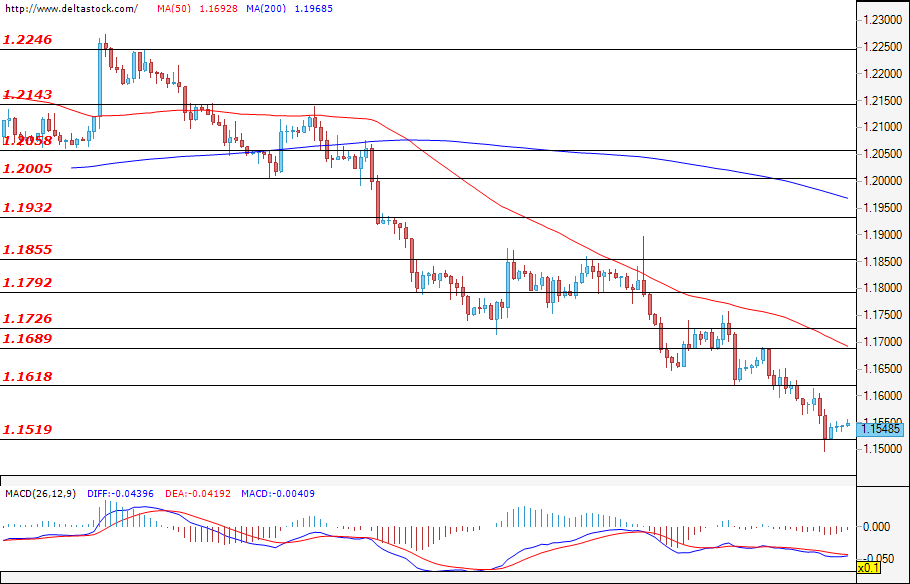
The test of the support zone at 1.1519 was not successful, and during the time of writing the analysis, the price is holding positions around the current level at 1.1548. A new attempt for a violation of the aforementioned level is a highly probable scenario, but only a successful breach for the bears could continue the sell-off and lead the Cable towards the bottom levels from March 2020 at around 1.1420. If the bulls prevail and manage to breach the resistance at 1.1618, then they could test the next zone at 1.1689. The news, mentioned in the EUR/USD analysis, will be the driving factor for price action today.
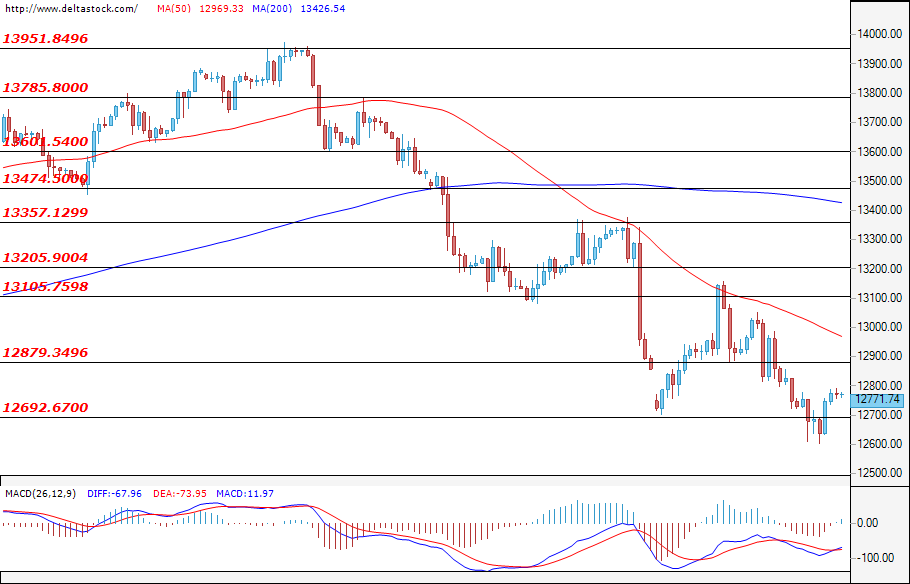
EUGERMANY40
Yesterday, the support zone at 12692 withheld the bearish attack and the German index recovered some of its recent losses. During the early hours of today, the EUGERMANY40 is trading above the mentioned support, and If the bulls prevail, then their first target would be the resistance at 12879, followed by the upper level at 13105. However, the more likely scenario is for a new attack for the bears, and a successful violation of the mentioned zone at 12692 could lead to a continual decline and could strengthen the negative expectations for the future path of the index.
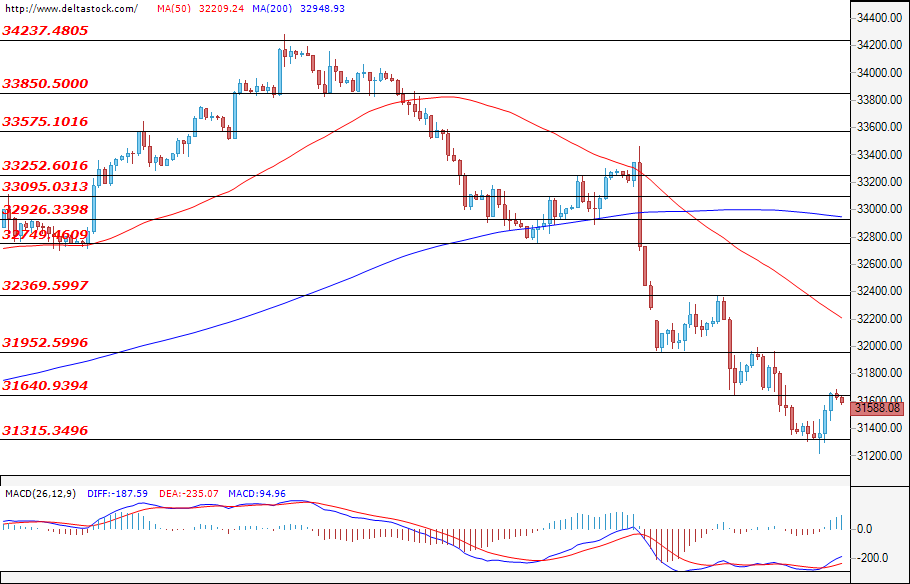
US30
The bears did not get enough momentum for a successful breach of the support at 31315 and the index bounced and tested the zone at 31640. If trading remains limited below the mentioned resistance, then a new successful attack on the support at 31315 could lead to a sell-off towards the levels at around 31100. Better-than-expected data on the non-farm payrolls change and the unemployment rate (both today at 12:30 GMT) could help the bulls prevail. A violation of the level at 31640, followed by a breach of the upper resistance at 31952, could easily lead to a correction towards the local high at 32369.
US Payrolls (Together with CPI Release on Sept 13) are the Last Important Input for Fed
Markets
The established market trends basically continued yesterday. Yields maintained (EMU) or even extended (US) recent repositioning as central bankers reinforced their message that they have no choice but to continue their anti-inflationary crusade. The rise in EMU yields temporary slowed, as there was little in the way of specific news. Especially short-term European yields took a breather as a 75 bps rate hike for next week’s ECB meeting is now more or less discounted. The German 2-y and 5-y yields ‘corrected’ 1.6/2.4 bps. Longer maturities remained upwardly oriented. (30-y + 7.5 bps). US yields intraday also showed some hesitation after recent strong gains, but US data came to the rescue. US jobless claims declined for the third consecutive week (to 232k). The US manufacturing ISM also printed at a stronger than expected 52.9. Prices pressures eased (prices paid 52.5). Production held north of 50 (50.4). New orders improved (51.3 from 48.0). The employment index even jumped to a five month high at 54.2. With the Fed focused on slowing demand, the report only confirms a ‘nihil obstat’ for the Fed to further tighten monetary conditions. The US yield curve bear steepened with yields rising between 0.65 bps (2-y) and 6.8 bps (30-y). The rise in LT yields was again fully driven by real yields (10-y +9.4 bps). Inflation expectations eased further. The latter move was supported by a decline in several cyclical commodities. A further tightening of monetary conditions combined with persistent recessionary risks again hit European stocks hard (EuroStoxx -1.72%). US stock reversed (most of) their initial losses to closed mixed. (Dow +0.46%/Nasdaq -0.26%). After some hesitation earlier this week, the dollar this time profited from the rise in real yields. The DXY index touched the highest level since mid-2002. USD/JPY surpassed the 140 barrier, the weakest level for the yen since 1998. EUR/USD reversed all of this week’s ‘gain’ to close at 0.9945.
This morning, Asian equity indices trade with modest losses, despite yesterday’s late session rebound on WS. US Treasuries are trading little changed. The dollar maintains yesterday’s gain with the DXY (109.5) holding north of the July top. USD/JPY trading north of 140 as expected triggers some verbal interventions from Japan’s Finance Minister Suzuki. Question is whether Japan has much leverage to counter a move that is mainly overall USD strength. Later today, the US payrolls (together with CPI release on Sept 13) are the last important input for the Fed to decide whether it should raise the policy rate by 75 or 50 bps at the September 21 meeting. This week’s data (consumer confidence, jobless claims, manufacturing ISM) all suggested that demand stays stronger than what the Fed is aiming for. Markets expect net payrolls growth of about 300k. The unemployment rate is expected unchanged at 3.5%. AHE are seen at a solid 0.4% M/M and 5.3% Y/Y. This week’s ADP report suggests some downside risks to consensus. However, except in case of an outsized negative surprise, expectations for bold Fed tightening probably will continue to dominate global trading.
News Headlines
South Korean inflation declined for the first time since November 2020 on a monthly basis (-0.1% M/M) with the headline figure decelerating more than expected in August, from 6.3% Y/Y to 5.7% Y/Y. The monthly outcome was mainly influenced by lower oil prices. Underlying price pressure persists with core inflation only a tad lower at 4.4% Y/Y from 4.5% in July. Services inflation rose to its highest level since February 2009 at 4% Y/Y. The Bank of Korea incorporated a temporary setback in its prognosis, but expects inflation to stay at 5%-6% over the coming months. They are expected to extend their tightening cycle in regular steps of 25 bps. The policy rate currently stands at 2.5%.
Shipment orders published by Nord Stream 1’s operator indicate a resumption of supplies tomorrow at around 20% of normal capacity. That’s equal to the levels flowing since July 27. Sources close to the German government fear a further reduction in mid-October for additional maintenance on the key gas pipe line..
GBP/JPY Daily Outlook
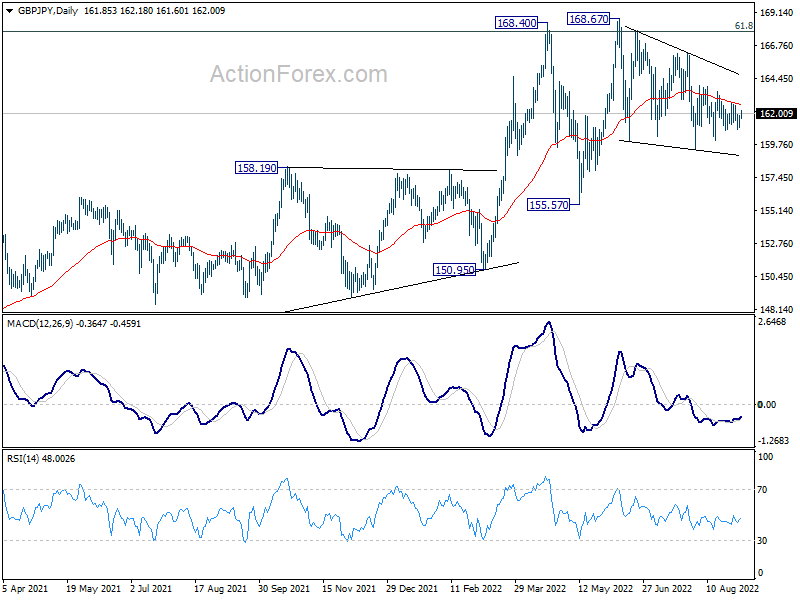
Daily Pivots: (S1) 161.26; (P) 161.56; (R1) 162.13; More...
Intraday bias in GBP/JPY remains neutral as sideway trading continues. Corrective pattern from 168.67 would extend for a while. On the upside, break of 163.91 will bring stronger rise to 166.31 resistance. On the downside, below 160.07 will turn bias to the downside for 159.42 and below.
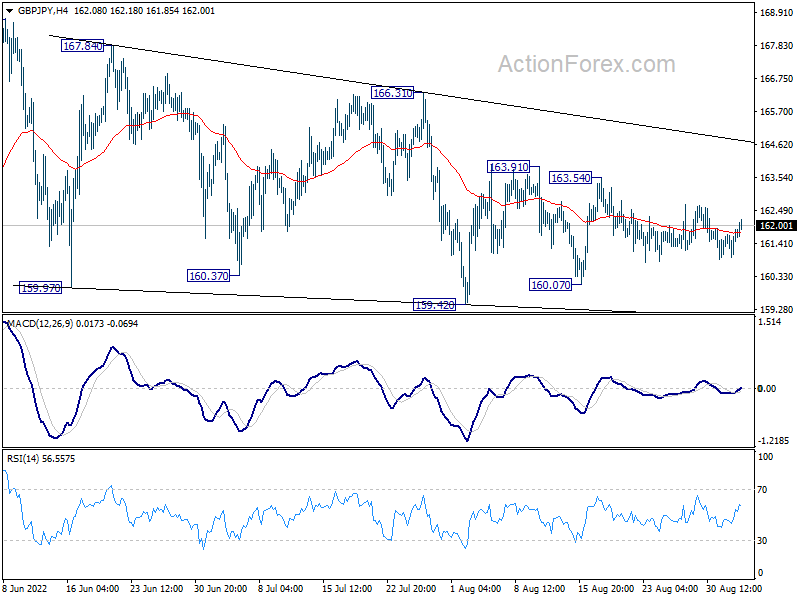
In the bigger picture, up trend from 123.94 (2020 low) is still in progress. Sustained break of 61.8% retracement of 195.86 (2015 high) to 122.75 (2016 low) at 167.93 will be a long term bullish signal, and could pave the way back to 195.86 high. This will remain the favored case as long as 155.57 support holds, even in case of deep pull back.
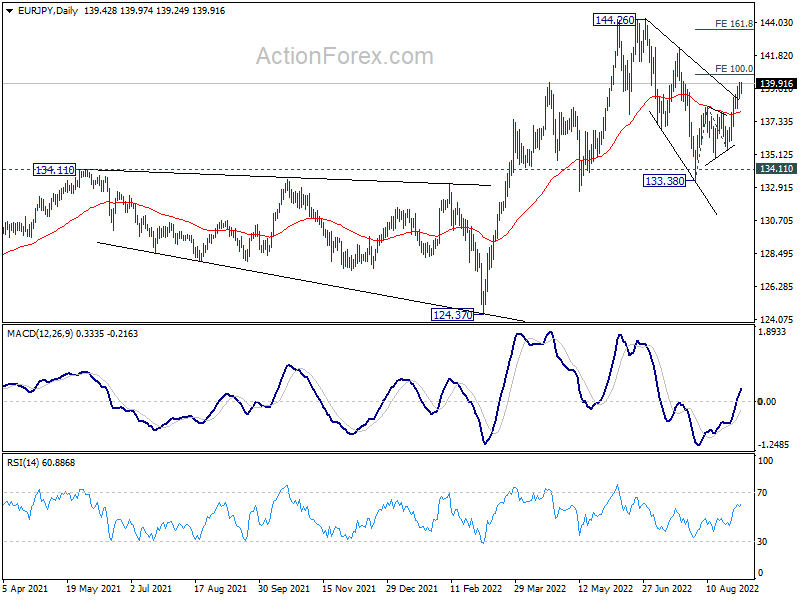
EUR/JPY Daily Outlook
Daily Pivots: (S1) 138.93; (P) 139.47; (R1) 140.00; More....
EUR/JPY's rise from 133.38 is still in progress. Intraday bias stays on the upside for 100% projection of 133.38 to 138.38 from 135.50 at 140.50. Decisive break there will indicate upside acceleration, and raise the chance of up trend resumption through 144.26 high. On the downside, below 138.24 minor support will turn intraday bias neutral again.
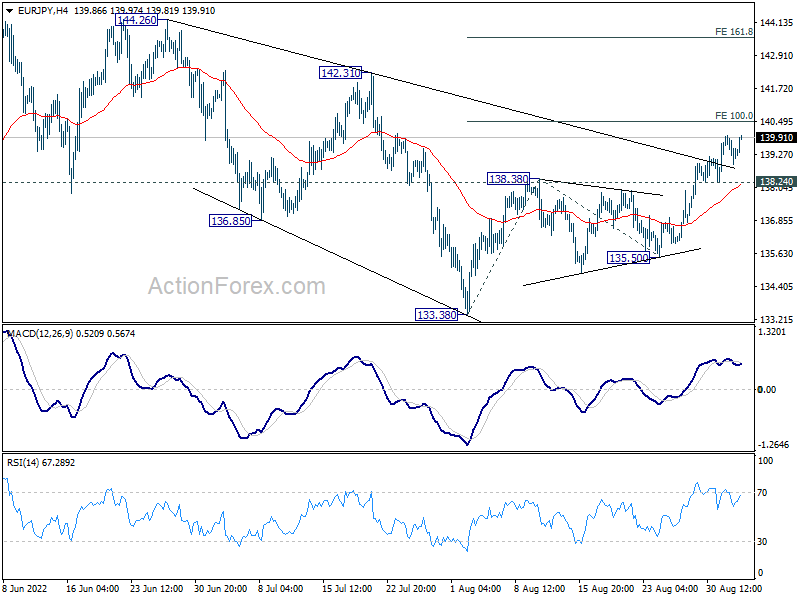
In the bigger picture, up trend from 114.42 (2020 low) is seen as the third leg of the pattern from 109.30 (2016 low). Further rally is in favor as long as 134.11 resistance turned support holds, even in case of deep pull back. Next target is 149.76 (2015 high). However, sustained break of 134.11 will be a sign of medium term bearish reversal and turn focus to 124.37 support for confirmation.