

Sample Category Title
Strong US Data supports Another 75bp Hike from Fed
Market movers today
Market focus will be on the US labour market report today. Consensus is looking for easing jobs growth (NFP +290k) in line with lower PMI employment indices and the ADP report released earlier this week. However, even with slowing employment growth the labour market remains extremely tight. Another increase in wage growth could seal the deal for another 75bp Fed hike in September, which is also our base case, read more in Research US - Fed continues to guide US economy towards a recession, 1 September.
ECB will release its July Consumer Expectations Survey results. Developments in inflation expectations will be particularly in focus, given ECB members' increased focus on the risk of de-anchoring inflation expectations lately.
We think Norway's unemployment rate likely declined to 1.6% in August.
The 60 second overview
Strong US economy: Jobless claims were lower than expected and ISM manufacturing was stronger than expected at 52.8. The news drove EUR/USD back below 1, and took long US yields higher. While production growth slowed, new orders index rebounded back above 50. Prices paid and supplier's delivery times indices continued moving lower, pointing towards easing inflationary pressures. The market is now pricing 75% probability of a 75bp hike in the next meeting.
Executive briefing: We have published our monthly executive briefing, which gives a short and high-level overview of global and Nordic economies and financial markets Executive Briefing - Central banks double down on fighting inflation, 1 September.
German retail sales recovered some ground in July, rising 1.9% m/m after the last months' declines. It suggests consumer spending was not yet falling off a cliff at the start of Q3, despite record-low consumer confidence and an inflation peak not yet in sight. However, we expect further slowdown in consumption lies ahead, once the latest surge in energy prices starts to feed through fully to consumers.
Equities: Global equities dropped further yesterday although the US cash session ended close to day-high with some indices in green. Please note the increases in US driven by defensives with health care and utilities on top and energy materials both sharply lower. In other words, investors are not seeing a better growth outlook or more positive signs, they are simply moving in the part of equities where they are not risking too much. This is very much in line with our strategy but we are still challenged by the long end of the yield curve continuing to tick higher. This gives some headwind to growth and quality stocks while benefitting value stocks in the relative game. Yesterday in US Dow +0.5%, S&P500 +0.3%, Nasdaq -0.3% and Russell 2000 -1.2%. Asian markets mixed this morning and the same goes for futures in the western world. European futures pointing to a solid opening while US futures are slightly lower.
FI: Global bond yields continue to rise ahead of the US labour market report and the ECB meeting next week, where the consensus regarding the policy hike is now 75bp. In our fixed income weekly on the European market, we look at the potential outcomes of the ECB meeting regarding the rate hike.
FX: USD rose vis-à-vis EUR and Scandi currencies yesterday. EUR/USD fell back below parity, USD/SEK rose to 10.80 and USD/NOK above the 10.00 level. USD/JPY above 140, now and Japanese government warns against rapid FX moves once again.
Credit: CDS indices opened the day sharply wider, but made a quick turn-around. This made Xover close the day 2bp tighter while Main widened 0.3bp.
Nordic macro
Norwegian registered unemployment was slightly lower than expected in July, but we expect the improvement to tail off in August, leaving the jobless rate unchanged at 1.6% (seasonally adjusted), which is exactly what Norges Bank projected in the June monetary policy report. Keep an eye on new vacancies as well, as they seem to have slowed down in recent months.
USD/JPY Daily Outlook
Daily Pivots: (S1) 139.24; (P) 139.74; (R1) 140.70; More...
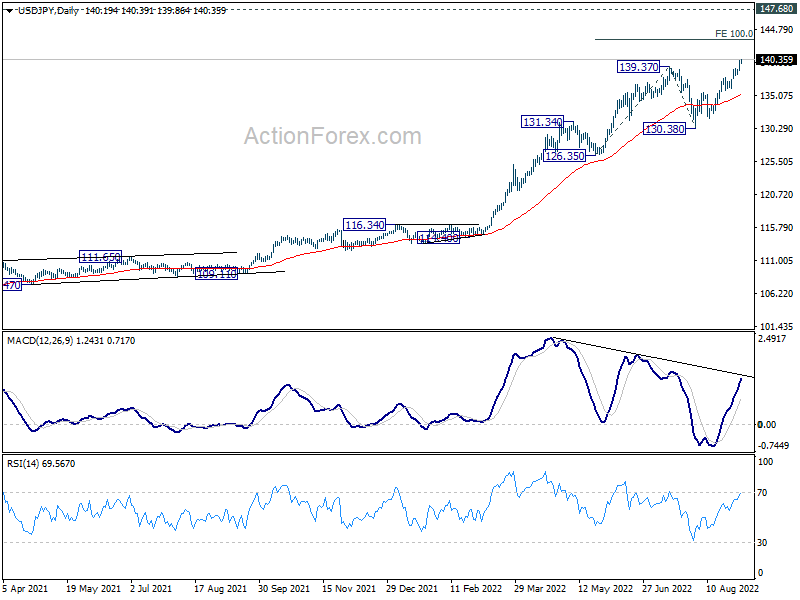
USD/JPY's firm break of 139.37 resistance confirms up trend resumption. Intraday bias stays on the upside for 100% projection of 126.35 to 139.37 from 130.38 at 143.40 next. Sustained break there could bring upside acceleration of 147.68 long term resistance. On the downside, below 138.04 minor support will turn intraday bias neutral and bring consolidations first, before staging another rally.
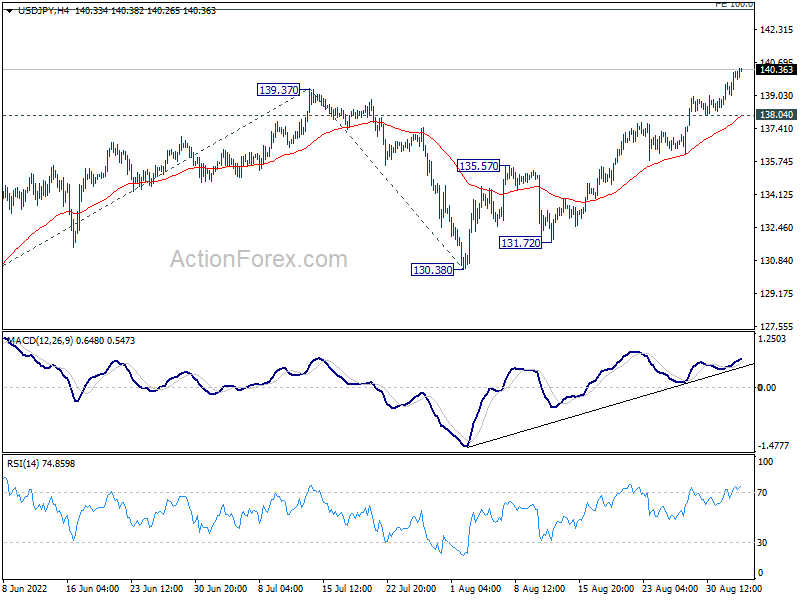
In the bigger picture, up trend from 101.18 is still in progress, as part of the whole up trend from 75.56 (2011 low). Further rise should be seen to 147.68 (1998 high). For now, break of 130.38 support is needed to be the first indicate of medium term topping. Otherwise, outlook will stay bullish even in case of deep pull back.
Dollar Strong ahead of NFP, Time for EUR/USD Breakout?
With risk-off sentiment and rising treasury yields, Dollar is extending recent rally as focus now turns to US non-farm payrolls report. 2-yaer year hit the highest level since 2007 overnight while 10-year yield also breaks above 3.2 handle. While Dollar is strong, Euro is also resilient, holding in range against the greenback and maintaining most gains against others. Yen is so far the worst performer for the week, followed by Sterling and Swiss Franc.
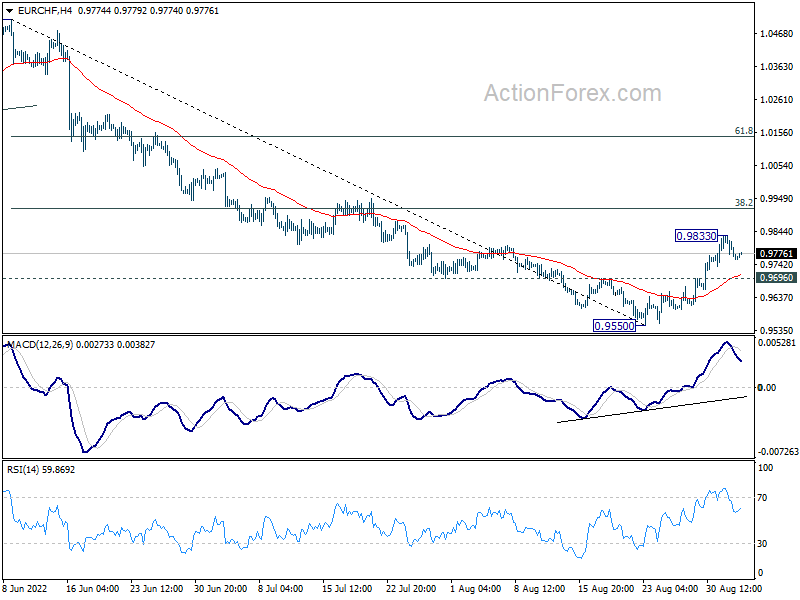
Technically, while most attention is on Dollar pairs today, we'll keep an eye on EUR/CHF too. It lost much upside momentum after hitting 0.9833. Extended decline from there, and break of 0.9696 support, will argue that the rebound from 0.9550 has completed. That could also be a signal of the end of rally in Euro in crosses, and the readiness for downside breakout in EUR/USD.
In Asia, at the time of writing, Nikkei is down -0.06%. Hong Kong HSI is down -0.91%. China Shanghai SSE is up 0.01%. Singapore Strait Times is down -0.62%. Japan 10-year JGB yield is down -0.0002 at 0.240. Overnight, DOW rose 0.46%. S&P 500 rose 0.30%. NASDAQ dropped -0.26%. 10-year yield rose 0.132 to 3.265.
BCC expects negative UK GDP growth in Q2, Q3, Q4, inflation to peak at 14%
The British Chambers of Commerce said in a release that the UK economy is expected to "plunge into recession" before the end of 2022, with inflation "spiking to 14%". Also, "lingering weakness in growth expected to continue into 2024".
BCC downgraded UK GDP growth forecast for 2022 from 3.5% to 3.3%. Also, a recession is forecast for the UK this year, with negative economic growth for Q2, Q3, and Q4. It expects the economy to return to 0.2% growth in 2023, and 1% growth in 2024.
Inflation is projected to reach 14% in Q4 2022, upgraded from prior forecast of 10%. CPI is forecast to slow to 5% in 2023, and then return to BoE's 2% target in 2024.
BCC also expects BoE interest rate to increase from 2% in 2022 to 3% in 2023 and 2024.
Fed Bostic: Soft landing is a very hard thing to do
Atlanta Fed President Raphael Bostic said yesterday that "Inflation is high, inflation is too high and we have got to bring it down to our target... So we have got some work to do. We have got to figure out how fast we are going to move our policy to try to arrest that inflation and to wrestle it back down to 2%."
"When you bring demand down, that has the risk of slowing the economy down so that the economy stops growing, where it loses all of its momentum, and then you might get to a situation that some would describe as recessionary," he said.
He added that soft landing is "a very hard thing to do. I think it's only happened maybe once or twice in the history of this country. Ultimately that's the best of all possible worlds."
US to release NFP today, EUR/USD ready for breakout?
The US non-farm payroll day is today. Markets are expecting 290k job growth in August, slowed from July's 528k. Unemployment rate is forecast to be unchanged at 3.5%. Average hourly earnings growth are expected to slow from 0.5% mom to 0.3% mom.
Looking at related economic data, ADP reported showed only 132k private job growth, well below expectations of 300k. However, ISM manufacturing employment improved notably from 49.9 to 52.8, back in expansion. Four-week moving average of initial jobless claims ticked down to 247k.
A disastrous NFP print is not expected today. Anything between 150 and 350k wouldn't alter the current paths of the markets. However, another month of strong earnings growth should reinforce Fed's swift tightening path with another 75bps hike this month.
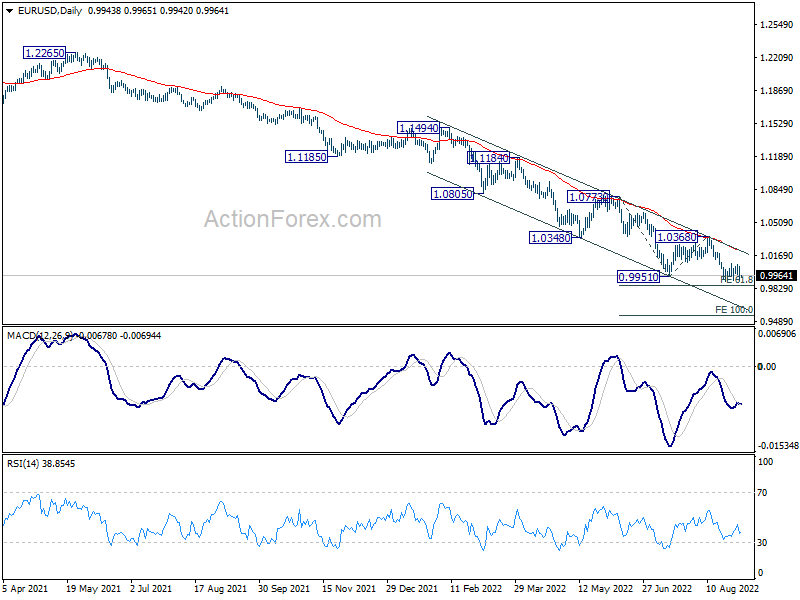
As for market reactions, a major focus is on whether EUR/USD would finally break out from range to resume larger down trend, and accelerate away from parity.
Elsewhere
Germany trade balance and Eurozone PPI will be released in European session. Canada labor productivity, US non-farm payroll and factory orders will be featured later in the day.
USD/JPY Daily Outlook
Daily Pivots: (S1) 139.24; (P) 139.74; (R1) 140.70; More...
USD/JPY's firm break of 139.37 resistance confirms up trend resumption. Intraday bias stays on the upside for 100% projection of 126.35 to 139.37 from 130.38 at 143.40 next. Sustained break there could bring upside acceleration of 147.68 long term resistance. On the downside, below 138.04 minor support will turn intraday bias neutral and bring consolidations first, before staging another rally.
In the bigger picture, up trend from 101.18 is still in progress, as part of the whole up trend from 75.56 (2011 low). Further rise should be seen to 147.68 (1998 high). For now, break of 130.38 support is needed to be the first indicate of medium term topping. Otherwise, outlook will stay bullish even in case of deep pull back.
Economic Indicators Update
| GMT | Ccy | Events | Actual | Forecast | Previous | Revised |
|---|---|---|---|---|---|---|
| 22:45 | NZD | Terms of Trade Index Q2 | -2.40% | 0.20% | 0.50% | 0.60% |
| 06:00 | EUR | Germany Trade Balance (EUR) Jul | 4.6B | 6.4B | ||
| 09:00 | EUR | Eurozone PPI M/M Jul | 2.50% | 1.10% | ||
| 09:00 | EUR | Eurozone PPI Y/Y Jul | 35.80% | 35.80% | ||
| 12:30 | CAD | Labor Productivity Q/Q Q2 | 0.10% | -0.50% | ||
| 12:30 | USD | Nonfarm Payrolls Aug | 290K | 528K | ||
| 12:30 | USD | Unemployment Rate Aug | 3.50% | 3.50% | ||
| 12:30 | USD | Average Hourly Earnings M/M Aug | 0.30% | 0.50% | ||
| 14:00 | USD | Factory Orders M/M Jul | 0.20% | 2.00% |
US to release NFP today, EUR/USD ready for breakout?
The US non-farm payroll day is today. Markets are expecting 290k job growth in August, slowed from July's 528k. Unemployment rate is forecast to be unchanged at 3.5%. Average hourly earnings growth are expected to slow from 0.5% mom to 0.3% mom.
Looking at related economic data, ADP reported showed only 132k private job growth, well below expectations of 300k. However, ISM manufacturing employment improved notably from 49.9 to 52.8, back in expansion. Four-week moving average of initial jobless claims ticked down to 247k.
A disastrous NFP print is not expected today. Anything between 150 and 350k wouldn't alter the current paths of the markets. However, another month of strong earnings growth should reinforce Fed's swift tightening path with another 75bps hike this month.
As for market reactions, a major focus is on whether EUR/USD would finally break out from range to resume larger down trend, and accelerate away from parity.
BCC expects negative UK GDP growth in Q2, Q3, Q4, inflation to peak at 14%
The British Chambers of Commerce said in a release that the UK economy is expected to "plunge into recession" before the end of 2022, with inflation "spiking to 14%". Also, "lingering weakness in growth expected to continue into 2024".
BCC downgraded UK GDP growth forecast for 2022 from 3.5% to 3.3%. Also, a recession is forecast for the UK this year, with negative economic growth for Q2, Q3, and Q4. It expects the economy to return to 0.2% growth in 2023, and 1% growth in 2024.
Inflation is projected to reach 14% in Q4 2022, upgraded from prior forecast of 10%. CPI is forecast to slow to 5% in 2023, and then return to BoE's 2% target in 2024.
BCC also expects BoE interest rate to increase from 2% in 2022 to 3% in 2023 and 2024.
Fed Bostic: Soft landing is a very hard thing to do
Atlanta Fed President Raphael Bostic said yesterday that "Inflation is high, inflation is too high and we have got to bring it down to our target... So we have got some work to do. We have got to figure out how fast we are going to move our policy to try to arrest that inflation and to wrestle it back down to 2%."
"When you bring demand down, that has the risk of slowing the economy down so that the economy stops growing, where it loses all of its momentum, and then you might get to a situation that some would describe as recessionary," he said.
He added that soft landing is "a very hard thing to do. I think it's only happened maybe once or twice in the history of this country. Ultimately that's the best of all possible worlds."
Cliff Notes: Jackson Hole Casts a Long Shadow
Key insights from the week that was.
The Australian data flow started the week with a positive surprise, but has disappointed since.
Against an expectation for another broadly flat outcome, July retail sales instead jumped 1.3% higher. Apparel and department store sales were particularly strong, while consumer spending at cafes & restaurants, ‘other’ retail and food grew robustly. A second consecutive decline for household goods provided only a marginal offset. While we continue to expect higher interest rates, declining house prices and historically-weak consumer sentiment to materially curb households discretionary consumption into year end, currently spending has momentum.
The housing sector stands in stark contrast to consumption having already been hit hard by actual and expected interest rate increases. The CoreLogic home value index fell 1.6% in August – the biggest monthly decline in nearly 40 years – indicating the housing market correction is shifting into a higher gear. This was further emphasised by a steep fall in housing finance approvals (-8.5%mth) and a materially soft outcome for housing credit growth in July. Meanwhile, dwelling approvals surprised with a 17.2% decline driven by a slump in high-rise approvals, but with the surprising resilience of non high-rise segments continuing despite the wider downturn. Nevertheless, weakness in Australia’s housing market will persist as the RBA delivers further rate hikes in the coming months.
Arguably the key domestic releases for this week were the two investment partials for Q2 GDP. Construction work done surprised materially to the downside in the three months to June, declining by 3.8%. That construction activity fell sharply as hours worked for the economy overall jolted higher (4.6%) suggests material and labour shortages remain acute for the sector; wet weather was also likely a factor in Q2. While national construction work has fallen 1.5% during the pandemic (since end-2019), the sector’s pipeline remains in robust health. An uptrend should become apparent hence.
The Q2 CAPEX survey also signalled a robust outlook for investment in construction and equipment despite a disappointing reading for activity in the quarter. Estimate 3 for FY2022/23 implies a circa 15% gain for total investment, broadly in line with estimate 2. Importantly, this strength was broad-based across the mining and non-mining sectors and comes amid considerable uncertainty over the state of the global economy and as interest rates move higher. A note of caution though: the CAPEX survey projections are nominal and so include cost inflation which was substantial during the current financial year at 8.2%.
Despite the downside surprise in Q2 for construction and CAPEX, we continue to expect GDP to gain 2.0%, 4.5%yr. As detailed in our GDP preview, offsetting weaker investment is strength in net exports. Also due next week is the September RBA decision. Ahead of the meeting, Chief Economist Bill Evans has laid out our rationale for a 50bp increase, taking the cash rate to 2.35%, near the RBA’s neutral estimate. Thereafter, we expect the RBA to shift back to a 25bp pace from October through February, when we see the cash rate at a peak of 3.35%. In the note, Chief Economist Bill Evans also discusses the potential medium-term challenges that central banks may face as they try to return GDP growth to trend or above while keeping inflation at target.
Moving offshore, the Asian data flow was very light this week, with only China’s official PMIs worthy of note. Power outages and the lingering effect of COVID-zero policies held the manufacturing index below the expansion/contraction divide of 50 for another month. The service sector performed better, printing at 52.6 in August; however, it is clear that the Hainan outbreak and COVID-19 flare ups elsewhere are continuing to impact momentum in the services sector as well.
Turning to the US, Chair Powell’s remarks continued to impact markets throughout the week ahead of the all-important August employment report (due tonight). Chair Powell’s speech was certainly a decisive stand against inflation, albeit conditional. A contractionary policy stance is necessary now and likely throughout 2023. However, at 2.375%, much of the work has already been done, with the full effect of policy tightening still to be felt. Chair Powell’s views and those of other FOMC members since speak to a desire to complete the tightening cycle by year end and to then remain on hold as a negative output gap grows, removing the risks for inflation and inflation expectations.
The FOMC’s guidance on timing is consistent with our own view; though we expect their actions to have a greater impact on the economy and, from December 2023, see a need to materially lower the fed funds rate to restore growth to trend and thereby stabilise the labour market. To leave growth well below trend for another year (2024) risks economic weakness becoming entrenched, to the long-term detriment of US households. This would also threaten the US’ path to a 50% reduction in emissions by 2030 and the eventual aim of a net zero economy come 2050. This is because much of the planned reduction in emissions requires the consumer to be in good financial health and willing to spend.
Given the swift move higher in US term interest rates and the US dollar this week, a final word on financial conditions. The focus of the FOMC on inflation this week has arguably been primarily about maintaining tight financial conditions rather than expressing a particular level the fed funds rate must get to. At the end of the day, market rates are what economic agents pay, not the fed funds rate itself. To maximise the inflation/ growth trade-off, the stance of policy must be tight now and inflation expectations guided lower. For the US at least, if conditions deteriorate further than the FOMC anticipate, the market will adjust in time, reducing the risk of policy becoming too tight. A focus on near term price dynamics and the risk of inflation persisting at rates materially above target if policy makers do not act aggressively is also likely to be the approach taken by the ECB next week.
USD/JPY Sets New 24-Year High Above 140, US NFP Next
Key Highlights
- USD/JPY gained pace and rallied to a new 24-year high above 140.00.
- A major bullish trend line is forming with support near 138.40 on the 4-hours chart.
- GBP/USD tumbled below 1.1550, and gold price dropped below $1,700.
- The US nonfarm payrolls could increase 300K in August 2022, down from 528K.
USD/JPY Technical Analysis
The US Dollar started a major increase above the 138.00 resistance against the Japanese Yen. USD/JPY gained pace and broke many important hurdles near 138.80.
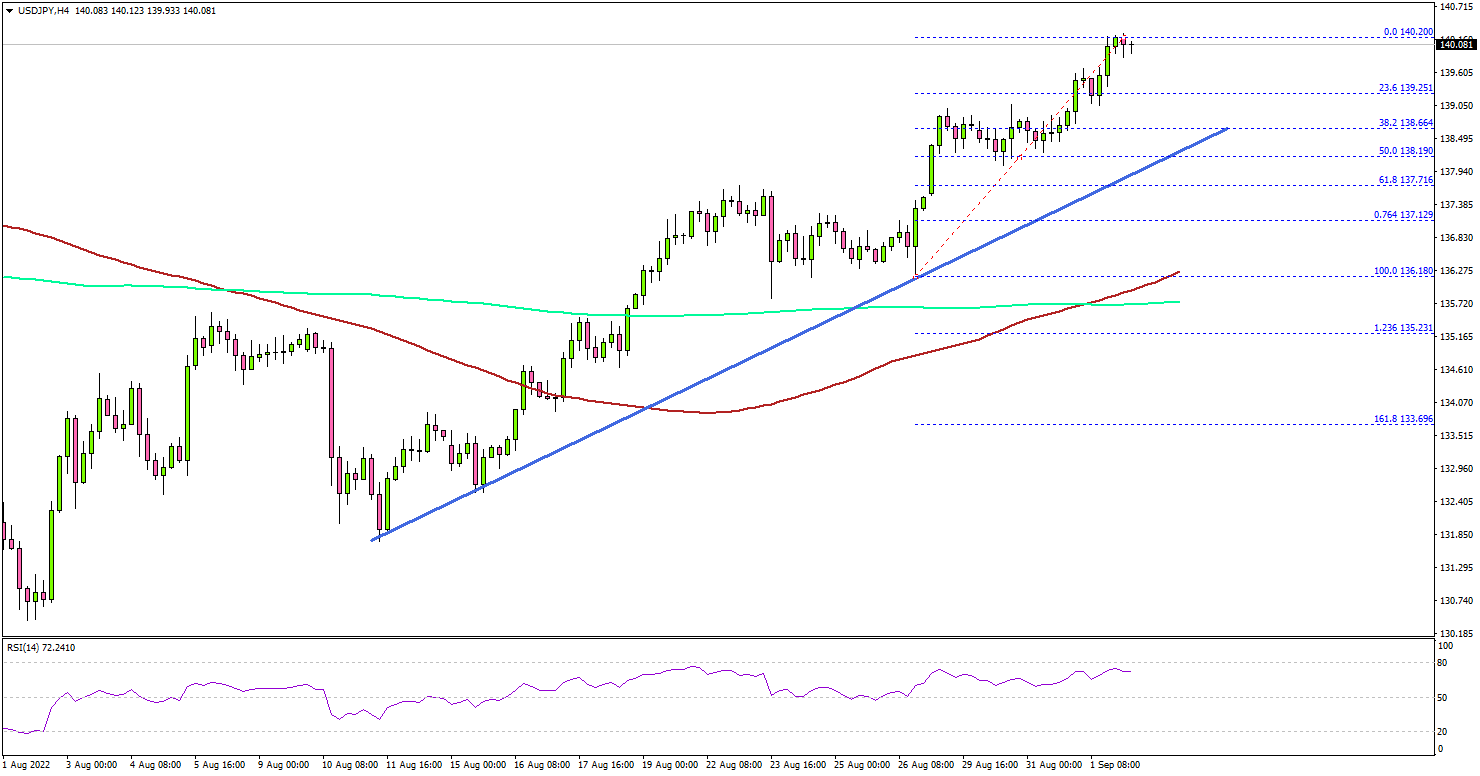
Looking at the 4-hours chart, the pair settled above the 138.80 level, the 100 simple moving average (red, 4-hours), and the 200 simple moving average (green, 4-hours).
The bulls even pumped the pair above the 139.40 resistance zone. It traded to a new 24-year high above 140.00. The pair seems to be trading in a strong uptrend above the 139.00 zone. There is also a major bullish trend line forming with support near 138.40 on the same chart.
A downside break below the trend line might send the pair towards the 137.80 support. The next major support is near the 137.00 level. Any more losses might call for a move towards 136.20.
On the upside, the pair is facing resistance near the 140.50 level. The next major resistance is near the 141.20 level, above which the pair might rise towards the 142.00 level.
Looking at GBP/USD, the pair gained bearish momentum below the 1.1600 level and declined heavily. Similarly, the bears push gold price below the $1,700 level.
Economic Releases
- US nonfarm payrolls for August 2022 – Forecast 300K, versus 528K previous.
- US Unemployment Rate for August 2022 - Forecast 3.5%, versus 3.5% previous.
Eco Data 9/2/22
[php_everywhere instance="1"]
ISM Manufacturing Remains Unchanged, Registering 27th Consecutive Month of Expansion
The August ISM Manufacturing index was unchanged in August at 52.8, beating expectations for a pullback to 51.9.
New orders rose by 3.3 percentage points to 51.3, while new export orders fell by 3.2 percentage points to 49.4.
The backlog of orders sub-index came in at 53.0, rising 1.7 percentage points from July's 51.3 print.
The production index fell 3.1 percentage points to 50.4 while the employment index rose 4.3 percentage points to 54.2. The employment index reversed a three month streak of sub-50 readings.
The supplier deliveries sub-index was virtually unchanged at 55.1 points (55.2 in July) indicating supplier delivery times expanded at their slowest rate since January 2020. The prices index fell 7.5 points to 52.5, reflecting another sharp slowdown in raw materials price growth.
10 of 18 manufacturing industries reported growth last month. Growth was led by Nonmetallic Mineral Products; Petroleum & Coal Products; Transportation Equipment; Computer & Electronic Products; Printing & Related Support Activities; and Plastics & Rubber Products.
Key Implications
A welcome upside surprise as the ISM index remained unchanged from July. Moreover, new orders sprung back firmly into growth territory in August after two months of contraction, with backlogs ticking up marginally. These developments reflect healthy demand in August helping support the economy – despite the contraction in new export orders.
Supply chain developments continue to trend in a positive direction. Supplier delivery times are no longer lengthening the way they were earlier in the year, and input price growth has slowed to its lowest pace since the summer of 2020, which should help to further cool inflationary pressures.
In the big picture, rising interest rates and widespread inflation have dented demand for manufactured goods. Looking forward, this trend is set to continue as the Fed moves rates higher to regain price stability. It's not all bad news though for the manufacturing sector, as the upticks in employment and new orders, increasing backlogs, and fewer supply-side headwinds should help keep the manufacturing sector in expansionary territory in the coming months.