Sample Category Title
USD/JPY Mid-Day Outlook
Daily Pivots: (S1) 138.48; (P) 138.75; (R1) 139.22; More...
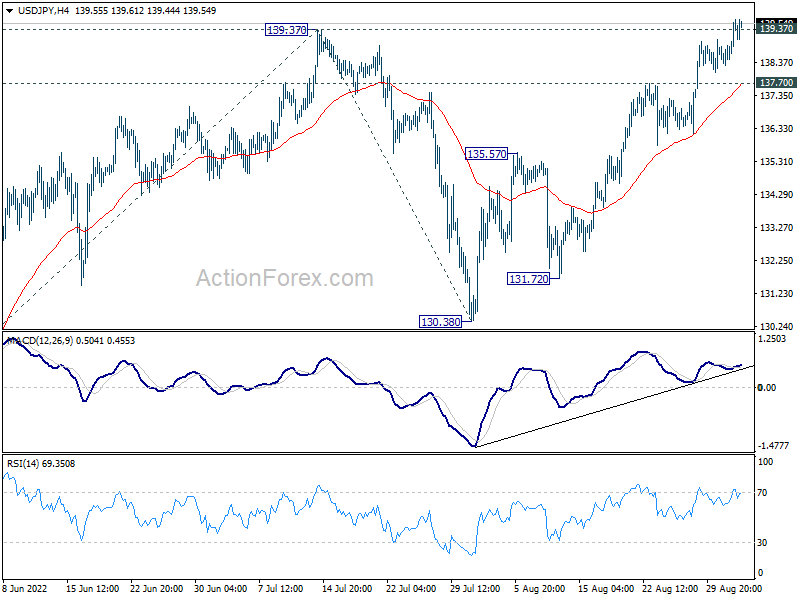
Focus stays on 139.37 resistance in USD/JPY. Sustained break there will confirm up trend resumption. Next target is 100% projection of 126.35 to 139.37 from 130.38 at 143.40. However, break of 137.70 resistance turned support will suggest rejection from 139.37, and turn bias to the downside to extend the corrective pattern from there with another falling leg.
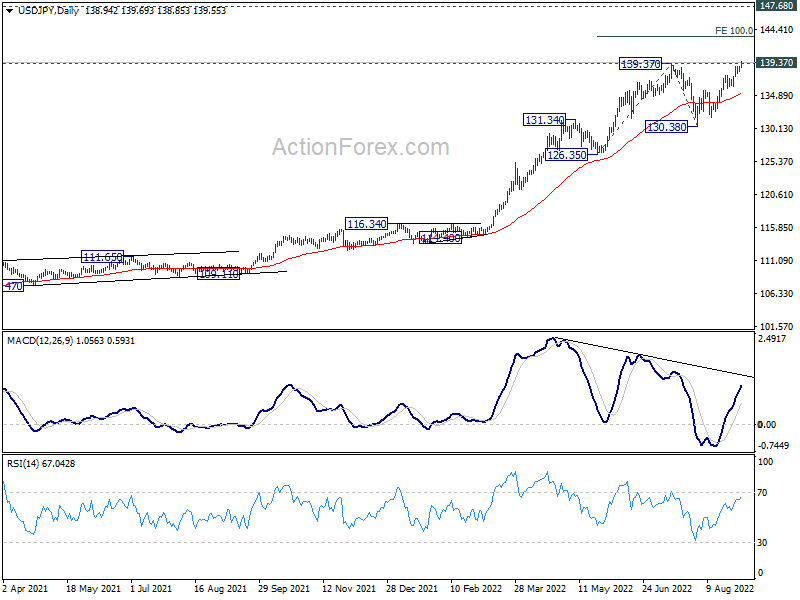
In the bigger picture, up trend from 101.18 is still in progress, as part of the whole up trend from 75.56 (2011 low). Further rise should be seen to 147.68 (1998 high). For now, break of 130.38 support is needed to be the first indicate of medium term topping. Otherwise, outlook will stay bullish even in case of deep pull back.
GBP/USD Mid-Day Outlook
Daily Pivots: (S1) 1.1584; (P) 1.1639; (R1) 1.1679; More...
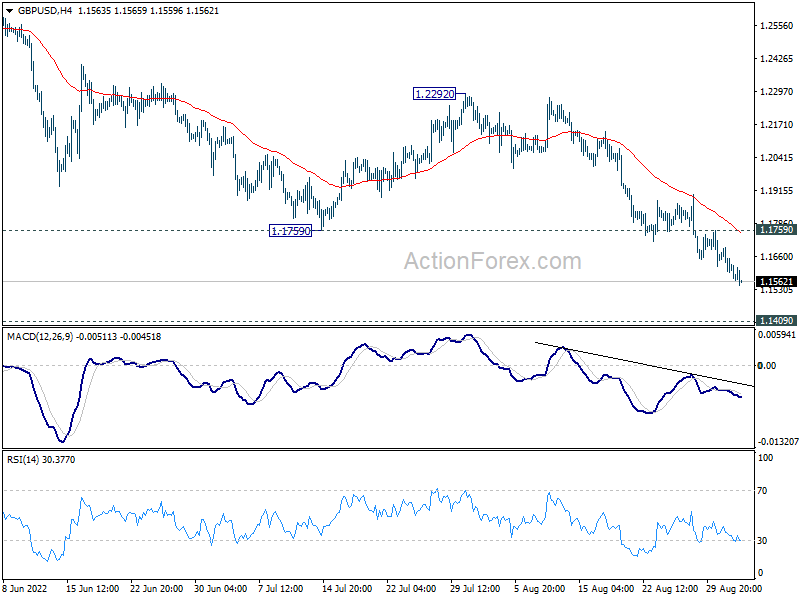
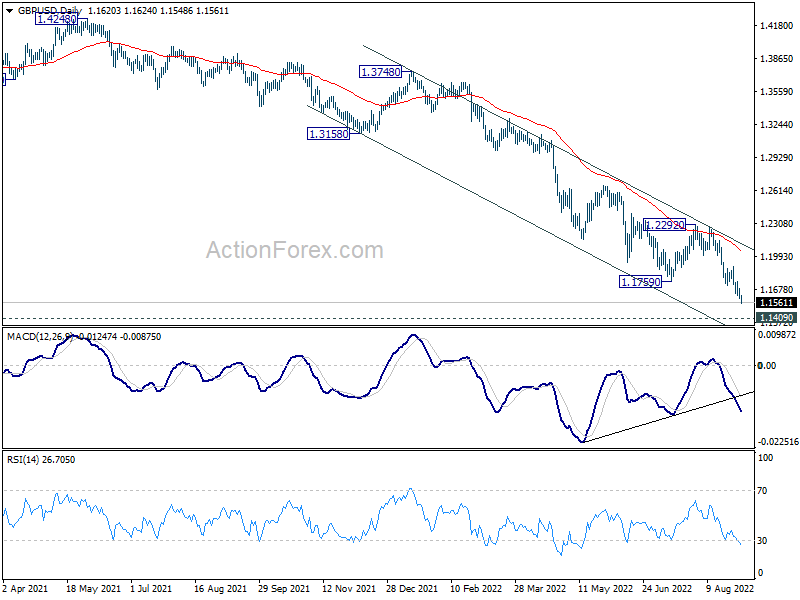
GBP/USD's down trend is in progress and intraday bias stays on the downside. Current fall should target 1.1409 long term support next. On the upside, above 1.1759 minor resistance will turn intraday bias neutral for consolidations. But outlook will stay bearish as long as 1.2292 resistance holds, in case of recovery.
In the bigger picture, fall from 1.4248 (2018 high) could be a leg inside the pattern from 1.1409 (2020 low), or resuming the longer term down trend. Deeper decline is expected as long as 1.2292 resistance holds. Next target is 1.1409 low. However, firm break of 1.2292 will bring stronger rise back to 55 week EMA (now at 1.2859).
Dollar Continuing Rally, Euro Losing Momentum
Dollar's rally continues in early US session as supported by risk aversion and rising yields. On the other hand, Euro is staying to digest this week's gain, and broadly. As for today, Canadian Dollar is currently the second strongest, following the greenback. Aussie and Kiwi follow. Sterling and Yen are the next weakest following Euro.
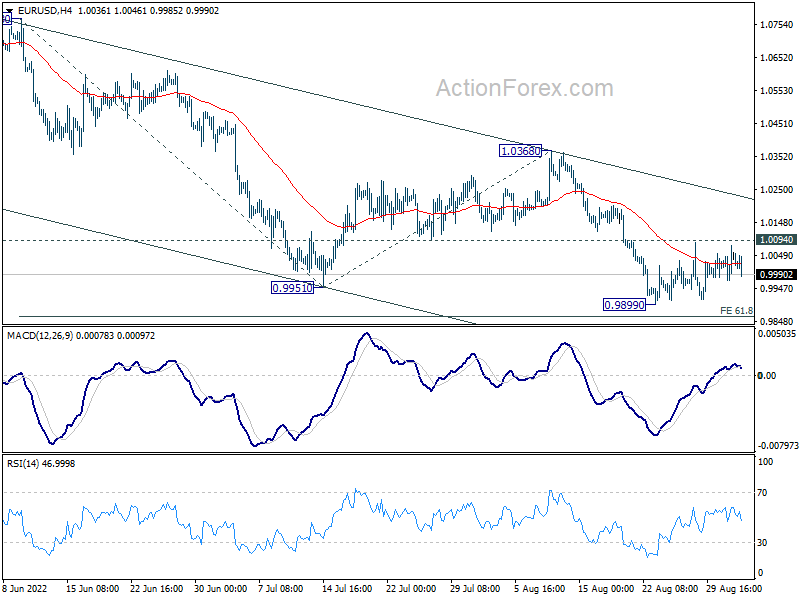
Technically, as Euro is starting to lose momentum in crosses while Dollar is heading higher, it's probably time for EUR/USD to break to the downside. Outlook is staying bearish with 1.0094 resistance intact in EUR/USD. The key level is 61.8% projection of 1.0773 to 0.9951 from 1.0368 at 0.9860. Decisive break there will confirm that bears are back in control and would setup downside acceleration to 100% projection at 0.9546.
In Europe, at the time of writing, FTSE is down -1.38%. DAX is down -1.10%. CAC is down -1.26%. Germany 10-yaer yield is up 0.037 at 1.579. Earlier in Asia, Nikkei dropped -1.53%. Hong Kong HSI dropped -1.79%. China Shanghai SSE dropped -0.54%. Singapore Strait Times rose 0.07%. Japan 10-year JGB yield rose 0.122 to 0.240.
US initial jobless claims dropped to 232k
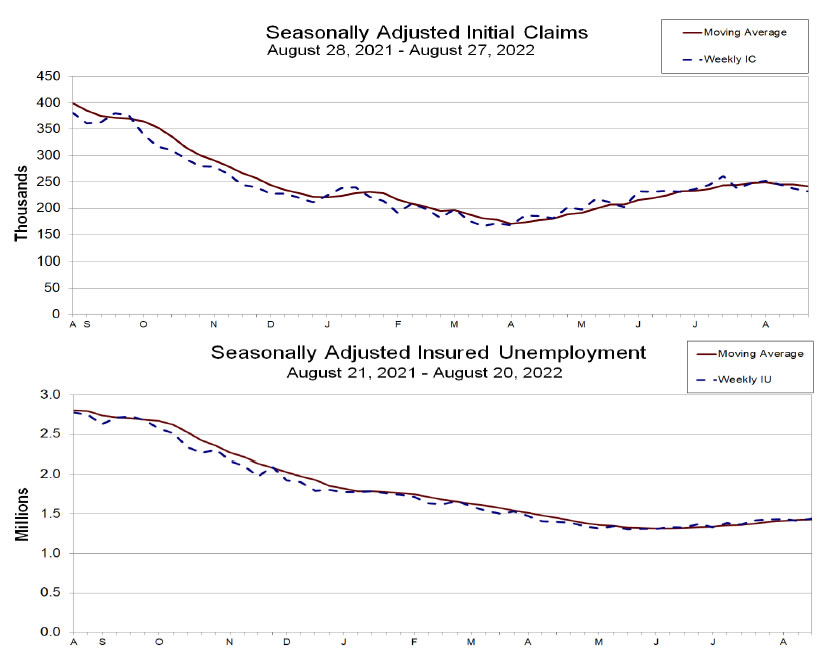
US initial jobless claims dropped -5k to 232k in the week ending August 27, below expectation of 250k. Four-week moving average of initial claims dropped -4k to 241.5k.
Continuing claims rose 26k to 1438k in the week ending August 20. Four-week moving average of continuing claims rose 4.5k to 1428.5k.
Eurozone unemployment rate dropped to 6.6% in Jul, EU down to 6.0%
Eurozone unemployment dropped from 6.7 to 6.6% in July, matched expectations. EU unemployment dropped from 6.1% to 6.0%.
Eurostat estimates that 12.959 million men and women in the EU, of whom 10.983 million in the euro area, were unemployed in July 2022. Compared with June 2022, the number of persons unemployed decreased by 113 000 in the EU and by 77 000 in the euro area. Compared with July 2021, unemployment decreased by 1.854 million in the EU and by 1.576 million in the euro area.
Eurozone PMI manufacturing finalized at 49.6 in Aug, downturn likely to intensify potentially markedly
Eurozone PMI Manufacturing was finalized at 49.6 in August, down slightly from July's 49.8. But that's still a 26-month low. Readings for the Netherlands at 52.6 (22-month low), Ireland at 51.1 (22-month low), France at 50.6 (2-month high) were in expansion. Readings for Spain at 49.9 (2-month high), Germany at 49.1 (26-month low), Austria at 48.8 (20-month low), Greece at 48.8 (20-month low), Italy at 48.0 (26-month low) were in contraction.
Chris Williamson, Chief Business Economist at S&P Global Market Intelligence said: "The euro area's beleaguered manufacturers reported a further steep drop in production in August, meaning output has now fallen for three successive months to add to the likelihood of GDP falling in the third quarter. Forward-looking indicators suggest that the downturn is likely to intensify – potentially markedly – in coming months, meaning recession risks have risen.
UK PMI manufacturing finalized at 47.3 in Aug, steepest downturn since first lockdown
UK PMI Manufacturing was finalized at 47.3 in August, down sharply from July's 52.1. That's also the lowest level in 27 months. S&P Global added that output, new business and new export orders contracted sharply. Still elevated input cost and selling price inflation eased further.
Rob Dobson, Director at S&P Global Market Intelligence, said: "August saw the UK manufacturing sector suffer its steepest downturn since the first COVID-19 lockdown. Output and new orders contracted at the fastest rates since May 2020, as inflows of work from both domestic and export markets slumped sharply lower. There were reports of clients postponing, rescheduling or cancelling agreements due to increased economic uncertainties, recession warnings, rising prices and component shortages, while port congestion and Brexit complications constrained export opportunities."
Swiss CPI rose to 3.5% yoy in Aug, core CPI at 2.0% yoy
Swiss CPI rose 0.3% mom in August, slightly below expectation of 0.4% mom. The monthly rise was due to several factors including rising prices for in-patient hospital services, social protection services and housing rentals. CPI core rose 0.3% mom. Domestic product prices rose 0.2% mom. Imported products prices rose 0.6% mom.
Comparing with August 2021, CPI rose 3.5% yoy, accelerated from 3.4% yoy, matched expectations. Core inflation came in at 2.0% yoy. Domestic product prices were up 1.8% yoy. Imported product prices were up 8.6% yoy.
Also released, real retail sales rose 2.6% yoy in July, above expectation of 0.9% yoy.
Australia AiG manufacturing dropped to 49.3, back in contraction
Australia AiG Performance of Manufacturing Index dropped from 52.5 to 49.3 in August, indicating the first contraction since January. Production fell -1.8 pts to 45.7. Employment dropped -2.6 to 47.5. New orders dropped -4.1 to 55.8. Exports dropped -4.3 to 46.9. Sales tumbled -8.8 to 45.2. Input prices rose 2.0 to 81.7. Selling prices rose 4.6 to 69.1. Average wages rose 11.3 to 74.1.
Innes Willox, Chief Executive of Ai Group said: "The Ai Group Australian PMI for August points to the end of the recent expansion of manufacturing activity. Production, employment and sales were all down in August and most manufacturing sectors reported lower performance in the month.... Prices and wages continued to push higher and with the Reserve Bank seeking to ease these pressures by raising interest rates, further slowing in manufacturing looks increasingly likely over the coming months."
Also released, private capital expenditure dropped -0.3% in Q2, below expectation of 1.1%.
Japan PMI manufacturing finalized at 51.1 in Aug, dip likely to continue near term
Japan PMI Manufacturing was finalized at 51.1 in August, down from July's 52.1. The health of the sector that was the joint-weakest since February 2021. S&P Global also noted new orders had the sharpest reduction since October 2020. Backlogs of work decreased for the first time in 18 months. Rise in input prices was slowest for 8 months.
Usamah Bhatti, Economist at S&P Global Market Intelligence, said: "Latest PMI data pointed to deteriorating current activity in the Japanese manufacturing sector midway through the third quarter of 2022.... The dip is likely to continue in the near term... A benefit that has come from softer demand conditions is that pressure on supply chains has been given the opportunity to ease."
Also from Japan, capital spending rose 4.6% in Q2, above expectation of 3.0%.
China Caixin PMI manufacturing dropped to 49.5 in Aug
China Caixin PMI Manufacturing dropped from 50.4 to 49.5 in August, below expectation of 50.2, back in contraction. Caixin added that output growth slowed as firms faced power supply disruption amid heatwave. New orders declined for the first time in three months. Input costs fell at quickest rate since January 2016.
Wang Zhe, Senior Economist at Caixin Insight Group said: "Overall, the Covid-19 flare-ups, the extreme heat wave and restricted power usage resulted in a slight deterioration in overall business conditions in the manufacturing sector. Supply remained stronger than demand, with the latter recording a contraction. The job market remained weak, while lower input costs and output prices eased inflationary pressures. At the same time, firms were cautious about increasing purchases and inventory levels. Market sentiment remained optimistic, although some were worried about the global economic outlook."
GBP/USD Mid-Day Outlook
Daily Pivots: (S1) 1.1584; (P) 1.1639; (R1) 1.1679; More...
GBP/USD's down trend is in progress and intraday bias stays on the downside. Current fall should target 1.1409 long term support next. On the upside, above 1.1759 minor resistance will turn intraday bias neutral for consolidations. But outlook will stay bearish as long as 1.2292 resistance holds, in case of recovery.
In the bigger picture, fall from 1.4248 (2018 high) could be a leg inside the pattern from 1.1409 (2020 low), or resuming the longer term down trend. Deeper decline is expected as long as 1.2292 resistance holds. Next target is 1.1409 low. However, firm break of 1.2292 will bring stronger rise back to 55 week EMA (now at 1.2859).
Economic Indicators Update
| GMT | Ccy | Events | Actual | Forecast | Previous | Revised |
|---|---|---|---|---|---|---|
| 22:30 | AUD | AiG Performance of Mfg Index Aug | 49.3 | 52.5 | ||
| 23:50 | JPY | Capital Spending Q2 | 4.60% | 3.00% | 3.00% | |
| 00:30 | JPY | Manufacturing PMI Aug F | 51.5 | 51 | 51 | |
| 01:30 | AUD | Private Capital Expenditure Q2 | -0.30% | 1.10% | -0.30% | |
| 01:45 | CNY | Caixin Manufacturing PMI Aug | 49.5 | 50.2 | 50.4 | |
| 06:00 | EUR | Germany Retail Sales M/M Jul | 1.90% | -0.40% | -1.60% | |
| 06:30 | CHF | Real Retail Sales Y/Y Jul | 2.60% | 0.90% | 1.20% | 0.70% |
| 06:30 | CHF | CPI M/M Aug | 0.30% | 0.40% | 0.00% | |
| 06:30 | CHF | CPI Y/Y Aug | 3.50% | 3.50% | 3.40% | |
| 07:30 | CHF | SVME - PMI Aug | 56.4 | 56.4 | 58 | |
| 07:45 | EUR | Italy Manufacturing PMI Aug | 48 | 48.4 | 48.5 | |
| 07:50 | EUR | France Manufacturing PMI Aug F | 50.6 | 49 | 49 | |
| 07:55 | EUR | Germany Manufacturing PMI Aug F | 49.1 | 49.8 | 49.8 | |
| 08:00 | EUR | Eurozone Manufacturing PMI Aug F | 49.6 | 49.7 | 49.7 | |
| 08:00 | EUR | Italy Unemployment Jul | 7.90% | 8.10% | 8.10% | 8.00% |
| 08:30 | GBP | Manufacturing PMI Aug F | 47.3 | 46 | 46 | |
| 09:00 | EUR | Eurozone Unemployment Rate Jul | 6.60% | 6.60% | 6.60% | 6.70% |
| 11:30 | USD | Challenger Job Cuts Y/Y Aug | 30.30% | 36.30% | ||
| 12:30 | USD | Initial Jobless Claims (Aug 26) | 232K | 250K | 243K | 237K |
| 12:30 | USD | Nonfarm Productivity Q2 | -4.10% | -4.60% | -4.60% | |
| 12:30 | USD | Unit Labor Costs Q2 | 10.20% | 10.60% | 10.80% | |
| 12:30 | CAD | Building Permits M/M Jul | -6.60% | -1.50% | -1.50% | -0.60% |
| 13:30 | CAD | Manufacturing PMI Aug | 52.5 | |||
| 13:45 | USD | Manufacturing PMI Aug F | 51.3 | 51.3 | ||
| 14:00 | USD | ISM Manufacturing PMI Aug | 52.6 | 52.8 | ||
| 14:00 | USD | ISM Manufacturing Prices Paid Aug | 59.5 | 60 | ||
| 14:00 | USD | ISM Manufacturing Employment Index Aug | 49.9 | |||
| 14:00 | USD | Construction Spending M/M Jul | -0.10% | -1.10% | ||
| 14:30 | USD | Natural Gas Storage | 58B | 60B |
US initial jobless claims dropped to 232k
US initial jobless claims dropped -5k to 232k in the week ending August 27, below expectation of 250k. Four-week moving average of initial claims dropped -4k to 241.5k.
Continuing claims rose 26k to 1438k in the week ending August 20. Four-week moving average of continuing claims rose 4.5k to 1428.5k.
Pound Extends Losses after Weak Mfg. PMI
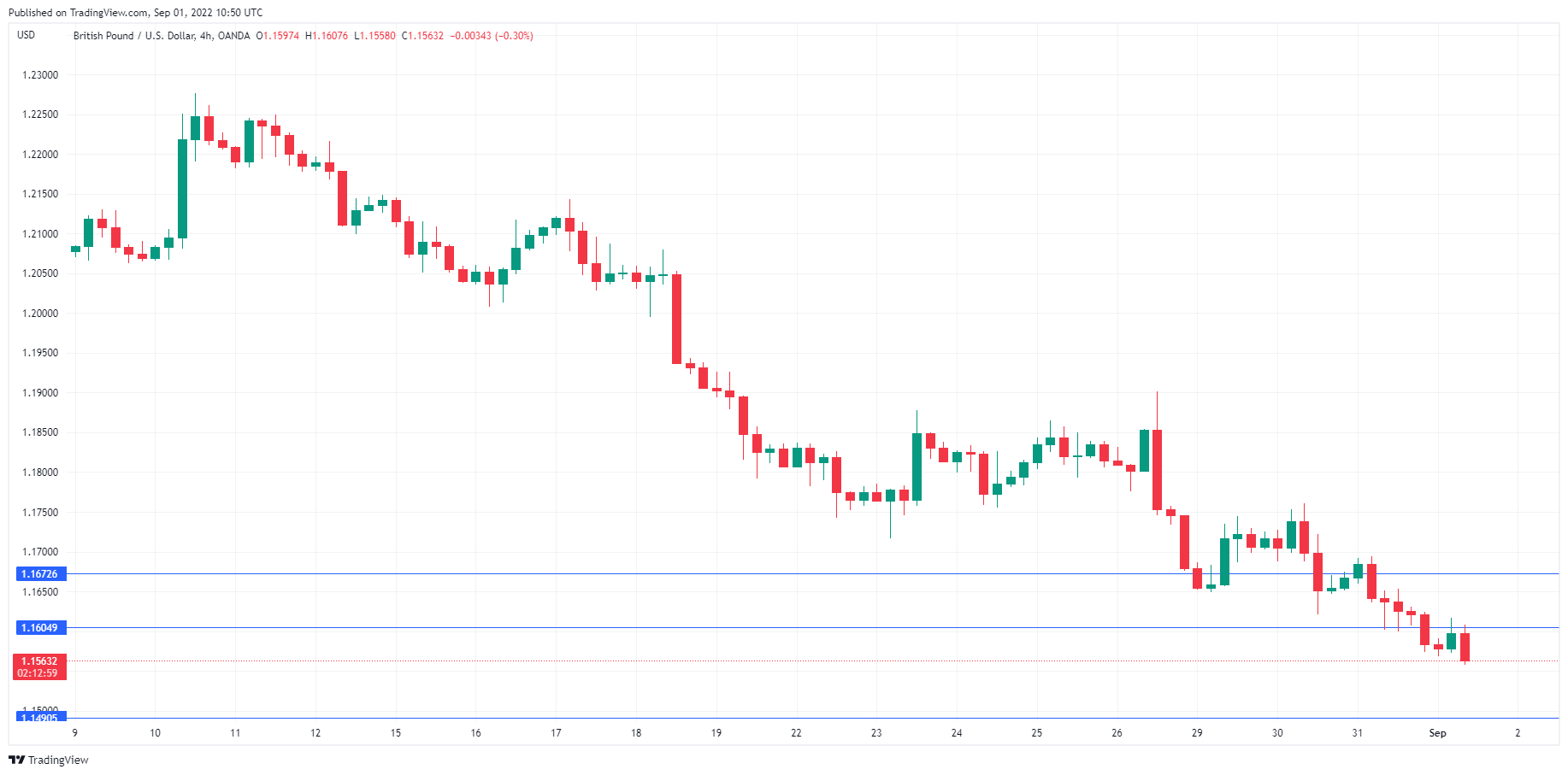
The British pound can’t buy a break and has fallen for a fifth straight day. GBP/USD is trading at 1.1586 in Europe, down 0.29%.
UK Manufacturing PMI contracts
The UK manufacturing sector has been struggling for quite some time and in August, manufacturing production declined. Manufacturing PMI fell to 47.3 in August, down from 52.1 in July. This marked the first contraction (a reading below 50.0) since May 2020, during the first Covid lockdown. The PMI decline reflected a range of problems, including supply chain disruptions, port congestion, and shortages of raw materials and workers. With inflation still on the rise and fears of a recession, the manufacturing sector faces plenty of headwinds and things could get worse before they improve.
Market attention now shifts to one of the key events on the economic calendar, Friday’s US nonfarm payrolls. On Wednesday, the ADP Employment report showed a drop to 130 thousand new jobs in August, down from 270 thousand. The reading was well below the estimate of 288 thousand and the lowest level since August 2021. The ADP release is not considered a reliable gauge for nonfarm payrolls, but still garners close attention as it could point to a trend in job growth.
August Nonfarm payrolls are also expected to drop, with a consensus of 300 thousand, following the massive 528 thousand gain in July. A reading of 300 thousand or higher would point to solid job growth and would likely give the US dollar a boost, as it would give the Federal Reserve a green light to continue with its aggressive rate-tightening cycle. Conversely, a weaker-than-expected reading would raise doubts about the Fed’s pledge to stay aggressive, which could lead to a rotation out of US dollars.
GBP/USD Technical
- GBP/USD is testing support at 1.1672. Below, there is support at 1.1604
- There is resistance at 1.1786 and 1.1854
XAG/USD: Silver Hits New Multi-Month Low in Extension of August 11.4% Fall
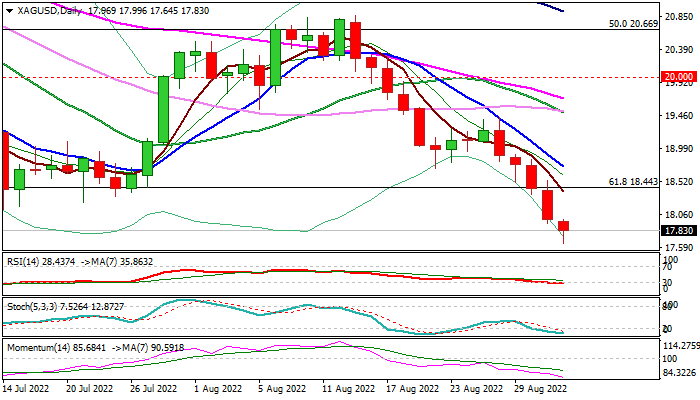
Spot silver entered new month firmly in red and hit new lowest in over two-years on Thursday, in extension of August’s 11.4% fall (the biggest monthly loss since September 2020).
The metal is under pressure by rising dollar on expectations of further aggressive rate hike and also by slower recovery in certain sectors where silver is used (industrial and jewellery).
Bearish studies add to negative outlook, along with negative signals on weekly bull-trap above 200WMA; completion of weekly failure swing pattern and converged 20/200WMA’s, about to form bear-cross.
Additional negative signal was generated by Aug close below pivotal Fibo support at $18.44 (61.8% of $11.23/$30.10 rally).
Bears eye June 2020 low ($16.94), violation of which would risk test of Fibo 76.4% support at $15.68.
Oversold conditions warn of some adjustment in coming sessions, with upticks to be ideally capped by falling daily Tenkan-sen (18.53) to keep bears intact.
Only bounce through $19.25/28 (daily Kijun-sen / daily cloud base) would put larger bears on hold.
Res: 18.00; 18.53; 18.74; 19.25.
Sup: 17.64; 16.94; 16.45; 15.68.
USD/JPY: Hits New 24-Year High, Pressures Psychological 140 Barrier
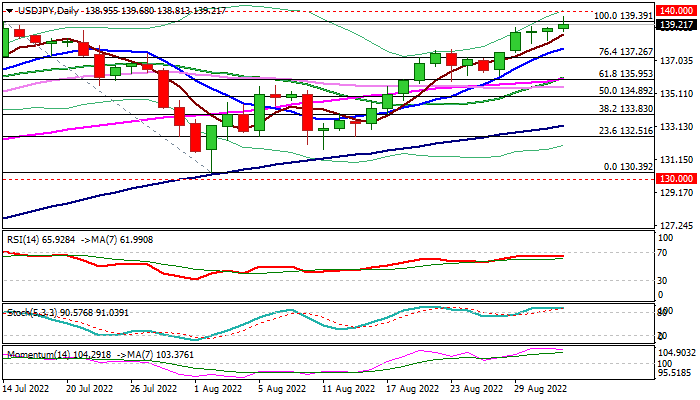
The USDJPY posted new 24-year high on break through former 2022 peak, posted in July.
The dollar remains strongly underpinned by a hawkish stance of Fed, as many market participants bet for another 75 basis points rate hike in the policy meeting later this month, as Fed expressed its strong commitment to restore price stability by tightening its monetary policy, even at cost of significant slowdown in economic growth.
On the other side, the Bank of Japan sticks to its ultra-loose policy and widening gap between the policies of two central banks would continue to be a main driver of the greenback against yen.
Although bulls cracked key barrier at 139.39, headwinds should be expected here as daily studies are overbought.
Limited dips (ideally to be contained at 128.00/137.80 zone) should offer better buying levels for clear break of 139.39 pivot and test of psychological 140 barrier, with further acceleration higher on break of 140 barrier, not ruled out on current conditions or more hawkish signals from the US central bank.
Res: 139.68; 140.00; 141.51; 142.82.
Sup: 138.63; 138.05; 137.80; 137.26.
Aussie Yawns after Capex Dips
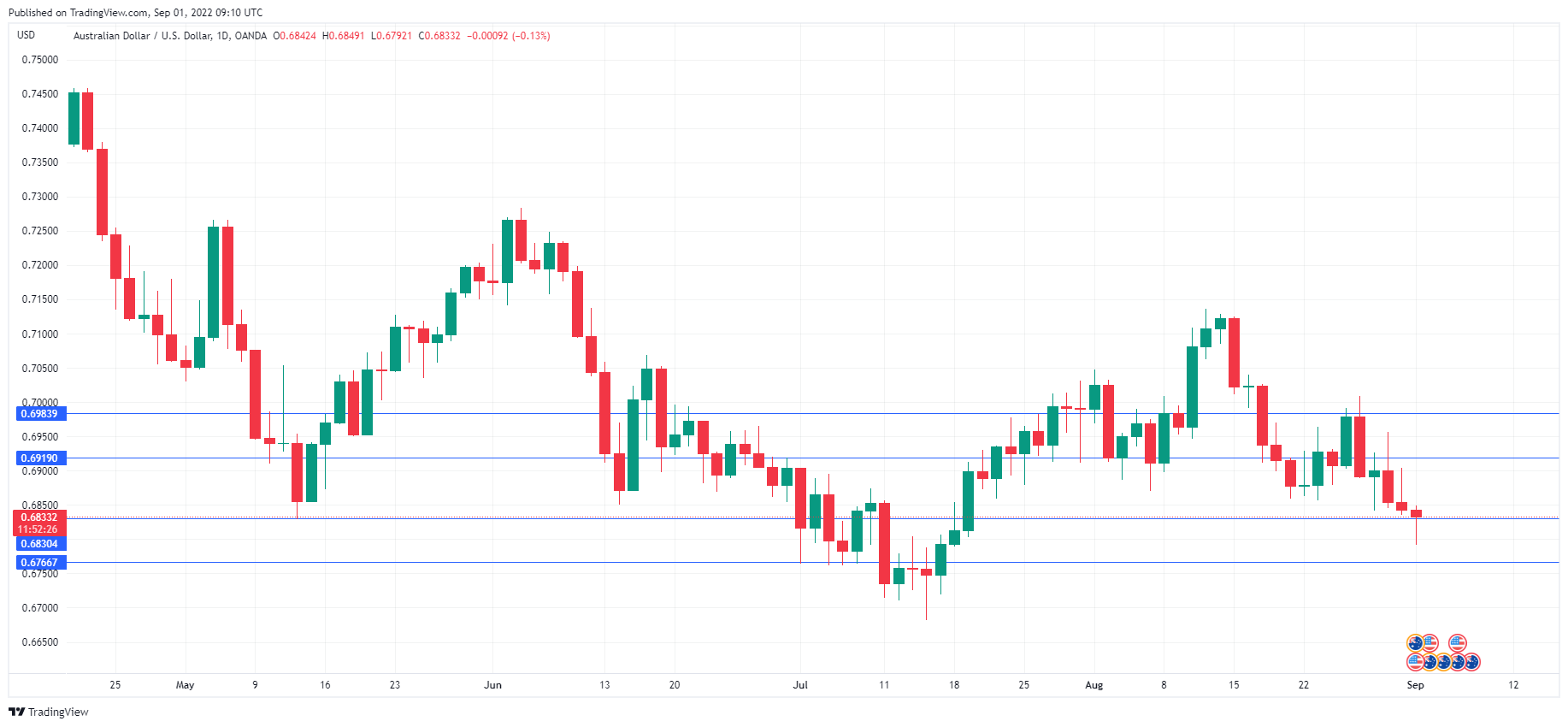
The Australian dollar is showing limited movement today. In the European session, AUD/USD is trading at 0.6835, down 0.10%.
Australian Capex falls for a second successive quarter
Australian Private Capital Expenditure disappointed in Q2, with a reading of -0.3% (vs -0.3% in Q1), well below the forecast of 1.5%. This follows weak construction data on Tuesday, as Construction Work Done posted a second straight decline, coming in at -3.8% in Q2. These numbers are a further indication that the Australian economy is slowing down, as a weak global economy and higher interest rates have dampened economic activity.
The Australian dollar has not reacted to these weak releases, as the currency is much more sensitive to global developments than internal data. The war in Ukraine has raised the price of energy and food imports for Australians and caused high inflation. As well, risk appetite has been dampened, and AUD/USD has tumbled about 650 points since the Russian invasion of Ukraine.
Additionally, the Federal Reserve continues to tighten policy, and this has boosted the US dollar over the past few months. With Fed Chair Powell delivering a “read my lips” speech at Jackson Hole, pledging to continue raising rates, there is room for the Australian dollar to continue to lose ground.
The RBA meets next on September 6th. In all likelihood, the RBA will deliver a 0.50% increase, as inflation hasn’t shown any signs of peaking. In the second quarter, inflation rose to 6.1%, up from 5.1% in Q1. Policy makers are hoping to avoid a recession and guide the economy to a soft landing, but the central bank, like the Fed, has made clear that its paramount goal is to curb inflation and avoid inflation expectations from becoming anchored.
Investors will be keeping a close eye on US nonfarm payrolls on Friday. The markets are expecting a strong gain of 300 thousand for August, after the massive 528 thousand gain in July. A strong NFP will provide support to the Fed’s plans to remain aggressive and should boost the US dollar. Conversely, a weak reading will raise speculation that the Fed will have to ease up and the US dollar could react with losses.
AUD/USD Technical
- There is resistance at 0.6919, followed by resistance at 0.6983
- 0.6830 is providing support, followed by 0.6766
Eurozone unemployment rate dropped to 6.6% in Jul, EU down to 6.0%
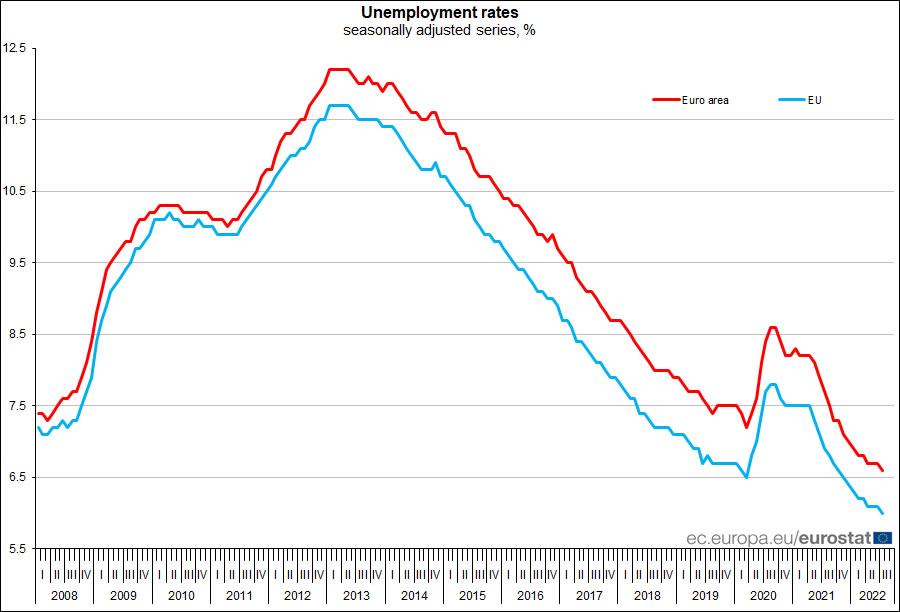
Eurozone unemployment dropped from 6.7 to 6.6% in July, matched expectations. EU unemployment dropped from 6.1% to 6.0%.
Eurostat estimates that 12.959 million men and women in the EU, of whom 10.983 million in the euro area, were unemployed in July 2022. Compared with June 2022, the number of persons unemployed decreased by 113 000 in the EU and by 77 000 in the euro area. Compared with July 2021, unemployment decreased by 1.854 million in the EU and by 1.576 million in the euro area.
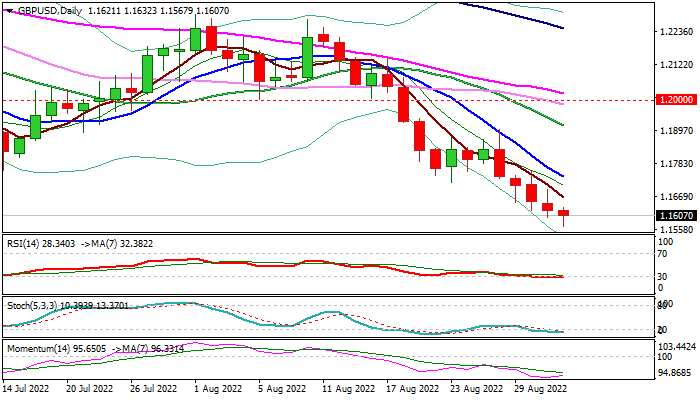
GBP/USD: Sterling May Retest 2020 Low after 4.5% Drop in August
Cable dips below 1.16 handle in early Thursday, hitting the lowest levels in 29 months, pressured by fading risk appetite on darkening economic outlook and strong dollar, driven by expectations for further aggressive stance of the US Federal Reserve.
Near-term action showed a little reaction on slightly better than expected UK housing data and will look for today’s release of US manufacturing PMI data for further signals, while larger picture sees ECB, BOE and Fed policy meetings later this month as key events which could influence pound’s performance.
Sterling was down 4.5% in August, in the biggest monthly loss since June 2016 post-Brexit vote drop and is on track for the third consecutive weekly fall that adds to negative outlook, along with bearish technical studies on all larger timeframes.
Bears eye pandemic low at 1.1410 (Mar 2020), but may face significant headwinds on approach as studies are oversold on daily, weekly and monthly chart.
In current environment, a limited correction would be likely scenario, with upticks to provide better levels to re-join firmly bearish market.
Res: 1.1634; 1.1693; 1.1737; 1.1760.
Sup: 1.1556; 1.1493; 1.1430; 1.1410.