Sample Category Title
Eco Data 8/30/22
[php_everywhere instance="1"]
Eurozone Inflation Set to Hit New Record as Gas Prices Keep Soaring
With the August S&P flash composite purchasing managers index (PMI) signaling that the Euro area economy is on the verge of recession and the problem of energy supply in Europe getting worse day by day, euro traders have been reluctant to bring euro/dollar back above parity permanently. Now they may turn their gaze to Eurozone’s preliminary inflation numbers for August, due out on Wednesday at 09:00 GMT, as they try to figure out what the outcome will mean for the ECB’s future course of action, and subsequently, the common currency.
Headline inflation to hit a new record
After hitting a record high of 8.9% year-over-year in July, the headline harmonized index of consumer prices (HICP) is expected to have ticked higher to 9.0%, while the core rate, which excludes the volatile items of food and energy, is forecast to have held steady at 5.1% yoy. This suggests that high energy costs remain the primary inflator of consumer prices.
With oil prices correcting lower during the summer months, the spotlight has fallen to natural gas, with the Dutch futures hitting another record on Friday. Looking at the graph below, we see that, although very volatile recently, the yearly change in natural gas prices has been decently correlated with the spread between the headline and core inflation rates.
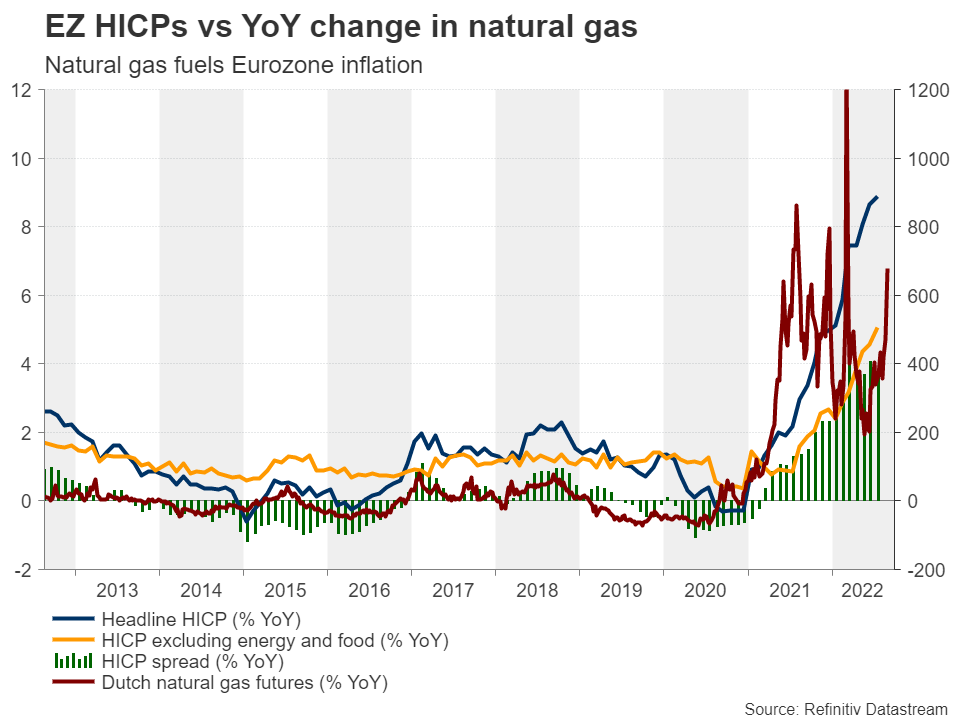
Following the sanctions imposed by the European Union on Russia for invading Ukraine, gas giant Gazprom has slashed gas flows to Germany – Eurozone’s economic powerhouse – via the Nord Steam 1 pipeline to only 20% of capacity. With the winter getting closer and Gazprom planning to close the pipeline for a three-day maintenance on Wednesday, euro traders are becoming increasingly nervous that the supply shortages and the increasing demand for heating gas will drive prices even higher and thereby drag the whole Euro-area economy into recession. That’s maybe why the euro has been suffering, even with the ECB appearing more hawkish than previously anticipated.
Investors place bets over a bigger September hike
In July, ECB policymakers raised interest rates twice as much as they had indicated after the June meeting, signaling that further increases are likely for the rest of the year. Lately, investors had been largely anticipating 50 more basis points to be served at the September gathering, but comments by a couple of ECB rate-setters over the weekend have prompted some investors to shift their bets to a 75bps hike. The level when a peak is expected was also raised, but the timing was kept untouched at October 2023.
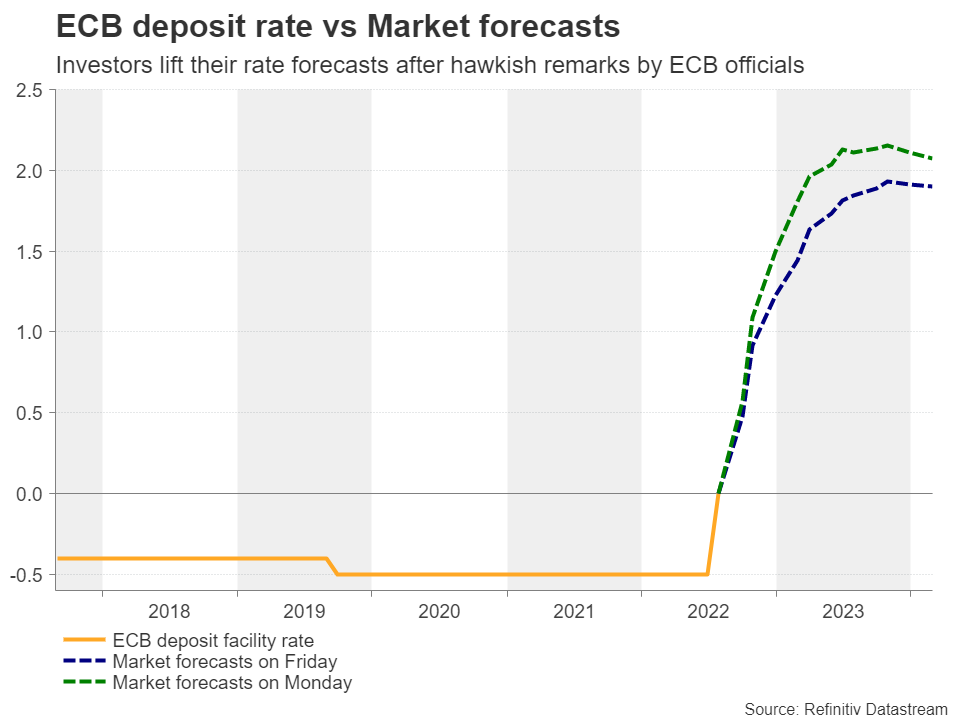
And yet, the euro was not resurrected. In contrast to how the dollar reacts to the prospect of higher interest rates in the US, the common currency is hurt by such expectations. Maybe its traders are more concerned over the ECB dragging the Euro-area economy into recession, rather than trusting it to relieve them from the pain of very high consumer prices. That conclusion is also supported by the fact that the euro is inversely correlated, rather than directly, to natural gas prices. With the picture expected to only get darker, this means that the euro/dollar pair may be destined to drift further below parity.
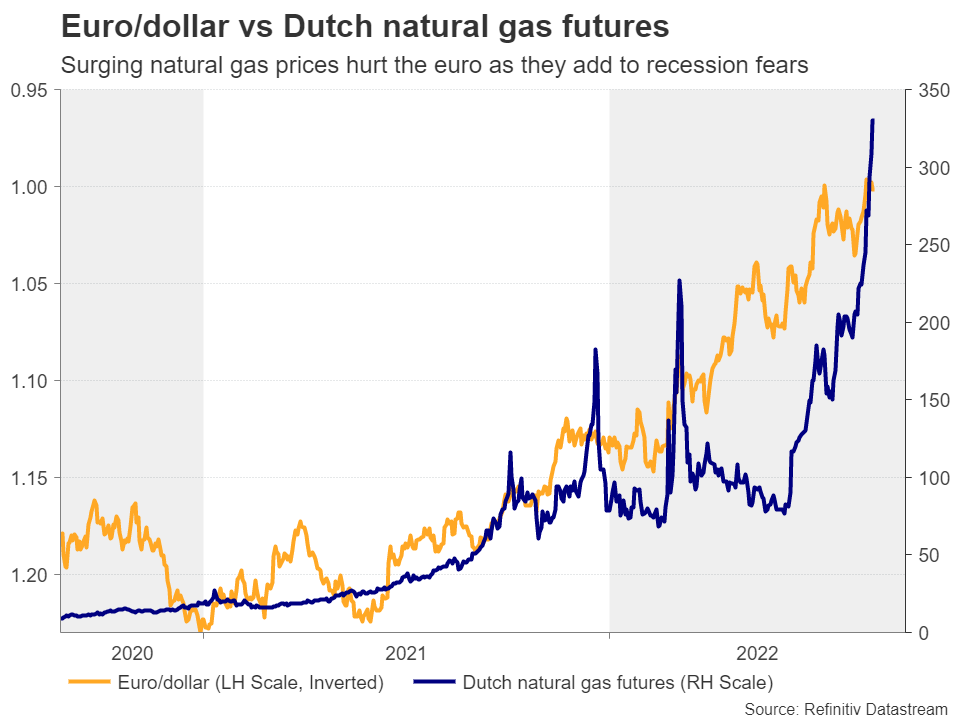
Where is euro/dollar headed next?
Yes, higher inflation could initially result in some automatic euro buying, but any recovery could stay limited near the 1.010 zone, marked by the inside swing lows of July 26 and 27, or near the downtrend line drawn from the high of February 10. Sellers may shoot again from near those resistance zones, pushing the pair back down to the 0.9900 territory. A break lower would confirm a forthcoming lower low and could pave the way towards the 0.9685 or 0.9600 zones, defined as supports by the lows of October and September 2002, respectively.
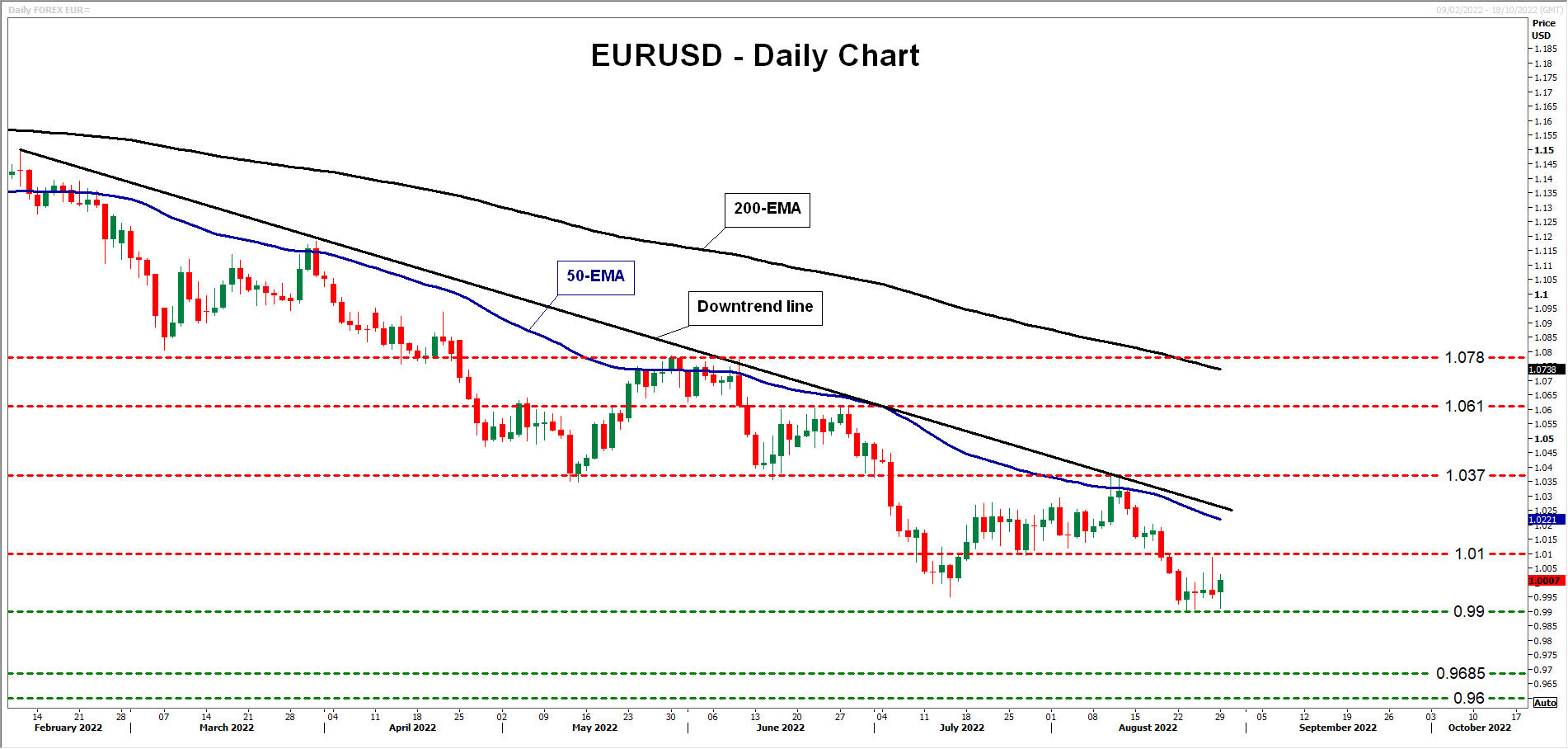
For a near-term reversal to start being examined, a break above 1.0370 may be needed, accompanied by improving Eurozone economic data. Such a move may also confirm the break above the downtrend line and could see scope for advances towards the 1.0610 territory, the break of which may allow extensions towards the 1.0780 zone, which acted as a ceiling between May 27 and June 6.
Jackson Hole Has Serious Consequences
Fed Chair Powell’s comments on the Jackson Hole Symposium resulted in the worst weekly candle in the US500 index since June. Most risky assets experienced severe drawdowns, and EURUSD returned to the above-parity area. We explain everything you need to know about the Symposium in this article.
The most important statements
As far as I remember, it was the first time Powell had an extremely hawkish speech since the Covid-19 pandemic. In eight minutes, he pointed directly at current economic concerns, saying that the road ahead will bring some pain to households and businesses. He says it’s an “unfortunate cost of bringing down inflation.” Federal Reserve is ready to imply higher interest rates, even if it does some damage. The next rate change will likely be a 75-basis-points hike, with the following rate changes depending only on the economic data. Also, high interest rates will stay with us for longer before descending.
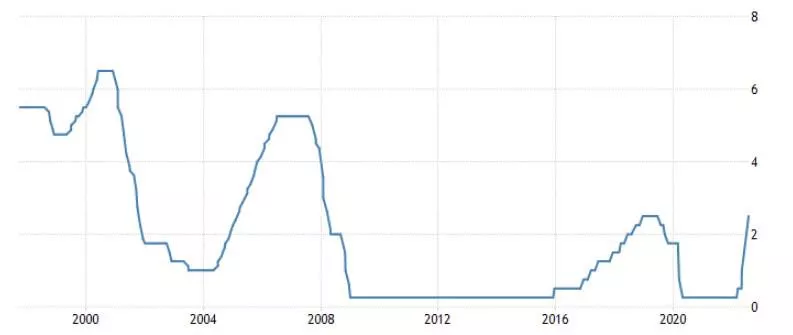
Isabel Schnabel, a top European Central Bank official, said she and her colleagues had little choice but to continue tightening even if Europe’s economy tips into recession, which is becoming increasingly likely. As you can see, the rhetoric is similar to Powell’s, and the effect on the markets is the same. Julia Coronado, president of MacroPolicy Perspectives LLS, said that “even the ECB, which has a much higher chance of a recession in the next 12 months than the US, knows that the direction of travel is you need to raise rates, and you need to raise rates in a pretty steady fashion.”
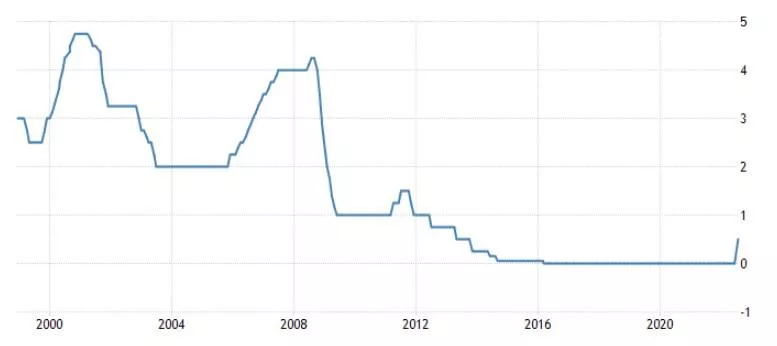
The BOE’s governor Bailey had a statement as well. The bank started to wind down (shrink) its balance sheets, which they scaled up during the pandemic to relieve pressure on banks and keep long-term interest rates low. If the bank continues to print more money (wind up balance sheets), it will speed up inflation. The BOE understood that interest rates should be significantly increased, and it’s time to stop creating money. Therefore, it has concerns about banks’ long-term financial stability.
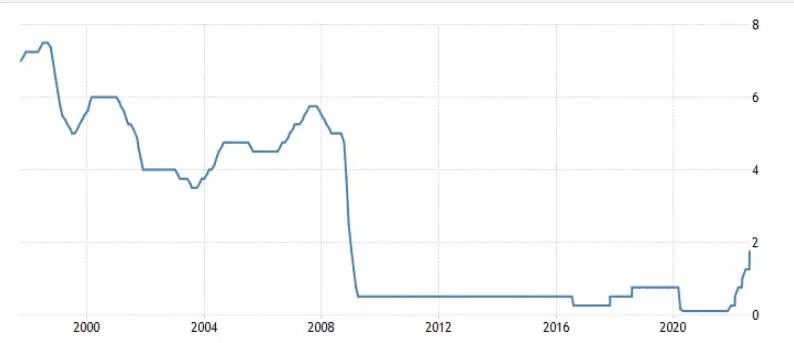
UK interest rates
It became clear that the ECB, the Fed, and the BOE were well overdue with rate hikes, and now they have no choice but to bite the bullet and cool down the economy with the harshest measures. Central bankers’ actions already sent some assets into a freefall and boosted the greenback. Let’s look at various charts to make predictions based on new information.
Sell gold, buy USD?
US500
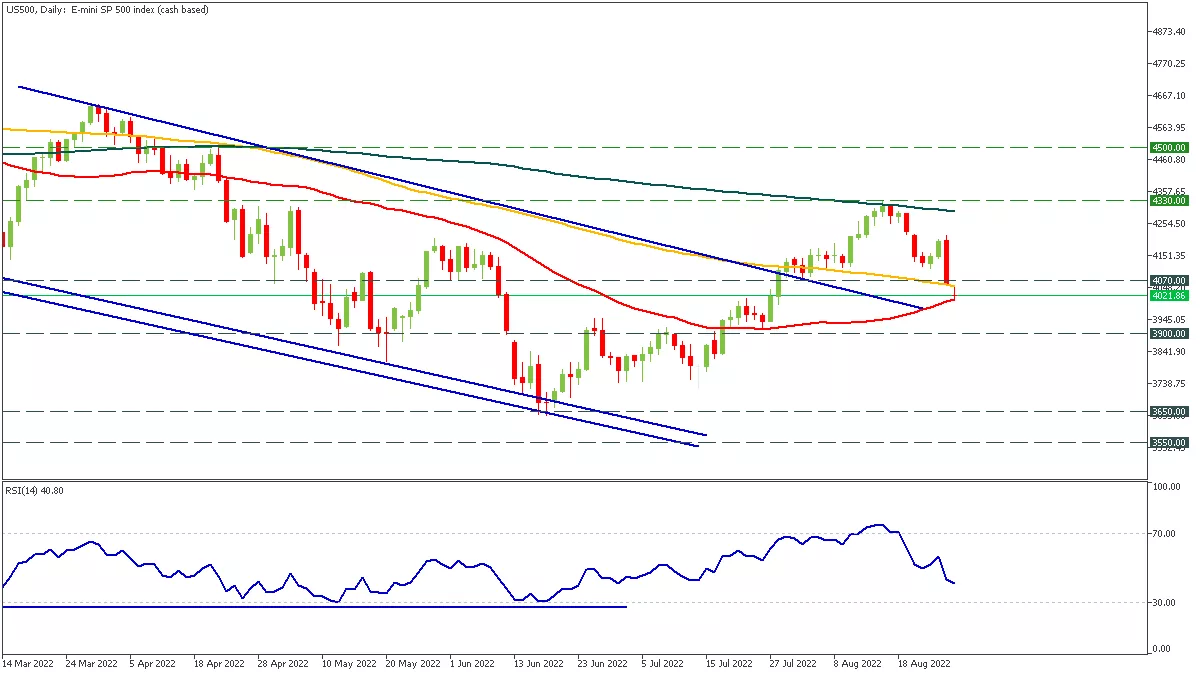
Right after Powell’s speech (which was the most anticipated at Jackson Hole), the US500 index reacted with a sharp decline and lost 3.47% during the day. The plunge ended right at the 100-daily MA, but the next day opened below it and touched the 50-daily MA. Considering all I said above, the US500 has a high chance of breaking the moving average and declining.
US500 daily chart
Resistance: 4330, 4500
Support: 3900, 3650, 3550
EURUSD
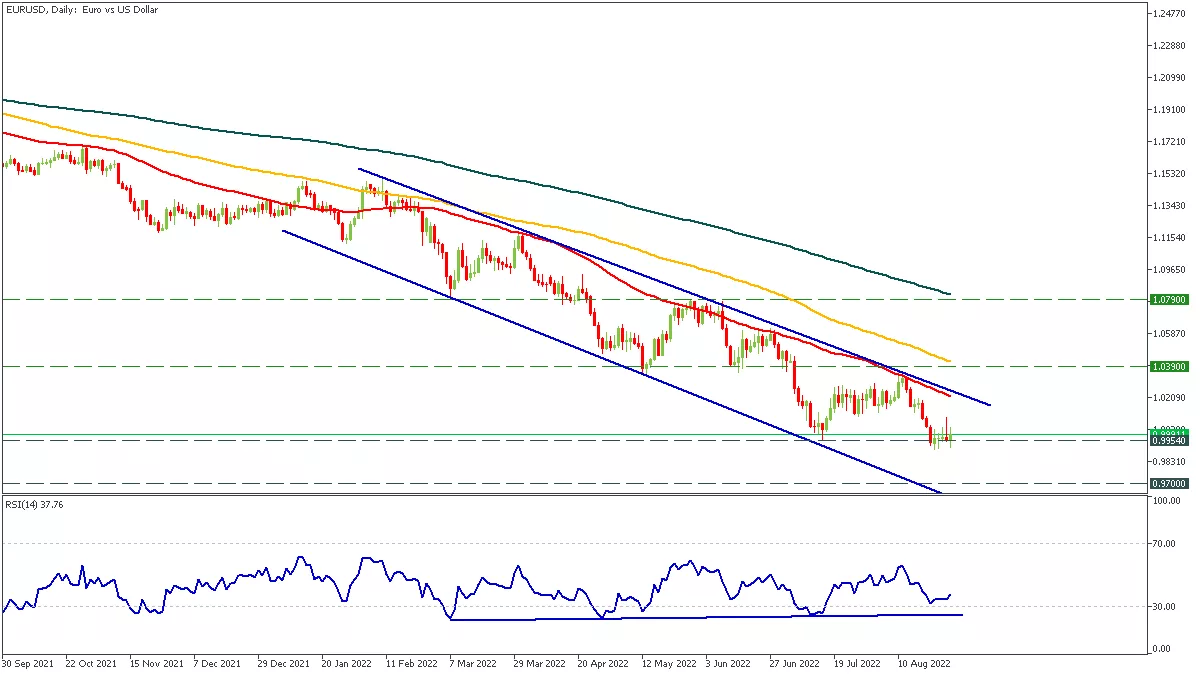
The pair has been moving inside a descending channel for eight months, and while it’s under the trendline, the outlook is bearish—however, multiple divergences on the RSI hint about a soon reversal in the pair. The USD is feeling strong and may push the pair lower to the support level of 0.9700. From it, I expect a gain of bullish momentum and a soar to the parity level and higher.
EURUSD daily chart
Resistance: 1.0390, 1.0790
Support: 0.9954, 0.9700
XAUUSD
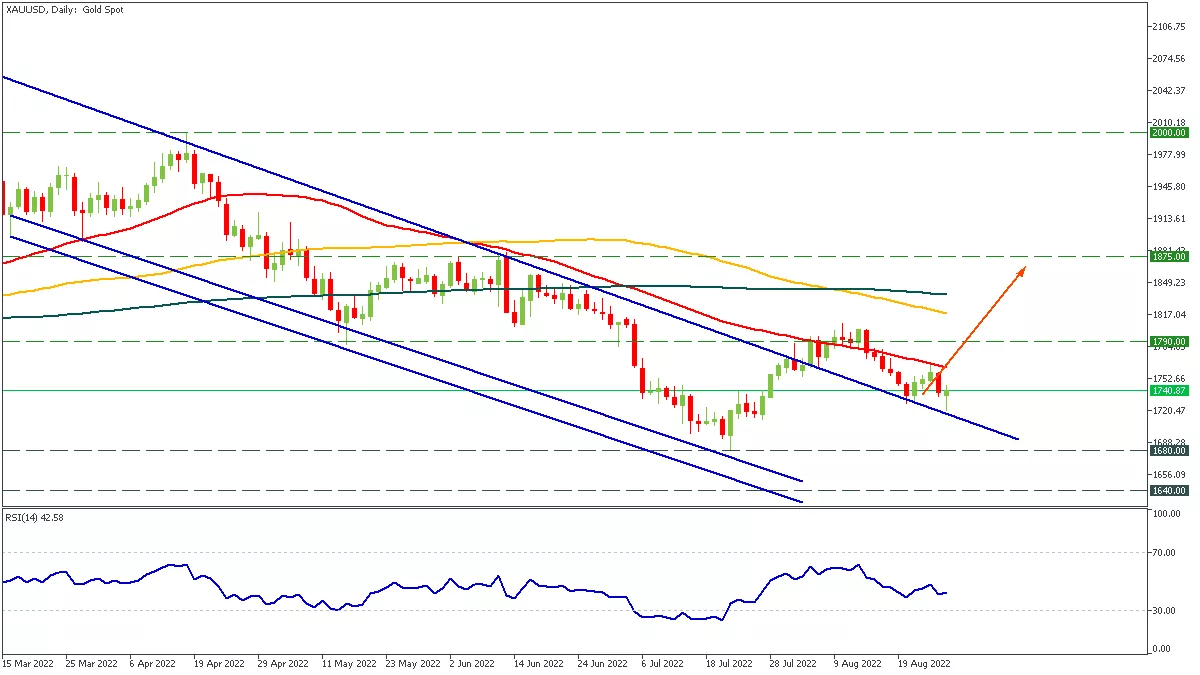
Gold loves the weak dollar, but sometimes the metal can grow with the currency. XAUUSD broke through the trendline and made two retests. I consider this a strong bullish signal for the price, but you must wait for the daily candle to close above the resistance of $1790. For conservative traders, it would be better to open a buy trade when gold crosses the 200-daily MA (dark line).
XAUUSD daily chart
Resistance: 1790, 1875, 2000
Support: 1680, 1640
USDJPY
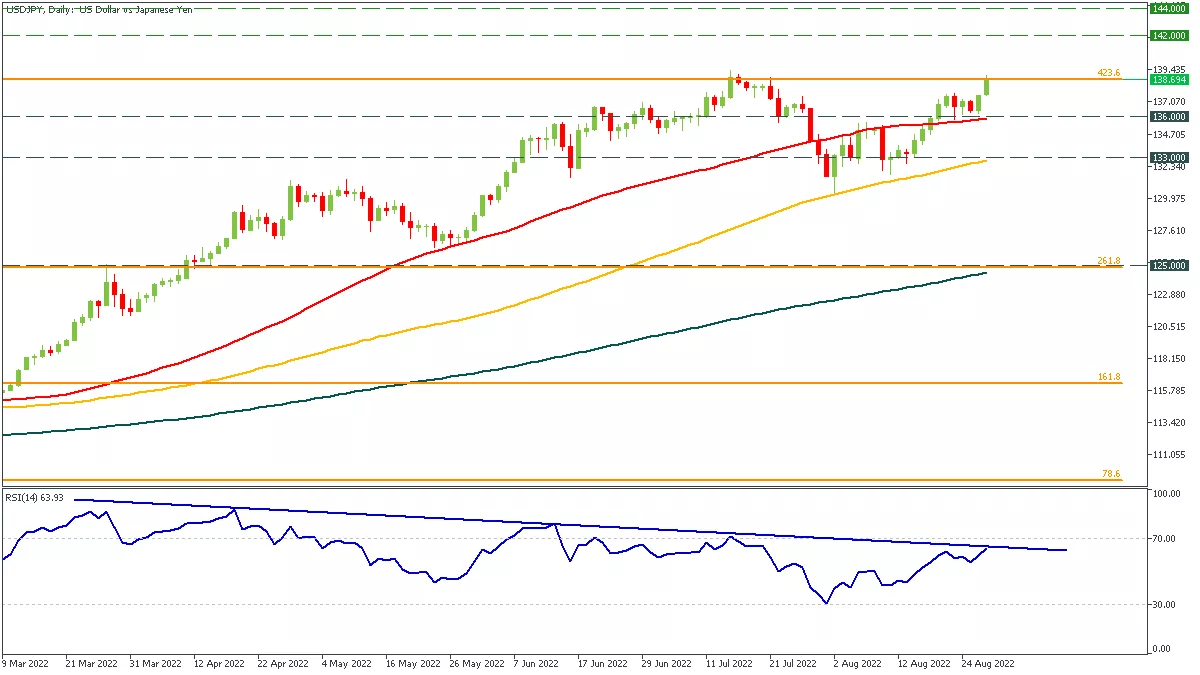
The pair looks bearish due to several divergences on the RSI and retest of the last high. However, the breakout of the previous high will open a road to 142.00 and 144.00 resistances. A bounce from the current levels will signal a trend change despite the USD strength, and USDJPY may slide to the 200-daily MA (125.00).
USDJPY daily chart
Resistance: 142.00, 144.00
Support: 136.00, 133.00, 125.00
The bottom line
There are fundamental reasons for the USD to grow, including hawkish US monetary policy and slowing down of inflation. On the other hand, the technical picture is rather bearish for the USD and bullish for the gold. Even if the greenback grows for another month, it would be the last rally of the US dollar because as the tightening ends, funds will go away from the currency into risky assets.
Stock Selling Continues, Gold Benefits on Dollar Rally Break, Oil Rises, BTC Back Above $20K for Now
US stocks are declining after a weekend filled with global central bank hawkishness reinforced the message that global central bank tightening will deliver pain to households and businesses. Friday’s sharp selloff is continuing as expectations for the global energy crisis to persist, which will keep inflation risks elevated and lead to a rapid deterioration of economic data.
Powell sent a short and direct message that there won’t be a Fed pivot anytime soon and that has markets positioned for further equity weakness. Investors were expecting that once the US got some ugly data, perhaps a couple negative NFP reports, that the Fed would come to the rescue, but that might not be the case. Premature loosening won’t be happening on the first signs that the economy is slowing down quickly and that raising doubts for anyone who bought stocks earlier this month.
All about Europe this week
The ECB rate decision will show that the current inflation narrative will force them to deliver massive rate hikes that will kill growth. Over the weekend, ECB’s Rehn said their next step is a significant rate move in September and that it should be by at least 50 basis points. The latest round of ECB talk has been hawkish and that should have markets leaning towards expecting a 75 basis point rate hike.
The European Union Commissioner Ursula von der Leyen is preparing an emergency intervention and structural reform of the electricity market. Drastic measures are needed to salvage the European economy as the risks of extremely higher energy costs could trigger a severe recession. Czech officials have suggested capping natural gas used for power generation. The EU is expected to meet on September 9th and is expected to show some plan on tackling the energy crisis.
Gold
Non-interest bearing gold got crushed early as more global central bank rate hikes are getting priced in. Gold is edging higher as the dollar rally halted as the euro rises on expectations the ECB will deliver more rate hikes than investors initially thought. If the dollar does not rally here, that could provide some relief for gold. If equities remain in risk aversion mode as the speculative money that bought risky assets this month grows nervous economic growth is about to collapse, gold might be able to stabilize here.
Gold was vulnerable to a plunge towards $1700 but it is starting to show some resilience. With the UK on holiday, today’s moves might be meaningless. The true test for gold will come tomorrow.
Oil
The one trade that everyone can agree upon is that the oil market will likely remain tight. Oil rallied on rising risks of a potential civil war that could put Libyan output at risk and over growing expectations that OPEC+ is positioning themselves to cut production. What is also helping oil today is that despite risk aversion running wild, the dollar rally is on hold.
Oil has been trending lower but the supply side risks are too great and prices need to find a home above the $100 a barrel level.
Bitcoin
Over the weekend, Bitcoin dipped below the coveted $20,000 price point as risk aversions grew following more global central bank hawkish talk from Jackson Hole. Bitcoin is showing some resilience here as it has clawed back above the $20,000 level, despite widespread stock market weakness. Crypto traders are not used to seeing Bitcoin withstand a rout on Wall Street, so this could be a promising sign. Crypto bulls will be tested here as the risk for further risk aversion are high given the trajectory of the global economy.
Pound is Plunging on the News
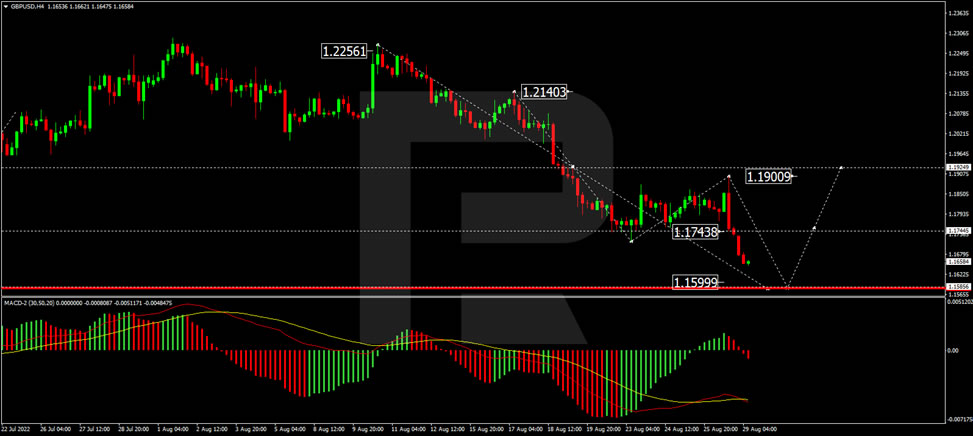
The Pound Sterling continues plummeting against the USD; by now, it has already dropped to 1.1660.
Apart from the strong USD factor, the Pound is being significantly pressured by domestic news. Britain's energy regulator announced Friday that energy bills for households in the UK would rise by 80% in October. In response to that, the HM Treasury said that it was thoroughly working on developing new options to support households and defuse cost loading from energy price surges. However, all these words didn’t help the Pound at all.
The bearish pressure on the Pound is currently too strong to expect a quick and miraculous recovery.
Systematic issues inside the British economy might seriously escalate in the near future due to the energy crisis, making the national currency much cheaper.
As we can see in the H4 chart, having finished the correctional structure at 1.1900 and rebounded from this level, GBP/USD is forming a new descending structure towards 1.1600. Later, the market may start another correction to reach 1.1750 and then resume trading downwards with the target at 1.1550. From the technical point of view, this scenario is confirmed by the MACD Oscillator: its signal line is moving below 0 and may continue falling to reach new lows soon.
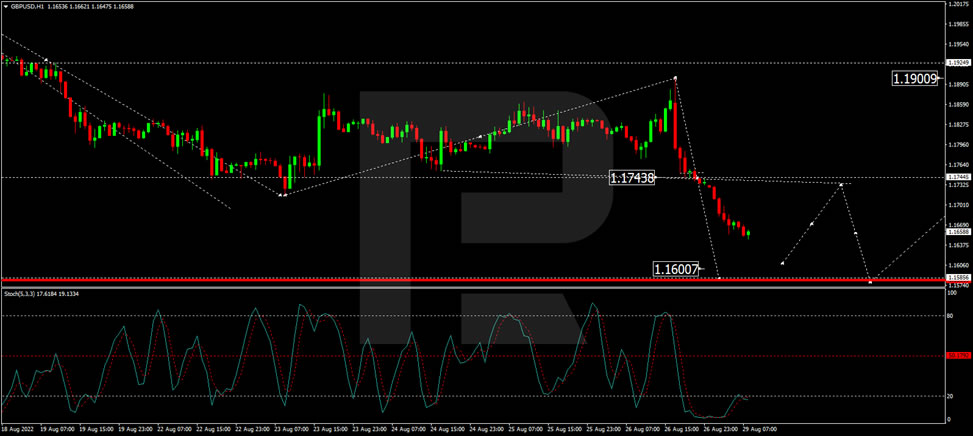
In the H1 chart, after completing the correction at 1.1900, breaking the correctional channel at 1.1744, and then forming a new consolidating range there, GBP/USD has broken it downwards and may continue falling towards 1.1600. Later, the market may correct to test 1.1744 from below and then resume trading downwards with the target at 1.1550. From the technical point of view, this scenario is confirmed by the Stochastic Oscillator: its signal line is moving below 20. In the future, it may grow to rebound from 50 and resume falling to return to 20.
Euro Rises to Parity as ECB Hints at 75bp Hike
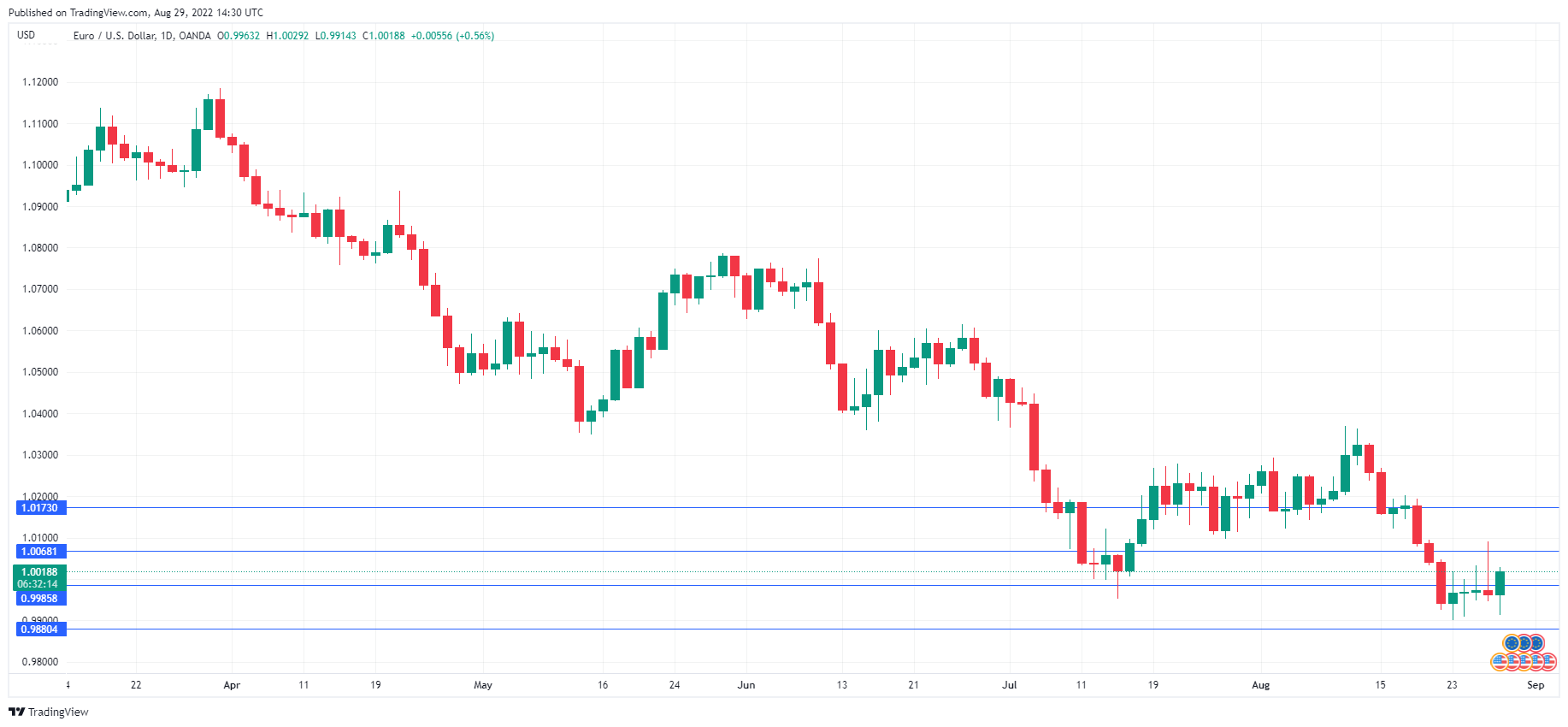
EUR/USD has edged higher today and is trading at the parity line. In the North American sesssion, EUR/USD is trading at 1.0019, up 0.57%.
Euro bucks the trend, rises against greenback
The US dollar has posted sharp gains against the major currencies, as Fed Chair Powell’s hawkish speech at Jackson Hole left no doubt that the Fed will continue to tighten rates in its titanic battle with surging inflation. The euro, however, bucked the trend and posted strong gains on Friday but ultimately pared these gains, before moving higher once again today. The upward movement has been driven by hawkish comments at Jackson Hole from senior ECB members, including Isabel Schnabel, who is well-known for being a hawk. Shnabel said that the likelihood of high inflation becoming entrenched in expectations was “uncomfortably high” and argued that “central banks need to act forcefully”. Latvian central bank Governor Martins Kazak was even more specific, stating that the ECB should be open to discussing 50 or 75 basis point moves.
The ECB has raised rates but only to zero, well below the neutral rate of around 1.5%. This means that ECB policy continues to stimulate the economy, at a time when inflation and inflation expectations continue to move higher. The ECB will be hard-pressed to find the balance of raising rates without tipping the weak eurozone economy into a recession.
Overshadowed by Powell’s hawkish speech at Jackson Hole was a host of weak US releases. Personal income and spending data both missed expectations, while the Core PCE Index, the Fed’s preferred inflation gauge, fell to 0.1% in July MoM, down from 0.6% in June and shy of the estimate of 0.3%. The weak numbers mean that the Fed may have to ease back on rate hikes, despite Powell’s hawkish speech, as the data continue to indicate that the economy is slowing in response to the Fed’s tightening. If upcoming releases indicate that the economy is losing steam, the dollar will be under pressure.
EUR/USD Technical
- EUR/USD has support at 0.9985 and 0.9880
- There is resistance at 1.0068 and 1.0173
New ECB Call – We Expect 75bp at the Meeting Next Week
In light of the numerous hawkish comments and sources stories during the weekend, we now change our ECB rate call.
We now expect ECB to hike 75bp next week, which will be followed by 50bp in October and 25bp in December, but acknowledge the increased uncertainty on the two latter hike size expectations. This is +25bp for our previous rate hike expectations at both the September and the October meetings, respectively, and we now see the end-point of the ECB deposit rate at 1.5%.
As regards the reinvestment schedule, we currently do not foresee that ECB will change it, but increased market and ECB focus in
We believe the euro area will face a recession and ECB will hike into that, however, we also acknowledge that even without the ECB tightening, the European economy was in a severe situation to begin with a worsening energy crisis.
Intensifying inflation pressure - hawks are on the wires
The European economy is facing a large supply shock on the back of spiralling gas and electricity prices in the past couple of weeks. As a result, we have seen a significant intensification of the near-term inflation pressure, with the inflation peak now projected by markets above 10% in December (compared to an expected inflation around 9% in September for most of Q2). As a result of the intensifying inflation dynamics we have also seen increased volatility and uncertainty around this. This has lead the particularly hawkish members of the ECB's Governing Council to be very aggressive and argue for a sharp tightening need in the past couple of days. They also point to increased risks of inflation expectations becoming de-anchored or a wage/inflation spiral kicking in.
Important speech by Schnabel
During the Jackson Hole conference this weekend, the influential ECB member Schnabel outlined a very hawkish presentation, when she shared her view of the economy and inflation outlook. While Schnabel argued for a new era of volatility, with a less favourable environment where shocks are potentially larger, more frequent and persistent, she also recalled that the ECB has a price stability mandate, which may be controversial in an environment of elevated uncertainty and structural change in economic dynamics. However, she argues that in certain circumstances stabilising inflation is no longer equivalent to stabilising output during shocks and therefore implies a trade-off for monetary policy, between inflation and output. Furthermore, Schnabel said that central banks can take two paths: either 1) 'caution', in line with the view that monetary policy is the wrong medicine to deal with supply shocks or 2) 'determination' with a forceful response to inflation even at the risk of lower growth and higher unemployment.
Sunset Market Commentary
Powell’s hawkish 9-minute speech on Friday was followed by decisive commentary from ECB’s Schnabel and Villeroy over the weekend. That delivered a one-two punch to core bonds at the start of the new week, keeping the almost one-month old repositioning firmly in place. Bonds fell sharply during early European trading hours but then recovered a bit. A steep drop in (Dutch) natural gas prices - at some point more than 11% - helped to explain the move. It was a combination of some profit-taking after the scorching rally last week and Germany announcing it will probably reach the October 85% storage target already next month. Nevertheless, yields gains still flirt with or even went into the double digits. Europe underperforms. Swap yield changes range between 1.3 bps (30y) and 14.3 bps (2y) in a flattening move. The latter pierced through the 2% resistance level (previous cycle high) to see an intraday high at 2.13% before paring gains back to 2.07% currently. It’s the result of markets ramping up bets for a 75 bps move at the September ECB policy meeting next week. There’s an 85% chance discounted. The 10y reference yield jumps 9.6 bps (2.39%) and narrows the gap with the June cycle high to 22 bps. German yields advance 5.7 bps (30y) to 11.8 bps (5y). The shortest 2y tenor settles back above 1% for the first time since mid-June. Peripheral spreads with Germany’s 10y narrow 1-3 bps with Greece outperforming. US yields grow 1.6 bps (2y, attacking the previous cycle high at 3.45%) to 4.5 bps (10y, confirming the weekly close above 3% last week) in otherwise quiet trading.
On currency markets, Japanese yen weakness catches the eye. Risk-off on stock markets does little to offset the pain coming from searing core bond yields. EUR/JPY rises more than a percent to 138.6. USD/JPY (now 138.48) tested the previous 24-y highs in the 139+ area. The greenback traded solid in Asian dealings but lost some momentum as Europe started joining. It helped EUR/USD to bottom near the year-lows around 0.9914 and to head back to parity. On a trade-weighted basis, DXY’s attempt to take out the July 109.29 cycle high failed. Instead, it changes hands in the 108.66 area. Sterling loses out against most G10 peers but is trading in thin liquidity circumstances (UK markets closed for the Summer Bank Holiday). EUR/GBP surpasses the 0.85(4) barrier. GBP/USD set new 2022 lows (1.165) before capping losses to 1.17.
News Headlines
The trade deficit of the Turkish Republic jumped to a new record in July, rising from $8.2 bln to $10.7 bln. The deficit over the January-July period also rose to $62.2 bln, being 143.7% higher compared to the same period last year. Exports in July rose 13.4% from the same month last year, but imports at the same time jumped 41.2%. The value of energy imports almost doubled. The ballooning trade and current account deficit further complicates Turkish monetary policy. The country aims to reduce the current account deficit via higher exports to ease pressure on the currency and support financial stability. However, deeply negative real yields due to the extremely stimulating monetary policy fueled a spiral of a weaker currency reinforcing domestic inflation while at the same time raising the external deficit due to higher import prices. The Turkish lira weakened slightly today to EUR/TRY 18.16, but losses after all remain modest given a substantial rise in yields in Europe and the US.
The Czech Minster of Industry Jozef Sikela today said that the Czech Republic, which currently holds the rotating presidency of the European Union, called an extraordinary meeting of the EU energy ministers to address the sharp rise in European energy prices. Among the measures that will be proposed is capping the price of gas used for electricity production. At the same time, Sikela indicated that the aim isn’t about returning prices to the original level, but to restart functionality of systems and safeguard operation of the economy. Measures proposed will also try to separate gas prices from electricity prices.
ECB Lane: Meeting-by-meeting approach suited as policy move away from lower bound
ECB Chief Economist Philip Lane said in a speech that the upcoming September monetary policy meeting will be the "start of a new phase" for the central bank. This new phase consists of a " meeting-by-meeting (MBM) approach" to setting interest rates.
At a basic level, the transition from rate forward guidance to the MBM approach is in line with our monetary policy strategy, which assessed that forward guidance was primarily an appropriate response to the lower bound constraint," he said. "As policy rates move away from the lower bound, the inherent flexibility of the MBM approach is better suited to calibrating monetary policy in a highly uncertain environment."
Lane also explained that the MBM approach essentially has "two elements", the terminal rate, and the speed to close the gap between prevailing interest rate and the assessed terminal rate.
EUR/JPY Mid-Day Outlook
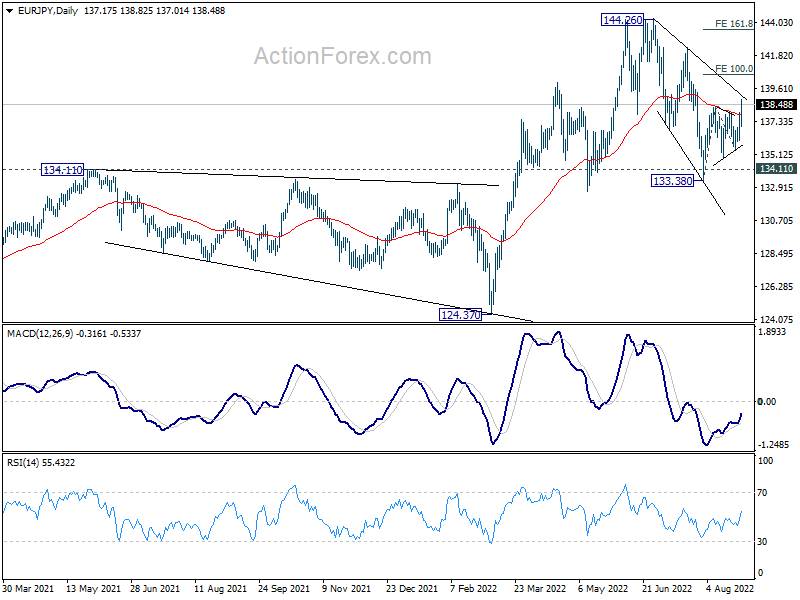
Daily Pivots: (S1) 136.10; (P) 137.03; (R1) 137.97; More....
EUR/JPY's break of 138.38 resistance confirms resumption of rebound from 133.38. Intraday bias stays on the upside for 100% projection of 133.38 to 138.38 from 135.50 at 140.50. Decisive break there will indicate upside acceleration, and raise the chance of up trend resumption through 144.26 high. On the downside, below 137.66 minor support will turn intraday bias neutral again.
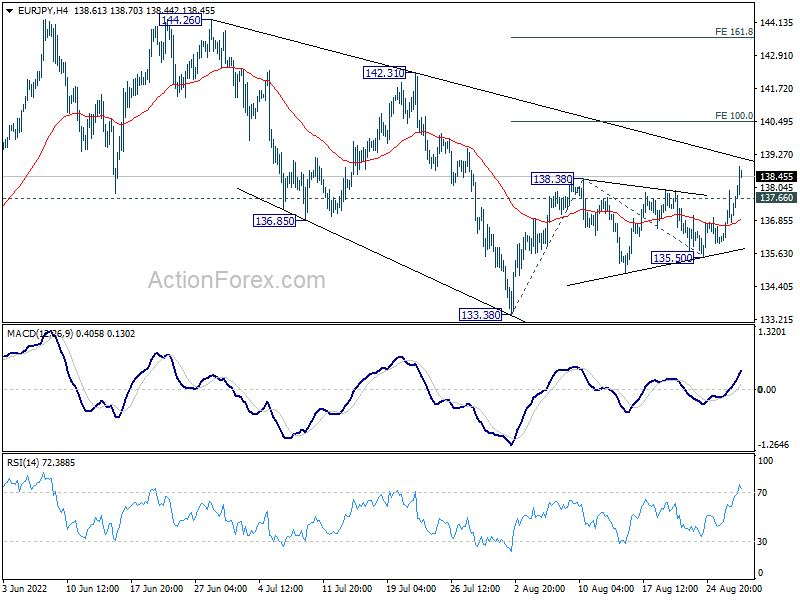
In the bigger picture, up trend from 114.42 (2020 low) is seen as the third leg of the pattern from 109.30 (2016 low). Further rally is in favor as long as 134.11 resistance turned support holds, even in case of deep pull back. Next target is 149.76 (2015 high). However, sustained break of 134.11 will be a sign of medium term bearish reversal and turn focus to 124.37 support for confirmation.