Sample Category Title
Fed Decisively Intends to Keep Inflation Expectations Well Anchored
Markets
Markets pondering Fed Powell’s assessment on monetary policy dominated trading throughout the whole of last week. It took Powell less than 10 minutes to clarify Fed’s intentions going forward. The Fed’s focus continues to be on bringing inflation back to 2.0% and its aim to do so is unconditional. In the respect, the Fed will do its part to bring supply and demand back into balance. Policy will have to be sufficiently restrictive. This probably will translate into a period of sub-trend growth and cause some easing of current very tight labour market conditions. However, this price needs to be paid to prevent persistently high inflation causing more damage. History illustrates that a delay in the policy response only raises the cost for employment. The Fed decisively intends to keep inflation expectations well anchored. Powell also clearly indicated that policy probably will have to remain tight for quite some time. A discussion on rate cuts is currently highly inappropriate. US interest rates evidently jumped higher in the wake of Powell’s straightforward message. However, the reaction could have been bigger. Of course, (US) yields last week had already repositioned for a hawkish guidance. The US 5y and 2y yield respectively closed 5.3 and 3.0 bps higher. In a further flattening trend the 30y lost 4.9 bps. The most forceful reaction occurred on equity markets. US indices lost up to 3.94% (Nasdaq). The Fed deliberately slowing aggregate demand is no good news for growth-sensitive assets. The dollar post-Powell reversed an initial intraday setback. Still, here too, gains could have been bigger. DXY closed the day only modestly higher at 108.8. EUR/USD, which jumped well north of 1.005 in in the run-up to Powell’s speech, also closed little changed at 0.9966. Euro losses were at least partially mitigated by a flood of hawkish headlines on ECB policy. A Reuters report, citing sources with knowledge of the internal debate within the ECB, indicated that several policy makers want to discuss a 75 bps rate hike at next month’s meeting. This was later confirmed by comments from the likes of ECB’s Kazaks, Schnabel, Villeroy and Knot. Some ECB members apparently also want to start the discussion on shrinking the ECB balance sheet already before the end of this year. German yields rose between 11.4 bps (2-y) and 1.6 bp (30-y).
Asian markets this morning are in an outright risk-off modus in the wake of Powell’s comments on Friday (Nikkei -2.50%). After a modest reaction on Friday, US yields are now rising up to 7 bps for shorter maturities. The broad risk-off repositioning also fully allows the dollar to fulfill its safe have role. The DXY index tries to overcome the 109.30 June top. EUR/USD (0.9935) is drifting back lower in the 0.99 big figure. The eco calendar is extremely thin today. However, this probably won’t prevent the trend of weaker equities, a strong dollar and a bear flattening of the yield curves to continue.
News Headlines
Czech National Bank governor Michl wrote in a blog on the CNB-website that inflation is unlikely to be persistent as declining real income will probably curb household consumption. Monetary policy is already in restrictive territory (policy rate: 7%) and is helping to curb demand. Czech interest rates will remain at elevated levels in the coming quarters. He doesn’t exclude a potential rate hike at the next meeting, but says that rates alone won’t cure inflation. Earlier in the weekend, a CNB vice governor said she favoured an EU energy price cap over a Czech windfall tax while warning against large wage hikes. The government recently agreed a 10% salary boost for some sectors. EUR/CZK holds near 24.65 thanks to continued FX interventions by the CNB, preventing an unwelcome decline in the currency.
National Bank of Poland governor Glapinski told Business Insider that the NBP will probably raise its policy rate (currently 6.5%) once or twice by an additional 25 bps. Such smaller rate hike would signal that the cycle is slowing down. Personally, he’d even consider stopping the tightening cycle completely as inflation is expected to slowdown in coming months. A spike in the January 2023 reading because of an increase of regulated prices, shouldn’t influence monetary policy. Glapinski thinks that a first rate cut should be possible in Q4 2023. The Polish zloty remains rather weak around EUR/PLN 4.75. The global environment (big central banks stepping it up and hurting risk sentiment) plays in the currency’s disadvantage, especially should the NBP simultaneously slow it down.
Coordinated Tightening Adds to USD Upside
Market movers today
Markets are focusing on discussing the message of 'coordinated tightening' from Jackson Hole. ECB and Fed appear to have re-committed to creating price stability, yields are shooting higher and risk assets are quite a bit lower since last week.
Focus also remains on European energy price developments, with gas and electricity prices continuing to see steep increases and no peak yet in sight as another maintenance shutdown of the North Stream 1 pipeline is due later this week.
German Chancellor Scholz will give a speech on the Future of Europe in Prague, while the Czech EU presidency is also calling for an emergency meeting of energy ministers.
ECB Chief Economist Lane, Riskbank's Flodén and Fed's Brainard are also on the wires. Tomorrow, the ECB Governing council member, Klaas Knot speaks at a Danske Talks at a hybrid event where we will discuss the monetary policy outlook.
In Sweden, Q2 GDP figures and retail sales are on the agenda.
The key releases later this week will be the euro area inflation figures (Wednesday), Chinese PMI manufacturing (Wednesday) and US labour market report (Friday).
The 60 second overview
US yields at new highs: Powell struck a fairly hawkish tone in his widely anticipated speech at Jackson Hole last Friday, signaling that Fed is committed to bringing inflation down even if it requires an extended period of below-trend growth and some weakening in labour market conditions. While Powell provided little new signals on the hiking pace of the coming meetings, he reinforced the view that financial conditions will need to be tightened further, and that rates will be held at moderately restrictive levels for some time - a message which was also echoed by Mester and Bostic later after the speech. The bottom line of Powell's statement, "We are taking forceful and rapid steps to moderate demand so that it comes into better alignment with supply", summarizes our broad view which we wrote about earlier in Research US - Higher for longer, 19 August. Even though headline inflation will continue to ease further over the coming months, the aggregate demand has recovered above its potential, and a period of stagnant growth is required to bring the US economy back into equilibrium.
ECB officials warn of 'sacrifice' needed: ECB seems to follow in the footsteps of the Fed. On Friday, Reuters reported that ECB were to discuss a 75bp rate hike at the December meeting, while a Bloomberg sources story during the weekend said that QT may be discussed towards the end of the year. Also Schnabel, Holzmann, Kazaks and Knot were all very hawkish, where notably Schnabel's presentation at the Jackson Hole shows her clear view that a recession and higher unemployment rates in the euro area may be needed to bring inflation lower (and also less relevance where the inflation pressure is emanating). Rehn and Villeroy mentioned a 'significant' rate move was to be expected in September. ECB is set to meet next week.
Reversal in asset markets: Markets are focusing on discussing the message of 'coordinated tightening' from Jackson Hole as ECB and Fed appear to have re-committed to creating price stability: yields are shooting higher and risk assets are quite a bit lower since last week. This stands in stark contrast to the rally we have seen since June. Equally, the levels of risk assets does contribute to explaining how e.g. equities are down some 6% from recent highs. We continue to see EUR/USD as declining further, targeting some 0.95 in 12m as dollar strength will likely pick up pace in this environment.
Equities: Equities fell Friday, as Powell did not hint at signs of pivoting. It makes sense based on the inflation and job market outlooks but it obviously disappointed equity investors. Please note that according to surveys the biggest tail risk for investors are inflation and with central bank tightening coming in at third place. In that perspective the sell-off on Friday makes sense. Recession risk is in our opinion the biggest risk. In US on Friday, Dow -3.0%, S&P 500 -3.4%, Nasdaq -3.9% and Russell 2000 -3.3%. Asian markets are catching up (negative) this morning. However, more interestingly, US futures are sharply lower led by growth stocks as yields continuing higher.
FI: A Reuters sources story saying that a 75bp rate hike was to be discussed at the September meeting sent European rates in a bearish flattening move. 10y Bunds sold off by 7bp, while the 2y point rose 10bp. Powell's much awaited Jackson Hole speech was essentially a blow to anyone thinking a Fed-pivot was imminent. During the weekend, several ECB speakers were on the wires, where notably Schnabel's presentation is worth highlighting as she essentially argued that the origin of inflation is largely irrelevant and that a recession may be needed with higher unemployment to follow to get inflation lower.
FX: EUR/USD bounced around Friday amid hawkish signals from Fed and ECB, but ended the week below parity. Scandies dropped on the back of the following set-back to risk sentiment.
Credit: The modest tightening we saw during the course of last week reversed Friday with tangible spread widening driven by hawkish central bank signals coupled with recession worries. The liquidity in the cash market has deteriorated and the bouts of activity amongst investors remains focussed on new issues. During Friday, iTraxx main widened 5.6bp to 113bp while Xover widened 29.4bp to 559.9bp.
Nordic macro
Q2 GDP release Monday with the Q2 GDP indicator suggesting +1.4 % q/q. SCB also releases July trade balance and retail sales, the latter probably more interesting, giving clues to whether Swedish consumers can keep up spending or not. The Riksbank's Martin Flodén will particpate in a panel on the topic "High inflation and other challenges for monetary policy". His speech last week was interpreted as somewhat hawkish saying that the Krona is "too weak" and that further rate hikes are needed for inflation to fall.
Gone are the Days We Could Rely on a Powell-Backed Equity Rally
Federal Reserve (Fed) Chair Jerome Powell’s speech at the Jackson Hole meeting wreaked havoc across the equity markets on Friday. His message was crystal clear: inflation must come down even if it means pain for households and businesses in the process.
The S&P 500 tanked more than 3% on Friday and slipped below the 100-DMA. It will certainly clear the major Fibonacci support in the coming hours, which is the 38.2% Fibonacci retracement on the summer rally, and which stands near the 4060 points. Breaking below this level will mark the end of the summer rally, from a technical standpoint, and send the index to the bearish consolidation zone. The 50-DMA, which stands a touch below the 4000 mark, will then be the next important support.
Nasdaq, on the other hand, dropped more than 4% on Friday, as the technology stocks are more sensitive to interest rate changes. The index slipped below its 100-DMA, and the 38.2% Fibonacci support on the summer rally, and is already in the bearish consolidation zone.
And oh, before I forget, Powell also mentioned how surprisingly resilient the US jobs market is, and hinted that the Fed is tolerant for a certain cool down in the jobs figures.
Therefore, this week’s jobs data has power to further revive the Fed hawks, rather than the contrary.
Due Friday, the NFP data is expected to print another month close to 300’000 new nonfarm job additions in the US. Over the past four months, the data clearly exceeded the market expectations, especially last month, the number printed was above half-a-million new job additions, versus around 250’000 expected by analysts.
Although, the layoff news over the past couple of months should, at some point, reflect in the US jobs data, it’s too early to titillate the Fed about the destroyed jobs. Therefore, even if we see a disappointing number, the Fed doves will be nowhere to be found and from now, we expect to see a deeper downside correction in equities, and further retracement of the summer rally.
Up goes the dollar, again
The US 2-year yield came close to the 2.50% level, the 10-year yield edged up following Powell’s Jackson Hole speech, but the price action in the US papers were less aggressive than in equities, as long-term bond holders seem relatively happy with a 3% return. Near the 3% threshold, the selloff in equities drive capital to the less risky sovereign assets.
The FX price action was of course in favour of a stronger US dollar. Powell sent the dollar rallying, and the dollar bulls now eye the 110 level, on the back of a solid divergence between the decidedly hawkish Fed, and more hawkish, but increasingly worried other central banks.
Other major central banks are also hawkish, but they are less aggressive than the Fed. The European Central Bank members, for example, are increasingly in favour of a tighter monetary policy, if nothing, to fight the strong dollar, which becomes a serious headache.
Activity in the European money markets now hints at nearly 50% chance of seeing a bigger than a 50bp hike in September. But even that, doesn’t get the euro bulls back on track. The euro is pushing lower below parity against the US dollar, and the Europeans are holding their breath before the next round of inflation figures in Europe start flowing in from tomorrow. Due Wednesday, the flash CPI estimate for Europe is expected to hit the 9% mark, and there is a stronger probability of seeing a bad surprise than a good done, given the skyrocketing gas prices, and the weakening euro.
Energy up
The European nat gas prices continue spiking. The Dutch TTF futures rose another 8% on Friday, and are up by 340% since June, and crude oil kicks off the week on a positive note, as the supply side issues came back in force last week, after the Saudi minister said that OPEC is unhappy about the falling prices, and could restrict output. Also, there is no breakthrough in the US – Iran nuclear deal. We could see the barrel of crude exceed its 200-DMA level this week, which stands a touch below the $97 mark. The latter would add more pressure on equity pricing.
Gold, Bitcoin dive
Elsewhere, gold is cheaper since Powell’s speech, and is set to make another attempt below the $1700 mark, while Bitcoin fell below the $20’000 mark, and is now below the summer uptrending trend. The selloff in equities should further pressure Bitcoin lower. The next natural target for Bitcoin bears stands near $17’500, the June dip, then the $15’000 level, the next psychological support.
AUD/USD Daily Report
Daily Pivots: (S1) 0.6852; (P) 0.6930; (R1) 0.6972; More...
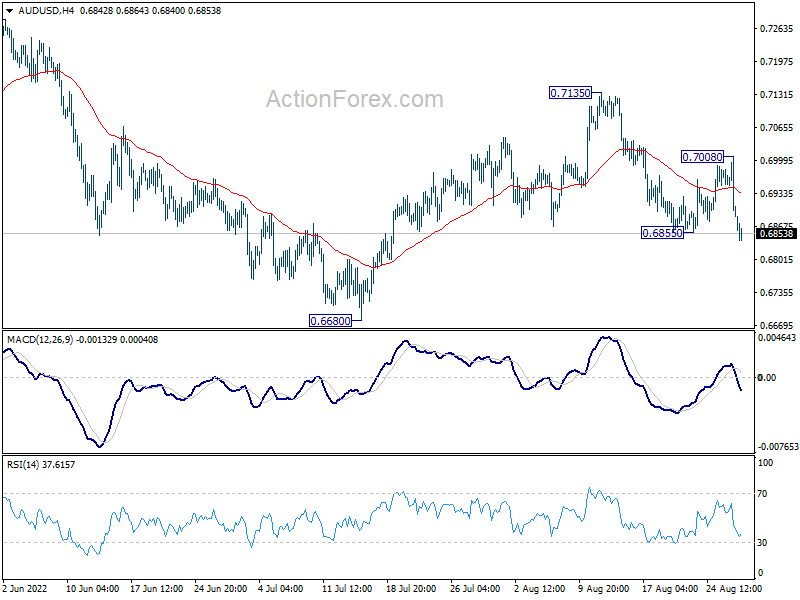
AUD/USD's fall from 0.7135 resumed by breaking through 0.6855 temporary low, and intraday bias is back on the downside. As noted before, corrective rebound from 0.6680 could have completed with three waves up to 0.7135. Deeper decline would be seen back to retest 0.6680 low next. Firm break there will resume larger down trend. For now, outlook will stay cautiously bearish as long as 0.7008 minor resistance holds, in case of recovery.
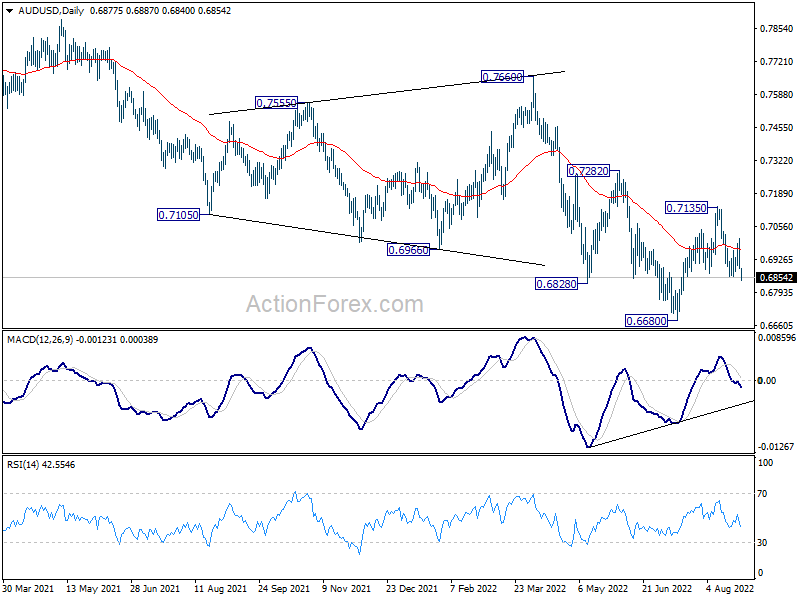
In the bigger picture, price actions from 0.8006 (2021 high) is seen more as a corrective pattern to rise from 0.5506 (2020 low). Or it could also be a bearish impulsive move. In either case, outlook will remain bearish as long as 0.7282 resistance holds. Next target is 61.8% retracement of 0.5506 to 0.8006 at 0.6461.
USD/CAD Daily Outlook
Daily Pivots: (S1) 1.2947; (P) 1.2996; (R1) 1.3086; More...
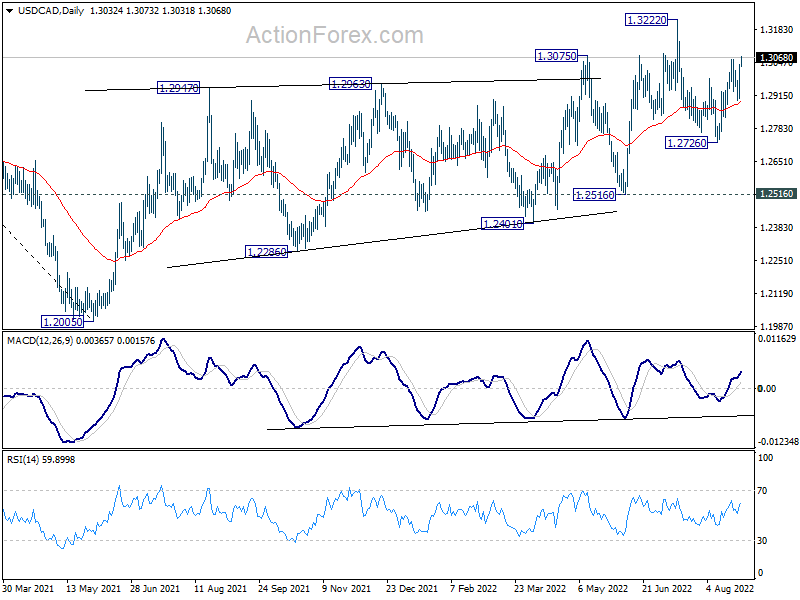
Intraday bias in USD/CAD is back on the upside with break of 1.3063 temporary top. As noted before, corrective decline from 1.3222 could have completed with three waves down to 1.2726. Further rise should be seen to retest 1.3222 high next. Decisive break there will resume larger up trend. For now, outlook will stay cautiously bullish as long as 1.2893 support holds, in case of retreat.
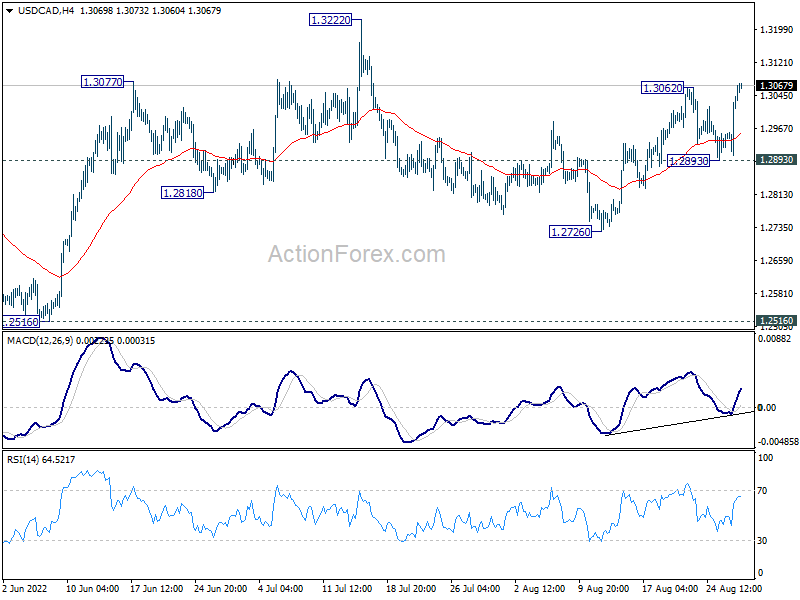
In the bigger picture, down trend from 1.4667 (2020 high) should have completed at 1.2005, after defending 1.2061 long term cluster support. Rise from there should target 61.8% retracement of 1.4667 to 1.2005 (2021 low) at 1.3650. This will remain the favored case now as long as 1.2516 support holds.
EUR/USD Daily Outlook
Daily Pivots: (S1) 0.9911; (P) 1.0000; (R1) 1.0053; More...
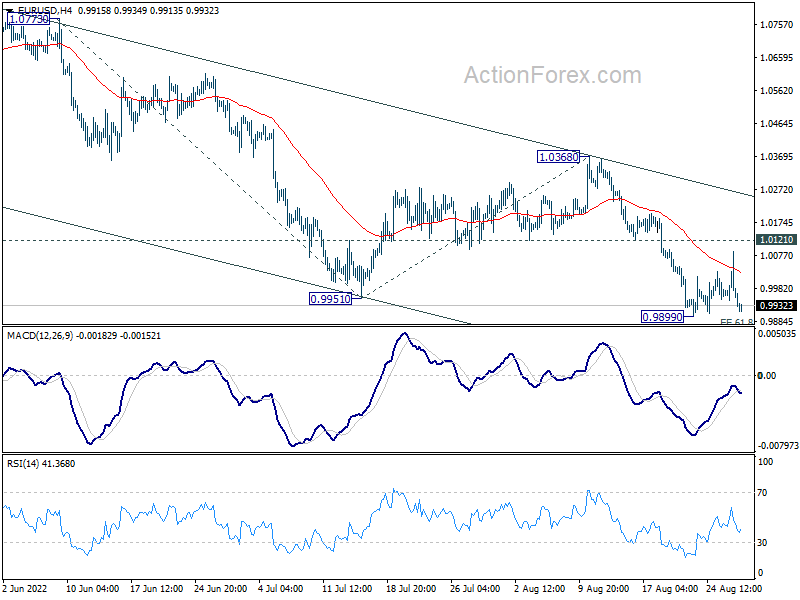
Intraday bias in EUR/USD remains neutral and outlook stays bearish with 1.0121 minor resistance intact. Break of 0.9899 will resume larger down trend to 61.8% projection of 1.0773 to 0.9951 from 1.0368 at 0.9860. Firm break there should prompt downside acceleration to 100% projection at 0.9546. However, firm break of 1.0121 will dampen this view and turn focus to 1.0368 resistance instead.
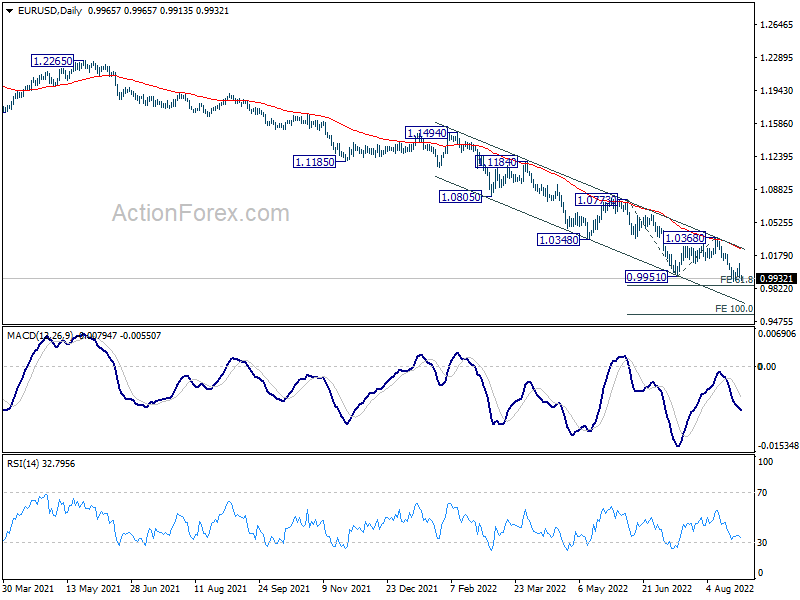
In the bigger picture, down trend from 1.6039 (2008 high) is still in progress. Next target is 100% projection of 1.3993 to 1.0339 from 1.2348 at 0.8694. In any case, outlook will stay bearish as long as 1.0368 resistance holds, in case of strong rebound.
GBP/USD Daily Outlook
Daily Pivots: (S1) 1.1682; (P) 1.1791; (R1) 1.1849; More...
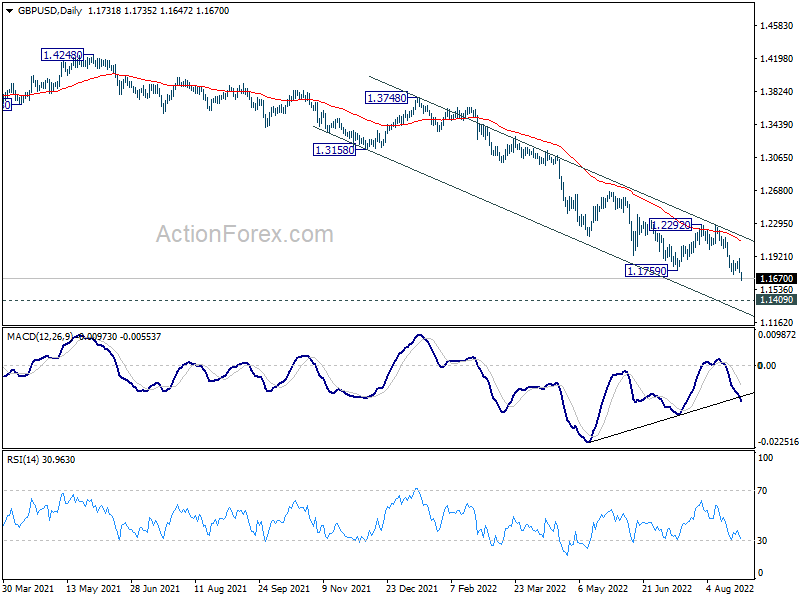
GBP/USD's down trend resumed by breaking through 1.1716 temporary low. Intraday bias is back on the downside. Current decline should target 1.1409 long term support. On the upside, above 1.1899 minor resistance will turn intraday bias neutral again. But outlook will stay bearish as long as 1.2292 resistance holds, in case of recovery.
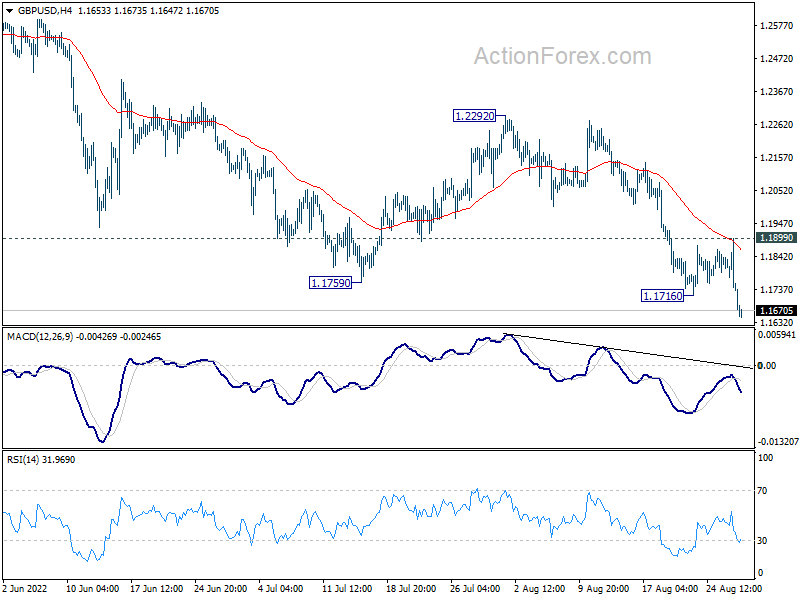
In the bigger picture, fall from 1.4248 (2018 high) could be a leg inside the pattern from 1.1409 (2020 low), or resuming the longer term down trend. Deeper decline is expected as long as 1.2292 resistance holds. Next target is 1.1409 low. However, firm break of 1.2292 will bring stronger rise back to 55 week EMA (now at 1.2859).
USD/CHF Daily Outlook
Daily Pivots: (S1) 0.9602; (P) 0.9636; (R1) 0.9694; More...
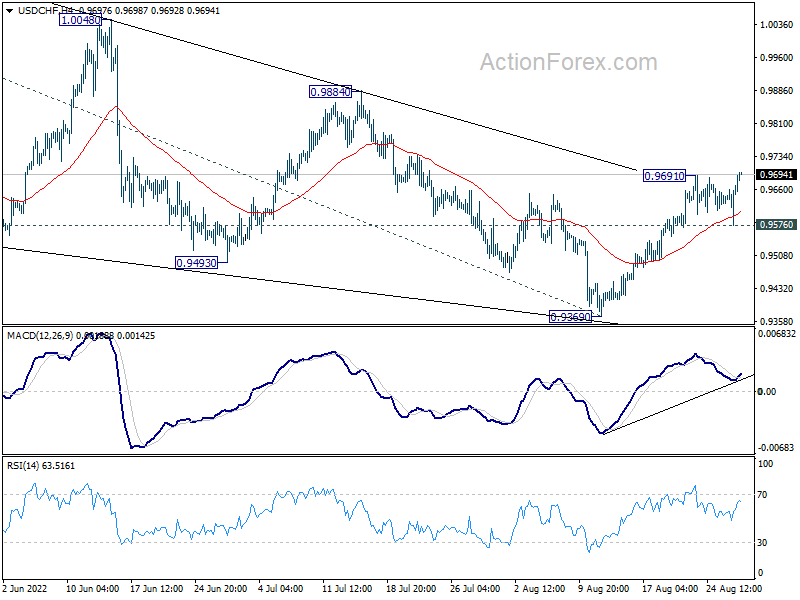
USD/CHF's rise from 0.9369 resumed after brief retreat and intraday bias is back on the upside. Outlook is unchanged that triangle correction from 1.0063 could have completed at 0.9369 already. Further rise should be seen to 0.9884 resistance next. Break there will argue that larger up trend is ready for resumption through 1.0063. On the downside, below 0.9576 minor support will dampen this view and turn bias back to the downside for 0.9369 support instead.
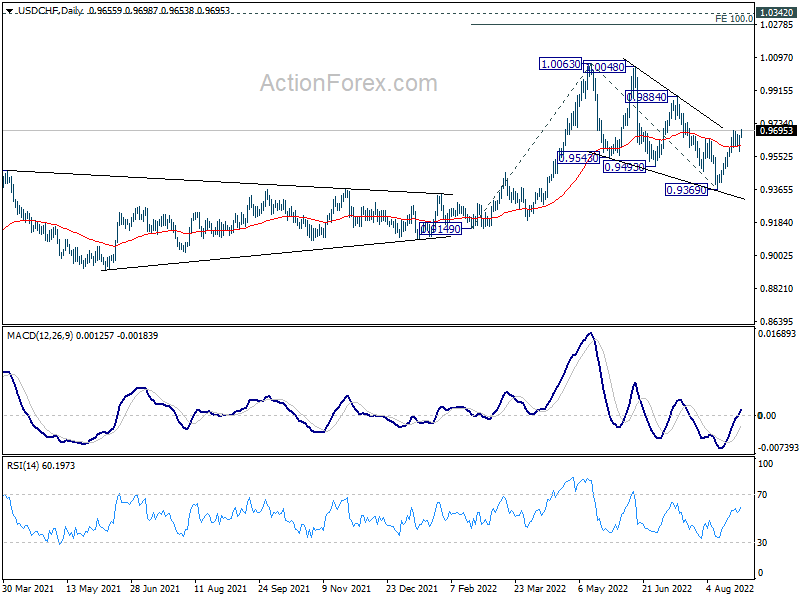
In the bigger picture, current development suggests that up trend from 0.8756 (2021 low) is still in progress. Sustained break of 1.0063 will target 100% projection of 0.9149 to 1.0063 from 0.9369 at 1.0283, and then 1.0342 (2016 high). For now, this will remain the favored case as long as 0.9369 support holds, even in case of deep pull back.
Forex and Cryptocurrency Forecast
EUR/USD: The Global Economy Is in Danger Again
So, EUR/USD broke through the key support level formed in 2016. It fixed a low at 0.9899 on Tuesday, August 23, the low the pair traded 20 years ago, in November-December 2002. The euro lost about 485 points to the dollar lover the past year alone.
Although not officially recognized, in fact the US economy has already plunged into recession, GDP continues to fall, although this movement has slowed down a bit: -0.9% in Q1 2022 and -0.6% in Q2. Quantitative tightening (QT) by the Fed and macroeconomic factors increase the chances of strengthening this process. Thus, JP Morgan CEO Jamie Dimon has warned that the country's economy could expect "something worse than a recession", and the probability of this event occurring is 20-30%.
The situation in the Eurozone is even worse, and macroeconomic conditions still do not bode well. According to forecasts, due to the energy crisis caused by anti-Russian sanctions, Europe, and especially Germany, will face a very difficult winter.
"The world economy is in danger again," said World Bank President David Malpass. "It is facing high inflation and slow growth at the same time. Even if a global recession is averted, the pain of stagflation could linger for several years." This situation fuels the demand for safe-haven assets, and the US currency is traditionally one of them. The dollar index (DXY) is holding positions near multi-year highs around 108 points and, according to experts, may rise to 110 points.
The key event of the past week was the annual economic symposium in Jackson Hole on August 25-27, which brought together almost the entire US financial elite. The key event at the symposium was to be the speech of Fed Chairman Jerome Powell, from whom market participants hoped to receive signals regarding the regulator's future plans. But he did not say anything new and significant, Powell's statements were a little more "hawkish" than before, but generally coincided with market expectations. Perhaps the head of the US Central Bank did not want to shock the markets in any of the directions. He did not name a specific figure by which the FOMC (Federal Open Market Committee) can raise the interest rate on September 21. Moreover, this decision may still be influenced by the forthcoming September reports on the labor market and consumer price dynamics.
The likelihood of a 50 basis point (bp) or 75 bp rate hike in September is about the same. Recall that the rate is at the level of 2.5% at the moment and the next increase will send it to the maximum level since 2008. And there is no doubt that it will happen, even though the CPI showed signs of slowing in July, falling to 8.5%, and inflation, as measured by the Core Price Index for Personal Consumption Expenditures (PCE), fell from 0.6% to 0.1% in a month.
At the same time, the ECB may also raise borrowing costs by 50 bp at its meeting on September 8. The minutes of the last, July, meeting of the regulator showed that a very large number of members of the Board of Governors agreed on the advisability of raising the key rate from 0.5% to 1.0%. Moreover, according to Reuters, some ECB leaders, due to the deterioration of the inflation forecast, want to discuss the issue of raising the rate immediately by 0.75%. However, the decrease in the difference between the rates of the Fed and the ECB, although it may slightly support the euro, will not change the situation fundamentally, since the difference between the rates will still remain in favor of the dollar. As a result, the US currency will continue to strengthen, and, according to Wells Fargo analysts, it may peak in Q4 2022. Economists from Nordea expect that EUR/USD may fall to 0.9700 by the end of the year, a number of experts call 0.9600 as well.
Jerome Powell's speech took place on the evening of Friday, August 26, in the middle of the US trading session, when the Asian and European currency markets had already closed. Therefore, the final reaction to the words of the head of the Fed will become clear only on Monday, August 29. As for the last week, although its performance caused some volatility, the pair placed the last chord within the weekly range, slightly below its center at 0.9966.
60% of experts support the fact that it will continue to move south in the near future, while the remaining 40% indicate the opposite direction to it. The readings of the indicators on D1 give much more definite signals. 100% side with the bears both among trend indicators and among oscillators. However, a quarter gives signals of it being oversold among the latter. The nearest bearish targets for EUR/USD are the July 14 low at 0.9950 and August 23 low at 0.9899. Note that the 0.9900-0.9930 area is also a strong 2002 support/resistance zone. For the bulls, the first priority is to rise above the 1.0000 parity level, after which it will be necessary to overcome the resistance of 1.0030, then 1.0090-1.0100, followed by the levels and zones of 1.0120, 1.0150-1.0180, 1.0200 and 1.0250-1.0270.
Statistics on the US consumer market will be released on Tuesday, August 30. We will have a whole series of data from the US labor market on the same day, as well as on Wednesday, August 31, Thursday, September 01 and Friday, September 02, including such important indicators as the unemployment rate and the number of new jobs created outside the agricultural sector (NFP). As for the European economy, data on unemployment in Germany and the consumer market of the Eurozone (CPI) will be received on Wednesday, August 31, and the value of the Business Activity Index in the manufacturing sector (PMI) and retail sales in Germany will become known on September 01.
GBP/USD: Very "Terrible Long-Term Outlook"
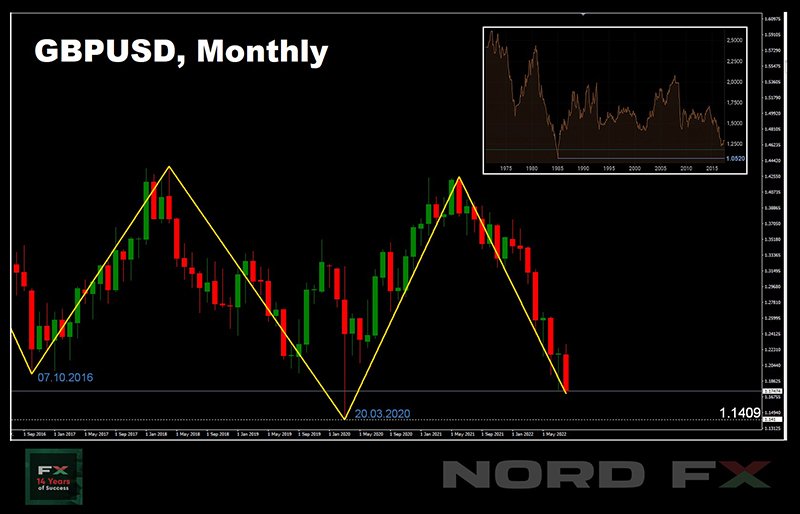
We titled the review for GBP/USD "Gloomy Forecasts for the Pound Continue to Come True" a week ago. But it turns out that the situation does not just look gloomy but inspires real horror for some experts. "The long-term chart of the pair," economists at Citi Bank believe, "is looking really terrible right now. It can be viewed as a large double top forming as a continuation pattern, which promises a price drawdown to parity and possibly below it. […] There is no significant support now (beyond the March 2020 peak low just above 1.14) until the major lows set in 1985 at 1.0520. […] This month's close below 1.1760, if any, would be a bearish external month."
GBP/USD closed last week at 1.1736. The pound continues to be pressured by the resignation of Prime Minister Boris Johnson, accompanied by a sex scandal, and rising inflation. British energy regulator Ofgem has announced that average annual household electricity bills will rise by 80% from October and that the new Prime minister will need to take urgent action to deal with such skyrocketing prices.
The median forecast for the coming week looks fairly neutral. 45% of analysts side with the bulls, and 55% support the bearish scenario. The indicator readings on D1 look exactly the same as those of the EUR/USD pair: all 100% are colored red, while 25% of the oscillators signal that the pair is oversold. Immediate support is the August 23 low at 1.1716, followed by 1.1650, 1.1535 and the March 2020 lows in the zone 1.1400-1.1450. As for the bulls, they will meet resistance in the zones and at the levels of 1.1755, 1.1800, 1.1865-1.1900, 1.2000, 1.2050-1.2075, 1.2160-1.2200, 1.2275-1.2325 and 1.2400-1.2430.
With regard to the economic statistics of the United Kingdom, traders should take into account that there is a bank holiday in the country on Monday, August 29. Among the important events, we can note Thursday, September 01, when the August value of the UK Manufacturing PMI will be known.
USD/JPY: BOJ Policy Will Remain the Same
The USD/JPY pair has been moving in the sideways corridor 135.80-137.70 throughout the week. And if we talk about the results of the five-day period, the bulls won with a slight advantage: having started the week at 136.81, the pair ended it at 137.45. So, the neutral forecast was fully justified. Recall that the majority of experts voted for the movement of the pair to the east last time.
The latest survey of economists conducted by Bloomberg showed that inflation, which reached 3%, is unlikely to force the head of the Bank of Japan (BOJ) Haruhiko Kuroda to tighten monetary policy. While 3% is the highest level since 1991 (excluding years of tax hikes), it is still well below the 8.5% inflation rate in the US. Moreover, according to forecasts, inflation may reach 2.5% in the last three months of 2022, and be at the level of 1% at the end of next year.
As for a possible change in the monetary policy of the BOJ after the expiration of the term of Haruhiko Kuroda in April 2023, one cannot really count on this. And even more so, one should not expect an increase in interest rates at the next meeting of the Japanese regulator on September 22.
Based on the above, the majority of analysts (60%) believe that USD/JPY will again aim to test the July 14 high and take the height of 139.40. 30% of experts expect the yen to strengthen and a downtrend, and 10% give a neutral forecast. The indicators on D1 mirror the readings of the previous pairs: 100% of them point north, while 25% of the oscillators are in the overbought zone. Supports for the pair are located at the levels and in the zones 137.00, 136.70, 136.15-136.30, 135.50, 134.70, 134.00-134.25, 132.85-133.00, 131.75-132.00, 131.00. Resistances are 137.70, 138.40, 138.50-139.00, and finally the July 14 high at 139.38. Bulls' next targets are 140.00 and 142.00.
No significant statistics on the Japanese economy are expected to be released this week.
CRYPTOCURRENCIES: Dark Gray is the Colour
As of last week, BTC/USD was trading in a tight $20,900-$21,800 range most of the time ahead of Jerome Powell's speech at Jackson Hole. It is in this zone that the cumulative average break-even of all bitcoin holders is located. But risky assets: stock indices (S&P500, Dow Jones, Nasdaq) and quotes of digital currencies flew down on the evening of August 26. At the time of writing, the main cryptocurrency has already begun to react to the hawkish mood of the head of the Fed and recorded a weekly low at $20,534. The total capitalization of the crypto market has fallen below the psychologically important level of $1 trillion and stands at $0.991 trillion ($1.028 trillion a week ago). The Crypto Fear & Greed Index has dropped 6 points in seven days from 33 to 27 and is in the Extreme Fear zone. It is possible that these figures will become even worse on Saturday and Sunday, August 27-28.
The overall picture at the end of summer looks like this. In July, whales (with assets of over 10,000 BTC) and shrimps (less than 1 BTC) have been the main investment force driving bitcoin up. It is known that institutional investors play a leading role in the whale population, highly dependent on what is happening on Wall Street. Institutional operations with digital assets are carried out through cryptocurrency funds. And, judging by the statistics, the inflow of investments into these funds stopped at the beginning of August, and the whales returned to selling their BTC coins in the second week of the month: the outflow amounted to about $21 million.
However, according to Bakkt crypto platform CEO Gavin Michael, despite what is happening, bitcoin will show significant growth in the coming years. Bakkt provides digital assets and futures trading services for institutional investors and, according to Michael, they are closely watching what is happening and their interest in the market is constantly growing.
One of the key signs of future price growth is the increase in network activity and the emergence of new addresses. Bitcoin activity is now at the same level as it was at the end of the 2018-2019 bearish market, according to analytics firm Glassnode. However, despite the signs of the end of the "crypto winter", network indicators still do not signal a reversal of the macroeconomic trend. The researchers note that the bitcoin network still does not record the presence of demand for cryptocurrency from investors, which is essential for a sustainable uptrend. "Recent price increases failed to attract a significant wave of new active users, which is especially noticeable among retail investors and speculators," Glassnode notes. The lack of hype is also indicated by the falling fees in the bitcoin network. As noted, its size has fallen below $1. Currently, the average cost of BTC transactions is around $0.825, which is the lowest level since June 13, 2020. Despite this, Glassnode believes that it is at current price levels that bitcoin can try to form a solid foundation for future growth.
CoinShares Chief Strategy Officer Meltem Demirors believes that "BTC does not see catalysts that could contribute to growth until the end of Q3." But despite this, "we saw a lot of buying on drawdowns in relation to BTC" in summer, which, in her opinion, indicates the presence of capital willing to accumulate this asset.
If Meltem Demirors is cautiously optimistic, analyst Justin Bennett is quite pessimistic and believes that BTC may face another sell-off. Bitcoin has gone below the diagonal support that has kept the bullish vibe for the past few months. According to Bennett, the coin's rate fell by more than 30% the last two times in such situations.
Although the analyst is bearish, he predicts a small short-term rise in BTC to $23,000, which should be retested as resistance. Then a decline to $19,000 is expected. Bitcoin's reaction at this level should, according to Bennett, determine its behavior until the end of the year: "The question will be whether we see a rebound and higher lows, or get lower lows for the rest of the year."
As for ethereum, Meltem Demirors believes that investors are ignoring the general situation in the market, amid the hype around the transition of ETH to the PoS mechanism. And that, despite the benefits of the merger for the ethereum network itself, it is not certain that this event will attract significant investment capital: "While there is significant enthusiasm in the crypto community for a merger that can rapidly reduce supply and increase demand, the reality is more prosaic: investors are concerned about rates and macro indicators. I believe that significant amounts of new capital are unlikely to enter ETH. There are certain risks that need to be played out in the market because the merger has been used as an excuse to buy on the rumor and sell on the news. How will these risks be played out? Most likely on the institutional side or through trading, but through options rather than outright purchases of the asset."
Another well-known strategist, Benjamin Cowen, spoke out about the ethereum. In his opinion, if the most negative scenario is implemented, the logarithmic regression band indicates a possible fall in the ETH/USD pair to the $400-$800 area. Cowen calls such a drop an excellent opportunity to replenish Ethereum reserves. At the same time, he does not exclude the possibility of the altcoin moving up: "ETH can demonstrate a rally if the transition to PoS goes without significant problems (you need to be aware that some software updates do not always go smoothly) and the Fed changes its monetary policy." (As a reminder, the ethereum network upgrade is scheduled for September 15-20. So, it won't take long to wait.)
USD/JPY Daily Outlook
Daily Pivots: (S1) 136.67; (P) 137.12; (R1) 137.96; More...
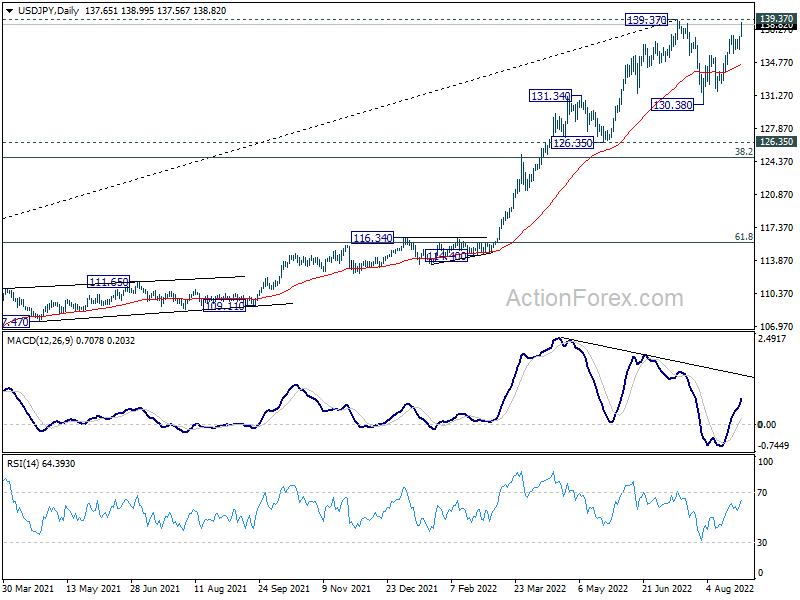
USD/JPY's rise resumes by breaking through 137.70 and intraday bias is back on the upside for 139.37 high. Strong resistance could be seen there to limit upside, to start the third leg of the corrective pattern from 139.37. Break of 136.17 minor support will turn bias back to the downside for 130.38 support. Nevertheless, decisive break of 139.37 will confirm up trend resumption for 147.68 long term resistance.
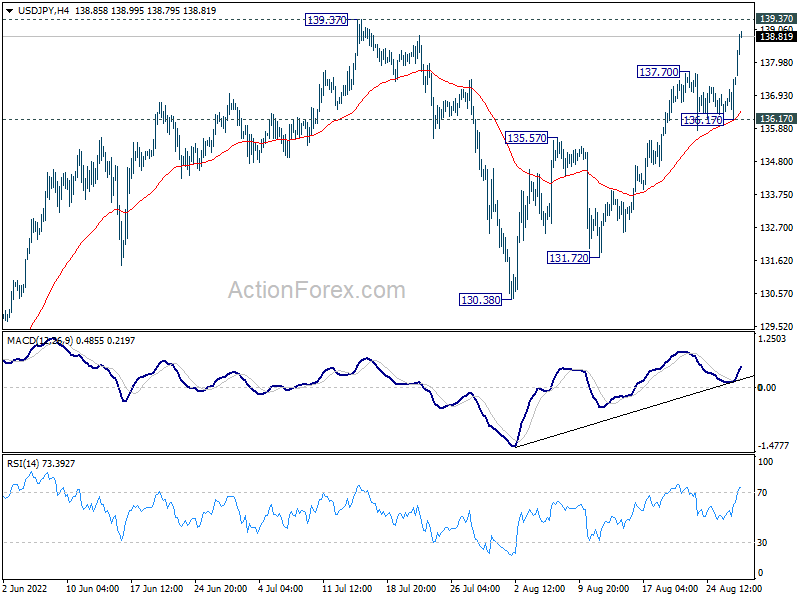
In the bigger picture, price actions from 139.37 medium term top are seen as a corrective pattern to up trend from 101.18 (2020 low). While deeper decline cannot be ruled out, outlook will stays bullish as long as 55 week EMA (now at 123.72) holds. Long term up trend is expected to resume through 139.37 at a later stage, after the correction finishes. Next target is 147.68 (1998 high).