Sample Category Title
SNB Jordan: Inflation is increasingly spreading to goods and services
SNB Chairman Thomas Jordan said over the weekend, "There are signs that inflation is increasingly spreading to goods and services that are not directly affected by the pandemic or the war in Ukraine."
"In fact, it appears that in the current environment, higher prices are being passed on more quickly -- and are also being more readily accepted -- than was the case until just recently," he added.
Inflation expectations "have also been moving upwards slightly" and wage growth is "gathering momentum," Jordan said, cautioning that the "longer-term outlook for monetary policy is also subject to high uncertainty."
"In particular, a decline in global economic integration could increase companies' price-setting power, meaning that they would be able to push through price increases more easily," he said.
ECB policymakers wants forceful actions in September
ECB board member Isabel Schnabel said, "Both the likelihood and the cost of current high inflation becoming entrenched in expectations are uncomfortably high. In this environment, central banks need to act forcefully."
Governing Council member Martins Kazaks said, "Frontloading rate hikes is a reasonable policy choice. We should be open to discussing both 50 and 75 basis points as possible moves. From the current perspective, it should at least be 50."
Another Governing Council member Francois Villeroy de Galhau said ECB needs to be at "neutral rate" before the end of the year, "after another significant step in September... Have no doubt that we at the ECB would if needed raise rates further beyond normalization: bringing inflation back to 2% is our responsibility; our will and our capacity to deliver on our mandate are unconditional."
Governing Council member Olli Rehn said, "The reality is that we have excessively high inflation globally, also in Europe -- that's why it's action time. The next step will be a significant move in September, depending on the incoming data and the inflation outlook."
EUR/USD Bears Target Fresh Lows, Dollar Rallies
Key Highlights
- EUR/USD failed to recover above the parity level and declined.
- It broke a key rising channel with support at 0.9940 on the 4-hours chart.
- GBP/USD is accelerating lower below the 1.1800 support zone.
- AUD/USD and NZD/USD are also gaining bearish momentum.
EUR/USD Technical Analysis
The Euro attempted a recovery wave from the 0.9900 zone against the US Dollar. EUR/USD moved above the 0.9950 and 0.9980 resistance levels, but upsides were limited.
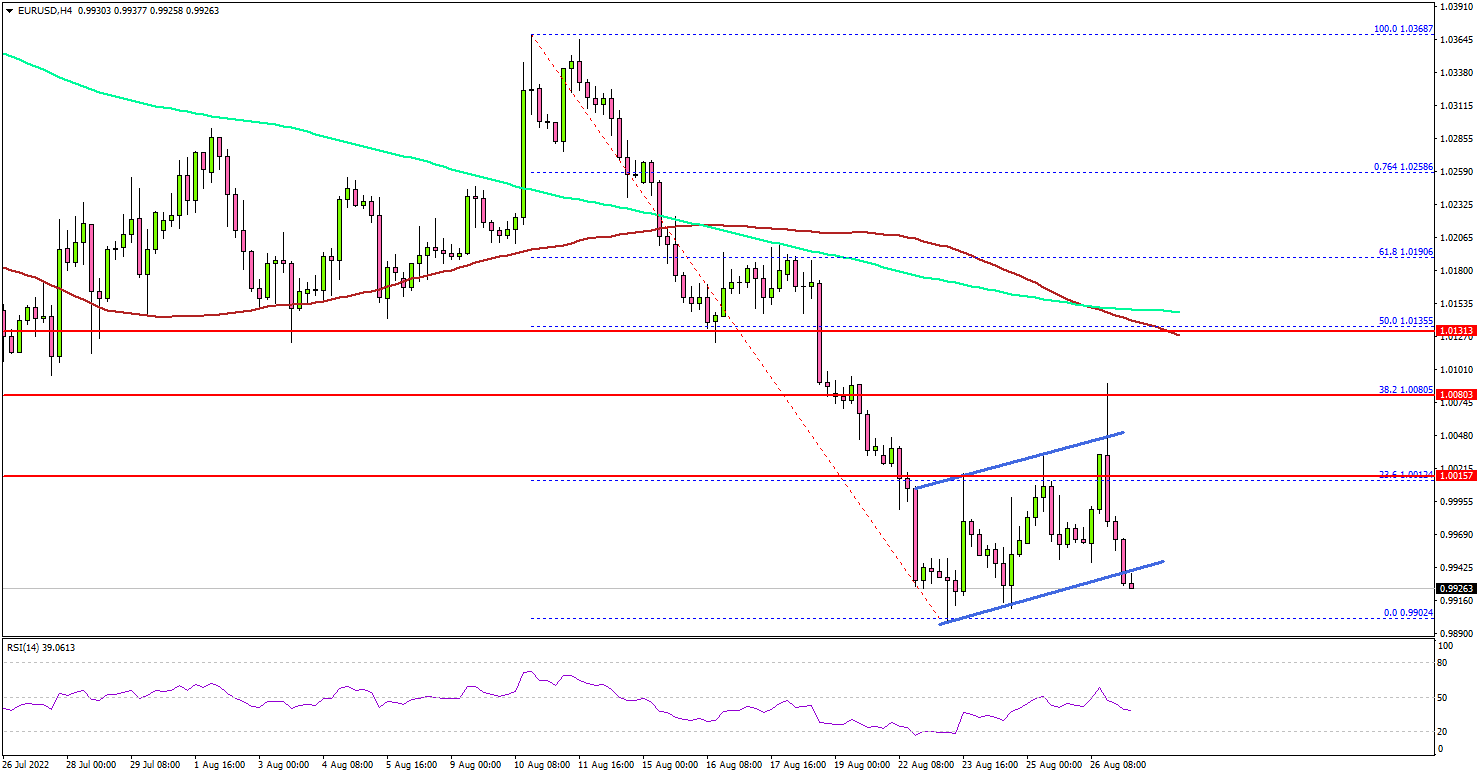
Looking at the 4-hours chart, the pair settled below the 1.0050 level, the 100 simple moving average (red, 4-hours), and the 200 simple moving average (green, 4-hours).
Recently, it saw a minor upward move above the 1.0000 resistance zone. However, the bears were active near the 1.0080 level. It failed to clear the 38.2% Fib retracement level of the downward move from the 1.0368 swing high to 0.9902 low.
It started a fresh decline below the 1.0000 support. There was a break below a key rising channel with support at 0.9940 on the same chart.
The pair is now approaching the 0.9900 support zone. If there is a downside break below the 0.9900 support, the pair could decline towards the 0.9850 support. Any more losses might call for a move towards 0.9720.
Conversely, the pair might rise again above 0.9950. On the upside, the pair is facing resistance near the 1.0000 level. The next major resistance is near the 1.0080 level. A clear move above the 1.0080 resistance might send the pair higher towards the 1.0120 level or the 100 simple moving average (red, 4-hours).
The 50% Fib retracement level of the downward move from the 1.0368 swing high to 0.9902 low is also near the 1.0135 zone to act as a resistance.
Looking at GBP/USD, the pair struggled to clear the 1.1900 level and started a fresh decline below the 1.1800 support zone.
Economic Releases
- Dallas Fed Manufacturing Business Index for August 2022 – Forecast -20.2, versus -22.6 previous.
Australian Retail Sales Post Surprise Bounce
July sales: +1.3%mth (market +0.3%), 16.5%yr. Rate hikes, sentiment slump yet to impact.
The ABS preliminary estimates of official retail sales showed a much stronger than expected 1.3% gain in July. That compares to a subdued 0.2% rise in June and marks the strongest monthly gain since March. The consensus forecast was for a 0.3% rise. The detail shows a broad-based lift with nothing to suggest the monthly gain is a ‘rogue’. That said, rising retail prices undoubtedly account for a sizeable part of the rise, with volumes likely to have been somewhat flatter.
Recall that the ABS retail release now comes in two stages: an early preliminary release with limited detail; and a final estimate that may see some revisions and provides the full range of additional detail.
The limited detail available for July shows a strong rebound for department stores (+3.8%mth, reversing a similar-sized decline in June), and a strong gain for clothing & footwear (+3.3%mth), with robust rises for cafes & restaurants (+1.8%mth), ‘other retail’ (+1.6%mth) and basic food (+1.2%mth). The only soft spot was around household goods which saw a second consecutive monthly decline, down 1.1%mth. That weakness may be a sign that housing-related and big ticket durables spend is contracting but the rest of the detail suggests this is being more than offset by strong gains in both ‘small ticket’ discretionary categories and essentials.
By state, retailers reported strong rebounds in Vic (+1.8%mth) NSW (+1.3%mth), and SA (+1.2%mth), which were all coming off poor June months. WA also recorded a robust 1.6%mth gain. Qld was on the softer side with a 0.4%mth rise but had bucked the wider trend in June, posting a 0.7% gain.
Overall, the July update suggests initial rate rises have done little to slow the consumer. We still expect the RBA’s tightening and slumping consumer sentiment to eventually weigh on demand but that may not come until late in Q3.
FOMC Chair Powell Gives a Decisive But Conditional Commitment
Chair Powell's remarks at Jackson Hole 2022 were brief but to the point.
At the Jackson Hole Symposium of 2022, FOMC Chair Powell was clear on the Committee’s resolve to bring inflation to heel and their purpose in doing so – it being necessary to safe-guard the long-term welfare of the US economy.
In fact, the key opening remarks referred to his “overarching focus right now” being to “bring inflation back down to our 2 percent goal”. The clear objective of that statement is to send a strong message that the FOMC is fully committed to restoring inflation to target and containing inflationary expectations.
On the timing of further hikes, “[r]estoring price stability will take some time and requires using our tools forcefully” speaks to a need for rapid policy tightening; and “[w]e will keep at it until we are confident the job is done” implies the Committee do not intend to pause mid-way through this cycle.
Elsewhere in Chair Powell’s speech, justification for charting this course is found. Quoting Chairman Paul Volcker from 1979, "Inflation feeds in part on itself, so part of the job of returning to a more stable and more productive economy must be to break the grip of inflationary expectations". Further, in Chair Powell’s own words, “[h]istory shows that the employment costs of bringing down inflation are likely to increase with delay”. Finally, “[r]estoring price stability will likely require maintaining a restrictive policy stance for some time” emphasises the Committee plan to hold the fed funds rate at its peak level for an extended period, with reducing inflation “likely to require a sustained period of below-trend growth”.
However, the number of hikes from here was left relatively open by Chair Powell. The need for “restrictive” policy signals an expected peak rate above 3.0% -- the top of the ‘neutral range’ Chair Powell has previously given as a guide. While reference to the June FOMC “median federal funds rate” forecast being “slightly below 4 percent through the end of 2023” arguably leaves 4.0% as an upper limit for the peak given a downtrend is forming in the CPI detail and as a material negative output gap has already been established compared to the FOMC’s June forecast of trend growth through 2022-2024.
Our current forecast for a peak fed funds range of 3.25%-3.50% in December sits right in the middle of this range and looks to be consistent with the FOMC’s planned timing. Yet the same could also be said for a 3.50%-3.75% range, the additional 25bps coming in the form of either a 75bp September hike (our current forecast is 50bps), or via a second 50bp increase in November (our current forecast is 25bps). Either path would require a 25bp last move come December.
For our current forecast to be achieved, nonfarm payroll growth must decelerate from the next read (the August report is due this Friday). August also needs to record another benign CPI inflation print, with the scale and breadth of domestic price pressures critical. Even if both outcomes are as we expect and the FOMC hike by 50bps in September, a 50bp move come November will remain a material risk.
A final word on financial conditions. Term interest rates can quickly reverse course, the US 10 year as an example falling from a peak of 3.50% to near 2.60% in around 6 weeks from mid-June to the beginning of August. If yields jolt lower again before a downtrend in inflation is firmly established, the FOMC may decide to take out additional short-term insurance. Fed funds rate cuts are unlikely before late-2023, but will continue through 2024.
Eco Data 8/29/22
[php_everywhere instance="1"]
EUR/USD Weekly Outlook
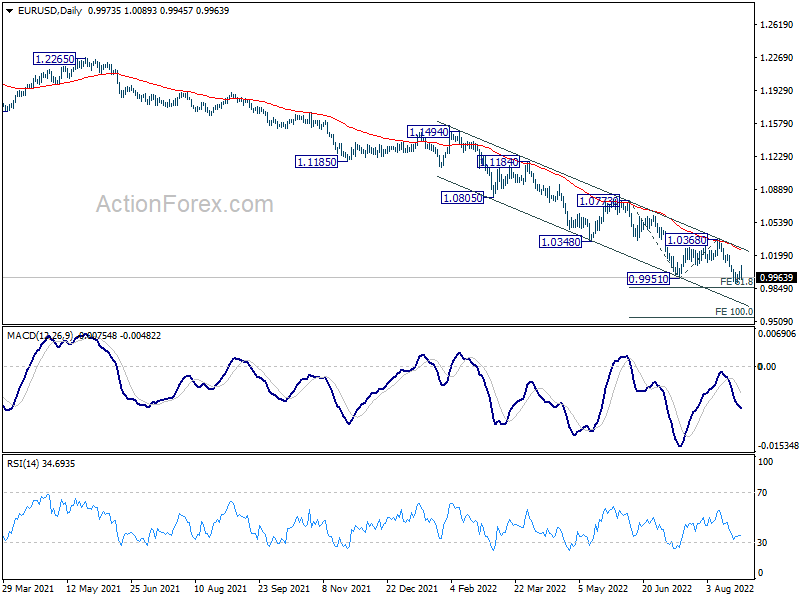
EUR/USD's down trend resumed last week and dropped to 0.9899. But it then turned into consolidation. Initial bias remains neutral this week first. Upside of recovery should be limited by 1.0121 minor resistance to bring another fall. Break of 0.9899 will resume larger down trend to 61.8% projection of 1.0773 to 0.9951 from 1.0368 at 0.9860. Firm break there should prompt downside acceleration to 100% projection at 0.9546. However, firm break of 1.0121 will dampen this view and turn focus to 1.0368 resistance instead.
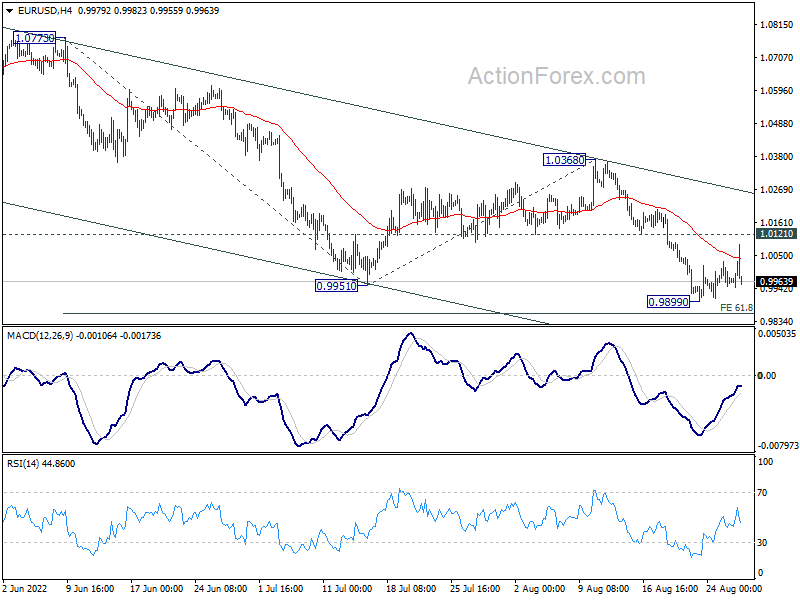
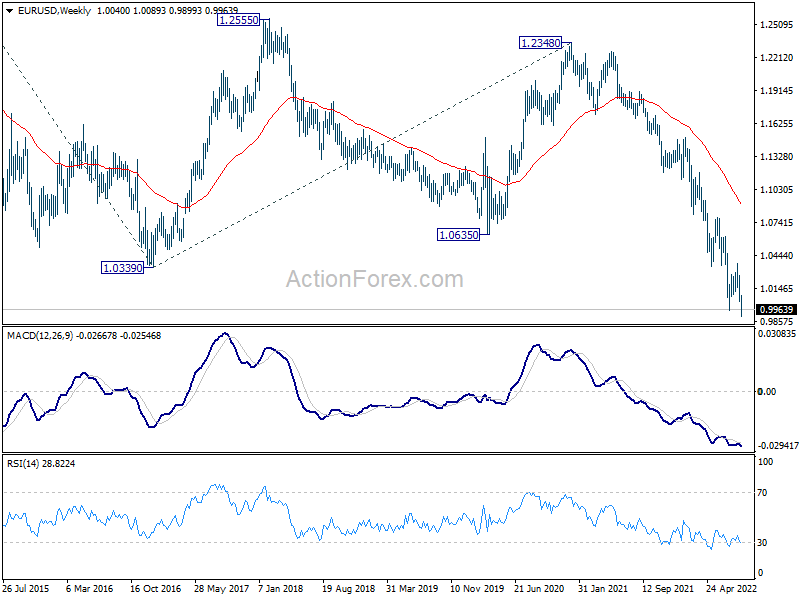
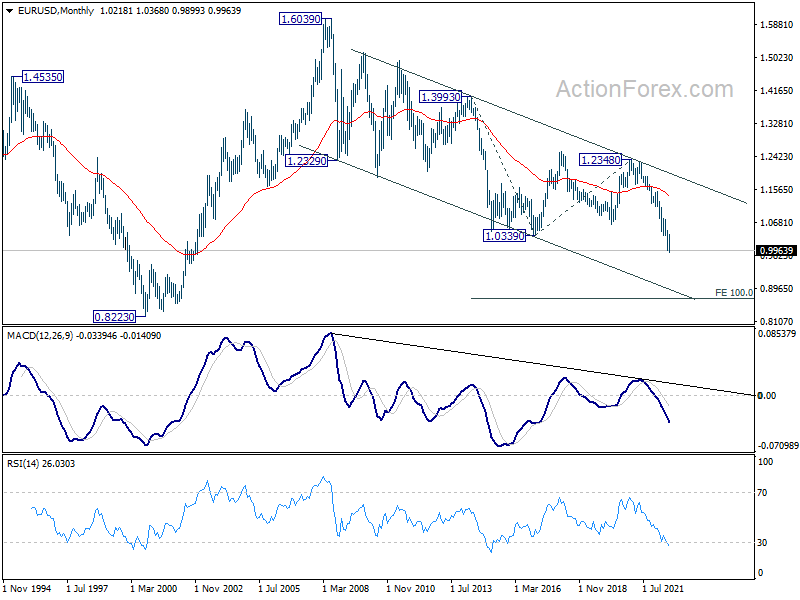
In the bigger picture, down trend from 1.6039 (2008 high) is still in progress. Next target is 100% projection of 1.3993 to 1.0339 from 1.2348 at 0.8694. In any case, outlook will stay bearish as long as 1.0368 resistance holds, in case of strong rebound.
In the long term picture, long term down trend from 1.6039 (2008 high) is extending. Next target is 100% projection of 1.3993 to 1.0339 from 1.2348 at 0.8694. This will now remain the favored case as long as 1.0638 support turned resistance holds.
USD/JPY Weekly Outlook
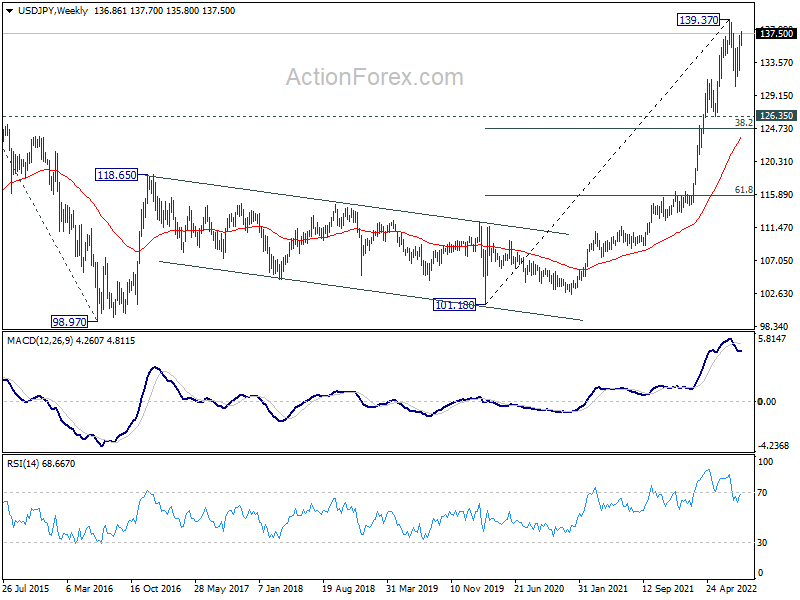
USD/JPY rose to 137.70 last week but turned sideway since then. Initial bias is neutral this week first. Overall, price actions from 139.37 are seen as a corrective pattern, with rise from 130.38 as the second leg. Above 137.70 will extend the rebound but upside should be limited by 139.37. On the downside, firm break of 135.57 will suggest that the third leg of the pattern has started, and turn intraday bias back to the downside for 131.72 support first.
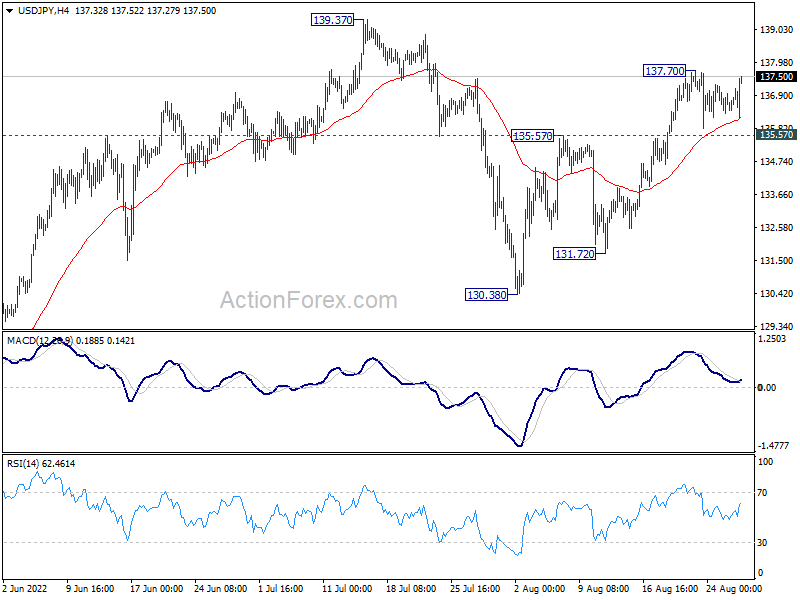
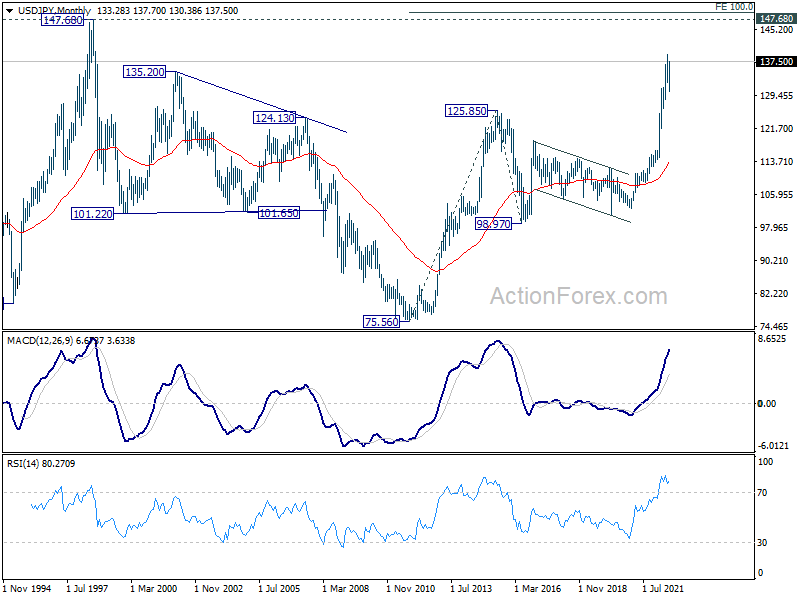
In the bigger picture, price actions from 139.37 medium term top are seen as a corrective pattern to up trend from 101.18 (2020 low). While deeper decline cannot be ruled out, outlook will stays bullish as long as 55 week EMA (now at 123.72) holds. Long term up trend is expected to resume through 139.37 at a later stage, after the correction finishes.
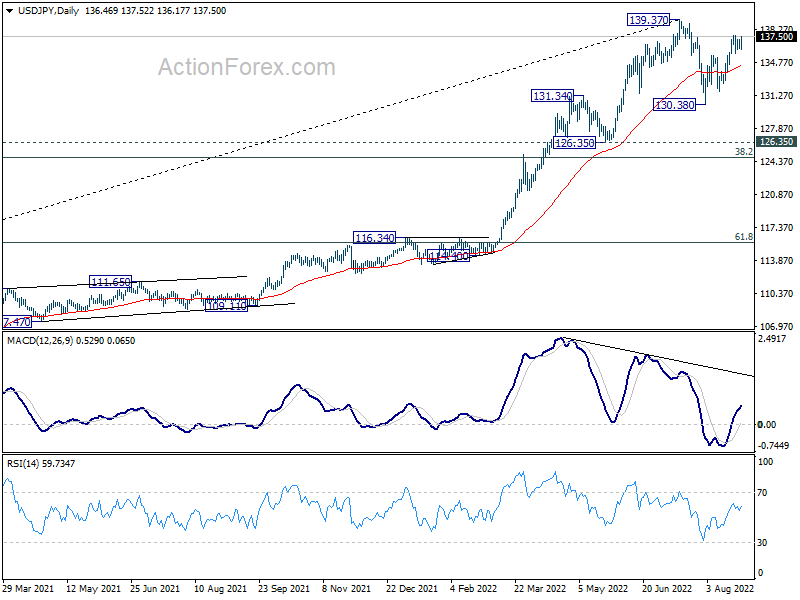
In the long term picture, rise from 101.18 is seen as part of the up trend from 75.56 (2011 low). Further rally is expected to 100% projection of 75.56 (2011 low) to 125.85 (2015 high) from 98.97 at 149.26, which is close to 147.68 (1998 high). This will remain the favored case as long as 55 week EMA (now at 123.72) holds.
GBP/USD Weekly Outlook
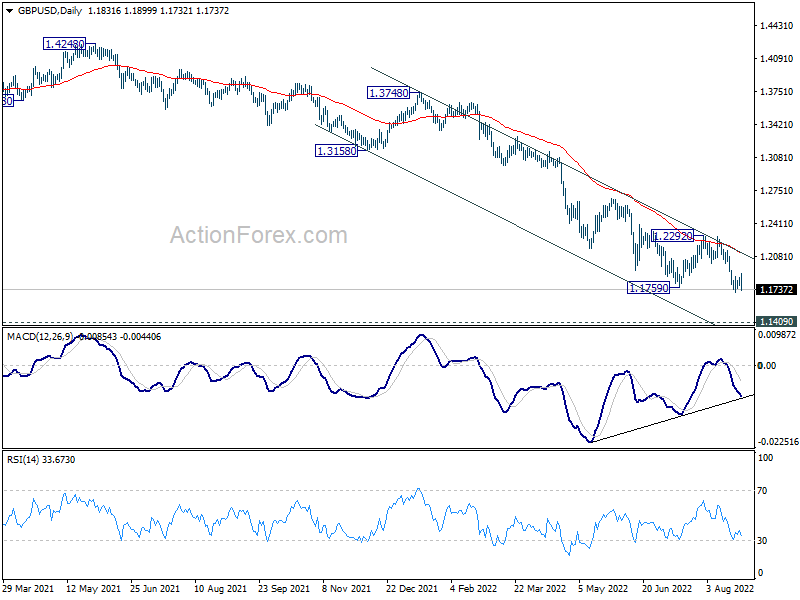
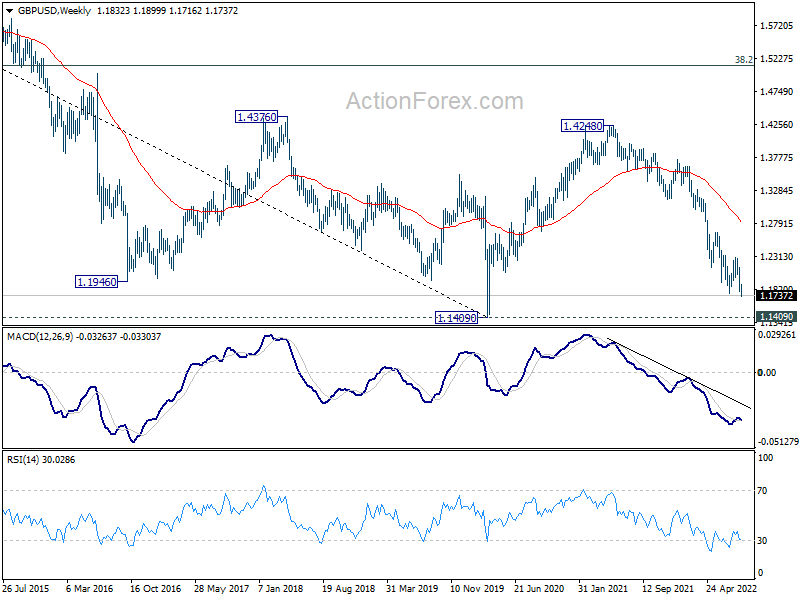
GBP/USD's down trend resumed last week by breaking 1.1759 low. But it recovered after hitting 1.1716. Initial bias is neutral this week first. In case of another recovery, upside should be limited by 1.2002 support turned resistance to bring another fall. Break of 1.1716 will resume larger down trend to 1.1409 long term support. However, firm break of 1.2002 will dampen this bearish view and bring stronger rise back to 1.2292 resistance.
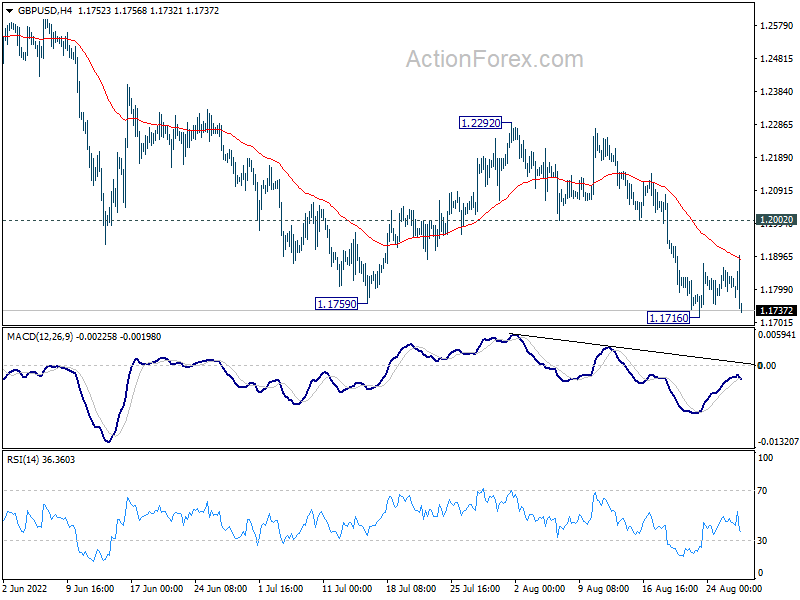
In the bigger picture, fall from 1.4248 (2018 high) could be a leg inside the pattern from 1.1409 (2020 low), or resuming the longer term down trend. Deeper decline is expected as long as 1.2292 resistance holds. Next target is 1.1409 low. However, firm break of 1.2292 will bring stronger rise back to 55 week EMA (now at 1.2859).
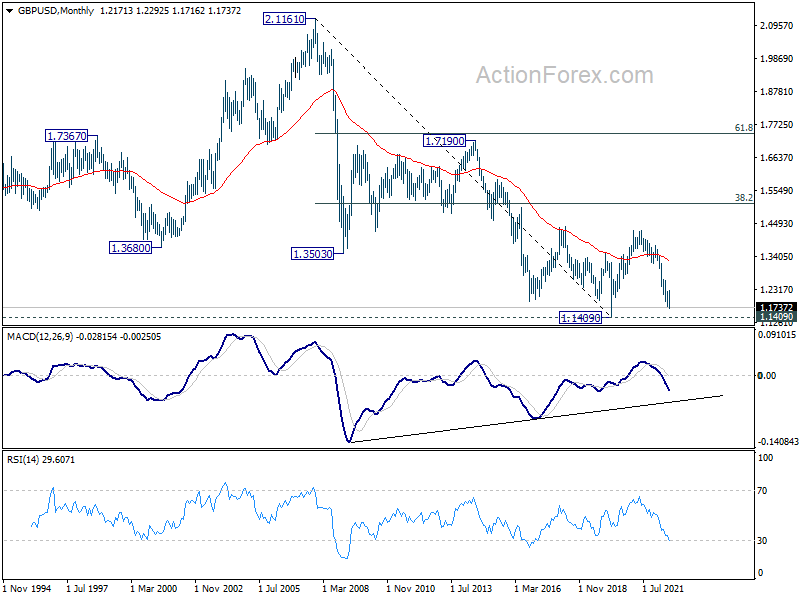
In the longer term picture, rebound from 1.1409 long term bottom should have completed at 1.4248 already, well ahead of 38.2% retracement of 2.1161 to 1.1409 at 1.5134. The development argues that price actions from 1.1409 was a corrective pattern only. That is, long term bearishness is retained for resuming the down trend from 2.1161 (2007 high) at a later stage.
USD/CHF Weekly Outlook
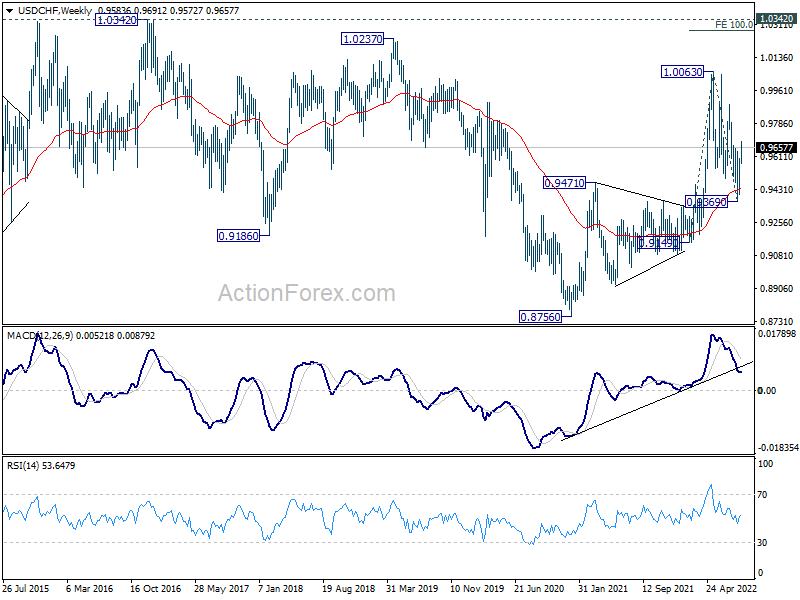
USD/CHF rose further to 0.9691 last week but retreated since then. Initial bias is neutral this week first. Triangle correction from 1.0063 could have completed at 0.9369 already. Above 0.9691 will resume the rise from 0.9369 and target 0.9884 resistance next. Break there will argue that larger up trend is ready for resumption through 1.0063. On the downside, below 0.9551 minor support will dampen this view and turn bias back to the downside for 0.9369 support instead.
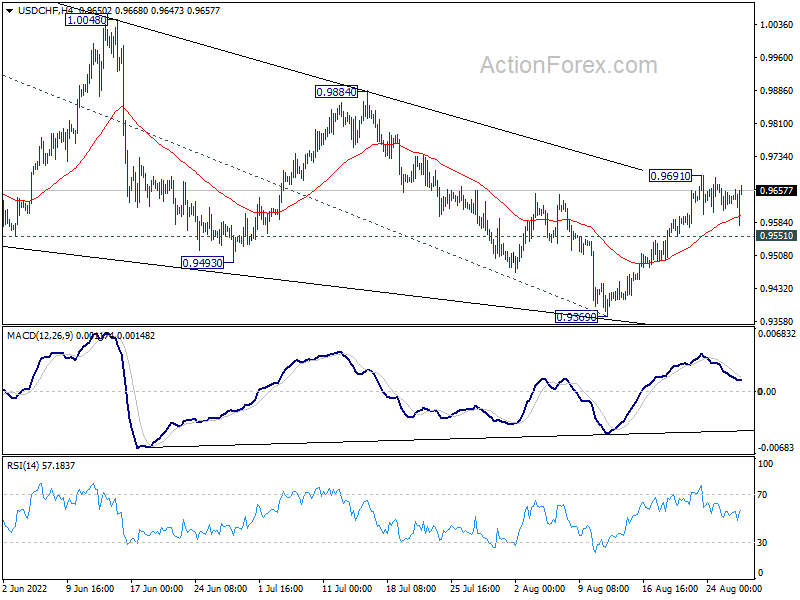
In the bigger picture, current development suggests that up trend from 0.8756 (2021 low) is still in progress. Sustained break of 1.0063 will target 100% projection of 0.9149 to 1.0063 from 0.9369 at 1.0283, and then 1.0342 (2016 high). For now, this will remain the favored case as long as 0.9369 support holds, even in case of deep pull back.
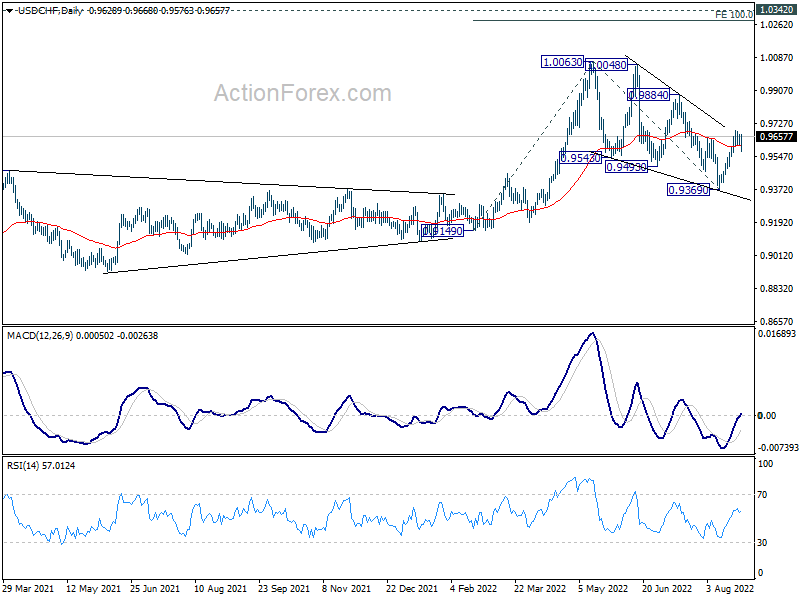
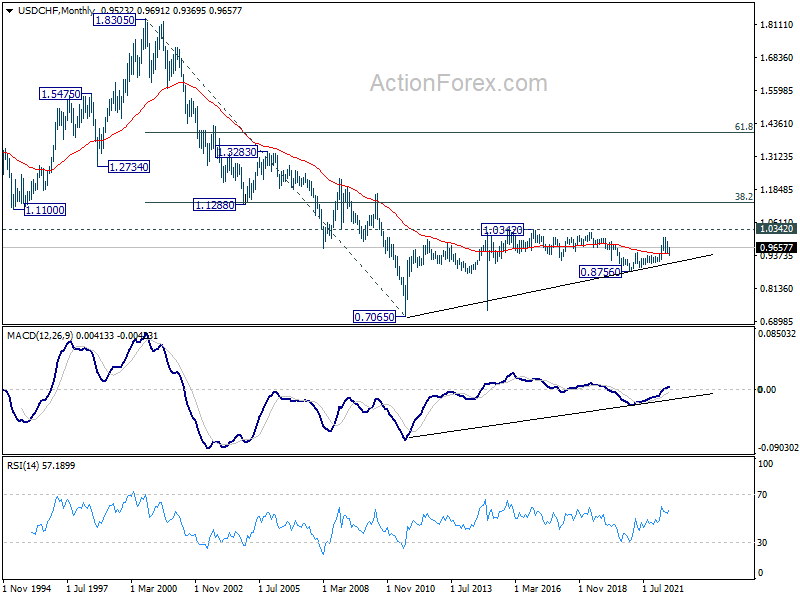
In the long term picture, outlook is mixed with deeper than expected fall from 1.0063, but some support is seen from 55 week EMA (now at 0.9433). Overall, though, USD/CHF is seen as in sideway pattern from 1.0342 (2016 high). Range trading should continue until further development.