

Sample Category Title
EUR/GBP Weekly Outlook
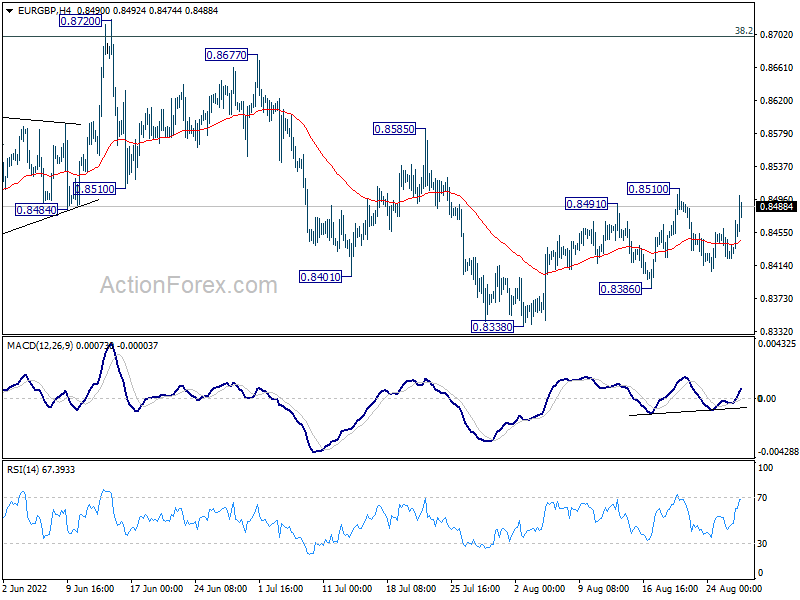
EUR/GBP stayed in range below 0.8510 last week and outlook is unchanged. Initial bias stays neutral this week first. On the downside, break of 0.8386 minor support will resume the choppy fall from 0.8720 through 0.8338. On the upside, above 0.8510 will resume the rebound to 0.8585 resistance next.
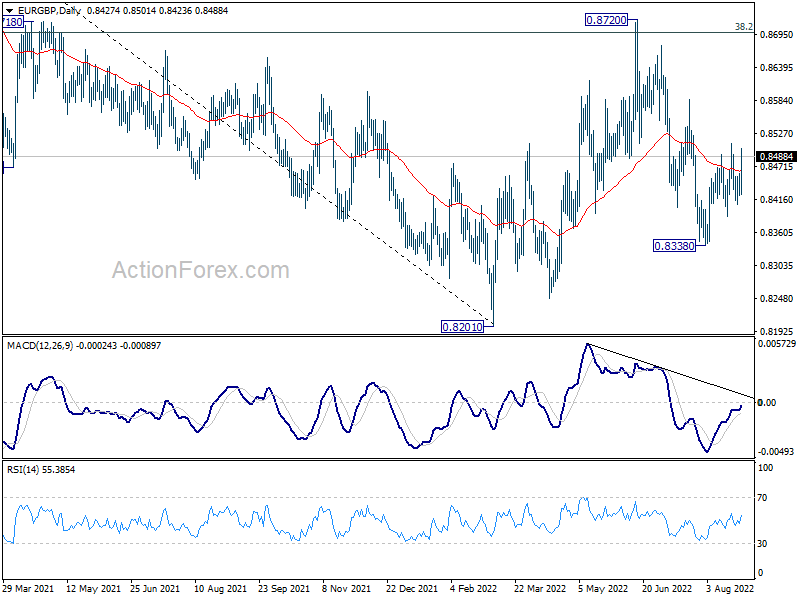
In the bigger picture, medium term bearishness is maintained with prior rejection by 38.2% retracement of 0.9499 to 0.8201 at 0.8697. Break of 0.8201 will resume larger down trend from 0.9499 (2020 high). Nevertheless, sustained break of 0.8697 will affirm the case that rise from 0.8201 is a medium term up trend itself.
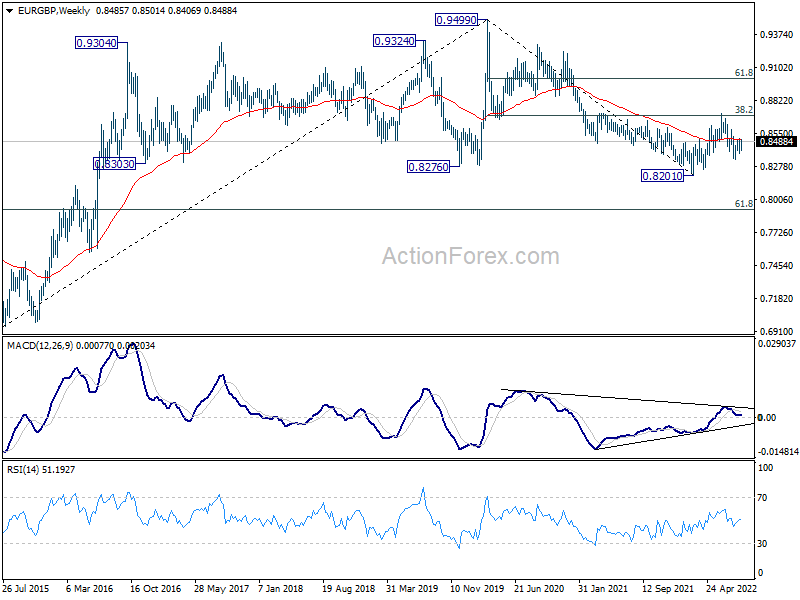
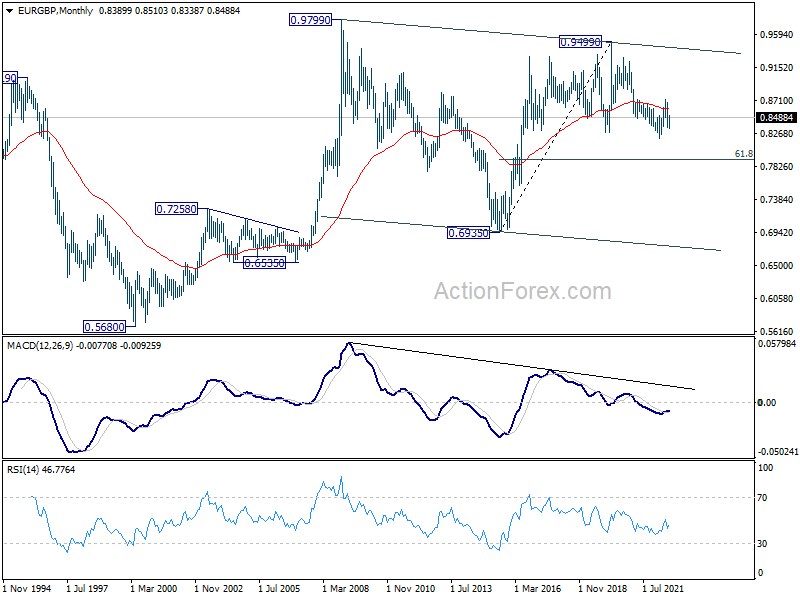
In the long term picture, the lack of medium term downside momentum suggests that fall from 0.9499 (2020 high) is merely a correction to rise from 0.6935 (2015 high). In case of another fall, downside should be contained by 61.8% retracement of 0.6935 to 0.9499 at 0.7917 to bring rebound. Sustained trading above 55 month EMA (now at 0.8597) will indicate that the correction has completed and bring retest of 0.9499.
EUR/AUD Weekly Outlook
EUR/AUD dropped to 1.4281 last week, but failed to sustain below 1.4318 low and recovered. Initial bias is neutral this week first, and further decline is still expected. On the downside, firm break of 1.4318 low will resume larger down trend to medium term projection level at 1.3623. On the upside, break of 1.4712 resistance will delay the bearish case and turn bias to the upside for stronger rebound first.
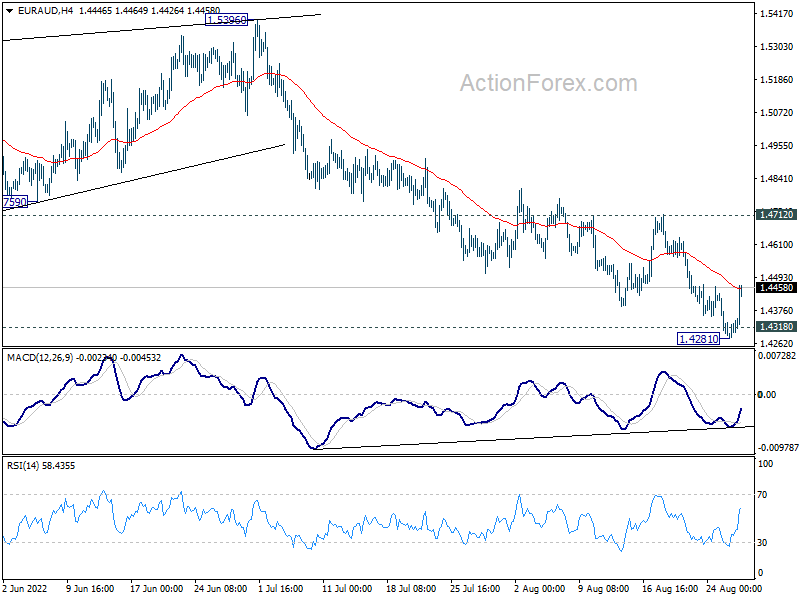
In the bigger picture, down trend from 1.9799 is still in progress. Break of 1.4318 low will target 61.8% projection of 1.9799 to 1.5250 from 1.6434 at 1.3623, which is close to 1.3624 long term support (2017 low). This will remain the favored case now as long as 1.5396 resistance holds.
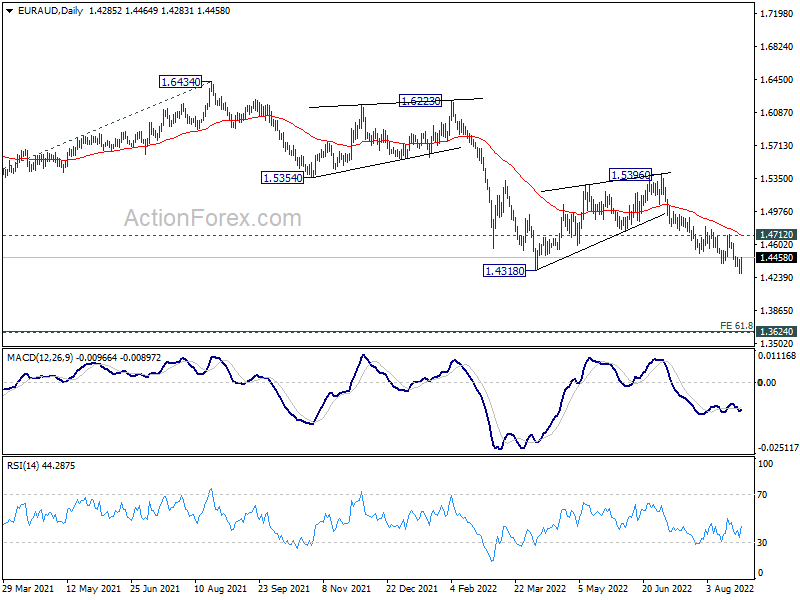
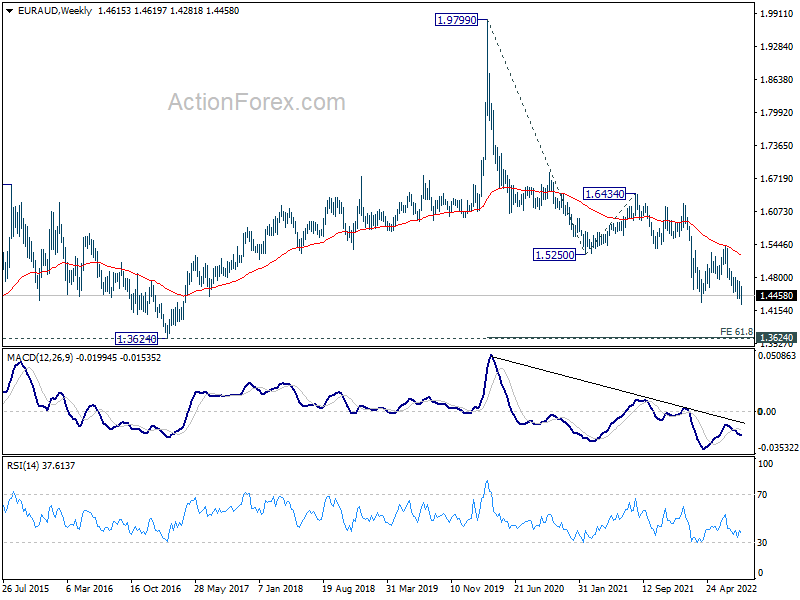
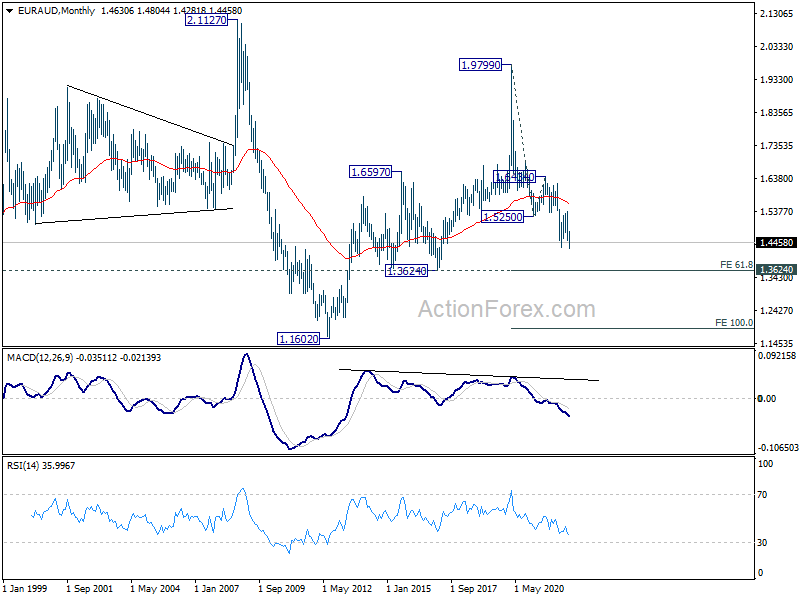
In the longer term picture, fall from 1.9799 (2020 high) is seen as the third leg of the pattern from 2.1127 (2008 high). Deeper fall should be seen to 1.3624 support. Decisive break there would pave the way back to 1.1602 (2012 low). This will remain the favored case as long as 55 month EMA (now at 1.5656) holds.
EUR/CHF Weekly Outlook
EUR/CHF edged lower to 0.9550 but recovered since then. Initial bias stays neutral this week first but further decline is expected as long as 0.9689 resistance holds. Break of 0.9550 will resume larger down trend to 100% projection of 1.1149 to 0.9970 from 1.0513 at 0.9334. On the upside, however, break of 0.9698 will confirm short term bottoming. Bias will be turned back to the upside for rebound, towards 55 day EMA (now at 0.9850).
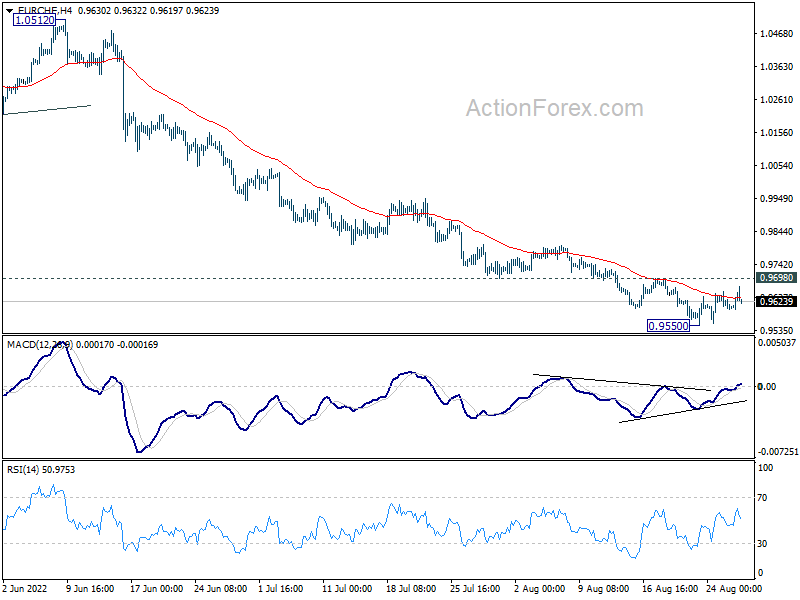
In the bigger picture, long term down trend from 1.2004 (2018 high) is still in progress. Next target is 138.2% projection of 1.2004 to 1.0505 to 1.1149 at 0.9033. On the upside, break of 0.9970 support turned resistance is needed to be the first sign of medium term bottoming. Otherwise, outlook will stay bearish in case of strong rebound.
In the long term picture, capped below 55 month EMA, EUR/CHF is seen as extending the multi-decade down trend. There is no prospect of a bullish reversal until firm break of 1.0505 support (2020 low).
Fed Powell Brought Risk Aversion Back, Dollar Ready for More Upside
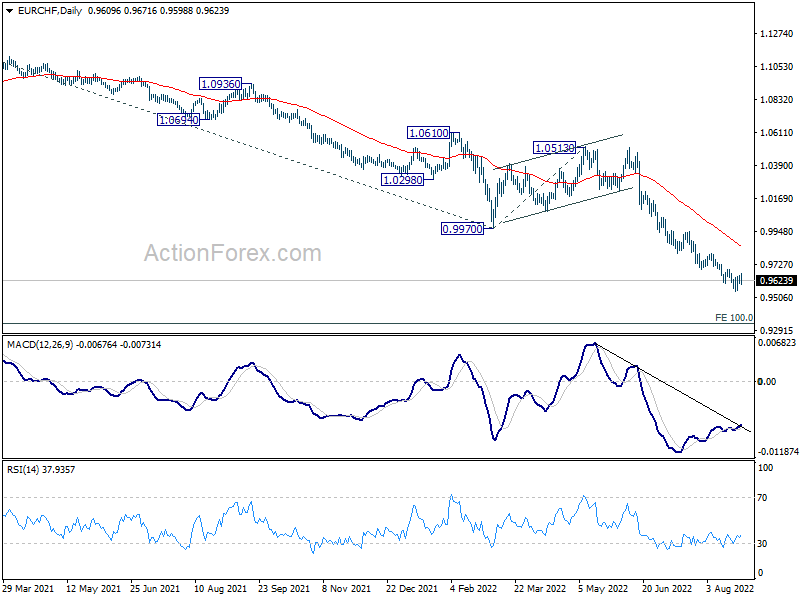
In terms of prompting market volatility, Fed Chair Jerome Powell didn't disappoint. Stocks suffered steep selloff after his Jackson Speech. While Australian Dollar was still at top of the chart, most of its earlier gains evaded on Friday, and looks set to weaken further in the near term. Dollar was the second strongest. But it has yet risen through the highs set earlier in the week. The greenback is staying bullish, but more fuel is needed for the rally.
Meanwhile, European majors were the clear losers for the week. Energy crunch, persistently high inflation, and recessions risks are clouding the outlook of Europe. Swiss Franc is having a slight upper hand over Euro and Sterling but recent declines in EUR/CHF and GBP/CHF look a bit exhausted. Yen ended mixed with countering forces of resilient treasury yields and risk off sentiment.
Investors reacted rather negatively to Fed Powell
Investors have clearly reacted very negatively to Fed Chair Jerome Powell's Jackson Hole speech. In short, Powell showed strong commitment to fight inflation, with willingness to tolerate pain in the economy, while hold interest rates high for a period of time until the job is done.
"Reducing inflation is likely to require a sustained period of below-trend growth. While higher interest rates, slower growth, and softer labor market conditions will bring down inflation, they will also bring some pain to households and businesses. These are the unfortunate costs of reducing inflation," he said, adding, "but a failure to restore price stability would mean far greater pain."
Additionally, Powell emphasized, "the historical record cautions strongly against prematurely loosening policy. We must keep at it until the job is done. History shows that the employment costs of bringing down inflation are likely to increase with delay."
There was not clear indication on whether he preferred a 50bps or 75bps hike at the September FOMC meeting. The decision would depend on the "totality" of data by that time.
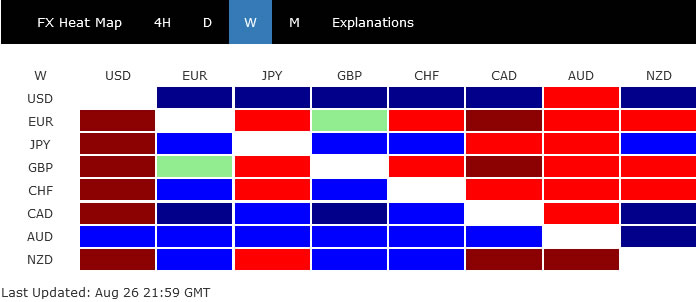
All three major US stock indexes tumbled sharply on Friday, with DOW down -3.03%, S&P 500 down -3.37%. NASDAQ down -3.94%. All closed below their 55 day EMAs.
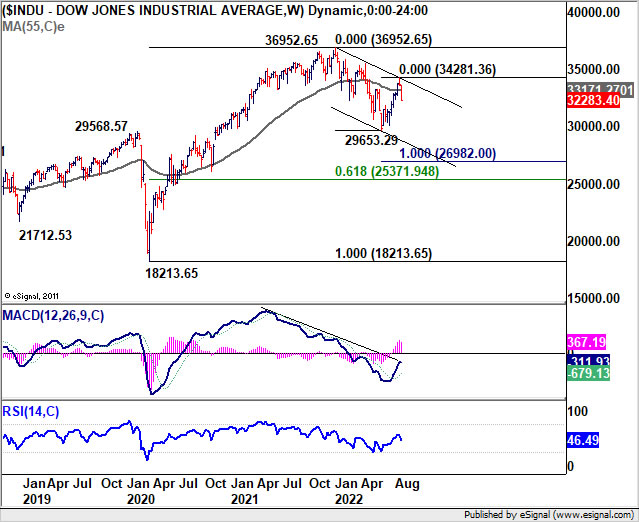
Development in DOW now argues that rebound from 29653.29 has completed at 34281.36 already. Deeper fall is expected in the near term as long as 33364.70 resistance holds, towards 61.8% retracement of 29653.29 to 34281.36 at 31421.21.
Reaction from 31421.21 would unveil the larger picture. That is, sustained break there will raise the chance of extending the correction from 36952.63 through 26953.29, towards 100% projection of 35952.65 to 29653.29 from 34281.36 at 26982.00.
10-year yield capped by 3.1 by calm bond traders
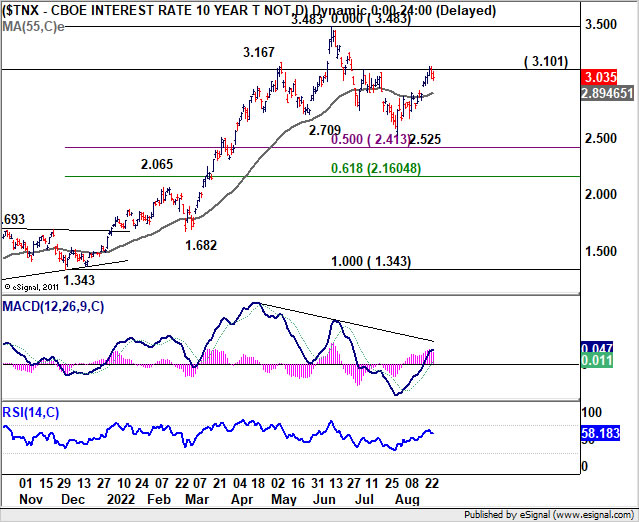
Bond traders were relatively calm, on the other hand. 10-year yield breached 3.101 resistance last week but failed to sustain above there. Overall outlook is unchanged that corrective pattern from 3.483, which is now in the second leg, is going to extend for a while. In case of further rally, upside should be limited by 3.483 to bring the third leg.
On the downside, sustained trading below 55 day EMA (now at 2.894) will suggest that the third leg has started towards 2.525. But in this case, downside should be contained by 50% retracement of 1.343 to 3.483 at 2.413 to complete the correction.
Dollar index supported by risk aversion, further up trend to follow
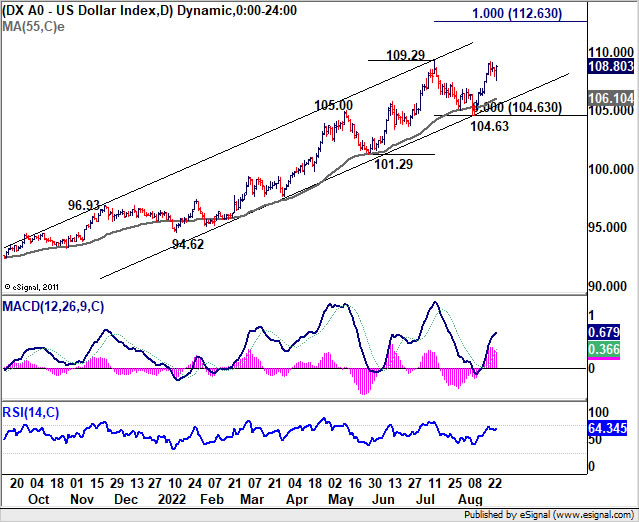
Dollar had some jittery on Friday but was eventually lifted by risk aversion. As long as Friday's low at 107.58 holds, further rally is in favor in Dollar index. Sustained break of 109.29 will resume larger up trend to 100% projection of 101.29 to 109.29 from 104.63 at 112.63. Such move, if happens, should mainly be driven by extended down trend in EUR/USD away from parity.
Bitcoin ready to resume down trend
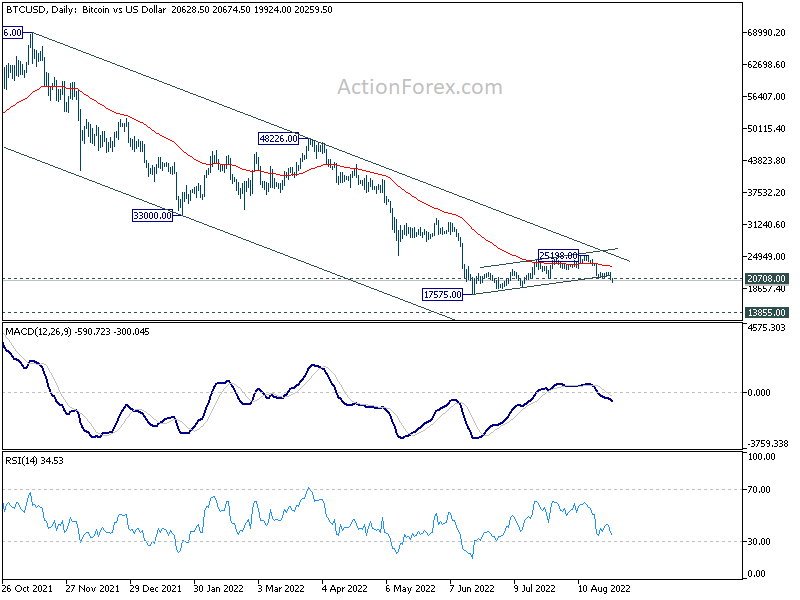
Talking about risk aversion, Bitcoin's break of 20708. support should confirm that corrective recovery from 17575 has completed at 25198. BTC is also kept well inside medium term falling channel, and back staying below 55 day EMA. Retest of 17575 support should be seen soon . Firm break there will target 13855 (2019 high) next.
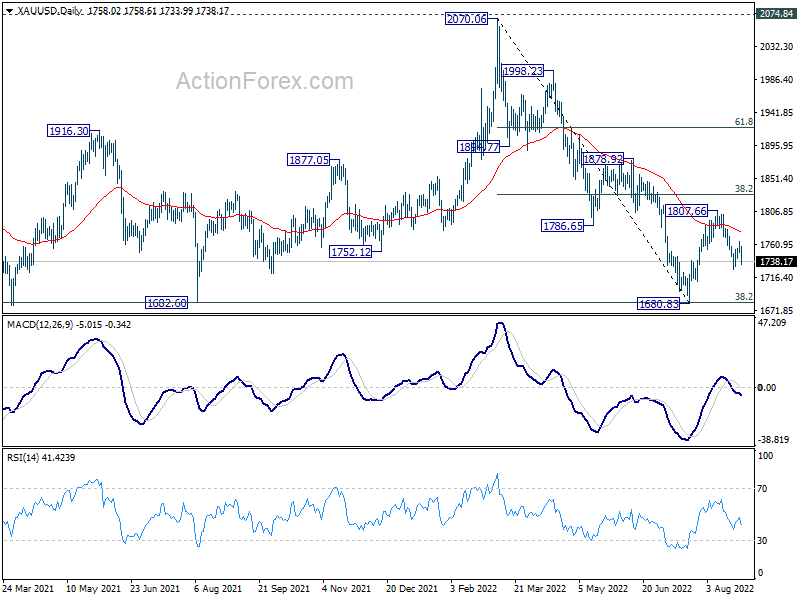
Gold might revisit 1680.83 key support as rebound finished
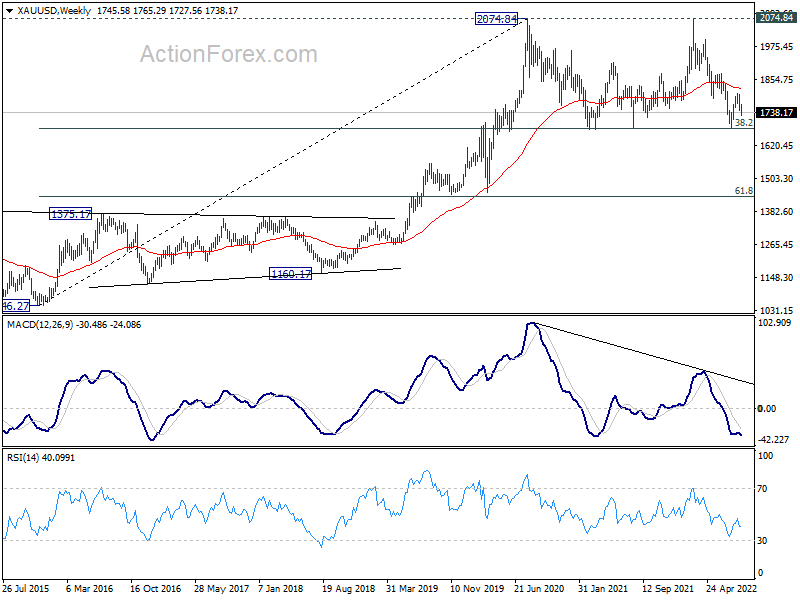
Gold's deeper than expected decline last week dampened the original bullish view that it has bottomed at 1680.83 already. The rejections by 55 day EMA, and below 55 week EMA are also bearish signals.
While a temporary low was formed at 1727.56, deeper decline will remain in favor as long as 1772.19 resistance holds. Break of 1727.56 will target important support level at 1680.83.
Firm break of 1680.83 cluster support will complete a medium term double top pattern (2074.84, 2070.06). That could prompt deeper selloff to 61.8% retracement of 1046.27 to 2074.84 at 1439.18. If that happens, it would likely be accompanied by some upside acceleration in Dollar. On the other hand, if Gold can hold above 1680, Dollar's upside moment should be relatively capped.
AUD/JPY rally cut short by risk reversal
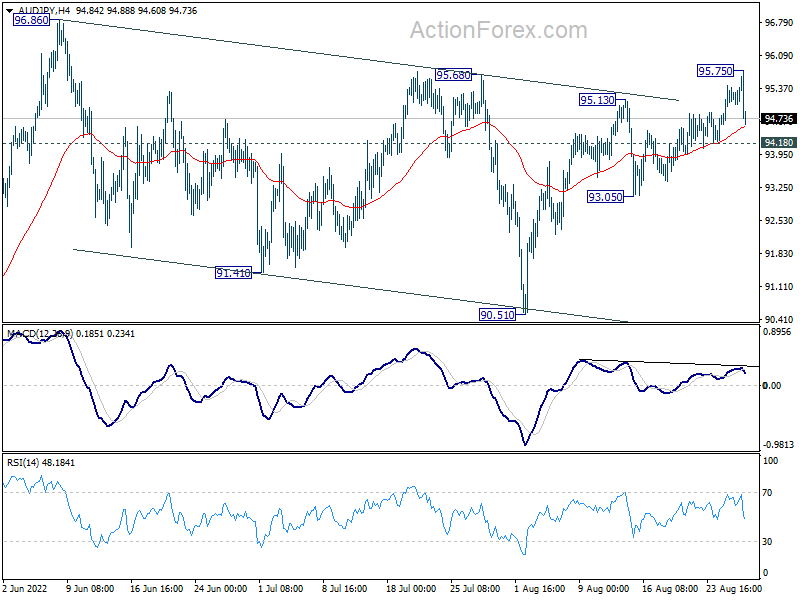
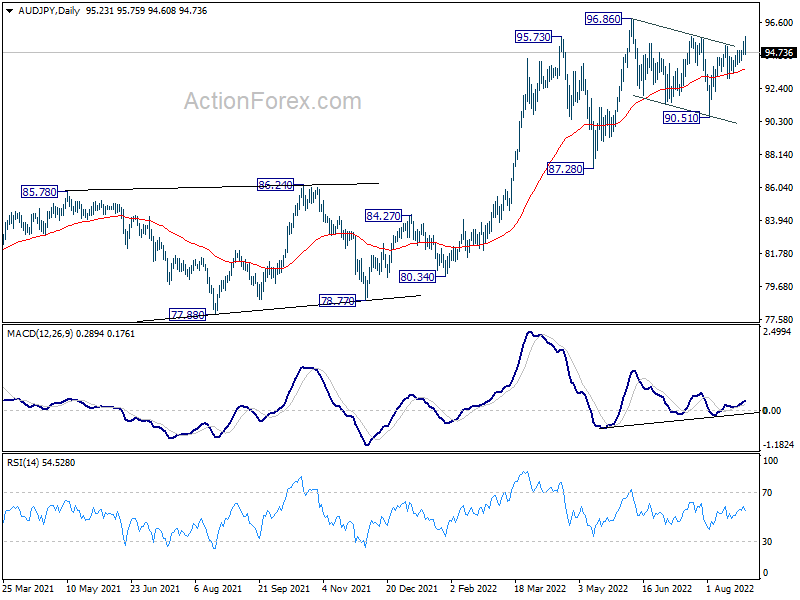
After climbing to 95.75, AUD/JPY was hammered by risk reversal towards the end of the week. Near term upside momentum started diminishing as seen in 4 hour MACD. The once promising rally now looks rather shaky.
Immediate focus is back on 94.18 support. Break there will argue that rebound form 90.51 has completed. Corrective pattern from 96.86 is going to extend with another falling leg through 93.05, towards 90.51 support. If happens, that would be a confirmation signal for broad based risk-off sentiment.
USD/CAD Weekly Outlook
Some volatility was seen in USD/CAD last week but outlook is unchanged. Corrective decline from 1.3222 could have completed with three waves down to 1.2726. Initial bias remains neutral this week first and further rise is in favor. On the upside, break of 1.3062 will resume the rally from 1.2726 to retest 1.3222 high next. However, break of 1.2893 minor support will dampen this view and turn bias back to the downside for 1.2726 and possibly below.
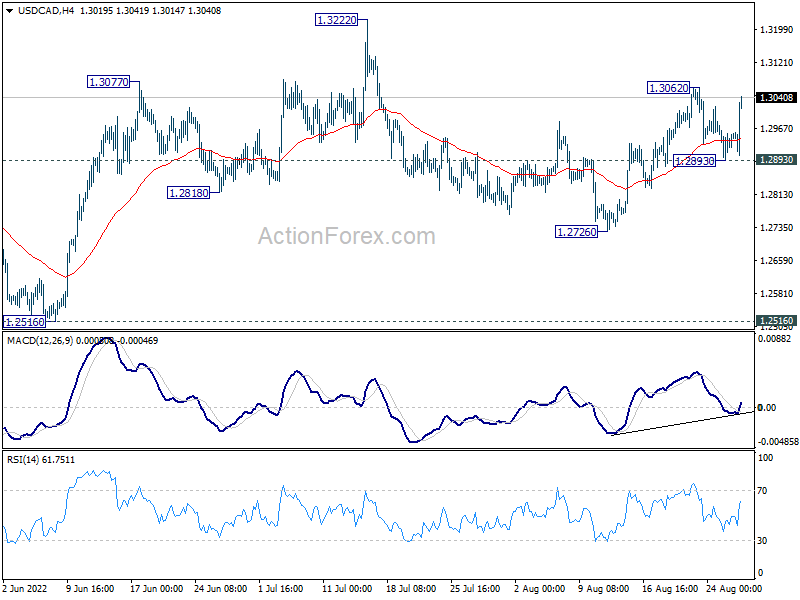
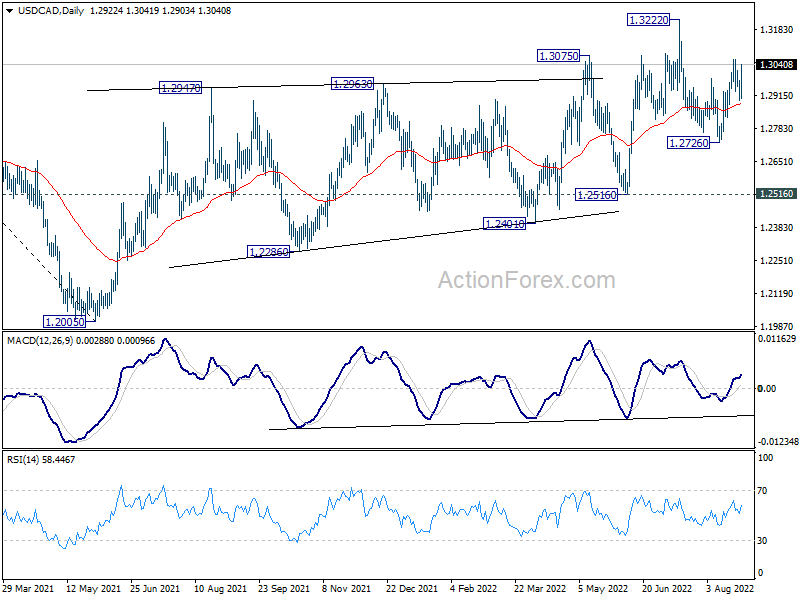
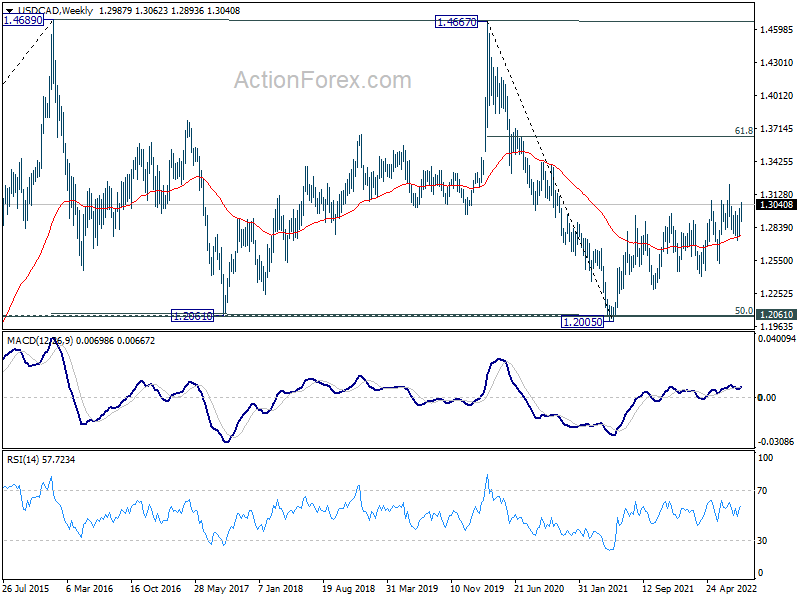
In the bigger picture, down trend from 1.4667 (2020 high) should have completed at 1.2005, after defending 1.2061 long term cluster support. Rise from there should target 61.8% retracement of 1.4667 to 1.2005 (2021 low) at 1.3650. This will remain the favored case now as long as 1.2516 support holds.
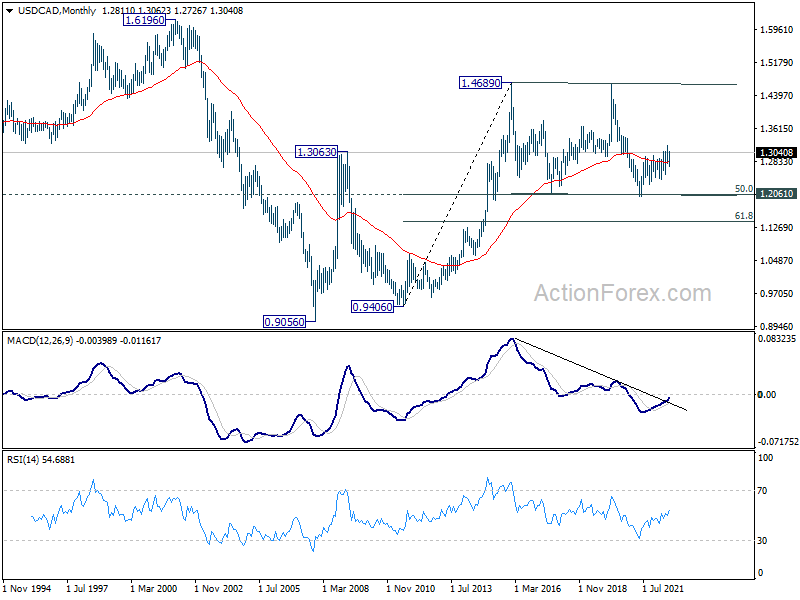
In the longer term picture, price actions from 1.4689 (2016 high) are seen as a consolidation pattern only. That is, up trend from 0.9506 (2007 low) is still expected to resume at a later stage. This will remain the favored case as long as 1.2061 support holds, which is close to 50% retracement of 0.9406 to 1.4689 at 1.2048.
Summary 8/29 – 9/2
Monday, Aug 29, 2022
[php_everywhere instance="1"]
Tuesday, Aug 30, 2022
[php_everywhere instance="2"]
Wednesday, Aug 31, 2022
[php_everywhere instance="3"]
Thursday, Sep 1, 2022
[php_everywhere instance="4"]
Friday, Sep 2, 2022
[php_everywhere instance="5"]
The Weekly Bottom Line: Powell Stands Firm on Higher Rates
U.S. Highlights
- Fed Chair Jay Powell’s hawkish remarks at the annual Jackson Hole conference did not sit well with equity markets.
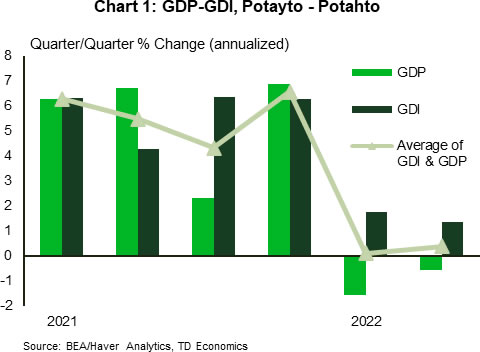
- The second estimate of Q2 GDP data showed that the economy contracted slightly less, and that GDP grew modestly. looking at an average of the two measures shows that the U.S. economy grew only slightly in the first half of the year.
Canadian Highlights
- Data from the SEPH report and the CFIB Business Barometer showed labour market remained tight in summer. Job openings remain at record level, and small business owners continue to report that labour shortages are weighing on sales.
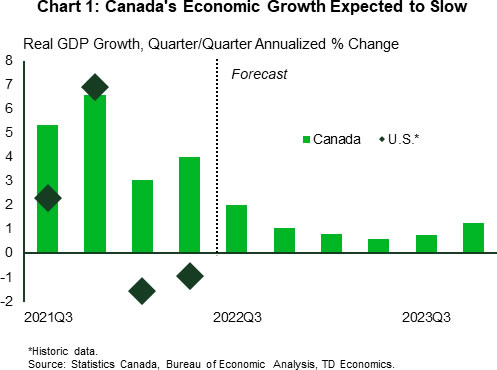
- Next week’s Q2 GDP report is expected to show that growth has picked up to 4.4% (annualized) from 3.1% in the prior quarter, but momentum is expected to slow noticeably in the second half of 2022.
Special - U.S. Students Get Up to $20,000 in Student Debt Erased
- President Biden announced details on a much-anticipated student debt forgiveness plan that will forgive up to $20,000 in federal student debt per borrower.
- A reduction in student debt will be stimulative for people receiving the relief, and could add more fire to current inflationary pressures, making the Fed’s job that much more difficult.
U.S. - Powell Stands Firm on Higher Rates
It was a full week for economic data, but the most anticipated event for markets was the Fed Chair’s speech at the annual Jackson Hole conference on Friday. Equity markets didn’t like what they heard. Powell’s hawkish remarks that the Fed remains committed to fight inflation and is likely to keep rates high for an extended period did not sit well with investors, and stocks fell on the remarks. The yield on the 2-Year Treasury was up slightly after the speech, continuing a recent trend as markets expect a bit more monetary tightening over the next two years.
Longer-term bond yields remain lower than the 2-Year as markets expect an economic slowing and future rate cuts by the Fed. It is understandable that investors are worried about a recession, when the second estimate for GDP growth in Q2, was revised up only slightly and still contracted by 0.6% annualized. This release was more highly anticipated than usual because it included another measure of national output – Gross Domestic Income (GDI). GDI measures output based on income in the economy – summing wages, profits, interest payments and investments. Whereas GDP is defined as the value of final goods and services on the production side. In theory they should be similar, but there usually is some deviation due to being measured from different data sources.
Some economists argue that GDI is the better measure – but it is released later by the BEA, and so usually gets less attention. Early estimates of GDI better captured the downturn in the 2007-09 recession. The compromise is that an average between the two measures likely captures momentum in the economy best. In the first half of 2022, GDP estimates suggested the economy contracted, while GDI showed the economy grew at 1.6% on average through Q1-Q2 (Chart 1). The average of the two measures shows the economy stalled in the first half of the year, so to some extent it feels like a potayto-potahto situation – either way you slice it, the U.S. economy is on a dramatically slower growth trajectory in 2022 in the face of high inflation, rising interest rates and less fiscal stimulus.
As for momentum in the second half of the year, consumer spending data for July showed that nominal spending continued to lose momentum. But, due to weaker inflation pressures, the real spending slowdown is somewhat less than we expected a few weeks ago. Real consumer spending is tracking around 1.5-2% annualized in the third quarter, which is roughly the same pace averaged over the first half of the year. This suggests the consumer is proving quite resilient to all the onslaughts against their purchasing power.
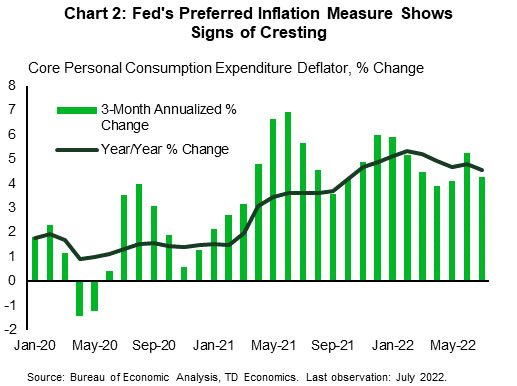
Inflation, as measured by the core PCE deflator, also cooled a bit in July. Looking at it on a year-on-year basis, core inflation has cooled to 4.6%, and ran at a 4.3% annualized pace over the past three months (Chart 2). We aren’t saying that inflation pressures have been vanquished, but it is encouraging they are moving in the right direction. Given the false dawn we had last year, where inflation pressures originally cooled, only to quickly heat up again, Chair Powell is right to point out that the Fed needs to see more convincing evidence before easing up on rate hikes.
Canada - Economic Resilience on Borrowed Time
As Canadians were taking their time off to enjoy the tail end of summer, so seeming did the economic data. The economic calendar was sparse this week ahead of next week's Q2 GDP report. The GDP report will be the final key piece of data for the Bank of Canada ahead of its interest rate decision on September 7th. The release is likely to be a ho-hum affair, given that the report is backward-looking and also expected to come in relatively in line with the BoC's expectations. In July's MPR the Bank penciled a 4% (annualized) growth for Q2, and so far, the preliminary monthly GDP releases point to a solid 4.5% expansion.
This year Canada's economy has been an outperformer relative to the U.S., with its economy contracting in the first half of the year. But Canada's economic resilience is on borrowed time as rising interest rates, reduced consumers' purchasing power and negative economic sentiment begin to weigh on growth. Next week's release is expected to show that underneath the robust Q2 headline print, cracks are already forming in the rate-sensitive sectors of the economy, such as residential investment and spending on durable goods. This sets the stage for significant deceleration in the second half of the year (Chart 1).
While the housing market has been cooling rapidly over the last several months, consumer spending has so far remained relatively resilient. However, there are signs that spending is slowing. Last week's retail sales report showed that consumers have been increasingly looking for deals online and have cut back on driving in both in May and June amid surging prices at the pump. The slowing housing market is also weighing on purchases of housing-related items. This week's data showed that spending on discretionary items, like dining out, which has seen a strong post-reopening rally, may now be slowing as well. Sales at restaurants and bars grew by just 0.8% in nominal terms in June – the smallest increase since January – and were essentially flat after adjusting for inflation.
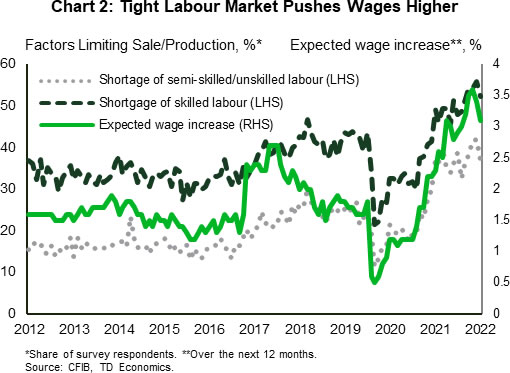
Though gas prices have been trending lower, which is easing the pressure on headline inflation, core inflation remains too hot for the BoC's comfort. This is unlikely to ease much in the coming months as the tight labour market is adding pressure on wages. This week's SEPH/payrolls data showed job openings remained at a record level in June. At over 1 million, this translates into one opening for every unemployed Canadian. The CFIB small business optimism survey also echoed this, with businesses still reporting significant labour shortages (although less than in prior months) (Chart 2). Given this strong starting point, we'd reiterate Governor Macklem's recent comments where he emphasized that the BoC's "job is not done yet" as "it will take some time before inflation is back to normal."
U.S. Students Get Up to $20,000 in Student Debt Erased
President Biden announced a much-anticipated executive action to reduce the burden of federal student debt. At the time of writing, the White House hasn't provided cost estimates, or all the details, but according to the Committee for a Responsible Federal Budget, the plan will cost roughly $500 billion dollars over the next 10 years.
Under the plan, $10,000 in federal student loan debt will be forgiven for borrowers making under $125,000 (or $250,000 for couples). Approximately 40 million borrowers would be eligible for this amount. In addition, up to $20,000 will be forgiven for the 27 million recipients of Pell Grants – a specific program for students in financial need. It's estimated that more than a third of the total $1.6 trillion in student debt will be forgiven.
The plan also modifies existing income-driven repayments by reducing future monthly payments for lower-and middle-income borrowers. Payments will be reduced from 10% to 5% percent of discretionary income, and forgives loan balances of $12,000 or less after 10 years.
Furthermore, borrowers who are employed by non-profits, the military, or government may be eligible to have all their student loans forgiven through the Public Service Loan Forgiveness program. The pandemic moratorium on federal student loan payments will also be extended through December 31st, saving roughly $20 billion in debt payments.
The announcement puts an end to a debate that has been around since at least the Occupy Wall Street protests a decade ago. The proponents of forgiveness argue it would stop the racial wealth gap from growing and help borrowers turn regular earnings into longer-lasting wealth. Indeed, African American college graduates hold disproportionally large student debt balances in comparison to peers (Chart 1). Those against forgiveness point out that student debt is disproportionately held by more affluent families, and that it will stimulate economic activity at the time when inflation is already running hot.
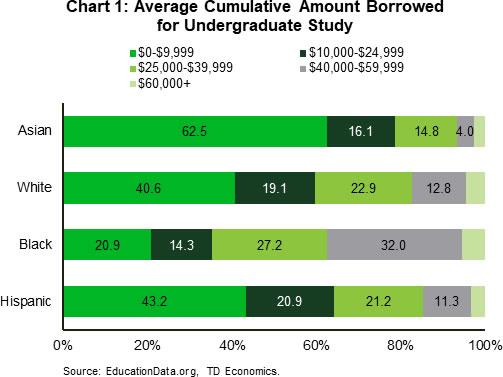
The debate is hot but ultimately the additional forgiveness of $20,000 for Pell grant recipients and modifications to income-driven repayment programs makes the plan more targeted towards lower-income Americans, helping the administration achieve progressive goals. According to White House's estimates, 87% of the relief will go to lower-income families earning less than $75,000. However, some portion of higher income families stand to benefit, given that the income threshold set at $125,000 is well above the median American income (Chart 2).
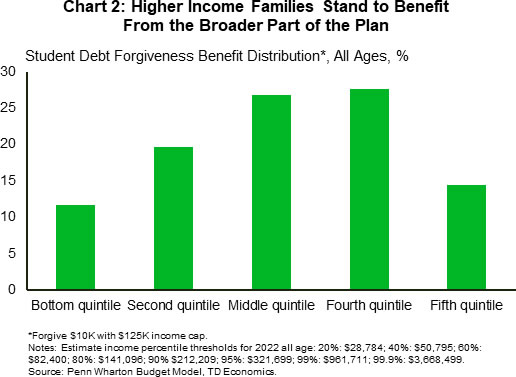
In terms of the economic impact, a reduction in student debt will be mildly stimulative, though the average borrower can expect to have their annual payment reduced by $1,000. While there’s still uncertainty over both the timing and implementation of the program, preliminary estimates suggest that the impact to economic growth will be relatively small compared to its cost – with only a tenth of the dollar amount forgiven expected to flow back into the economy. Still, more economic stimulus at time when inflation is already running at multidecade highs will make the Fed’s job that much harder to regain price stability over the coming years.
Weekly Economic & Financial Commentary: Powell Delivers Hawkish Message at Jackson Hole
Summary
United States: Economy Still Climbing the Mountain
- The second estimate of Q2 real GDP posted a 0.6% quarterly decline, slightly better than the first-reported 0.7% drop. New home sales fell 12.6% in July, reflecting the ongoing downshift in housing activity. Durable goods orders were essentially flat in July, while personal income and spending rose 0.2% and 0.1%, respectively. U. Mich. consumer sentiment improved to 58.2 in August.
- Next week: Home Prices (Tue), ISM Manufacturing Index (Thu), Employment (Fri)
International: Eurozone Growth Pauses, U.K. Growth Slows
- This week's data from Europe offered insight on how the surge in inflation is weighing on the economy. In the Eurozone, the August services PMI fell more than expected and the manufacturing PMI also eased, which saw the economy-wide PMI fall to levels consistent with contracting GDP. In the U.K. the August services PMI showed some resilience, while the manufacturing PMI fell. Although U.K. activity is holding up for now, we still expect a U.K. recession in the quarters ahead.
- Next week: China PMIs (Wed), Eurozone CPI (Wed), Canada GDP (Wed)
Interest Rate Watch: Powell Delivers Hawkish Message at Jackson Hole
- Fed Chair Jerome Powell delivered a forceful speech in which he stressed that the Fed's "overarching goal" is to bring inflation back to its 2 percent target. He also stressed that rate may need to be held at a high level for an extended period of time to ensure that inflation is indeed wrung out of the economy.
Credit Market Insights: White House Proposes Student Debt Relief
- The White House announced its long-awaited student debt relief plan on Wednesday. Individuals making less than $125,000 a year and couples making less than $250,000 will qualify for student loan forgiveness of up to $10,000, or up to $20,000 if they were Pell Grant eligible. In our view, the proposal will not present major inflationary pressure to the current macroeconomic environment.
Topic of the Week: Corporate Profit Margins Widest in 72 Years, Although Inventories Spell Trouble
- On an after-tax basis, profit margins widened to 15.5%, the highest since 1950. However, big-box retailers are already cautioning a hit to revenues later in the year from a need to move undesired inventory through discounting. Companies are increasingly looking for space to store their inventory, swamping an already exceptionally tight warehouse market.
Week Ahead – Fed Needs More Data
What will the jobs report tell us?
The build-up to the Jackson Hole symposium last week was quite tense. Investors have spent the weeks since the July Federal Reserve meeting celebrating the “dovish pivot” and then in the days leading up to Powell’s speech, doubt started to creep in. As it turned out, for good reason.
Policymakers have spent weeks trying to convince investors that there was no dovish pivot, to no avail. So it was up to Powell to reinforce the Fed’s commitment to bringing inflation back to target and I think there’s little doubt he did it. There was no room for error and his speech ensured the message was crystal clear.
In referencing other data points, one thing he achieved is intense scrutiny of all incoming US economic data. And next week brings the big one; the jobs report. Investors will no doubt scrutinise every element of it for any indication that the Fed could take its foot off the brake in September. After Powell successfully reset expectations, the coming weeks could be very different from those we’ve just experienced.
US
The Fed is sticking to the hawkish script and future rate hikes will depend on how quickly inflation eases and the economy weakens. It’s a busy week filled with more Fed speak and key manufacturing and labour market readings. The main event of the week will be the August employment report, but many traders will also pay a lot of attention to how fast manufacturing activity will fall towards contraction territory.
The nonfarm payroll report is expected to show the pace of hiring slowed from a robust July payroll count of 528,000 to 300,000 jobs in August. The ISM manufacturing report is expected to weaken from 52.8 to 52.1, as stockpiles continue to mount for many manufacturers.
Fed speak begins on Monday with Fed’s Brainard. Tuesday we will hear from Barkin and Williams. On Wednesday, Mester will talk about the economic outlook and Bostic will discuss fintech in financial inclusion. Bostic will speak again on Thursday to business school students.
EU
A lot of economic data is due from around the euro area next week with the highlight no doubt being the inflation figures. Initially, this will come from individual countries including Spain and Germany on Tuesday before France releases its number early Wednesday followed by the eurozone as a whole shortly after. This is important as the individual releases offer insight into what we can expect from the bloc as a whole.
Reuters reported Friday that some ECB policymakers want to discuss a 75 basis point rate hike next month which could shift the conversation in that direction between now and then.
Aside from this, we’ll get final manufacturing PMIs, unemployment, retail sales and more. As ever, a lot of focus will remain on the energy situation, in particular Nord Stream 1 maintenance that starts Wednesday and lasts three days. Any hint of delays could cause another surge in gas prices.
UK
A long bank holiday weekend ahead for the UK and people will need it after Ofgem confirmed the energy price cap will rise by 80% in October. If the UK isn’t already in recession, it will be soon.
Light on the data front next week, with the final manufacturing PMI on Thursday the only release of note.
Russia
Next week offers unemployment on Wednesday and the manufacturing PMI on Thursday. Unemployment is expected to rise from 3.9% to 4.1% in July, perhaps a sign of sanctions starting to bite in the labour market. The rouble remains around 20% higher against the dollar compared to before the war in Ukraine.
South Africa
No major economic releases next week. Inflation hit 7.8% last month which leaves the SARB in an uncomfortable position ahead of the next meeting on 22 September, with another 75 basis point hike looking likely.
Turkey
Quarterly GDP is expected to accelerate to 7.5% in the second quarter, even as inflation runs at 80%. President Erdogan will be hoping the fact that the economy is holding up will see him and his party through the election next year. Manufacturing PMI is the only other notable release.
Switzerland
A lot to look forward to next week starting with an appearance by SNB Chairman Thomas Jordan at Jackson Hole on Saturday. The central bank isn’t averse to catching markets off guard so traders will be following his comments with keen interest. There’s plenty of data next week including the KOF indicator on Tuesday and inflation, retail sales and the manufacturing PMI on Thursday.
China
The August manufacturing PMI, non-manufacturing PMI and composite PMI will be released on 31 August, while the Caixin manufacturing PMI will be released on 1 September. The recent impact on water and electricity caused by the hot weather in China may have negatively affected the economic data in August, which could lead to some disappointing figures.
India
Next week brings quarterly GDP data for Q1 and the manufacturing PMI for August.
Australia & New Zealand
A selection of data on offer next week with retail sales up first on Monday followed by building approvals Tuesday and the manufacturing PMI on Thursday. A 50 basis point hike at the next RBA meeting is still viewed as likely.
Only tier two and three data on offer from New Zealand next week.
Japan
The divergent attitude of the Fed and the Bank of Japan toward the fundamentals of the rate hike outlook continues to support USD/JPY.
A number of important economic indicators will be released over the next week covering the labour market, industrial output, retail sales and manufacturing. We’ll also hear from BoJ Board Member Junko Nakagawa on Wednesday.
Singapore
The only data release next week is the PMI on Friday.
Economic Calendar
Saturday, Aug. 27
Economic Data/Events
- China industrial profits
- Last day of the Kansas City Fed’s annual Economic Policy Symposium in Jackson Hole
Sunday, Aug. 28
Economic Data/Events
- No major events or economic releases
Monday, Aug. 29
Economic Data/Events
- Australia retail sales
- Japan leading index, coincident index
- Sweden GDP
- Turkey trade balance, economic confidence
- Elon Musk and Ukraine President Volodymyr Zelenskiy expected to speak at the ONS conference
- Markets are closed in London due to the UK’s Summer Bank Holiday
- ECB Chief Economist Lane and Riksbank Deputy Governor Floden to speak at the Central Bank Research Association’s annual meeting in Barcelona
Tuesday, Aug. 30
Economic Data/Events
- US Conference Board consumer confidence
- Australia building approvals
- Chile unemployment
- Czech Republic GDP
- Euro Zone economic confidence, consumer confidence
- Germany CPI
- India Bloomberg economic survey
- Japan unemployment
- Mexico international reserves, unemployment
- Spain CPI
- New York Fed President Williams speaks with the Wall Street Journal about the US economic outlook
- ECB’s Holzmann, Stournaras, Muller and Wunsch speak about “Inflation: Can Central Banks Cope?” at the Alpbach Forum in Austria
Wednesday, Aug. 31
Economic Data/Events
- Russia’s Gazprom to halt gas flows through the key Nord Stream pipeline for three days of maintenance
- Australia construction work, private sector credit
- Brazil unemployment
- Chile industrial production
- China PMI
- Eurozone CPI
- Poland CPI
- Canada GDP
- Finland GDP
- India GDP
- Turkey GDP
- Germany unemployment
- India eight infrastructure industries
- Japan industrial production, retail sales, consumer confidence index
- New Zealand building permits, business confidence
- Russia unemployment
- Singapore money supply
- South Africa trade balance
- Thailand trade, BoP, capacity utilization
- EIA crude oil inventory report
- Cleveland Fed President Mester speaks on the outlook for the economy and monetary policy at an event hosted by the Dayton Area Chamber of Commerce
- Atlanta Fed President Bostic speaks at the Georgia Fintech Academy about the role of fintech in promoting financial inclusion
- Riksbank Deputy Governor Breman speaks at a seminar about the Swedish economy
Thursday, Sept. 1
Economic Data/Events
- US construction spending, ISM manufacturing, S&P final manufacturing PMI reading, initial jobless claims
- Eurozone manufacturing PMIs
- Australia PMIs
- India manufacturing PMI
- South Africa manufacturing PMI
- Thailand manufacturing PMI
- UK manufacturing PMI
- China Caixin manufacturing PMI
- Eurozone unemployment
- Germany manufacturing PMI
- Hungary GDP, One-Week Deposit Rate
- Italy unemployment, GDP
- Japan capital spending, vehicle sales, company profits, PMI
- New Zealand house prices
- Thailand business sentiment index
Friday, Sept. 2
Economic Data/Events
- US August change in employment: 300K expected v 528K prior, factory goods, durable goods
- Euro Zone PPI
- Japan monetary base
- Singapore electronics sector index, PMI
- Spain unemployment
- Thailand foreign reserves, forward contracts
- The UK leadership ballot closes in the evening with the winner being announced on Sept 5th
Sovereign Rating Updates
- Cyprus (S&P)
- Spain (DBRS)
Forward Guidance: Canadian GDP Growth Slowing into the Summer
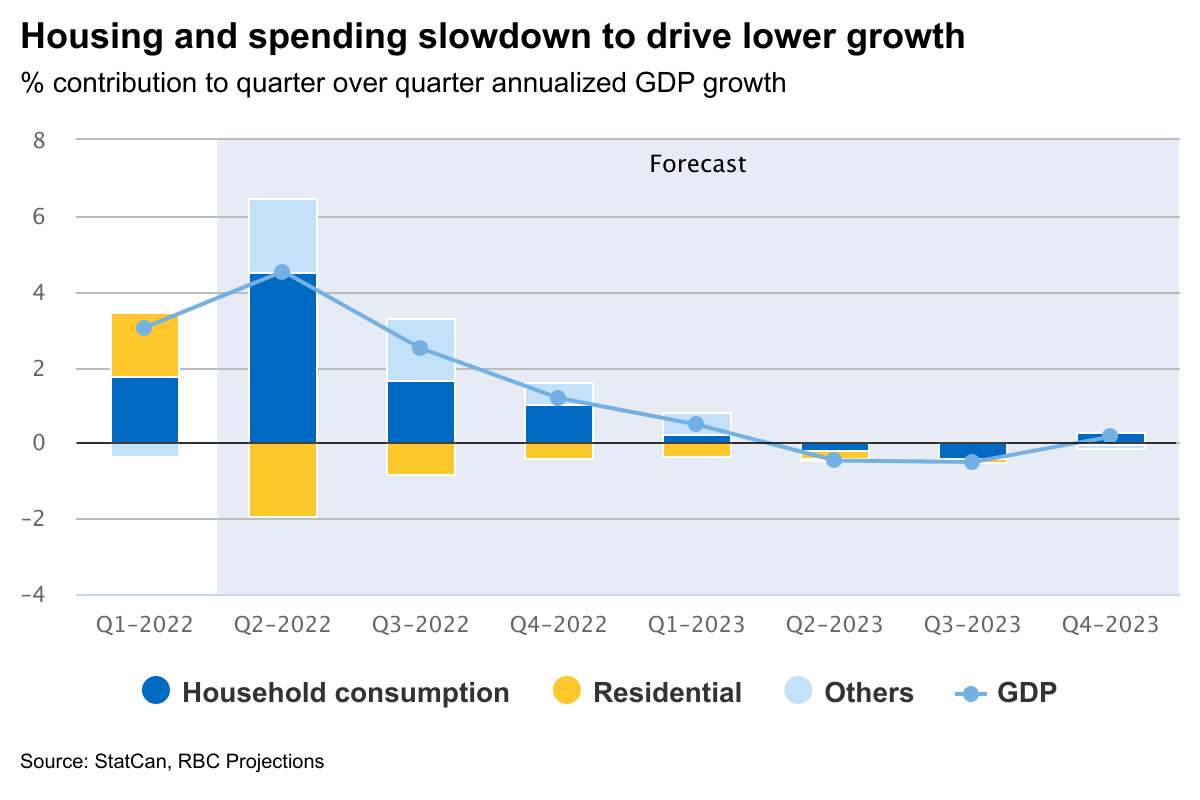
Canadian GDP likely rose in the second quarter—but the trend is unlikely to last. We expect annualized growth jumped to 4.5% from the 3.1% reported in Q1. Spending on services (particularly in the travel and hospitality sectors) surged higher following winter lockdowns. And an increase in equipment imports suggests businesses ramped up capital investment as acute labour shortages made boosting output a challenge. Strong domestic demand also sent imports surging in Q2, with net trade likely to be a sizable drag on quarterly growth despite a strong export gain.
Still, there are clear signs that growth is slowing. Residential investment plunged in the second quarter as aggressive Bank of Canada interest rate hikes pushed home resale markets sharply lower. Most of the increase in Q2 GDP came earlier in the quarter, with momentum losing steam over May and June. We expect June output edged up 0.1% (in line with Statistics Canada’s early estimate a month ago) after a flat reading in May and 0.3% rise in April. And early reports are pointing to another month of little output growth in July. Manufacturing activity remains strong despite a sharp decline in petroleum prices in July. And activity in the oil and gas sector continues to improve on higher prices, with drilling activity continuing to edge higher over the summer.
But housing markets have continued to soften, and the post-lockdown surge in travel and hospitality spending appears to have plateaued. The Bank of Canada and other global central banks (including the U.S. Fed) will continue to hike interest rates aggressively near-term to tame inflation. Against that backdrop, we continue to expect growth to slow substantially over the second half of this year, and for the economy to slip into a moderate recession in 2023.
Week ahead data watch:
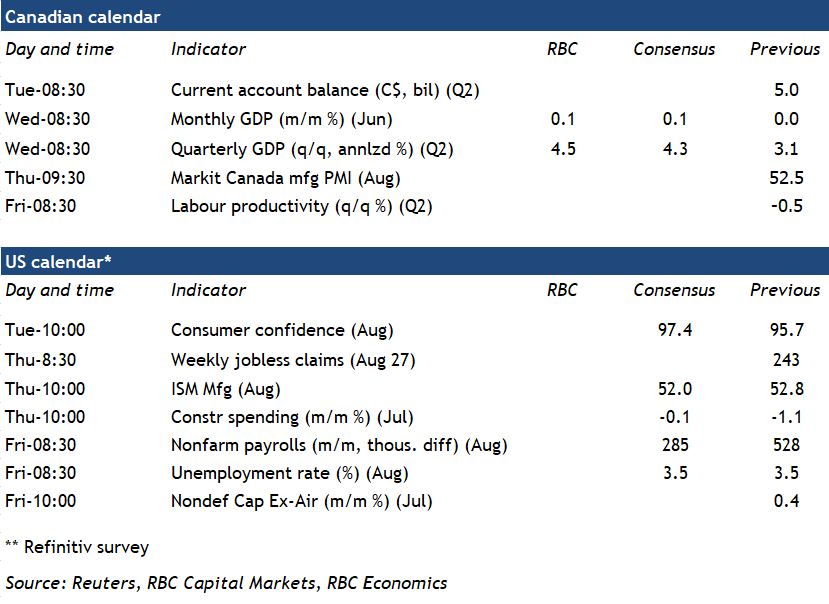
U.S. unemployment is expected to hold steady at 3.5% in July, its lowest level since before the pandemic. Labour markets remain extremely tight, but weekly jobless claims have been ticking higher.
Fed Chair Powell on the path for policy
At the Federal Reserve Bank of Kansas City's Jackson Hole Symposium, Federal Reserve Chair Jay Powell gave a much-anticipated speech titled, Monetary Policy and Price Stability.
Chair Powell spoke on the state of the economy, reiterating that "while the latest economic data have been mixed, in my view our economy continues to show strong underlying momentum. The labor market is particularly strong, but it is clearly out of balance, with demand for workers substantially exceeding the supply of available workers."
On inflation, he noted it "is running well above 2 percent, and high inflation has continued to spread through the economy. While the lower inflation readings for July are welcome, a single month's improvement falls far short of what the Committee will need to see before we are confident that inflation is moving down."
Regarding the path for policy, he stated "in current circumstances, with inflation running far above 2 percent and the labor market extremely tight, estimates of longer-run neutral are not a place to stop or pause." He also stated that, "our decision at the September meeting will depend on the totality of the incoming data and the evolving outlook. At some point, as the stance of monetary policy tightens further, it likely will become appropriate to slow the pace of increases."
Key Implications
Chair Powell's speech struck a hawkish tone as he reiterated the need to "forcefully" bring demand and supply into balance, which will require a sustained period of below-trend growth." This reaffirmed the Fed's intent to continue to raise its policy rate into restrictive territory at its upcoming meeting running from September 20th to 21st. Powell also emphasized the need to keep rates at elevated levels for an extended period of time in order to ensure that inflation decisively returns to target.
Over the last few weeks, financial markets have started to price more tightening from the Fed, with the policy rate expected to land between 3.5% and 3.75% by year-end. This has the U.S. 2-year Treasury yield reaching above 3.4%. But with the 10-year yield trailing behind at close to 3.0%, the deeply inverted yield curve implies that market participants are betting that the Fed won't be able to keep rates at elevated levels for too long. Though Powell's comments today were clearly aimed at setting expectations for a higher for longer policy path, markets are expecting that with high inflation and rising rates, the growth slowdown is likely to test the nerves of policymakers.