Sample Category Title
Dollar Dips as PCE Inflation Slowed, But Loss Limited So Far
Dollar dips in early US session following lower than expected PCE and core inflation data. But loss is so far limited as traders are holding their bets ahead of Fed Chair Jerome Powell's speech. Euro, Aussie and Swiss Franc are so far the stronger ones for the day, while Yen and Kiwi are the weaker ones. Trading in the stock markets is subdued with major European indexes, and US futures flat.
Technically, to confirm selloff in Dollar, some levels need to be violated decisively, at least. The levels include 1.0121 resistance in EUR/USD, 1.2002 resistance in GBP/USD, 0.9951 support in USD/CHF and 1.2826 support in USD/CAD. Otherwise, any dip in Dollar as reactions to Powell would be considered temporary first.
In Europe, at the time of writing, FTSE is up 0.18%. DAX is down -0.04%. CAC is down -0.09%. Germany 10-year yield is up 0.0382 at 1.357. Earlier in Asia, Nikkei rose 0.57%. Hong Kong HSI rose 1.01%. China Shanghai SSE dropped -0.31% Singapore Strait Times rose 0.05%. Japan 10-year JGB yield dropped -0.0094 to 0.221.
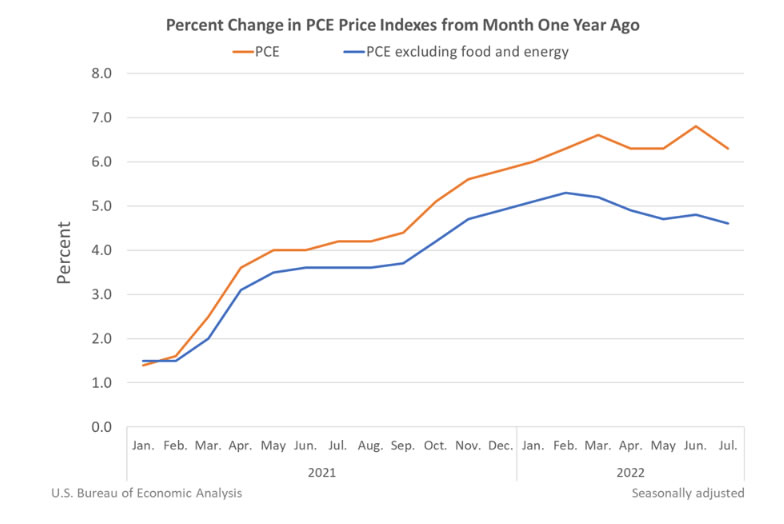
US PCE price index slowed to 6.3% yoy, PCE core slowed to 4.6% yoy
US personal income rose 0.2% mom, or USD 47.0B in July, below expectation of 0.6% mom. Spending rose 0.1% mom or USD 23.7B, also below expectation of 0.4% mom.
From the preceding month, PCE price index dropped -0.1% mom. prices for goods dropped -0.4% mom while prices for services rose 0.1% mom. Food prices rose 1.3% mom. Energy prices decreased -4.8% mom. PCE core, excluding food and energy, rose 0.1% mom.
Over the year, PCE price index rose 6.3% yoy, slowed from 6.8% yoy. Prices for goods rose 9.5% yoy while prices for services rose 4.6% yoy. Food prices rose 11.9% yoy. Energy prices rose 34.4% yoy. PCE core, excluding food and energy, rose 4.6% yoy, slowed from 4.8% yoy.
Also released, exports of goods dropped USD -0.4% to USD 181.0B in July. Import of goods dropped USD -9.9B to USD 270.0B. Trade deficit came in at USD -89.1B, smaller than June's USD -98.6B.
Germany Gfk consumer sentiment dropped to -36.5, another record low
Germany Gfk consumer sentiment for September dropped from -30.9 to -36.5, Worse than expectation of -31.5. In August, economic expectations improved from -18.2 to -17.6. Income expectations ticked up from -45.7 to -45.3. Propensity to buy dropped from -14.5 to -15.7. Propensity to save rose 17.6 pts to 3.5.
"The sharp increase in the propensity to save this month means that the consumer sentiment is continuing its steep descent. It has once again hit a new record low," explains Rolf Bürkl, GfK consumer expert.
"The fear of significantly higher energy costs in the coming months is forcing many households to take precautions and put money aside for future energy bills. This is further dampening the consumer sentiment, as in return there are fewer financial resources available for consumption elsewhere."
RBNZ Orr: There'll be least another couple of rate hikes
RBNZ Governor Adrian Orr told Bloomberg TV earlier today, "We know we have to slow the economy. We knew we had to be 3% plus (on interest rates) to begin that slowing journey and now we're in a much more comfortable position."
"We think there'll be least another couple of rate hikes, but then we hope to be in a position where we can be data driven," he added.
As about the risks of recession, Orr said, "Our core view is no, that we won't see technical recession. There's quite a reasonable bounce back in economic activity."
"Our outlook is for almost flat real consumption so for us to see retail sales come off like that, it's not a surprise," Orr said. "It's a good signal that that monetary policy is biting and we're doing our work."
"Consumers will be taking a significant part of the brunt of the slowdown because, we're an open trading economy. Our monetary policy mostly bites on domestic spending." But, while "slower growth is a necessary position. It doesn't have to be negative growth."
EUR/USD Mid-Day Outlook
Daily Pivots: (S1) 0.9939; (P) 0.9986; (R1) 1.0024; More...
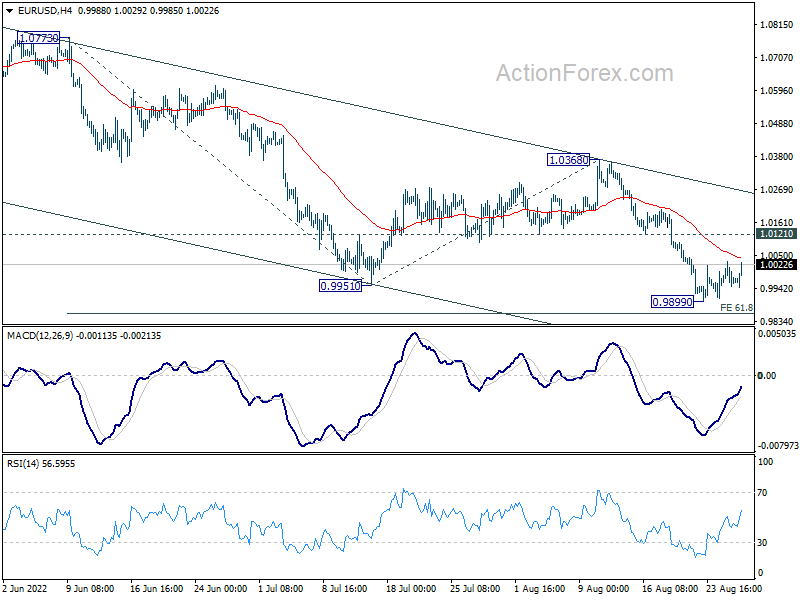
EUR/USD recovers mildly today but outlook is unchanged. Intraday bias remains neutral first. Consolidation from 0.9899 could extend, but upside of recovery should be limited by 1.0121 minor resistance to bring another fall. Break of 0.9899 will resume larger down trend to 61.8% projection of 1.0773 to 0.9951 from 1.0368 at 0.9860. Firm break there should prompt downside acceleration to 100% projection at 0.9546. However, firm break of 1.0121 will dampen this view and turn focus to 1.0368 resistance instead.
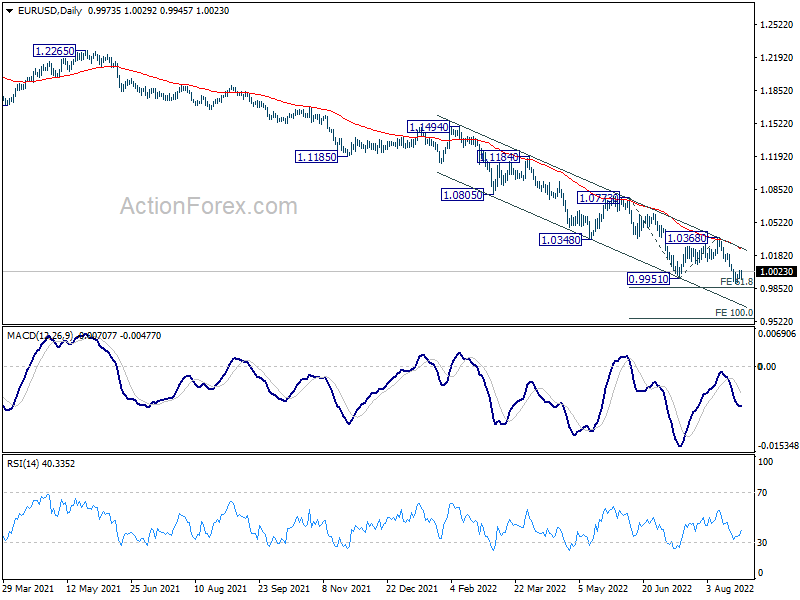
In the bigger picture, down trend from 1.6039 (2008 high) is still in progress. Next target is 100% projection of 1.3993 to 1.0339 from 1.2348 at 0.8694. In any case, outlook will stay bearish as long as 1.0368 resistance holds, in case of strong rebound.
Economic Indicators Update
| GMT | Ccy | Events | Actual | Forecast | Previous | Revised |
|---|---|---|---|---|---|---|
| 23:30 | JPY | Tokyo CPI Core Y/Y Aug | 2.60% | 2.50% | 2.30% | |
| 06:00 | EUR | Germany Gfk Consumer Confidence Sep | -36.5 | -31.5 | -30.6 | -30.9 |
| 08:00 | EUR | Eurozone M3 Money Supply Y/Y Jul | 5.50% | 5.60% | 5.70% | |
| 12:30 | USD | Personal Income M/M Jul | 0.20% | 0.60% | 0.60% | 0.70% |
| 12:30 | USD | Personal Spending M/M Jul | 0.10% | 0.40% | 1.10% | 1.00% |
| 12:30 | USD | PCE Price Index M/M Jul | -0.10% | 1.00% | ||
| 12:30 | USD | PCE Price Index Y/Y Jul | 6.30% | 6.80% | ||
| 12:30 | USD | Core PCE Price Index M/M Jul | 0.10% | 0.30% | 0.60% | |
| 12:30 | USD | Core PCE Price Index Y/Y Jul | 4.60% | 4.70% | 4.80% | |
| 12:30 | USD | Goods Trade Balance (USD) Jul P | -89.1B | -99.0B | -98.6B | |
| 12:30 | USD | Wholesale Inventories Jul P | 0.80% | 1.50% | 1.80% | |
| 14:00 | USD | Michigan Consumer Sentiment Index Aug F | 55.2 | 55.1 |
US PCE price index slowed to 6.3% yoy, PCE core slowed to 4.6% yoy
US personal income rose 0.2% mom, or USD 47.0B in July, below expectation of 0.6% mom. Spending rose 0.1% mom or USD 23.7B, also below expectation of 0.4% mom.
From the preceding month, PCE price index dropped -0.1% mom. prices for goods dropped -0.4% mom while prices for services rose 0.1% mom. Food prices rose 1.3% mom. Energy prices decreased -4.8% mom. PCE core, excluding food and energy, rose 0.1% mom.
Over the year, PCE price index rose 6.3% yoy, slowed from 6.8% yoy. Prices for goods rose 9.5% yoy while prices for services rose 4.6% yoy. Food prices rose 11.9% yoy. Energy prices rose 34.4% yoy. PCE core, excluding food and energy, rose 4.6% yoy, slowed from 4.8% yoy.
GBPUSD Corrects Higher, But Stays in a Downtrend
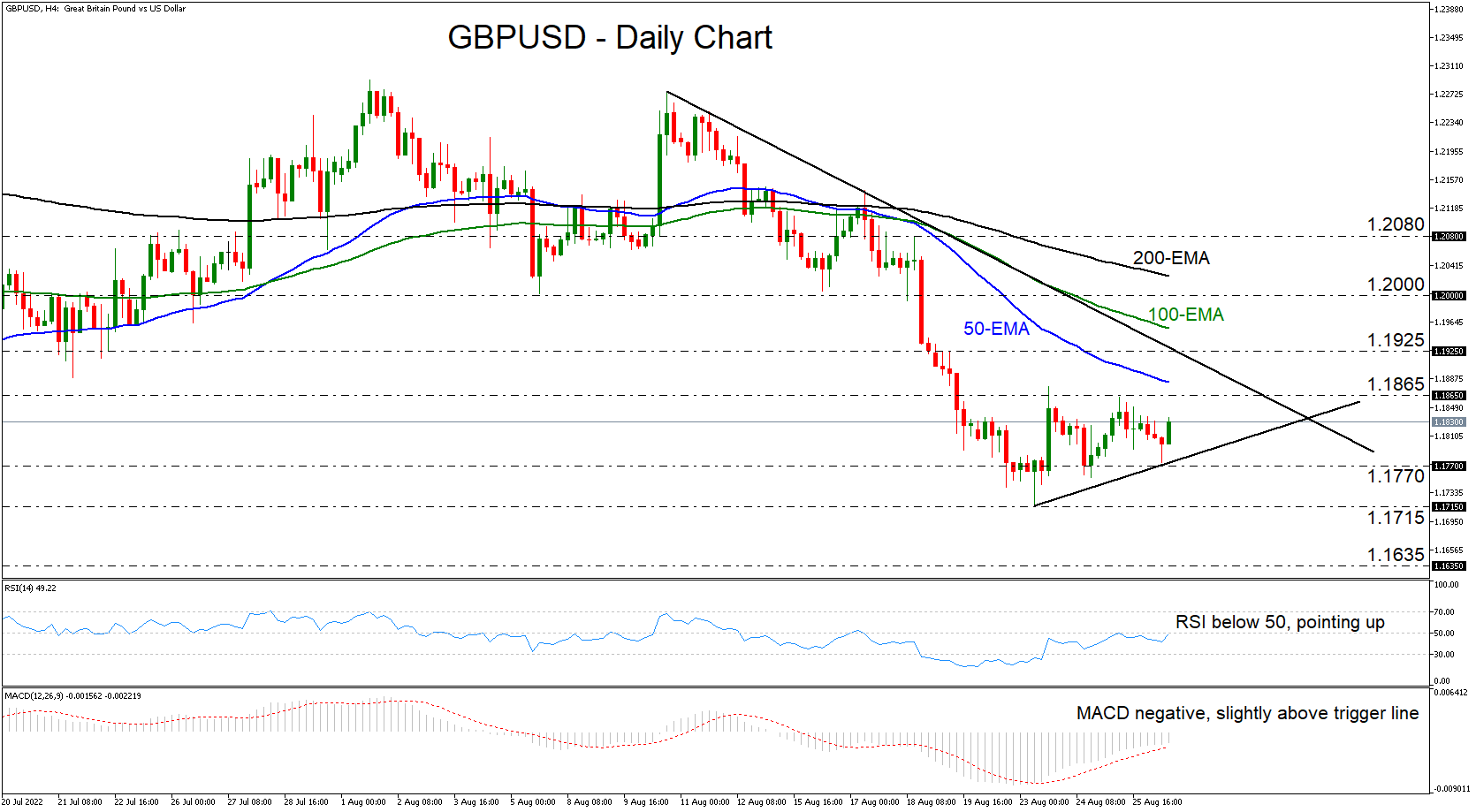
GBPUSD traded higher on Friday, after hitting support at 1.1770. The pair has been printing higher lows since August 23, but it is still trading below the downtrend line drawn from the high of August 10, as well as below all the moving averages. This implies that the pair is in a corrective phase within a bigger downtrend.
The oscillators suggest some further recovery before the bears take the reins again. The RSI is fractionally below 50, but it is pointing up and appears ready to move above that equilibrium level, while the MACD, although negative, lies above its trigger line, pointing up as well.
The move signaling a downtrend continuation may be a dip below 1.1770. This will confirm a forthcoming lower low on the 4-hour chart, and may initially target the low of August 23, at 1.1715. If there are no buyers to be found near that zone either, then a break lower could set the stage for declines towards the 1.1635 territory, defined as a support by the low of March 25, 2020.
On the upside, a break above the aforementioned downtrend line and the 1.1925 zone may wake up more bulls, who could shoot for the psychological round figure of 1.2000. That zone acted as a key support area between August 5 and 18. If they do not abandon the push after hitting that zone, then they could decide to extend the advance towards the peak of August 18, at around 1.2080.
In brief, GBPUSD has been forming higher lows recently, but it remains below a downtrend line. This implies that the pair is in a corrective phase within a broader downtrend. That trend may be reignited upon a dip below the 1.1770 support.
Euro Edges Up to Parity ahead of Powell
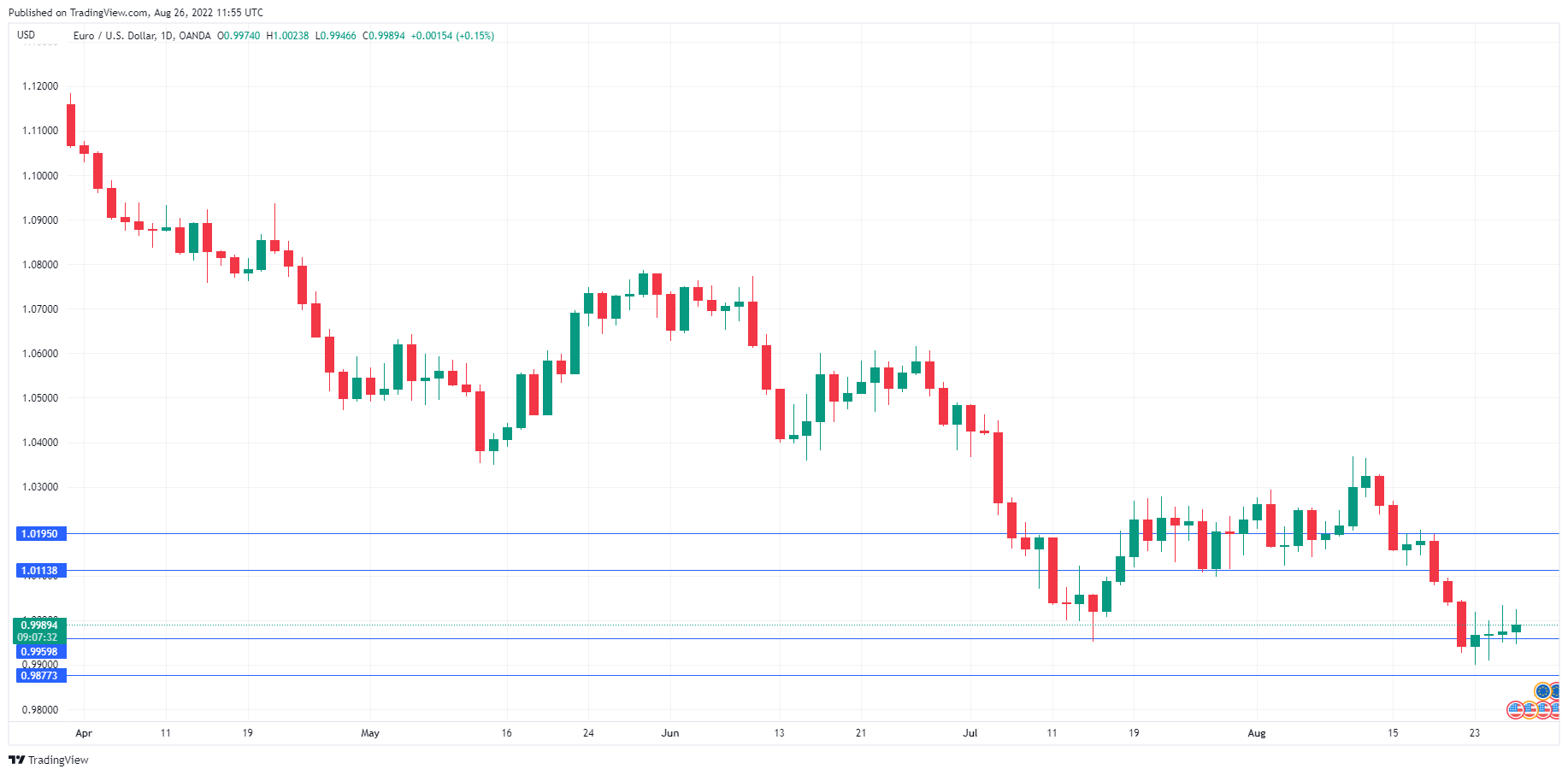
EUR/USD has edged higher today and is trading at the parity line. It could be a volatile North American session, with Fed Chair Powell addressing the Jackson Hole central bank conference.
German consumer confidence slides
Germany posted another soft release today in what has been a miserable week. GfK Consumer Confidence for September slipped to -36.5, down from -30.9 and worse than the estimate of -31.8. The index has reeled off 10 straight declines, with the readings falling ever-deeper in negative territory. The sharp rise in energy prices have raised the risk of a recession in the eurozone’s largest economy, and this has sapped the confidence of the German consumer.
This week’s German releases paint a grim picture of the economy. Services and manufacturing PMIs both remained in contraction territory (below 50.0) for a second straight month. The labour market, which had been a bright spot in the economy, saw the pace of job creation fall to a 1.5-year low. GDP in Q2 rose a negligible 0.1% and German Ifo Business Confidence fell to 88.5, the index’s lowest level since mid-2020.
As the war in Ukraine drags on with no end in sight, the energy crisis could get significantly worse in the winter, as Western Europe is vulnerable to a cutoff of Russian oil and natural gas. German maufacturers are grappling with higher costs, a possible energy crunch and supply chain disruptions. Things could get very bad this winter, and this will put pressure on EUR/USD, as investors ponder whether to dump their euros and look for greener pastures to park their assets.
Powell under the microscope
Fed Chair Powell’s speech at the Jackson Hole Symposium is the event of the week. If Powell repeats the well-worn message that the Fed plans to continue tightening aggressively until inflation is curbed, the dollar could gain ground. However, if the Fed Chair’s message is less hawkish than expected, we could see sharp gains in the equity markets at the expense of the dollar, as was the case following the surprise drop in US inflation earlier this month.
Overshadowed by Jackson Hole, the US releases some key data today ahead of Powell’s speech. We’ll get a look at US Personal Income, Personal Spending and the Fed’s preferred inflation gauge, The Core PCE Price Index. If these numbers are stronger than expected, it will drive home the point that the economy is resilient and able to absorb further rate hikes in the coming months, and the the US dollar could respond with gains in the North American session.
EUR/USD Technical
- EUR/USD continues to test support at 0.9959. Below, there is support at 0.9877
- There is resistance at 1.0113 and 1.0195
Dollar Pushes Yen to 137, Powell Speech Eyed
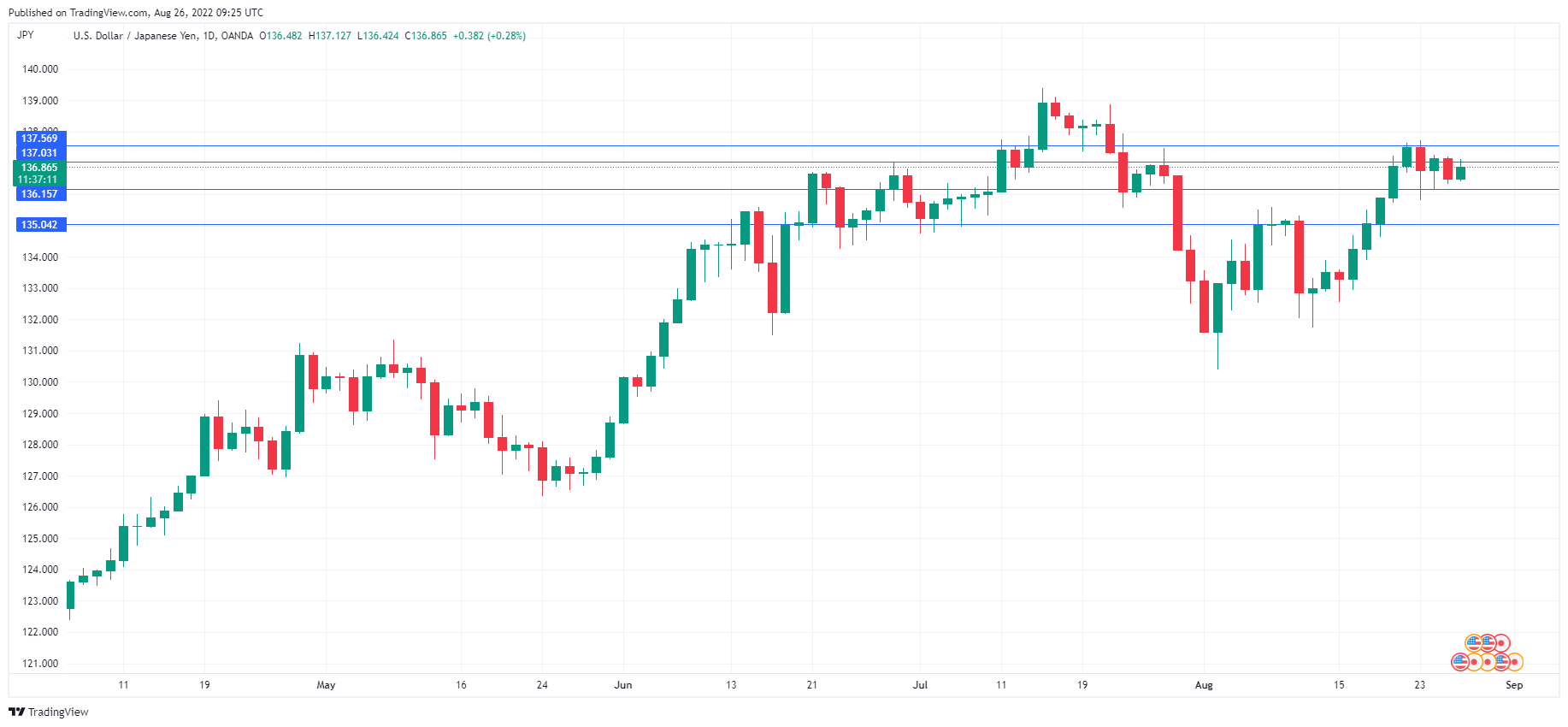
The Japanese yen is in negative territory today. USD/JPY is trading at 136.90 in the European session, up 0.34%.
It has been a relatively quiet week for the yen, which is trading exactly where it started the week, around the 137 line. The month of August has not been kind to the yen, with USD/JPY soaring 2.75%. The US dollar is again in favor as the markets have tapered down their excitement that the Fed plans a dovish pivot. Does the Fed plan to let up or remain aggressive in its fight against inflation? We will certainly be smarter after Jerome Powell’s speech at Jackson Hole later today. A hawkish message from Powell should boost the US dollar unless investors zero in on any dovish remarks or projections, which could reignite speculation that the Fed will ease up on rate hikes.
Japanese inflation rises
The Tokyo Core CPI index rose 2.6% in August, above the forecast of 2.5% and higher than the 2.3% gain in July. This marked the highest gain since October 2014. Policy makers in other major economies can only dream about inflation below 3%, but for Japan, rising inflation is a new phenomenon after decades of deflation. Inflation has exceeded the Bank of Japan’s target of 2% for four successive months and inflation is finally on the Bank’s agenda. Still, it is very unlikely that the BoJ will do anything more than tweak monetary policy, as its number one goal is to stimulate Japan’s fragile economy.
The rise in inflation and the BoJ’s rigorous control of its yield curve has caused a steep deprecation of the yen, and an exchange rate of 140 may not be far off. There has been speculation in recent months that the Ministry of Finance could intervene to support the yen, but this has not happened until now and there is no indication that the 140 level is a magical ‘line in the sand’ that would trigger intervention. For now, the main driver of USD/JPY remains the US/Japan rate differential, leaving the yen at the mercy of the movement of US Treasury yields.
USD/JPY Technical
- USD/JPY is testing resistance at 137.03. Above, there is resistance at 137.03
- 1.3615 and 1.3504 are providing support
Bitcoin Weakness: A Warning for Stocks or Its Own Problem?
Market picture
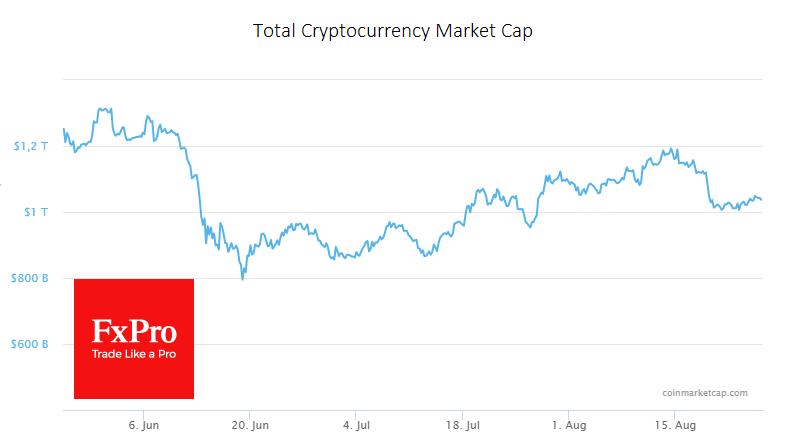
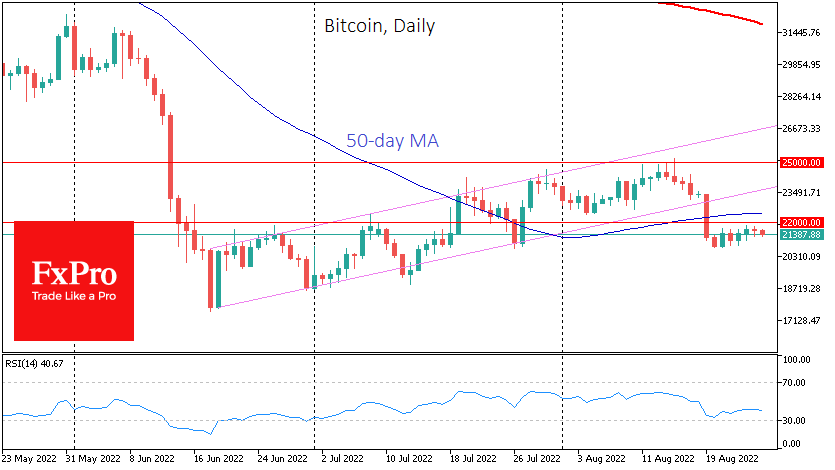
Things are slow now in crypto, with a slight downward bias for the second day. Bitcoin is losing 1.5% to $21.4K in the last 24 hours. Ethereum is unchanged for the same time, remaining at $1680. Top altcoins show mixed dynamics, ranging from a 4.1% decline (Solana) to a 2.6% increase (Cardano).
Total cryptocurrency market capitalisation, according to CoinMarketCap, was down slightly, by 0.1% overnight, to $1.04 trillion. The Cryptocurrency Fear & Greed Index rose 2 points to 27 by Friday and moved into “fear” status from “extreme fear”.
Bitcoin lags behind the equity market and altcoins on Thursday and early trading on Friday. And now, it is crucial to understand whether this is a formidable warning of domestic weakness in the latest demand for risky assets. Alternatively, the poor performance of the first cryptocurrency might be its own problem. But it would break the trend of recent months, where Bitcoin has often acted as a leading indicator for the global equity market.
News background
Coinbase CEO Brian Armstrong said that eventually, cryptocurrencies would be integrated everywhere, as the internet has previously been, and the catalyst for their universal adoption will come from large tech companies.
Ethereum co-founder Vitalik Buterin believes that people underestimate how much cryptocurrency payments are superior to other traditional payment instruments.
One of the world’s leading technology companies, South Korea’s Samsung, is serious about entering the crypto market by launching its cryptocurrency platform in the first half of 2023.
Olli Rehn, governor of the Bank of Finland, said the digital euro and private financial technology could make cross-border payments easier in Europe.
EUR/USD Pair is Consolidating Losses Near the Parity Level
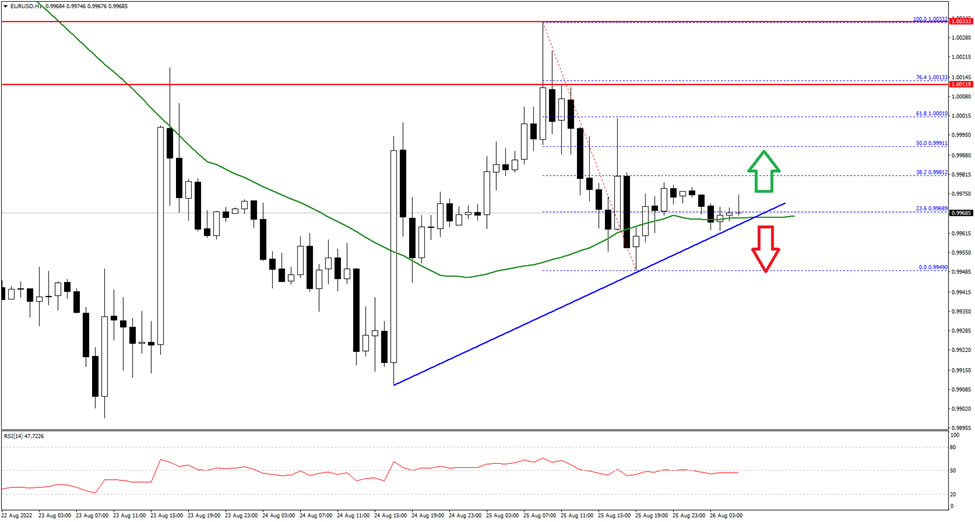
The Euro settled below the key parity level against the US Dollar. The EUR/USD pair is consolidating losses and flirting with the parity level.
The pair is currently trading near the 0.9970 level and the 50 hourly simple moving average. An immediate resistance on the upside is near 0.9990 on FXOpen. The first major resistance is near the 1.0000 level.
The next major resistance is near the 1.0030 level. A break above the 1.0030 resistance level could start a decent upward move. In the stated case, it could even surpass 1.0050.
If not, the pair might drop below 0.9960. There is also a connecting bullish trend line at 0.9960 on the hourly chart. The next key support is near 0.9950, below the pair could decline towards the 0.9920 level in the near term. Any more losses might send the pair towards the 0.9880 level.
Forex Implications of US-Europe Wage Divide
As we all know, both the US and Europe (to include the UK along with the EU) are experiencing high inflation. However, how this impacts employees is very different. Employees constitute the bulk of consumers, and therefore drive the economy. The employment culture between these major economies has important implications of how the economy could react to inflation. That, combined with different monetary policy, could be a driving force of currency fluctuations.
Last month, EU CPI rose above the US'. The UK's CPI pushed above the US' the month prior. With the Fed acting more aggressively to combat inflation than European central banks, this gap could widen. That could increase the difference in how labor practice and laws affect the economy and currencies.
The main differences
Generally, the US has "at will" employment, which is often understood that employees can be fired for any reason. But it also means that employees can be hired for any salary, and salary changes are much more flexible. In Europe, employees typically are hired for fixed contracts, often in the framework of collective negotiation. In the US it's rare to have inflation adjustment included in the contract, whereas in Europe (particularly in the periphery) it is almost standard practice.
When the cost of living starts rising at an unprecedented rate, the reaction of the labor market is quite different. In the US, employees are more prone to change jobs, looking for better salaries. This has led the BLS to report the highest "churn" rate on record, with as many as 4.6M people changing jobs in a month. Despite this, however, average wages have been declining when adjusted for inflation. Employees who can change jobs are keeping up with inflation, those who cannot are seeing their income erode.
Slow and deliberate vs fast and erratic
With employees locked into collective contracts, discontent over lower wages translates instead towards industrial action. In recent months, there has been a spate of warnings or outright strikes. Most recently Lufthansa's pilots were unable to reach an agreement, and might go on strike at any time. SAS had to reschedule over 300K passengers because of strikes. One of the key sticking points of these discussions is the inclusion of automatic cost of living adjustments to wages.
One of the phenomena most feared by central bankers is a price-wage spiral. That's when higher prices drive workers to demand higher pay, which increases costs to produce goods, causing higher prices, and workers demanding higher pay. An automatic inflation adjustment in labor contracts makes this price-wage spiral easier to develop, and increases the potential for runaway inflation.
What does it mean for the future?
The theoretical way to head off a wage-price spiral is to aggressively front load interest rates, to prevent inflation rising. However, European central banks have, relatively speaking, not done that. The Fed has acted a lot more aggressively. On the one hand, because of fixed contracts and collective bargaining, wages were likely to rise slower in Europe. On the other, those rises are likely to come along with strikes and be much broader than in the US, which increases inflationary pressure in the long term.
Basically, inflation might be further entrenched in Europe than in the US, implying that in the long run, the dollar could outperform the pound and Euro.
GBP/JPY Daily Outlook
Daily Pivots: (S1) 161.23; (P) 161.62; (R1) 161.91; More...
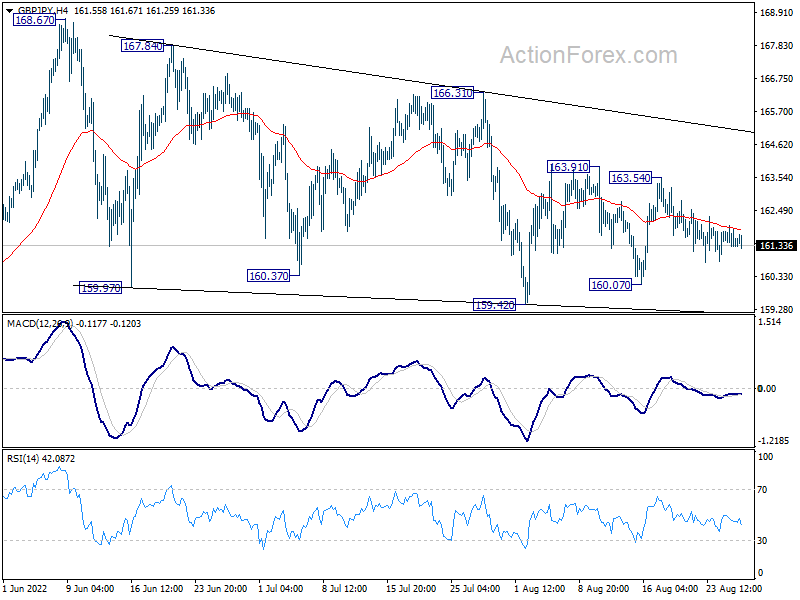
Intraday bias in GBP/JPY remains neutral as sideway trading continues. Corrective pattern from 168.67 would extend for a while. On the upside, break of 163.91 will bring stronger rise to 166.31 resistance. On the downside, below 160.07 will turn bias to the downside for 159.42 and below.
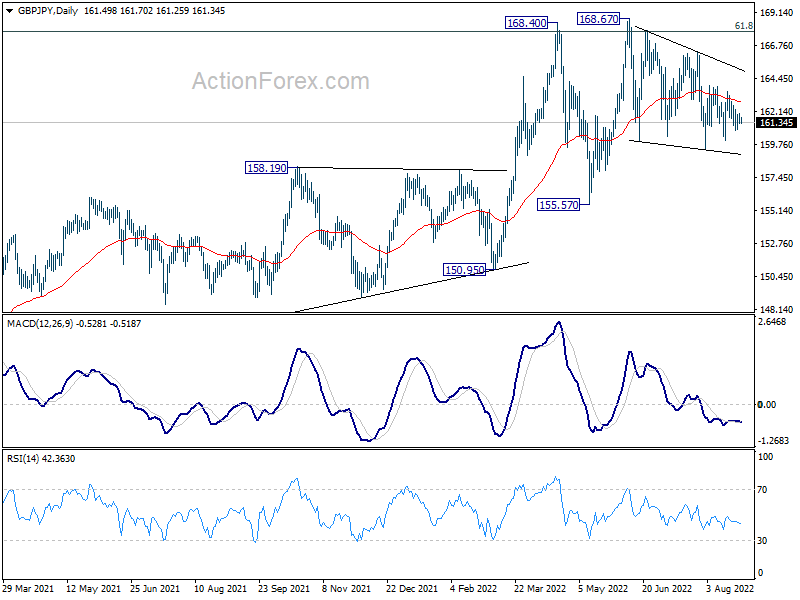
In the bigger picture, up trend from 123.94 (2020 low) is still in progress. Sustained break of 61.8% retracement of 195.86 (2015 high) to 122.75 (2016 low) at 167.93 will be a long term bullish signal, and could pave the way back to 195.86 high. This will remain the favored case as long as 155.57 support holds, even in case of deep pull back.
EUR/JPY Daily Outlook
Daily Pivots: (S1) 135.76; (P) 136.38; (R1) 136.73; More....
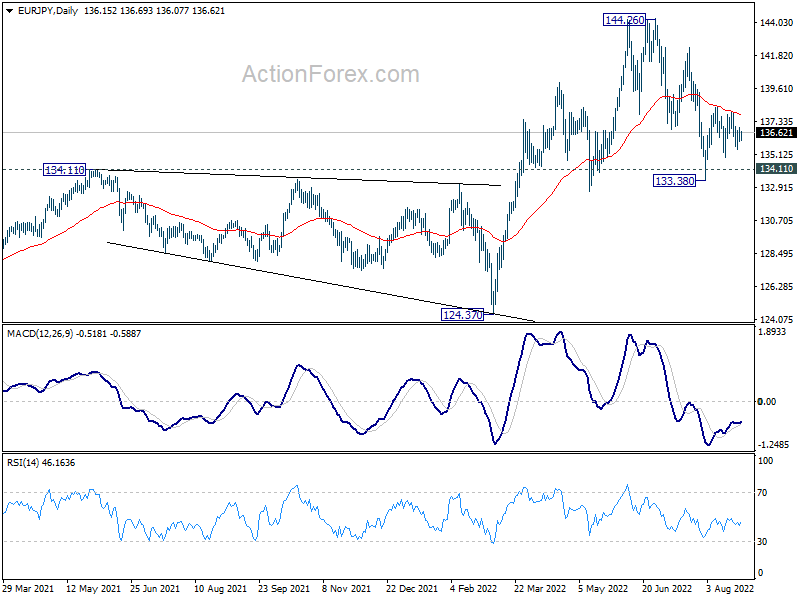
Intraday bias in EUR/JPY stays neutral as range trading continues. On the upside, break of 138.38 resistance will resume the rebound from 133.38 towards 142.31 resistance. On the downside, break of 134.93 will turn bias back to the downside for 133.38 support. Overall, corrective pattern from 144.26 could extend further with more choppy trading.
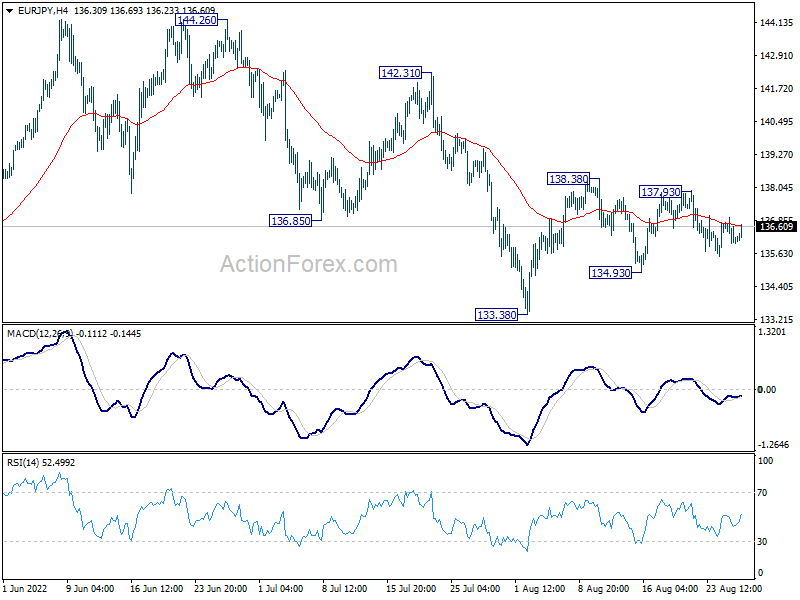
In the bigger picture, up trend from 114.42 (2020 low) is seen as the third leg of the pattern from 109.30 (2016 low). Further rally is in favor as long as 134.11 resistance turned support holds, even in case of deep pull back. Next target is 149.76 (2015 high). However, sustained break of 134.11 will be a sign of medium term bearish reversal and turn focus to 124.37 support for confirmation.