Sample Category Title
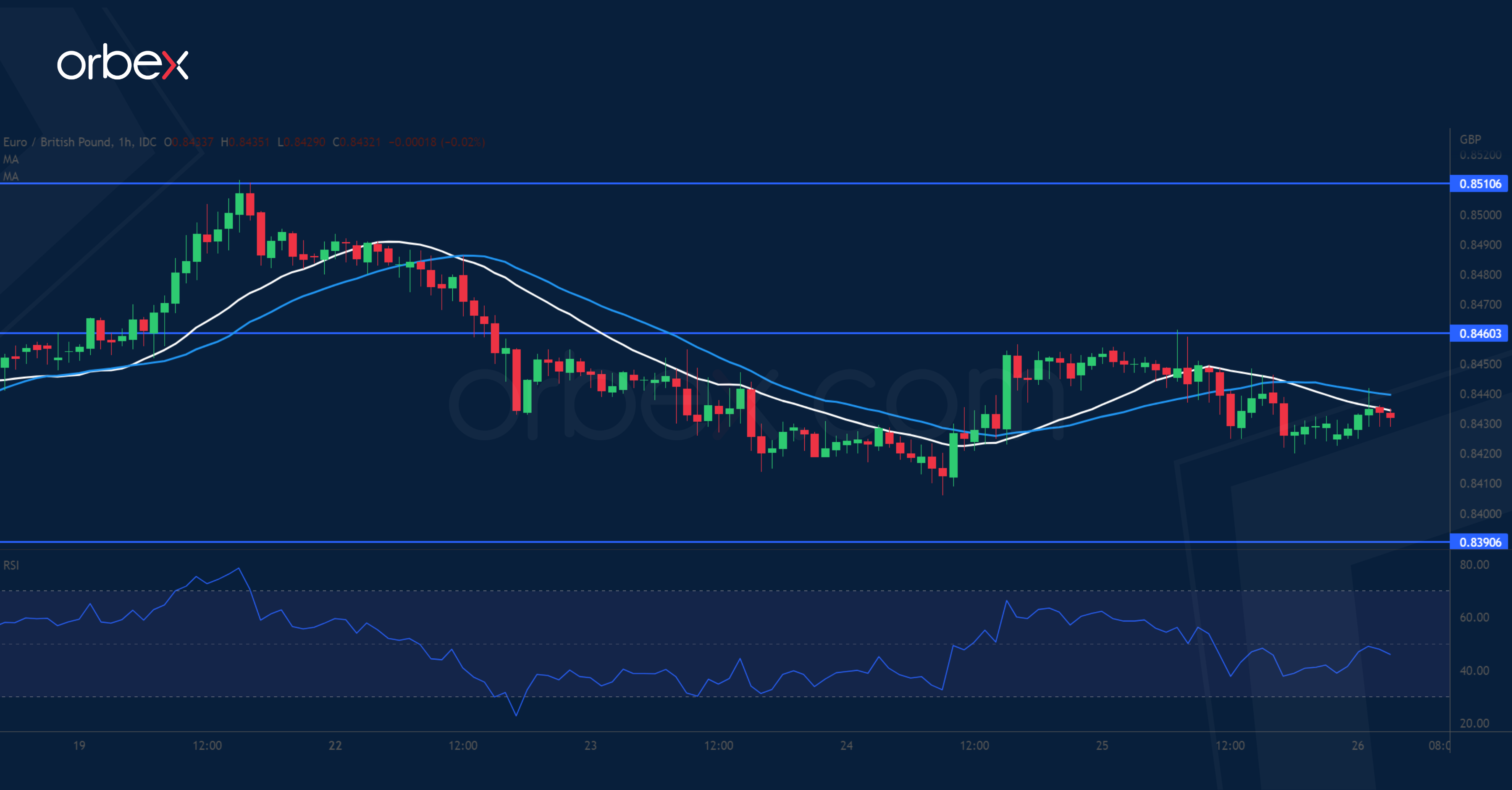
EUR/GBP Consolidates
The pound steadies over a higher chance of a 75bp rate rise by the BOE next month. The pair came under pressure in the supply area around 0.8510 and a follow-up break below 0.8430 put the bulls on the defensive. The euro is hovering above the daily support at 0.8390 which is a key level to keep last week’s rebound intact. 0.8460 is the first hurdle ahead and a close above 0.8510 may trigger an extended rally towards 0.8600. Failing that, the pair could be vulnerable to a sell-off to this month’s low at 0.8340.
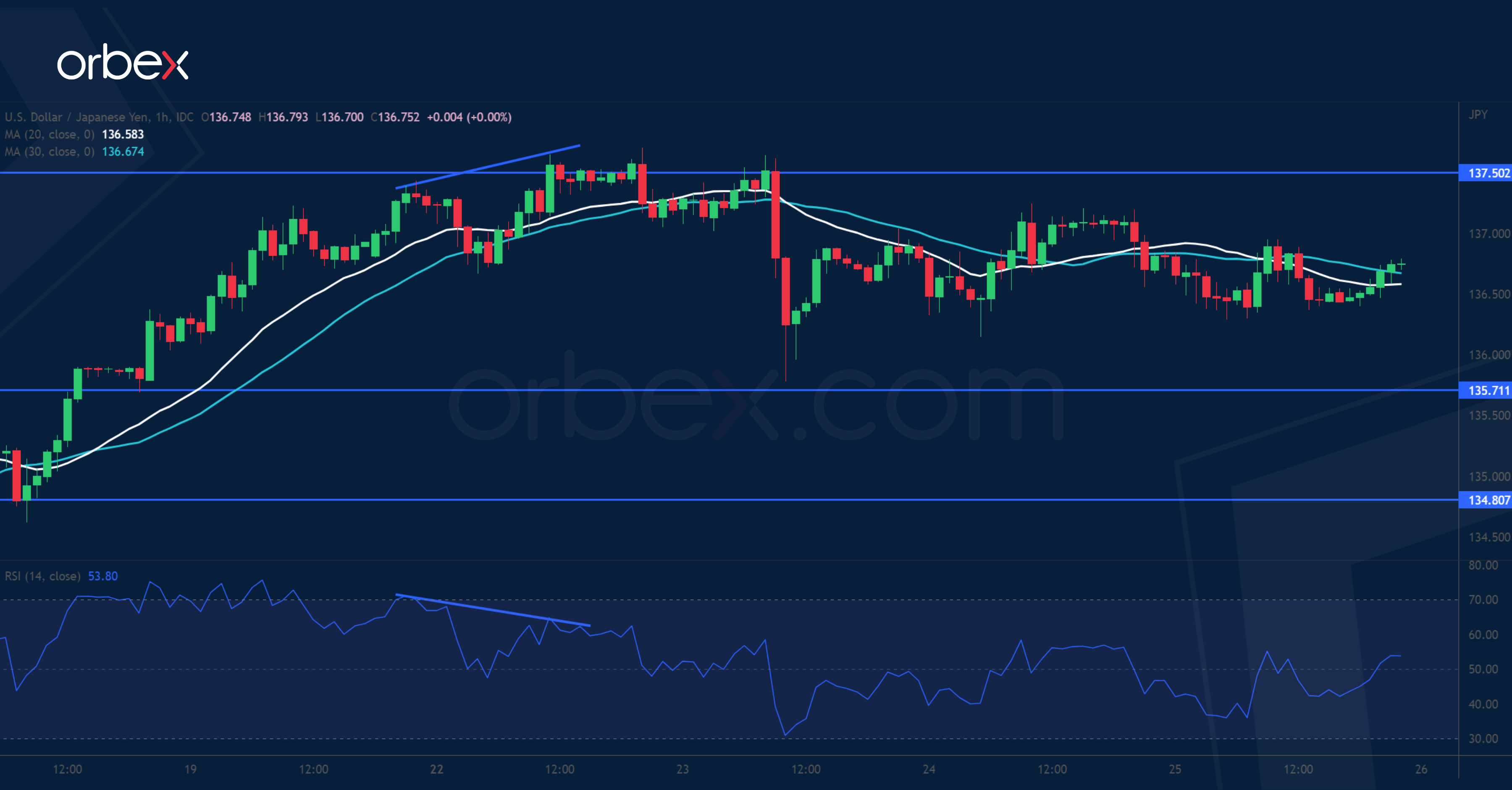
USD/JPY Seeks Support
The Japanese yen finds support as August’s CPI hits an eight-year high. The trajectory remains up from the daily chart’s perspective and the latest pullback could be an opportunity to accumulate. A rally back above 137.40 at the start of the liquidation in late July is an encouraging sign that buyers are still in the game. However, the price action may stay choppy after a bearish RSI divergence and a fall below 136.70 triggered some profit-taking. 135.70 is the closest support and a bounce above 137.50 may send the dollar to 139.40.
Cliff Notes: The Long Wait for Chair Powell at Jackson Hole
Key insights from the week that was.
It has been a very light week for data globally, and so the focus has remained on policy actions in China and expectations of a hawkish tone from Chair Powell at the Jackson Hole Symposium this weekend.
On the whole, the US data received this week was mixed. The second estimate of GDP for Q2 surprised to the upside, printing at -0.6% annualised (previously -0.9%) thanks to a modest, but broad based, upward revision to household demand, including residential construction. Still, annualised growth over the first half of 2022 is -1.1%; also, the Atlanta Fed nowcast for Q3 GDP has fallen from an initial estimate near 2.5% annualised to 1.4% currently.
On the partial data released this week: July durable goods orders pointed to little-to-no growth in equipment investment as Q3 began; pending and new home sales fell to their lowest levels since 2020 and 2016 respectively in July; and the S&P Global composite PMI fell to a contractionary read of 45 in August as activity in the services sector jolted lower – note though that the market continues to focus on the signal from the ISM PMI surveys which, for July at least, was materially stronger. All of the above suggests Chair Powell and the FOMC should be increasingly mindful of the risks to activity and the labour market as they pursue their fight against inflation.
European data meanwhile continues to show resilience amid immense uncertainty. German GDP growth for Q2 was revised up at the margin this week from 0.0% to 0.1% (not annualised). German and French business confidence also beat, admittedly very weak, expectations in August.
While a decline in activity in the second half of 2022 seems almost certain given the wave upon wave of energy price inflation and historically-weak consumer confidence, not to mention the risk of power outages, it should be remembered that the Euro Area economy began this period with strength, having grown circa 2.25% annualised in the six months to June and with the labour market historically tight. Moreover, there seems a greater likelihood of Euro Area authorities providing cost of living assistance to households than in the US; paired with robust nominal wage gains, this government support could preserve much of Euro Area households’ purchasing power over the coming year.
Another area of the global economy we perceive there to be too much pessimism over is China. Last week, we revised down our growth view for 2022 to 3.0% as a result of the Hainan COVID-19 outbreak and the current weak state of the housing sector. However, we kept to our view of strength come 2023, forecasting a year-average gain of 7.0%.
Developments this week have been supportive of the latter view, with authorities announcing another wave of stimulus targeting nation-building infrastructure investment from late-2022 while also giving local government authorities greater flexibility to support their regional economies, including residential construction. With total social financing already up 15% year-to-date to July and total fixed asset investment having risen almost 6%, the pipeline of work is clearly building quickly. As we outlined this week, there is good reason to believe that residential construction will follow once the liquidity and confidence concerns of the sector are worked through – this is in train.
Coming back to Australia to conclude. While there was no data of significance, this week saw RBA Head of Domestic Markets Jonathan Kearns deliver a speech on “Climate Change Risk in the Financial System”. Highlighted in the speech is the reality that, while we know how climate change will impact the environment and society overall, there is “uncertainty about specific aspects”. This leads to assessments of the implications for the financial system being focused on quantifying risks, specifically physical risk from weather events and a potential loss of productive capacity as well as transition risk which represents “changes to policies, technology and people's preferences that are brought about by climate change”.
For every country, the cumulative impact and timeline will differ, so too for key agents in our financial system, namely insurers, investors and banks. Head of Domestic Markets Kearns goes on to outline the work of regulators to begin assessing the consequences of a delayed or partial transition of the economy and to develop required disclosures and taxonomies to give the financial industry and investors a clear understanding and language for assessing climate-related risks and their management.
All Eyes on Fed at Jackson Hole
Market movers today
The market will be eagerly awaiting Fed chair Jerome Powell's speech at 16.00 CET, where he is expected to lay out the path for monetary policy amid still significant inflation pressures but an US economy that is witnessing a significant growth slowdown.
The personal consumption expenditure report is also due in the US, which will reveal the Fed's favoured inflation measure, the core PCE core deflator. The consensus is for an easing in both the core and headline inflation.
The 60 second overview
Markets have seen renewed focus on stagflation: Over the last 1-2 weeks, markets have seen an increased focus on the risk of very weak growth coupled with high inflation. In fixed income, interest rates have gone up again (e.g. the US 10yr yield is back at 3%). In equities, we have seen a shift towards the energy sector and defensiveness as found in high-dividend paying companies and equally, in FX; we have seen a substantial strengthening of the dollar as US benefits relatively over Europe through the terms-of-trade. While the natural gas surge in the past two weeks has reignited inflation fears in markets, the weakening growth outlook is also visible on the back of this shock. This week, it seems like markets are waiting for the next step as regards policy intervention and focus is thus with the Fed meeting at Jackson Hole.
This morning we published our new recession monitor where we track how close a recession is, in notably the US and euro area economies, using various indicators for production, income, labour markets and financial markets, which are typically good leading recession indicators. Our recession model indicators for the US and Eurozone show that a recession is certainly nearing, especially in the euro area, but the labour markets and investment cycles are still holding up relatively well on both sides of the Atlantic giving some cushion for the time being, see Recession monitor - Closing in, 26 August.
Equities: What started as wait-and-see mode ended in outright rally in the final hours of trading. We see positioning as the major reason behind these moves on top of dovish Fed speech, lower oil price and Chinese stimulus. Cyclicals the name of the game with tech and banks among the better groups. S&P500 1.4%, Nasdaq 1.7%, Dow 1% and Russell 2000 1.5%.
FI: Yesterday markets reverted some of the recent sell-off, amid Bunds rallied 4bp to 1.31%. While the natural gas surge in the past two weeks has reignited inflation fears in markets, the weakening growth outlook is also visible on the back of this exogenous shock. This constantly changing narrative of market drivers is keeping volatility elevated. Front end flattened notably yesterday, yet there are 190bp priced until the peak in ECB hikes, we find it difficult for ECB to validate market pricing.
FX: With real rates dropping and risk rallying heading into Jackson Hole the notoriously risk-sensitive ZAR, AUD and NZD had a strong Thursday session. EUR/USD trades just below parity while both EUR/NOK and EUR/SEK have edged a few figures lower. EUR/GBP continues to hover just north of 0.84 while EUR/CHF so far has failed to sustainably break through 0.96.
Credit: Credit markets saw another day of slight tightening with main being 2.3bp tighter to 107.2bp. iTraxx Xover tightened 12.3bp to 530.5bp. We also saw decent activity in the secondary cash market. The primary Nordic market remains open with several prints including a subordinated high yield bond from NKT A/S issued at a coupon of 7.24%.
Nordic macro
In Sweden, we get PPI and the labour force survey for July from Statistics Sweden at 8.00 CET. The seasonally adjusted unemployment rate is expected to remain around 7.7%. There are so far no signs of a weaker labour market with companies reporting of high labour shortages and households, despite being historically pessimistic in general, are not too concerned about losing their job according to the NIER survey.
A One Man Show
Time will stop today, when Jerome Powell speaks at the opening of the Jackson Hole meeting. There are many expectations regarding what Powell could say and how the market could react. Some, like analysts at Goldman Sachs think that Powell will lay out a case, as he did in his last press conference, for slowing the size of the Federal Reserve’s (Fed) rate increases. He could emphasize the risk of over-tightening the monetary policy, and causing an unnecessary slowdown in the US economy.
That’s possible, as the minutes from the latest FOMC meeting revealed that some Fed members are increasingly concerned with the risk of tightening too fast, and by too much.
But for now, the US jobs data remains relatively resilient to rate hikes and the latest growth data revealed, yesterday, a slower-than-expected contraction in the US GDP in the second quarter.
Even though, big companies announce decent layoffs as a result of tightening economic conditions, somehow, we don’t see that in the data, and their profit margins keep rising as they are passing increasing costs on to their customers.
Therefore, there is not much reason for Powell to complain about the weak economic data, however, the risk of ‘too much tightening’ is now a concern that the Fed voices, and that could be a dovish argument that could give a further relief to the US stock markets, and keep the S&P500 on track for another leg higher. In this case, the bulls’ next target will be to clear the 200-DMA offers, which stand at 4310.
But all that sounds a bit too dovish to me. In fact, it’s in Jerome Powell’s interest to stay down to earth, and focused on inflation, as triggering a market rally would have the opposite effect of boosting inflation, and this is not something the Fed wants, when inflation hangs around the eye-watering 8.5% level.
Yes, the latest data showed easing in consumer price pressures thanks to a slowdown in energy and commodity prices. But the Fed knows that energy prices are too volatile to rely on, and they are right. We see oil prices rebound again since the July dip. The barrel of US crude tested the 200-DMA yesterday, to the upside, on the back of
- OPEC’s threat to decrease oil demand
- News that Iran shipped hundreds of drones capable of being used in its war against Ukraine despite US warnings - which could complicate a nuclear deal between the US and Iran, and keep the Iranian barrels out of reach, and,
- Another 10% rise in European gas prices.
In commodities, copper futures trade 10% higher from the July dip. Meaning that the Fed’s battle against inflation is not necessarily over from the optic of energy prices.
Happily, there are some encouraging signs that inflation could still be abating in the coming months in the US. One of them is the easing supply chain problems, and the decline in shipping costs. The spot rate for the benchmark route from Asia to the US fell below $5000 per 40-foot container, for the first time since December 2020. That’s encouraging.
The second is, the US CPI tends to track the Chinese PPI and the downturn in the Chinese PPI is a good indication that we could see the same in the US CPI.
If this is the case, if we see inflation headed persistently to the downside, we could expect the Fed to slow the pace of its interest rate hikes.
Should that get the stock investors excited and jump back on the back of a bull? I am not sure, because, even if the Fed slows the pace of interest rate hikes, the winding of the balance sheet will be on full speed from September, when the Fed will start unwinding its balance sheet by $95 billion a month. And there is a lot to be unwound.
If we compare the Fed’s balance sheet to the S&P500, there is a very clear correlation between the size of the balance sheet and the level of the S&P500. The bigger the balance sheet, the higher the S&P500. Therefore, it’s more likely than not that the S&P500 keeps falling as the Fed’s balance sheet shrinks in the coming quarters.
A single word, or a tiny sentence could send the market rallying or tumbling, but it’s probably too early to call the end of the bear market before we see the impact of the QT on equity prices.
Yesterday, sentiment in major US indices was rather bullish on hope that the massive stimulus in China could boost activity and demand. The US 10-year yield eased, and the dollar retreated. The EURUSD failed to hold ground above parity, as the European Central Bank (ECB) meeting minutes didn’t do much to revive the hawks yesterday. The ECB is now committed to hike the rates and to fight the euro weakness, and inflation, but with the deepening energy crisis and the slowing economies, the European policymakers may not go as fast as their American colleagues. As a consequence, there is a stronger case for cheaper euro against the US dollar, than the contrary in the medium run.
Elsewhere, gold tested the 50-DMA on the back of softer yields and the softer dollar, but couldn’t clear resistance at this level. A dovish price action on Powell’s Jackson Hole speech could help gold bulls’ win over the bears. Likewise, a hawkish market pricing should keep the price of an ounce below the 50-DMA, and trend lower along with it.
Despite Repositioning on Rate Markets, We Still See Room for Hawkish Surprises by Fed Chair Powell
Markets
“It’s time to just go to a meeting-by-meeting basis and not provide the kind of clear guidance that we had provided”. It were the final remarks of Fed Chair Powell at the July Fed meeting after which he went radio silent until today’s key note address at the Jackson Hole meeting. In absence of short term direction, markets swung from worrying over growth to worrying over inflation. Powell didn’t want to pin the central bank to a very strict rate path, after having to backtrack on promises in June and July.
Recall that the Fed after its May meeting sent out the message that similar 50 bps rate hikes would follow at next policy meetings, but accelerating monthly inflation prints eventually prompted back-to-back 75 bps rate hikes to the current level of 2.25%-2.50%. Since that July policy meeting, we’ve had a stellar payrolls report, strong ISM’s, a mixed bag of regional business gauges, better-than-feared retail sales, but also a (slight) deceleration in inflation dynamics (CPI: 8.5% Y/Y from 9.1% Y/Y). Individual Fed members over the past days added that, for now, there’s only one needle in the Fed compass: inflation.
Central banks all over the world hold the view that the long term benefits of anchored inflation expectations outweigh the short term economic pain stemming from aggressive tightening.
Despite the repositioning on rate markets, we still see room for hawkish surprises by Fed Chair Powell. We look for clues on three topics. First: guidance for the remainder of this year. US money markets currently discount a cumulative 125 bps additional rate hikes. Second: intentions for 2023. US money markets still hold on to the possibility of rate cuts in from H2 2023, a scenario which we deem very unlikely. Finally, and most importantly, hints on the neutral interest rate level.
Powell in July pointed out that the Fed reached that neutral level which neither fuels nor restrains growth if inflation were at 2%. The median projection in the June dot plot for this neutral level was indeed 2.5%. If inflation doesn’t return to target over the policy horizon, expectations about a neutral interest level could be increased. If so, it gives the Fed more leeway to tighten policy further before becoming really restrictive. For markets, we hold our medium-term views of higher core bonds yields, weakness on stock markets (which could be tonight’s main mechanism following Powell’s economic outlook) and a stronger dollar. Specifically for the US we target in first instance a return of the 10-yr yield towards the 3.5% YTD high. First targets in EUR/USD are around 0.97 which is the current bottom of the downward trend channel.
News Headlines
In an interview with Bloomberg Reserve Bank of New Zealand governor Orr indicated that the RBNZ probably is coming closer to the point where aggressive tightening might slow. Another couple of rate hikes might nevertheless be needed. RBNZ policy is slowing consumption as needed. In this respect, Orr said that the Q2 decline in retail sales was no surprise, but’ "a good signal that monetary policy is biting and that we're doing our job." Still the RBNZ governor doesn’t expect a recession. Other factors than retail sales, including favourable terms of trade, a rebound in tourism and investment in construction are supporting New Zealand growth. The Kiwi dollar is ceding modest ground this morning trading near NZD/USD 0.62. Inflation in the Tokyo area this month rose at the faster than expected pace. Prices excluding fresh food rose from 2.3% Y/Y to 2.6% Y/Y. The August reading marks the fastest pace of increase since October 2014. However, the rise was again mainly driven by higher prices for energy and processed food. In this respect, the data probably won’t change the BoJ’s current stance to maintain an easy monetary policy. USD/JPY this morning gains a few ticks to trade at 136.8, but this meaning reflects the broader USD move.
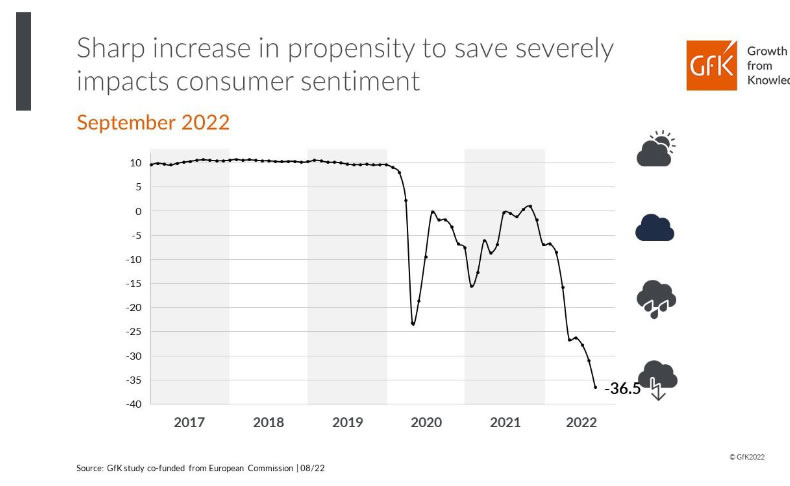
Germany Gfk consumer sentiment dropped to -36.5, another record low
Germany Gfk consumer sentiment for September dropped from -30.9 to -36.5, Worse than expectation of -31.5. In August, economic expectations improved from -18.2 to -17.6. Income expectations ticked up from -45.7 to -45.3. Propensity to buy dropped from -14.5 to -15.7. Propensity to save rose 17.6 pts to 3.5.
"The sharp increase in the propensity to save this month means that the consumer sentiment is continuing its steep descent. It has once again hit a new record low," explains Rolf Bürkl, GfK consumer expert.
"The fear of significantly higher energy costs in the coming months is forcing many households to take precautions and put money aside for future energy bills. This is further dampening the consumer sentiment, as in return there are fewer financial resources available for consumption elsewhere."
USD/CAD Daily Outlook
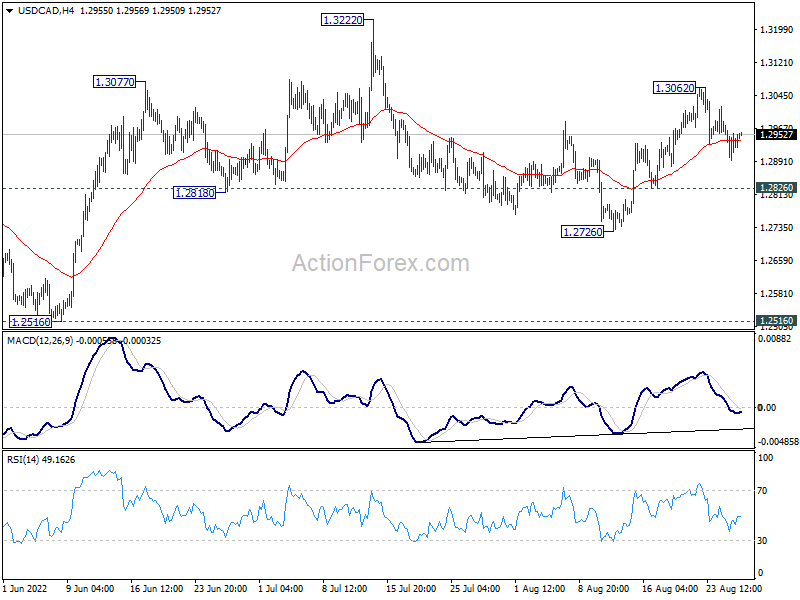
Daily Pivots: (S1) 1.2886; (P) 1.2932; (R1) 1.2970; More...
Intraday bias in USD/CAD remains neutral and outlook is unchanged. Corrective decline from 1.3222 could have completed with three waves down to 1.2726. Above 1.3062 will resume the rebound to retest 1.3222 high. However, break of 1.2826 support will dampen this view and turn bias back to the downside for 1.2726 and possibly below.
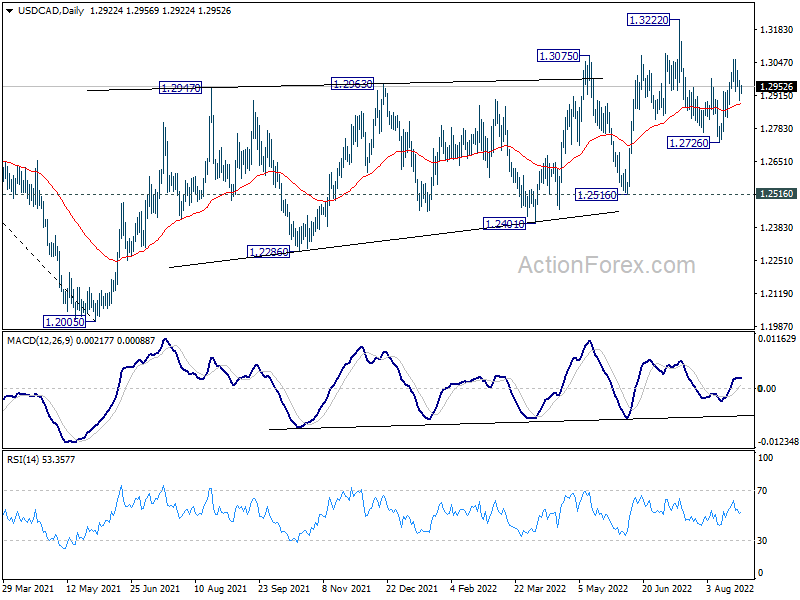
In the bigger picture, down trend from 1.4667 (2020 high) should have completed at 1.2005, after defending 1.2061 long term cluster support. Rise from there should target 61.8% retracement of 1.4667 to 1.2005 (2021 low) at 1.3650. This will remain the favored case now as long as 1.2516 support holds.
AUD/USD Daily Report
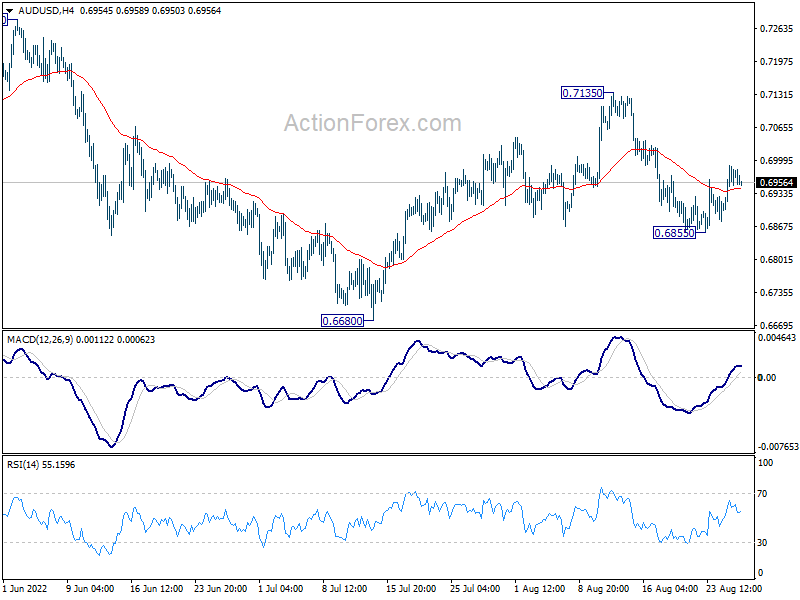
Daily Pivots: (S1) 0.6925; (P) 0.6958; (R1) 0.7014; More...
Intraday bias in AUD/USD remains neutral as range trading continues. Corrective rebound from 0.6680 could have completed with three waves up to 0.7135. Below 0.6855 will target a retest on 0.6680 low. However, break of 0.7135 will invalidate this view and resume the rebound from 0.6680 instead.
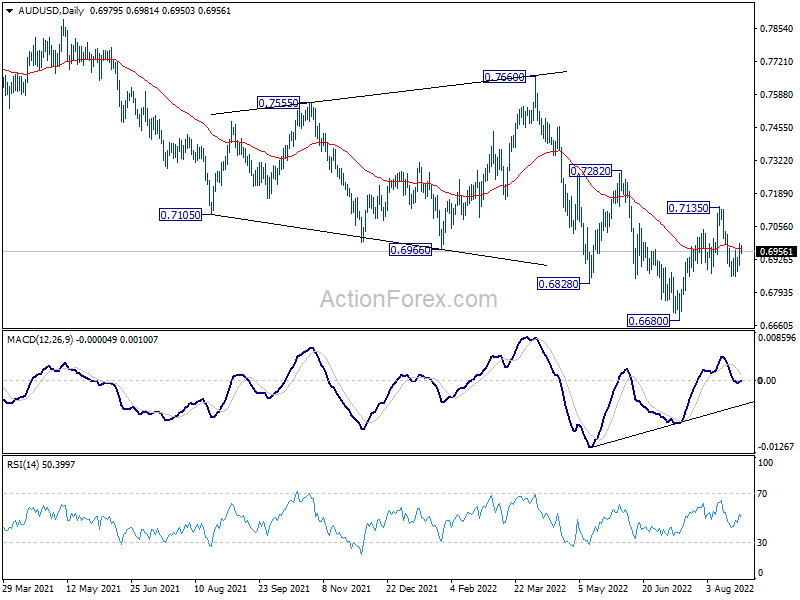
In the bigger picture, price actions from 0.8006 (2021 high) is seen more as a corrective pattern to rise from 0.5506 (2020 low). Or it could also be a bearish impulsive move. In either case, outlook will remain bearish as long as 0.7282 resistance holds. Next target is 61.8% retracement of 0.5506 to 0.8006 at 0.6461.
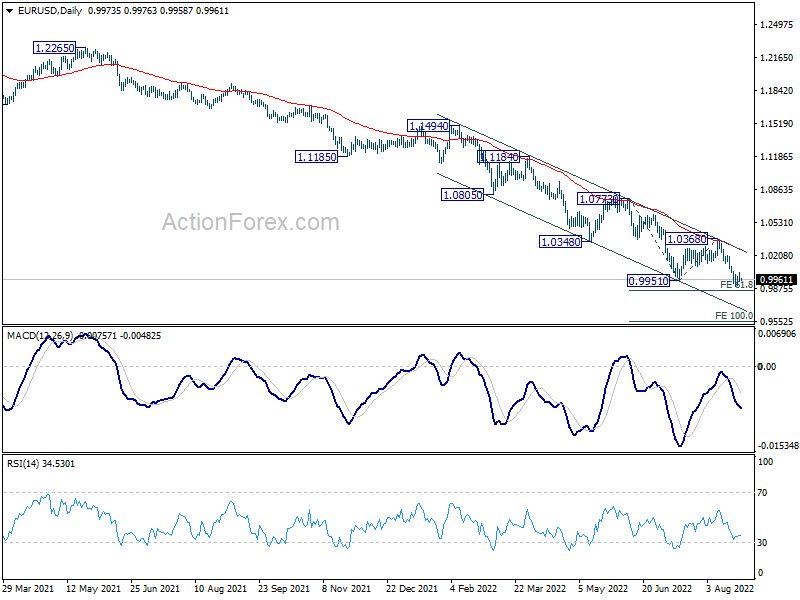
EUR/USD Daily Outlook
Daily Pivots: (S1) 0.9939; (P) 0.9986; (R1) 1.0024; More...
Intraday bias in EUR/USD remains neutral and outlook is unchanged. Consolidation from 0.9899 could extend, but upside of recovery should be limited by 1.0121 minor resistance to bring another fall. Break of 0.9899 will resume larger down trend to 61.8% projection of 1.0773 to 0.9951 from 1.0368 at 0.9860. Firm break there should prompt downside acceleration to 100% projection at 0.9546.
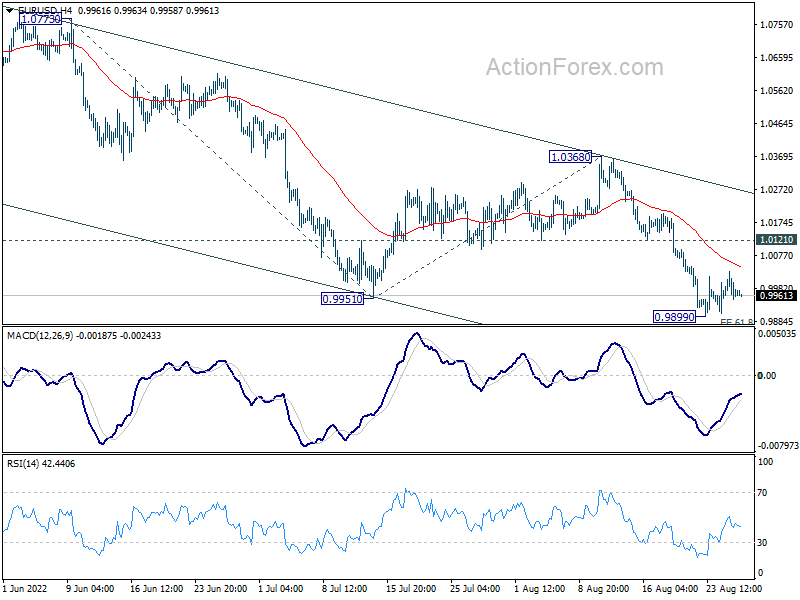
In the bigger picture, down trend from 1.6039 (2008 high) is still in progress. Next target is 100% projection of 1.3993 to 1.0339 from 1.2348 at 0.8694. In any case, outlook will stay bearish as long as 1.0368 resistance holds, in case of strong rebound.