

Sample Category Title
EUR/GBP Daily Outlook
Daily Pivots: (S1) 0.8434; (P) 0.8463; (R1) 0.8481; More...
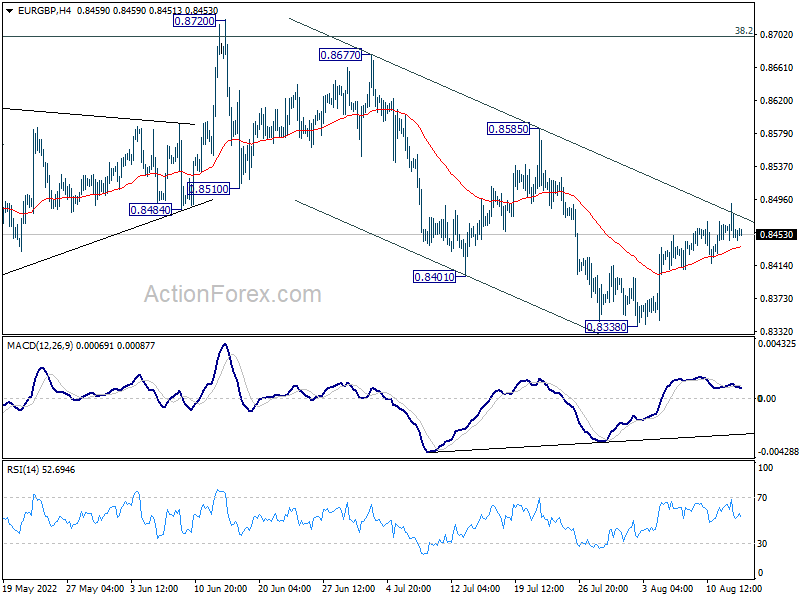
Intraday bias in EUR/GBP remains neutral and outlook is unchanged. Fall from 0.8720 is still expected to resume as long as 0.8585 resistance holds. Firm break of 0.8338 support will target a retest on 0.8201 low.
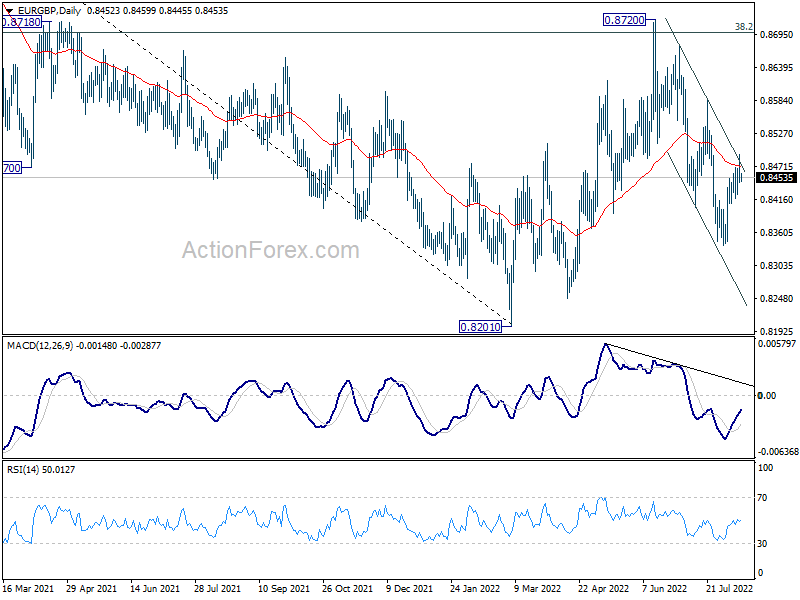
In the bigger picture, current development suggests rejection by 38.2% retracement of 0.9499 to 0.8201 at 0.8697. Medium term bearishness is maintained. Break of 0.8201 will resume larger down trend from 0.9499 (2020 high). Nevertheless, sustained break of 0.8697 will affirm the case that rise from 0.8201 is a medium term up trend itself.
EUR/AUD Daily Outlook
Daily Pivots: (S1) 1.4351; (P) 1.4445; (R1) 1.4496; More...
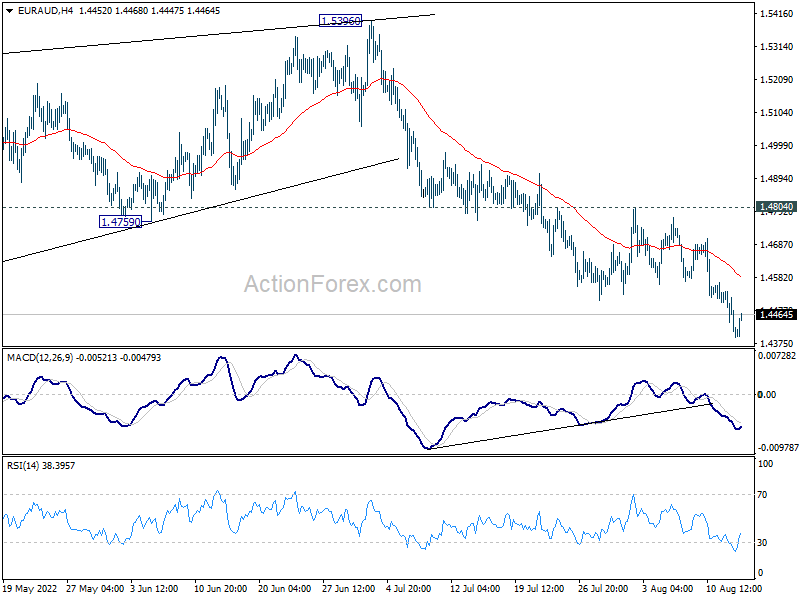
Intraday bias in EUR/AUD remains on the downside for the moment. Current decline from 1.5396 should target 1.4318 support first. Firm break there will resume larger down trend to medium term projection level at 1.3623. On the upside, break of 1.4804 resistance is needed to indicate short term bottoming. Otherwise, risk will stay on the downside in case of recovery.
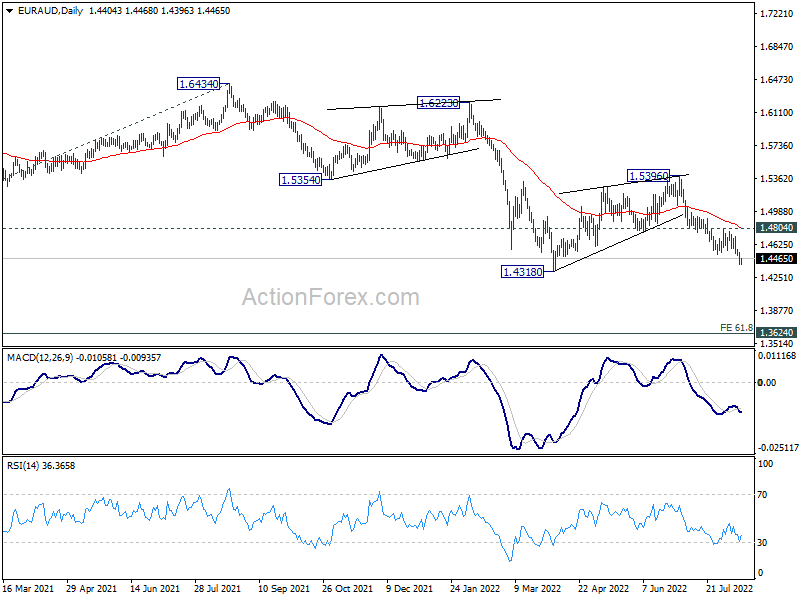
In the bigger picture, down trend from 1.9799 is still in progress. Break of 1.4318 low will target 61.8% projection of 1.9799 to 1.5250 from 1.6434 at 1.3623, which is close to 1.3624 long term support (2017 low). This will remain the favored case now as long as 1.5396 resistance holds.
EUR/CHF Daily Outlook
Daily Pivots: (S1) 0.9633; (P) 0.9679; (R1) 0.9703; More....
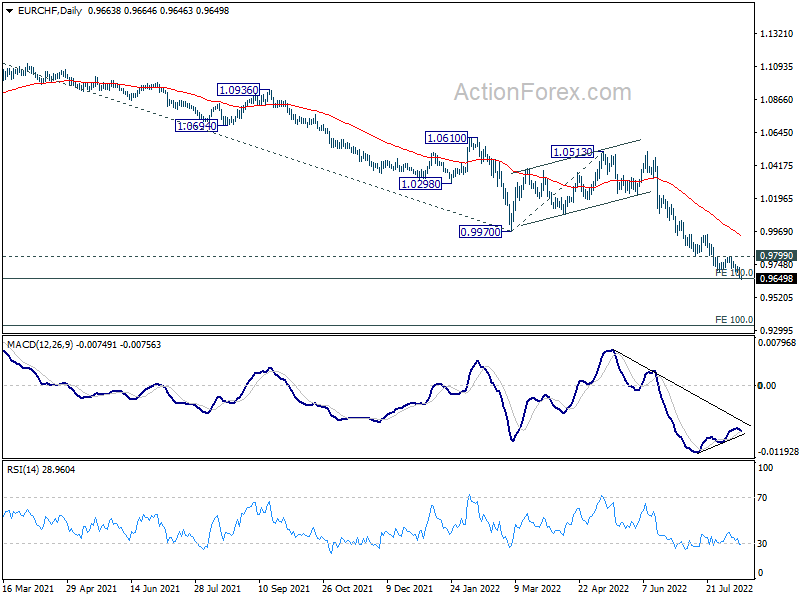
Intraday bias in EUR/CHF stays on the downside at this point. Firm break of 0.9650 long term projection level will target 100% projection of 1.1149 to 0.9970 from 1.0513 at 0.9334. Meanwhile, rebound from current level, followed by break of 0.9799 resistance should confirm short term bottoming.
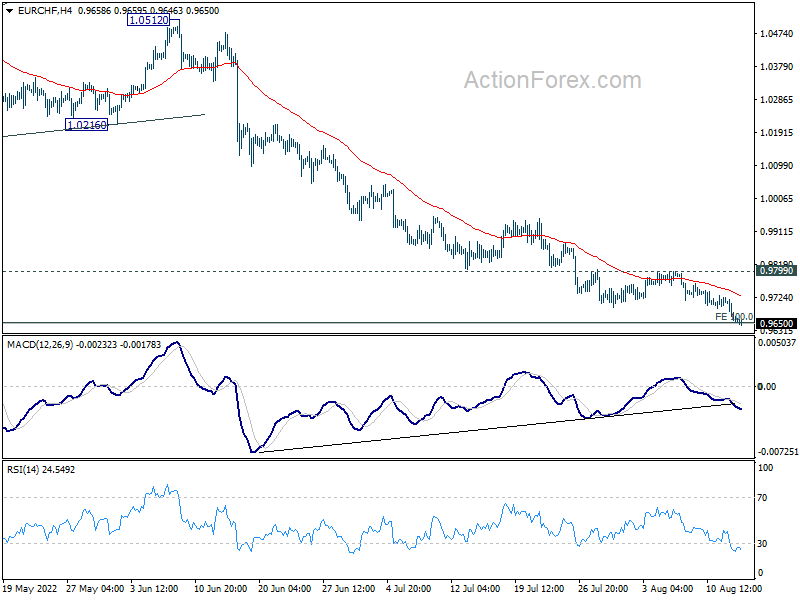
In the bigger picture, long term down trend from 1.2004 (2018 high) is still in progress. Sustained break of 100% projection of 1.2004 to 1.0505 to 1.1149 at 0.9650 will target 138.2% projection at 0.9033 next. On the upside, break of 0.9970 support turned resistance is needed to be the first sign of medium term bottoming. Otherwise, outlook will stay bearish in case of strong rebound.
GBP/JPY Daily Outlook
Daily Pivots: (S1) 161.62; (P) 162.21; (R1) 162.61; More...
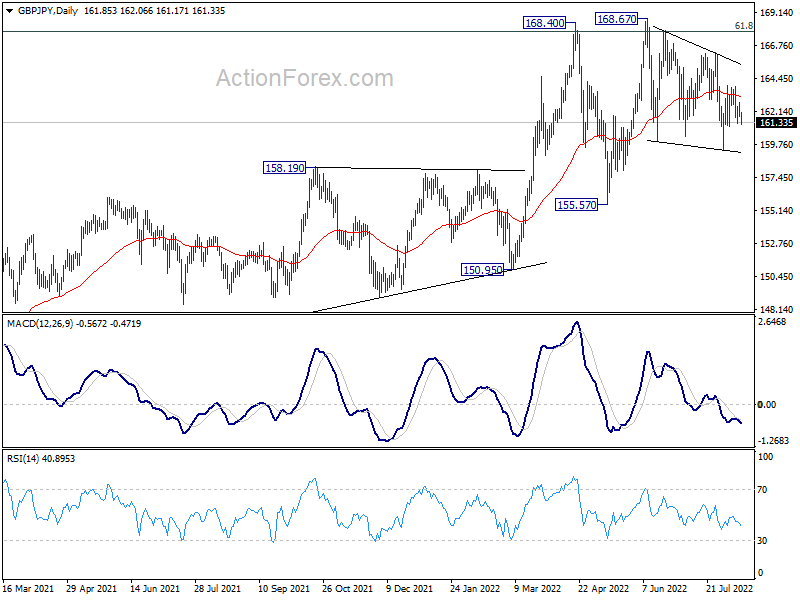
Intraday bias in GBP/JPY stay s neutral at this point. Consolidation from pattern from 168.67 could extend further. On the upside, above 163.97 will turn bias to the upside, and resume the rebound to 166.31 resistance. Break there will be the first sign of up trend resumption. On the downside, break of 161.08 minor support will target 159.42 support and below.
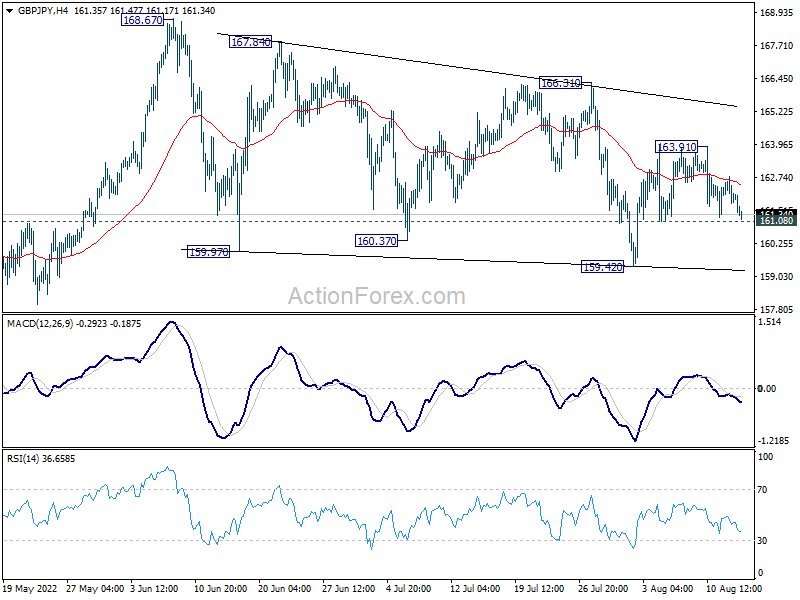
In the bigger picture, up trend from 123.94 (2020 low) is still in progress. Sustained break of 61.8% retracement of 195.86 (2015 high) to 122.75 (2016 low) at 167.93 will be a long term bullish signal, and could pave the way back to 195.86 high. This will remain the favored case as long as 155.57 support holds, even in case of deep pull back.
Soft China, Japan Data Weigh on Sentiment
The week starts moody in Asia, as economic data from China and Japan missed estimates early this Monday. Japanese economy grew last than expected in the Q2, although there was an acceleration in both private consumption and government spending, and capital expenditures rose sharply. Also, net exports contributed positively to the GDP, as exports increased while imports fell; the massive depreciation in the Japanese yen during last quarter certainly helped.
In China, retail sales, investment and industrial production, all, unexpectedly fell, and an earlier rate cut from the People’s Bank of China (PBoC) could hardly improve the mood in Chinese stocks. Shanghai’s composite is slightly.
Of course, bad data from China also weighs on recession worries for the rest of the world. Crude oil begins the week under selling pressure around the $91 per barrel. US index futures are down, but interestingly, the European futures were better bid in Asia; Asian traders didn’t price in the fact that Rhine, the biggest river in Germany where ships transport coal among other crucial goods is drying to a point that it can no longer be navigated at some parts. The water level at Kaub, which is a key water marker, will fall to 30 centimeters today – and the latter will only deepen the European energy crisis, and perhaps inflation. The EURUSD slips below the 2.50 level.
Too early to call the end of US selloff
In the US, Friday’s session was again a strong one. The S&P500 gained 1.73%, while Nasdaq jumped more than 2%. From a technical standpoint, last week’s advance in Nasdaq marks the end of the bear market, as the index rallied more than 20% since the June dip.
But, it’s too early to uncork the champagne, and call the end of the market selloff. Last week’s softer-than-expected inflation data gave a glimpse of hope that things could start looking better in the second half of the year. But the Federal Reserve (Fed) members warned immediately that inflation in the US remains at a particularly high level, which needs continuous intervention from the policy perspective until the levels get back toward the policy target.
The Fed minutes, due this week, will certainly confirm that the Fed remains focused on bringing US inflation lower; the latest softness in inflation data will unlikely change the Fed’s roadmap, at least for the next couple of meetings.
For now, activity on Fed funds futures gives almost 50-50 chance for a 50 and a 75bp hike in September meeting. I believe we will still see a 75bp hike in September.
The US dollar is firmer this Monday. Gold struggles finding buyers into the $1800 per ounce level, as Bitcoin tests the $25K resistance to the upside. The US delegation visit to Taiwan this week could revive tensions between the US and China, and help the precious metal amass safe haven flows. But the topside will likely remain limited around the $1835 level, where we have the 100-DMA.
The Chinese Central Bank Unexpectedly Eases Monetary Policy
Market movers today
- There are no significant market movers today.
- The Chinese central bank unexpectedly cut policy rates this morning.
- The key numbers and events are the German ZEW indicator tomorrow, UK inflation data and Fed minutes later this week.
The 60 second overview
The Chinese central bank unexpectedly cut rates this morning as it lowered its one-year policy loans by 10bp and the 7-day reverse repo rate to 2% from 2.1%. They were expected to keep rates unchanged. The rate cut comes on the back of a slowdown in the Chinese economy.
The focus on a recession in the euro-area continues and the risk of a recession is seen as 60% according to a recent poll conducted by Bloomberg. This is the highest since November 2020. It is driven by a string of factors but primarily by energy shortages that threaten to push inflation even higher, but also the drought and rising monetary policy rates. All this drives the cost-of-living higher and increases the risk of a recession.
The UK inflation numbers are one of the highlights of the week as inflation is expected to hit 9.8%. We also have Fed minutes from the latest FOMC meeting where we will look for comments on future path for monetary policy. A string of Fed officials have stated that we are still far from easing and declare victory over inflation. Tomorrow is the release of the German ZEW indicator. Here the number will most likely show a reflection of the increased risk of recession.
Equities: Global equities rallied Friday and thereby closing yet another strong week with gains around 2.5%. VIX drifted lower to sub 20 and most of the down-beaten stocks in first half of the year continue to regain some the loss to the winners of H1. As the rally on Friday was (again) driven by an inflation-related relief, this time coming from lower consumer based inflation expectations in the Michigan survey, it resulted in the bucket of cyclical growth and quality companies outperforming together with small caps. In US Dow +1.3%, S&P 500 +1.7%, Nasdaq +2.1% and Russell 2000 +2.1%. Asian markets are higher this morning with the Nikkei 225 getting back into green for the year. China is lagging the rally after a weak set of key figures and with retail sales coming in very weak. European futures are higher in a Friday catch-up while US futures a tad lower this morning.
FI: The flattening of the US yield curve continued on Friday after a very brief bearish steepening of the 2-10Y curve on Thursday last week. There has also been some relief in the Bund ASW-spread as it has declined from 95bp down towards 90bp. We still believe that the German government bond yield curve will continue to flatten as we have seen in the US yield curve. The ASW-spread can also continue to widen even at these elevated levels.
FX: EUR/SEK rebounded above 10.40 after the surprise drop in Swedish inflation on Friday. EUR/NOK stayed put around the 9.80 level. EUR/USD edged below 1.03 to finish the week.
Credit: Credit markets saw further tightening on Friday as iTraxx Main was tighter by 2bp and Crossover by 16bp, with the indices ending the week tighter by 10bp and 56bp, respectively (at 92bp and 463bp).
EUR/JPY Daily Outlook
Daily Pivots: (S1) 136.60; (P) 137.00; (R1) 137.70; More....
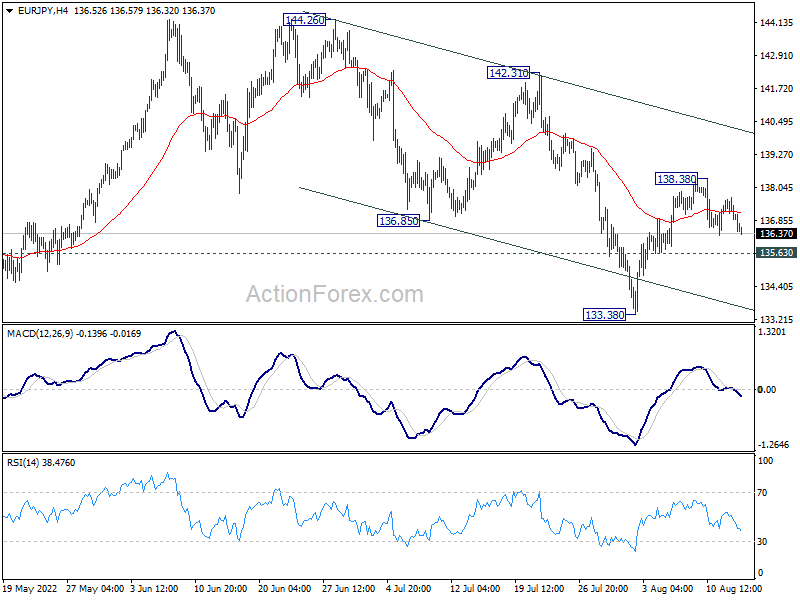
Intraday bias in EUR/JPY remains neutral for the moment. On the upside, break of 138.38, and sustained trading above 55 day EMA (now at 138.29) will suggest that whole correction from 144.26 has completed. Further rally would then be seen back to retest 144.26 high. However, break of 135.63 will turn bias back to the downside for 133.38 low instead.
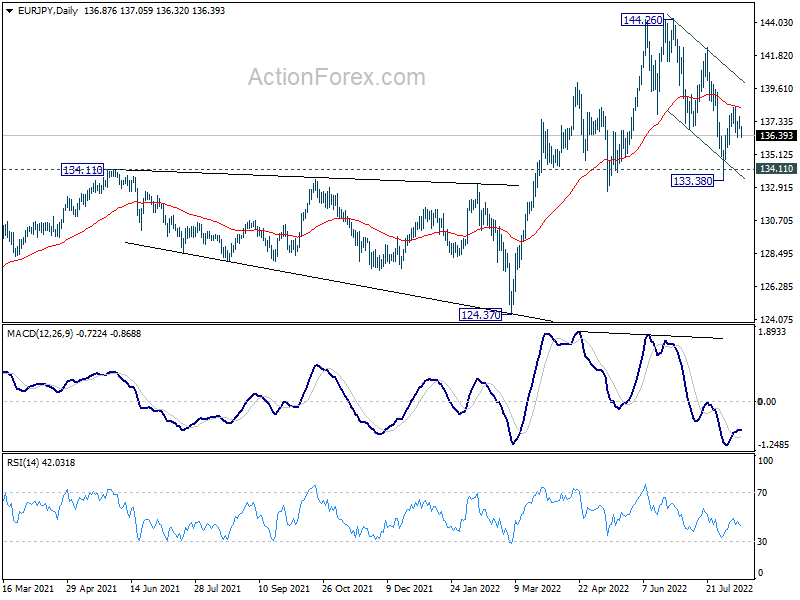
In the bigger picture, up trend from 114.42 (2020 low) is seen as the third leg of the pattern from 109.30 (2016 low). Further rally is in favor as long as 134.11 resistance turned support holds, even in case of deep pull back. Next target is 149.76 (2015 high). However, sustained break of 134.11 will be a sign of medium term bearish reversal and turn focus to 124.37 support for confirmation.
Yen Rises, Commodity Currencies Soften after China Data Miss
Commodity currencies soften mildly in Asian session today, following weaker than expected economic data from China. On the other hand, Yen is leading Dollar and Swiss Franc higher. Euro and Sterling are mixed for now. Overall sentiment is mixed, with notable gains in Nikkei but other Asian indexes are sluggish. Gold is still struggling to break away from 1800 handle. WTI crude oil is dipping below 92 handle.
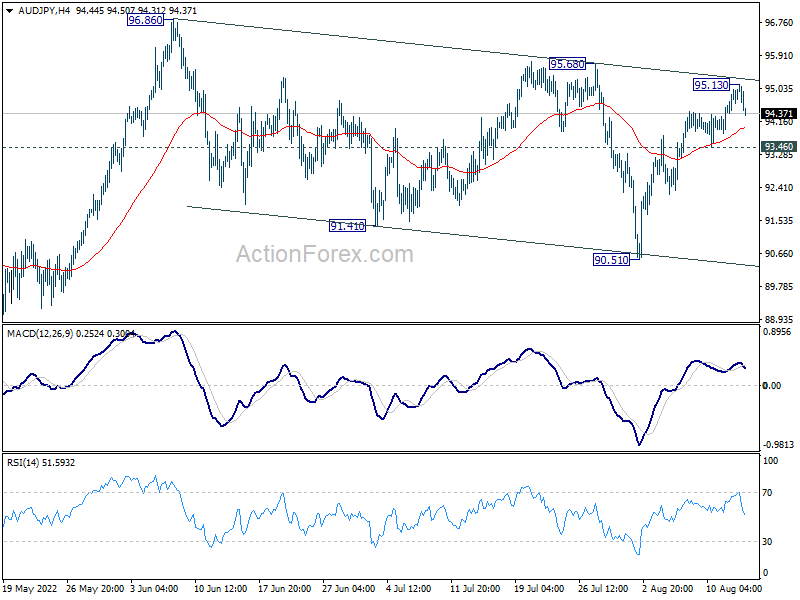
Technically, one focus today is one whether buying in Yen would pick up momentum again. One level to watch is AUD/JPY's reaction to 93.46 minor support in case of deeper retreat. More too look at include 135.63 minor support in EUR/JPY and 161.08 minor support in GBP/JPY. Break of these levels would argue that Yen bulls are back on board.
In Asia, at the time of writing, Nikkei is up 1.14%. Hong Kong HSI is down -0.08%. China Shanghai SSE is up 0.15%. Singapore Strait Times is down -0.22%. Japan 10-year JGB yield is down -0.0021 at 0.187.
Japan GDP grew 0.5% qoq in Q2, exceeding pre-pandemic level finally
Japan GDP grew 0.5% qoq in Q2, below expectation of 0.6% qoq. In annualized term, GDP grew 2.2%, below expectation of 2.5%. The size of the economy was lifted to JPY 542.1T, exceeding pre-pandemic level in Q4 2019.
Growth was driven by 1.1% gain in private consumption. Capital expenditure rose 1.4%. Public investment rose 0.9%. Exports and imports rose 0.9% and 0.7% respectively.
China data disappoints, PBoC cuts MLF rate
China industrial production rose 3.8% yoy in July, below expectation of 4.6% yoy, slowed from 3.9% yoy. Retail sales rose 2.7% yoy, below expectation of 5.0% yoy, slowed from 3.1% yoy. Fixed asset investment rose 5.7% ytd yoy, below expectation of 6.2%.
"The national economy maintained strong recovery momentum," the NBS said in a statement. But it warned of rising stagflation risks globally and said "the foundation for the recovery of the domestic economy has yet to be consolidated."
Separately, PBoC cut a key interest rate for the second time this year and withdrew some cash from the banking system on Monday The rate on one-year medium-term lending facility (MLF) loans is lowed by 10 bps to 2.75%. The PBOC attributed its move to "keep banking system liquidity reasonably ample".
NZ BusinessNZ services dropped to 51.2, back below average
New Zealand BusinessNZ Performance of Services Index dropped from 54.7 to 51.2 in July. Activity/Sales dropped from 55.8 to 54.4. Employment dropped from 52.7 to 49.2.New orders/business dropped from 60.5 to 52.5. Stocks/inventories dropped from 54.0 to 53.1. Supplier deliveries dropped from 48.4 to 47.3.
BNZ Senior Economist Doug Steel said that "it is difficult to be sure from one month's data, but July's outcome is the lowest since February, has retreated further from the recent 54.9 peak set in May, and is back below average."
RBNZ to hike 50bps, and lots of data featured
RBNZ is expected to raise the Official Cash Rate by another 50bps to 3.00% this week. Tightening bias should be maintained based on the May's projected path for interest rate. The question is whether RBNZ would signal that "front-loading" of rate hike is complete, giving that interest rate is in restrictive region. That is, the pace of tightening would be back on data-dependent mode. In terms of central bank activities, RBA and Fed will release minutes.
Economic calendar is very busy this week, with particular focus on US retail sales. Eurozone ZEW economic sentiment is another focus. Also, UK will publish employment, CPI and retail sales. Moreover, Canada CPI, Australia employment and a batch of China data could also be market moving.
Here are some highlights for the week:
- Monday: Japan GDP; China retail sales, industrial production, fixed asset investment; Swiss PPI; Canada manufacturing sales, wholesale sales; US Empire State manufacturing, NAHB housing index.
- Tuesday: RBA minutes; Japan tertiary industry index; UK employment; Eurozone trade balance; German ZEW; Canada CPI, housing starts; US housing starts and building permits, industrial production.
- Wednesday: RBNZ rate decision; Australia wage price index; Japan trade balance, machine orders; UK CPI, PPI; Eurozone employment, GDP; US retail sales, business inventories, FOMC minutes.
- Thursday: Australia employment; Swiss Trade balance; Eurozone CPI final; Canada IPPI and RMPI; US Philly Fed survey, jobless claims, existing home sales.
- Friday: New Zealand trade balance; Japan CPI; Germany PPI; UK Gfk consumer confidence, retail sales; Eurozone current account; Canada retail sales.
EUR/JPY Daily Outlook
Daily Pivots: (S1) 136.60; (P) 137.00; (R1) 137.70; More....
Intraday bias in EUR/JPY remains neutral for the moment. On the upside, break of 138.38, and sustained trading above 55 day EMA (now at 138.29) will suggest that whole correction from 144.26 has completed. Further rally would then be seen back to retest 144.26 high. However, break of 135.63 will turn bias back to the downside for 133.38 low instead.
In the bigger picture, up trend from 114.42 (2020 low) is seen as the third leg of the pattern from 109.30 (2016 low). Further rally is in favor as long as 134.11 resistance turned support holds, even in case of deep pull back. Next target is 149.76 (2015 high). However, sustained break of 134.11 will be a sign of medium term bearish reversal and turn focus to 124.37 support for confirmation.
Economic Indicators Update
| GMT | Ccy | Events | Actual | Forecast | Previous | Revised |
|---|---|---|---|---|---|---|
| 23:01 | GBP | Rightmove House Price Index M/M Aug | -1.30% | 0.40% | ||
| 23:50 | JPY | GDP Q/Q Q2 P | 0.50% | 0.60% | -0.10% | |
| 23:50 | JPY | GDP Deflator Y/Y Q2 P | -0.40% | -0.80% | -0.50% | |
| 02:00 | CNY | Retail Sales Y/Y Jul | 2.70% | 5.00% | 3.10% | |
| 02:00 | CNY | Fixed Asset Investment YTD Y/Y Jul | 5.70% | 6.20% | 6.10% | |
| 02:00 | CNY | Industrial Production Y/Y Jul | 3.80% | 4.60% | 3.90% | |
| 04:30 | JPY | Industrial Production M/M Jun F | 9.20% | -7.50% | -7.50% | |
| 06:30 | CHF | Producer and Import Prices M/M Jul | 0.40% | 0.30% | ||
| 06:30 | CHF | Producer and Import Prices Y/Y Jul | 6.70% | 6.90% | ||
| 12:30 | CAD | Manufacturing Sales M/M Jun | -2.00% | |||
| 12:30 | CAD | Wholesale Sales M/M Jun | 1.60% | |||
| 12:30 | USD | Empire State Manufacturing Index Aug | 5.1 | 11.1 | ||
| 14:00 | USD | NAHB Housing Market Index Aug | 55 | 55 |
China data disappoints, PBoC cuts MLF rate
China industrial production rose 3.8% yoy in July, below expectation of 4.6% yoy, slowed from 3.9% yoy. Retail sales rose 2.7% yoy, below expectation of 5.0% yoy, slowed from 3.1% yoy. Fixed asset investment rose 5.7% ytd yoy, below expectation of 6.2%.
"The national economy maintained strong recovery momentum," the NBS said in a statement. But it warned of rising stagflation risks globally and said "the foundation for the recovery of the domestic economy has yet to be consolidated."
Separately, PBoC cut a key interest rate for the second time this year and withdrew some cash from the banking system on Monday The rate on one-year medium-term lending facility (MLF) loans is lowed by 10 bps to 2.75%. The PBOC attributed its move to "keep banking system liquidity reasonably ample".
Japan GDP grew 0.5% qoq in Q2, exceeding pre-pandemic level finally
Japan GDP grew 0.5% qoq in Q2, below expectation of 0.6% qoq. In annualized term, GDP grew 2.2%, below expectation of 2.5%. The size of the economy was lifted to JPY 542.1T, finally exceeding pre-pandemic level in Q4 2019.
Growth was driven by 1.1% gain in private consumption. Capital expenditure rose 1.4%. Public investment rose 0.9%. Exports and imports rose 0.9% and 0.7% respectively.