Sample Category Title
The MPC’s Economic Assessment Was Nothing But Grim
Markets
The Bank of England did what it was expected to do. After delivering a 50 bps rate hike in a 8-1 vote, the biggest in 27 years, the policy rate now stands at 1.75%. Inflation intensified, amongst others due to near doubling in gas prices. But domestic price pressures remain strong too owing to a tight labour market and low unemployment. Wage growth is expected higher than was forecasts in the May report, adding to the risks of a price-wage spiral. Inflation should peak in Q4 this year at more than 13% compared to the 10% in May and will stay at very elevated levels in 2023 (9.5% y/y in Q3). It should drop materially into 2024 to 2% in Q3 and to 0.8% in three years’ time. This is assuming a market implied peak policy rate of 3%. While this used to be a signal from the BoE that markets are pricing in too much tightening (since 2025 inflation is well below target), this is not the case today. Given high uncertainty, the BoE said its putting less weight on the implications of the assumptions made and even its own forecasts. Instead, it let data guide them in deciding which the next move is going to be. This could be another 50 bps in September but it might just as well already return to 25. The MPC’s economic assessment was nothing but grim. It projects the UK economy to enter into a recession in Q4 all the way through 2023. Real household income is projected to fall sharply in 2022 and 2023 in the worst squeeze in living standards in more than 60 years while consumption growth turns negative. Aside from the rate hike, the BoE also decided on quantitative tightening. It will start selling gilts shortly after the September meeting. In the first 12 months, it plans to shrink the balance sheet by £80bn. Taking into account the natural roll-off, this implies a quarterly £10bn of active sales. The strategy is subject to an annual review.Gilt yields fell off a cliff in a knee-jerk reaction. Moves went as deep as 11 bps for the 2y (or 18 bps even from an intraday perspective). But that changed fast. Markets assume there’s no other option for the BoE to hike further with inflation expected at such high levels. The eventual damage for Gilt yields ranged from -1.3 bps (2y) to -3.2 bps (10y). The steep drop in UK yields caused knock-on effects on European and US bond markets but there too the move (partially) reversed. German yields ease between -2.6 bps and -5.4 bps. A 4 bps drop in US yields retraced about half of those losses, with the wings underperforming the belly of the curve. The British pound, having anticipated today’s move quite in advance, reacted negatively. EUR/GBP jumped from 0.837 to 0.842. Cable (GBP/USD) retreated to 1.21. EUR/USD is eking out a negligible gain and still switches hands sub 1.02. News Headlines
The ECB started publishing the result of its Consumer Expectations Survey, a questionnaire targeting consumers in 6 EU core countries which the central bank started conducting since April 2020. According to the June edition, consumers expect inflation one year ahead still to be 5%. Three years from now, median inflation expectations are at 2.8%, above the ECB’s 2% target. Interestingly, they’ve estimated price increases over the past year up until June to be lower than they actually were (7.2% vs 8.6% HICP). Regarding the economic outlook, households believe the economy will shrink 1.3% in the year ahead while the unemployment rate is seen ticking higher to 11.5%, a significant increase compared to the actual 6.6% today.
The Czech National Bank at the meeting today decided to keep policy rates unchanged at 7%, defying market and analyst expectations for a 25 bps move higher. It’s the first meeting of the CNB in its new composition and with Ales Michl at the helm. Following the decision, Czech money markets assume the current rate to be the terminal one with rate cuts starting around this period next year. Czech swap rates tumble up to 14 bps at the front. The Czech crown in a first reaction lost minor ground, with CNB FX interventions probably capping losses, before staging a remarkable strengthening move that went as far as EUR/CZK 24.50.
USD/JPY Mid-Day Outlook
Daily Pivots: (S1) 132.58; (P) 133.57; (R1) 134.84; More...
Intraday bias in USD/JPY remains neutral for the moment. Correction from 139.37 could still extend through 130.38. But downside should be contained above 126.35 support, at least on first attempt, to bring rebound. On the upside, firm break of 134.58 will turn bias to the upside for stronger rally to retest 139.37 high.
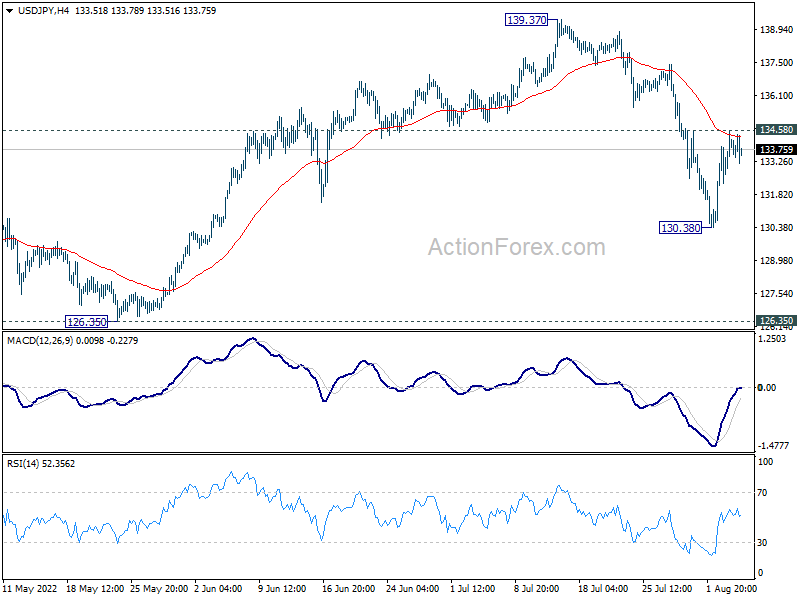
In the bigger picture, a medium term top should be in place at 139.37, on bearish divergence condition in daily MACD. Fall from there could be correcting whole up trend from 101.18 (2020 low). While deeper decline cannot be ruled out, outlook will stays bullish as long as 55 week EMA (now at 121.84) holds. Long term up trend is expected to resume through 139.37 at a later stage, after the correction finishes.
USD/CHF Mid-Day Outlook
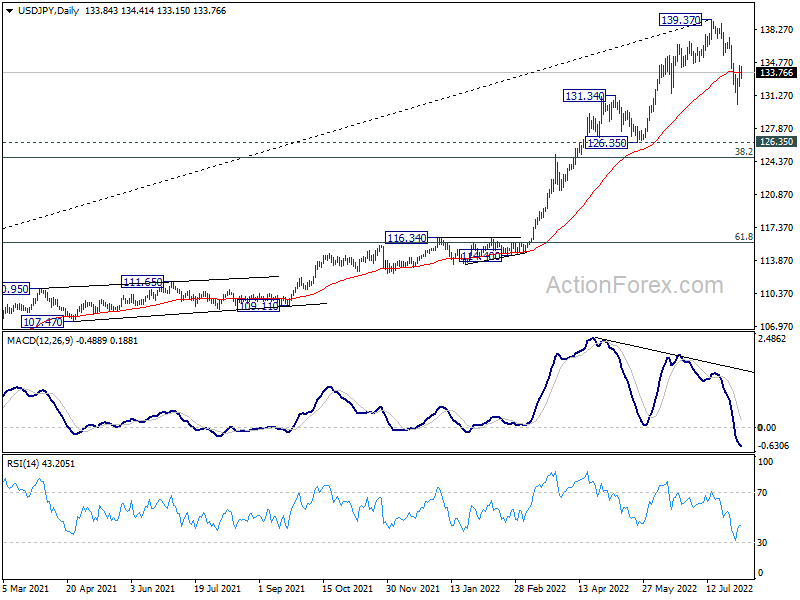
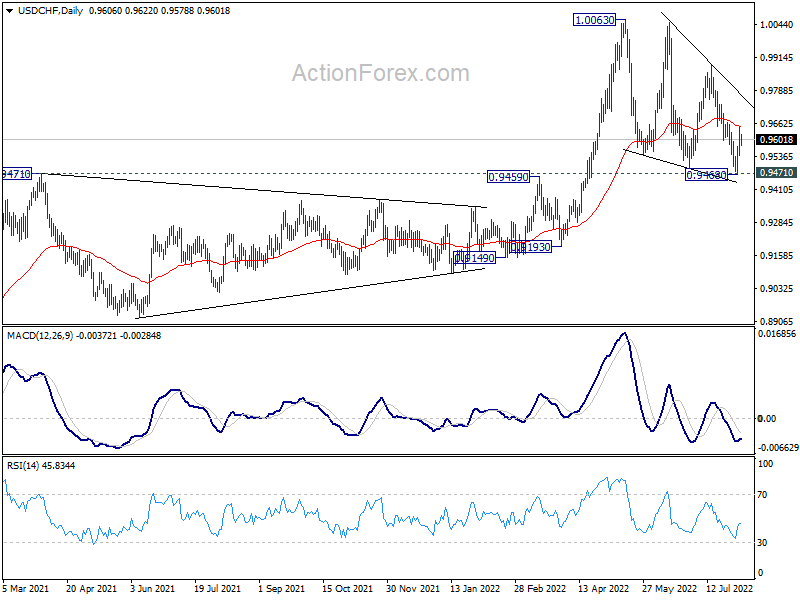
Daily Pivots: (S1) 0.9548; (P) 0.9600; (R1) 0.9657; More...
Intraday bias in USD/CHF stays mildly on the upside as rebound from 0.9468 short term bottom is in progress. Sustained trading above 55 day EMA (now at 0.9650) will raise the chance that corrective pattern from 1.0063 has completed. Further rally should then be seen to 0.9884 resistance next. This will remain the favored case as long as 0.9468 support holds.
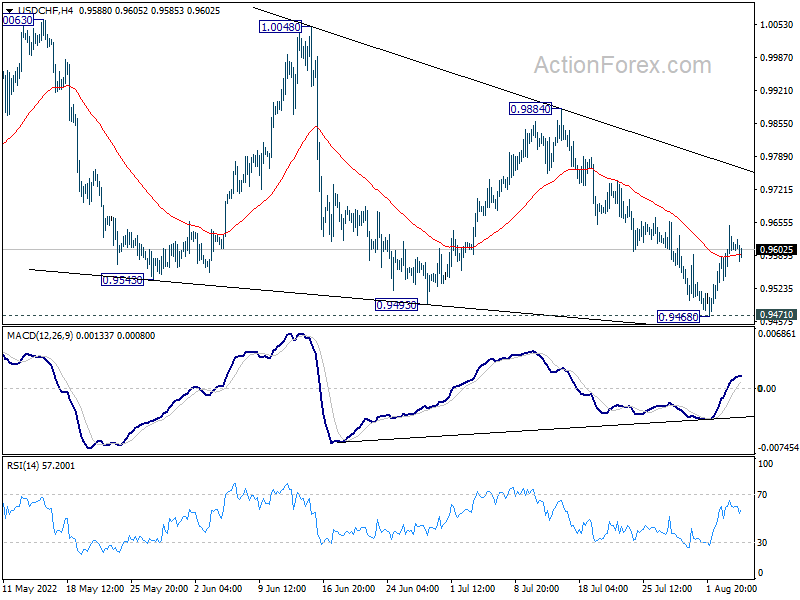
In the bigger picture, medium term up trend from 0.8756 (2021 low) is still in progress. On resumption, next target is 1.0342 (2016 high). Sustained break there will resume long term up trend from 0.7065 (2011 low). This will remain the favored case as long as 0.9471 resistance turned support holds. However, firm break of 0.9471 will raise the chance that such up trend is over. Sustained trading below 55 week EMA (now at 0.9424) could bring deeper medium term fall back to 0.9149 support and below.
EUR/USD Mid-Day Outlook
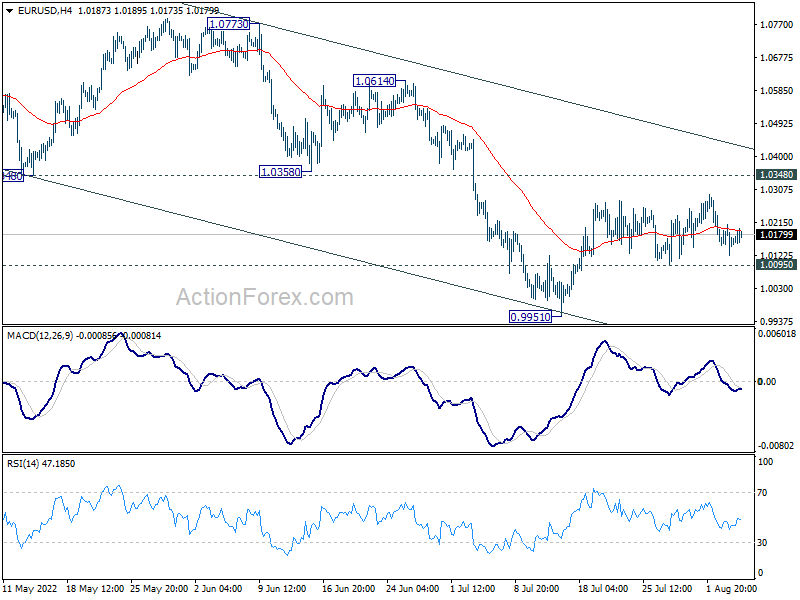
Daily Pivots: (S1) 1.0125; (P) 1.0167; (R1) 1.0211; More...
Intraday bias in EUR/USD remains neutral for the moment. Further rise is in favor with 1.095 minor support intact. Rebound from 0.9951 will target 1.0348 support turned resistance. Break there will target channel resistance at 1.0432. On the downside, break of 1.0095 minor support will turn bias back to the downside, and bring retest of 0.9951 low instead.
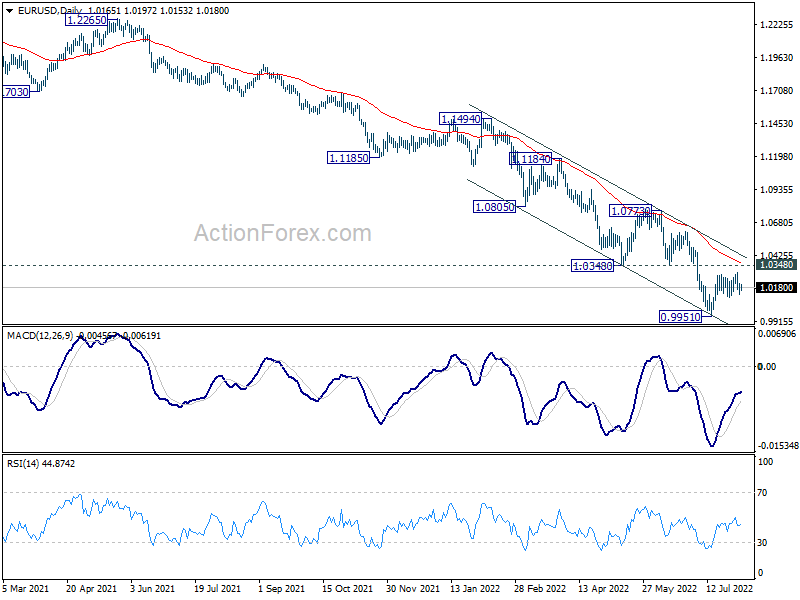
In the bigger picture, down trend from 1.6039 (2008 high) is still in progress. Next target is 100% projection of 1.3993 to 1.0339 from 1.2348 at 0.8694. In any case, outlook will stay bearish as long as 1.0773 resistance holds, in case of strong rebound.
GBP/USD Mid-Day Outlook
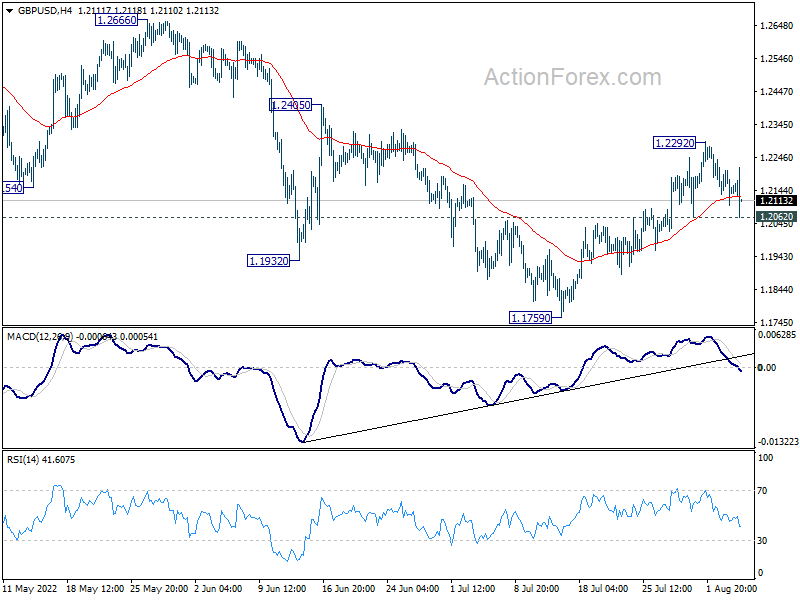
Daily Pivots: (S1) 1.2096; (P) 1.2152; (R1) 1.2203; More...
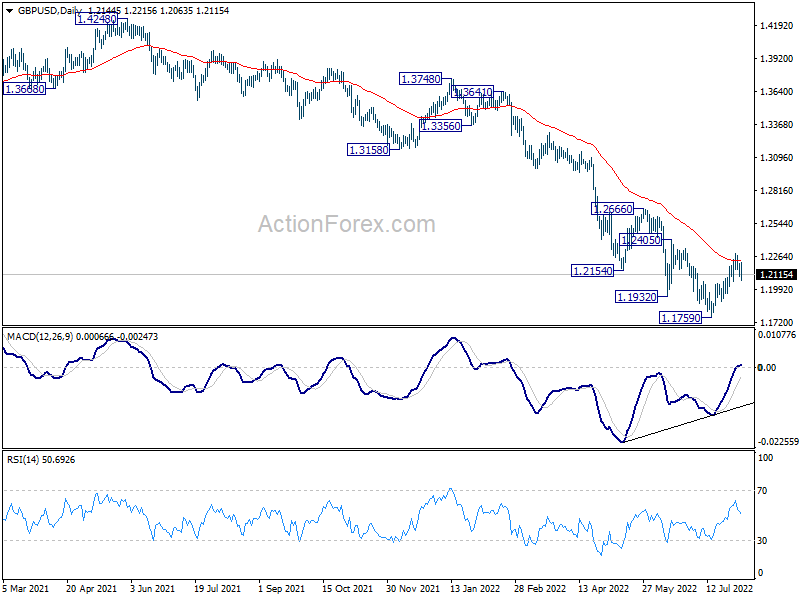
GBP/USD is still staying above 1.2062 minor support despite today's dip. Intraday bias stays neutral first. On the downside, firm break of 1.2062 minor support will argue that the rebound from 1.1759 is over, and turn bias back to the downside for retesting 1.1759 low. On the upside, above 1.2292 will resume the rebound to 1.2405 resistance.
In the bigger picture, fall from 1.4248 (2018 high) could be a leg inside the pattern from 1.1409 (2020 low), or resuming the longer term down trend. Deeper decline is expected as long as 1.2666 resistance holds. Next target is 1.1409 low. However, firm break of 1.2666 will bring stronger rise back to 55 week EMA (now at 1.2957).
Sterling Falls as BoE Forecasts Prolonged Recession
Sterling falls broadly today after BoE hikes by 50bps but indicates that a prolonged recession will start in the UK in Q4. But the selloff in the Pound is not helping Euro and Swiss Franc much, as both are mixed. Dollar and Canadian are following Sterling as next weakest. Meanwhile, Yen is leading Aussie and Kiwi higher.
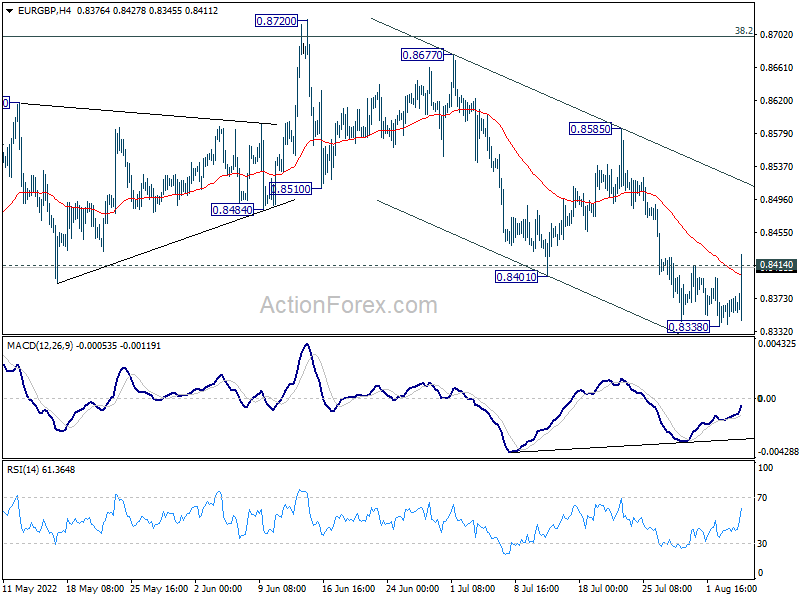
Technically, EUR/GBP's break of 0.8414 minor resistance suggests short term bottoming at 0.8338 and stronger recovery could be seen. But to solidify Sterling's weakness, GBP/USD will need to break through 1.2062 minor support. GBP/CHF will also need to break through 1.1525 low. Otherwise, bearishness in not confirmed.
In Europe, at the time of writing, FTSE is up 0.49%. DAX is up 1.08%. CAC is up 0.78%. Germany 10-year yield is down -0.075 at 0.803. Earlier in Asia, Nikkei rose 0.69%. Hong Kong HSI rose 2.06%. China Shanghai SSE rose 0.80%. Singapore Strait Times rose 0.55%. Japan 10-year JGB yield dropped -0.0143 to 0.175.
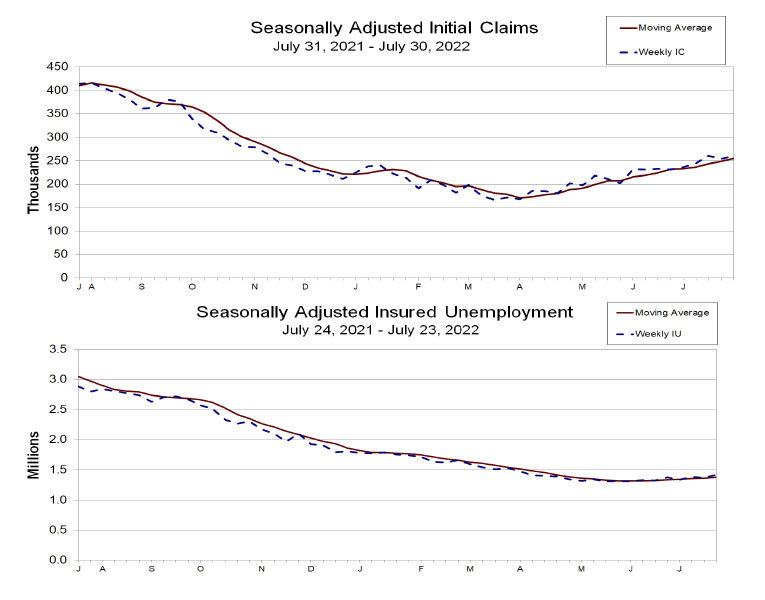
US initial jobless claims rose to 260k, continuing claims rose to 1416k
US initial jobless claims rose 6k to 260k in the week ending July 30, above expectation of 250k. Four-week moving average of initial claims rose 6k to 255k.
Continuing claims rose 48k to 1416k in the week ending July 23. Four-week moving average of continuing claims rose 11k to 1375k.
US exports of goods and services rose 1.7% or USD 4.3B in June to USD 260.8B. Imports dropped -0.3% or USD 1B to USD 340.4B. Trade deficit decreased by 6.2% to USD -79.6B.
BoE hikes 50bps, CPI to peak at over 13%, GDP to contract -1% in Q4
BoE raises Bank Rate by 50bps to 1.75% by 8-1 vote. Known dove Silvana Tenreyro voted for just 25bps hike. In the accompanying statement, BoE said the MPC will "take the actions necessary to return inflation to the 2% target sustainably in the medium term". Policy is "not on a pre-set path". But it will be "particularly alert to indications of more persistent inflationary pressures", and will "if necessary act forcefully in response."
In the Monetary Policy Report, CPI is projected to peak at "just over 13%" in Q4, due to Russia restricting the supply of gas to Europe and the risk of further curbs. It's projected to fall to 5.5% by the end of 2023, and back at 2% in Q3 2024.
GDP growth is expected to slow further from Q2's 0.5% to 0.2% in Q3, and then decline by nearly -1% in Q4. GDP is also forecast to all further, by -1.50% in 2023, and then -0.25% in 2024.
BoE Bailey: Faster tightening will help, but policy not on predetermined path
In the post meeting press conference, BoE Governor Andrew Bailey said, "overall a faster pace of policy tightening at this meeting will help to bring inflation back to the 2% target sustainably in the medium term," he said.
"Looking ahead, that does not mean we're now moving to a predetermined path of raising bank rate by 50 basis points per meeting, or indeed any other number for that matter."
"Policy is not on a preset path. And what we do this time does not tell you what we're going to do next time. All options are on the table for our September meeting, and beyond that."
UK PMI construction dropped to 48.9, first contraction since since start of 2021
UK PMI Construction dropped from 52.6 to 48.9 in July, below expectation of 52.1. That's the first contraction reading since January 2021, and worst since May 2020.
Tim Moore, Economics Director at S&P Global Market Intelligence, said:
"July data illustrated that cost of living pressures, higher interest rates and increasing recession risks for the UK economy are taking a toll on construction activity. Total industry output fell for the first time since the start of 2021 as civil engineering joined house building in contraction territory.... Expectations for output growth in the next 12 months are far less exuberant than those seen over the past two years, amid concerns that elevated inflation and higher borrowing costs will constrain demand."
ECB consumer survey: Inflation expectations up, growth expectations down
In ECB's Consumer Expectations Survey, consumers' mean perceived inflation over the past 12 months increased markedly from May's 8.2% to June's 8.6%. Median inflation perceptions over the previous 12 months rose from 6.6% to 7.2%.
Mean inflation expectations for 12 month ahead rose from 6.3% to 6.6%. Median inflation expectations for 12 months ahead rose from 4.9% to 5.0%.
Mean economic growth expectations for the next 12 months dropped from -1.0% to -1.3%. Median economic growth expectations was unchanged at 0%.
GBP/USD Mid-Day Outlook
Daily Pivots: (S1) 1.2096; (P) 1.2152; (R1) 1.2203; More...
GBP/USD is still staying above 1.2062 minor support despite today's dip. Intraday bias stays neutral first. On the downside, firm break of 1.2062 minor support will argue that the rebound from 1.1759 is over, and turn bias back to the downside for retesting 1.1759 low. On the upside, above 1.2292 will resume the rebound to 1.2405 resistance.
In the bigger picture, fall from 1.4248 (2018 high) could be a leg inside the pattern from 1.1409 (2020 low), or resuming the longer term down trend. Deeper decline is expected as long as 1.2666 resistance holds. Next target is 1.1409 low. However, firm break of 1.2666 will bring stronger rise back to 55 week EMA (now at 1.2957).
Economic Indicators Update
| GMT | Ccy | Events | Actual | Forecast | Previous | Revised |
|---|---|---|---|---|---|---|
| 01:30 | AUD | Trade Balance (AUD) Jun | 17.67B | 14.00B | 15.97B | 15.02B |
| 06:00 | EUR | Germany Factory Orders M/M Jun | -0.40% | -0.70% | 0.10% | -0.20% |
| 08:00 | EUR | ECB Economic Bulletin | ||||
| 08:30 | GBP | Construction PMI Jul | 48.9 | 52.1 | 52.6 | |
| 11:00 | GBP | BoE Interest Rate Decision | 1.75% | 1.75% | 1.25% | |
| 11:00 | GBP | MPC Official Bank Rate Votes | 9--0--0 | 9--0--0 | 9--0--0 | |
| 11:30 | USD | Challenger Job Cuts Y/Y Jul | 36.30% | 58.80% | ||
| 12:30 | CAD | Building Permits M/M Jun | -1.50% | -2.00% | 2.30% | |
| 12:30 | CAD | International Merchandise Trade (CAD) Jun | 5.05B | 5.0B | 5.3B | |
| 12:30 | USD | Initial Jobless Claims (Jul 29) | 260K | 250K | 256K | 254K |
| 12:30 | USD | Goods and Services Trade Balance (USD) Jun | -79.6B | -81.5B | -85.5B | -84.9B |
| 14:30 | USD | Natural Gas Storage | 25B | 15B |
US initial jobless claims rose to 260k, continuing claims rose to 1416k
US initial jobless claims rose 6k to 260k in the week ending July 30, above expectation of 250k. Four-week moving average of initial claims rose 6k to 255k.
Continuing claims rose 48k to 1416k in the week ending July 23. Four-week moving average of continuing claims rose 11k to 1375k.
BoE Bailey: Faster tightening will help, but policy not on predetermined path
In the post meeting press conference, BoE Governor Andrew Bailey said, "overall a faster pace of policy tightening at this meeting will help to bring inflation back to the 2% target sustainably in the medium term," he said.
"Looking ahead, that does not mean we're now moving to a predetermined path of raising bank rate by 50 basis points per meeting, or indeed any other number for that matter."
"Policy is not on a preset path. And what we do this time does not tell you what we're going to do next time. All options are on the table for our September meeting, and beyond that."
Crude Oil Affirms Downtrend
Wednesday proved to be a busy day for oil traders, but the bears emerged as winners at the end of the day. Following WTI, which surrendered a tactically important position, Brent is showing more and more signs of a bear market.
Brent and WTI traded up almost 3% after reports that OPEC is likely to raise output quotas by 100kbpd in September, as market participants anticipated a more significant rise in quotas in response to a call from the US. Cartel participants, however, cited previous weak investment in the industry, which has now prevented a more aggressive production increase.
We also note that the cartel’s actual production has been falling further behind the allowable quotas month on month, which is also working to overheat the market.
Nevertheless, the bulls’ situational victory was short-lived. By the start of active trading in the USA, oil prices turned sharply to the downside, exacerbated by the release of weekly inventory data. Commercial crude inventories rose 4.5Mb compared to a 1.4Mb decline last week.
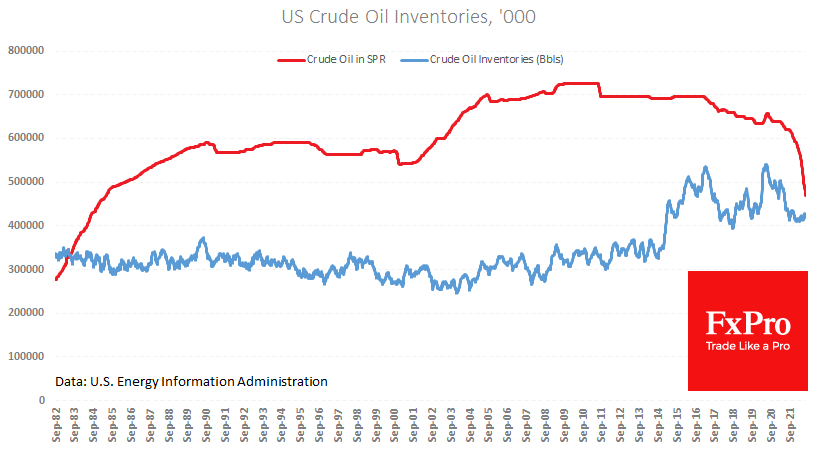
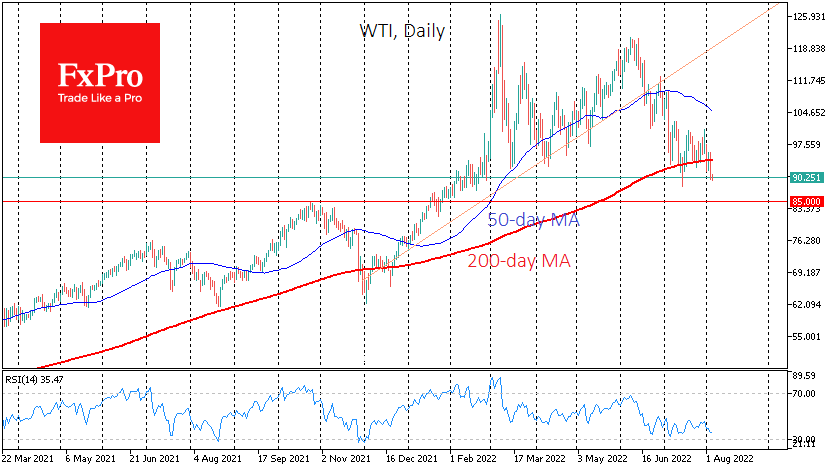
Signs that sales from reserves are allowing commercial inventories to build up added pressure on the oil price, which closed the day at its lowest level since 18 February. WTI lost 5.7% from Wednesday’s peak and almost 8% from the start of the week and month.
WTI was testing the $90 mark early Thursday, a psychologically significant level from which buyers have been pushing back since the start of hostilities in Ukraine. The market has staged a strong sell-off near the 200-day moving average, which is an important bearish signal.
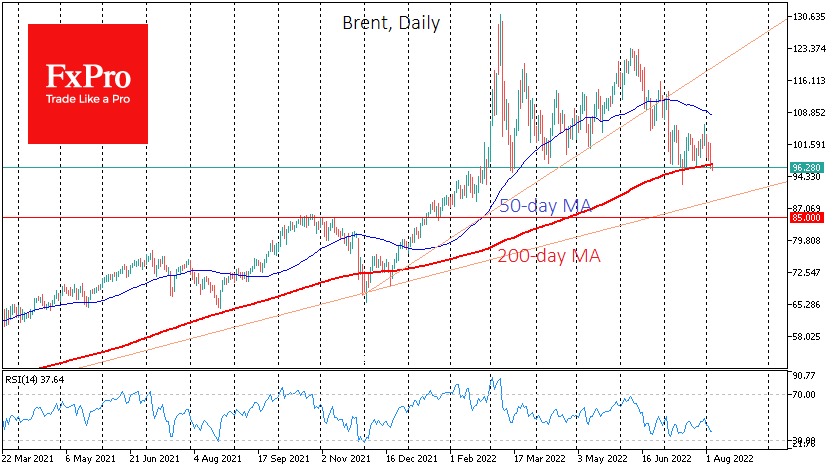
Brent is currently testing its 200-day average and last month’s support area. However, with American WTI surrendering critical levels one by one while Brent plunges below $100, it is not easy to be on the bulls’ side right now.
Having returned to the area of the July lows and zeroed in on the rally since late February, oil is potentially facing an abyss. If we break that downward slide down into phases, the nearest next stop on the way down could be the area of $85 per barrel for Brent and $80 for WTI.
Yen Edges Lower ahead of Household Spending
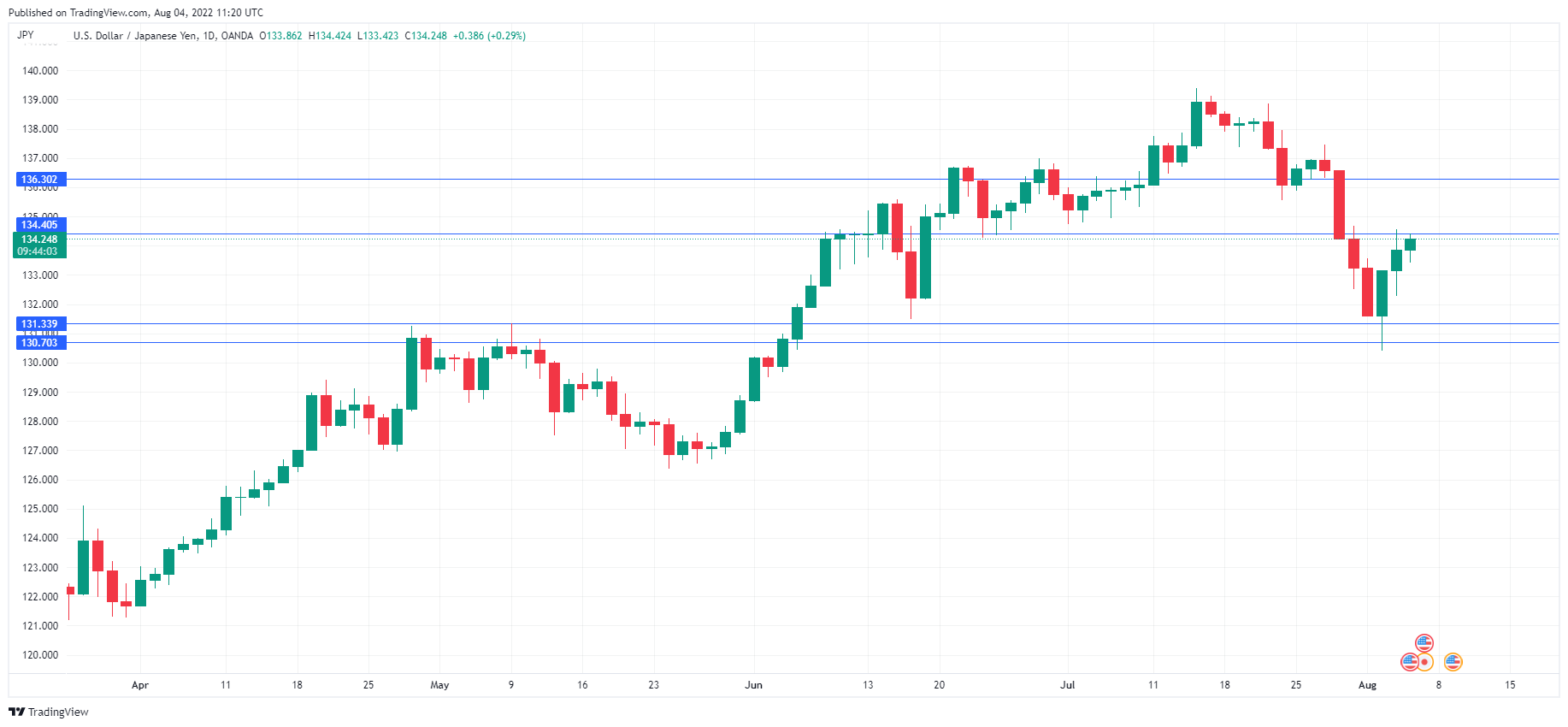
USD/JPY continues to gain ground and has pushed across the 134 line. In the European session, the pair is trading at 134.12, up 0.20%.
The week started off nicely for the Japanese yen, which took advantage of broad weakness in the US dollar. USD/JPY fell 1.22% on Monday and touched a low of 131.60, its lowest level since mid-June. However, the dollar has since recovered and then some with a strong rally.
Japan’s household spending expected to rebound
Japan’s household spending was miserable in May but is expected to bounce back in the June report. Household spending declined in May by 1.9% MoM, with a June forecast of a 0.2% gain. On an annualized basis, Household Spending fell in May by 0.5%, marking a third straight decline. The forecast for June is for a strong gain of 1.5%.
Inflation is much lower in Japan than in other major economies, but food and electricity prices have been rising sharply due to the war in Ukraine. Households have responded by cutting their spending on items such as vegetables and cars. A rebound in the June report would indicate increased consumption. That would certainly be good news for the economy, which contracted in the first quarter.
There is increased chatter in the markets about the Fed nearing the end of its rate-tightening cycle and actually lowering rates, but Fed policymakers are trying to dispel that notion. A slew of Fed members have been sending out the message that the inflation battle is far from over and further rate hikes are coming. James Bullard, for example, said that he expects 1.5% or more in rate increases this year and the hikes won’t peak until the Fed is convinced that inflation is easing lower. Bullard downplayed the consecutive quarters of negative growth in the US, saying that the strong labour market was proof that the US was not in a recession. The Fed does not hold a policy meeting until September and will have some time to monitor data and determine whether to deliver a rate hike of 50bp or 75bp.
USD/JPY Technical
- USD/JPY is putting pressure on resistance at 134.40, which was tested on Wednesday. 136.30 is the next resistance line
- There is support at 131.34 and 130.70